
Broken link building delivers high-quality backlinks by helping webmasters fix dead links on their sites while positioning your content as the replacement. This white-hat strategy consistently outperforms cold outreach because you’re solving a problem, not just asking for favors.
The approach works across industries and scales effectively. Whether you’re a startup building initial authority or an established brand expanding link equity, broken link building offers predictable, measurable results.
This guide covers everything from finding broken link opportunities to executing outreach campaigns that convert. You’ll learn the tools, templates, and tactics that drive real backlink acquisition.
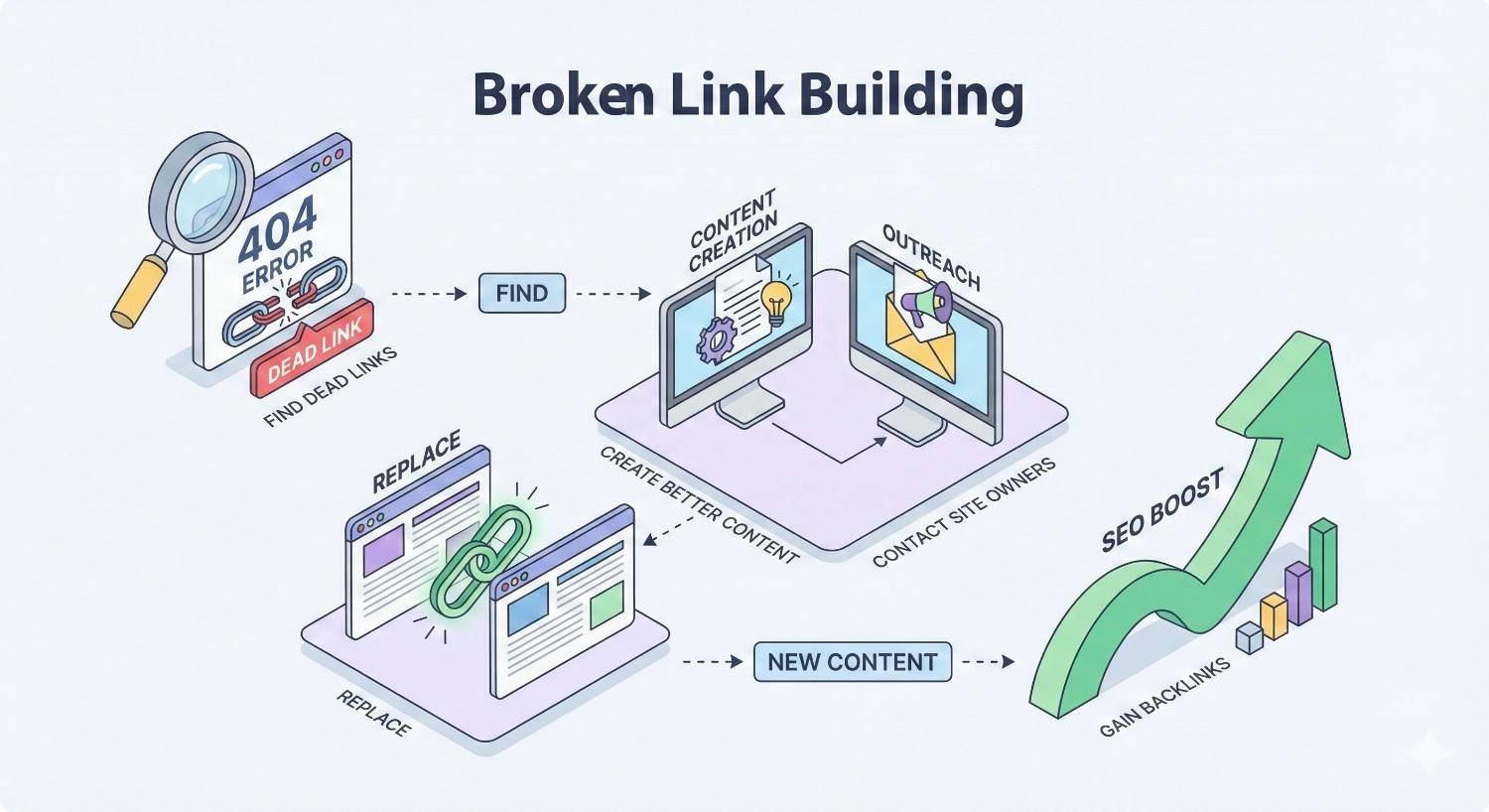
What Is Broken Link Building?
Broken link building is a link acquisition strategy where you find dead links on external websites, create or identify content that matches what the original link pointed to, and reach out to webmasters suggesting they replace the broken link with yours. The method leverages a universal problem—link rot—and transforms it into a mutual benefit.
Every website accumulates broken outbound links over time. Pages get deleted, domains expire, and URLs change without redirects. These 404 errors hurt user experience and can negatively impact the linking site’s SEO. Your outreach solves this problem while earning you a contextually relevant backlink.
How Broken Link Building Works
The process follows a straightforward workflow. First, you identify websites in your niche that link to content similar to what you offer. Then you scan those pages for broken outbound links using specialized tools. When you find a dead link pointing to content you can replace, you create matching content or identify existing assets on your site.
The final step involves contacting the webmaster with a helpful notification about the broken link and suggesting your content as a replacement. Because you’re providing value—alerting them to a problem and offering a solution—response rates typically exceed standard link request outreach.
The key differentiator is the value exchange. Traditional outreach asks for something. Broken link building offers something first.
Why Broken Link Building Is Effective for SEO
Search engines evaluate backlinks based on relevance, authority, and context. Broken link building naturally produces links that score well on all three factors. The links come from pages already linking to similar content, ensuring topical relevance. The sites you target typically have established authority in your niche. And the links appear within existing content, providing strong contextual signals.
According to Ahrefs research, backlinks remain one of Google’s top ranking factors. Broken link building earns editorial links—the type search engines value most—because webmasters actively choose to add your link rather than having it placed through paid or automated means.
The strategy also builds sustainable link profiles. Unlike tactics that can trigger algorithmic penalties, broken link building follows Google’s guidelines for natural link acquisition.
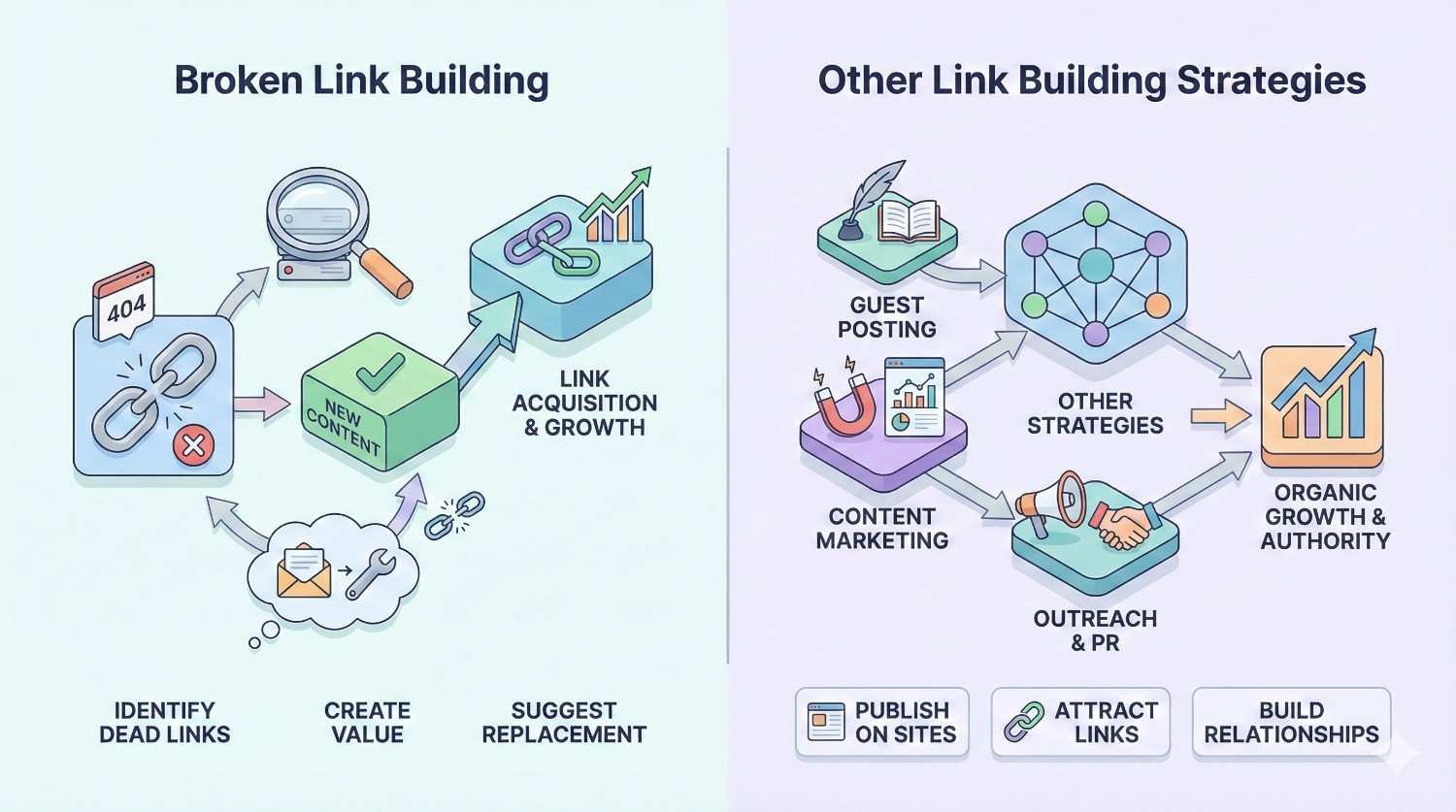
Broken Link Building vs. Other Link Building Strategies
Guest posting requires creating unique content for each opportunity and often involves lengthy editorial processes. Broken link building lets you leverage existing content assets across multiple opportunities.
Resource page link building targets pages specifically designed to link out, but competition for these placements is intense. Broken link building finds opportunities across any page type, dramatically expanding your prospect pool.
HARO and journalist outreach depend on timing and relevance to current news cycles. Broken link building operates on your schedule with consistent opportunity availability.
Skyscraper technique requires creating content significantly better than existing top performers. Broken link building only requires content that adequately replaces what the dead link originally referenced—a lower bar that still produces quality links.
Benefits of Broken Link Building
The strategic advantages extend beyond simple link acquisition. Broken link building creates compounding returns through relationship development, content improvement, and competitive intelligence gathering.
High-Quality Backlink Acquisition
Links earned through broken link building come from pages with established link equity. The original content earned those links through merit, and your replacement inherits that positioning. This means you’re not building links on new or untested pages—you’re inserting your content into proven link-worthy contexts.
The relevance factor is built into the process. You only pursue opportunities where your content genuinely fits the linking context. This natural alignment produces links that pass maximum SEO value and drive relevant referral traffic.
Quality metrics typically exceed other outreach methods. Because you’re targeting pages that already link to similar content, the Domain Authority and topical relevance of acquired links tend to be higher than cold outreach campaigns.
Lower Rejection Rates Compared to Traditional Outreach
Standard link request emails face rejection rates of 85-95% according to industry benchmarks. Broken link building campaigns typically achieve 5-15% success rates—a significant improvement that compounds over time.
The psychology behind this difference is simple. Traditional outreach asks webmasters to do you a favor. Broken link building alerts them to a problem affecting their site and offers a solution. You’re helping them, not just asking for help.
Webmasters appreciate being notified about broken links. Even when they don’t use your suggested replacement, they often respond positively. This goodwill creates opportunities for future collaboration.
Relationship Building with Website Owners
Every outreach email is a relationship touchpoint. Broken link building positions you as a helpful resource rather than another marketer asking for links. This framing opens doors for ongoing collaboration.
Many successful broken link campaigns lead to additional opportunities: guest post invitations, expert quote requests, social media mentions, and partnership discussions. The initial helpful interaction establishes trust that compounds over time.
Building relationships with webmasters in your niche creates a network effect. As you become known as someone who provides value, future outreach becomes easier and more effective.
Scalability and Long-Term Value
Broken link building scales efficiently because the core process remains consistent regardless of volume. Once you establish your workflow, tools, and templates, increasing output primarily requires additional prospecting time.
The links you build are permanent assets. Unlike paid placements or sponsored content that may be removed, editorial links earned through broken link building typically remain indefinitely. Each successful placement adds lasting value to your backlink profile.
Content created for broken link building serves multiple purposes. The same asset can target numerous broken link opportunities across different sites, maximizing return on content investment.
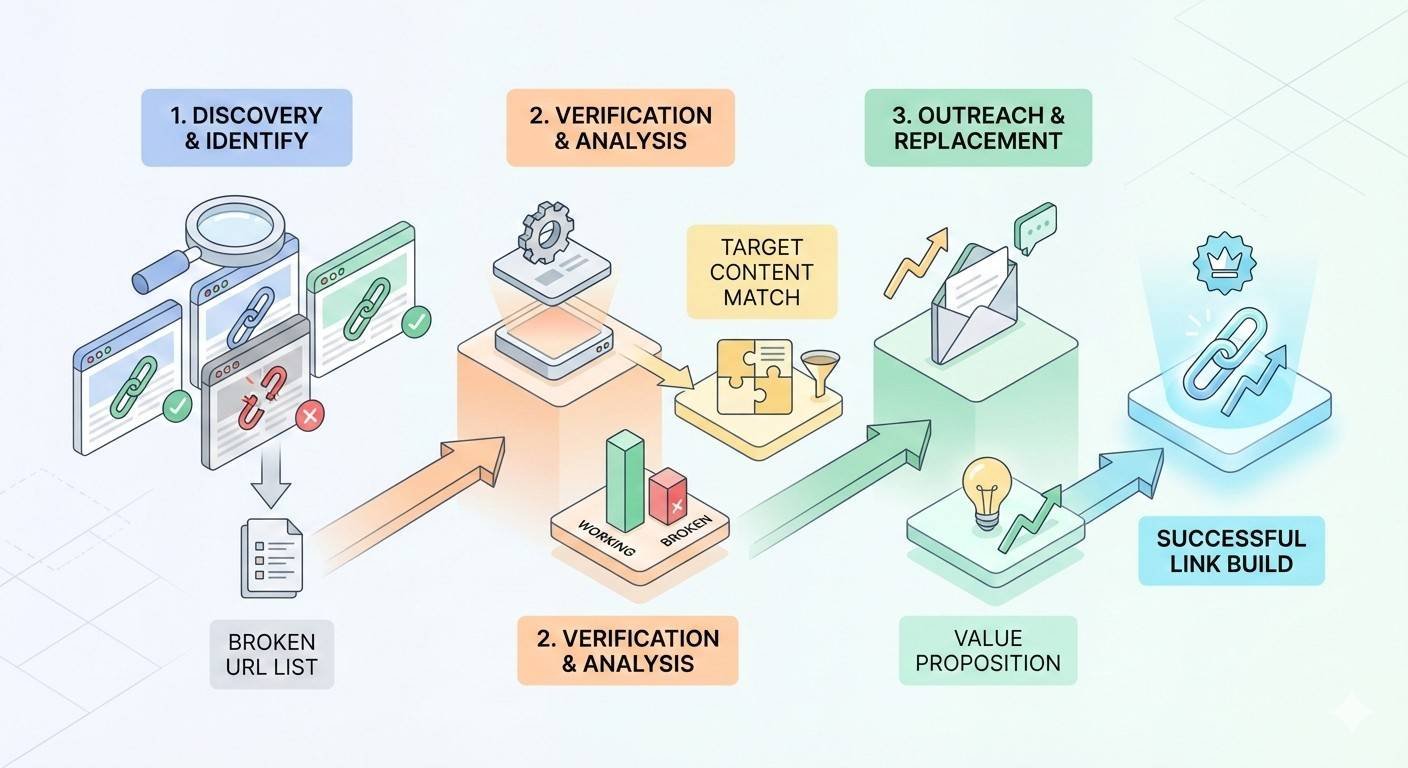
How to Find Broken Links for Link Building
Effective prospecting separates successful campaigns from wasted effort. The goal is finding broken links where your content genuinely fits as a replacement on sites worth earning links from.
Using Backlink Analysis Tools (Ahrefs, SEMrush, Moz)
Professional SEO tools provide the most efficient path to broken link discovery. Ahrefs’ Broken Backlinks report shows all 404 pages on any domain along with the sites linking to those dead pages. This reveals opportunities where multiple sites link to the same dead resource.
SEMrush’s Backlink Analytics includes similar functionality. Enter a competitor domain or industry resource site, filter for broken backlinks, and export opportunities for further analysis.
Moz’s Link Explorer provides broken link data with additional metrics like Spam Score to help filter low-quality opportunities. The tool integrates with other Moz features for comprehensive campaign management.
The workflow involves identifying authoritative sites in your niche, running broken link reports, and filtering results for relevance and quality. Prioritize opportunities where multiple sites link to the same dead page—one piece of replacement content can earn links from all of them.
Finding Broken Links on Resource Pages
Resource pages exist specifically to link to helpful content. When links on these pages break, webmasters are highly motivated to find replacements. This makes resource pages prime targets for broken link building.
Search for resource pages using queries like:
- “keyword” + “resources”
- “keyword” + “useful links”
- “keyword” + “recommended sites”
- “keyword” + inurl:resources
- “keyword” + inurl:links
Once you find resource pages, scan them for broken links using browser extensions or crawling tools. Resource pages often contain dozens of outbound links, increasing the probability of finding dead ones.
The replacement content bar is lower for resource pages. These pages link to external resources by design, so webmasters expect to update them regularly. Your outreach fits naturally into their maintenance workflow.
Identifying Broken Links in Your Niche
Niche-specific prospecting produces the most relevant opportunities. Start by listing the top 50-100 websites in your industry, including competitors, industry publications, educational resources, and professional organizations.
Run each site through broken link analysis tools. Export all broken outbound links and categorize them by topic. Look for patterns—certain types of content break more frequently, revealing systematic opportunities.
Industry-specific dead content often includes:
- Discontinued tools or services
- Outdated statistics or research
- Defunct company pages
- Expired event or conference pages
- Removed blog posts or articles
These patterns help you anticipate opportunities and create content proactively.
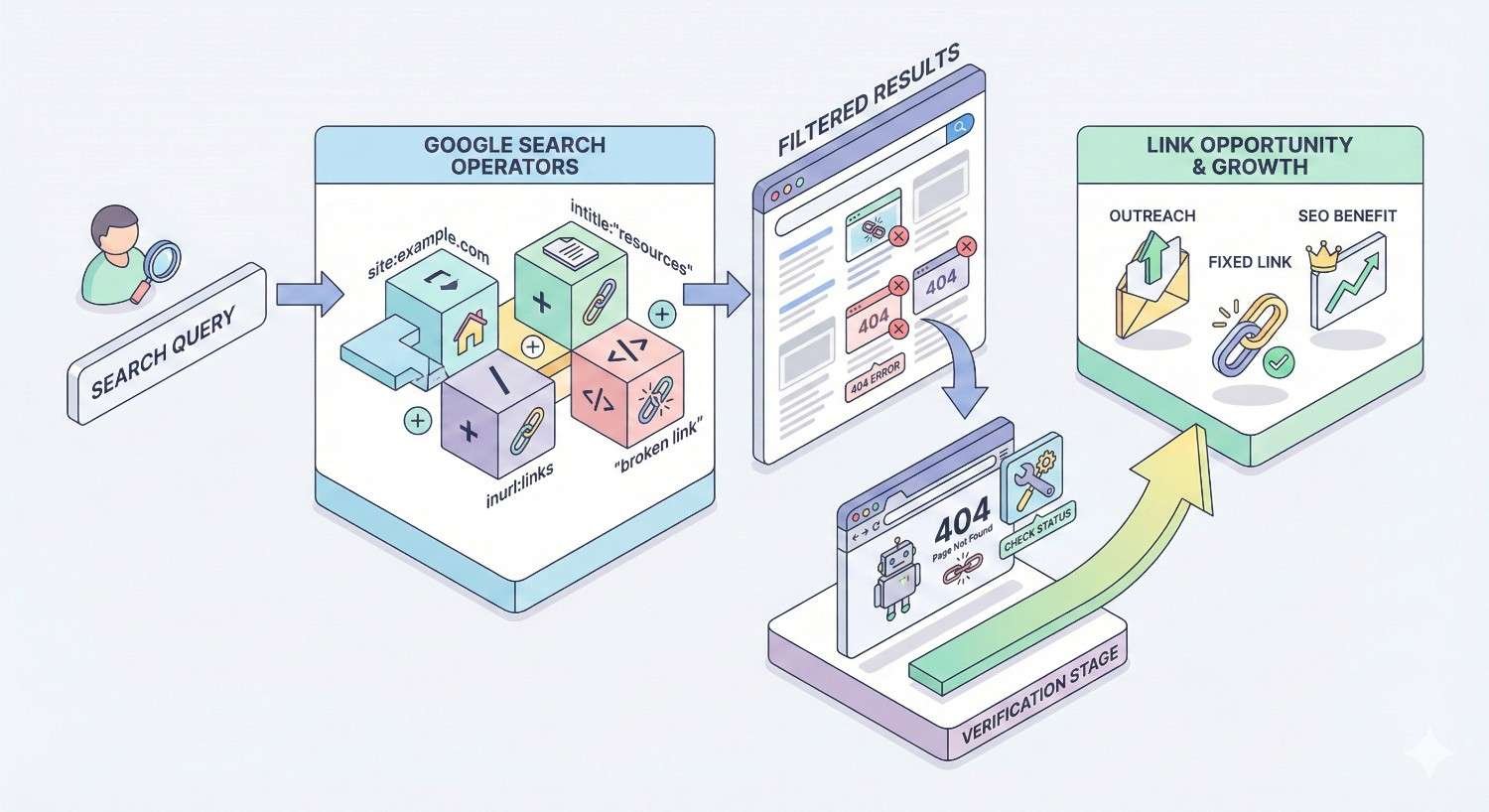
Using Google Search Operators for Broken Link Opportunities
Google search operators help find specific page types likely to contain broken links. Combine niche keywords with operators to surface prospects:
- site:edu “keyword” “resources” — Educational resource pages
- site:org “keyword” “links” — Organization link directories
- “keyword” intitle:resources inurl:links — General resource pages
- “keyword” “this page is no longer available” — Pages referencing dead content
Advanced operators narrow results further:
- “keyword” -inurl:forum -inurl:blog — Excludes forums and blogs
- “keyword” filetype:pdf — Finds PDFs that may reference dead links
Document your successful search queries. Effective operators become reusable assets for ongoing prospecting.
Analyzing Competitor Backlink Profiles for Dead Links
Your competitors’ lost backlinks represent direct opportunities. When a competitor’s page goes offline or a linking site removes their link, you can pursue that same placement with your content.
Use Ahrefs’ “Lost Backlinks” report or SEMrush’s equivalent to monitor competitor link losses. Filter for high-authority losses and investigate why the link was removed. If the competitor’s content is genuinely gone, you have a clear replacement opportunity.
This approach works particularly well when competitors:
- Discontinue products or services
- Remove outdated content
- Rebrand or change domains
- Go out of business entirely
Competitor analysis also reveals which content types earn links in your niche. Use these insights to guide your replacement content creation.
How to Execute a Broken Link Building Campaign
Systematic execution transforms opportunities into acquired links. Each step builds on the previous one, creating a repeatable process that improves with iteration.
Step 1: Identify Target Websites and Pages
Begin with qualification criteria. Define minimum Domain Authority, relevance requirements, and traffic thresholds for target sites. Pursuing low-quality opportunities wastes resources and can harm your link profile.
Create a prospect list using the discovery methods outlined above. Organize prospects in a spreadsheet or CRM with columns for:
- Website URL
- Page URL with broken link
- Broken link URL
- Original content topic
- Contact information
- Outreach status
Prioritize prospects by potential value. High-authority sites with multiple broken links pointing to content you can replace should top your list.
Step 2: Find Broken Outbound Links
With target pages identified, systematically scan for broken links. Browser extensions like Check My Links highlight dead links directly on the page. For bulk analysis, crawl target pages with Screaming Frog or similar tools.
Document each broken link with:
- The exact broken URL
- The anchor text used
- The surrounding content context
- What the original link likely pointed to
Understanding the original content helps you create or identify appropriate replacements. Use the Wayback Machine to view archived versions of dead pages when needed.
Step 3: Create or Identify Replacement Content
Evaluate your existing content against each broken link opportunity. The replacement doesn’t need to be identical—it needs to serve the same purpose for the linking page’s audience.
If you lack suitable existing content, create it. The investment is justified when:
- Multiple sites link to the same dead resource
- The linking sites have high authority
- The topic aligns with your content strategy
Replacement content should match or exceed the quality of the original. Review archived versions to understand what made the content link-worthy, then create something that delivers equal or greater value.
Step 4: Craft Effective Outreach Emails
Your outreach email must accomplish three things: alert the webmaster to the problem, establish your credibility, and present your replacement as the obvious solution.
Subject line examples:
- “Quick fix for [Page Name]”
- “Broken link on your [Topic] page”
- “Found an issue on [Website Name]”
Email structure:
- Identify the specific page and broken link
- Briefly explain why it matters
- Introduce your replacement content
- Make the ask clear and simple
Keep emails concise. Webmasters receive many outreach emails—respect their time by getting to the point quickly.
Template example:
Hi [Name],
I was reading your [page topic] resource and noticed a broken link to [original site/content]. The link to [anchor text] returns a 404.
I recently published a comprehensive guide on [topic] that covers similar ground: [your URL]
It might work as a replacement if you’re updating the page.
Either way, wanted to give you a heads up about the dead link.
[Your name]
Personalize each email. Reference specific content on their site to demonstrate you’ve actually visited it.
Step 5: Follow Up and Track Responses
Most responses come from follow-up emails, not initial outreach. Plan a follow-up sequence:
- Day 3-5: First follow-up, brief reminder
- Day 10-14: Second follow-up, add value or new angle
- Day 21+: Final follow-up, close the loop
Track all outreach in your CRM or spreadsheet. Record:
- Date of each email
- Response received
- Outcome (link placed, declined, no response)
- Notes for future reference
Analyze response patterns to optimize timing, subject lines, and messaging. Small improvements compound across hundreds of outreach emails.
Step 6: Monitor and Measure Results
Verify link placements using backlink monitoring tools. Set up alerts for new backlinks to your target pages so you know when outreach succeeds.
Track campaign metrics:
- Outreach volume (emails sent)
- Response rate (replies received)
- Conversion rate (links acquired)
- Link quality (average DA of acquired links)
- Time investment (hours per link)
Calculate cost per link by dividing total campaign costs (tools, time, content creation) by links acquired. Use this metric to compare broken link building efficiency against other link building methods.
Tools for Broken Link Building
The right tools dramatically increase efficiency. Invest in tools that match your campaign scale and integrate with your existing workflow.
Ahrefs Site Explorer and Content Explorer
Ahrefs provides the most comprehensive broken link data. Site Explorer’s “Broken Backlinks” report shows all external sites linking to 404 pages on any domain. Content Explorer finds content by topic and filters for pages with broken outbound links.
Key features for broken link building:
- Broken backlinks report with referring domain metrics
- Historical data showing when links broke
- Batch analysis for processing multiple domains
- Export functionality for campaign management
The tool’s database updates frequently, ensuring you find recent opportunities before competitors.
SEMrush Backlink Analytics
SEMrush offers comparable broken link functionality with additional competitive intelligence features. The Backlink Analytics tool identifies broken links and provides context about the linking pages.
Advantages include:
- Integration with other SEMrush tools
- Toxic link identification to avoid bad neighborhoods
- Competitor comparison features
- Automated reporting options
SEMrush works well for teams already using the platform for other SEO functions.
Check My Links (Chrome Extension)
This free browser extension scans any webpage and highlights broken links in real-time. Green indicates working links; red indicates broken ones.
Use Check My Links for:
- Quick manual verification of prospects
- Scanning resource pages during prospecting
- Verifying your own site’s outbound links
- Spot-checking before outreach
The extension is lightweight and doesn’t require a subscription, making it accessible for any budget.
Screaming Frog SEO Spider
Screaming Frog crawls websites and identifies broken links at scale. Configure the tool to check external links and export all 404 responses.
For broken link building, use Screaming Frog to:
- Crawl entire prospect sites for broken links
- Verify large lists of potential opportunities
- Identify broken links on your own site
- Export data for analysis and outreach planning
The free version crawls up to 500 URLs per site—sufficient for most broken link prospecting.
Dead Link Checker
Online tools like Dead Link Checker provide quick analysis without software installation. Enter a URL and receive a report of all broken links on that page.
These tools work well for:
- One-off checks during prospecting
- Verifying specific pages before outreach
- Quick analysis when away from your primary workstation
Limitations include slower processing and less detailed data than professional tools.
Hunter.io and Email Finder Tools
Finding contact information is often the bottleneck in outreach campaigns. Hunter.io searches domains for email addresses and verifies deliverability.
Complement Hunter with:
- LinkedIn for identifying the right contact person
- Website contact pages and about sections
- WHOIS data for domain owner information
- Social media profiles linked from the website
Verify email addresses before sending to maintain sender reputation and improve deliverability.
Best Practices for Broken Link Building Outreach
Outreach quality determines campaign success. Technical prospecting means nothing if your emails don’t convert.
Personalizing Your Outreach Emails
Generic templates get ignored. Personalization demonstrates you’ve invested time in understanding the recipient’s site and needs.
Effective personalization includes:
- Referencing specific content on their site
- Mentioning something unique about their work
- Connecting your content to their audience’s interests
- Using their name and website name correctly
Avoid fake personalization like “I love your blog!” without specifics. Webmasters recognize hollow flattery.
Research each prospect before writing. Spend 2-3 minutes reviewing their site to find genuine personalization angles.
Providing Value in Your Pitch
Position your outreach as helpful, not self-serving. Lead with the problem (broken link) and the solution (your content), not with what you want (a backlink).
Value-first framing:
- “I found an issue that might be affecting your readers”
- “Wanted to help you fix a broken resource”
- “Your [topic] page has a dead link—here’s a working alternative”
Avoid:
- “I’d love a backlink from your site”
- “Please link to my content”
- “I’m reaching out for link building purposes”
The value exchange should be obvious without explicitly requesting a link.
Timing and Frequency of Follow-Ups
Send initial outreach Tuesday through Thursday, mid-morning in the recipient’s timezone. Avoid Mondays (inbox overload) and Fridays (weekend mindset).
Follow-up timing:
- First follow-up: 3-5 business days after initial email
- Second follow-up: 7-10 days after first follow-up
- Final follow-up: 14+ days after second follow-up
Each follow-up should add something new—additional context, a different angle, or simply a polite reminder. Don’t just resend the same email.
Stop after three follow-ups. Continued contact becomes spam and damages your reputation.
Building Genuine Relationships
Think beyond the immediate link opportunity. Each outreach is a chance to build a relationship that produces value over time.
Relationship-building tactics:
- Share their content on social media
- Comment thoughtfully on their posts
- Offer help beyond the link request
- Follow up after they place your link with thanks
Maintain a database of contacts you’ve built relationships with. These warm contacts become easier to reach for future opportunities.
Avoiding Common Outreach Mistakes
Mistake 1: Mass emailing without personalization Webmasters receive dozens of link requests. Generic emails get deleted immediately.
Mistake 2: Suggesting irrelevant replacements Your content must genuinely fit the context. Forcing irrelevant content damages credibility.
Mistake 3: Being pushy or demanding You’re asking for a favor. Aggressive follow-ups burn bridges.
Mistake 4: Ignoring the webmaster’s perspective Consider what’s in it for them. Make the replacement easy and beneficial.
Mistake 5: Poor email deliverability Verify email addresses, use a professional domain, and maintain sender reputation.
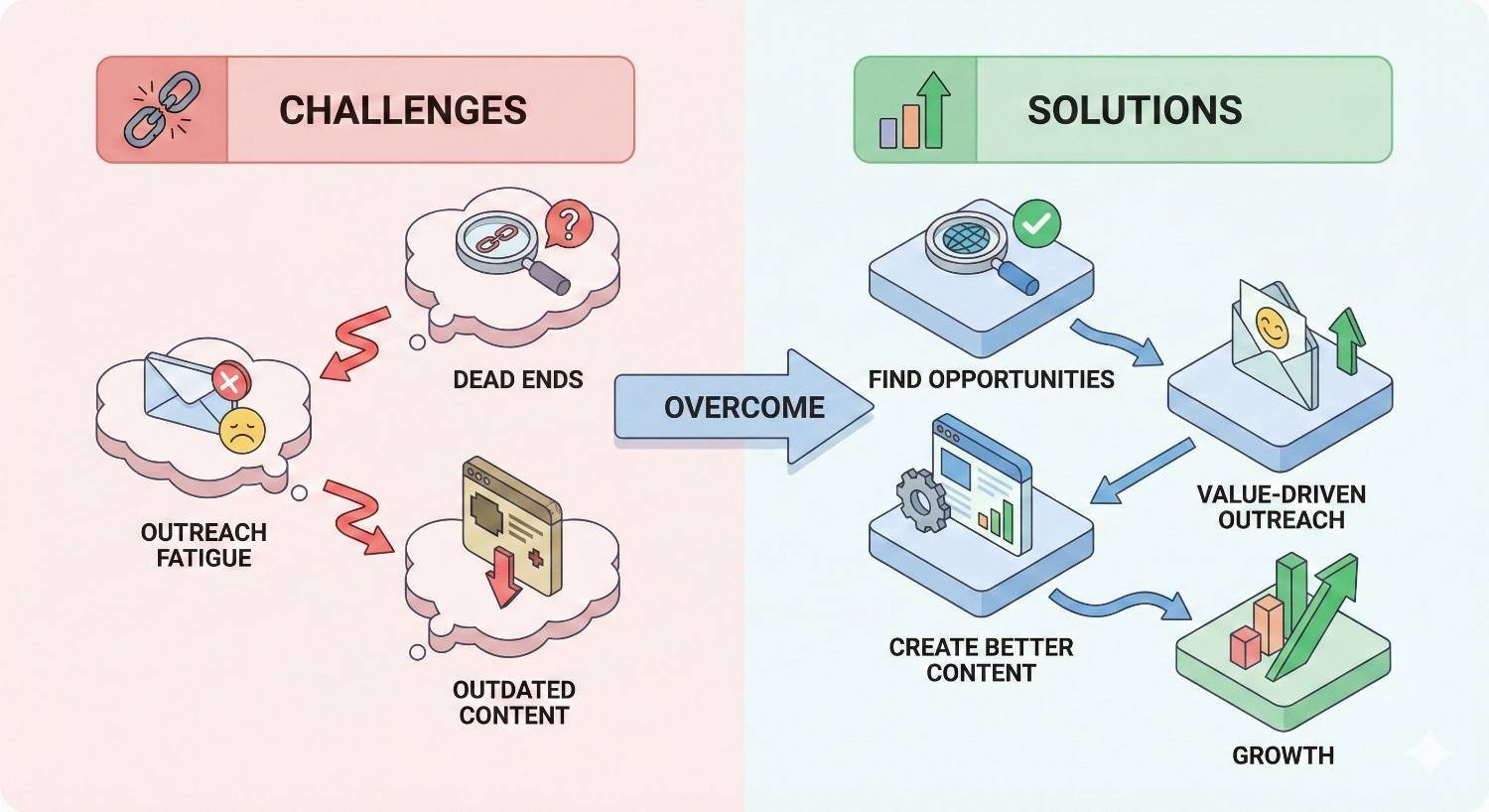
Common Challenges in Broken Link Building (and How to Overcome Them)
Every link building strategy has obstacles. Understanding common challenges helps you prepare solutions before they derail your campaigns.
Low Response Rates
Even well-executed campaigns face low response rates. Many webmasters don’t check email regularly, have abandoned sites, or simply don’t respond to outreach.
Solutions:
- Improve email deliverability through proper authentication
- Test different subject lines and messaging
- Try alternative contact methods (social media, contact forms)
- Focus on higher-quality prospects who actively maintain their sites
- Accept that low response rates are normal and plan volume accordingly
Benchmark your response rate against industry averages. If you’re significantly below 5-10%, diagnose the problem. If you’re within range, focus on volume.
Finding Relevant Broken Links at Scale
As you exhaust obvious opportunities, finding new prospects becomes harder. The most accessible broken links get targeted by multiple competitors.
Solutions:
- Expand your niche definition to include adjacent topics
- Monitor new broken links as they occur using alerts
- Target less obvious page types beyond resource pages
- Analyze competitor backlinks for opportunities they’ve missed
- Create content for underserved topics with broken link potential
Build prospecting into your ongoing workflow rather than treating it as a one-time project.
Creating Suitable Replacement Content
Not every broken link opportunity matches your existing content. Creating new content for each opportunity isn’t scalable.
Solutions:
- Prioritize opportunities matching existing content
- Create comprehensive resources that serve multiple opportunities
- Update and expand existing content to fit more contexts
- Partner with content creators to share production costs
- Focus on evergreen topics with long-term opportunity potential
Calculate the expected return before creating new content. Multiple high-authority sites linking to the same dead resource justifies significant content investment.
Time and Resource Investment
Broken link building requires sustained effort. Prospecting, outreach, follow-up, and content creation consume significant time.
Solutions:
- Systematize your workflow with templates and processes
- Use tools to automate repetitive tasks
- Batch similar activities (all prospecting, then all outreach)
- Set realistic expectations for time-to-results
- Consider outsourcing components to specialists
Track time investment per link acquired. This metric helps you optimize processes and compare against alternative strategies.
Dealing with Outdated Contact Information
Websites change ownership, employees leave, and email addresses become invalid. Outdated contact information wastes outreach effort.
Solutions:
- Verify emails before sending using validation tools
- Try multiple contact methods for important prospects
- Use LinkedIn to find current employees
- Check for updated contact information on the website
- Accept some contact failures as unavoidable
Maintain your contact database. Update information when you learn of changes to improve future campaign efficiency.
Broken Link Building for Different Industries
Strategy adaptation improves results. Different industries have unique characteristics affecting broken link building approaches.
Broken Link Building for SaaS and Tech Companies
Tech content becomes outdated quickly. Software tools get discontinued, features change, and documentation expires. This creates abundant broken link opportunities.
Industry-specific tactics:
- Target comparison pages and tool roundups
- Monitor competitor shutdowns and pivots
- Create evergreen content about persistent problems
- Focus on educational and how-to content
- Build relationships with tech bloggers and reviewers
Tech audiences expect current information. Position your content as the updated, maintained alternative to dead resources.
Broken Link Building for E-commerce
E-commerce broken link building often targets product-related content: buying guides, product comparisons, and category resources.
Industry-specific tactics:
- Find broken links to discontinued products
- Target gift guides and seasonal content
- Create comprehensive buying guides as replacement content
- Monitor competitor product page changes
- Focus on informational content, not product pages
Avoid appearing overly promotional. Replacement content should provide genuine value, not just push products.
Broken Link Building for Local Businesses
Local businesses benefit from geographically targeted broken link building. Local resource pages, community directories, and regional publications offer opportunities.
Industry-specific tactics:
- Target local business directories with dead listings
- Find broken links on chamber of commerce pages
- Monitor local news sites for dead references
- Create locally-relevant content as replacement
- Build relationships with local bloggers and journalists
Local opportunities are less competitive. Smaller prospect pools mean less competition for each opportunity.
Broken Link Building for B2B Services
B2B content often includes research, case studies, and industry analysis—content types prone to becoming outdated.
Industry-specific tactics:
- Target industry association resource pages
- Find broken links to outdated research and statistics
- Create updated versions of dead industry reports
- Monitor trade publication archives
- Focus on thought leadership content
B2B decision-makers value authoritative sources. Position your content as the credible, current alternative.
How Long Does Broken Link Building Take to Show Results?
Setting realistic expectations prevents frustration and ensures appropriate resource allocation.
Timeline for Outreach and Link Acquisition
From initial prospecting to link placement typically takes 4-8 weeks for individual opportunities. The timeline breaks down as:
- Week 1-2: Prospecting and qualification
- Week 2-3: Content creation or identification
- Week 3-4: Initial outreach
- Week 4-6: Follow-up sequence
- Week 6-8: Link placement and verification
Some opportunities convert faster; others take months. Plan campaigns with sufficient runway to complete the full outreach cycle.
When to Expect Ranking Improvements
Backlinks influence rankings gradually. Google discovers and evaluates new links over weeks to months. Expect 3-6 months before seeing measurable ranking improvements from new backlinks.
Factors affecting timeline:
- Crawl frequency of linking sites
- Authority of acquired links
- Competitive intensity of target keywords
- Overall backlink profile strength
- Content quality and relevance
Track rankings for target keywords before and after campaigns. Isolate the impact of broken link building from other SEO activities.
Long-Term Impact on Domain Authority
Domain Authority and similar metrics respond slowly to backlink changes. Expect 6-12 months of consistent link building before seeing significant metric improvements.
More importantly, focus on ranking improvements and organic traffic growth rather than third-party metrics. DA is a proxy for authority, not the goal itself.
Broken link building’s long-term value comes from:
- Permanent link placements that compound over time
- Relationships that produce ongoing opportunities
- Content assets that serve multiple campaigns
- Improved topical authority in your niche
Measuring the Success of Your Broken Link Building Campaign
Data-driven optimization improves results over time. Track the right metrics and use them to refine your approach.
Key Metrics to Track
Outreach metrics:
- Emails sent per week/month
- Open rate (if trackable)
- Response rate
- Positive response rate
Acquisition metrics:
- Links acquired
- Average Domain Authority of acquired links
- Relevance score of linking pages
- Anchor text distribution
Efficiency metrics:
- Time per link acquired
- Cost per link (including tools and labor)
- Conversion rate (links/emails sent)
Impact metrics:
- Ranking changes for target keywords
- Organic traffic growth
- Referral traffic from acquired links
Calculating ROI from Broken Link Building
Calculate ROI by comparing campaign costs against the value of acquired links.
Cost calculation:
- Tool subscriptions (prorated)
- Labor hours × hourly rate
- Content creation costs
- Outreach tool costs
Value calculation:
- Estimated value per link (based on comparable paid placements)
- Traffic value from ranking improvements
- Lead/revenue attribution from organic growth
Compare cost-per-link against other acquisition methods. Broken link building typically produces links at $100-500 per link when accounting for all costs—competitive with other white-hat strategies.
Using Google Analytics and Search Console
Google Search Console shows which pages receive organic traffic and how rankings change over time. Monitor target pages before and after link building campaigns.
Key reports:
- Performance report filtered by target pages
- Links report showing new backlinks Google has discovered
- Index coverage for any crawling issues
Google Analytics tracks referral traffic from acquired links. Create segments for traffic from linking domains to measure direct impact.
Monitoring Backlink Quality and Relevance
Not all links are equal. Monitor the quality of acquired links to ensure your efforts produce valuable results.
Quality indicators:
- Domain Authority/Rating of linking site
- Relevance of linking page to your content
- Traffic to the linking page
- Link placement (editorial vs. footer/sidebar)
- Anchor text naturalness
Use backlink monitoring tools to track your profile over time. Identify patterns in successful placements to guide future targeting.
Advanced Broken Link Building Strategies
Once you’ve mastered fundamentals, advanced tactics increase efficiency and results.
Scaling Broken Link Building with Automation
Automation handles repetitive tasks while you focus on strategy and relationship building.
Automate:
- Broken link discovery and monitoring
- Email verification
- Outreach scheduling and follow-ups
- Response tracking and categorization
- Reporting and analytics
Don’t automate:
- Personalization and email writing
- Relationship building
- Content creation
- Quality assessment of opportunities
Tools like Pitchbox, BuzzStream, and Mailshake provide outreach automation while maintaining personalization capabilities.
Combining Broken Link Building with Content Marketing
Integrate broken link building into your content strategy. Create content specifically designed to replace common broken link types in your niche.
Integration tactics:
- Research broken links before creating content
- Design content to serve multiple replacement opportunities
- Update existing content to match broken link contexts
- Promote new content through broken link outreach
This approach maximizes content ROI by building link acquisition into the creation process.
Leveraging Historical Content and Dead Brands
When companies shut down or rebrand, their content disappears but backlinks remain. These orphaned links represent significant opportunities.
Tactics:
- Monitor industry news for company closures
- Track domain expirations in your niche
- Use Wayback Machine to understand dead content
- Create comprehensive replacements for popular dead resources
Dead brand opportunities often have dozens or hundreds of backlinks pointing to the same dead domain. One piece of replacement content can earn links from all of them.
Using Broken Link Building for Competitive Advantage
Broken link building provides competitive intelligence beyond link acquisition.
Competitive applications:
- Identify content gaps competitors haven’t filled
- Discover link opportunities competitors are pursuing
- Monitor competitor link losses for immediate opportunities
- Understand what content earns links in your niche
Use competitive insights to inform broader SEO and content strategy.
Broken Link Building Mistakes to Avoid
Learning from common mistakes accelerates your success and protects your reputation.
Targeting Irrelevant or Low-Quality Sites
Pursuing every broken link opportunity wastes resources and can harm your link profile. Low-quality links provide minimal value and may trigger algorithmic scrutiny.
Avoid:
- Sites with obvious spam indicators
- Pages with no organic traffic
- Domains with very low authority
- Sites in unrelated industries
- Link farms and PBNs
Establish minimum quality thresholds and stick to them regardless of how easy an opportunity appears.
Using Generic Outreach Templates
Templates save time but destroy response rates when used without customization. Webmasters recognize mass outreach immediately.
Instead:
- Use templates as starting frameworks, not final copy
- Personalize every email with specific references
- Vary your messaging to avoid pattern detection
- Test different approaches and iterate based on results
The extra time spent personalizing pays dividends in response rates.
Ignoring Relationship Building
Treating broken link building as purely transactional leaves value on the table. Relationships produce compounding returns over time.
Relationship investments:
- Thank webmasters who place your links
- Share their content and engage on social media
- Offer help beyond link requests
- Maintain contact for future opportunities
A network of warm contacts makes all future outreach more effective.
Failing to Create Quality Replacement Content
Suggesting inferior content damages your credibility and wastes the opportunity. Webmasters who receive poor suggestions won’t respond to future outreach.
Content standards:
- Match or exceed the quality of the original
- Ensure complete topical coverage
- Update information to current standards
- Provide genuine value to the linking page’s audience
If you can’t create quality replacement content, skip the opportunity.
Not Tracking and Optimizing Your Process
Without data, you can’t improve. Many practitioners repeat ineffective approaches because they don’t measure results.
Track everything:
- Outreach volume and timing
- Response rates by template/approach
- Conversion rates by prospect type
- Time investment per link
Use data to identify what works and eliminate what doesn’t. Small optimizations compound across hundreds of outreach attempts.
Case Studies: Successful Broken Link Building Campaigns
Real-world examples demonstrate what’s possible with proper execution.
Case Study 1: SaaS Company Acquires 47 High-Authority Links
A B2B SaaS company in the project management space identified a competitor that had shut down. The defunct tool had accumulated hundreds of backlinks over years of operation.
Approach:
- Analyzed all backlinks to the dead domain
- Created comprehensive comparison content covering the dead tool’s use cases
- Reached out to 200+ sites linking to the defunct competitor
- Positioned their tool as the natural replacement
Results:
- 47 links acquired from domains averaging DA 45
- 23% response rate on outreach
- $127 cost per link including content creation
- 34% increase in organic traffic within 6 months
The campaign succeeded because the replacement content genuinely served the needs of sites linking to the dead tool.
Case Study 2: E-commerce Brand Recovers Lost Link Equity
An outdoor gear retailer discovered that a popular buying guide they’d been featured in had removed their link during a site redesign. Investigation revealed the entire resource section had broken links.
Approach:
- Identified all broken links on the resource page
- Created updated versions of dead resources
- Reached out offering to help fix multiple broken links
- Provided value beyond just their own link request
Results:
- Original link restored plus 3 additional placements
- Relationship established with the publication’s editor
- 2 guest post opportunities resulted from the relationship
- $0 direct cost (used existing content)
The multi-link approach demonstrated value and built a lasting relationship.
Case Study 3: Agency Scales Broken Link Building for Clients
A digital marketing agency systematized broken link building across 12 client accounts in various industries.
Approach:
- Built a centralized prospecting database
- Created industry-specific outreach templates
- Trained team members on consistent execution
- Implemented tracking across all campaigns
Results:
- Average 8 links per client per month
- $200 average cost per link across all clients
- 15% average response rate
- Scalable process supporting continued growth
Systematization enabled consistent results across diverse industries and client needs.
Getting Started with Broken Link Building: Your Action Plan
Transform knowledge into action with a structured implementation plan.
Setting Realistic Goals and Expectations
Start with achievable targets based on your resources and experience level.
Beginner goals (Month 1-3):
- Learn tools and processes
- Complete 50-100 outreach emails
- Acquire 3-5 links
- Establish baseline metrics
Intermediate goals (Month 4-6):
- Refine templates and targeting
- Scale to 200+ outreach emails monthly
- Acquire 8-12 links monthly
- Optimize based on data
Advanced goals (Month 7+):
- Systematize for efficiency
- Integrate with content strategy
- Build relationship network
- Achieve consistent, predictable results
Adjust goals based on your specific situation, resources, and competitive landscape.
Building Your Broken Link Building Workflow
Document your process to ensure consistency and enable delegation.
Workflow components:
- Prospecting: Weekly time block for finding opportunities
- Qualification: Criteria checklist for evaluating prospects
- Content matching: Process for identifying/creating replacements
- Outreach: Templates, personalization guidelines, sending schedule
- Follow-up: Timing, messaging, tracking
- Reporting: Metrics, analysis, optimization
Create standard operating procedures for each component. This documentation enables team scaling and maintains quality.
When to Handle In-House vs. Outsource to an Agency
The build-vs-buy decision depends on your resources, expertise, and strategic priorities.
Handle in-house when:
- You have team members with time and interest
- Link building is a core competency you want to develop
- Budget constraints limit agency options
- You need deep integration with content strategy
Outsource to an agency when:
- You lack internal expertise or bandwidth
- You need faster results than learning allows
- Link building isn’t a strategic priority to own
- You want predictable, scalable results
Many organizations use a hybrid approach: in-house strategy and oversight with agency execution support.
Next Steps: Integrating Broken Link Building into Your SEO Strategy
Broken link building works best as part of a comprehensive SEO strategy, not an isolated tactic.
Integration points:
- Content strategy: Create content designed for link acquisition
- Technical SEO: Ensure your site can receive and benefit from links
- On-page optimization: Optimize pages receiving new links
- Analytics: Track link building impact on broader goals
Connect broken link building to business outcomes. Links are a means to rankings, traffic, leads, and revenue—not an end in themselves.
Conclusion
Broken link building remains one of the most effective white-hat link acquisition strategies available. The approach works because it creates genuine value for webmasters while earning contextually relevant, high-authority backlinks that improve rankings and drive organic growth.
Success requires systematic execution: proper prospecting, quality content, personalized outreach, and consistent follow-through. The strategies, tools, and templates in this guide provide everything needed to launch and scale effective campaigns.
We help businesses implement broken link building as part of comprehensive SEO strategies. White Label SEO Service provides the expertise, tools, and execution support to build sustainable organic growth through strategic link acquisition and authority building.
Frequently Asked Questions
How many broken link building emails should I send per day?
Start with 20-30 personalized emails daily to maintain quality while building volume. Scale gradually as you refine templates and processes. Quality always trumps quantity—50 well-researched, personalized emails outperform 200 generic ones.
What response rate should I expect from broken link building outreach?
Expect 5-15% response rates for well-executed campaigns. Response rates below 5% indicate problems with targeting, messaging, or email deliverability. Rates above 15% suggest your approach is working exceptionally well.
Can I use broken link building for new websites with no existing content?
Yes, but you’ll need to create replacement content first. New sites can use broken link building effectively by identifying opportunities, creating targeted content to serve as replacements, then executing outreach. The strategy actually helps new sites build authority faster than waiting for organic link acquisition.
How do I find the right contact person for broken link outreach?
Start with the page author if credited. Check the website’s about page, team page, or contact page. Use tools like Hunter.io to find email addresses. LinkedIn helps identify current employees. When uncertain, contact forms or general info@ addresses work as fallbacks.
Is broken link building still effective in 2024 and beyond?
Yes. Broken link building remains effective because it solves a real problem for webmasters. As long as links break and webmasters want to fix them, the strategy works. The fundamentals haven’t changed even as search algorithms evolve.
What’s the difference between broken link building and reclamation?
Broken link building targets broken links on external sites pointing to third-party content you can replace. Link reclamation recovers links that previously pointed to your own content but broke due to URL changes, site migrations, or other issues. Both are valuable but serve different purposes.
How do I prioritize which broken link opportunities to pursue first?
Prioritize by: (1) Domain Authority of the linking site, (2) relevance to your content and audience, (3) number of sites linking to the same dead resource, (4) ease of creating suitable replacement content. High-authority, high-relevance opportunities with existing replacement content should top your list.