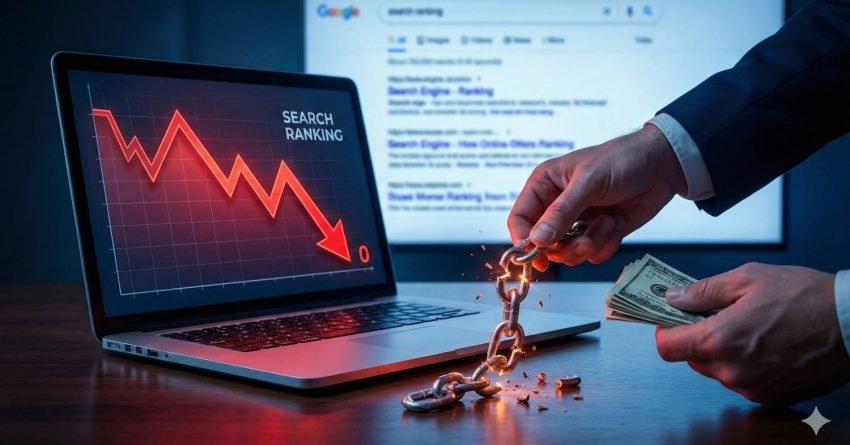
Buying links might seem like a shortcut to higher rankings, but it’s one of the fastest ways to destroy your organic visibility. Google has spent over a decade refining its ability to detect paid links, and the consequences range from ranking drops to complete deindexation.
The pressure to compete in crowded markets pushes many businesses toward link buying schemes. Understanding why this approach fails helps you make smarter decisions about your SEO investment.
This guide covers how Google detects purchased links, the real penalties businesses face, and proven alternatives that build sustainable authority without risking everything you’ve worked to achieve.
What Is Link Buying in SEO?
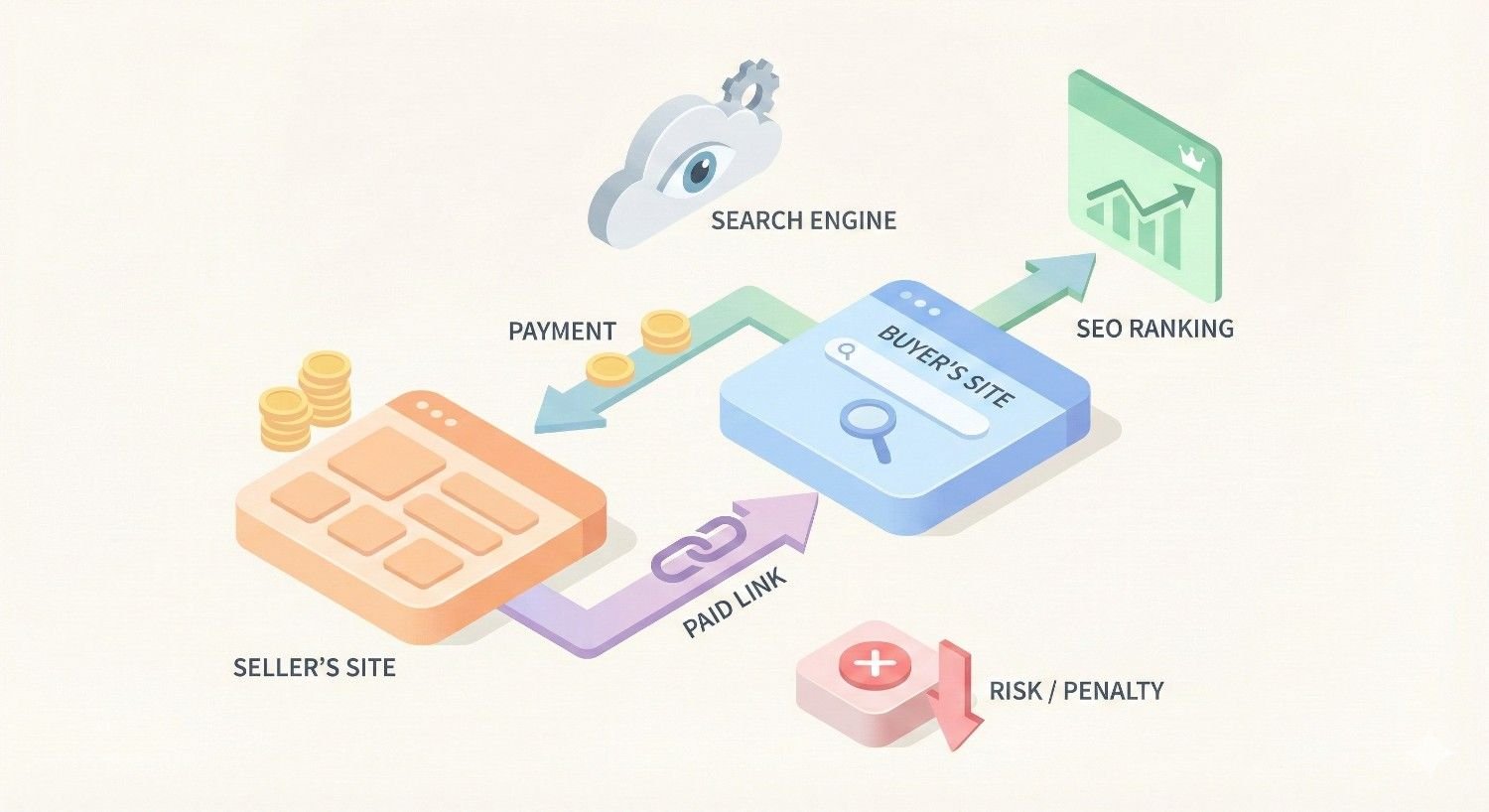
Link buying refers to any transaction where money, goods, or services are exchanged specifically to acquire backlinks that pass PageRank. These links are designed to manipulate search rankings rather than serve users.
The practice violates Google’s Webmaster Guidelines because it artificially inflates a site’s perceived authority. When you pay for a link, you’re essentially trying to game the algorithm that determines which pages deserve to rank.
How Paid Links Work
The mechanics are straightforward. A website owner or broker offers to place a link on their site pointing to yours in exchange for payment. Prices vary wildly based on the linking site’s perceived authority, traffic, and niche relevance.
Some sellers charge per link. Others offer monthly packages with guaranteed link quantities. The transaction typically involves agreeing on anchor text, placement location, and whether the link will be permanent or temporary.
Payment methods range from direct bank transfers to cryptocurrency for anonymity. Many link sellers operate through intermediary platforms that obscure the transaction trail.
Common Types of Purchased Links
Understanding the different forms of paid links helps you recognize them when evaluating SEO services or auditing your own backlink profile.
PBN (Private Blog Network) Links
Private blog networks consist of multiple websites owned by a single entity, created specifically to sell links. These sites often have expired domain authority from previous legitimate owners.
PBN operators purchase expired domains with existing backlink profiles, then populate them with thin content. The sole purpose is generating links to client sites. Google actively hunts these networks, and when one falls, every site it linked to becomes suspect.
Guest Post Placements for Payment
Legitimate guest posting involves contributing valuable content to relevant publications. Paid guest posting flips this model. You pay for placement regardless of content quality, and the primary goal is the link rather than audience value.
Many “guest post marketplaces” openly sell placements on sites that accept any content for the right price. These sites often have inflated metrics but minimal real traffic or engagement.
Link Insertions/Niche Edits
Niche edits involve paying to have links added to existing published content. A site owner inserts your link into an article that’s already indexed and ranking.
This approach attempts to appear more natural than new guest posts since the content already exists. However, Google’s systems can detect sudden link additions to old content, especially when patterns emerge across multiple sites.
Directory and Sponsored Link Schemes
Low-quality directories exist primarily to sell links. They accept any submission for a fee, creating massive lists of unrelated sites with no editorial standards.
Sponsored link schemes involve paying for links labeled as “sponsored” or “partner” but without proper rel=”sponsored” or rel=”nofollow” attributes. This attempts to pass PageRank while technically disclosing the relationship.
Link Farms and Automated Link Building
Link farms are networks of sites that exist solely to link to each other and to paying clients. Automated link building uses software to create profiles, comments, or forum posts across thousands of sites simultaneously.
These approaches generate massive link quantities quickly but produce obvious footprints. The links come from irrelevant, low-quality sources with no real traffic or authority.
Why Businesses Consider Buying Links
Understanding the motivations behind link buying helps explain why the practice persists despite clear risks. Most businesses don’t buy links out of malice. They’re responding to real pressures with incomplete information.
The Promise of Faster Rankings
Organic link building takes time. Creating content, conducting outreach, and building relationships can take months before generating meaningful backlinks. Paid links offer immediate results.
When a competitor seems to be ranking quickly, the temptation to match their pace through shortcuts becomes strong. Link sellers exploit this impatience by promising rapid ranking improvements.
The reality is that any gains from purchased links are temporary and fragile. Google’s algorithms continuously improve at detecting manipulation, meaning today’s shortcut becomes tomorrow’s penalty.
Competitive Pressure in Saturated Markets
Some industries have extremely competitive search landscapes. When every competitor appears to have strong backlink profiles, businesses feel they can’t compete through legitimate means alone.
This creates a perceived arms race where buying links seems necessary just to stay even. The irony is that many competitors with strong profiles built them legitimately over years. Their authority isn’t from purchased links but from sustained effort.
Misunderstanding How Google Evaluates Links
Many business owners don’t fully understand how Google assesses link quality. They see links as a numbers game where more equals better.
Google’s systems evaluate links based on relevance, context, linking site quality, anchor text patterns, and dozens of other signals. A single high-quality editorial link from a relevant publication provides more value than hundreds of purchased links from irrelevant sites.
This misunderstanding leads businesses to chase quantity over quality, making them vulnerable to link selling pitches that promise high volumes at low prices.
Google’s Stance on Paid Links
Google has been explicitly clear about paid links for over fifteen years. The search engine considers any link intended to manipulate PageRank a violation of its guidelines.
Link Schemes and Webmaster Guidelines
Google’s Link Spam documentation specifically lists “buying or selling links for ranking purposes” as a link scheme. This includes exchanging money for links, exchanging goods or services for links, and sending free products in exchange for links.
The guidelines also cover excessive link exchanges, large-scale article marketing with keyword-rich anchor text, and using automated programs to create links. Google treats all these practices as attempts to manipulate rankings.
The key distinction is intent. A link given because someone genuinely found your content valuable is legitimate. A link given because you paid for it is not, regardless of how natural it might appear.
How Google Detects Purchased Links
Google employs multiple detection methods that work together to identify paid link patterns.
Algorithmic Detection (Penguin)
The Penguin algorithm, now integrated into Google’s core ranking systems, specifically targets manipulative link building. It analyzes link patterns across the web to identify unnatural acquisition.
Penguin looks for signals like sudden spikes in backlinks, over-optimized anchor text distributions, links from irrelevant sites, and connections to known link selling networks. The algorithm operates in real-time, meaning penalties can apply as soon as suspicious patterns emerge.
Manual Reviews and Spam Reports
Google’s Search Quality team conducts manual reviews of sites suspected of link manipulation. These reviews can be triggered by algorithmic flags, competitor reports, or random sampling.
Anyone can report suspected link schemes through Google’s spam report form. Competitors who notice you suddenly acquiring suspicious links have strong incentive to report you.
Manual reviewers examine link profiles in detail, looking for patterns that algorithms might miss. They can identify paid links based on context, placement, and relationship patterns between sites.
Link Pattern Analysis
Google’s systems analyze link patterns at massive scale. They can identify networks of sites that frequently link to the same clients, anchor text distributions that don’t match natural patterns, and timing correlations that suggest coordinated link building.
When multiple sites acquire links from the same sources with similar anchor text around the same time, it signals a link selling operation. Google can then devalue or penalize all sites involved.
Official Penalties and Consequences
Google applies two types of penalties for link scheme violations: algorithmic and manual.
Algorithmic penalties happen automatically when systems detect manipulation. Your rankings drop without notification. You might not even realize what happened until you notice traffic declining.
Manual actions are applied by human reviewers and come with notification in Google Search Console. These require active remediation and a reconsideration request to lift.
Penalties range from partial ranking decreases for specific pages to complete removal from search results. The severity depends on the extent of manipulation and whether it appears intentional.
The Real Risks of Buying Links
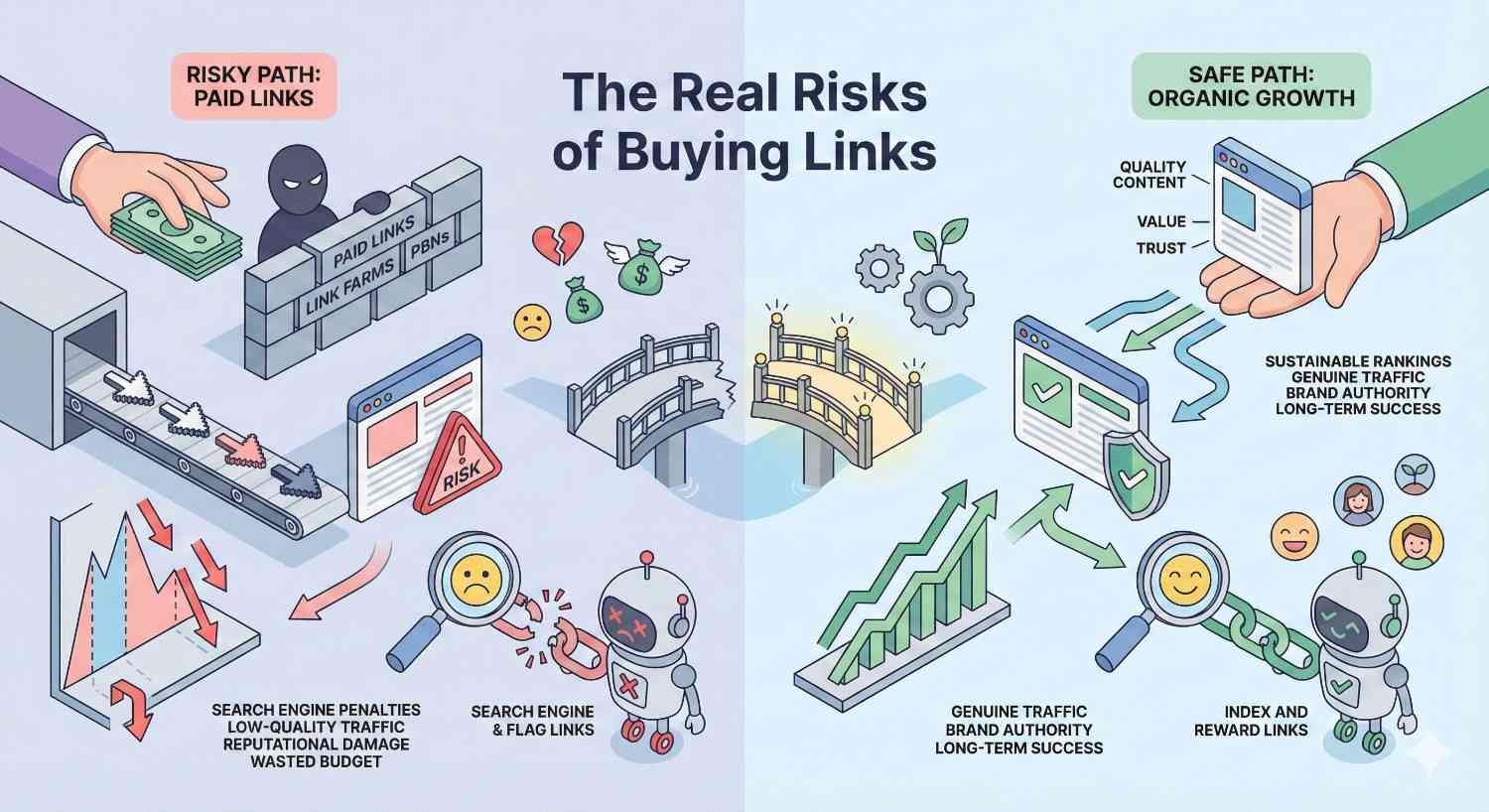
The consequences of buying links extend far beyond temporary ranking drops. Understanding the full scope of risk helps explain why legitimate SEO professionals refuse to engage in these practices.
Manual Actions and Ranking Penalties
A manual action for unnatural links can devastate organic traffic overnight. Google notifies you through Search Console that your site has been penalized, but by then the damage is done.
Recovery requires identifying and removing or disavowing all problematic links, then submitting a reconsideration request. Google reviews these requests manually, and there’s no guaranteed timeline. Some sites wait months for review.
Even after a manual action is lifted, rankings don’t automatically return to previous levels. You’ve lost trust with Google’s systems, and rebuilding takes significant time and effort.
Algorithmic Devaluation and Traffic Loss
Algorithmic penalties are often worse than manual actions because you receive no notification. Your traffic simply declines, and you’re left guessing about the cause.
The Penguin algorithm can devalue links without penalizing your entire site. This means your purchased links simply stop helping, but you’ve already paid for them. You get no benefit while still carrying the risk of future manual review.
Traffic loss from algorithmic devaluation can be gradual, making it harder to identify the cause. By the time you realize what’s happening, you may have continued buying links, deepening the problem.
Wasted Budget with No ROI
Link buying represents a direct financial loss when penalties occur. You’ve paid for links that now hurt rather than help your rankings.
But even without penalties, purchased links often provide poor ROI. Low-quality links from irrelevant sites don’t move rankings meaningfully. The money spent on link schemes could have funded legitimate content marketing or digital PR with lasting benefits.
Many businesses discover they’ve spent thousands on links that provided zero ranking improvement, simply because the links came from sites Google already distrusted.
Reputation and Trust Damage
Being penalized for link buying can damage your brand’s reputation beyond search rankings. Industry peers, potential partners, and customers may learn about your penalty.
If you operate in a space where trust matters, being caught manipulating search results undermines credibility. This is especially damaging for businesses in finance, health, legal, or other YMYL (Your Money or Your Life) categories.
Recovery from reputation damage takes longer than recovery from ranking penalties. The association with black-hat SEO practices can follow a brand for years.
Long-Term Recovery Challenges
Recovering from link penalties isn’t simply a matter of removing bad links and waiting. The process is complex, time-consuming, and uncertain.
You must audit your entire backlink profile, identify every potentially problematic link, attempt to have them removed, disavow those you can’t remove, and then wait for Google to recrawl and reassess. This process can take six months to over a year.
During recovery, your organic traffic remains suppressed. You’re essentially starting over while competitors who built authority legitimately continue growing.
Case Studies: When Link Buying Backfires
Real-world examples demonstrate that link penalties affect businesses of all sizes, including major brands with significant resources.
High-Profile Penalty Examples
In 2011, J.C. Penney received a manual penalty after The New York Times exposed an extensive paid link campaign. The retailer had purchased thousands of links from unrelated sites to rank for competitive terms. Rankings dropped dramatically overnight.
Overstock.com faced penalties in 2011 for offering discounts to universities in exchange for .edu links. The scheme violated Google’s guidelines against exchanging goods for links. The company’s organic visibility suffered significantly.
Interflora, a major UK flower delivery service, was penalized in 2013 for paying newspapers to publish advertorial content with followed links. The penalty came just before Valentine’s Day, one of their peak sales periods.
These examples share common elements: the companies believed they could manipulate rankings without consequences, and they were wrong. Google’s detection capabilities caught schemes that seemed sophisticated at the time.
Recovery Timelines and Costs
Recovery from major link penalties typically takes 6-18 months of dedicated effort. The process involves:
Comprehensive backlink audits using tools like Ahrefs, Semrush, or Majestic to identify every inbound link. Manual review of thousands of links to classify them as natural, suspicious, or clearly paid.
Outreach to webmasters requesting link removal. This has low success rates since many link sellers ignore removal requests or demand payment to remove links they sold you.
Creating and submitting disavow files to Google, listing all links you want ignored. Then waiting for Google to process the disavow and recrawl affected pages.
Submitting reconsideration requests with detailed documentation of your cleanup efforts. Google may reject initial requests, requiring additional work and resubmission.
The direct costs include SEO consultant fees, tool subscriptions, and staff time. Indirect costs include lost revenue during the recovery period and opportunity costs from resources diverted from growth activities.
Safe Alternatives to Buying Links
Legitimate link building takes more time but produces sustainable results without penalty risk. These approaches build genuine authority that compounds over time.
Creating Link-Worthy Content Assets
The most reliable way to earn links is creating content people genuinely want to reference. This includes original research, comprehensive guides, useful tools, and unique data visualizations.
Original research attracts links because it provides information unavailable elsewhere. Surveys, studies, and data analysis give other content creators something to cite.
Comprehensive guides become reference resources that accumulate links over time. When you create the definitive resource on a topic, others naturally link to it when discussing that subject.
Interactive tools and calculators provide utility that earns links. If you create something useful, people share and reference it without any outreach required.
Digital PR and Outreach Strategies
Digital PR involves creating newsworthy content and pitching it to journalists and publications. When your story gets covered, you earn editorial links from authoritative sources.
Effective digital PR requires understanding what makes content newsworthy: timeliness, relevance, uniqueness, and human interest. Data-driven stories often perform well because they give journalists concrete angles.
Outreach should focus on building relationships rather than transactional link requests. Journalists remember sources who provide value consistently, leading to ongoing coverage opportunities.
Building Relationships for Natural Links
Long-term relationship building with industry peers, complementary businesses, and content creators generates natural link opportunities over time.
Participating in industry communities, contributing to discussions, and helping others without expecting immediate returns builds goodwill. When these contacts need to reference resources, they think of people who’ve been helpful.
Collaboration on content, events, or research creates mutual linking opportunities that benefit all parties. These links appear natural because they are natural.
HARO and Journalist Requests
Help A Reporter Out (HARO) and similar services connect sources with journalists seeking expert quotes. Responding to relevant queries can earn links from major publications.
Success requires quick responses with genuinely helpful information. Journalists receive many pitches, so standing out requires providing unique insights rather than generic answers.
Other platforms like Qwoted, SourceBottle, and Twitter’s #journorequest hashtag offer similar opportunities. Consistent participation builds a portfolio of media mentions and links.
Leveraging Existing Brand Mentions
Many sites mention your brand without linking. Finding and converting these unlinked mentions into links is a low-effort, high-success-rate tactic.
Tools like Google Alerts, Mention, or Ahrefs’ Content Explorer help identify brand mentions. A polite outreach email explaining that a link would help readers find you often succeeds since the site already views your brand positively.
This approach works because you’re not asking for something new. You’re simply requesting that an existing mention become more useful to readers.
How to Evaluate Link Building Services
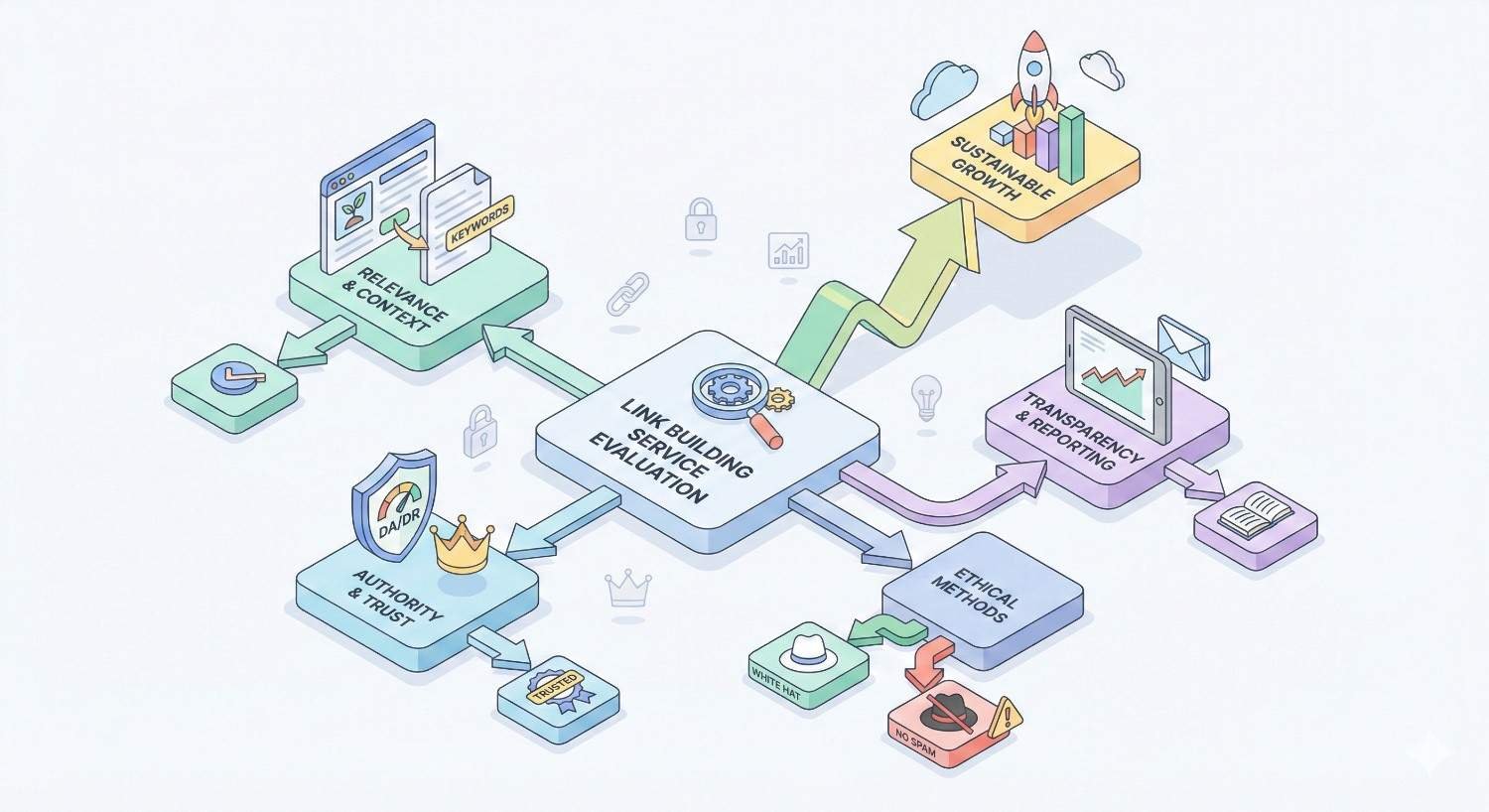
Not all link building services engage in risky practices. Understanding the difference between legitimate services and link selling schemes protects your investment.
Red Flags of Link Selling Schemes
Certain characteristics indicate a service is selling links rather than earning them:
Guaranteed link quantities. Legitimate link building can’t guarantee specific numbers because it depends on third-party decisions. Anyone promising “10 links per month” is likely buying or controlling the linking sites.
Unusually low prices. Quality link building requires significant time and expertise. If prices seem too good to be true, the links probably come from low-quality or risky sources.
No transparency about methods. Legitimate providers explain their process. If a service won’t tell you how they acquire links, they’re likely hiding something.
Links from unrelated sites. If your SaaS company is getting links from pet blogs and recipe sites, something is wrong. Relevance matters for both value and risk.
Rapid delivery timelines. Natural link building takes time. Promises of dozens of links within days indicate purchased placements.
Questions to Ask SEO Providers
Before engaging any link building service, ask:
“Can you show me examples of links you’ve built for similar clients?” Legitimate providers have case studies and can demonstrate their work.
“What’s your process for identifying link opportunities?” The answer should involve research, content creation, and relationship building, not purchasing placements.
“How do you ensure links comply with Google’s guidelines?” Providers should demonstrate awareness of guidelines and explain their compliance approach.
“What happens if a link is removed?” Natural links occasionally disappear. Providers focused on quality accept this reality rather than guaranteeing permanent placements.
“Can I see the sites before links are placed?” Transparency about linking sites indicates legitimate practices.
What Legitimate Link Building Looks Like
Ethical link building services focus on:
Content creation that attracts links naturally. This might include creating resources for your site or developing content for placement on relevant publications.
Relationship-based outreach where links result from genuine connections rather than transactions. This takes longer but produces sustainable results.
Digital PR campaigns that earn coverage through newsworthy angles. Links come from editorial decisions, not payments.
Strategic guest contributions where the content provides genuine value to the publication’s audience. The link is secondary to the content quality.
Legitimate services set realistic expectations about timelines and quantities. They can’t guarantee specific results because they’re working within Google’s guidelines.
What to Do If You’ve Already Bought Links
If you’ve purchased links in the past, taking proactive steps can minimize damage and begin recovery before penalties occur.
Auditing Your Backlink Profile
Start by exporting your complete backlink profile from Google Search Console and third-party tools like Ahrefs or Semrush. Cross-reference these sources for comprehensive coverage.
Review each linking domain for signs of paid placement: irrelevant content, low-quality sites, obvious link selling patterns, or sites you know you paid.
Document everything. Note which links were purchased, when, from whom, and how much you paid. This documentation helps if you need to demonstrate cleanup efforts to Google.
Categorize links as clearly paid, suspicious, or natural. Focus initial efforts on the clearly paid links since these carry the highest risk.
Using Google’s Disavow Tool
Google’s Disavow Tool tells the search engine to ignore specific links when assessing your site. It’s a last resort when you can’t get links removed.
Before disavowing, attempt to have links removed by contacting webmasters. Document your removal attempts. Google wants to see you tried before resorting to disavow.
Create a disavow file listing domains or specific URLs you want ignored. Submit through Google Search Console. The tool processes requests during normal crawling, so effects aren’t immediate.
Be careful not to disavow legitimate links. Incorrectly disavowing good links can hurt your rankings. When in doubt, consult an experienced SEO professional.
Submitting a Reconsideration Request
If you’ve received a manual action, you must submit a reconsideration request after cleanup to have the penalty lifted.
Your request should detail what happened, what you’ve done to fix it, and what you’ve changed to prevent recurrence. Be honest and thorough. Google reviewers can tell when you’re being evasive.
Include documentation of your cleanup efforts: removal request emails, disavow files, and evidence of policy changes. Show that you understand why the penalty occurred and have genuinely reformed.
Google may reject your first request if cleanup is incomplete. Address their feedback and resubmit. Persistence and thoroughness eventually succeed if your cleanup is genuine.
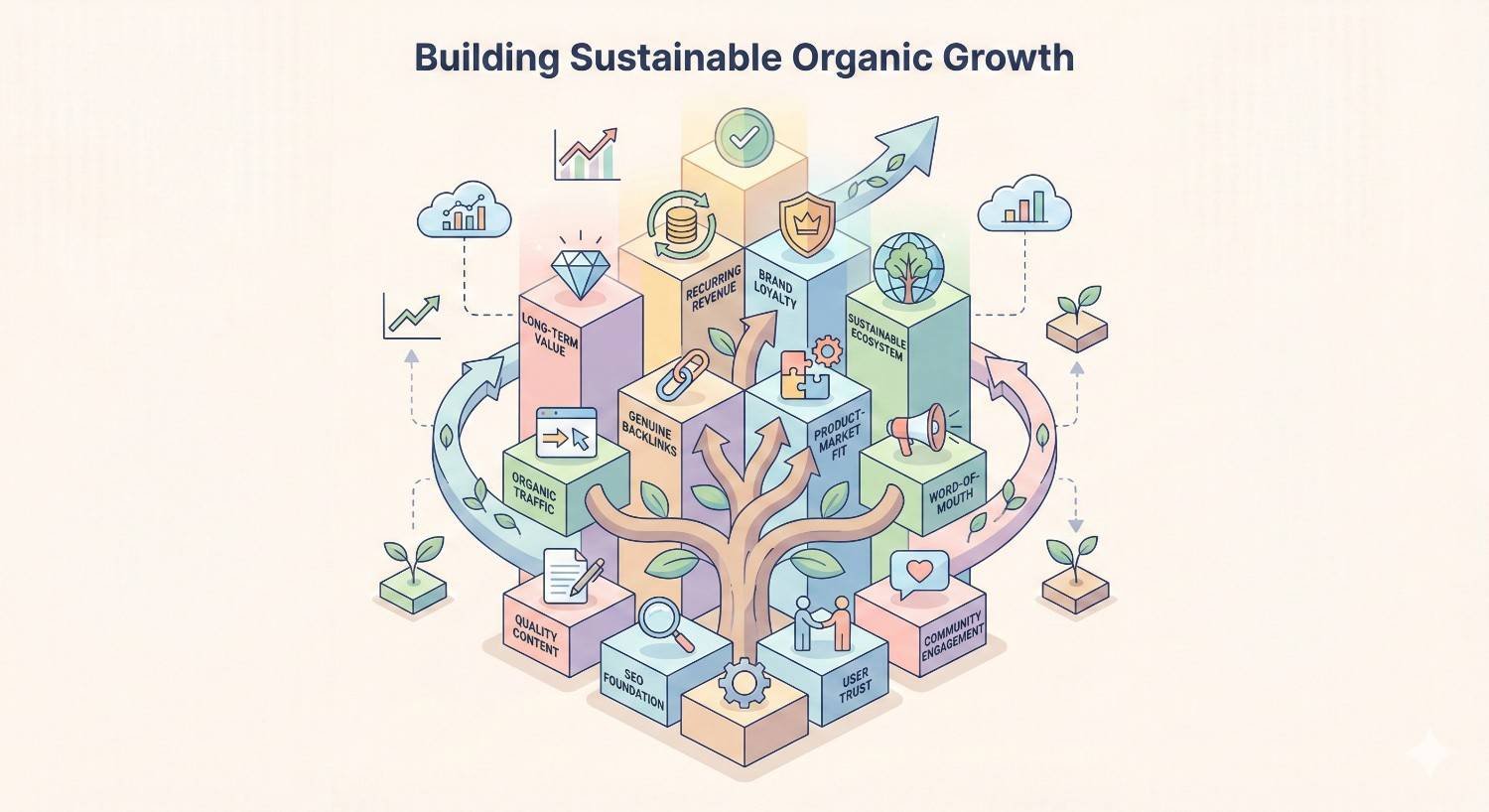
Building Sustainable Organic Growth
Long-term SEO success comes from building genuine authority rather than manipulating signals. This approach takes longer but produces results that compound over time.
The Role of Quality Content in Link Acquisition
Content quality directly determines link earning potential. Thin, generic content doesn’t attract links regardless of how much outreach you do.
Invest in creating content that serves your audience better than anything else available. This might mean more depth, better research, clearer explanations, or more practical applications.
Update content regularly to maintain relevance. Outdated content loses links over time as people find fresher resources. Keeping your best content current protects and grows your link profile.
Consider what makes content link-worthy in your industry. For some niches, original data wins. For others, comprehensive guides or practical tools perform best. Understand your audience’s linking behavior.
Technical SEO Foundations
Technical SEO ensures search engines can properly crawl, index, and understand your content. Without solid technical foundations, even great content underperforms.
Site speed, mobile usability, crawlability, and structured data all affect how Google perceives your site. Technical issues can prevent links from passing full value or cause indexing problems that limit visibility.
Regular technical audits identify issues before they compound. Tools like Screaming Frog, Google Search Console, and PageSpeed Insights help monitor technical health.
A technically sound site also provides better user experience, which indirectly supports link building. People are more likely to link to sites that work well.
Long-Term Authority Building Strategy
Authority builds through consistent effort across multiple channels. Content, links, brand mentions, social signals, and user engagement all contribute.
Develop a content calendar that systematically covers your topic area. Over time, comprehensive coverage establishes topical authority that benefits all your pages.
Build relationships with industry publications, influencers, and complementary businesses. These relationships generate ongoing link opportunities without transactional exchanges.
Track progress through metrics like organic traffic growth, ranking improvements for target keywords, and domain authority trends. Sustainable growth shows steady improvement rather than sudden spikes.
Conclusion
Buying links offers an illusion of faster results while creating real risks that can destroy years of SEO progress. Google’s detection capabilities continue improving, making paid link schemes increasingly likely to fail.
The businesses that succeed in organic search build genuine authority through quality content, legitimate outreach, and consistent effort. This approach takes longer but produces sustainable results that compound over time without penalty risk.
At White Label SEO Service, we help businesses build organic visibility through ethical, effective strategies that align with search engine guidelines. Contact us to develop a link building approach that grows your authority without risking your rankings.
Frequently Asked Questions
Is buying backlinks illegal?
Buying backlinks isn’t illegal in a criminal sense. However, it violates Google’s Webmaster Guidelines and can result in severe ranking penalties. The practice is against the terms of service you implicitly agree to when seeking Google rankings.
Can Google really detect paid links?
Yes, Google detects paid links through algorithmic analysis, manual reviews, and pattern recognition across billions of links. The Penguin algorithm specifically targets link manipulation, and detection capabilities improve continuously. Many link schemes that worked years ago now trigger immediate penalties.
How long does it take to recover from a link penalty?
Recovery typically takes 6-18 months depending on penalty severity and cleanup thoroughness. The process involves auditing links, requesting removals, submitting disavow files, and waiting for reconsideration. Some sites never fully recover their previous rankings.
Are all paid links bad for SEO?
Links that use rel=”sponsored” or rel=”nofollow” attributes don’t violate guidelines because they don’t pass PageRank. The problem is paying for followed links intended to manipulate rankings. Legitimate sponsored content with proper disclosure and attributes is acceptable.
What’s the difference between link buying and sponsored content?
Sponsored content involves paying for content placement with proper disclosure and nofollow/sponsored link attributes. Link buying involves paying specifically for followed links that pass PageRank. The distinction is transparency and whether links are designed to manipulate rankings.
How do I know if my SEO agency is buying links?
Ask for transparency about link sources and methods. Red flags include guaranteed link quantities, links from irrelevant sites, unusually fast results, and reluctance to explain processes. Request examples of links they’ve built and verify the linking sites appear legitimate.
What should I do if I suspect my previous SEO provider bought links?
Conduct a thorough backlink audit using tools like Ahrefs or Semrush. Look for links from low-quality, irrelevant, or known link-selling sites. If you find suspicious links, begin the cleanup process proactively before Google takes action. Document everything for potential reconsideration requests.