
Case study link building transforms your documented successes into powerful backlink magnets that attract high-authority domains naturally. This strategy leverages real results, original data, and compelling narratives to earn editorial links from industry publications, bloggers, and researchers.
For business owners and marketing teams seeking sustainable organic growth, case studies offer a proven path to quality backlinks without relying on outdated tactics.
This guide covers everything from creating link-worthy case studies to outreach strategies, technical optimization, and measuring ROI for your campaigns.
What Is Case Study Link Building?
Definition and Core Concept
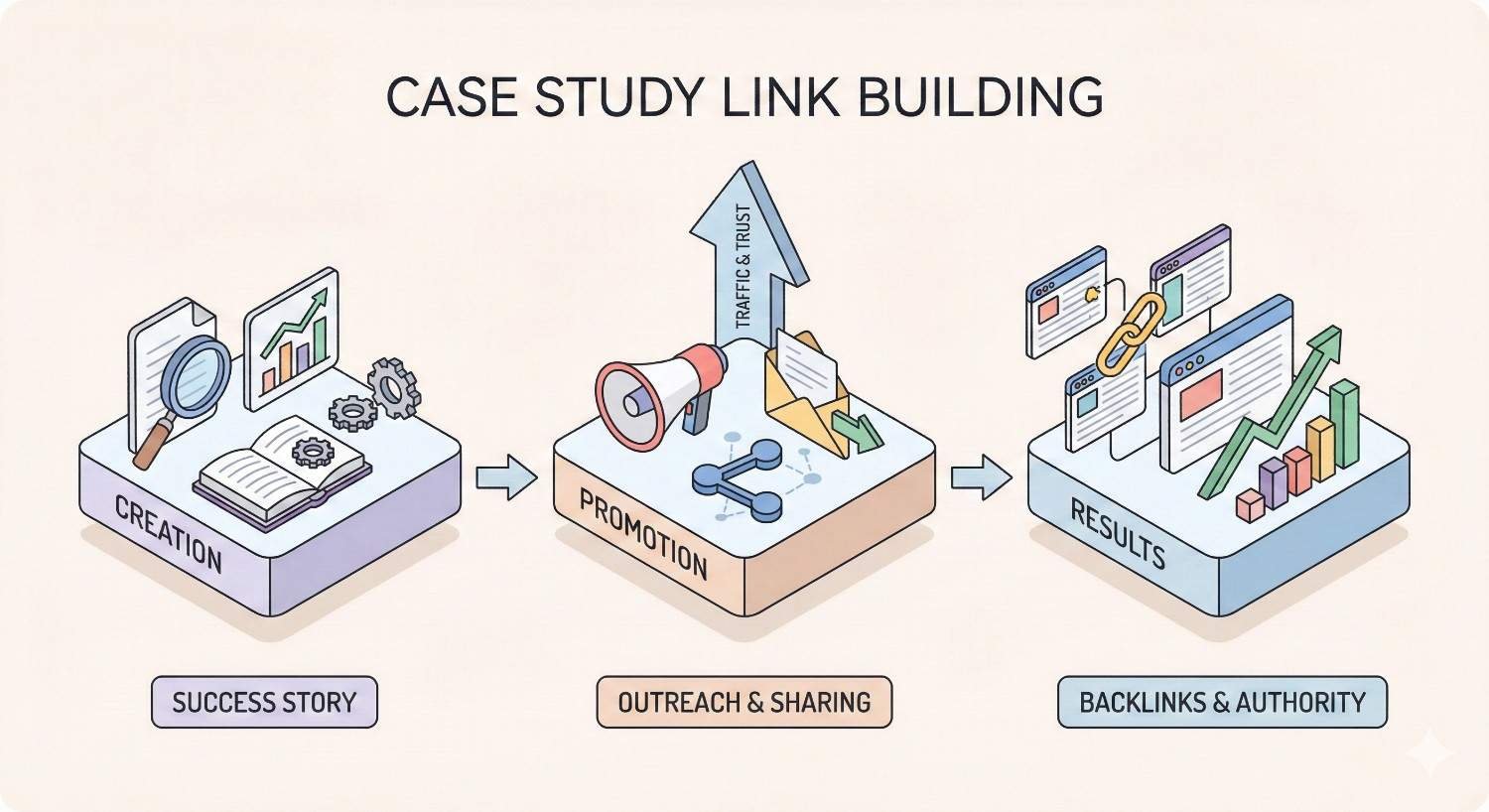
Case study link building is a content-driven link acquisition strategy that uses documented real-world results to attract backlinks from authoritative websites. You create detailed analyses of projects, experiments, or client successes that contain unique data, insights, or methodologies worth referencing.
The core concept centers on value exchange. Publishers need credible sources to cite. Your case study provides that credibility through verifiable results and original findings. When journalists, bloggers, or researchers write about topics related to your case study, they link to your content as supporting evidence.
This approach differs fundamentally from transactional link building. You earn links through merit rather than payment or reciprocal arrangements. The content itself becomes the asset that generates ongoing link acquisition over months or years.
How Case Study Link Building Differs from Traditional Link Building
Traditional link building often relies on direct outreach requesting links, guest posting on external sites, or directory submissions. These methods place your content on someone else’s platform or require explicit link requests.
Case study link building flips this model. You create exceptional content on your own domain that others want to reference. The outreach focuses on awareness rather than asking for links directly. You inform relevant publishers about your research, and they decide independently whether to cite it.
The quality differential matters significantly. Traditional tactics often yield links from lower-authority sites willing to accept guest posts or link exchanges. Case studies attract links from editorial content on high-authority publications that maintain strict linking standards.
Scalability also differs. Guest posting requires creating new content for each link. A single well-crafted case study can generate dozens or hundreds of links over its lifetime as different publishers discover and reference it.
Why Case Studies Attract Natural Backlinks
Case studies attract natural backlinks because they solve a fundamental problem for content creators: the need for credible sources. Writers researching topics need data, examples, and expert perspectives to support their arguments.
Original data creates citation opportunities. When you publish findings that nobody else has, you become the only source for that information. Anyone writing about related topics must link to you or omit valuable data from their content.
Specificity builds trust. Vague claims like “our clients see great results” generate no links. Specific statements like “organic traffic increased 312% over six months” give writers concrete facts to reference.
Narrative structure increases shareability. Case studies tell stories with challenges, solutions, and outcomes. This format resonates with readers and makes content more memorable than dry statistics alone.
Evergreen relevance extends link acquisition timelines. A well-documented case study remains citable for years. The initial promotion generates immediate links, while ongoing discovery through search and social channels produces passive link acquisition indefinitely.
The Strategic Value of Case Study Link Building
Authority and Trust Signals
Search engines evaluate websites partly through their backlink profiles. Links from authoritative domains signal that your content deserves trust. Case studies generate these high-value links because they meet the editorial standards of quality publications.
When industry publications cite your case study, they transfer authority signals to your domain. This differs from links acquired through guest posts or directories, which often come from sites with lower editorial standards.
The contextual relevance of case study links strengthens their value. Links appear within editorial content discussing topics directly related to your expertise. This topical alignment reinforces your authority in specific subject areas rather than providing generic domain authority.
Trust signals extend beyond search algorithms. Potential clients researching your company find third-party validation through these citations. Seeing your work referenced by respected publications builds confidence in your capabilities.
Link Quality vs. Link Quantity
Case study link building prioritizes quality over volume. A single link from a high-authority industry publication often delivers more ranking impact than dozens of links from low-quality sources.
Quality indicators include domain authority, topical relevance, editorial standards, and link placement. Case studies naturally attract links meeting all these criteria because publishers only cite sources that enhance their own credibility.
The quantity-focused approach creates risks. Accumulating many low-quality links can trigger algorithmic penalties or manual actions. Google’s systems increasingly identify and devalue manipulative link patterns.
Case study links carry minimal risk because they represent genuine editorial endorsements. Publishers link because your content adds value to their readers, not because of any arrangement or incentive.
Long-Term SEO Benefits
Case studies generate compounding returns over time. Initial promotion produces immediate links, but the content continues attracting citations as new publishers discover it through search, social sharing, or competitor research.
Ranking improvements from quality backlinks increase organic visibility for your case study pages. Higher rankings lead to more discovery, which generates additional links. This creates a positive feedback loop that amplifies results.
The content asset appreciates rather than depreciates. Unlike paid advertising that stops producing results when spending ends, case studies continue working indefinitely. Updating case studies with new data extends their relevance and link-earning potential.
Domain authority improvements benefit your entire website. Links to case study pages strengthen your overall backlink profile, helping other pages rank more effectively for their target keywords.
Brand Positioning and Thought Leadership
Case studies establish your brand as an authority in your field. Publishing original research and documented results demonstrates expertise that competitors making unsubstantiated claims cannot match.
Media coverage often follows successful case studies. Journalists seeking expert sources for stories discover your research and reach out for quotes or interviews. This earned media extends your reach beyond the initial case study.
Sales conversations benefit from documented proof. Prospects evaluating your services find concrete evidence of results rather than generic promises. Case studies serve dual purposes as marketing content and sales enablement tools.
Industry recognition builds over time. Consistently publishing valuable case studies positions your brand as a go-to resource for insights in your specialty area.
Types of Case Studies That Generate Backlinks
Client Success Stories and Results-Driven Case Studies
Client success stories document the outcomes you achieved for specific customers. These case studies work best when they include specific metrics, clear timelines, and verifiable results.
Effective client case studies follow a narrative arc. They establish the client’s initial situation and challenges, explain your approach and implementation, then reveal the measurable outcomes. This structure creates engaging content that readers follow from problem to solution.
Permission requirements matter for client stories. You need explicit approval to share company names, data, and details. Some clients prefer anonymity, which reduces the case study’s credibility and link-earning potential.
Industry relevance affects link acquisition. A case study about helping an e-commerce company increase conversions attracts links from e-commerce publications. Matching your case study topics to your target link sources improves outreach success rates.
Original Research and Data-Driven Case Studies
Original research case studies present findings from studies you conducted. These generate significant backlinks because they provide data unavailable elsewhere.
Research topics should address questions your industry cares about but lacks answers to. Identifying knowledge gaps and filling them with original data creates maximum citation potential.
Methodology transparency builds credibility. Explain how you collected data, sample sizes, timeframes, and any limitations. Publishers evaluate source quality before citing, and clear methodology demonstrates rigor.
Data visualization increases shareability. Charts, graphs, and infographics make findings accessible and provide visual assets others can embed with attribution links.
Industry Experiments and Tests
Experiment-based case studies document tests you ran to answer specific questions. These generate links because they provide empirical evidence rather than opinions.
Testing common assumptions creates controversy and engagement. If your experiment contradicts conventional wisdom, it generates discussion and citations from people on both sides of the debate.
Replicability adds value. When you document your methodology clearly enough for others to repeat your experiment, researchers and practitioners reference your work as a foundation for their own investigations.
Negative results matter too. Experiments that disprove hypotheses provide valuable information. Publishing what does not work helps others avoid wasted effort and generates citations from content warning against ineffective approaches.
Process Documentation and Methodology Case Studies
Process case studies explain how you accomplish specific outcomes. They attract links from content creators writing how-to guides who need authoritative sources to reference.
Step-by-step documentation creates practical value. Readers can follow your process to achieve similar results. This utility drives sharing and citation.
Proprietary methodologies differentiate your content. If you developed a unique approach to solving common problems, documenting it establishes you as the originator. Others writing about the topic must credit your methodology.
Templates and frameworks increase link potential. Providing downloadable resources alongside your process documentation gives publishers additional reasons to link.
Before-and-After Transformation Case Studies
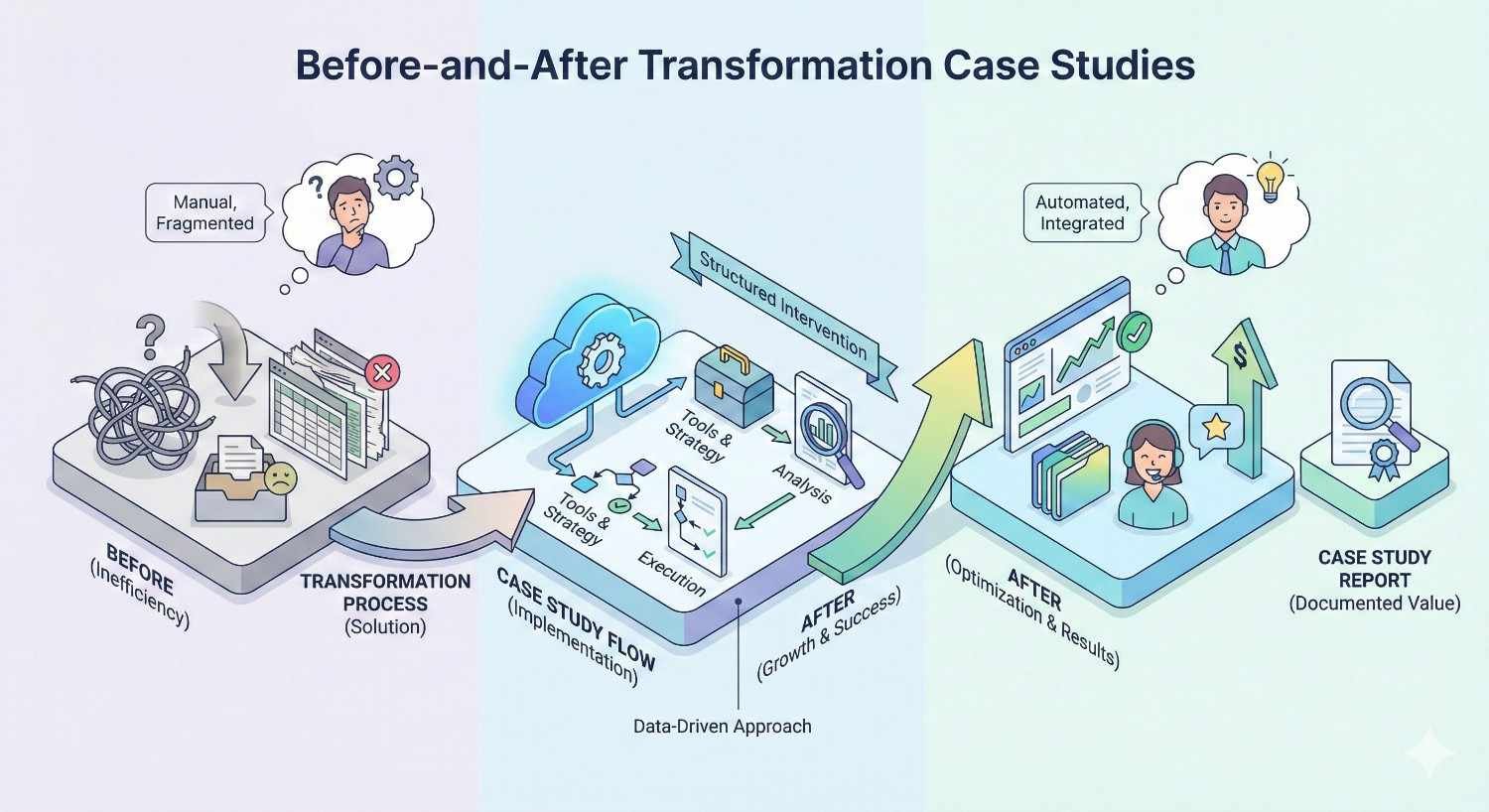
Transformation case studies emphasize dramatic changes between starting and ending states. The visual and emotional impact of significant improvements drives engagement and sharing.
Visual documentation strengthens these case studies. Screenshots, photos, or videos showing the before and after states make results tangible and shareable.
Quantified improvements provide citation material. Specific metrics like “page load time decreased from 8.2 seconds to 1.4 seconds” give writers concrete facts to reference.
Relatable starting points increase relevance. When readers recognize their own situation in your “before” state, they engage more deeply with the transformation story.
How to Create Link-Worthy Case Studies
Step 1: Identify Compelling Results and Data
Start by auditing your existing work for link-worthy material. Review client projects, internal experiments, and accumulated data for standout results that would interest your target publishers.
Compelling results share common characteristics. They involve significant improvements, surprising findings, or outcomes that contradict expectations. Incremental gains rarely generate links; dramatic transformations do.
Data uniqueness matters more than data volume. A single metric nobody else has published creates more citation opportunities than extensive data that duplicates existing research.
Consider your target audience’s interests. Results that matter to your clients may not interest publishers. Identify the overlap between what you can document and what your target link sources want to cover.
Step 2: Structure Your Case Study for Maximum Impact
The Challenge/Problem Section
Open by establishing the situation before your intervention. Describe the specific challenges, pain points, or questions that needed addressing.
Quantify the problem when possible. “The website received 2,300 monthly visitors despite 18 months of content production” creates more impact than “traffic was disappointing.”
Make the challenge relatable. Readers should recognize similar situations in their own experience. This connection keeps them engaged through the rest of the case study.
The Solution/Strategy Section
Explain your approach to solving the identified problem. Describe the strategy, methodology, or framework you applied.
Provide enough detail for credibility without overwhelming readers. The goal is demonstrating thoughtful analysis and expertise, not creating a complete implementation guide.
Connect your solution to the specific challenges identified. Show how each element of your approach addressed particular aspects of the problem.
The Implementation Section
Document what you actually did. This section bridges strategy and results by showing the work that produced outcomes.
Include timelines and sequences. Understanding when actions occurred helps readers evaluate the relationship between activities and results.
Acknowledge obstacles and adjustments. Real implementations rarely follow plans perfectly. Discussing challenges you encountered and how you adapted demonstrates practical expertise.
The Results/Outcomes Section
Present your findings with specific metrics and clear timeframes. Vague claims like “significant improvement” generate no links; precise statements like “organic traffic increased 247% over four months” do.
Compare results to starting points and industry benchmarks. Context helps readers understand the significance of your outcomes.
Include multiple metrics when available. Traffic, conversions, revenue, rankings, and other measures provide comprehensive evidence of success.
Step 3: Include Verifiable Data and Metrics
Verifiability separates credible case studies from marketing claims. Publishers evaluate whether they can trust your data before citing it.
Provide context for your numbers. Explain data sources, measurement methods, and timeframes. This transparency allows readers to assess reliability.
Use screenshots and documentation when possible. Visual evidence of analytics data, rankings, or other metrics strengthens credibility.
Acknowledge limitations honestly. If your sample size was small or your timeframe short, say so. Transparency about limitations actually increases trust.
Step 4: Add Visual Elements (Charts, Graphs, Screenshots)
Visual elements make data accessible and increase shareability. Complex findings become understandable through effective visualization.
Charts and graphs should communicate single clear points. Avoid cluttered visualizations that require extensive interpretation. Simple, focused graphics get shared and embedded more frequently.
Screenshots provide evidence and context. Analytics dashboards, ranking reports, and before/after comparisons demonstrate results visually.
Design quality affects perception. Professional-looking visuals signal that your organization takes quality seriously. Invest in clean, branded graphics.
Step 5: Incorporate Expert Quotes and Testimonials
Third-party voices add credibility and interest. Client quotes, expert opinions, and team member insights break up your narrative and provide additional perspectives.
Client testimonials validate your claims. When the person who experienced the results confirms them, readers trust the case study more.
Expert commentary adds depth. If industry authorities can speak to the significance of your findings, their perspectives strengthen your content.
Attribution matters for quotes. Named sources with titles and organizations carry more weight than anonymous testimonials.
Step 6: Optimize for Shareability and Citation
Make your case study easy to reference. Clear section headings, numbered findings, and quotable statistics help writers cite your work.
Create multiple entry points. Some publishers want your headline finding; others want methodology details. Structure content so different audiences find what they need quickly.
Provide embed codes for graphics. When publishers can easily add your charts to their content with attribution, they link more readily.
Include a clear summary or key findings section. Busy writers scanning for citable material should find your main points immediately.
Case Study Link Building Outreach Strategy
Identifying Link Prospects for Your Case Study
Industry Publications and Trade Journals
Industry publications need credible sources for their editorial content. Identify publications covering topics related to your case study findings.
Review recent articles in target publications. Note which topics they cover, what sources they cite, and which writers handle relevant subjects.
Build lists of specific writers, not just publications. Individual journalists and editors make linking decisions. Personalized outreach to the right person outperforms generic publication submissions.
Bloggers and Content Creators
Independent bloggers and content creators often have more flexibility than institutional publications. They can link to valuable resources without extensive editorial approval processes.
Identify bloggers who write about topics your case study addresses. Look for those who regularly cite external sources and link to supporting evidence.
Evaluate audience alignment. Bloggers whose readers match your target market provide both link value and potential referral traffic.
Academic and Research Institutions
Academic researchers cite sources rigorously. If your case study contains original data or methodology, it may interest researchers studying related topics.
University marketing, business, and communications departments often research digital marketing topics. Faculty and graduate students writing papers need citable sources.
Industry research organizations compile data and publish reports. Your case study might provide data points for their broader analyses.
Competitors’ Backlink Sources
Analyze where competitors earn links for similar content. These publishers have demonstrated interest in your topic area.
Use backlink analysis tools to identify sites linking to competitor case studies or research. These represent warm prospects already inclined to link to relevant content.
Look for patterns in competitor backlink profiles. Certain publication types or specific sites may link frequently to content in your space.
Crafting Effective Outreach Messages
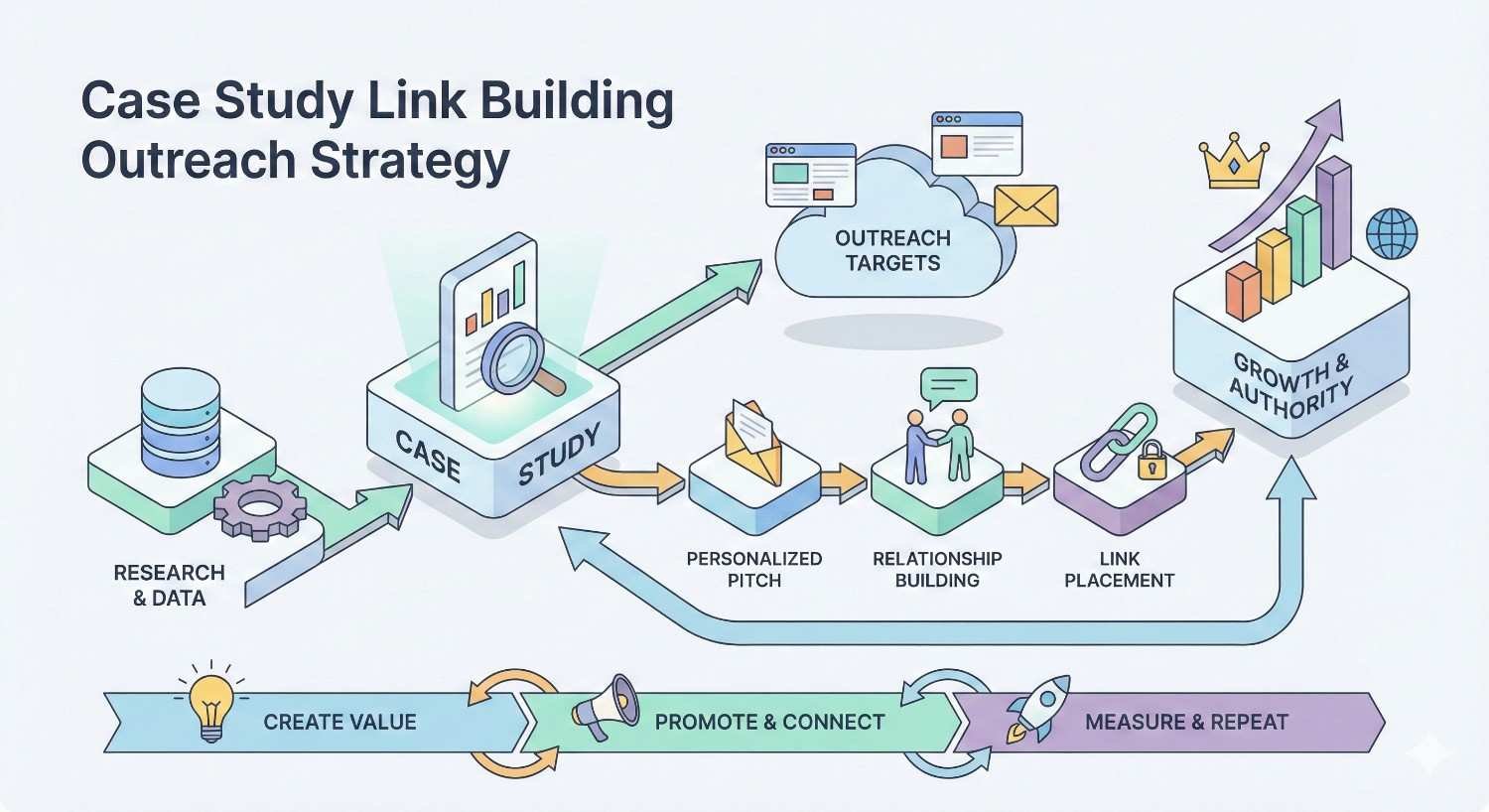
Effective outreach focuses on value to the recipient, not your desire for links. Explain why your case study matters to their audience.
Lead with the most compelling finding. Busy recipients decide quickly whether to continue reading. Your strongest data point should appear in the first sentence or two.
Keep messages concise. Three to five sentences typically suffice. Provide enough information to generate interest, then link to the full case study.
Personalize meaningfully. Reference specific articles the recipient wrote or topics they cover. Generic templates perform poorly compared to messages demonstrating genuine familiarity with their work.
Positioning Your Case Study as a Resource
Frame your case study as a resource that helps the recipient create better content. You are offering value, not asking for favors.
Suggest specific use cases. “This data might be useful for your upcoming piece on [topic]” gives recipients a concrete reason to engage.
Offer additional assistance. Availability for questions, additional data, or expert quotes makes you a valuable source beyond the case study itself.
Avoid asking for links directly. Let recipients decide how to use your resource. Explicit link requests often backfire with quality publishers.
Follow-Up Sequences and Timing
Initial outreach often goes unread or forgotten. Planned follow-up sequences increase response rates significantly.
Wait five to seven days before following up. This gives recipients time to read and consider your initial message without feeling pressured.
Add value in follow-ups. Share an additional finding, offer a different angle, or reference something new they published. Avoid simply repeating your initial request.
Limit follow-ups to two or three total messages. Persistent outreach beyond this point damages relationships and your reputation.
Personalization at Scale
Scaling outreach while maintaining personalization requires systems and templates with customizable elements.
Create message frameworks with placeholder sections for personalization. The core value proposition remains consistent while specific references change for each recipient.
Research recipients in batches. Spend focused time gathering personalization details for groups of prospects, then send customized messages efficiently.
Use tools that support mail merge with custom fields. This enables sending personalized messages at volume without manual copying and pasting.
Promoting Your Case Study for Maximum Link Acquisition
Distribution Channels and Platforms
Multi-channel distribution maximizes case study visibility. Different audiences discover content through different channels.
Your website serves as the primary home. Optimize the case study page for search visibility so it attracts organic discovery over time.
Email distribution reaches your existing audience immediately. Newsletter subscribers and contact lists provide initial traffic and sharing.
Content syndication platforms extend reach. Sites like Medium, LinkedIn articles, or industry-specific platforms expose your case study to new audiences.
Social Media Amplification Strategy
Social media generates initial visibility and sharing that can lead to links. Different platforms serve different purposes.
LinkedIn works well for B2B case studies. Professional audiences engage with business results and methodology discussions.
Twitter enables rapid sharing and discovery. Threads breaking down key findings can generate significant engagement and reach.
Visual platforms like Instagram or Pinterest suit case studies with strong visual elements. Before/after transformations and data visualizations perform well.
Industry Communities and Forums
Niche communities contain concentrated audiences interested in specific topics. Sharing relevant case studies in these spaces generates targeted visibility.
Identify communities where your target audience participates. Reddit subreddits, Slack groups, Discord servers, and industry forums each have distinct cultures and rules.
Contribute value before promoting. Establish yourself as a helpful community member before sharing your own content. Pure self-promotion typically receives negative responses.
Frame shares as contributions, not promotions. “I researched this question and here’s what I found” performs better than “check out my new case study.”
Email Newsletter Promotion
Email newsletters provide direct access to engaged audiences. Both your own newsletter and others’ newsletters offer promotion opportunities.
Feature case studies prominently in your own newsletters. Dedicated sends or featured sections drive traffic from your most engaged subscribers.
Pitch relevant newsletters for inclusion. Many newsletter curators seek quality content to share. Your case study might fit their editorial needs.
Offer exclusive angles for newsletter features. Additional data, early access, or unique commentary gives newsletter operators reasons to feature your content.
Paid Promotion to Boost Initial Visibility
Paid promotion accelerates initial discovery. Strategic ad spend can expose your case study to audiences who might link to it.
LinkedIn ads target professional audiences by job title, industry, and company. This precision helps reach potential linkers directly.
Content discovery platforms like Outbrain or Taboola place your case study on major publisher sites. This exposure can generate both traffic and links.
Retargeting keeps your case study visible to previous visitors. People who showed initial interest may link after multiple exposures.
Repurposing Case Study Content
Single case studies can generate multiple content pieces, each with its own link-earning potential.
Create infographics summarizing key findings. Visual content earns links independently and drives traffic back to the full case study.
Write blog posts exploring specific aspects in depth. Individual findings can support entire articles that link to the comprehensive case study.
Develop presentations for speaking opportunities. Conference talks and webinars based on case study findings generate visibility and often result in links from event pages and attendee content.
Record video content discussing your findings. YouTube videos and social clips reach audiences who prefer video formats.
Technical Optimization for Case Study Pages
On-Page SEO for Case Study Content
Technical optimization ensures search engines understand and rank your case study appropriately.
Target relevant keywords in your title, headings, and content. Research what terms your target audience uses when searching for information your case study provides.
Write compelling meta descriptions that encourage clicks. Search visibility means nothing if searchers do not click through to your content.
Use descriptive heading structures. H2 and H3 tags should clearly indicate section content, helping both readers and search engines navigate your case study.
Optimize images with descriptive file names and alt text. Visual elements should contribute to search visibility, not detract from page performance.
Schema Markup for Case Studies
Structured data helps search engines understand your content type and display rich results.
Article schema applies to most case studies. This markup identifies your content as editorial material and provides publication details.
FAQ schema works if your case study includes question-and-answer sections. This can generate expanded search listings with dropdown questions.
Organization and author schema establishes entity connections. Linking your case study to your organization and author entities strengthens knowledge graph associations.
Internal Linking Strategy
Internal links distribute authority from your case study to other pages and help visitors discover related content.
Link from your case study to relevant service pages, related blog posts, and other case studies. This creates topical clusters that strengthen overall site authority.
Link to your case study from existing content. Blog posts, service pages, and resource sections should reference your case study where relevant.
Use descriptive anchor text. “Our e-commerce conversion rate optimization case study” provides more context than “click here” or “read more.”
Page Speed and User Experience
Fast-loading pages retain visitors and satisfy search engine requirements. Case studies with heavy visual elements need particular attention to performance.
Optimize images for web delivery. Compress files, use appropriate formats, and implement lazy loading for images below the fold.
Minimize render-blocking resources. CSS and JavaScript that delay page rendering frustrate users and hurt search performance.
Test page speed regularly. Tools like Google PageSpeed Insights identify specific issues affecting your case study pages.
Mobile Optimization
Mobile users represent a significant portion of web traffic. Case studies must display effectively on smaller screens.
Use responsive design that adapts to screen sizes. Tables, charts, and images should resize appropriately for mobile viewing.
Ensure tap targets are adequately sized. Links and buttons need sufficient spacing for accurate mobile interaction.
Test mobile experience directly. Automated tools catch many issues, but manual testing on actual devices reveals usability problems tools miss.
Measuring Case Study Link Building Success
Key Performance Indicators (KPIs)
Number of Referring Domains
Referring domains count unique websites linking to your case study. This metric indicates how widely your content has spread.
Track referring domains over time. Initial promotion generates a spike, but successful case studies continue acquiring links months or years later.
Compare referring domains across case studies. This reveals which topics, formats, or approaches generate the most link acquisition.
Domain Authority of Linking Sites
Not all links carry equal weight. Links from high-authority domains provide more ranking benefit than links from low-authority sites.
Monitor the authority distribution of your backlinks. A profile weighted toward higher-authority sites indicates successful targeting of quality publishers.
Track authority metrics using tools like Moz Domain Authority, Ahrefs Domain Rating, or Semrush Authority Score. While imperfect, these metrics provide useful comparisons.
Link Placement and Context
Where links appear on pages affects their value. Editorial links within content carry more weight than footer or sidebar links.
Evaluate link context for relevance. Links appearing in content discussing topics related to your case study provide stronger topical signals.
Monitor anchor text distribution. Natural link profiles include varied anchor text. Over-optimization with exact-match anchors can trigger algorithmic concerns.
Traffic from Backlinks
Backlinks generate direct referral traffic in addition to ranking benefits. Track visitors arriving from linking sites.
High-traffic referral sources indicate valuable link placements. These links provide immediate business value beyond SEO benefits.
Analyze referral traffic behavior. Visitors from relevant sources should engage more deeply than random traffic, indicating audience alignment.
Tools for Tracking Backlinks
Multiple tools provide backlink monitoring capabilities. Using several tools gives more complete visibility.
Ahrefs offers comprehensive backlink data with historical tracking. Their index updates frequently, catching new links relatively quickly.
Semrush provides backlink analytics alongside broader SEO toolsets. Integration with other Semrush features enables comprehensive campaign tracking.
Moz Link Explorer tracks backlinks with spam score analysis. This helps identify potentially harmful links requiring attention.
Google Search Console shows links Google has discovered. While less comprehensive than third-party tools, this data comes directly from Google.
Attribution and ROI Calculation
Connecting case study link building to business outcomes requires tracking beyond link counts.
Monitor ranking changes for target keywords. Improved rankings following link acquisition indicate SEO impact.
Track organic traffic growth to case study pages and related content. Increased visibility should translate to more visitors.
Measure conversions from case study traffic. Visitors who convert demonstrate business value beyond traffic metrics.
Calculate cost per link by dividing total investment by links acquired. Compare this to costs for other link building methods.
Long-Term Performance Monitoring
Case study link building produces results over extended timeframes. Ongoing monitoring captures the full value.
Set up automated alerts for new backlinks. Tools like Ahrefs and Semrush can notify you when new sites link to your case studies.
Review performance quarterly. Assess cumulative link acquisition, ranking impacts, and traffic trends over longer periods.
Identify evergreen performers. Some case studies continue generating links years after publication. These deserve ongoing promotion and updates.
Real-World Case Study Link Building Examples
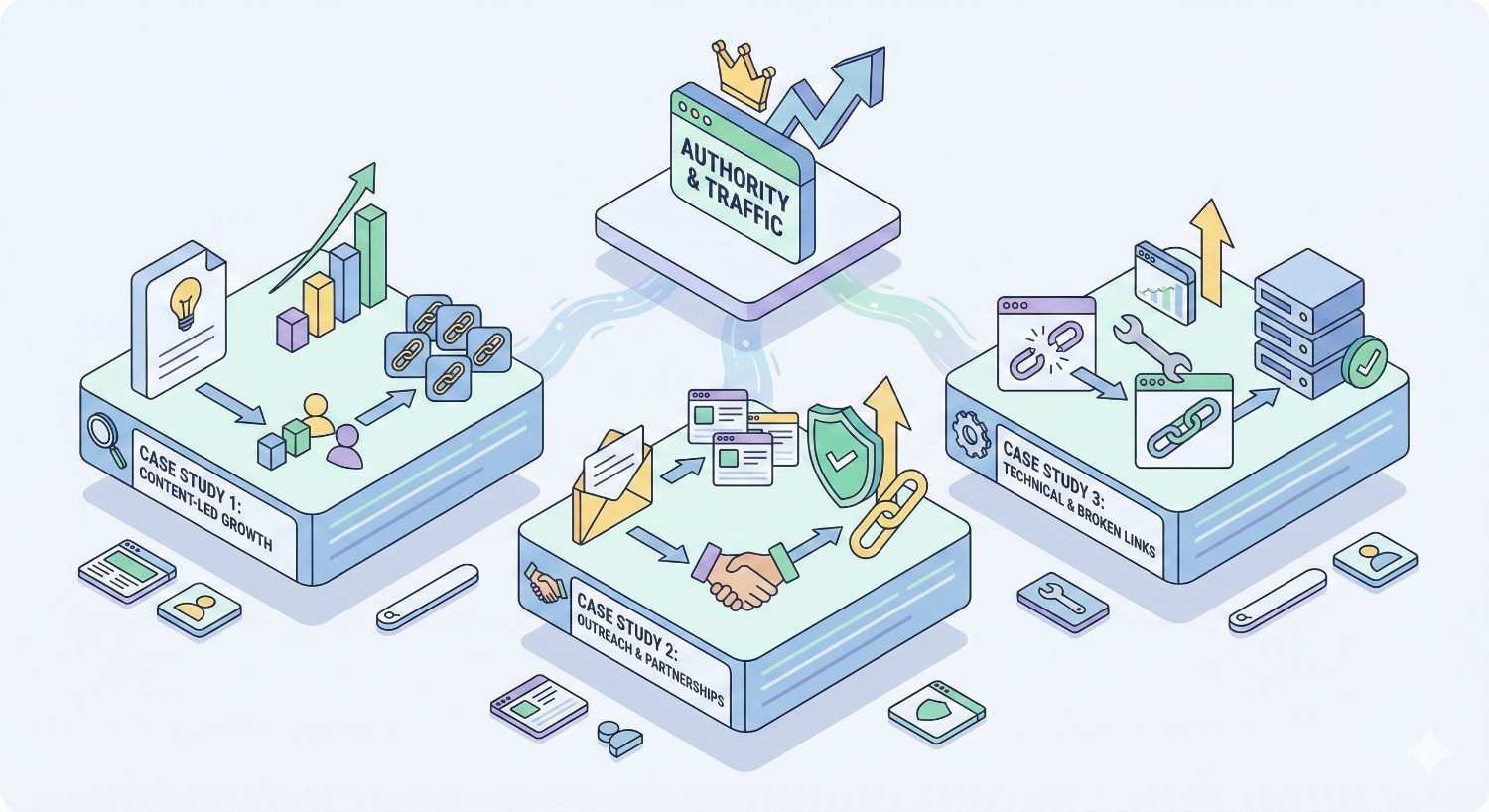
Example 1: SaaS Company Data Study
A project management software company analyzed usage data from 10,000 teams to identify productivity patterns. They published findings about optimal meeting frequencies, task completion rates, and collaboration patterns.
The case study generated links from major business publications covering workplace productivity. HR and management blogs cited the data when discussing team efficiency. The company earned over 150 referring domains within the first year.
Key success factors included unique data nobody else could access, findings that challenged common assumptions, and clear visualizations that publishers could embed.
Example 2: Agency Client Success Story
A digital marketing agency documented a campaign that increased a client’s organic traffic by 412% over eight months. The case study detailed their technical SEO fixes, content strategy, and link building approach.
Industry publications covering SEO and digital marketing linked to the case study as an example of effective strategy. The agency earned links from sites with Domain Authority scores above 60, significantly strengthening their backlink profile.
Success came from specific metrics, transparent methodology, and client willingness to be named and quoted.
Example 3: Industry Benchmark Report
An email marketing platform surveyed 5,000 marketers about email performance metrics. They published benchmark data for open rates, click rates, and conversion rates across industries.
The benchmark report became a frequently cited resource. Writers covering email marketing referenced the data when discussing performance standards. The report generated links continuously for over three years after publication.
Annual updates kept the data current and generated new waves of links each year. The initial research investment produced compounding returns.
Lessons Learned from Successful Campaigns
Successful case study link building shares common patterns. Original data that answers real questions generates the most links. Specific metrics outperform vague claims. Visual elements increase shareability. Ongoing promotion extends link acquisition beyond initial launch.
Timing matters for certain topics. Case studies addressing trending issues or seasonal topics can capture attention during peak interest periods.
Relationship building amplifies results. Publishers who linked to previous case studies often link to new ones. Nurturing these relationships creates ongoing link acquisition opportunities.
Common Mistakes in Case Study Link Building
Creating Case Studies Without Newsworthy Data
Many case studies fail because they lack compelling findings. Modest improvements or expected outcomes do not generate links.
Before investing in case study creation, evaluate whether your data would interest publishers. Ask whether the findings are surprising, significant, or unique.
If your results are not newsworthy, consider combining multiple projects or waiting until you have more compelling data.
Poor Outreach Targeting and Messaging
Sending generic outreach to irrelevant recipients wastes effort and damages your reputation. Publishers remember spammy pitches.
Research recipients before reaching out. Understand what they cover, what sources they cite, and how your case study fits their needs.
Craft messages that demonstrate genuine familiarity with their work. Personalization takes time but dramatically improves response rates.
Neglecting Visual Design and Presentation
Poorly designed case studies undermine credibility. Publishers evaluate source quality partly through presentation.
Invest in professional design for charts, graphics, and page layout. Visual quality signals organizational competence.
Ensure readability with appropriate typography, spacing, and formatting. Dense walls of text discourage engagement.
Failing to Promote Beyond Initial Launch
Many organizations publish case studies and move on. Without ongoing promotion, case studies underperform their potential.
Plan promotion campaigns extending weeks or months after publication. Different channels and audiences require different timing.
Update and re-promote successful case studies. Adding new data or insights creates opportunities for fresh outreach.
Not Following Up or Building Relationships
Single outreach attempts rarely succeed. Planned follow-up sequences significantly increase response rates.
Build relationships with publishers who link to your content. Thank them, share their work, and offer assistance for future projects.
Maintain contact lists of responsive publishers. These relationships become increasingly valuable over time.
Case Study Link Building vs. Other Link Building Strategies
Case Studies vs. Guest Posting
Guest posting places your content on external sites. Case study link building brings links to your own domain.
Guest posts provide immediate, predictable links but require ongoing content creation. Case studies require upfront investment but generate passive links over time.
Link quality often favors case studies. Editorial links citing your research typically come from higher-authority sources than guest post placements.
Both strategies can work together. Guest posts can reference your case studies, driving both links and traffic to your owned content.
Case Studies vs. Broken Link Building
Broken link building identifies dead links on other sites and suggests your content as a replacement. This requires finding relevant broken links and having appropriate replacement content.
Case studies can serve as replacement resources for broken links. Original research often fits where outdated studies previously linked.
Broken link building provides more predictable outreach opportunities. You know the site already linked to similar content. Case study outreach involves more uncertainty about recipient interest.
Case Studies vs. Digital PR
Digital PR seeks media coverage through newsworthy stories, often involving data studies or research. Case study link building overlaps significantly with this approach.
The distinction lies in scope and targeting. Digital PR typically targets major media outlets with broad audiences. Case study link building often focuses on niche publications and industry-specific sites.
Many successful campaigns combine both approaches. The same case study can support digital PR pitches to major outlets and targeted outreach to industry blogs.
When to Use Case Study Link Building
Case study link building works best when you have access to unique data, compelling results, or original research. Without these elements, other strategies may prove more effective.
Consider your resources and timeline. Case studies require significant upfront investment but produce long-term returns. If you need links quickly, other tactics may deliver faster results.
Evaluate your competitive landscape. In industries where competitors publish extensive research, you need exceptional case studies to stand out. In less competitive spaces, even modest case studies can generate significant links.
How Long Does Case Study Link Building Take?
Timeline for Case Study Creation
Case study creation typically requires two to eight weeks depending on complexity and available resources.
Simple client success stories with existing data can come together in two to three weeks. Original research projects requiring data collection may take two to three months.
Factor in client approval processes for case studies featuring external organizations. Review cycles can add weeks to timelines.
Outreach and Link Acquisition Timeline
Initial outreach campaigns typically run four to eight weeks. This includes prospect research, message crafting, sending, and follow-up sequences.
First links often appear two to four weeks after outreach begins. Response rates vary significantly based on case study quality and targeting accuracy.
Passive link acquisition continues indefinitely. Well-optimized case studies attract links through search discovery months or years after publication.
Factors That Affect Speed of Results
Case study quality directly impacts link acquisition speed. Exceptional content with unique data generates links faster than mediocre case studies.
Existing relationships accelerate results. Organizations with established publisher connections see faster responses than those starting from scratch.
Topic timeliness matters. Case studies addressing trending issues attract immediate attention. Evergreen topics generate steadier but slower link acquisition.
Promotion investment affects visibility. Paid amplification and multi-channel distribution expose case studies to more potential linkers faster.
Setting Realistic Expectations
Expect three to six months before seeing significant SEO impact from case study link building. Link acquisition, indexing, and ranking improvements all take time.
Plan for ongoing returns. Successful case studies continue generating links for years. Initial investment produces compounding value.
Not every case study succeeds. Some generate hundreds of links; others attract few despite quality content. Portfolio approaches with multiple case studies reduce risk.
Cost and Resources Required
In-House vs. Agency Case Study Creation
In-house creation offers control and potentially lower direct costs. Your team understands your work and can access internal data readily.
Agency creation provides expertise and capacity. Specialized agencies bring experience with formats, outreach, and promotion that internal teams may lack.
Hybrid approaches work for many organizations. Internal teams provide data and subject matter expertise while agencies handle writing, design, and outreach.
Budget Considerations
Case study creation costs vary widely based on complexity and quality standards. Simple text-based case studies might cost $1,000 to $3,000. Comprehensive research projects with custom design can exceed $10,000.
Outreach costs include tools, time, and potentially paid promotion. Budget $500 to $2,000 monthly for tools and 20 to 40 hours of staff time for active campaigns.
Calculate cost per link to evaluate ROI. Divide total investment by links acquired and compare to alternative link building methods.
Tools and Software Needed
Backlink analysis tools like Ahrefs, Semrush, or Moz enable prospect research and performance tracking. Expect $100 to $500 monthly depending on plan levels.
Outreach tools like Pitchbox, BuzzStream, or Hunter streamline prospect management and email sending. Costs range from $50 to $500 monthly.
Design tools for creating visuals include Canva, Adobe Creative Suite, or specialized data visualization platforms. Costs vary from free to several hundred dollars monthly.
Team Roles and Responsibilities
Successful case study link building requires multiple skill sets. Writers create compelling content. Designers produce visual elements. Outreach specialists manage prospect relationships. Analysts track performance.
Small teams often combine roles. One person might handle writing and outreach while another manages design and analytics.
Clear ownership prevents gaps. Assign specific responsibility for each phase of the process to ensure nothing falls through cracks.
Scaling Your Case Study Link Building Program
Creating a Case Study Production System
Systematic production enables consistent output. Document your process from topic selection through publication and promotion.
Create templates for case study formats. Standardized structures speed creation while maintaining quality.
Establish regular production schedules. Monthly or quarterly case study releases create predictable content pipelines.
Building a Case Study Library
Multiple case studies create a portfolio effect. Different topics attract different audiences and link sources.
Organize case studies by topic, industry, and type. This organization helps match case studies to outreach opportunities.
Cross-link between case studies. Internal linking strengthens topical authority and helps visitors discover related content.
Automating Outreach and Tracking
Automation increases efficiency without sacrificing personalization. Use tools to manage prospect lists, send sequences, and track responses.
Set up automated backlink monitoring. Alerts for new links help you identify successful tactics and responsive publishers.
Create reporting dashboards. Regular visibility into performance metrics enables data-driven optimization.
Continuous Improvement and Iteration
Analyze what works and refine your approach. Track which case study types, topics, and outreach approaches generate the best results.
Update successful case studies. Adding new data or insights creates opportunities for fresh promotion and additional links.
Test variations in format, length, and presentation. Systematic experimentation reveals what resonates with your target publishers.
Legal and Ethical Considerations
Client Permissions and NDAs
Always obtain explicit permission before featuring clients in case studies. Written agreements protect both parties.
Review existing contracts for confidentiality provisions. NDAs may restrict what information you can share publicly.
Offer clients review rights before publication. This builds trust and catches potential issues before they become problems.
Data Privacy and Confidentiality
Protect sensitive information even when you have permission to publish. Aggregate or anonymize data that could expose confidential details.
Consider competitive implications for featured clients. Publishing certain metrics might disadvantage them against competitors.
Comply with data protection regulations. GDPR, CCPA, and other frameworks may affect what data you can publish and how.
Accurate Reporting and Transparency
Report results honestly. Exaggerating outcomes damages credibility and may create legal liability.
Acknowledge limitations and context. Results achieved in specific circumstances may not generalize to other situations.
Maintain documentation supporting your claims. If publishers or readers question your data, you should be able to provide evidence.
Disclosure Requirements
Disclose material relationships that might affect credibility. If the featured client paid for services, that context matters.
Follow FTC guidelines for endorsements and testimonials. Commercial relationships require appropriate disclosure.
Be transparent about your role in achieving results. Readers should understand what you contributed versus what the client did independently.
Getting Started with Case Study Link Building
Audit Your Existing Success Stories
Review past projects for case study potential. Look for standout results, unique approaches, or surprising findings.
Interview team members about memorable projects. Institutional knowledge often contains case study material that has not been documented.
Evaluate which successes would interest your target publishers. Align your case study topics with the content your desired link sources cover.
Identify Your First Case Study Opportunity
Select a topic with strong data and clear narrative potential. Your first case study should demonstrate your capabilities effectively.
Confirm you have necessary permissions and access. Ensure you can obtain client approval and gather required data before committing.
Assess competitive landscape. Research existing case studies on similar topics to identify differentiation opportunities.
Create Your Case Study Template
Develop a standard structure for your case studies. Consistent formatting speeds production and establishes brand recognition.
Include sections for challenge, solution, implementation, and results. This framework applies to most case study types.
Design templates for visual elements. Branded chart styles, screenshot treatments, and layout patterns create professional consistency.
Build Your Outreach List
Research publications and writers covering topics related to your case study. Build lists of specific contacts, not just publication names.
Use backlink analysis to identify sites linking to similar content. These represent warm prospects with demonstrated interest.
Organize prospects by priority. Focus initial outreach on highest-potential targets before expanding to broader lists.
Launch Your First Campaign
Publish your case study with full technical optimization. Ensure the page loads quickly, displays well on mobile, and includes appropriate schema markup.
Begin outreach systematically. Send personalized messages to prioritized prospects, then follow up according to your planned sequence.
Promote across owned channels. Email newsletters, social media, and community participation extend reach beyond direct outreach.
Track results from day one. Monitor backlinks, traffic, and engagement to understand what works for future campaigns.
Conclusion
Case study link building represents one of the most effective strategies for earning high-quality backlinks that drive sustainable organic growth. By documenting real results with verifiable data, you create content that publishers genuinely want to cite.
The approach requires upfront investment in research, content creation, and outreach. However, successful case studies generate compounding returns as they continue attracting links months and years after publication.
We help businesses build comprehensive case study link building programs that strengthen domain authority and drive measurable results. Contact White Label SEO Service to discuss how strategic case studies can accelerate your organic growth.
Frequently Asked Questions
How many backlinks can I expect from a single case study?
Results vary significantly based on data quality, topic relevance, and promotion effort. Strong case studies with unique data typically generate 10 to 50 links in the first year, with exceptional examples earning 100 or more referring domains.
Do I need client permission to create case studies about their projects?
Yes, always obtain explicit written permission before publishing case studies featuring clients. This protects both parties legally and maintains trust in your business relationships.
How often should I publish new case studies for link building?
Most organizations benefit from publishing one to four case studies quarterly. Consistency matters more than volume. Regular publication builds a portfolio that attracts diverse link sources over time.
Can case study link building work for small businesses without big data?
Absolutely. Small businesses can create effective case studies using client success stories, process documentation, or small-scale experiments. Unique insights matter more than data volume.
How long before I see SEO results from case study link building?
Expect three to six months before seeing meaningful ranking improvements. Link acquisition, indexing, and algorithm processing all require time. Plan for long-term returns rather than immediate results.
Should I gate my case studies behind email capture forms?
Gating reduces link acquisition because publishers cannot easily reference gated content. For link building purposes, keep case studies freely accessible. Consider offering additional resources as gated content instead.
What makes a case study link-worthy versus just good marketing content?
Link-worthy case studies contain unique data, surprising findings, or specific metrics that writers need to cite. Good marketing content may persuade prospects but lacks the citable elements that generate editorial links.