
Citations and backlinks serve different purposes in SEO, and understanding when to use each determines whether your strategy drives real results. Citations mention your business name, address, and phone number across directories without necessarily linking to your site. Backlinks are clickable hyperlinks from other websites pointing directly to yours.
This distinction matters because local businesses and national brands require different approaches. Misallocating resources between citations and backlinks wastes budget and delays ranking improvements.
This guide breaks down exactly how citations and backlinks work, when to prioritize each, and how to build a combined strategy that matches your business goals.
What Are Citations in SEO?
Citations are online mentions of your business that include your name, address, and phone number. These mentions appear on directories, social platforms, and industry-specific websites. Unlike backlinks, citations don’t require a clickable link to your website to provide SEO value.
Search engines use citations to verify that your business exists and operates at the location you claim. When Google finds consistent business information across multiple trusted sources, it gains confidence in displaying your business for relevant local searches.
The value of citations comes from consistency and volume across authoritative platforms. A business listed accurately on 50 relevant directories signals legitimacy more effectively than one listed on 5 directories with inconsistent information.
Types of Citations: Structured vs Unstructured
Structured citations appear in formal business listings with dedicated fields for your NAP (name, address, phone number). Examples include Google Business Profile, Yelp, Yellow Pages, and industry-specific directories. These citations follow a predictable format that search engines easily parse and verify.
Unstructured citations occur when your business information appears within content like blog posts, news articles, or social media mentions. A local newspaper mentioning your restaurant’s address in a review creates an unstructured citation. These carry value but are harder to control and monitor.
Where Citations Appear Online
Citations appear across several categories of platforms:
General business directories like Google Business Profile, Bing Places, Apple Maps, and Yelp serve as foundational citation sources. Industry-specific directories such as Avvo for lawyers, Healthgrades for doctors, or TripAdvisor for hospitality businesses provide niche relevance. Local directories including chamber of commerce websites, local news sites, and community portals add geographic authority.
Social platforms like Facebook, LinkedIn, and Instagram also function as citation sources when they display your complete business information.
What Are Backlinks in SEO?
Backlinks are hyperlinks on external websites that point to pages on your website. When another site links to your content, search engines interpret this as a vote of confidence in your site’s authority and relevance.
According to Backlinko’s analysis of 11.8 million search results, the number of domains linking to a page correlates strongly with higher Google rankings. Pages ranking in position one have an average of 3.8x more backlinks than pages ranking in positions two through ten.
Backlinks transfer authority from the linking site to yours. A link from a high-authority website like Forbes or an established industry publication carries more weight than links from new or low-quality sites.
How Backlinks Work as Ranking Signals
Search engines evaluate backlinks based on several factors. Relevance measures whether the linking site’s content relates to your topic. Authority assesses the linking domain’s overall trustworthiness and ranking power. Anchor text provides context about what the linked page covers.
When a respected industry blog links to your guide using descriptive anchor text, search engines receive multiple positive signals: a relevant source vouches for your content, the anchor text confirms your topic, and the link passes authority to your domain.
Types of Backlinks: Dofollow vs Nofollow
Dofollow backlinks pass full link equity and ranking signals to your website. These are the links that directly impact your search rankings and domain authority. Most editorial links, guest post links, and natural mentions default to dofollow status.
Nofollow backlinks include a rel=”nofollow” attribute that tells search engines not to pass ranking credit. Social media links, paid links, and user-generated content typically carry nofollow tags. While nofollow links don’t directly boost rankings, they drive referral traffic and contribute to a natural-looking link profile.
Google has evolved its treatment of nofollow links. The search engine now treats nofollow as a “hint” rather than a directive, meaning some nofollow links may still influence rankings in certain contexts.
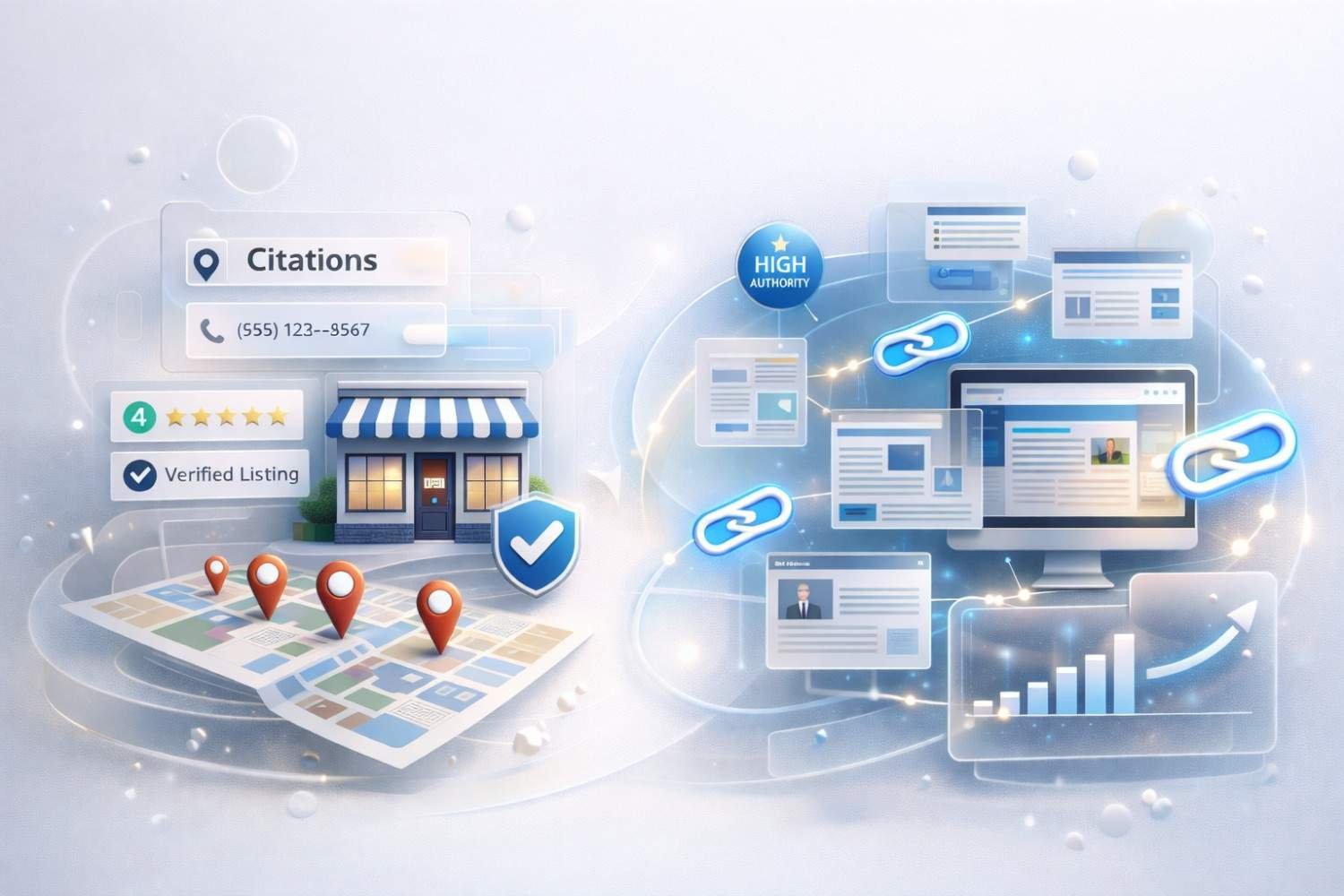
Citations vs Backlinks: Key Differences
Understanding the fundamental differences between citations and backlinks helps you allocate SEO resources effectively. These two elements serve distinct purposes and impact different aspects of search visibility.
Link Presence and Click-Through Capability
The most obvious difference is whether users can click through to your website. Backlinks are clickable hyperlinks that send visitors directly to your pages. This creates both SEO value and referral traffic opportunities.
Citations may or may not include links. A business listing on Yelp includes a link to your website, making it both a citation and a backlink. A mention of your business in a local news article without a hyperlink is a citation only. Both scenarios provide SEO value, but through different mechanisms.
Primary SEO Function and Value
Citations primarily support local SEO. They help search engines verify your business location, build trust in your NAP data, and determine relevance for “near me” and location-based searches. Citations answer the question: “Is this a real business operating where it claims?”
Backlinks primarily support organic SEO. They build domain authority, help pages rank for competitive keywords, and signal content quality to search engines. Backlinks answer the question: “Is this website trustworthy and authoritative on this topic?”
Use Cases by Business Type
Local service businesses (plumbers, dentists, restaurants, law firms) benefit most from citations. Their customers search with local intent, and Google’s local pack results heavily weight citation signals.
E-commerce sites, SaaS companies, and content publishers benefit most from backlinks. Their target keywords are competitive nationally or globally, and rankings depend on domain authority built through quality links.
Multi-location businesses need both. Citations establish each location’s local presence while backlinks build overall brand authority.
| Factor | Citations | Backlinks |
| Primary purpose | Local SEO, business verification | Domain authority, organic rankings |
| Link required | No | Yes |
| Traffic potential | Indirect (through local visibility) | Direct (referral clicks) |
| Best for | Local businesses | National/global brands |
| Key metric | NAP consistency | Domain authority |
How Citations Impact Local SEO Rankings
Citations directly influence how your business appears in Google’s local pack and Google Maps results. For businesses targeting customers in specific geographic areas, citation building is foundational to local search visibility.
Whitespark’s Local Search Ranking Factors survey identifies Google Business Profile signals and citation signals among the top factors for local pack rankings. Businesses with strong citation profiles consistently outperform competitors with weak or inconsistent listings.
NAP Consistency and Trust Signals
NAP consistency means your business name, address, and phone number appear identically across all platforms. Variations like “Street” vs “St.” or different phone number formats create confusion for search engines trying to verify your business.
Inconsistent NAP data reduces Google’s confidence in your business information. If your address appears differently on Yelp, Facebook, and your website, search engines struggle to determine which version is correct. This uncertainty can suppress your local rankings.
Maintaining NAP consistency requires regular audits. Businesses that move locations, change phone numbers, or rebrand must update citations across all platforms to maintain ranking strength.
Citation Sources That Matter Most
Not all citations carry equal weight. Primary data aggregators like Data Axle, Localeze, and Foursquare distribute business information to hundreds of smaller directories. Getting listed accurately with these aggregators creates a foundation of consistent citations.
Industry-specific directories provide relevance signals. A law firm listed on Avvo, FindLaw, and Justia demonstrates industry legitimacy. A restaurant on TripAdvisor, OpenTable, and Zomato signals relevance to food-related searches.
Local and regional directories add geographic authority. Chamber of commerce listings, local business associations, and community websites strengthen your connection to specific service areas.

How Backlinks Impact Organic Rankings
Backlinks remain one of the strongest ranking factors for competitive organic search terms. While Google’s algorithm considers hundreds of signals, the quality and quantity of backlinks consistently correlate with higher rankings.
Domain authority, a metric developed by Moz to predict ranking potential, is calculated primarily based on backlink profiles. Sites with more high-quality backlinks from diverse, authoritative sources achieve higher domain authority scores and typically rank better for competitive keywords.
Domain Authority and Link Equity
Link equity (sometimes called “link juice”) refers to the ranking value passed from one page to another through hyperlinks. When a high-authority page links to your content, some of that authority transfers to your site.
The amount of link equity passed depends on several factors:
The linking page’s own authority and backlink profile matters significantly. A link from a page with strong backlinks passes more value than a link from a page with no external links.
The number of outbound links on the linking page dilutes equity. A page linking to 100 sites passes less value per link than a page linking to 5 sites.
The relevance of the linking content affects how search engines weight the signal. A link from a related industry site carries more topical authority than a link from an unrelated source.
Quality vs Quantity in Link Building
One high-quality backlink often outweighs dozens of low-quality links. A single link from an authoritative industry publication can move rankings more than 50 links from obscure directories or low-traffic blogs.
Quality indicators include:
Domain authority of the linking site. Links from established, trusted domains carry more weight.
Editorial placement within content. Links naturally embedded in relevant articles outperform footer links, sidebar links, or comment links.
Traffic and engagement on the linking page. Links from pages that receive real visitors and engagement signal genuine endorsement.
Low-quality link building tactics like buying links, participating in link schemes, or acquiring links from irrelevant sites can trigger Google penalties. The algorithm specifically targets manipulative link patterns and can demote or remove sites that violate guidelines.
When to Prioritize Citations Over Backlinks
Citations should take priority when your business depends on local customers finding you through location-based searches. If your revenue comes from people searching “service + city” or “service near me,” citations directly impact your visibility.
Local Business SEO Strategy
Service-area businesses like plumbers, electricians, HVAC technicians, and cleaning services need strong citation profiles. Their customers search with immediate local intent, and appearing in the local pack drives the majority of their leads.
Brick-and-mortar retailers including restaurants, salons, gyms, and retail stores compete for local pack visibility. Citations help these businesses appear when nearby customers search for their category.
Professional service providers such as dentists, lawyers, accountants, and real estate agents serve geographic markets. Citations establish their presence in specific cities or neighborhoods.
For these business types, citation building should precede aggressive backlink campaigns. Establishing accurate, consistent listings across 50-100 relevant directories creates the foundation for local visibility. Once citation profiles are strong, backlink building can amplify overall authority.
When to Prioritize Backlinks Over Citations
Backlinks should take priority when your target keywords are competitive nationally or globally, and your customers don’t search with local intent. If you’re competing for rankings against sites across the country or world, domain authority built through backlinks determines success.
National and Global SEO Strategy
E-commerce businesses selling products nationwide compete on product and category keywords without geographic modifiers. Rankings depend on domain authority, content quality, and backlink profiles rather than local signals.
SaaS companies and software providers target keywords like “project management software” or “email marketing tools.” These searches have no local intent, and rankings go to sites with the strongest authority and content.
Content publishers and media sites compete for informational keywords. A site ranking for “how to start a business” or “best productivity tips” needs backlinks from authoritative sources to outrank established competitors.
B2B service providers targeting national clients prioritize backlinks over citations. A consulting firm serving Fortune 500 companies nationwide builds authority through thought leadership content and backlinks from industry publications.
Building a Combined Citation and Backlink Strategy
Most businesses benefit from both citations and backlinks, but the ratio depends on your business model and target market. A strategic approach allocates resources based on where you’ll see the greatest ranking impact.
Audit Your Current Profile
Before building new citations or backlinks, assess your current position:
Citation audit: Use tools like Moz Local, BrightLocal, or Whitespark to scan your existing citations. Identify inconsistencies, duplicate listings, and missing directories. Fix errors before adding new citations.
Backlink audit: Use Ahrefs, Semrush, or Moz to analyze your backlink profile. Identify your strongest links, spot potentially harmful links, and benchmark against competitors. Understanding your current authority level informs how aggressively you need to build.
Competitor analysis: Review the citation and backlink profiles of businesses ranking above you. If competitors have 200 citations and you have 50, citation building is a priority. If competitors have 500 referring domains and you have 50, backlinks need attention.
Allocate Resources Based on Business Goals
Local-focused businesses should allocate roughly 60-70% of link building resources to citations and 30-40% to backlinks. Build a comprehensive citation foundation first, then pursue local backlinks from community organizations, local news, and regional industry sites.
National/global businesses should allocate 70-80% of resources to backlink acquisition and 20-30% to maintaining basic citation presence. Focus on earning editorial links through content marketing, digital PR, and relationship building.
Multi-location businesses need parallel strategies. Build location-specific citations for each service area while pursuing brand-level backlinks that strengthen overall domain authority.
Conclusion
Citations and backlinks serve distinct purposes in SEO strategy. Citations verify your business presence and drive local search visibility. Backlinks build domain authority and power organic rankings for competitive keywords. Understanding when to prioritize each determines whether your SEO investment delivers results.
The right balance depends on your business model. Local service providers need strong citation foundations. National brands need authoritative backlink profiles. Most businesses benefit from both, allocated strategically based on their target market and competitive landscape.
White Label SEO Service builds customized citation and backlink strategies based on your specific business goals. Contact our team to audit your current profile and develop a roadmap for sustainable organic growth.
Frequently Asked Questions
Do citations count as backlinks?
Citations and backlinks are different. A citation is any mention of your business NAP information, with or without a link. Some citations include links (making them both citations and backlinks), but many citations are linkless mentions that still provide local SEO value.
Which is more important for local SEO: citations or backlinks?
For local SEO specifically, citations typically have more direct impact. They help Google verify your business location and build trust for local pack rankings. However, backlinks from local sources also strengthen local authority, so both contribute to local visibility.
How many citations does a local business need?
Most local businesses benefit from 50-100 quality citations across relevant directories. Focus on accuracy and consistency over volume. Fifty accurate citations outperform 200 inconsistent listings with NAP variations.
Can backlinks hurt my SEO?
Yes, low-quality or manipulative backlinks can trigger Google penalties. Links from spammy sites, paid link schemes, or irrelevant sources can harm rankings. Focus on earning editorial links from legitimate, relevant websites.
How long does it take for citations to impact rankings?
Citation impact typically appears within 4-8 weeks as search engines crawl and index new listings. Major directories like Google Business Profile may show faster results. Consistent citation building over 3-6 months produces the strongest local ranking improvements.
Should I build citations or backlinks first?
For local businesses, build citations first to establish your foundational local presence. For national businesses, prioritize backlinks from the start. Most businesses should begin with a citation audit to fix inconsistencies before pursuing either strategy aggressively.
Do nofollow backlinks have any SEO value?
Nofollow backlinks don’t pass direct ranking credit, but they provide indirect value. They drive referral traffic, increase brand visibility, and contribute to a natural-looking link profile. Google now treats nofollow as a hint, meaning some nofollow links may influence rankings.