

Understanding Content Quality in Modern SEO
Content quality signals determine whether your pages rank on page one or disappear into search obscurity. Google evaluates hundreds of factors to assess whether your content deserves visibility, from E-E-A-T indicators to user engagement patterns and technical performance metrics.
Understanding these signals separates businesses achieving sustainable organic growth from those struggling with stagnant traffic. The difference between ranking and not ranking often comes down to how well your content satisfies what search engines measure.
This guide breaks down every content quality signal that impacts rankings, provides actionable measurement frameworks, and shows you exactly how to improve each factor for better organic visibility.
What Are Content Quality Signals in SEO?
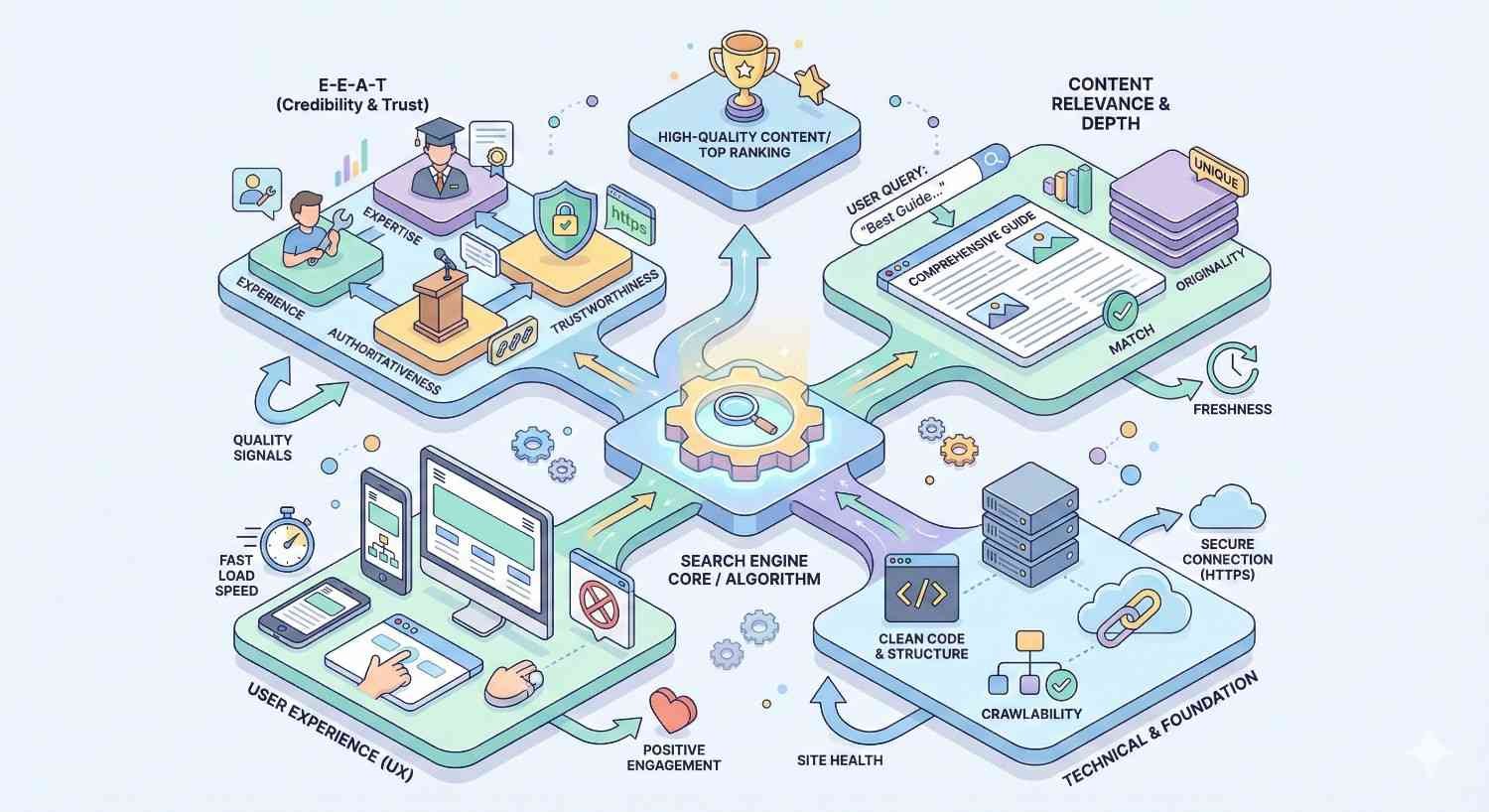
Content quality signals are the measurable indicators search engines use to evaluate whether a page deserves to rank for specific queries. These signals span content characteristics, user behavior patterns, technical performance, and authority markers that collectively determine your organic visibility.
How Search Engines Define Content Quality
Search engines define quality through a combination of algorithmic assessments and human quality rater guidelines. Google’s Search Quality Rater Guidelines provide the clearest window into how quality is evaluated, emphasizing page purpose fulfillment, E-E-A-T signals, and main content quality.
Quality assessment happens at multiple levels. Page-level signals evaluate individual content pieces. Site-level signals assess overall domain trustworthiness. Query-level signals determine relevance to specific searches.
The algorithm doesn’t read content like humans do. Instead, it processes signals that correlate with quality: semantic completeness, entity coverage, user satisfaction metrics, and authority indicators from across the web.
The Evolution of Quality Signals: From Keyword Density to User Experience
Early search algorithms relied heavily on keyword density and basic on-page factors. Pages stuffed with target keywords could rank regardless of actual value to users. This created a landscape of low-quality content optimized for machines rather than people.
Google’s Panda update in 2011 marked the first major shift toward content quality assessment. Sites with thin, duplicate, or low-value content saw dramatic ranking drops. The algorithm began evaluating content substance rather than just keyword presence.
Subsequent updates continued this trajectory. Hummingbird introduced semantic understanding. RankBrain added machine learning to query interpretation. BERT improved natural language processing. Each update moved further from keyword matching toward genuine quality assessment.
Today’s algorithms evaluate user experience signals, E-E-A-T indicators, content comprehensiveness, and technical performance. The focus has shifted entirely to whether content genuinely serves user needs.
Why Content Quality Signals Matter for Organic Visibility
Quality signals directly determine ranking potential. Pages lacking strong quality indicators struggle to compete regardless of other optimization efforts. Technical SEO and link building cannot compensate for fundamentally weak content.
Research from Backlinko analyzing 11.8 million Google search results found that comprehensive content significantly outperforms thin pages. The average first-page result contains 1,447 words, indicating search engines reward depth and thoroughness.
Quality signals also impact crawl budget allocation. Google prioritizes crawling and indexing high-quality pages while deprioritizing or ignoring low-quality content. Poor quality signals can result in pages being excluded from the index entirely.
Beyond rankings, quality signals affect user behavior metrics that feed back into algorithmic assessments. High-quality content generates better engagement, lower bounce rates, and more return visits, creating a positive feedback loop that reinforces ranking positions.
Core Content Quality Signals That Impact Rankings
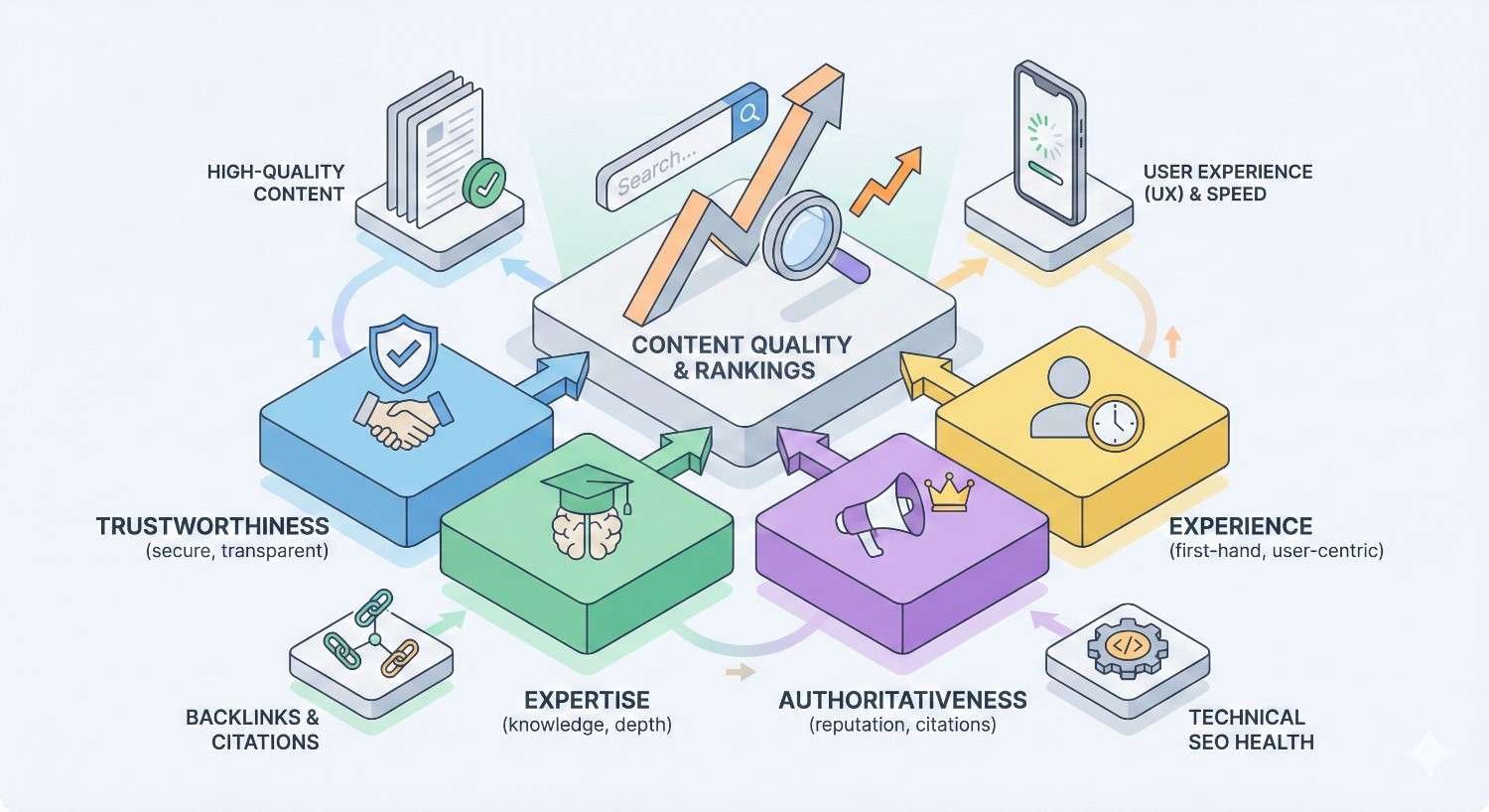
Core quality signals form the foundation of how search engines evaluate content worthiness. These factors carry significant weight in ranking algorithms and should be prioritized in any content strategy.
E-E-A-T: Experience, Expertise, Authoritativeness, and Trustworthiness
E-E-A-T represents Google’s framework for evaluating content credibility. While not a direct ranking factor, E-E-A-T signals inform algorithmic assessments and quality rater evaluations that influence search visibility.
Demonstrating First-Hand Experience in Content
The “Experience” component, added to Google’s guidelines in December 2022, evaluates whether content creators have actual experience with the topic. First-hand experience signals include personal anecdotes, original photos, specific details only someone with direct experience would know, and practical insights beyond theoretical knowledge.
Content demonstrating genuine experience outperforms generic information compiled from other sources. A product review from someone who actually used the product carries more weight than a summary of other reviews. A travel guide from someone who visited the destination provides more value than aggregated information.
Signals of experience include specific measurements, timeframes, challenges encountered, and lessons learned. These details are difficult to fabricate and indicate authentic expertise.
Establishing Author and Site Expertise
Expertise signals demonstrate that content creators possess relevant knowledge and qualifications. For YMYL (Your Money or Your Life) topics, formal credentials matter significantly. Medical content should come from healthcare professionals. Financial advice should come from qualified advisors.
Author expertise is established through detailed author bios, credentials, professional affiliations, and publication history. Linking author pages to professional profiles, academic publications, and industry recognition strengthens expertise signals.
Site-level expertise develops through consistent coverage of related topics. A site publishing extensively about SEO builds expertise signals for SEO-related queries. Topical focus and depth demonstrate specialized knowledge.
Building Topical Authority Through Content Depth
Topical authority emerges from comprehensive coverage of a subject area. Rather than publishing isolated articles, authoritative sites develop interconnected content that addresses topics from multiple angles.
Building topical authority requires covering core topics thoroughly, addressing related subtopics, answering common questions, and providing resources that serve user needs at different stages. This creates a content ecosystem that signals deep subject matter expertise.
Internal linking reinforces topical authority by connecting related content and demonstrating the breadth of coverage. Topic clusters with pillar pages and supporting content create clear topical hierarchies that search engines recognize.
Trust Signals: Citations, Sources, and Transparency
Trust signals indicate content reliability and organizational credibility. Citing authoritative sources, providing references for claims, and maintaining transparency about authorship and organizational identity all contribute to trust assessment.
Transparency pages matter significantly. About pages explaining organizational mission and expertise, contact pages with legitimate business information, and clear editorial policies all strengthen trust signals.
For YMYL content, trust signals carry extra weight. Medical, financial, legal, and safety-related content requires strong trust indicators to rank competitively.
Content Depth and Comprehensiveness
Content depth signals indicate whether pages thoroughly address user needs. Comprehensive content that fully covers a topic outperforms shallow pages that only scratch the surface.
Topic Coverage and Semantic Completeness
Semantic completeness means covering all relevant aspects of a topic that users expect to find. Search engines evaluate whether content addresses the full scope of a subject or leaves significant gaps.
Tools like Clearscope, Surfer SEO, and MarketMuse analyze top-ranking content to identify semantic gaps. These tools reveal related terms, concepts, and subtopics that comprehensive content should address.
Semantic completeness doesn’t mean maximum word count. It means covering what matters without unnecessary padding. Some topics require extensive treatment. Others can be addressed thoroughly in fewer words.
Answering User Intent Fully
User intent satisfaction is the ultimate quality signal. Content that fully answers what users are searching for generates positive engagement signals and earns ranking positions.
Intent analysis requires understanding what users actually want when they search. Informational queries need thorough explanations. Transactional queries need clear paths to conversion. Navigational queries need direct access to specific pages.
Fully answering intent often means addressing follow-up questions users might have. Anticipating related questions and providing answers within the content creates a more complete resource.
Balancing Depth vs. Readability
Depth without readability fails users. Comprehensive content must remain accessible and scannable. Long-form content requires clear organization, visual breaks, and logical progression to maintain engagement.
The balance point varies by audience and topic. Technical audiences may prefer dense, detailed content. General audiences need more accessible presentation. Understanding your specific audience determines the appropriate balance.
Readability metrics provide guidance but shouldn’t override judgment. A Flesch-Kincaid score appropriate for one audience may be wrong for another. Match complexity to audience expectations.
Content Originality and Uniqueness
Original content provides value that doesn’t exist elsewhere. Search engines prioritize unique perspectives, original research, and fresh insights over rehashed information.
Original Research and Data
Original research creates content that cannot be found anywhere else. Surveys, studies, data analysis, and proprietary insights generate unique value that attracts links and citations naturally.
Orbit Media’s annual blogging survey demonstrates this approach. By publishing original research annually, they’ve created a consistently cited resource that generates ongoing authority and visibility.
Original data doesn’t require massive research budgets. Customer surveys, internal data analysis, expert interviews, and case studies all create unique content assets.
Unique Perspectives and Insights
Even without original research, unique perspectives differentiate content. Expert opinions, contrarian viewpoints, novel frameworks, and fresh angles on familiar topics provide value beyond commodity information.
Unique perspectives come from genuine expertise and experience. They cannot be generated by simply rewriting existing content. They require actual knowledge and thoughtful analysis.
Content that merely summarizes what others have said adds little value. Content that synthesizes information into new insights, challenges conventional wisdom, or provides actionable frameworks stands apart.
Avoiding Duplicate and Thin Content
Duplicate content creates indexing confusion and dilutes ranking signals. Pages with substantially similar content compete against each other rather than building collective authority.
Thin content provides insufficient value to justify its existence. Pages with minimal original content, excessive ads relative to content, or content that doesn’t fulfill page purpose harm site-wide quality signals.
Content audits should identify and address duplicate and thin content. Options include consolidation, expansion, noindexing, or removal depending on the specific situation.
Content Accuracy and Factual Correctness
Accuracy signals indicate content reliability. Factually incorrect content damages trust and can result in ranking penalties, particularly for YMYL topics.
Fact-Checking and Verification Standards
Establishing fact-checking processes ensures content accuracy before publication. Verification should include checking statistics against original sources, confirming claims with authoritative references, and reviewing for outdated information.
Editorial standards should define fact-checking requirements. Who verifies claims? What sources are acceptable? How are disputes resolved? Clear processes prevent accuracy issues.
For sensitive topics, multiple verification steps may be appropriate. Medical claims should be reviewed by healthcare professionals. Legal information should be verified by qualified attorneys.
Citing Authoritative Sources
Source quality matters as much as source presence. Citing authoritative, primary sources strengthens content credibility. Citing low-quality or unreliable sources can harm trust signals.
Authoritative sources include peer-reviewed research, government data, recognized industry organizations, and established experts. Wikipedia and other aggregators should lead to primary sources rather than serving as final citations.
Citation format should make sources easily verifiable. Inline links to source material allow readers to confirm claims directly.
Updating Outdated Information
Content accuracy degrades over time. Statistics become outdated. Best practices evolve. Regulations change. Maintaining accuracy requires ongoing content maintenance.
Regular content audits should identify pages with outdated information. Priority should go to high-traffic pages and YMYL content where accuracy matters most.
Update timestamps signal content freshness to both users and search engines. Displaying “last updated” dates demonstrates commitment to accuracy.
Content Freshness and Timeliness
Freshness signals indicate content currency. For time-sensitive topics, recent content outperforms older pages. For evergreen topics, freshness matters less than comprehensiveness.
Publication Date and Last Updated Signals
Publication dates and update timestamps provide explicit freshness signals. Search engines use these dates to assess content currency for queries where freshness matters.
Structured data can communicate dates clearly to search engines. Article schema includes datePublished and dateModified properties that inform algorithmic assessments.
Manipulating dates without substantive updates violates guidelines and can result in penalties. Dates should reflect genuine publication or update activity.
When to Update vs. Publish New Content
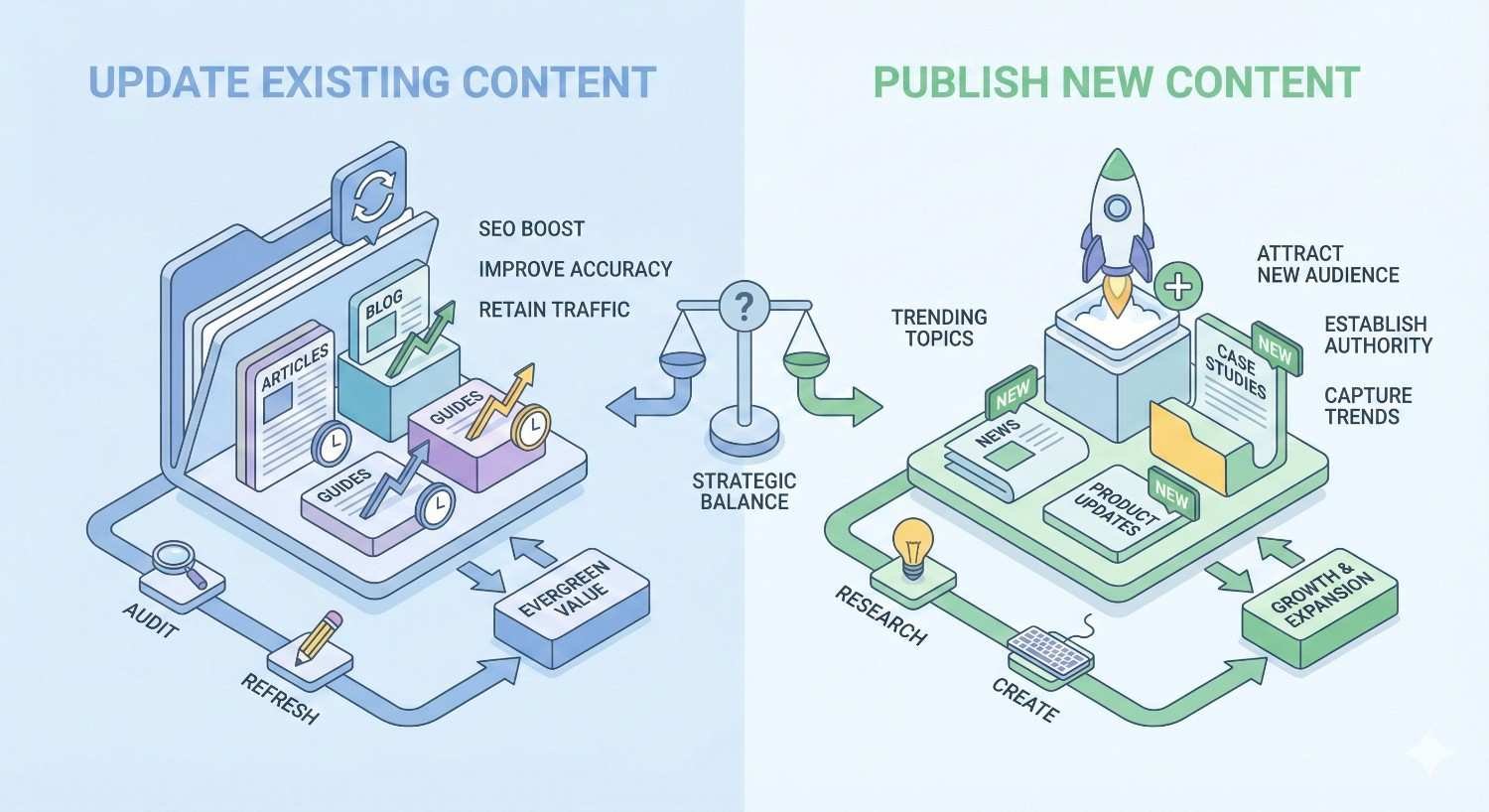
The update vs. new content decision depends on several factors. Existing pages with established rankings and backlinks often benefit more from updates than replacement. New pages make sense when the topic angle differs significantly or when starting fresh provides advantages.
URL preservation maintains accumulated authority. Updating existing URLs retains backlinks, historical engagement data, and established rankings. New URLs start from zero.
Substantial updates can trigger re-evaluation and ranking improvements. Minor changes typically don’t generate significant ranking impact.
Evergreen vs. Time-Sensitive Content Strategy
Evergreen content maintains relevance over extended periods. Time-sensitive content addresses current events, trends, or temporary situations. Both have roles in comprehensive content strategies.
Evergreen content builds sustainable traffic over time. Initial investment continues generating returns for years with periodic maintenance. Time-sensitive content can capture immediate traffic but requires ongoing production to maintain visibility.
Balancing evergreen and time-sensitive content depends on business goals and resources. Most sites benefit from an evergreen foundation supplemented by timely content addressing current developments.
User Engagement Signals and Behavioral Metrics
User engagement signals indicate how visitors interact with content. While Google has been cautious about confirming behavioral ranking factors, evidence suggests engagement metrics influence rankings either directly or indirectly.
Dwell Time and Time on Page
Dwell time measures how long users spend on a page before returning to search results. Longer dwell time suggests content satisfied user needs. Short dwell time may indicate content didn’t match expectations.
Time on page, measured in analytics, provides similar insights but includes all visits rather than just search traffic. Both metrics indicate content engagement quality.
Improving dwell time requires creating content worth spending time on. Comprehensive coverage, engaging presentation, and multimedia elements all contribute to longer engagement.
Bounce Rate and Pogo-Sticking
Bounce rate measures single-page sessions where users leave without further interaction. High bounce rates aren’t inherently negative. Users finding exactly what they need may leave satisfied.
Pogo-sticking, where users quickly return to search results and click another result, more clearly indicates dissatisfaction. This behavior suggests content didn’t meet expectations set by the search listing.
Reducing pogo-sticking requires alignment between search listings and content. Meta descriptions should accurately represent page content. Content should immediately demonstrate relevance to the query.
Click-Through Rate (CTR) from Search Results
CTR measures how often users click your listing when it appears in search results. Higher CTR indicates compelling titles and descriptions that attract clicks.
A study by Sistrix found the average CTR for position one is 28.5%, dropping significantly for lower positions. Improving CTR can increase traffic even without ranking improvements.
CTR optimization involves crafting compelling title tags, writing engaging meta descriptions, and earning rich snippets that enhance listing visibility.
Scroll Depth and Content Consumption Patterns
Scroll depth indicates how much of a page users actually view. Pages where users scroll through most content demonstrate engagement. Pages where users abandon quickly suggest problems.
Scroll depth tracking in analytics reveals content consumption patterns. Identifying where users stop scrolling highlights potential content issues or natural completion points.
Content structure affects scroll behavior. Clear visual hierarchy, engaging subheadings, and varied content formats encourage continued scrolling.
Return Visitor Behavior and Repeat Engagement
Return visitors indicate content value worth revisiting. Sites generating repeat visits demonstrate ongoing relevance and user satisfaction.
Return visitor metrics in analytics show what percentage of traffic comes from returning users. High return rates suggest strong content that builds audience loyalty.
Building return visits requires consistent quality, regular updates, and content that serves ongoing needs rather than one-time queries.
Content Structure and Readability Signals
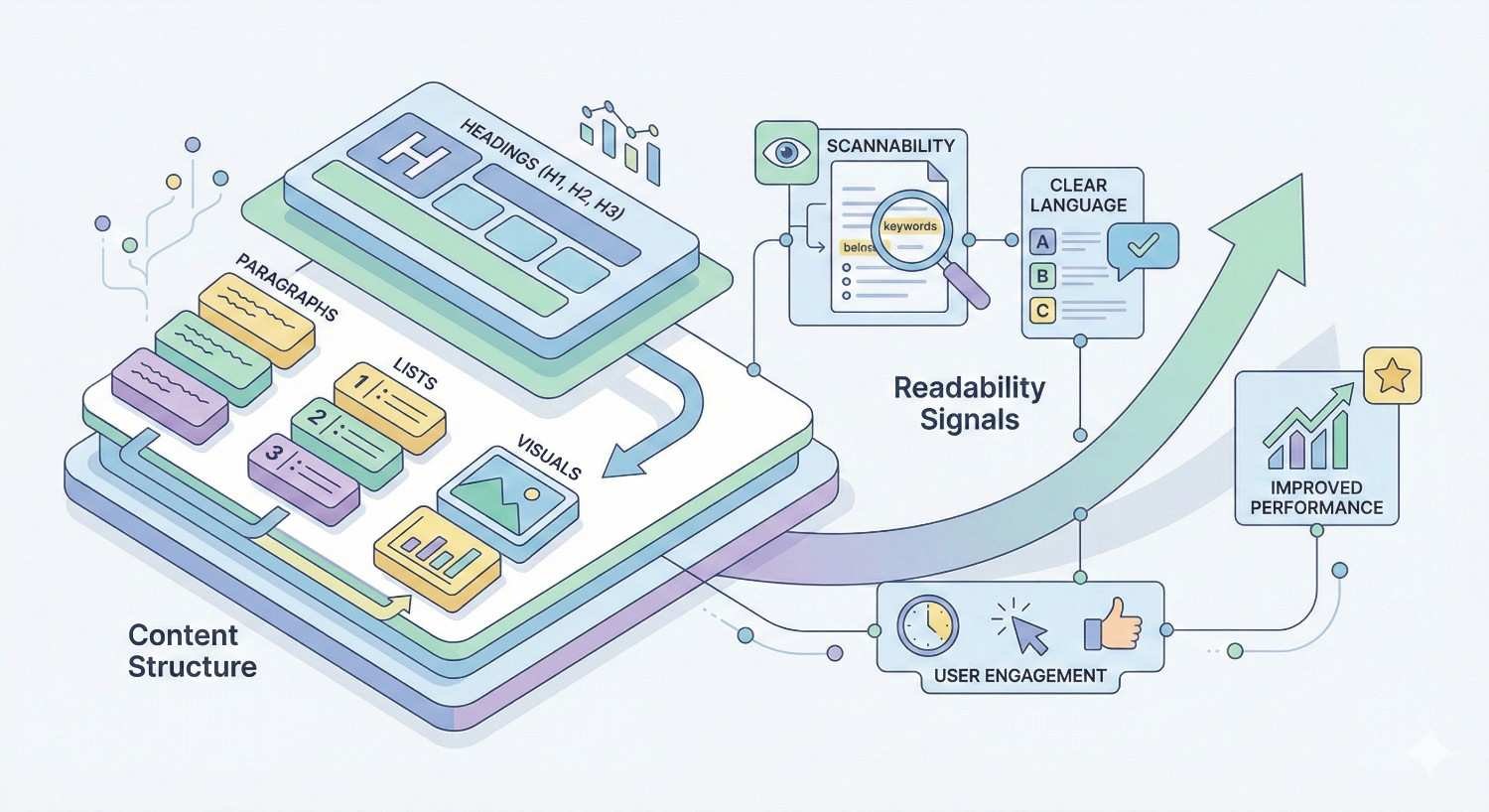
Content structure affects both user experience and search engine understanding. Well-organized content is easier to read, scan, and process algorithmically.
Heading Hierarchy and Content Organization
Heading structure provides semantic organization that helps both users and search engines understand content hierarchy.
Proper H1-H6 Structure
HTML heading tags should follow logical hierarchy. H1 identifies the main topic. H2s mark major sections. H3s subdivide H2 sections. This structure creates clear content organization.
Each page should have one H1 matching the primary topic. Multiple H1s create confusion about page focus. Heading levels shouldn’t skip, moving from H2 directly to H4 breaks logical hierarchy.
Headings should be descriptive and include relevant keywords naturally. They serve as both navigation aids and semantic signals about content topics.
Logical Information Flow
Content should progress logically from introduction through supporting sections to conclusion. Each section should build on previous sections and lead naturally to subsequent content.
Information architecture affects comprehension. Presenting foundational concepts before advanced applications helps readers follow complex topics. Jumping between unrelated points creates confusion.
Transition phrases and connecting language help readers follow content flow. Clear progression through topics improves both readability and engagement.
Readability and Reading Level
Readability affects content accessibility and engagement. Content that’s too complex loses readers. Content that’s too simple may lack depth.
Sentence and Paragraph Length
Varied sentence length improves readability. Mixing short, punchy sentences with longer explanatory ones creates rhythm and maintains interest.
Paragraph length affects scannability. Long paragraphs create visual walls of text that discourage reading. Short paragraphs, typically 2-4 sentences, improve readability on screens.
Web reading differs from print reading. Users scan rather than read linearly. Content structure should accommodate scanning behavior.
Vocabulary Complexity
Vocabulary should match audience expectations. Technical audiences expect industry terminology. General audiences need accessible language.
Jargon without explanation excludes readers unfamiliar with specialized terms. Either avoid jargon or define terms when first introduced.
Simpler words often communicate more effectively than complex alternatives. “Use” beats “utilize.” “Help” beats “facilitate.” Clarity trumps sophistication.
Readability Scores and Tools
Readability formulas like Flesch-Kincaid, Gunning Fog, and SMOG provide objective complexity measurements. These scores indicate reading level required to understand content.
Tools like Hemingway Editor, Grammarly, and Yoast SEO provide readability analysis. These tools identify complex sentences, passive voice, and other readability issues.
Target readability depends on audience. General consumer content typically targets 7th-8th grade reading level. Technical content for specialists can be more complex.
Visual Content and Multimedia Integration
Visual elements enhance content engagement and comprehension. Images, videos, and interactive elements break up text and communicate information differently.
Images, Diagrams, and Infographics
Images support text content and improve engagement. Relevant images illustrate concepts, provide examples, and create visual interest.
Diagrams and infographics communicate complex information visually. Process flows, comparison charts, and data visualizations often communicate more effectively than text descriptions.
Original images provide more value than stock photos. Custom graphics, screenshots, and original photography demonstrate effort and expertise.
Video Content Integration
Video content serves users who prefer visual learning. Embedded videos increase time on page and provide alternative content consumption options.
Video should complement rather than replace text content. Search engines can’t fully understand video content, so text should cover key information.
Video optimization includes descriptive titles, transcripts, and schema markup. These elements help search engines understand video content and context.
Alt Text and Image Optimization
Alt text describes images for accessibility and search engines. Descriptive alt text helps visually impaired users and provides context for image search.
Image optimization includes appropriate file formats, compression for fast loading, and descriptive file names. Large, unoptimized images harm page speed and user experience.
Image relevance matters. Images should support content rather than serving as decoration. Relevant images reinforce content themes and improve comprehension.
Formatting and Scannability
Formatting affects how easily users can scan and consume content. Well-formatted content accommodates natural reading patterns.
Bullet Points and Lists
Lists organize information for easy scanning. Bulleted lists work for unordered items. Numbered lists work for sequences or ranked items.
Lists should be used purposefully, not excessively. Every paragraph doesn’t need to become a list. Lists work best for genuinely list-worthy content.
List items should be parallel in structure. Consistent formatting within lists improves readability and comprehension.
White Space and Visual Breaks
White space prevents visual overwhelm. Adequate spacing between paragraphs, sections, and elements improves readability.
Visual breaks using images, pull quotes, or section dividers help readers navigate long content. These elements provide natural pause points and maintain engagement.
Dense text walls discourage reading. Strategic white space makes content more approachable and less intimidating.
Bold, Italics, and Text Emphasis
Text emphasis highlights important information. Bold text draws attention to key points. Italics indicate emphasis or introduce terms.
Emphasis should be used sparingly. When everything is emphasized, nothing stands out. Reserve bold and italics for genuinely important elements.
Consistent emphasis patterns help readers understand content hierarchy. Establishing conventions and following them throughout content improves comprehension.
Internal Linking Structure
Internal links connect related content and distribute authority throughout a site. Strategic internal linking improves both user experience and search visibility.
Contextual Internal Links
Contextual links within content connect related pages naturally. These links help users find additional relevant information and signal topical relationships to search engines.
Anchor text should be descriptive and relevant. Generic anchors like “click here” waste linking opportunities. Descriptive anchors indicate linked page topics.
Link placement affects both user behavior and link value. Links within main content carry more weight than footer or sidebar links.
Topic Clusters and Content Hubs
Topic clusters organize content around central themes. Pillar pages provide comprehensive topic overviews. Cluster pages address specific subtopics and link back to pillars.
This structure demonstrates topical authority and creates clear content hierarchies. Search engines recognize these relationships and reward comprehensive topic coverage.
Hub pages serve as central resources linking to related content. These pages help users navigate topic areas and consolidate authority.
Link Depth and Distribution
Link depth measures how many clicks from the homepage reach a page. Important pages should be accessible within 3-4 clicks. Deeply buried pages receive less crawl attention and authority.
Link distribution should prioritize important pages. High-value content should receive more internal links than low-priority pages.
Orphan pages with no internal links are difficult for search engines to discover and evaluate. Every indexable page should have at least one internal link.
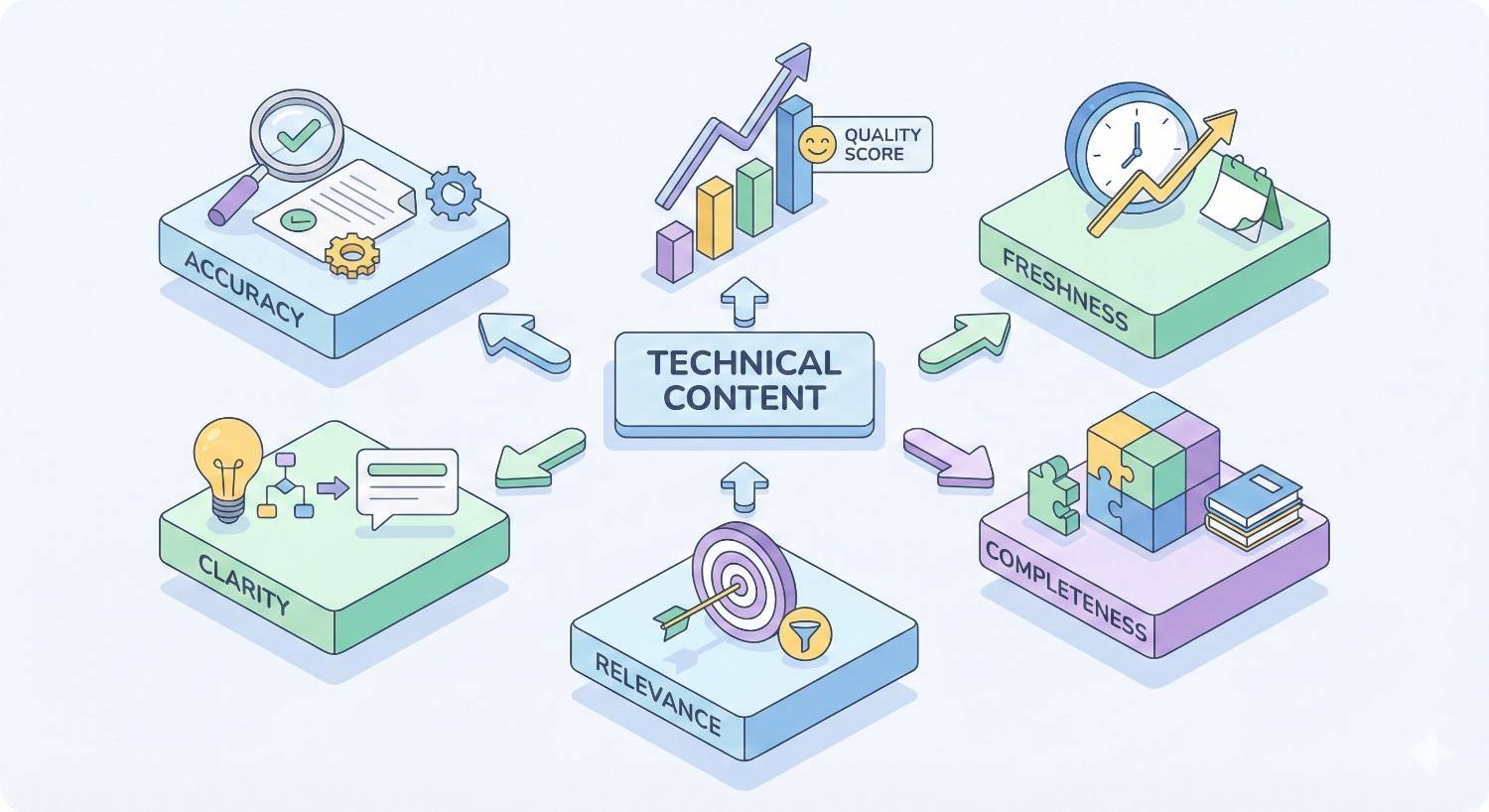
Technical Content Quality Signals
Technical factors affect how search engines access, process, and evaluate content. Technical quality signals ensure content can be properly crawled, indexed, and rendered.
Page Speed and Core Web Vitals
Page speed affects both user experience and search rankings. Google’s Core Web Vitals provide specific metrics for measuring page experience.
Largest Contentful Paint (LCP)
LCP measures loading performance, specifically when the largest content element becomes visible. Google recommends LCP under 2.5 seconds for good user experience.
Improving LCP involves optimizing server response times, eliminating render-blocking resources, and optimizing images and other large elements.
LCP issues often stem from slow servers, unoptimized images, or render-blocking JavaScript. Identifying the largest element and optimizing its delivery improves LCP.
First Input Delay (FID) / Interaction to Next Paint (INP)
FID measured input responsiveness. INP, which replaced FID in March 2024, measures overall interaction responsiveness throughout the page lifecycle.
Good INP scores require pages that respond quickly to user interactions. Heavy JavaScript, long tasks, and inefficient code create interaction delays.
Optimizing INP involves breaking up long tasks, optimizing JavaScript execution, and minimizing main thread blocking.
Cumulative Layout Shift (CLS)
CLS measures visual stability, specifically unexpected layout shifts during page loading. Good CLS scores require minimal unexpected movement.
Layout shifts frustrate users and can cause misclicks. Common causes include images without dimensions, dynamically injected content, and late-loading fonts.
Preventing CLS requires reserving space for dynamic elements, including size attributes on images and videos, and avoiding content insertion above existing content.
Mobile Optimization and Responsive Design
Mobile optimization is essential given mobile-first indexing and mobile search dominance. Sites must provide excellent mobile experiences to rank competitively.
Mobile-First Indexing Implications
Google primarily uses mobile versions of pages for indexing and ranking. Desktop-only optimization is insufficient. Mobile experience determines search visibility.
Mobile-first indexing means mobile content must be complete. Content hidden on mobile but visible on desktop may not be indexed. Ensure mobile versions include all important content.
Mobile and desktop versions should have equivalent content, structured data, and metadata. Significant differences between versions can cause indexing issues.
Mobile Usability Signals
Mobile usability encompasses touch-friendly design, readable text without zooming, and appropriate viewport configuration. Google Search Console reports mobile usability issues.
Common mobile usability problems include text too small to read, clickable elements too close together, and content wider than screen. These issues harm both user experience and rankings.
Responsive design that adapts to screen sizes provides the best mobile experience. Separate mobile sites create maintenance challenges and potential content parity issues.
Content Accessibility
Accessibility ensures content is usable by people with disabilities. Accessible content also tends to be better structured and more search-engine friendly.
WCAG Compliance Standards
Web Content Accessibility Guidelines (WCAG) provide standards for accessible web content. WCAG 2.1 Level AA is the common compliance target.
Key accessibility requirements include text alternatives for images, keyboard navigability, sufficient color contrast, and clear content structure.
Accessibility benefits all users, not just those with disabilities. Clear structure, readable text, and logical navigation improve experience for everyone.
Screen Reader Optimization
Screen readers convert visual content to audio for visually impaired users. Optimizing for screen readers requires proper heading structure, descriptive link text, and meaningful alt text.
ARIA labels provide additional context for interactive elements. These labels help screen readers communicate element purposes and states.
Testing with actual screen readers reveals accessibility issues that automated tools miss. Manual testing ensures content works for assistive technology users.
Keyboard Navigation
Keyboard navigation allows users to navigate without a mouse. All interactive elements should be accessible via keyboard.
Focus indicators show which element is currently selected. Visible focus states help keyboard users track their position on the page.
Tab order should follow logical content flow. Users should be able to navigate through content in a sensible sequence using only the keyboard.
Structured Data and Schema Markup
Structured data helps search engines understand content context and can enable rich results in search listings.
Article Schema
Article schema identifies content as articles and provides metadata including headline, author, publication date, and publisher information.
Proper article schema can enable rich results including article carousels and enhanced listings. Required properties include headline, image, datePublished, and author.
Article schema should accurately represent content. Misusing schema to claim content is something it’s not violates guidelines.
FAQ and How-To Schema
FAQ schema marks up question-and-answer content. When eligible, FAQ schema can generate expandable questions directly in search results.
How-To schema marks up instructional content with steps. This schema can generate rich results showing steps directly in search listings.
Both schema types require content that genuinely matches the format. FAQ schema requires actual questions and answers. How-To schema requires actual step-by-step instructions.
Author and Organization Markup
Author schema identifies content creators and can link to author profiles and credentials. This markup supports E-E-A-T signals by clearly identifying who created content.
Organization schema identifies the publishing entity. This markup can enable knowledge panel information and supports brand recognition.
Connecting author and organization markup creates clear attribution chains that support trust and authority signals.
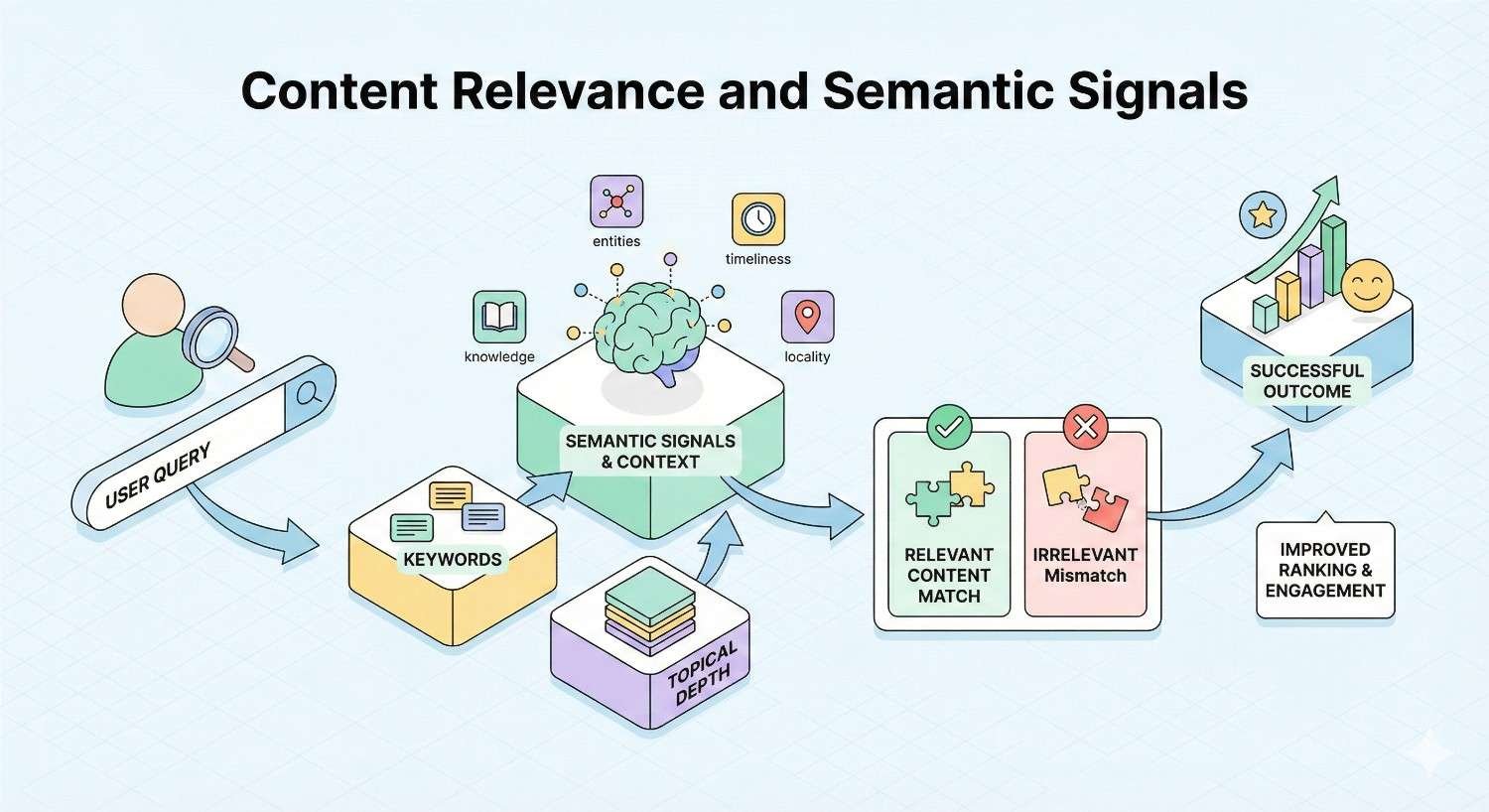
Content Relevance and Semantic Signals
Relevance signals indicate how well content matches search queries. Semantic understanding allows search engines to evaluate relevance beyond simple keyword matching.
Keyword Relevance and Natural Language Use
Keywords remain important but must be used naturally within comprehensive, valuable content.
Primary Keyword Integration
Primary keywords should appear in key locations including title tags, H1 headings, first paragraph, and throughout content. Placement should be natural, not forced.
Keyword prominence in early content signals topic focus. Including primary keywords in the first 100 words helps establish relevance.
Exact match keywords matter less than they once did. Semantic understanding allows search engines to recognize relevance even with keyword variations.
Semantic Keyword Variations
Semantic variations include synonyms, related terms, and different phrasings of the same concept. Natural content includes these variations automatically.
LSI (Latent Semantic Indexing) keywords are terms that frequently co-occur with primary keywords. Including these terms signals comprehensive topic coverage.
Keyword research tools identify semantic variations to include. Tools like Ahrefs, Semrush, and Google’s related searches reveal relevant variations.
Avoiding Keyword Stuffing
Keyword stuffing, repeating keywords unnaturally to manipulate rankings, violates guidelines and harms user experience. Modern algorithms detect and penalize keyword stuffing.
Natural keyword density varies by topic and content type. There’s no optimal percentage. Keywords should appear where they naturally fit.
Reading content aloud reveals unnatural keyword usage. If phrasing sounds awkward or repetitive, it likely needs revision.
Topic Modeling and Entity Coverage
Search engines understand topics through entities and their relationships. Comprehensive content covers relevant entities and concepts.
Related Entities and Concepts
Entities are specific things: people, places, organizations, concepts. Content about a topic should mention relevant entities naturally.
Entity coverage signals comprehensive understanding. Content about SEO should mention Google, search engines, rankings, algorithms, and related entities.
Entity relationships matter as much as entity presence. How entities connect and relate demonstrates deeper topic understanding.
Co-Occurrence Patterns
Co-occurrence refers to terms that frequently appear together in quality content about a topic. Search engines learn these patterns and expect them in comprehensive content.
Missing expected co-occurring terms may signal incomplete coverage. Including these terms naturally demonstrates thorough topic treatment.
Co-occurrence analysis tools identify terms that should appear together. These tools help ensure content meets semantic expectations.
Knowledge Graph Alignment
Google’s Knowledge Graph contains structured information about entities and relationships. Content aligned with Knowledge Graph understanding may receive enhanced treatment.
Structured data helps connect content to Knowledge Graph entities. Clear entity identification supports algorithmic understanding.
Factual accuracy matters for Knowledge Graph alignment. Contradicting established facts can harm content credibility.
Search Intent Matching
Intent matching ensures content serves what users actually want when they search.
Informational Intent Signals
Informational queries seek knowledge and understanding. Content serving informational intent should educate, explain, and inform.
Informational content typically includes definitions, explanations, how-to instructions, and comprehensive topic coverage. The goal is helping users understand.
SERP analysis reveals informational intent through result types. Queries returning guides, articles, and educational content indicate informational intent.
Transactional Intent Signals
Transactional queries indicate readiness to take action, typically purchasing. Content serving transactional intent should facilitate conversion.
Transactional content includes product pages, pricing information, and clear calls to action. The goal is enabling the desired transaction.
Transactional SERPs feature product listings, shopping results, and commercial pages. These signals indicate transactional intent.
Navigational Intent Signals
Navigational queries seek specific websites or pages. Users know where they want to go and use search to get there.
Navigational content should be the destination users seek. Brand searches should lead to official brand pages.
Optimizing for navigational queries involves ensuring your pages rank for your brand terms and specific page names.
Commercial Investigation Intent
Commercial investigation queries indicate research before purchase. Users are comparing options and gathering information to inform decisions.
Commercial investigation content includes comparisons, reviews, and buying guides. The goal is helping users evaluate options.
These queries often include terms like “best,” “vs,” “review,” and “comparison.” Content should address the evaluation criteria users care about.
Query-Content Alignment
Query-content alignment ensures content directly addresses what users search for.
Featured Snippet Optimization
Featured snippets appear above regular results, providing direct answers. Earning featured snippets requires content structured to answer questions directly.
Snippet-optimized content includes clear question-and-answer formats, concise definitions, and well-structured lists or tables.
Analyzing existing snippets reveals format preferences. Matching the format of current snippets improves snippet capture chances.
People Also Ask (PAA) Coverage
People Also Ask boxes show related questions users search. Addressing PAA questions within content demonstrates comprehensive coverage.
PAA questions reveal related user needs. Including answers to these questions serves users who have follow-up questions.
FAQ sections can address PAA questions directly. This format supports both user needs and potential rich result eligibility.
Related Searches Integration
Related searches at the bottom of SERPs indicate connected queries. Addressing related search topics within content signals comprehensive coverage.
Related searches reveal the broader topic context users explore. Content addressing these related areas serves users more completely.
Natural integration of related topics improves content comprehensiveness without forcing unrelated information.
Authority and Trust Signals Beyond Content
Authority and trust signals extend beyond on-page content to include external validation and site-wide credibility indicators.
Backlink Quality and Relevance
Backlinks remain among the strongest ranking signals. Link quality matters far more than quantity.
Link Authority Metrics
Link authority derives from the linking page and domain. Links from authoritative, trusted sites carry more weight than links from low-quality sources.
Third-party metrics like Domain Authority (Moz) and Domain Rating (Ahrefs) estimate link authority. While not Google metrics, they correlate with ranking ability.
A few high-quality links outperform many low-quality links. Focus link building efforts on earning links from authoritative, relevant sources.
Topical Relevance of Linking Domains
Topical relevance affects link value. Links from sites covering related topics carry more weight than links from unrelated sources.
A link from an SEO blog to SEO content is more valuable than a link from an unrelated site. Relevance signals that the link represents genuine endorsement.
Building topically relevant links requires creating content that appeals to sites in your space. Original research, unique insights, and valuable resources attract relevant links.
Natural Link Profile Patterns
Natural link profiles show diversity in anchor text, linking domains, and link types. Unnatural patterns, like excessive exact-match anchors, can trigger penalties.
Link velocity should be consistent with content publication and promotion. Sudden link spikes without corresponding activity appear manipulative.
Monitoring link profiles identifies potential issues before they cause problems. Regular audits catch toxic links and unnatural patterns.
Author Authority and Credentials
Author authority signals indicate content creator credibility. For YMYL topics especially, author credentials significantly impact content evaluation.
Author Bio and Bylines
Author bios establish creator credentials. Detailed bios including qualifications, experience, and expertise support E-E-A-T signals.
Bylines should link to author pages with additional information. These pages can include publication history, credentials, and social profiles.
Consistent author identification across content builds author authority over time. Anonymous content lacks the credibility of attributed content.
Author Entity Recognition
Search engines recognize authors as entities. Building author entity recognition involves consistent identification across the web.
Author schema markup helps search engines identify content creators. Linking to authoritative profiles (LinkedIn, industry publications) strengthens entity recognition.
Authors with established entities may see their content treated more favorably. Building author reputation supports content performance.
Subject Matter Expert Verification
For YMYL topics, subject matter expert verification matters significantly. Medical content should be reviewed by healthcare professionals. Financial content should involve qualified advisors.
Expert review can be indicated through reviewer credits, editorial policies, and verification statements. These signals demonstrate commitment to accuracy.
Expert involvement should be genuine, not performative. Claiming expert review without actual expert involvement violates trust.
Domain Authority and Site-Wide Trust
Site-level signals affect all content on a domain. Building domain authority supports individual page performance.
Historical Performance and Age
Domain age and historical performance contribute to trust signals. Established domains with consistent quality history have advantages over new domains.
Historical performance includes ranking history, traffic patterns, and past content quality. Domains with penalty history may face ongoing trust challenges.
New domains can build authority through consistent quality content and legitimate link building. Age alone doesn’t guarantee authority.
Security Signals (HTTPS, Privacy)
HTTPS is a confirmed ranking signal. Secure connections protect user data and demonstrate site professionalism.
Privacy policies and data handling transparency support trust signals. Clear privacy practices demonstrate respect for user data.
Security extends beyond HTTPS to include protection against malware, spam, and other threats. Compromised sites face ranking penalties.
About Us, Contact, and Transparency Pages
Transparency pages establish organizational credibility. About pages explain who operates the site and their qualifications.
Contact information demonstrates legitimacy. Physical addresses, phone numbers, and responsive contact forms support trust.
Editorial policies explain content creation standards. These policies demonstrate commitment to quality and accuracy.
Social Signals and Brand Mentions
Social signals and brand mentions indicate broader recognition and reputation.
Social Sharing Patterns
Social sharing indicates content resonance. Widely shared content demonstrates value to audiences.
While social signals aren’t confirmed direct ranking factors, they correlate with other positive signals like links and engagement.
Creating shareable content involves providing genuine value, emotional resonance, or practical utility that motivates sharing.
Unlinked Brand Mentions
Brand mentions without links still provide value. Search engines can identify brand mentions and use them as reputation signals.
Monitoring brand mentions reveals reputation and sentiment. Positive mentions support brand authority. Negative mentions may require response.
Building brand mentions involves PR, thought leadership, and creating content worth discussing.
Online Reputation Signals
Online reputation encompasses reviews, ratings, and sentiment across the web. Positive reputation supports trust signals.
Review management matters for local and e-commerce SEO. Responding to reviews, addressing concerns, and maintaining positive ratings support visibility.
Reputation monitoring identifies issues before they escalate. Proactive reputation management protects brand authority.
How to Measure and Audit Content Quality Signals
Measuring content quality requires systematic assessment using appropriate tools and frameworks.
Content Quality Audit Framework
Structured audits identify quality issues and improvement opportunities across content portfolios.
Establishing Quality Benchmarks
Benchmarks define quality standards for your content. These standards should reflect audience expectations, competitive requirements, and business goals.
Benchmark criteria might include minimum word counts, required elements (images, sources), readability targets, and E-E-A-T requirements.
Benchmarks should be documented and consistently applied. Clear standards enable objective quality assessment.
Page-Level Quality Assessment
Page-level audits evaluate individual content pieces against quality criteria. Each page should be assessed for comprehensiveness, accuracy, engagement, and technical factors.
Scoring systems help prioritize improvements. Pages scoring lowest on quality metrics should receive attention first.
Page-level assessment should include both quantitative metrics (word count, engagement data) and qualitative evaluation (accuracy, usefulness).
Site-Wide Quality Analysis
Site-wide analysis identifies patterns and systemic issues. Are certain content types consistently underperforming? Are there common quality gaps?
Aggregate analysis reveals portfolio-level opportunities. Improving site-wide quality lifts all content performance.
Site-wide audits should occur regularly, not just once. Ongoing monitoring catches issues before they compound.
Tools for Measuring Content Quality
Various tools support content quality measurement and improvement.
Google Search Console Insights
Search Console provides direct data on how Google sees your content. Performance reports show impressions, clicks, and average positions.
Coverage reports identify indexing issues. Pages not indexed may have quality problems preventing inclusion.
Core Web Vitals reports show page experience metrics. These reports identify technical quality issues affecting user experience.
Google Analytics Engagement Metrics
Analytics provides user behavior data indicating content engagement. Time on page, bounce rate, and pages per session reveal how users interact with content.
Behavior flow reports show how users navigate through content. Drop-off points indicate potential content issues.
Conversion tracking connects content performance to business outcomes. Quality content should drive desired actions.
Third-Party SEO Tools (Semrush, Ahrefs, Clearscope)
SEO platforms provide competitive analysis and content optimization insights. These tools reveal how your content compares to ranking competitors.
Content optimization tools like Clearscope, Surfer SEO, and MarketMuse analyze semantic completeness. These tools identify gaps in topic coverage.
Backlink analysis tools show authority signals. Link profiles indicate external validation of content quality.
Readability and Accessibility Checkers
Readability tools assess content complexity. Hemingway Editor, Grammarly, and similar tools identify readability issues.
Accessibility checkers evaluate compliance with accessibility standards. WAVE, axe, and similar tools identify accessibility barriers.
These tools provide objective measurements supporting quality improvement efforts.
Key Performance Indicators (KPIs) for Content Quality
KPIs connect quality signals to measurable outcomes.
Organic Traffic Growth
Organic traffic growth indicates improving search visibility. Quality improvements should drive traffic increases over time.
Traffic analysis should segment by content type, topic, and age. Understanding what drives traffic informs strategy.
Traffic quality matters as much as quantity. Relevant traffic that converts provides more value than high-volume irrelevant traffic.
Ranking Position Changes
Ranking improvements indicate quality recognition by search engines. Tracking positions for target keywords reveals content performance.
Position tracking should cover primary keywords and long-tail variations. Comprehensive tracking reveals full visibility picture.
Ranking volatility is normal. Focus on trends rather than daily fluctuations.
Engagement Metrics
Engagement metrics indicate user satisfaction with content. Time on page, scroll depth, and return visits signal content value.
Engagement benchmarks should reflect content type and purpose. Reference content may have shorter engagement than in-depth guides.
Improving engagement often requires content improvements rather than just technical changes.
Conversion and Lead Generation
Conversions connect content to business outcomes. Quality content should drive desired actions whether purchases, leads, or other goals.
Attribution modeling reveals which content contributes to conversions. Understanding content’s role in conversion paths informs investment.
Conversion optimization and content quality work together. Great content with poor conversion paths wastes opportunity.
Identifying Low-Quality Content
Identifying low-quality content enables targeted improvement or removal.
Thin Content Pages
Thin content provides insufficient value to justify existence. Pages with minimal original content, excessive ads, or incomplete information qualify as thin.
Thin content identification involves reviewing word counts, unique content ratios, and user engagement metrics.
Thin content options include expansion, consolidation, noindexing, or removal. The right choice depends on page potential and resources.
Duplicate Content Issues
Duplicate content creates indexing confusion and dilutes authority. Internal duplication and external copying both cause problems.
Duplicate content tools identify matching content across pages. Siteliner, Copyscape, and similar tools reveal duplication.
Addressing duplication involves canonicalization, consolidation, or differentiation depending on the situation.
Outdated or Inaccurate Information
Outdated content provides incorrect information that harms user experience and trust. Regular audits should identify content needing updates.
Accuracy verification should check statistics, recommendations, and factual claims. Outdated information should be corrected or removed.
Update frequency depends on topic volatility. Fast-changing topics need more frequent review than stable subjects.
Poor User Engagement Signals
Poor engagement indicates content isn’t meeting user needs. High bounce rates, low time on page, and minimal scroll depth signal problems.
Engagement analysis should identify specific issues. Is content not matching search intent? Is presentation problematic? Is information incomplete?
Improving engagement requires addressing root causes, not just symptoms. Surface-level changes rarely fix fundamental content problems.
Implementing a Content Quality Improvement Strategy
Systematic quality improvement requires structured processes for creation, optimization, and maintenance.
Content Creation Best Practices
Quality starts with creation processes that prioritize value and accuracy.
Research and Planning Phase
Thorough research precedes quality content creation. Understanding the topic, audience needs, and competitive landscape informs content development.
Planning should define content goals, target keywords, required elements, and success metrics. Clear plans guide creation toward quality outcomes.
Research should include primary sources, expert perspectives, and competitive analysis. Comprehensive research enables comprehensive content.
Writing for Users and Search Engines
Quality content serves users first while incorporating SEO best practices. User value and search optimization aren’t opposing goals.
Writing for users means clear communication, practical value, and genuine helpfulness. Writing for search engines means proper structure, semantic completeness, and technical optimization.
The best content achieves both objectives simultaneously. User-focused content that’s well-optimized performs best.
Editorial Standards and Guidelines
Editorial standards ensure consistent quality across content. Style guides, quality checklists, and review processes maintain standards.
Standards should cover accuracy requirements, source quality, formatting conventions, and brand voice. Clear guidelines enable consistent execution.
Standards should evolve based on performance data and changing requirements. Regular review keeps standards relevant.
Quality Assurance and Review Process
Review processes catch issues before publication. Editorial review, fact-checking, and technical review all contribute to quality.
Review checklists ensure consistent evaluation. Reviewers should assess accuracy, completeness, readability, and optimization.
Multiple review stages catch different issues. Initial review, subject matter expert review, and final editorial review each serve purposes.
Content Optimization and Enhancement
Existing content often offers improvement opportunities with less effort than new creation.
Updating Existing Content
Content updates refresh information, improve comprehensiveness, and signal freshness. Updates can significantly improve performance of existing pages.
Update prioritization should focus on high-potential pages. Pages with existing traffic and rankings often respond well to improvements.
Substantial updates involve more than date changes. Adding sections, updating statistics, improving examples, and enhancing structure constitute meaningful updates.
Expanding Thin Content
Thin content can be expanded into comprehensive resources. Adding depth, examples, and supporting information transforms thin pages.
Expansion should address user needs, not just add words. Additional content should provide additional value.
Some thin content may not warrant expansion. Pages without strategic value may be better consolidated or removed.
Consolidating Duplicate Content
Duplicate content consolidation combines similar pages into single, stronger resources. Consolidation concentrates authority and eliminates confusion.
Consolidation involves identifying the best URL, redirecting others, and combining valuable content from all sources.
Proper redirects preserve link equity from consolidated pages. 301 redirects pass authority to the consolidated destination.
Adding Multimedia and Visual Elements
Multimedia enhances content engagement and comprehension. Images, videos, and interactive elements provide value beyond text.
Multimedia should support content goals, not just decorate pages. Each element should serve a purpose.
Optimization ensures multimedia doesn’t harm performance. Compressed images, lazy loading, and proper formatting maintain page speed.
Building Topical Authority Through Content
Topical authority develops through comprehensive, interconnected content coverage.
Content Hub and Pillar Page Strategy
Pillar pages provide comprehensive topic overviews. Hub pages connect related content into organized resources.
Pillar content should be the definitive resource on a topic. Comprehensive coverage, regular updates, and strong internal linking characterize effective pillars.
Hub structures help users navigate topic areas and demonstrate topical depth to search engines.
Topic Cluster Development
Topic clusters organize content around central themes. Pillar pages anchor clusters. Supporting content addresses specific subtopics.
Cluster development requires identifying core topics and mapping subtopics. Each subtopic becomes a content opportunity.
Internal linking connects cluster content. Supporting pages link to pillars. Pillars link to relevant supporting content.
Internal Linking Architecture
Strategic internal linking distributes authority and signals topical relationships. Link architecture should reflect content priorities.
Important pages should receive more internal links. Link distribution should align with business and SEO priorities.
Contextual links within content carry more weight than navigational links. Natural, relevant internal links provide the most value.
Consistent Publishing Schedule
Consistent publishing builds topical authority over time. Regular content addition signals active, authoritative coverage.
Publishing frequency should be sustainable. Consistent moderate output beats inconsistent bursts.
Quality should never be sacrificed for quantity. Publishing schedules should allow adequate time for quality creation.
Ongoing Content Maintenance
Content requires ongoing maintenance to remain accurate and effective.
Content Refresh Schedules
Scheduled refreshes ensure content stays current. Different content types need different refresh frequencies.
Time-sensitive content needs frequent review. Evergreen content needs less frequent but still regular attention.
Refresh schedules should be documented and followed. Systematic maintenance prevents content decay.
Performance Monitoring
Ongoing monitoring identifies performance changes requiring attention. Traffic drops, ranking losses, and engagement declines signal potential issues.
Monitoring should cover key metrics for priority content. Automated alerts can flag significant changes.
Performance changes should trigger investigation. Understanding why performance changed informs appropriate response.
Continuous Improvement Cycles
Quality improvement is ongoing, not one-time. Continuous improvement cycles identify opportunities and implement enhancements.
Improvement cycles should include measurement, analysis, action, and evaluation. Each cycle builds on previous learnings.
Improvement prioritization should focus resources on highest-impact opportunities. Not all content warrants equal investment.
Common Content Quality Mistakes to Avoid
Avoiding common mistakes prevents quality problems that harm performance.
Over-Optimization and Keyword Stuffing
Over-optimization prioritizes search engines over users. Keyword stuffing, unnatural anchor text, and forced optimization harm both user experience and rankings.
Natural language should guide keyword usage. If phrasing sounds awkward, it’s probably over-optimized.
Modern algorithms detect and penalize over-optimization. Natural, user-focused content performs better than manipulative optimization.
Prioritizing Search Engines Over Users
Content created primarily for search engines rather than users typically underperforms. Search engines aim to reward content that serves users.
User-first content naturally incorporates SEO best practices. Helpful, comprehensive content tends to be well-optimized.
Testing content with actual users reveals whether it serves their needs. User feedback should inform content development.
Neglecting Content Updates and Maintenance
Published content requires ongoing attention. Neglected content becomes outdated, inaccurate, and less competitive.
Content maintenance should be budgeted and scheduled. Treating content as a one-time investment leads to decay.
Regular audits identify content needing attention. Systematic maintenance prevents accumulation of quality debt.
Thin or Duplicate Content at Scale
Scaling thin or duplicate content harms site-wide quality signals. Large volumes of low-quality content can trigger algorithmic penalties.
Quality should scale with quantity. Growth should come from more quality content, not lower standards.
Content audits should identify and address thin and duplicate content. Pruning low-quality content can improve overall site performance.
Ignoring Mobile Experience
Mobile experience affects rankings through mobile-first indexing. Sites with poor mobile experience struggle to rank.
Mobile testing should be part of quality assurance. Content should be evaluated on mobile devices, not just desktop.
Responsive design ensures consistent experience across devices. Mobile-specific issues should be identified and resolved.
Lack of E-E-A-T Signals
Missing E-E-A-T signals undermine content credibility. Without clear expertise, experience, authority, and trust indicators, content struggles to compete.
E-E-A-T signals should be built into content creation processes. Author identification, source citation, and transparency should be standard.
E-E-A-T matters most for YMYL topics but affects all content. Building E-E-A-T signals benefits all content performance.
Content Quality Signals and SEO Timelines
Understanding timelines helps set realistic expectations for quality improvement initiatives.
How Long Does It Take for Quality Improvements to Impact Rankings?
Quality improvements typically take weeks to months to impact rankings. The timeline depends on crawl frequency, competition, and improvement magnitude.
Minor updates may show impact within weeks. Major improvements to competitive content may take months.
Patience is essential. Quality improvements compound over time. Initial results often understate long-term impact.
Crawling, Indexing, and Ranking Refresh Cycles
Search engines must crawl, index, and re-evaluate content before improvements affect rankings. Each step takes time.
Crawl frequency varies by site authority and content freshness. High-authority sites with frequent updates get crawled more often.
Requesting indexing through Search Console can accelerate discovery. However, ranking improvements still require algorithmic re-evaluation.
Setting Realistic Expectations for Content ROI
Content ROI develops over time. Unlike paid advertising, content builds value gradually rather than immediately.
Initial months may show minimal returns. Months 6-12 typically show meaningful traffic growth. Years 2-3 often deliver the strongest returns.
ROI expectations should account for this timeline. Content investment requires patience and sustained commitment.
Quick Wins vs. Long-Term Quality Investments
Some improvements deliver faster results than others. Technical fixes, title optimization, and featured snippet targeting can show quick impact.
Long-term investments like topical authority building and comprehensive content development take longer but deliver more sustainable results.
Balanced strategies include both quick wins and long-term investments. Quick wins maintain momentum while long-term investments build foundation.
The Future of Content Quality Signals
Content quality evaluation continues evolving with technology and user expectations.
AI-Generated Content and Quality Standards
AI content generation has exploded, raising questions about quality standards. Google’s position focuses on content quality regardless of creation method.
AI-generated content must meet the same quality standards as human-created content. Helpful, accurate, original content can rank regardless of how it was created.
Low-quality AI content at scale faces the same penalties as low-quality human content. The creation method matters less than the result.
Evolving User Experience Signals
User experience signals continue gaining importance. Page experience, accessibility, and interaction quality increasingly influence rankings.
New metrics may emerge as technology evolves. Staying current with experience requirements ensures continued competitiveness.
User expectations rise over time. Content that met experience standards years ago may now fall short.
Multimodal Content (Video, Audio, Interactive)
Content increasingly spans multiple formats. Video, audio, and interactive elements complement traditional text content.
Search engines are improving at understanding multimodal content. Video transcripts, audio descriptions, and interactive element markup help.
Multimodal strategies serve diverse user preferences. Some users prefer reading. Others prefer watching or listening.
Personalization and Context-Specific Quality
Search results increasingly personalize based on user context. Location, search history, and preferences influence what users see.
Quality may be evaluated contextually. Content that’s high quality for one audience may be less relevant for another.
Understanding your specific audience becomes more important as personalization increases. Generic content for everyone may underperform targeted content for specific audiences.
Conclusion: Building Sustainable Organic Growth Through Content Quality
Content quality signals form the foundation of sustainable organic visibility. Understanding and optimizing these signals separates successful SEO strategies from those that struggle.
Quality improvement requires systematic attention to E-E-A-T signals, content depth, technical performance, and user experience. No single factor determines success. Comprehensive quality across all dimensions drives results.
We help businesses build sustainable organic growth through strategic content quality improvement. Contact White Label SEO Service to discuss how we can strengthen your content quality signals and drive measurable traffic growth.
Frequently Asked Questions
What are the most important content quality signals for SEO?
E-E-A-T signals, content comprehensiveness, user engagement metrics, and technical performance are the most impactful quality signals. These factors collectively determine how search engines evaluate content worthiness for ranking positions.
How do I measure content quality on my website?
Use Google Search Console for search performance data, Google Analytics for engagement metrics, and third-party tools like Semrush or Ahrefs for competitive analysis. Combine quantitative metrics with qualitative assessment of accuracy, comprehensiveness, and user value.
How long does it take to see results from content quality improvements?
Most quality improvements show initial impact within 4-8 weeks, with full results developing over 3-6 months. Timeline varies based on crawl frequency, competition level, and improvement magnitude.
Does word count affect content quality signals?
Word count itself isn’t a ranking factor, but comprehensive content that fully addresses topics tends to be longer. Focus on covering topics thoroughly rather than hitting arbitrary word counts.
How often should I update existing content?
Update frequency depends on topic volatility. Time-sensitive content needs quarterly or monthly review. Evergreen content should be audited annually at minimum. High-traffic pages warrant more frequent attention.
Can AI-generated content rank well in search results?
AI-generated content can rank if it meets quality standards. Google evaluates content quality regardless of creation method. The key is ensuring AI content is accurate, helpful, original, and demonstrates E-E-A-T signals.
What’s the difference between content quality and content optimization?
Content quality refers to the inherent value, accuracy, and usefulness of content. Content optimization involves technical and structural improvements that help search engines understand and rank quality content. Both are necessary for SEO success.