
Content writing directly impacts your search rankings, organic traffic, and revenue growth. Businesses that publish strategic, well-optimized content consistently outperform competitors who treat content as an afterthought. The difference between content that ranks and content that disappears lies in following proven best practices.
Whether you’re building brand awareness, generating leads, or establishing topical authority, your content strategy determines outcomes. This guide covers everything from foundational principles to advanced SEO techniques that drive measurable results.
You’ll learn the complete content writing process, optimization strategies for 2024, common mistakes to avoid, and how to measure success through actionable KPIs.
What Is Content Writing?
Content writing is the strategic creation of written material designed to inform, engage, and convert target audiences. Unlike casual writing, professional content writing serves specific business objectives while meeting user needs and search engine requirements.
Effective content writing balances multiple elements: audience understanding, keyword optimization, readability, and conversion focus. It requires research, planning, and continuous refinement based on performance data.
The scope extends beyond blog posts. Content writing encompasses website copy, product descriptions, email sequences, social media content, whitepapers, case studies, and any written material that supports business goals.
Content Writing vs. Copywriting: Key Differences
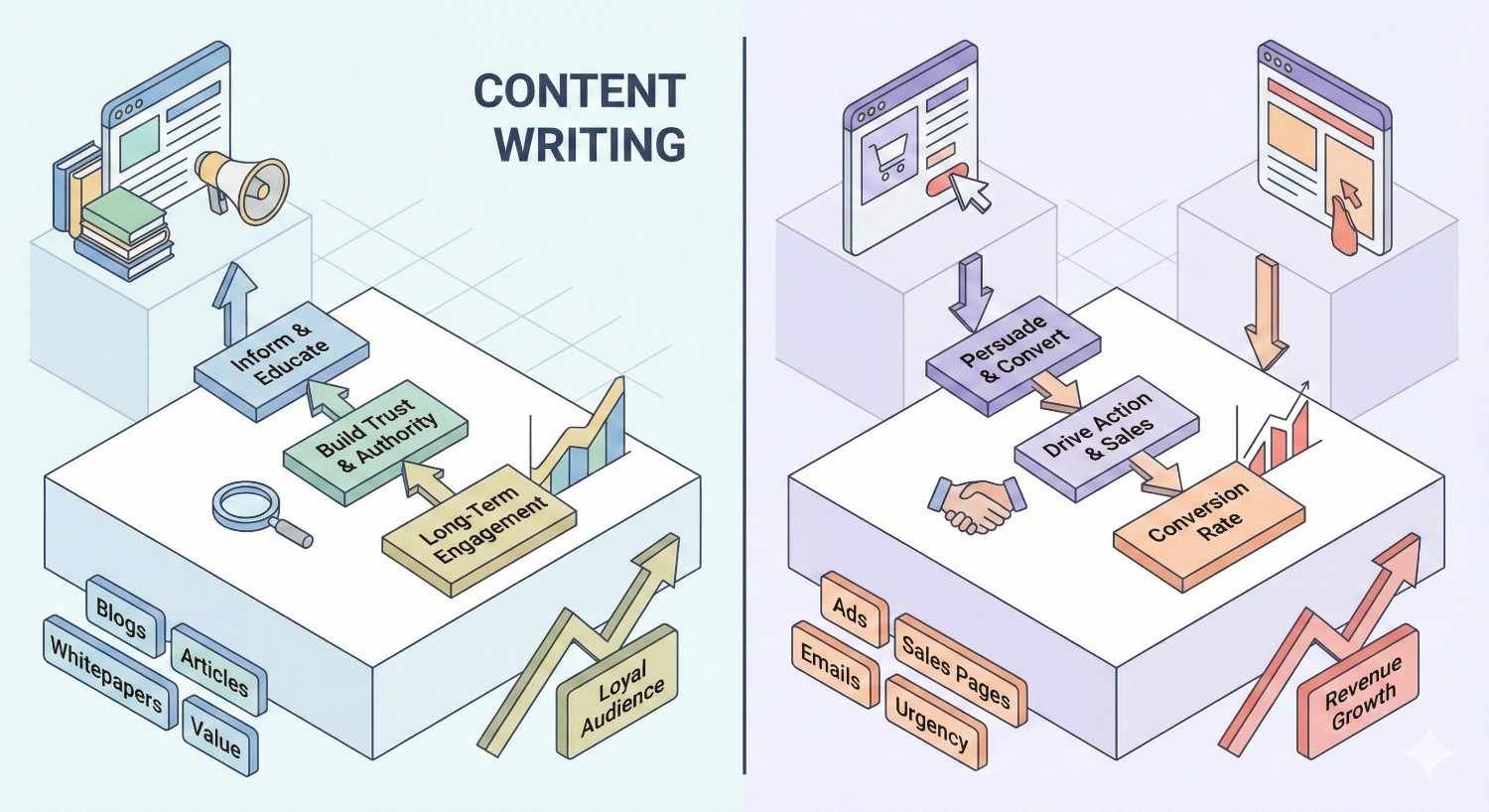
Content writing and copywriting serve distinct purposes, though they often overlap in practice.
Content writing focuses on educating, informing, and building long-term relationships with audiences. The primary goal is providing value that establishes trust and authority. Blog posts, guides, tutorials, and informational articles fall into this category. Success metrics include organic traffic, time on page, and engagement rates.
Copywriting prioritizes immediate action and conversion. Sales pages, advertisements, email subject lines, and landing page headlines aim to persuade readers toward specific actions. Success metrics center on conversion rates, click-through rates, and direct revenue attribution.
The best content writers understand both disciplines. Educational content still needs compelling headlines. Sales copy benefits from informative context. Modern SEO content blends both approaches, providing genuine value while guiding readers toward business outcomes.
Types of Content Writing for Business Growth
Different content types serve different stages of the customer journey and business objectives.
Blog posts and articles build organic visibility and topical authority. They answer questions your audience asks, capture search traffic, and establish expertise. Long-form guides perform particularly well for competitive keywords.
Website pages communicate brand value, services, and differentiation. Homepage copy, about pages, and service descriptions require clarity and persuasion balanced with SEO optimization.
Product descriptions directly impact e-commerce conversions. They combine features, benefits, and emotional triggers while incorporating relevant keywords for product search visibility.
Case studies and whitepapers demonstrate expertise and results. They serve bottom-funnel prospects evaluating solutions and support sales conversations with concrete evidence.
Email content nurtures leads and maintains customer relationships. Welcome sequences, newsletters, and promotional emails require different approaches but all benefit from content writing fundamentals.
Social media content extends reach and engagement. Platform-specific writing adapts core messages for different audiences and formats while maintaining brand voice consistency.
Why Content Writing Matters for SEO and Organic Visibility
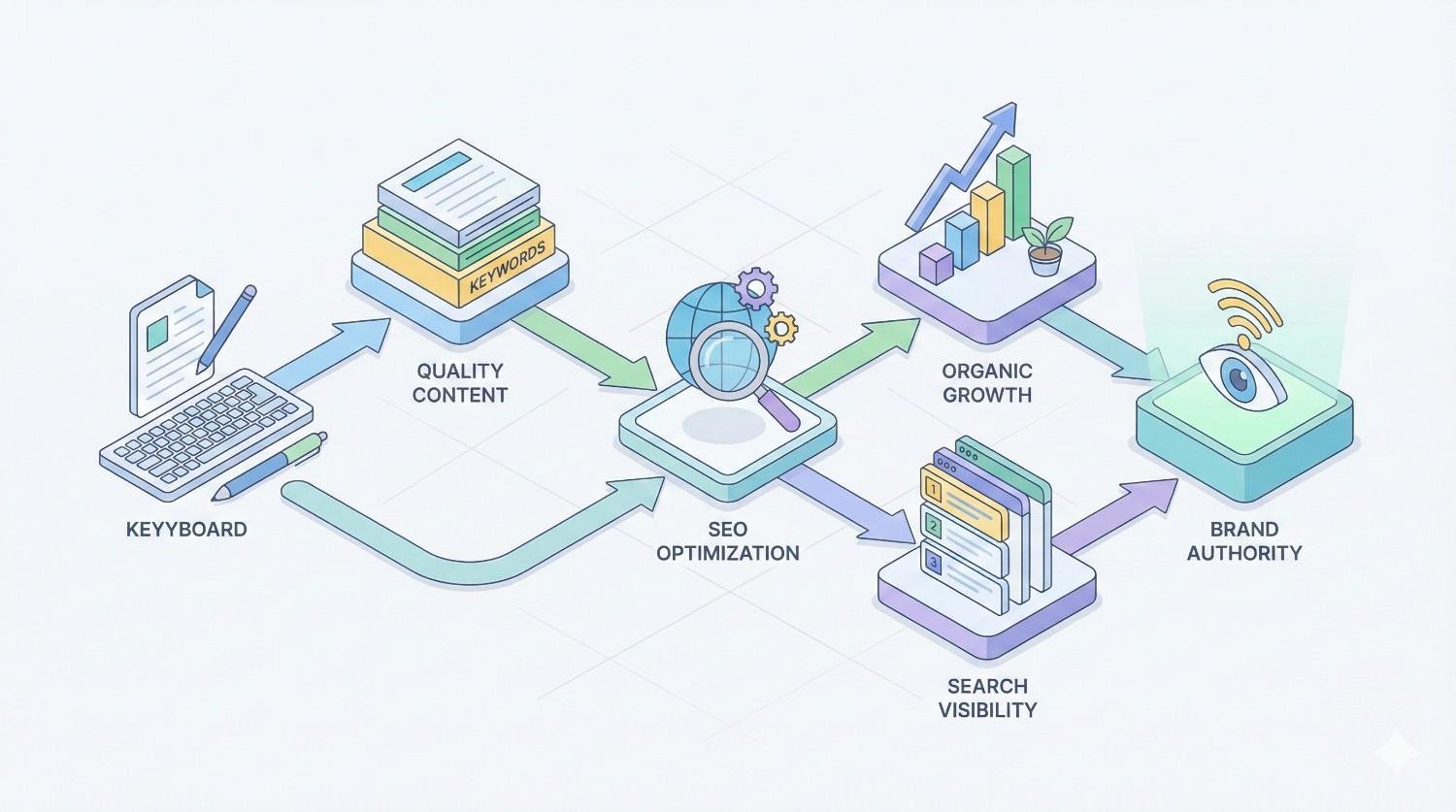
Search engines exist to connect users with relevant, helpful content. Your content quality directly determines whether search engines surface your pages for valuable queries.
Google’s algorithms have evolved dramatically. Keyword density and backlink quantity no longer guarantee rankings. Content that genuinely satisfies user intent, demonstrates expertise, and provides comprehensive coverage now dominates search results.
For businesses, this shift represents both challenge and opportunity. Companies willing to invest in quality content writing gain sustainable competitive advantages. Those relying on outdated tactics or thin content face declining visibility.
How Quality Content Drives Search Rankings
Search engines evaluate content through multiple signals that collectively determine ranking positions.
Relevance measures how well content matches search queries. This goes beyond keyword matching to semantic understanding. Google interprets user intent and evaluates whether content addresses the underlying need, not just the surface query.
Comprehensiveness rewards content that covers topics thoroughly. Pages addressing related questions, providing context, and leaving no gaps outperform shallow content targeting the same keywords.
Engagement signals indicate content quality through user behavior. Pages with high dwell time, low bounce rates, and strong click-through rates signal value to search engines. Poor engagement suggests content fails to meet expectations.
Freshness matters for topics where information changes. Regularly updated content maintains relevance while stale pages lose ranking positions to newer, more accurate alternatives.
Authority develops through consistent quality content production. Sites demonstrating deep expertise across related topics earn topical authority that benefits all content within that subject area.
The Connection Between Content and User Intent
User intent represents the underlying goal behind every search query. Understanding and satisfying intent is the foundation of effective content writing.
Informational intent seeks knowledge and understanding. Users want answers, explanations, or guidance. Content should educate thoroughly without aggressive sales messaging.
Navigational intent looks for specific pages or brands. Users know what they want and need efficient paths to reach it. Clear site structure and branded content serve this intent.
Commercial investigation compares options before decisions. Users research products, services, or solutions. Comparison content, reviews, and detailed feature explanations address this stage.
Transactional intent indicates readiness to act. Users want to purchase, sign up, or complete specific actions. Content should facilitate conversion with clear calls-to-action and minimal friction.
Misaligning content with intent wastes resources and frustrates users. A sales-focused page ranking for informational queries will underperform. Educational content appearing for transactional searches misses conversion opportunities.
Core Content Writing Best Practices for 2026
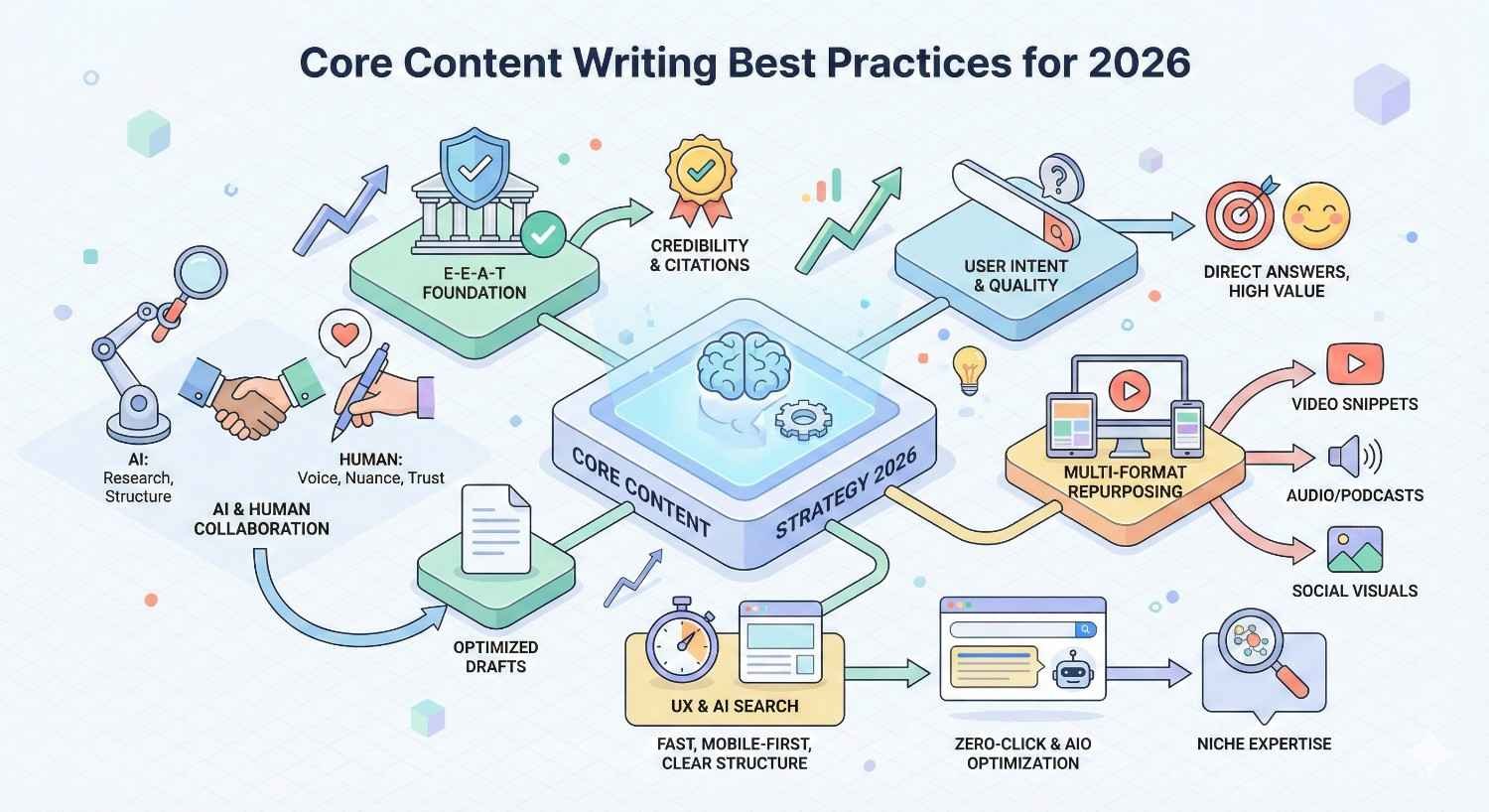
Modern content writing requires balancing user needs, search optimization, and business objectives. These practices form the foundation of content that performs.
Research and Understand Your Target Audience
Effective content starts with deep audience understanding. Generic content targeting everyone reaches no one effectively.
Define your ideal reader with specificity. What problems do they face? What questions do they ask? What language do they use? What level of expertise do they have? What motivates their decisions?
Gather audience insights from multiple sources. Customer interviews reveal pain points and priorities. Sales team feedback identifies common objections and questions. Analytics data shows which content resonates. Social listening uncovers trending topics and concerns.
Create content personas representing key audience segments. A startup founder has different needs than an enterprise marketing manager, even when searching similar topics. Tailor depth, examples, and recommendations accordingly.
Validate assumptions through content performance. High engagement indicates audience alignment. Poor performance suggests mismatched expectations or needs.
Conduct Keyword Research Before Writing
Keyword research identifies the specific terms and phrases your audience uses when searching. It guides topic selection, content structure, and optimization priorities.
Start with seed keywords representing your core topics. Expand using keyword research tools to discover related terms, questions, and long-tail variations. Analyze search volume, competition, and intent for each potential target.
Prioritize keywords based on business value and ranking potential. High-volume keywords attract more traffic but face intense competition. Long-tail keywords offer easier ranking opportunities with more specific intent.
Group related keywords into topic clusters. A single piece of content can target multiple related terms when structured comprehensively. This approach builds topical authority more efficiently than isolated keyword targeting.
Consider keyword difficulty relative to your site’s authority. New sites should target lower-competition terms initially, building authority before pursuing competitive keywords.
Create Clear, Scannable Content Structure
Online readers scan before committing to read. Content structure determines whether users engage or leave.
Use descriptive headings that communicate section content. Readers should understand your content’s scope from headings alone. Include relevant keywords naturally without forcing awkward phrasing.
Keep paragraphs short. Dense text blocks discourage reading. Two to three sentences per paragraph maintains visual accessibility and reading momentum.
Employ bullet points and numbered lists for sequences, features, or multiple related items. Lists improve scannability and comprehension while breaking visual monotony.
Front-load important information. Place key points at the beginning of sections and paragraphs. Readers who scan will still capture essential content.
Use visual hierarchy consistently. Heading levels should follow logical structure. H2 sections contain H3 subsections. Skipping levels confuses both readers and search engines.
Write Compelling Headlines and Subheadings
Headlines determine whether content gets read. Even excellent content fails without headlines that capture attention and communicate value.
Include your primary keyword in the H1 title naturally. Forced keyword placement damages readability and click-through rates. Balance optimization with appeal.
Communicate specific value in headlines. “Content Writing Tips” is generic. “Content Writing Best Practices That Drive Organic Traffic” promises concrete outcomes.
Use numbers when appropriate. Specific quantities set expectations and improve click-through rates. “7 Steps” outperforms “Several Steps” for process content.
Create curiosity without clickbait. Headlines should accurately represent content. Misleading headlines damage trust and increase bounce rates, hurting rankings.
Test headline variations when possible. Small changes in phrasing can significantly impact performance. A/B testing reveals what resonates with your specific audience.
Focus on Readability and Clarity
Complex ideas require clear explanation. Readability directly impacts engagement, comprehension, and conversion.
Write at appropriate reading levels for your audience. Technical content for experts can use industry terminology. General audience content should avoid jargon or explain it clearly.
Use active voice predominantly. “The team completed the project” is clearer than “The project was completed by the team.” Active voice improves engagement and reduces word count.
Vary sentence length intentionally. Short sentences create impact. Longer sentences provide context and nuance. Monotonous rhythm loses readers.
Define technical terms when first introduced. Don’t assume knowledge. Brief explanations maintain accessibility without condescending to informed readers.
Edit ruthlessly for clarity. Remove unnecessary words. Simplify complex sentences. Every word should earn its place.
Optimize for Search Intent and User Experience
Content must satisfy both search engines and human readers. Optimization that damages user experience ultimately hurts rankings.
Match content format to intent. How-to queries expect step-by-step instructions. Comparison queries need side-by-side analysis. Definition queries require clear explanations.
Answer the primary question early. Users shouldn’t scroll extensively to find core information. Provide immediate value, then expand with context and details.
Include related information users need. Comprehensive content anticipates follow-up questions and addresses them proactively. This increases dwell time and reduces pogo-sticking to other results.
Optimize page speed and mobile experience. Technical performance affects rankings directly and user engagement indirectly. Slow, poorly formatted pages lose readers regardless of content quality.
Use internal links strategically. Connect related content to help users explore topics deeply while distributing page authority throughout your site.
Include Strong Calls-to-Action (CTAs)
Content without direction wastes conversion opportunities. Every piece should guide readers toward meaningful next steps.
Align CTAs with content intent and reader stage. Informational content suits newsletter signups or related content suggestions. Commercial content can promote consultations or product trials.
Place CTAs strategically throughout content. A single end-of-article CTA misses readers who don’t finish. Contextual CTAs within relevant sections capture engaged readers at decision points.
Write action-oriented CTA copy. “Get Your Free Audit” outperforms “Submit.” Specific, benefit-focused language increases click-through rates.
Test CTA variations systematically. Button colors, placement, copy, and offers all impact conversion rates. Data-driven optimization improves results over time.
Balance conversion focus with user experience. Aggressive, intrusive CTAs damage trust and engagement. Helpful, relevant offers enhance the content experience.
Content Writing Process: A Step-by-Step Framework
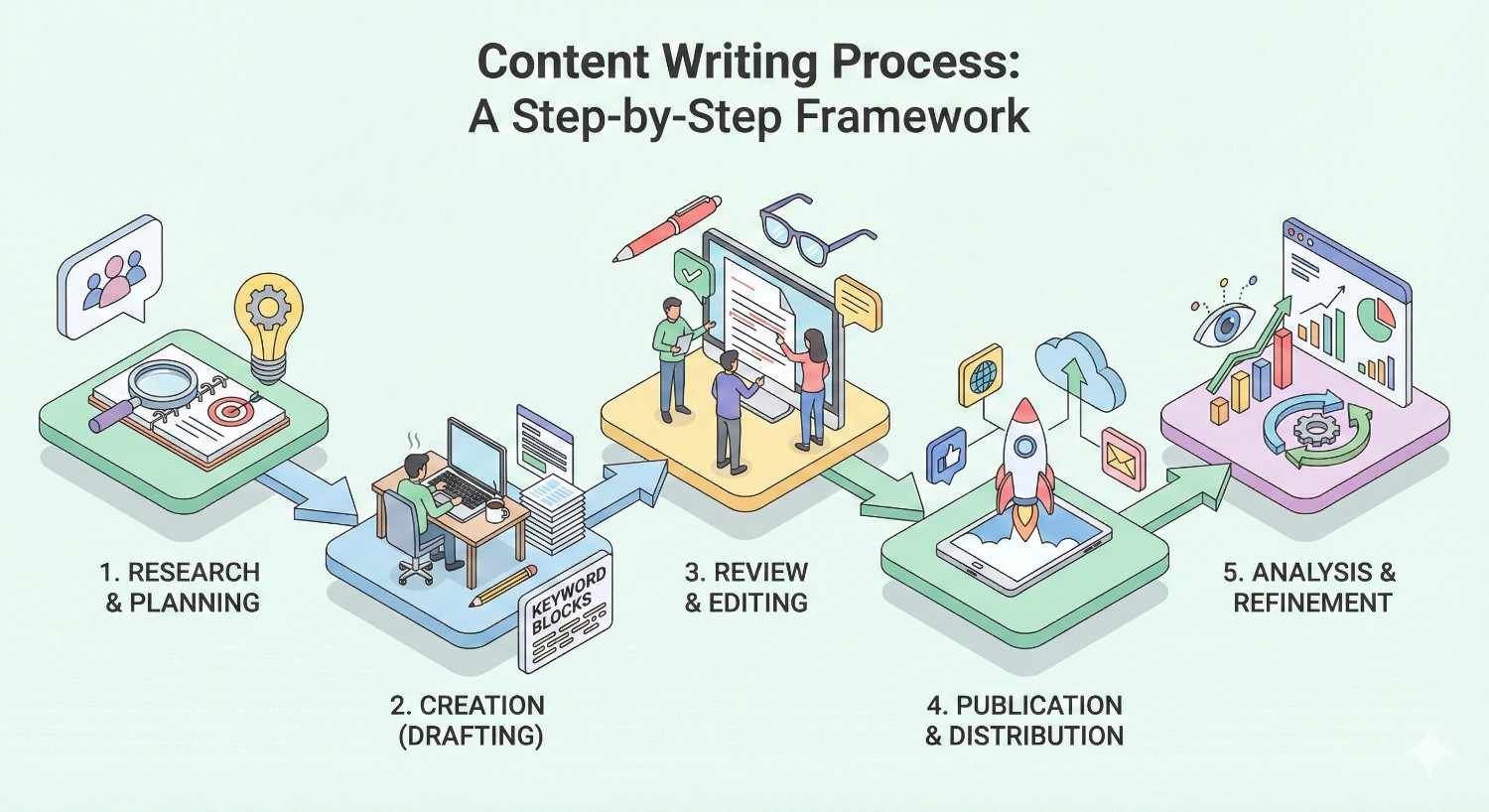
Consistent processes produce consistent results. This framework transforms content creation from ad-hoc effort into systematic production.
Step 1: Define Content Goals and KPIs
Every piece of content should serve specific, measurable objectives. Vague goals produce unfocused content.
Identify the primary purpose. Is this content meant to rank for specific keywords? Generate leads? Support sales conversations? Build brand awareness? Different goals require different approaches.
Set specific KPIs before writing. Target keyword rankings, organic traffic thresholds, conversion rates, or engagement metrics. Measurable goals enable performance evaluation and optimization.
Align content goals with business objectives. Content that drives traffic without business impact wastes resources. Connect content KPIs to revenue outcomes.
Document goals for reference during creation and evaluation. Writers should understand success criteria. Reviewers should evaluate against defined objectives.
Step 2: Research Topics and Competitors
Thorough research prevents wasted effort and identifies opportunities for differentiation.
Analyze top-ranking content for target keywords. What topics do they cover? What depth do they provide? What formats do they use? What gaps exist?
Identify content angles competitors miss. Unique perspectives, updated information, or deeper expertise create differentiation. Matching existing content rarely outperforms established pages.
Gather supporting information and data. Statistics, examples, expert quotes, and case studies strengthen content authority. Research before writing prevents weak, unsupported claims.
Understand the competitive landscape realistically. Highly competitive keywords require exceptional content and strong domain authority. Assess whether you can realistically outperform existing results.
Step 3: Create a Content Outline
Outlines prevent structural problems and ensure comprehensive coverage before significant writing investment.
Start with the primary heading structure. H2 sections should cover all major subtopics. H3 subsections break down complex areas. Logical flow guides readers through the topic.
Note key points for each section. What must be covered? What examples will illustrate concepts? What data will support claims? Detailed outlines accelerate writing.
Identify keyword placement opportunities. Primary keywords belong in H1, introduction, and conclusion. Secondary keywords fit naturally in relevant sections. Plan integration without forcing.
Review outlines against competitor content. Does your structure cover everything competitors address? Does it include unique elements? Gaps in outlines become gaps in content.
Step 4: Write the First Draft
First drafts prioritize completeness over perfection. Editing refines; drafting captures ideas.
Follow your outline but allow flexibility. New ideas emerge during writing. Valuable tangents can strengthen content. Rigid adherence to outlines can limit quality.
Write without excessive self-editing. Stopping to perfect every sentence slows progress and disrupts flow. Capture thoughts completely, then refine.
Focus on communicating clearly. Fancy language rarely improves content. Simple, direct explanations serve readers better than impressive vocabulary.
Include all planned elements. Examples, data, quotes, and CTAs should appear in drafts. Adding them later often results in awkward integration or omission.
Step 5: Edit, Proofread, and Optimize
Editing transforms drafts into polished, optimized content. Multiple passes address different concerns.
Structural editing evaluates organization and flow. Are sections in logical order? Does content progress naturally? Are transitions smooth? Reorganize as needed.
Content editing assesses completeness and accuracy. Are claims supported? Are explanations clear? Is anything missing? Add, remove, or revise content.
Line editing improves sentence-level quality. Tighten wordy passages. Vary sentence structure. Improve word choices. Enhance readability.
Proofreading catches errors. Spelling, grammar, punctuation, and formatting mistakes damage credibility. Fresh eyes catch errors writers miss.
SEO optimization ensures technical elements are complete. Meta titles, descriptions, image alt text, internal links, and keyword placement all require attention.
Step 6: Publish and Promote
Publication is the beginning, not the end. Promotion amplifies content reach and impact.
Optimize technical elements before publishing. Page speed, mobile formatting, schema markup, and URL structure affect performance. Address issues before launch.
Promote through owned channels immediately. Email lists, social media accounts, and internal linking from existing content drive initial traffic.
Consider paid promotion for high-value content. Social advertising, content discovery platforms, and influencer outreach extend reach beyond organic channels.
Monitor performance from publication. Early engagement signals inform optimization opportunities. Quick adjustments can improve trajectory.
Plan ongoing promotion. Evergreen content benefits from repeated sharing. Seasonal content needs timely promotion. One-time publication limits content ROI.
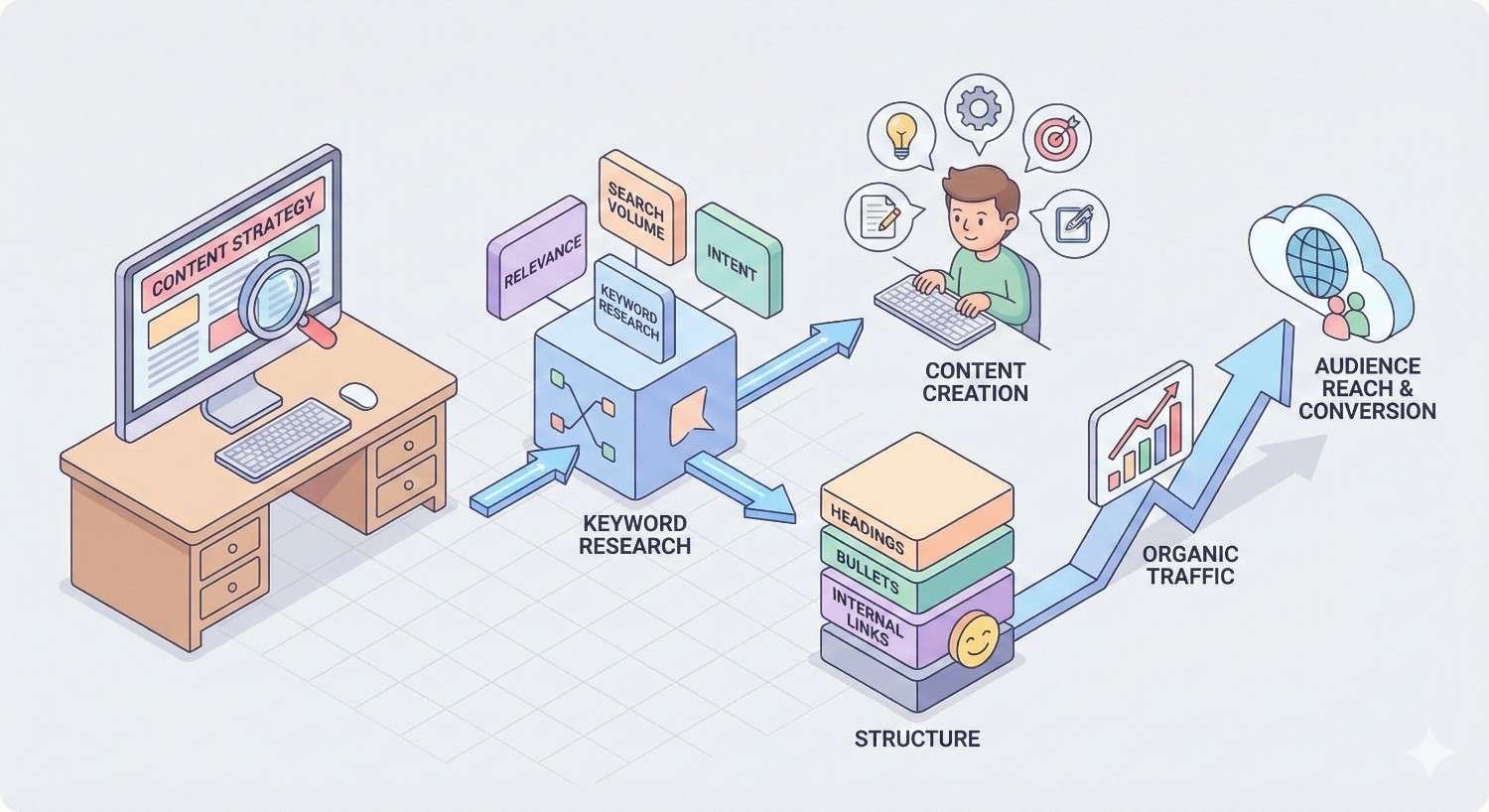
SEO Content Writing Techniques That Drive Traffic
Beyond fundamentals, specific techniques maximize content’s search performance and traffic potential.
On-Page SEO Elements for Content Writers
On-page optimization ensures search engines understand and properly index your content.
Title tags appear in search results and browser tabs. Include primary keywords near the beginning. Keep under 60 characters to prevent truncation. Make them compelling enough to earn clicks.
Meta descriptions don’t directly affect rankings but influence click-through rates. Summarize content value in 150-160 characters. Include keywords naturally. End with implicit or explicit calls-to-action.
Header tags (H1-H6) structure content hierarchically. Use one H1 per page containing the primary keyword. H2s and H3s should include secondary keywords where natural.
Image optimization includes descriptive file names, alt text, and appropriate compression. Images should load quickly and provide context for visually impaired users and search engines.
URL structure should be clean, descriptive, and keyword-inclusive. Short URLs outperform long ones. Hyphens separate words. Avoid unnecessary parameters or numbers.
Internal Linking Strategies
Internal links distribute page authority, guide user navigation, and help search engines understand site structure.
Link to relevant content contextually. Anchor text should describe the linked page accurately. “Content writing guide” is better than “click here” for linking to content writing resources.
Create topic clusters through strategic linking. Pillar pages covering broad topics link to detailed subtopic pages. Subtopic pages link back to pillars and to each other.
Update older content with links to newer pages. New content benefits from established page authority. Regular link audits identify opportunities.
Balance link quantity with user experience. Excessive links distract readers and dilute value. Include links where genuinely helpful, not to manipulate algorithms.
Fix broken internal links promptly. Broken links frustrate users and waste crawl budget. Regular audits identify and resolve issues.
Writing for Featured Snippets and PAA
Featured snippets and People Also Ask boxes capture significant search real estate and traffic.
Paragraph snippets answer questions directly in 40-60 words. Structure content with clear questions as headings followed by concise, direct answers.
List snippets appear for process or collection queries. Use numbered lists for steps and bulleted lists for non-sequential items. Include 5-8 items for optimal snippet capture.
Table snippets display comparative or structured data. Format comparisons, specifications, or categorized information in clean HTML tables.
Target question-based keywords explicitly. Include the exact question as a heading, then answer immediately and comprehensively.
Analyze existing snippets for target keywords. Understanding what currently earns snippets reveals format and content requirements.
E-E-A-T Principles in Content Creation
Experience, Expertise, Authoritativeness, and Trustworthiness determine content quality in Google’s evaluation framework.
Experience demonstrates first-hand knowledge. Include personal insights, original research, testing results, or practical application examples. Generic information lacks experience signals.
Expertise shows deep subject knowledge. Technical accuracy, comprehensive coverage, and appropriate terminology indicate expertise. Credentials and author bios support expertise claims.
Authoritativeness reflects reputation within your field. Citations from other sources, industry recognition, and consistent quality content build authority over time.
Trustworthiness encompasses accuracy, transparency, and reliability. Cite sources, acknowledge limitations, update outdated information, and maintain consistent quality standards.
YMYL (Your Money or Your Life) topics require heightened E-E-A-T signals. Health, finance, legal, and safety content faces stricter quality evaluation.
Content Writing Tools and Resources
The right tools improve efficiency, quality, and optimization without replacing human judgment and creativity.
Writing and Grammar Tools
Writing tools catch errors and suggest improvements that human review might miss.
Grammarly identifies grammar, spelling, and punctuation errors while suggesting clarity improvements. The premium version offers style and tone recommendations.
Hemingway Editor highlights complex sentences, passive voice, and readability issues. It encourages clear, direct writing accessible to broader audiences.
ProWritingAid combines grammar checking with style analysis, offering detailed reports on writing patterns and improvement opportunities.
Google Docs provides collaborative writing with built-in spelling and grammar checking. Comments and suggestion modes facilitate team review processes.
These tools assist but don’t replace careful human editing. Automated suggestions sometimes miss context or recommend inappropriate changes.
SEO and Keyword Research Tools
SEO tools inform strategy and optimization decisions with data human research can’t efficiently gather.
Semrush offers comprehensive keyword research, competitor analysis, and content optimization features. It identifies ranking opportunities and tracks performance over time.
Ahrefs excels at backlink analysis and keyword research. Content Explorer finds top-performing content in any niche for competitive analysis.
Google Search Console provides direct data on how Google sees your site. Search queries, click-through rates, and indexing issues inform optimization priorities.
Google Analytics tracks user behavior after they reach your site. Engagement metrics, conversion tracking, and audience insights guide content strategy.
Surfer SEO analyzes top-ranking content to recommend optimization targets. It suggests keyword usage, content length, and structural elements based on competitive analysis.
Content Planning and Organization Tools
Planning tools maintain consistency and coordination across content operations.
Notion combines documentation, databases, and project management. Content calendars, style guides, and workflow tracking integrate in one platform.
Trello visualizes content workflows through kanban boards. Cards move through stages from ideation to publication, maintaining visibility across teams.
Asana manages complex content projects with task dependencies, timelines, and team assignments. It scales from individual writers to large content teams.
Airtable offers database flexibility for content inventories, editorial calendars, and performance tracking. Custom views and automations adapt to specific workflows.
Google Sheets provides accessible, collaborative spreadsheets for content calendars and tracking. Simplicity and familiarity make it effective for smaller operations.
Common Content Writing Mistakes to Avoid
Avoiding common mistakes prevents wasted effort and poor performance. Learn from others’ errors.
Writing Without a Clear Strategy
Random content production wastes resources and fails to build cumulative value.
Content without strategic purpose lacks focus. Writers don’t know what success looks like. Topics don’t connect to business objectives. Results disappoint despite effort.
Strategy defines what to write, why, and how success will be measured. It identifies target audiences, priority topics, and content types that serve business goals.
Strategic content builds on itself. Topic clusters develop topical authority. Internal linking strengthens the entire site. Each piece contributes to larger objectives.
Develop strategy before scaling production. A few strategic pieces outperform many random ones.
Ignoring Search Intent
Content that mismatches intent fails regardless of quality or optimization.
Informational content targeting transactional keywords frustrates ready-to-buy users. Sales content ranking for informational queries annoys researchers. Both scenarios produce poor engagement signals.
Analyze SERP results for target keywords. What content types rank? What format do they use? What depth do they provide? Match your content to demonstrated intent.
Consider intent throughout the content. Introduction, body, and conclusion should all serve the user’s underlying goal. Tangents that don’t serve intent dilute effectiveness.
Test assumptions through performance data. High bounce rates and low engagement suggest intent mismatch. Adjust content or targeting accordingly.
Keyword Stuffing and Over-Optimization
Excessive keyword focus damages readability and triggers algorithmic penalties.
Keyword stuffing repeats target terms unnaturally. “Our content writing services offer the best content writing for businesses needing content writing help” reads poorly and signals manipulation.
Modern algorithms understand semantic relationships. Synonyms, related terms, and natural language variations demonstrate relevance without repetition. Write naturally; optimize thoughtfully.
Over-optimization extends beyond keywords. Excessive internal links, manipulative anchor text, and artificial structure all risk penalties.
Focus on user value first. Optimization should enhance, not compromise, content quality. If optimization makes content worse for readers, reconsider the approach.
Neglecting Content Updates and Refreshes
Published content requires ongoing maintenance to remain effective.
Information becomes outdated. Statistics age. Best practices evolve. Links break. Content that was accurate becomes misleading or incomplete.
Search engines favor fresh, accurate content. Competitors publishing updated information can displace previously ranking pages. Maintenance protects existing rankings.
Schedule regular content audits. Identify underperforming pages, outdated information, and refresh opportunities. Prioritize high-traffic pages and strategic content.
Updates can be minor or major. Correcting statistics, adding new sections, or completely rewriting content all constitute refreshes. Match effort to need.
How to Measure Content Writing Success
Measurement enables optimization. Without data, improvement relies on guesswork.
Key Performance Indicators (KPIs) for Content
Different content goals require different metrics. Select KPIs that align with objectives.
Awareness KPIs measure reach and visibility. Organic traffic, impressions, and new user acquisition indicate content’s ability to attract audiences.
Engagement KPIs assess content quality and relevance. Time on page, pages per session, scroll depth, and social shares reveal whether content resonates.
Conversion KPIs track business outcomes. Lead generation, email signups, purchases, and goal completions connect content to revenue.
SEO KPIs monitor search performance. Keyword rankings, organic click-through rates, and backlinks earned measure search visibility progress.
Establish baselines before optimization. Improvement requires comparison points. Track metrics consistently over time.
Traffic and Engagement Metrics
Traffic quantity and quality both matter. High traffic with poor engagement indicates problems.
Organic sessions measure search-driven visits. Growth indicates improving visibility. Decline signals ranking losses or reduced search demand.
Bounce rate shows single-page visits. High bounce rates suggest content doesn’t meet expectations or lacks compelling next steps. Context matters; some content naturally has higher bounce rates.
Average time on page indicates engagement depth. Longer times suggest thorough reading. Very short times indicate quick departures. Compare against content length expectations.
Pages per session reveals site exploration. Higher numbers indicate content encourages further engagement. Internal linking and related content suggestions influence this metric.
Return visitors demonstrate ongoing value. Content that brings users back builds relationships and brand affinity.
Conversion and ROI Tracking
Ultimately, content must contribute to business outcomes. Conversion tracking connects content to revenue.
Goal completions track specific actions. Form submissions, downloads, signups, and purchases can all be configured as goals in analytics platforms.
Assisted conversions recognize content’s role in longer journeys. Users may discover your brand through content, then convert later through other channels. Attribution models reveal content’s contribution.
Content ROI compares investment to returns. Calculate content production costs against revenue generated or leads acquired. Positive ROI justifies continued investment.
Customer acquisition cost through content compares to other channels. Content often delivers lower CAC than paid advertising over time, though results take longer to materialize.
Track conversions by content piece and type. Identify what works to inform future production priorities.
Content Writing for Different Platforms and Formats
Different platforms and formats require adapted approaches while maintaining core best practices.
Blog Posts and Long-Form Articles
Blog content builds organic visibility and establishes expertise over time.
Length should match topic complexity and competitive requirements. Comprehensive guides often exceed 2,000 words. Simple topics may need only 800-1,200 words. Let the subject dictate length.
Structure emphasizes scannability. Clear headings, short paragraphs, and visual breaks maintain engagement through longer content.
Tone can be more conversational than formal website copy. Personality builds connection. Expertise builds trust. Balance both.
Frequency matters for building momentum. Consistent publication signals active expertise. Quality should never sacrifice for quantity.
Evergreen vs. timely content serves different purposes. Evergreen content provides lasting value and ongoing traffic. Timely content captures immediate interest but requires more frequent updates.
Website Pages and Landing Pages
Website pages serve different purposes than blog content and require different approaches.
Homepage copy must communicate value proposition quickly. Visitors decide within seconds whether to explore further. Clarity and relevance trump cleverness.
Service pages balance information and persuasion. Explain what you offer, who it’s for, and why it matters. Include clear paths to conversion.
Landing pages focus on single conversion goals. Remove distractions. Align messaging with traffic sources. Test variations systematically.
About pages build trust and connection. Share your story, values, and team. Humanize your brand while demonstrating credibility.
Navigation and user flow influence how copy should guide visitors. Understand the journey users take and optimize copy for each stage.
Product Descriptions and E-commerce Content
E-commerce content directly impacts purchase decisions and search visibility.
Feature-benefit balance addresses both logical and emotional decision factors. Features describe what products do. Benefits explain why that matters to buyers.
Unique descriptions avoid duplicate content issues. Manufacturer descriptions used across retailers provide no differentiation or SEO value.
Sensory and emotional language helps buyers imagine ownership. Describe experiences, not just specifications.
Technical specifications serve comparison shoppers. Include complete, accurate details in scannable formats.
Social proof integration builds confidence. Reviews, ratings, and user-generated content support purchase decisions.
Social Media and Email Content
Short-form content requires different skills than long-form writing.
Social media demands immediate impact. Character limits force concision. Visual integration extends messaging. Platform norms vary significantly.
Email subject lines determine open rates. Curiosity, urgency, personalization, and clarity all influence performance. Test extensively.
Email body copy balances value and action. Provide enough information to motivate clicks without overwhelming readers. Respect inbox attention limits.
Consistency across channels maintains brand voice while adapting to platform requirements. Core messaging should align even as format changes.
Repurposing extends content value. Blog posts become social threads, email series, or video scripts. Efficient content operations maximize asset value.
Building a Sustainable Content Writing Strategy
Sustainable strategies produce consistent results without burnout or resource exhaustion.
Creating a Content Calendar
Content calendars transform reactive publishing into proactive strategy execution.
Planning horizons vary by organization. Monthly calendars suit smaller operations. Quarterly planning enables larger initiatives. Annual themes provide strategic direction.
Calendar elements include topics, keywords, formats, authors, deadlines, and publication dates. More detail enables better coordination.
Flexibility accommodates opportunities and changes. Rigid calendars miss timely topics. Balance structure with adaptability.
Workflow integration connects calendars to production processes. Calendars should trigger actions, not just document plans.
Review and adjustment keeps calendars relevant. Regular assessment identifies what’s working and what needs change.
Scaling Content Production
Growing content output requires systems, not just more effort.
Process documentation enables consistency across writers. Style guides, templates, and checklists maintain quality as production scales.
Workflow optimization identifies bottlenecks and inefficiencies. Streamlined processes produce more content with the same resources.
Technology leverage automates repetitive tasks. Research tools, writing assistants, and publishing automation free human time for high-value work.
Quality control systems prevent scaling from degrading standards. Review processes, performance monitoring, and feedback loops maintain quality.
Team development builds capacity over time. Training, mentorship, and skill development increase what teams can produce effectively.
When to Outsource vs. Write In-House
Both approaches have advantages. The right choice depends on your situation.
In-house advantages include deep brand knowledge, quick communication, and institutional learning. Writers who understand your business produce more relevant content.
Outsourcing advantages include scalability, specialized expertise, and cost flexibility. External writers can ramp up quickly and bring fresh perspectives.
Hybrid approaches combine both. Core strategic content stays in-house. Volume production or specialized topics go to external writers.
Quality considerations apply to both models. In-house writers need development. External writers need management. Neither guarantees quality without proper systems.
Cost analysis should include hidden factors. In-house costs include benefits, management, and tools. Outsourcing costs include coordination, revision, and quality control.
Conclusion
Content writing best practices combine strategic thinking, technical optimization, and genuine value creation. Success requires understanding your audience, matching search intent, and consistently producing content that serves both users and business objectives.
The techniques and frameworks covered here provide a foundation for sustainable organic growth. From keyword research through publication and measurement, each step contributes to content that ranks, engages, and converts.
At White Label SEO Service, we help businesses implement comprehensive content strategies that drive measurable results. Contact us to discuss how strategic content writing can accelerate your organic growth and deliver lasting competitive advantages.
Frequently Asked Questions About Content Writing
How long should content be for SEO?
Content length should match topic complexity and competitive requirements. Comprehensive guides typically perform well at 1,500-2,500 words, while simple topics may need only 800-1,200 words. Analyze top-ranking content for your target keywords to determine appropriate length for your specific situation.
How often should you publish new content?
Publication frequency depends on your resources and goals. Consistency matters more than volume. Publishing one high-quality piece weekly outperforms daily low-quality content. Start with a sustainable pace and increase as capacity allows while maintaining quality standards.
What makes content high-quality?
High-quality content thoroughly addresses user intent with accurate, well-organized information. It demonstrates expertise through depth and specificity, provides unique value beyond competitors, and engages readers with clear, accessible writing. Quality content earns engagement, shares, and links naturally.
How do you write content that converts?
Converting content aligns with reader intent and guides them toward logical next steps. Understand where readers are in their journey, address their specific concerns, build trust through valuable information, and include clear calls-to-action that match their readiness to act.
How long does it take to see results from content writing?
Content typically takes 3-6 months to reach full ranking potential, though some results appear sooner. New sites face longer timelines than established domains. Consistent publication accelerates results by building topical authority. Expect gradual improvement rather than immediate impact.
What is the difference between content writing and content marketing?
Content writing is the creation of written material. Content marketing is the broader strategy of using content to achieve business objectives. Content writing is a skill within content marketing, which also includes strategy, distribution, promotion, and measurement.
How do you measure content writing ROI?
Calculate content ROI by comparing production costs against measurable outcomes. Track organic traffic value, lead generation, and conversions attributed to content. Consider both direct conversions and assisted conversions where content contributed to longer customer journeys.