
Content writing ROI averages 3x higher returns than paid advertising over a 36-month period, with top-performing content assets generating leads for years after publication. Understanding how to measure, calculate, and optimize these returns separates profitable content strategies from expensive experiments.
Most businesses invest in content without clear measurement frameworks. This creates budget uncertainty and missed optimization opportunities that compound over time.
This guide covers ROI formulas, tracking infrastructure, realistic timelines, and proven strategies to maximize returns from every piece of content you publish.
What Is Content Writing ROI?
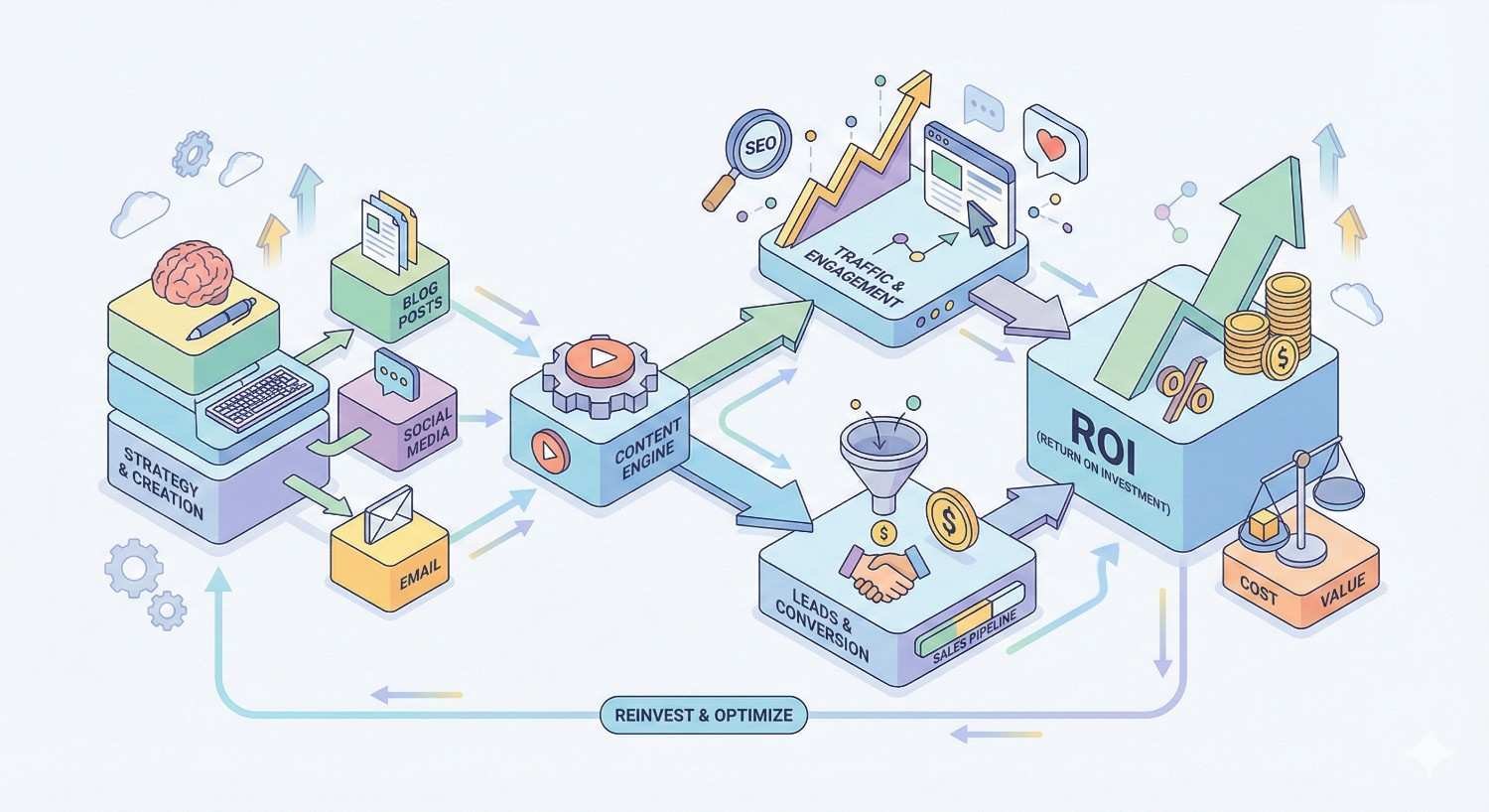
Content writing ROI measures the financial return generated from your investment in written content assets. This includes blog posts, landing pages, case studies, email sequences, and any text-based marketing material designed to attract, engage, and convert your target audience.
Unlike paid advertising where returns stop when spending stops, content creates compounding value. A single well-optimized article can generate organic traffic, leads, and revenue for years.
Defining Content Writing Return on Investment
Content writing ROI represents the relationship between what you spend creating content and what you earn from it. The calculation accounts for direct revenue attribution, lead generation value, customer acquisition cost reduction, and brand equity gains.
Direct returns include sales traced to content touchpoints. Indirect returns encompass reduced paid advertising dependency, shortened sales cycles, and improved conversion rates across all channels.
The challenge lies in attribution. Content rarely operates in isolation. A prospect might discover your brand through a blog post, return via email, and convert after reading a case study. Each touchpoint contributes value that traditional last-click attribution misses.
Why Content ROI Measurement Matters for Business Growth
Measurement transforms content from a cost center into a strategic investment. Without ROI tracking, content budgets become vulnerable during economic uncertainty. With clear performance data, content earns increased investment based on demonstrated returns.
ROI measurement enables optimization. When you know which content types, topics, and formats generate the highest returns, you allocate resources accordingly. This compounds results over time.
Measurement also reveals timeline expectations. Content marketing requires patience. ROI data helps stakeholders understand that a piece published today might generate its highest returns 12-18 months from now.
Key Metrics That Define Content Writing ROI
Effective ROI measurement requires tracking metrics across four categories: traffic, conversions, revenue, and brand. Each category provides different insights into content performance and business impact.
Traffic Metrics: Organic Sessions, Page Views, and User Engagement
Traffic metrics establish the foundation of content ROI measurement. Organic sessions indicate how effectively content attracts visitors from search engines without paid promotion.
Page views reveal content consumption patterns. High page views with low engagement suggest content attracts clicks but fails to deliver value. Balanced metrics indicate content that both attracts and satisfies user intent.
Engagement metrics include time on page, scroll depth, and pages per session. These indicators help distinguish between content that genuinely serves users and content that merely ranks. Google Analytics 4 tracks engagement rate as a core metric, replacing the outdated bounce rate measurement.
Average engagement rates vary by industry. B2B content typically sees 2-4 minutes average time on page for comprehensive guides. E-commerce content often performs well with shorter engagement times when users find product information quickly.
Conversion Metrics: Leads, Sign-ups, and Sales Attribution
Conversion metrics connect traffic to business outcomes. Lead generation tracks form submissions, demo requests, consultation bookings, and email sign-ups attributed to content touchpoints.
Micro-conversions matter too. Newsletter subscriptions, resource downloads, and account creations indicate content effectiveness even when immediate sales don’t occur. These actions build audiences for future conversion.
Sales attribution requires tracking the full customer journey. First-touch attribution credits the initial content discovery. Last-touch credits the final interaction before purchase. Multi-touch models distribute credit across all content touchpoints.
Most businesses undercount content conversions by relying solely on last-touch attribution. A prospect who discovers your brand through organic search, then converts through a direct visit, appears as a direct conversion. Proper tracking reveals the content’s true contribution.
Revenue Metrics: Customer Acquisition Cost and Lifetime Value
Revenue metrics translate content performance into financial terms. Customer acquisition cost (CAC) measures total marketing spend divided by new customers acquired. Content marketing typically reduces CAC over time as organic traffic compounds.
HubSpot research indicates that content marketing costs 62% less than traditional outbound marketing while generating 3x more leads. This cost efficiency improves as content assets age and accumulate authority.
Customer lifetime value (CLV) connects to content through retention and expansion. Educational content that helps customers succeed increases retention rates. Product content that showcases advanced features drives expansion revenue.
The CLV-to-CAC ratio reveals content marketing sustainability. Healthy ratios exceed 3:1, meaning each customer generates at least three times their acquisition cost. Content marketing often achieves ratios of 5:1 or higher due to low marginal costs.
Brand Metrics: Authority, Visibility, and Search Rankings
Brand metrics capture value that doesn’t immediately convert to revenue but builds long-term competitive advantage. Domain authority scores from tools like Ahrefs or Moz indicate overall site strength.
Search visibility tracks the percentage of available search traffic your content captures. Increasing visibility across target keywords indicates growing topical authority.
Brand search volume measures how many people search for your company name directly. Growing brand searches suggest content is building awareness and recall. This metric often correlates with reduced CAC as prospects arrive pre-educated about your offerings.
Share of voice compares your content visibility against competitors for target topics. Increasing share of voice indicates you’re winning the content competition in your market.
How to Calculate Content Writing ROI: Formula and Framework
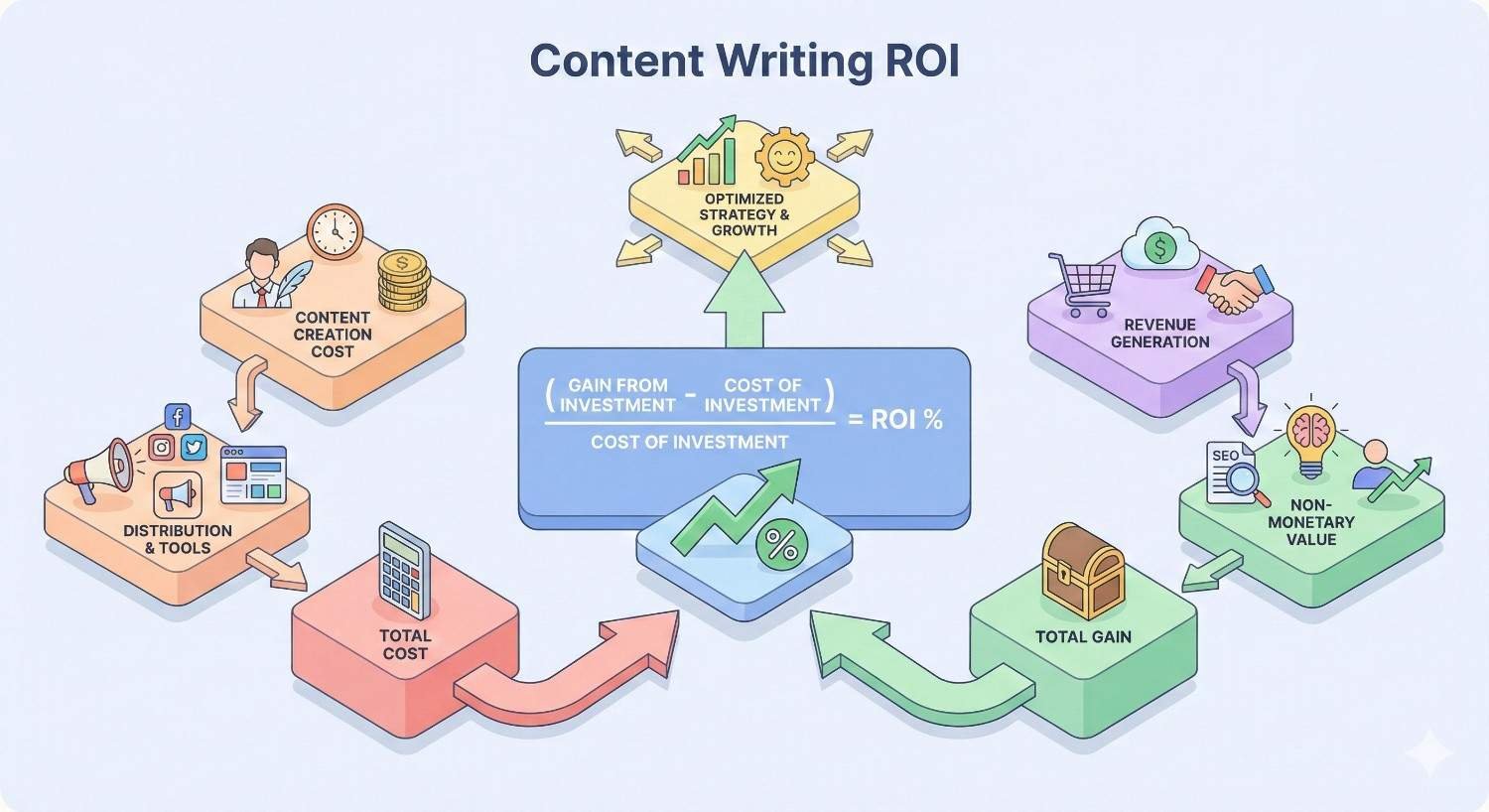
Calculating content ROI requires a systematic approach that accounts for all costs and attributes returns accurately. The basic formula provides a starting point, but sophisticated measurement requires deeper analysis.
The Basic ROI Formula for Content Marketing
The fundamental ROI formula applies to content:
ROI = (Return – Investment) / Investment × 100
For content marketing, this becomes:
Content ROI = (Revenue from Content – Content Costs) / Content Costs × 100
A content program costing $50,000 annually that generates $150,000 in attributed revenue produces:
($150,000 – $50,000) / $50,000 × 100 = 200% ROI
This basic calculation works for straightforward attribution scenarios. Complex buyer journeys require more sophisticated approaches.
Identifying and Tracking Content Costs (Investment Side)
Content costs extend beyond writer fees. Complete cost accounting includes:
Direct costs:
- Writer compensation (in-house salary or freelance fees)
- Editor and proofreader fees
- Subject matter expert time
- Design and visual asset creation
- Video and multimedia production
Indirect costs:
- Content management system fees
- SEO tool subscriptions
- Analytics platform costs
- Project management overhead
- Content distribution and promotion
Opportunity costs:
- Staff time diverted from other activities
- Resources allocated away from alternative marketing channels
Many businesses underestimate content costs by tracking only writer fees. A $500 article might actually cost $800-1,200 when accounting for editing, design, SEO optimization, and publication overhead.
Measuring Content Returns (Revenue and Value Side)
Content returns include both direct revenue and indirect value. Direct revenue attribution tracks sales where content played a documented role in the customer journey.
Indirect value includes:
Lead value: Multiply leads generated by average lead-to-customer conversion rate and average customer value. If content generates 100 leads monthly, 10% convert, and average customer value is $5,000, monthly lead value equals $50,000.
Traffic value: Estimate what equivalent paid traffic would cost. If content drives 10,000 monthly organic visits and equivalent PPC traffic costs $3 per click, monthly traffic value equals $30,000.
Brand value: Harder to quantify but real. Increased brand searches, improved conversion rates across channels, and reduced sales cycle length all indicate brand value from content.
Attribution Models: Connecting Content to Conversions
Attribution models determine how credit distributes across touchpoints. Each model suits different business contexts.
First-touch attribution credits the initial content discovery. This model values top-of-funnel content that introduces prospects to your brand. It undervalues content that nurtures and converts.
Last-touch attribution credits the final interaction before conversion. This model values bottom-of-funnel content but ignores the awareness and consideration content that made conversion possible.
Linear attribution distributes credit equally across all touchpoints. A customer who interacts with five pieces of content before purchasing gives each piece 20% credit.
Time-decay attribution gives more credit to recent touchpoints. This acknowledges that closer interactions likely had more influence on the purchase decision.
Position-based attribution gives 40% credit to first touch, 40% to last touch, and distributes 20% across middle interactions. This balances awareness and conversion content value.
Most businesses benefit from multi-touch attribution models. Google Analytics 4 offers data-driven attribution that uses machine learning to distribute credit based on actual conversion patterns.
Realistic Timelines: When to Expect ROI from Content Writing
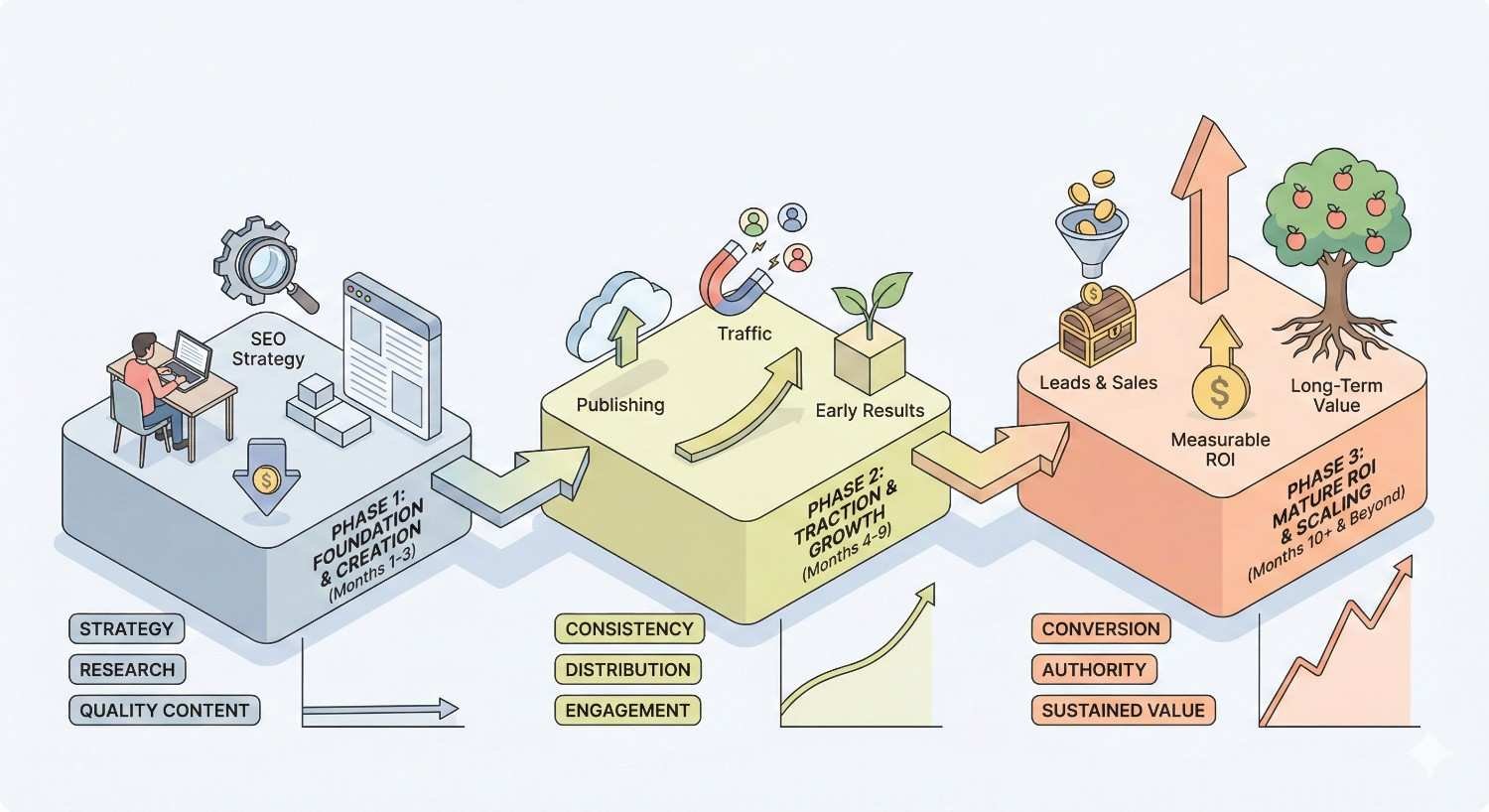
Content marketing operates on different timelines than paid advertising. Setting realistic expectations prevents premature program cancellation and enables proper resource allocation.
Short-Term Returns (0-3 Months): Early Indicators
The first three months focus on foundation building rather than revenue generation. Early indicators suggest whether your content strategy is on track.
Indexing and crawling: New content should appear in search results within days to weeks. Delayed indexing indicates technical issues requiring attention.
Initial rankings: Content typically enters search results at lower positions, then climbs as Google evaluates user engagement signals. Appearing on page 2-3 for target keywords within 60-90 days indicates positive trajectory.
Engagement metrics: Time on page, scroll depth, and pages per session reveal whether content resonates with visitors. Strong engagement predicts future ranking improvements.
Social signals: Shares, comments, and backlinks from initial promotion indicate content quality and audience relevance.
Don’t expect significant revenue in this phase. Content published today competes against established pages with years of accumulated authority. Building competitive positioning takes time.
Medium-Term Returns (3-12 Months): Momentum Building
Months 3-12 typically show accelerating returns as content accumulates authority and rankings improve.
Ranking improvements: Content should climb from page 2-3 into page 1 positions for target keywords. Top 10 rankings begin generating meaningful traffic.
Traffic growth: Organic traffic typically shows month-over-month increases as more content ranks and existing content climbs. Expect 10-30% monthly traffic growth during this phase for active content programs.
Lead generation: As traffic grows, lead volume increases proportionally. Conversion rate optimization during this phase amplifies returns from existing traffic.
Revenue attribution: First content-attributed sales typically occur in this phase. Initial revenue often seems modest relative to investment, but trajectory matters more than absolute numbers.
This phase tests organizational patience. Content programs frequently get cut during months 6-9 when investment has accumulated but returns haven’t yet compounded. Businesses that persist through this phase typically see dramatic returns in year two.
Long-Term Returns (12+ Months): Compounding Value
Content marketing’s true power emerges after 12 months. Compounding effects create exponential rather than linear returns.
Authority accumulation: Older content with strong engagement signals outranks newer competitors. Your established content becomes increasingly difficult to displace.
Reduced marginal costs: Content creation costs remain relatively stable while returns grow. A $1,000 article generating $500 monthly in year one might generate $2,000 monthly in year three with no additional investment.
Network effects: High-authority content attracts backlinks naturally. These links strengthen your entire domain, improving rankings for all content.
Brand recognition: Consistent content presence builds audience familiarity. Prospects who’ve consumed your content convert at higher rates and require less sales effort.
Demand Metric research shows content marketing generates 3x more leads per dollar than paid search over a three-year period. This advantage compounds as content assets age.

Factors That Impact Content Writing ROI
Multiple variables influence content ROI. Understanding these factors enables strategic optimization and realistic expectation setting.
Content Quality and Relevance to Target Audience
Quality determines whether content earns engagement, links, and conversions. High-quality content demonstrates expertise, provides unique value, and satisfies user intent comprehensively.
Relevance connects quality to audience needs. Technically excellent content on topics your audience doesn’t care about generates no returns. Audience research ensures content investment targets high-value topics.
Quality indicators include:
- Comprehensive coverage of the topic
- Original insights or data not available elsewhere
- Clear, accessible explanations of complex concepts
- Practical, actionable recommendations
- Professional presentation and formatting
Low-quality content often costs more long-term than high-quality content. Cheap articles that fail to rank require replacement or extensive revision. Investing in quality upfront typically delivers better ROI.
SEO Optimization and Search Intent Alignment
SEO optimization ensures content reaches its intended audience through search engines. Technical optimization includes proper heading structure, meta descriptions, internal linking, and page speed.
Search intent alignment matters more than keyword density. Content must match what users actually want when they search. Informational queries require educational content. Transactional queries need product-focused pages.
Misaligned intent kills ROI. A comprehensive guide ranking for a transactional keyword attracts visitors who want to buy, not learn. They leave immediately, sending negative engagement signals that hurt rankings.
Keyword research reveals intent patterns. Tools like Semrush and Ahrefs show what content types rank for target keywords, indicating what Google believes users want.
Distribution Strategy and Promotion Channels
Creation without distribution limits ROI. Even excellent content needs initial promotion to generate the engagement signals that drive organic rankings.
Effective distribution channels include:
- Email newsletters to existing subscribers
- Social media promotion across relevant platforms
- Outreach to industry publications and influencers
- Paid promotion for high-value content assets
- Internal linking from existing high-traffic pages
Distribution investment should match content value. Cornerstone content deserves significant promotion investment. Supporting content might need only basic distribution.
Repurposing extends distribution ROI. A comprehensive guide can become social posts, email sequences, video scripts, and podcast topics. Each format reaches different audience segments.
Technical SEO Foundation and Site Performance
Technical issues can nullify content investment. Slow page speed, poor mobile experience, crawling errors, and indexing problems prevent content from reaching its potential.
Core Web Vitals directly impact rankings. Pages failing Google’s performance thresholds face ranking penalties regardless of content quality. PageSpeed Insights identifies specific issues requiring attention.
Site architecture affects content discoverability. Logical URL structures, clear navigation, and strategic internal linking help search engines understand content relationships and importance.
Security issues destroy trust signals. HTTPS encryption is mandatory. Security warnings drive visitors away and signal low trustworthiness to search engines.
Content Frequency, Consistency, and Volume
Publishing frequency impacts authority building speed. More content creates more ranking opportunities and demonstrates topical commitment to search engines.
However, quality must not sacrifice for quantity. Ten excellent articles outperform 100 mediocre ones. Find the sustainable frequency that maintains quality standards.
Consistency matters more than volume. Regular publishing signals active site maintenance. Sporadic publishing followed by long gaps suggests abandonment.
Content volume requirements vary by competition. Highly competitive niches require more content to establish authority. Less competitive spaces might achieve dominance with fewer, more targeted pieces.
How to Track and Measure Content Writing ROI
Effective measurement requires proper infrastructure. Setting up tracking before content publication ensures you capture the data needed for ROI calculation.
Setting Up Analytics and Tracking Infrastructure
Measurement infrastructure includes analytics platforms, conversion tracking, and attribution systems. Implementing these tools before launching content programs prevents data gaps.
Essential tracking elements:
- Website analytics (GA4 or alternative)
- Conversion tracking for all goal actions
- UTM parameters for campaign attribution
- CRM integration for lead tracking
- Revenue attribution for sales data
Tag management systems like Google Tag Manager simplify tracking implementation. Centralized tag management reduces errors and enables quick adjustments.
Data layer implementation enables advanced tracking. Passing user and content data to analytics platforms enables sophisticated segmentation and attribution analysis.
Google Analytics 4: Traffic and Conversion Tracking
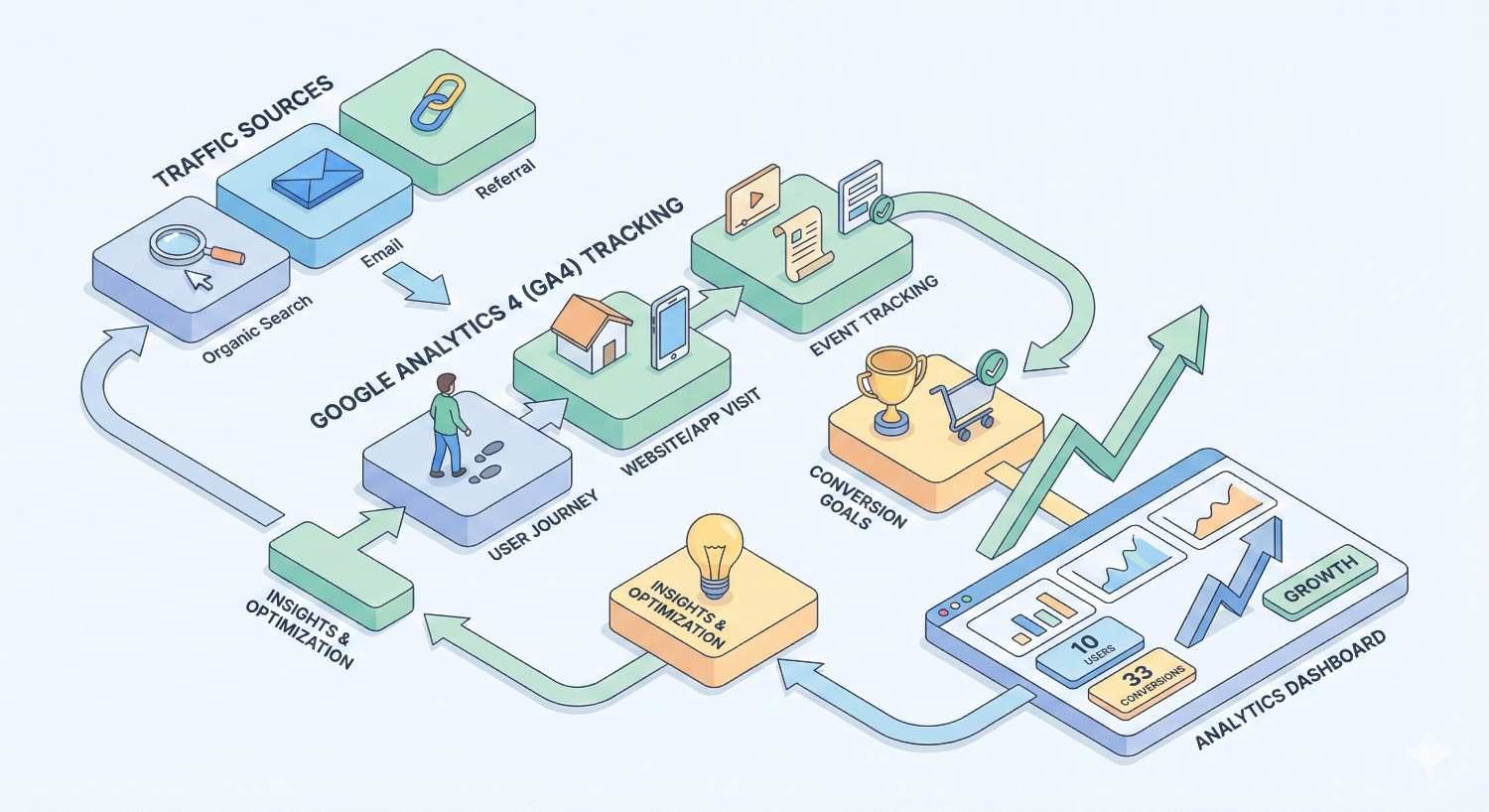
GA4 provides the foundation for content performance measurement. Proper configuration ensures accurate data collection.
Traffic tracking: GA4 automatically tracks page views, sessions, and users. Enhanced measurement captures scrolls, outbound clicks, site search, and video engagement without additional configuration.
Conversion tracking: Define conversions for key actions including form submissions, purchases, sign-ups, and downloads. GA4 allows up to 30 conversion events per property.
Content grouping: Organize content by type, topic, or funnel stage. Content groups enable performance comparison across categories.
Exploration reports: Build custom analyses examining content performance by various dimensions. Landing page reports reveal which content attracts visitors. Path exploration shows how users move through content.
Attribution reporting: GA4’s data-driven attribution model distributes conversion credit based on actual user behavior patterns. This provides more accurate content value assessment than rule-based models.
Google Search Console: Visibility and Performance Metrics
Google Search Console provides search-specific data unavailable in analytics platforms. This data reveals how content performs in search results.
Performance report: Track impressions, clicks, click-through rate, and average position for queries and pages. Identify which content ranks and for what terms.
Index coverage: Ensure content gets indexed properly. Identify and fix indexing errors that prevent content from appearing in search results.
Core Web Vitals: Monitor page experience metrics that impact rankings. Address performance issues before they affect visibility.
Links report: Track backlinks pointing to your content. Growing link profiles indicate content earning authority.
Combine Search Console data with analytics for complete visibility. Search Console shows how content performs in search results. Analytics shows what happens after users click through.
CRM Integration: Lead Attribution and Revenue Tracking
CRM integration connects content touchpoints to revenue outcomes. This enables true ROI calculation rather than proxy metrics.
Lead source tracking: Capture the content that generated each lead. First-touch and multi-touch attribution require knowing which content prospects consumed.
Opportunity attribution: Connect content touchpoints to sales opportunities. Track which content influences deals at each pipeline stage.
Revenue attribution: Link closed revenue to content that contributed to the sale. This provides the return data needed for ROI calculation.
Platforms like HubSpot, Salesforce, and Marketo offer built-in content attribution. Proper implementation requires consistent tracking across marketing and sales touchpoints.
Content Performance Dashboards and Reporting
Dashboards consolidate metrics for ongoing monitoring and stakeholder reporting. Effective dashboards balance comprehensiveness with clarity.
Executive dashboards: Focus on business outcomes including leads, revenue, and ROI. Minimize technical metrics that don’t connect to business goals.
Operational dashboards: Include detailed metrics for optimization. Traffic trends, ranking changes, and engagement patterns guide tactical decisions.
Content-specific reports: Analyze individual content performance. Identify top performers for replication and underperformers for improvement or retirement.
Reporting frequency should match decision cycles. Monthly reports suit most organizations. Weekly monitoring catches issues quickly. Quarterly reviews assess strategic direction.
Automate reporting where possible. Tools like Looker Studio (formerly Data Studio) connect to multiple data sources and update automatically.
Common Content ROI Measurement Mistakes to Avoid
Measurement mistakes lead to incorrect conclusions and poor decisions. Avoiding these common errors improves ROI accuracy and strategic clarity.
Expecting Immediate Returns from Long-Form Content
Impatience kills content programs. Stakeholders expecting paid advertising timelines from content marketing will always be disappointed.
Content requires time to:
- Get indexed by search engines
- Accumulate engagement signals
- Build backlinks and authority
- Climb search rankings
- Generate consistent traffic
Evaluating content ROI at 90 days captures only a fraction of lifetime value. A piece generating $100 monthly at month three might generate $1,000 monthly at month 18.
Set appropriate evaluation windows. Minimum 12 months for SEO content. Shorter windows for email and social content with faster feedback loops.
Ignoring Non-Conversion Value (Brand Awareness, Authority)
Focusing exclusively on conversions undervalues content’s full contribution. Brand building, authority establishment, and audience development create value that doesn’t immediately convert.
Content that ranks for informational queries builds brand awareness. Prospects who learn from your content remember your brand when purchase intent develops.
Authority content attracts backlinks that strengthen your entire domain. A single linkable asset can improve rankings for dozens of other pages.
Audience building through email subscriptions creates owned channels. These subscribers convert over time at rates far exceeding cold traffic.
Include proxy metrics for non-conversion value. Brand search volume, domain authority growth, and email list growth indicate value creation even without immediate revenue.
Failing to Account for Compounding Returns
Linear projections underestimate content value. Content returns compound as authority accumulates and rankings improve.
Year one content might generate modest returns. Year two returns often double or triple as the same content climbs rankings and attracts more traffic.
Additionally, new content benefits from existing authority. A site with 100 quality articles ranks new content faster than a site starting from zero.
Model content value over 3-5 year horizons. Short-term ROI calculations miss the compounding that makes content marketing so powerful.
Using Vanity Metrics Instead of Business Outcomes
Vanity metrics feel good but don’t connect to business results. Page views, social shares, and time on site matter only if they correlate with revenue.
Vanity metrics:
- Raw page views without conversion context
- Social shares without traffic or lead impact
- Keyword rankings without traffic value
- Backlink counts without authority impact
Business metrics:
- Leads generated and their conversion rates
- Revenue attributed to content touchpoints
- Customer acquisition cost trends
- Customer lifetime value by acquisition source
Always connect metrics to business outcomes. If a metric doesn’t influence revenue, customer acquisition, or retention, question whether it deserves dashboard space.
Content Writing ROI by Content Type
Different content types serve different purposes and generate returns through different mechanisms. Understanding these differences enables strategic content mix optimization.
Blog Posts and SEO Articles: Long-Term Organic ROI
Blog posts and SEO articles generate returns primarily through organic search traffic. These assets typically require 6-18 months to reach full potential but continue generating value for years.
ROI characteristics:
- High upfront investment, low ongoing costs
- Returns compound over time
- Long payback periods (often 12+ months)
- Excellent lifetime value for successful pieces
Optimization focus:
- Keyword targeting and search intent alignment
- Comprehensive topic coverage
- Regular updates to maintain relevance
- Internal linking to distribute authority
Blog content works best for informational queries where prospects research before purchasing. Educational content builds trust and positions your brand as an authority.
Landing Pages and Sales Copy: Direct Conversion ROI
Landing pages and sales copy generate returns through direct conversion. These assets have shorter feedback loops and more immediate ROI visibility.
ROI characteristics:
- Faster feedback on performance
- Direct revenue attribution
- Requires ongoing traffic investment (paid or organic)
- High optimization potential through testing
Optimization focus:
- Conversion rate optimization
- A/B testing headlines, copy, and CTAs
- Page speed and user experience
- Trust signals and social proof
Landing page ROI depends heavily on traffic quality. The best copy can’t convert poorly targeted visitors. Ensure traffic sources align with landing page intent.
Case Studies and Whitepapers: Lead Generation ROI
Case studies and whitepapers generate returns through lead capture. Gated content exchanges valuable information for contact details.
ROI characteristics:
- Clear lead attribution
- Higher-quality leads (demonstrated interest)
- Longer sales cycles for enterprise content
- Reusable across multiple campaigns
Optimization focus:
- Topic selection based on buyer priorities
- Compelling titles and descriptions
- Strategic gating decisions
- Follow-up nurture sequences
Case study ROI extends beyond lead generation. Sales teams use case studies to overcome objections and demonstrate results. This sales enablement value often exceeds direct lead generation value.
Email Content and Newsletters: Retention and Nurture ROI
Email content generates returns through audience nurture and customer retention. These assets work with owned audiences rather than attracting new visitors.
ROI characteristics:
- Low distribution costs (owned channel)
- Fast feedback on engagement
- Cumulative relationship building
- Direct revenue from promotional emails
Optimization focus:
- Subject line and preview text optimization
- Segmentation and personalization
- Send time and frequency testing
- Clear calls to action
Email ROI compounds with list size. Building email subscribers through content marketing creates an owned asset that generates returns independent of search algorithm changes.
Social Media Content: Amplification and Awareness ROI
Social media content generates returns through amplification, awareness, and community building. Direct attribution is challenging, but social presence supports other content efforts.
ROI characteristics:
- Difficult direct attribution
- Supports brand awareness and recall
- Amplifies other content distribution
- Community building and engagement
Optimization focus:
- Platform-specific content optimization
- Engagement and community management
- Content repurposing from other formats
- Influencer and partnership opportunities
Social media ROI often appears in other channels. Social presence increases brand search volume, improves email open rates, and shortens sales cycles. Attribution models that ignore social undervalue its contribution.
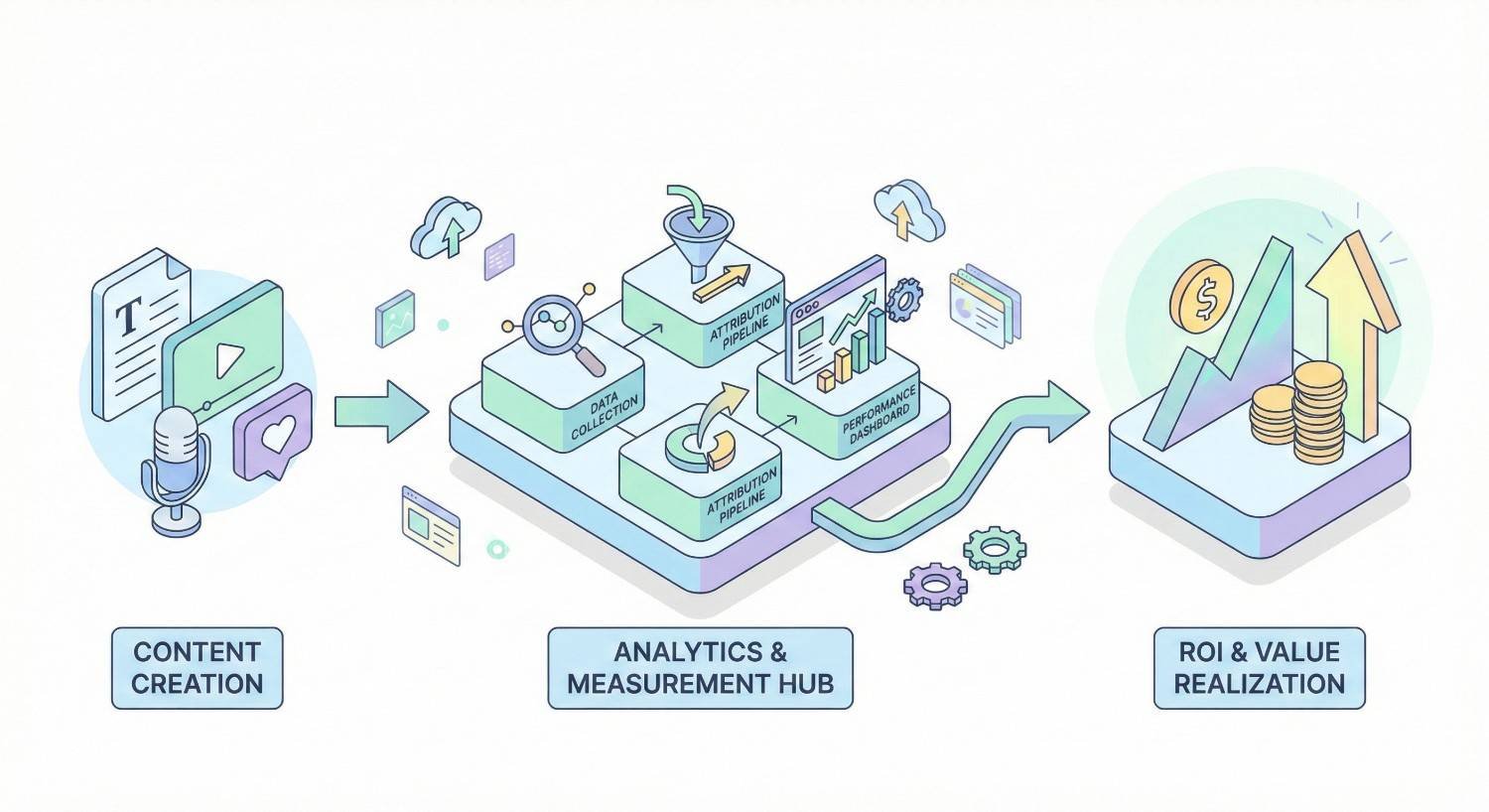
Tools and Platforms for Measuring Content ROI
The right tools enable accurate measurement and efficient optimization. Tool selection depends on business size, technical resources, and measurement sophistication requirements.
Analytics Platforms (GA4, Adobe Analytics, Mixpanel)
Analytics platforms provide the foundation for content measurement. Each platform offers different capabilities and suits different use cases.
Google Analytics 4: Free, powerful, and widely supported. Best for most businesses. Requires learning new interface and data model compared to Universal Analytics.
Adobe Analytics: Enterprise-grade capabilities with advanced segmentation and attribution. Higher cost and complexity. Best for large organizations with dedicated analytics teams.
Mixpanel: Product analytics focus with strong event tracking. Better for SaaS and app-based businesses tracking user behavior within products.
Choose based on your needs and resources. GA4 serves most content marketing measurement needs. Upgrade to enterprise platforms only when you’ve outgrown GA4’s capabilities.
SEO Tools (Ahrefs, SEMrush, Moz) for Visibility Tracking
SEO tools track search visibility, keyword rankings, and competitive positioning. These metrics indicate content’s organic search performance.
Ahrefs: Strong backlink analysis and content explorer features. Excellent for competitive research and link building opportunities.
Semrush: Comprehensive SEO suite with content marketing features. Good all-in-one option for teams wanting single-platform solutions.
Moz: User-friendly interface with strong local SEO features. Good for businesses with local search focus.
Most businesses need only one SEO platform. Choose based on specific feature priorities and budget. All major platforms provide adequate ranking and visibility tracking.
Marketing Attribution Software (HubSpot, Marketo, Salesforce)
Marketing automation and CRM platforms enable lead and revenue attribution. These tools connect content touchpoints to business outcomes.
HubSpot: Integrated marketing, sales, and service platform. Strong content attribution for businesses using HubSpot CRM. Free tier available.
Marketo: Enterprise marketing automation with sophisticated attribution. Best for large B2B organizations with complex buyer journeys.
Salesforce: CRM with marketing cloud integration. Powerful attribution when properly configured. Requires significant implementation investment.
Attribution accuracy depends on implementation quality. Even the best platform produces garbage data without proper tracking configuration. Invest in setup and ongoing maintenance.
Content Performance Tools (Clearscope, MarketMuse, ContentSquare)
Specialized content tools optimize creation and analyze performance. These platforms complement analytics with content-specific insights.
Clearscope: Content optimization based on competitive analysis. Helps ensure content covers topics comprehensively for SEO.
MarketMuse: AI-powered content planning and optimization. Identifies content gaps and optimization opportunities.
ContentSquare: User experience analytics showing how visitors interact with content. Heat maps and session recordings reveal engagement patterns.
These tools provide optimization insights rather than ROI measurement. Use them to improve content performance, then measure results through analytics platforms.
How to Improve and Maximize Content Writing ROI
Optimization transforms good content ROI into exceptional returns. Strategic improvements compound over time, dramatically increasing content program value.
Content Optimization: Updating and Refreshing Existing Assets
Updating existing content often delivers better ROI than creating new content. Established pages have accumulated authority that new content lacks.
Update triggers:
- Declining traffic or rankings
- Outdated information or statistics
- New competitive content ranking higher
- Changed search intent for target keywords
Update strategies:
- Add new sections covering emerging subtopics
- Update statistics and examples with current data
- Improve comprehensiveness based on competitor analysis
- Enhance formatting and readability
- Add internal links to newer related content
Content updates signal freshness to search engines. Google prefers current information, especially for topics where accuracy matters.
Track update impact. Compare traffic and rankings before and after updates. Successful updates often recover or exceed previous performance peaks.
Strategic Topic Selection Based on Search Demand
Topic selection determines content ceiling. Even perfect execution can’t overcome poor topic choices.
High-ROI topic characteristics:
- Sufficient search volume to justify investment
- Manageable competition relative to your authority
- Clear connection to business offerings
- Buyer intent alignment with your sales process
Topic research process:
- Identify seed topics from customer questions and sales conversations
- Expand with keyword research tools
- Analyze competition and ranking difficulty
- Prioritize based on business value and feasibility
- Map topics to content calendar
Avoid vanity topics that attract traffic without business relevance. High-volume keywords that don’t connect to your offerings waste resources.
Conversion Rate Optimization for Content Pages
Traffic without conversion wastes content investment. CRO improvements multiply returns from existing traffic.
CRO opportunities:
- Clear, compelling calls to action
- Strategic CTA placement throughout content
- Reduced friction in conversion processes
- Trust signals and social proof
- Mobile optimization for conversion paths
Testing approach:
- Identify high-traffic, low-conversion pages
- Hypothesize improvement opportunities
- Test changes with A/B or multivariate tests
- Implement winners and iterate
Small conversion improvements compound significantly. Improving conversion rate from 2% to 3% increases leads by 50% without additional traffic investment.
Building Content Clusters and Topic Authority
Content clusters organize related content around pillar topics. This structure signals topical authority to search engines and improves user navigation.
Cluster structure:
- Pillar page covering broad topic comprehensively
- Cluster content addressing specific subtopics
- Internal links connecting cluster content to pillar
- Consistent topic focus across cluster
Authority benefits:
- Stronger rankings for competitive pillar keywords
- Faster ranking for new cluster content
- Improved user engagement through related content
- Clear topical focus for search engines
Plan clusters strategically. Identify 5-10 core topics central to your business. Build comprehensive clusters around each topic over time.
Repurposing High-Performing Content Across Channels
Repurposing extracts additional value from successful content. One piece can become multiple assets reaching different audiences through different channels.
Repurposing opportunities:
- Blog post → Social media thread
- Guide → Email sequence
- Research → Infographic
- Article → Video script
- Webinar → Blog post series
Repurposing benefits:
- Lower marginal content costs
- Extended reach across channels
- Reinforced messaging through repetition
- Testing content in different formats
Prioritize repurposing for proven performers. Content that succeeded in one format likely succeeds in others. Don’t repurpose content that failed initially.
Content ROI Benchmarks by Industry and Business Type
Benchmarks provide context for evaluating your content performance. However, your specific situation matters more than industry averages.
B2B SaaS Content ROI Expectations
B2B SaaS companies typically see strong content ROI due to high customer lifetime values and long sales cycles where content influences decisions.
Typical benchmarks:
- 6-12 months to positive ROI
- 3-5x ROI over 3-year content lifespan
- $50-200 cost per lead from organic content
- 15-25% of pipeline influenced by content
SaaS content ROI benefits from:
- High CLV justifying significant content investment
- Complex products requiring educational content
- Long consideration phases where content builds trust
- Recurring revenue amplifying customer value
Focus on bottom-of-funnel content for faster ROI. Product comparisons, use case content, and integration guides convert prospects closer to purchase decisions.
E-commerce and Retail Content Performance
E-commerce content ROI varies significantly by product category and price point. Higher-margin products justify more content investment.
Typical benchmarks:
- 3-6 months to positive ROI for product content
- 12-18 months for informational content
- 2-4x ROI over content lifespan
- Direct revenue attribution more feasible
E-commerce content opportunities:
- Product descriptions and category pages
- Buying guides and comparison content
- How-to content for product usage
- User-generated content and reviews
Prioritize content for high-margin products. A comprehensive guide for a $500 product justifies more investment than content for $20 items.
Professional Services and Agency Content Returns
Professional services firms use content to demonstrate expertise and generate leads. High service values support significant content investment.
Typical benchmarks:
- 9-18 months to positive ROI
- 5-10x ROI for successful thought leadership
- $100-500 cost per qualified lead
- Strong brand building effects
Professional services content focus:
- Thought leadership establishing expertise
- Case studies demonstrating results
- Educational content addressing client challenges
- Industry analysis and trend content
Content ROI in professional services often appears in shortened sales cycles and increased close rates rather than direct lead attribution.
Startup vs. Enterprise Content Investment Models
Startups and enterprises approach content investment differently based on resources, timelines, and competitive positioning.
Startup approach:
- Limited budgets require focused investment
- Faster ROI requirements due to runway constraints
- Opportunity to establish authority in emerging niches
- Content often created by founders with deep expertise
Enterprise approach:
- Larger budgets enable comprehensive coverage
- Longer ROI timelines acceptable
- Competing against established competitors
- Dedicated content teams and resources
Startups should focus on specific niches where they can achieve authority quickly. Enterprises can pursue broader topical coverage across multiple content clusters.
Building a Sustainable Content Strategy for Long-Term ROI
Sustainable content strategies balance immediate needs with long-term authority building. Short-term thinking undermines content’s compounding potential.
Aligning Content Investment with Business Goals
Content investment should connect directly to business objectives. Misaligned content wastes resources regardless of quality.
Alignment process:
- Identify primary business goals (revenue, leads, awareness)
- Map content types to goal achievement
- Allocate resources proportionally to goal priority
- Measure content against goal-specific metrics
Common misalignments:
- Creating awareness content when leads are the priority
- Investing in bottom-funnel content without top-funnel traffic
- Building content for keywords disconnected from offerings
- Pursuing vanity metrics instead of business outcomes
Review alignment quarterly. Business priorities shift. Content strategy should adapt accordingly.
Creating a Content Calendar for Consistent Publishing
Content calendars ensure consistent publishing and strategic topic coverage. Ad-hoc content creation leads to gaps and redundancies.
Calendar elements:
- Publication dates and deadlines
- Topic and keyword targets
- Content type and format
- Author and reviewer assignments
- Distribution and promotion plans
Calendar benefits:
- Predictable resource requirements
- Balanced topic coverage
- Coordination across team members
- Accountability for deadlines
Plan 3-6 months ahead for strategic content. Leave flexibility for timely topics and emerging opportunities.
Balancing Quick Wins with Long-Term Authority Building
Effective content strategies pursue both immediate results and long-term positioning. Overemphasis on either creates problems.
Quick win content:
- Lower competition keywords
- Timely topics with immediate interest
- Bottom-funnel content for ready buyers
- Content updates and optimizations
Authority building content:
- Comprehensive pillar content
- Original research and data
- Thought leadership pieces
- Competitive keyword targeting
Allocate roughly 30% to quick wins and 70% to authority building. Quick wins maintain momentum and stakeholder confidence while authority content builds long-term competitive advantage.
When to Partner with a Full-Service SEO Provider
Internal content teams face capacity and expertise constraints. Partnering with specialized providers can accelerate results and improve ROI.
Partnership indicators:
- Content production bottlenecks limiting growth
- Technical SEO issues beyond internal expertise
- Competitive pressure requiring faster scaling
- Need for specialized skills (link building, technical audits)
Partnership benefits:
- Access to specialized expertise
- Scalable content production
- Proven processes and frameworks
- Objective outside perspective
Evaluate partners based on demonstrated results, transparent processes, and alignment with your business goals. The right partnership accelerates content ROI while building internal capabilities.
Conclusion
Content writing ROI measurement transforms content from an expense into a strategic investment with quantifiable returns. The combination of proper tracking infrastructure, realistic timeline expectations, and continuous optimization creates compounding value that paid channels cannot match.
Success requires patience, measurement discipline, and strategic focus. Businesses that commit to comprehensive content strategies typically see returns exceeding 3-5x their investment over three-year periods, with top performers achieving even higher multiples.
We help businesses build sustainable organic growth through strategic content development, technical SEO foundations, and performance tracking systems. Contact White Label SEO Service to discuss how we can accelerate your content ROI and build long-term search visibility for your brand.
Frequently Asked Questions
What is a good ROI percentage for content marketing?
A healthy content marketing ROI typically ranges from 200-500% over a three-year period. This means generating $3-6 in revenue for every $1 invested. However, ROI varies significantly by industry, content type, and measurement methodology.
How long does it take to see ROI from content writing?
Most content programs require 6-12 months to achieve positive ROI. SEO-focused content typically takes 12-18 months to reach full potential. Email and social content show faster returns but with lower long-term compounding effects.
What metrics should I track to measure content ROI?
Track traffic metrics (organic sessions, engagement), conversion metrics (leads, sign-ups), revenue metrics (attributed sales, CAC), and brand metrics (rankings, authority scores). Connect all metrics to business outcomes rather than tracking vanity metrics in isolation.
How do I attribute revenue to specific content pieces?
Use multi-touch attribution models in Google Analytics 4 or marketing automation platforms. Track the full customer journey from first content interaction through purchase. First-touch, last-touch, and linear attribution models each provide different perspectives on content value.
Why is my content not generating ROI?
Common causes include poor topic selection, weak SEO optimization, insufficient promotion, technical site issues, or unrealistic timeline expectations. Audit content performance against competitors, verify technical health, and ensure adequate time has passed for organic content to mature.
Should I update old content or create new content for better ROI?
Updating high-potential existing content often delivers better ROI than creating new content. Established pages have accumulated authority that new content lacks. Prioritize updates for pages with declining traffic, outdated information, or ranking potential that hasn’t been realized.
How much should I invest in content marketing?
Content marketing budgets typically range from 5-15% of total marketing spend for established programs. Startups building initial content foundations may invest higher percentages. Base investment on competitive requirements, business goals, and realistic ROI timelines for your industry.