

Content writing services pricing ranges from $0.05 to $1.00+ per word, with blog posts costing $50-$500, website pages $100-$2,000, and white papers $1,000-$6,000+. Your actual investment depends on content type, writer expertise, industry complexity, and turnaround requirements.
Understanding these pricing structures helps you budget effectively and avoid overpaying or underinvesting. The wrong choice costs more than money—it costs rankings, traffic, and revenue opportunities.
This guide breaks down every pricing model, compares provider types, reveals industry-specific rates, and shows you exactly how to calculate content ROI. You’ll leave knowing precisely what to pay and what to expect.
What Are Content Writing Services?
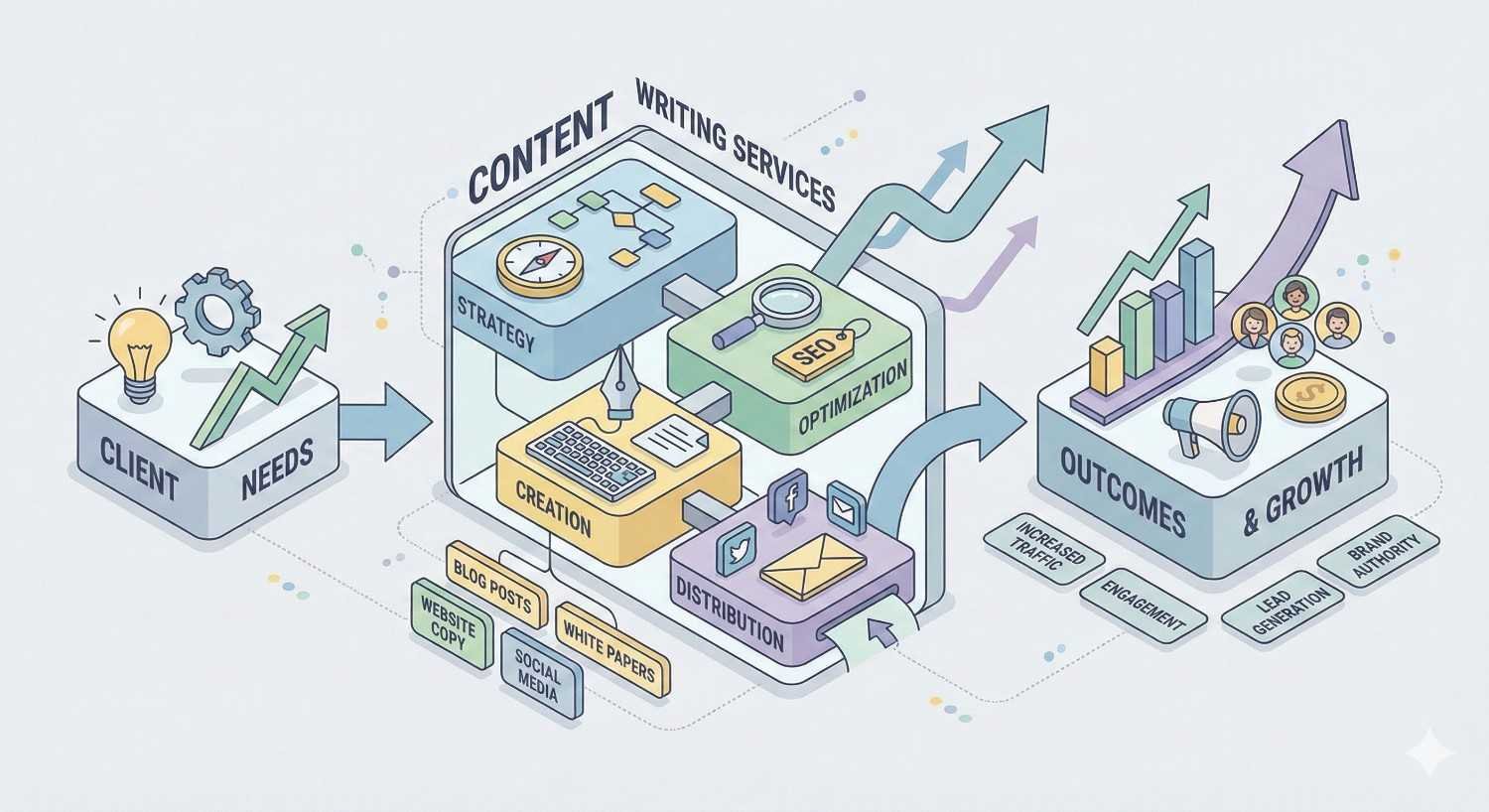
Content writing services deliver professionally crafted written materials designed to attract, engage, and convert your target audience. These services span everything from quick product descriptions to comprehensive technical documentation.
Professional content writers combine subject matter research, audience understanding, and strategic optimization to produce materials that serve both readers and search engines. The goal isn’t just words on a page—it’s content that drives measurable business outcomes.
Types of Content Writing Services
Blog Post Writing forms the backbone of most content marketing strategies. Writers create informative, engaging articles that target specific keywords, answer user questions, and establish topical authority. Blog content typically ranges from 800 to 2,500 words and requires research, SEO optimization, and brand voice alignment.
Website Copywriting focuses on conversion-oriented pages including homepages, service pages, about pages, and landing pages. This content demands persuasive writing skills, clear value proposition communication, and strategic call-to-action placement. Website copy directly impacts bounce rates, time on site, and conversion metrics.
SEO Content Writing specifically targets search engine visibility. Writers conduct keyword research, analyze search intent, optimize for featured snippets, and structure content for both users and crawlers. This specialization commands premium rates due to the technical knowledge required.
Technical Writing translates complex information into accessible documentation. This includes user manuals, API documentation, software guides, and process documentation. Technical writers need subject matter expertise and the ability to simplify complicated concepts without losing accuracy.
Product Descriptions drive e-commerce conversions. Writers create compelling, benefit-focused copy that helps shoppers understand product value and make purchase decisions. High-volume product description projects often involve hundreds or thousands of individual pieces.
White Papers & Case Studies establish thought leadership and support B2B sales cycles. These long-form assets require deep research, data analysis, and sophisticated argumentation. They typically range from 2,000 to 6,000+ words and demand significant writer expertise.
Who Needs Content Writing Services?
Startups and SMEs need content to build brand awareness, establish credibility, and compete with larger competitors in organic search. Limited internal resources make outsourcing essential for maintaining consistent publishing schedules.
Marketing managers and teams outsource content to scale production beyond internal capacity. Even companies with in-house writers supplement with external resources during campaigns, product launches, or content expansion initiatives.
E-commerce businesses require massive volumes of product descriptions, category pages, and supporting blog content. The scale makes outsourcing more cost-effective than building large internal teams.
B2B companies need specialized content for complex sales cycles. White papers, case studies, and technical content require writers who understand specific industries and can communicate with sophisticated audiences.
Agencies white-label content services to fulfill client deliverables without expanding headcount. This model allows agencies to offer comprehensive services while maintaining margins.
How Much Do Content Writing Services Cost?
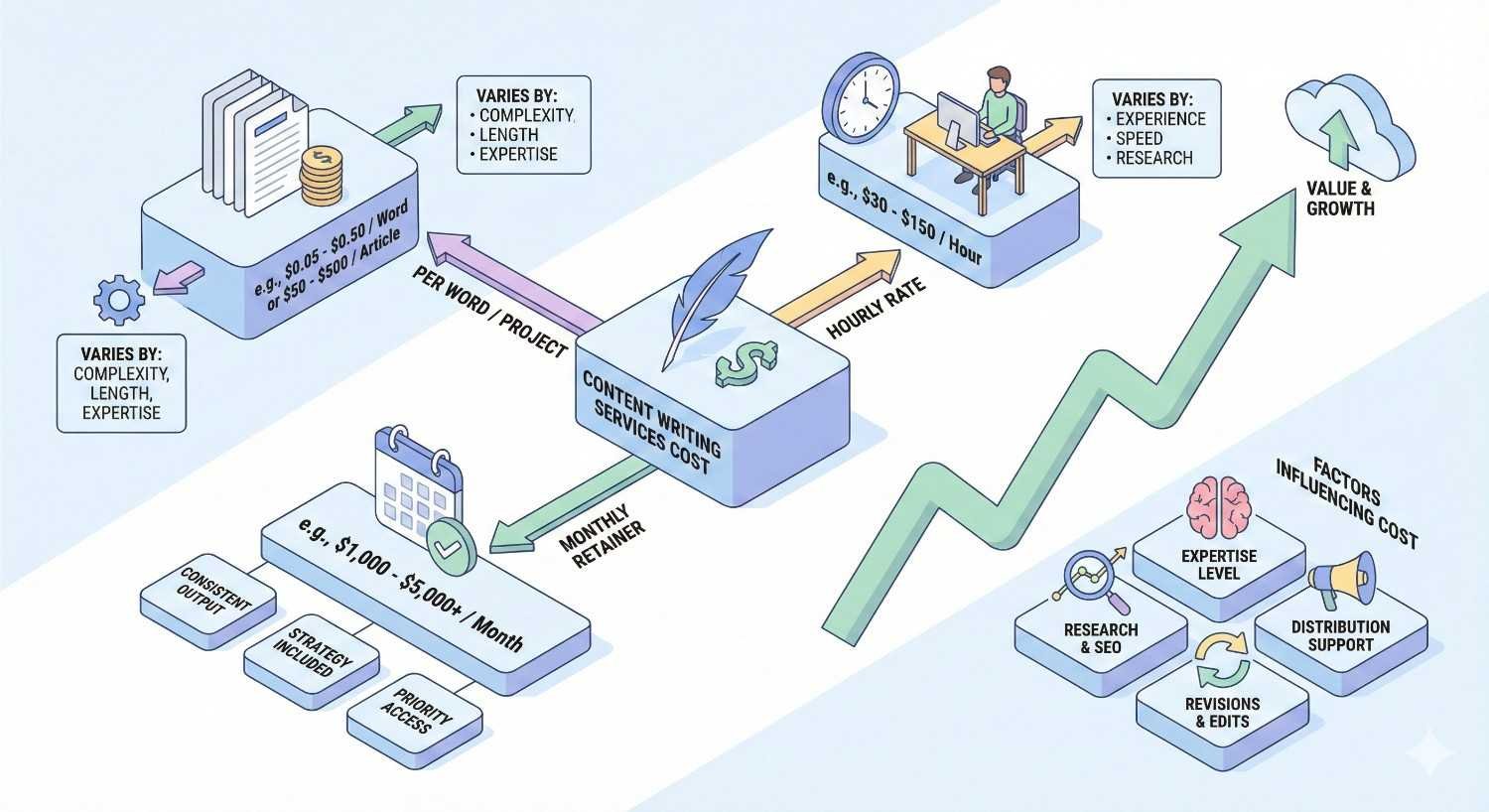
Content writing costs vary dramatically based on content type, writer expertise, and project requirements. Understanding market rates helps you set realistic budgets and evaluate proposals effectively.
Average Content Writing Rates in 2024
The content writing market spans a wide pricing spectrum. Entry-level writers charge $0.03-$0.10 per word, while experienced professionals command $0.15-$0.50 per word. Expert-level specialists in technical or regulated industries often exceed $1.00 per word.
Project-based pricing has become increasingly common, with writers quoting flat fees based on scope rather than word count. This model benefits both parties—writers aren’t penalized for efficient writing, and clients get predictable costs.
Monthly retainers for ongoing content needs typically range from $1,000-$10,000+ depending on volume, complexity, and service level. Retainer arrangements often include discounted per-piece rates compared to one-off projects.
Pricing by Content Type
Blog Posts ($50–$500+)
Standard blog posts of 1,000-1,500 words typically cost $100-$300 from mid-tier writers. Premium writers with subject matter expertise charge $300-$500+ for the same length. Budget options exist at $50-$100, but quality and optimization often suffer.
Factors affecting blog post pricing include research depth, SEO requirements, topic complexity, and revision rounds. A straightforward lifestyle post costs less than a technical B2B article requiring industry expertise.
Website Pages ($100–$2,000+)
Homepage copy ranges from $200-$1,000 depending on business complexity and writer caliber. Service pages typically cost $150-$500 each. Landing pages designed for paid campaigns command $300-$1,500 due to conversion optimization requirements.
Website copy pricing reflects the high-stakes nature of these pages. Poor website copy directly impacts revenue, making this an area where quality investment pays dividends.
SEO Articles ($150–$1,000+)
SEO-focused content commands premium pricing due to the additional skills required. Writers must understand keyword research, search intent analysis, content structure optimization, and competitive positioning.
A comprehensive SEO article of 2,000+ words with keyword optimization, internal linking recommendations, and meta descriptions typically costs $300-$800 from experienced SEO writers.
Product Descriptions ($25–$200)
Individual product descriptions range from $25-$75 for standard e-commerce items. Technical products requiring specification interpretation cost $75-$200 per description.
Volume discounts significantly impact product description pricing. Projects involving hundreds of descriptions often negotiate rates of $15-$40 per piece.
White Papers ($1,000–$6,000+)
White papers represent significant investments due to research requirements, length, and expertise needed. A standard 2,500-word white paper costs $1,500-$3,000. Complex technical or financial white papers requiring original research reach $4,000-$6,000+.
Email Sequences ($200–$2,000+)
Email sequence pricing depends on the number of emails and strategic complexity. A basic 5-email welcome sequence costs $200-$500. Sophisticated nurture sequences with segmentation and personalization reach $1,000-$2,000+.
Pricing by Word Count vs. Project-Based Pricing
Per-word pricing offers transparency and easy comparison between providers. You know exactly what you’re paying for each word delivered. However, this model can incentivize padding and penalize efficient writers who communicate effectively in fewer words.
Project-based pricing aligns incentives better for quality outcomes. Writers focus on achieving objectives rather than hitting word counts. This model works well for defined deliverables like landing pages, email sequences, or specific article briefs.
The trend in professional content writing moves toward project-based and value-based pricing. Experienced writers increasingly quote based on the value delivered rather than words produced.
Content Writing Pricing Models Explained
Understanding different pricing models helps you choose the right structure for your needs and negotiate effectively with providers.
Per-Word Pricing ($0.05–$1.00+ per word)
Per-word rates remain the most common pricing model, especially for blog content and articles. This model provides clear cost calculations and easy budget planning.
Entry-level rates ($0.05-$0.10/word): New writers, content mills, and offshore providers. Expect basic content requiring significant editing.
Mid-tier rates ($0.10-$0.30/word): Experienced generalist writers delivering solid, publish-ready content. Good balance of quality and cost for most business content.
Premium rates ($0.30-$0.75/word): Specialized writers with industry expertise, strong portfolios, and proven results. Appropriate for high-stakes content.
Expert rates ($0.75-$1.00+/word): Top-tier specialists in technical, medical, financial, or legal content. These writers bring credentials and deep expertise.
Per-Project/Flat-Rate Pricing
Flat-rate pricing provides budget certainty and simplifies procurement. Writers quote a single price for defined deliverables regardless of final word count.
This model works best when project scope is clearly defined. Vague briefs lead to scope creep and disputes. Successful flat-rate projects require detailed briefs specifying topic, audience, goals, format, and revision expectations.
Flat rates typically include a defined number of revision rounds. Additional revisions beyond the agreed scope incur extra charges.
Hourly Rates ($25–$150+ per hour)
Hourly billing suits projects with undefined scope or ongoing consulting relationships. Content strategy, editorial planning, and content audits often bill hourly.
Entry-level writers: $25-$50/hour Experienced writers: $50-$100/hour Expert consultants: $100-$150+/hour
Hourly rates require trust and clear communication. Without defined deliverables, costs can escalate quickly. Most clients prefer project-based pricing for actual content production.
Monthly Retainer Packages
Retainer arrangements provide predictable costs and guaranteed capacity. You pay a fixed monthly fee for a defined content volume or hours.
Typical retainer structures include:
Basic retainers ($1,000-$2,500/month): 4-8 blog posts or equivalent content volume Growth retainers ($2,500-$5,000/month): 8-16 pieces plus strategy support Enterprise retainers ($5,000-$15,000+/month): High-volume production with dedicated resources
Retainers often include discounted per-piece rates compared to one-off projects. The trade-off is commitment—most retainers require 3-6 month minimums.
Performance-Based Pricing
Performance-based models tie compensation to results like traffic, leads, or conversions. This structure aligns writer incentives with business outcomes.
Pure performance-based pricing remains rare due to the many factors beyond content quality that affect results. More common are hybrid models combining base fees with performance bonuses.
Performance pricing requires clear attribution and agreed metrics. It works best for ongoing relationships where writers can optimize based on data.
Factors That Affect Content Writing Prices
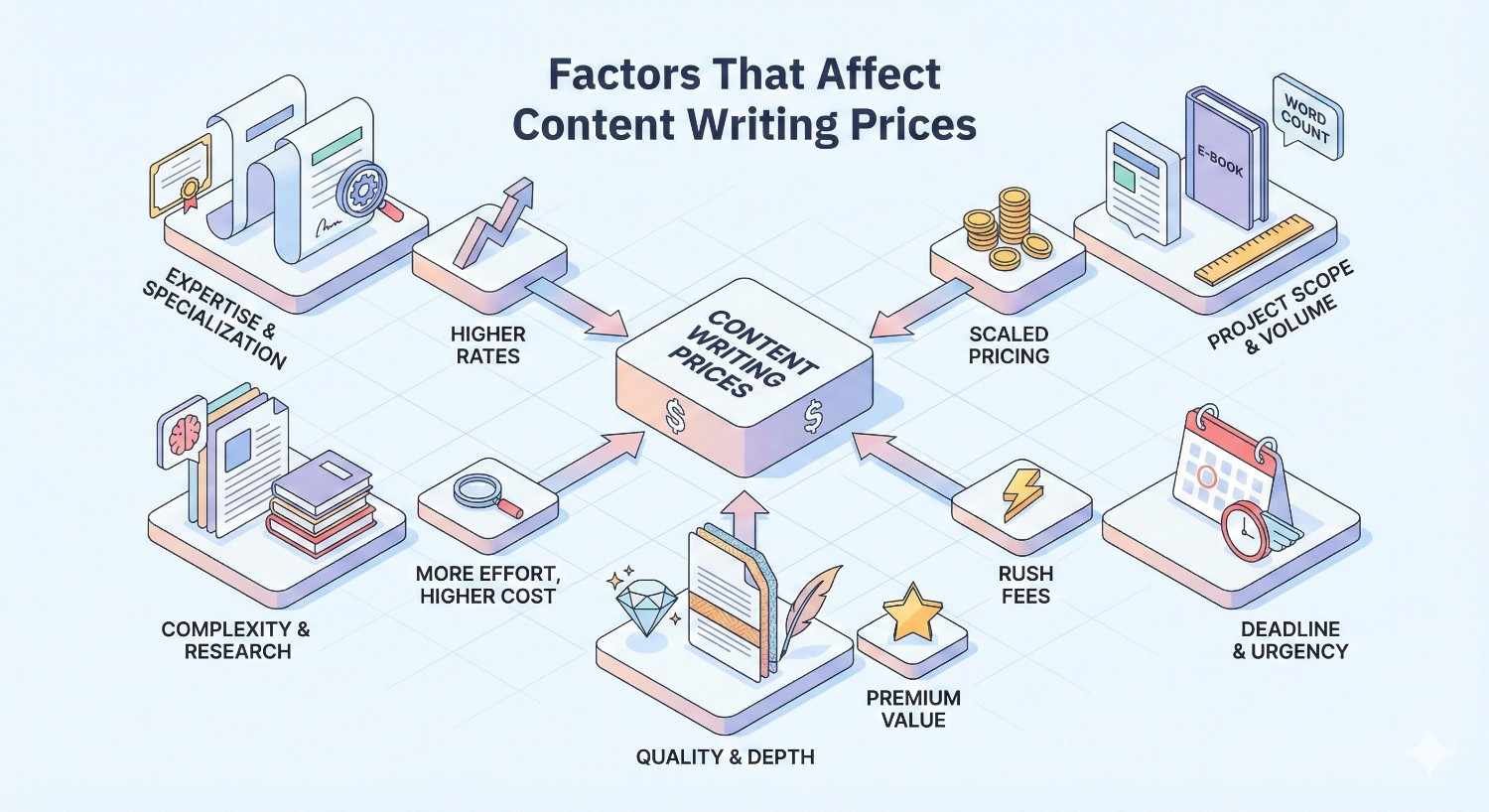
Multiple variables influence what you’ll pay for content writing services. Understanding these factors helps you evaluate quotes and make informed decisions.
Writer Experience and Expertise Level
Experience directly correlates with pricing. Writers with 5+ years of professional experience, strong portfolios, and proven results command premium rates.
Expertise matters beyond general writing skill. A writer with 10 years of SaaS marketing experience delivers more value for a SaaS company than a generalist with equal writing ability.
Credentials and bylines also affect pricing. Writers published in major publications or with recognized industry expertise justify higher rates through established authority.
Content Complexity and Research Requirements
Simple topics requiring minimal research cost less than complex subjects demanding deep investigation. A lifestyle blog post about morning routines requires less effort than a technical article about cloud infrastructure security.
Research-intensive content takes more time and expertise. Writers must locate credible sources, synthesize information, and present complex topics accessibly. This additional effort justifies higher pricing.
Original research, data analysis, and expert interviews add significant costs. Content requiring primary research rather than secondary source compilation commands premium rates.
Industry and Niche Specialization
Specialized industries command higher rates due to limited writer availability and expertise requirements. Writers who understand your industry deliver better content faster.
High-premium industries:
- Healthcare and medical (YMYL compliance, accuracy requirements)
- Finance and legal (regulatory knowledge, liability concerns)
- Technology and SaaS (technical accuracy, audience sophistication)
- Cybersecurity (specialized knowledge, rapid evolution)
Standard-rate industries:
- General business and marketing
- Lifestyle and consumer products
- Travel and hospitality
- Food and beverage
SEO Optimization and Keyword Research
Content requiring SEO optimization costs more than non-optimized writing. SEO writers must understand search intent, keyword strategy, content structure, and technical optimization.
Full-service SEO content includes:
- Keyword research and selection
- Competitive content analysis
- Search intent alignment
- On-page optimization
- Internal linking recommendations
- Meta title and description writing
This comprehensive approach adds 20-50% to base content costs but delivers significantly better organic performance.
Turnaround Time and Deadlines
Rush projects command premium pricing. Writers must reorganize schedules, work extended hours, and prioritize your project over others.
Standard turnaround for blog content is 5-10 business days. Rush delivery within 24-48 hours typically adds 25-50% to standard rates. Same-day delivery, when available, may double the price.
Planning content needs in advance saves money. Building buffer time into your content calendar avoids rush fees and gives writers time to produce their best work.
Revision Rounds and Editing Included
Most professional writers include 1-2 revision rounds in their pricing. Additional revisions beyond the agreed scope incur extra charges, typically $50-$150 per round.
Clear briefs reduce revision needs. Providing detailed guidelines, examples, and feedback on initial drafts helps writers hit the mark faster.
Some writers offer editing-only services at reduced rates. If you have draft content needing polish, editing services cost less than full content creation.
Content Volume and Bulk Discounts
Higher volumes typically unlock better per-piece pricing. Writers offer discounts for guaranteed ongoing work because it reduces their sales and administrative overhead.
Typical volume discount structures:
- 5-10 pieces/month: 5-10% discount
- 10-20 pieces/month: 10-15% discount
- 20+ pieces/month: 15-25% discount
Long-term commitments also improve pricing. A 6-month contract often secures better rates than month-to-month arrangements.
Content Writing Rates by Provider Type
Different provider types offer distinct advantages, limitations, and pricing structures. Choosing the right provider depends on your needs, budget, and quality requirements.
Freelance Content Writers
Freelance writers offer direct relationships, flexible arrangements, and often the best quality-to-cost ratio for specific needs.
Pricing range: $0.10-$1.00+/word depending on experience
Advantages:
- Direct communication without intermediaries
- Consistent voice and style from a single writer
- Flexibility in scope and scheduling
- Often better rates than agencies for equivalent quality
Limitations:
- Capacity constraints for high-volume needs
- Single point of failure if writer becomes unavailable
- Variable reliability depending on individual
- You manage the relationship directly
Finding quality freelancers requires vetting. Review portfolios, request samples, check references, and start with trial projects before committing to large volumes.
Content Writing Agencies
Agencies provide scalable capacity, project management, and access to diverse writer pools. They handle recruitment, quality control, and administrative tasks.
Pricing range: $0.15-$0.75/word or project-based
Advantages:
- Scalable capacity for high-volume needs
- Project management and quality assurance included
- Access to writers across specializations
- Business continuity if individual writers leave
- Often include strategy and editorial services
Limitations:
- Higher costs due to overhead and margins
- Less direct writer relationships
- Potential inconsistency across different writers
- Communication through account managers
Agencies suit businesses needing significant content volume, multiple content types, or comprehensive content marketing services beyond writing alone.
Content Mills and Marketplaces
Content mills and marketplaces offer low-cost content at scale. Platforms like Textbroker, Contently, and various freelance marketplaces connect buyers with large writer pools.
Pricing range: $0.03-$0.15/word
Advantages:
- Lowest cost option
- Fast turnaround for simple content
- Easy ordering and payment systems
- Large writer pools for volume needs
Limitations:
- Highly variable quality
- Limited writer vetting
- Generic content lacking brand voice
- Often requires significant editing
- Poor fit for specialized or strategic content
Content mills work for basic content needs where quality requirements are modest. They’re inappropriate for brand-critical content, technical subjects, or SEO-focused strategies.
In-House Writers vs. Outsourcing
The in-house versus outsourcing decision involves more than per-piece costs. Total cost of employment, management overhead, and flexibility all factor in.
In-house writer costs:
- Salary: $45,000-$85,000+ annually
- Benefits: 20-30% of salary
- Equipment, software, training
- Management time and overhead
An in-house writer producing 8-12 pieces monthly costs $5,000-$10,000+ per month fully loaded. This makes sense only at sufficient volume where the writer stays fully utilized.
Outsourcing advantages:
- Pay only for content produced
- Access to diverse expertise
- Scale up or down as needed
- No employment overhead
Hybrid approaches often work best. Maintain a small in-house team for brand-critical content while outsourcing volume production and specialized needs.
Content Writing Services Price Comparison Table
| Content Type | Budget Range | Mid-Tier Range | Premium Range | Enterprise Range |
| Blog Post (1,000 words) | $50-$100 | $100-$250 | $250-$500 | $500-$1,000+ |
| Website Page | $75-$150 | $150-$400 | $400-$800 | $800-$2,000+ |
| SEO Article (2,000 words) | $100-$200 | $200-$500 | $500-$800 | $800-$1,500+ |
| Product Description | $15-$30 | $30-$75 | $75-$150 | $150-$300+ |
| White Paper | $500-$1,000 | $1,000-$2,500 | $2,500-$4,500 | $4,500-$8,000+ |
| Case Study | $300-$600 | $600-$1,200 | $1,200-$2,500 | $2,500-$5,000+ |
| Email Sequence (5 emails) | $150-$300 | $300-$600 | $600-$1,200 | $1,200-$2,500+ |
| Landing Page | $150-$300 | $300-$600 | $600-$1,200 | $1,200-$2,500+ |
| Provider Type | Per-Word Range | Best For | Quality Level |
| Content Mills | $0.03-$0.10 | Basic, high-volume content | Variable, often low |
| Entry Freelancers | $0.05-$0.15 | Simple topics, tight budgets | Developing |
| Mid-Tier Freelancers | $0.15-$0.35 | Most business content | Solid, publish-ready |
| Premium Freelancers | $0.35-$0.75 | Strategic, specialized content | High quality |
| Expert Specialists | $0.75-$1.50+ | Technical, regulated industries | Expert level |
| Agencies | $0.15-$0.60 | Scalable, managed programs | Varies by agency |
| Pricing Model | Typical Range | Best For | Considerations |
| Per Word | $0.05-$1.00+ | Articles, blog posts | Easy comparison, may incentivize padding |
| Per Project | $100-$5,000+ | Defined deliverables | Budget certainty, requires clear scope |
| Hourly | $25-$150+ | Strategy, consulting | Flexible, costs can escalate |
| Monthly Retainer | $1,000-$15,000+ | Ongoing programs | Predictable, requires commitment |
How to Budget for Content Writing Services
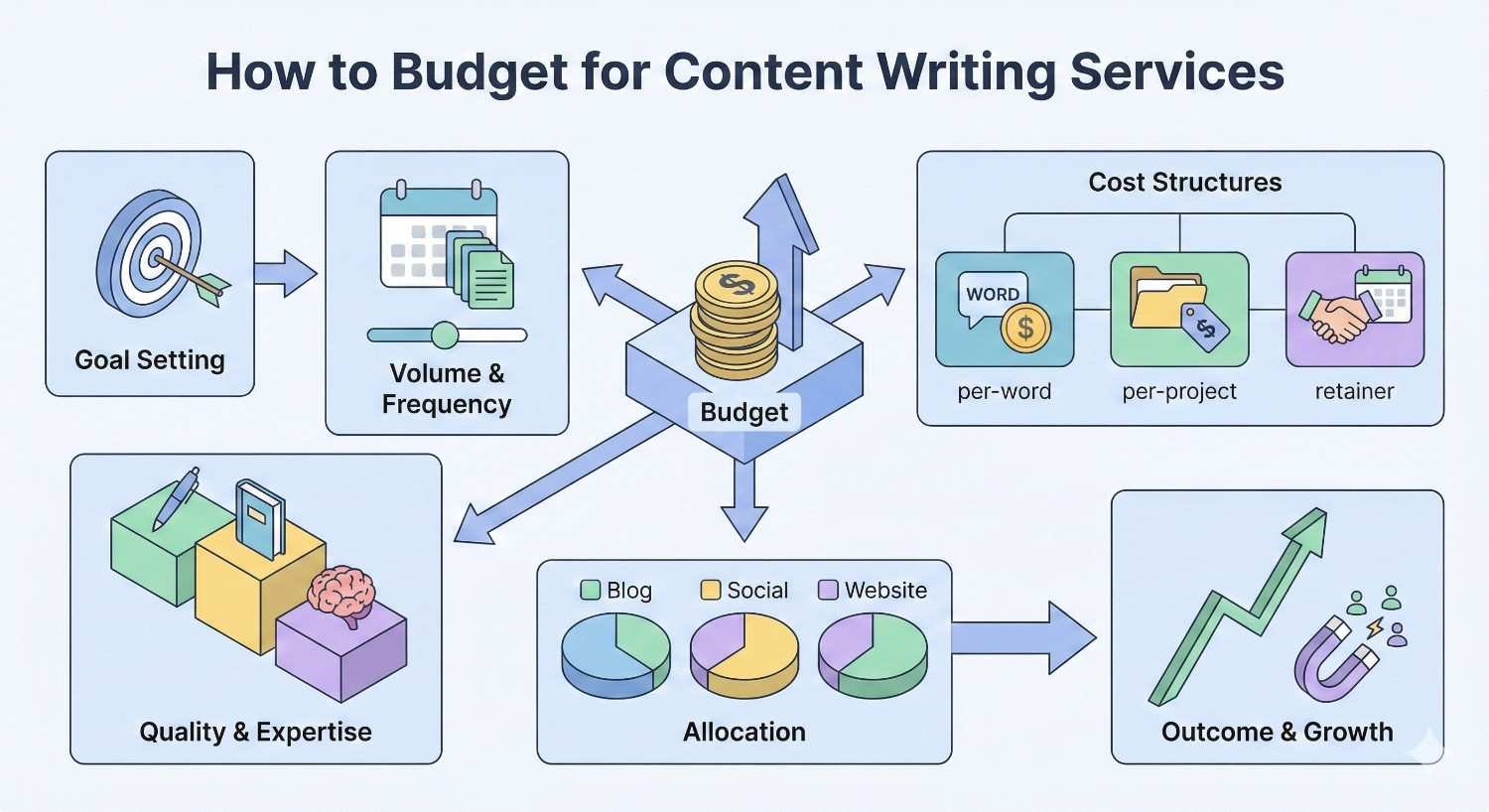
Strategic content budgeting balances investment against expected returns. Underspending produces ineffective content while overspending strains resources unnecessarily.
Calculating Content ROI
Content ROI measurement requires tracking both costs and returns over appropriate timeframes. Content marketing typically shows returns over months, not days.
Cost tracking includes:
- Writer fees
- Editing and review time
- Design and formatting
- Distribution and promotion
- Tools and software
Return measurement includes:
- Organic traffic generated
- Leads captured
- Conversions attributed
- Brand awareness metrics
- Link acquisition value
A blog post costing $300 that generates 100 monthly visitors over 24 months delivers 2,400 total visits. At a $5 cost-per-click equivalent, that’s $12,000 in traffic value—a 40x return.
This calculation demonstrates why quality content investment pays off. Cheap content that fails to rank delivers zero return regardless of low cost.
Setting Realistic Content Budgets
Content budgets should align with business goals and competitive requirements. Analyze what competitors invest and what’s needed to compete effectively.
Startup/early-stage budgets: $1,000-$3,000/month Focus on foundational content, key landing pages, and initial blog presence. Prioritize quality over quantity.
Growth-stage budgets: $3,000-$8,000/month Scale content production, build topical authority, and expand keyword coverage. Mix of blog content, landing pages, and lead magnets.
Established business budgets: $8,000-$25,000+/month Comprehensive content programs including thought leadership, multiple content types, and aggressive publishing schedules.
Budget allocation typically breaks down as:
- 60-70% for content creation
- 15-20% for strategy and planning
- 10-20% for distribution and promotion
Scaling Content Investment Over Time
Start conservatively and scale based on proven results. Initial investments should test approaches before committing significant resources.
Phase 1 (Months 1-3): Test and learn Invest modestly, try different content types and writers, measure what works. Budget: baseline investment.
Phase 2 (Months 4-6): Optimize and expand Double down on what works, eliminate what doesn’t, increase volume of proven formats. Budget: 1.5-2x baseline.
Phase 3 (Months 7-12): Scale aggressively With proven ROI, invest confidently in scaling successful approaches. Budget: 2-4x baseline.
This phased approach minimizes risk while building toward significant content programs.
Is Professional Content Writing Worth the Investment?
The value question depends on your alternatives and what you’re trying to achieve. For most businesses, professional content writing delivers positive ROI when executed strategically.
Content Writing ROI: Traffic, Leads, and Revenue
Quality content compounds over time. Unlike paid advertising that stops delivering when you stop paying, content continues generating returns indefinitely.
Traffic value: A single well-optimized article can generate thousands of monthly visits for years. Calculate the equivalent paid traffic cost to understand true value.
Lead generation: Content targeting commercial intent keywords captures prospects actively seeking solutions. These leads often convert better than paid traffic.
Revenue attribution: While direct attribution is challenging, businesses with strong content programs consistently report content-influenced revenue across their sales pipeline.
The key is strategic content investment. Random blog posts without keyword strategy or optimization waste money. Strategic content targeting valuable keywords with quality execution delivers returns.
Cheap vs. Quality Content: The True Cost
Budget content often costs more than premium content when you factor in true total costs.
Hidden costs of cheap content:
- Editing and rewriting time
- Missed ranking opportunities
- Brand reputation damage
- Wasted promotion efforts
- Opportunity cost of poor performance
A $50 article that requires 2 hours of editing at $50/hour actually costs $150. If it still fails to rank, the entire investment is wasted.
A $300 article that ranks and generates traffic delivers positive ROI despite higher upfront cost. The “expensive” option proves cheaper in outcomes.
When to Invest More in Content Writing
Certain situations justify premium content investment:
High-value keywords: When targeting keywords with significant commercial value, quality content is essential for ranking success.
Competitive markets: Outranking established competitors requires superior content. Budget content won’t displace quality incumbents.
Brand-critical content: Homepage copy, key landing pages, and thought leadership content directly impact brand perception.
Regulated industries: Healthcare, finance, and legal content requires accuracy and expertise. Errors create liability.
Technical subjects: Complex topics need writers who understand the material. Generalists produce superficial content that fails to satisfy expert audiences.
How to Choose a Content Writing Service
Selecting the right content partner requires systematic evaluation. The cheapest option rarely delivers the best value, but the most expensive isn’t automatically best either.
Evaluating Writer Portfolios and Samples
Portfolios reveal writing quality, subject matter range, and style fit. Request samples relevant to your industry and content needs.
What to evaluate:
- Writing clarity and readability
- Research depth and accuracy
- SEO optimization evidence
- Engagement and persuasiveness
- Brand voice adaptability
Request samples in your specific niche when possible. A writer excellent at lifestyle content may struggle with technical B2B topics.
Published samples carry more weight than unpublished work. Seeing content that clients actually used demonstrates real-world acceptance.
Questions to Ask Before Hiring
Process questions:
- What’s your typical turnaround time?
- How many revision rounds are included?
- What do you need from me to get started?
- How do you handle feedback and changes?
Experience questions:
- Have you written for my industry before?
- Can you share relevant samples?
- What’s your research process?
- How do you approach SEO optimization?
Business questions:
- What are your payment terms?
- Do you offer volume discounts?
- What’s your availability for ongoing work?
- How do you handle rush projects?
Red Flags to Avoid
Warning signs in content providers:
- Unwillingness to share samples
- Prices dramatically below market rates
- Guaranteed rankings or traffic promises
- No clear revision policy
- Poor communication responsiveness
- Inability to explain their process
- Resistance to contracts or agreements
Content quality red flags:
- Generic, surface-level content
- Obvious keyword stuffing
- Factual errors or outdated information
- Inconsistent voice or style
- Poor grammar and mechanics
Trust your instincts. If something feels off during the sales process, it likely won’t improve during the working relationship.
Trial Projects and Test Content
Start with small trial projects before committing to large volumes or long-term contracts. A single blog post or landing page reveals working style and quality.
Trial project best practices:
- Provide a detailed brief matching your real needs
- Evaluate the process, not just the output
- Assess communication and responsiveness
- Test revision handling
- Compare against your quality standards
Successful trials build confidence for larger commitments. Failed trials save you from expensive mistakes.
Content Writing Pricing for Different Industries
Industry specialization significantly impacts content writing costs. Regulated industries, technical fields, and B2B markets command premium pricing.
SaaS and Technology
SaaS content requires understanding of software concepts, technical audiences, and product-led growth strategies. Writers must translate complex features into compelling benefits.
Typical pricing:
- Blog posts: $200-$500
- Product pages: $300-$800
- Technical documentation: $400-$1,000
- White papers: $2,000-$5,000
SaaS content often requires product familiarity. Expect onboarding time for writers to understand your platform.
Healthcare and Medical
Healthcare content falls under YMYL (Your Money or Your Life) guidelines, requiring exceptional accuracy and often medical review. Writers need healthcare knowledge and understanding of compliance requirements.
Typical pricing:
- Blog posts: $300-$700
- Patient education: $250-$600
- Clinical content: $500-$1,200
- White papers: $3,000-$7,000
Medical content often requires review by healthcare professionals, adding to total costs.
Finance and Legal
Financial and legal content requires accuracy, compliance awareness, and sophisticated audience understanding. Errors create liability and regulatory risk.
Typical pricing:
- Blog posts: $300-$600
- Service pages: $400-$900
- Compliance content: $500-$1,200
- White papers: $3,000-$6,000
Many financial content projects require legal review, adding time and cost to the production process.
E-commerce and Retail
E-commerce content spans high-volume product descriptions to brand storytelling. Pricing varies dramatically based on content type and volume.
Typical pricing:
- Product descriptions: $25-$100 each
- Category pages: $150-$400
- Blog posts: $150-$400
- Brand content: $300-$800
Volume discounts significantly impact e-commerce content costs. Large catalog projects negotiate substantially lower per-piece rates.
B2B vs. B2C Content Pricing
B2B content typically costs more than B2C due to complexity, research requirements, and audience sophistication.
B2B content characteristics:
- Longer sales cycles requiring more content types
- Technical accuracy requirements
- Multiple stakeholder audiences
- Higher word counts and depth
B2C content characteristics:
- Emotional appeal focus
- Shorter, punchier formats
- Higher volume, lower complexity
- Faster production cycles
Expect 20-40% higher rates for B2B content compared to equivalent B2C formats.
Negotiating Content Writing Rates
Effective negotiation creates win-win arrangements. The goal isn’t the lowest possible price but the best value for sustainable partnerships.
When and How to Negotiate
Appropriate negotiation situations:
- Large volume commitments
- Long-term contracts
- Repeat business relationships
- Budget constraints with quality requirements
- Bundled service packages
Negotiation approaches:
- Lead with volume or commitment, not price complaints
- Offer something valuable in exchange (faster payment, longer contracts, referrals)
- Be transparent about budget constraints
- Focus on value, not just cost reduction
Avoid aggressive negotiation that damages relationships. Writers who feel undervalued deliver lower quality or prioritize other clients.
Building Long-Term Writer Relationships
Long-term relationships benefit both parties. Writers gain predictable income and deep client knowledge. Clients get consistent quality and reduced onboarding costs.
Relationship-building practices:
- Pay promptly and reliably
- Provide clear, constructive feedback
- Respect writer expertise and recommendations
- Communicate openly about needs and changes
- Offer fair rates that sustain quality work
Loyal writers often provide informal discounts, priority scheduling, and extra effort for valued clients.
Volume Discounts and Retainer Benefits
Volume commitments unlock better pricing through reduced writer overhead. Guaranteed work eliminates sales time and provides income stability.
Typical volume discount structures:
- 5-10 pieces/month: 5-10% discount
- 10-20 pieces/month: 10-15% discount
- 20+ pieces/month: 15-25% discount
Retainer benefits beyond pricing:
- Priority scheduling and availability
- Dedicated writer assignment
- Streamlined processes and communication
- Strategic input and recommendations
- Flexibility for rush needs
Retainers require commitment but deliver significant value for ongoing content programs.
Conclusion
Content writing services pricing spans from $0.05 to $1.00+ per word, with costs determined by content type, writer expertise, industry complexity, and project requirements. Understanding these variables helps you budget effectively and select providers delivering genuine value rather than just low prices.
Quality content investment generates compounding returns through organic traffic, lead generation, and brand authority. The true cost of cheap content often exceeds premium alternatives when factoring in editing time, missed opportunities, and failed performance.
At White Label SEO Service, we deliver transparent content writing pricing matched to your specific needs and goals. Contact us today for custom pricing on content that drives measurable organic growth and sustainable business results.
Frequently Asked Questions
How much should I pay for a 1,000-word blog post?
Quality 1,000-word blog posts typically cost $150-$350 from experienced writers. Budget options exist at $50-$100, but often require significant editing. Premium specialized content reaches $400-$600+ for technical or regulated industries.
Why is content writing so expensive?
Professional content writing requires research, expertise, SEO knowledge, and revision time beyond just typing words. Quality writers invest hours in each piece, and their rates reflect the value delivered through traffic, leads, and conversions rather than just word count.
What is the average cost per word for content writing?
Average per-word rates range from $0.10-$0.30 for mid-tier professional writers. Entry-level writers charge $0.05-$0.10, while specialists command $0.50-$1.00+. Project-based pricing increasingly replaces per-word models for defined deliverables.
Are cheap content writing services worth it?
Cheap content services rarely deliver value for strategic content needs. Low-cost content typically requires extensive editing, fails to rank, and wastes promotion efforts. Budget options may work for basic, non-critical content but underperform for SEO or brand-building purposes.
How do agencies price content writing differently than freelancers?
Agencies include overhead costs for project management, quality assurance, and business operations in their pricing. Expect 20-50% higher rates than equivalent freelancer quality. Agencies provide scalability and reduced management burden that justifies premium pricing for many businesses.
What’s included in content writing service pricing?
Standard pricing typically includes research, writing, basic SEO optimization, and 1-2 revision rounds. Additional services like keyword research, image sourcing, CMS uploading, and extensive revisions often cost extra. Clarify inclusions before committing to any provider.
How do I calculate ROI on content writing investment?
Track content costs against traffic generated, leads captured, and conversions attributed over 12-24 months. Compare organic traffic value to equivalent paid advertising costs. Quality content typically delivers 5-20x ROI when targeting valuable keywords with strategic optimization.