
Content writing and copywriting serve fundamentally different purposes in your marketing strategy, and understanding this distinction directly impacts your organic traffic, lead generation, and conversion rates. Many business owners invest in the wrong type of writing for their goals, wasting budget and missing growth opportunities.
This guide breaks down the core differences between content writing and copywriting, explains when to use each, and shows you how to build an integrated strategy that drives sustainable results.
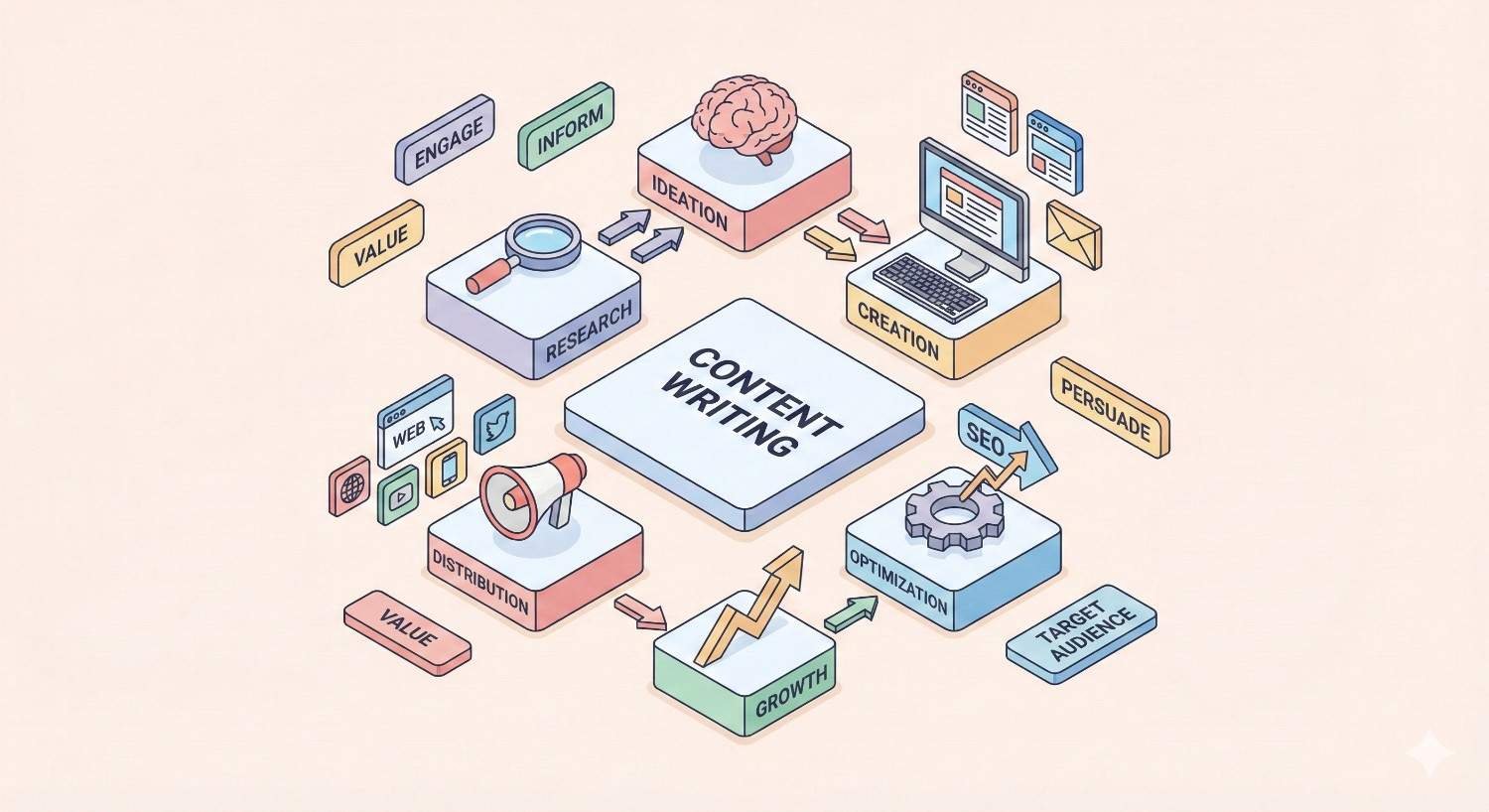
What Is Content Writing?
Content writing focuses on creating valuable, informative material that educates your audience and builds long-term organic visibility. Unlike promotional copy, content writing prioritizes delivering genuine value that helps readers solve problems, learn new skills, or make informed decisions.
Core Purpose and Objectives of Content Writing
The primary objective of content writing is to attract, engage, and retain an audience through valuable information. Content writers create material designed to rank in search engines, answer user questions, and establish your brand as a trusted resource in your industry.
Content writing supports the top and middle stages of the marketing funnel. It brings new visitors to your website through organic search, keeps them engaged with helpful information, and nurtures them toward conversion over time. The goal is building relationships, not immediate sales.
From an SEO perspective, content writing targets informational search intent. When someone searches “how to improve website speed” or “what is technical SEO,” they want education, not a sales pitch. Content writing meets this need while positioning your brand as the authority.
Common Content Writing Formats and Deliverables
Content writers produce a wide range of formats, each serving specific purposes in your content strategy:
Blog posts and articles form the foundation of most content strategies. These pieces target specific keywords, answer user questions, and drive organic traffic. A well-optimized blog post can generate traffic for years after publication.
Long-form guides and pillar content provide comprehensive coverage of broad topics. These pieces often exceed 3,000 words and serve as cornerstone content that other articles link to internally.
Case studies document real results and demonstrate expertise through concrete examples. They bridge informational content and sales material by showing what’s possible.
White papers and ebooks offer in-depth analysis on specific topics. These gated assets often support lead generation by requiring email signup for access.
Email newsletters maintain ongoing relationships with subscribers through regular valuable content. Unlike promotional emails, newsletter content educates and informs.
How-to tutorials and educational content provide step-by-step guidance that helps readers accomplish specific tasks. This format performs exceptionally well in search results.
Key Skills Required for Content Writers
Effective content writers combine research abilities with clear communication skills. They must understand how to find accurate information, synthesize complex topics, and present them in accessible language.
Research and fact-checking ensure content accuracy and credibility. Content writers verify claims, find supporting data, and cite authoritative sources.
SEO fundamentals help content writers create material that ranks. This includes keyword research, on-page optimization, internal linking, and understanding search intent.
Subject matter comprehension allows writers to explain complex topics clearly. While they don’t need to be experts, they must grasp concepts well enough to teach others.
Audience awareness shapes how content writers present information. They adjust vocabulary, depth, and examples based on reader sophistication and needs.
Storytelling ability makes informational content engaging. The best content writers weave narratives that hold attention while delivering value.

What Is Copywriting?
Copywriting is persuasive writing designed to drive specific actions. Every word serves a strategic purpose: moving readers toward a conversion, whether that’s a purchase, signup, download, or inquiry.
Core Purpose and Objectives of Copywriting
The core purpose of copywriting is persuasion. Copywriters craft messages that motivate readers to take immediate action. Unlike content writing’s educational focus, copywriting exists to sell.
Copywriting targets the bottom of the marketing funnel. It speaks to prospects who already understand their problem and are evaluating solutions. The goal is converting interest into action.
Effective copywriting connects product benefits to customer desires. It addresses objections, creates urgency, and makes the next step feel natural and low-risk. Every element, from headlines to button text, is optimized for conversion.
Common Copywriting Formats and Deliverables
Copywriters work across formats designed to drive action:
Landing pages convert traffic into leads or customers. These focused pages eliminate distractions and guide visitors toward a single conversion goal.
Sales pages present offers in detail, addressing objections and building desire. Long-form sales pages can exceed 5,000 words for high-ticket offers.
Email sequences nurture leads through automated campaigns. Each email moves subscribers closer to purchase through strategic messaging.
Ad copy captures attention in crowded feeds. Whether Google Ads, Facebook, or LinkedIn, copywriters craft messages that stop scrollers and drive clicks.
Product descriptions transform features into benefits. Effective product copy helps buyers envision ownership and overcome purchase hesitation.
Website homepage and service pages communicate value propositions and guide visitors toward conversion points.
Video scripts for sales videos, webinars, and promotional content require copywriting skills to maintain engagement and drive action.
Key Skills Required for Copywriters
Copywriters need a distinct skill set focused on persuasion and conversion:
Consumer psychology understanding helps copywriters tap into motivations, fears, and desires that drive purchasing decisions.
Headline writing determines whether copy gets read. Copywriters test and refine headlines to maximize engagement.
Benefit-focused communication translates features into outcomes readers care about. “500GB storage” becomes “never delete another photo.”
Objection handling anticipates and addresses reasons prospects might not buy. Effective copy preemptively resolves concerns.
Call-to-action optimization ensures readers know exactly what to do next. Strong CTAs are specific, urgent, and low-friction.
A/B testing mindset drives continuous improvement. Copywriters test variations to identify what resonates with specific audiences.
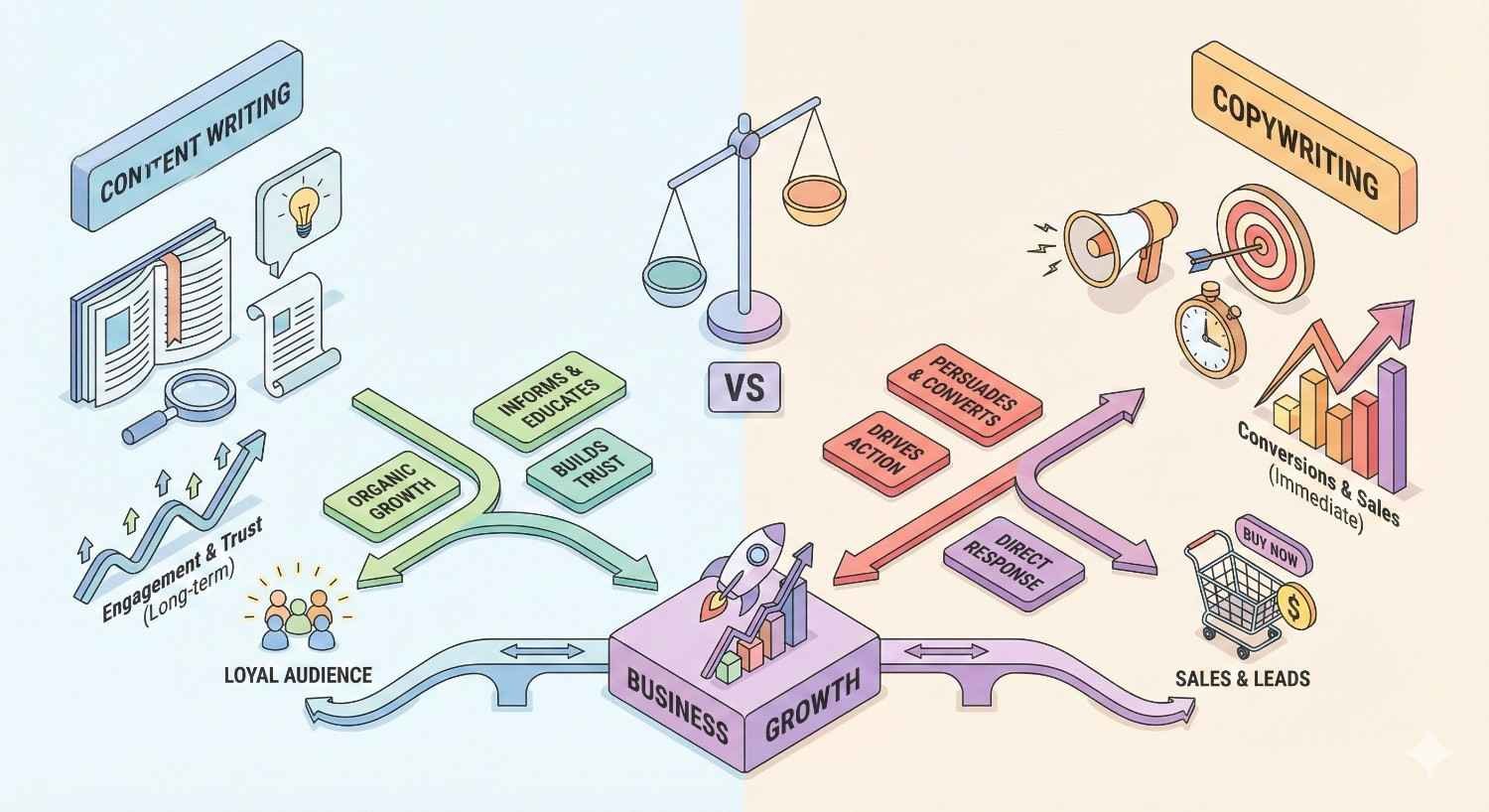
Content Writing vs Copywriting: Key Differences Explained
While both disciplines involve writing, content writing and copywriting differ fundamentally in purpose, approach, and measurement. Understanding these differences helps you invest in the right type of writing for your goals.
Primary Goal: Education vs Persuasion
Content writing educates. It answers questions, explains concepts, and helps readers understand topics more deeply. The writer succeeds when readers leave more informed than they arrived.
Copywriting persuades. It motivates action, overcomes objections, and drives conversions. The writer succeeds when readers take the desired next step.
This distinction shapes everything else. Content writers ask, “What does my reader need to learn?” Copywriters ask, “What does my reader need to believe to take action?”
Both approaches serve legitimate business purposes. Content writing builds the audience that copywriting converts. Neither replaces the other.
Content Length and Format Differences
Content writing typically runs longer. Blog posts range from 1,000 to 3,000+ words. Guides and pillar content often exceed 5,000 words. Depth and comprehensiveness matter because readers seek thorough answers.
Copywriting varies more dramatically. A headline might be five words. A landing page might be 500 words. A long-form sales page might exceed 10,000 words. Length depends entirely on what’s needed to drive conversion.
Content writing follows more predictable structures: introduction, body sections, conclusion. Copywriting structures vary based on the specific conversion goal and audience awareness level.
Tone, Style, and Voice Variations
Content writing tends toward informative, helpful, and educational tones. The voice positions the brand as a knowledgeable guide. Objectivity and balance often matter, especially for comparison content.
Copywriting adopts more direct, urgent, and emotionally engaging tones. The voice positions the brand as the solution to reader problems. Persuasion requires taking a clear stance.
Content writing can afford subtlety. Readers have time to absorb information. Copywriting demands clarity and impact. Readers decide quickly whether to engage or leave.
SEO and Search Intent Considerations
Content writing aligns primarily with informational search intent. Users searching “what is content marketing” or “how to write a blog post” want education. Content writing meets this need while building organic visibility.
Copywriting aligns with transactional and commercial investigation intent. Users searching “best CRM software” or “buy running shoes online” are closer to purchase. While copywriting can be optimized for search, its primary distribution often comes through paid channels, email, and direct traffic.
Content writing prioritizes keyword optimization, semantic coverage, and topical authority. Copywriting prioritizes conversion optimization, even if that means fewer keywords.
Audience Engagement and Call-to-Action Approach
Content writing uses softer calls-to-action. “Read our related guide” or “Subscribe for more tips” feel appropriate after educational content. Aggressive sales CTAs would feel jarring.
Copywriting uses direct, action-oriented CTAs. “Buy now,” “Start your free trial,” and “Schedule a demo” match reader expectations on sales pages. Soft CTAs would waste conversion opportunities.
Content writing builds engagement over time through multiple touchpoints. Copywriting aims to convert in a single interaction when possible.
Metrics and Success Measurement
Content writing success metrics focus on traffic and engagement:
- Organic traffic growth
- Keyword rankings
- Time on page
- Pages per session
- Backlinks earned
- Social shares
Copywriting success metrics focus on conversion:
- Conversion rate
- Click-through rate
- Cost per acquisition
- Revenue generated
- Return on ad spend
- Email open and click rates
Different goals require different measurements. Judging content writing by conversion rate or copywriting by organic traffic misses the point of each discipline.
Content Writing vs Copywriting: Side-by-Side Comparison Table
| Aspect | Content Writing | Copywriting |
| Primary Goal | Educate and inform | Persuade and convert |
| Funnel Stage | Top and middle | Bottom |
| Search Intent | Informational | Transactional/Commercial |
| Typical Length | 1,000-5,000+ words | Varies (5-10,000+ words) |
| Tone | Helpful, educational | Urgent, persuasive |
| CTA Style | Soft, relationship-building | Direct, action-oriented |
| Time to Results | 3-12 months | Days to weeks |
| Key Metrics | Traffic, rankings, engagement | Conversions, revenue, ROI |
| Distribution | Organic search, social | Paid ads, email, direct |
| Shelf Life | Long (evergreen potential) | Short (campaign-based) |
| SEO Focus | High | Moderate to low |
| Emotional Appeal | Moderate | High |
When to Use Content Writing for Your Business
Content writing serves specific strategic purposes. Understanding when to invest in content writing helps you allocate resources effectively.
Building Long-Term Organic Visibility
Content writing is your primary tool for organic search growth. Every blog post, guide, and resource page creates an opportunity to rank for relevant keywords and attract qualified traffic.
Unlike paid advertising, content writing compounds over time. A blog post published today can generate traffic for years. As you build a library of quality content, your organic visibility grows exponentially.
For businesses targeting sustainable growth, content writing is non-negotiable. Research from Ahrefs shows that 90.63% of pages get zero traffic from Google. The pages that do rank typically offer comprehensive, well-optimized content that satisfies search intent.
Establishing Thought Leadership and Authority
Content writing positions your brand as an industry authority. When you consistently publish valuable insights, readers begin associating your brand with expertise.
This authority translates into business results. Prospects who’ve consumed your content arrive at sales conversations already trusting your expertise. They’re easier to convert and often become better customers.
Thought leadership content also attracts backlinks naturally. Other sites reference authoritative content, building your domain authority and improving rankings across your entire site.
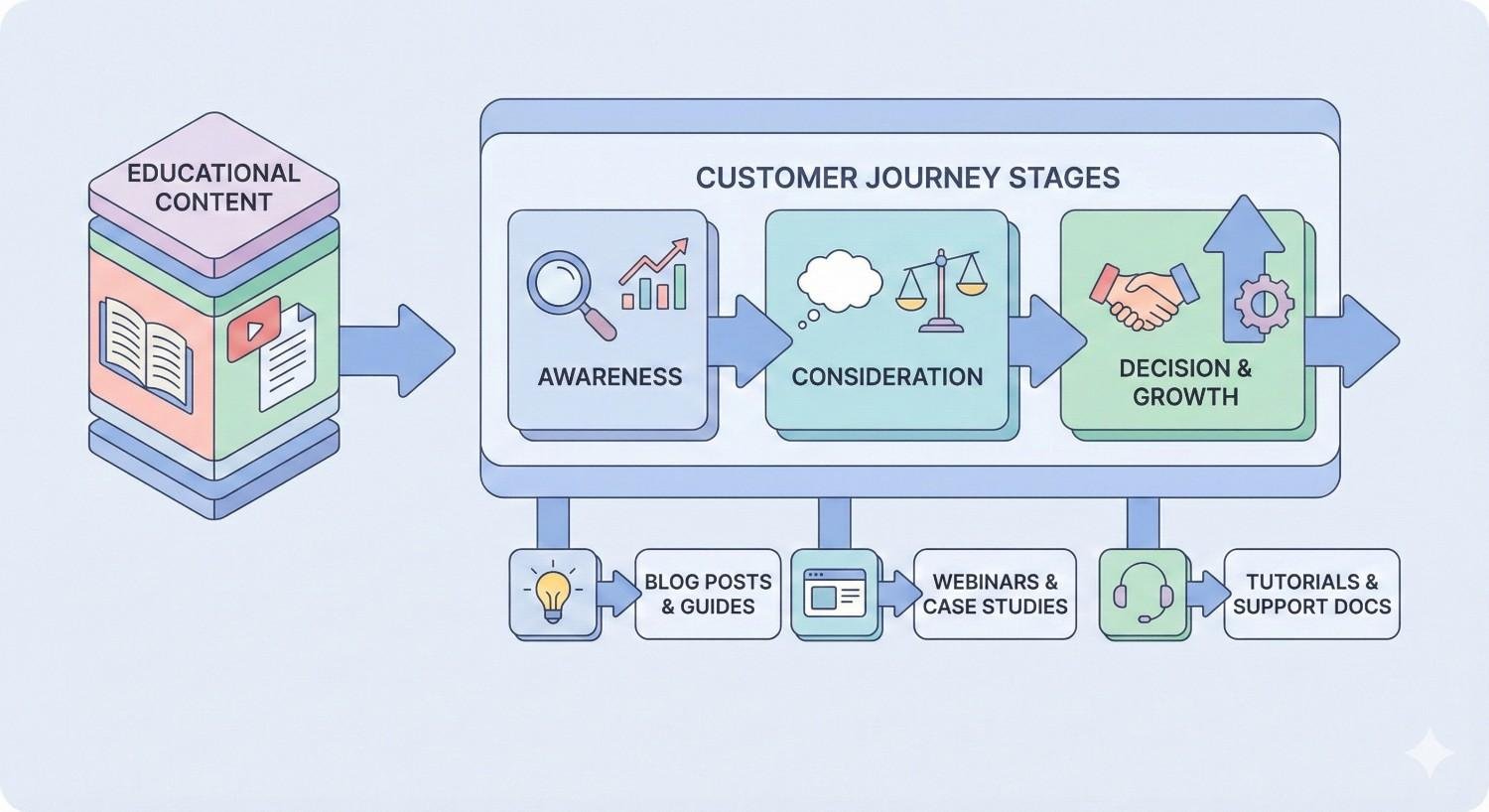
Supporting the Customer Journey with Educational Content
Buyers research before purchasing. Content writing provides the information they need at each stage of their journey.
Awareness stage content helps prospects understand their problems. Blog posts explaining common challenges and their causes attract early-stage buyers.
Consideration stage content helps prospects evaluate solutions. Comparison guides, case studies, and detailed how-to content serve buyers actively researching options.
Decision stage content helps prospects choose confidently. Product-focused content, implementation guides, and FAQ pages support final purchase decisions.
Without content at each stage, you lose prospects to competitors who provide the information buyers need.
Content Writing Use Cases and Examples
SaaS companies use content writing to rank for problem-aware searches. A project management tool might publish “how to improve team productivity” to attract potential customers.
E-commerce brands use content writing to capture informational searches related to their products. A running shoe retailer might publish “how to choose running shoes for flat feet.”
Professional services firms use content writing to demonstrate expertise. A law firm might publish guides on specific legal topics to attract clients facing those issues.
B2B companies use content writing to educate complex buying committees. Technical guides and industry analysis help multiple stakeholders understand solutions.
When to Use Copywriting for Your Business
Copywriting drives immediate action. When you need conversions now, copywriting delivers.
Driving Immediate Conversions and Sales
Copywriting converts interest into action. When prospects land on your sales page, product page, or landing page, copywriting determines whether they buy or bounce.
Strong copywriting can dramatically improve conversion rates. The difference between mediocre and excellent copy often means 2-5x more conversions from the same traffic.
For businesses with proven offers and traffic sources, copywriting optimization often provides the fastest path to revenue growth.
Creating High-Impact Marketing Campaigns
Marketing campaigns live or die on copy quality. Whether you’re launching a product, running a promotion, or announcing a new service, copywriting shapes campaign performance.
Ad copy determines click-through rates. Email copy determines open and conversion rates. Landing page copy determines whether clicks become customers.
Campaign copywriting requires understanding your specific audience, offer, and competitive landscape. Generic copy underperforms targeted messaging.
Optimizing Landing Pages and Sales Funnels
Landing pages exist to convert. Every element, from headline to button text, should move visitors toward action. Copywriting optimizes each component for maximum conversion.
Sales funnels guide prospects through multiple conversion points. Email sequences, upsell pages, and checkout flows all require copywriting that maintains momentum and overcomes objections.
Funnel optimization often reveals that small copy changes produce significant revenue increases. Testing headlines, CTAs, and value propositions identifies what resonates with your specific audience.
Copywriting Use Cases and Examples
E-commerce product pages use copywriting to transform browsers into buyers. Benefit-focused descriptions, urgency elements, and social proof drive purchases.
Lead generation landing pages use copywriting to maximize opt-ins. Clear value propositions and low-friction forms convert traffic into leads.
Email marketing campaigns use copywriting to nurture and convert subscribers. Subject lines, body copy, and CTAs all require persuasive writing.
Paid advertising uses copywriting to maximize ad performance. Headlines and descriptions must capture attention and drive clicks within strict character limits.
Can Content Writing and Copywriting Work Together?
Content writing and copywriting aren’t competitors. They’re complementary disciplines that work together in effective marketing strategies.
The Integrated Content Strategy Approach
Smart marketers use content writing to attract and nurture audiences, then copywriting to convert them. This integrated approach maximizes both traffic and revenue.
Content writing fills the top of your funnel with qualified prospects. Blog posts, guides, and educational resources attract people interested in topics related to your solutions.
Copywriting converts those prospects into customers. Landing pages, email sequences, and sales pages turn readers into buyers.
Neither discipline works optimally alone. Content without conversion mechanisms wastes traffic. Copywriting without content lacks the audience to convert.
How Content Writing Supports Copywriting Goals
Content writing warms up prospects before they encounter sales copy. Readers who’ve consumed your educational content arrive at sales pages with established trust and understanding.
This pre-selling effect improves copywriting performance. Warm audiences convert at higher rates than cold traffic. They already believe in your expertise and understand the value you provide.
Content writing also provides material for copywriting. Case studies become testimonials. Blog insights become email content. Educational frameworks become sales page sections.
Creating a Balanced Content Marketing Ecosystem
Effective content ecosystems balance education and conversion. Too much content without conversion paths wastes resources. Too much sales copy without supporting content feels pushy.
The right balance depends on your business model, sales cycle, and audience. B2B companies with long sales cycles typically need more content. E-commerce brands with impulse purchases might weight toward copywriting.
Most businesses benefit from a foundation of quality content supported by optimized conversion copy at key decision points.
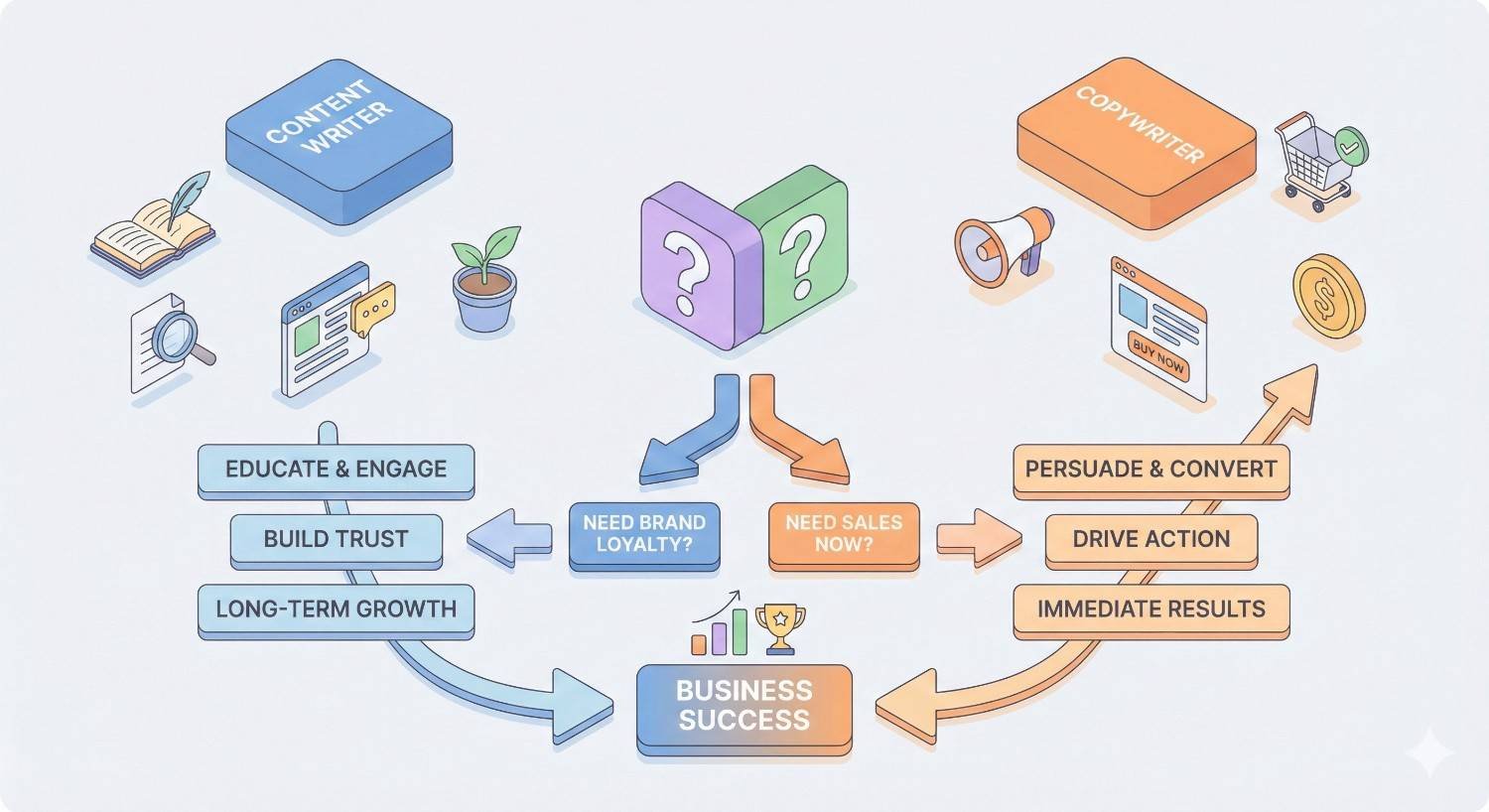
Content Writer vs Copywriter: Which Should You Hire?
Choosing between a content writer and copywriter depends on your current business needs, goals, and existing assets.
Assessing Your Business Goals and Priorities
Start with your primary objective. What do you need most right now?
If you need organic traffic: Hire a content writer. Building search visibility requires consistent, quality content optimized for your target keywords.
If you need better conversions: Hire a copywriter. Improving landing pages, emails, and sales pages requires persuasion expertise.
If you need both: Prioritize based on your biggest gap. Most businesses benefit from content first (to build traffic), then copywriting (to convert that traffic).
Budget Considerations and ROI Expectations
Content writing typically costs less per piece but requires ongoing investment. Building organic visibility takes months of consistent publishing.
Copywriting often costs more per project but can deliver faster ROI. A single high-converting landing page might pay for itself within weeks.
Consider your timeline. If you need results in 30 days, copywriting optimization of existing traffic makes sense. If you’re building for 12+ months, content writing investments compound over time.
In-House vs Freelance vs Agency Options
In-house writers provide consistency and deep brand knowledge. They’re ideal for companies with ongoing, high-volume content needs.
Freelance writers offer flexibility and specialized expertise. They’re ideal for specific projects or supplementing in-house capacity.
Agencies provide comprehensive services and scalability. They’re ideal for businesses wanting strategic guidance alongside execution.
Each option has tradeoffs. In-house requires management overhead. Freelancers require coordination. Agencies cost more but handle strategy and execution.
Hiring Decision Framework
Use this framework to guide your decision:
- Define your primary goal (traffic vs conversions)
- Assess your current assets (existing content, traffic levels)
- Determine your timeline (immediate needs vs long-term building)
- Calculate your budget (ongoing vs project-based)
- Evaluate your internal capacity (management bandwidth)
The right choice aligns with your specific situation. There’s no universal answer.
Content Writing and Copywriting Rates: What to Expect
Understanding market rates helps you budget appropriately and evaluate proposals.
Average Content Writing Costs by Format
Content writing rates vary based on complexity, research requirements, and writer experience:
Blog posts (1,000-1,500 words): $150-$500 Long-form articles (2,000-3,000 words): $300-$1,000 Pillar content/guides (3,000-5,000+ words): $500-$2,500 Case studies: $500-$1,500 White papers: $1,000-$5,000 Email newsletters: $100-$500 per issue
Rates increase for specialized industries (finance, healthcare, legal) requiring subject matter expertise.
Average Copywriting Costs by Format
Copywriting rates reflect the direct revenue impact of the work:
Landing pages: $500-$3,000 Sales pages: $1,000-$10,000+ Email sequences (5-7 emails): $500-$2,500 Ad copy (per campaign): $200-$1,000 Product descriptions: $50-$300 each Website homepage: $500-$5,000
High-performing copywriters with proven track records command premium rates. Their work often delivers ROI that justifies the investment.
Factors That Influence Pricing
Several factors affect what you’ll pay:
Writer experience: Established writers with portfolios and results charge more than beginners.
Industry specialization: Writers with niche expertise command premiums.
Research requirements: Complex topics requiring significant research cost more.
Revision rounds: More revisions mean higher costs.
Turnaround time: Rush projects typically cost 25-50% more.
Rights and usage: Exclusive rights or broad usage may increase costs.
Cheap writing often costs more in the long run through poor performance, extensive revisions, or reputation damage.
Skills Overlap: Can One Person Do Both?
Many writers develop skills in both content writing and copywriting. Understanding the overlap helps you evaluate candidates and build teams.
The Hybrid Content-Copywriter Profile
Some writers excel at both disciplines. These hybrid professionals understand how to educate and persuade, adjusting their approach based on the project.
Hybrid writers are valuable for smaller teams that can’t afford specialists. They can produce blog content and optimize landing pages, creating cohesive messaging across touchpoints.
However, true mastery of both disciplines is rare. Most writers lean toward one specialty while maintaining competence in the other.
When Specialization Matters More
Specialization matters most at scale and for high-stakes projects.
High-volume content operations benefit from dedicated content writers who can maintain quality across dozens of monthly pieces.
High-converting funnels benefit from dedicated copywriters who obsess over conversion optimization and testing.
Complex industries benefit from specialists who deeply understand either educational content or sales psychology within that niche.
If you’re investing significantly in either content or conversion, specialists typically outperform generalists.
Training and Development Pathways
Writers can develop skills in their weaker area through:
Courses and certifications: Numerous programs teach content writing and copywriting fundamentals.
Mentorship: Learning from experienced practitioners accelerates skill development.
Practice projects: Real-world application builds competence faster than theory alone.
Analysis and study: Studying successful content and copy reveals patterns and techniques.
Encourage your writers to develop complementary skills, but recognize that deep expertise requires focused practice.
How SEO Fits Into Content Writing and Copywriting
SEO intersects with both disciplines differently. Understanding these relationships helps you optimize effectively.
SEO Content Writing: Strategy and Best Practices
SEO content writing combines educational value with search optimization. The goal is creating content that ranks and satisfies user intent.
Keyword research identifies topics with search demand and reasonable competition. Tools like Ahrefs, Semrush, and Google Keyword Planner reveal opportunities.
Search intent analysis ensures content matches what users actually want. Analyzing current rankings reveals whether Google prefers guides, lists, tools, or other formats.
On-page optimization helps search engines understand content relevance. This includes title tags, meta descriptions, header structure, and internal linking.
Semantic coverage addresses related topics and questions comprehensively. Covering a topic thoroughly signals expertise to search engines.
Technical considerations ensure content is crawlable and indexable. Page speed, mobile-friendliness, and proper markup all affect rankings.
SEO Copywriting: Balancing Persuasion with Optimization
SEO copywriting optimizes conversion-focused pages for search visibility. This balance requires careful execution.
Landing pages can rank for commercial keywords while maintaining conversion focus. The key is satisfying search intent while guiding visitors toward action.
Product pages benefit from SEO optimization, especially for e-commerce. Unique, benefit-focused descriptions outperform manufacturer copy.
Service pages can target local and service-specific keywords while presenting compelling offers.
The challenge is avoiding over-optimization that hurts conversion. Keyword stuffing and awkward phrasing reduce persuasive impact. Natural integration preserves both SEO value and conversion potential.
Technical SEO Considerations for Both Disciplines
Both content writers and copywriters should understand basic technical SEO:
Page speed affects both rankings and conversions. Slow pages rank worse and convert less.
Mobile optimization is essential as mobile searches dominate. Content must be readable and copy must convert on small screens.
Structured data helps search engines understand content. FAQ schema, article schema, and product schema enhance visibility.
Internal linking distributes authority and guides users. Both content and copy benefit from strategic internal links.
Core Web Vitals measure user experience factors that affect rankings. Writers should understand how their content affects these metrics.
Common Mistakes When Choosing Between Content Writing and Copywriting
Avoid these common errors that waste budget and limit results.
Confusing Objectives and Expecting Wrong Outcomes
The most common mistake is expecting content writing to drive immediate conversions or copywriting to build organic traffic.
Content writing builds audiences over months. Expecting quick sales from blog posts leads to disappointment and premature strategy abandonment.
Copywriting converts existing traffic. Expecting landing pages to rank and drive organic visitors misunderstands how search engines evaluate content.
Match your expectations to each discipline’s strengths. Content writing is a long-term investment. Copywriting is a conversion optimization tool.
Undervaluing Long-Term Content Strategy
Many businesses underinvest in content writing because results take time. They see faster returns from paid advertising and copywriting, so they neglect organic growth.
This short-term thinking creates long-term vulnerability. Businesses dependent on paid traffic face rising costs and platform changes. Those with strong organic presence have sustainable, compounding traffic sources.
Content writing requires patience and consistency. The businesses that commit to quality content for 12-24 months build significant competitive advantages.
Over-Optimizing Copy at the Expense of Conversion
Some marketers over-optimize copywriting for SEO, sacrificing persuasive impact. They stuff keywords into headlines, interrupt flow with awkward phrases, and prioritize search engines over readers.
This approach fails both goals. Search engines increasingly evaluate user engagement signals. Copy that doesn’t convert also doesn’t satisfy users, hurting rankings.
Prioritize conversion on sales-focused pages. If SEO and conversion conflict, conversion wins. You can build organic traffic through content writing while keeping copywriting focused on persuasion.
Building a Sustainable Content and Copy Strategy
Long-term success requires strategic planning that balances both disciplines.
Mapping Content Types to Business Objectives
Start by connecting content types to specific business goals:
Brand awareness: Blog posts, social content, guest articles Lead generation: Gated content, landing pages, email sequences Sales enablement: Case studies, comparison content, product pages Customer retention: Help documentation, newsletters, community content
Each objective requires different content types. Map your priorities to appropriate formats.
Creating a Content Calendar That Balances Both
Your content calendar should include both educational content and conversion-focused copy:
Monthly content writing: 4-8 blog posts, 1-2 long-form guides, ongoing optimization Quarterly copywriting: Landing page updates, email sequence refinement, campaign copy Ongoing: A/B testing, performance analysis, strategy adjustment
Balance depends on your current needs. New businesses might weight toward content building. Established businesses with traffic might weight toward conversion optimization.
Measuring Performance Across Content and Copy
Track appropriate metrics for each discipline:
Content writing metrics:
- Organic traffic growth (month-over-month, year-over-year)
- Keyword ranking improvements
- Backlinks earned
- Time on page and engagement
- Content-assisted conversions
Copywriting metrics:
- Conversion rates by page
- Revenue per visitor
- Email open and click rates
- A/B test results
- Customer acquisition cost
Review metrics regularly and adjust strategy based on performance data.
Scaling Your Content Operations
As your business grows, scale content operations strategically:
Document processes: Create style guides, templates, and workflows Build a team: Add writers, editors, and strategists as volume increases Implement tools: Use content management, SEO, and analytics platforms Establish quality control: Create review processes that maintain standards Develop training: Onboard new team members effectively
Scaling too fast sacrifices quality. Scaling too slow limits growth. Find the pace that maintains standards while meeting business needs.
How White Label SEO Service Approaches Content Writing and Copywriting
At White Label SEO Service, we integrate content writing and copywriting into comprehensive organic growth strategies.
Our Integrated Content Strategy Framework
We don’t treat content writing and copywriting as separate services. Our framework connects both disciplines to your business objectives.
We start with competitive analysis and keyword research to identify opportunities. Then we map content types to funnel stages, ensuring you have educational content attracting prospects and conversion copy turning them into customers.
This integrated approach maximizes ROI from your content investment. Every piece serves a strategic purpose in your growth plan.
Content Writing Services: Building Organic Authority
Our content writing services focus on sustainable organic growth:
Keyword-targeted blog content that ranks and attracts qualified traffic Pillar content and topic clusters that establish topical authority Technical content for complex industries requiring subject matter expertise Content optimization that improves existing page performance
We measure success through traffic growth, ranking improvements, and content-assisted conversions.
Copywriting Services: Driving Conversions
Our copywriting services optimize conversion at every touchpoint:
Landing page optimization that increases lead generation Sales page development that converts prospects into customers Email sequence creation that nurtures leads through your funnel A/B testing programs that continuously improve performance
We measure success through conversion rate improvements and revenue impact.
Performance Tracking and Continuous Optimization
We don’t just create content and copy. We track performance and optimize continuously.
Monthly reporting shows exactly how your content performs. We identify what’s working, what needs improvement, and where opportunities exist.
This data-driven approach ensures your investment delivers measurable results. No guessing, no vanity metrics, just clear performance data tied to business outcomes.
Conclusion: Making the Right Choice for Your Business
Content writing and copywriting serve distinct purposes in your marketing strategy. Content writing builds organic visibility and establishes authority over time. Copywriting converts that visibility into leads and revenue.
Most businesses need both disciplines working together. Content writing fills your funnel with qualified prospects. Copywriting converts those prospects into customers. The right balance depends on your current traffic, conversion rates, and growth goals.
We help businesses build integrated content strategies that drive sustainable organic growth. Contact White Label SEO Service to discuss how content writing and copywriting can work together for your business.
Frequently Asked Questions
Is content writing easier than copywriting?
Neither is inherently easier. Content writing requires research depth and SEO knowledge. Copywriting requires persuasion skills and conversion psychology understanding. Both demand practice and expertise to execute well.
Can a content writer become a copywriter?
Yes, many writers transition between disciplines or develop skills in both. The fundamentals of clear communication transfer. However, copywriting requires additional study of persuasion techniques, consumer psychology, and conversion optimization.
Which pays more: content writing or copywriting?
Copywriting typically commands higher rates because of its direct revenue impact. Top copywriters earn significantly more than content writers. However, experienced content writers in specialized industries also earn premium rates.
Do I need different writers for blog posts and landing pages?
Not necessarily, but specialists often outperform generalists. If budget allows, use content writers for educational material and copywriters for conversion-focused pages. Hybrid writers can handle both for smaller operations.
How long does it take to see results from content writing vs copywriting?
Content writing results typically appear in 3-12 months as pages index and rank. Copywriting results can appear within days or weeks as conversion improvements take effect immediately on existing traffic.
What tools do content writers and copywriters use?
Content writers use SEO tools (Ahrefs, Semrush), grammar checkers (Grammarly), and content management systems. Copywriters use A/B testing platforms, email marketing tools, and analytics software. Both use research tools and writing software.
Should I invest in content writing or copywriting first?
If you lack organic traffic, invest in content writing first to build an audience. If you have traffic but poor conversions, invest in copywriting to optimize conversion rates. Most businesses eventually need both working together.