

Understanding Contextual Links in Modern SEO
Contextual links are hyperlinks embedded within the body content of a webpage that point to relevant, related resources. These links carry significantly more SEO weight than navigation, footer, or sidebar links because search engines interpret them as editorial endorsements of the linked content.
For business owners and marketing teams focused on sustainable organic growth, understanding contextual links is essential. They directly influence how search engines evaluate your site’s authority and relevance within your industry.
This guide covers everything from contextual link fundamentals to advanced acquisition strategies, timeline expectations, and measurement frameworks that connect link building to real business outcomes.
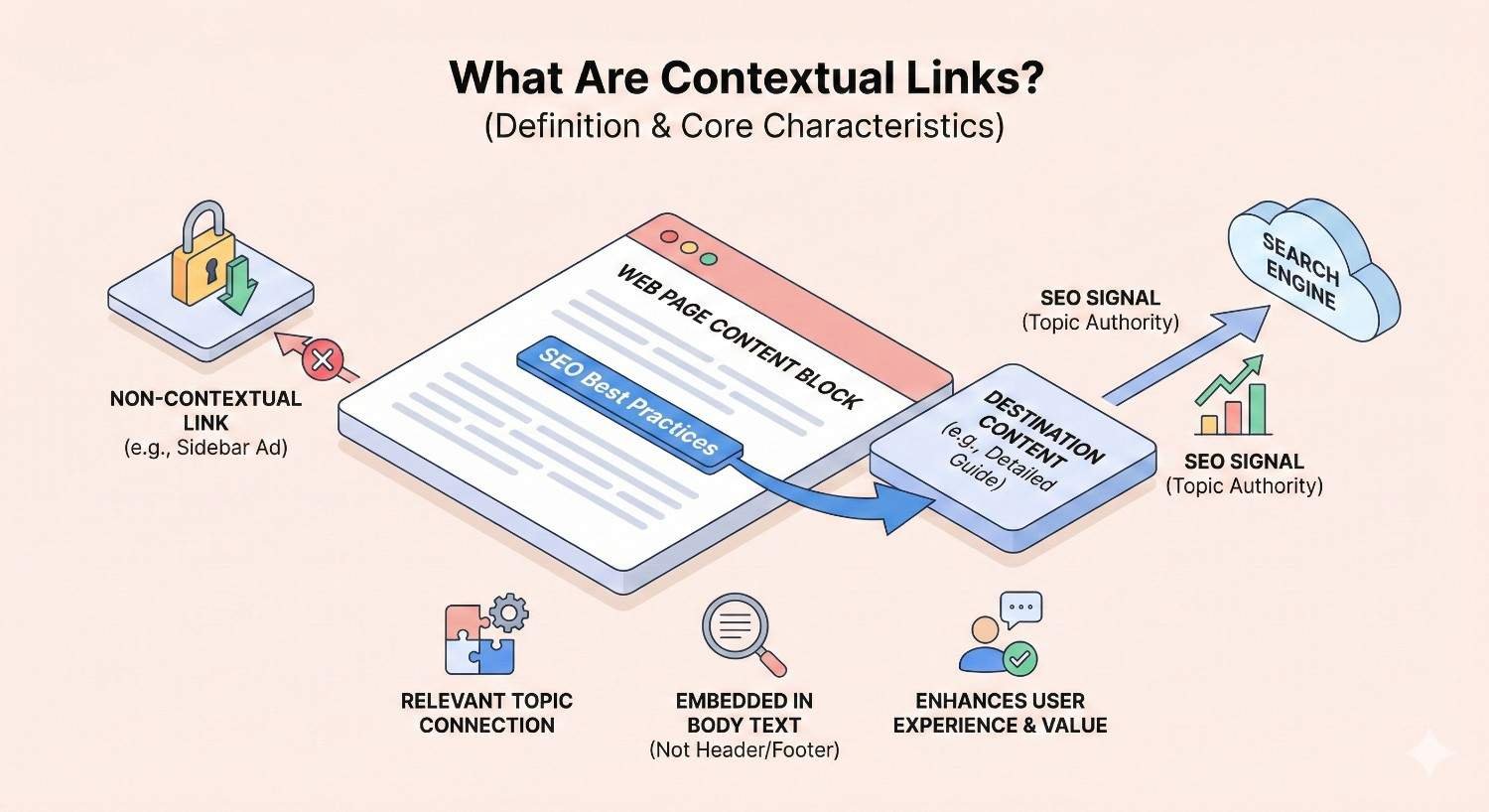
What Are Contextual Links? (Definition & Core Characteristics)
A contextual link is a hyperlink placed within the main body content of a webpage, surrounded by relevant text that provides context about the linked destination. Unlike structural links found in menus or footers, contextual links appear naturally within paragraphs, sentences, and content blocks where they add genuine value to the reader’s experience.
The defining characteristic of a contextual link is its placement within topically relevant content. When a technology blog links to a software company’s product page within an article about productivity tools, that link carries contextual relevance. The surrounding text signals to both users and search engines what the linked page is about and why it matters.
Search engines have evolved to recognize that links embedded in content represent a stronger signal of trust and relevance than links placed in templated areas of a website. This distinction forms the foundation of modern link building strategy.
How Contextual Links Differ from Other Link Types
Contextual links stand apart from other link categories based on placement, intent, and SEO value. Navigation links appear in menus and help users move through a website’s structure. Footer links typically contain legal pages, contact information, and sitemap references. Sidebar links often feature related posts, advertisements, or promotional content.
The key differences include editorial intent, surrounding content relevance, and click probability. Contextual links are placed deliberately within content to support a point, provide additional resources, or cite a source. They exist because an author or editor decided the linked resource adds value to the reader’s understanding.
From an SEO perspective, search engines assign different weights to links based on their placement. Google’s documentation emphasizes that links within main content areas carry more significance than those in boilerplate sections that repeat across multiple pages.
The Anatomy of a High-Quality Contextual Link
A high-quality contextual link consists of several interconnected elements that determine its SEO value. The anchor text provides the clickable words that describe the linked destination. The surrounding content establishes topical relevance and context. The source page’s authority influences how much link equity transfers to the destination.
Strong contextual links share common characteristics. The anchor text accurately describes the linked content without being overly optimized or keyword-stuffed. The surrounding paragraph relates directly to the linked topic. The source page itself covers a relevant subject matter and comes from a trustworthy domain.
The placement within the content also matters. Links appearing in the first few paragraphs of an article often carry more weight than those buried at the bottom. Links within the main content area outperform those in author bios or related post sections.
Where Contextual Links Appear on a Page
Contextual links appear throughout the main body content of webpages, blog posts, articles, guides, and other editorial content. They show up in introductory paragraphs that set context for readers. They appear in body sections where authors cite sources, reference related concepts, or recommend resources.
Common placement locations include within explanatory paragraphs, inside bulleted or numbered lists that compile resources, within case study sections that reference external examples, and in conclusion sections that point readers toward next steps.
The most valuable contextual link placements occur where the link genuinely enhances the reader’s experience. A link to a research study that supports a claim adds credibility. A link to a tool that helps readers implement advice adds utility. A link to a related guide that expands on a concept adds depth.
Why Contextual Links Are Critical for SEO Success
Contextual links function as the primary currency of authority in search engine optimization. They represent third-party validation that your content deserves attention and trust. When authoritative websites link to your pages within their content, they transfer a portion of their credibility to you.
The importance of contextual links extends beyond simple ranking factors. They drive referral traffic from engaged audiences. They establish your brand within industry conversations. They create pathways for search engine crawlers to discover and index your content.
For businesses investing in organic growth, contextual links often represent the difference between stagnant rankings and breakthrough visibility. Technical SEO and content quality establish the foundation, but contextual links from relevant sources accelerate authority building.
How Search Engines Evaluate Contextual Links
Search engines analyze contextual links through multiple dimensions to determine their value and authenticity. The relevance between the source page, the surrounding content, and the destination page forms the primary evaluation criteria. A link from a marketing blog to an SEO tool carries more weight than a link from an unrelated cooking website.
Google’s algorithms assess the authority of the linking domain, the specific page’s strength, and the overall link profile of both sites. They examine anchor text patterns to identify natural versus manipulative linking. They consider the link’s position on the page and whether it appears within genuine editorial content.
Machine learning models have become increasingly sophisticated at detecting artificial link patterns. Links that appear natural, come from diverse sources, and exist within genuinely useful content receive the strongest positive signals.
The Role of Contextual Links in PageRank and Authority Flow
PageRank, Google’s foundational algorithm for measuring page importance, relies heavily on link analysis. When a page links to another page, it passes a portion of its PageRank value through that link. Contextual links within main content areas transfer more value than links in less prominent positions.
Authority flows through contextual links based on several factors. The linking page’s own authority determines how much it can pass. The number of outbound links on the page dilutes the value each link receives. The relevance between pages influences how effectively authority transfers.
This authority flow creates a network effect where well-linked pages accumulate more ranking power over time. Pages that earn contextual links from multiple authoritative sources build compounding advantages that become difficult for competitors to overcome.
Contextual Relevance and Topical Authority Signals
Search engines increasingly evaluate websites based on topical authority rather than individual page metrics. Contextual links from topically related sources strengthen your site’s perceived expertise within specific subject areas.
When multiple authoritative websites in your industry link to your content, search engines interpret this as validation of your topical expertise. A cybersecurity company that earns contextual links from technology publications, security blogs, and industry associations builds stronger topical authority than one with links from random, unrelated sources.
This topical clustering effect means that the relevance of your link sources matters as much as their raw authority metrics. Ten contextual links from mid-authority sites in your niche often outperform one link from a high-authority site in an unrelated field.
User Experience and Engagement Benefits
Contextual links deliver value beyond search engine algorithms. They improve user experience by providing pathways to additional relevant information. Readers who click contextual links often spend more time engaging with your content ecosystem.
Well-placed contextual links reduce bounce rates by giving visitors reasons to explore further. They increase pages per session as users follow link trails through related content. They build trust by demonstrating that your content connects to authoritative external sources.
These engagement signals feed back into SEO performance. Search engines monitor user behavior metrics to assess content quality. Pages that keep users engaged and satisfied tend to maintain or improve their rankings over time.
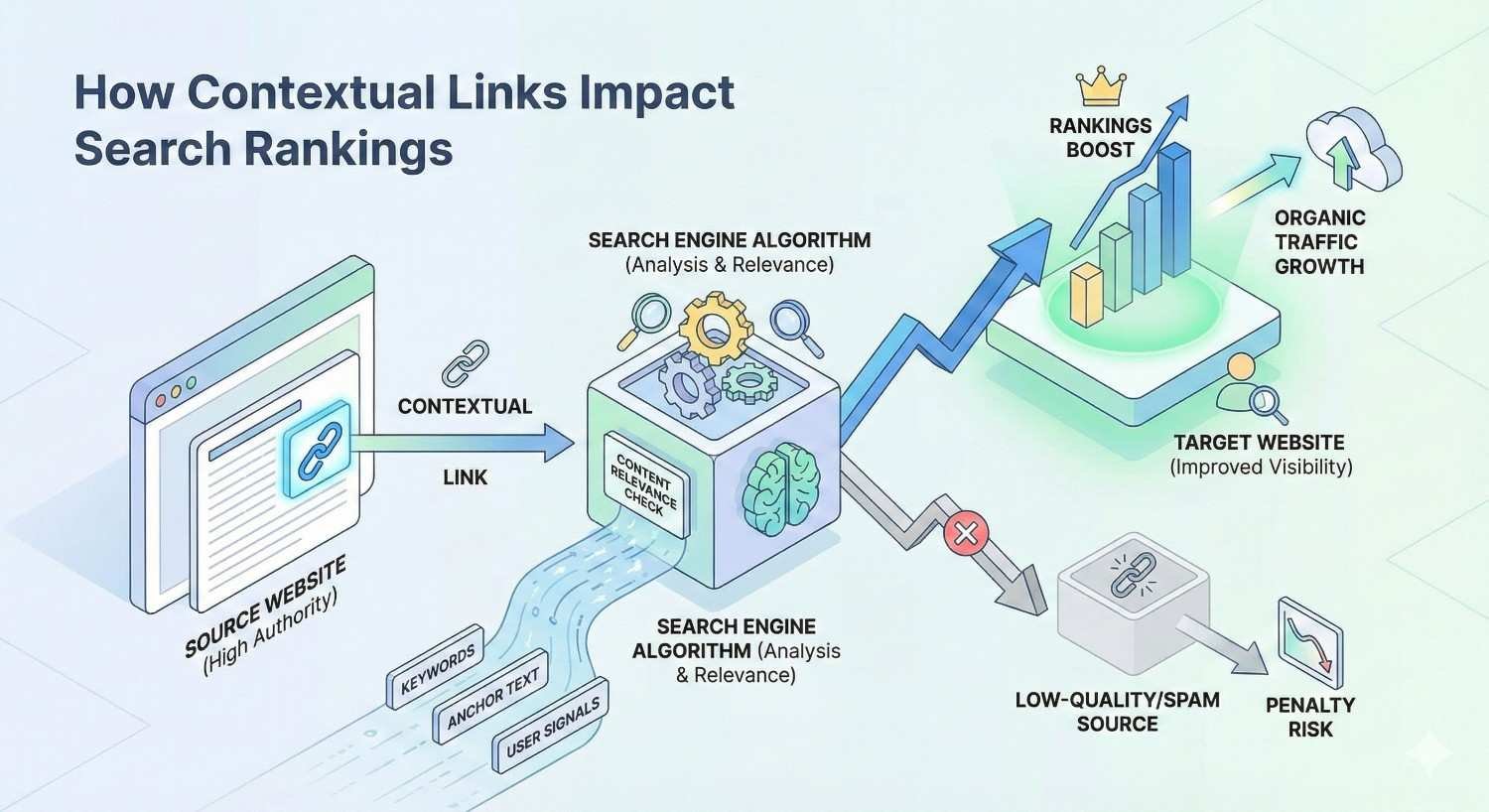
How Contextual Links Impact Search Rankings
The relationship between contextual links and search rankings operates through multiple mechanisms. Direct ranking influence comes from the authority and relevance signals that links transmit. Indirect influence comes from increased crawling, faster indexing, and improved user engagement metrics.
Studies consistently show strong correlations between backlink profiles and search rankings. Backlinko’s analysis of ranking factors found that the number of referring domains remains one of the strongest predictors of Google rankings. Contextual links from unique domains carry particular weight in these calculations.
Understanding how contextual links impact rankings helps prioritize link building efforts and set realistic expectations for SEO campaigns.
Link Equity Distribution Through Contextual Placement
Link equity, sometimes called link juice, flows from source pages to destination pages through hyperlinks. The amount of equity transferred depends on the source page’s authority, the link’s placement, and technical factors like follow versus nofollow attributes.
Contextual links within main content areas distribute more equity than links in sidebars, footers, or navigation menus. Search engines recognize that editorial links represent deliberate endorsements, while structural links serve navigational purposes.
The position within the content also affects equity distribution. Links appearing early in an article, within the first few paragraphs, often pass more value than links buried near the bottom. Links surrounded by highly relevant text transfer equity more effectively than those in loosely related contexts.
Anchor Text Relevance in Contextual Links
Anchor text provides search engines with explicit signals about the linked page’s content. When multiple sites link to a page using similar anchor text, search engines gain confidence about what that page covers and which queries it should rank for.
Natural anchor text profiles include a mix of branded terms, exact match keywords, partial match phrases, generic terms like “click here,” and naked URLs. Over-reliance on exact match anchor text can trigger algorithmic penalties, as it suggests manipulative link building.
The surrounding text also influences how search engines interpret anchor text. A link with anchor text “SEO tools” surrounded by content about search engine optimization carries different signals than the same anchor text within unrelated content.
Contextual Links vs. Sidebar, Footer, and Navigation Links
Search engines differentiate between links based on their page location and likely editorial intent. Contextual links within body content receive the strongest positive signals. Sidebar links, often used for related posts or advertisements, receive moderate consideration. Footer links, typically site-wide and templated, receive minimal ranking influence.
Navigation links serve structural purposes and help search engines understand site architecture, but they don’t function as editorial endorsements. A link in your main navigation to your services page helps users and crawlers, but it doesn’t carry the same authority signal as an external site linking to that page within their content.
This hierarchy explains why link building strategies focus on earning contextual placements rather than directory listings, footer links, or sidebar mentions. The effort required to earn a contextual link correlates with its SEO value.
The Relationship Between Context and Link Value
The content surrounding a contextual link directly influences its value. A link embedded within a comprehensive, well-researched article on a relevant topic transfers more authority than a link within thin, low-quality content.
Search engines analyze the semantic relationship between the linking content and the destination page. Strong topical alignment amplifies the link’s positive signals. Weak or nonexistent relevance diminishes its impact and can even raise red flags about link manipulation.
This context-value relationship means that earning links from high-quality, relevant content should take priority over accumulating links from any available source. One contextual link from a thorough industry analysis often outperforms multiple links from shallow, unrelated pages.
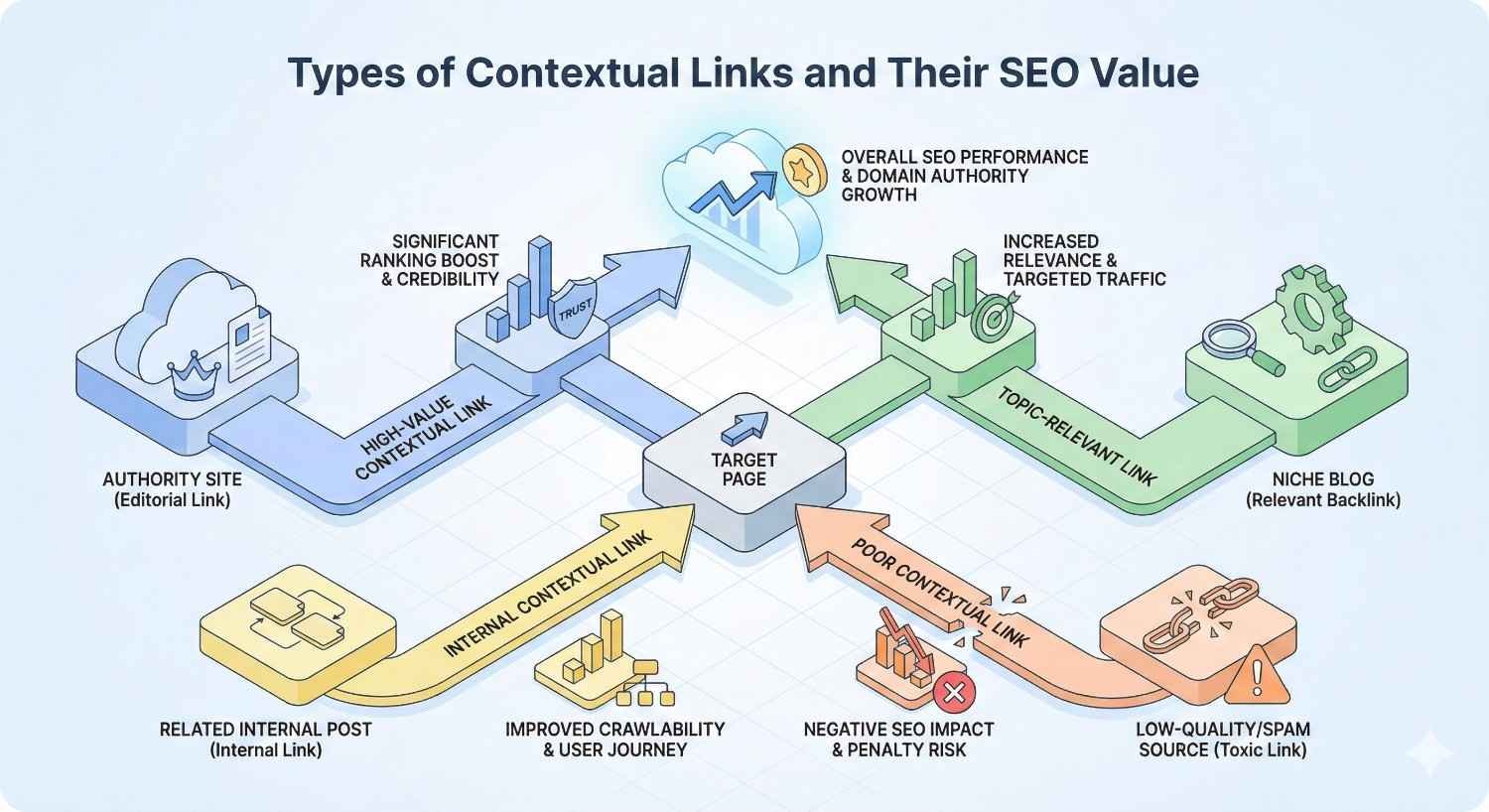
Types of Contextual Links and Their SEO Value
Contextual links come in various forms, each with distinct characteristics and SEO implications. Understanding these categories helps prioritize link building efforts and evaluate opportunities based on their potential impact.
The most valuable contextual links share common traits regardless of category. They come from relevant, authoritative sources. They appear within genuine editorial content. They provide value to readers beyond the SEO benefit to the linked site.
Editorial Contextual Links (Earned Links)
Editorial contextual links represent the gold standard of link building. These links occur when content creators independently discover your resource and decide to link to it because it adds value to their content. No outreach, payment, or exchange prompted the link.
Earning editorial links requires creating genuinely exceptional content that serves as a reference resource within your industry. Original research, comprehensive guides, unique data, and innovative tools attract editorial links because they help other content creators support their own work.
The SEO value of editorial links stems from their authenticity. Search engines can detect patterns that suggest link manipulation. Editorial links, by definition, lack these patterns because they arise organically from content merit.
Guest Post Contextual Links
Guest posting involves creating content for publication on external websites, typically including one or more contextual links back to your own site. When executed properly, guest posting builds relationships, expands audience reach, and earns relevant contextual links.
The SEO value of guest post links depends heavily on execution quality. Links within genuinely valuable guest content on relevant, authoritative sites carry significant weight. Links within thin, promotional content on low-quality sites can harm rather than help.
Effective guest posting focuses on providing genuine value to the host site’s audience. The contextual links should enhance the content rather than distract from it. The host site should have editorial standards that ensure content quality.
Resource Page Contextual Links
Resource pages compile useful links around specific topics, serving as curated directories for their audiences. Earning placement on relevant resource pages provides contextual links within topically focused content.
The value of resource page links varies based on the page’s authority, relevance, and curation standards. A resource page on a respected industry publication that carefully vets inclusions provides more value than a generic link directory with minimal quality control.
Identifying resource page opportunities requires searching for pages that compile links in your niche. Outreach involves demonstrating why your resource deserves inclusion alongside the other curated links.
Internal Contextual Links
Internal contextual links connect pages within your own website, distributing authority and helping users navigate related content. While they don’t carry the same external validation as backlinks, internal links play a crucial role in SEO architecture.
Strategic internal linking helps search engines understand your site’s topical structure and identify your most important pages. Pages that receive more internal links signal higher importance within your content hierarchy.
Internal contextual links also improve user experience by guiding visitors to related content that addresses their needs. This engagement benefit supports SEO performance through improved behavioral metrics.
Contextual Links in Digital PR and Content Marketing
Digital PR campaigns generate contextual links by creating newsworthy content that journalists and publishers want to cover. Original research, industry surveys, data studies, and expert commentary attract media coverage that includes contextual links.
Content marketing strategies focus on creating resources that naturally attract links over time. Comprehensive guides, interactive tools, templates, and educational content serve as link magnets that continue earning contextual links long after publication.
The intersection of PR and content marketing creates compounding link building opportunities. A well-promoted piece of original research can earn immediate coverage links while also attracting ongoing editorial links as others discover and reference the data.
Best Practices for Building Contextual Links
Effective contextual link building combines content excellence, strategic outreach, and relationship development. The goal is earning links that search engines recognize as genuine editorial endorsements rather than manufactured signals.
Sustainable link building requires patience and consistency. Quick-win tactics often produce short-term gains followed by algorithmic penalties. Building a foundation of high-quality contextual links creates lasting competitive advantages.
Creating Link-Worthy Content That Attracts Contextual Links
Link-worthy content provides unique value that other content creators want to reference. This typically means offering something unavailable elsewhere: original data, comprehensive coverage, unique perspectives, or practical tools.
Original research consistently attracts contextual links because it provides citable information that supports other content. Industry surveys, data analyses, and trend reports give journalists and bloggers concrete facts to reference.
Comprehensive guides that thoroughly cover complex topics become reference resources within their niches. When your guide represents the definitive resource on a subject, other content creators naturally link to it when discussing related topics.
Identifying High-Quality Link Opportunities
High-quality link opportunities share several characteristics. The source site has genuine authority and relevance to your industry. The content where your link would appear provides real value to readers. The link would enhance rather than detract from the user experience.
Prospecting for opportunities involves analyzing competitor backlink profiles, monitoring industry publications, and identifying content gaps that your resources could fill. Tools like Ahrefs, Semrush, and Moz help identify sites that link to competitors but not to you.
Evaluating opportunities requires looking beyond surface metrics. A site with moderate domain authority but highly engaged, relevant audience often provides more value than a high-authority site with no topical connection to your business.
Outreach Strategies for Contextual Link Acquisition
Effective outreach focuses on providing value to the recipient rather than asking for favors. The best outreach emails explain why linking to your resource would benefit the recipient’s audience, not why it would benefit you.
Personalization dramatically improves outreach success rates. Generic templates that could apply to any recipient get ignored. Specific references to the recipient’s content, audience, or recent work demonstrate genuine engagement.
Building relationships before requesting links increases success rates. Engaging with potential link sources through social media, comments, and industry events creates familiarity that makes outreach feel less transactional.
Writing Contextual Link Placements That Add Value
When creating content that includes your own contextual links, whether for guest posts or your own site, the links should genuinely enhance the reader’s experience. Each link should answer a question, provide additional depth, or offer a useful resource.
Forced or irrelevant link placements damage content quality and can trigger editorial rejection or algorithmic penalties. The test for any contextual link is whether removing it would make the content less valuable to readers.
Natural link integration means the anchor text flows within the sentence structure. The linked resource directly relates to the surrounding discussion. The link appears at a point where readers would naturally want more information.
Anchor Text Optimization for Contextual Links
Anchor text optimization balances relevance signals with natural variation. Using the same exact-match anchor text across all links creates unnatural patterns that search engines can detect and penalize.
A healthy anchor text profile includes branded terms, partial match keywords, related phrases, generic terms, and naked URLs. The distribution should appear organic, reflecting how different content creators would naturally describe your resource.
When you control the anchor text, as in guest posts or internal links, vary your approach based on context. Let the surrounding content guide anchor text choices rather than forcing predetermined keywords into every placement.
How to Evaluate Contextual Link Quality
Not all contextual links provide equal value. Evaluating link quality helps prioritize acquisition efforts and avoid links that could harm rather than help your SEO performance.
Quality evaluation combines quantitative metrics with qualitative assessment. Numbers provide useful signals, but human judgment about relevance, authenticity, and editorial standards matters equally.
Assessing Domain Authority and Topical Relevance
Domain authority metrics from tools like Moz, Ahrefs, and Semrush provide rough estimates of a site’s overall link equity. Higher authority sites generally pass more value through their links.
However, topical relevance often matters more than raw authority scores. A link from a mid-authority site that closely matches your industry can outperform a link from a high-authority site with no topical connection.
Evaluate both factors together. The ideal link source combines strong authority with direct topical relevance. When forced to choose, prioritize relevance for long-term topical authority building.
Analyzing Surrounding Content and Context
The content surrounding a contextual link influences its value. Links within comprehensive, well-researched articles transfer more authority than links within thin, low-quality content.
Examine the page where your link appears or would appear. Does the content provide genuine value to readers? Is it well-written and properly edited? Does it cover the topic thoroughly?
Also consider the broader context of the linking site. Sites that maintain consistent editorial standards across their content provide more reliable link value than sites with inconsistent quality.
Evaluating Link Placement and Visibility
Link placement within a page affects both SEO value and referral traffic potential. Links in prominent positions within the main content area provide more value than links buried in less visible locations.
Consider whether the link appears in a natural reading flow where users would encounter it. Links that users actually see and potentially click provide engagement benefits beyond pure SEO signals.
Avoid links in locations that suggest manipulation, such as hidden text, excessive link lists, or positions that users would never naturally reach.
Identifying Natural vs. Manipulative Link Patterns
Natural link profiles show diversity in sources, anchor text, and acquisition timing. Manipulative patterns show uniformity that suggests artificial link building.
Warning signs include sudden spikes in link acquisition, over-optimized anchor text ratios, links from unrelated or low-quality sites, and patterns that match known link schemes.
When evaluating potential link sources, consider whether the site appears to sell links, participate in link exchanges, or engage in other practices that violate search engine guidelines.
Tools for Contextual Link Analysis
Several tools help analyze contextual link quality and track backlink profiles. Ahrefs provides comprehensive backlink data including referring domains, anchor text distribution, and link placement details. Semrush offers similar capabilities with additional competitive analysis features.
Moz’s Link Explorer focuses on domain authority metrics and spam score indicators. Majestic provides trust flow and citation flow metrics that help evaluate link quality.
Google Search Console shows which sites link to yours according to Google’s own data, though with less detail than third-party tools. Regular monitoring across multiple tools provides the most complete picture.
Common Contextual Link Building Mistakes to Avoid
Link building mistakes can waste resources, damage rankings, or trigger penalties. Understanding common errors helps avoid costly setbacks and maintain sustainable growth.
Most mistakes stem from prioritizing quantity over quality or seeking shortcuts that search engines have learned to detect. Successful link building requires patience and commitment to genuine value creation.
Over-Optimization and Exact-Match Anchor Text Abuse
Using the same exact-match keyword anchor text across multiple links creates unnatural patterns that trigger algorithmic filters. Google’s Penguin algorithm specifically targets manipulative anchor text practices.
Natural anchor text profiles include significant variation. Branded terms, partial matches, related phrases, and generic anchors should all appear in healthy proportions. Exact-match anchors should represent a minority of your overall profile.
If your anchor text profile already shows over-optimization, diversifying future links with branded and generic anchors can help rebalance the distribution over time.
Low-Quality or Irrelevant Link Sources
Links from low-quality sites provide minimal value and can actively harm your rankings. Sites with thin content, excessive advertising, or obvious link selling signals should be avoided.
Irrelevant links, even from authoritative sites, provide less value than relevant links from moderate-authority sources. A technology company gains more from links on tech blogs than from links on unrelated lifestyle sites.
Evaluate every link opportunity against quality and relevance criteria. Declining low-quality opportunities protects your site’s long-term health.
Ignoring Link Velocity and Natural Growth Patterns
Link velocity refers to the rate at which a site acquires new backlinks. Sudden spikes in link acquisition can trigger algorithmic scrutiny, especially for newer sites without established link building history.
Natural link growth typically shows gradual increases with occasional spikes around notable content or events. Artificial patterns show consistent, mechanical acquisition that doesn’t correlate with content publication or promotional activities.
Plan link building campaigns to produce steady, sustainable growth rather than dramatic short-term spikes. This approach builds lasting authority while avoiding velocity-related red flags.
Neglecting Internal Contextual Link Opportunities
Internal links don’t require outreach or relationship building, yet many sites underutilize this opportunity. Strategic internal linking distributes authority to important pages and helps search engines understand your content structure.
Audit your existing content for internal linking opportunities. New content should link to relevant existing pages. Existing content should be updated to link to new resources as they’re published.
Internal link anchor text can be more keyword-focused than external links since you control the entire context. Use this opportunity to reinforce topical signals for your most important pages.
Failing to Monitor and Maintain Link Quality
Link profiles require ongoing maintenance. Links can disappear when source pages are deleted or restructured. Previously quality sites can decline into link farms or spam sources.
Regular backlink audits identify lost links that might be recoverable and toxic links that should be disavowed. Monitoring tools can alert you to significant changes in your link profile.
Proactive maintenance protects the value you’ve built and identifies problems before they impact rankings.
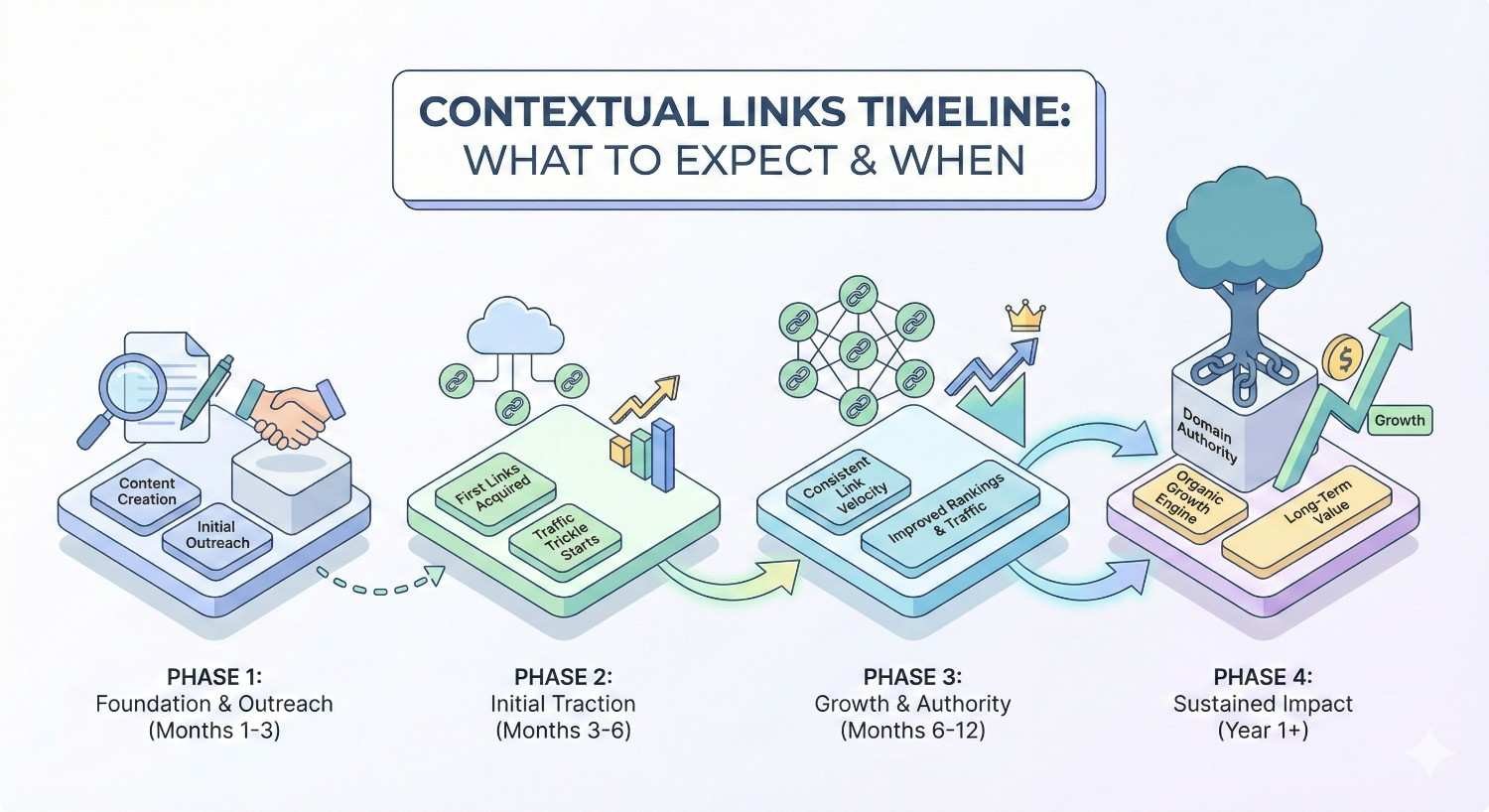
Contextual Links Timeline: What to Expect and When
Understanding realistic timelines helps set appropriate expectations and maintain commitment through the patience required for link building success. SEO results compound over time, and contextual links follow similar patterns.
The timeline for seeing results depends on your starting position, competitive landscape, and the quality and quantity of links acquired. New sites typically see slower initial progress than established domains.
Short-Term Results (0-3 Months)
In the first three months, focus on building infrastructure and beginning link acquisition. New links take time to be discovered, indexed, and incorporated into ranking calculations.
During this period, you may see increased crawling activity as search engines discover new links pointing to your site. Some ranking movement may occur for less competitive keywords, but dramatic changes are unlikely.
Use this time to establish link building processes, build relationships with potential link sources, and create content assets that will attract links over time.
Medium-Term Impact (3-6 Months)
Between three and six months, accumulated links begin producing measurable ranking improvements. Pages with new contextual links often show upward movement for target keywords.
Referral traffic from link sources becomes more noticeable as your content appears on more external sites. Brand awareness increases as your resources are referenced across your industry.
This period often shows the clearest correlation between link building activity and ranking changes, making it easier to demonstrate ROI to stakeholders.
Long-Term Authority Building (6-12+ Months)
Beyond six months, consistent link building produces compounding authority gains. Your domain becomes increasingly competitive for difficult keywords as accumulated link equity strengthens your overall profile.
Established authority makes future link building easier. Sites that have earned recognition as industry resources attract editorial links more naturally than unknown newcomers.
The long-term perspective is essential for sustainable SEO success. Sites that maintain consistent link building over years build advantages that competitors cannot quickly replicate.
Factors That Influence Contextual Link Impact Speed
Several factors affect how quickly contextual links influence rankings. Your site’s existing authority determines how much additional links can move the needle. Highly competitive keywords require more links over longer periods than less contested terms.
The authority of linking sites affects impact speed. Links from highly authoritative sources often produce faster, more noticeable effects than links from moderate-authority sites.
Technical factors like crawl frequency and indexing speed also play roles. Sites that search engines crawl frequently see new links incorporated into rankings faster than sites with slower crawl rates.
Integrating Contextual Links into Your Complete SEO Strategy
Contextual link building works best as part of a comprehensive SEO strategy that includes technical optimization, content development, and ongoing performance analysis. Isolated link building without supporting elements produces limited results.
Strategic integration ensures that link building efforts support broader business objectives and that other SEO activities create conditions for link building success.
Balancing Technical SEO, Content, and Link Building
Technical SEO ensures search engines can properly crawl, index, and understand your site. Without solid technical foundations, link equity cannot flow effectively through your site architecture.
Content provides the destination for contextual links and the assets that attract them. High-quality content gives link sources something worth linking to and gives your site pages worth promoting.
Link building amplifies the value of technical optimization and content investment. All three elements work together, and weakness in any area limits overall performance.
Coordinating Contextual Links with Content Strategy
Content strategy should inform link building priorities. When planning major content investments, consider the link building potential of different topics and formats.
Link building campaigns should support content goals. Promoting new content through outreach accelerates its visibility and helps it earn additional organic links over time.
Timing coordination matters. Launch link building campaigns alongside content publication to maximize initial momentum and establish early authority signals.
Budget Allocation for Contextual Link Acquisition
Link building costs vary based on approach. In-house efforts require staff time for content creation, prospecting, and outreach. Agency partnerships involve service fees but provide specialized expertise and established relationships.
Budget allocation should reflect the competitive requirements of your target keywords. Highly competitive markets require more aggressive link building investment than less contested niches.
Consider the full cost of link acquisition, including content creation for guest posts, tool subscriptions for prospecting and analysis, and staff time for relationship management.
Measuring ROI from Contextual Link Campaigns
Link building ROI connects link acquisition metrics to business outcomes. Track the cost per link acquired, the authority and relevance of link sources, and the resulting ranking and traffic changes.
Attribution requires patience since link building effects compound over time. Short-term ROI calculations often underestimate long-term value.
Compare link building ROI to other marketing channels while accounting for the lasting nature of SEO gains. Unlike paid advertising, link building investments continue producing returns long after the initial effort.
Scaling Contextual Link Building Sustainably
Sustainable scaling maintains quality standards while increasing output. This typically requires systematizing processes, building larger teams, or partnering with specialized agencies.
Quality control becomes more challenging at scale. Establish clear criteria for acceptable link sources and implement review processes that catch problems before they affect your site.
Diversify link building approaches as you scale. Relying on a single tactic creates vulnerability if that approach becomes less effective or triggers algorithmic changes.
Measuring and Tracking Contextual Link Performance
Effective measurement connects link building activities to SEO outcomes and business results. Tracking provides accountability, enables optimization, and demonstrates value to stakeholders.
Measurement should cover both leading indicators like links acquired and lagging indicators like ranking improvements and organic traffic growth.
Key Metrics for Contextual Link Success
Primary metrics include the number of referring domains, the authority distribution of link sources, and anchor text diversity. These directly measure link building output and quality.
Secondary metrics include ranking positions for target keywords, organic traffic to linked pages, and referral traffic from link sources. These measure the SEO impact of link building efforts.
Business metrics include leads, conversions, and revenue attributed to organic search. These connect link building to outcomes that matter to stakeholders.
Tools for Monitoring Backlink Profiles
Ahrefs provides comprehensive backlink monitoring with alerts for new and lost links. Its historical data helps track profile changes over time.
Semrush offers similar monitoring capabilities with integration into broader SEO workflow tools. Its competitive analysis features help benchmark against competitors.
Google Search Console provides Google’s own view of your backlink profile, though with less detail than third-party tools. Regular comparison between tools provides the most complete picture.
Attributing Traffic and Rankings to Contextual Links
Attribution connects specific links to ranking and traffic changes. This requires tracking when links are acquired and correlating with subsequent performance shifts.
Isolating link building impact from other factors is challenging since multiple SEO activities typically occur simultaneously. Controlled experiments, where possible, provide clearer attribution.
Referral traffic from link sources provides direct attribution for traffic generated by specific links. This metric often underestimates total impact since most link value comes through improved organic rankings.
Reporting Contextual Link Impact to Stakeholders
Effective reporting translates link building metrics into business language. Stakeholders care about traffic, leads, and revenue more than domain authority scores or referring domain counts.
Visual dashboards that show trends over time help stakeholders understand the cumulative nature of link building. Month-over-month comparisons can be misleading for activities with long-term payoffs.
Connect link building reports to broader SEO and marketing reports. This context helps stakeholders understand how link building contributes to overall growth objectives.
The Future of Contextual Links in SEO
Search engine algorithms continue evolving, but contextual links remain fundamental to how search engines evaluate authority and relevance. Understanding emerging trends helps prepare for future changes.
The core principle that links represent endorsements will likely persist even as evaluation methods become more sophisticated.
How AI and Machine Learning Affect Link Evaluation
Machine learning enables more nuanced link evaluation than rule-based algorithms. Search engines can better identify natural versus artificial link patterns and assess the genuine editorial value of link placements.
AI systems can analyze the semantic relationship between linking content and destination pages with greater sophistication. This increases the importance of topical relevance in link building.
These advances generally favor authentic, high-quality link building over manipulative tactics. Sites that earn genuine editorial links benefit as search engines become better at distinguishing real endorsements from artificial signals.
E-E-A-T and the Growing Importance of Editorial Links
Google’s E-E-A-T framework emphasizes Experience, Expertise, Authoritativeness, and Trustworthiness. Contextual links from authoritative sources directly support authoritativeness signals.
Editorial links from recognized industry publications, educational institutions, and established experts carry increasing weight as search engines prioritize E-E-A-T factors.
This trend favors link building strategies focused on earning recognition from legitimate authorities rather than accumulating links from any available source.
Adapting Contextual Link Strategy to Algorithm Updates
Algorithm updates periodically shift the relative importance of different ranking factors. Maintaining diverse, high-quality link building practices provides resilience against individual updates.
Monitor industry news and your own performance data for signs of algorithmic changes affecting link evaluation. Rapid ranking changes across multiple pages may indicate link-related algorithm updates.
Avoid tactics that rely on exploiting specific algorithmic weaknesses. These approaches typically fail when algorithms update and can result in lasting penalties.
How White Label SEO Service Builds High-Quality Contextual Links
Professional link building combines strategic planning, quality standards, and systematic execution. Our approach focuses on earning contextual links that provide lasting value rather than quick wins that risk future penalties.
We work with businesses across industries to build sustainable organic growth through comprehensive SEO strategies that include contextual link acquisition as a core component.
Our Strategic Approach to Contextual Link Acquisition
Our link building strategy begins with understanding your business objectives, competitive landscape, and existing authority position. This analysis informs targeting decisions and resource allocation.
We identify link opportunities that align with your topical focus and authority goals. Prospecting combines competitive analysis, industry research, and relationship mapping to build targeted outreach lists.
Content development supports link acquisition by creating assets that attract editorial links and provide value for guest posting opportunities.
Quality Standards and Vetting Process
Every potential link source undergoes evaluation against our quality criteria. We assess domain authority, topical relevance, editorial standards, and traffic quality before pursuing any opportunity.
We reject opportunities that could harm your site’s long-term health, even when they might provide short-term ranking benefits. This discipline protects your investment and builds sustainable authority.
Our vetting process includes manual review of potential link sources to catch issues that automated tools might miss.
Transparent Reporting and Performance Tracking
Regular reporting shows exactly what links have been acquired, their quality metrics, and the resulting impact on your SEO performance. We believe in complete transparency about our activities and results.
Our tracking connects link building efforts to ranking improvements, traffic growth, and business outcomes. This accountability ensures our work delivers measurable value.
We provide access to the data and tools we use so you can verify our work and understand your link profile’s evolution.
Getting Started with Professional Contextual Link Building
Beginning a link building engagement starts with understanding your current position and goals. We analyze your existing backlink profile, competitive landscape, and target keywords to develop a customized strategy.
Our team handles prospecting, outreach, content creation, and relationship management while keeping you informed of progress and results. You maintain control over strategic direction while we execute the tactical work.
Contact us to discuss how contextual link building can accelerate your organic growth and build lasting competitive advantages.
Conclusion
Contextual links remain one of the most powerful ranking factors in modern SEO, directly influencing how search engines evaluate your site’s authority, relevance, and trustworthiness within your industry.
Building a strong contextual link profile requires strategic planning, quality content, and consistent execution over time. The businesses that invest in sustainable link building create compounding advantages that competitors struggle to match.
At White Label SEO Service, we help businesses worldwide build the contextual link profiles that drive sustainable organic growth. Contact our team to discuss how professional link building can accelerate your SEO results and deliver measurable business outcomes.
Frequently Asked Questions
How long does it take to see SEO results from contextual links?
Most sites begin seeing measurable ranking improvements within three to six months of consistent contextual link building. The timeline depends on your starting authority, competitive landscape, and the quality of links acquired. Highly competitive keywords may require twelve months or longer of sustained effort.
What makes a contextual link high quality?
High-quality contextual links come from authoritative, topically relevant websites and appear within genuine editorial content that provides value to readers. The link should enhance the surrounding content rather than feel forced or promotional. Strong links use natural anchor text and appear in prominent positions within the main content area.
How many contextual links do I need to rank?
The number of links required depends entirely on your competitive landscape. Analyze the backlink profiles of pages currently ranking for your target keywords to establish benchmarks. Focus on link quality and relevance rather than hitting arbitrary quantity targets.
Can contextual links hurt my SEO?
Low-quality contextual links from spammy, irrelevant, or manipulative sources can trigger algorithmic penalties that harm your rankings. Links with over-optimized anchor text or from sites that violate search engine guidelines pose particular risks. Quality evaluation and ongoing monitoring protect against negative impacts.
What is the difference between contextual links and backlinks?
All contextual links are backlinks, but not all backlinks are contextual. Backlinks include any link pointing to your site from an external source. Contextual links specifically refer to backlinks placed within the main body content of a page, surrounded by relevant text that provides context about the linked destination.
Should I focus on internal or external contextual links?
Both internal and external contextual links play important roles in SEO. External links build authority through third-party validation, while internal links distribute that authority throughout your site and help search engines understand your content structure. A comprehensive strategy addresses both.
How do I know if my contextual link building is working?
Track referring domain growth, ranking positions for target keywords, organic traffic to linked pages, and referral traffic from link sources. Compare these metrics over time to identify trends. Allow three to six months before expecting significant measurable impact from new link building efforts.