
Link building remains one of the most significant investments in any SEO strategy, with costs ranging from $100 to over $1,500 per link depending on industry, quality, and acquisition method. Understanding these benchmarks helps you allocate budget effectively and avoid overpaying—or worse, investing in links that damage your rankings.
Whether you’re scaling an e-commerce brand, launching a SaaS product, or building authority in competitive verticals like finance or legal, knowing what others pay provides critical context for your decisions. The gap between a worthwhile investment and wasted spend often comes down to understanding true market rates.
This guide breaks down cost per link benchmarks across industries, acquisition methods, and domain authority tiers—giving you the data needed to budget strategically and measure ROI accurately.
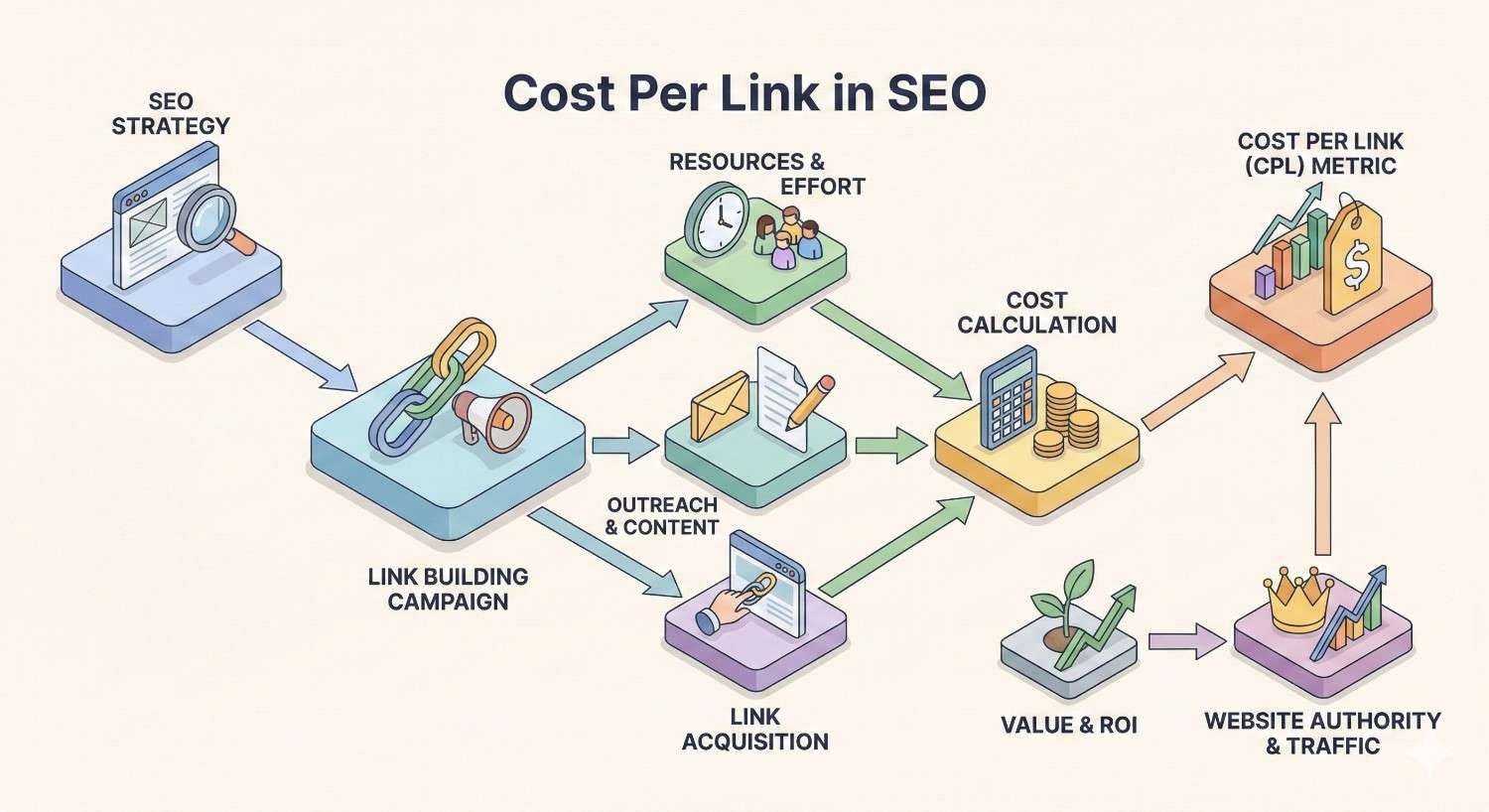
What Is Cost Per Link in SEO?
Link building costs vary dramatically based on dozens of factors, making standardized pricing nearly impossible without context. Before diving into benchmarks, understanding what actually comprises “cost per link” ensures you’re comparing apples to apples.
Definition and Core Components
Cost per link represents the total investment required to acquire a single backlink pointing to your website. This metric encompasses both direct expenses and indirect costs that many businesses overlook when calculating their true link building spend.
Direct costs include payments to publishers, content creation fees, outreach tool subscriptions, and agency or freelancer fees. A guest post placement might cost $300 for the placement itself, but the supporting content creation adds another $150-400 depending on length and complexity.
Indirect costs often exceed direct expenses. Staff time for prospecting, relationship building, negotiation, and quality control adds substantial hidden costs. A link that appears to cost $200 might actually require $400-600 when accounting for the 4-6 hours of work surrounding it.
The components that determine final cost per link include:
- Publisher or placement fees
- Content creation and editing
- Outreach and prospecting time
- Tool and software subscriptions
- Quality assurance and vetting
- Relationship management overhead
Why Cost Per Link Matters for ROI Measurement
Tracking cost per link transforms link building from a vague expense into a measurable investment with calculable returns. Without this metric, you cannot determine whether your link building efforts generate positive ROI or drain resources better spent elsewhere.
The metric enables direct comparison between acquisition methods. When you know guest posting costs $350 per link while digital PR averages $180, you can allocate budget toward higher-efficiency channels—assuming quality remains comparable.
Cost per link also reveals operational inefficiencies. If your in-house team produces links at $600 each while agencies deliver similar quality at $400, the data supports outsourcing decisions. Conversely, if agency links underperform despite lower costs, the metric highlights quality issues requiring attention.
For businesses tracking customer acquisition cost and lifetime value, cost per link feeds directly into broader marketing ROI calculations. A $500 link that contributes to rankings generating $50,000 in annual revenue represents exceptional value—but you need the cost data to make that determination.
Average Cost Per Link by Industry (2024-2025 Benchmarks)
Industry significantly impacts link building costs due to varying competition levels, content requirements, and publisher availability. These benchmarks reflect market rates for quality links from relevant, authoritative sources within each vertical.
SaaS and Technology
SaaS and technology companies typically pay $200-$600 per link for quality placements, with enterprise-focused B2B SaaS often reaching $800+ for high-authority tech publications.
The technology sector benefits from abundant publisher options—tech blogs, software review sites, and industry publications actively seek quality content. This supply moderates pricing compared to more restricted niches.
However, competition for top-tier placements remains fierce. Links from sites like TechCrunch, Wired, or industry-specific authorities command premium pricing, often requiring digital PR campaigns costing $2,000-5,000 per successful placement.
Mid-tier technology blogs with DA 40-60 typically charge $250-450 for guest posts or sponsored content. Niche software review sites often accept $150-300 for contextual link insertions within existing content.
E-commerce and Retail
E-commerce link building costs range from $150-$500 per link, though product-specific campaigns in competitive categories like fashion, electronics, or home goods push toward the higher end.
Product roundups and “best of” lists represent primary link targets for e-commerce brands. Securing placement in established buying guides typically costs $200-400, with premium publications charging $500-800.
Lifestyle and consumer publications offer relatively accessible pricing compared to B2B verticals. Fashion blogs, home décor sites, and general consumer publications frequently accept $150-300 for quality content placements.
The challenge for e-commerce lies in link relevance. Generic links provide minimal value—costs increase when targeting category-specific publications that actually influence purchase decisions and rankings for commercial keywords.
Finance and Insurance
Financial services face the highest link building costs across industries, with quality links averaging $400-$1,200 and premium placements exceeding $2,000.
YMYL (Your Money or Your Life) content requirements create significant barriers. Publishers in finance demand exceptional content quality, expert authorship, and often require editorial review processes that extend timelines and increase costs.
Regulatory considerations further complicate finance link building. Many financial publications refuse paid placements entirely, limiting options to earned media through digital PR—an approach requiring substantial investment in newsworthy content and journalist relationships.
Insurance companies face similar challenges, with added difficulty finding relevant, authoritative publishers willing to link to commercial insurance content. Costs for quality insurance links typically range $500-1,000, with health insurance and life insurance niches at the premium end.
Healthcare and Medical
Healthcare link building costs $350-$900 per link on average, with medical device, pharmaceutical, and clinical service providers often paying $1,000+ for authoritative placements.
Google’s emphasis on E-E-A-T makes healthcare link building particularly challenging. Links from medical publications, health news sites, and clinical resources require content reviewed or authored by credentialed professionals—adding $200-500 to content creation costs alone.
Hospital and health system websites rarely accept external content, limiting placement opportunities. Health-focused consumer publications offer more accessible options at $300-500 per placement, though relevance to specific medical specialties varies.
Telehealth, wellness, and fitness-adjacent healthcare businesses find slightly lower costs ($250-500) due to broader publisher availability in lifestyle and wellness categories.
Legal Services
Law firm link building averages $400-$1,000 per link, with personal injury, mass tort, and high-value practice areas commanding premium pricing.
Legal content requires accuracy and often attorney review, increasing content creation costs. Publishers in the legal space—law journals, legal news sites, and bar association publications—maintain strict editorial standards that limit placement opportunities.
Local legal link building for regional law firms costs less ($200-400) when targeting local news outlets, business directories, and community publications. National legal SEO campaigns targeting competitive practice areas face costs at the higher end of the range.
The legal vertical also sees significant variation by practice area. Immigration and family law link building typically costs less than personal injury or mass tort, where competition drives prices upward.
Real Estate
Real estate link building costs $200-$500 per link, benefiting from abundant local and regional publication options.
Local news sites, community blogs, and regional business publications offer accessible pricing for real estate content. Agents and brokerages targeting specific markets find costs at the lower end when focusing on hyperlocal placements.
National real estate publications and major property portals command higher fees ($400-700) but provide broader authority signals. Investment-focused real estate content targeting commercial or multifamily audiences faces costs similar to finance verticals.
Real estate technology companies (proptech) encounter pricing closer to SaaS benchmarks, particularly when targeting technology publications rather than traditional real estate media.
Travel and Hospitality
Travel industry link building ranges from $150-$450 per link, with destination-specific and luxury travel content at the premium end.
Travel blogs and destination guides represent abundant link opportunities, with many accepting guest content at $150-300. The challenge lies in finding relevant, authoritative sites rather than low-quality travel blog networks.
Hotel chains, tour operators, and destination marketing organizations benefit from newsworthy content opportunities—new property openings, unique experiences, and destination features attract earned media at lower effective costs than paid placements.
Luxury travel and high-end hospitality face elevated costs ($400-600) when targeting premium publications like Condé Nast Traveler or Travel + Leisure, where editorial standards and competition increase pricing.
B2B Professional Services
Professional services firms—consulting, accounting, HR, and similar—pay $250-$600 per link depending on specialization and target publications.
Industry-specific trade publications offer the most valuable link opportunities for B2B services. Placement costs vary significantly by industry vertical, with technology-adjacent services finding more options than traditional professional services.
Thought leadership content performs well in B2B link building, though the investment in quality content creation adds $300-600 to total costs. Executive bylines in business publications provide both links and brand authority but require substantial content investment.
Local B2B services targeting regional markets find lower costs ($200-350) through business journals, chamber of commerce publications, and local business media.
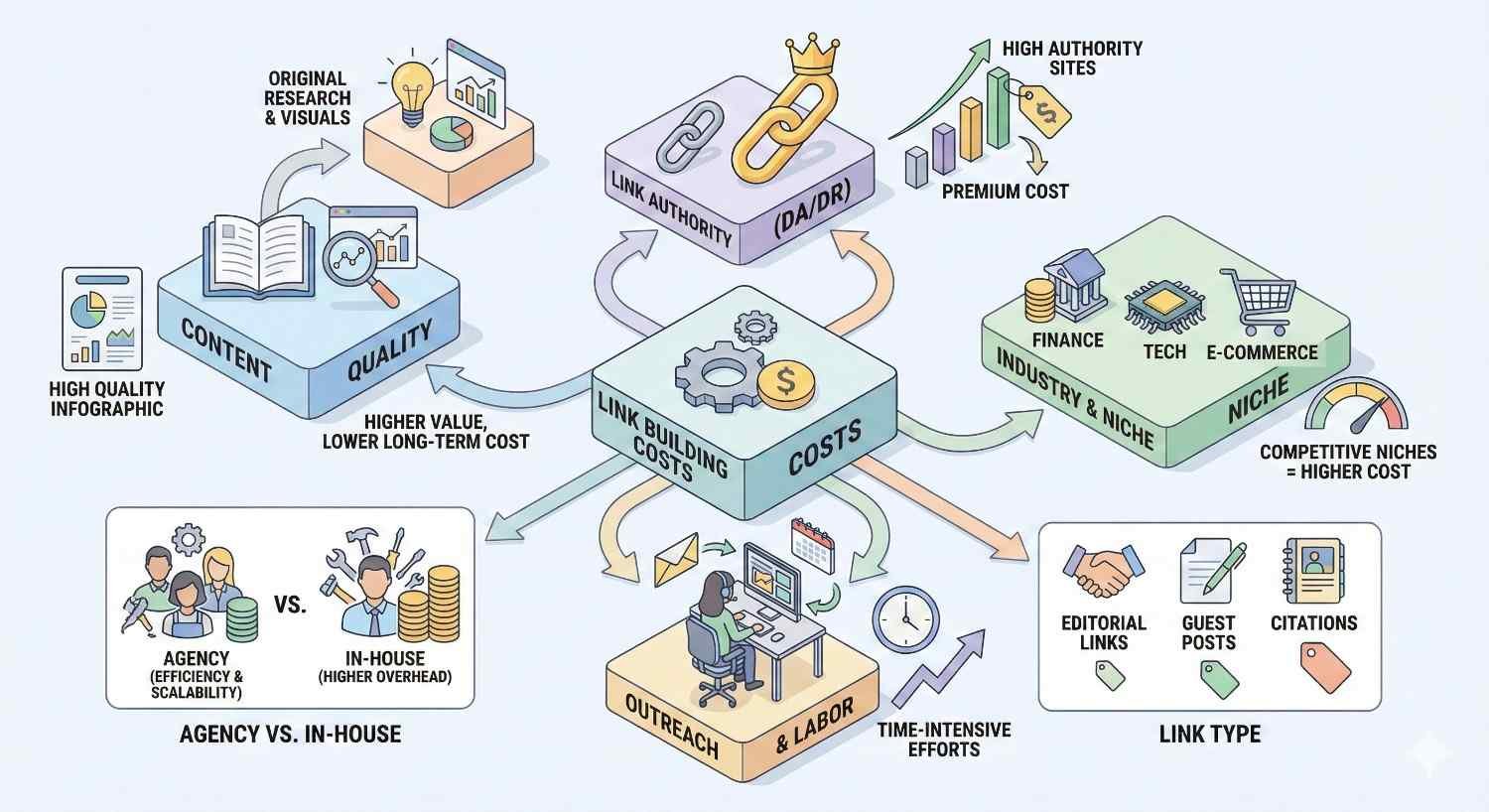
Factors That Influence Link Building Costs
Understanding cost drivers helps you anticipate expenses and identify opportunities for efficiency. These factors interact to determine final pricing for any link building campaign.
Domain Authority and Site Quality
Domain authority remains the primary cost driver for individual link placements. Higher DA sites charge more because they provide greater ranking impact and are harder to access.
Links from DA 20-40 sites typically cost 40-60% less than equivalent placements on DA 60+ sites. A guest post that costs $200 on a DA 35 blog might cost $500-700 on a DA 65 publication covering the same topic.
Beyond DA, traffic quality matters. A DA 50 site with 100,000 monthly organic visitors commands higher prices than a DA 60 site with minimal traffic. Publishers increasingly price based on traffic value rather than authority metrics alone.
Editorial standards also impact pricing. Sites with rigorous review processes, fact-checking requirements, and quality guidelines charge premiums reflecting their investment in content quality—and the value that quality provides to link acquirers.
Niche Competitiveness
Competitive industries face elevated link building costs due to simple supply and demand dynamics. When more businesses pursue links in a vertical, publishers can charge more.
Finance, legal, and healthcare represent the most competitive link building environments. Limited publisher options combined with high demand from well-funded competitors drive costs upward.
Emerging or underserved niches often provide cost advantages. Businesses in specialized B2B verticals, regional markets, or new technology categories may find less competition for relevant placements.
Keyword difficulty correlates with link building costs. Ranking for high-difficulty keywords requires more links from stronger sources—increasing both volume requirements and per-link costs.
Link Acquisition Method
Different acquisition methods carry dramatically different cost structures. Guest posting, digital PR, niche edits, and other approaches each have distinct economics.
Guest posting typically costs $200-500 per placement including content creation. The method offers predictable pricing but requires ongoing content investment.
Digital PR can achieve lower effective costs per link when campaigns generate multiple placements, but upfront investment in newsworthy content and outreach runs $2,000-10,000+ per campaign.
Niche edits (link insertions into existing content) often cost less than guest posts ($100-300) but carry higher risk of removal and may provide less contextual relevance.
The most cost-effective approach varies by industry, goals, and internal capabilities. Businesses with strong content teams may find guest posting efficient, while those with newsworthy stories benefit from digital PR economics.
Content Requirements
Content quality requirements significantly impact total link costs. Basic blog posts cost less to produce than data-driven research, interactive tools, or expert-authored content.
Standard guest posts (1,000-1,500 words) typically cost $150-300 for quality writing. Long-form content (2,500+ words) with original research or expert interviews can cost $500-1,000+.
Some publishers require specific content formats—infographics, videos, or interactive elements—that add $500-2,000 to production costs. These requirements are more common among high-authority publications.
Expert authorship requirements in YMYL verticals add another cost layer. Having content reviewed or bylined by credentialed professionals (doctors, lawyers, financial advisors) adds $100-500 per piece.
Geographic Targeting
Location-specific link building introduces additional cost variables. Local, national, and international campaigns each carry different pricing dynamics.
Local link building typically costs less ($100-300 per link) due to reduced competition and accessible community publications. Regional businesses benefit from local news sites, business directories, and community organizations.
National campaigns in competitive markets face standard industry pricing. International link building adds complexity—language requirements, regional publisher relationships, and currency considerations can increase costs 20-50%.
Country-specific targeting matters for international SEO. Links from UK publications cost differently than US equivalents, and emerging market publications often offer lower pricing with varying quality standards.
Cost Per Link by Acquisition Method
Each link building method carries distinct cost structures, success rates, and quality considerations. Understanding these differences enables strategic budget allocation.
Guest Posting Costs
Guest posting remains the most common link building method, with costs ranging from $150-$600 per placement depending on site quality and content requirements.
The cost breakdown typically includes:
- Content creation: $100-400
- Placement fee: $50-300
- Outreach and coordination: $50-100 (often absorbed in agency fees)
Budget guest posting services offering $50-100 links typically deliver low-quality placements on sites with minimal traffic, poor editorial standards, or link networks that risk penalties. Quality guest posting requires investment in both content and placement.
Premium guest posting on high-authority industry publications can exceed $1,000 when accounting for the content quality required to meet editorial standards. These placements often require original research, expert sources, or unique data.
Scalability represents guest posting’s primary advantage. The method produces predictable results at consistent costs, enabling reliable budget planning and steady link velocity.
Digital PR and Link Earning
Digital PR campaigns cost $2,000-$15,000+ per campaign, with effective cost per link ranging from $100-$500 when campaigns generate multiple placements.
The approach invests heavily upfront in newsworthy content—original research, data studies, surveys, or creative campaigns designed to attract journalist attention and earn editorial links.
Successful digital PR campaigns can generate 10-50+ links from a single piece of content, dramatically reducing effective cost per link. However, results are less predictable than paid placements—some campaigns generate extensive coverage while others underperform.
The method excels for brands with genuinely newsworthy stories, unique data, or creative angles. Companies without compelling narratives may find digital PR less cost-effective than direct placement methods.
Agency digital PR retainers typically run $5,000-15,000 monthly, with expectations of 10-30+ links per month from quality publications. In-house digital PR requires investment in tools, media databases, and skilled practitioners.
Niche Edits and Link Insertions
Niche edits—adding links to existing published content—typically cost $100-$400 per link, offering lower pricing than guest posts but with important tradeoffs.
The method skips content creation costs since links insert into already-published articles. This efficiency enables lower pricing, particularly for links from mid-tier authority sites.
Quality concerns exist with niche edits. Links added post-publication may appear less natural to search engines, and some publishers remove inserted links during content audits. Retention rates vary significantly by publisher.
The approach works best for supplementing other link building methods rather than serving as a primary strategy. Mixing niche edits with guest posts and earned links creates a more natural-appearing link profile.
Pricing varies dramatically by site quality. DA 30-40 niche edits might cost $100-150, while DA 60+ insertions can reach $300-500.
Broken Link Building
Broken link building costs $150-$350 per acquired link when accounting for prospecting time, content creation, and outreach effort.
The method identifies broken links on relevant websites, creates replacement content, and pitches site owners on updating their links. Success rates typically run 5-15%, requiring substantial outreach volume.
Direct costs appear low since no placement fees exist—site owners benefit from fixing broken links. However, the prospecting and outreach time investment makes this method labor-intensive.
The approach works best for businesses with existing quality content that naturally replaces broken resources. Creating new content specifically for broken link opportunities increases costs significantly.
Broken link building scales poorly compared to other methods. The prospecting requirements and low success rates limit volume, making it better suited as a supplementary tactic than a primary link building strategy.
Resource Link Building
Resource page link building costs $100-$300 per link but requires significant upfront investment in link-worthy resources.
The method creates genuinely useful resources—tools, guides, templates, or data—then promotes them to sites maintaining resource pages in relevant niches.
Initial resource creation can cost $1,000-10,000+ depending on complexity. A basic industry guide might cost $500-1,000, while interactive tools or comprehensive data resources require substantially more investment.
Once created, quality resources can generate ongoing links with minimal incremental cost. The effective cost per link decreases over time as the resource continues attracting links.
Success depends entirely on resource quality. Generic content fails to earn resource page placements, while genuinely useful tools and guides can generate dozens of links from a single asset.
HARO and Journalist Outreach
HARO (Help A Reporter Out) and direct journalist outreach can achieve costs as low as $50-$200 per link, but success requires expertise and consistent effort.
The method involves responding to journalist queries or proactively pitching story ideas. No placement fees exist—links come from earned media coverage.
Time investment represents the primary cost. Monitoring queries, crafting responses, and building journalist relationships requires 10-20+ hours weekly for meaningful results. This time has real cost whether performed in-house or outsourced.
Success rates vary dramatically based on response quality, source credibility, and topic relevance. Expert sources with genuine credentials see higher success rates than businesses pitching promotional content.
HARO alternatives like Qwoted, SourceBottle, and direct journalist outreach via Twitter/X provide additional opportunities. The combined approach can generate 5-15 quality links monthly for businesses with newsworthy expertise.
Cost Per Link by Domain Authority Tier
Domain authority directly correlates with link pricing. Understanding tier-based costs helps set realistic expectations and allocate budget appropriately.
DA 20-40 Links (Entry-Level)
Entry-level links from DA 20-40 sites typically cost $75-$200 per link, offering accessible pricing for businesses building initial link profiles.
These links provide foundational authority signals and help establish topical relevance. While individual impact is modest, consistent acquisition builds cumulative authority over time.
Quality varies significantly in this tier. Some DA 30 sites maintain strong editorial standards and relevant audiences, while others exist primarily for link sales with minimal real traffic.
Vetting remains essential even at lower price points. Traffic verification, content quality assessment, and spam signal checks prevent investment in links that provide no value or create risk.
Entry-level links work best as part of a diversified strategy. Building a foundation of relevant DA 30-40 links while pursuing higher-authority placements creates a natural-appearing link profile.
DA 40-60 Links (Mid-Tier)
Mid-tier links from DA 40-60 sites cost $200-$450 per link, representing the sweet spot for many link building campaigns.
These sites typically have established audiences, reasonable traffic, and editorial standards that ensure content quality. Links from this tier provide meaningful ranking impact without premium pricing.
Industry blogs, niche publications, and regional news sites commonly fall in this range. The tier offers abundant options across most verticals, enabling consistent link acquisition at manageable costs.
Mid-tier links often provide the best ROI for competitive keyword targeting. The authority boost justifies the cost while remaining accessible for sustained campaigns.
Quality differentiation matters significantly in this tier. A DA 50 site with 50,000 monthly visitors provides far more value than a DA 55 site with 5,000 visitors—yet pricing may be similar.
DA 60-80 Links (High Authority)
High-authority links from DA 60-80 sites cost $400-$900 per link, with pricing reflecting both ranking impact and limited availability.
Major industry publications, established news sites, and authoritative blogs populate this tier. Access often requires exceptional content, established relationships, or newsworthy angles.
These links can significantly impact rankings for competitive keywords. A single DA 70 link may provide more ranking benefit than five DA 40 links—though the math varies by specific sites and contexts.
Editorial requirements increase substantially at this level. Publications expect original research, expert sources, or genuinely newsworthy content rather than standard promotional material.
Relationship building becomes essential for consistent access to high-authority placements. One-off purchases are possible but expensive; ongoing relationships enable better pricing and more reliable access.
DA 80+ Links (Premium/Elite)
Premium links from DA 80+ sites—major news outlets, top-tier publications, and industry-leading platforms—cost $1,000-$3,000+ per link when achievable through any method.
These placements typically cannot be purchased directly. Earning coverage requires genuine newsworthiness, significant PR investment, or exceptional content that attracts editorial attention.
Digital PR campaigns targeting premium placements require $5,000-20,000+ investment with no guarantee of specific outcomes. Success depends on story quality, timing, and journalist interest.
The ranking impact of premium links is substantial but often overstated. A DA 85 link provides meaningful authority, but the cost differential versus multiple mid-tier links may not justify the investment for all businesses.
Premium links serve brand building as much as SEO. Coverage in major publications provides credibility, referral traffic, and brand awareness beyond pure ranking benefits.
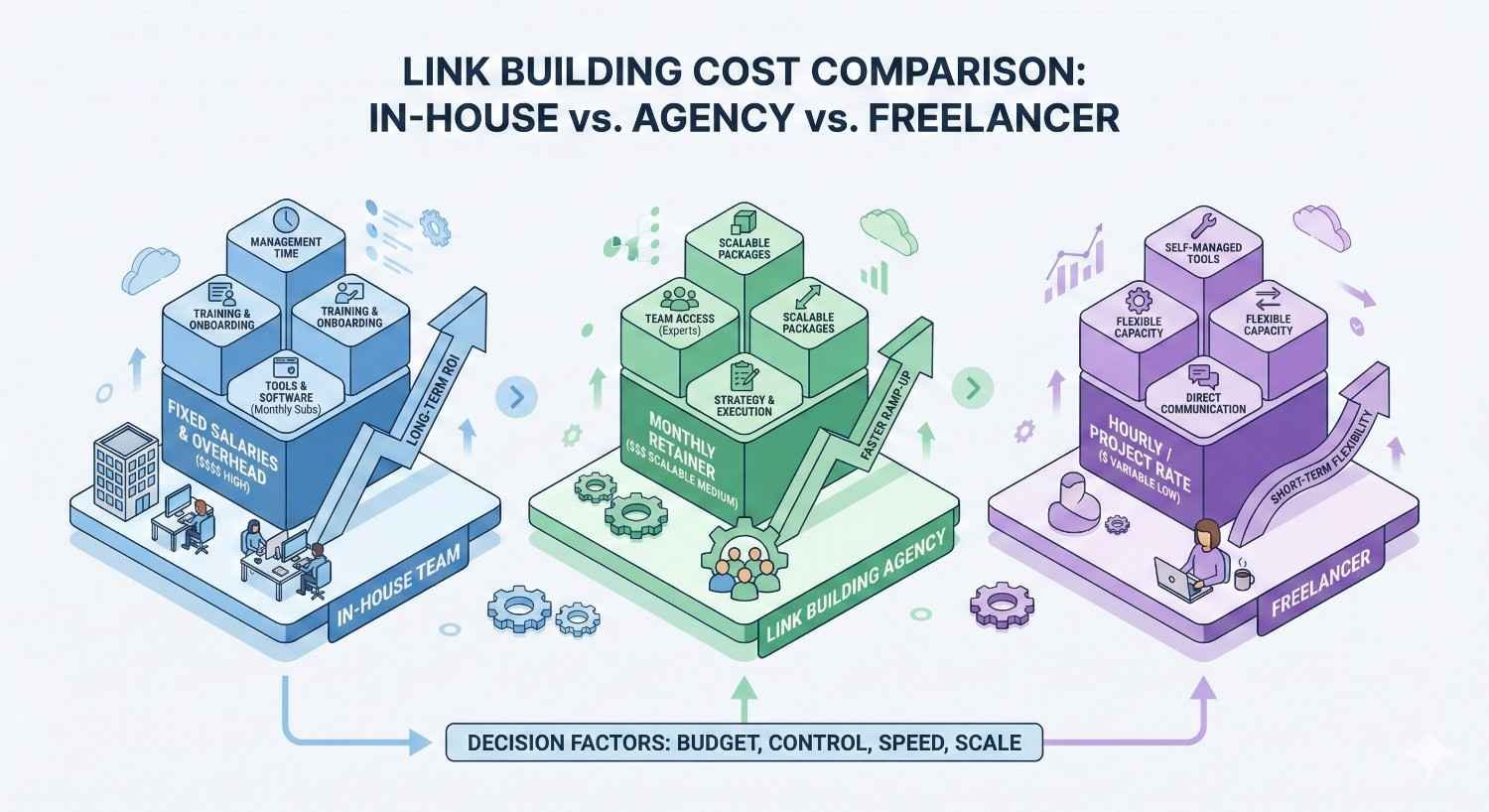
In-House vs. Agency vs. Freelancer Link Building Costs
Execution model significantly impacts total link building costs. Each approach carries distinct cost structures, capabilities, and tradeoffs.
Building an In-House Link Building Team
In-house link building teams cost $8,000-$20,000+ monthly when accounting for salaries, tools, and overhead—translating to $300-$800 per link at typical production rates.
A functional in-house team requires:
- Link building specialist: $50,000-$80,000 annually
- Content writer (partial allocation): $20,000-$40,000 annually
- Tools and subscriptions: $500-$2,000 monthly
- Management overhead: 10-20% of salary costs
Production capacity varies by skill level and niche difficulty. Experienced link builders might secure 15-30 quality links monthly, while newer team members may achieve 8-15.
The approach offers maximum control over quality, strategy, and brand alignment. In-house teams develop deep understanding of your business and can pursue opportunities requiring nuanced judgment.
Scalability limitations exist. Expanding in-house capacity requires hiring, training, and management investment. Agencies can scale faster when campaign needs increase.
Agency Pricing Models and Retainers
Link building agencies typically charge $3,000-$15,000 monthly on retainer models, with per-link pricing ranging from $200-$600 depending on quality tiers.
Common agency pricing structures include:
- Monthly retainers: Fixed fee for agreed link volume and quality standards
- Per-link pricing: Pay for each delivered link meeting specifications
- Performance-based: Pricing tied to ranking improvements or traffic gains
- Hybrid models: Base retainer plus per-link fees for additional volume
Quality varies dramatically across agencies. Budget agencies ($1,500-$3,000 monthly) often deliver low-quality links that provide minimal value or create risk. Premium agencies ($8,000-$15,000 monthly) typically deliver higher-quality placements with better vetting.
Agency advantages include established publisher relationships, proven processes, and scalable capacity. Disadvantages include less control, potential quality inconsistency, and communication overhead.
Due diligence is essential when selecting agencies. Request case studies, sample placements, and client references. Verify that delivered links meet quality standards before committing to long-term engagements.
Freelancer and Contractor Rates
Freelance link builders charge $25-$100 per hour or $150-$400 per link, offering flexibility without agency overhead.
Experienced freelancers with established publisher relationships can deliver quality links efficiently. However, finding reliable freelancers requires vetting, and quality varies significantly.
Freelancer advantages include lower costs, direct communication, and flexibility to scale up or down. Disadvantages include limited capacity, potential reliability issues, and less process standardization.
Platforms like Upwork, specialized SEO job boards, and industry referrals provide freelancer access. Expect to test multiple freelancers before finding reliable partners.
The freelancer model works well for businesses with internal SEO expertise who can manage quality control. Without oversight capability, agency partnerships may provide more consistent results despite higher costs.
How to Calculate Your True Cost Per Link
Accurate cost calculation requires accounting for all expenses—not just obvious placement fees. Understanding true costs enables meaningful ROI analysis and budget optimization.
Direct Costs vs. Hidden Costs
Direct costs include obvious expenses: placement fees, content creation, and tool subscriptions. Hidden costs often exceed direct expenses but go untracked.
Direct costs typically include:
- Publisher placement fees
- Content writing and editing
- Outreach tool subscriptions
- Agency or freelancer fees
Hidden costs often overlooked:
- Staff time for prospecting and outreach
- Management and quality control time
- Failed outreach attempts (time spent on links not acquired)
- Revision and negotiation time
- Relationship maintenance
A link with a $300 placement fee might require 6 hours of staff time across prospecting, outreach, negotiation, and coordination. At $50/hour fully loaded cost, that adds $300 in hidden expenses—doubling the true cost per link.
Tracking time investment reveals true costs. Even rough time tracking for a month provides data to calculate accurate cost per link across your campaigns.
Time Investment and Opportunity Cost
Time represents the largest hidden cost in link building. Staff hours spent on link acquisition cannot be spent on other valuable activities.
Typical time investment per acquired link:
- Prospecting and research: 1-3 hours
- Outreach and follow-up: 1-2 hours
- Content creation coordination: 1-2 hours
- Quality review and approval: 0.5-1 hour
- Total: 3.5-8 hours per link
At $50/hour fully loaded cost, time investment adds $175-$400 to each link acquired—often exceeding direct placement costs.
Opportunity cost compounds the impact. Hours spent on link building could generate value through other marketing activities, product development, or revenue-generating work.
This calculation often justifies outsourcing. When internal time costs exceed agency fees for equivalent quality, outsourcing improves both efficiency and focus.
Cost Per Link ROI Formula
Calculating link building ROI requires connecting link investment to business outcomes. The basic formula provides a starting framework:
Cost Per Link ROI = (Revenue Attributed to Links – Total Link Cost) / Total Link Cost × 100
Attribution presents the primary challenge. Links contribute to rankings, which drive traffic, which generates conversions—but isolating link contribution from other factors requires careful analysis.
Practical approaches to attribution:
- Ranking improvement value: Calculate traffic value of ranking gains achieved through link building
- Incremental traffic analysis: Compare organic traffic growth during link building periods to baseline
- Conversion tracking: Monitor conversions from organic traffic improvements
Example calculation:
- Monthly link building investment: $5,000
- Links acquired: 12 (cost per link: $417)
- Ranking improvements: 5 keywords moved to page 1
- Estimated monthly traffic value: $3,000
- 12-month traffic value: $36,000
- ROI: ($36,000 – $60,000 annual cost) / $60,000 = -40% Year 1
This example shows negative first-year ROI—common for link building since benefits compound over time. Year 2 and beyond, with maintained rankings and no additional link cost for those keywords, ROI turns strongly positive.
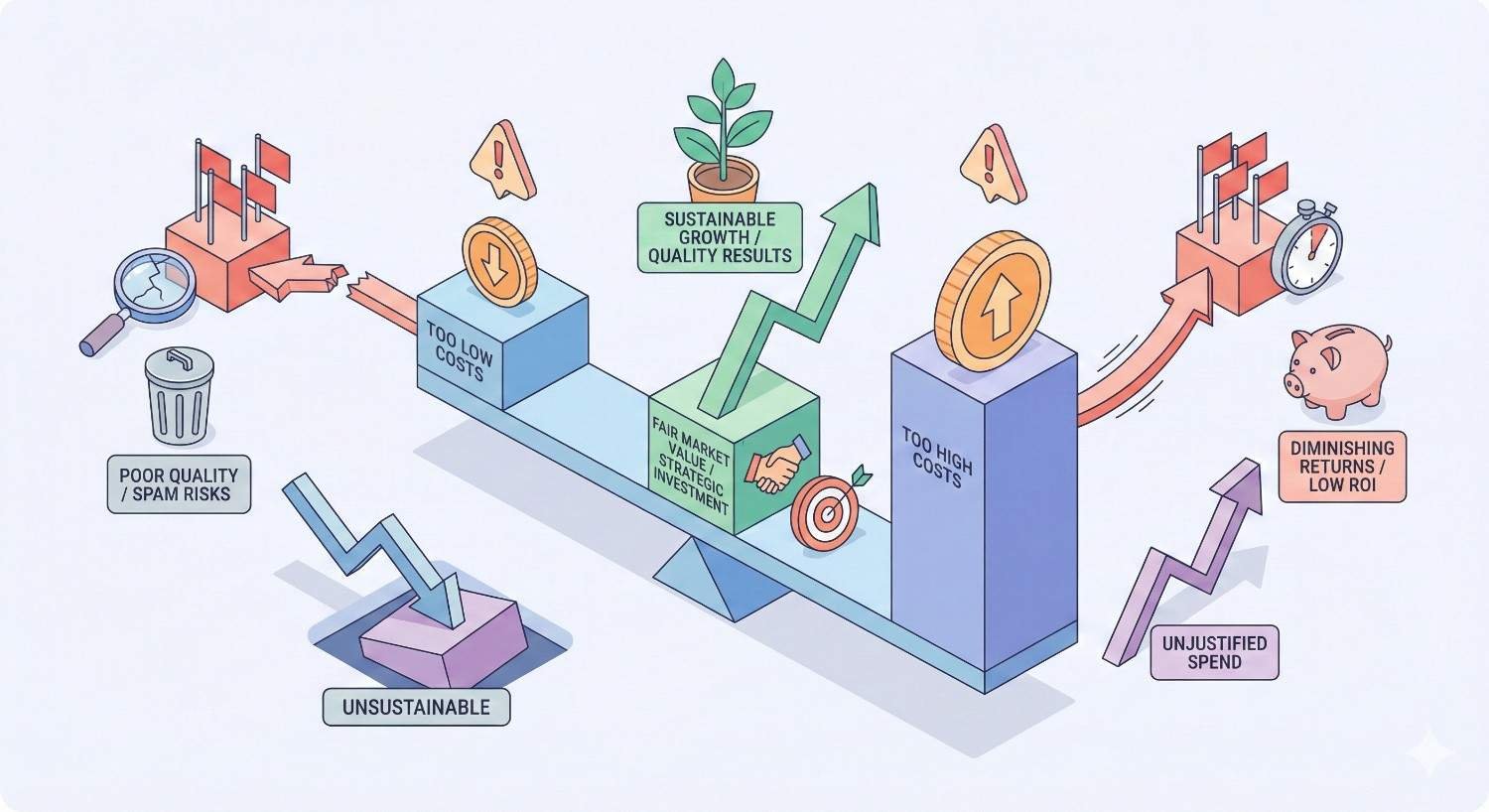
Red Flags: When Link Costs Are Too Low or Too High
Pricing outside normal ranges signals potential problems. Understanding red flags helps avoid both low-quality schemes and overpriced services.
Signs of Low-Quality Link Schemes
Links priced significantly below market rates almost always indicate quality problems. Common red flags include:
Pricing red flags:
- Links under $50 from any source
- “Unlimited links” packages
- Guaranteed placements on high-DA sites at low prices
- Bulk pricing (e.g., “100 links for $500”)
Quality red flags:
- Sites with no real traffic despite high DA
- Excessive outbound links on placement pages
- Foreign language sites linking to English content
- Sites covering unrelated topics
- Obvious link networks with cross-linking patterns
Process red flags:
- No content requirements or review process
- Instant placement guarantees
- No information about target sites before purchase
- Refusal to provide placement examples
Low-quality links waste budget at best and create penalty risk at worst. Google’s algorithms increasingly identify and devalue manipulative link patterns. Links from obvious schemes may trigger manual actions requiring costly disavow and recovery efforts.
The minimum viable cost for a quality link from a real site with real traffic is approximately $100-150. Anything significantly below this threshold warrants skepticism.
Understanding Premium Link Pricing
High prices don’t automatically indicate quality, but premium placements do cost more for legitimate reasons.
Factors justifying premium pricing:
- High domain authority (DA 60+)
- Significant organic traffic
- Strong editorial standards
- Relevant, engaged audience
- Limited placement availability
- Content quality requirements
When premium pricing is warranted:
- Major industry publications
- High-traffic news sites
- Authoritative niche resources
- Sites with genuine editorial review
When premium pricing is questionable:
- High DA but minimal traffic
- No clear editorial standards
- Unlimited placement availability
- Generic sites without niche focus
Verify premium placements before paying premium prices. Request traffic data, review existing content quality, and assess whether the site’s audience aligns with your goals.
Premium links should provide proportionally greater value. A $1,000 link should deliver meaningfully more ranking impact than two $500 links—verify this through site quality assessment rather than accepting price as a quality proxy.
How to Budget for Link Building Campaigns
Effective budgeting balances ambition with realism. Understanding typical investment levels and scaling approaches enables sustainable link building programs.
Setting Realistic Monthly Budgets
Monthly link building budgets typically range from $2,000-$15,000 for most businesses, with enterprise campaigns exceeding $25,000 monthly.
Budget tiers and typical outcomes:
- $1,000-$2,000/month: 3-6 quality links, suitable for local businesses or low-competition niches
- $3,000-$5,000/month: 8-15 quality links, appropriate for regional businesses or moderate competition
- $5,000-$10,000/month: 15-30 quality links, suitable for national campaigns or competitive industries
- $10,000-$20,000/month: 25-50+ quality links, appropriate for highly competitive verticals or aggressive growth
Budget should align with competitive requirements. Analyze competitor link profiles to understand the link velocity needed to compete. Targeting keywords where competitors acquire 20 links monthly requires similar investment.
Start conservatively and scale based on results. Beginning with $3,000-$5,000 monthly allows testing approaches and validating quality before committing larger budgets.
Scaling Link Acquisition Over Time
Effective scaling increases investment as results validate the approach. Premature scaling wastes budget; delayed scaling misses growth opportunities.
Phase 1 (Months 1-3): Foundation
- Budget: $2,000-$4,000 monthly
- Focus: Testing methods, vetting partners, establishing quality standards
- Goal: Identify effective approaches and reliable sources
Phase 2 (Months 4-6): Validation
- Budget: $4,000-$8,000 monthly
- Focus: Scaling proven methods, expanding publisher relationships
- Goal: Confirm ROI trajectory and refine processes
Phase 3 (Months 7-12): Growth
- Budget: $6,000-$15,000 monthly
- Focus: Maximizing effective channels, diversifying approaches
- Goal: Achieve target link velocity for competitive positioning
Phase 4 (Ongoing): Maintenance
- Budget: Varies based on competitive requirements
- Focus: Maintaining rankings, defending against competitors
- Goal: Sustain position with efficient ongoing investment
Scaling triggers should include ranking improvements, traffic growth, and positive ROI indicators. Scale back if quality declines, costs increase without corresponding results, or competitive dynamics shift.
Balancing Quantity vs. Quality
The quantity-quality tradeoff represents link building’s central strategic decision. Neither extreme optimizes results.
Quality-focused approach:
- Fewer links from higher-authority sources
- Higher cost per link ($400-$800+)
- Greater individual link impact
- Lower risk of quality issues
- Slower link velocity
Quantity-focused approach:
- More links from moderate-authority sources
- Lower cost per link ($150-$300)
- Cumulative authority building
- Higher management overhead
- Faster link velocity
Optimal balance for most businesses:
- 60-70% mid-tier links (DA 40-60)
- 20-30% high-authority links (DA 60+)
- 10% foundational links (DA 30-40)
This distribution provides steady authority building through volume while securing high-impact placements that move competitive keywords.
Adjust based on competitive analysis. If competitors primarily build high-authority links, matching that approach may be necessary. If they rely on volume, quality differentiation may provide advantage.
Measuring Link Building ROI Beyond Cost Per Link
Cost per link provides operational efficiency insight but doesn’t capture full value. Comprehensive ROI measurement connects link investment to business outcomes.
Traffic Value and Revenue Attribution
Traffic value translates ranking improvements into monetary terms, enabling direct ROI calculation.
Traffic value calculation:
- Identify keywords with ranking improvements
- Estimate traffic gain from position changes
- Apply traffic value (CPC equivalent or conversion value)
- Sum across all improved keywords
Example:
- Keyword moves from position 8 to position 3
- Estimated traffic increase: 500 visits/month
- Traffic value (based on $2.50 CPC): $1,250/month
- Annual traffic value: $15,000
Revenue attribution extends this analysis to actual conversions:
- 500 additional visits × 2% conversion rate = 10 conversions
- 10 conversions × $500 average order value = $5,000 monthly revenue
- Annual revenue attribution: $60,000
This attribution isn’t perfect—other factors influence rankings and conversions—but provides reasonable estimates for ROI analysis.
Ranking Improvements and Visibility Gains
Ranking improvements represent the most direct link building outcome. Tracking position changes across target keywords quantifies impact.
Metrics to track:
- Average position for target keywords
- Number of page 1 rankings
- Number of top 3 rankings
- Share of voice vs. competitors
- Ranking velocity (improvement rate over time)
Connecting rankings to link building:
- Track ranking changes during active link building periods
- Compare improvement rates to baseline periods
- Analyze correlation between link acquisition and ranking gains
- Account for other variables (content updates, technical changes)
Visibility improvements often precede traffic gains. Rankings may improve before traffic increases as Google tests positions. Patience and consistent tracking reveal true impact.
Long-Term Authority Building
Link building’s full value extends beyond immediate ranking gains. Domain authority improvements benefit all content, not just linked pages.
Long-term benefits:
- Improved crawling and indexing
- Faster ranking for new content
- Greater resilience to algorithm updates
- Competitive moat against new entrants
- Compounding returns over time
Measuring authority growth:
- Track domain authority/rating over time
- Monitor referring domain growth
- Assess link profile quality improvements
- Compare authority metrics to competitors
Authority building justifies link investment even when immediate ranking gains are modest. The cumulative effect of consistent link building creates sustainable competitive advantage.
Conclusion
Understanding cost per link benchmarks transforms link building from guesswork into strategic investment. Industry rates, acquisition methods, and quality tiers each carry distinct pricing—and knowing these benchmarks ensures you neither overpay nor underinvest in this critical ranking factor.
At White Label SEO Service, we help businesses navigate link building economics with transparent pricing and quality-focused execution. Our approach balances cost efficiency with the authority signals needed to compete in your specific market.
Ready to build a link acquisition strategy aligned with realistic budgets and measurable ROI? Contact our team to discuss benchmarks specific to your industry and develop a sustainable link building roadmap.
Frequently Asked Questions About Link Building Costs
What is a good cost per link?
A good cost per link ranges from $200-$500 for quality placements from DA 40-60 sites. Lower costs often indicate quality issues, while higher costs should deliver proportionally greater authority. Evaluate cost relative to site quality, traffic, and relevance rather than seeking the lowest price.
How much should I spend on link building per month?
Most businesses should budget $3,000-$10,000 monthly for meaningful link building impact. Local businesses in low-competition niches can start at $1,500-$2,500, while competitive national campaigns may require $10,000-$20,000+. Align budget with competitive requirements in your specific market.
Are cheap links worth buying?
Links under $100 rarely provide value and often create risk. Low-cost links typically come from low-quality sites, link networks, or schemes that Google can identify and penalize. Investing in fewer quality links outperforms buying many cheap links in virtually all scenarios.
How do agencies price link building services?
Agencies use monthly retainers ($3,000-$15,000), per-link pricing ($200-$600), or hybrid models. Retainers provide predictable costs and committed resources, while per-link pricing offers flexibility. Evaluate agencies on delivered quality and transparency rather than pricing model alone.
How many links do I need to rank for competitive keywords?
Link requirements vary dramatically by keyword difficulty and competitor profiles. Analyze top-ranking competitors to estimate requirements—if they average 50 referring domains, you likely need similar authority. Focus on link quality and relevance rather than hitting arbitrary volume targets.
Is paying for links against Google’s guidelines?
Google’s guidelines prohibit buying links that pass PageRank. However, the line between “buying links” and “paying for content placement” remains practically blurry. Focus on acquiring links from real sites with real audiences through quality content—regardless of whether placement fees are involved.
What’s the difference between cheap and expensive link building services?
Expensive services typically provide better site vetting, higher-quality content, stronger publisher relationships, and more transparent reporting. Cheap services often deliver links from low-quality sites, use automated outreach, and provide minimal quality control. The cost difference usually reflects genuine quality differences.