
Understanding Content Pricing Models
Choosing between cost per word and cost per article pricing directly impacts your content budget, quality outcomes, and SEO performance. Both models serve different strategic purposes, and the right choice depends on your content volume, quality requirements, and business goals.
This decision affects everything from writer incentives to content depth. Understanding the mechanics of each model helps you avoid overpaying for thin content or underfunding strategic pieces.
This guide breaks down both pricing structures, compares their strengths, and provides a framework for selecting the model that aligns with your SEO objectives.
What Is Cost Per Word Pricing?
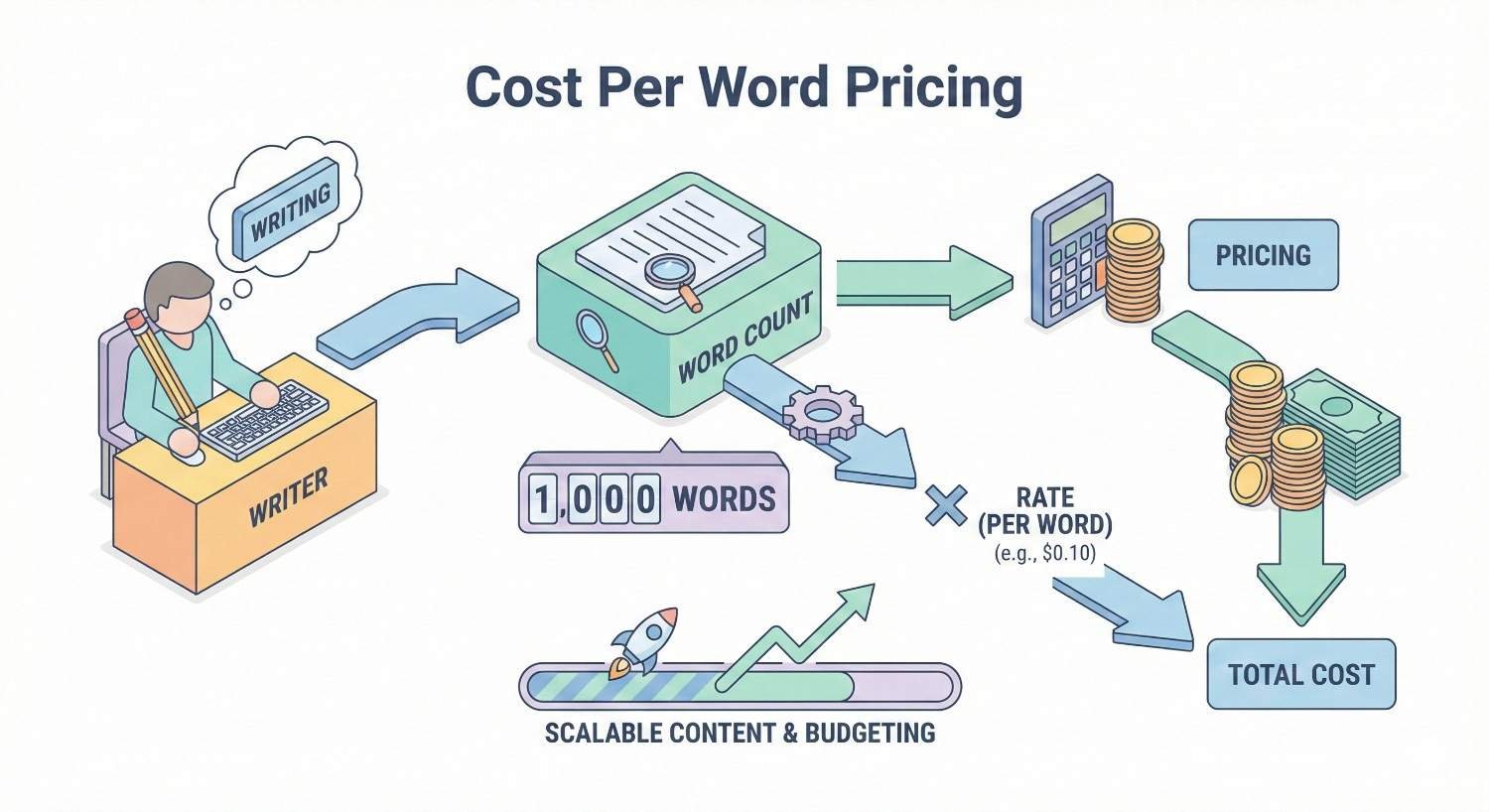
Cost per word pricing charges a fixed rate for every word written. This model dominates freelance marketplaces and content mills because it offers straightforward calculations. You know exactly what you’re paying before the project starts.
The simplicity appeals to businesses scaling content production. However, this pricing structure creates specific incentives that can affect content quality and strategic alignment.
How Cost Per Word Works
Writers multiply their per-word rate by the total word count to determine project cost. A 1,500-word article at $0.10 per word costs $150. A 3,000-word guide at the same rate costs $300.
Rates vary dramatically based on writer experience, industry specialization, and content complexity. Entry-level writers charge $0.03 to $0.06 per word. Mid-tier professionals typically charge $0.10 to $0.25 per word. Expert writers with specialized knowledge command $0.30 to $1.00+ per word.
The calculation is transparent. You specify word count, multiply by rate, and get your total. No surprises on the invoice.
When Cost Per Word Makes Sense
Cost per word works best when you need predictable budgeting across high-volume content production. If you’re publishing 20+ blog posts monthly with consistent length requirements, this model simplifies financial planning.
Product descriptions benefit from per-word pricing. You need 150 words per product across 500 SKUs. The math is clean: 75,000 words at your negotiated rate.
Content refreshes and updates also fit this model. Adding 300 words to existing articles has a clear cost. You’re not renegotiating project scope for minor additions.
Standardized content types with predictable research requirements work well here. Category pages, location pages, and templated content all benefit from per-word simplicity.
Advantages of Cost Per Word Pricing
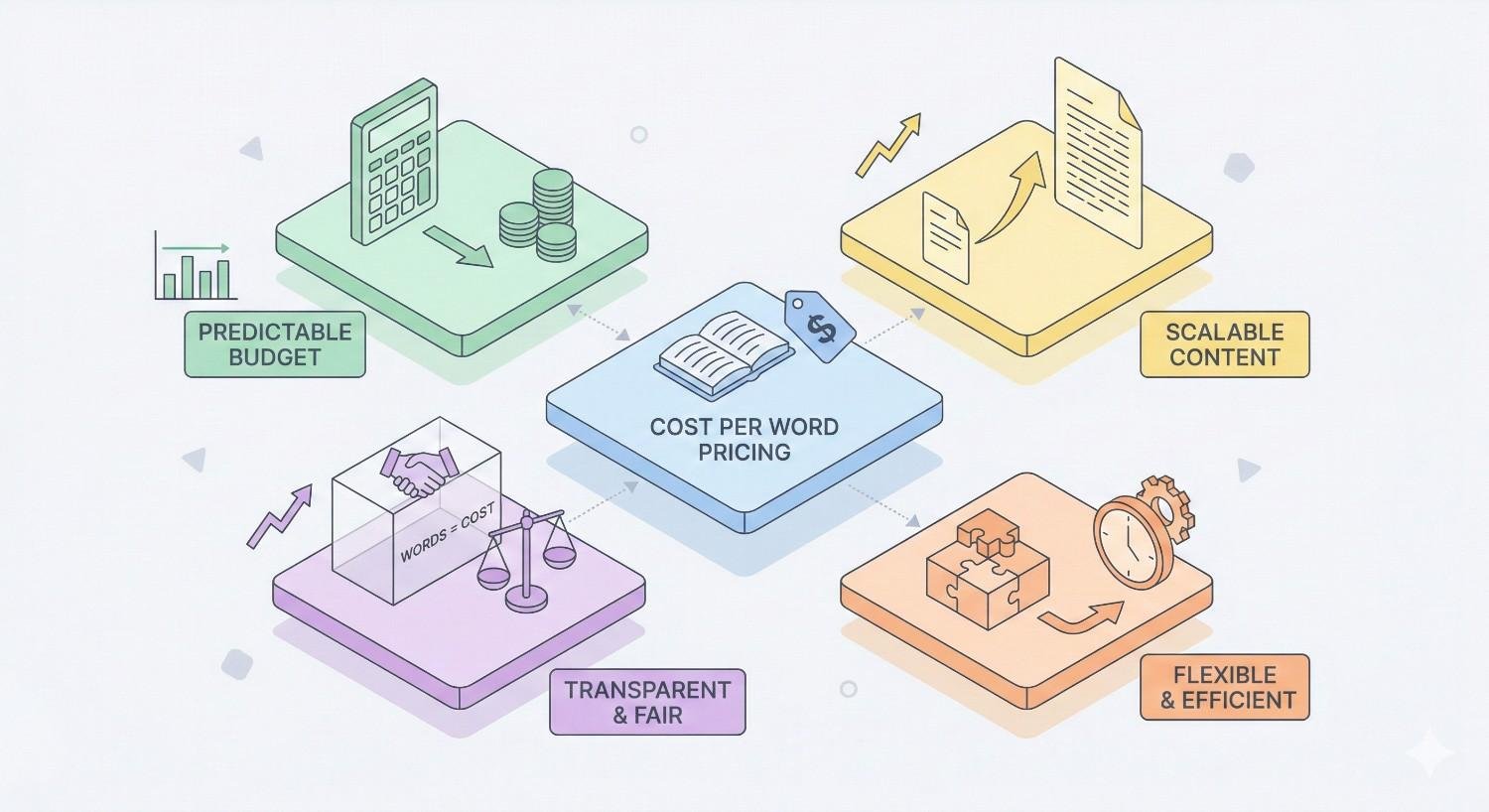
Predictability stands out as the primary benefit. You set word count targets, calculate costs instantly, and budget accurately across content calendars.
Scalability follows naturally. Increasing production from 10 to 50 articles monthly requires simple multiplication. No complex negotiations for each piece.
Transparency builds trust between clients and writers. Both parties understand exactly what’s being delivered and what it costs. Disputes over scope become rare.
Easy comparison between writers and agencies becomes possible. When everyone quotes per-word rates, you can evaluate options directly.
What Is Cost Per Article Pricing?
Cost per article pricing charges a flat fee for a complete piece regardless of final word count. A blog post costs $500 whether it ends up at 1,200 words or 2,000 words.
This model shifts focus from word count to deliverable quality. Writers aren’t incentivized to pad content. Instead, they’re paid to solve the content brief comprehensively.
How Cost Per Article Works
Writers or agencies quote a fixed price based on content type, complexity, research requirements, and strategic value. The quote covers everything needed to produce a publish-ready piece.
Pricing factors include topic difficulty, required expertise, research depth, interview requirements, and optimization expectations. A technical whitepaper costs more than a lifestyle blog post because it demands specialized knowledge.
Most agencies tier their pricing by content type. Blog posts might range from $300 to $800. Pillar pages could run $1,000 to $3,000. Technical guides requiring subject matter expert interviews might cost $2,000 to $5,000+.
The final word count becomes a byproduct of thorough coverage rather than a target to hit.
When Cost Per Article Makes Sense
Complex topics requiring variable depth benefit from article-based pricing. Some sections need extensive explanation. Others require brevity. Per-article pricing lets writers match depth to content needs.
SEO-focused content particularly benefits from this model. Search intent determines appropriate length, not arbitrary word targets. A query might need 800 words or 3,000 words depending on what ranks and what users need.
Strategic content assets like pillar pages, ultimate guides, and thought leadership pieces work better with flat-rate pricing. These pieces require research, planning, and optimization that per-word rates don’t adequately compensate.
When quality matters more than volume, per-article pricing aligns incentives correctly.
Advantages of Cost Per Article Pricing
Scope clarity eliminates word count negotiations. You’re buying a complete solution to a content need, not a specific number of words.
Quality focus removes the incentive to pad content. Writers can be concise where appropriate and thorough where necessary.
Strategic alignment connects pricing to business outcomes. You’re paying for content that ranks, converts, or builds authority rather than paying for words.
Research inclusion becomes standard. Complex topics get the investigation they need because writers aren’t penalized for time spent researching versus writing.
Cost Per Word vs Cost Per Article: Direct Comparison
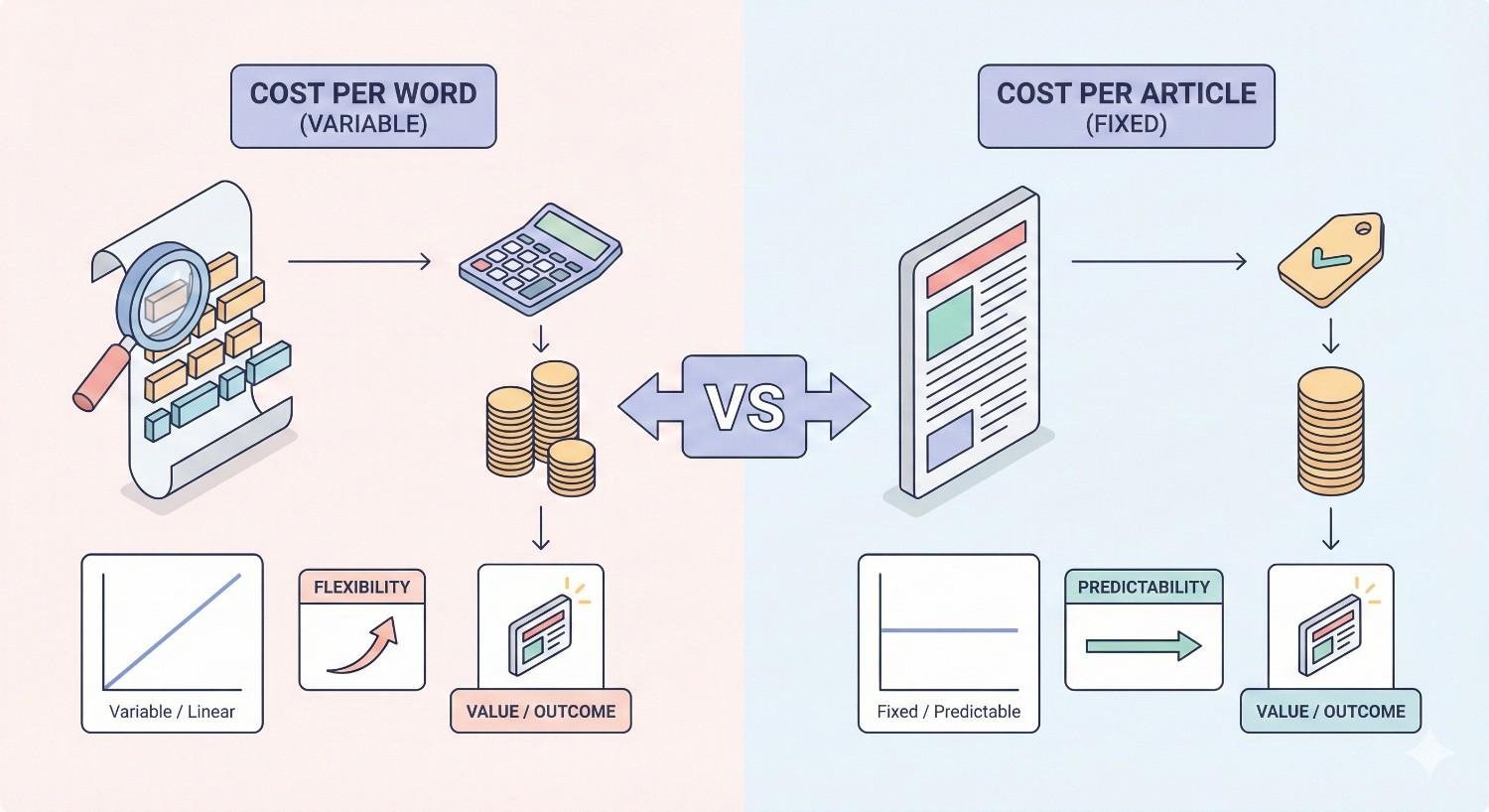
Both models have legitimate applications. The right choice depends on your specific content needs, team structure, and strategic priorities.
Pricing Transparency and Predictability
Cost per word offers superior upfront predictability. You know the exact cost before work begins. Budget variance approaches zero when word counts are specified.
Cost per article provides predictability at the project level but less precision for individual pieces. A $500 article is a $500 article, but you won’t know the final word count until delivery.
For annual budget planning, both models work. Per-word pricing lets you calculate costs from content calendars. Per-article pricing requires categorizing content types and applying average rates.
Quality and Depth Considerations
Per-word pricing can inadvertently incentivize padding. Writers earn more by writing more, even when brevity serves readers better. This creates a structural tension between writer income and content quality.
Per-article pricing removes this tension. Writers can match content depth to topic requirements without financial penalty. A 1,200-word article that perfectly addresses search intent earns the same as a 2,000-word version.
Research depth often suffers under per-word models. Time spent researching doesn’t generate revenue. Writers may minimize research to maximize hourly earnings.
Article-based pricing typically includes research time in the quote. Writers can investigate thoroughly because that time is compensated.
Scalability and Volume Production
Per-word pricing scales more easily for high-volume production. Content mills and large-scale operations prefer this model because it simplifies management across hundreds of pieces.
Per-article pricing requires more upfront scoping. Each piece needs evaluation for complexity and appropriate pricing. This adds management overhead at scale.
However, per-article pricing scales better for quality-focused operations. You’re not managing word counts across dozens of pieces. You’re managing deliverables.
Flexibility and Scope Changes
Per-word pricing handles scope changes cleanly. Need 500 more words? Multiply and invoice. The math is simple.
Per-article pricing requires renegotiation for significant scope changes. If a 1,500-word brief becomes a 4,000-word guide, the original quote no longer applies.
Minor adjustments favor per-article pricing. Adding a section or expanding coverage doesn’t trigger additional charges if it falls within reasonable scope.
Major pivots favor per-word pricing. Complete direction changes have clear cost implications.
Writer Incentives and Behavior
Per-word pricing incentivizes volume over value. Writers maximize income by writing more words faster. This can produce verbose content that buries key information.
Per-article pricing incentivizes efficiency and quality. Writers earn the same regardless of word count, so they focus on delivering the best possible piece in reasonable time.
The best writers adapt to either model. But pricing structure influences behavior at the margins, and those margins compound across large content operations.
Typical Pricing Ranges and Market Rates
Understanding market rates helps you evaluate proposals and set realistic budgets. Rates vary significantly based on multiple factors.
Cost Per Word Rate Benchmarks
Entry-level content (basic blog posts, simple product descriptions): $0.03 to $0.08 per word. Expect minimal research and straightforward topics.
Mid-tier content (researched articles, industry blogs): $0.10 to $0.25 per word. Writers bring subject knowledge and can handle moderate complexity.
Expert content (technical writing, specialized industries): $0.30 to $0.75 per word. Writers have verifiable expertise and can produce authoritative content.
Premium content (thought leadership, executive ghostwriting): $0.75 to $2.00+ per word. Top-tier writers with established credentials and unique perspectives.
According to Contently’s 2024 freelance rates survey, experienced B2B writers average $0.50 to $1.00 per word for specialized content.
Cost Per Article Rate Benchmarks
Basic blog posts (500-1,000 words, light research): $100 to $300
Standard blog posts (1,000-1,500 words, moderate research): $300 to $600
In-depth articles (1,500-2,500 words, significant research): $500 to $1,200
Pillar content (2,500-5,000+ words, comprehensive coverage): $1,000 to $3,500
Technical guides (variable length, expert knowledge required): $1,500 to $5,000+
Agency rates typically run 30-50% higher than freelance rates due to additional services like editing, optimization, and project management.
Factors That Influence Pricing in Both Models
Writer expertise drives the largest price variations. A healthcare writer with clinical experience commands premium rates. A generalist writing about healthcare charges less but delivers less authority.
Research requirements significantly impact fair pricing. Original research, expert interviews, and data analysis justify higher rates.
Industry complexity affects pricing. Finance, legal, medical, and technical content require specialized knowledge that commands premium rates.
Turnaround time influences cost. Rush projects typically add 25-50% to standard rates.
Revision expectations should factor into pricing. Unlimited revisions require higher base rates to remain profitable for writers.
Which Pricing Model Should You Choose?
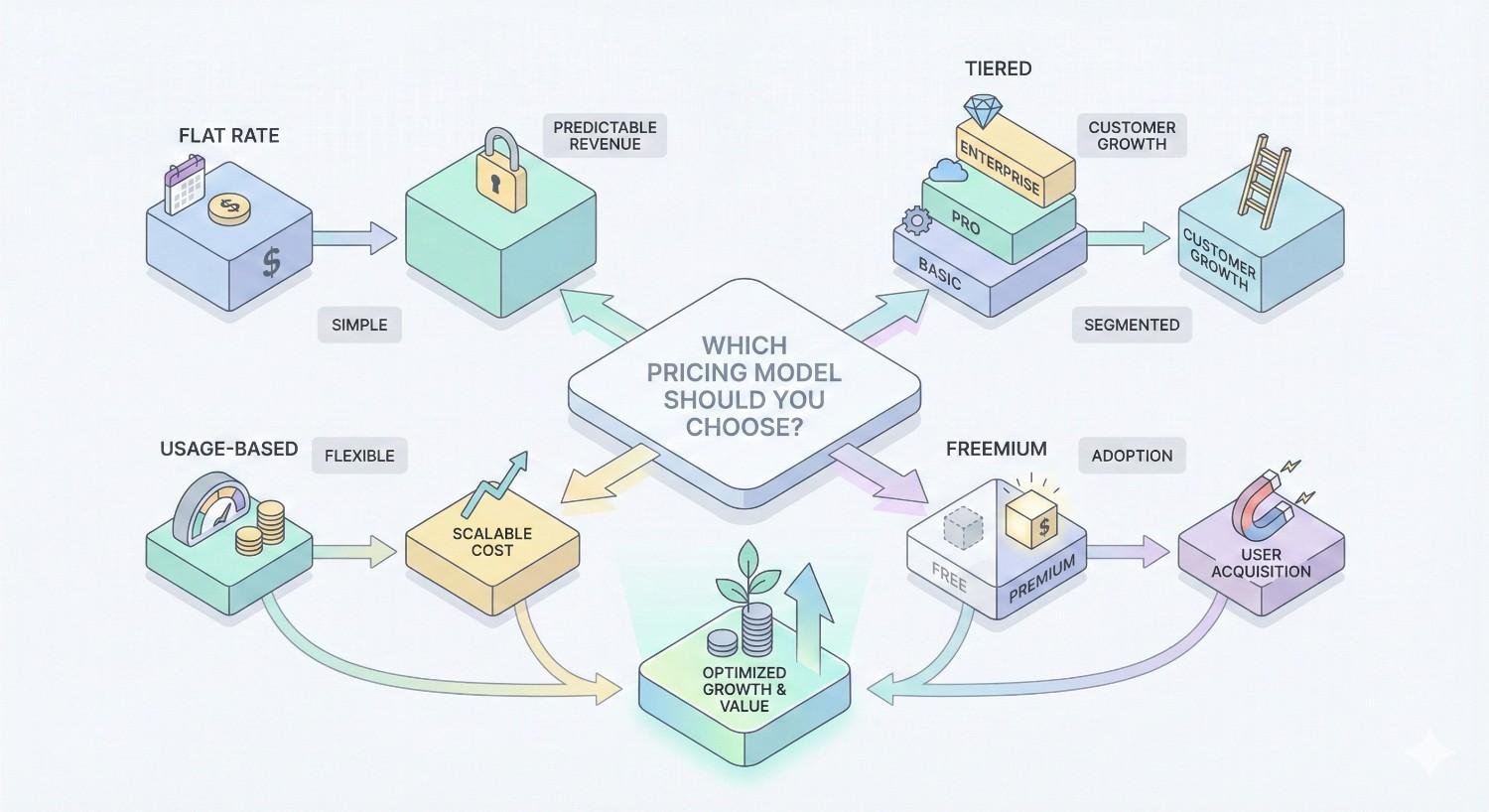
The right model depends on your specific situation. Consider your content goals, team capabilities, and strategic priorities.
Choose Cost Per Word If…
You’re producing high volumes of standardized content. Product descriptions, location pages, and templated content benefit from per-word simplicity.
Your content needs are predictable and consistent. Same topics, same depth, same format across dozens of pieces.
You have strong editorial oversight. Per-word content requires more editing to ensure quality. If you have editors who can refine output, the model works.
Budget predictability matters more than content optimization. You need to know exact costs months in advance.
You’re working with proven writers who deliver quality regardless of pricing model. Experienced professionals don’t pad content just because they’re paid per word.
Choose Cost Per Article If…
Content quality directly impacts business outcomes. If rankings, conversions, or brand perception depend on content excellence, per-article pricing aligns incentives.
Your topics require variable depth. Some pieces need 800 words. Others need 3,000. Per-article pricing lets content match requirements.
SEO performance is a primary goal. Search intent should determine content length, not arbitrary word targets.
You’re producing strategic content assets. Pillar pages, cornerstone content, and thought leadership pieces deserve pricing that reflects their value.
You want writers to invest in research. Per-article pricing compensates investigation time that per-word models discourage.
Hybrid Approaches and Custom Pricing
Many successful content operations use both models strategically. Per-word pricing handles volume content. Per-article pricing covers strategic pieces.
Tiered per-word rates adjust for complexity. Basic content at $0.10 per word. Technical content at $0.25 per word. Same model, different rates.
Per-article with word ranges provides flexibility. A blog post costs $400 for 1,000-1,500 words. Exceeding the range triggers additional charges.
Retainer arrangements bypass both models entirely. Monthly fees cover agreed deliverables regardless of word counts or article numbers.
The best approach matches pricing to content type. Don’t force one model across all content needs.
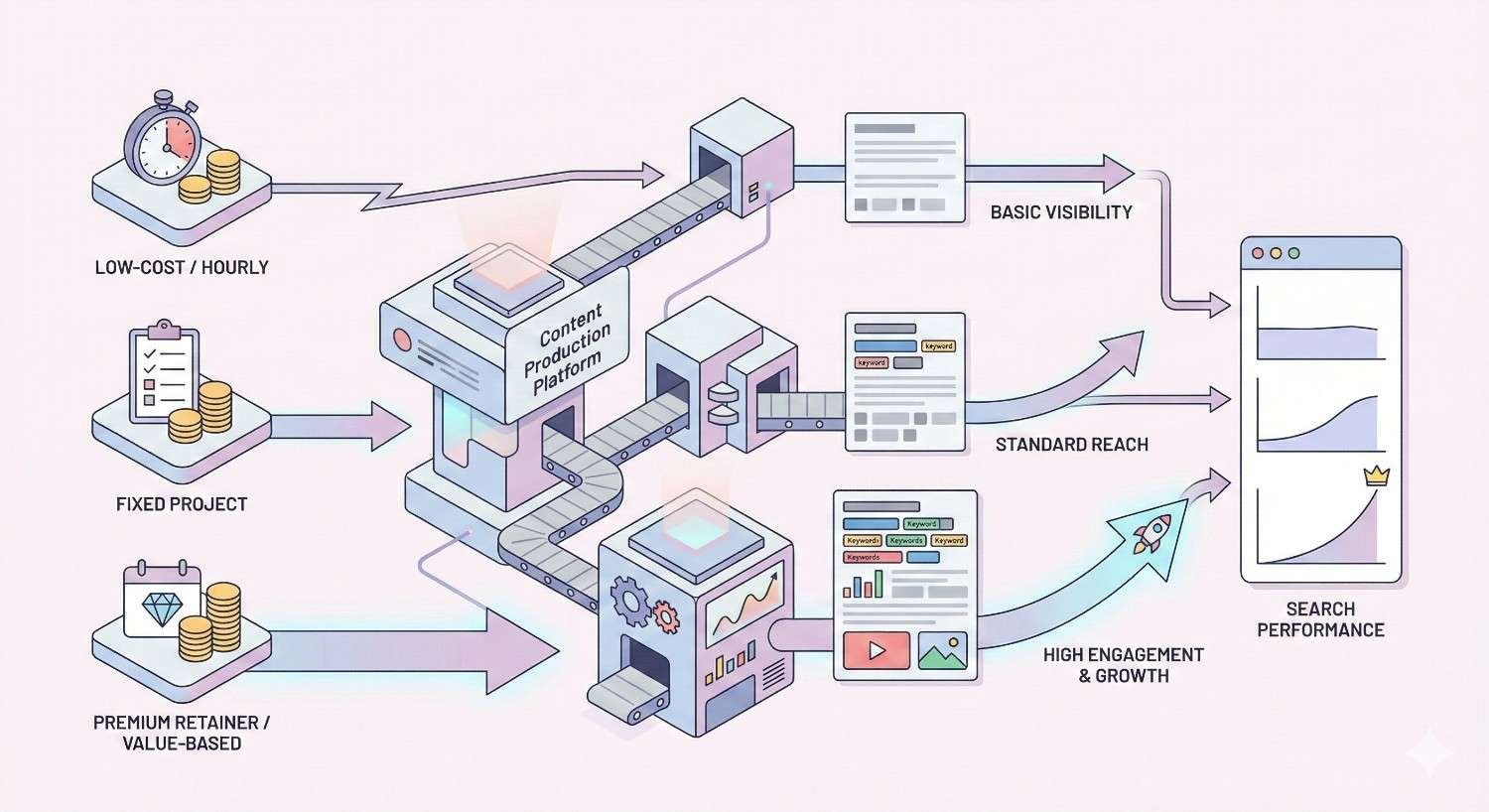
How Pricing Models Impact SEO Content Quality
Pricing structure directly influences the content you receive. Understanding these dynamics helps you make better decisions.
Word Count vs. Search Intent Alignment
Google doesn’t rank content based on word count. It ranks content that best satisfies search intent. Sometimes that’s 500 words. Sometimes it’s 5,000.
Per-word pricing creates pressure to hit word targets regardless of intent. Writers may pad thin topics or truncate complex ones to match specified counts.
Per-article pricing lets content length follow intent. Writers analyze what ranks, assess user needs, and produce appropriately sized content.
Backlinko’s analysis of 11.8 million Google results found that average first-page content length varies dramatically by query type. Forcing uniform word counts ignores this reality.
Research Depth and Topical Authority
Topical authority requires comprehensive coverage. Surface-level content doesn’t build authority regardless of word count.
Per-word pricing discourages deep research. Every hour spent investigating is an hour not generating billable words. Writers optimize for output speed.
Per-article pricing includes research in the deliverable cost. Writers can investigate thoroughly because that time is compensated within the flat fee.
The difference shows in content quality. Per-article content typically includes more original insights, better source integration, and stronger expertise signals.
Optimization and Strategic Content Planning
SEO-optimized content requires more than writing. It needs keyword research, competitor analysis, internal linking strategy, and on-page optimization.
Per-word pricing rarely includes these elements. You’re paying for words, not strategy. Optimization becomes an additional cost or gets skipped entirely.
Per-article pricing from SEO-focused providers typically includes optimization. The flat fee covers research, writing, and optimization as an integrated deliverable.
This integration produces better results. Content created with SEO strategy from the start outperforms content optimized after the fact.
Managing Content Costs at Scale
Scaling content production requires systematic cost management. Both pricing models present different challenges at volume.
Building a Content Budget Framework
Start by categorizing content types. Blog posts, pillar pages, product content, and technical documentation have different requirements and costs.
Assign pricing models to categories. High-volume standardized content might use per-word pricing. Strategic pieces might use per-article pricing.
Calculate monthly and quarterly budgets based on content calendars. Include buffer for scope changes and rush projects.
Track actual costs against projections. Adjust rates and volume as you learn what delivers results.
Negotiating Rates with Writers and Agencies
Volume commitments unlock better rates. Guaranteeing 20 articles monthly justifies discounts that one-off projects don’t.
Long-term relationships reduce costs over time. Writers learn your voice, requirements, and preferences. Efficiency improves. Rates can reflect this.
Clear briefs reduce revision cycles. Better inputs produce better outputs faster. Writers can offer better rates when projects run smoothly.
Payment terms affect pricing. Faster payment justifies lower rates. Net-60 terms require higher rates to compensate for cash flow impact.
Measuring ROI by Pricing Model
Track content performance by pricing model. Do per-word articles rank as well as per-article pieces? Do they convert at similar rates?
Calculate cost per ranking keyword. Divide content cost by keywords ranking in top 10 positions after 6 months.
Measure cost per lead or conversion. Connect content costs to business outcomes through proper attribution.
Compare efficiency across models. Per-word content might cost less but require more pieces to achieve the same results.
Common Pricing Pitfalls to Avoid
Both pricing models have traps that waste budget and produce poor results. Awareness helps you avoid them.
The “Cheapest Rate” Trap
Low rates attract low-quality writers. A $0.03 per word rate doesn’t attract experienced professionals. You get what you pay for.
Cheap content often costs more in the long run. Poor articles need extensive editing, don’t rank, and damage brand perception. The “savings” evaporate.
Calculate total cost of ownership. Include editing time, revision cycles, and opportunity cost of content that doesn’t perform.
Quality content at fair rates outperforms cheap content at volume. One excellent article often beats five mediocre ones.
Misaligned Incentives and Quality Issues
Per-word pricing incentivizes padding. Watch for unnecessary introductions, redundant explanations, and filler content that inflates word counts.
Per-article pricing can incentivize rushing. If writers earn the same regardless of effort, some minimize time investment. Vet writers carefully.
Both models require quality control. Don’t assume pricing structure guarantees quality. Review content critically regardless of how you’re paying.
Set clear quality standards in contracts. Define what constitutes acceptable work. Include revision rights and rejection criteria.
Hidden Costs in Both Models
Revision cycles add cost even when “included.” Your time reviewing and providing feedback has value. Excessive revisions indicate poor initial quality.
Project management consumes resources. Briefing writers, answering questions, and coordinating delivery takes time. Factor this into total cost calculations.
Editing and optimization may not be included. Per-word rates rarely cover SEO optimization. Per-article rates might not include editing. Clarify what’s included.
Opportunity cost of poor content compounds. Articles that don’t rank represent wasted investment. The cheapest content often has the highest opportunity cost.
How Professional SEO Agencies Price Content
Understanding agency pricing models helps you evaluate proposals and set appropriate expectations.
Strategic Content Pricing vs. Commodity Writing
Commodity writing treats content as interchangeable units. Any writer can produce any article. Price is the primary differentiator.
Strategic content pricing reflects the value of expertise, research, and optimization. Writers bring specialized knowledge. Content serves specific business objectives.
Agencies typically offer both tiers. Basic content production at competitive rates. Strategic content at premium rates with additional services.
Choose based on content purpose. Commodity pricing works for volume content. Strategic pricing suits high-value assets.
What’s Included in Agency Content Pricing
Research and planning should be included. Topic research, keyword analysis, and competitive review inform better content.
Writing and editing form the core deliverable. Professional editing catches errors and improves clarity.
SEO optimization adds significant value. On-page optimization, internal linking recommendations, and meta descriptions enhance performance.
Revision rounds should be specified. One to two rounds is standard. Unlimited revisions suggest unclear processes.
Project management coordinates delivery. Account managers handle communication, scheduling, and quality control.
Ask what’s included before comparing prices. A $500 article with full optimization beats a $300 article requiring separate optimization work.
Evaluating Content Pricing Proposals
Request sample content before committing. Quality varies dramatically between agencies. Samples reveal actual capabilities.
Ask about writer qualifications. Who will write your content? What’s their expertise? Can you review their portfolio?
Understand the process. How are briefs created? Who reviews content? What’s the revision process?
Clarify deliverables explicitly. Word count ranges, optimization elements, and format specifications should be documented.
Check references from similar clients. An agency excelling at lifestyle content might struggle with technical B2B topics.
Final Recommendations: Making the Right Choice for Your Business
Selecting the right pricing model requires honest assessment of your needs, capabilities, and priorities.
Assess Your Content Goals and Volume Needs
Define what success looks like. Rankings? Traffic? Leads? Brand authority? Different goals suggest different pricing approaches.
Estimate realistic volume requirements. How many pieces monthly? What types? What quality level?
Consider your team’s capabilities. Do you have editors? SEO specialists? Project managers? Available support affects which model works best.
Match pricing to content purpose. Volume content can use per-word pricing. Strategic content deserves per-article investment.
Prioritize Quality and Strategic Alignment
Cheap content rarely delivers value. The lowest cost option almost never produces the best results.
Invest appropriately in strategic content. Pillar pages, cornerstone content, and thought leadership pieces deserve premium investment.
Accept that quality costs money. Experienced writers with specialized knowledge command higher rates. Their content performs better.
Calculate ROI, not just cost. A $1,000 article generating $10,000 in leads beats a $100 article generating nothing.
Working with SEO-Focused Content Partners
SEO-focused agencies understand how pricing affects performance. They structure pricing to align with ranking and traffic goals.
Look for partners who discuss strategy, not just word counts. Content should serve business objectives, not arbitrary metrics.
Evaluate based on results, not rates. Track rankings, traffic, and conversions. Adjust investment based on performance.
Build long-term relationships. Consistent partners learn your business, voice, and audience. Quality improves over time.
Conclusion
Cost per word and cost per article pricing each serve distinct purposes in content strategy. Per-word pricing offers predictability and scales efficiently for standardized content. Per-article pricing aligns incentives with quality and works better for strategic SEO content.
The right choice depends on your content goals, volume requirements, and quality standards. Many successful operations use both models strategically, matching pricing structure to content type and business purpose.
We help businesses build sustainable organic growth through strategic content that ranks and converts. Contact White Label SEO Service to discuss content pricing structures that align with your SEO objectives and deliver measurable results.
Frequently Asked Questions
Is cost per word or cost per article better for SEO content?
Cost per article typically serves SEO content better because it lets writers match content length to search intent rather than arbitrary word targets. This produces content that addresses user needs comprehensively without padding or truncation.
What is a fair cost per word rate for quality content?
Fair rates range from $0.10 to $0.30 per word for mid-tier content and $0.30 to $1.00+ per word for expert-level specialized content. Rates below $0.08 per word rarely attract experienced writers capable of producing authoritative content.
How do I calculate content ROI across different pricing models?
Track cost per ranking keyword, cost per lead, and cost per conversion for content produced under each model. Compare performance metrics against investment to determine which pricing structure delivers better returns for your specific content types.
Should I use different pricing models for different content types?
Yes. Many successful content operations use per-word pricing for high-volume standardized content like product descriptions and per-article pricing for strategic pieces like pillar pages and thought leadership content.
What hidden costs should I watch for in content pricing?
Watch for editing costs, revision cycles, SEO optimization fees, and project management time. Clarify what’s included before comparing prices. A lower base rate with extensive add-ons often costs more than a higher all-inclusive rate.
How do agencies typically structure content pricing?
Most agencies offer tiered pricing based on content type and complexity. Basic blog posts might cost $300 to $600. Comprehensive guides and pillar content typically range from $1,000 to $3,500. Pricing usually includes research, writing, editing, and optimization.
Can I negotiate better rates for volume content commitments?
Yes. Volume commitments of 15-20+ articles monthly typically unlock 10-25% discounts from both freelancers and agencies. Long-term contracts with guaranteed minimums provide leverage for rate negotiations.