
CRM software SEO requires a specialized approach that combines SaaS marketing expertise with deep technical optimization. Unlike general software categories, CRM platforms compete in one of the most saturated B2B search landscapes, where giants like Salesforce and HubSpot dominate page one. The opportunity? Most CRM companies leave significant organic traffic on the table by ignoring long-tail keywords and industry-specific search intent.
This matters because organic search drives the highest-quality leads for SaaS companies. Buyers researching CRM solutions are actively seeking solutions, making them far more valuable than cold outreach targets.
This guide covers everything from technical foundations and keyword strategy to content frameworks and realistic timelines. You’ll learn exactly how to build sustainable organic visibility for your CRM product.
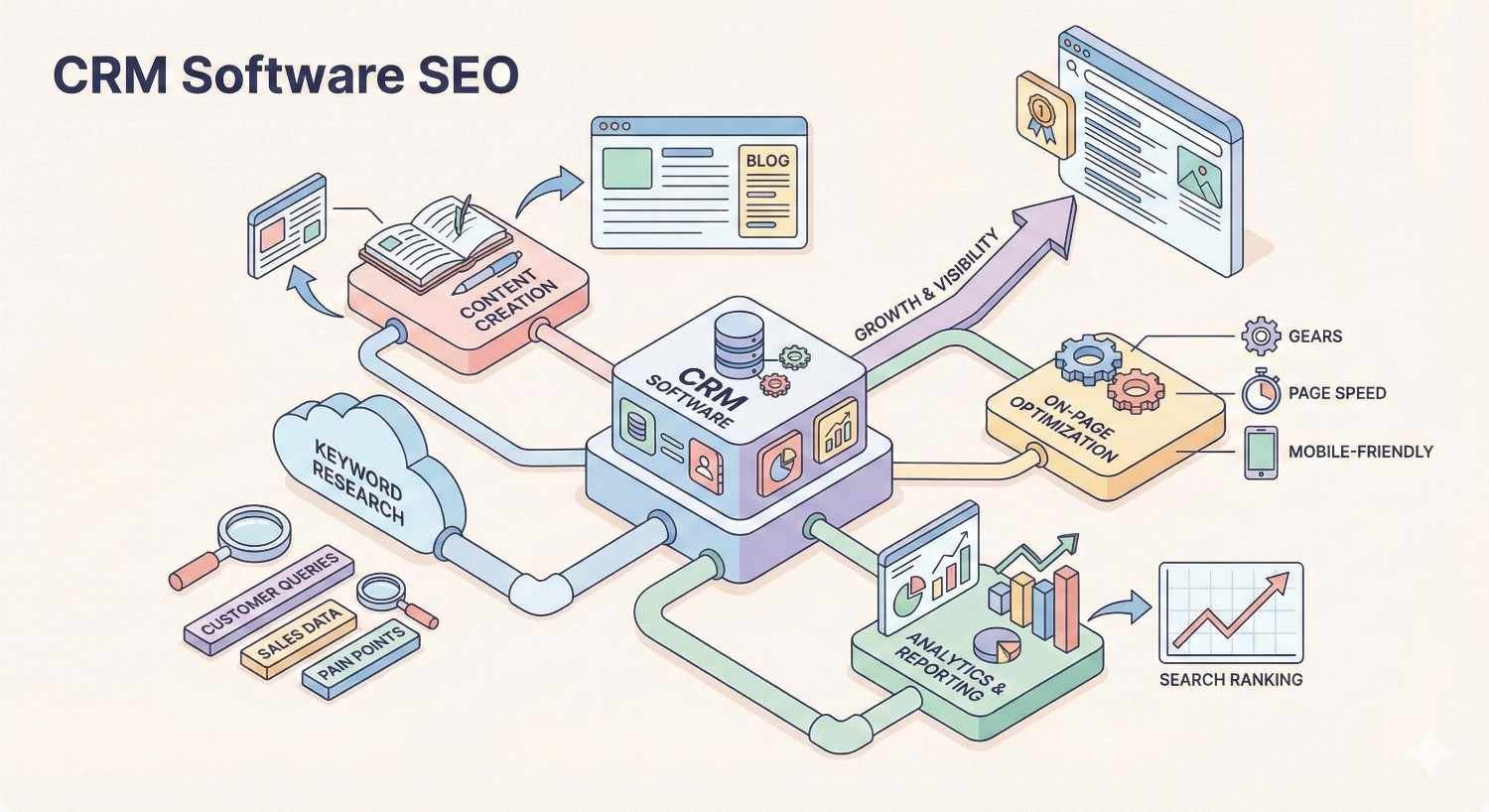
What Is CRM Software SEO?
CRM software SEO is the practice of optimizing customer relationship management platforms and their associated websites to rank higher in search engine results. It encompasses technical optimization, content strategy, and authority building specifically tailored to the competitive SaaS landscape.
The goal extends beyond traffic. Effective CRM SEO connects search visibility directly to pipeline generation, demo requests, and ultimately, customer acquisition. This requires understanding both search engine mechanics and the complex B2B buying journey.
How CRM SEO Differs from General Software SEO
CRM SEO operates under unique constraints that separate it from broader software marketing. The sales cycle is longer, often spanning three to twelve months. Multiple stakeholders influence purchasing decisions. And the competitive landscape includes some of the most well-funded marketing teams in SaaS.
Keyword intent varies dramatically across the funnel. Someone searching “what is a CRM” needs educational content. Someone searching “Salesforce vs HubSpot pricing” is comparing options. Someone searching “CRM free trial” is ready to act. Each requires different content types and optimization approaches.
The technical complexity also differs. CRM websites typically include product pages, feature comparisons, integration directories, pricing calculators, and extensive documentation. Each section requires distinct optimization strategies while maintaining cohesive site architecture.
Why Search Visibility Matters for CRM Companies
Organic search delivers compounding returns that paid channels cannot match. Once you rank for valuable keywords, traffic flows without ongoing ad spend. For CRM companies with high customer lifetime values, this creates exceptional unit economics.
Consider the math. A single enterprise CRM deal might generate $50,000 to $500,000 in lifetime revenue. If organic search contributes even a fraction of those deals, the ROI on SEO investment becomes substantial.
Search visibility also builds brand authority. When prospects repeatedly encounter your content during their research phase, you establish credibility before the first sales conversation. This shortens sales cycles and improves close rates.
Understanding the CRM Software Search Landscape
The CRM search landscape is dominated by established players, but opportunities exist for strategic challengers. Understanding how users search and what competitors do well reveals gaps you can exploit.
Search Intent Types for CRM Queries
CRM-related searches fall into four primary intent categories, each requiring different content approaches.
Informational intent drives queries like “what does CRM software do” or “benefits of using a CRM.” These searchers need educational content that builds awareness without aggressive selling.
Commercial investigation appears in searches like “best CRM for small business” or “CRM software reviews 2025.” These users are actively comparing options and respond well to comparison content and detailed feature breakdowns.
Transactional intent shows in queries like “buy CRM software” or “CRM pricing plans.” These searchers are ready to purchase and need clear paths to conversion.
Navigational intent involves branded searches like “Salesforce login” or “HubSpot CRM.” While you cannot capture competitor branded traffic, optimizing for your own brand terms ensures you control that experience.
The CRM Buyer’s Journey in Search
B2B CRM purchases rarely happen in a single session. The typical journey spans multiple searches over weeks or months, with different stakeholders conducting research at various stages.
Awareness stage searches focus on problems and general solutions. Users search for “how to manage customer relationships” or “sales team organization tools.” Content here should educate without pushing products.
Consideration stage searches become more specific. Users search for “CRM features comparison” or “CRM for real estate agents.” They know they need a CRM and are evaluating options.
Decision stage searches indicate purchase readiness. Users search for “CRM implementation cost” or specific product names with “pricing” or “demo.” Content should remove friction and drive conversions.
Competitive Analysis: Who Dominates CRM SERPs
Salesforce, HubSpot, Zoho, and Pipedrive consistently dominate CRM search results. Their advantages include massive content libraries, strong domain authority, and years of accumulated backlinks.
However, analysis reveals patterns you can exploit. Large players often neglect niche keywords. They produce generic content that fails to address specific industry needs. And their comparison pages rarely acknowledge weaknesses.
Successful challengers win by going deeper on specific topics, targeting underserved industries, and creating genuinely helpful content that large competitors cannot replicate at scale.
Technical SEO Foundations for CRM Websites
Technical SEO creates the foundation for all other optimization efforts. Without solid technical infrastructure, even excellent content struggles to rank.
Site Architecture for CRM Product Pages
CRM websites require logical hierarchies that help both users and search engines understand content relationships. The structure should reflect how buyers think about your product.
A typical effective architecture includes:
Homepage linking to main product pages Product pages organized by solution type or user role Feature pages detailing specific capabilities Integration pages for each connected platform Industry pages targeting vertical-specific needs Resource sections containing guides, templates, and educational content
Internal linking should create clear pathways between related content. A feature page about email automation should link to relevant integrations, use cases, and educational content about email marketing best practices.
URL structure matters. Keep URLs descriptive but concise. Use hyphens between words. Maintain consistent patterns across similar page types.
Page Speed Optimization for SaaS Platforms
SaaS websites often struggle with speed due to complex functionality, third-party scripts, and dynamic content. Google’s Core Web Vitals directly impact rankings, making speed optimization essential.
Focus on three core metrics. Largest Contentful Paint (LCP) measures loading performance and should occur within 2.5 seconds. First Input Delay (FID) measures interactivity and should be under 100 milliseconds. Cumulative Layout Shift (CLS) measures visual stability and should score below 0.1.
Common fixes include image compression, lazy loading for below-fold content, minimizing JavaScript execution, and leveraging browser caching. Consider using a content delivery network to serve assets from locations closer to users.
Mobile Experience and Core Web Vitals
Mobile optimization is non-negotiable. Google uses mobile-first indexing, meaning your mobile site determines rankings even for desktop searches.
Ensure responsive design adapts to all screen sizes. Test forms and interactive elements on actual mobile devices. Simplify navigation for touch interfaces. Verify that text remains readable without zooming.
Core Web Vitals often differ between mobile and desktop. Test both versions separately and prioritize mobile improvements when resources are limited.
Schema Markup for CRM Software
Structured data helps search engines understand your content and can generate rich results that improve click-through rates.
SoftwareApplication schema should mark up your main product pages, including name, description, operating system, and pricing information.
FAQ schema can generate expandable questions directly in search results, increasing SERP real estate.
Organization schema establishes your company’s identity and connects your brand across Google’s knowledge graph.
Review schema displays star ratings in search results when you have legitimate customer reviews.
Implement schema using JSON-LD format in the head section of relevant pages. Test implementation using Google’s Rich Results Test tool.
Crawlability and Indexation Best Practices
Search engines must access and understand your content before ranking it. Technical barriers can prevent even excellent content from appearing in results.
Create and maintain an XML sitemap listing all important pages. Submit it through Google Search Console and update it automatically when content changes.
Use robots.txt to guide crawlers away from low-value pages like admin areas, duplicate content, and internal search results. But verify you are not accidentally blocking important content.
Implement canonical tags to indicate preferred versions when similar content exists at multiple URLs. This prevents duplicate content issues that dilute ranking signals.
Monitor crawl errors in Search Console. Fix broken links, redirect deleted pages, and resolve server errors promptly.
Keyword Research Strategy for CRM Software
Effective keyword research balances search volume with competition and intent. The goal is finding queries where you can realistically rank and where ranking drives business value.
Mapping Keywords to the CRM Sales Funnel
Different keywords serve different purposes in your marketing funnel. A comprehensive strategy addresses all stages.
Top-of-Funnel: Awareness Keywords
Awareness keywords target users who may not know they need a CRM. These queries often focus on problems rather than solutions.
Examples include “how to organize customer data,” “sales team productivity tips,” and “managing client relationships.” Search volumes are often high, but conversion rates are low.
Content for these keywords should educate and build trust. Blog posts, guides, and educational resources work well. Include soft calls-to-action that introduce your product as a potential solution.
Middle-of-Funnel: Consideration Keywords
Consideration keywords target users actively evaluating CRM options. They know they need a solution and are comparing alternatives.
Examples include “best CRM for startups,” “CRM features checklist,” and “cloud vs on-premise CRM.” These users are closer to purchase but still need convincing.
Content should demonstrate expertise and differentiate your product. Comparison guides, feature breakdowns, and detailed use cases perform well. Include clear paths to demos or trials.
Bottom-of-Funnel: Decision Keywords
Decision keywords indicate purchase readiness. Users searching these terms are ready to buy and need final information to choose.
Examples include “CRM pricing comparison,” “CRM free trial,” and “[Your Brand] vs [Competitor].” Conversion rates are highest here, but volumes are typically lower.
Content should remove friction and drive action. Pricing pages, demo request forms, and detailed implementation guides serve these users. Make conversion paths obvious and simple.
Long-Tail CRM Keywords That Convert
Long-tail keywords contain three or more words and target specific needs. While individual search volumes are lower, they often convert better due to precise intent.
“CRM for real estate agents with email integration” reveals exactly what the searcher needs. If your product fits, you can create highly targeted content that directly addresses their requirements.
Find long-tail opportunities by analyzing search suggestions, reviewing competitor content gaps, and mining customer questions from sales and support teams.
Competitor Keyword Gap Analysis
Gap analysis reveals keywords where competitors rank but you do not. These represent proven opportunities with demonstrated search demand.
Use tools like Ahrefs, Semrush, or Moz to compare your keyword profile against top competitors. Filter for keywords with reasonable difficulty scores and clear commercial intent.
Prioritize gaps where you have genuine advantages. If competitors rank for “CRM for nonprofits” but your product lacks nonprofit-specific features, that keyword may not be worth pursuing.
Industry-Specific CRM Keyword Opportunities
Vertical-specific keywords often have lower competition than generic terms. “CRM for construction companies” faces less competition than “best CRM software” while attracting highly qualified traffic.
Identify industries where your product has strong fit or existing customers. Research industry-specific terminology and pain points. Create dedicated landing pages and content clusters for each target vertical.
Content Strategy for CRM Software SEO
Content is the vehicle for ranking. A strategic content plan ensures you create the right content for the right keywords at the right time.
Product and Feature Pages That Rank
Product pages must balance conversion optimization with SEO requirements. They need enough content to rank while maintaining focus on driving action.
Include comprehensive feature descriptions that naturally incorporate target keywords. Address common questions and objections. Provide clear pricing information or paths to pricing details.
Avoid thin product pages with minimal text. Search engines need content to understand relevance. Aim for at least 500 to 1,000 words on main product pages, more for complex features.
Comparison Pages: [Your CRM] vs Competitors
Comparison pages capture high-intent traffic from users evaluating specific alternatives. These pages can rank for valuable “[Competitor] alternative” and “[Your Brand] vs [Competitor]” queries.
Create honest, detailed comparisons that acknowledge competitor strengths while highlighting your advantages. Include feature-by-feature breakdowns, pricing comparisons, and use case recommendations.
Avoid purely promotional content that dismisses competitors. Sophisticated B2B buyers recognize bias and will discount overly one-sided comparisons.
Use Case and Industry Landing Pages
Use case pages target specific applications of your CRM. “CRM for sales teams,” “CRM for customer support,” and “CRM for marketing automation” each address distinct needs.
Industry pages target vertical markets. “CRM for healthcare,” “CRM for financial services,” and “CRM for manufacturing” attract users seeking specialized solutions.
Each page should address industry-specific pain points, feature relevant case studies, and include terminology familiar to that audience.
Educational Blog Content for CRM Topics
Blog content builds topical authority and captures informational queries. A consistent publishing schedule signals freshness to search engines.
Focus on topics that demonstrate expertise and serve your target audience. “How to improve sales team productivity,” “Customer retention strategies,” and “Building a customer-centric culture” attract potential CRM buyers.
Avoid purely promotional blog posts. Educational content that genuinely helps readers builds trust and earns links naturally.
Resource Hubs and Pillar Content Architecture
Pillar pages provide comprehensive coverage of broad topics, with cluster content addressing specific subtopics. This structure demonstrates topical authority and creates natural internal linking opportunities.
A pillar page on “Customer Relationship Management” might link to cluster content on “CRM implementation,” “CRM best practices,” “CRM metrics,” and “CRM integrations.”
Each cluster page links back to the pillar and to related cluster content, creating a web of topically connected pages that reinforces relevance signals.
Customer Success Stories and Case Studies
Case studies provide social proof while targeting valuable keywords. “How [Company] increased sales by 40% with [Your CRM]” attracts users researching solutions.
Include specific metrics and outcomes. Vague success claims lack credibility. Concrete numbers like “reduced response time by 60%” or “increased deal close rate from 15% to 23%” resonate with data-driven buyers.
Optimize case studies for industry and use case keywords. A case study about a healthcare company should target “CRM for healthcare” variations.
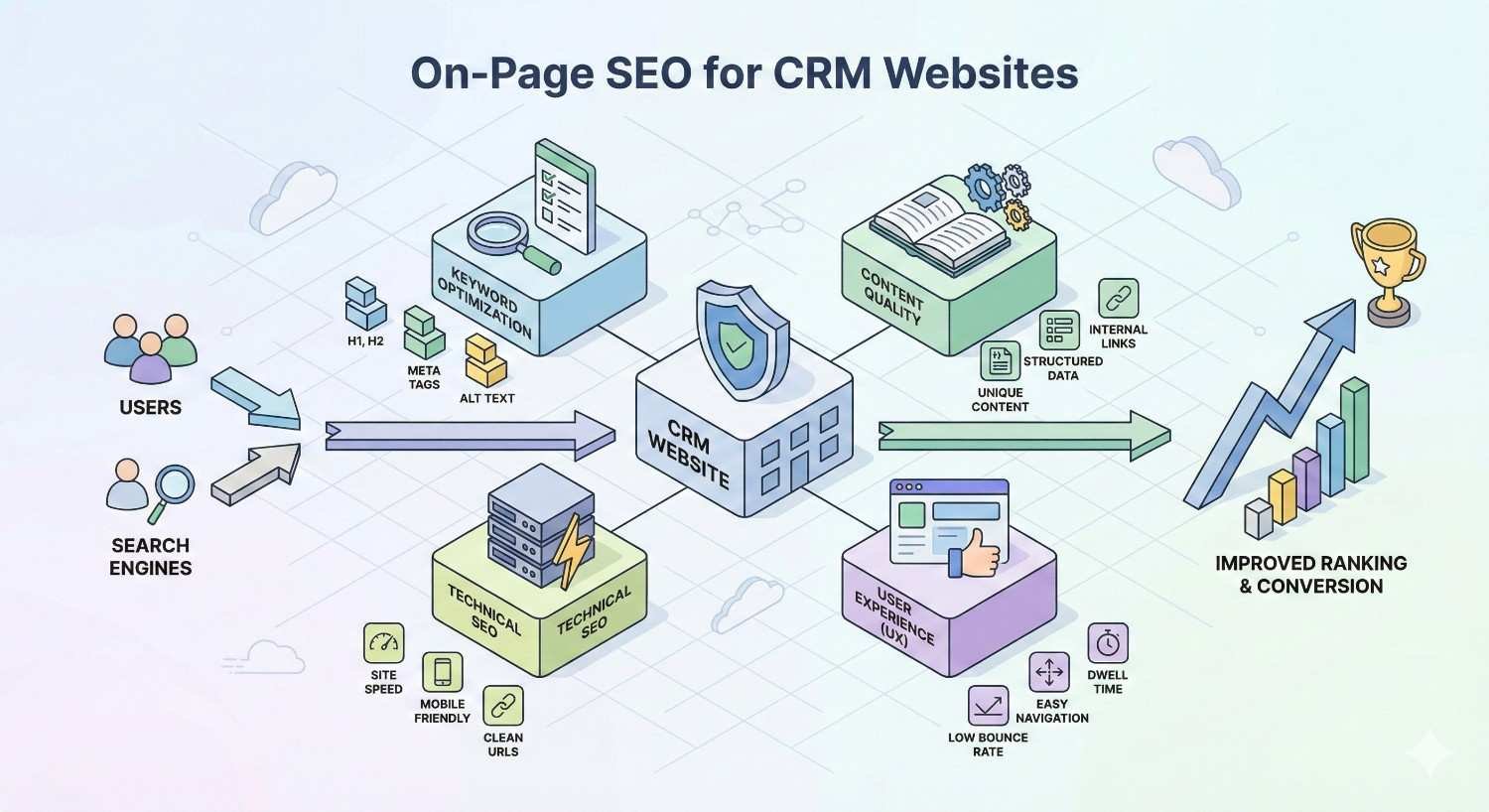
On-Page SEO for CRM Websites
On-page optimization ensures individual pages communicate relevance to search engines. Small improvements across many pages compound into significant ranking gains.
Title Tags and Meta Descriptions That Drive Clicks
Title tags directly impact rankings and click-through rates. Include primary keywords near the beginning. Keep titles under 60 characters to avoid truncation.
Effective title formulas for CRM content include:
“[Primary Keyword]: [Benefit or Qualifier]” “[Number] [Topic] [Qualifier] in [Year]” “[Your Brand] vs [Competitor]: [Differentiator]”
Meta descriptions do not directly impact rankings but influence clicks. Write compelling descriptions under 160 characters that include keywords and clear value propositions. End with a call-to-action.
Header Structure and Content Hierarchy
Headers organize content for readers and search engines. Use a single H1 containing your primary keyword. Structure H2s as main sections and H3s as subsections.
Headers should create a logical outline. A reader scanning only headers should understand the page’s content and structure.
Include keyword variations in headers naturally. Avoid keyword stuffing that makes headers awkward or repetitive.
Internal Linking Strategy for CRM Sites
Internal links distribute ranking authority and help search engines discover content. Strategic linking improves rankings for target pages.
Link from high-authority pages to pages you want to rank. Your homepage and popular blog posts likely have the most authority. Use those pages to boost important product and feature pages.
Use descriptive anchor text that includes target keywords. “Learn more about our sales automation features” is better than “click here.”
Create content hubs where related pages link to each other. This reinforces topical relationships and keeps users engaged longer.
Image Optimization and Visual Content
Images enhance user experience but require optimization to avoid slowing pages. Compress images without visible quality loss. Use modern formats like WebP when browser support allows.
Include descriptive alt text for accessibility and SEO. Alt text should describe the image while naturally incorporating relevant keywords.
Name image files descriptively. “crm-dashboard-sales-pipeline.jpg” provides more context than “IMG_12345.jpg.”
Link Building for CRM Software Companies
Backlinks remain a critical ranking factor. Quality links from relevant, authoritative sites signal trust and improve rankings.
Authority Building Through Industry Publications
Guest contributions to industry publications build authority and earn valuable links. Target publications your audience reads, not just high-domain-authority sites.
Pitch unique insights based on your data or expertise. “5 CRM Trends We’re Seeing Across 10,000 Users” offers more value than generic advice.
Focus on publications covering SaaS, sales, marketing, and your target industries. Build relationships with editors through consistent, high-quality contributions.
SaaS Review Sites and Directory Listings
Review sites like G2, Capterra, and TrustRadius drive referral traffic and provide authoritative backlinks. Claim and optimize your profiles on all major platforms.
Encourage satisfied customers to leave reviews. Higher ratings improve visibility within these platforms and build trust with prospects.
Directory listings on sites like Product Hunt, SaaSHub, and industry-specific directories provide additional link opportunities.
Integration Partner Link Opportunities
Integration partners offer natural link building opportunities. When you integrate with another platform, both parties benefit from cross-promotion.
Request inclusion in partner integration directories. Create co-branded content highlighting the integration. Pursue joint webinars or case studies that generate links from partner sites.
Digital PR for CRM Brands
Digital PR earns links through newsworthy content. Original research, industry surveys, and data studies attract coverage from journalists and bloggers.
Analyze your product data for interesting trends. Survey your customers about industry topics. Package findings into compelling stories that publications want to cover.
Respond to journalist queries through services like HARO, Qwoted, and Help a B2B Writer. Timely, expert responses can earn links from major publications.
Guest Posting in B2B and SaaS Niches
Guest posting remains effective when focused on quality over quantity. Target relevant sites where your audience spends time.
Avoid low-quality guest post networks and sites that accept anything. These links provide minimal value and can trigger penalties.
Create genuinely valuable content for host sites. Build relationships with editors. Focus on a few high-quality placements rather than many low-quality ones.
Realistic SEO Timelines for CRM Software
SEO is a long-term investment. Understanding realistic timelines helps set appropriate expectations and maintain commitment through early stages.
Month 1-3: Foundation and Technical Fixes
The first quarter focuses on technical foundations and quick wins. Conduct a comprehensive technical audit. Fix crawl errors, speed issues, and indexation problems.
Perform keyword research and competitive analysis. Develop content strategy and editorial calendar. Begin creating foundational content.
Expect minimal ranking improvements during this phase. You are building infrastructure that enables future growth.
Month 4-6: Content Development and Initial Rankings
Months four through six focus on content production and initial optimization. Publish core product and feature pages. Begin blog content production. Implement on-page optimizations across existing pages.
Initial rankings may appear for long-tail keywords. Traffic growth remains modest but measurable. Continue building content library and earning early links.
Month 7-12: Authority Building and Traffic Growth
The second half of year one shows accelerating results. Content begins ranking for more competitive terms. Link building efforts compound. Organic traffic grows noticeably.
Refine strategy based on performance data. Double down on content types and topics that perform well. Address gaps revealed by analytics.
By month twelve, expect meaningful organic traffic and initial lead generation from search. Exact results depend on competition, investment level, and execution quality.
Year 2+: Scaling and Market Dominance
Year two and beyond focus on scaling success and expanding coverage. Target increasingly competitive keywords. Expand into new topic areas and verticals.
Organic traffic should grow substantially. SEO becomes a reliable, predictable lead generation channel. Continue investing to maintain and extend competitive advantages.
Measuring CRM Software SEO Performance
Measurement connects SEO activities to business outcomes. Proper tracking enables optimization and demonstrates value to stakeholders.
Key Performance Indicators (KPIs) to Track
Organic traffic measures total visits from search engines. Track overall trends and segment by landing page, keyword, and user type.
Keyword rankings show visibility for target terms. Monitor positions for priority keywords and track movement over time.
Organic conversions measure business outcomes from search traffic. Track demo requests, trial signups, and other conversion events attributed to organic search.
Click-through rate (CTR) from search results indicates how compelling your listings appear. Low CTR suggests title and description optimization opportunities.
Backlink growth tracks authority building progress. Monitor new links acquired and overall domain authority trends.
Attribution: Connecting SEO to Pipeline and Revenue
Connecting SEO to revenue requires proper attribution setup. Implement UTM parameters and conversion tracking to follow users from search to purchase.
Understand that B2B attribution is complex. Multiple touches across channels contribute to deals. Use multi-touch attribution models that credit SEO appropriately.
Track assisted conversions where organic search contributed to deals closed through other channels. This reveals SEO’s full impact beyond last-click attribution.
SEO Reporting for Stakeholders
Different stakeholders need different information. Executives want business impact: traffic, leads, and revenue. Marketing teams want tactical details: rankings, content performance, and technical health.
Create tiered reports that serve each audience. Monthly executive summaries should fit on one page. Detailed tactical reports can go deeper for teams executing strategy.
Focus on trends rather than single data points. Month-over-month and year-over-year comparisons reveal meaningful patterns.
Tools for CRM SEO Analytics
Google Search Console provides direct data from Google about impressions, clicks, and rankings. It is free and essential.
Google Analytics tracks user behavior after they reach your site. Monitor organic traffic, engagement, and conversions.
Ahrefs, Semrush, or Moz provide competitive intelligence, keyword research, and backlink analysis. Choose one based on your needs and budget.
Screaming Frog or Sitebulb crawl your site to identify technical issues. Regular crawls catch problems before they impact rankings.
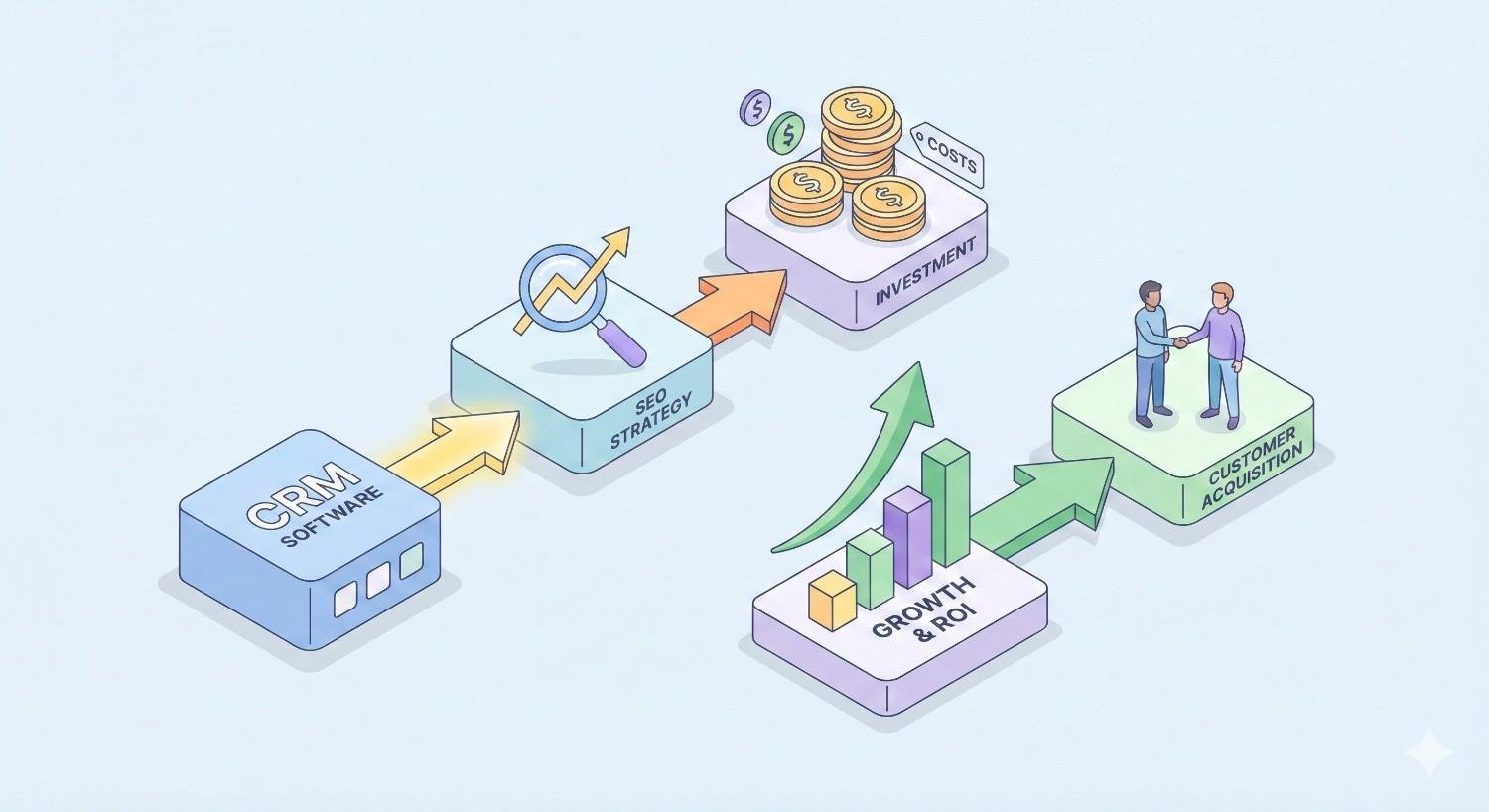
CRM Software SEO Costs and Investment
SEO requires investment in people, tools, and content. Understanding typical costs helps budget appropriately and evaluate options.
Agency vs In-House SEO Teams
Agency partnerships provide immediate expertise without hiring overhead. Agencies bring experience across multiple clients and stay current on algorithm changes. Costs typically range from $3,000 to $15,000 monthly for comprehensive SaaS SEO services.
In-house teams offer dedicated focus and deep product knowledge. Building internal capability requires hiring experienced practitioners and ongoing training. A single senior SEO hire costs $80,000 to $150,000 annually plus benefits and tools.
Many companies use hybrid approaches. An agency handles strategy and specialized tasks while internal resources manage day-to-day execution.
Typical Budget Ranges for SaaS SEO
Startup stage companies typically invest $2,000 to $5,000 monthly in SEO. This covers basic technical optimization, limited content production, and foundational link building.
Growth stage companies invest $5,000 to $15,000 monthly. This enables comprehensive content strategies, aggressive link building, and dedicated resources.
Enterprise companies invest $15,000 to $50,000+ monthly. This supports large content teams, sophisticated technical optimization, and multi-market strategies.
Calculating SEO ROI for CRM Companies
Calculate SEO ROI by comparing investment to revenue generated. Track organic traffic, conversion rates, and average deal values.
Example calculation: If SEO drives 1,000 monthly visitors with a 2% conversion rate to demos, and 20% of demos close at $10,000 average deal value, monthly SEO-attributed revenue equals $40,000.
Compare this to monthly SEO investment. A $10,000 monthly investment generating $40,000 in revenue delivers 4x ROI.
Remember that SEO compounds over time. Early investments build assets that continue generating returns for years.
Common CRM SEO Mistakes to Avoid
Learning from common mistakes accelerates success. These errors frequently undermine CRM SEO efforts.
Ignoring Technical Debt
Technical issues silently undermine SEO performance. Slow pages, crawl errors, and indexation problems prevent content from ranking regardless of quality.
Conduct regular technical audits. Address issues promptly rather than letting them accumulate. Prioritize fixes based on impact and effort required.
Targeting Only High-Volume Keywords
High-volume keywords attract competition from well-funded competitors. New or smaller CRM companies rarely win these battles quickly.
Balance your keyword portfolio. Include high-volume targets for long-term goals. But prioritize long-tail and niche keywords where you can win faster.
Neglecting Content Updates and Freshness
Published content requires maintenance. Outdated statistics, broken links, and stale information erode rankings over time.
Schedule regular content audits. Update high-performing pages with fresh information. Consolidate or remove underperforming content that dilutes site quality.
Expecting Immediate Results
SEO takes time. Expecting quick results leads to premature strategy changes and abandoned efforts.
Set realistic expectations with stakeholders. Celebrate early wins like ranking improvements and traffic growth. Maintain commitment through the months required to see significant results.
CRM SEO Case Studies and Results
Real examples demonstrate what is achievable with strategic SEO investment.
Startup CRM: 0 to 50K Monthly Organic Visits
A startup CRM with minimal initial traffic implemented a focused SEO strategy targeting underserved niches. They created comprehensive content for three specific industries where larger competitors had weak coverage.
Within 18 months, organic traffic grew from near zero to 50,000 monthly visits. More importantly, this traffic converted at 3x the rate of paid channels due to high intent.
Key success factors included niche focus, consistent content production, and patience through early months with minimal results.
Enterprise CRM: Recovering from Algorithm Update
An established CRM provider saw organic traffic drop 40% following a Google algorithm update. Analysis revealed thin content, excessive internal linking, and technical issues had accumulated over years.
A comprehensive recovery effort addressed technical debt, consolidated thin pages, and improved content quality across the site. Traffic recovered within six months and exceeded previous levels within twelve months.
The lesson: ongoing maintenance prevents dramatic declines. Regular audits catch issues before they trigger penalties.
Niche CRM: Dominating Industry-Specific Search
A CRM focused exclusively on the real estate industry built topical authority through deep vertical expertise. They created content addressing every aspect of real estate customer management.
Within two years, they ranked first for virtually every “real estate CRM” variation. This dominant position generated consistent lead flow that supported company growth without significant paid advertising.
Niche focus enabled a smaller company to outcompete larger generalist competitors in their specific market.

Choosing an SEO Partner for Your CRM Business
Selecting the right SEO partner significantly impacts results. Evaluate options carefully before committing.
What to Look for in a SaaS SEO Agency
SaaS experience matters. Agencies familiar with software business models understand long sales cycles, technical products, and B2B buyer behavior.
Proven results should be demonstrable. Ask for case studies with specific metrics. Verify claims when possible.
Strategic thinking separates good agencies from order-takers. Partners should challenge assumptions and propose approaches you had not considered.
Transparent communication builds trust. Expect regular reporting, clear explanations, and honest assessments of progress and challenges.
Questions to Ask Before Hiring
“What is your experience with CRM or SaaS companies specifically?”
“Can you share case studies with measurable results?”
“How do you approach keyword research and prioritization?”
“What does your reporting include and how often will we meet?”
“How do you handle algorithm updates or ranking drops?”
“What is your link building approach and how do you ensure quality?”
“Who will work on our account and what is their experience level?”
Red Flags and Warning Signs
Guaranteed rankings are impossible to promise. Search engines control rankings, not agencies.
Secretive methods suggest potentially risky tactics. Legitimate agencies explain their approaches.
Extremely low prices often indicate low-quality work or offshore execution without proper oversight.
No case studies or references suggests limited experience or poor results.
Long-term contracts with no performance clauses protect the agency, not you.
Frequently Asked Questions About CRM Software SEO
How long does it take to rank for CRM keywords?
Expect 6 to 12 months for meaningful rankings on competitive CRM keywords. Long-tail and niche keywords may rank faster, within 3 to 6 months. Timelines depend on your starting authority, competition level, and investment in content and links.
Can a new CRM compete with Salesforce and HubSpot in search?
Yes, but not on their terms. New CRMs win by targeting niches, industries, and long-tail keywords that giants neglect. Build authority in specific areas before challenging broad, competitive terms.
What content types work best for CRM SEO?
Comparison pages, industry-specific landing pages, and comprehensive guides typically perform best. Product pages optimized for feature keywords also drive qualified traffic. Educational blog content builds authority and captures top-of-funnel searches.
How important are backlinks for CRM software rankings?
Backlinks remain critical for competitive keywords. Quality matters more than quantity. Links from relevant SaaS publications, industry sites, and authoritative domains provide the most value.
Should I focus on branded or non-branded keywords first?
Start with non-branded keywords to capture new audiences. Branded searches typically convert well but only reach people already aware of your product. Non-branded SEO expands your addressable market.
What technical SEO issues most commonly affect CRM websites?
Slow page speed, poor mobile experience, and crawlability issues are most common. Complex SaaS platforms often accumulate JavaScript-heavy pages, duplicate content from dynamic URLs, and orphaned pages that search engines cannot find.
How do I measure SEO ROI for my CRM company?
Track organic traffic, conversions from organic visitors, and revenue attributed to organic search. Compare monthly SEO investment to revenue generated. Account for the compounding nature of SEO where early investments continue generating returns over time.
Next Steps: Building Your CRM Software SEO Strategy
Moving from understanding to action requires a structured approach. These frameworks help you begin implementation.
SEO Audit Checklist for CRM Websites
Technical Foundation
- Site loads in under 3 seconds on mobile
- No critical crawl errors in Search Console
- XML sitemap submitted and current
- Robots.txt properly configured
- HTTPS implemented across all pages
- Mobile experience passes Core Web Vitals
On-Page Elements
- Unique title tags on all pages
- Meta descriptions written for all key pages
- Header hierarchy properly structured
- Internal links connect related content
- Images optimized with alt text
Content Assessment
- Product pages have sufficient depth
- Blog content targets relevant keywords
- No thin or duplicate content issues
- Content updated within past 12 months
Authority Signals
- Backlink profile growing steadily
- Links from relevant industry sources
- No toxic or spammy link patterns
90-Day CRM SEO Action Plan
Days 1-30: Foundation
- Complete technical audit and fix critical issues
- Conduct keyword research and competitive analysis
- Develop content strategy and editorial calendar
- Optimize existing high-priority pages
Days 31-60: Content Development
- Publish 4-6 new optimized pages
- Update and improve existing underperforming content
- Begin outreach for link building opportunities
- Implement schema markup on key pages
Days 61-90: Acceleration
- Continue content production at sustainable pace
- Secure first quality backlinks
- Analyze initial performance data
- Refine strategy based on early results
How to Get Started with Professional SEO Support
Implementing comprehensive CRM SEO requires expertise, resources, and sustained effort. Many companies benefit from professional support to accelerate results and avoid costly mistakes.
Evaluate your internal capabilities honestly. If you lack dedicated SEO expertise, partnering with specialists often delivers faster, better results than learning through trial and error.
When evaluating partners, prioritize SaaS experience, transparent communication, and proven results. The right partner becomes an extension of your team, bringing expertise while you maintain strategic control.
Conclusion
CRM software SEO combines technical optimization, strategic content development, and authority building to drive sustainable organic growth. Success requires understanding the unique competitive landscape, targeting the right keywords at each funnel stage, and maintaining commitment through the months required to see significant results.
The opportunity is substantial. Organic search delivers high-intent traffic that converts better than most channels. For CRM companies with high customer lifetime values, effective SEO creates exceptional returns on investment.
We help CRM companies and SaaS brands build sustainable organic visibility through comprehensive SEO services. White Label SEO Service provides the technical expertise, content strategy, and authority building required to compete in demanding search landscapes. Contact us to discuss how we can accelerate your CRM software SEO results.
Frequently Asked Questions
What makes CRM software SEO different from regular SEO?
CRM SEO requires understanding complex B2B buying cycles, multiple stakeholder decision-making, and highly competitive SaaS search landscapes. Technical optimization must account for dynamic product pages, integration directories, and documentation sections unique to software platforms.
How much should a CRM company budget for SEO?
Startup CRM companies typically invest $2,000 to $5,000 monthly, while growth-stage companies invest $5,000 to $15,000 monthly. Enterprise CRM providers may invest $15,000 to $50,000+ monthly for comprehensive multi-market strategies.
Can SEO generate leads for enterprise CRM sales?
Yes. While enterprise sales cycles are long, organic search captures buyers during research phases. Content targeting enterprise-specific keywords like “enterprise CRM implementation” and “CRM for large sales teams” attracts qualified prospects early in their journey.
What is the most important ranking factor for CRM websites?
No single factor dominates. Success requires strong technical foundations, comprehensive content covering user intent, and quality backlinks from relevant sources. Neglecting any element limits overall performance.
How often should CRM companies publish new content?
Consistency matters more than frequency. Publishing 2 to 4 quality pieces monthly sustainably outperforms sporadic bursts of activity. Focus on depth and relevance rather than volume.
Should CRM companies create comparison pages against competitors?
Yes. Comparison pages capture high-intent traffic from users evaluating alternatives. Create honest, detailed comparisons that acknowledge competitor strengths while highlighting your advantages.
How do algorithm updates affect CRM software websites?
Algorithm updates can significantly impact rankings, positively or negatively. Sites with strong technical foundations, quality content, and natural link profiles typically weather updates well. Regular audits and ongoing optimization reduce vulnerability to sudden ranking changes.