
Digital PR campaigns generate editorial backlinks from high-authority news sites, industry publications, and trusted media outlets that traditional outreach simply cannot reach. These links carry significant ranking weight because journalists and editors choose to reference your content based on genuine newsworthiness.
For business owners and marketing teams investing in SEO, digital PR represents one of the most scalable and sustainable approaches to building domain authority. The strategy shifts link acquisition from manual requests to earned media coverage.
This guide covers everything from campaign types and execution frameworks to realistic costs and measurement approaches for digital PR link building success.
What Is Digital PR for Link Building?
Digital PR for link building combines traditional public relations tactics with SEO objectives. The goal is creating newsworthy content and stories that journalists want to cover, resulting in natural editorial backlinks from authoritative publications.
Unlike conventional link building that relies on direct requests, digital PR earns links through media coverage. When a news site publishes a story about your research, data study, or expert commentary, they typically link back to your original source. These editorial links signal trust to search engines because they represent genuine third-party endorsements.
The approach requires different skills than traditional SEO outreach. Success depends on understanding what makes content newsworthy, building relationships with journalists, and creating assets that publications genuinely want to reference.
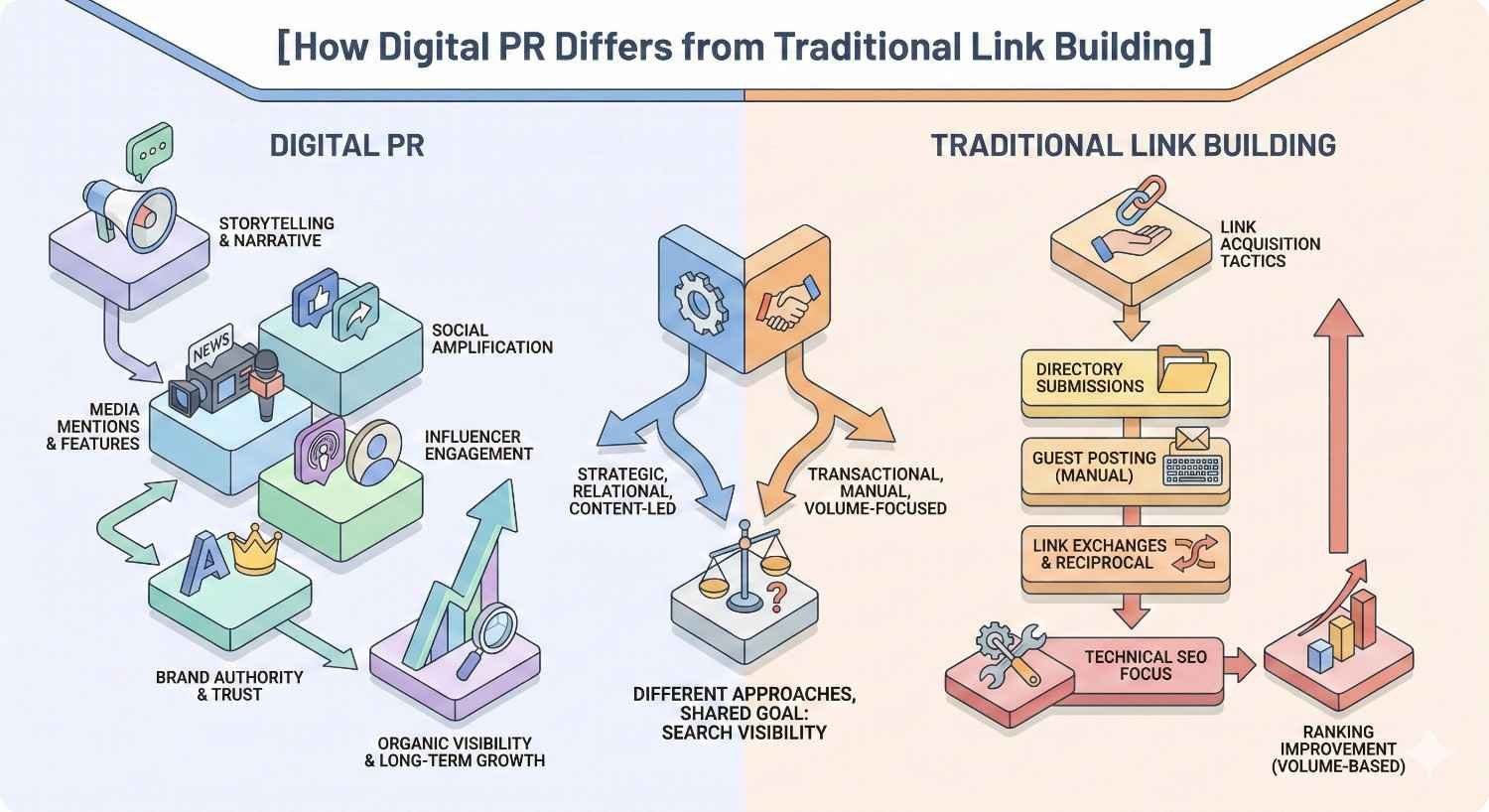
How Digital PR Differs from Traditional Link Building
Traditional link building typically involves identifying target sites, finding contact information, and sending outreach emails requesting links. Methods include guest posting, resource page outreach, broken link building, and directory submissions. The process is direct and transactional.
Digital PR takes an indirect approach. Instead of asking for links, you create content that earns coverage. Journalists discover your data study, find it relevant to their audience, and cite it in their articles. The link happens as a natural byproduct of media coverage rather than a direct request.
The quality difference is substantial. Traditional outreach often targets mid-tier blogs and niche sites willing to accept guest content. Digital PR campaigns can earn links from major news outlets, industry-leading publications, and sites with domain authority scores above 80. These high-authority editorial links carry significantly more ranking weight.
Scale also differs dramatically. A single successful digital PR campaign can generate dozens or hundreds of backlinks from one piece of content. Traditional outreach typically produces one link per successful pitch, requiring constant effort to maintain link velocity.
The Role of Digital PR in Modern SEO Strategy
Search algorithms increasingly prioritize signals that indicate genuine authority and trustworthiness. Editorial links from recognized publications serve as strong trust signals because they represent independent validation of your expertise or content value.
Google’s emphasis on E-E-A-T (Experience, Expertise, Authoritativeness, Trustworthiness) aligns directly with digital PR outcomes. Media coverage demonstrates that external authorities recognize your brand as a credible source. This recognition extends beyond individual links to overall brand perception in search results.
Digital PR also supports broader SEO goals beyond link acquisition. Brand mentions without links still contribute to entity recognition. Increased brand searches signal relevance to search engines. Referral traffic from media coverage can improve engagement metrics across your site.
For competitive industries where link building has become increasingly difficult, digital PR offers a path to acquiring links that competitors cannot easily replicate. Creating original research or developing unique story angles creates defensible competitive advantages.
Digital PR vs. Outreach: Understanding the Distinction
Standard link outreach involves contacting website owners or editors directly to request link placement. The pitch focuses on why linking to your content benefits their audience. Success rates typically range from 1-5% depending on content quality and targeting.
Digital PR pitches journalists with story ideas rather than link requests. The focus is on newsworthiness, timeliness, and relevance to the publication’s audience. Links happen when journalists cite your content as a source within their coverage.
The relationship dynamic differs significantly. Outreach positions you as someone asking for a favor. Digital PR positions you as a source providing value to journalists who need stories, data, and expert commentary for their articles.
Journalist relationships built through digital PR create ongoing opportunities. Once you establish yourself as a reliable source, journalists may proactively reach out for future stories. This creates sustainable link velocity without constant campaign investment.
Why Digital PR Works for Building High-Quality Backlinks
Digital PR effectiveness stems from how search engines evaluate link quality. Not all backlinks carry equal weight. Links from trusted, authoritative sources within relevant contexts provide substantially more ranking benefit than links from lower-quality sites.
The editorial nature of digital PR links makes them particularly valuable. When a journalist chooses to reference your content, that decision represents genuine editorial judgment rather than a paid placement or reciprocal arrangement. Search engines can distinguish between these link types.
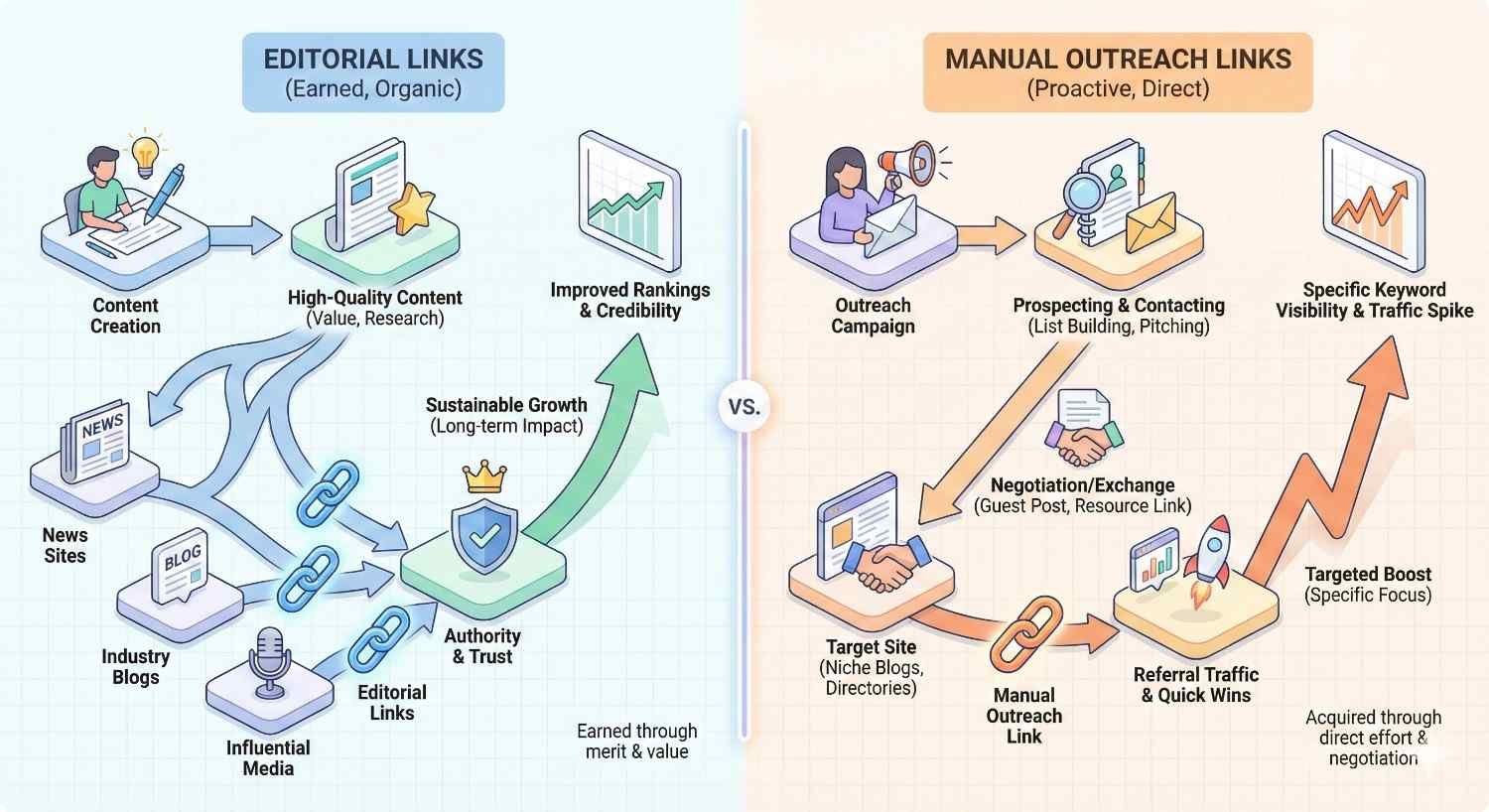
Editorial Links vs. Manual Outreach Links
Editorial links occur when content creators independently decide to reference your work. The linking site receives no compensation, no reciprocal link, and no direct request. These links represent the purest form of third-party endorsement.
Manual outreach links result from direct requests. While legitimate outreach for genuinely valuable content remains acceptable, the transactional nature of the relationship differs from editorial decisions. Search engines have become increasingly sophisticated at identifying link patterns that suggest manipulation.
The contextual placement of editorial links also differs. Journalists integrate sources naturally within article narratives. The surrounding content provides relevant context that reinforces topical relationships. Manual outreach links often appear in less contextually relevant positions like author bios or resource sections.
Editorial links from news sites and major publications also tend to appear on pages with significant traffic and engagement. These pages accumulate their own backlinks over time, passing additional authority through to your linked content.
Domain Authority and Trust Signals from Digital PR
Major news publications and industry media sites typically maintain domain authority scores between 70 and 95. A single link from these sources can provide more ranking benefit than dozens of links from lower-authority sites.
Trust signals extend beyond raw authority metrics. Links from recognized news brands carry implicit credibility that search engines factor into quality assessments. A link from a publication with established editorial standards signals different trust levels than links from sites without editorial oversight.
Digital PR campaigns targeting relevant industry publications also build topical authority. Links from sites covering your specific industry reinforce your relevance for related search queries. This topical alignment strengthens the semantic relationship between your content and target keywords.
The diversity of linking domains from successful digital PR campaigns also benefits SEO. A single campaign covered by multiple publications creates natural link diversity across different domain types, geographic regions, and audience segments.
Scalability and Long-Term Link Velocity
Traditional link building requires continuous effort to maintain link acquisition rates. Each new link typically requires a separate outreach campaign. Scaling requires proportionally more resources and time investment.
Digital PR campaigns can generate significant link volume from single content assets. A data study that gains traction across multiple publications might earn 50-200 backlinks from one campaign. This efficiency makes digital PR cost-effective at scale.
Successful digital PR content often continues earning links long after initial publication. Journalists researching future stories discover your original research and cite it as a source. This passive link acquisition extends campaign ROI over months or years.
The compounding effect of digital PR also accelerates results over time. As your domain authority increases from initial campaigns, future content becomes more likely to rank and attract additional coverage. Brand recognition among journalists improves response rates for subsequent pitches.
Brand Visibility and Indirect SEO Benefits
Digital PR generates brand exposure beyond direct link value. Media coverage introduces your brand to new audiences, builds recognition, and establishes credibility that influences future search behavior.
Increased branded search volume signals relevance to search engines. When more users search specifically for your brand name, algorithms interpret this as evidence of authority and user interest. This branded search effect can improve rankings for non-branded queries.
Media coverage also creates citation opportunities beyond traditional backlinks. Brand mentions without links still contribute to entity recognition. Search engines understand brand references in context and factor these mentions into authority assessments.
The referral traffic from media coverage provides engagement signals that may influence rankings. Users arriving from trusted publications often demonstrate different behavior patterns than other traffic sources, potentially improving site-wide engagement metrics.
Core Components of a Successful Digital PR Campaign
Effective digital PR campaigns require multiple elements working together. Content must be genuinely newsworthy. Assets must be shareable and easy to reference. Outreach must target appropriate journalists with compelling pitches. Timing must align with editorial calendars and news cycles.
Understanding these components helps you evaluate campaign feasibility and allocate resources appropriately. Missing any critical element significantly reduces success probability.
Newsworthy Angles and Story Development
Newsworthiness determines whether journalists will cover your content. Stories must provide value to their audience through new information, surprising findings, timely relevance, or compelling narratives.
Strong news angles typically include one or more of these elements: new data or research findings, counterintuitive insights that challenge assumptions, timely connections to current events, human interest stories with emotional resonance, or practical information that helps readers solve problems.
Developing newsworthy angles requires understanding what publications cover and what their audiences care about. Analyzing recent coverage from target publications reveals patterns in story selection. Successful pitches align with these established interests while offering fresh perspectives.
The specificity of your angle matters significantly. Generic topics like “social media marketing tips” lack news value. Specific findings like “survey reveals 67% of marketers plan to reduce Facebook ad spend in 2025” provide concrete information journalists can report.
Data-Driven Content and Original Research
Original research and data studies consistently perform well in digital PR campaigns. Journalists need credible sources to support their reporting. Proprietary data that cannot be found elsewhere creates genuine citation value.
Effective data campaigns typically involve surveys, analysis of proprietary datasets, aggregation of public data in new ways, or original experiments and tests. The methodology must be defensible and the sample sizes sufficient to support conclusions.
Data presentation matters as much as the findings themselves. Key statistics should be immediately clear and quotable. Journalists scanning your content should quickly identify the most newsworthy numbers without extensive reading.
The topic selection for data studies should balance newsworthiness with relevance to your business. Studies completely unrelated to your industry may earn links but provide limited brand-building value. The best campaigns connect naturally to your expertise and offerings.
Visual Assets: Infographics, Charts, and Interactive Tools
Visual content increases shareability and makes complex data accessible. Journalists often include images in their coverage, and compelling visuals increase the likelihood of prominent placement.
Infographics that summarize key findings provide ready-made visual assets for publications. Charts and graphs that clearly illustrate trends or comparisons support data-driven stories. Interactive tools that let users explore data create engagement opportunities.
Visual quality reflects on your brand credibility. Professional design signals investment and seriousness. Amateur graphics can undermine otherwise strong content. Budget appropriately for design resources.
Embed codes and easy download options make visual assets more likely to be used. Journalists working on deadline appreciate content that requires minimal additional effort to incorporate into their stories.
Journalist and Media Outreach Strategy
Identifying and reaching appropriate journalists determines campaign success. The best content fails without effective distribution to people who can amplify it.
Media list building requires research into who covers your topic area, what they’ve written recently, and how they prefer to receive pitches. Generic mass emails to irrelevant journalists waste resources and damage your reputation.
Personalization significantly improves response rates. Referencing specific articles the journalist has written, explaining why your content fits their beat, and demonstrating familiarity with their work shows respect for their time.
Pitch timing affects open rates and responses. Avoid Monday mornings when inboxes overflow and Friday afternoons when journalists are wrapping up for the week. Mid-week mornings typically perform best for initial outreach.
Timing, Relevance, and Trend Alignment
Campaign timing can determine success or failure. Launching during major news events means competing for limited journalist attention. Aligning with relevant awareness days, seasonal trends, or industry events increases relevance.
Editorial calendars at major publications plan content months in advance. Understanding these cycles helps you pitch content when journalists are actively seeking sources for upcoming coverage.
Reactive opportunities require speed. When breaking news relates to your expertise, rapid response can earn coverage that planned campaigns cannot achieve. Building systems for quick turnaround enables newsjacking success.
Evergreen content provides flexibility in timing but may lack urgency that drives immediate coverage. Balancing timely and evergreen campaigns creates sustainable link velocity throughout the year.
Types of Digital PR Campaigns That Generate Links
Different campaign types suit different objectives, budgets, and brand positioning. Understanding the options helps you select approaches aligned with your resources and goals.
Some campaign types require significant investment in research and production. Others leverage existing expertise with minimal additional content creation. Matching campaign types to your capabilities improves success rates.
Data Studies and Survey-Based Campaigns
Survey campaigns collect original data through questionnaires distributed to relevant audiences. The findings provide exclusive statistics that journalists cannot find elsewhere.
Effective surveys require sufficient sample sizes for credibility. Industry-specific surveys might need 500-1,000 respondents. Consumer surveys often require larger samples for statistical validity. Survey methodology should withstand scrutiny from journalists and readers.
Question design determines the newsworthiness of findings. Questions should explore topics journalists care about and yield results that surprise or inform. Testing questions before full deployment helps identify the most promising angles.
Survey distribution options include panel providers, email lists, social media promotion, and partnerships with relevant organizations. Costs vary significantly based on audience specificity and sample size requirements.
Newsjacking and Reactive PR
Newsjacking involves inserting your brand into breaking news stories by providing relevant commentary, data, or expertise. When executed well, this approach earns coverage with minimal content creation investment.
Success requires monitoring news cycles and responding quickly. Journalists working on breaking stories need sources immediately. Responses arriving hours or days later miss the window of opportunity.
Expert commentary positions your team members as authoritative sources on trending topics. Building relationships with journalists in advance increases the likelihood they’ll reach out when relevant stories break.
Reactive campaigns carry risks. Associating your brand with controversial topics can backfire. Ensure any newsjacking aligns with your brand values and expertise areas.
Expert Commentary and Thought Leadership
Positioning executives or subject matter experts as media sources creates ongoing link opportunities. Journalists regularly seek expert quotes to add credibility and perspective to their reporting.
Building expert profiles requires consistent visibility. Publishing original perspectives, participating in industry discussions, and responding to journalist queries establishes recognition over time.
Platforms like HARO (Help a Reporter Out), Qwoted, and similar services connect journalists with sources. Responding to relevant queries with thoughtful, quotable commentary can earn links from major publications.
The quality of commentary matters more than quantity. Providing genuine insights rather than promotional messaging builds journalist trust and increases future opportunities.
Creative Campaigns and Viral Content
Creative campaigns use unexpected angles, humor, or emotional resonance to capture attention. These campaigns often generate significant social sharing alongside media coverage.
Viral potential is difficult to predict. Creative concepts that seem promising may fail to gain traction while unexpected ideas take off. Testing concepts with small audiences before full investment helps identify winners.
Creative campaigns require higher production investment but can generate outsized returns. A single viral campaign might earn more links than months of traditional outreach.
Brand alignment remains important even for creative content. Campaigns that feel disconnected from your core business may earn links but provide limited brand-building value.
Industry Reports and Benchmark Studies
Comprehensive industry reports establish authority and provide ongoing citation value. Annual reports become reference sources that journalists cite repeatedly throughout the year.
Report creation requires significant research investment. Aggregating data from multiple sources, conducting original analysis, and presenting findings professionally demands substantial resources.
The ongoing value of industry reports justifies higher initial investment. A well-executed annual report can earn links continuously as journalists reference it for context in related stories.
Establishing your report as the definitive source for specific metrics or trends creates competitive advantages. Once journalists habitually cite your data, competitors struggle to displace that position.
Award Programs and Recognition Initiatives
Creating industry awards or recognition programs generates coverage from winners promoting their achievements. Each award recipient becomes a potential amplifier of your brand.
Award programs require careful design to maintain credibility. Transparent judging criteria, respected judges, and genuine selectivity prevent perception of pay-to-play schemes.
The link value comes from winners announcing their recognition. Press releases, social media posts, and website badges all typically link back to the award program source.
Building award program authority takes time. Initial years may generate limited coverage, but established programs with recognized prestige earn significant ongoing attention.
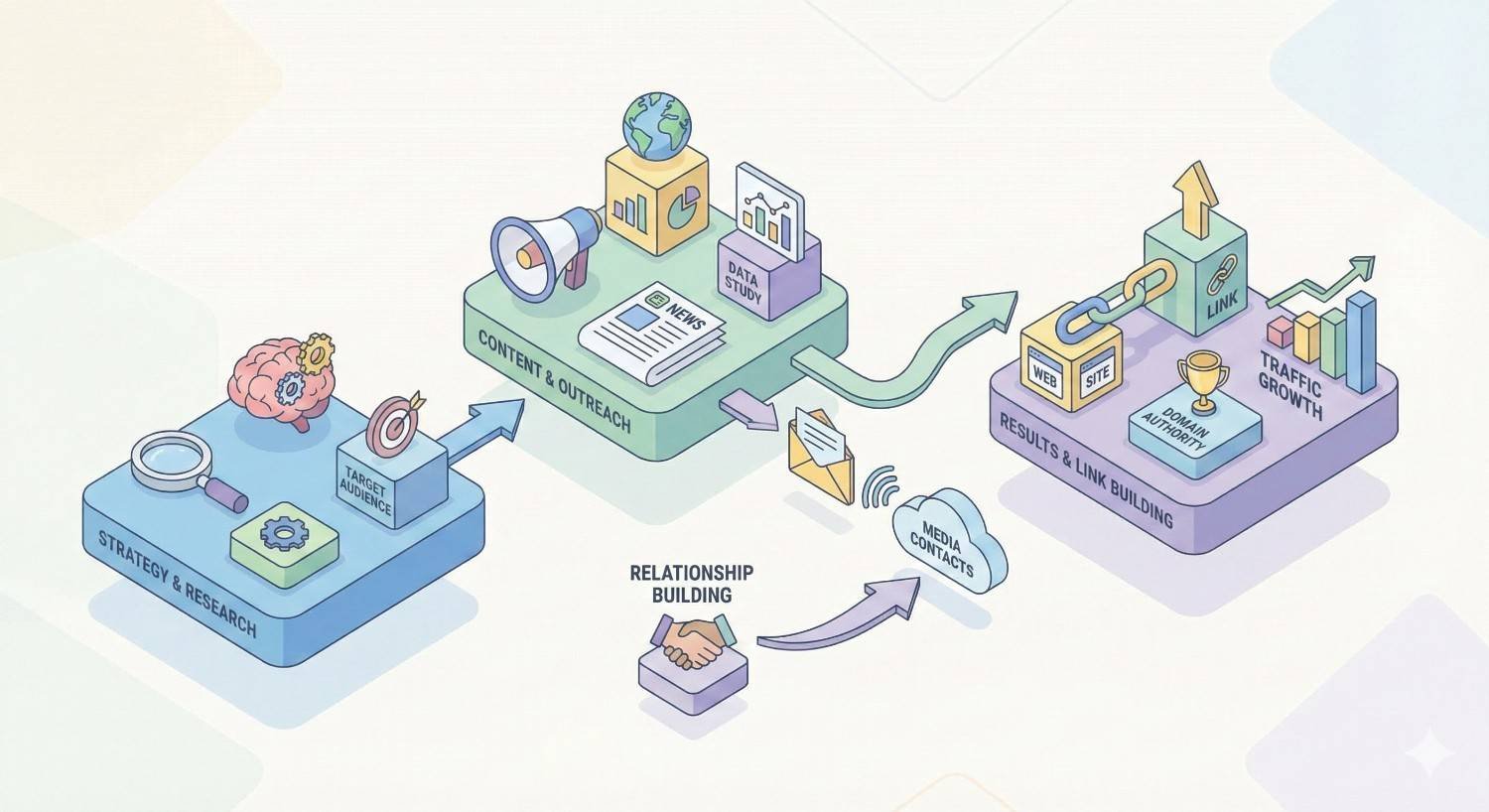
How to Execute a Digital PR Campaign for Link Building
Successful execution requires systematic processes across multiple phases. Rushing any stage reduces overall campaign effectiveness. Planning adequate time and resources for each step improves outcomes.
The following framework provides a repeatable structure for campaign execution. Adapt specific tactics to your industry, resources, and objectives while maintaining the overall process flow.
Step 1: Identify Link-Worthy Story Angles
Begin by researching what publications in your target space have covered recently. Identify patterns in story selection, data sources cited, and angles that generated significant coverage.
Brainstorm potential angles that align with your expertise and available resources. Consider what unique data or perspectives you can provide that competitors cannot easily replicate.
Validate angles by checking whether similar content already exists. If competitors have covered the same ground, your angle needs differentiation. If no coverage exists, consider whether the topic genuinely interests journalists or simply lacks appeal.
Prioritize angles based on newsworthiness, production feasibility, and alignment with business objectives. The strongest campaigns balance all three factors.
Step 2: Create Compelling, Shareable Assets
Develop content assets that support your chosen angle. For data campaigns, this includes the research methodology, key findings, supporting visualizations, and a dedicated landing page.
Write content for journalists, not general audiences. Lead with the most newsworthy findings. Provide quotable statistics prominently. Include methodology details for credibility without burying key points.
Create multiple asset formats to support different coverage types. Press releases summarize key points. Full reports provide depth for feature coverage. Individual statistics enable quick social sharing.
Quality control matters significantly. Fact-check all statistics. Proofread all content. Test all interactive elements. Errors discovered after launch damage credibility and can derail campaigns.
Step 3: Build a Targeted Media List
Research journalists who cover your topic area at target publications. Review their recent articles to understand their specific interests and coverage patterns.
Prioritize journalists based on relevance, publication authority, and likelihood of coverage. A smaller list of highly relevant contacts outperforms large lists of marginally relevant journalists.
Gather contact information through publication websites, social media profiles, and media database tools. Verify email addresses before sending to avoid bounces that harm sender reputation.
Segment your list by publication type, geographic focus, or specific angle relevance. Different segments may require different pitch approaches.
Step 4: Craft Effective Pitch Emails
Write subject lines that clearly communicate news value without clickbait tactics. Journalists receive hundreds of pitches daily. Your subject line determines whether they open your email.
Lead pitches with the most newsworthy element. Journalists scanning quickly should immediately understand why your content matters to their audience.
Keep pitches concise. Three to four short paragraphs typically suffice. Include essential information without overwhelming detail. Link to full assets for journalists who want more depth.
Personalize each pitch to demonstrate relevance to the specific journalist. Reference their recent work. Explain why your content fits their beat. Avoid generic templates that feel mass-produced.
Step 5: Follow-Up Strategy and Relationship Building
Plan follow-up timing before initial outreach. One follow-up email 3-5 days after the initial pitch is standard practice. Additional follow-ups risk annoying journalists.
Follow-up emails should add value rather than simply asking whether they received your first message. Offer additional angles, new data points, or exclusive access to sources.
Track responses to identify interested journalists even if they don’t cover your current campaign. Building relationships over time increases success rates for future campaigns.
Accept rejection gracefully. Journalists who pass on one story may cover future campaigns. Maintaining positive relationships matters more than any single placement.
Step 6: Amplify Coverage Through Social and Owned Channels
When coverage appears, amplify it through your own channels. Share articles on social media. Feature coverage on your website. Include mentions in email newsletters.
Amplification increases the reach of coverage and signals to search engines that the content generates engagement. Social sharing can also attract additional journalists who discover your story through their networks.
Thank journalists publicly for coverage. Tagging them in social posts builds goodwill and keeps your brand visible for future opportunities.
Create a coverage page on your website that aggregates media mentions. This demonstrates credibility to site visitors and provides a resource for future journalist research.
Step 7: Track Links, Mentions, and Campaign Performance
Monitor for new backlinks using tools like Ahrefs, Moz, or SEMrush. Links may appear days or weeks after initial coverage as articles get indexed and syndicated.
Track brand mentions even without links. Unlinked mentions still provide value and may convert to links if you reach out to request attribution.
Document campaign performance metrics including total links earned, average domain authority of linking sites, referral traffic generated, and estimated link value.
Analyze what worked and what didn’t to improve future campaigns. Identify which angles resonated, which journalists responded, and which outreach approaches succeeded.
Tools and Resources for Digital PR Link Building
The right tools improve efficiency and effectiveness across campaign phases. Different tools serve different functions from research through measurement.
Tool selection depends on campaign volume, budget, and team capabilities. Smaller operations may rely on manual processes and free tools. Larger programs benefit from comprehensive platforms that automate repetitive tasks.
Media Database and Journalist Research Tools
Media databases like Cision, Muck Rack, and Prowly provide journalist contact information, beat coverage, and recent article history. These platforms streamline the research process for building targeted media lists.
Free alternatives include manual research through publication websites, LinkedIn, and Twitter. While more time-intensive, manual research can identify journalists that databases miss.
Social listening tools help identify journalists actively covering relevant topics. Monitoring hashtags, keywords, and industry conversations reveals real-time opportunities.
HARO and similar platforms provide direct access to journalist queries. Responding to relevant requests offers a lower-effort path to media coverage than proactive pitching.
Content Creation and Design Tools
Survey platforms like SurveyMonkey, Typeform, and Google Forms enable data collection for research campaigns. Enterprise options like Pollfish and Prolific provide access to specific demographic panels.
Design tools including Canva, Adobe Creative Suite, and Figma support visual asset creation. Templates and design systems ensure consistent quality across campaign materials.
Data visualization tools like Tableau, Datawrapper, and Flourish transform raw data into compelling charts and interactive graphics. Clear visualizations increase journalist adoption of your content.
Content management systems should support dedicated landing pages for campaign assets. Easy embedding, download options, and clear attribution guidelines encourage proper citation.
Outreach and Email Management Platforms
Email outreach tools like Pitchbox, BuzzStream, and Respona manage contact lists, personalize messages at scale, and track responses. These platforms improve efficiency for high-volume campaigns.
CRM systems help maintain journalist relationships over time. Tracking past interactions, coverage history, and preferences enables more effective future outreach.
Email deliverability tools ensure messages reach journalist inboxes rather than spam folders. Warming up sending domains and maintaining list hygiene protects sender reputation.
Calendar and scheduling tools coordinate campaign timing across team members. Shared visibility into outreach status prevents duplicate contacts and missed follow-ups.
Link Tracking and Attribution Tools
Backlink monitoring tools like Ahrefs, Moz, SEMrush, and Majestic track new links as they appear. Setting up alerts for your domain enables timely discovery of coverage.
Brand mention monitoring through tools like Mention, Brand24, or Google Alerts identifies unlinked coverage that may convert to backlinks with outreach.
UTM parameters and analytics tracking attribute referral traffic to specific campaigns and placements. Understanding which coverage drives engagement informs future targeting.
Link quality assessment tools evaluate the authority and relevance of acquired links. Not all links provide equal value, and tracking quality metrics alongside quantity provides complete performance pictures.
Competitive Intelligence and Opportunity Analysis
Competitor backlink analysis reveals which publications link to similar brands. These sites represent proven opportunities for your own campaigns.
Content gap analysis identifies topics competitors have covered successfully that you haven’t addressed. Filling these gaps with superior content can capture existing link opportunities.
SERP analysis for target keywords shows what content types currently rank. Understanding the competitive landscape informs content strategy and angle development.
Industry news monitoring identifies trending topics and emerging stories. Early awareness of developing trends enables faster reactive campaign execution.
Measuring Digital PR Success: Metrics and KPIs
Measurement frameworks should align with campaign objectives. Link acquisition metrics matter most for SEO-focused campaigns. Brand awareness metrics matter more for visibility-focused efforts.
Establishing baseline measurements before campaigns enables accurate performance assessment. Tracking metrics consistently over time reveals trends and informs optimization.
Link Metrics: Quantity, Quality, and Domain Authority
Total links earned provides the most basic performance measure. Track both the number of linking domains and total backlinks, as multiple links from single domains provide diminishing returns.
Domain authority distribution reveals link quality. Categorize links by authority ranges (90+, 80-89, 70-79, etc.) to understand the caliber of sites linking to your content.
Link relevance assessment evaluates topical alignment between linking sites and your content. Links from relevant industry publications typically provide more ranking benefit than links from unrelated general news sites.
Follow vs. nofollow link ratios affect direct SEO value. While nofollow links from authoritative sites still provide brand benefits, follow links pass more direct ranking signals.
Media Coverage and Brand Mentions
Coverage volume tracks total articles mentioning your brand or campaign. This metric captures visibility beyond direct link acquisition.
Publication tier analysis categorizes coverage by outlet prestige. National news coverage carries different weight than local or niche publication mentions.
Share of voice comparisons measure your coverage relative to competitors. Tracking industry coverage over time reveals whether your visibility is growing or declining.
Sentiment analysis evaluates whether coverage portrays your brand positively, negatively, or neutrally. Quality of coverage matters alongside quantity.
Referral Traffic and Engagement Signals
Referral traffic from media coverage indicates audience interest beyond journalist attention. High-traffic placements provide immediate visibility benefits alongside long-term link value.
Engagement metrics for referral visitors reveal traffic quality. Bounce rates, time on site, and pages per session indicate whether media audiences find your content valuable.
Conversion tracking attributes leads or sales to specific media placements. Understanding which coverage drives business outcomes informs future targeting priorities.
Traffic sustainability shows whether coverage generates ongoing visits or only initial spikes. Evergreen placements in frequently referenced articles provide sustained value.
Ranking Improvements and Organic Visibility
Keyword ranking changes following campaigns indicate SEO impact. Track target keywords before, during, and after campaigns to measure ranking improvements.
Organic traffic growth provides the ultimate measure of SEO success. Correlating traffic increases with campaign timing helps attribute results to digital PR efforts.
SERP feature acquisition tracks whether your content appears in featured snippets, knowledge panels, or other enhanced results. Digital PR can accelerate SERP feature capture.
Indexed page growth monitors whether search engines discover and index your campaign landing pages. Proper indexation ensures link value flows to your domain.
ROI Calculation for Digital PR Campaigns
Cost per link calculations divide total campaign investment by links earned. Compare this metric against alternative link building methods to evaluate relative efficiency.
Link value estimation assigns dollar values to acquired links based on authority levels. While imprecise, these estimates enable ROI comparisons across marketing channels.
Traffic value calculations multiply referral visits by estimated cost-per-click equivalents. This approach quantifies the paid media value of earned coverage.
Long-term value projections account for ongoing link acquisition from evergreen content. Initial campaign costs amortized over multi-year link accumulation often reveal favorable economics.
Digital PR Campaign Costs and Budget Planning
Understanding cost structures helps you plan realistic budgets and evaluate agency proposals. Costs vary significantly based on campaign complexity, production requirements, and execution approach.
Budget allocation across campaign phases ensures adequate resources for each critical element. Underfunding any phase compromises overall campaign effectiveness.
In-House vs. Agency vs. Freelance Digital PR
In-house teams provide the most control but require significant capability building. Salaries for experienced digital PR professionals range from $60,000 to $120,000 annually depending on location and seniority. Additional costs include tools, training, and management overhead.
Agency partnerships offer established expertise and media relationships. Monthly retainers typically range from $5,000 to $25,000 depending on agency reputation and campaign scope. Project-based engagements may cost $10,000 to $50,000 per campaign.
Freelance specialists provide flexible capacity without long-term commitments. Day rates for experienced digital PR freelancers range from $500 to $1,500. Freelancers work well for specific campaign execution but may lack the media relationships of established agencies.
Hybrid approaches combine in-house strategy with external execution support. This model balances control with access to specialized capabilities.
Typical Campaign Costs by Campaign Type
Data study campaigns typically cost $5,000 to $30,000 including survey costs, analysis, content creation, design, and outreach. Larger sample sizes and more complex analysis increase costs.
Newsjacking and reactive campaigns require minimal production investment but demand rapid response capabilities. Costs primarily involve monitoring tools and staff time for quick turnaround.
Creative campaigns with custom design, video production, or interactive elements can cost $20,000 to $100,000 or more depending on production complexity.
Expert commentary programs require ongoing investment in source positioning and journalist relationship building. Annual costs typically range from $2,000 to $10,000 for platform subscriptions and response time.
Cost Per Link Analysis and Expected ROI
Industry benchmarks suggest digital PR cost per link ranges from $200 to $1,500 depending on campaign type and link quality. High-authority links from major publications command premium costs.
Comparing cost per link against alternative methods provides context. Guest posting typically costs $100 to $500 per link but yields lower authority placements. Link insertions may cost $50 to $300 but carry higher risk profiles.
ROI calculations should account for link quality differences. A single link from a DA 90 publication may provide more ranking benefit than ten links from DA 40 sites, justifying higher per-link costs.
Long-term ROI improves as campaigns generate passive link acquisition over time. Initial investment amortized across years of ongoing link value often reveals favorable returns.
Budget Allocation Across Campaign Phases
Research and ideation typically require 10-15% of campaign budgets. Adequate investment in angle development improves overall campaign success rates.
Content production including writing, design, and development usually consumes 30-40% of budgets. Quality assets are essential for journalist adoption.
Outreach and promotion require 20-30% of budgets including tool costs, list building, and staff time for personalized pitching.
Measurement and optimization should receive 10-15% of budgets. Understanding what works enables continuous improvement across campaigns.
Reserve 10-15% for contingencies and amplification opportunities. Successful campaigns may warrant additional promotion investment.
Common Digital PR Mistakes and How to Avoid Them
Learning from common failures helps you avoid wasted resources and damaged relationships. Many digital PR campaigns fail due to preventable errors in planning or execution.
Understanding these pitfalls enables proactive mitigation. Building processes that address common failure points improves overall success rates.
Pitching Non-Newsworthy Stories
The most common digital PR failure involves pitching content that lacks genuine news value. Journalists receive hundreds of pitches daily and quickly identify promotional content disguised as news.
Newsworthy content provides new information, surprising findings, or timely relevance. Company announcements, product launches, and self-promotional content rarely qualify unless they represent genuine industry significance.
Test newsworthiness by asking whether a journalist could write an interesting article based solely on your content. If the answer requires significant additional reporting, your content may lack standalone news value.
Seek honest feedback from journalists or PR professionals before investing in full campaign production. Early validation prevents wasted resources on non-viable angles.
Poor Targeting and Irrelevant Media Lists
Mass emailing irrelevant journalists wastes resources and damages your reputation. Journalists remember brands that spam them with off-topic pitches and may ignore future relevant outreach.
Effective targeting requires understanding each journalist’s specific beat, recent coverage, and audience interests. Generic lists purchased from databases often include outdated or irrelevant contacts.
Quality over quantity applies to media lists. Ten highly relevant journalists who regularly cover your topic area outperform hundreds of marginally related contacts.
Segment lists by angle relevance, publication type, and geographic focus. Different journalists may respond to different aspects of the same campaign.
Weak Follow-Up and Relationship Management
Many campaigns fail not from poor content but from inadequate follow-up. Journalists miss emails, forget to respond, or need reminders amid busy schedules.
Systematic follow-up processes ensure no interested journalist falls through the cracks. One thoughtful follow-up 3-5 days after initial outreach is standard practice.
Follow-ups should add value rather than simply asking for responses. Offer new angles, additional data, or exclusive access to differentiate from the original pitch.
Relationship management extends beyond individual campaigns. Maintaining journalist connections over time increases success rates for future outreach.
Ignoring Journalist Preferences and Guidelines
Many publications provide explicit guidelines for pitches and submissions. Ignoring these guidelines signals disrespect and reduces response likelihood.
Research individual journalist preferences through their social media profiles, published articles, and any stated pitch preferences. Some journalists prefer Twitter DMs over email. Others specify particular subject line formats.
Timing preferences vary by journalist and publication type. Daily news reporters work on tight deadlines and need immediate responses. Feature writers may plan content weeks in advance.
Respect stated boundaries around topics, formats, and contact methods. Building positive relationships requires demonstrating consideration for journalist needs.
Failing to Track and Attribute Results
Without proper tracking, you cannot demonstrate campaign value or optimize future efforts. Many teams invest in digital PR without systems to measure outcomes.
Implement link monitoring before campaigns launch. Baseline measurements enable accurate attribution of new links to specific campaigns.
Track beyond direct links to capture full campaign value. Brand mentions, referral traffic, social engagement, and ranking changes all contribute to ROI.
Document learnings from each campaign to improve future performance. Understanding what worked and what didn’t enables continuous optimization.
Digital PR for Different Industries and Niches
Digital PR strategies require adaptation for different industry contexts. What works for consumer brands may fail for B2B companies. Regulated industries face additional constraints.
Understanding industry-specific considerations helps you develop appropriate strategies and set realistic expectations.
Digital PR for B2B and SaaS Companies
B2B digital PR typically targets trade publications and industry media rather than mainstream news outlets. These publications have smaller audiences but highly relevant readership.
Data campaigns work particularly well for B2B contexts. Industry benchmarks, survey findings, and trend analyses provide valuable content for trade journalists covering specific sectors.
Thought leadership positioning helps B2B brands build authority. Executive commentary on industry trends and challenges establishes credibility with professional audiences.
Longer sales cycles in B2B mean digital PR contributes to awareness and consideration rather than immediate conversion. Measure success through brand visibility and lead quality rather than direct sales attribution.
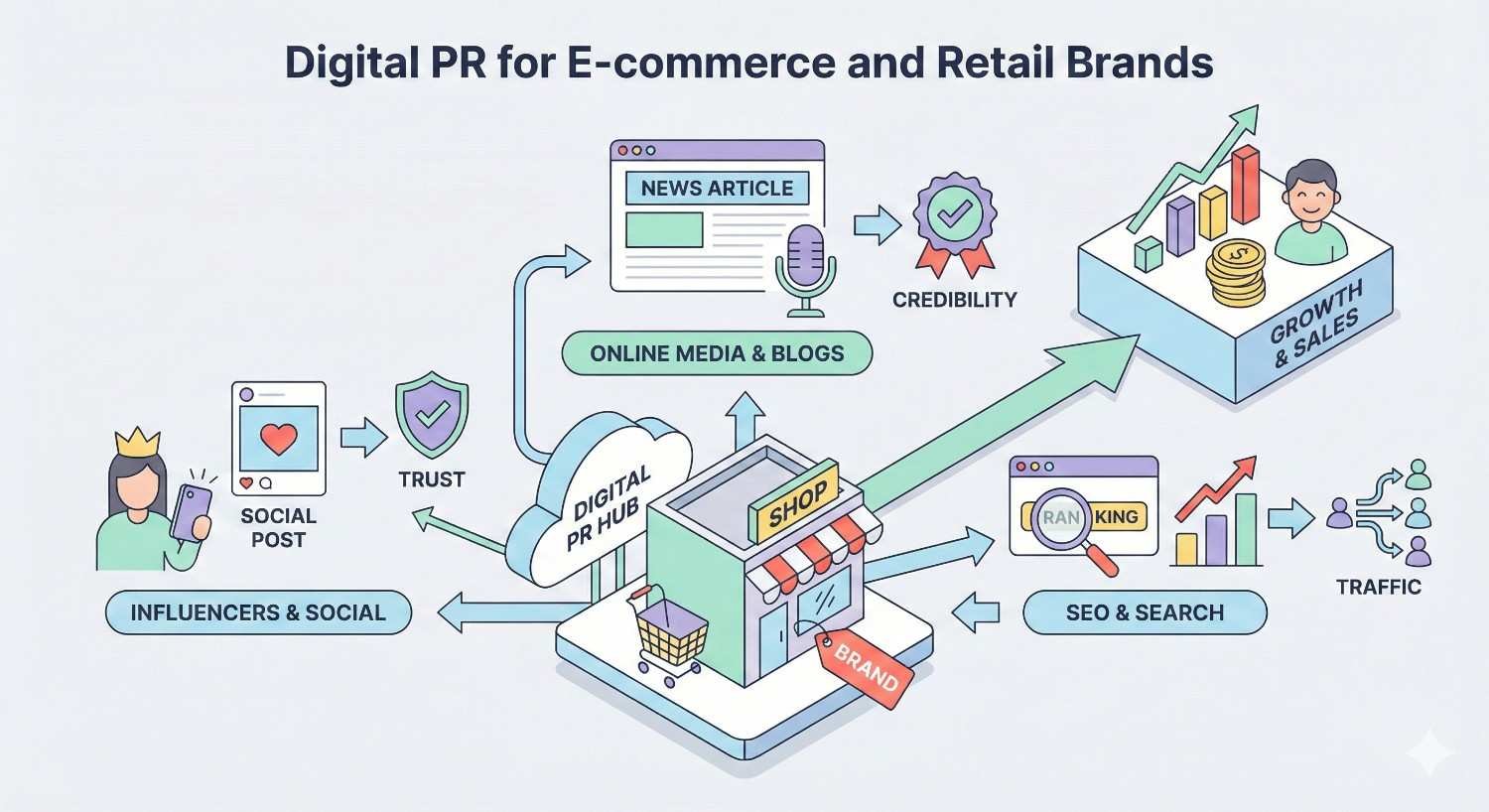
Digital PR for E-commerce and Retail Brands
Consumer-focused digital PR can target mainstream media alongside retail and lifestyle publications. Broader audience appeal enables coverage in higher-traffic outlets.
Product-focused campaigns require genuine newsworthiness beyond promotional messaging. Unique product innovations, sustainability initiatives, or consumer trend data can earn coverage.
Seasonal timing matters significantly for retail digital PR. Aligning campaigns with shopping seasons, gift guides, and trend forecasts increases relevance.
Visual content performs particularly well for consumer brands. Compelling product photography, lifestyle imagery, and video content increase journalist adoption.
Digital PR for Local and Regional Businesses
Local digital PR targets regional media outlets, local news sites, and community publications. These outlets have smaller audiences but high relevance for geographically focused businesses.
Community involvement and local impact stories resonate with regional journalists. Hiring announcements, charitable initiatives, and local economic contributions provide newsworthy angles.
Local business awards and recognition programs offer link building opportunities. Regional business journals and chambers of commerce frequently feature award winners.
Combining local digital PR with broader industry coverage creates comprehensive link profiles. National trade coverage complements regional visibility.
Digital PR for Startups and Early-Stage Companies
Startups face credibility challenges that established brands don’t encounter. Building media relationships and demonstrating expertise requires additional effort.
Funding announcements provide natural news hooks for startup coverage. Series raises, notable investors, and significant milestones attract journalist attention.
Founder expertise positioning helps startups punch above their weight. Establishing founders as industry thought leaders creates ongoing coverage opportunities.
Resource constraints require startups to prioritize high-impact campaigns over volume. Focus on fewer, higher-quality initiatives rather than spreading resources thin.
Digital PR in Highly Regulated Industries
Healthcare, finance, legal, and other regulated industries face additional constraints on claims and messaging. Compliance review requirements extend campaign timelines.
Data campaigns in regulated industries require careful methodology documentation. Claims must be defensible and compliant with industry regulations.
Expert commentary in regulated fields carries additional responsibility. Ensure all public statements align with professional standards and regulatory requirements.
Working with PR professionals experienced in your specific industry helps navigate compliance requirements while still achieving coverage goals.
Building Long-Term Media Relationships for Sustained Link Growth
One-off campaigns provide temporary link velocity. Sustained growth requires ongoing journalist relationships that generate coverage opportunities over time.
Relationship building requires consistent investment beyond individual campaigns. The effort pays dividends through improved response rates and proactive journalist outreach.
Journalist Relationship Management Best Practices
Treat journalists as partners rather than targets. Understanding their needs, respecting their time, and providing genuine value builds lasting relationships.
Maintain contact between campaigns through social media engagement, sharing relevant information, and occasional check-ins. Staying visible keeps your brand top-of-mind for future stories.
Deliver on promises consistently. If you commit to providing information, sources, or assets, follow through reliably. Reliability builds trust that improves future collaboration.
Accept that not every pitch will succeed. Graceful responses to rejection maintain relationships for future opportunities. Pushing too hard damages long-term prospects.
Becoming a Go-To Expert Source
Positioning yourself or team members as reliable expert sources creates ongoing coverage opportunities. Journalists need quotable experts for many stories and prefer sources they’ve worked with successfully.
Demonstrate expertise through consistent, valuable contributions. Providing thoughtful commentary, accurate information, and timely responses establishes credibility.
Make yourself easy to work with. Respond quickly to journalist inquiries. Provide clear, quotable statements. Offer additional context or sources when helpful.
Build visibility through industry participation, speaking engagements, and published content. Journalists research potential sources and visible experts attract more opportunities.
Creating Ongoing Value for Media Contacts
Provide value beyond your own promotional interests. Share relevant industry news, introduce useful contacts, and offer assistance without expecting immediate returns.
Create resources that help journalists do their jobs. Data repositories, expert directories, and background briefings provide ongoing utility that keeps your brand relevant.
Offer exclusive access or early information to key journalist relationships. Exclusives incentivize coverage and strengthen individual relationships.
Celebrate journalist successes by sharing their work and providing positive feedback. Mutual support strengthens professional relationships.
Leveraging HARO and Source Request Platforms
HARO (Help a Reporter Out) and similar platforms connect journalists seeking sources with potential experts. Responding to relevant queries provides a lower-effort path to coverage.
Success on these platforms requires speed and quality. Journalists often receive dozens of responses and select sources who respond quickly with relevant, quotable information.
Craft responses that directly address journalist questions. Provide specific, useful information rather than generic expertise claims. Include credentials that establish authority.
Track which responses generate coverage to understand what works. Refine your approach based on success patterns over time.
Integrating Digital PR with Your Broader SEO Strategy
Digital PR works best as part of comprehensive SEO strategies rather than isolated initiatives. Integration with content marketing, technical SEO, and other link building tactics maximizes overall impact.
Strategic alignment ensures digital PR efforts support broader business objectives. Coordination across marketing functions prevents duplication and leverages synergies.
Aligning Digital PR with Content Marketing
Digital PR campaigns should connect to your broader content strategy. Campaign landing pages can serve as pillar content that supports topic clusters.
Content created for digital PR campaigns can be repurposed across marketing channels. Data findings become blog posts, social content, and sales enablement materials.
Editorial calendars should coordinate digital PR timing with content publication schedules. Launching campaigns alongside related content maximizes topical authority building.
Internal linking from digital PR landing pages to related content distributes link equity across your site. Strategic link architecture amplifies campaign benefits.
Supporting Technical SEO with Authority Building
Technical SEO ensures search engines can properly crawl, index, and understand your content. Digital PR builds the authority signals that help technically sound pages rank.
Site architecture should support digital PR landing pages with clear navigation paths and internal linking. Orphaned campaign pages fail to distribute link equity effectively.
Page speed and mobile optimization affect how journalists and their audiences experience your content. Technical issues can undermine otherwise successful campaigns.
Schema markup on campaign pages helps search engines understand content context. Proper structured data implementation supports rich result eligibility.
Using Digital PR to Accelerate New Site Growth
New websites face authority challenges that limit ranking potential. Digital PR can accelerate authority building faster than organic link accumulation.
Early-stage sites benefit from establishing topical relevance through targeted digital PR. Campaigns focused on core topic areas build foundational authority.
Link velocity from digital PR signals site quality to search engines. Consistent link acquisition demonstrates ongoing relevance and value.
Brand building through digital PR creates branded search demand that supports overall SEO performance. Recognition drives direct traffic and improves click-through rates.
Combining Digital PR with Other Link Building Tactics
Digital PR complements rather than replaces other link building approaches. Comprehensive strategies use multiple tactics to build diverse link profiles.
Guest posting and contributed content provide steady link acquisition between major digital PR campaigns. These tactics maintain link velocity during campaign development phases.
Resource link building and broken link outreach target opportunities digital PR cannot reach. Some valuable links require direct outreach rather than media coverage.
Local citations and directory listings support local SEO alongside digital PR efforts. Different link types serve different ranking objectives.
Case Studies: Successful Digital PR Link Building Campaigns
Real campaign examples illustrate how digital PR principles apply in practice. These case studies demonstrate different approaches and their outcomes.
Analyzing successful campaigns reveals patterns and tactics applicable to your own efforts. Learning from proven examples accelerates your digital PR development.
Case Study 1: Data Study Campaign Results
A B2B software company conducted a survey of 1,500 marketing professionals about budget allocation trends. The study revealed that 67% planned to increase content marketing investment while reducing paid advertising spend.
The campaign targeted marketing trade publications and business media. Personalized pitches highlighted specific findings relevant to each publication’s audience focus.
Results included coverage in Marketing Week, AdAge, and Forbes, generating 47 backlinks from domains averaging DA 72. The campaign cost approximately $18,000 including survey costs, content production, and outreach.
Cost per link averaged $383, significantly below industry benchmarks for comparable authority levels. The landing page continues earning passive links as journalists reference the study in subsequent articles.
Case Study 2: Newsjacking Campaign Success
A cybersecurity firm monitored for major data breach announcements and prepared rapid response commentary. When a significant breach affected a major retailer, the firm’s CISO provided expert analysis within hours.
The quick response earned quotes in coverage from CNBC, Wired, and multiple technology publications. The firm was positioned as an authoritative voice on breach response and prevention.
The campaign generated 23 backlinks from high-authority technology and business publications. Total investment was minimal, primarily staff time for monitoring and response preparation.
The success established the CISO as a go-to source for future breach coverage. Subsequent incidents generated additional coverage without proactive outreach.
Case Study 3: Industry Report Link Acquisition
A financial services firm published an annual report on small business lending trends. The report aggregated data from multiple sources and provided original analysis of market conditions.
Initial publication generated moderate coverage. The firm then conducted targeted outreach to journalists covering small business finance, offering exclusive data access and expert interviews.
Over 12 months, the report earned 89 backlinks as journalists referenced it in related coverage throughout the year. The report became a standard citation for small business lending statistics.
Annual updates maintain relevance and generate renewed coverage each year. The cumulative link value significantly exceeds the initial production investment.
Getting Started with Digital PR for Link Building
Beginning digital PR requires honest assessment of your current capabilities and realistic planning for capability development. Starting small and scaling based on results provides the most sustainable path.
The following framework helps you evaluate readiness and plan initial campaigns appropriate to your resources and objectives.
Assessing Your Digital PR Readiness
Evaluate your current assets and capabilities honestly. Do you have data, expertise, or stories that journalists would find genuinely newsworthy? Can you produce quality content assets? Do you have capacity for outreach and relationship building?
Identify gaps that need addressing before launching campaigns. Missing capabilities might include design resources, media database access, or PR expertise. Plan how you’ll fill these gaps through hiring, training, or external partnerships.
Set realistic expectations based on your starting point. Brands with existing media relationships and proven expertise will see faster results than unknown companies building from scratch.
Consider starting with lower-investment tactics like HARO responses and expert commentary before committing to full campaign production. Early wins build confidence and capabilities.
Building Your First Campaign: A Starter Framework
Start with a single, focused campaign rather than multiple simultaneous initiatives. Concentrated effort produces better results than divided attention.
Choose a campaign type that matches your available resources. Data campaigns require research investment. Expert commentary requires subject matter expertise. Creative campaigns require production capabilities.
Build a small, highly targeted media list of 20-30 journalists who regularly cover your topic area. Quality targeting matters more than list size for initial campaigns.
Set modest goals for your first campaign. Earning 5-10 quality links from a first effort represents solid success. Learning from the process provides value beyond immediate link acquisition.
When to Scale and Expand Your Digital PR Efforts
Scale digital PR investment when initial campaigns demonstrate positive results. Successful campaigns justify increased resource allocation.
Expansion options include increasing campaign frequency, targeting additional publication tiers, or diversifying campaign types. Choose expansion paths aligned with your objectives and capabilities.
Build internal capabilities as you scale. Hiring dedicated digital PR staff or developing existing team members reduces reliance on external resources.
Maintain quality standards as you scale. Rushing campaigns to increase volume often reduces per-campaign effectiveness. Sustainable growth balances quantity with quality.
Working with a Digital PR Agency: What to Expect
Agencies provide expertise, media relationships, and execution capacity that internal teams may lack. The right agency partnership accelerates results and reduces learning curves.
Evaluate agencies based on relevant experience, demonstrated results, and cultural fit. Request case studies from similar industries and verify claimed results.
Expect agencies to require onboarding time to understand your business, develop angles, and build campaign strategies. Immediate results are unrealistic; plan for 2-3 months before significant link acquisition.
Maintain involvement in strategy and approval processes. Agencies execute most effectively when clients provide clear direction, timely feedback, and access to internal expertise.
Establish clear success metrics and reporting expectations upfront. Regular performance reviews ensure alignment and enable course correction when needed.
Conclusion
Digital PR for link building represents one of the most effective strategies for earning high-authority backlinks that genuinely improve search rankings. The approach combines newsworthy content creation with strategic media outreach to generate editorial links from trusted publications.
Success requires understanding what makes content newsworthy, building journalist relationships, and executing campaigns systematically. The investment in capabilities and processes pays dividends through sustainable link velocity and brand authority building.
We help businesses develop and execute digital PR strategies that drive measurable SEO results. Contact White Label SEO Service to discuss how digital PR can accelerate your organic growth and build lasting search visibility.
Frequently Asked Questions
How long does it take to see SEO results from digital PR campaigns?
Most digital PR campaigns begin generating links within 2-4 weeks of launch, though full link acquisition may continue for months. SEO ranking improvements typically appear 2-3 months after links are acquired as search engines process and weight the new signals.
What is a realistic cost per link for digital PR?
Digital PR cost per link typically ranges from $200 to $1,500 depending on campaign type and target publication authority. High-authority links from major news outlets command premium costs, while trade publication links cost less.
Can small businesses with limited budgets do digital PR effectively?
Yes, small businesses can execute effective digital PR through lower-cost tactics like HARO responses, expert commentary, and targeted local media outreach. Starting with focused campaigns and scaling based on results provides a sustainable path.
How many links should I expect from a single digital PR campaign?
Campaign results vary significantly based on content quality, newsworthiness, and outreach effectiveness. Well-executed data campaigns typically earn 20-100 links. Some viral campaigns generate hundreds of links while others may earn only a handful.
Should I hire an agency or build in-house digital PR capabilities?
The choice depends on your resources, timeline, and long-term plans. Agencies provide faster results through established relationships but cost more. In-house teams offer more control and lower long-term costs but require capability building time.
What types of content work best for digital PR link building?
Original research, data studies, and survey findings consistently perform well because they provide exclusive information journalists cannot find elsewhere. Expert commentary, industry reports, and creative campaigns also generate strong results when executed effectively.
How do I measure the ROI of digital PR campaigns?
Calculate ROI by comparing total campaign costs against the value of acquired links, referral traffic, and brand visibility gains. Link value can be estimated based on domain authority and compared against alternative acquisition costs. Track ranking improvements and organic traffic growth for comprehensive ROI assessment.