

Domain Authority and Page Authority are third-party metrics created by Moz to predict how well websites and individual pages might rank in search results. They measure different things: DA evaluates your entire domain’s ranking potential, while PA focuses on a single URL’s strength.
Understanding these metrics helps you benchmark competitors, prioritize link building efforts, and set realistic SEO expectations. Neither metric is a Google ranking factor, but both provide valuable strategic insights.
This guide breaks down how DA and PA work, when each metric matters most, and how to use them effectively in your SEO strategy.

What is Domain Authority (DA)?
Domain Authority is a search engine ranking score developed by Moz that predicts how likely an entire website is to rank in search engine results pages. The metric provides a comparative benchmark for evaluating the overall strength of a domain against competitors in your niche.
DA serves as a useful proxy for understanding a website’s accumulated trust and link equity over time. While Google doesn’t use DA directly, the underlying factors that influence DA scores often correlate with actual ranking performance.
How Domain Authority is Calculated
Moz calculates Domain Authority using a machine learning algorithm that analyzes multiple factors from their Link Explorer web index. The calculation incorporates data from over 40 trillion links across the web, evaluating both the quantity and quality of backlinks pointing to a domain.
The algorithm considers linking root domains, total link count, and various link quality signals. Moz regularly updates their model to better correlate with actual Google rankings, meaning DA scores can fluctuate even without changes to your backlink profile.
The calculation uses a logarithmic scale, which means improving from DA 20 to 30 is significantly easier than moving from DA 70 to 80. Each point becomes progressively harder to earn as you climb higher.
Domain Authority Score Range and What It Means
Domain Authority scores range from 1 to 100, with higher scores indicating greater ranking potential. New websites typically start with a DA of 1, while established sites like Wikipedia or Google.com approach the maximum score.
Here’s a general interpretation framework:
- DA 1-20: New or small websites with limited backlink profiles
- DA 21-40: Growing sites with moderate authority and some quality links
- DA 41-60: Established websites with solid backlink profiles
- DA 61-80: Authoritative sites with strong link equity
- DA 81-100: Major brands and highly authoritative domains
These ranges are relative. A DA 35 site can absolutely outrank a DA 60 competitor for specific keywords if the lower-DA site has better content relevance and targeted page-level optimization.
Factors That Influence Domain Authority
Multiple factors contribute to your Domain Authority score. The most significant include:
Linking Root Domains: The number of unique websites linking to your domain matters more than total link count. One hundred links from 100 different domains typically outweighs 1,000 links from 10 domains.
Link Quality: Links from high-authority, relevant websites carry more weight than links from low-quality or unrelated sources. A single link from a major industry publication can impact DA more than dozens of directory listings.
Site Age and History: Older domains with consistent link acquisition patterns tend to have higher DA scores. This reflects the time required to build genuine authority.
Content Volume and Quality: While not directly measured, sites with more indexed pages and quality content tend to attract more natural backlinks, indirectly boosting DA.
Technical Health: Crawlability issues, broken links, and poor site structure can limit how effectively search engines discover and value your content.
What is Page Authority (PA)?
Page Authority measures the ranking strength of a single webpage rather than an entire domain. This metric helps you understand which specific URLs on your site or competitors’ sites have accumulated the most link equity and ranking potential.
PA provides granular insights that DA cannot offer. Two pages on the same website can have dramatically different PA scores based on their individual backlink profiles and internal linking support.
How Page Authority is Calculated
Page Authority uses a similar machine learning model to Domain Authority but focuses on URL-specific signals. The algorithm evaluates links pointing directly to a specific page, along with factors like internal link support and the page’s position within the site architecture.
Moz’s calculation considers both the quantity and quality of backlinks to the individual URL. A page receiving links from multiple high-authority sources will score higher than one with links from low-quality sites.
The PA algorithm also factors in the linking page’s own authority. A link from a high-PA page passes more value than a link from a low-PA page, even if both pages exist on the same domain.
Page Authority Score Range and Interpretation
Like Domain Authority, Page Authority operates on a 1-100 logarithmic scale. New pages start with minimal PA and build authority as they acquire backlinks and internal linking support.
Typical PA ranges include:
- PA 1-20: New pages or pages with few backlinks
- PA 21-40: Pages with moderate link profiles
- PA 41-60: Well-linked pages with solid authority
- PA 61-80: Highly authoritative pages with strong backlink profiles
- PA 81-100: Exceptional pages with extensive high-quality links
Homepage PA often exceeds inner page PA because homepages typically receive the most external links. However, specific content pieces that earn significant links can achieve higher PA than the homepage.
Factors That Influence Page Authority
Several factors determine a page’s authority score:
Direct Backlinks: External links pointing specifically to the URL are the primary PA driver. More high-quality backlinks generally mean higher PA.
Internal Links: Pages receiving more internal links from other pages on your site benefit from distributed link equity. Strategic internal linking can significantly boost PA for priority pages.
Linking Page Quality: The authority of pages linking to your URL matters. One link from a PA 70 page often outweighs multiple links from PA 20 pages.
Link Relevance: Links from topically related pages and websites carry more weight than links from unrelated sources.
Content Depth: Pages with comprehensive, valuable content tend to attract more natural backlinks over time, indirectly improving PA.
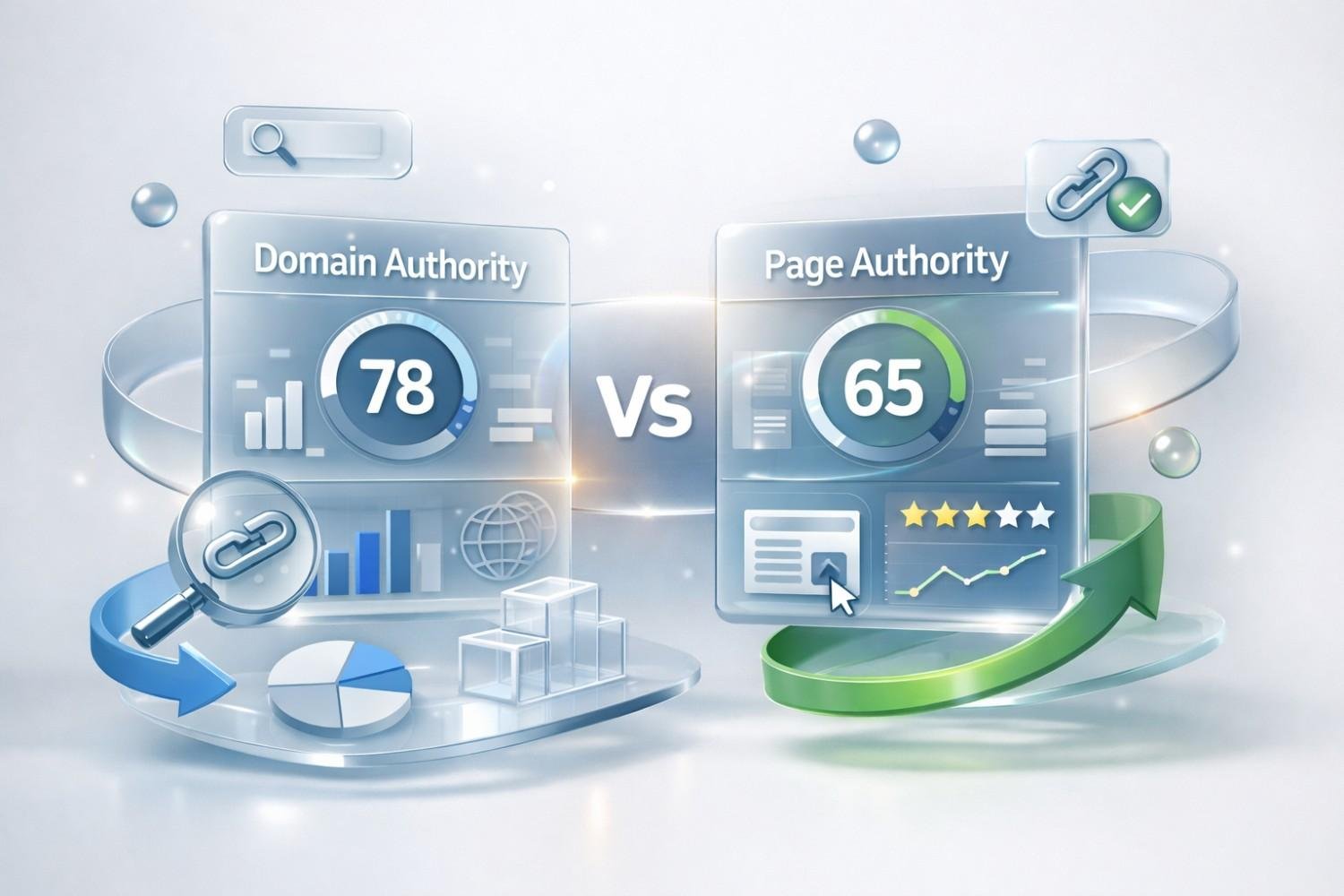
Domain Authority vs Page Authority: Key Differences
Understanding the distinction between these metrics helps you apply them correctly in your SEO strategy. While both measure link-based authority, they serve different analytical purposes.
Scope: Site-Wide vs Individual Page Metrics
Domain Authority evaluates your entire website’s collective authority. It reflects the cumulative link equity, trust signals, and ranking potential across all pages on your domain. Changes to DA typically happen gradually as your overall backlink profile evolves.
Page Authority focuses exclusively on individual URLs. Each page has its own PA score independent of other pages on the same site. A high-DA website can have low-PA pages, and vice versa.
This distinction matters for competitive analysis. When evaluating whether you can rank for a specific keyword, comparing your target page’s PA against ranking pages’ PA provides more actionable insights than comparing domain-level metrics alone.
Calculation Methodology Differences
Both metrics use machine learning algorithms trained on ranking data, but they weight factors differently.
Domain Authority emphasizes:
- Total linking root domains to the entire site
- Overall link profile diversity
- Domain-level trust signals
- Historical link acquisition patterns
Page Authority emphasizes:
- Direct backlinks to the specific URL
- Internal link support to the page
- Quality of linking pages
- URL-specific relevance signals
The logarithmic scale applies to both, but PA scores tend to be more volatile. A single high-quality backlink to a page can move PA significantly, while the same link might barely register at the domain level.
Use Cases: When to Focus on DA vs PA
Focus on Domain Authority when:
- Evaluating overall competitive landscape
- Assessing potential link building partners
- Benchmarking your site against industry competitors
- Planning long-term authority building strategies
- Qualifying guest posting opportunities
Focus on Page Authority when:
- Analyzing specific SERP competition
- Identifying which competitor pages to study
- Prioritizing internal linking targets
- Evaluating individual content performance
- Planning page-specific link building campaigns
Most SEO strategies benefit from monitoring both metrics. DA provides strategic context, while PA offers tactical insights for specific ranking opportunities.
How DA and PA Influence Each Other
Domain Authority and Page Authority share a relationship, though it’s not perfectly linear. High-DA sites tend to have higher average PA across their pages because domain-level link equity distributes throughout the site.
When your homepage receives a high-quality backlink, some of that authority flows to inner pages through internal links. This means improving DA can indirectly boost PA across multiple pages.
However, PA can exceed what DA might suggest. A specific page that earns significant direct backlinks can achieve PA higher than the site’s DA. This often happens with viral content, research studies, or comprehensive resources that attract links independently.
The relationship works both ways. Pages with high PA contribute to overall DA. Building authority to key pages strengthens your domain’s aggregate authority over time.
Are Domain Authority and Page Authority Google Ranking Factors?
This question causes significant confusion in the SEO community. The short answer: no, Google does not use Moz’s Domain Authority or Page Authority in their ranking algorithm. However, the factors these metrics measure often correlate with ranking success.
The Truth About Third-Party Metrics vs Google’s Algorithm
Domain Authority and Page Authority are proprietary metrics created by Moz. Google has explicitly stated they do not use DA or PA as ranking signals. These are third-party approximations, not direct inputs to Google’s algorithm.
Google’s John Mueller has confirmed that Google doesn’t use Domain Authority or any similar third-party metric. Google has their own internal metrics and signals that determine rankings.
This doesn’t make DA and PA useless. Moz designed these metrics to correlate with ranking performance by analyzing what factors tend to predict ranking success. They’re predictive tools, not ranking inputs.
What Google Actually Uses to Rank Pages
Google’s algorithm evaluates hundreds of ranking signals. While the exact formula remains proprietary, confirmed and strongly suspected factors include:
Content Quality and Relevance: How well your content matches search intent and provides comprehensive, accurate information.
Backlink Profile: The quantity, quality, and relevance of links pointing to your pages. Google has their own link evaluation systems, including PageRank.
User Experience Signals: Page speed, mobile-friendliness, Core Web Vitals, and engagement metrics.
On-Page Optimization: Title tags, headers, content structure, and keyword usage.
E-E-A-T Signals: Experience, Expertise, Authoritativeness, and Trustworthiness indicators throughout your content and site.
Technical SEO: Crawlability, indexation, site architecture, and structured data.
Many of these factors overlap with what influences DA and PA, which explains why these metrics often correlate with rankings even though Google doesn’t use them directly.
Why DA and PA Still Matter for SEO Strategy
Despite not being ranking factors, DA and PA provide genuine strategic value:
Competitive Benchmarking: These metrics offer standardized ways to compare your site against competitors. Understanding where you stand helps set realistic expectations.
Link Prospecting: When evaluating potential link building targets, DA helps quickly filter high-value opportunities from low-quality sites.
Progress Tracking: While imperfect, DA and PA trends indicate whether your authority-building efforts are working over time.
Client Communication: These metrics provide tangible numbers to demonstrate SEO progress to stakeholders who need simplified reporting.
SERP Analysis: Comparing your PA against ranking pages helps assess competitive difficulty for specific keywords.
The key is using these metrics as directional indicators rather than absolute measures of SEO success.
How to Check Domain Authority and Page Authority
Multiple tools allow you to check DA and PA scores. Understanding your options helps you choose the right approach for your needs and budget.
Free Tools to Check DA and PA
Several free options exist for checking these metrics:
MozBar Browser Extension: Moz’s free Chrome extension displays DA and PA directly in search results and on any webpage you visit. Limited to 10 queries per month on free accounts.
Moz Link Explorer: The free version allows limited searches to check DA, PA, and basic backlink data for any URL.
Small SEO Tools: Various free online tools aggregate Moz data, though accuracy and update frequency vary.
Website Authority Checker: Free tools that pull DA data, useful for quick checks without creating accounts.
Free tools work for occasional checks but limit serious competitive analysis. Most restrict query volume or provide outdated data.
Premium SEO Tools for DA/PA Analysis
Professional SEO work typically requires paid tools:
Moz Pro: The source of DA and PA metrics. Provides the most accurate and up-to-date scores, plus comprehensive backlink analysis, keyword research, and rank tracking. Plans start around $99/month.
Ahrefs: While using their own Domain Rating and URL Rating metrics, Ahrefs also displays Moz DA for comparison. Offers extensive backlink analysis and competitive research.
Semrush: Includes Authority Score (their proprietary metric) alongside tools to check Moz DA. Comprehensive all-in-one SEO platform.
Majestic: Provides Trust Flow and Citation Flow metrics as alternatives to DA/PA, with deep backlink analysis capabilities.
For agencies and serious SEO practitioners, investing in at least one premium tool provides the data depth needed for strategic decision-making.
How to Interpret DA and PA Scores Correctly
Proper interpretation prevents common mistakes:
Compare Within Your Niche: A DA 30 might be excellent in a small B2B niche but weak in a competitive consumer space. Always benchmark against direct competitors.
Track Trends Over Time: Single snapshots mean less than directional movement. A site growing from DA 25 to DA 35 over 12 months shows positive momentum.
Consider Score Volatility: Moz updates their algorithm periodically, which can cause score fluctuations unrelated to your actual link profile changes.
Don’t Obsess Over Small Changes: Moving from DA 42 to DA 44 isn’t significant. Focus on meaningful trends rather than minor fluctuations.
Combine With Other Metrics: DA and PA tell part of the story. Combine with traffic data, ranking positions, and conversion metrics for complete performance pictures.
What’s a Good Domain Authority or Page Authority Score?
“Good” is entirely relative in the context of authority metrics. What matters is how your scores compare to competitors you’re trying to outrank.
Industry Benchmarks by Niche
Different industries have vastly different authority landscapes:
News and Media: Major publications typically have DA 80-95. Competing requires exceptional content and significant link building investment.
Finance and Insurance: Highly competitive with established players at DA 60-90. New entrants face steep authority gaps.
Local Services: Many successful local businesses operate with DA 20-40. Competition is often less intense at the domain level.
B2B SaaS: Ranges widely from DA 30-70 depending on market maturity and company size.
E-commerce: Major retailers have DA 70-90, while niche stores can succeed with DA 30-50.
Personal Blogs: Successful blogs typically range from DA 20-50, with top-tier publications reaching DA 60+.
Research your specific competitive landscape rather than relying on general benchmarks.
Relative vs Absolute Score Interpretation
Absolute DA numbers matter less than relative positioning. Consider these scenarios:
Scenario A: Your site has DA 25, and top-ranking competitors average DA 30. The gap is manageable with focused effort.
Scenario B: Your site has DA 45, but competitors average DA 75. Despite a higher absolute score, the competitive gap is substantial.
The same logic applies to PA. A PA 35 page can rank above PA 50 competitors if it has better content relevance, on-page optimization, and user experience signals.
Authority metrics indicate competitive difficulty, not absolute ranking potential.
Why Comparing Scores to Competitors Matters More Than Absolute Numbers
Competitive context determines what scores you need:
Step 1: Identify your top 5-10 direct competitors for target keywords.
Step 2: Document their DA scores and the PA of their ranking pages.
Step 3: Calculate the gap between your metrics and theirs.
Step 4: Assess whether closing the gap is realistic given your resources and timeline.
If competitors average DA 40 and you’re at DA 35, aggressive link building can close that gap within 6-12 months. If they average DA 80 and you’re at DA 25, you’ll need alternative strategies like targeting less competitive keywords or building topical authority in specific niches.
How to Improve Domain Authority
Improving DA requires consistent effort across multiple fronts. There are no shortcuts—sustainable authority growth comes from building genuine value and earning quality links over time.
Build High-Quality Backlinks from Authoritative Sites
Link building remains the most direct path to higher DA. Focus on earning links from relevant, authoritative sources:
Guest Posting: Contribute valuable content to industry publications. Target sites with DA higher than yours and relevant audiences.
Digital PR: Create newsworthy content, research, or data that journalists and bloggers want to reference and link to.
Resource Link Building: Develop comprehensive resources that become go-to references in your industry.
Broken Link Building: Find broken links on relevant sites and offer your content as a replacement.
Relationship Building: Develop genuine relationships with industry peers who naturally link to valuable content.
Quality trumps quantity. Ten links from DA 50+ relevant sites impact DA more than 100 links from DA 10 directories.
Improve Your Internal Linking Structure
Internal links distribute authority throughout your site and help search engines understand your content hierarchy:
Create Topic Clusters: Organize content around pillar pages with supporting articles that link back to the main topic.
Link From High-Authority Pages: Your homepage and other high-PA pages should link to priority content you want to rank.
Use Descriptive Anchor Text: Internal link anchors should clearly describe the destination page’s topic.
Audit Orphan Pages: Ensure every important page receives internal links from other relevant content.
Update Old Content: Add internal links from existing high-performing content to newer pages.
Strategic internal linking doesn’t directly increase DA but helps distribute existing authority more effectively.
Create Link-Worthy Content Assets
Content that naturally attracts links accelerates authority growth:
Original Research: Conduct surveys, analyze data, or compile industry statistics that others will cite.
Comprehensive Guides: Create the definitive resource on topics in your niche.
Interactive Tools: Calculators, templates, and tools earn links when they provide genuine utility.
Visual Content: Infographics, charts, and diagrams get shared and linked when they communicate complex information clearly.
Expert Roundups: Compile insights from industry experts who will share and link to the finished piece.
The best link-worthy content solves real problems or provides unique value that doesn’t exist elsewhere.
Remove Toxic or Low-Quality Backlinks
Cleaning your backlink profile can indirectly support DA growth:
Audit Regularly: Use Moz, Ahrefs, or Google Search Console to identify suspicious links.
Identify Toxic Patterns: Watch for links from link farms, irrelevant foreign sites, or obvious spam.
Request Removal: Contact webmasters to remove harmful links when possible.
Disavow When Necessary: Use Google’s disavow tool for links you can’t get removed that may harm your site.
While Moz’s DA calculation differs from Google’s algorithm, removing toxic links improves your overall link profile health.
Strengthen Technical SEO Foundations
Technical health supports authority building indirectly:
Ensure Crawlability: Fix crawl errors, broken links, and redirect chains that prevent proper indexing.
Improve Site Speed: Faster sites provide better user experience and may earn more links.
Mobile Optimization: Ensure your site works flawlessly on mobile devices.
Implement HTTPS: Secure sites signal trustworthiness to users and search engines.
Fix Duplicate Content: Canonical tags and proper URL structure prevent authority dilution.
Technical issues don’t directly lower DA but can prevent your site from earning and retaining the authority it deserves.
How to Improve Page Authority
Page Authority improvement focuses on individual URLs rather than site-wide efforts. These tactics help specific pages gain ranking strength.
Optimize On-Page SEO Elements
Strong on-page optimization makes pages more link-worthy and rankable:
Title Tags: Include target keywords naturally while making titles compelling and click-worthy.
Header Structure: Use logical H1-H6 hierarchy that organizes content clearly.
Content Depth: Cover topics comprehensively, answering all related questions users might have.
Keyword Integration: Use primary and related keywords naturally throughout content.
Meta Descriptions: Write compelling descriptions that encourage clicks from search results.
While on-page factors don’t directly influence PA, optimized pages tend to rank better and attract more links.
Acquire Targeted Backlinks to Specific Pages
Direct link building to priority pages accelerates PA growth:
Page-Specific Outreach: When pitching guest posts or link opportunities, request links to specific pages rather than just your homepage.
Content Promotion: Actively promote new content to relevant audiences who might link to it.
Skyscraper Technique: Find content with existing links, create something better, and reach out to those linking sites.
Resource Page Inclusion: Get your best content included on relevant resource pages and link roundups.
HARO and Journalist Queries: Respond to media queries with links to relevant pages on your site.
Concentrated link building to specific URLs moves PA faster than distributed efforts.
Leverage Internal Links to Distribute Authority
Strategic internal linking boosts PA for priority pages:
Link From High-PA Pages: Identify your highest-authority pages and add internal links to pages you want to strengthen.
Contextual Relevance: Internal links should connect genuinely related content, not random pages.
Anchor Text Optimization: Use descriptive, keyword-relevant anchor text for internal links.
Navigation Links: Include priority pages in main navigation or footer links for site-wide authority distribution.
Content Hubs: Create topic clusters where supporting content links to and from pillar pages.
Internal linking is one of the fastest ways to boost PA because you control it entirely.
Improve Content Quality and Relevance
Better content earns more links and ranks better:
Update Outdated Information: Refresh statistics, examples, and recommendations regularly.
Expand Thin Content: Add depth to pages that don’t fully cover their topics.
Improve Readability: Break up walls of text, add visuals, and improve formatting.
Add Unique Value: Include original insights, data, or perspectives competitors don’t offer.
Match Search Intent: Ensure content format and depth match what users actually want.
Quality improvements make pages more link-worthy, creating a virtuous cycle of authority growth.
Domain Authority vs Page Authority: Which Should You Prioritize?
The right focus depends on your site’s maturity, competitive landscape, and specific goals. Most successful SEO strategies address both metrics strategically.
For New Websites: Building Domain Authority First
New sites benefit from prioritizing DA growth initially:
Establish Baseline Authority: Without some domain-level authority, individual pages struggle to rank even with good content.
Build Trust Signals: Early link building establishes your site as legitimate in search engines’ eyes.
Create Foundation: Higher DA makes future page-level efforts more effective.
Focus Areas for New Sites:
- Earn links to your homepage and key category pages
- Build relationships with industry publications
- Create foundational content that attracts natural links
- Establish social proof and brand presence
Once DA reaches competitive levels for your niche, shift focus toward page-specific optimization.
For Established Sites: Strategic Page Authority Optimization
Sites with established DA benefit from targeted PA efforts:
Maximize Existing Authority: Distribute your domain’s authority to pages targeting valuable keywords.
Competitive Targeting: Build PA on pages competing for specific high-value rankings.
Content Investment: Focus link building on your best content rather than spreading efforts thin.
Focus Areas for Established Sites:
- Identify pages with ranking potential but insufficient PA
- Build targeted backlinks to priority content
- Optimize internal linking to support key pages
- Create new content designed to earn links and rank
Established sites often see faster results from page-level optimization than continued domain-wide efforts.
Balancing Both Metrics in Your SEO Strategy
Most situations call for balanced approaches:
Allocate Resources Proportionally: Perhaps 60% of link building efforts toward domain authority and 40% toward specific pages, adjusting based on competitive analysis.
Align With Business Goals: Prioritize PA for pages targeting high-value keywords that drive revenue.
Consider Timeline: DA improvements compound over time, while PA efforts can show faster results for specific rankings.
Monitor Both Metrics: Track DA trends monthly and PA for priority pages weekly or bi-weekly.
The right balance depends on your starting position, competitive landscape, and business objectives.
When to Focus on Alternative Metrics
Sometimes DA and PA aren’t the right focus:
For Local SEO: Google Business Profile optimization, local citations, and reviews often matter more than domain authority.
For Niche Topics: Topical authority and content relevance can overcome authority gaps in specialized subjects.
For Brand Searches: Brand recognition and direct traffic matter more than third-party authority metrics.
For Conversion Optimization: Traffic quality and conversion rates matter more than authority scores.
Authority metrics are tools, not goals. Focus on business outcomes rather than metric optimization for its own sake.
Common Misconceptions About DA and PA
Misunderstanding these metrics leads to poor strategic decisions. Let’s address the most common myths.
“Higher DA Guarantees Better Rankings” (Myth)
Higher DA correlates with ranking potential but doesn’t guarantee rankings. Google doesn’t use DA, and many factors influence rankings beyond link authority:
Content Relevance: A DA 30 site with perfectly relevant content can outrank a DA 60 site with tangential coverage.
Search Intent Match: Pages that best satisfy user intent rank higher regardless of authority.
On-Page Optimization: Technical and content optimization can overcome authority disadvantages.
User Experience: Sites that provide better experiences may rank above higher-authority competitors.
DA indicates competitive difficulty, not predetermined outcomes.
“You Can Directly Manipulate DA/PA Scores” (Myth)
You cannot directly manipulate DA or PA. These metrics reflect underlying factors you can influence, but the scores themselves are calculated by Moz’s algorithm.
What You Can Do:
- Build quality backlinks (influences DA and PA)
- Improve internal linking (influences PA)
- Create link-worthy content (influences both)
- Remove toxic links (may influence both)
What You Cannot Do:
- Pay Moz to increase your score
- Use any tool to directly change DA/PA
- Guarantee specific score increases from specific actions
Focus on the underlying factors rather than the scores themselves.
“DA and PA Are Official Google Metrics” (Myth)
This is perhaps the most damaging misconception. DA and PA are Moz’s proprietary metrics, not Google’s.
The Reality:
- Google has their own internal metrics (including PageRank, which is not publicly visible)
- Google has explicitly stated they don’t use DA
- Moz created DA to approximate ranking potential
- The correlation between DA and rankings exists because Moz designed it that way
Understanding this distinction helps you use these metrics appropriately—as directional indicators rather than ranking factors.
“Low DA Means You Can’t Rank” (Myth)
Low DA makes ranking harder but not impossible. Many factors can overcome authority disadvantages:
Long-Tail Keywords: Less competitive keywords require less authority to rank.
Topical Authority: Deep expertise in a narrow topic can overcome domain-wide authority gaps.
Content Quality: Exceptional content can outperform authoritative but mediocre competitors.
Local Intent: Local searches often favor relevance and proximity over domain authority.
Fresh Content: For trending topics, new content can outrank established pages temporarily.
Low-DA sites rank successfully every day by focusing on opportunities matched to their current authority level.
Alternative Metrics to Domain Authority and Page Authority
Moz isn’t the only provider of authority metrics. Understanding alternatives helps you choose the right tools for your needs.
Ahrefs Domain Rating (DR) and URL Rating (UR)
Ahrefs offers their own authority metrics based on their extensive backlink index:
Domain Rating (DR): Measures the strength of a website’s backlink profile on a 0-100 scale. Focuses primarily on the quantity and quality of linking domains.
URL Rating (UR): Measures the strength of a specific page’s backlink profile. Considers both internal and external links.
Key Differences from Moz:
- Ahrefs has a larger link index (updated more frequently)
- DR focuses more heavily on linking root domains
- UR incorporates internal links more explicitly
- Scores between platforms aren’t directly comparable
Many SEO professionals prefer Ahrefs for backlink analysis due to their comprehensive data.
Semrush Authority Score
Semrush provides their own Authority Score metric:
How It Works: Combines link data, organic traffic data, and spam signals into a single 0-100 score.
Unique Factors:
- Incorporates organic traffic estimates (not just links)
- Includes spam detection signals
- Updates monthly with their database refreshes
Best For: Users already invested in the Semrush ecosystem who want authority metrics alongside other SEO tools.
Majestic Trust Flow and Citation Flow
Majestic offers two complementary metrics:
Trust Flow: Measures the quality of links pointing to a site based on how closely linked it is to trusted seed sites.
Citation Flow: Measures the quantity of links pointing to a site regardless of quality.
Using Both Together: The ratio between Trust Flow and Citation Flow indicates link profile quality. High Trust Flow with lower Citation Flow suggests quality over quantity.
Best For: Deep backlink analysis and understanding link quality versus quantity trade-offs.
Which Third-Party Metric Should You Use?
The best metric depends on your needs:
Choose Moz DA/PA if:
- You need widely recognized metrics for client reporting
- You want metrics specifically designed to correlate with rankings
- You’re already using Moz tools
Choose Ahrefs DR/UR if:
- You prioritize comprehensive backlink data
- You need frequently updated metrics
- You’re focused on link building strategy
Choose Semrush Authority Score if:
- You want traffic data incorporated into authority metrics
- You’re already using Semrush for other SEO tasks
- You value spam detection in authority calculations
Choose Majestic Trust Flow/Citation Flow if:
- You need to distinguish link quality from quantity
- You’re doing deep backlink audits
- You want historical link data
Many professionals use multiple tools, comparing metrics across platforms for more complete pictures.
How Domain Authority and Page Authority Fit Into a Complete SEO Strategy
Authority metrics are tools within a broader SEO strategy, not the strategy itself. Here’s how to integrate them effectively.
Using DA/PA for Competitive Analysis
Authority metrics provide quick competitive intelligence:
SERP Analysis: Before targeting a keyword, check the DA and PA of ranking pages. High-authority competition suggests you’ll need significant investment to compete.
Gap Analysis: Compare your DA against direct competitors. Large gaps indicate you may need to target less competitive keywords initially.
Opportunity Identification: Find keywords where ranking pages have PA similar to or lower than your target page. These represent realistic opportunities.
Competitor Monitoring: Track competitor DA over time to understand their link building momentum.
Use authority metrics as one input among many in competitive analysis, not the sole deciding factor.
Link Prospecting and Outreach Prioritization
DA helps qualify link building opportunities:
Minimum Thresholds: Set DA minimums for outreach targets (e.g., only pitch sites with DA 30+).
Prioritization: When you have limited outreach capacity, prioritize higher-DA opportunities.
Quality Signals: Very low DA combined with high spam signals suggests sites to avoid.
Relevance Balance: A DA 40 site in your exact niche often provides more value than a DA 60 site in an unrelated field.
Don’t let DA override relevance. A perfectly relevant DA 25 link can outperform an irrelevant DA 50 link.
Tracking SEO Progress Over Time
Authority metrics help demonstrate SEO momentum:
Monthly DA Tracking: Monitor DA trends to show authority building progress over time.
PA for Priority Pages: Track PA for your most important pages to measure targeted link building effectiveness.
Competitive Tracking: Monitor competitor DA to understand whether you’re gaining or losing ground.
Correlation Analysis: Compare authority trends with traffic and ranking improvements to validate your strategy.
Remember that DA and PA are lagging indicators. Improvements in these metrics often follow ranking and traffic gains rather than preceding them.
Setting Realistic SEO Expectations Based on Authority Metrics
Authority gaps help set appropriate timelines:
Small Gaps (5-10 DA points): Achievable within 6-12 months with consistent effort.
Medium Gaps (15-25 DA points): Expect 12-24 months of sustained link building.
Large Gaps (30+ DA points): May require 2-3+ years or alternative strategies like targeting less competitive keywords.
Page-Level Gaps: PA improvements can happen faster than DA improvements with targeted link building.
Use these benchmarks to set realistic expectations with stakeholders and avoid overpromising results.
Working With an SEO Agency to Build Sustainable Authority
Professional SEO services can accelerate authority building through expertise, relationships, and dedicated resources.
How Professional SEO Services Approach Authority Building
Experienced agencies bring systematic approaches to authority development:
Strategic Planning: Agencies assess your competitive landscape and develop authority building roadmaps aligned with business goals.
Relationship Networks: Established agencies have relationships with publishers, journalists, and industry sites that accelerate link acquisition.
Content Development: Professional content teams create link-worthy assets designed to earn natural backlinks.
Outreach Expertise: Dedicated outreach specialists have refined processes for earning high-quality placements.
Technical Foundation: Agencies ensure technical SEO supports authority building efforts.
The right agency partnership can compress timelines significantly compared to in-house efforts alone.
Strategic Link Acquisition vs Vanity Metrics
Quality agencies focus on business outcomes rather than metric manipulation:
Strategic Approach:
- Target links that drive referral traffic and rankings
- Prioritize relevance alongside authority
- Build diverse, natural-looking link profiles
- Focus on sustainable, white-hat tactics
Vanity Metric Approach (Avoid):
- Chasing DA increases without strategic purpose
- Buying links from irrelevant high-DA sites
- Prioritizing quantity over quality
- Using manipulative tactics that risk penalties
Ask potential agencies about their link building philosophy and how they measure success beyond authority metrics.
Measuring Real SEO Performance Beyond DA and PA
Effective SEO measurement goes beyond authority scores:
Primary Metrics:
- Organic traffic growth
- Keyword ranking improvements
- Conversion rates from organic traffic
- Revenue attributed to SEO
Secondary Metrics:
- Click-through rates from search results
- Engagement metrics (time on site, pages per session)
- Brand search volume growth
- Share of voice in your market
Supporting Metrics:
- DA and PA trends
- Backlink acquisition rate
- Content indexation rates
- Technical health scores
Authority metrics support the story but shouldn’t be the headline.
Long-Term Authority Growth and Organic Visibility
Sustainable SEO success requires patience and consistent investment:
Compound Growth: Authority building compounds over time. Early investments in link building and content create foundations for accelerating returns.
Competitive Moats: High domain authority becomes a competitive advantage that’s difficult for competitors to overcome quickly.
Diversified Traffic: Strong organic visibility reduces dependence on paid channels and provides more stable traffic.
Brand Building: Authority building often coincides with brand awareness growth, creating synergies across marketing channels.
The most successful SEO programs view authority building as ongoing investment rather than one-time projects.
Conclusion
Domain Authority measures site-wide ranking potential while Page Authority evaluates individual URL strength. Neither metric is a Google ranking factor, but both provide valuable strategic insights for competitive analysis, link prospecting, and progress tracking.
Understanding when to prioritize DA versus PA depends on your site’s maturity and specific goals. New sites benefit from domain-level authority building, while established sites often see faster results from targeted page-level optimization.
At White Label SEO Service, we help businesses build sustainable organic authority through strategic link acquisition, technical optimization, and content development. Contact our team to develop an authority building strategy aligned with your business goals and competitive landscape.
Frequently Asked Questions
What is the difference between Domain Authority and Page Authority?
Domain Authority measures the overall ranking strength of an entire website, while Page Authority measures the ranking potential of a single webpage. DA reflects your site’s cumulative link equity, while PA shows how much authority a specific URL has accumulated through direct backlinks and internal linking support.
Is Domain Authority a Google ranking factor?
No, Domain Authority is not a Google ranking factor. DA is a third-party metric created by Moz to predict ranking potential. Google has confirmed they don’t use DA in their algorithm. However, the factors that influence DA often correlate with actual ranking performance.
How long does it take to improve Domain Authority?
Improving Domain Authority typically takes 3-12 months of consistent link building effort. Small improvements of 5-10 points are achievable within 6 months, while significant gains of 20+ points may require 1-2 years. The logarithmic scale means higher scores become progressively harder to achieve.
Can a low DA website outrank a high DA website?
Yes, low DA websites can outrank higher DA competitors. Factors like content relevance, search intent match, on-page optimization, and user experience can overcome authority disadvantages. Targeting less competitive keywords also improves ranking chances for lower-authority sites.
Should I focus on improving DA or PA first?
New websites should prioritize Domain Authority to establish baseline credibility. Established sites often benefit more from targeted Page Authority improvements on priority pages. Most successful strategies balance both, with resource allocation depending on competitive analysis and business goals.
How often does Domain Authority update?
Moz updates Domain Authority scores approximately once per month when they refresh their link index. However, Moz also periodically updates their DA algorithm, which can cause score fluctuations unrelated to actual changes in your backlink profile.
What tools can I use to check Domain Authority and Page Authority?
Free options include MozBar browser extension and Moz Link Explorer’s free tier. Premium tools include Moz Pro, Ahrefs (which shows DA alongside their own metrics), and Semrush. For comprehensive analysis, most SEO professionals use paid tools that provide more data and higher query limits.