
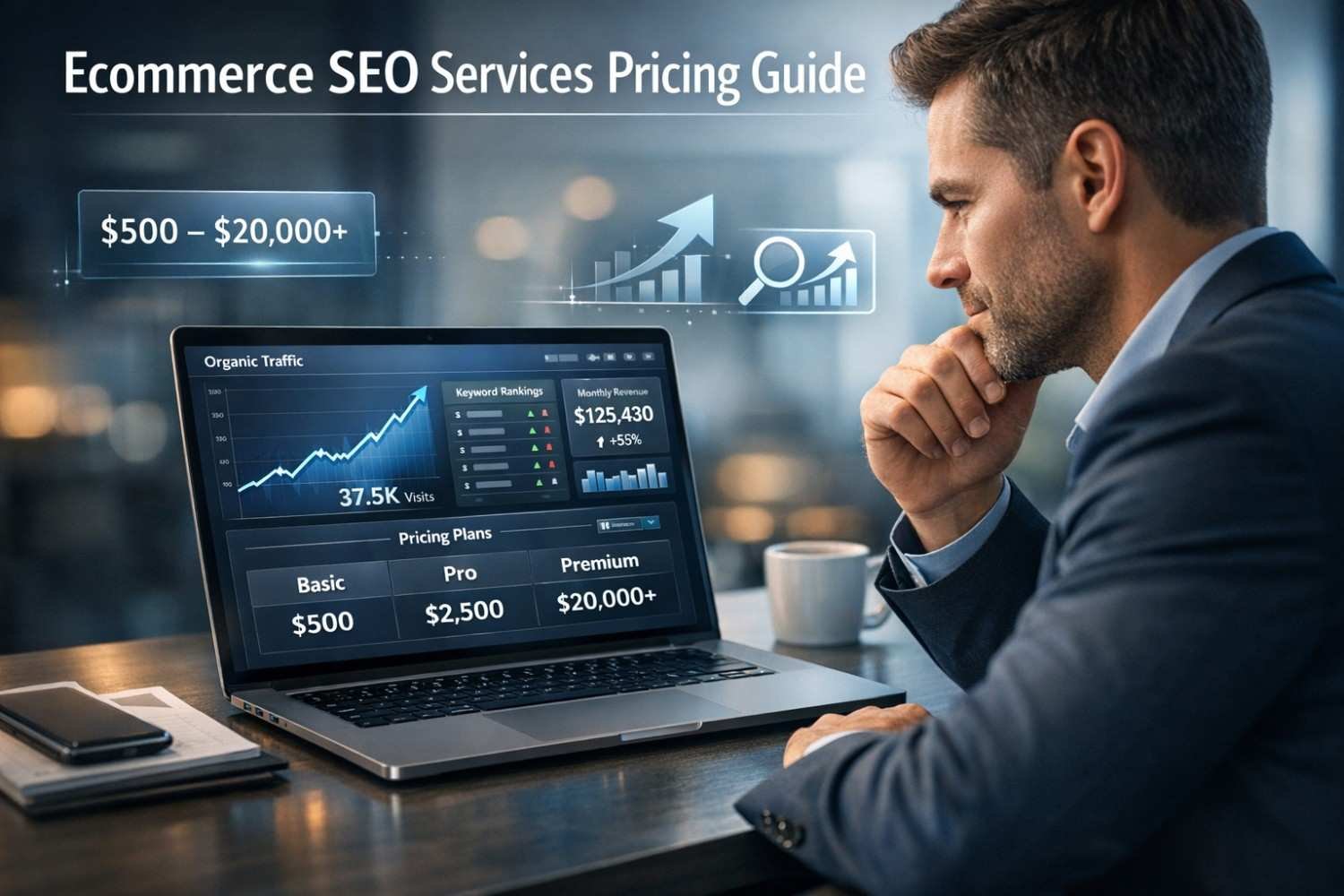
Ecommerce SEO services typically cost between $500 and $20,000+ per month, depending on your store size, competition level, and scope of work required. Understanding these pricing variables helps you budget effectively and avoid overpaying for services that don’t match your growth stage.
Whether you’re launching your first Shopify store or scaling a multi-million dollar enterprise operation, SEO investment directly impacts your organic revenue potential. The difference between a well-structured SEO campaign and a poorly executed one often determines whether you capture market share or lose it to competitors.
This guide breaks down every pricing model, cost factor, and evaluation criteria you need to make an informed decision about ecommerce SEO investment.
What Are Ecommerce SEO Services?
Ecommerce SEO services encompass specialized search optimization strategies designed specifically for online stores. Unlike standard SEO, these services address the unique challenges of product catalogs, category hierarchies, transactional intent keywords, and platform-specific technical requirements.
The goal is straightforward: increase organic visibility for product and category pages to drive qualified traffic that converts into revenue. This requires expertise in both traditional SEO fundamentals and ecommerce-specific optimization techniques.
Core Components of Ecommerce SEO
Effective ecommerce SEO combines multiple disciplines working together. Technical SEO ensures search engines can crawl and index your product pages efficiently. On-page optimization targets product titles, descriptions, and metadata for relevant search queries.
Content strategy addresses informational searches that lead customers toward purchase decisions. Link building establishes domain authority that helps product pages compete against established competitors. Analytics and reporting track performance against revenue-focused KPIs.
Each component requires specialized knowledge. Product schema markup differs from article schema. Category page optimization follows different rules than blog post optimization. Faceted navigation creates crawl budget challenges that service websites never encounter.
How Ecommerce SEO Differs From Standard SEO
Standard SEO typically focuses on ranking informational content or service pages. Ecommerce SEO must optimize hundreds or thousands of product pages simultaneously while managing duplicate content, thin content, and crawl efficiency issues.
Product pages present unique challenges. They often contain similar content across variations. They require structured data for rich snippets. They must balance SEO optimization with conversion optimization. Category pages need to rank for competitive head terms while providing clear navigation paths.
Technical complexity increases exponentially with catalog size. A 50-page service website requires different strategies than a 50,000-SKU ecommerce store. Pagination, filtering, sorting, and faceted navigation create indexation challenges that require specialized solutions.
Why Online Stores Need Specialized SEO
Generic SEO approaches fail ecommerce sites because they don’t address platform limitations, product page optimization at scale, or transactional keyword targeting. An SEO provider experienced with blogs won’t understand Shopify’s URL structure limitations or Magento’s canonical tag requirements.
Ecommerce SEO specialists understand purchase intent. They know which keywords drive revenue versus which drive tire-kickers. They optimize for commercial and transactional queries, not just informational traffic that never converts.
Platform expertise matters significantly. Each ecommerce platform handles SEO elements differently. Shopify restricts URL customization. WooCommerce requires plugin management. Magento offers flexibility but demands technical expertise. Specialists know these nuances and optimize accordingly.
Ecommerce SEO Pricing Models Explained
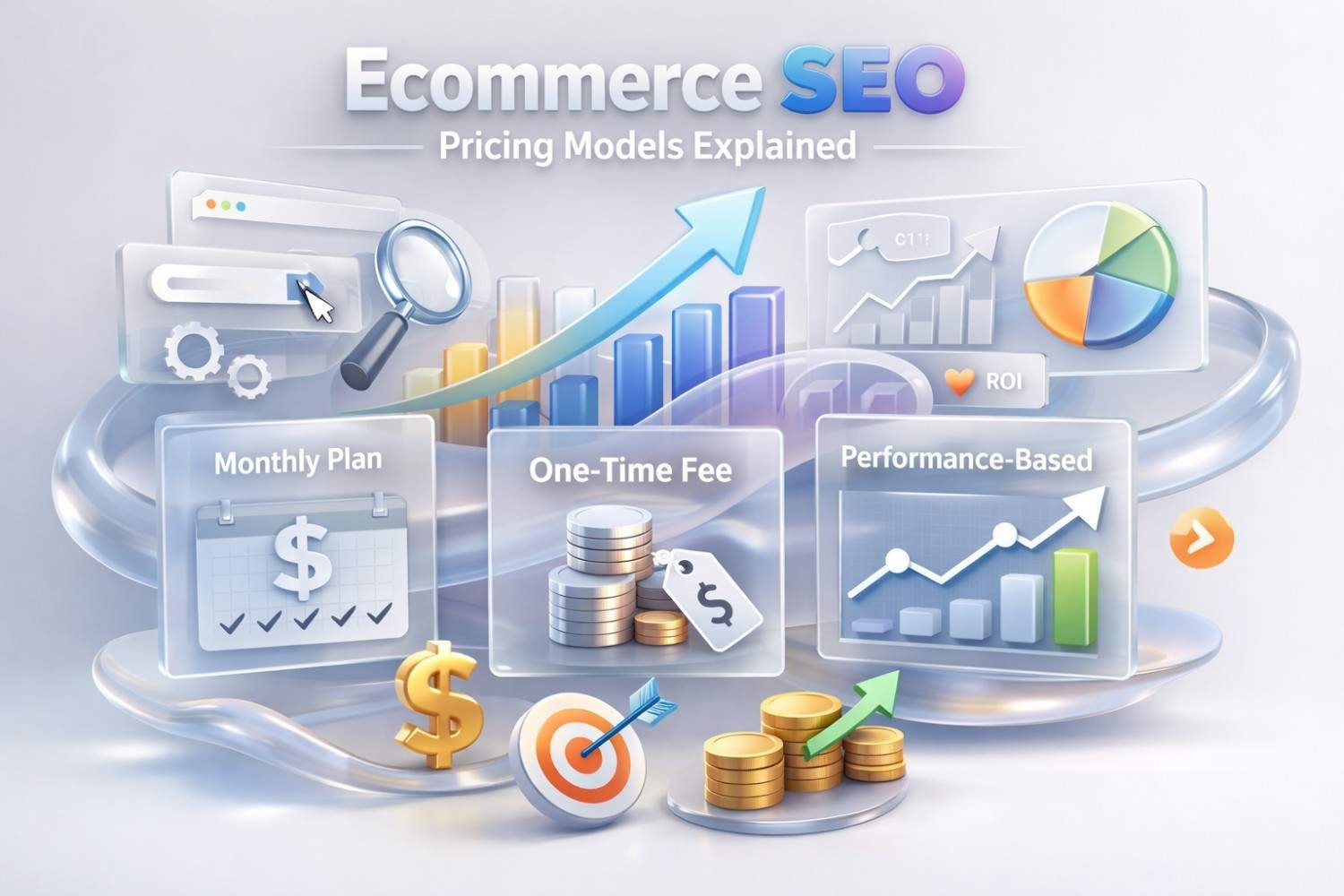
SEO agencies and consultants structure their pricing in several ways. Understanding each model helps you evaluate proposals and choose arrangements that align with your business goals and cash flow requirements.
Monthly Retainer Pricing
Monthly retainers represent the most common pricing structure for ongoing ecommerce SEO services. You pay a fixed monthly fee for a defined scope of work, typically including technical maintenance, content creation, link building, and reporting.
Retainer pricing provides predictable budgeting and consistent attention to your SEO program. Agencies allocate dedicated resources to your account, ensuring continuous optimization rather than sporadic project work.
Typical retainer arrangements range from 6 to 12 months minimum commitment. This timeframe allows sufficient time for SEO strategies to produce measurable results. Shorter commitments often indicate agencies focused on quick wins rather than sustainable growth.
Project-Based Pricing
Project-based pricing works well for defined deliverables with clear start and end points. Technical SEO audits, site migrations, platform transitions, and initial optimization projects often use this model.
You pay a fixed fee for specific outcomes. A comprehensive technical audit might cost $2,000 to $10,000 depending on site complexity. A site migration project could range from $5,000 to $50,000 based on catalog size and technical requirements.
This model suits businesses that need specific problems solved without ongoing commitments. However, SEO requires continuous effort. Project-based work alone rarely produces long-term ranking improvements without follow-up implementation and maintenance.
Hourly Consulting Rates
Hourly rates apply to consulting engagements, training sessions, and advisory relationships. Experienced ecommerce SEO consultants typically charge between $150 and $500 per hour depending on expertise level and market positioning.
This model works for businesses with internal SEO teams needing strategic guidance or specialized expertise for specific challenges. You get expert input without committing to full-service engagement.
Hourly consulting becomes expensive for implementation work. If you need hands-on optimization, monthly retainers typically provide better value than accumulating consulting hours.
Performance-Based Pricing
Performance-based models tie fees to results, typically ranking improvements, traffic increases, or revenue growth. While attractive in theory, these arrangements carry significant caveats.
Legitimate performance-based pricing usually includes a base retainer plus performance bonuses. Pure performance models often indicate agencies willing to use risky tactics or those targeting easy wins rather than sustainable growth.
Be cautious of guarantees. No ethical SEO provider can guarantee specific rankings because search algorithms remain outside anyone’s control. Performance incentives work best as supplements to base fees, not replacements.
Hybrid Pricing Structures
Many agencies combine pricing models to balance risk and reward. A common structure includes a reduced monthly retainer plus performance bonuses tied to traffic or revenue milestones.
Hybrid models align agency incentives with your business outcomes while providing stable income that allows agencies to invest in quality work. This arrangement often produces the best results for both parties.
Another hybrid approach combines project-based setup fees with ongoing retainers. You pay a larger upfront amount for initial optimization, then transition to maintenance-level retainers for continued growth.
How Much Do Ecommerce SEO Services Cost?
Pricing varies dramatically based on business size, competition, and service scope. These ranges represent typical market rates for quality services from reputable providers.
Small Business/Startup Pricing ($500–$2,000/month)
Entry-level ecommerce SEO services target small stores with limited product catalogs and local or niche market focus. At this price point, expect foundational optimization rather than comprehensive campaigns.
Services typically include basic technical SEO maintenance, limited keyword research, on-page optimization for priority pages, and monthly reporting. Content creation and link building remain minimal or absent at lower price points.
This tier suits businesses generating under $500,000 in annual revenue or those in low-competition niches. Expectations should remain realistic. Budget constraints limit the scope and speed of results.
Startups often benefit from project-based technical audits combined with DIY implementation rather than thin monthly retainers that spread resources too thin to produce meaningful impact.
Mid-Market Ecommerce Pricing ($2,000–$5,000/month)
Mid-market pricing supports comprehensive SEO programs for growing ecommerce businesses. This range typically includes technical SEO, content strategy and creation, link building, and detailed performance tracking.
Businesses at this level usually have established revenue streams and competitive markets requiring sustained SEO investment. The budget allows for meaningful content production, quality link acquisition, and platform-specific technical optimization.
Expect dedicated account management, regular strategy calls, and proactive optimization recommendations. Agencies can allocate sufficient resources to move the needle on competitive keywords and drive measurable organic revenue growth.
This tier fits businesses generating $500,000 to $5 million in annual revenue or those in moderately competitive markets requiring consistent effort to maintain and improve rankings.
Enterprise Ecommerce Pricing ($5,000–$20,000+/month)
Enterprise ecommerce SEO addresses large catalogs, multiple markets, and highly competitive industries. These engagements require senior strategists, dedicated teams, and sophisticated technical solutions.
Services include comprehensive technical SEO for complex architectures, large-scale content programs, aggressive link building campaigns, international SEO, and advanced analytics integration. Custom reporting dashboards and executive-level strategy sessions come standard.
Enterprise clients typically generate $5 million or more in annual revenue and compete against well-funded competitors with established SEO programs. The investment reflects the complexity and competitive intensity of these markets.
At the upper end, enterprise SEO programs may include dedicated full-time resources, custom tool development, and integration with broader marketing technology stacks.
Agency vs Freelancer vs In-House Cost Comparison
Each provider type offers different value propositions at different price points. Understanding these tradeoffs helps you choose the right fit for your situation.
Freelancers typically charge $50 to $150 per hour or $1,000 to $4,000 monthly. They offer personalized attention and lower overhead costs. However, capacity limitations restrict scalability, and single points of failure create risk if the freelancer becomes unavailable.
Agencies charge premium rates but provide team depth, diverse expertise, and business continuity. Mid-tier agencies range from $2,000 to $7,000 monthly. Top-tier agencies command $7,000 to $25,000 or more. You pay for infrastructure, processes, and collective experience.
In-house hires require salary, benefits, tools, and management overhead. A competent ecommerce SEO specialist costs $60,000 to $120,000 annually in total compensation, plus tool subscriptions averaging $500 to $2,000 monthly. This option makes sense only when SEO volume justifies dedicated headcount.
What’s Included in Ecommerce SEO Packages?
Understanding deliverables helps you evaluate proposals and ensure you’re comparing equivalent service levels across providers.
Technical SEO Audits & Implementation
Technical audits identify crawlability, indexation, and performance issues affecting search visibility. Comprehensive audits examine site architecture, URL structure, internal linking, page speed, mobile usability, structured data, and crawl efficiency.
Implementation addresses identified issues through direct fixes or detailed recommendations for your development team. Priority ranking helps focus resources on high-impact improvements first.
Ongoing technical SEO includes monitoring for new issues, adapting to algorithm updates, and optimizing for Core Web Vitals and other ranking factors. Ecommerce sites require continuous technical attention as catalogs change and platforms update.
Product Page Optimization
Product page SEO focuses on title tags, meta descriptions, header structure, product descriptions, image optimization, and schema markup. The goal is ranking individual products for relevant search queries.
Optimization at scale requires systematic approaches. Templates and guidelines ensure consistency across large catalogs. Priority frameworks focus manual optimization on highest-value products while automated solutions handle long-tail items.
Effective product page SEO balances search optimization with conversion optimization. Pages must rank and convert. Keyword-stuffed descriptions that hurt user experience ultimately harm both rankings and revenue.
Category Page SEO
Category pages often represent the highest-value SEO targets for ecommerce sites. They target competitive head terms and serve as hub pages distributing authority to product pages.
Optimization includes keyword-targeted titles and descriptions, unique category content, optimized filtering and sorting, proper pagination handling, and strategic internal linking. Category architecture directly impacts crawl efficiency and ranking potential.
Many ecommerce sites neglect category page content, leaving thin pages that struggle to rank. Adding substantial, helpful content to category pages often produces significant ranking improvements for competitive terms.
Content Strategy & Creation
Content marketing supports ecommerce SEO through buying guides, comparison articles, how-to content, and informational resources that attract links and capture top-of-funnel searches.
Strategy development identifies content opportunities based on keyword research, competitor analysis, and customer journey mapping. Content calendars ensure consistent production aligned with business priorities and seasonal trends.
Quality content creation requires subject matter expertise, SEO knowledge, and strong writing skills. Budget constraints often force tradeoffs between quantity and quality. Fewer excellent pieces typically outperform many mediocre ones.
Link Building & Authority Development
Link building remains essential for competitive ecommerce SEO. Product and category pages need domain authority to rank against established competitors.
Legitimate link building strategies include digital PR, resource link building, broken link building, and strategic partnerships. Quality matters more than quantity. A few links from authoritative, relevant sites outweigh dozens of low-quality placements.
Avoid providers promising specific link quantities at low prices. These typically deliver spammy links that risk penalties. Sustainable link building requires time, creativity, and genuine value creation.
Keyword Research & Mapping
Keyword research identifies search terms with commercial intent and ranking potential. Ecommerce keyword research emphasizes transactional and commercial investigation queries over informational terms.
Keyword mapping assigns target keywords to specific pages, ensuring clear focus and avoiding internal competition. Large catalogs require systematic mapping approaches to maintain organization and prevent cannibalization.
Ongoing keyword research identifies new opportunities as search behavior evolves and your catalog expands. Quarterly or monthly research refreshes keep strategies aligned with current market conditions.
Reporting & Performance Tracking
Reporting demonstrates progress and informs strategy adjustments. Effective ecommerce SEO reporting tracks rankings, organic traffic, and revenue attribution.
Standard reporting includes keyword ranking movements, organic traffic trends, technical health metrics, and completed deliverables. Advanced reporting integrates with analytics platforms to track organic revenue, conversion rates, and customer acquisition costs.
Report frequency varies by engagement level. Monthly reports suit most retainer arrangements. Enterprise clients may require weekly updates or real-time dashboards. Ensure reporting formats and metrics align with your business priorities.
Factors That Affect Ecommerce SEO Pricing
Multiple variables influence pricing beyond basic service scope. Understanding these factors helps you anticipate costs and evaluate whether quotes accurately reflect your situation.
Store Size & Product Catalog Volume
Catalog size directly impacts SEO workload. A 100-product store requires fundamentally different approaches than a 10,000-product store. Larger catalogs demand more technical optimization, more content, and more sophisticated management systems.
Pricing typically scales with product count, though not linearly. Economies of scale apply to templated optimization, but complexity increases with size. Expect significant price jumps at common thresholds: 500 products, 2,000 products, 10,000 products.
SKU proliferation through variants (sizes, colors, configurations) adds complexity even when base product counts seem manageable. Clarify how providers count and price product optimization.
Current Website Health & Technical Debt
Sites with significant technical issues require more upfront work before growth-focused optimization can begin. Legacy platforms, accumulated technical debt, and previous poor SEO practices all increase initial investment requirements.
Technical audits reveal the true scope of remediation needed. Sites requiring major architectural changes, platform migrations, or extensive cleanup cost more to optimize than well-maintained sites needing only incremental improvements.
Be honest about your site’s current state when requesting proposals. Providers who quote without understanding existing issues will either deliver disappointing results or request budget increases after discovery.
Competition Level in Your Niche
Competitive intensity determines how much effort rankings require. Niche markets with few competitors need less investment than saturated markets dominated by well-funded players.
Competitor analysis reveals the investment required to compete. If top-ranking competitors have thousands of backlinks and extensive content libraries, matching their visibility requires comparable investment over time.
Some markets simply cost more to win. Fashion, electronics, and health supplements face intense competition requiring substantial budgets. Specialized B2B or niche consumer categories may offer easier paths to visibility.
Target Markets & Geographic Scope
Geographic targeting affects complexity and cost. Local ecommerce serving single markets requires simpler optimization than national campaigns. International SEO multiplies complexity through language, currency, and market-specific requirements.
Multi-country strategies require separate keyword research, content creation, and link building for each market. Technical implementation of hreflang tags and international site architecture adds complexity.
Clearly define your geographic priorities when scoping projects. Providers should adjust pricing based on the number of markets and languages requiring optimization.
Platform (Shopify, WooCommerce, Magento, BigCommerce)
Each ecommerce platform presents unique SEO challenges and opportunities. Provider expertise with your specific platform affects both pricing and results.
Some platforms require more technical workarounds than others. Shopify’s URL limitations and restricted access to certain files require creative solutions. Magento’s flexibility demands more technical expertise to implement properly.
Providers specializing in your platform can work more efficiently, potentially reducing costs while improving outcomes. Generalist providers may charge more for the learning curve or deliver suboptimal results.
Scope of Services Required
Full-service engagements cost more than focused projects. Determine which services you actually need versus which you can handle internally or defer.
Technical SEO alone costs less than technical plus content plus link building. However, partial approaches often produce partial results. Comprehensive strategies typically deliver better ROI than piecemeal efforts.
Scope discussions should address both immediate needs and long-term goals. Starting with focused projects and expanding over time can manage cash flow while building toward comprehensive programs.
Ecommerce SEO Pricing by Platform
Platform-specific expertise affects both pricing and effectiveness. These ranges reflect typical costs for providers with demonstrated platform experience.
Shopify SEO Services Pricing
Shopify SEO services typically range from $1,000 to $10,000 monthly depending on store size and competition. The platform’s popularity means many providers offer Shopify-specific expertise.
Shopify’s standardized architecture simplifies some optimization tasks but limits others. URL structure restrictions, theme limitations, and app dependencies create platform-specific challenges requiring workarounds.
Entry-level Shopify SEO ($1,000 to $2,500/month) suits smaller stores in moderate competition. Growth-stage stores ($2,500 to $5,000/month) benefit from content and link building additions. Established Shopify Plus stores may invest $5,000 to $15,000 monthly for comprehensive programs.
WooCommerce SEO Services Pricing
WooCommerce SEO ranges from $1,000 to $12,000 monthly. The platform’s WordPress foundation provides SEO flexibility but requires more technical management than hosted solutions.
Plugin selection, hosting configuration, and theme optimization significantly impact WooCommerce SEO. Providers must understand both WordPress SEO fundamentals and WooCommerce-specific requirements.
WooCommerce’s flexibility allows deeper optimization than some platforms but demands more technical expertise. Budget for both SEO services and ongoing technical maintenance to maximize results.
Magento SEO Services Pricing
Magento SEO commands premium pricing, typically $3,000 to $20,000 monthly. The platform’s complexity requires specialized technical expertise that fewer providers possess.
Magento suits enterprise-level operations with complex requirements. Its flexibility enables sophisticated SEO implementations but demands significant technical resources. Adobe Commerce (Magento 2) adds cloud infrastructure considerations.
Magento projects often require larger upfront investments for technical optimization before ongoing programs begin. Factor setup costs into total budget calculations.
BigCommerce SEO Services Pricing
BigCommerce SEO typically costs $1,500 to $8,000 monthly. The platform offers strong native SEO features but has a smaller provider ecosystem than Shopify or WooCommerce.
BigCommerce’s built-in SEO capabilities reduce some technical optimization needs. However, the platform’s smaller market share means fewer providers specialize in BigCommerce-specific optimization.
Evaluate provider BigCommerce experience carefully. Platform-specific knowledge significantly impacts efficiency and results.
Custom/Headless Ecommerce SEO Pricing
Custom and headless ecommerce implementations require the highest SEO investments, typically $5,000 to $25,000+ monthly. These architectures demand deep technical expertise and custom solutions.
Headless commerce separates frontend presentation from backend commerce functionality. This creates SEO opportunities through performance optimization and flexibility but requires careful implementation to maintain crawlability and indexation.
Custom platforms lack the established optimization playbooks of standard platforms. Every solution requires custom development and testing. Budget accordingly for both initial implementation and ongoing optimization.
How to Evaluate Ecommerce SEO Service Providers
Choosing the right provider significantly impacts results. These evaluation criteria help distinguish quality providers from those likely to underdeliver.
Red Flags to Avoid When Hiring
Guaranteed rankings indicate either dishonesty or willingness to use risky tactics. No legitimate provider can guarantee specific positions because algorithms remain outside anyone’s control.
Extremely low pricing suggests corner-cutting on quality. If a provider charges significantly less than market rates, question how they maintain profitability. Cheap link building often means spammy links. Cheap content means thin, unhelpful pages.
Vague deliverables prevent accountability. Providers should clearly specify what they’ll deliver, not just promise “SEO services” or “optimization.” Demand specificity about activities, quantities, and timelines.
No case studies or references raises credibility concerns. Established providers can demonstrate results for similar clients. New providers should offer other credibility signals like individual track records or detailed methodology explanations.
Long-term contracts with no performance clauses protect providers at your expense. Reasonable commitments make sense, but contracts should include performance expectations and exit provisions for sustained underperformance.
Questions to Ask Before Signing a Contract
Ask about their experience with your specific platform and industry. Generic SEO knowledge doesn’t guarantee ecommerce expertise. Request examples of similar client work.
Inquire about their team structure. Who will actually work on your account? What are their qualifications? Will you have consistent points of contact or rotating staff?
Understand their approach to link building specifically. This area carries the most risk and varies most between providers. Ethical link building looks very different from risky tactics.
Request details on reporting and communication. How often will you receive updates? What metrics will they track? How will they demonstrate ROI?
Ask about their process for handling algorithm updates or ranking drops. Experienced providers have established protocols for these situations.
Understanding Deliverables & KPIs
Deliverables should be specific and measurable. “Content creation” is vague. “Four 1,500-word buying guides per month targeting specified keywords” is specific.
KPIs should align with business outcomes. Rankings matter, but traffic and revenue matter more. Ensure reporting connects SEO activities to metrics you actually care about.
Establish baseline measurements before engagement begins. You can’t demonstrate improvement without knowing starting points. Ensure providers document current rankings, traffic, and revenue attribution.
Agree on realistic timeframes for different KPIs. Ranking improvements take months. Traffic growth follows rankings. Revenue impact follows traffic. Set expectations accordingly.
Contract Terms & Commitment Periods
Six-month minimum commitments are reasonable for SEO engagements. Shorter periods rarely allow sufficient time for strategies to produce results. Longer commitments should include performance reviews and adjustment opportunities.
Understand cancellation terms. What happens if you need to exit early? Are there penalties? What notice period applies?
Clarify ownership of work product. Who owns content created during the engagement? What about research, strategies, and documentation?
Review payment terms. Monthly billing aligns incentives better than large upfront payments. Milestone-based payments work for project engagements.
Ecommerce SEO Timeline & ROI Expectations
Setting realistic expectations prevents disappointment and enables proper planning. SEO produces results over months and years, not days and weeks.
Realistic Timeline for Ranking Improvements
Initial ranking movements typically appear within 3 to 6 months for moderately competitive keywords. Highly competitive terms may require 6 to 12 months or longer to achieve meaningful positions.
Technical fixes often produce faster results than content or link building. Resolving crawl issues or improving page speed can impact rankings within weeks. New content and links take longer to influence algorithms.
Expect a progression: technical improvements first, then on-page optimization gains, then content and authority building effects. Each phase builds on previous work.
New sites face longer timelines than established domains. Building domain authority from scratch requires more time and investment than improving already-authoritative sites.
Measuring Ecommerce SEO ROI
ROI calculation requires tracking organic revenue attribution. Connect Google Analytics or your analytics platform to track transactions originating from organic search.
Calculate ROI by comparing organic revenue growth against SEO investment. If you invest $5,000 monthly and organic revenue increases $25,000 monthly, your ROI is positive even accounting for product costs and overhead.
Attribution models affect ROI calculations. Last-click attribution may undervalue SEO’s contribution to purchases that involved multiple touchpoints. Consider assisted conversions and multi-touch attribution for complete pictures.
Factor in customer lifetime value for subscription or repeat-purchase businesses. A customer acquired through organic search may generate revenue for years, dramatically improving true ROI.
Traffic vs Revenue: What Metrics Matter
Traffic without revenue is vanity. Focus on metrics that connect to business outcomes: organic revenue, organic conversion rate, and revenue per organic session.
Ranking improvements matter only when they drive qualified traffic. Position 1 for irrelevant keywords produces worthless traffic. Position 5 for high-intent commercial terms drives revenue.
Monitor traffic quality indicators: bounce rate, pages per session, time on site, and conversion rate by landing page. High-quality traffic engages and converts. Low-quality traffic bounces immediately.
Segment organic traffic by intent. Informational traffic supports brand awareness but converts differently than transactional traffic. Evaluate each segment against appropriate benchmarks.
Long-Term Value of Organic Search Investment
Organic search produces compounding returns over time. Content and authority built today continue generating traffic for years. Unlike paid advertising, organic visibility doesn’t disappear when spending stops.
Research from BrightEdge indicates organic search drives approximately 53% of all website traffic, making it the largest single traffic source for most websites.
SEO investment builds business assets. Quality content, authoritative backlinks, and technical infrastructure retain value even if you change providers or bring SEO in-house.
Consider SEO as infrastructure investment rather than marketing expense. The work compounds over time, reducing customer acquisition costs and increasing marketing efficiency.
DIY vs Hiring an Ecommerce SEO Agency
The right approach depends on your resources, expertise, and growth stage. Each option offers distinct advantages and limitations.
When to Handle SEO In-House
In-house SEO makes sense when you have sufficient volume to justify dedicated headcount and can attract qualified talent. Typically, this means businesses generating $2 million or more in annual revenue with significant organic growth potential.
Internal teams offer deep brand knowledge, faster communication, and alignment with broader business strategy. They can respond quickly to opportunities and integrate SEO with other marketing efforts seamlessly.
However, in-house teams require management, training, and tool investments. Single-person teams create key-person risk. Building comprehensive expertise takes time and may require multiple hires.
Consider in-house SEO when organic search represents a primary growth channel and you’re prepared to invest in building genuine internal capability.
When to Hire an Agency or Consultant
Agencies suit businesses needing comprehensive expertise without building internal teams. They provide immediate access to specialists across technical SEO, content, and link building.
Hire agencies when you lack internal SEO expertise, need to scale quickly, or face competitive situations requiring experienced strategists. Agencies bring cross-client learning and established processes that accelerate results.
Consultants work well for strategic guidance, training internal teams, or solving specific problems. They offer senior expertise without full-service overhead.
Consider external help when SEO isn’t your core competency but significantly impacts business outcomes. The opportunity cost of learning SEO internally may exceed agency fees.
Hybrid Approach: Combining Internal & External Resources
Many successful ecommerce businesses combine internal and external resources. Internal teams handle day-to-day optimization and content creation while agencies provide strategic direction, technical expertise, and link building.
This model leverages internal brand knowledge and external specialized expertise. It also provides redundancy and knowledge transfer that builds internal capability over time.
Structure hybrid arrangements clearly. Define responsibilities, communication protocols, and decision-making authority. Ambiguity creates gaps and conflicts.
Hybrid approaches often evolve over time. Businesses may start with full-service agencies, transition to hybrid models as internal capability grows, then eventually bring most functions in-house while retaining agency support for specialized needs.
How to Budget for Ecommerce SEO Services
Effective budgeting balances investment against expected returns while accounting for business stage and competitive requirements.
Setting Realistic SEO Budgets by Business Stage
Startup/Early Stage ($0-$500K revenue): Allocate 5-10% of revenue or $500-$2,000 monthly. Focus on technical foundations and quick wins. Consider project-based work over thin retainers.
Growth Stage ($500K-$5M revenue): Invest 5-8% of revenue or $2,000-$8,000 monthly. Comprehensive programs become viable. Balance foundational work with growth initiatives.
Established ($5M+ revenue): Budget 3-5% of revenue or $5,000-$25,000+ monthly. Full-service programs with dedicated resources. Competitive positioning against well-funded rivals.
These percentages represent starting points. Actual budgets should reflect competitive intensity, organic growth potential, and alternative customer acquisition costs.
Allocating Budget Across SEO Activities
Typical allocation for comprehensive programs:
- Technical SEO: 15-25% of budget
- Content Strategy & Creation: 25-35% of budget
- Link Building: 25-35% of budget
- Reporting & Strategy: 10-15% of budget
Early-stage programs may weight technical SEO higher to establish foundations. Mature programs often shift toward content and link building for continued growth.
Adjust allocations based on current gaps. Sites with technical debt need remediation before growth investments pay off. Sites with strong technical foundations can invest more aggressively in content and authority.
Scaling SEO Investment as Revenue Grows
Increase SEO investment as organic revenue grows, maintaining or improving ROI. Successful programs justify expanded budgets through demonstrated returns.
Scale strategically, not just proportionally. Identify highest-impact opportunities and fund those first. Diminishing returns apply to SEO like any marketing channel.
Plan for step-function increases at growth milestones. Moving from local to national targeting, expanding internationally, or launching new product categories may require significant budget increases.
Maintain investment during plateaus. SEO requires sustained effort to maintain positions. Cutting budgets during slow periods often leads to ranking losses that cost more to recover than continued investment.
Frequently Asked Questions About Ecommerce SEO Pricing
Why is ecommerce SEO more expensive than regular SEO?
Ecommerce SEO addresses larger scale and greater complexity than standard SEO. Product catalogs containing hundreds or thousands of pages require systematic optimization approaches. Technical challenges like faceted navigation, duplicate content, and crawl budget management demand specialized expertise. The commercial intent of ecommerce keywords also attracts more competition, requiring greater investment to achieve rankings.
Can I pay for ecommerce SEO on a per-product basis?
Some providers offer per-product optimization pricing, typically ranging from $50 to $200 per product for basic optimization. However, this model ignores the interconnected nature of ecommerce SEO. Category pages, site architecture, and domain authority affect individual product rankings. Per-product pricing works for specific optimization projects but not comprehensive SEO programs.
What’s the minimum budget for ecommerce SEO?
Meaningful ecommerce SEO requires minimum investment of $1,000 to $1,500 monthly for small stores in low-competition niches. Below this threshold, resources spread too thin to produce measurable results. Businesses with tighter budgets should consider project-based technical audits or focused optimization of highest-priority pages rather than diluted monthly retainers.
Do cheap SEO services work for online stores?
Cheap SEO services rarely produce sustainable results for ecommerce sites. Low-cost providers typically cut corners on content quality, use risky link building tactics, or spread resources too thin across too many clients. The risks include wasted investment, algorithm penalties, and opportunity costs from delayed results. Quality SEO requires adequate investment in skilled professionals and legitimate tactics.
How do I know if I’m overpaying for SEO?
Compare your investment against industry benchmarks and demonstrated results. If you’re paying enterprise rates for a small store, you may be overpaying. If results consistently underperform expectations despite adequate timeframes, pricing may not match value delivered. Request detailed reporting connecting activities to outcomes. Legitimate providers demonstrate ROI through traffic growth, ranking improvements, and revenue attribution.
Next Steps: Getting a Custom Ecommerce SEO Quote
Armed with pricing knowledge, you’re ready to evaluate providers and request proposals that match your specific situation.
What Information to Prepare
Gather key information before contacting providers:
- Current monthly organic traffic and revenue
- Product catalog size and category structure
- Ecommerce platform and hosting details
- Previous SEO work and known technical issues
- Primary competitors and target keywords
- Geographic markets and growth priorities
- Budget range and timeline expectations
Complete information enables accurate proposals. Vague requests produce vague quotes that don’t reflect actual project requirements.
How to Request & Compare Proposals
Contact 3-5 providers with consistent information. Provide the same details to each so proposals reflect comparable understanding of your needs.
Evaluate proposals on specificity, not just price. Detailed proposals indicating genuine understanding of your situation suggest providers who will deliver tailored strategies rather than generic approaches.
Compare deliverables carefully. Lower prices often mean fewer deliverables or lower quality. Ensure you’re comparing equivalent service levels.
Ask clarifying questions about anything unclear. How providers respond to questions reveals their communication style and expertise.
Starting Your Ecommerce SEO Journey
Begin with clear goals and realistic expectations. Define what success looks like in 6 months, 12 months, and 24 months. Align provider selection with these objectives.
Start with technical foundations if your site has known issues. Fixing technical problems first ensures subsequent content and link building investments produce maximum impact.
Commit to adequate timeframes. SEO produces results over months, not weeks. Providers who promise fast results either target easy wins or use risky tactics.
Maintain involvement throughout the engagement. The best results come from collaborative relationships where business knowledge combines with SEO expertise.
Conclusion
Ecommerce SEO pricing ranges from $500 to $20,000+ monthly depending on store size, competition, platform, and service scope. Understanding these variables helps you budget appropriately and evaluate provider proposals against realistic benchmarks.
The right investment level depends on your growth stage, competitive landscape, and organic revenue potential. Starting with clear goals and comprehensive provider evaluation sets the foundation for successful SEO partnerships that deliver measurable ROI.
We help ecommerce businesses build sustainable organic growth through technical SEO, content strategy, and authority development. Contact White Label SEO Service today to discuss your ecommerce SEO needs and receive a custom proposal tailored to your specific situation and goals.
Frequently Asked Questions
How long does it take to see results from ecommerce SEO services?
Most ecommerce sites see initial ranking improvements within 3 to 6 months, with significant traffic and revenue growth typically appearing between 6 and 12 months. Technical fixes often produce faster results than content or link building efforts. Highly competitive markets may require longer timeframes to achieve meaningful positions.
What’s the difference between cheap and expensive ecommerce SEO services?
Price differences reflect service scope, expertise level, and resource allocation. Expensive services typically include senior strategists, comprehensive deliverables, quality content creation, and legitimate link building. Cheap services often cut corners through thin content, risky link tactics, or insufficient attention to individual client needs.
Should I hire a freelancer or agency for ecommerce SEO?
Agencies provide team depth, diverse expertise, and business continuity but cost more. Freelancers offer personalized attention at lower rates but have capacity limitations. Choose based on your budget, project complexity, and risk tolerance. Many businesses start with freelancers and transition to agencies as they scale.
How do I measure ROI from ecommerce SEO investment?
Track organic revenue through analytics platforms that attribute transactions to traffic sources. Compare organic revenue growth against SEO investment to calculate ROI. Factor in customer lifetime value for repeat-purchase businesses. Effective measurement requires baseline documentation before SEO work begins.
Can I do ecommerce SEO myself instead of hiring a provider?
DIY SEO is possible for business owners willing to invest significant time in learning and implementation. However, ecommerce SEO complexity often exceeds what non-specialists can effectively manage. Consider DIY for basic optimization while hiring specialists for technical issues, content strategy, and link building.
What questions should I ask before hiring an ecommerce SEO provider?
Ask about their experience with your specific platform and industry, team structure and qualifications, link building approach, reporting frequency and metrics, and process for handling algorithm updates. Request case studies from similar clients and clarify deliverables, timelines, and contract terms before signing.
Is ecommerce SEO worth the investment for small online stores?
Ecommerce SEO provides positive ROI for most online stores when properly executed. Small stores in low-competition niches can achieve meaningful results with modest budgets. The key is matching investment level to realistic opportunity. Even small stores benefit from technical foundations and targeted optimization of priority pages.