

Enterprise SaaS companies investing strategically in SEO generate up to 3x more qualified pipeline than those relying solely on paid acquisition. The difference lies not in spending more, but in allocating resources across technical infrastructure, content production, and authority building with precision.
For marketing leaders and founders scaling B2B software, understanding where and how to invest in organic search determines whether SEO becomes a compounding revenue engine or an underperforming cost center. The stakes are significant: enterprise deals often exceed six figures, and buyers conduct extensive research before engaging sales.
This guide breaks down enterprise SaaS SEO investment comprehensively—from budget benchmarks and team structures to realistic timelines and ROI measurement frameworks that connect organic visibility directly to pipeline and revenue.
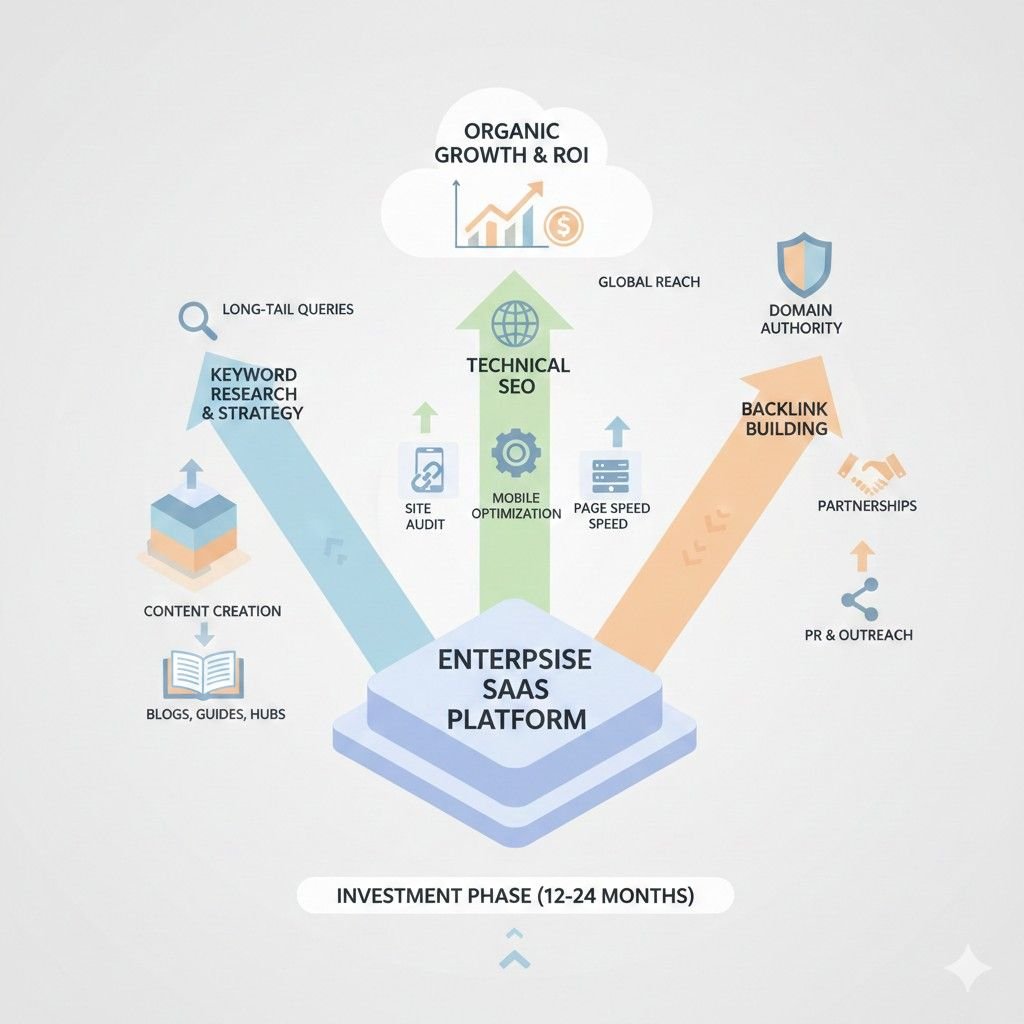
What Is Enterprise SaaS SEO Investment?
Enterprise SaaS SEO investment encompasses the strategic allocation of financial resources, personnel, and technology toward improving organic search visibility for large-scale software-as-a-service companies. Unlike tactical SEO efforts focused on quick wins, enterprise investment requires systematic approaches that account for complex site architectures, multiple product lines, international markets, and lengthy B2B sales cycles.
This investment category extends beyond monthly retainers or content budgets. It includes infrastructure decisions, cross-functional team coordination, technology stack investments, and long-term strategic planning that positions organic search as a primary growth channel.
Defining Enterprise-Level SEO for SaaS Companies
Enterprise-level SEO for SaaS differs fundamentally from standard search optimization. These programs typically manage thousands to millions of indexed pages, require coordination across engineering, product, and marketing teams, and must demonstrate measurable impact on revenue—not just traffic metrics.
The defining characteristics include scale, complexity, and accountability. Enterprise SaaS sites often feature dynamic content, user-generated elements, multiple subdomains, and sophisticated JavaScript frameworks that create unique crawling and indexing challenges. SEO teams must navigate internal stakeholders, competing priorities, and approval processes that smaller organizations never encounter.
Additionally, enterprise SaaS SEO demands integration with existing marketing technology stacks, CRM systems, and attribution models. The investment must connect organic search performance to pipeline influence and closed revenue, requiring sophisticated tracking and reporting infrastructure.
How SEO Investment Differs for Enterprise SaaS vs. SMB SaaS
The investment profile for enterprise SaaS SEO diverges significantly from small and mid-market approaches across several dimensions.
Budget scale represents the most obvious difference. While SMB SaaS companies might allocate $5,000-$15,000 monthly for SEO, enterprise programs typically require $25,000-$100,000+ monthly to achieve meaningful results. This reflects the expanded scope, competitive intensity, and resource requirements at scale.
Timeline expectations also shift dramatically. SMB SaaS can sometimes achieve ranking improvements within 3-6 months for moderate-competition keywords. Enterprise SaaS targeting high-value commercial terms often requires 12-18 months before seeing substantial organic pipeline contribution.
Team structure differs as well. SMB programs often rely on a single SEO manager or agency partnership. Enterprise programs require dedicated specialists across technical SEO, content strategy, link acquisition, and analytics—plus coordination with engineering resources for implementation.
Content requirements expand exponentially. Enterprise SaaS must produce content addressing multiple buyer personas, use cases, industries, and buying stages. A single product might require dozens of feature pages, comparison content, integration documentation, and thought leadership pieces.
Why Enterprise SaaS Companies Need Strategic SEO Investment
Strategic SEO investment addresses fundamental challenges facing enterprise software companies: rising customer acquisition costs, increasing competition for buyer attention, and the need for sustainable growth channels that compound over time rather than requiring proportional spending increases.
The B2B software market has matured significantly. Buyers conduct extensive independent research before engaging vendors, making organic visibility during the research phase critical for pipeline generation.
The Role of Organic Search in B2B SaaS Growth
Organic search serves as the primary discovery channel for enterprise software buyers during their research phase. According to Gartner research, B2B buyers spend only 17% of their purchase journey meeting with potential suppliers. The remainder involves independent research—much of it through search engines.
For enterprise SaaS, this research phase is particularly extended. Buyers evaluating six-figure software investments conduct thorough due diligence, comparing features, reading case studies, and seeking validation from multiple sources. Companies with strong organic visibility capture these high-intent researchers early in their journey.
The compounding nature of organic traffic creates additional strategic value. Unlike paid acquisition where traffic stops when spending stops, SEO investments continue generating returns indefinitely. A well-optimized page can drive qualified traffic for years with minimal ongoing investment.
SEO as a Long-Term Revenue Driver for Enterprise Software
Enterprise SaaS companies with mature SEO programs report that organic search contributes 30-50% of total pipeline. This contribution grows over time as content assets accumulate and domain authority strengthens.
The economics favor long-term investment. Customer acquisition costs through organic search typically run 60-70% lower than paid channels once programs reach maturity. For enterprise deals with average contract values exceeding $100,000 annually, even modest improvements in organic acquisition efficiency translate to significant revenue impact.
SEO also supports other marketing channels. Content created for organic visibility fuels email marketing, social distribution, and sales enablement. Technical improvements benefit paid landing pages. The investment multiplies across the marketing ecosystem.
Competitive Landscape and Market Visibility
Enterprise SaaS markets feature intense competition for visibility. Category leaders often dominate organic search results, creating barriers for challengers and making strategic investment essential for market entry or expansion.
Companies that underinvest in SEO cede valuable digital real estate to competitors. When buyers search for solutions, comparison content, or educational resources, competitors with stronger organic presence capture that demand. The opportunity cost compounds as competitors build authority that becomes increasingly difficult to overcome.
Market visibility through organic search also influences brand perception. Companies appearing consistently in search results for industry topics establish thought leadership positioning that supports sales conversations and premium pricing.
Key Components of Enterprise SaaS SEO Investment
Effective enterprise SaaS SEO investment distributes resources across four primary areas: technical infrastructure, content strategy, authority building, and analytics. Each component requires dedicated attention and budget allocation to achieve sustainable results.
The balance between these components shifts based on program maturity, competitive positioning, and specific business objectives. New programs typically emphasize technical foundations and content production, while mature programs shift toward authority building and optimization.
Technical SEO Infrastructure
Technical SEO forms the foundation upon which all other efforts build. For enterprise SaaS, technical complexity often creates the most significant barriers to organic visibility—and the greatest opportunities for improvement.
Investment in technical SEO infrastructure includes site architecture optimization, performance improvements, and international SEO capabilities. These foundational elements determine whether content can be discovered, indexed, and ranked effectively.
Site Architecture and Crawlability
Enterprise SaaS sites frequently suffer from architectural issues that limit organic visibility. Common problems include orphaned pages, excessive crawl depth, inefficient internal linking, and URL structures that dilute topical authority.
Investment in site architecture addresses these foundational issues. This includes creating logical URL hierarchies that reflect topical relationships, implementing strategic internal linking that distributes authority effectively, and ensuring all valuable pages are accessible within three clicks from the homepage.
For SaaS companies with dynamic content—user dashboards, documentation, help centers—crawlability requires particular attention. Proper implementation of robots.txt directives, canonical tags, and JavaScript rendering ensures search engines can access and index valuable content while excluding low-value pages.
Core Web Vitals and Performance Optimization
Page experience signals directly influence rankings and user engagement. Enterprise SaaS sites, often built on complex technology stacks with extensive functionality, frequently struggle with Core Web Vitals performance.
Investment in performance optimization includes server infrastructure improvements, code optimization, image compression, and third-party script management. For SaaS companies, this often requires engineering resources and may involve significant development work.
The return on performance investment extends beyond SEO. Faster pages improve conversion rates, reduce bounce rates, and enhance user experience across all traffic sources. Google’s research indicates that sites meeting Core Web Vitals thresholds see 24% fewer page abandonment rates.
International and Multi-Language SEO
Enterprise SaaS companies serving global markets require sophisticated international SEO implementation. This includes proper hreflang configuration, localized content strategies, and country-specific domain or subdirectory structures.
Investment in international SEO often represents a significant budget allocation. Beyond technical implementation, effective global SEO requires localized keyword research, culturally appropriate content adaptation, and region-specific link building efforts.
The complexity multiplies with each additional market. Companies targeting 10+ countries may need dedicated international SEO resources or specialized agency partnerships to manage the scope effectively.
Content Strategy and Production
Content represents the largest ongoing investment for most enterprise SaaS SEO programs. Effective content strategy addresses the full buyer journey while building topical authority across relevant subject areas.
Enterprise content production requires substantial resources: strategists to plan content architecture, writers with subject matter expertise, editors for quality control, and designers for visual assets. The investment scales with competitive intensity and market scope.
Bottom-of-Funnel Product and Feature Pages
Product and feature pages capture high-intent commercial traffic—buyers actively evaluating solutions. These pages require significant investment in optimization, differentiation, and conversion elements.
Effective product pages go beyond feature lists. They address specific buyer concerns, demonstrate value through use cases and outcomes, and provide clear paths to conversion or sales engagement. For enterprise SaaS with multiple products or extensive feature sets, this can require dozens of optimized pages.
Investment in bottom-funnel content also includes landing pages for specific use cases, industry verticals, and integration partnerships. Each page targets distinct keyword clusters and buyer segments, expanding organic capture across commercial intent queries.
Middle-of-Funnel Comparison and Use Case Content
Comparison content captures buyers actively evaluating alternatives. “Versus” pages, alternative lists, and competitive comparison guides target high-intent keywords that indicate purchase consideration.
This content category requires careful positioning and ongoing maintenance. Competitors evolve, pricing changes, and feature sets expand. Investment includes both initial production and regular updates to maintain accuracy and relevance.
Use case content addresses specific applications of the software, targeting buyers searching for solutions to particular problems. This content bridges educational and commercial intent, capturing researchers who may not yet know the product category they need.
Top-of-Funnel Educational and Thought Leadership Content
Educational content builds topical authority and captures early-stage researchers. While these visitors may not convert immediately, they enter the awareness funnel and can be nurtured toward eventual purchase consideration.
Investment in top-funnel content supports long-term authority building. Comprehensive guides, original research, and thought leadership pieces attract links naturally, strengthen domain authority, and establish brand credibility within the industry.
The volume requirements for top-funnel content are substantial. Achieving topical authority often requires covering subjects comprehensively—meaning dozens or hundreds of pieces addressing various aspects of core topics.
Authority Building and Link Acquisition
Domain authority remains a critical ranking factor for competitive enterprise keywords. Building authority requires sustained investment in link acquisition, digital PR, and partnership development.
Unlike content production, authority building often involves external relationships and earned media. The investment includes both direct costs (agency fees, tools, outreach resources) and indirect costs (executive time for thought leadership, partnership development efforts).
Digital PR and Brand Mentions
Digital PR generates high-authority links and brand mentions through newsworthy content, original research, and expert commentary. For enterprise SaaS, this often involves publishing industry reports, survey data, or trend analyses that attract media coverage.
Investment in digital PR includes research production, media outreach, and relationship development with journalists and publications covering the industry. The return comes through high-authority links from news sites, industry publications, and influential blogs.
Brand mentions without links also carry value. Search engines increasingly recognize unlinked brand mentions as authority signals, making broad visibility valuable even without direct link acquisition.
Strategic Link Building for SaaS
Beyond PR-driven links, enterprise SaaS programs require systematic link building targeting relevant industry sites, technology publications, and complementary software providers.
Effective link building for SaaS includes guest posting on industry blogs, resource page outreach, broken link replacement, and content-driven link acquisition through linkable assets. Each tactic requires dedicated resources and ongoing effort.
Investment in link building should emphasize quality over quantity. A single link from a high-authority, relevant site delivers more value than dozens of low-quality placements. Enterprise programs typically target 10-30 high-quality links monthly to maintain competitive authority growth.
Industry Partnerships and Co-Marketing
Integration partnerships and co-marketing relationships provide natural link building opportunities while supporting business development objectives. For SaaS companies, technology partnerships often include mutual linking, co-created content, and shared promotion.
Investment in partnership-driven SEO includes relationship development, co-marketing content production, and integration documentation. These efforts serve dual purposes: building authority for SEO while supporting partnership revenue goals.
The integration ecosystem represents a significant opportunity for enterprise SaaS. Companies with extensive integration networks can build substantial authority through partner directories, integration pages, and co-branded content.
Analytics, Attribution, and Performance Tracking
Measuring SEO impact on business outcomes requires sophisticated analytics infrastructure. Enterprise programs must connect organic visibility to pipeline and revenue, demonstrating ROI to stakeholders and informing investment decisions.
Investment in analytics includes tool subscriptions, implementation resources, and analyst time for reporting and insights. The infrastructure must integrate with existing marketing technology and CRM systems.
SEO KPIs for Enterprise SaaS
Enterprise SEO programs track metrics across multiple categories: visibility metrics (rankings, impressions, share of voice), traffic metrics (sessions, users, engagement), and business metrics (conversions, pipeline, revenue).
Effective measurement requires defining KPIs aligned with business objectives. For enterprise SaaS, the most meaningful metrics typically include organic pipeline contribution, cost per organic acquisition, and organic revenue attribution.
Leading indicators—rankings, traffic, engagement—provide early signals of program health. Lagging indicators—pipeline, revenue—demonstrate ultimate business impact. Both categories require tracking and regular reporting.
Revenue Attribution and Pipeline Influence
Connecting organic traffic to revenue requires multi-touch attribution modeling. Enterprise B2B sales cycles involve multiple touchpoints across extended timeframes, making simple last-click attribution inadequate.
Investment in attribution includes implementing tracking infrastructure, integrating with CRM systems, and developing attribution models that accurately credit organic search for its pipeline influence. This often requires dedicated analytics resources or specialized tools.
Proper attribution enables accurate ROI calculation and informed budget allocation. Without it, SEO programs struggle to demonstrate value and secure continued investment.
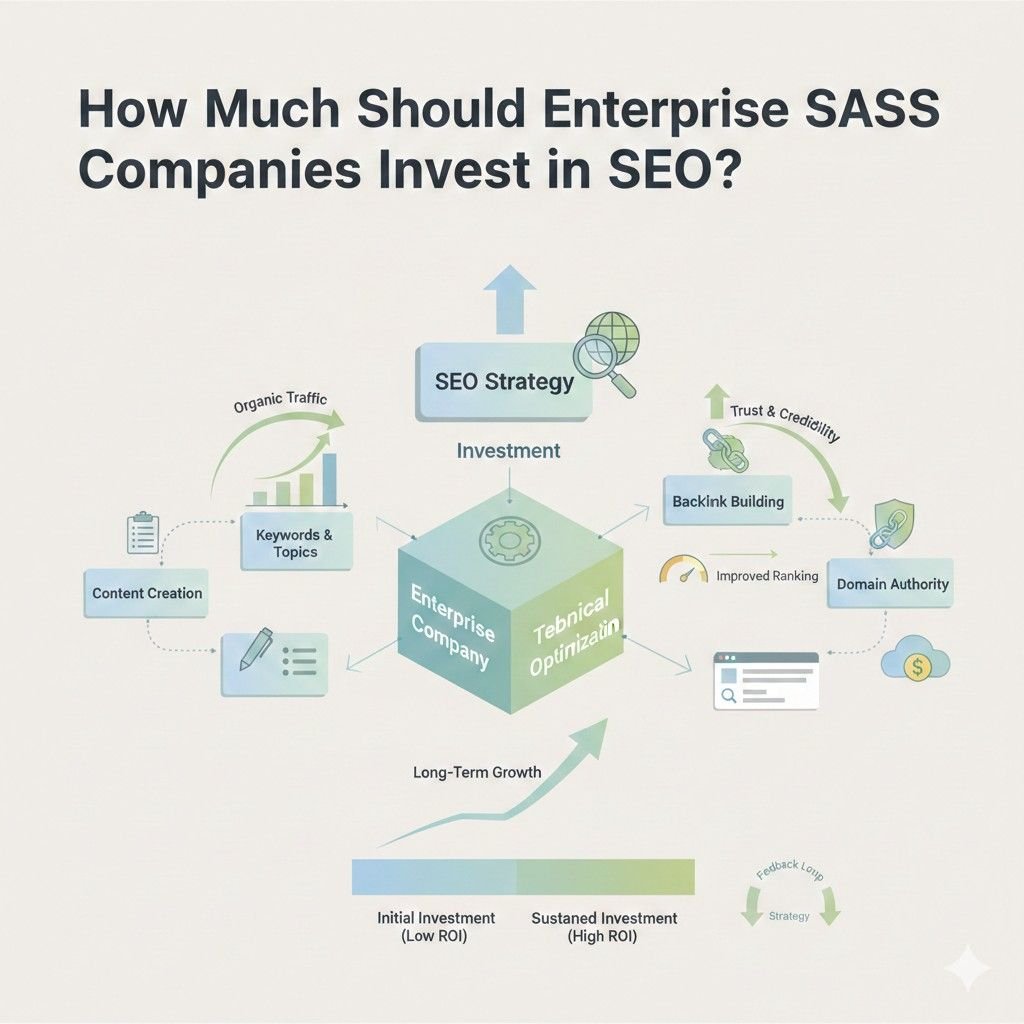
How Much Should Enterprise SaaS Companies Invest in SEO?
Budget allocation for enterprise SaaS SEO depends on competitive intensity, growth objectives, and current organic maturity. Companies entering competitive markets or pursuing aggressive growth require larger investments than those maintaining established positions.
The investment should be viewed as a long-term commitment rather than a short-term expense. SEO programs require sustained funding over 18-24 months minimum to achieve meaningful results in competitive enterprise markets.
SEO Budget Benchmarks for Enterprise SaaS
Enterprise SaaS companies typically allocate $25,000-$100,000+ monthly for comprehensive SEO programs. This range reflects the full scope of investment including personnel, tools, content production, and link building.
According to Gartner’s CMO Spend Survey, marketing budgets average 9.1% of company revenue for B2B technology companies. SEO typically represents 10-15% of total marketing budget for companies prioritizing organic growth.
For context, a $50M ARR enterprise SaaS company with a 9% marketing budget ($4.5M annually) might allocate $450,000-$675,000 annually to SEO—translating to $37,500-$56,250 monthly.
Competitive analysis should inform budget decisions. If primary competitors invest heavily in SEO, matching or exceeding their investment is necessary to compete for visibility. Underinvestment relative to competitors results in declining share of voice over time.
In-House vs. Agency vs. Hybrid SEO Investment Models
Enterprise SaaS companies choose between three primary investment models, each with distinct cost structures and tradeoffs.
In-house teams provide dedicated focus, institutional knowledge, and tight integration with other departments. However, building comprehensive in-house capabilities requires significant investment in salaries, benefits, tools, and ongoing training. A full in-house team (SEO manager, technical specialist, content strategist, link builder, analyst) can cost $400,000-$700,000 annually in fully loaded compensation.
Agency partnerships provide access to specialized expertise, established processes, and scalable resources without full-time hiring commitments. Enterprise SEO agency retainers typically range from $15,000-$50,000 monthly, with additional costs for content production and link building.
Hybrid models combine in-house leadership with agency execution. An internal SEO director or manager provides strategic direction and stakeholder management while agencies handle specialized execution. This model balances control with capability access.
Most enterprise SaaS companies employ hybrid approaches, maintaining core in-house expertise while leveraging agencies for specialized capabilities or additional capacity.
Allocating Budget Across Technical, Content, and Link Building
Budget allocation across SEO components should reflect program maturity and specific needs. General guidelines suggest:
Technical SEO: 15-25% of budget Technical investment is typically front-loaded during program establishment, then reduced to maintenance levels. New programs may allocate 30%+ to technical foundations initially.
Content Strategy and Production: 40-50% of budget Content represents the largest ongoing investment for most programs. This allocation covers strategy, production, optimization, and maintenance across all content types.
Authority Building: 20-30% of budget Link acquisition and digital PR require sustained investment to build and maintain competitive authority. Underfunding this category limits ranking potential for competitive keywords.
Analytics and Tools: 10-15% of budget Tool subscriptions, tracking infrastructure, and analyst resources enable measurement and optimization. This investment supports all other activities.
Allocation should be reviewed quarterly and adjusted based on performance data, competitive dynamics, and strategic priorities.
Enterprise SaaS SEO Investment Timeline and ROI Expectations
Understanding realistic timelines prevents premature program abandonment and sets appropriate stakeholder expectations. Enterprise SEO operates on longer timeframes than most marketing channels, but delivers compounding returns that justify patience.
The timeline varies based on competitive intensity, domain authority starting point, and investment level. Companies with established domains and existing content assets can accelerate results compared to new market entrants.
Realistic SEO Timelines for Enterprise SaaS
Enterprise SaaS SEO programs typically follow a predictable progression through distinct phases. Each phase builds on previous work, creating cumulative momentum toward sustainable organic growth.
Months 1-3: Foundation and Technical Audit
The initial phase focuses on assessment, planning, and foundational improvements. Activities include comprehensive technical audits, competitive analysis, keyword research, and content strategy development.
During this phase, visible results are limited. Rankings may fluctuate as technical changes are implemented. Traffic improvements are unlikely, and pipeline impact is negligible.
Investment during this phase establishes the infrastructure for future success. Skipping or rushing foundational work creates problems that compound over time.
Months 4-6: Content Velocity and Initial Rankings
The second phase emphasizes content production and initial optimization. New content targets identified keyword opportunities while existing content receives optimization updates.
Initial ranking improvements begin appearing for lower-competition keywords. Traffic may show modest increases, particularly for long-tail queries. Pipeline impact remains minimal as new content has not yet accumulated authority.
Content velocity during this phase sets the pace for future growth. Programs producing 8-12+ quality pieces monthly build momentum faster than those with limited output.
Months 7-12: Authority Growth and Traffic Scaling
The third phase sees accelerating results as content accumulates, authority builds, and rankings improve for more competitive terms. Traffic growth becomes more pronounced, and organic pipeline contribution begins materializing.
By month 12, well-executed programs typically show 50-100%+ traffic increases from baseline. Rankings for target keywords improve significantly, though highly competitive terms may still require additional time.
Pipeline attribution becomes meaningful during this phase. Marketing qualified leads from organic sources increase, and revenue attribution models begin showing organic contribution.
Year 2+: Compounding Returns and Market Dominance
Mature programs enter a compounding phase where previous investments generate increasing returns. Content assets continue driving traffic indefinitely, authority compounds through ongoing link acquisition, and organic pipeline contribution grows as a percentage of total.
Companies maintaining investment through year two and beyond often achieve 200-400%+ traffic growth from program inception. Organic search becomes a primary pipeline driver, often contributing 30-50% of total marketing-sourced revenue.
The compounding nature of SEO creates increasing efficiency over time. Cost per organic acquisition decreases as traffic grows without proportional investment increases.
Measuring SEO ROI for Enterprise SaaS
ROI calculation for enterprise SEO requires connecting organic traffic to revenue through attribution modeling. The basic formula:
SEO ROI = (Organic Revenue – SEO Investment) / SEO Investment × 100
Calculating organic revenue requires tracking the full funnel: organic traffic → conversions → opportunities → closed revenue. Multi-touch attribution models credit organic search for its influence on deals that involved organic touchpoints.
For enterprise SaaS with long sales cycles, ROI measurement must account for time lag between traffic and revenue. A visitor arriving via organic search in January may not close as a customer until June or later. Cohort analysis helps connect investment periods to revenue outcomes.
Mature enterprise SEO programs typically achieve 300-500% ROI when measured over 24-month periods. The extended measurement window captures the compounding returns that shorter analyses miss.
SEO vs. Paid Acquisition: Long-Term Cost Comparison
Comparing SEO and paid acquisition requires examining both immediate costs and long-term economics. Paid channels deliver immediate traffic but require ongoing spending. SEO requires upfront investment but generates traffic indefinitely.
For enterprise SaaS, paid search CPCs for competitive keywords often exceed $50-$150 per click. With typical conversion rates of 2-5%, cost per lead through paid search can reach $1,000-$7,500.
Organic traffic, once established, costs only the marginal expense of content maintenance and authority building. Mature programs often achieve cost per organic lead of $100-$300—a fraction of paid acquisition costs.
The crossover point—where cumulative SEO investment becomes more efficient than equivalent paid spending—typically occurs between months 12-18 for enterprise programs. Beyond this point, SEO delivers increasingly superior economics.
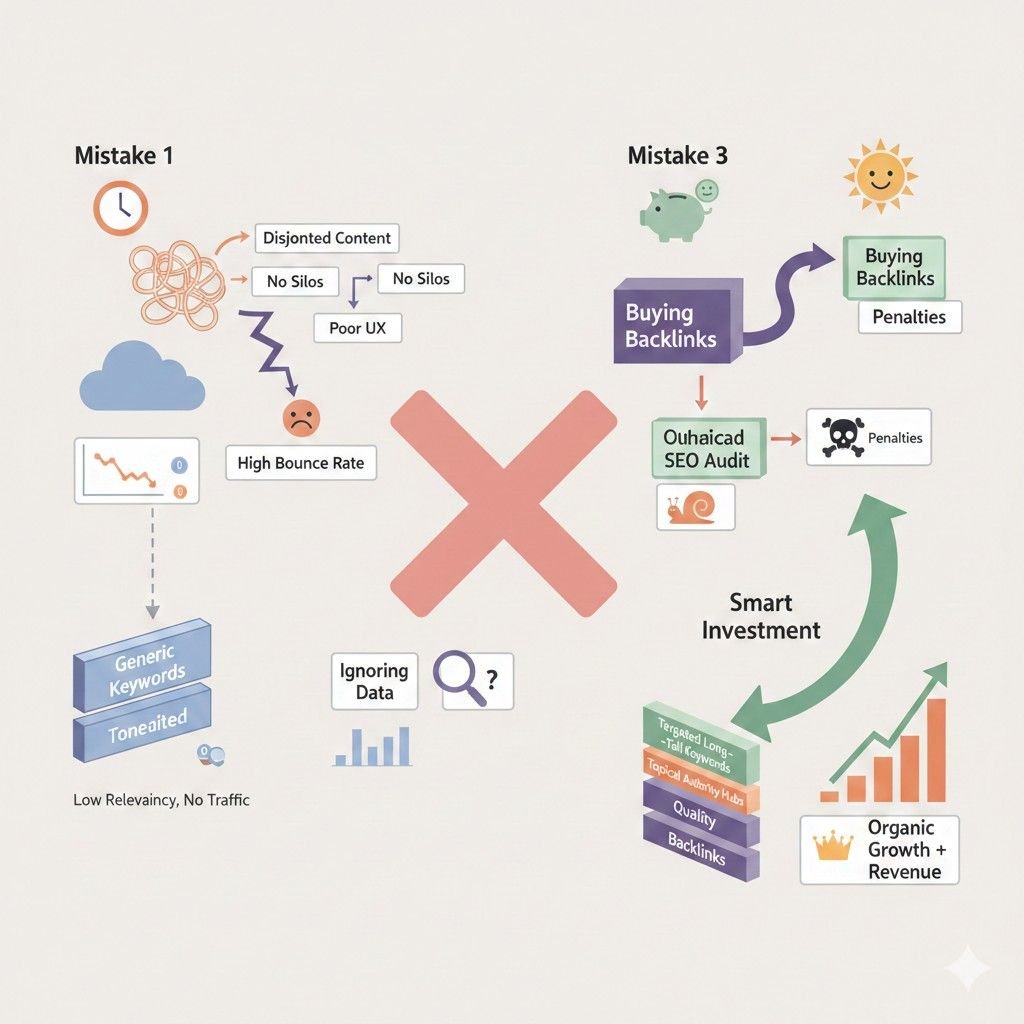
Common Enterprise SaaS SEO Investment Mistakes to Avoid
Enterprise SEO programs fail for predictable reasons. Understanding common mistakes enables proactive avoidance and improves program success rates.
These mistakes often stem from misaligned expectations, inadequate resources, or strategic errors that compound over time. Early identification and correction prevent wasted investment.
Underinvesting in Technical SEO Foundations
Technical debt limits the effectiveness of all other SEO efforts. Companies that rush past technical foundations to focus on content production often find their content underperforms due to crawling, indexing, or rendering issues.
Common technical underinvestment includes inadequate site architecture planning, deferred Core Web Vitals improvements, and insufficient attention to JavaScript rendering. These issues create ceilings on organic performance that content and links cannot overcome.
The solution requires dedicated technical SEO resources and engineering support. Technical improvements should be prioritized based on impact potential and addressed systematically before scaling content production.
Prioritizing Vanity Metrics Over Revenue Impact
Traffic and rankings feel satisfying but matter only insofar as they drive business outcomes. Programs optimizing for vanity metrics often pursue high-volume, low-intent keywords that generate traffic without pipeline contribution.
Effective enterprise SEO focuses on revenue-connected metrics: organic pipeline, organic revenue, and organic customer acquisition cost. Traffic and rankings serve as leading indicators but should not be primary success measures.
Proper attribution infrastructure enables revenue-focused measurement. Without it, programs default to vanity metrics because they are easier to track.
Expecting Immediate Results from Organic Search
Impatience kills SEO programs. Stakeholders accustomed to paid channel immediacy often lose confidence in SEO before it has time to deliver results.
Setting realistic expectations from program inception prevents premature abandonment. Stakeholders should understand that meaningful results require 6-12 months, and full program maturity takes 18-24 months.
Interim milestones help maintain confidence during the building phase. Tracking leading indicators—content production, technical improvements, link acquisition—demonstrates progress before traffic and revenue materialize.
Neglecting Content Refresh and Maintenance
Content decay affects all organic assets over time. Rankings decline as content becomes outdated, competitors publish superior alternatives, and search intent evolves.
Effective programs allocate 20-30% of content resources to refresh and maintenance activities. This includes updating statistics, expanding coverage, improving formatting, and addressing competitive gaps.
Neglecting maintenance erodes previous investments. A comprehensive content library requires ongoing attention to maintain its value and ranking potential.
Building an Enterprise SaaS SEO Team Structure
Organizational structure significantly impacts SEO program effectiveness. The right team structure enables efficient execution, cross-functional collaboration, and strategic alignment with business objectives.
Team composition should reflect program scope, investment level, and organizational context. Smaller programs may combine roles while larger programs require specialized positions.
Key SEO Roles for Enterprise SaaS Organizations
Comprehensive enterprise SEO teams include several specialized roles:
SEO Director/Head of SEO provides strategic leadership, stakeholder management, and program oversight. This role connects SEO to business objectives and secures organizational support.
Technical SEO Manager focuses on site architecture, crawlability, performance, and technical implementation. This role requires strong technical skills and ability to work with engineering teams.
Content Strategist develops content architecture, editorial calendars, and content briefs. This role ensures content production aligns with keyword opportunities and business priorities.
SEO Content Writers produce optimized content across all funnel stages. Enterprise programs typically require multiple writers to maintain necessary content velocity.
Link Building Specialist manages outreach, digital PR, and authority building activities. This role requires relationship skills and creative approaches to link acquisition.
SEO Analyst handles reporting, attribution, and data analysis. This role connects SEO activities to business outcomes and informs optimization decisions.
When to Hire In-House vs. Partner with an Agency
The in-house versus agency decision depends on several factors:
Hire in-house when:
- SEO is a primary growth channel requiring dedicated focus
- Institutional knowledge and tight integration are critical
- Budget supports competitive compensation for specialized talent
- Long-term commitment to organic growth is established
Partner with an agency when:
- Specialized expertise is needed beyond current capabilities
- Scaling capacity quickly is required
- Budget constraints prevent full in-house team building
- Flexibility to adjust investment level is important
Most enterprise programs benefit from hybrid approaches that combine in-house leadership with agency execution capabilities.
Cross-Functional Collaboration: SEO, Product, and Engineering
Enterprise SEO requires collaboration across organizational boundaries. Technical implementations need engineering resources. Product decisions impact SEO performance. Content requires subject matter expertise from across the organization.
Effective collaboration requires established processes, clear communication channels, and executive support. SEO teams should have regular touchpoints with engineering, product, and marketing counterparts.
Common collaboration challenges include competing priorities, resource constraints, and lack of SEO understanding among other teams. Education and relationship building help overcome these barriers.
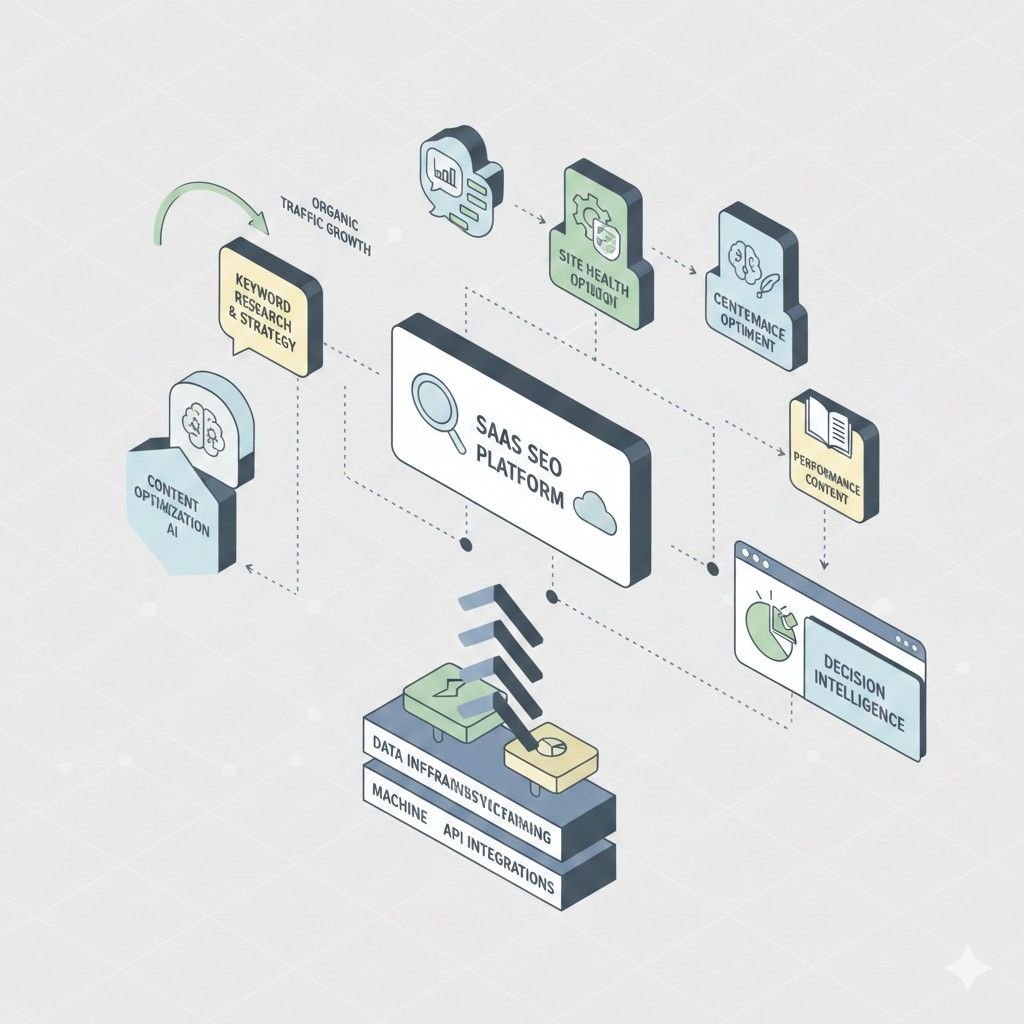
Enterprise SaaS SEO Tools and Technology Stack
The right technology stack enables efficient execution, accurate measurement, and informed decision-making. Enterprise programs require more sophisticated tooling than smaller operations.
Tool selection should balance capability with complexity. Overly complex stacks create maintenance burdens and adoption challenges.
Technical SEO and Site Audit Tools
Technical SEO requires specialized crawling and analysis tools:
Screaming Frog provides comprehensive site crawling for technical audits. The tool identifies issues with redirects, canonicals, meta data, and site structure.
Sitebulb offers visual site architecture analysis and prioritized recommendations. The tool excels at identifying technical issues and their impact.
Google Search Console provides direct insight into how Google sees and indexes the site. This free tool is essential for monitoring indexing status and identifying issues.
Lumar (formerly Deepcrawl) offers enterprise-scale crawling with advanced segmentation and monitoring capabilities.
Content Optimization and Research Platforms
Content strategy and optimization benefit from dedicated platforms:
Clearscope or Surfer SEO provide content optimization recommendations based on competitive analysis. These tools help ensure content covers topics comprehensively.
Ahrefs or Semrush offer keyword research, competitive analysis, and content gap identification. These platforms are essential for content strategy development.
MarketMuse provides AI-powered content planning and optimization for enterprise content programs.
Rank Tracking and Competitive Intelligence
Monitoring rankings and competitive positioning requires dedicated tracking:
Ahrefs, Semrush, or Moz provide rank tracking across keyword portfolios. Enterprise programs may track thousands of keywords across multiple markets.
Similarweb offers competitive traffic analysis and market share insights.
SparkToro provides audience research and competitive intelligence for content and link building strategy.
Analytics and Attribution Solutions
Measuring SEO impact requires robust analytics infrastructure:
Google Analytics 4 provides foundational traffic and engagement analysis. Proper configuration is essential for accurate measurement.
Segment or similar customer data platforms enable unified tracking across touchpoints.
Attribution platforms like Dreamdata, Bizible, or HubSpot connect organic traffic to pipeline and revenue through multi-touch attribution models.
Integrating SEO with Enterprise SaaS Marketing Strategy
SEO delivers maximum value when integrated with broader marketing strategy. Isolated SEO programs miss synergies and struggle to demonstrate full impact.
Integration requires alignment on goals, coordinated execution, and shared measurement frameworks.
SEO and Demand Generation Alignment
SEO and demand generation share common objectives: generating qualified pipeline efficiently. Alignment ensures these functions support rather than compete with each other.
Practical alignment includes coordinating keyword targeting with campaign themes, repurposing SEO content for demand generation programs, and sharing audience insights across teams.
SEO content often serves demand generation purposes. Gated assets, webinar topics, and email content can originate from SEO keyword research and content production.
SEO and Product-Led Growth (PLG) Synergies
Product-led growth strategies create unique SEO opportunities. Free trials, freemium tiers, and self-service onboarding generate user-created content, reviews, and organic advocacy.
SEO supports PLG by driving trial signups through organic visibility. PLG supports SEO by generating authentic user signals, reviews, and word-of-mouth links.
Integration points include optimizing signup flows for organic traffic, creating content supporting self-service discovery, and leveraging user success stories for link building.
Multi-Channel Attribution: SEO’s Role in the Buyer Journey
Enterprise B2B purchases involve multiple touchpoints across extended timeframes. SEO often plays an early-stage role, introducing buyers to solutions during research phases.
Proper attribution credits SEO for its influence even when other channels receive last-touch credit. Multi-touch models reveal SEO’s true contribution to pipeline and revenue.
Understanding SEO’s role in the buyer journey informs content strategy. If organic search primarily drives early-stage awareness, top-funnel educational content deserves investment priority.
Enterprise SaaS SEO Case Studies and Benchmarks
Real-world examples and industry benchmarks provide context for planning and evaluation. Understanding what successful programs achieve helps set appropriate targets.
B2B SaaS SEO Success Stories
Successful enterprise SaaS SEO programs share common characteristics: sustained investment, comprehensive strategy, and patient execution.
Companies like HubSpot, Salesforce, and Atlassian have built dominant organic positions through years of consistent investment. Their content libraries span thousands of pages, their domain authorities exceed 90, and organic search drives substantial portions of their pipeline.
Emerging SaaS companies have achieved significant organic growth through focused strategies. Companies targeting specific niches can achieve category dominance with smaller absolute investments by concentrating resources on defined keyword clusters.
Industry Benchmarks: Traffic, Conversions, and Pipeline
Industry benchmarks help contextualize program performance:
Organic traffic growth: Successful programs typically achieve 50-100% year-over-year growth during scaling phases, moderating to 20-30% annually at maturity.
Organic conversion rates: B2B SaaS organic traffic converts at 2-5% for lead generation, varying by traffic quality and offer relevance.
Pipeline contribution: Mature programs attribute 30-50% of pipeline to organic search when using multi-touch attribution models.
Cost efficiency: Organic cost per lead typically runs 60-70% lower than paid acquisition for mature programs.
These benchmarks represent achievable targets for well-executed programs with appropriate investment levels.
How to Evaluate an Enterprise SaaS SEO Partner
Selecting the right agency partner significantly impacts program success. Evaluation should assess capabilities, approach, and fit with organizational needs.
Questions to Ask Potential SEO Agencies
Effective evaluation includes probing questions:
Experience questions:
- What enterprise SaaS clients have you worked with?
- Can you share case studies with measurable results?
- How do you handle complex technical environments?
Approach questions:
- How do you develop SEO strategy for enterprise clients?
- What does your typical engagement timeline look like?
- How do you measure and report on success?
Team questions:
- Who will work on our account?
- What is your team’s experience with our industry?
- How do you handle capacity constraints?
Process questions:
- How do you collaborate with internal teams?
- What is your approach to technical implementation?
- How do you handle strategy adjustments?
Red Flags in Enterprise SEO Proposals
Warning signs indicate potential problems:
Guaranteed rankings: No legitimate agency can guarantee specific ranking positions. Search algorithms are complex and rankings depend on competitive factors outside any agency’s control.
Vague deliverables: Proposals should specify exactly what will be delivered, when, and by whom. Vague language often masks limited actual work.
Unrealistic timelines: Promises of significant results within 3-6 months for competitive enterprise keywords indicate either inexperience or dishonesty.
Link scheme involvement: Any mention of link networks, PBNs, or purchased links indicates tactics that risk penalties.
Lack of attribution focus: Agencies that cannot explain how they will measure revenue impact likely lack enterprise experience.
What to Expect from a Strategic SEO Partnership
Effective agency partnerships deliver:
Strategic guidance: Beyond execution, agencies should provide strategic recommendations informed by experience across multiple clients and industries.
Transparent communication: Regular reporting, proactive updates, and honest assessment of progress and challenges.
Collaborative approach: Working with internal teams rather than operating in isolation.
Measurable results: Clear connection between activities and outcomes, with attribution to business metrics.
Continuous improvement: Ongoing optimization based on performance data and competitive dynamics.
Conclusion
Enterprise SaaS SEO investment represents a strategic commitment to building sustainable organic growth. Success requires appropriate budget allocation across technical infrastructure, content production, authority building, and analytics—sustained over 18-24 months minimum to achieve meaningful results.
The companies that invest strategically in SEO build compounding advantages that become increasingly difficult for competitors to overcome. Organic search becomes a primary pipeline driver, delivering qualified leads at a fraction of paid acquisition costs while establishing market authority.
We help enterprise SaaS companies build and execute comprehensive SEO programs that connect organic visibility to pipeline and revenue. Contact White Label SEO Service to discuss how strategic SEO investment can accelerate your organic growth trajectory.
Frequently Asked Questions About Enterprise SaaS SEO Investment
What is a reasonable SEO budget for enterprise SaaS?
Enterprise SaaS companies typically invest $25,000-$100,000+ monthly for comprehensive SEO programs. Budget should scale with competitive intensity and growth objectives. Companies in highly competitive markets or pursuing aggressive growth require investment at the higher end of this range.
How long does it take to see ROI from enterprise SEO?
Meaningful ROI typically materializes between months 12-18 for enterprise programs. Initial ranking improvements appear in months 4-6, with traffic growth accelerating through months 7-12. Full program maturity and maximum ROI occur in year two and beyond as compounding effects take hold.
Should enterprise SaaS companies prioritize SEO or paid ads?
Most enterprise SaaS companies benefit from both channels serving different purposes. Paid provides immediate traffic and testing capabilities while SEO builds long-term sustainable growth. The optimal mix depends on growth timeline, competitive dynamics, and budget constraints.
What makes SaaS SEO different from other industries?
SaaS SEO involves longer sales cycles, multiple buyer personas, complex technical products, and subscription-based business models. Content must address various buying stages and use cases. Technical SEO often involves JavaScript-heavy applications and dynamic content that create unique challenges.
How do you measure SEO success for enterprise software?
Enterprise SEO success is measured through pipeline and revenue attribution, not just traffic metrics. Key metrics include organic pipeline contribution, cost per organic acquisition, and organic revenue. Multi-touch attribution models connect organic traffic to closed deals across extended sales cycles.
What team structure do enterprise SaaS companies need for SEO?
Comprehensive enterprise SEO teams include an SEO director, technical SEO specialist, content strategist, writers, link building specialist, and analyst. Many companies use hybrid models combining in-house leadership with agency execution. Team size scales with investment level and program scope.
How should SEO budget be allocated across different activities?
General allocation guidelines suggest 40-50% for content strategy and production, 20-30% for authority building and link acquisition, 15-25% for technical SEO, and 10-15% for analytics and tools. Allocation should be adjusted based on program maturity and specific needs identified through ongoing analysis.