
Understanding the distinction between feature keywords and solution keywords transforms how you approach SEO strategy and content planning. These two keyword categories serve different purposes in the buyer journey, attract users with distinct mindsets, and require tailored content approaches to maximize their potential.
Most businesses unknowingly focus on one type while neglecting the other, leaving significant traffic and conversion opportunities untapped. This imbalance often explains why some pages generate impressive traffic but few leads, while others convert well but struggle to attract visitors.
This guide breaks down both keyword types, shows you how to identify them in your niche, and provides a framework for building a balanced strategy that captures users at every stage of their journey.
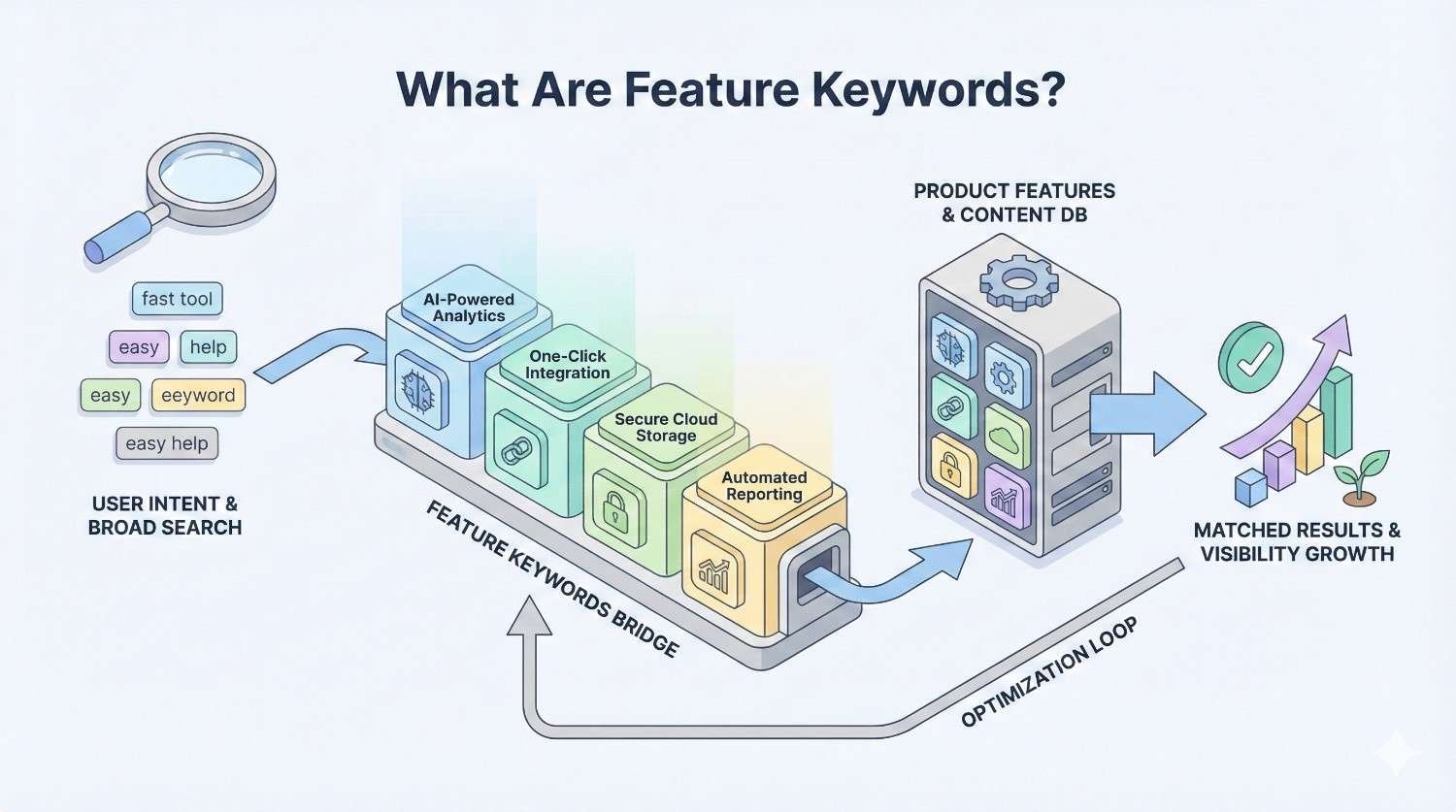
What Are Feature Keywords?
Feature keywords represent a specific category of search terms that focus on product or service attributes, specifications, and capabilities. Understanding their nature helps you create content that matches what users actually want when they type these queries.
Definition and Core Characteristics
Feature keywords describe what a product, service, or tool does or includes. They center on specifications, functionalities, technical attributes, and capabilities rather than problems or outcomes.
These keywords typically contain product-specific terminology. They reference measurable attributes like size, speed, capacity, or compatibility. Users searching feature keywords already know what type of solution they need and are evaluating options based on specific criteria.
The language tends to be technical or specification-oriented. Someone searching “CRM with email automation” knows they want a CRM and is filtering options by a specific feature. The search assumes baseline knowledge about the product category.
Common Examples of Feature Keywords
Feature keywords appear across every industry with consistent patterns. In software, you see terms like “project management tool with Gantt charts,” “accounting software with invoicing,” or “email marketing platform with A/B testing.”
E-commerce examples include “wireless headphones with noise cancellation,” “laptop with 32GB RAM,” or “running shoes with arch support.” Each query specifies a product category plus a desired attribute.
Service-based businesses encounter feature keywords like “SEO agency with link building services,” “law firm with free consultation,” or “gym with personal training.” The searcher knows the service category and filters by specific offerings.
When Users Search Feature Keywords
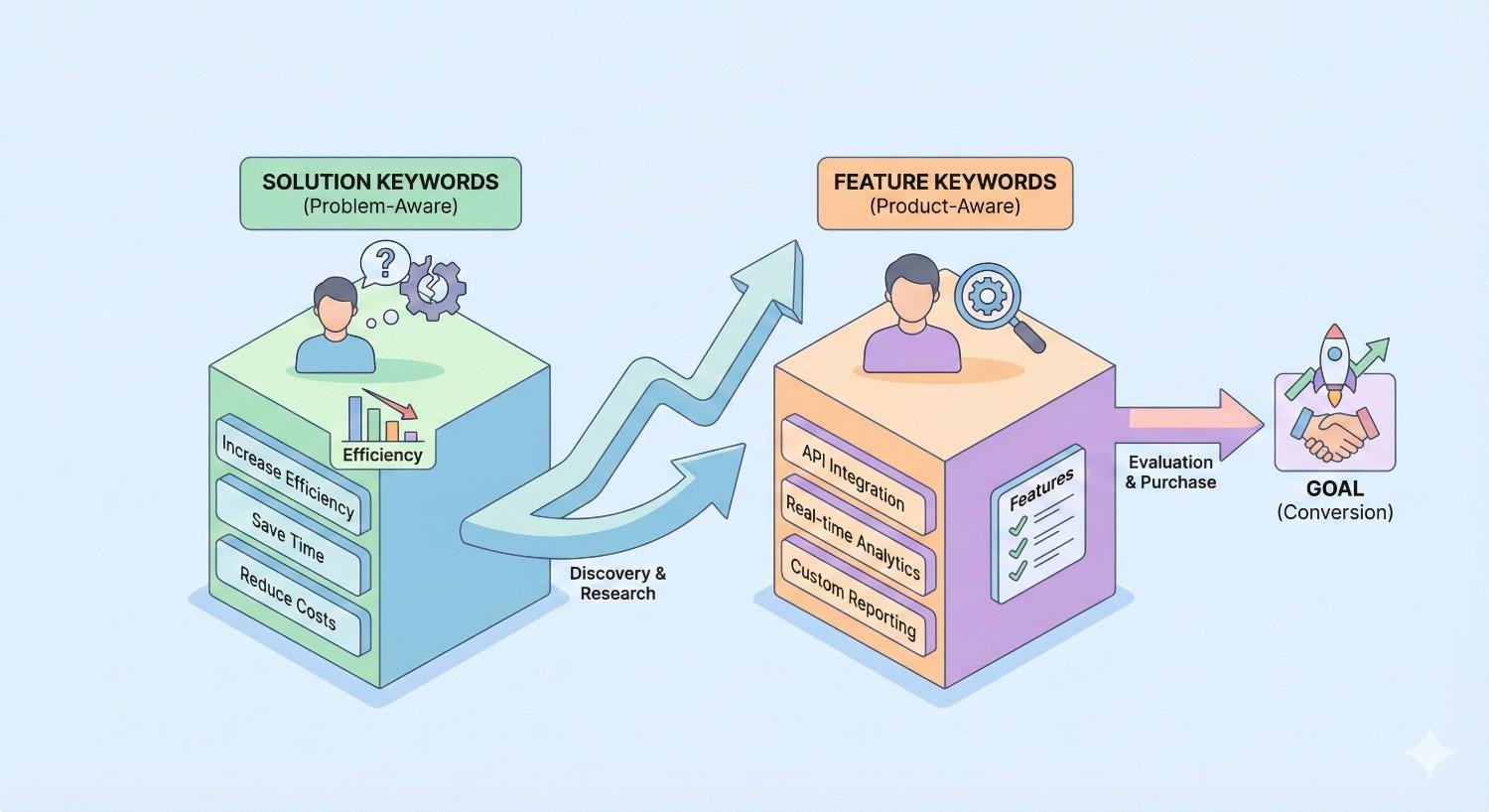
Users turn to feature keywords during the consideration and evaluation phases of their journey. They have already identified their general need and are now comparing options based on specific criteria.
This search behavior indicates product awareness. The user understands the solution category and is narrowing choices. They may be creating shortlists, comparing specifications, or validating that a product meets their requirements.
Feature keyword searches often happen after initial research. Someone might first search “how to manage remote teams” (solution keyword), then later search “project management software with time tracking” (feature keyword) once they know what tool category they need.
What Are Solution Keywords?
Solution keywords take a fundamentally different approach by focusing on problems, challenges, and desired outcomes rather than product specifications. They capture users earlier in their journey and require different content strategies.
Definition and Core Characteristics
Solution keywords express problems users want to solve or outcomes they want to achieve. They focus on the “why” rather than the “what,” describing situations, challenges, pain points, or goals.
These keywords rarely mention specific product categories. Instead, they describe symptoms, frustrations, or aspirations. Someone searching “how to reduce customer churn” has a problem but may not know what type of solution addresses it.
The language mirrors how people naturally describe their challenges. Solution keywords often appear as questions or problem statements. They reflect the user’s current state rather than their knowledge of available solutions.
Common Examples of Solution Keywords
Solution keywords reveal pain points and goals across industries. Business examples include “how to get more leads,” “reduce employee turnover,” “improve website conversion rate,” or “automate repetitive tasks.”
Consumer examples show similar patterns: “stop back pain while working,” “save money on groceries,” “learn guitar faster,” or “get better sleep.” Each describes a desired outcome without specifying a product type.
Technical solution keywords might include “speed up slow website,” “prevent data breaches,” or “reduce server downtime.” The searcher knows their problem but may not know whether they need software, services, or process changes.
When Users Search Solution Keywords
Solution keyword searches happen during the awareness and early consideration stages. Users recognize they have a problem but may not know what solutions exist or which category fits their needs.
This represents the beginning of the buyer journey for many users. They are researching their problem, understanding their options, and learning about potential approaches. They have not yet committed to a solution type.
Solution keyword searches indicate educational intent. Users want to understand their situation better before evaluating specific products. Content that ranks for these terms has the opportunity to shape how users think about their problem and guide them toward specific solution categories.
Key Differences Between Feature Keywords and Solution Keywords
The distinctions between these keyword types extend beyond surface-level differences in phrasing. Understanding these differences shapes your entire content and SEO strategy.
Search Intent Comparison
Feature keywords carry commercial investigation or transactional intent. Users searching these terms are actively evaluating products and moving toward a purchase decision. They want specifications, comparisons, and validation that a product meets their criteria.
Solution keywords typically carry informational intent. Users want to understand their problem, learn about approaches, and discover what options exist. They are not yet ready to evaluate specific products.
This intent difference determines what content satisfies each search. Feature keyword content should facilitate comparison and decision-making. Solution keyword content should educate, build trust, and guide users toward appropriate solution categories.
Buyer Journey Stage Alignment
Feature keywords align with the middle and bottom of the funnel. Users have progressed past awareness and are actively considering specific solutions. They know what they want and are determining which option best delivers it.
Solution keywords align with the top and middle of the funnel. Users are still defining their problem and exploring approaches. They may not know your product category exists or that it addresses their challenge.
This alignment affects how you measure success. Feature keyword content should drive product page visits, demo requests, and purchases. Solution keyword content should drive email signups, content engagement, and movement into the consideration phase.
Conversion Potential Differences
Feature keywords generally show higher immediate conversion rates. Users are closer to purchase decisions and have clearer buying intent. Content ranking for these terms often converts directly to sales or qualified leads.
Solution keywords typically show lower immediate conversion rates but capture larger audiences. Users need more nurturing before they are ready to buy. However, these keywords often have higher search volumes and lower competition.
The total conversion value depends on your funnel efficiency. A solution keyword with 10,000 monthly searches and a 1% conversion rate may generate more leads than a feature keyword with 500 searches and a 5% conversion rate. Both play essential roles.
Content Strategy Implications
Feature keyword content requires product knowledge and comparison frameworks. You need to demonstrate how specific features work, compare options, and help users make informed decisions. Product pages, comparison guides, and feature breakdowns perform well.
Solution keyword content requires problem expertise and educational depth. You need to demonstrate understanding of the user’s situation, explain various approaches, and build trust before introducing your solution. Guides, how-to content, and problem-focused articles work best.
Your content calendar should include both types. Focusing exclusively on feature keywords limits your audience to users who already know about your solution category. Focusing only on solution keywords may attract traffic that never converts because you lack decision-stage content.
How to Identify Feature Keywords in Your Niche
Finding feature keywords requires systematic research into how users describe and search for product attributes in your market. Several methods help uncover these valuable terms.
Keyword Research Methods
Start with your product’s feature list. Document every capability, specification, and attribute your product offers. Then research how users search for each feature using keyword tools.
Analyze competitor product pages. Note which features they highlight and how they describe them. Search these terms to see search volumes and related queries. Competitors often reveal feature keywords you have overlooked.
Review customer conversations. Sales calls, support tickets, and reviews reveal which features matter most to buyers. The language customers use often differs from internal terminology and reflects actual search behavior.
Analyzing Search Modifiers and Patterns
Feature keywords follow predictable patterns. Look for searches combining product categories with modifiers like “with,” “that has,” “including,” or “featuring.” These modifiers signal feature-focused intent.
Specification modifiers indicate feature searches. Terms like “best [product] for [use case],” “[product] with [specification],” or “[product] under [price/size/capacity]” all represent feature-oriented queries.
Comparison modifiers also signal feature intent. Searches like “[product A] vs [product B],” “best [product] for [specific need],” or “[product] comparison” indicate users evaluating options based on features.
Tools for Feature Keyword Discovery
Semrush and Ahrefs provide keyword research capabilities that help identify feature-related searches. Use their keyword magic tools to explore variations around your product features.
Google Search Console reveals which feature-related queries already drive impressions to your site. Filter for queries containing feature terms to find optimization opportunities.
AnswerThePublic and AlsoAsked show questions people ask about products, many of which relate to specific features. These tools help you understand how users phrase feature-related queries.
How to Identify Solution Keywords in Your Niche
Solution keyword research requires shifting perspective from your product to your customer’s problems. This approach uncovers terms that capture users before they know about your solution category.
Problem-Focused Research Techniques
Map your product’s benefits to the problems they solve. For each feature, ask “what problem does this solve?” and “what outcome does this enable?” These answers reveal solution keyword themes.
Research industry challenges and pain points. Industry reports, surveys, and trend analyses identify problems your target audience faces. These problems become the foundation for solution keyword research.
Study the language of problem awareness. How do people describe their challenges before they know solutions exist? This language often differs significantly from how solution providers describe the same issues.
Mining Customer Questions and Pain Points
Customer support interactions reveal solution keywords. Analyze support tickets, chat logs, and call recordings for how customers describe their problems before learning about your product.
Sales conversations capture early-stage language. Prospects often describe their situation in problem terms during initial calls. Document these phrases as potential solution keywords.
Online communities provide unfiltered problem language. Reddit, Quora, industry forums, and social media groups show how people naturally discuss challenges. Search these platforms for discussions related to problems your product solves.
Tools for Solution Keyword Discovery
Quora and Reddit searches reveal how people phrase problems in your industry. Look for question patterns and recurring themes that indicate common challenges.
Google’s “People Also Ask” boxes show related questions for any search. Start with a known solution keyword and explore the questions to find problem-focused variations.
BuzzSumo identifies popular content in your niche. Analyze top-performing articles to understand which problems resonate with your audience and drive engagement.
When to Target Feature Keywords vs Solution Keywords
Strategic keyword targeting requires matching keyword types to your business goals, resources, and competitive position. Neither type is universally better; the right choice depends on your situation.
Matching Keywords to Business Goals
If your immediate goal is revenue, prioritize feature keywords. These terms attract users closer to purchase decisions and convert more directly. They suit businesses with established products and sales processes.
If your goal is audience building and brand awareness, prioritize solution keywords. These terms capture larger audiences earlier in their journey. They suit businesses investing in long-term growth and content marketing.
Most businesses need both. The question is resource allocation and sequencing. Limited resources may require focusing on one type initially, then expanding to the other as capacity grows.
Funnel Stage Targeting Strategy
Map keywords to funnel stages for strategic coverage. Solution keywords fill the top of funnel, attracting users who are just discovering their problem. Feature keywords fill the middle and bottom, capturing users ready to evaluate and decide.
Identify gaps in your current coverage. If you rank well for feature keywords but struggle with solution keywords, you are missing top-of-funnel traffic. If the reverse is true, you may attract visitors who never convert because you lack decision-stage content.
Create content pathways between stages. Solution keyword content should guide users toward feature keyword content. Internal linking, CTAs, and content recommendations should move users through your funnel.
Balancing Both Keyword Types in Your Strategy
A balanced strategy captures users at every journey stage. The ideal ratio depends on your business model, sales cycle length, and competitive landscape.
Longer sales cycles benefit from heavier solution keyword investment. Users need more education and nurturing before they are ready to buy. Solution content builds relationships over time.
Shorter sales cycles may favor feature keywords. Users move quickly from problem awareness to purchase. Capturing them during the evaluation phase may be more efficient than nurturing them from awareness.
Review your analytics to find the right balance. Track how users move through your content and which entry points lead to conversions. Adjust your keyword mix based on actual performance data.
Creating Content for Feature Keywords
Feature keyword content serves users who are actively evaluating options. The content formats, optimization approaches, and examples differ significantly from solution keyword content.
Content Formats That Work Best
Comparison pages perform exceptionally well for feature keywords. Users searching feature terms often want to compare options. Pages comparing your product to alternatives or comparing multiple solutions satisfy this intent.
Feature-focused landing pages convert feature keyword traffic. These pages should detail specific capabilities, show the feature in action, and address common questions about that functionality.
Product roundups and “best of” lists capture feature keyword searches. Users searching “best [product] with [feature]” want curated recommendations. These pages can rank well and drive qualified traffic.
Optimization Techniques
Include the specific feature in your title tag and H1. Users scanning search results look for confirmation that your page addresses their specific need. Clear feature mentions improve click-through rates.
Structure content around feature benefits and use cases. Explain not just what the feature does but why it matters and how users apply it. This depth satisfies user intent and improves engagement metrics.
Add comparison elements even on single-product pages. Show how your feature implementation compares to alternatives. This addresses the comparative mindset of feature keyword searchers.
Feature Keyword Content Examples
A SaaS company targeting “CRM with email automation” might create a page titled “CRM Email Automation: How [Product] Streamlines Your Outreach.” The page would detail the automation capabilities, show workflows, and compare to manual processes.
An e-commerce site targeting “running shoes with arch support” could create a buying guide explaining arch support technology, comparing support levels across models, and recommending options for different arch types.
A service business targeting “SEO agency with link building” might create a service page detailing their link building methodology, showing case study results, and explaining how link building integrates with their broader SEO approach.
Creating Content for Solution Keywords
Solution keyword content educates users about their problems and guides them toward appropriate solutions. This content builds trust and positions your brand as a helpful resource.
Content Formats That Work Best
Comprehensive guides perform well for solution keywords. Users searching problem-focused terms want thorough explanations. Long-form content that covers all aspects of a problem satisfies this intent.
How-to articles address solution keywords phrased as questions. Step-by-step instructions help users solve problems and demonstrate your expertise. These articles often earn featured snippets.
Problem diagnosis content helps users understand their situation. Articles explaining why problems occur, what factors contribute, and how to assess severity capture early-stage searchers.
Optimization Techniques
Lead with the problem, not your product. Solution keyword searchers want to understand their situation first. Content that immediately pitches products feels misaligned with their intent.
Provide genuine value before any product mention. Earn trust by helping users understand their problem thoroughly. Only introduce your solution after establishing credibility and relevance.
Include multiple solution approaches. Users searching solution keywords may not know your product category is the answer. Presenting various approaches (including yours) builds trust and positions you as an objective resource.
Solution Keyword Content Examples
A project management software company targeting “how to improve team productivity” might create a guide covering productivity frameworks, communication strategies, and tool recommendations. Their software appears as one solution among several.
A cybersecurity firm targeting “prevent data breaches” could create comprehensive content explaining breach causes, prevention strategies, and response plans. Their services appear in context as part of a complete security approach.
A fitness brand targeting “reduce back pain from sitting” might publish content covering ergonomics, exercises, and lifestyle changes. Their products appear as tools supporting the broader solution.
Measuring Performance: Feature Keywords vs Solution Keywords
Different keyword types require different success metrics. Applying the same measurements to both leads to misleading conclusions about content performance.
Traffic Metrics to Track
For feature keywords, monitor qualified traffic rather than total volume. These keywords typically have lower search volumes but higher relevance. Track traffic quality through engagement metrics and conversion rates.
For solution keywords, total traffic matters more initially. These keywords capture broader audiences. Monitor traffic growth, new user acquisition, and audience expansion over time.
Both keyword types benefit from tracking organic impressions and click-through rates in Google Search Console. Rising impressions indicate growing visibility; improving CTR suggests better SERP positioning and title optimization.
Conversion Metrics to Track
Feature keyword content should drive direct conversions. Track demo requests, free trial signups, purchases, or other bottom-funnel actions. These pages should show clear conversion attribution.
Solution keyword content drives micro-conversions and assisted conversions. Track email signups, content downloads, return visits, and multi-touch attribution. These pages contribute to conversions that happen later in the journey.
Set up conversion paths in Google Analytics to understand how solution keyword content contributes to eventual purchases. First-touch and assisted conversion reports reveal value that direct attribution misses.
Adjusting Strategy Based on Data
If feature keyword content drives traffic but not conversions, examine intent alignment. The content may attract users who are not actually ready to buy, or the page may lack clear conversion paths.
If solution keyword content fails to move users toward conversion, check your internal linking and CTAs. Users need clear pathways from educational content to product information.
Review performance quarterly and adjust keyword targeting based on results. Some keywords will outperform expectations; others will underperform. Reallocate resources toward what works.
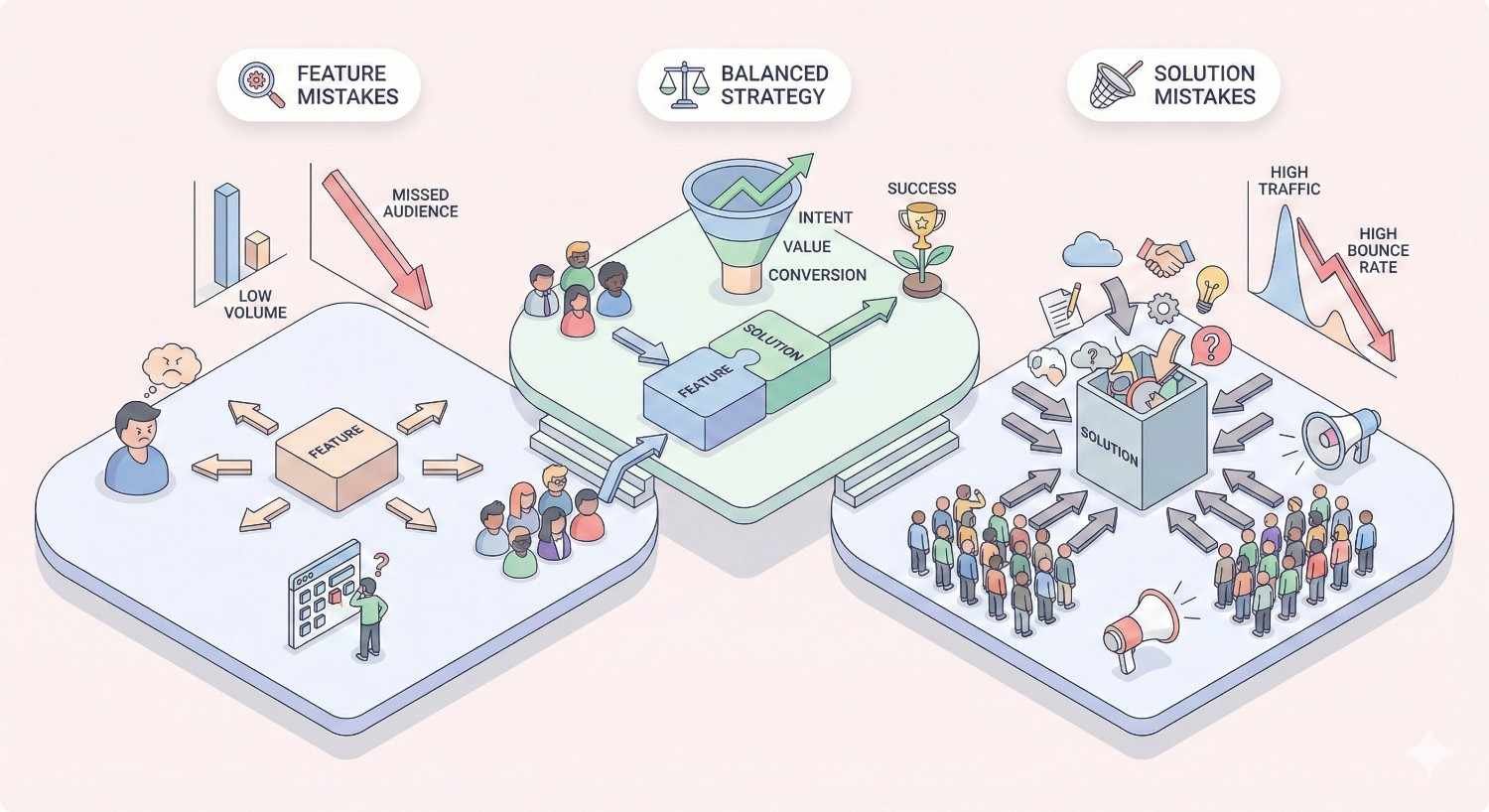
Common Mistakes When Targeting Feature and Solution Keywords
Several recurring errors undermine keyword strategies. Recognizing these mistakes helps you avoid them and improve your results.
Misaligning Content with Intent
The most common mistake is creating the wrong content type for a keyword. Feature keyword pages that read like educational articles fail to help users compare and decide. Solution keyword pages that immediately pitch products feel salesy and unhelpful.
Match content format to search intent. Analyze what currently ranks for your target keyword. If comparison pages dominate, create comparison content. If educational guides rank, create educational content.
Test your content against user expectations. Would someone searching this term find your content helpful? Does it answer their actual question or serve your agenda? Honest assessment prevents intent misalignment.
Ignoring Buyer Journey Context
Some businesses create feature content for users who have not yet reached the consideration stage. These users are not ready to compare products; they are still understanding their problem.
Others create only solution content, leaving users without guidance when they are ready to evaluate options. These users may find your educational content helpful but purchase from competitors who provide better decision-stage resources.
Map your content to journey stages and ensure coverage at each phase. Identify where users enter your content ecosystem and where they exit. Fill gaps that cause users to leave before converting.
Over-Focusing on One Keyword Type
Businesses often gravitate toward one keyword type based on comfort or past success. Product-focused companies naturally create feature content. Content marketing teams naturally create solution content.
This imbalance limits growth. Feature-only strategies miss top-of-funnel opportunities. Solution-only strategies fail to capture users ready to buy.
Audit your current content distribution. Calculate what percentage targets feature keywords versus solution keywords. If the split is heavily skewed, prioritize the underrepresented type in your content calendar.
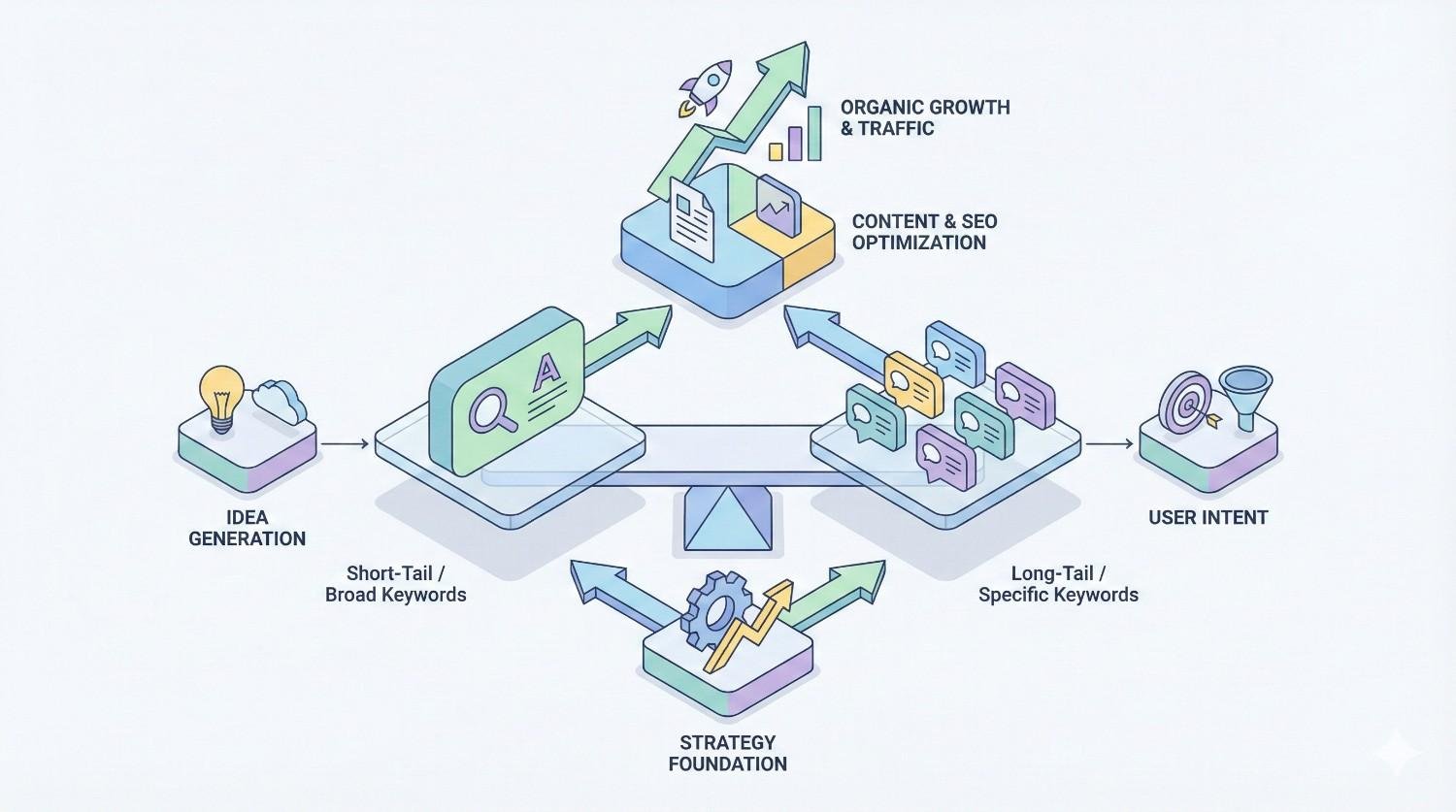
Building a Balanced Keyword Strategy
Long-term SEO success requires systematic integration of both keyword types. A balanced approach captures users throughout their journey and maximizes your content investment.
Integrating Both Keyword Types
Start by mapping your existing content to keyword types. Identify which pages target feature keywords, which target solution keywords, and which attempt both (often unsuccessfully).
Create explicit connections between content types. Solution keyword content should link to relevant feature keyword content. Feature keyword content should reference the problems your features solve.
Plan content in pairs or clusters. When creating solution content, plan the corresponding feature content that captures users as they progress. This systematic approach ensures complete journey coverage.
Content Mapping Framework
Build a content map organized by buyer journey stage and keyword type. The top row lists journey stages: Awareness, Consideration, Decision. The columns list keyword types and corresponding content.
Awareness stage content targets solution keywords with educational formats. Consideration stage content may target both types with comparison and evaluation content. Decision stage content targets feature keywords with product-focused pages.
Use this framework to identify gaps. Empty cells in your content map represent missed opportunities. Prioritize filling gaps that connect to high-performing existing content.
Long-Term SEO Growth Considerations
Topical authority requires comprehensive coverage. Search engines recognize sites that thoroughly cover a topic across all angles. Targeting both keyword types demonstrates broader expertise than focusing on one.
Content ecosystems outperform isolated pages. Individual pages targeting single keywords have limited potential. Interconnected content clusters targeting related feature and solution keywords build compounding authority.
Plan for content maintenance and updates. Both keyword types require ongoing optimization as search behavior evolves, competitors publish new content, and your products change. Build update cycles into your content operations.
Conclusion
Feature keywords and solution keywords serve distinct purposes in your SEO strategy, capturing users at different journey stages with different content needs. Understanding when and how to target each type transforms your ability to attract qualified traffic and convert visitors into customers.
The most effective SEO strategies integrate both keyword types systematically. Solution keywords build your audience and establish trust early in the buyer journey. Feature keywords capture users ready to evaluate and purchase, converting the awareness you have built into revenue.
At White Label SEO Service, we help businesses build balanced keyword strategies that drive sustainable organic growth. Contact us to develop a content approach that captures users at every stage of their journey and turns search visibility into measurable business results.
Frequently Asked Questions
What is the main difference between feature and solution keywords?
Feature keywords describe product attributes and specifications, like “CRM with email automation.” Solution keywords describe problems and desired outcomes, like “how to improve sales follow-up.” The core difference is product focus versus problem focus.
Which keyword type has higher conversion rates?
Feature keywords typically show higher immediate conversion rates because users are closer to purchase decisions. However, solution keywords often capture larger audiences and contribute to conversions through longer nurturing paths. Total conversion value depends on your funnel efficiency.
Should startups focus on feature or solution keywords first?
Startups with limited resources often benefit from starting with solution keywords. These terms typically have lower competition and help establish thought leadership. As the business grows, expanding into feature keywords captures users ready to buy.
How do feature and solution keywords affect SEO timelines?
Solution keywords often show faster ranking progress due to lower competition, but take longer to generate revenue because users need nurturing. Feature keywords may take longer to rank due to commercial competition, but convert more quickly once rankings are achieved.
Can one page target both feature and solution keywords?
Attempting to target both on a single page usually dilutes effectiveness. The content either fails to fully address the problem (disappointing solution seekers) or buries product information (frustrating feature seekers). Separate pages with strong internal linking work better.
How do I know if my content matches the right keyword type?
Analyze search results for your target keyword. If educational guides dominate, it is a solution keyword requiring educational content. If product pages and comparisons rank, it is a feature keyword requiring decision-focused content. Match your format to what ranks.
What tools help identify both keyword types in my niche?
Keyword research platforms like Semrush and Ahrefs help identify both types through different filters. For feature keywords, search product category terms with modifiers. For solution keywords, use question-based research tools like AnswerThePublic and analyze “People Also Ask” results.