Most outreach campaigns fail not because of weak initial emails, but because of absent or poorly executed follow-ups. Data consistently shows that 80% of successful deals require five or more follow-up touches, yet most marketers stop after just one or two attempts. This gap represents massive untapped potential for your link building, PR, and partnership efforts.
The difference between a 5% response rate and a 25% response rate often comes down to systematic follow-up execution. Whether you’re building backlinks, securing guest posts, or landing media coverage, your follow-up strategy directly impacts campaign ROI.
This guide covers everything from optimal timing sequences to multi-channel approaches, industry-specific tactics, and ready-to-use templates that convert.
Understanding Outreach Follow-Up Fundamentals
What Is Outreach Follow-Up and Why It Matters
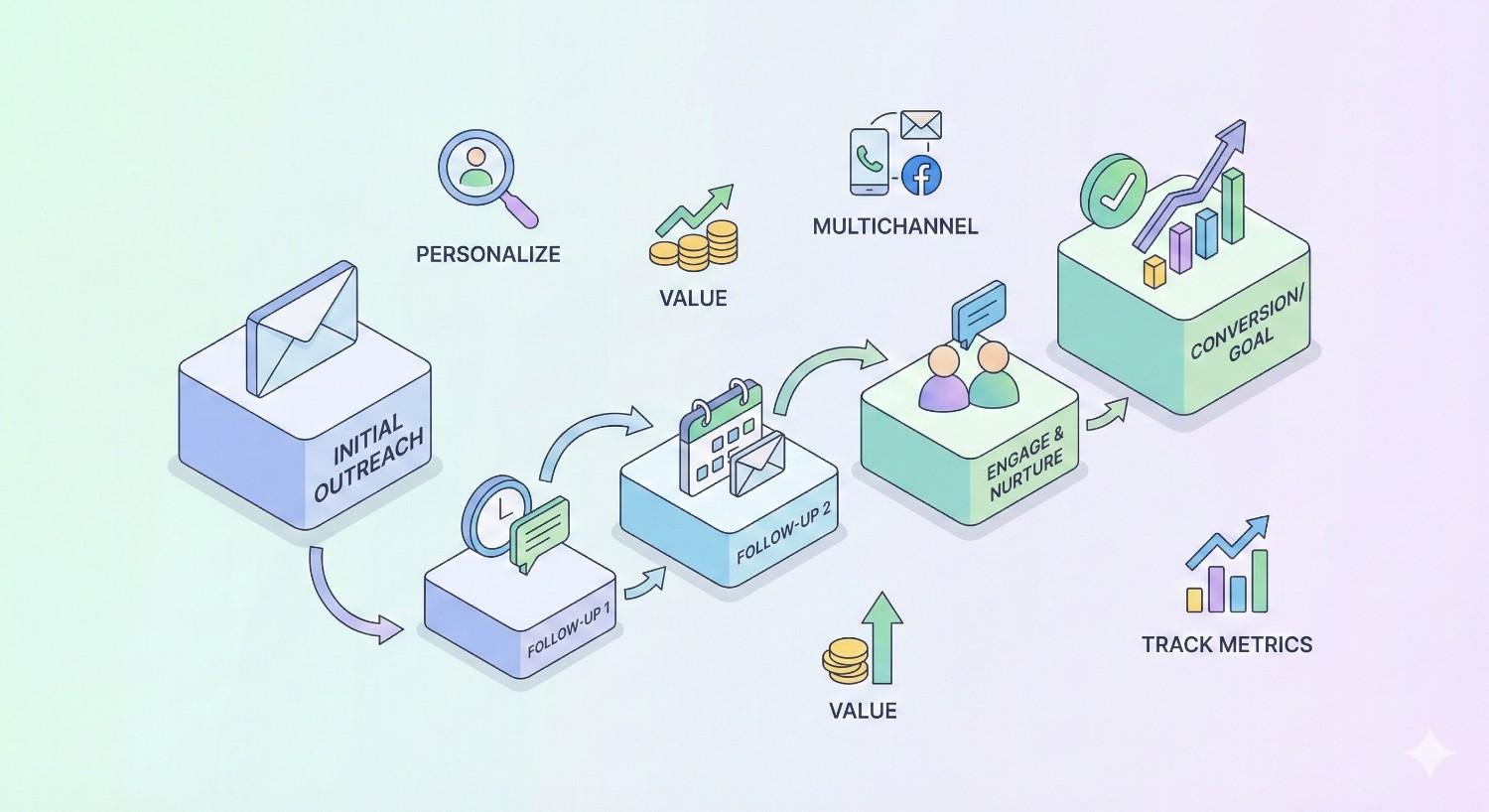
Outreach follow-up is the systematic process of re-engaging prospects who haven’t responded to your initial contact. It transforms single-touch campaigns into multi-touch sequences that dramatically increase conversion probability.
The math is straightforward. Your first email might achieve a 15-20% open rate and 2-5% response rate. Each strategic follow-up compounds these numbers. By the third or fourth touch, cumulative response rates can reach 25-40% for well-targeted campaigns.
Follow-ups matter because busy professionals miss emails constantly. Inboxes overflow. Priorities shift. Your message arrives at the wrong moment. A well-timed follow-up catches prospects when they’re ready to engage.
For SEO campaigns specifically, follow-up effectiveness directly correlates with link acquisition costs. Higher response rates mean more placements from the same prospect list, reducing your cost-per-link and accelerating authority building.
The Psychology Behind Effective Follow-Ups
Understanding why follow-ups work helps you craft better ones. Several psychological principles drive follow-up effectiveness.
The mere exposure effect means repeated contact increases familiarity and trust. Each touchpoint makes your name more recognizable, your request more legitimate.
Reciprocity plays a role when you add value in follow-ups. Sharing useful resources or insights creates psychological obligation to respond.
Social proof becomes more powerful with persistence. Prospects assume that someone following up professionally must have something worthwhile to offer.
Timing and context matter enormously. Your follow-up might arrive exactly when the prospect finishes a related project, suddenly making your pitch relevant.
The key insight: follow-ups don’t annoy most professionals when done correctly. They demonstrate commitment and professionalism. The prospects who find follow-ups annoying were unlikely to convert anyway.
Common Follow-Up Mistakes That Kill Response Rates
Certain patterns consistently destroy follow-up effectiveness. Avoid these errors.
Sending identical messages signals laziness and automation. Each follow-up should offer something new, whether fresh context, additional value, or a different angle.
Following up too quickly creates pressure and annoyance. Sending three emails in three days screams desperation.
Following up too slowly loses momentum. Waiting three weeks between touches means starting over each time.
Generic subject lines like “Following up” or “Checking in” get ignored. They communicate nothing compelling.
Apologizing for following up undermines your position. Phrases like “Sorry to bother you again” suggest your message lacks value.
Focusing only on your needs rather than prospect benefits kills engagement. Every follow-up should answer “what’s in it for them.”
No clear call-to-action leaves prospects unsure how to respond. Make the next step obvious and easy.
Timing Your Follow-Up Sequence
Optimal Wait Times Between Follow-Ups
Timing significantly impacts follow-up success. Research and practitioner experience point to specific intervals.
First follow-up: 3-4 business days after initial outreach. This gives prospects time to see and consider your message without losing context.
Second follow-up: 5-7 business days after the first follow-up. Slightly longer gaps prevent fatigue while maintaining presence.
Third follow-up: 7-10 business days after the second. Extended intervals signal persistence without desperation.
Fourth and beyond: 10-14 business days between touches. At this stage, you’re playing a longer game.
These intervals adjust based on context. Time-sensitive opportunities warrant faster sequences. High-value prospects might deserve more patience. Industry norms vary, with media and PR often expecting faster turnarounds than enterprise partnerships.
Track your own data. Some audiences respond better to compressed timelines. Others need more breathing room. Let performance metrics guide adjustments.
How Many Follow-Ups Should You Send
The optimal number depends on outreach type, prospect value, and your relationship history.
For cold outreach (link building, guest posting, PR), 4-6 follow-ups typically maximize returns without damaging reputation. Studies show response rates continue climbing through the fifth touch, then plateau.
For warm outreach (existing relationships, referrals), 3-4 follow-ups usually suffice. These prospects already know you, so fewer touches are needed.
For high-value targets (major publications, enterprise partnerships), extend to 6-8 touches over longer timeframes. The potential ROI justifies extra effort.
For transactional requests (simple link insertions, quick asks), 2-3 follow-ups work best. More can seem disproportionate to the request size.
The “break-up email” concept works well as a final touch. This message explicitly signals your last attempt, often triggering responses from prospects who intended to reply but procrastinated.
Best Days and Times for Follow-Up Emails
Timing within the week and day affects open and response rates.
Best days: Tuesday, Wednesday, and Thursday consistently outperform Monday and Friday. Monday inboxes overflow with weekend accumulation. Friday attention shifts toward weekend plans.
Best times: Mid-morning (9-11 AM) and mid-afternoon (2-4 PM) in the recipient’s timezone show strongest engagement. Early morning emails get buried. Late afternoon emails wait until tomorrow.
Avoid: Weekends for B2B outreach, holidays, and major industry events when attention is elsewhere.
These patterns vary by industry and role. C-suite executives might check email earlier. Creative professionals might engage later. Media contacts often work non-traditional hours.
Test different send times with your specific audience. Email platforms with send-time optimization can automate this testing.
When to Stop Following Up
Knowing when to stop protects your reputation and focuses resources on responsive prospects.
Stop immediately if someone explicitly requests no further contact. Respect this boundary absolutely.
Stop after your sequence completes (typically 4-6 touches) if you’ve received no engagement. No opens, no clicks, no responses means this prospect isn’t interested now.
Pause and revisit later if you see engagement (opens, clicks) but no response. These prospects might convert with different timing or messaging.
Stop permanently if your emails bounce, the contact leaves their role, or the opportunity becomes irrelevant.
Never stop maintaining a long-term nurture list. Prospects who don’t convert now might become perfect fits in six months. Quarterly or semi-annual check-ins keep relationships warm without overwhelming.
Document why you stopped for each prospect. This information helps when revisiting contacts later or analyzing campaign performance.
Crafting High-Converting Follow-Up Messages
Subject Line Strategies for Follow-Up Emails
Subject lines determine whether your follow-up gets opened. Effective follow-up subject lines share specific characteristics.
Reference the original thread when possible. “Re: [Original Subject]” maintains context and increases open rates by appearing as an ongoing conversation.
Add new information to signal fresh value. “Quick update on [topic]” or “New resource for [their site]” promises something worth opening.
Create curiosity without clickbait. “Thought about your [specific content]” or “Idea for [their challenge]” prompts engagement.
Keep it short. Mobile devices truncate long subjects. Aim for 6-10 words maximum.
Personalize when genuine. Including their name or company works if it feels natural, not forced.
Avoid spam triggers. Words like “free,” “urgent,” excessive punctuation, and ALL CAPS hurt deliverability.
Examples that work:
- “Re: Guest post for [Site Name]”
- “Quick follow-up + new angle”
- “Still interested in [specific topic]?”
- “One more thought on [their article]”
- “Did this land in spam?”
Test subject lines systematically. Small changes can significantly impact open rates.
Email Body Structure and Messaging
Follow-up email bodies should be shorter than initial outreach. Prospects already have context. Get to the point.
Opening line: Reference your previous message briefly. “Following up on my email last Tuesday about [topic]” establishes context in one sentence.
New value or angle: Add something fresh. A new resource, different perspective, updated information, or simplified ask. Never just repeat your original pitch.
Social proof or urgency (optional): If relevant, mention recent wins, deadlines, or limited availability. Only include if genuine.
Clear CTA: One specific, easy action. “Would a 10-minute call Thursday work?” beats “Let me know your thoughts.”
Sign-off: Professional, brief, no excessive pleasantries.
Keep follow-ups under 100 words when possible. Busy professionals appreciate brevity. If your message requires scrolling, it’s probably too long.
Format for scannability. Short paragraphs. White space. Bold key points if appropriate. Make the core message visible in preview panes.
Personalization Techniques That Work
Generic follow-ups get generic results. Personalization demonstrates genuine interest and effort.
Reference their recent content. Mention a specific article, podcast, or social post. Show you actually follow their work.
Acknowledge their challenges. If you know their industry struggles or company situation, address it directly.
Connect to mutual contacts. Shared connections build trust. Mention them naturally if relevant.
Note specific site details. For link building, reference particular pages, content gaps, or opportunities you’ve identified.
Adjust tone to match theirs. Mirror their communication style. Formal prospects get formal follow-ups. Casual communicators appreciate relaxed language.
Time-based personalization. Reference seasons, industry events, or company milestones. “Congrats on the Series B” shows you’re paying attention.
Avoid fake personalization. Inserting {First Name} into templates without genuine customization often backfires. Prospects recognize mail-merge laziness.
The goal: make each recipient feel like you wrote specifically for them, because you did.
Adding Value in Each Follow-Up
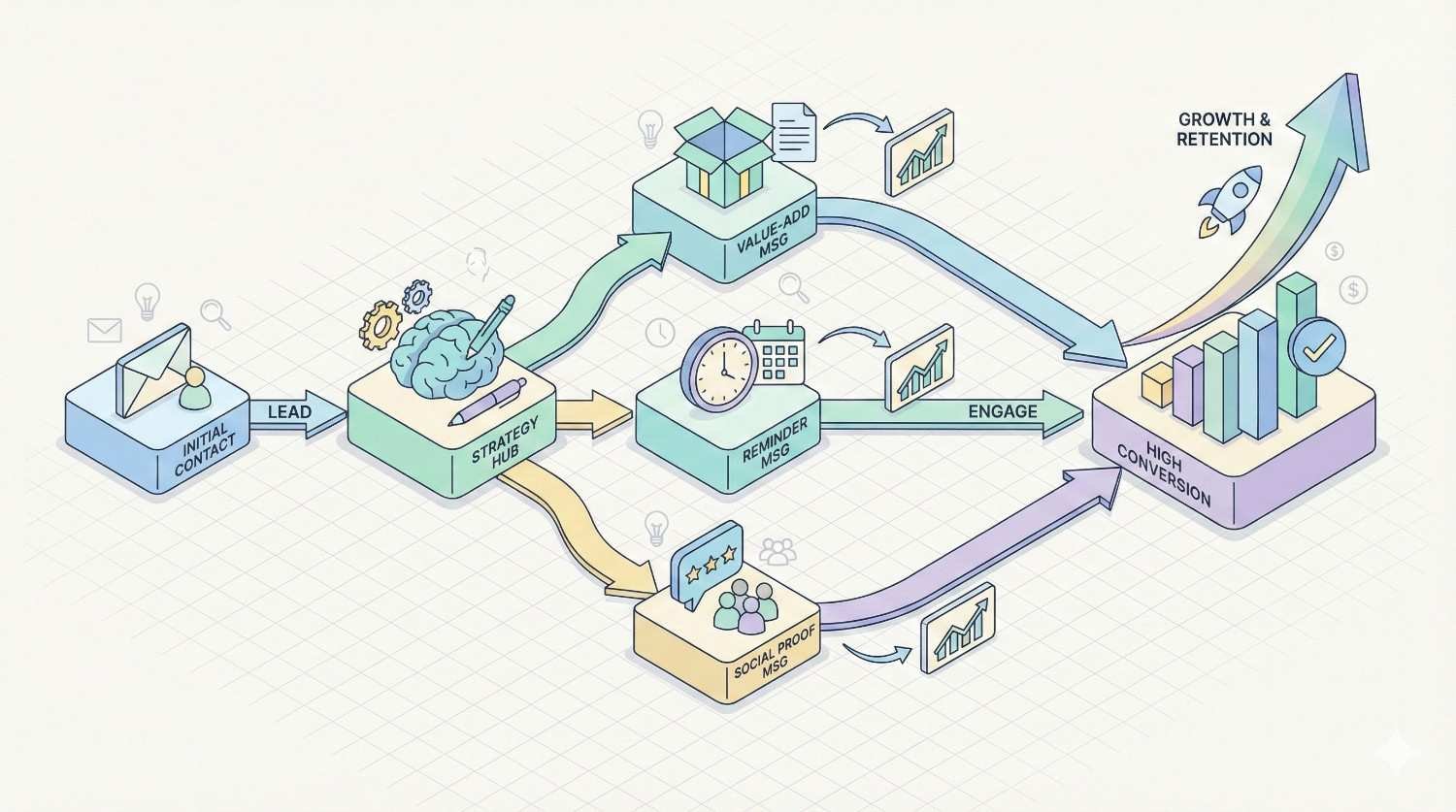
Every follow-up should offer something beyond “just checking in.” Value-add follow-ups dramatically outperform reminder-only messages.
Share relevant resources. Articles, tools, or data related to their interests. “Thought you’d find this research useful” positions you as helpful, not needy.
Offer new angles. If your initial pitch focused on one benefit, highlight a different one. “Another thought: this could also help with [different goal].”
Provide social proof. Share recent results, testimonials, or case studies. “Just helped [similar company] achieve [result]” builds credibility.
Simplify your ask. If your original request was complex, offer an easier entry point. “If a full collaboration is too much right now, would you be open to [smaller ask]?”
Give before asking. Share something valuable with no strings attached. Reciprocity often follows.
Update on your progress. If you’ve improved your offering since initial contact, share the news. “We just added [feature] that addresses [their concern].”
Track which value-adds resonate with your audience. Double down on what works.
Call-to-Action Best Practices
Your CTA determines whether engagement converts to action. Weak CTAs waste strong messages.
Be specific. “Would Tuesday at 2 PM work for a 15-minute call?” beats “Let’s chat sometime.”
Make it easy. Reduce friction. Include calendar links. Offer multiple options. Remove barriers.
Ask for one thing. Multiple CTAs confuse and paralyze. Choose your primary goal and focus there.
Match CTA to relationship stage. Early touches might ask for a reply. Later touches can request calls or commitments.
Create urgency when genuine. “Finalizing our Q2 partnerships this week” motivates action if true. Fake urgency damages trust.
Offer alternatives. “If timing doesn’t work, would you prefer I check back in [timeframe]?” gives prospects an easy out that keeps the door open.
Test different CTAs. Some audiences prefer calls. Others want email-only communication. Let data guide your approach.
Multi-Channel Follow-Up Approaches
Email Follow-Up Strategies
Email remains the primary outreach channel for most campaigns. Maximize its effectiveness with these strategies.
Thread your follow-ups when possible. Replying to your original email keeps context visible and increases open rates.
Vary your send times. If morning emails aren’t working, try afternoon. Different times reach prospects in different mindsets.
Use plain text for later follow-ups. HTML-heavy emails can feel promotional. Simple text feels personal.
Monitor engagement signals. Email tracking shows opens and clicks. Multiple opens without response might indicate interest but hesitation. Address potential objections.
Segment your follow-up approach. High-value prospects get more personalized sequences. Lower-priority contacts can receive more automated touches.
Clean your list regularly. Remove bounces, unsubscribes, and consistently unengaged contacts. List hygiene improves deliverability.
Test email length. Some audiences prefer detailed messages. Others want brevity. A/B test to find your sweet spot.
LinkedIn Follow-Up Tactics
LinkedIn provides a powerful secondary channel, especially for B2B outreach.
Connect first, pitch later. Send a connection request with a brief, non-salesy note. Once connected, your messages land in their primary inbox.
Engage with their content. Like, comment thoughtfully, and share their posts before following up. This warms the relationship.
Use InMail strategically. InMail works for non-connections but has limited monthly credits. Reserve for high-value targets.
Reference your email. “I sent an email last week about [topic]. Wanted to connect here as well” bridges channels naturally.
Keep LinkedIn messages shorter than email. The platform’s interface favors brevity. Get to the point quickly.
Leverage mutual connections. If you share connections, mention them. “I see we both know [Name]” builds instant credibility.
Time LinkedIn touches between emails. Don’t send email and LinkedIn messages the same day. Space them 2-3 days apart.
Phone Follow-Up Methods
Phone calls cut through inbox noise but require careful execution.
Call after email engagement. If someone opens your email multiple times, they’re interested. A call can close the gap.
Keep calls brief. Respect their time. State your purpose in 30 seconds. Ask if now works or offer to schedule.
Leave voicemails strategically. Short, specific voicemails referencing your emails can prompt responses. Long voicemails get deleted.
Follow calls with email. “Great speaking briefly. As mentioned, here’s [resource/information]” reinforces the conversation.
Research before calling. Know their role, company, and recent news. Personalized calls dramatically outperform cold scripts.
Accept that most calls won’t connect. Voicemail and callbacks are normal. Persistence pays off.
Track call outcomes. Note what you discussed, their objections, and next steps. This information improves future touches.
Twitter/Social Media Follow-Ups
Social platforms offer informal touchpoints that complement formal outreach.
Engage authentically first. Follow their account. Like and retweet relevant content. Comment thoughtfully on their posts.
Use DMs carefully. Twitter DMs can feel intrusive. Reserve for prospects who engage with your content first.
Reference social activity in emails. “Loved your thread on [topic]” shows genuine interest and bridges channels.
Share their content. Amplifying their work builds goodwill. Tag them when sharing.
Monitor for opportunities. If they tweet about a challenge you can solve, respond helpfully. This creates natural conversation starters.
Match platform tone. Twitter is casual. LinkedIn is professional. Adjust your voice accordingly.
Don’t overdo it. Excessive social engagement can feel stalkerish. Keep it natural and proportionate.
Combining Channels for Maximum Impact
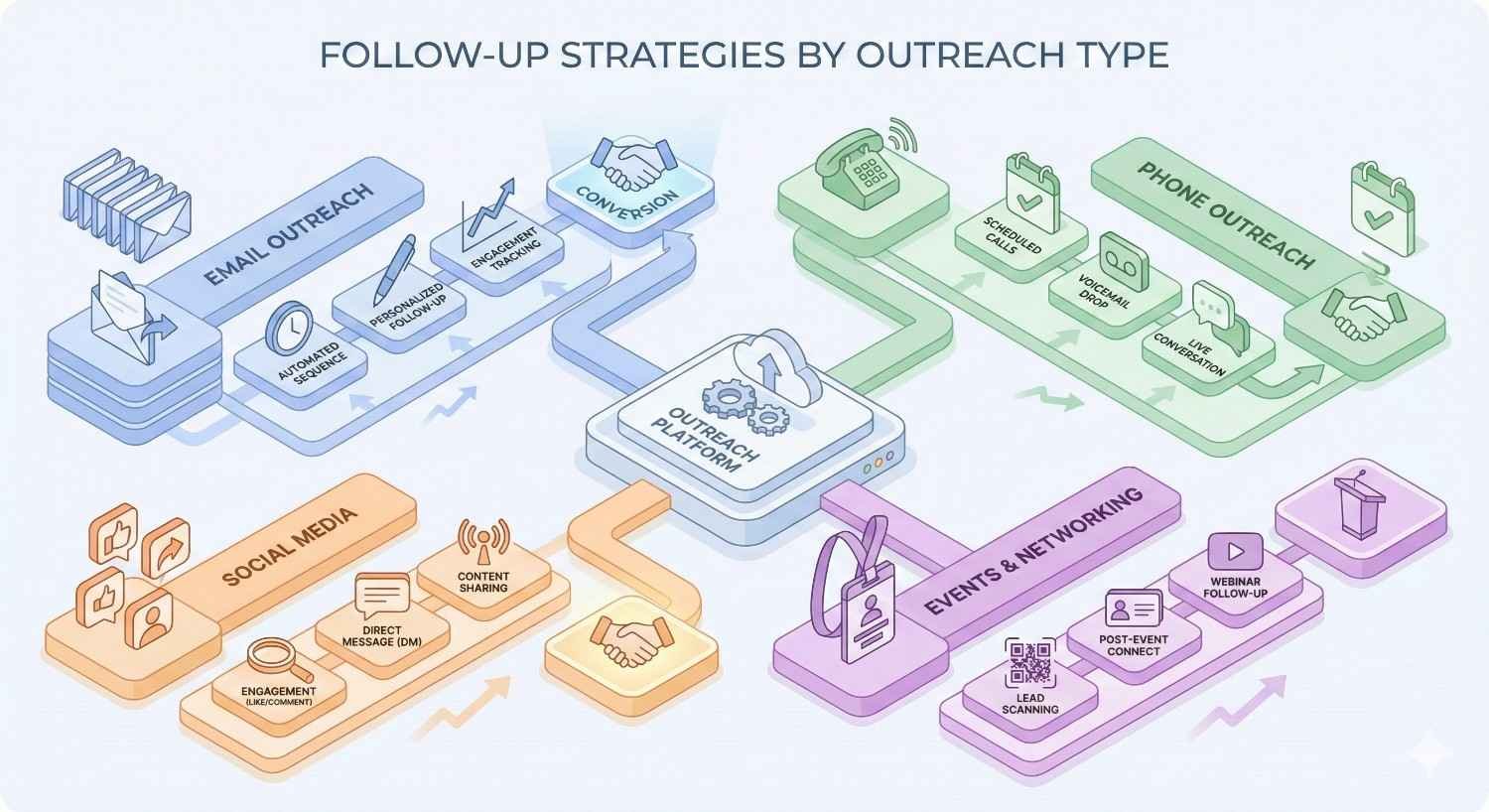
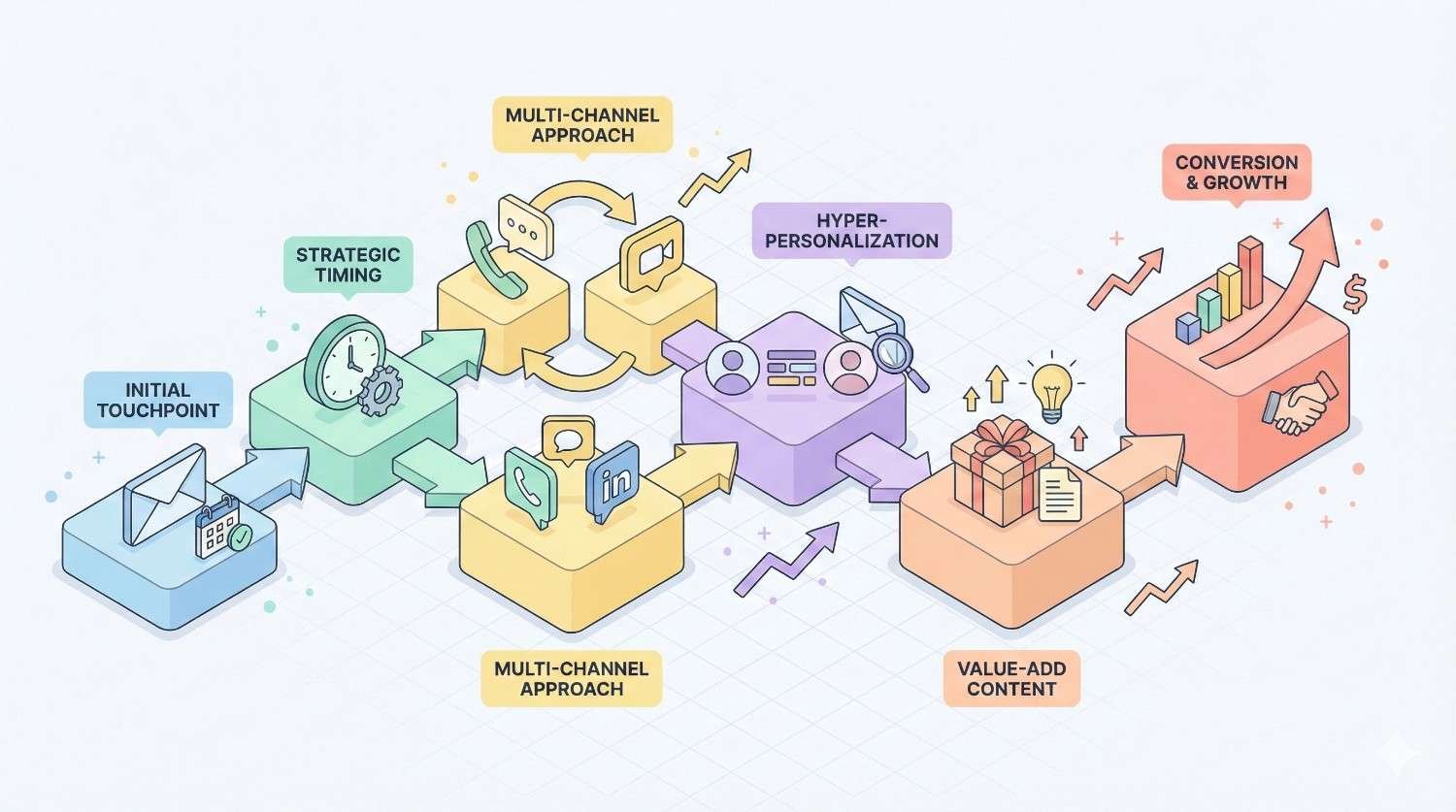
Multi-channel sequences outperform single-channel approaches. Coordinate touches strategically.
Typical multi-channel sequence:
- Day 1: Initial email
- Day 4: First email follow-up
- Day 6: LinkedIn connection request
- Day 9: Second email follow-up
- Day 11: LinkedIn message
- Day 14: Third email follow-up
- Day 18: Phone call (if appropriate)
- Day 21: Final email
Maintain message consistency. Your value proposition should be coherent across channels, even if tone varies.
Reference other channels. “I also connected on LinkedIn” or “Left a voicemail earlier” shows coordinated effort without seeming automated.
Track cross-channel engagement. Someone who ignores emails but engages on LinkedIn should receive more LinkedIn touches.
Avoid overwhelming. Multi-channel doesn’t mean multi-touch daily. Space interactions appropriately.
Personalize channel selection. Some prospects live on Twitter. Others never check LinkedIn. Adapt to their preferences.
Follow-Up Automation and Tools
Email Automation Platforms for Follow-Ups
Automation enables consistent follow-up at scale without sacrificing quality.
Popular platforms for outreach automation:
- Mailshake: Purpose-built for cold outreach with strong follow-up sequences
- Lemlist: Known for personalization features and deliverability
- Woodpecker: Focuses on B2B cold email with safety features
- Reply.io: Multi-channel sequences including LinkedIn
- Instantly: Emphasizes deliverability and inbox rotation
Key features to prioritize:
- Automated follow-up sequences with customizable timing
- Personalization tokens and dynamic content
- A/B testing capabilities
- Deliverability monitoring and warm-up tools
- CRM integration
- Detailed analytics
Automation best practices:
- Set up sequences but review before sending
- Use conditional logic (stop sequence if reply received)
- Maintain separate sending domains for outreach
- Warm up new email accounts gradually
- Monitor bounce rates and spam complaints
Automation handles logistics. You handle strategy and personalization.
CRM Systems for Follow-Up Management
CRM systems organize prospect data and track relationship history.
CRM options for outreach teams:
- HubSpot CRM: Free tier with solid outreach features
- Pipedrive: Sales-focused with visual pipeline management
- Salesforce: Enterprise-grade with extensive customization
- Close: Built for outreach with calling features
- Streak: Gmail-native CRM for smaller teams
Essential CRM practices:
- Log every interaction automatically when possible
- Tag prospects by status, source, and priority
- Set follow-up reminders and tasks
- Track response rates by segment
- Note objections and preferences for future reference
Integration matters. Your CRM should connect with your email platform, calendar, and other tools. Manual data entry kills efficiency.
Keep data clean. Regularly update contact information, remove duplicates, and archive dead prospects. Clean data enables accurate reporting.
Tracking and Analytics Tools
Measurement drives improvement. Track the right metrics with the right tools.
Email tracking essentials:
- Open rates by message and sequence position
- Click rates on links
- Reply rates and sentiment
- Bounce and unsubscribe rates
- Best-performing subject lines and send times
Tools for tracking:
- Built-in analytics from your email platform
- Google Analytics for website traffic from outreach
- UTM parameters to track link clicks by campaign
- Spreadsheets for custom analysis and reporting
Advanced tracking:
- Sequence completion rates
- Time-to-response patterns
- Channel attribution (which touchpoint triggered response)
- Conversion rates by prospect segment
Reporting cadence: Review metrics weekly for tactical adjustments. Monthly for strategic changes. Quarterly for major optimizations.
Balancing Automation with Personalization
Automation and personalization aren’t opposites. Smart systems combine both.
What to automate:
- Sequence timing and triggers
- Basic personalization (name, company, role)
- Follow-up reminders and task creation
- Data logging and CRM updates
- Initial prospect research gathering
What to personalize manually:
- Opening lines referencing specific content
- Value propositions tailored to their situation
- Responses to their replies
- High-value prospect communications
- Relationship-building touches
Tiered approach:
- Tier 1 (high value): Fully personalized, manual follow-ups
- Tier 2 (medium value): Automated sequences with personalized elements
- Tier 3 (lower value): Mostly automated with basic personalization
Quality checks: Regularly review automated messages before they send. Catch errors, update outdated references, and ensure personalization tokens work correctly.
The test: Would you be embarrassed if the recipient knew this was automated? If yes, add more personalization.
Measuring Follow-Up Performance
Key Metrics to Track
Focus on metrics that indicate real progress, not vanity numbers.
Primary metrics:
- Response rate: Percentage of prospects who reply (positive or negative)
- Positive response rate: Percentage who express interest or agree to next steps
- Conversion rate: Percentage who complete your desired action (link placed, call scheduled, partnership signed)
- Cost per conversion: Total campaign cost divided by conversions
Secondary metrics:
- Open rate: Indicates subject line and deliverability effectiveness
- Click rate: Shows content engagement
- Sequence completion rate: How many prospects receive all follow-ups
- Time to response: Average days between first touch and reply
Diagnostic metrics:
- Bounce rate: Email list quality indicator
- Unsubscribe/complaint rate: Message relevance signal
- Response by sequence position: Which follow-up number generates most replies
Track metrics by segment (industry, role, source) to identify patterns and optimize targeting.
Response Rate Benchmarks
Benchmarks provide context for your performance. Expect variation by outreach type and quality.
Cold email outreach benchmarks:
- Open rate: 40-60% (well-targeted lists)
- Response rate: 5-15% (initial email)
- Cumulative response rate: 15-30% (full sequence)
- Positive response rate: 3-10%
Link building specific:
- Response rates vary dramatically by niche and approach
- Resource page outreach: 5-15% response
- Guest posting: 10-20% response
- Broken link building: 8-15% response
Factors affecting benchmarks:
- List quality and targeting precision
- Offer relevance and value
- Brand recognition
- Email deliverability
- Personalization level
Improving below-benchmark performance:
- Tighten targeting criteria
- Strengthen value proposition
- Increase personalization
- Test different messaging angles
- Verify deliverability
Don’t obsess over industry benchmarks. Focus on improving your own numbers over time.
A/B Testing Your Follow-Up Sequences
Systematic testing reveals what works for your specific audience.
What to test:
- Subject lines (most impactful)
- Opening lines
- Value propositions
- CTAs
- Email length
- Send times
- Number of follow-ups
- Timing between follow-ups
Testing methodology:
- Change one variable at a time
- Use statistically significant sample sizes (minimum 100 per variant)
- Run tests for complete sequences, not just first emails
- Document results and learnings
Common test findings:
- Shorter emails often outperform longer ones
- Questions in subject lines can boost opens
- Specific CTAs beat vague ones
- Tuesday-Thursday sends outperform Monday/Friday
- Third and fourth follow-ups often generate most responses
Continuous improvement: Testing never ends. Audiences evolve. What worked last quarter might underperform now. Maintain a testing calendar.
Analyzing and Optimizing Results
Data without action is worthless. Build analysis into your workflow.
Weekly analysis:
- Review response rates by sequence and segment
- Identify underperforming sequences for adjustment
- Note any deliverability issues
- Check for patterns in positive responses
Monthly analysis:
- Calculate conversion rates and cost per conversion
- Compare performance across campaigns
- Identify top-performing message templates
- Update benchmarks based on recent data
Quarterly analysis:
- Assess overall strategy effectiveness
- Review and update prospect targeting criteria
- Evaluate tool and process efficiency
- Plan major optimizations
Optimization actions:
- Pause underperforming sequences
- Scale successful approaches
- Refine targeting based on conversion patterns
- Update templates with winning elements
- Adjust timing based on response data
Document everything. Your optimization history becomes institutional knowledge.
Follow-Up Strategies by Outreach Type
Link Building Outreach Follow-Ups
Link building follow-ups require specific approaches based on the link type you’re pursuing.
Resource page outreach:
- Follow up with additional resources they might include
- Reference recent updates to your content
- Offer to help update their page with other relevant links
- Timing: 4-5 day intervals, 3-4 follow-ups total
Broken link building:
- Remind them of the specific broken link location
- Offer alternative replacement options
- Emphasize the user experience benefit
- Timing: 3-4 day intervals, 3 follow-ups total
Skyscraper technique:
- Highlight specific improvements over the content they currently link to
- Share engagement metrics or social proof
- Offer exclusive data or insights
- Timing: 5-7 day intervals, 4-5 follow-ups total
Unlinked brand mentions:
- Keep follow-ups brief since they already know your brand
- Reference the specific mention location
- Make adding the link as easy as possible
- Timing: 3-4 day intervals, 2-3 follow-ups total
Guest Posting Follow-Up Sequences
Guest posting requires relationship-building follow-ups.
Initial pitch follow-ups:
- Offer alternative topic ideas
- Share examples of recent published work
- Reference their content guidelines compliance
- Timing: 5-7 day intervals, 4 follow-ups total
After pitch acceptance:
- Confirm deadlines and requirements
- Share draft progress updates
- Ask clarifying questions proactively
- Timing: Based on deadline, more frequent as deadline approaches
Post-publication follow-ups:
- Thank them and share promotion efforts
- Propose future collaboration
- Offer to contribute to other content needs
- Timing: Immediately after publication, then 30-60 days later
Relationship maintenance:
- Engage with their content regularly
- Share their articles with your audience
- Check in quarterly with new ideas
- Timing: Ongoing, non-promotional touches
Partnership and Collaboration Follow-Ups
Partnership outreach involves longer sales cycles and higher stakes.
Initial outreach follow-ups:
- Share case studies from similar partnerships
- Offer a low-commitment first step
- Address likely objections proactively
- Timing: 5-7 day intervals, 5-6 follow-ups total
After initial interest:
- Provide detailed partnership information
- Introduce relevant team members
- Propose specific next steps
- Timing: 2-3 day intervals, responsive to their pace
Negotiation phase:
- Summarize discussion points
- Address concerns raised
- Provide requested information promptly
- Timing: Same-day or next-day responses
Post-agreement follow-ups:
- Confirm implementation details
- Schedule kickoff meetings
- Establish ongoing communication cadence
- Timing: Immediate and structured
PR and Media Outreach Follow-Ups
Media follow-ups require understanding journalist workflows and preferences.
Press release follow-ups:
- Offer exclusive angles or interviews
- Provide additional data or visuals
- Connect to trending news hooks
- Timing: 2-3 day intervals, 2-3 follow-ups maximum
Story pitch follow-ups:
- Share new developments or data
- Offer expert sources for quotes
- Suggest alternative story angles
- Timing: 3-5 day intervals, 3-4 follow-ups total
Journalist relationship building:
- Share relevant tips without asking for coverage
- Congratulate them on published pieces
- Offer to be a source for future stories
- Timing: Ongoing, value-first approach
Time-sensitive pitches:
- Compress follow-up timing significantly
- Emphasize deadline relevance
- Offer immediate availability
- Timing: Daily follow-ups if truly time-sensitive
Influencer Outreach Follow-Up Tactics
Influencer outreach blends relationship building with business negotiation.
Collaboration pitch follow-ups:
- Share examples of successful past collaborations
- Offer flexible partnership structures
- Highlight audience alignment
- Timing: 5-7 day intervals, 4-5 follow-ups total
Product seeding follow-ups:
- Confirm delivery and receipt
- Ask for initial impressions
- Offer additional support or information
- Timing: After delivery confirmation, then 7-10 days later
Ongoing relationship follow-ups:
- Engage with their content consistently
- Share their work with your audience
- Propose new collaboration ideas
- Timing: Monthly touchpoints minimum
Negotiation follow-ups:
- Clarify terms and expectations
- Provide requested materials promptly
- Confirm agreements in writing
- Timing: Responsive, typically 1-2 days
Industry-Specific Follow-Up Approaches
B2B SaaS Follow-Up Strategies
SaaS outreach targets busy professionals evaluating multiple solutions.
Key considerations:
- Longer decision cycles require patient follow-up
- Multiple stakeholders may need different messaging
- Free trials and demos create natural follow-up triggers
- Integration and technical questions are common
Effective tactics:
- Share relevant case studies from similar companies
- Offer personalized demos addressing their specific use case
- Provide ROI calculators or assessment tools
- Reference competitor comparisons when appropriate
Timing adjustments:
- Extend intervals to 7-10 days between touches
- Plan for 6-8 touch sequences
- Align follow-ups with typical buying cycles
- Increase frequency after demo or trial signup
E-commerce Outreach Follow-Ups
E-commerce outreach often targets bloggers, affiliates, and media.
Key considerations:
- Seasonal timing significantly impacts response rates
- Product samples can accelerate relationships
- Affiliate commission structures affect motivation
- Visual content matters more than in other industries
Effective tactics:
- Offer exclusive discount codes for their audience
- Provide high-quality product images and descriptions
- Share sales data and conversion rates
- Time outreach around shopping seasons
Timing adjustments:
- Compress sequences before major shopping events
- Plan campaigns 8-12 weeks before peak seasons
- Follow up more aggressively on time-sensitive opportunities
- Maintain year-round relationships for recurring coverage
Agency Client Acquisition Follow-Ups
Agency outreach targets decision-makers evaluating service providers.
Key considerations:
- Trust and credibility are paramount
- Prospects often have negative past agency experiences
- Budget cycles affect timing
- Referrals and case studies carry significant weight
Effective tactics:
- Share specific results from similar clients
- Offer free audits or assessments
- Provide educational content demonstrating expertise
- Reference mutual connections when possible
Timing adjustments:
- Align outreach with budget planning cycles
- Follow up more frequently during active evaluation periods
- Maintain long-term nurture for prospects not ready now
- Respond immediately to inbound interest
Content Marketing Follow-Up Methods
Content marketing outreach targets publishers, editors, and content managers.
Key considerations:
- Editorial calendars drive timing
- Content quality is the primary evaluation criterion
- Relationships matter more than individual pitches
- Exclusivity can be valuable
Effective tactics:
- Pitch content aligned with their editorial calendar
- Offer exclusive data or research
- Provide ready-to-publish content when appropriate
- Build relationships before pitching
Timing adjustments:
- Research and align with their publishing schedule
- Pitch seasonal content 2-3 months in advance
- Follow up based on their typical response patterns
- Maintain ongoing relationships between pitches
Advanced Follow-Up Techniques
Re-Engagement Campaigns for Cold Prospects
Prospects who went cold can often be revived with the right approach.
When to re-engage:
- 3-6 months after last contact
- When you have genuinely new information
- After significant company or industry changes
- When their situation may have changed
Re-engagement approaches:
- Reference your previous conversation
- Share what’s changed since then
- Offer a fresh value proposition
- Acknowledge the time gap naturally
Message example: “Hi [Name], we connected back in [month] about [topic]. Since then, we’ve [new development]. Given [their situation], thought it might be worth reconnecting. Would you be open to a quick conversation?”
Re-engagement sequence:
- Initial re-engagement email
- Follow-up with new value 5-7 days later
- Final touch 7-10 days after that
- If no response, wait another 3-6 months
Follow-Up Strategies After No Response
Complete silence requires strategic persistence.
Diagnose the silence:
- Check if emails are being opened (tracking)
- Verify email address validity
- Consider if timing was poor
- Evaluate if your offer was relevant
Adjust your approach:
- Try different subject lines
- Shorten your message significantly
- Change your value proposition angle
- Switch channels (email to LinkedIn)
The “pattern interrupt” follow-up: Break expected patterns to capture attention. Unusual subject lines, different formats, or unexpected value can cut through.
Know when to stop:
- After 5-6 touches with zero engagement
- If emails consistently bounce
- When the opportunity becomes irrelevant
- If they explicitly request no contact
Handling Objections in Follow-Ups
Objections are opportunities to address concerns and advance the conversation.
Common objections and responses:
“Not interested”
- Thank them for responding
- Ask if you can check back in 6 months
- Offer to share relevant content occasionally
“Not the right time”
- Ask when would be better
- Offer to follow up at their preferred time
- Provide value in the meantime
“Too expensive/no budget”
- Explore flexible options
- Highlight ROI and value
- Offer smaller starting points
“Already working with someone”
- Respect the relationship
- Offer to be a backup option
- Stay in touch for future opportunities
“Send more information”
- Provide requested information promptly
- Include a specific next step
- Follow up to discuss the information
Seasonal and Event-Based Follow-Up Timing
Timing follow-ups around events and seasons can boost response rates.
Industry events:
- Follow up before events you’ll both attend
- Reference shared event attendance
- Follow up after events while top-of-mind
Seasonal patterns:
- Avoid major holidays and vacation periods
- Align with budget cycles (Q4 planning, fiscal year starts)
- Consider industry-specific busy seasons
Company events:
- Funding announcements create opportunities
- Leadership changes may open doors
- Product launches indicate active growth
Content triggers:
- New blog posts or reports they publish
- Awards or recognition they receive
- News coverage about their company
Building Long-Term Relationships Through Follow-Ups
The best follow-up strategy builds relationships that transcend individual transactions.
Relationship-building touches:
- Share relevant content without asking for anything
- Congratulate them on achievements
- Introduce them to valuable connections
- Provide helpful feedback on their work
Nurture sequence principles:
- Value-first, ask-second
- Consistent but not overwhelming
- Personalized to their interests
- Patient with long-term perspective
Relationship maintenance cadence:
- Monthly value-add touches for warm prospects
- Quarterly check-ins for past collaborators
- Annual relationship reviews and outreach
The compound effect: Relationships built over time convert at dramatically higher rates than cold outreach. Invest in relationship building as a long-term strategy.
Follow-Up Templates and Examples
First Follow-Up Email Templates
Template 1: Simple reminder
Copy
Subject: Re: [Original subject]
Hi [Name],
Wanted to follow up on my email from [day]. I know things get busy.
[One sentence restating your value proposition]
Would [specific CTA] work for you?
[Your name]
Template 2: Adding value
Copy
Subject: Quick follow-up + [resource type]
Hi [Name],
Following up on my note about [topic].
Thought you might find this useful: [link to relevant resource]
It covers [brief description relevant to their interests].
Still happy to discuss [your offer] when timing works.
[Your name]
Template 3: Different angle
Copy
Subject: Another thought on [topic]
Hi [Name],
Circling back on [original topic].
I realized I didn’t mention [different benefit or angle]. Given [their situation], this might be particularly relevant.
Worth a quick conversation?
[Your name]
Second and Third Follow-Up Templates
Second follow-up template:
Copy
Subject: Re: [Original subject]
Hi [Name],
Checking in once more on [topic].
[New piece of information, social proof, or value]
If now isn’t the right time, happy to reconnect in [timeframe]. Just let me know.
[Your name]
Third follow-up template:
Copy
Subject: [Name], quick question
Hi [Name],
I’ve reached out a few times about [topic]. Want to make sure I’m not missing the mark.
Is [your offer] something that could be useful, or should I focus my energy elsewhere?
Either way, appreciate you letting me know.
[Your name]
Break-Up Email Templates
Template 1: Direct break-up
Copy
Subject: Should I close your file?
Hi [Name],
I’ve tried reaching you several times about [topic] without hearing back.
I don’t want to keep bothering you if this isn’t a fit. Should I close your file and stop reaching out?
If timing is just off, let me know when to check back.
[Your name]
Template 2: Soft break-up
Copy
Subject: Last note from me
Hi [Name],
This will be my last email about [topic]. I understand if it’s not the right fit or timing.
If things change down the road, my door is always open. Feel free to reach out anytime.
Wishing you continued success with [their work/company].
[Your name]
Value-Add Follow-Up Examples
Example 1: Sharing research
Copy
Subject: Data you might find interesting
Hi [Name],
Came across this research on [topic relevant to them]: [link]
The finding about [specific insight] seemed particularly relevant to [their situation].
No ask here, just thought you’d find it useful.
[Your name]
P.S. Still happy to discuss [your offer] whenever timing works.
Example 2: Offering help
Copy
Subject: Noticed something on [their site]
Hi [Name],
Was browsing [their site] and noticed [specific observation, not criticism].
[Helpful suggestion or offer to assist]
Happy to elaborate if useful. No strings attached.
[Your name]
Multi-Channel Follow-Up Scripts
LinkedIn connection request:
Copy
Hi [Name], I reached out via email about [topic]. Would love to connect here as well. [Your name]
LinkedIn message after connection:
Copy
Thanks for connecting, [Name].
Following up on my email about [topic]. Thought LinkedIn might be easier to catch you.
[Brief value proposition]
Open to a quick chat?
Voicemail script:
Copy
Hi [Name], this is [Your name] from [Company].
I’ve sent a couple emails about [topic] and wanted to try reaching you directly.
[One sentence value proposition]
I’ll follow up with an email. Feel free to reach me at [number] or reply to my email.
Thanks, [Name]. Talk soon.
Legal and Compliance Considerations
GDPR and Email Follow-Up Compliance
GDPR affects outreach to EU residents. Understand the requirements.
Key GDPR principles for outreach:
- Lawful basis: You need a legal reason to process their data. Legitimate interest can apply to B2B outreach.
- Transparency: Be clear about who you are and why you’re contacting them.
- Data minimization: Only collect and store necessary information.
- Right to erasure: Honor requests to delete their data.
Practical compliance steps:
- Document your legitimate interest assessment
- Include your identity and contact information in emails
- Honor opt-out requests immediately
- Maintain records of consent and communication
- Limit data retention to necessary periods
B2B vs. B2C: B2B outreach generally has more flexibility under legitimate interest, but respect remains essential.
CAN-SPAM Act Requirements
CAN-SPAM governs commercial email in the United States.
Required elements:
- Accurate “From” and “Reply-To” information
- Non-deceptive subject lines
- Identification as an advertisement (if applicable)
- Physical postal address included
- Clear opt-out mechanism
- Honor opt-outs within 10 business days
Best practices beyond requirements:
- Process opt-outs immediately, not just within 10 days
- Use clear sender names recipients will recognize
- Avoid misleading subject lines even if technically compliant
- Maintain suppression lists across all campaigns
Penalties: Violations can result in fines up to $50,120 per email. Compliance isn’t optional.
Unsubscribe and Opt-Out Management
Proper opt-out handling protects your reputation and ensures compliance.
Opt-out best practices:
- Include unsubscribe links in every email
- Process opt-outs immediately
- Maintain centralized suppression lists
- Sync suppression lists across all tools and campaigns
- Never re-add opted-out contacts
Types of opt-outs:
- Global opt-out: Remove from all communications
- Campaign opt-out: Remove from specific campaign only
- Channel opt-out: Remove from email but allow other channels
Handling opt-out requests:
- Confirm receipt of their request
- Remove them from active sequences immediately
- Document the opt-out with timestamp
- Never argue or try to change their mind
Ethical Follow-Up Practices
Legal compliance is the floor. Ethical practice builds sustainable success.
Ethical principles:
- Respect: Treat prospects as you’d want to be treated
- Honesty: Never mislead about who you are or what you want
- Value: Ensure your outreach offers genuine benefit
- Restraint: Know when to stop, even before legal limits
Practices to avoid:
- Misleading subject lines to boost opens
- Fake personalization that’s obviously templated
- Excessive follow-up frequency
- Ignoring clear disinterest signals
- Purchasing low-quality contact lists
Building reputation: Your outreach reputation follows you. Ethical practices build long-term relationships and referrals. Short-term tricks damage long-term success.
Building a Sustainable Follow-Up System
Creating Follow-Up SOPs for Your Team
Standard operating procedures ensure consistency and quality at scale.
SOP components:
- Sequence templates: Approved follow-up sequences by outreach type
- Timing guidelines: When to send each follow-up
- Personalization requirements: Minimum personalization standards
- Quality checks: Review processes before sending
- Escalation procedures: When to involve senior team members
- Documentation standards: What to log in CRM
SOP development process:
- Document current best practices
- Identify gaps and inconsistencies
- Create standardized templates and guidelines
- Train team on new procedures
- Review and update quarterly
Balancing standardization and flexibility: SOPs provide structure, not rigid scripts. Allow room for judgment while ensuring baseline quality.
Training Team Members on Follow-Up Best Practices
Effective training builds capable, confident outreach teams.
Training topics:
- Follow-up psychology and principles
- Tool and platform usage
- Template customization techniques
- Compliance requirements
- Quality standards and expectations
- Performance metrics and goals
Training methods:
- Initial onboarding program
- Shadowing experienced team members
- Regular skill-building sessions
- Performance feedback and coaching
- Access to resources and documentation
Ongoing development:
- Share successful examples and learnings
- Review metrics together regularly
- Encourage experimentation within guidelines
- Celebrate wins and analyze losses
Scaling Follow-Up Operations
Growth requires systems that maintain quality at higher volumes.
Scaling challenges:
- Maintaining personalization at volume
- Ensuring consistent quality across team members
- Managing increased data and complexity
- Avoiding deliverability issues
Scaling solutions:
- Tiered personalization based on prospect value
- Robust quality assurance processes
- Advanced automation with human oversight
- Multiple sending domains and accounts
- Clear role specialization
Technology for scale:
- Email automation platforms with team features
- CRM systems with workflow automation
- Quality monitoring and approval tools
- Analytics dashboards for performance visibility
Integrating Follow-Ups into Your SEO Strategy
Follow-up effectiveness directly impacts SEO campaign success.
Link building integration:
- Track follow-up performance by link type
- Optimize sequences for highest-converting link opportunities
- Measure cost-per-link including follow-up effort
- Build relationships for ongoing link opportunities
Content promotion integration:
- Follow up on content distribution outreach
- Track which follow-up approaches drive most shares
- Build media relationships through consistent follow-up
- Measure content reach influenced by follow-up
Authority building integration:
- Nurture relationships with industry influencers
- Follow up on speaking and collaboration opportunities
- Build expert source relationships with journalists
- Track authority metrics influenced by outreach
Long-Term Follow-Up Relationship Management
Sustainable outreach builds relationships that compound over time.
Relationship lifecycle:
- Prospect: Initial outreach and follow-up
- Collaborator: Active partnership or transaction
- Advocate: Ongoing relationship and referrals
- Dormant: Past relationship, potential reactivation
Lifecycle-appropriate follow-up:
- Prospects get conversion-focused sequences
- Collaborators get project-related communication
- Advocates get value-add and appreciation touches
- Dormant contacts get periodic re-engagement
Relationship database management:
- Track relationship status and history
- Note preferences and communication style
- Set reminders for periodic check-ins
- Document all interactions for continuity
The long game: Today’s ignored email might become next year’s partnership. Maintain relationships professionally, and opportunities emerge over time.
Conclusion
Effective follow-up strategies transform outreach from a numbers game into a relationship-building system that delivers compounding returns. The fundamentals remain consistent: strategic timing, genuine value in every touch, multi-channel coordination, and systematic measurement drive results across link building, PR, partnerships, and every other outreach goal.
Your follow-up system directly impacts SEO outcomes. Higher response rates mean more backlinks acquired, more content partnerships secured, and stronger domain authority built, all from the same prospect lists. The ROI multiplier from proper follow-up execution often exceeds any other campaign optimization.
We help businesses build sustainable organic growth through comprehensive SEO services, including outreach systems that convert. Contact White Label SEO Service to discuss how strategic follow-up implementation can accelerate your link building and authority development.
Frequently Asked Questions
How many follow-up emails should I send before giving up?
Send 4-6 follow-up emails for most cold outreach campaigns. Research shows response rates continue climbing through the fifth touch before plateauing. High-value prospects may warrant 6-8 touches over longer timeframes, while simple requests need only 2-3 follow-ups.
What is the best time gap between follow-up emails?
Start with 3-4 business days after your initial email, then extend to 5-7 days for the second follow-up, and 7-10 days for subsequent touches. These intervals prevent fatigue while maintaining presence. Adjust based on urgency and your audience’s response patterns.
How do I follow up without being annoying?
Add genuine value in each follow-up rather than just “checking in.” Share relevant resources, offer new angles, or provide useful information. Keep messages brief, respect their time, and always include an easy way to opt out. Prospects rarely find helpful follow-ups annoying.
Should I use the same email thread for follow-ups?
Yes, threading follow-ups in the same email chain is generally more effective. It maintains context, appears as an ongoing conversation rather than new outreach, and typically achieves higher open rates. Only start a new thread if you’re taking a completely different approach.
What should I write in a follow-up email subject line?
Use “Re: [Original Subject]” to maintain thread continuity, or add new information like “Quick update on [topic]” or “New resource for [their site].” Avoid generic phrases like “Following up” or “Checking in” that communicate nothing compelling.
How do I track follow-up email performance?
Use email automation platforms with built-in tracking for opens, clicks, and replies. Monitor response rates by sequence position to identify which follow-up generates most engagement. Track conversion rates and cost-per-conversion to measure true campaign effectiveness.
When should I stop following up with a prospect?
Stop immediately if someone explicitly requests no further contact. Stop after completing your sequence (4-6 touches) with zero engagement. Pause and revisit later if you see opens but no responses. Add unresponsive prospects to a long-term nurture list for quarterly re-engagement attempts.