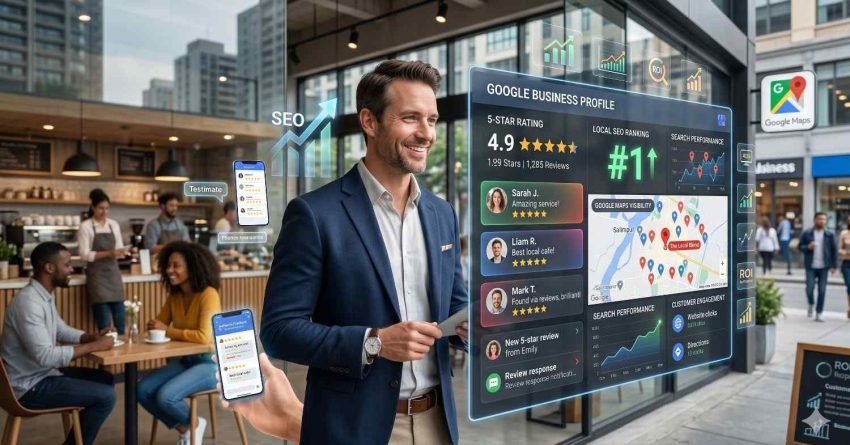
Google Reviews are public ratings and written feedback that customers leave about a business directly on its Google Business Profile. They appear in Google Search and Google Maps, shaping local visibility, consumer trust, and purchase decisions for businesses of every size.
Reviews now influence rankings, click-through rates, and revenue more than almost any other local signal, making them a critical asset every business owner must actively manage and continuously optimize today.
This guide covers what Google Reviews are, how they affect SEO, profile setup, generation strategies, response management, fake review handling, policies, ROI measurement, platform comparisons, tools, and the common pitfalls.
What Google Reviews Are and Why They Matter
A Google Review is a star rating from one to five combined with optional written feedback that a verified Google account holder leaves on a business’s Google Business Profile. Reviews surface in the local pack, on Google Maps, on knowledge panels, and inside branded search results, often acting as the first impression a prospect has of a brand.
The volume, recency, rating average, and content of reviews collectively shape three outcomes: how easily customers find a business, how much they trust it once they do, and how likely they are to convert. Research from BrightLocal’s 2024 Local Consumer Review Survey found that 87% of consumers used Google to evaluate a local business in the past year, more than any other platform.
For business owners, reviews function as social proof, ranking input, and customer feedback loop simultaneously. They tell Google your business exists, is active, and serves real customers. They tell prospects what to expect. And they tell your operations team where to improve.
The mechanics behind how reviews are submitted, verified, and displayed across Google surfaces deserve their own deep dive — our dedicated breakdown of what Google Reviews really are walks through every display element, eligibility rule, and ranking signal so you understand the full anatomy before optimizing. <!–NEW PAGE NEEDED–>
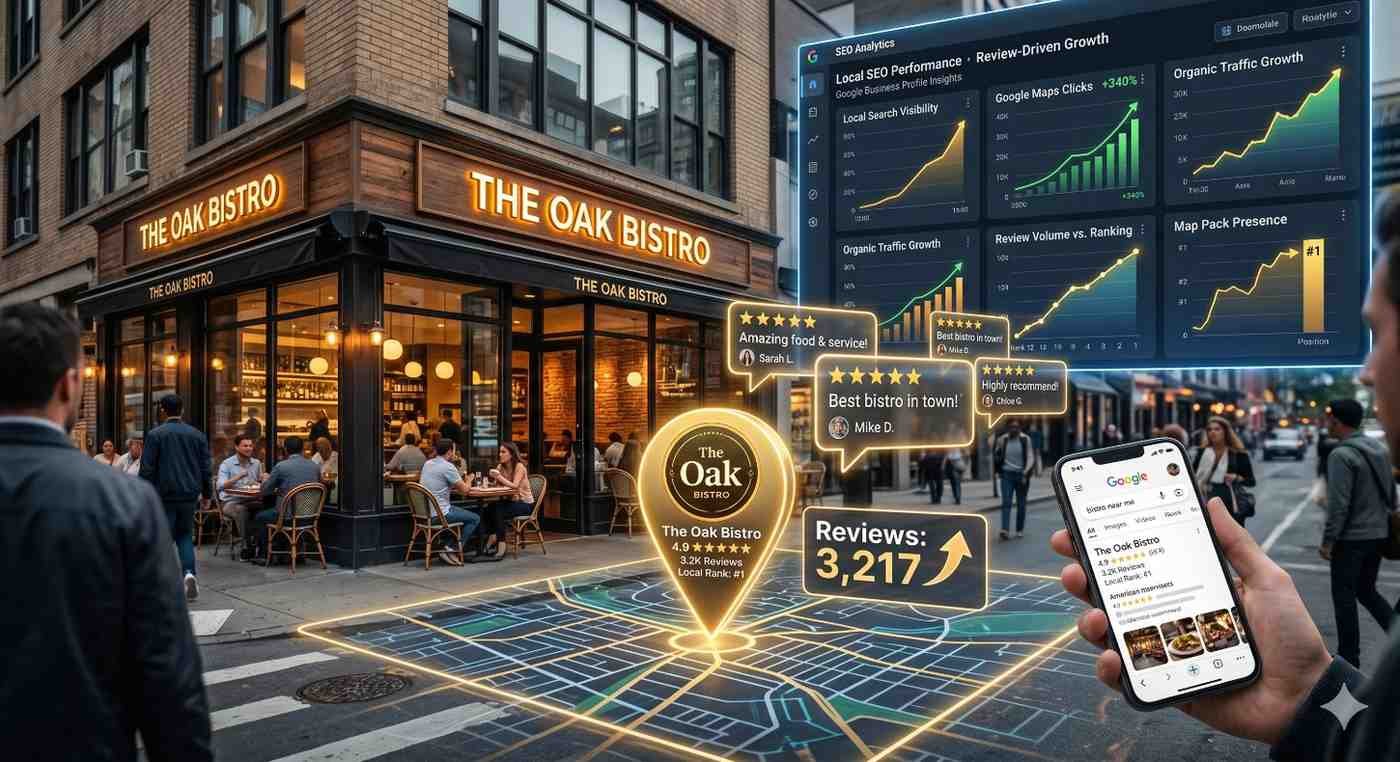
How Google Reviews Impact Local SEO and Rankings
Google has confirmed that reviews influence local rankings as part of the “prominence” factor inside its local search algorithm. Prominence reflects how well-known and trusted a business is, and review signals are one of its most observable inputs.
Three review attributes carry the most ranking weight. Review quantity signals that a business serves enough customers to be a credible option. Recency signals that the business is still active and relevant. Rating quality signals overall customer satisfaction. Keyword presence inside review text also helps Google associate your business with specific services, products, and locations.
Beyond direct ranking impact, reviews influence click-through rate from the local pack. A profile showing a 4.8-star average with 300+ reviews almost always outperforms a competing 4.2-star, 40-review listing in the same map pack, even when the lower-rated business ranks slightly higher. Higher click-through then reinforces the ranking through behavioral signals.
The compound effect is significant. Each new review adds to volume, refreshes recency, contributes to average rating, and often enriches keyword diversity. Done consistently, a structured review program becomes one of the highest-leverage local SEO investments a business can make.
Reviews are one signal among many that Google uses to rank local businesses, and the full weighting system involves proximity, relevance, prominence, and behavioral data — our guide to the complete local SEO ranking factors breaks down every input and how reviews fit inside the broader algorithm. <!–NEW PAGE NEEDED–>
Setting Up Your Google Business Profile to Collect Reviews
Reviews cannot exist without a verified Google Business Profile. The profile is the digital storefront where reviews accumulate, and its completeness directly affects how many reviews customers leave and how Google interprets them.
A review-ready profile includes a verified business name that matches signage and legal records, an accurate primary category, supporting secondary categories, a precise service area, current hours, a working phone number, a click-to-call enabled mobile experience, and at least ten recent photos. Each of these elements builds trust and triggers more spontaneous reviews from satisfied customers.
The most overlooked setup task is generating your review request shortlink inside the profile dashboard. This link routes customers directly to the review form, removes friction, and can be embedded in receipts, SMS messages, email signatures, and QR codes. Businesses that surface this link consistently see review velocity multiply within weeks.
Profile completeness, category accuracy, and the active use of features like Posts, Q&A, and Products also create more touchpoints that lead to reviews. A neglected profile collects neglected feedback.
A fully optimized profile is the foundation that every review attaches to, and details like category selection, attributes, services, and photos directly influence how often customers leave reviews — our complete Google Business Profile optimization guide walks through every field, setting, and weekly maintenance task that makes a profile review-ready.
How to Get More Google Reviews (Strategy Overview)
The single biggest predictor of review volume is whether a business asks for reviews systematically. Most businesses do not. The few that do dominate their local market within months.
Effective review generation runs on three principles: ask the right customer, at the right moment, through the right channel. Timing matters more than copy. A review request sent within twenty-four hours of a positive customer experience converts five to ten times higher than one sent a week later, when the emotional peak has faded.
Channel mix also affects outcomes. SMS requests typically generate the highest conversion rate, followed by personalized email, then in-person QR code prompts, then receipt-printed links. Multi-touch sequences that combine two or more of these channels outperform any single channel by a wide margin.
Compliance is critical. Google’s policies prohibit incentivized reviews, review gating, and any practice that filters negative feedback away from the platform. Programs built on shortcuts get reviews filtered, profiles suspended, and accounts penalized. Sustainable growth comes from asking openly, asking everyone, and making the process effortless.
Done well, a review request program adds dozens of authentic reviews per month for an SME and hundreds for multi-location brands, creating a compounding ranking and trust advantage.
The fastest path from “we should ask for reviews” to a steady, compliant flow of customer feedback runs through specific request templates, timing windows, and channel mixes — our breakdown of proven strategies to get more Google reviews covers every method, script, and automation framework that consistently doubles review velocity. <!–NEW PAGE NEEDED–>

How to Respond to Google Reviews (Positive and Negative)
Every review response is a public marketing message read by future customers, often weighed more heavily than the original review. Google itself recommends responding to reviews, and businesses that respond to at least 25% of their reviews see meaningfully higher conversion rates than those that ignore feedback.
Positive review responses should be short, personal, and specific. Thank the customer by name, reference a detail from their review, and reinforce a brand attribute. A four-line response signals care without sounding scripted. Templated, generic replies erode the trust the original review created.
Negative review responses require a different framework. Acknowledge the issue, take ownership without arguing, offer a clear path to resolution offline, and close with a respectful invitation to reconnect. The goal is not to win the argument inside the review — it is to show every future prospect reading the exchange that your business handles problems professionally.
Response speed also matters. Replies posted within forty-eight hours signal an active, attentive business. Replies posted weeks late signal disengagement. A simple internal SLA of forty-eight hours for every review, regardless of rating, transforms review threads into trust assets.
Every response is a public marketing asset that shapes how future customers perceive your brand, and the language, length, and tone you use directly influence conversion — our complete guide on how to respond to Google reviews provides response frameworks, templates, and de-escalation tactics for every scenario. <!–NEW PAGE NEEDED–>
Managing Fake, Negative, and Policy-Violating Reviews
Not every review reflects a real customer interaction. Competitor attacks, mistaken-identity reviews, spam, and policy-violating content all surface periodically and can be addressed inside Google’s review removal framework.
Google’s content policies prohibit reviews that contain hate speech, profanity, sexually explicit content, conflicts of interest, misinformation, impersonation, irrelevant content, or off-topic complaints. Any review that violates these rules is eligible for removal, but removal is not automatic. Owners must flag the review, provide context, and often escalate through the Google Business Profile support team.
Negative reviews that simply describe a poor experience are not removable, even if you disagree with the account. The right response is not to fight the rating but to respond professionally, fix the underlying issue, and outweigh the negative with a steady volume of authentic positive reviews. A single one-star review becomes invisible when buried under dozens of recent five-star reviews.
Documentation matters during disputes. Keep records of communications, transactions, and any evidence supporting your claim that a review violates policy. Successful removals usually depend on clear, specific, policy-aligned evidence rather than emotional appeals.
Fake reviews, competitor attacks, and policy-violating content can be flagged, escalated, and in many cases removed when you follow Google’s exact dispute process — our step-by-step guide on how to remove fake Google reviews walks through the reporting workflow, appeal escalation, and documentation requirements. <!–NEW PAGE NEEDED–>
Google Review Policies, Guidelines, and Compliance
Google publishes detailed policies that govern how reviews may be solicited, displayed, and managed. Violating these policies can result in filtered reviews, suspended profiles, or permanent account restrictions. Compliance is not optional.
Three policy areas trip up businesses most often. Incentives are prohibited — offering discounts, freebies, contest entries, or payment in exchange for reviews violates Google’s terms and exposes the business to penalties. Review gating, the practice of filtering customers to only invite happy ones to review publicly, is explicitly banned. And fake reviews, whether self-generated, written by employees, or sourced from third parties, are a direct policy violation.
The compliant approach is also the most sustainable. Ask every customer for honest feedback, accept the rating they give, and use negative reviews as operational improvement signals rather than as content to suppress. Businesses that operate transparently inside Google’s guidelines build review profiles that survive algorithm updates, policy changes, and competitor reports.
Compliance also extends to staff training, marketing collateral, and third-party vendors. Many policy violations originate not from the business owner but from an outsourced agency or automated platform using gray-area tactics. Audit every external partner before they touch your review program.
The boundaries between acceptable review solicitation and policy violations are narrower than most owners realize, and a single misstep can lead to filtered reviews or profile suspension — our full Google review policy guide covers every prohibited practice, gating rule, and content guideline you must follow. <!–NEW PAGE NEEDED–>

Measuring the ROI of Google Reviews
Reviews are an asset, and assets must be measured. The businesses that scale review programs successfully do so because they can prove the connection between review investment and business outcomes.
Core metrics fall into four layers. Volume metrics track new reviews per month, total review count, and review velocity by location. Quality metrics track average rating, rating distribution, and recency. Engagement metrics track profile views, direction requests, calls, and website clicks from the Google Business Profile. Outcome metrics tie those engagement events to leads, customers, and revenue inside GA4 and your CRM.
The clearest ROI signal is the relationship between review growth and profile actions. A rising review count combined with rising profile views, calls, and direction requests is almost always followed by rising local search rankings and revenue. Most agencies report payback periods of three to six months on structured review programs.
Attribution becomes more sophisticated when call tracking, UTM-tagged profile links, and CRM integration are layered together. At that point, you can quantify the cost-per-review, lifetime value of a review-attributed customer, and revenue contribution per star-rating improvement.
Tying review volume and rating to real business outcomes requires connecting Google Business Profile insights, GA4, and call tracking inside one attribution model — our complete framework on measuring Google reviews ROI shows the exact metrics, dashboards, and benchmarks that prove revenue impact. <!–NEW PAGE NEEDED–>
Google Reviews vs Yelp, Trustpilot, and Other Platforms
Google is the dominant review platform globally, but it is not the only one. Yelp, Trustpilot, Facebook, Trip Advisor, G2, and industry-specific platforms each play distinct roles depending on category, geography, and customer behavior.
Google Reviews carry the broadest reach and the most direct SEO impact. They surface in the local pack, on Maps, and inside organic search, influencing both ranking and click-through. No other platform integrates as tightly with the discovery experience. For local service businesses, restaurants, and retail, Google should be the primary review investment.
Other platforms add value as supplementary trust signals. Trustpilot influences e-commerce and SaaS buyer decisions and powers rich snippets when integrated with schema. Yelp still matters for hospitality and restaurants in specific markets. G2 dominates B2B software. Industry directories — Healthgrades, Avvo, Houzz — carry weight in regulated categories.
The strategic question is not “which platform is best” but “which platform mix maps to my customer’s decision journey.” For most local businesses, that mix is heavy on Google, supported by one or two category-specific platforms, with the rest treated as monitoring channels rather than active growth targets.
Each review platform plays a different role in trust signals, SEO impact, and industry visibility, and choosing where to invest your team’s effort depends on your audience and category — our side-by-side analysis of Google Reviews vs other review platforms compares features, reach, schema impact, and conversion lift. <!–NEW PAGE NEEDED–>
Tools and Software for Managing Google Reviews
At small scale, reviews can be managed manually inside the Google Business Profile dashboard. At scale — multi-location brands, franchises, or businesses processing dozens of reviews per week — software is essential. The right tool turns reviews from a reactive task into a managed growth program.
Review management platforms typically handle four jobs. They request reviews through SMS, email, or QR-based campaigns. They monitor new reviews across Google and other platforms in real time. They respond with AI-assisted or templated replies that maintain consistency and SLA compliance. And they report on volume, sentiment, and performance across locations.
Top platforms include Birdeye, Podium, NiceJob, Trustpilot Business, GatherUp, and Reputation.com. Each has strengths. Birdeye and Podium excel at multi-location enterprise. NiceJob and GatherUp suit SMEs. Trustpilot Business dominates e-commerce. Choosing the right fit depends on volume, integrations with your CRM and POS, and how much automation versus customization you need.
Tools accelerate execution but they do not replace strategy. The same platform can produce excellent results for one business and mediocre results for another, depending on the underlying review program design.
Software platforms automate the request, monitor, respond, and report cycle across multiple locations and channels, and choosing the right stack determines your scalability — our deep dive into the best review management tools compares features, pricing, integrations, and use-case fit for SMEs through multi-location brands. <!–NEW PAGE NEEDED–>
Common Mistakes Business Owners Make With Reviews
Even well-intentioned businesses make a handful of recurring mistakes that limit their review growth and put their profiles at risk. Awareness alone prevents most of them.
The first mistake is inconsistency. Businesses ask for reviews for a month, see results, then stop. Review velocity stalls, recency decays, and rankings slip. Reviews need to be a permanent operational process, not a campaign.
The second mistake is over-engineering the ask. Long surveys, multi-step forms, and clever copy convert worse than a one-sentence direct request with a clickable link. Friction is the enemy of feedback.
The third mistake is ignoring negative reviews. An unanswered one-star review is read by every prospect for years. A thoughtful response neutralizes most of the damage and often converts the original reviewer back into a customer.
The fourth mistake is treating reviews as a marketing problem rather than a business problem. Reviews reflect operational reality. If reviews are persistently negative, the answer is not better wording — it is better service. Owners who treat reviews as customer feedback first and SEO signal second build the strongest long-term review profiles.
For owners who want a managed solution that combines review generation, profile optimization, and ongoing performance tracking, working with full-service local SEO support compresses months of in-house experimentation into a structured engagement that drives ranking and revenue outcomes.

The Future of Google Reviews, AI, and Online Reputation
Google Reviews are not static. The system that exists today will continue to evolve as Google integrates generative AI, refines spam detection, and changes how reviews surface across search experiences.
Three trends are already shaping the next chapter. AI-generated review summaries are appearing in search results, condensing dozens of reviews into a single overview that influences click decisions. Spam detection has tightened, with Google’s machine learning systems removing fake reviews faster and more aggressively than ever. And review content is increasingly being mined to populate AI Overviews, voice search results, and recommendation features.
For business owners, the implication is clear: review quality, specificity, and keyword diversity now matter as much as volume. Reviews that mention services, locations, and outcomes feed directly into AI-generated answers about your business. Generic five-star reviews provide ranking value but little narrative for AI systems to draw from.
Reviews sit inside a much wider reputation ecosystem covering branded search, social mentions, and third-party listings, and the long-term winners build a unified approach — our framework on building an online reputation management strategy ties reviews into a complete reputation defense and growth plan. <!–NEW PAGE NEEDED–>
Conclusion
Google Reviews shape visibility, trust, and conversion across every customer touchpoint, anchoring local search performance, profile authority, and long-term reputation simultaneously.
Pair these fundamentals with the spoke resources above, and you build a reputation engine that compounds organic growth and supports broader local SEO performance long-term.
We help businesses turn reviews into revenue. Partner with White Label SEO Service to build a review strategy that drives rankings, trust, and sustainable growth.
Frequently Asked Questions
How long does it take for a Google Review to appear?
Most reviews appear within a few minutes of submission, though some take up to several hours. Reviews flagged by Google’s spam filters may take longer or be removed automatically before publishing.
Can I delete a Google Review I do not like?
You cannot delete reviews left by customers, but you can flag reviews that violate Google’s content policies. Only Google can remove a review after evaluating your report against its guidelines.
How many Google Reviews do I need to rank well?
There is no fixed number, but most top-ranking local businesses have more reviews than direct competitors in their category and area. Consistent velocity often matters more than raw volume.
Is it against Google’s rules to incentivize reviews?
Yes. Offering discounts, gifts, contest entries, or any benefit in exchange for reviews violates Google’s policies and can lead to filtered reviews, profile suspension, or permanent account restrictions.
Do Google Reviews directly affect SEO rankings?
Yes. Review quantity, rating, recency, and keyword content influence the prominence factor inside Google’s local algorithm and indirectly affect rankings through improved click-through and behavioral signals.
Should I respond to every Google Review?
Ideally, yes. Responding to most reviews — positive and negative — signals an active, customer-focused business and has been linked to higher conversion rates and stronger local search performance.
How do I report a fake or abusive Google Review?
Use the “Report review” option inside your Google Business Profile dashboard, select the policy violation category, and submit supporting context. Escalate through Google support if the initial report is denied.