
National SEO builds your website’s visibility across an entire country by optimizing technical foundations, creating authoritative content, and earning high-quality backlinks that signal relevance to search engines. Unlike local strategies targeting specific cities, national campaigns compete for broader keywords with higher search volumes and greater competition.
This approach matters for any business selling products or services nationwide. E-commerce brands, SaaS companies, and service providers without geographic limits need national visibility to capture market share and drive sustainable revenue growth.
This guide covers how search engines rank sites nationally, the core components of an effective strategy, realistic timelines, and how to measure success. You’ll understand exactly what national SEO requires and how to execute it.

What Is National SEO?
National SEO is the practice of optimizing a website to rank for keywords across an entire country rather than specific geographic locations. The goal is capturing organic search traffic from users regardless of their city, state, or region.
This strategy focuses on broad, high-volume keywords without location modifiers. Instead of targeting “plumber in Chicago,” a national approach targets “best plumbing tools” or “how to fix a leaky faucet.” The content serves anyone searching, not just people in a particular area.
National SEO requires building significant domain authority. Search engines need strong signals that your site deserves to rank above thousands of competitors targeting the same terms. This means comprehensive content, technical excellence, and authoritative backlinks working together.
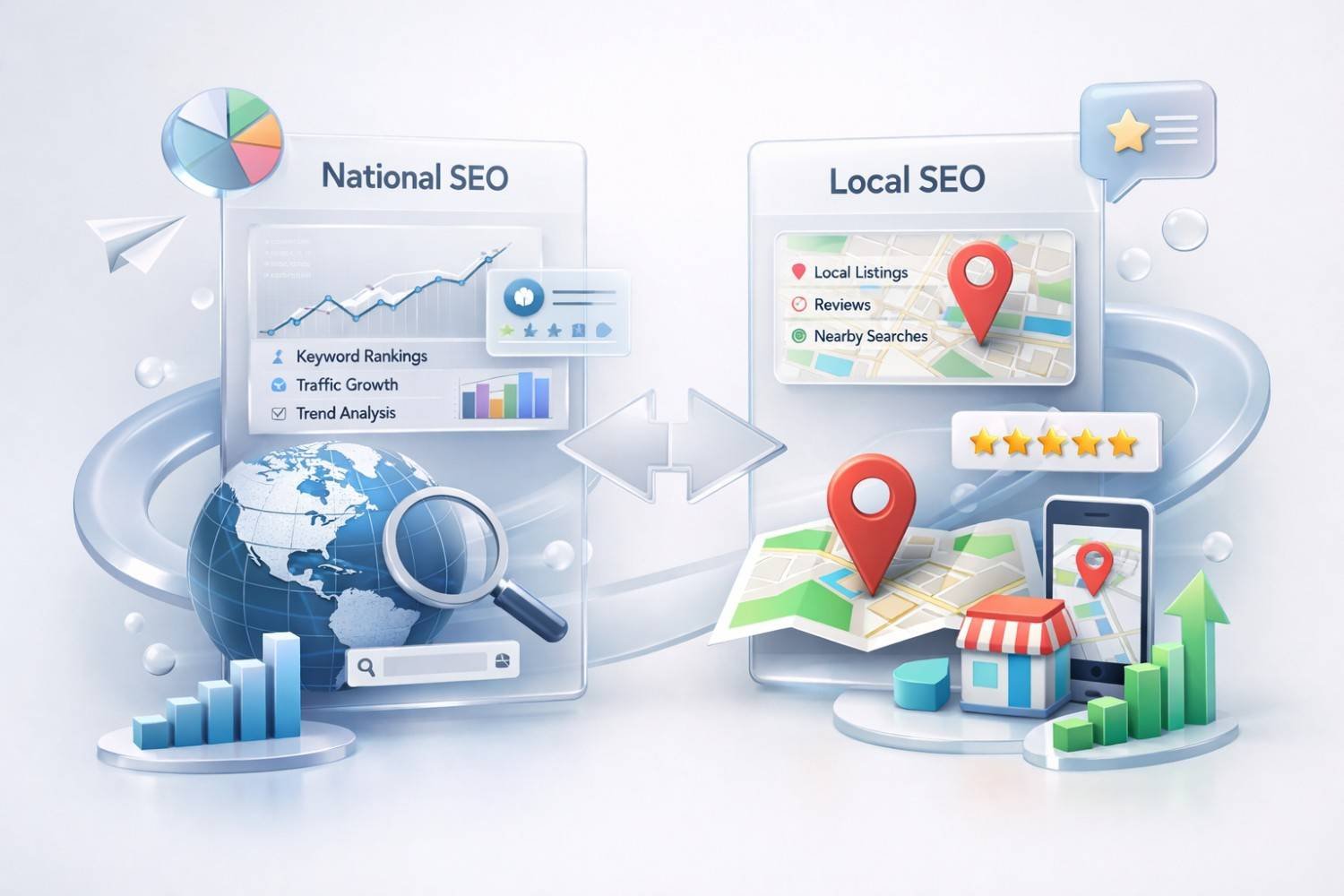
National SEO vs Local SEO: Key Differences
The fundamental difference lies in geographic intent and competition scope.
Local SEO targets users searching with location intent. Google serves different results based on the searcher’s physical location. A search for “coffee shop” in Seattle shows different results than the same search in Miami. Local strategies optimize Google Business Profiles, build local citations, and earn reviews from nearby customers.
National SEO ignores geographic signals entirely. The same content should rank whether someone searches from New York or Los Angeles. This creates a larger potential audience but dramatically increases competition.
Keyword difficulty differs substantially between approaches. Local keywords often have lower competition because fewer businesses target each specific location. National keywords face competition from every relevant business in the country, plus major publications, established brands, and content aggregators.
Content requirements also diverge. Local content can reference specific neighborhoods, landmarks, and regional concerns. National content must remain universally relevant while still providing specific, actionable value.
Link building strategies differ as well. Local SEO benefits from regional directories, local news coverage, and community partnerships. National SEO requires links from authoritative sites with national or international reach.
Who Needs National SEO?
E-commerce businesses selling products nationwide represent the clearest use case. Whether you ship physical goods or sell digital products, customers can purchase from anywhere. Ranking nationally captures the full addressable market.
SaaS companies and software providers need national visibility. Their products serve users regardless of location. A project management tool works identically in Texas and Vermont.
Online service providers benefit from national strategies. Consultants, coaches, agencies, and professionals delivering services remotely can serve clients anywhere. Geographic limitations don’t apply.
Content publishers and media companies require national reach. Their audience isn’t defined by location but by interest in specific topics. A finance blog serves readers across the country equally.
Franchise businesses with nationwide locations often combine local and national approaches. The parent brand builds national authority while individual locations optimize locally.
Direct-to-consumer brands competing with established retailers need national SEO. Building organic visibility reduces dependence on paid advertising and creates sustainable customer acquisition channels.
How Search Engines Rank Websites Nationally
Understanding search engine mechanics helps you build strategies aligned with how rankings actually work. Google processes billions of queries daily, matching each search with the most relevant, authoritative results from its index.
Crawling, Indexing, and Ranking Explained
Search engines discover content through crawling. Googlebot and similar crawlers follow links across the web, downloading pages and extracting information. Your site architecture determines how efficiently crawlers discover and access your content.
Indexing stores discovered content in massive databases. Google analyzes page content, identifies topics and entities, and catalogs information for retrieval. Not every crawled page gets indexed. Low-quality, duplicate, or inaccessible content may be excluded.
Ranking determines which indexed pages appear for specific queries. Google’s algorithms evaluate hundreds of factors to match search intent with the best available content. Rankings change constantly as new content appears, existing content updates, and algorithm refinements occur.
For national SEO, this process means your content must be discoverable, indexable, and demonstrably better than competitors. Technical barriers prevent crawling. Quality issues prevent indexing. Authority gaps prevent ranking.
The timeline matters too. New content takes time to be discovered, indexed, and evaluated. Established sites with strong crawl relationships see faster processing than new domains.
Core Ranking Factors for National Visibility
Content relevance remains foundational. Your pages must comprehensively address the topics users search for. Surface-level content loses to thorough, expert coverage.
Backlink authority signals trust and importance. Links from respected sites indicate your content deserves attention. Quality matters more than quantity. One link from a major publication outweighs dozens from low-authority sources.
User experience metrics influence rankings. Pages that load quickly, display properly on mobile devices, and provide intuitive navigation perform better. Core Web Vitals measure specific performance thresholds Google considers important.
Content freshness affects certain queries. Topics with rapidly changing information favor recently updated content. Evergreen topics weight freshness less heavily.
Topical authority emerges from comprehensive coverage. Sites demonstrating deep expertise across related subjects earn stronger rankings than those with isolated pages on random topics.
Brand signals increasingly influence national rankings. Branded searches, mentions across the web, and recognition as an authority in your space contribute to ranking potential.
How Google Evaluates Authority and Relevance
Google’s systems assess authority through multiple signals working together. No single factor determines rankings. The combination creates a holistic evaluation.
PageRank, though evolved significantly from its original form, still influences how link equity flows between pages. Links pass authority based on the linking page’s own authority and relevance.
Entity recognition connects your content to Google’s Knowledge Graph. When Google understands your brand as a recognized entity associated with specific topics, ranking potential increases.
E-E-A-T evaluation assesses Experience, Expertise, Authoritativeness, and Trustworthiness. While not a direct ranking factor, these qualities influence how quality raters evaluate search results, which informs algorithm development.
Relevance assessment goes beyond keyword matching. Google understands synonyms, related concepts, and search intent. Content must satisfy what users actually want, not just contain target keywords.
Behavioral signals may influence rankings, though Google’s statements on this remain ambiguous. Pages that satisfy users likely perform better over time than those causing immediate bounces back to search results.
The Core Components of a National SEO Strategy
Effective national SEO integrates multiple disciplines into a cohesive approach. Technical foundations enable visibility. Content demonstrates expertise. Links build authority. Each component supports the others.
Technical SEO Foundations
Technical SEO ensures search engines can access, understand, and index your content efficiently. Without solid technical foundations, even excellent content struggles to rank.
Site Architecture and Crawlability
Logical site structure helps both users and search engines navigate your content. Flat architectures where important pages sit within three clicks of the homepage perform better than deeply nested structures.
Internal linking distributes authority throughout your site. Strategic links from high-authority pages to important content signal relevance and pass ranking power.
URL structure should be clean, descriptive, and consistent. Avoid parameters, excessive subdirectories, and dynamically generated URLs when possible.
XML sitemaps guide crawlers to your important pages. Submit sitemaps through Google Search Console and update them as content changes.
Robots.txt files control crawler access. Ensure you’re not accidentally blocking important content while preventing crawling of low-value pages.
Canonical tags prevent duplicate content issues. When similar content exists at multiple URLs, canonicals tell search engines which version to index.
Page Speed and Core Web Vitals
Page speed directly impacts both rankings and user experience. Slow pages frustrate users and signal quality issues to search engines.
Core Web Vitals measure specific performance aspects. Largest Contentful Paint (LCP) tracks loading performance. First Input Delay (FID) measures interactivity. Cumulative Layout Shift (CLS) assesses visual stability.
Image optimization often provides the largest speed improvements. Compress images, use modern formats like WebP, and implement lazy loading for below-fold content.
Server response time affects initial page load. Quality hosting, content delivery networks, and efficient backend code reduce time to first byte.
JavaScript and CSS optimization prevents render-blocking. Minimize, defer, and async scripts appropriately. Remove unused code.
Caching reduces server load and improves repeat visitor experience. Browser caching stores assets locally. Server-side caching reduces database queries.
Mobile Optimization and Indexing
Google uses mobile-first indexing, meaning the mobile version of your site determines rankings. Desktop-only optimization no longer suffices.
Responsive design adapts layouts to any screen size. This approach serves the same HTML with CSS adjustments rather than maintaining separate mobile sites.
Touch targets must be appropriately sized and spaced. Buttons and links need sufficient size for finger taps without accidental clicks on adjacent elements.
Font sizes should remain readable without zooming. Body text below 16 pixels often creates usability issues on mobile devices.
Mobile page speed matters even more than desktop. Users on cellular connections expect fast experiences despite potentially slower network speeds.
Avoid intrusive interstitials that block content on mobile. Google penalizes pages where pop-ups prevent users from accessing the content they came for.
Keyword Research for National Targeting
Keyword research for national campaigns differs from local approaches. Higher search volumes bring greater competition. Strategic selection balances opportunity with realistic ranking potential.
Identifying High-Volume National Keywords
Start with seed keywords representing your core offerings. Use tools like Ahrefs, Semrush, or Google Keyword Planner to expand into related terms and variations.
Analyze search volume alongside keyword difficulty. High-volume terms with extreme difficulty may be long-term targets rather than immediate opportunities.
Examine competitor rankings to identify realistic targets. If your domain authority significantly trails competitors ranking for a term, prioritize building authority before targeting that keyword.
Consider commercial value, not just volume. A keyword with 1,000 monthly searches that converts at 5% outperforms one with 10,000 searches and 0.1% conversion.
Long-tail keywords often provide better initial opportunities. More specific phrases face less competition while attracting highly qualified traffic.
Group keywords by topic clusters rather than treating each as isolated targets. This approach builds topical authority and creates natural internal linking opportunities.
Search Intent Mapping Across the Funnel
Search intent determines what content type satisfies users. Misaligned intent means your content won’t rank regardless of quality.
Informational intent seeks knowledge. Users want to learn something. Blog posts, guides, and educational content serve this intent.
Navigational intent seeks specific destinations. Users want to find a particular site or page. Brand optimization captures this traffic.
Commercial investigation compares options. Users research before purchasing. Comparison content, reviews, and buying guides address this stage.
Transactional intent indicates purchase readiness. Users want to buy now. Product pages and service pages with clear conversion paths serve this intent.
Map your target keywords to appropriate intent categories. Create content matching what users actually want when they search each term.
Analyze SERP features for intent signals. If Google shows product carousels, the intent is transactional. If featured snippets dominate, informational content wins.
Content Strategy and Creation
Content serves as the vehicle for ranking. Without pages targeting your keywords, you have nothing to optimize. Strategic content creation builds the foundation for national visibility.
Building Topical Authority
Topical authority emerges from comprehensive coverage of a subject area. Single pages on isolated topics rarely compete against sites demonstrating deep expertise.
Create content clusters around core topics. A pillar page covers the broad subject while supporting articles address specific subtopics in depth.
Internal linking connects cluster content. The pillar page links to supporting articles. Supporting articles link back to the pillar and to each other where relevant.
Cover topics exhaustively before expanding to new areas. Depth in one subject builds more authority than shallow coverage across many.
Update existing content regularly. Fresh information signals ongoing expertise. Outdated content suggests abandonment.
Address questions your audience asks at every stage. Awareness content introduces concepts. Consideration content compares solutions. Decision content facilitates purchases.
Content Formats That Drive National Rankings
Long-form guides rank well for competitive informational queries. Comprehensive coverage that answers all related questions outperforms shallow articles.
How-to content captures instructional searches. Step-by-step guides with clear instructions satisfy users seeking to accomplish specific tasks.
Listicles and roundups work for comparison queries. “Best X” and “Top Y” formats match how users search when evaluating options.
Data-driven content earns links naturally. Original research, surveys, and statistical analysis provide unique value other sites want to reference.
Tools and calculators serve functional queries. Interactive content that helps users accomplish tasks generates engagement and links.
Video content captures YouTube rankings and video carousels in search results. Some queries strongly favor video over text content.
E-E-A-T and Content Quality Signals
Experience demonstrates first-hand knowledge. Content from practitioners who’ve actually done what they describe carries more weight than theoretical explanations.
Expertise shows subject matter depth. Technical accuracy, industry terminology used correctly, and nuanced understanding signal expertise.
Authoritativeness comes from recognition by others. Links, mentions, and citations from respected sources indicate your content deserves attention.
Trustworthiness requires accuracy and transparency. Cite sources, acknowledge limitations, and provide clear information about who creates your content.
Author bylines with credentials support E-E-A-T signals. Identify who writes your content and why they’re qualified.
About pages and author bios provide context. Help users and search engines understand your organization’s expertise and credibility.
Link Building and Authority Acquisition
Backlinks remain among the strongest ranking factors for national SEO. Building authority through quality links differentiates competitive sites from also-rans.
Earning High-Authority Backlinks
Create linkable assets that naturally attract references. Original research, comprehensive guides, and unique tools give others reasons to link.
Guest posting on relevant, authoritative sites builds links and exposure. Focus on publications your audience actually reads, not just any site accepting contributions.
Broken link building identifies dead links on other sites and offers your content as a replacement. This provides value to site owners while earning links.
Resource page outreach targets curated lists of helpful links. If your content genuinely helps their audience, site owners often add it.
Competitor backlink analysis reveals linking opportunities. Sites linking to competitors may link to your superior content when approached appropriately.
Relationship building creates ongoing link opportunities. Genuine connections with journalists, bloggers, and industry figures lead to natural mentions over time.
Digital PR and Brand Mentions
Digital PR earns coverage from news sites and major publications. Newsworthy announcements, expert commentary, and data-driven stories attract journalist attention.
HARO (Help a Reporter Out) and similar services connect experts with journalists seeking sources. Providing valuable quotes earns links and brand mentions.
Newsjacking inserts your expertise into trending stories. Timely commentary on relevant news can earn significant coverage.
Brand mentions without links still provide value. Google likely considers unlinked mentions as authority signals. They also create opportunities for link reclamation outreach.
Thought leadership positions your team as industry experts. Speaking engagements, podcast appearances, and industry contributions build recognition that translates to links.
The National SEO Process: Step-by-Step
Effective national SEO follows a structured process. Random tactics without strategic coordination waste resources. Systematic execution builds compounding results.
Phase 1: SEO Audit and Competitive Analysis
Begin with a comprehensive audit of your current state. Identify technical issues preventing optimal crawling and indexing. Assess content gaps and quality issues. Evaluate your backlink profile against competitors.
Technical audits examine site architecture, page speed, mobile optimization, indexation status, and crawl errors. Tools like Screaming Frog, Sitebulb, or DeepCrawl automate much of this analysis.
Content audits inventory existing pages, assess quality and relevance, identify thin or duplicate content, and map current keyword coverage.
Backlink audits analyze your link profile’s strength, diversity, and quality. Compare against competitors to understand the authority gap you need to close.
Competitive analysis reveals what’s working in your space. Examine top-ranking competitors’ content strategies, technical implementations, and link profiles.
Document findings with prioritized recommendations. Not all issues carry equal weight. Focus on high-impact opportunities first.
Phase 2: Strategy Development and Prioritization
Transform audit findings into an actionable strategy. Define target keywords, content priorities, technical fixes, and link building approaches.
Set realistic goals based on current authority and competitive landscape. New sites targeting highly competitive keywords need longer timelines than established sites pursuing moderate-difficulty terms.
Prioritize quick wins alongside long-term investments. Technical fixes often provide immediate improvements. Content and link building compound over time.
Allocate resources appropriately. National SEO requires sustained investment. Sporadic efforts rarely overcome established competitors.
Create a content calendar mapping topics to target keywords and publication dates. Consistent publishing builds momentum.
Define success metrics aligned with business objectives. Rankings matter, but traffic, leads, and revenue matter more.
Phase 3: Technical Implementation
Execute technical fixes identified during the audit. Address crawlability issues, speed problems, and mobile optimization gaps.
Implement proper site architecture if restructuring is needed. This may require careful redirect planning to preserve existing authority.
Set up proper tracking and measurement. Google Search Console, Google Analytics, and rank tracking tools provide essential data.
Establish ongoing technical monitoring. New issues emerge as sites evolve. Regular audits catch problems before they impact rankings.
Create processes for maintaining technical health as content scales. Template optimization, image compression workflows, and performance budgets prevent degradation.
Phase 4: Content Development and Optimization
Execute your content strategy systematically. Prioritize high-value targets while building supporting content.
Optimize existing content before creating new pages. Quick improvements to established pages often yield faster results than new content.
Create content following E-E-A-T principles. Demonstrate expertise, provide unique value, and cite authoritative sources.
Implement on-page optimization best practices. Strategic keyword placement, proper heading structure, and internal linking enhance relevance signals.
Build content clusters around priority topics. Comprehensive coverage of related subtopics strengthens topical authority.
Establish quality standards and editorial processes. Consistency matters for both users and search engines.
Phase 5: Authority Building and Outreach
Launch link building campaigns aligned with your strategy. Focus on quality over quantity.
Create linkable assets designed to earn natural links. Original research, tools, and comprehensive resources attract references.
Execute outreach campaigns targeting relevant, authoritative sites. Personalized pitches to appropriate contacts outperform mass emails.
Pursue digital PR opportunities. Newsworthy content and expert commentary earn coverage from major publications.
Build relationships within your industry. Genuine connections create ongoing opportunities beyond transactional link requests.
Monitor new links and mentions. Respond to coverage, thank linkers, and identify patterns in what earns attention.
Phase 6: Performance Tracking and Iteration
Measure results against defined KPIs. Track rankings, traffic, engagement, and conversions.
Analyze what’s working and what isn’t. Double down on successful approaches. Adjust or abandon underperforming tactics.
Report progress to stakeholders with context. Raw numbers without interpretation don’t drive decisions.
Refine strategy based on data. SEO requires continuous optimization, not set-and-forget implementation.
Stay current with algorithm updates and industry changes. Adapt approaches as search engines evolve.
Plan next-phase priorities based on results. Success in one area creates opportunities to expand into adjacent topics.
How Long Does National SEO Take to Work?
SEO timelines frustrate many business owners expecting quick results. Understanding realistic expectations helps you plan appropriately and evaluate progress accurately.
Realistic Timelines by Industry Competitiveness
Low-competition industries may see meaningful results within 3-6 months. Niche B2B services, specialized products, and emerging categories often have fewer established competitors.
Moderate-competition industries typically require 6-12 months for significant progress. Most B2B and B2C categories fall here. Established competitors exist but aren’t insurmountable.
High-competition industries demand 12-24 months or longer for substantial results. Finance, health, legal, and major e-commerce categories face intense competition from well-funded, established players.
Your starting point matters significantly. Sites with existing authority and content can accelerate timelines. New domains starting from zero face longer paths to visibility.
Factors That Accelerate or Delay Results
Existing domain authority provides a foundation. Sites with established backlink profiles and indexed content can rank new pages faster than brand-new domains.
Content quality and comprehensiveness impact speed. Exceptional content that clearly surpasses competitors can rank faster than merely adequate pages.
Technical health affects crawling and indexing speed. Sites with clean technical foundations see faster processing than those with significant issues.
Resource allocation influences pace. Aggressive content production and link building accelerate results compared to minimal investment.
Competitive response can slow progress. If competitors also invest in SEO, the bar keeps rising. Static competitors make your job easier.
Algorithm updates create volatility. Major updates can accelerate or delay progress depending on how your site aligns with new ranking factors.
What to Expect at 3, 6, and 12 Months
At 3 months, expect foundational progress rather than dramatic results. Technical issues should be resolved. Initial content should be indexed. Some long-tail keywords may show movement.
At 6 months, momentum should be building. Traffic from long-tail keywords should be growing. Some moderate-difficulty keywords should show ranking improvements. Content production should be establishing topical authority.
At 12 months, meaningful results should be evident. Traffic growth should be substantial and accelerating. Rankings for target keywords should be improving. ROI calculations should become possible.
These timelines assume consistent, quality execution. Sporadic efforts, poor content, or technical issues extend timelines significantly.
Measuring National SEO Success
Effective measurement connects SEO activities to business outcomes. Vanity metrics without revenue context don’t justify continued investment.
Key Performance Indicators (KPIs) to Track
Organic traffic measures visitors arriving through unpaid search results. Segment by landing page, device, and geography for deeper insights.
Keyword rankings track visibility for target terms. Monitor both primary targets and long-tail variations.
Organic conversions connect traffic to business outcomes. Track leads, sales, signups, or other valuable actions from organic visitors.
Click-through rate from search results indicates how compelling your listings appear. Low CTR despite good rankings suggests title and description optimization opportunities.
Engagement metrics like time on page, pages per session, and bounce rate indicate content quality and relevance.
Backlink growth tracks authority building progress. Monitor new links, referring domains, and domain authority trends.
Indexed pages confirm your content is discoverable. Significant gaps between published and indexed pages indicate technical issues.
Tools for Monitoring National Rankings
Google Search Console provides first-party data on impressions, clicks, and average positions. This free tool offers the most accurate ranking data available.
Ahrefs, Semrush, and Moz offer comprehensive rank tracking alongside competitive analysis. These paid tools provide broader keyword monitoring and historical data.
Google Analytics tracks traffic, engagement, and conversions. GA4’s integration with Search Console provides unified reporting.
Screaming Frog and similar crawlers monitor technical health. Regular crawls catch issues before they impact rankings.
Looker Studio (formerly Data Studio) creates custom dashboards combining data from multiple sources. Unified reporting simplifies stakeholder communication.
Connecting SEO Metrics to Revenue
Attribution modeling connects organic traffic to revenue. Understand how SEO contributes to conversions, even when not the final touchpoint.
Customer lifetime value calculations justify SEO investment. A customer acquired through organic search may generate revenue for years.
Cost per acquisition comparisons show SEO efficiency versus paid channels. Organic traffic often delivers lower CPA over time.
Revenue per organic visit helps prioritize optimization efforts. Focus on pages and keywords driving the most valuable traffic.
Forecasting models project future returns based on current trends. These projections help secure continued investment.
Common National SEO Mistakes to Avoid
Learning from others’ mistakes accelerates your progress. These common errors derail many national SEO campaigns.
Targeting Keywords Without Search Intent Alignment
Chasing high-volume keywords without considering intent wastes resources. If your content doesn’t match what users want, it won’t rank regardless of optimization.
Analyze SERPs before targeting keywords. If results show a different content type than you’re planning, reconsider your approach.
Match content format to intent. Informational queries need educational content. Transactional queries need product pages.
Consider the user’s stage in their journey. Awareness content shouldn’t push sales. Decision content shouldn’t withhold pricing.
Neglecting Technical SEO Foundations
Beautiful content on a broken site won’t rank. Technical issues prevent search engines from discovering and indexing your pages.
Regular technical audits catch emerging issues. Sites evolve, and new problems appear. Ongoing monitoring prevents degradation.
Mobile optimization isn’t optional. Mobile-first indexing means mobile issues affect all rankings, not just mobile searches.
Page speed impacts both rankings and conversions. Slow sites frustrate users and signal quality issues to search engines.
Expecting Immediate Results
Impatience leads to premature strategy changes. Abandoning approaches before they’ve had time to work prevents success.
SEO compounds over time. Early efforts build foundations that later efforts leverage. Stopping too soon wastes previous investment.
Set appropriate expectations with stakeholders. Unrealistic timelines create pressure that undermines long-term strategy.
Track leading indicators while waiting for lagging results. Indexation, impressions, and ranking movement signal progress before traffic materializes.
National SEO vs Paid Advertising: When to Use Each
SEO and paid advertising serve different purposes. Understanding when each approach makes sense optimizes your marketing investment.
Cost Comparison Over Time
Paid advertising delivers immediate visibility but requires ongoing spend. Stop paying, traffic stops. Costs remain constant or increase as competition grows.
SEO requires upfront investment but builds lasting assets. Content and authority continue generating traffic after initial creation. Marginal costs decrease as foundations strengthen.
Short-term campaigns favor paid advertising. Product launches, seasonal promotions, and time-sensitive offers need immediate visibility.
Long-term growth favors SEO investment. Sustainable traffic that doesn’t depend on ad spend creates more predictable, profitable customer acquisition.
Most businesses benefit from both channels working together. Paid advertising provides immediate results while SEO builds long-term foundations.
Building a Balanced Digital Marketing Strategy
Use paid advertising to test keywords before SEO investment. Conversion data from ads informs which organic keywords deserve priority.
Retarget organic visitors with paid campaigns. Users who discovered you through search may convert after seeing ads elsewhere.
Bid on branded terms even with strong organic rankings. Competitors bidding on your brand name can steal traffic. Owning both paid and organic results maximizes visibility.
Reduce paid spend as organic rankings improve. Reallocate budget to new keywords or other channels as SEO delivers traffic previously requiring ads.
Coordinate messaging across channels. Consistent positioning reinforces brand recognition regardless of how users find you.
How to Choose a National SEO Partner
Selecting the right SEO partner significantly impacts results. The wrong choice wastes budget and time. The right partner accelerates growth.
Questions to Ask Before Hiring an SEO Agency
Request case studies with measurable results. Vague claims of “improved rankings” don’t demonstrate capability. Look for traffic growth, revenue impact, and specific keyword achievements.
Ask about their process and methodology. Legitimate agencies explain their approach clearly. Evasiveness suggests questionable tactics.
Understand who will work on your account. Senior expertise during sales that disappears after signing indicates bait-and-switch practices.
Inquire about reporting frequency and format. Regular, transparent reporting enables accountability. Agencies avoiding reporting may be hiding poor performance.
Discuss contract terms and exit clauses. Reasonable agencies don’t require long lock-in periods. Confidence in their work means clients stay by choice.
Ask about their approach to link building. Tactics matter. Manipulative link schemes risk penalties. Quality-focused approaches build sustainable authority.
Red Flags and Warning Signs
Guaranteed rankings should trigger immediate skepticism. No one can guarantee specific positions. Google’s algorithms are beyond any agency’s control.
Unusually low pricing often indicates low-quality work. Effective SEO requires skilled professionals and significant effort. Bargain pricing usually means corner-cutting.
Lack of transparency about tactics suggests risky approaches. Agencies unwilling to explain their methods may be using techniques that could harm your site.
Overemphasis on vanity metrics like domain authority without connecting to business outcomes indicates misaligned priorities.
High client turnover suggests dissatisfaction. Ask for references and actually contact them.
Pressure tactics and urgency creation mirror scam patterns. Legitimate agencies don’t need high-pressure sales techniques.
What a Data-Driven SEO Partnership Looks Like
Clear goal alignment ensures everyone works toward the same outcomes. Business objectives drive SEO strategy, not the reverse.
Regular reporting with actionable insights keeps you informed. Data without interpretation doesn’t help. Good partners explain what numbers mean and what to do about them.
Proactive communication about opportunities and challenges builds trust. Partners who only report good news aren’t being honest.
Strategic recommendations based on data, not just activity reports, demonstrate expertise. Execution matters, but strategy matters more.
Flexibility to adjust approaches based on results shows commitment to outcomes over processes. Rigid adherence to initial plans despite contradicting data indicates inflexibility.
Collaborative relationships where your input matters create better results. You know your business. Good partners leverage that knowledge.
Conclusion
National SEO works through the coordinated optimization of technical foundations, strategic content creation, and systematic authority building. Success requires understanding how search engines evaluate relevance and authority, then executing consistently over time to demonstrate your site deserves top rankings.
The investment pays off through sustainable organic traffic that doesn’t depend on ongoing ad spend. Businesses that commit to national SEO build assets that generate leads and revenue for years, creating competitive advantages that grow stronger over time.
We help businesses build sustainable organic growth through comprehensive national SEO strategies. Contact White Label SEO Service to discuss how we can accelerate your path to nationwide visibility and the traffic growth your business deserves.
Frequently Asked Questions About National SEO
How is national SEO different from international SEO?
National SEO targets users within a single country, optimizing for one language and one version of Google. International SEO targets multiple countries, requiring hreflang implementation, multiple language versions, and potentially separate domains or subdirectories for each market.
Can small businesses compete with national SEO?
Small businesses can compete nationally by targeting less competitive long-tail keywords and building deep expertise in specific niches. Starting with focused topics where you can create genuinely superior content builds authority that eventually supports broader keyword targeting.
What industries benefit most from national SEO?
E-commerce, SaaS, online education, financial services, and any business serving customers regardless of location benefit most from national SEO. Industries with high customer lifetime values see the strongest ROI since organic traffic acquisition costs decrease over time.
How much should I budget for national SEO?
National SEO budgets typically range from $3,000 to $15,000 monthly for small to mid-sized businesses, with enterprise campaigns often exceeding $25,000 monthly. Budget requirements depend on competitive intensity, current site authority, and growth timeline expectations.
What’s the difference between national SEO and general SEO?
National SEO is a specific application of general SEO principles focused on country-wide visibility. It emphasizes high-volume keywords, significant authority building, and content strategies designed to compete against all businesses in a country rather than just local competitors.
How do I know if my business needs national SEO?
Your business needs national SEO if you serve customers across an entire country, sell products that ship nationwide, or provide services without geographic limitations. If your potential customers could be located anywhere in the country, national visibility maximizes your addressable market.
Can I do national SEO myself or do I need an agency?
You can execute national SEO in-house if you have team members with technical SEO knowledge, content creation capabilities, and link building experience. Many businesses lack these combined skills internally, making agency partnerships more efficient despite the cost.