
Job-to-be-done keywords connect your SaaS product directly to the outcomes customers actually want to achieve. Unlike traditional keyword targeting that focuses on features or generic search terms, JTBD keywords capture the specific progress users seek when they hire your software.
This approach transforms how SaaS companies attract qualified traffic. You stop competing on feature lists and start ranking for the exact moments when prospects need solutions.
This guide covers JTBD keyword identification, categorization by job type, buyer journey mapping, content creation strategies, and performance measurement frameworks for sustainable organic growth.
What Are Job-to-be-Done Keywords?
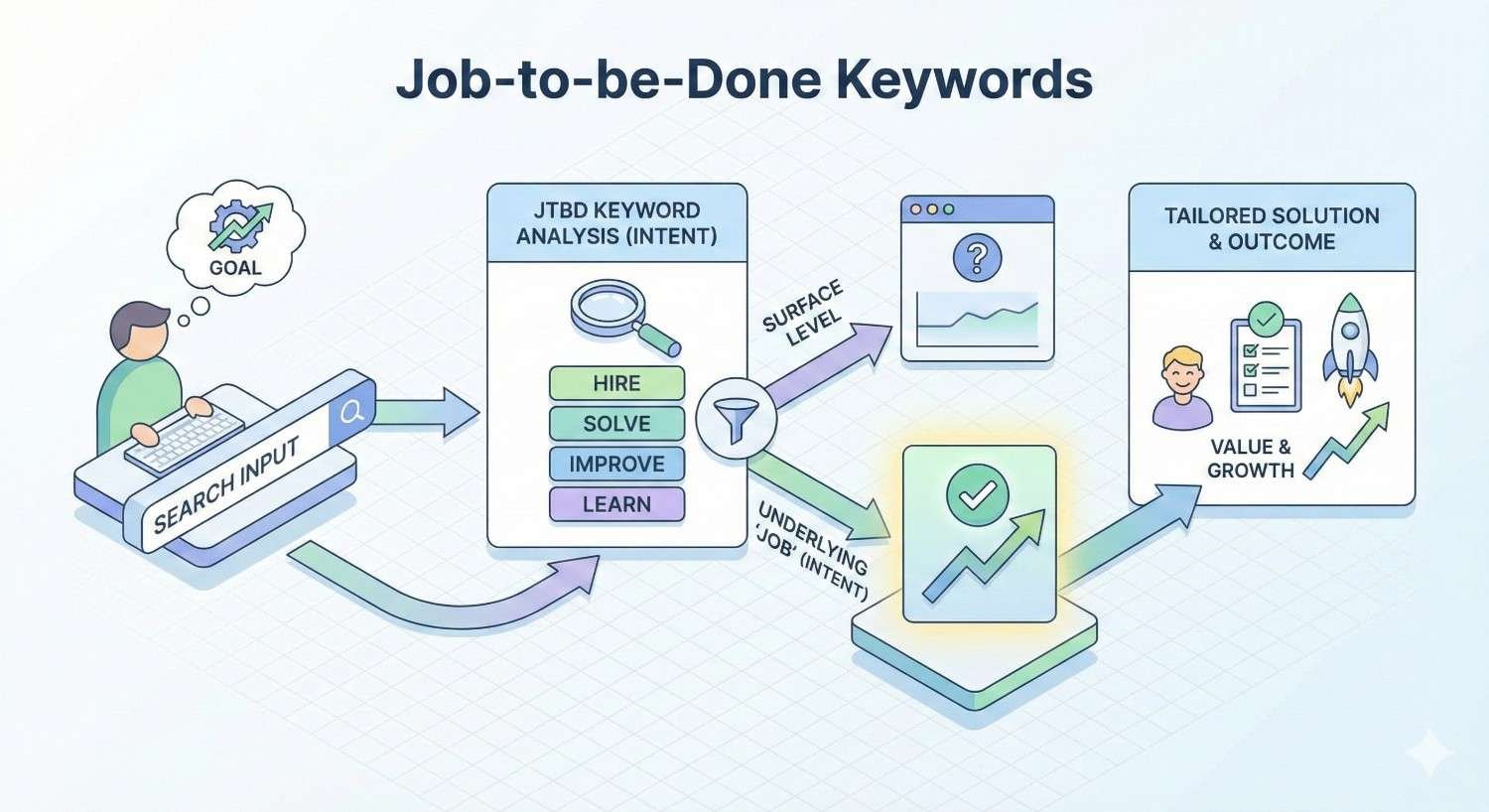
Job-to-be-done keywords are search phrases that reflect the underlying tasks, goals, or outcomes users want to accomplish. These keywords emerge from the jobs-to-be-done framework, which focuses on understanding why customers hire products rather than what features those products contain.
When someone searches “how to keep remote team aligned on project deadlines,” they reveal a job they need done. A project management SaaS can target this keyword because it directly addresses the outcome the searcher wants. The keyword captures intent at its most actionable level.
The JTBD Framework Explained
Clayton Christensen developed the jobs-to-be-done framework to explain why customers choose certain products over others. The core insight is simple: people do not buy products. They hire products to make progress in specific circumstances.
A customer does not want a drill. They want a hole in the wall. They do not want project management software. They want their team to deliver projects on time without constant check-ins.
This framework shifts product positioning from features to outcomes. For SaaS companies, it means understanding the progress customers seek and the circumstances that trigger their search for solutions. Every search query represents a job someone needs done.
The framework identifies three dimensions of every job. Functional jobs describe the practical task. Emotional jobs capture how users want to feel. Social jobs address how users want to be perceived by others. Effective JTBD keyword strategies address all three dimensions.
How JTBD Keywords Differ from Traditional Keywords
Traditional keyword research starts with seed terms related to your product category. You might research “project management software” or “CRM tools” and build content around those phrases. This approach targets people already aware of solution categories.
JTBD keywords work differently. They target people experiencing problems before they know what solution category exists. Someone searching “stop missing client follow-ups” has a job to be done. They may not know CRM software is the answer yet.
Traditional keywords often have higher search volume but lower conversion rates. JTBD keywords typically show lower volume but attract prospects with clearer intent and higher likelihood to convert. The searcher has already defined their problem in outcome terms.
Feature-based keywords describe what your product does. JTBD keywords describe what your customer achieves. “Automated email sequences” is feature-based. “Never forget to follow up with a lead” is job-based. Both might lead to the same product, but they attract different mindsets.
The Anatomy of a Job-to-be-Done Keyword
JTBD keywords follow predictable patterns that reveal user intent. Understanding these patterns helps you identify and create content around job-based search queries.
The most common structure includes an action verb plus a desired outcome. “Reduce time spent on invoicing” contains the action (reduce) and the outcome (less time on invoicing). “Keep team members accountable without micromanaging” shows the goal and the constraint.
Circumstance modifiers add context that increases relevance. “Track project progress for remote teams” specifies the situation. “Manage client expectations during long projects” defines when the job matters most.
Negation patterns reveal jobs through what users want to avoid. “Stop losing deals to competitors” and “prevent scope creep on client projects” express jobs through unwanted outcomes. These keywords often indicate high urgency and strong purchase intent.
Comparison structures show users evaluating how to accomplish jobs. “Faster way to onboard new clients” implies comparison to current methods. “Easier method for tracking billable hours” suggests dissatisfaction with existing approaches.
Why SaaS Companies Need JTBD Keywords
SaaS companies operate in crowded markets where feature differentiation becomes increasingly difficult. JTBD keywords provide a strategic advantage by connecting products to customer outcomes rather than competing on feature lists.
The subscription model makes customer acquisition cost critical. JTBD keywords attract prospects who already understand their problem, reducing the education burden and shortening sales cycles. These visitors arrive with context that makes conversion more likely.
Aligning Content with Customer Intent
Search intent alignment determines whether content converts visitors into users. When someone searches a JTBD keyword, they have already framed their problem in outcome terms. Content that mirrors this framing creates immediate resonance.
Traditional product pages describe features and hope visitors connect those features to their needs. JTBD-aligned content starts with the outcome and shows how features enable that outcome. The visitor sees their goal reflected back to them.
This alignment extends beyond landing pages. Blog content, help documentation, and even email sequences can use JTBD language. When every touchpoint speaks to jobs rather than features, the entire customer experience becomes more coherent.
Intent alignment also improves content performance metrics. Pages that match search intent earn longer time on page, lower bounce rates, and higher engagement. These signals reinforce rankings and create positive feedback loops.
Reducing Customer Acquisition Costs
Customer acquisition cost determines SaaS profitability. JTBD keywords reduce CAC through multiple mechanisms that compound over time.
First, JTBD keywords attract more qualified traffic. Visitors who search outcome-based queries have already identified their problem. They require less education before they can evaluate solutions. This reduces the content and touchpoints needed before conversion.
Second, JTBD content converts at higher rates. When landing pages speak directly to the job a visitor wants done, the value proposition becomes immediately clear. Visitors spend less time wondering if the product fits their needs.
Third, JTBD keywords often face less competition. While competitors fight over high-volume category keywords, JTBD keywords target specific circumstances that larger players overlook. Lower competition means lower cost per acquisition through both organic and paid channels.
Fourth, JTBD-acquired customers often retain better. They chose your product because it addressed their specific job. This clarity of purpose reduces churn from mismatched expectations.
Building Product-Led SEO Strategies
Product-led growth depends on users discovering value quickly. JTBD keywords support this model by attracting users who already understand what they want to accomplish.
Product-led SEO connects search queries directly to product capabilities. Instead of generic content that mentions your product, JTBD content shows exactly how your product accomplishes specific jobs. The content becomes a demonstration of value.
This approach works particularly well for freemium and free trial models. Users who arrive through JTBD keywords can immediately test whether the product accomplishes their job. The evaluation criteria are already established by their search query.
Product-led SEO also generates content ideas from product usage. Every feature exists to accomplish a job. Mapping features to jobs creates a content roadmap that covers your entire product surface area while maintaining relevance to searcher intent.
How to Identify Job-to-be-Done Keywords for SaaS
Finding JTBD keywords requires looking beyond traditional keyword research tools. The best sources are your customers themselves, followed by competitive analysis and search data interpretation.
Effective JTBD keyword research combines qualitative and quantitative methods. Customer conversations reveal the language people use to describe their jobs. Search data validates which phrases have sufficient volume to target.
Customer Interview Mining Techniques
Customer interviews provide the richest source of JTBD keyword language. The key is asking questions that reveal jobs rather than feature preferences.
Start with circumstance questions. “What was happening when you decided to look for a solution?” reveals the trigger event. “What had you tried before?” shows the competitive landscape from the customer perspective. “What would have happened if you had not found a solution?” exposes the stakes.
Progress questions uncover the desired outcome. “What does success look like for you?” defines the job in outcome terms. “How will you know this is working?” reveals measurement criteria. “What will be different six months from now?” captures the transformation customers seek.
Listen for the language customers use naturally. They rarely describe jobs using your product terminology. They use phrases like “keep track of,” “make sure,” “stop having to,” and “finally be able to.” These phrases become keyword seeds.
Record and transcribe interviews when possible. Review transcripts for repeated phrases and patterns. The exact words customers use often match search queries better than paraphrased versions.
Analyzing Support Tickets and Feedback
Support tickets reveal jobs customers struggle to accomplish. Every ticket represents a gap between what customers want to do and what they can currently do.
Categorize tickets by the underlying job rather than the feature involved. “How do I export data to Excel?” is really “I need to share project status with stakeholders who do not use this tool.” The job-based categorization reveals keyword opportunities.
Feature requests expose unmet jobs. When customers ask for new capabilities, they describe the outcome they want. “Can you add a way to see all overdue tasks across projects?” reveals a job around maintaining visibility without checking multiple views.
Review sites and feedback forums provide external perspectives. G2, Capterra, and industry-specific forums contain reviews that describe jobs in customer language. Negative reviews are particularly valuable because they explicitly state unmet jobs.
NPS survey responses often include job language. Promoters describe jobs your product accomplishes well. Detractors describe jobs where you fall short. Both provide keyword opportunities.
Competitor JTBD Keyword Gap Analysis
Competitors may have already identified JTBD keywords you have not considered. Analyzing their content reveals opportunities to target similar jobs or find gaps they have missed.
Review competitor blog content for job-based headlines. “How to [accomplish outcome]” and “The best way to [complete task]” patterns indicate JTBD targeting. Note which jobs they address and which they ignore.
Examine competitor landing pages for outcome language. Pages that lead with benefits rather than features often target JTBD keywords. The specific outcomes they highlight reveal their keyword strategy.
Use SEO tools to identify competitor rankings for question-based queries. Questions often represent jobs in interrogative form. “How do I keep my team on the same page?” is a job expressed as a question.
Look for gaps in competitor coverage. If competitors focus on certain job categories while ignoring others, those gaps represent opportunities. Jobs they consider too niche might be perfect for your positioning.
Using Search Data to Uncover Jobs
Search data provides quantitative validation for JTBD keywords identified through qualitative research. It also reveals jobs you might not have discovered through customer conversations.
Google Search Console shows queries that already bring traffic to your site. Filter for question queries and phrases containing outcome language. These represent jobs where you already have some relevance.
Keyword research tools help expand from seed terms. Start with job-based phrases from customer interviews and use related keyword features to find variations. Look for patterns in how people phrase similar jobs.
People Also Ask boxes reveal related jobs. When you search a JTBD keyword, the PAA section shows adjacent jobs that searchers also want to accomplish. Each question represents a potential content opportunity.
Autocomplete suggestions show common ways people phrase jobs. Type the beginning of a job-based query and note how search engines complete it. These completions reflect actual search behavior.
Social Listening for Unmet Jobs
Social platforms reveal jobs people discuss but may not search for directly. These conversations expose emerging needs and language patterns that have not yet appeared in search data.
Reddit communities contain detailed discussions of problems and desired outcomes. Subreddits related to your industry include threads where people describe jobs they struggle to accomplish. The comment sections often contain even more specific job language.
LinkedIn posts from your target audience reveal professional jobs. People share challenges and ask for recommendations. The way they describe their needs provides keyword language.
Twitter and X conversations capture real-time job expressions. Search for phrases like “I wish there was” and “does anyone know how to” combined with your industry terms. These queries represent active jobs.
Industry Slack communities and Discord servers contain candid discussions. Members describe problems without the polish of public posts. This raw language often matches search queries more closely.
JTBD Keyword Categories for SaaS Products
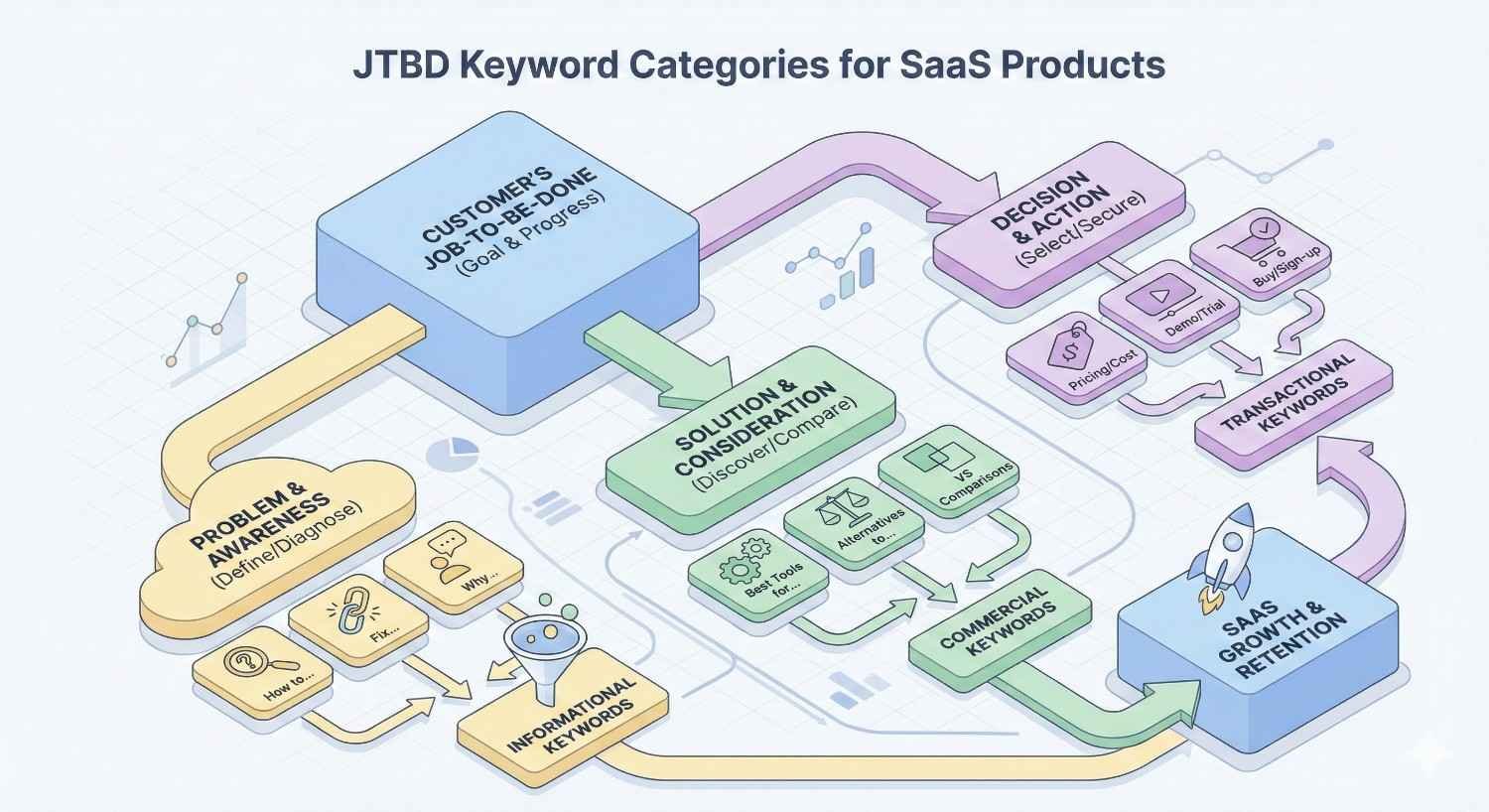
Jobs fall into distinct categories that require different content approaches. Understanding these categories helps you build comprehensive keyword coverage that addresses the full spectrum of customer needs.
Each category connects to different stages of the decision process and different aspects of product value. A complete JTBD keyword strategy includes keywords from all categories.
Functional Job Keywords
Functional jobs describe the practical tasks users want to accomplish. These are the most straightforward JTBD keywords and often have the clearest connection to product features.
Examples include “track time spent on client projects,” “send automated follow-up emails,” and “create reports from multiple data sources.” Each phrase describes a specific task with a measurable outcome.
Functional job keywords work well for product pages and feature documentation. They attract users who know what they need to do and want to find tools that help them do it.
These keywords often include action verbs: track, manage, create, send, organize, automate, schedule, monitor. The verb indicates the functional job while the object specifies the context.
Functional jobs can be broken into smaller sub-jobs. “Manage projects” contains sub-jobs like “assign tasks,” “track progress,” “communicate updates,” and “meet deadlines.” Targeting sub-jobs allows for more specific content that matches precise search intent.
Emotional Job Keywords
Emotional jobs describe how users want to feel during and after using your product. These keywords are often overlooked but drive significant search behavior.
Examples include “feel confident presenting to clients,” “stop worrying about missed deadlines,” and “finally get control of my inbox.” The emotional language signals the internal state users seek.
Emotional job keywords work well for top-of-funnel content. Users searching these terms may not know what solution category they need. Content that acknowledges the emotional job before introducing solutions builds trust.
These keywords often include feeling words: confident, calm, in control, organized, prepared, relieved. They also include negation of negative emotions: stop stressing, no more anxiety, never worry again.
Emotional jobs influence purchase decisions even when users focus on functional requirements. Content that addresses emotional jobs alongside functional capabilities creates stronger resonance.
Social Job Keywords
Social jobs describe how users want to be perceived by others. These keywords connect product usage to professional identity and reputation.
Examples include “look professional to clients,” “be seen as organized by my team,” and “demonstrate value to leadership.” The social context shapes how users evaluate solutions.
Social job keywords work well for case studies and testimonial content. Showing how other users achieved social outcomes provides proof that your product delivers on these jobs.
These keywords often reference specific audiences: clients, team members, managers, stakeholders, investors. The audience indicates whose perception matters for the job.
B2B SaaS products particularly benefit from social job keywords. Professional reputation influences many software decisions. Users want tools that make them look competent and capable.
Consumption Chain Keywords
Consumption chain keywords address jobs that occur before, during, and after using your core product. These peripheral jobs influence the overall experience and satisfaction.
Pre-use jobs include evaluation and setup. “Compare project management tools,” “migrate data from spreadsheets,” and “get team to adopt new software” represent jobs that occur before regular usage begins.
During-use jobs include learning and optimization. “Get more from my CRM,” “find features I am not using,” and “customize workflows for my team” represent ongoing jobs during product usage.
Post-use jobs include reporting and integration. “Show ROI to my boss,” “connect my tools together,” and “export data for analysis” represent jobs that extend beyond core product usage.
Consumption chain keywords attract users at different relationship stages. Pre-use keywords bring new prospects. During-use keywords engage current users. Post-use keywords support retention and expansion.
How to Map JTBD Keywords to the SaaS Buyer Journey
Different jobs become relevant at different stages of the buyer journey. Mapping keywords to stages ensures you have content that meets prospects wherever they are in their decision process.
This mapping also helps prioritize content creation. Keywords that align with high-intent stages may deserve earlier attention than awareness-stage keywords.
Awareness Stage JTBD Keywords
Awareness stage keywords target users who recognize they have a problem but have not yet identified solution categories. These users search for outcomes without knowing what products might help.
Examples include “spend less time on administrative tasks,” “keep remote team connected,” and “stop losing track of customer conversations.” The searches describe desired states without mentioning product types.
Content for awareness keywords should educate about the problem space. Explain why the job is difficult, what approaches exist, and how to evaluate options. Introduce your product category as one potential solution.
These keywords often have lower commercial intent but higher volume. They build brand awareness and capture users early in their journey. Retargeting and email nurture can move these visitors toward consideration.
Awareness content should be genuinely helpful rather than promotional. Users at this stage resist sales pitches. Content that helps them understand their situation builds trust for later stages.
Consideration Stage JTBD Keywords
Consideration stage keywords target users who know solution categories exist and are evaluating options. These users search for comparisons, alternatives, and specific capabilities.
Examples include “best tool for managing client projects,” “CRM that works for small teams,” and “project management software with time tracking.” The searches indicate awareness of product categories.
Content for consideration keywords should differentiate your product. Explain how your approach to the job differs from alternatives. Highlight specific capabilities that matter for the job.
Comparison content performs well at this stage. “X vs Y” pages, alternative roundups, and feature comparisons help users evaluate options. Position your product within the competitive landscape.
Consideration keywords often have moderate volume with higher intent. Users searching these terms are actively evaluating and closer to purchase decisions.
Decision Stage JTBD Keywords
Decision stage keywords target users ready to choose a solution. These users search for validation, pricing, and implementation details.
Examples include “how to implement [product category],” “pricing for [specific product],” and “reviews of [product name].” The searches indicate imminent purchase decisions.
Content for decision keywords should reduce friction. Address common objections, explain pricing clearly, and provide implementation guidance. Make it easy for users to take the next step.
Case studies and testimonials work well at this stage. Users want proof that others have successfully accomplished their job using your product. Specific results and outcomes matter more than general praise.
Decision keywords often have lower volume but highest intent. Users searching these terms are ready to convert. Ensure your content captures and converts this traffic effectively.
Retention and Expansion Stage Keywords
Retention keywords target existing customers who want to accomplish more with your product. These users search for advanced usage, integrations, and optimization.
Examples include “advanced features in [product],” “how to automate [specific workflow],” and “integrate [product] with [other tool].” The searches indicate desire to expand usage.
Content for retention keywords should deepen product adoption. Help users discover capabilities they have not explored. Show how to accomplish more sophisticated jobs.
Expansion keywords target jobs that require upgraded plans or additional products. “Scale [workflow] for larger team” and “enterprise features for [use case]” indicate readiness for expansion conversations.
Retention and expansion content reduces churn and increases lifetime value. Users who accomplish more jobs with your product have more reasons to stay and grow their usage.
Building Content Around JTBD Keywords
JTBD keywords require content formats that match the job being addressed. The format should help users accomplish their job or evaluate whether your product can help them accomplish it.
Content strategy should map formats to keyword categories and buyer journey stages. Different combinations require different approaches.
Content Formats That Match Job Intent
Informational jobs benefit from educational content. How-to guides, tutorials, and explainer articles help users understand how to accomplish jobs. These formats work well for awareness and consideration stages.
Evaluation jobs benefit from comparison content. Versus pages, alternative roundups, and feature comparisons help users choose between options. These formats work well for consideration and decision stages.
Implementation jobs benefit from practical content. Step-by-step guides, templates, and checklists help users take action. These formats work well for decision and retention stages.
Validation jobs benefit from proof content. Case studies, testimonials, and results showcases help users confirm their choices. These formats work well for decision stages.
Match the depth of content to the complexity of the job. Simple jobs need concise content. Complex jobs need comprehensive guides. Mismatched depth frustrates users in both directions.
Creating Solution-Aware Landing Pages
Solution-aware landing pages connect JTBD keywords directly to product capabilities. These pages show how your product accomplishes the specific job the visitor searched for.
Start with the job, not the product. The headline should reflect the outcome the visitor wants. “Track billable hours without manual timesheets” speaks to the job before mentioning features.
Show the transformation. Describe the current state (the problem) and the future state (the outcome). Make the gap clear and show how your product bridges it.
Include specific proof. Testimonials that mention the same job add credibility. Metrics that quantify the outcome make the value concrete. Screenshots that show the job being accomplished provide visual proof.
End with clear next steps. The call to action should connect to the job. “Start tracking time automatically” is more compelling than “Sign up for free trial” because it maintains job focus.
Developing Comparison and Alternative Content
Comparison content helps users evaluate options for accomplishing their job. This content type captures high-intent traffic from users actively choosing between solutions.
Structure comparisons around jobs, not features. Instead of listing feature differences, explain how each option accomplishes the job differently. Users care about outcomes, not checkboxes.
Be honest about trade-offs. Acknowledge where competitors excel and where your product fits best. This honesty builds trust and helps users self-select appropriately.
Include your product in alternative roundups. “Best tools for [job]” content can rank for valuable keywords while positioning your product among options. Fair treatment of alternatives increases credibility.
Update comparison content regularly. Products change, and outdated comparisons damage trust. Set review schedules to keep this content accurate.
Building Feature-Benefit Content Clusters
Feature-benefit clusters connect product capabilities to the jobs they accomplish. Each feature page explains what the feature does and why it matters for specific jobs.
Start with the job the feature addresses. “Never miss a follow-up again” introduces the job before explaining the automated reminder feature. The job provides context for the feature.
Explain how the feature works in job terms. Instead of technical descriptions, show the feature accomplishing the job. Screenshots and videos should demonstrate outcomes, not interfaces.
Link related features that accomplish related jobs. A cluster around “managing client relationships” might include pages on contact management, communication tracking, and follow-up automation. Internal links strengthen topical authority.
Include use cases that show features in context. Real scenarios help users imagine using the feature for their specific job. Multiple use cases expand relevance to different audience segments.
JTBD Keyword Research Tools and Resources
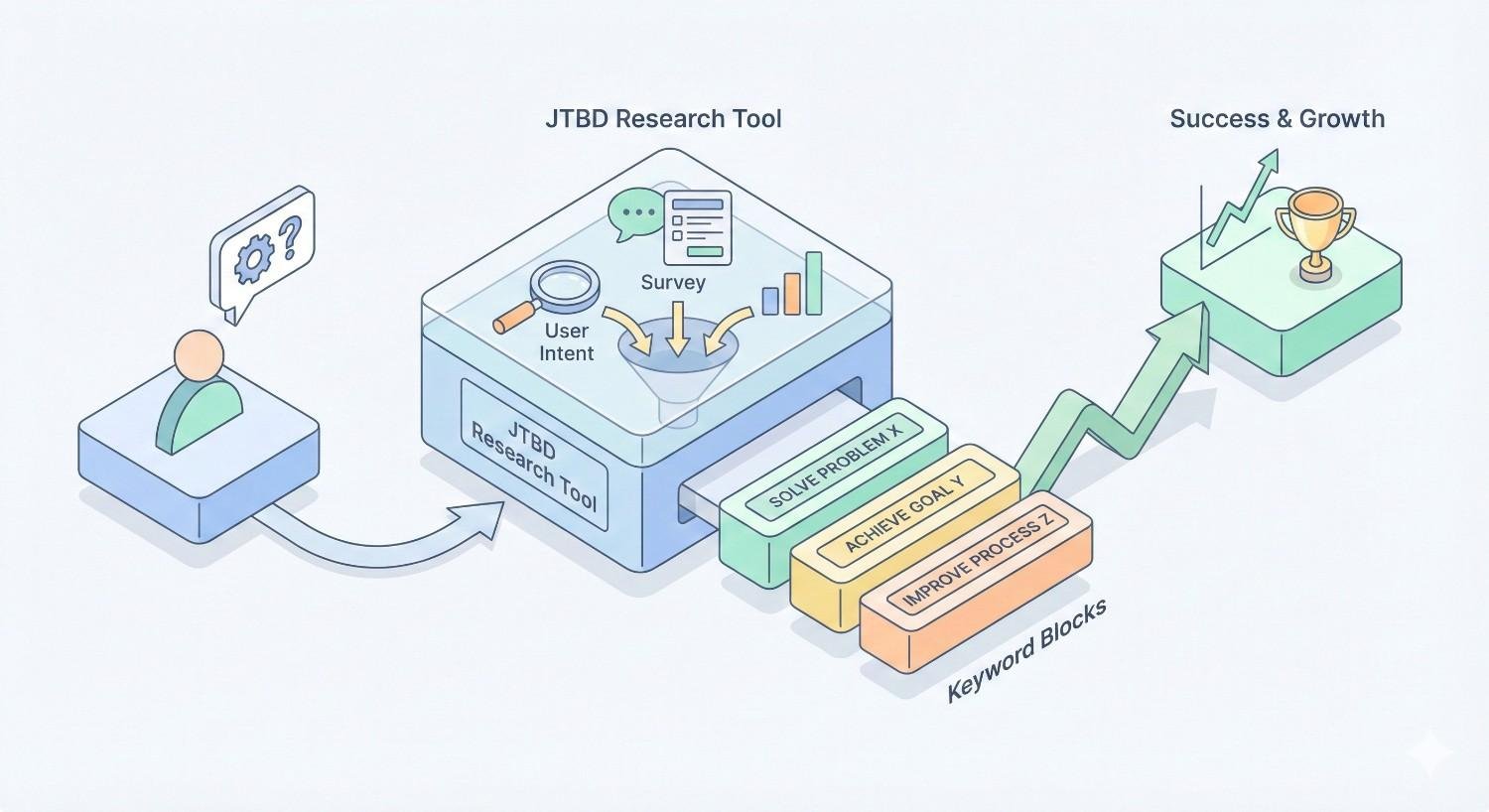
Effective JTBD keyword research combines multiple tool types. Keyword research platforms provide volume data. Customer research tools capture qualitative insights. Competitive intelligence tools reveal market opportunities.
No single tool provides complete JTBD keyword coverage. The best strategies combine tools to validate keywords from multiple angles.
Keyword Research Platforms for JTBD Discovery
Traditional keyword research platforms help validate and expand JTBD keyword lists. While these tools were not designed for JTBD research, they provide essential data.
Ahrefs and Semrush offer question-based keyword filters that surface job-related queries. Filter for questions containing action verbs and outcome language. The “Questions” report in both tools provides starting points.
Google Keyword Planner shows search volume for validated keywords. Use it to prioritize keywords from qualitative research. Low volume does not disqualify keywords, but it affects content prioritization.
AnswerThePublic visualizes questions around seed terms. The question patterns often reveal jobs. “How to,” “why does,” and “can I” queries frequently express jobs in question form.
AlsoAsked shows question relationships. Starting from a JTBD keyword, you can see related questions that represent adjacent jobs. This helps build comprehensive content clusters.
Customer Research Tools
Customer research tools help capture the language customers use to describe their jobs. These tools support the qualitative research that generates JTBD keyword candidates.
Survey tools like Typeform and SurveyMonkey help gather job language at scale. Open-ended questions about goals, challenges, and desired outcomes generate keyword-rich responses.
Interview recording tools like Grain and Otter.ai transcribe customer conversations. Searchable transcripts make it easier to find job language patterns across multiple interviews.
Feedback collection tools like Canny and UserVoice aggregate feature requests and feedback. The language customers use when requesting features often contains job descriptions.
Session recording tools like Hotjar and FullStory show how users interact with your product. Watching users attempt to accomplish jobs reveals language they might use in searches.
Competitive Intelligence Tools
Competitive intelligence tools reveal JTBD keywords competitors target. This information helps identify opportunities and gaps in your keyword strategy.
Ahrefs and Semrush show competitor organic rankings. Filter for question-based and outcome-oriented keywords to identify their JTBD targeting. Note keywords where they rank but you do not.
SpyFu and iSpionage reveal competitor paid keywords. Paid keywords often indicate high-value jobs worth targeting. If competitors pay for job-based keywords, those jobs likely convert.
SimilarWeb shows competitor traffic sources and top pages. Pages with significant traffic often target valuable keywords. Analyze top pages to understand their JTBD strategy.
Crayon and Klue track competitor messaging changes. When competitors shift to job-based messaging, it signals market validation for JTBD approaches.
JTBD Keyword Examples by SaaS Category
Concrete examples help illustrate JTBD keyword patterns across different SaaS categories. These examples show how the same principles apply to different product types.
Use these examples as templates for your own keyword research. Adapt the patterns to your specific product and customer jobs.
Project Management SaaS Examples
Project management tools help users accomplish jobs around planning, tracking, and completing work. JTBD keywords in this category focus on outcomes like meeting deadlines, maintaining visibility, and coordinating teams.
Functional job keywords include “keep projects on track without daily check-ins,” “see all team tasks in one place,” and “know which projects are at risk before they fail.” Each describes a practical outcome.
Emotional job keywords include “stop stressing about missed deadlines,” “feel confident about project status,” and “finally have control over my workload.” These address how users want to feel.
Social job keywords include “show clients we are organized,” “demonstrate progress to stakeholders,” and “look prepared in status meetings.” These address professional perception.
Consumption chain keywords include “get team to actually use project management tool,” “migrate from spreadsheets to project software,” and “prove project management ROI to leadership.”
CRM and Sales SaaS Examples
CRM tools help users accomplish jobs around managing relationships, tracking opportunities, and closing deals. JTBD keywords focus on outcomes like never losing leads, following up consistently, and understanding pipeline health.
Functional job keywords include “never forget to follow up with a prospect,” “see all customer interactions in one place,” and “know which deals will close this month.” Each describes a sales outcome.
Emotional job keywords include “stop worrying about dropped leads,” “feel prepared for every sales call,” and “have confidence in my forecast.” These address sales anxiety.
Social job keywords include “look professional to prospects,” “demonstrate value to sales leadership,” and “be seen as a top performer.” These address sales reputation.
Consumption chain keywords include “get sales team to log activities,” “import contacts from spreadsheets,” and “connect CRM to email and calendar.”
Marketing Automation SaaS Examples
Marketing automation tools help users accomplish jobs around nurturing leads, personalizing communication, and measuring campaign performance. JTBD keywords focus on outcomes like converting more leads, saving time on repetitive tasks, and proving marketing ROI.
Functional job keywords include “send the right message at the right time automatically,” “nurture leads without manual follow-up,” and “know which campaigns actually drive revenue.” Each describes a marketing outcome.
Emotional job keywords include “stop feeling overwhelmed by marketing tasks,” “have confidence that leads are being nurtured,” and “finally prove marketing impact.” These address marketer stress.
Social job keywords include “show leadership that marketing drives revenue,” “be seen as data-driven by the team,” and “demonstrate marketing sophistication to stakeholders.”
Consumption chain keywords include “get started with marketing automation,” “migrate from email blasts to automated campaigns,” and “integrate marketing tools with CRM.”
Productivity and Collaboration SaaS Examples
Productivity tools help users accomplish jobs around working efficiently, collaborating effectively, and managing information. JTBD keywords focus on outcomes like saving time, reducing friction, and staying organized.
Functional job keywords include “find any document in seconds,” “collaborate on files without version confusion,” and “keep all team communication in one place.” Each describes a productivity outcome.
Emotional job keywords include “stop wasting time searching for files,” “feel organized instead of overwhelmed,” and “have peace of mind that nothing falls through cracks.”
Social job keywords include “look organized to colleagues,” “be seen as efficient by managers,” and “demonstrate professionalism to clients.”
Consumption chain keywords include “get team to adopt new collaboration tool,” “migrate from email attachments to shared workspace,” and “integrate productivity tools with existing workflow.”
Measuring JTBD Keyword Performance
JTBD keyword performance requires metrics that go beyond traditional SEO measurements. While rankings and traffic matter, the ultimate measure is whether content helps users accomplish their jobs and converts them into customers.
Build measurement frameworks that connect keyword performance to business outcomes. This connection justifies continued investment in JTBD content strategies.
Traffic and Ranking Metrics
Standard SEO metrics provide baseline performance data for JTBD keywords. Track these metrics to understand visibility and reach.
Keyword rankings show whether content appears for target JTBD queries. Track rankings for primary keywords and related variations. Position changes indicate content performance trends.
Organic traffic from JTBD keywords shows how many users find your content through job-based searches. Segment traffic by keyword category to understand which job types drive the most visits.
Click-through rate from search results indicates whether titles and descriptions resonate with job-based intent. Low CTR despite good rankings suggests messaging misalignment.
Impressions show how often your content appears for JTBD queries. Growing impressions indicate expanding visibility for job-based searches.
Engagement and Conversion Metrics
Engagement metrics show whether content satisfies the job users came to accomplish. High engagement suggests content matches intent.
Time on page indicates content relevance. Users spend more time on content that addresses their job. Compare time on page across different JTBD keyword categories.
Scroll depth shows how much content users consume. Deep scrolling suggests content maintains relevance throughout. Shallow scrolling may indicate mismatched intent.
Bounce rate reflects whether users find what they need. High bounce rates on JTBD content may indicate intent mismatch or poor content quality.
Conversion rate measures whether content moves users toward desired actions. Track conversions by JTBD keyword category to identify which jobs drive the most valuable traffic.
Revenue Attribution from JTBD Content
Revenue attribution connects JTBD keyword performance to business outcomes. This connection demonstrates the value of JTBD content strategies.
First-touch attribution shows which JTBD keywords introduce users who eventually convert. This metric values awareness-stage content that starts customer relationships.
Multi-touch attribution distributes credit across all JTBD content touchpoints. This approach recognizes that multiple pieces of content contribute to conversions.
Pipeline influence tracks how JTBD content affects deal progression. Content that appears in customer journeys before closed deals demonstrates influence on revenue.
Customer lifetime value by acquisition source shows long-term value of JTBD-acquired customers. If JTBD keywords attract customers who retain longer or expand more, this metric captures that value.
Common Mistakes When Using JTBD Keywords
JTBD keyword strategies fail when execution deviates from core principles. Understanding common mistakes helps you avoid them and maintain strategy effectiveness.
These mistakes often stem from reverting to traditional keyword approaches. Consistent focus on jobs rather than features prevents most errors.
Focusing on Features Instead of Outcomes
The most common mistake is writing about features while targeting job-based keywords. Users searching for outcomes do not want feature descriptions.
This mistake happens when content teams understand JTBD keywords intellectually but default to feature-focused writing. The headline mentions the job, but the content describes product capabilities.
Fix this by writing from the user perspective. Every paragraph should connect to the job the user wants to accomplish. Features appear only as means to accomplish jobs, not as ends themselves.
Review content by asking whether someone who knows nothing about your product category would understand how to accomplish their job. If the content requires product knowledge to be useful, it has become feature-focused.
Ignoring Emotional and Social Jobs
Many JTBD strategies focus exclusively on functional jobs. This leaves significant keyword opportunities untapped and creates content that feels transactional.
Emotional and social jobs often drive purchase decisions even when users articulate functional requirements. Ignoring these jobs means missing the deeper motivations behind searches.
Fix this by including emotional and social dimensions in content. Acknowledge how users want to feel. Reference how accomplishing the job affects their professional reputation.
Balance is important. Content should not become purely emotional. The best JTBD content addresses functional jobs while acknowledging emotional and social dimensions.
Misaligning Keywords with Product Capabilities
Targeting JTBD keywords your product cannot actually address damages trust and wastes resources. Users who arrive expecting to accomplish a job and find your product cannot help them will not convert.
This mistake happens when keyword research focuses on volume without validating product fit. High-volume JTBD keywords attract attention even when the product does not address those jobs.
Fix this by validating every JTBD keyword against actual product capabilities. Can your product genuinely help users accomplish this job? If not, the keyword does not belong in your strategy.
Honest assessment prevents wasted content investment and protects brand reputation. Users remember when content promises outcomes products cannot deliver.
JTBD Keywords vs Other Keyword Frameworks
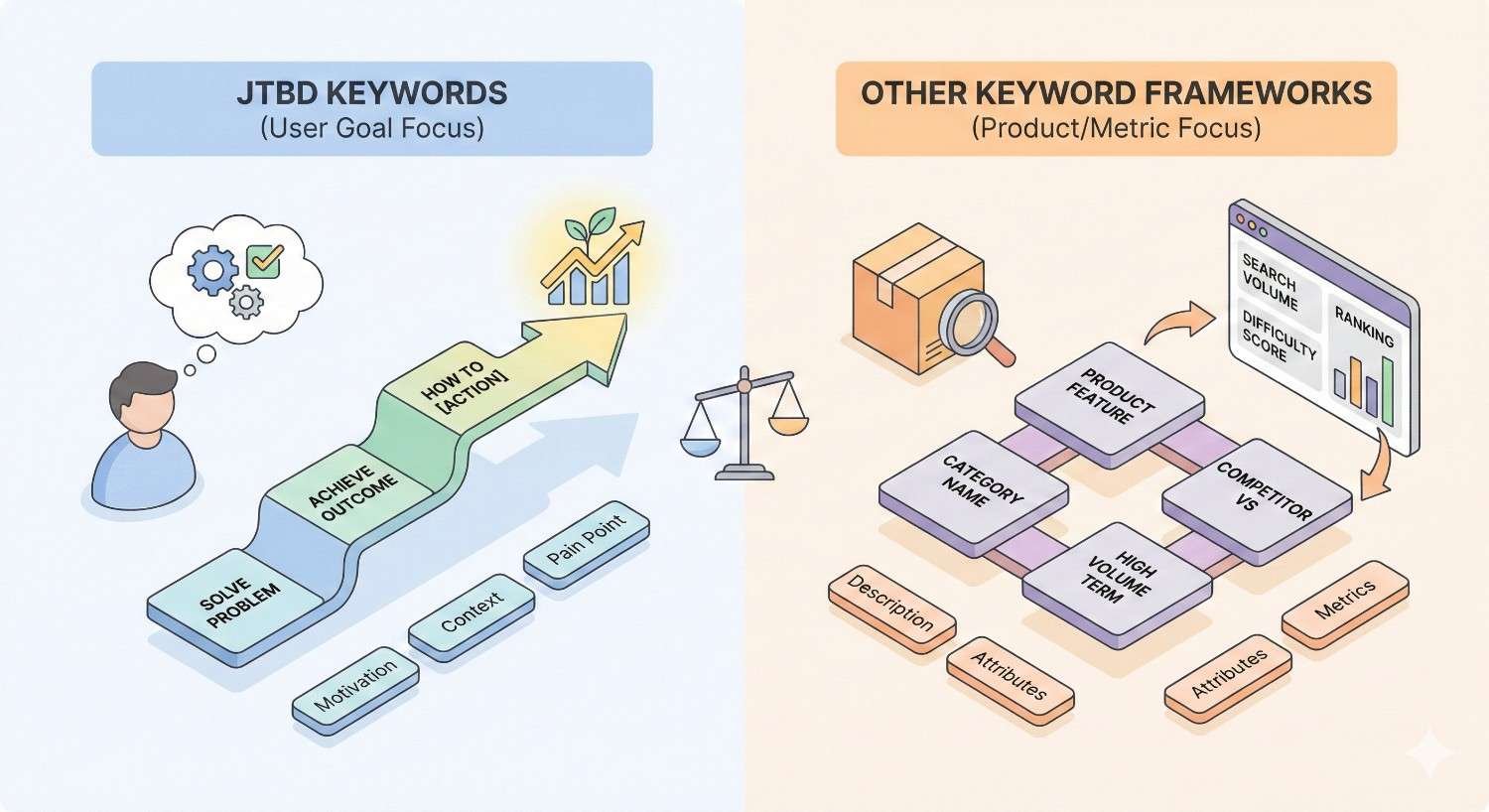
JTBD keywords represent one approach among several keyword frameworks. Understanding how JTBD compares to alternatives helps you choose the right approach for different situations.
These frameworks are not mutually exclusive. Comprehensive keyword strategies often combine multiple approaches.
JTBD vs Pain Point Keywords
Pain point keywords focus on problems users experience. “Struggling with project deadlines” and “frustrated by lost leads” are pain point keywords. They target negative states users want to escape.
JTBD keywords focus on outcomes users want to achieve. “Meet project deadlines consistently” and “never lose a lead” are JTBD keywords. They target positive states users want to reach.
The difference is framing. Pain points emphasize what is wrong. Jobs emphasize what could be right. Both attract users with similar needs but appeal to different psychological states.
Pain point keywords may attract users earlier in their journey, before they have articulated desired outcomes. JTBD keywords may attract users who have already envisioned success.
Use both approaches. Pain point content can introduce problems and transition to job-based solutions. JTBD content can acknowledge pain points while focusing on outcomes.
JTBD vs Feature-Based Keywords
Feature-based keywords describe product capabilities. “Project management software with Gantt charts” and “CRM with email integration” are feature keywords. They target users who know what features they want.
JTBD keywords describe outcomes regardless of features. “Visualize project timelines” and “track all customer communication” are JTBD keywords. They target users who know what they want to accomplish.
Feature keywords attract users further along in their journey. These users have already researched solution categories and identified specific requirements.
JTBD keywords attract users earlier in their journey. These users know their goals but may not know which features accomplish those goals.
Feature keywords face more direct competition. Every product with the feature targets the same keywords. JTBD keywords allow differentiation through how you accomplish the job, not just whether you have the feature.
JTBD vs Intent-Based Keywords
Intent-based keywords categorize searches by user intent: informational, navigational, transactional, or commercial investigation. This framework focuses on what users want to do with search results.
JTBD keywords focus on what users want to accomplish in their work or life. The job exists independent of the search. The search is just one step toward accomplishing the job.
Intent-based frameworks help match content formats to search behavior. Informational intent suggests educational content. Transactional intent suggests product pages.
JTBD frameworks help match content substance to user goals. The job determines what information users need, regardless of how they plan to use search results.
These frameworks complement each other. A JTBD keyword has an intent. Understanding both the job and the intent helps create content that matches user needs at multiple levels.
Conclusion
Job-to-be-done keywords transform SaaS content strategy from feature promotion to outcome delivery. By targeting the jobs customers want to accomplish, you attract qualified traffic that converts at higher rates.
This approach requires understanding your customers deeply. The best JTBD keywords come from customer conversations, support interactions, and careful observation of how people describe their goals.
At White Label SEO Service, we help SaaS companies build JTBD keyword strategies that drive sustainable organic growth. Contact us to develop a content approach that connects your product to the outcomes your customers actually want.
Frequently Asked Questions About JTBD Keywords for SaaS
What is an example of a job-to-be-done keyword?
A job-to-be-done keyword describes an outcome users want to achieve. “Keep remote team aligned on project deadlines” is a JTBD keyword because it expresses a desired result rather than a product feature or category.
How do you find JTBD keywords for a new SaaS product?
Start with customer interviews asking about goals and challenges. Analyze support tickets for outcome language. Use keyword tools to validate search volume for phrases customers use naturally.
Are JTBD keywords better than traditional keywords?
JTBD keywords typically convert better because they attract users with clear intent. Traditional keywords may have higher volume. The best strategies combine both approaches for comprehensive coverage.
How many JTBD keywords should a SaaS company target?
Start with ten to twenty core JTBD keywords that align with your primary product capabilities. Expand as you build content and identify additional jobs your product addresses.
Can JTBD keywords work for enterprise SaaS?
Yes. Enterprise buyers have jobs they want to accomplish just like SMB buyers. Enterprise JTBD keywords often include scale, security, and compliance dimensions that reflect enterprise-specific concerns.
How long does it take to see results from JTBD keyword targeting?
JTBD content typically takes three to six months to rank and generate consistent traffic. Lower competition for specific job-based queries may accelerate results compared to generic category keywords.
Should JTBD keywords replace all other keyword types?
No. JTBD keywords work best as part of a comprehensive strategy that includes branded keywords, feature keywords, and category keywords. Each type serves different purposes in the buyer journey.