
A well-planned link building budget typically ranges from $500 to $10,000+ monthly, depending on your business size, industry competitiveness, and growth goals. Without dedicated budget allocation, link acquisition becomes reactive rather than strategic, leaving ranking improvements to chance.
Link building remains one of the most impactful SEO investments you can make. Yet most businesses either overspend on low-quality links or underinvest entirely, missing critical opportunities to build domain authority and organic visibility.
This guide breaks down exactly how to plan, allocate, and optimize your link building budget. You’ll learn cost benchmarks by tactic, ROI measurement frameworks, and practical strategies to maximize every dollar spent on backlink acquisition.
What Is a Link Building Budget?
Definition and Core Components
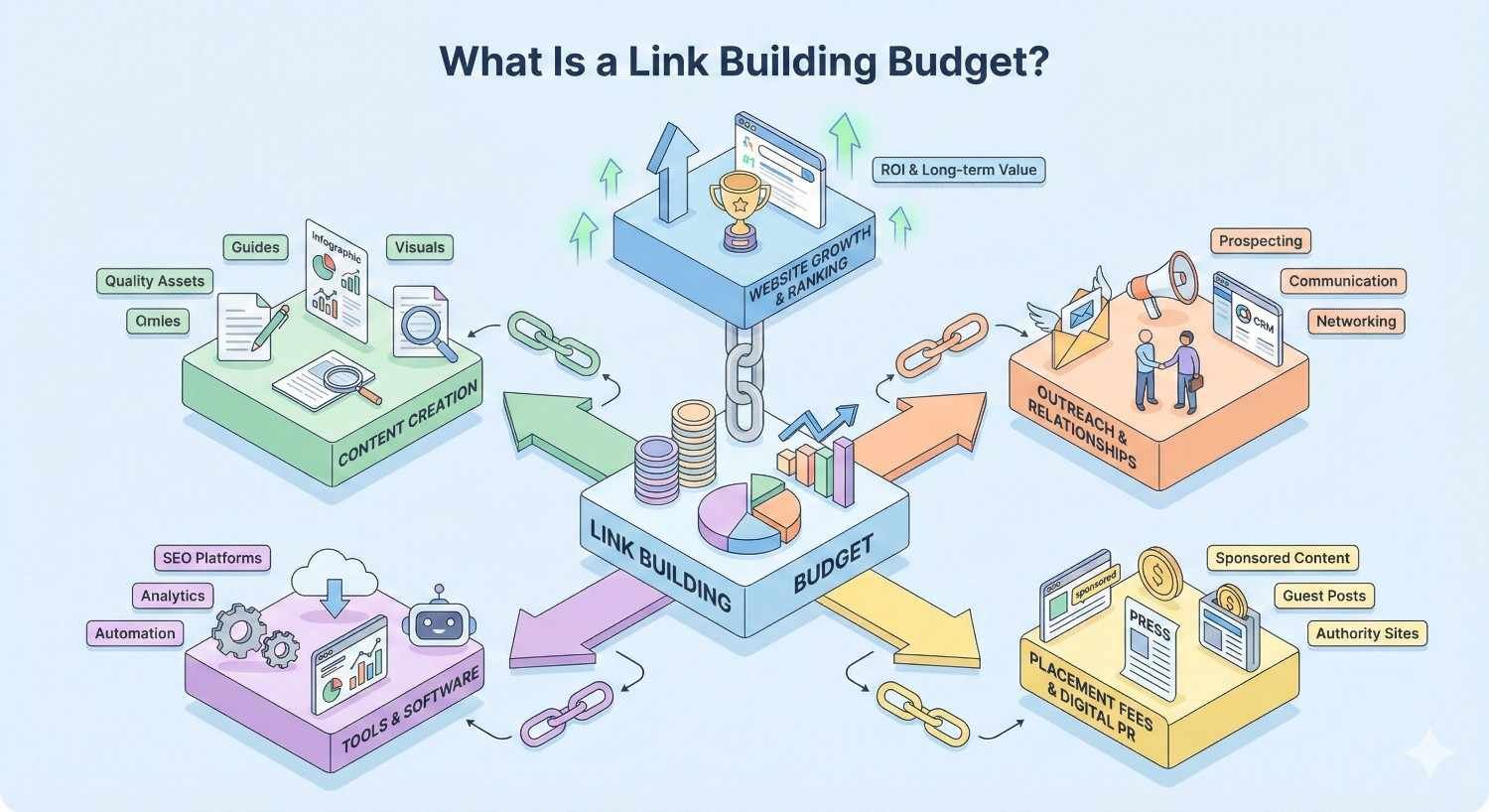
A link building budget is the dedicated financial allocation for acquiring backlinks to your website through various outreach, content, and promotional activities. It encompasses all costs associated with earning links that improve your domain authority and search rankings.
The core components of a link building budget include:
Direct acquisition costs cover payments for guest posting placements, niche edit insertions, digital PR campaigns, and agency or freelancer fees. These represent the most visible line items in your budget.
Content creation expenses include writer fees, graphic design, data research, and interactive asset development. Quality link-worthy content often requires significant upfront investment before outreach begins.
Outreach and tools encompass email outreach software, prospecting tools, backlink analysis platforms like Ahrefs or Semrush, and CRM systems for managing link building relationships.
Labor costs account for in-house team time spent on strategy, prospecting, outreach, relationship management, and performance tracking. Even when using agencies, internal oversight requires dedicated hours.
Monitoring and maintenance covers ongoing backlink audits, toxic link identification, disavow file management, and link reclamation efforts for lost placements.
Why Dedicated Budget Allocation Matters for SEO
Treating link building as an afterthought or discretionary expense undermines your entire SEO strategy. Backlinks remain a top-three ranking factor according to Google’s own documentation, making consistent investment essential for competitive visibility.
Dedicated budget allocation enables strategic planning rather than reactive spending. When you know exactly how much you can invest monthly, you can build sustainable outreach pipelines, negotiate better rates with vendors, and maintain consistent link velocity that search engines reward.
Without budget clarity, link building becomes sporadic. You might invest heavily one quarter, then pause entirely the next. This inconsistency creates unnatural link patterns and prevents the compounding authority growth that drives long-term ranking improvements.
Budget allocation also forces accountability. When link building has defined resources, you can measure cost per link, track ROI against specific investments, and make data-driven decisions about scaling or adjusting tactics.
Factors That Determine Link Building Costs
Industry Competitiveness and Niche Difficulty
Your industry directly impacts how much you’ll need to invest in link building. Competitive niches like finance, legal, health, and SaaS require significantly higher budgets because:
Link scarcity increases costs. In competitive verticals, high-authority sites receive constant outreach requests. Standing out requires better content, stronger pitches, and often higher placement fees.
Quality thresholds are higher. When competitors have thousands of referring domains from authoritative sources, matching their link profiles demands premium placements rather than volume-based approaches.
Content requirements escalate. Earning links in competitive spaces often requires original research, comprehensive guides, or interactive tools that cost more to produce than standard blog posts.
Less competitive niches like local services, niche B2B, or emerging industries can achieve meaningful results with smaller budgets. Fewer competitors means more available link opportunities and lower placement costs.
Assess your competitive landscape using backlink gap analysis. If top competitors have 50+ referring domains from high-authority sites, expect to invest more heavily than if they have 10-20 referring domains from moderate sources.
Link Quality Tiers and Pricing Structures
Link quality varies dramatically, and pricing reflects these differences. Understanding quality tiers helps you allocate budget effectively:
Premium tier (DR 70+): Links from major publications, industry-leading sites, and established media outlets. Expect costs of $500 to $5,000+ per link depending on the publication and placement type. These links carry significant authority but require substantial investment.
High-quality tier (DR 50-70): Links from respected industry blogs, established niche sites, and regional publications. Typical costs range from $150 to $500 per link. This tier often provides the best balance of authority and affordability.
Mid-tier (DR 30-50): Links from smaller blogs, newer publications, and niche directories. Costs typically fall between $50 and $150 per link. Useful for building link diversity but shouldn’t dominate your profile.
Low-tier (DR below 30): Generally avoid purchasing links from low-authority sites. The SEO value rarely justifies the cost, and high volumes of low-quality links can trigger algorithmic penalties.
Quality assessment should consider more than domain rating. Evaluate traffic levels, topical relevance, editorial standards, and existing outbound link patterns before investing.
In-House vs. Agency vs. Freelancer Costs
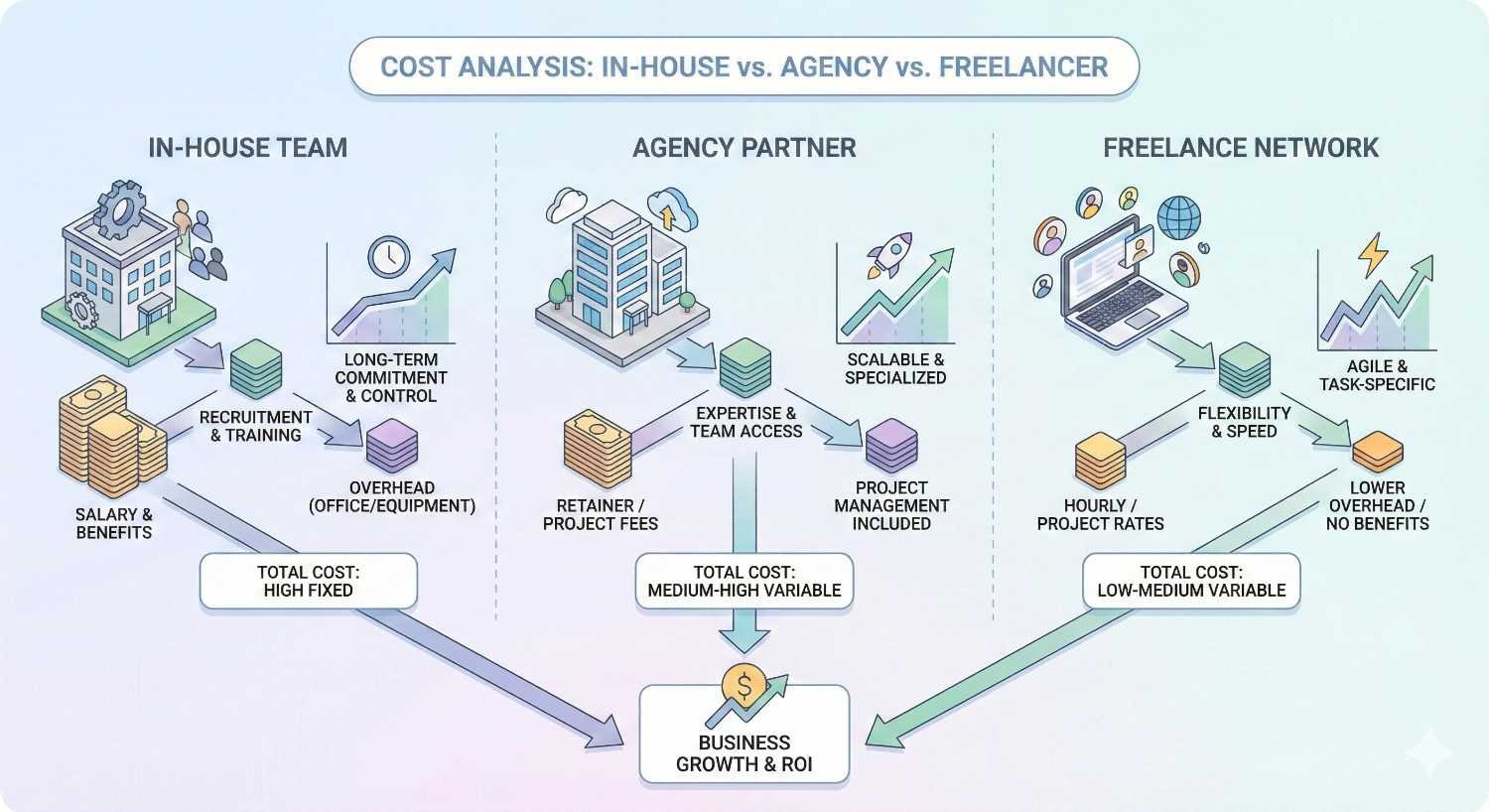
Your execution model significantly impacts total budget requirements:
In-house teams require salary, benefits, tools, and training investments. A dedicated link building specialist typically costs $50,000 to $80,000 annually in salary alone, plus $500 to $2,000 monthly in tools. However, in-house teams offer greater control, institutional knowledge, and long-term cost efficiency at scale.
Agency partnerships provide expertise and established processes without hiring overhead. Monthly retainers typically range from $2,000 to $15,000 depending on scope and agency reputation. Agencies offer faster ramp-up and proven methodologies but less direct control over tactics.
Freelancer arrangements offer flexibility and lower costs for specific campaigns. Experienced link building freelancers charge $50 to $150 per hour or $100 to $500 per link depending on quality targets. Freelancers work well for supplementing in-house efforts or testing new tactics.
Many businesses use hybrid models, combining in-house strategy with agency execution or freelancer support for specific campaigns.
Content Creation and Outreach Expenses
Content costs often surprise businesses new to link building. Earning quality links requires link-worthy assets that provide genuine value to linking sites and their audiences.
Written content costs:
- Standard guest posts: $100 to $300 per piece
- In-depth guides and resources: $500 to $2,000 per piece
- Original research and data studies: $2,000 to $10,000 per project
- Expert roundups and interviews: $200 to $500 per piece
Visual and interactive content:
- Custom infographics: $200 to $1,500 per design
- Interactive tools and calculators: $2,000 to $20,000 per tool
- Video content: $500 to $5,000 per video
Outreach expenses:
- Email outreach tools: $50 to $500 monthly
- Prospecting and contact finding: $100 to $300 monthly
- CRM and relationship management: $50 to $200 monthly
Budget for content creation separately from link placement costs. A common mistake is allocating funds only for placements while underestimating the content investment required to earn those placements.
How Much Should You Spend on Link Building?
Budget Benchmarks by Business Size
Startups and Small Businesses ($500–$2,500/month)
Early-stage companies and small businesses can build meaningful link profiles with modest budgets when focused strategically. At this investment level:
Prioritize 5 to 15 quality links monthly rather than high volumes of low-quality placements. Focus on relevant industry sites, local publications, and niche blogs where your content provides genuine value.
Allocate approximately 40% to content creation, 40% to outreach and placements, and 20% to tools and monitoring. This balance ensures you have link-worthy assets while maintaining consistent acquisition.
Expect 6 to 12 months before seeing significant ranking improvements. Lower budgets require patience as authority builds gradually through consistent effort.
Best tactics at this level include guest posting on niche sites, HARO responses, broken link building, and resource page outreach. These methods offer strong ROI without requiring premium placement fees.
Mid-Size Companies ($2,500–$10,000/month)
Established businesses with proven product-market fit can accelerate growth through more aggressive link building. This budget range enables:
Acquisition of 15 to 50 quality links monthly across multiple tactics. Diversify between guest posting, digital PR, niche edits, and content-driven link earning for a natural profile.
Investment in original research and premium content assets that attract links organically while supporting outreach campaigns. Data-driven content performs exceptionally well for mid-market companies with industry insights to share.
Allocation of approximately 30% to content, 50% to outreach and placements, and 20% to tools, monitoring, and strategy. Higher placement budgets enable access to more authoritative sites.
Expect measurable ranking improvements within 3 to 6 months for target keywords. Mid-range budgets create enough link velocity to compete in moderately competitive niches.
Enterprise and Competitive Niches ($10,000+/month)
Large organizations and businesses in highly competitive verticals require substantial investment to move rankings meaningfully. Enterprise budgets support:
Acquisition of 50 to 200+ quality links monthly through diverse channels including digital PR, sponsored content, influencer partnerships, and premium guest posting.
Development of flagship content assets like industry reports, interactive tools, and comprehensive resource centers that attract links continuously over time.
Dedicated teams or agency partnerships with specialized expertise in your vertical. Enterprise link building requires sophisticated strategy, relationship management, and quality control processes.
Allocation varies based on specific needs, but typically 20% to content, 60% to outreach and placements, and 20% to tools, team, and strategy. Premium placements consume the largest budget share.
Expect competitive ranking improvements within 3 to 6 months even in difficult niches. Sustained investment at this level can establish category leadership over 12 to 24 months.
Percentage of Overall SEO Budget for Links
Link building typically represents 30% to 50% of total SEO investment for most businesses. This allocation reflects the significant impact backlinks have on ranking potential while balancing other essential SEO activities.
Recommended allocation framework:
- Technical SEO: 15% to 25% (site health, speed, structure)
- Content creation: 25% to 35% (on-site content, blog, resources)
- Link building: 30% to 50% (outreach, placements, digital PR)
- Tools and analytics: 5% to 10% (software, tracking, reporting)
Adjust these percentages based on your current situation:
Increase link building allocation when your site has strong technical foundations and quality content but lacks domain authority. Links become the limiting factor for ranking improvement.
Decrease link building allocation when technical issues prevent search engines from properly crawling and indexing your content. Fix foundational problems before investing heavily in links.
Balance allocation when building a new site or entering a new market. All three pillars—technical, content, and links—need simultaneous investment for sustainable growth.
ROI Expectations and Timeline Considerations
Link building ROI manifests through improved rankings, increased organic traffic, and ultimately, business outcomes like leads and revenue. However, returns aren’t immediate.
Typical timeline expectations:
- Months 1-3: Links indexed, minimal ranking movement, authority metrics begin improving
- Months 3-6: Noticeable ranking improvements for target keywords, traffic increases begin
- Months 6-12: Significant traffic growth, compounding returns as authority builds
- Months 12+: Sustained competitive positioning, reduced cost per acquisition as organic traffic scales
ROI calculation framework:
Calculate cost per link by dividing total monthly investment by links acquired. Track this metric over time to identify efficiency improvements.
Measure cost per ranking improvement by comparing investment to keyword position changes. A $5,000 monthly investment that moves 10 keywords from page two to page one represents $500 per ranking improvement.
Connect to business outcomes by tracking organic traffic growth, conversion rates, and revenue attribution. If $5,000 monthly generates 1,000 additional organic visits converting at 2% with $500 average order value, that’s $10,000 in attributed revenue—a 2x ROI.
Set realistic expectations based on your competitive landscape. Highly competitive niches require longer timelines and larger investments before ROI materializes.
Link Building Budget Allocation Strategies
Monthly Retainer Model
The monthly retainer model provides consistent link building investment through fixed monthly payments to an agency or dedicated team. This approach offers predictability and sustained effort.
How it works: You commit to a fixed monthly budget, typically ranging from $2,000 to $15,000, and receive ongoing link building services including strategy, outreach, content creation, and reporting.
Advantages:
- Predictable costs for financial planning
- Consistent link velocity that appears natural to search engines
- Ongoing relationship building with link prospects
- Cumulative learning and optimization over time
- Dedicated resources focused on your success
Disadvantages:
- Less flexibility to adjust spending quickly
- May pay for slower months with fewer opportunities
- Requires trust in partner’s execution quality
- Long-term commitment often required
Best for: Businesses seeking sustained organic growth, companies with stable marketing budgets, and organizations prioritizing long-term authority building over quick wins.
Per-Link Pricing Model
Per-link pricing charges a fixed fee for each successfully placed backlink, with costs varying based on link quality and placement site authority.
How it works: You pay only for delivered links, typically ranging from $100 to $1,000+ per link depending on quality tier. Pricing often scales with domain rating, traffic, and relevance.
Advantages:
- Pay only for results delivered
- Clear cost-per-link metrics for ROI calculation
- Flexibility to scale up or down based on needs
- Easy to compare vendor pricing
- Lower risk for testing new partners
Disadvantages:
- May incentivize quantity over quality
- Less focus on strategy and long-term planning
- Potential for link quality inconsistency
- No investment in relationship building
- Can become expensive at scale
Best for: Businesses testing link building, companies with variable budgets, and organizations wanting clear deliverable accountability.
Campaign-Based Budgeting
Campaign-based budgeting allocates specific funds to defined link building initiatives with clear objectives, timelines, and deliverables.
How it works: You invest in discrete campaigns like a digital PR push, content launch, or competitive gap closure. Each campaign has its own budget, goals, and success metrics.
Advantages:
- Clear objectives and measurable outcomes
- Flexibility to invest in high-impact opportunities
- Easier to attribute results to specific investments
- Allows testing different tactics and approaches
- Budget aligned with business priorities
Disadvantages:
- Gaps between campaigns can slow momentum
- Requires more planning and management overhead
- May miss ongoing opportunities during off-periods
- Less consistent link velocity over time
Best for: Businesses with seasonal priorities, companies launching new products or entering new markets, and organizations with project-based marketing structures.
Hybrid Approaches for Scalable Growth
Hybrid models combine elements of retainer, per-link, and campaign-based approaches to maximize flexibility and results.
Common hybrid structures:
Base retainer plus performance bonuses: Maintain a smaller monthly retainer for consistent effort while paying bonuses for exceeding link targets or achieving specific ranking improvements.
Retainer plus campaign supplements: Keep ongoing link building through a retainer while adding campaign-based investments for product launches, seasonal pushes, or competitive responses.
In-house plus agency hybrid: Handle routine link building internally while engaging agencies for specialized campaigns, premium placements, or capacity overflow.
Tiered per-link with minimums: Commit to minimum monthly link volumes at negotiated rates while retaining flexibility to purchase additional links as opportunities arise.
Advantages of hybrid approaches:
- Balance consistency with flexibility
- Optimize costs across different link types
- Maintain momentum while capitalizing on opportunities
- Reduce risk through diversified execution models
Implementation tips:
- Define clear boundaries between retainer and campaign work
- Establish quality standards that apply across all models
- Create unified reporting to track total investment and results
- Review and adjust the hybrid mix quarterly based on performance
How to Create a Link Building Budget Plan
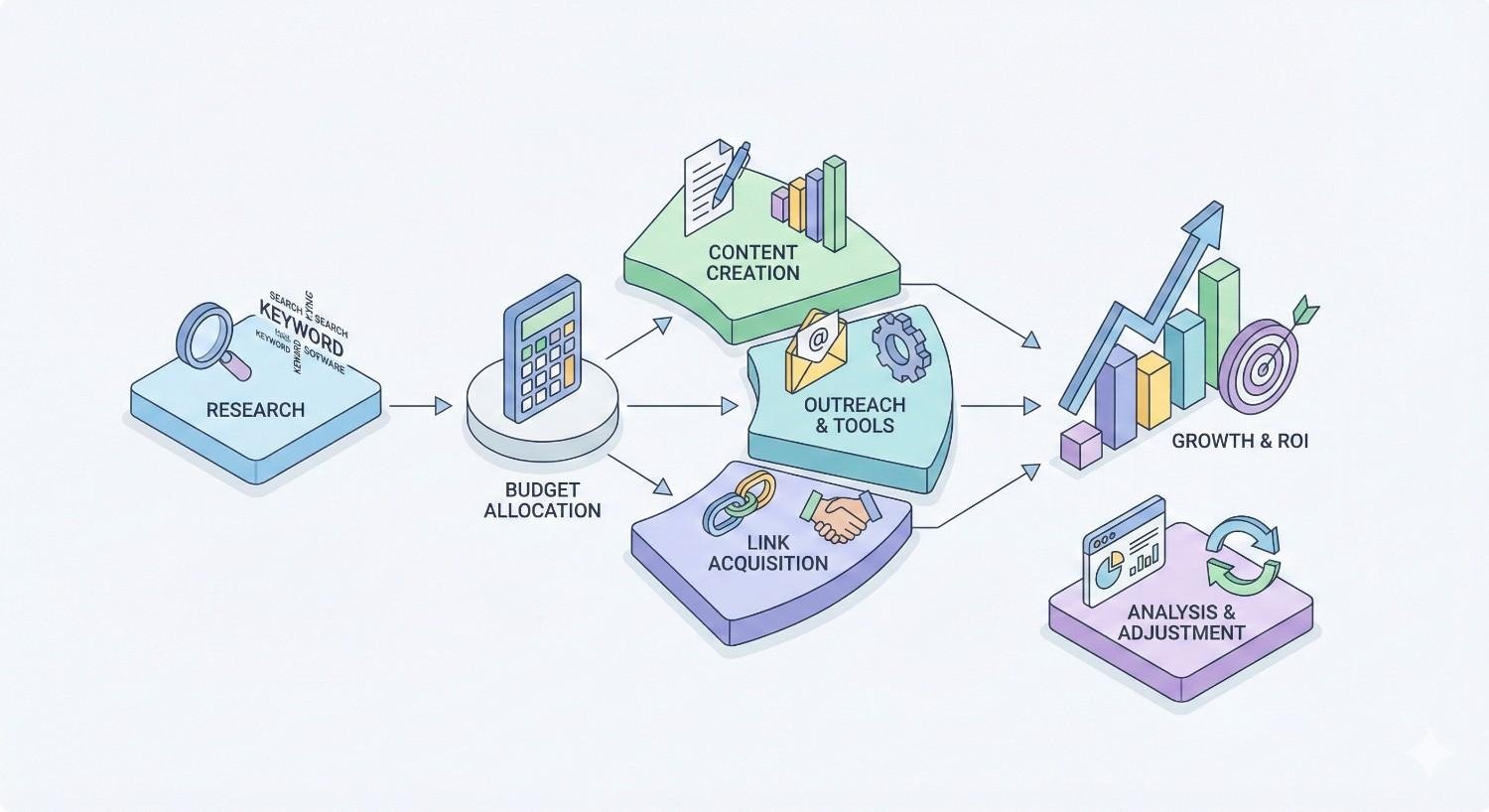
Step 1: Audit Current Backlink Profile
Before allocating budget, understand your starting position. A comprehensive backlink audit reveals strengths to build on and weaknesses to address.
Audit components:
Quantity assessment: Count total backlinks and referring domains. More referring domains generally indicates broader authority than many links from few sources.
Quality evaluation: Analyze domain ratings, traffic levels, and relevance of linking sites. Identify your highest-value links and patterns in what earned them.
Anchor text distribution: Review anchor text variety. Over-optimized anchor text (too many exact-match keywords) can trigger penalties, while natural profiles show diverse anchors.
Toxic link identification: Flag potentially harmful links from spammy, irrelevant, or penalized sites. These may require disavow action before investing in new links.
Link velocity history: Examine how quickly you’ve acquired links over time. Sudden spikes or drops can indicate issues or opportunities.
Tools for auditing: Ahrefs, Semrush, Moz, and Majestic all provide backlink analysis capabilities. Use at least two tools for comprehensive coverage since each has different crawling patterns.
Audit outputs: Document your current referring domain count, average domain rating of linking sites, anchor text distribution, and identified toxic links. These baselines inform goal setting and budget allocation.
Step 2: Analyze Competitor Link Gaps
Understanding competitor link profiles reveals opportunities and establishes benchmarks for your investment level.
Gap analysis process:
Identify competitors: Select 3 to 5 direct competitors ranking for your target keywords. Include both similar-sized competitors and aspirational leaders.
Compare referring domains: Note the quantity and quality of referring domains for each competitor. Calculate the gap between your profile and theirs.
Identify unique linking sites: Find sites linking to competitors but not to you. These represent immediate outreach opportunities since they’ve already demonstrated willingness to link in your space.
Analyze link types: Categorize competitor links by type (guest posts, resource links, press mentions, etc.). This reveals which tactics work in your industry.
Assess content gaps: Identify competitor content that earned significant links. Consider creating superior versions to capture similar link opportunities.
Gap analysis outputs: Create a prioritized list of link opportunities, estimate the investment needed to close competitive gaps, and identify tactics that work in your niche.
Step 3: Set Link Acquisition Goals
Transform audit insights and competitive analysis into specific, measurable link building goals that inform budget requirements.
Goal-setting framework:
Quantity goals: Set monthly or quarterly targets for new referring domains. Base these on competitive gaps and realistic acquisition rates for your budget level.
Quality goals: Define minimum quality thresholds for acquired links. Specify target domain rating ranges, relevance requirements, and traffic minimums.
Diversity goals: Plan for link type variety including editorial links, guest posts, resource links, and press mentions. Diverse profiles appear more natural and resilient.
Timeline goals: Establish milestones for closing competitive gaps. If competitors have 200 more referring domains, plan how long it will take to close that gap at your target acquisition rate.
Example goal structure:
- Acquire 20 new referring domains monthly
- Minimum DR 40 for all placements
- 70% from topically relevant sites
- Close 50% of competitive gap within 12 months
Step 4: Choose Link Building Tactics
Select tactics that align with your goals, budget, and competitive landscape. Different tactics offer varying cost-efficiency and scalability.
Tactic selection criteria:
Budget alignment: Match tactics to available resources. Guest posting works at any budget level, while digital PR typically requires larger investments.
Competitive fit: Choose tactics that work in your industry. B2B companies often succeed with resource link building, while consumer brands may benefit more from digital PR.
Scalability needs: Consider how tactics scale with increased investment. Some approaches (like HARO) have natural limits, while others (like guest posting) scale more linearly.
Risk tolerance: Evaluate tactic risk profiles. Earned editorial links carry no risk, while paid placements require careful vetting to avoid penalties.
Recommended tactic mix by budget:
$500-$2,500/month: Focus on guest posting (60%), HARO/journalist outreach (20%), and broken link building (20%).
$2,500-$10,000/month: Diversify across guest posting (40%), digital PR (25%), niche edits (20%), and resource link building (15%).
$10,000+/month: Full tactic deployment with digital PR (30%), premium guest posting (25%), niche edits (20%), content-driven link earning (15%), and experimental tactics (10%).
Step 5: Allocate Resources and Timeline
Translate goals and tactics into specific budget allocations and implementation timelines.
Budget allocation process:
Calculate tactic costs: Estimate per-link costs for each chosen tactic based on quality targets and market rates.
Map to goals: Multiply per-link costs by target acquisition volumes to determine tactic-level budgets.
Add supporting costs: Include content creation, tools, and management overhead in total budget calculations.
Build in contingency: Reserve 10% to 15% of budget for unexpected opportunities or cost overruns.
Timeline planning:
Month 1: Complete audits, finalize strategy, set up tools and processes, begin prospecting.
Months 2-3: Ramp up outreach, establish initial placements, refine targeting based on early results.
Months 4-6: Reach full operational capacity, optimize based on performance data, scale successful tactics.
Months 7-12: Maintain consistent execution, adjust tactics based on ROI, plan for next phase.
Step 6: Track Spend and Measure Performance
Implement tracking systems to monitor budget utilization and connect spending to results.
Spend tracking requirements:
Categorize expenses: Track spending by tactic, vendor, and link quality tier. This granularity enables optimization decisions.
Monitor pacing: Compare actual spending to planned budget monthly. Identify underspending (missed opportunities) or overspending (budget risk) early.
Document deliverables: Record every acquired link with placement date, URL, anchor text, and cost. This database supports ROI analysis and quality audits.
Performance measurement:
Link metrics: Track new referring domains, average domain rating of acquisitions, and link survival rates (how many links remain active over time).
SEO metrics: Monitor domain authority growth, keyword ranking changes, and organic traffic trends.
Business metrics: Connect to conversions, leads, and revenue where possible. Even directional attribution helps justify continued investment.
Reporting cadence: Review detailed metrics monthly, conduct comprehensive performance analysis quarterly, and adjust strategy annually based on cumulative learnings.
Link Building Cost Breakdown by Tactic
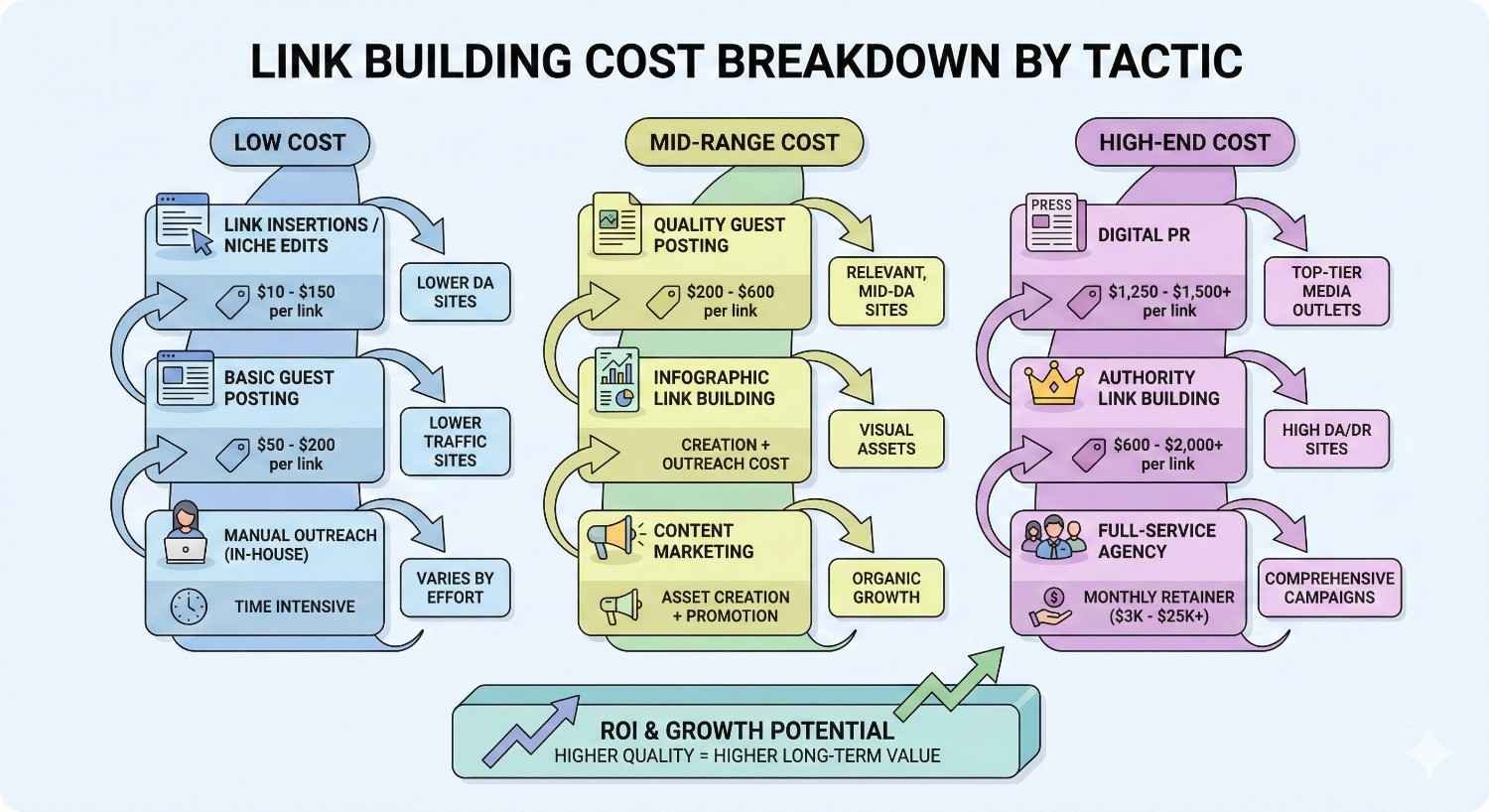
Guest Posting Costs
Guest posting involves creating content for publication on external websites in exchange for backlinks to your site. It remains one of the most accessible and scalable link building tactics.
Cost components:
Content creation: Quality guest posts require $100 to $500 per article depending on length, depth, and writer expertise. Technical topics and longer formats cost more.
Placement fees: Many sites charge for guest post publication, ranging from $50 for smaller blogs to $500+ for established publications. Some high-authority sites accept quality content without fees.
Outreach labor: Prospecting, pitching, and relationship management require 2 to 5 hours per successful placement when done in-house.
Total cost per link: Expect $150 to $800 per guest post link depending on target site quality and whether you handle outreach internally or through vendors.
Cost optimization tips:
- Build relationships with editors for repeat placements at lower costs
- Create content templates for efficient production
- Target sites that accept quality content without placement fees
- Batch outreach to improve efficiency
Digital PR and Media Outreach
Digital PR earns links through newsworthy content, expert commentary, and media relationships. It typically produces higher-authority links but requires larger investments.
Cost components:
Campaign development: Creating newsworthy angles, data studies, or expert commentary requires $1,000 to $10,000 per campaign depending on complexity.
Media database access: Tools like Cision, Muck Rack, or Prowly cost $200 to $1,000+ monthly for journalist contact information.
Outreach and follow-up: PR campaigns require significant outreach effort, typically 20 to 40 hours per campaign for pitching and relationship management.
Agency fees: Digital PR agencies charge $3,000 to $20,000+ monthly for ongoing campaigns with link guarantees.
Total cost per link: Digital PR links typically cost $200 to $2,000+ per placement but often come from high-authority news sites and publications.
When to invest in digital PR:
- You have genuinely newsworthy stories or data
- You’re targeting high-authority publications (DR 70+)
- You need brand awareness alongside links
- Your budget supports sustained campaign investment
Niche Edits and Link Insertions
Niche edits involve adding your link to existing, already-indexed content on relevant websites. This tactic offers faster results since the content already has authority.
Cost components:
Placement fees: Niche edit costs vary widely based on site quality, typically $80 to $500 per link for DR 30-70 sites.
Prospecting: Finding relevant existing content requires research time or prospecting tools.
Quality vetting: Evaluating placement sites for legitimacy, traffic, and relevance requires careful analysis.
Total cost per link: Expect $100 to $600 per niche edit depending on quality requirements and vendor relationships.
Quality considerations:
- Verify the linking page has real traffic and relevance
- Ensure natural contextual placement within content
- Avoid sites that sell excessive outbound links
- Check that existing content is genuinely valuable
Broken Link Building
Broken link building identifies dead links on relevant websites and offers your content as a replacement. It provides value to site owners while earning links.
Cost components:
Prospecting tools: Finding broken links requires tools like Ahrefs or Check My Links, costing $100 to $400 monthly.
Replacement content: You need quality content that serves as a worthy replacement, potentially requiring $200 to $1,000 in content creation.
Outreach labor: Broken link campaigns require personalized outreach, typically 3 to 8 hours per successful placement.
Total cost per link: Broken link building costs $50 to $300 per link when done in-house, making it highly cost-effective for those with time to invest.
Success factors:
- Target pages with multiple broken links for efficiency
- Create genuinely superior replacement content
- Personalize outreach to demonstrate value
- Follow up persistently but respectfully
Resource Link Building
Resource link building earns placements on curated resource pages, directories, and link roundups relevant to your industry.
Cost components:
Resource content creation: Building link-worthy resources like guides, tools, or directories requires $500 to $5,000 depending on scope.
Prospecting: Finding relevant resource pages requires research, typically 5 to 10 hours for a comprehensive prospect list.
Outreach: Resource page outreach is relatively straightforward, requiring 1 to 3 hours per successful placement.
Total cost per link: Resource links typically cost $50 to $200 per placement when you have quality resources to promote.
Best practices:
- Create genuinely useful resources that deserve inclusion
- Target actively maintained resource pages
- Offer reciprocal value where appropriate
- Update resources regularly to maintain link-worthiness
HARO and Journalist Outreach
HARO (Help A Reporter Out) and similar platforms connect sources with journalists seeking expert commentary. Successful responses earn high-authority media links.
Cost components:
Platform access: HARO offers free and paid tiers ($19 to $149 monthly). Alternatives like Qwoted and SourceBottle have similar pricing.
Response time: Crafting quality responses requires 15 to 45 minutes each, with success rates of 5% to 15% for quality pitches.
Expert availability: Responses often require subject matter expert input, representing opportunity cost.
Total cost per link: HARO links can cost as little as $50 to $200 in time investment but require consistent effort and expertise.
Success optimization:
- Respond quickly to relevant queries (within hours)
- Provide genuinely expert, quotable responses
- Include credentials that establish authority
- Follow journalist preferences for format and length
Common Link Building Budget Mistakes to Avoid
Prioritizing Quantity Over Quality
The most damaging budget mistake is chasing link volume at the expense of quality. Acquiring 100 low-quality links provides less value than 10 authoritative, relevant placements—and may actually harm your rankings.
Why this happens: Per-link pricing incentivizes vendors to deliver volume. Businesses see higher link counts as better value without understanding quality implications.
The real cost: Low-quality links waste budget directly and create potential penalty risk. Recovering from algorithmic penalties costs far more than the original link investment.
How to avoid it:
- Set minimum quality thresholds (DR, traffic, relevance) before any campaign
- Pay premium rates for quality rather than discount rates for volume
- Audit acquired links regularly to catch quality issues early
- Work with partners who prioritize quality over quantity metrics
Ignoring Link Relevance and Context
Links from irrelevant sites provide minimal SEO value regardless of their domain authority. A DR 60 link from an unrelated site often delivers less impact than a DR 40 link from a highly relevant source.
Why this happens: Relevance is harder to measure than domain rating. Vendors may offer “high DR” links without emphasizing topical fit.
The real cost: Irrelevant links dilute your topical authority signals and may appear manipulative to search algorithms. Budget spent on irrelevant placements generates poor ROI.
How to avoid it:
- Define relevance criteria before approving placements
- Evaluate linking site content, not just metrics
- Prioritize industry publications over general high-DR sites
- Review placement context to ensure natural fit
Underestimating Content Costs
Many businesses budget for link placements while neglecting the content investment required to earn those placements. Quality links require quality content—there’s no shortcut.
Why this happens: Content costs are less visible than placement fees. Businesses assume existing content will suffice or underestimate production requirements.
The real cost: Poor content leads to rejected pitches, lower placement rates, and weaker link performance. Campaigns stall when content bottlenecks emerge.
How to avoid it:
- Budget content creation separately from placement costs
- Allocate 30% to 40% of total budget to content
- Build content inventory before launching outreach campaigns
- Invest in quality over quantity for link-worthy assets
No Budget for Link Monitoring and Disavow
Link building doesn’t end at acquisition. Ongoing monitoring, maintenance, and occasional cleanup require dedicated resources that many budgets ignore.
Why this happens: Monitoring feels like overhead rather than growth investment. Businesses focus entirely on acquisition without considering maintenance.
The real cost: Unmonitored link profiles accumulate toxic links, lose valuable placements without replacement, and miss opportunities for link reclamation.
How to avoid it:
- Allocate 5% to 10% of budget to monitoring and maintenance
- Schedule quarterly backlink audits
- Track link survival rates and investigate losses
- Maintain disavow files for identified toxic links
How to Measure Link Building ROI
Key Metrics to Track
Domain Authority/Rating Growth
Domain authority metrics (Moz DA, Ahrefs DR, Majestic TF) provide directional indicators of your site’s link-based authority. While not direct ranking factors, they correlate with ranking potential.
Track month-over-month changes in your primary authority metric. Healthy link building should produce steady growth, typically 1 to 3 points monthly for active campaigns.
Compare your authority growth to competitors. Closing authority gaps indicates effective investment, while falling behind suggests budget or strategy adjustments.
Referring Domains Acquired
New referring domains represent the clearest output metric for link building investment. Track monthly acquisition rates against targets and historical performance.
Quality-weight your referring domain count by tracking average DR of new linking sites. Growing quantity while maintaining or improving average quality indicates healthy scaling.
Monitor referring domain diversity across link types, anchor text, and topical categories. Diverse profiles demonstrate natural link earning patterns.
Organic Traffic Increases
Ultimately, link building should drive organic traffic growth. Track total organic sessions, landing page performance, and traffic to pages targeted by link campaigns.
Isolate link building impact by comparing traffic growth to pages with new links versus pages without. This controlled comparison helps attribute results to link investment.
Account for seasonality and other factors when evaluating traffic changes. Use year-over-year comparisons alongside month-over-month tracking.
Keyword Ranking Improvements
Track ranking changes for target keywords, especially those on pages receiving new links. Position improvements validate link building effectiveness.
Monitor ranking velocity—how quickly positions improve after link acquisition. Faster improvements suggest higher-quality links and strong relevance signals.
Track ranking stability alongside improvements. Sustainable rankings indicate quality link building, while volatile positions may suggest issues.
Cost Per Link vs. Cost Per Ranking Improvement
Cost per link divides total investment by links acquired. This efficiency metric helps compare tactics, vendors, and time periods.
Calculate cost per link by quality tier to understand true value. A $300 average cost per link means different things if average DR is 30 versus 60.
Cost per ranking improvement connects investment to SEO outcomes. Divide monthly spend by the number of keywords that improved positions.
This metric reveals whether link building translates to ranking gains. High cost per link with low cost per ranking improvement indicates effective targeting. The reverse suggests quality or relevance issues.
Track both metrics over time to identify optimization opportunities and justify continued investment.
Attribution Models for Link Building Success
Attributing business outcomes to link building requires thoughtful modeling since links influence rankings which influence traffic which influences conversions.
First-touch attribution credits link building for users who first arrived via organic search to pages with recent link acquisition. This model captures direct link impact.
Linear attribution distributes credit across all touchpoints including organic visits influenced by improved rankings. This model acknowledges link building’s role in the broader journey.
Time-decay attribution weights recent link building more heavily while still crediting historical investment. This model reflects the compounding nature of authority building.
Practical attribution approach:
- Track organic traffic growth to linked pages
- Apply site-wide conversion rate to estimate attributed conversions
- Calculate revenue from attributed conversions
- Compare to link building investment for ROI
Even imperfect attribution provides directional guidance for budget decisions. Refine models over time as you gather more data.
Link Building Budget Templates and Tools
Free Budget Planning Spreadsheet Template
A functional link building budget template should track planned versus actual spending, link acquisition metrics, and ROI calculations.
Essential template components:
Budget allocation tab: Monthly budget by tactic, vendor, and quality tier. Include columns for planned spend, actual spend, and variance.
Link tracking tab: Record every acquired link with date, URL, anchor text, domain rating, cost, and status (live, pending, lost).
Performance dashboard: Calculate key metrics including cost per link, links per month, average DR, and budget utilization rate.
ROI analysis tab: Connect link metrics to ranking changes, traffic growth, and business outcomes where trackable.
Template structure example:
| Month | Tactic | Planned | Actual | Links | Avg DR | Cost/Link |
| Jan | Guest Post | $2,000 | $1,850 | 8 | 52 | $231 |
| Jan | Niche Edit | $1,000 | $1,100 | 6 | 45 | $183 |
| Jan | Digital PR | $1,500 | $1,500 | 3 | 71 | $500 |
Build your template in Google Sheets or Excel for easy sharing and updating. Review and update weekly to maintain accuracy.
Recommended Tools for Cost Tracking
Backlink analysis tools:
- Ahrefs ($99-$999/month): Comprehensive backlink data, competitor analysis, and link prospecting
- Semrush ($119-$449/month): Backlink analytics plus broader SEO toolkit
- Moz Pro ($99-$599/month): Domain authority tracking and link research
Outreach and CRM tools:
- Pitchbox ($195-$395/month): Link building outreach automation and tracking
- BuzzStream ($24-$999/month): Outreach CRM with link tracking
- Hunter.io ($49-$399/month): Email finding and verification
Project management:
- Asana (Free-$24.99/user/month): Campaign and task management
- Monday.com ($8-$16/user/month): Workflow tracking and reporting
- Notion (Free-$15/user/month): Flexible documentation and tracking
Reporting and analytics:
- Google Looker Studio (Free): Custom dashboards connecting multiple data sources
- Databox ($72-$231/month): Automated reporting and goal tracking
Select tools based on your budget and needs. Start with essential backlink analysis, then add outreach and reporting tools as campaigns scale.
Forecasting Link Building Spend
Accurate forecasting helps secure budget approval and plan resource allocation. Build forecasts using historical data and competitive benchmarks.
Forecasting methodology:
Bottom-up forecasting: Estimate costs for each planned tactic and sum to total budget. This approach works well when you have clear tactical plans.
Top-down forecasting: Start with competitive gap analysis and work backward to required investment. This approach ensures budget aligns with goals.
Historical trending: Project future costs based on past performance, adjusting for planned changes. This approach works best for established programs.
Forecast components:
- Link acquisition costs by tactic and quality tier
- Content creation requirements and costs
- Tool and platform subscriptions
- Labor costs (in-house or agency)
- Contingency buffer (10-15%)
Scenario planning: Build optimistic, realistic, and conservative forecasts. Present ranges rather than single numbers to account for uncertainty.
Update forecasts quarterly based on actual performance. Refine assumptions as you gather more data about costs and results in your specific context.
When to Increase or Decrease Your Link Budget
Signs You Need to Invest More
Competitive gap widening: If competitors are acquiring links faster than you, your relative authority decreases even with consistent investment. Monitor competitor link velocity and increase budget to maintain or close gaps.
Ranking plateau despite quality content: When technical SEO and content are strong but rankings stagnate, insufficient link authority is often the limiting factor. Increased link investment can break through plateaus.
High-value keyword opportunities: Identifying new keyword targets with strong business potential may justify increased investment to capture those opportunities faster.
Positive ROI at current levels: When link building demonstrably drives traffic and conversions, increasing investment should scale returns proportionally. Double down on what works.
Market expansion: Entering new markets, launching new products, or targeting new audiences requires additional link building to establish authority in those areas.
When to Scale Back Spending
Diminishing returns: If cost per ranking improvement increases significantly despite consistent tactics, you may be hitting natural limits. Reallocate budget to other growth channels.
Quality issues: If link quality declines as you scale, reduce volume to maintain standards. Quality problems compound over time and can trigger penalties.
Technical or content bottlenecks: Links can’t improve rankings if technical issues prevent proper indexing or content doesn’t satisfy user intent. Pause link building to address foundational problems.
Budget constraints: During cash flow challenges, link building can be reduced more safely than other marketing since existing links continue providing value. Maintain minimum investment to preserve momentum.
Algorithm uncertainty: During major algorithm updates, temporarily reducing link building while monitoring impact can reduce risk. Resume normal investment once patterns clarify.
Seasonal and Campaign-Based Adjustments
Seasonal business patterns: Increase link building 2 to 3 months before peak seasons to ensure ranking improvements materialize when traffic matters most. Reduce during slow periods if budget is constrained.
Product launches: Allocate additional budget for link building campaigns supporting new product or feature launches. Concentrated investment accelerates authority building for new pages.
Competitive responses: When competitors launch aggressive link building campaigns, consider temporary budget increases to maintain competitive position.
Content calendar alignment: Coordinate link building budget with content production. Increase investment when publishing major linkable assets; reduce when content pipeline is light.
Annual planning: Build seasonal adjustments into annual budgets rather than making reactive changes. Predictable patterns enable better vendor relationships and resource planning.
Conclusion
Effective link building budget planning transforms backlink acquisition from a sporadic expense into a strategic growth investment. By understanding cost factors, setting appropriate benchmarks, and implementing systematic tracking, you can maximize ROI from every dollar invested in building domain authority.
The key principles remain consistent regardless of budget size: prioritize quality over quantity, maintain relevance and context, invest adequately in content, and measure results rigorously. These fundamentals separate successful link building programs from wasted spend.
At White Label SEO Service, we help businesses develop and execute link building strategies that deliver measurable organic growth. Whether you need budget planning guidance, campaign execution, or comprehensive SEO support, our team brings the expertise to turn your link building investment into sustainable competitive advantage. Contact us to discuss your link building goals and build a budget plan that drives real results.
Frequently Asked Questions
How much does link building cost per month?
Link building costs typically range from $500 to $15,000+ monthly depending on your goals, industry competitiveness, and quality requirements. Small businesses often start at $500 to $2,500, while enterprise companies in competitive niches may invest $10,000 or more monthly for meaningful results.
What is a good link building budget for small businesses?
Small businesses should budget $500 to $2,500 monthly for link building, focusing on 5 to 15 quality links from relevant sites. Prioritize tactics like guest posting, HARO responses, and broken link building that offer strong ROI at lower investment levels.
Should I pay for links or build them organically?
Both approaches have merit when executed properly. Paid placements (guest posts, sponsored content) offer predictability and scale, while organic link earning through quality content provides long-term value. Most successful programs combine both, using paid tactics for consistent acquisition while investing in linkable assets that earn links naturally.
How long before I see ROI from link building?
Expect 3 to 6 months before seeing meaningful ranking improvements from link building investment. Initial months focus on link acquisition and indexing, with ranking and traffic gains typically materializing in months 4 to 8. Full ROI often requires 6 to 12 months of consistent investment.
What percentage of SEO budget should go to links?
Link building typically represents 30% to 50% of total SEO investment for most businesses. Adjust this percentage based on your current situation—increase allocation when technical foundations are solid but authority is lacking; decrease when foundational issues need addressing first.
How do I budget for link building with limited resources?
With limited resources, focus on high-ROI tactics like HARO responses, broken link building, and targeted guest posting on niche sites. Allocate 40% to content creation, 40% to outreach and placements, and 20% to tools. Prioritize quality over quantity and build relationships for repeat placement opportunities at lower costs.
How do I know if I’m overspending on links?
Signs of overspending include declining cost efficiency (higher cost per ranking improvement), link quality degradation as you scale, and diminishing returns on traffic growth. If doubling your budget doesn’t proportionally improve results, you may be hitting natural limits or experiencing quality issues that require strategy adjustment rather than increased spending.