
Link building costs range from $100 to $1,500+ per quality backlink in 2024, with monthly retainers spanning $1,000 to $20,000 depending on scope, quality targets, and provider expertise. Understanding these price ranges helps you avoid overpaying for mediocre results or underspending on tactics that won’t move the needle.
The investment you make in link building directly impacts your organic rankings, referral traffic, and long-term domain authority. Without a clear grasp of pricing models and quality benchmarks, businesses often waste budget on links that deliver zero SEO value or, worse, trigger penalties.
This guide breaks down every pricing model, cost factor, and evaluation criterion you need. You’ll learn how to budget strategically, spot red flags, calculate ROI, and choose the right approach for your business size and goals.
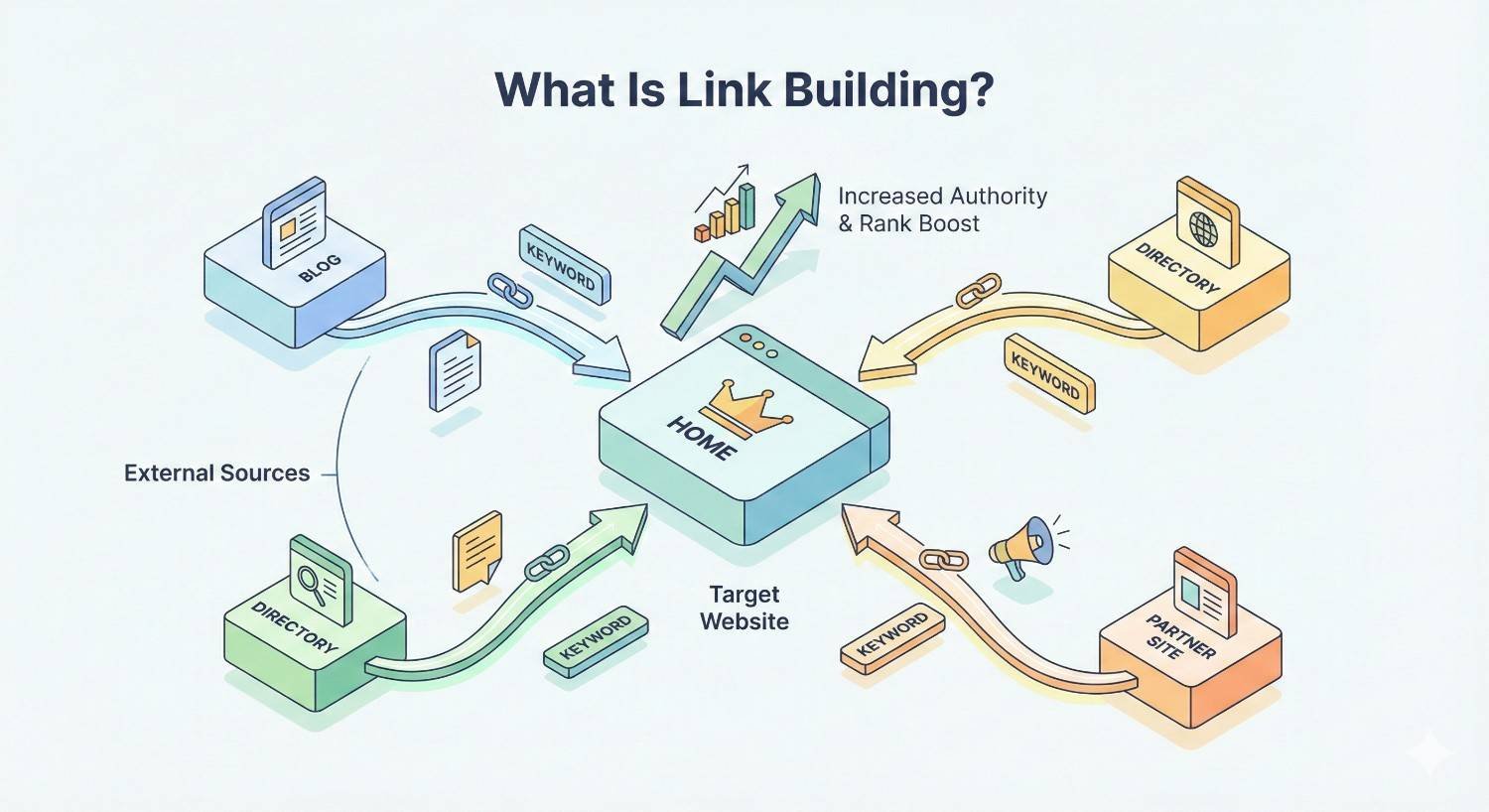
What Is Link Building?
Definition and Purpose
Link building is the process of acquiring hyperlinks from external websites that point back to your own. These backlinks serve as digital endorsements, signaling to search engines that your content holds value worth referencing.
The core purpose extends beyond simple SEO mechanics. Quality backlinks drive referral traffic from relevant audiences, establish your brand within industry conversations, and build the foundational authority that supports all other optimization efforts. Each legitimate link represents a vote of confidence from another website owner who found your content valuable enough to share.
Modern link building focuses on earning links through valuable content, strategic outreach, and relationship development rather than manipulative tactics. Google’s algorithms have evolved to distinguish between naturally earned links and artificially manufactured ones, making quality and relevance paramount.
Why Links Matter for SEO
Backlinks remain one of Google’s top three ranking factors according to Google’s own statements. They function as trust signals that help search engines determine which pages deserve visibility for competitive queries.
Pages with strong backlink profiles consistently outperform those without external validation. The relationship isn’t just correlational. Links pass authority, help search engines discover new content faster, and establish topical relevance through anchor text and surrounding context.
For competitive keywords, technical optimization and quality content alone rarely suffice. The sites ranking on page one typically possess substantial link equity built over months or years. This reality makes link building essential for businesses targeting valuable search terms in established markets.
Average Link Building Costs in 2024
Cost Per Link Breakdown
Individual link costs vary dramatically based on quality metrics and acquisition method. Here’s what the market looks like:
Low-tier links ($50-$150): Guest posts on low-authority sites, directory submissions, and forum links. These carry minimal SEO value and potential risk.
Mid-tier links ($150-$500): Guest posts on DA 30-50 sites, niche-relevant placements, and resource page links. These provide moderate authority transfer and reasonable safety.
High-tier links ($500-$1,500+): Placements on DA 60+ publications, industry-leading sites, and editorial mentions in established media. These deliver substantial authority and brand visibility.
Premium editorial links ($1,500-$5,000+): Features in major publications like Forbes, Entrepreneur, or industry-specific authorities. These combine SEO value with significant brand credibility.
According to Ahrefs’ link building survey, the average cost per link across the industry sits around $361, though this figure masks enormous variation based on quality standards.
Monthly Retainer Pricing
Retainer arrangements provide ongoing link acquisition with predictable budgeting. Typical monthly investments break down as follows:
Starter packages ($1,000-$2,500/month): 3-5 links monthly, suitable for local businesses or low-competition niches. Expect DA 20-40 placements with basic reporting.
Growth packages ($2,500-$5,000/month): 5-10 links monthly targeting DA 30-50+ sites. Includes content creation, outreach, and detailed performance tracking.
Competitive packages ($5,000-$10,000/month): 10-20+ links monthly with higher authority targets. Comprehensive strategy, custom content, and dedicated account management.
Enterprise packages ($10,000-$20,000+/month): Large-scale campaigns with premium placements, digital PR integration, and multi-channel authority building.
Project-Based Pricing
Some businesses prefer defined campaigns with clear deliverables and timelines. Project pricing typically includes:
Link audit and strategy ($500-$2,000): Analysis of current backlink profile, competitor gap analysis, and strategic recommendations.
Content-driven campaigns ($3,000-$15,000): Creation of linkable assets plus outreach. Pricing depends on content complexity and target link volume.
Digital PR campaigns ($5,000-$25,000+): Newsworthy content creation, journalist outreach, and media placement. Higher investment but potential for high-authority coverage.
Competitor link reclamation ($2,000-$8,000): Systematic acquisition of links pointing to competitors through superior content or direct outreach.
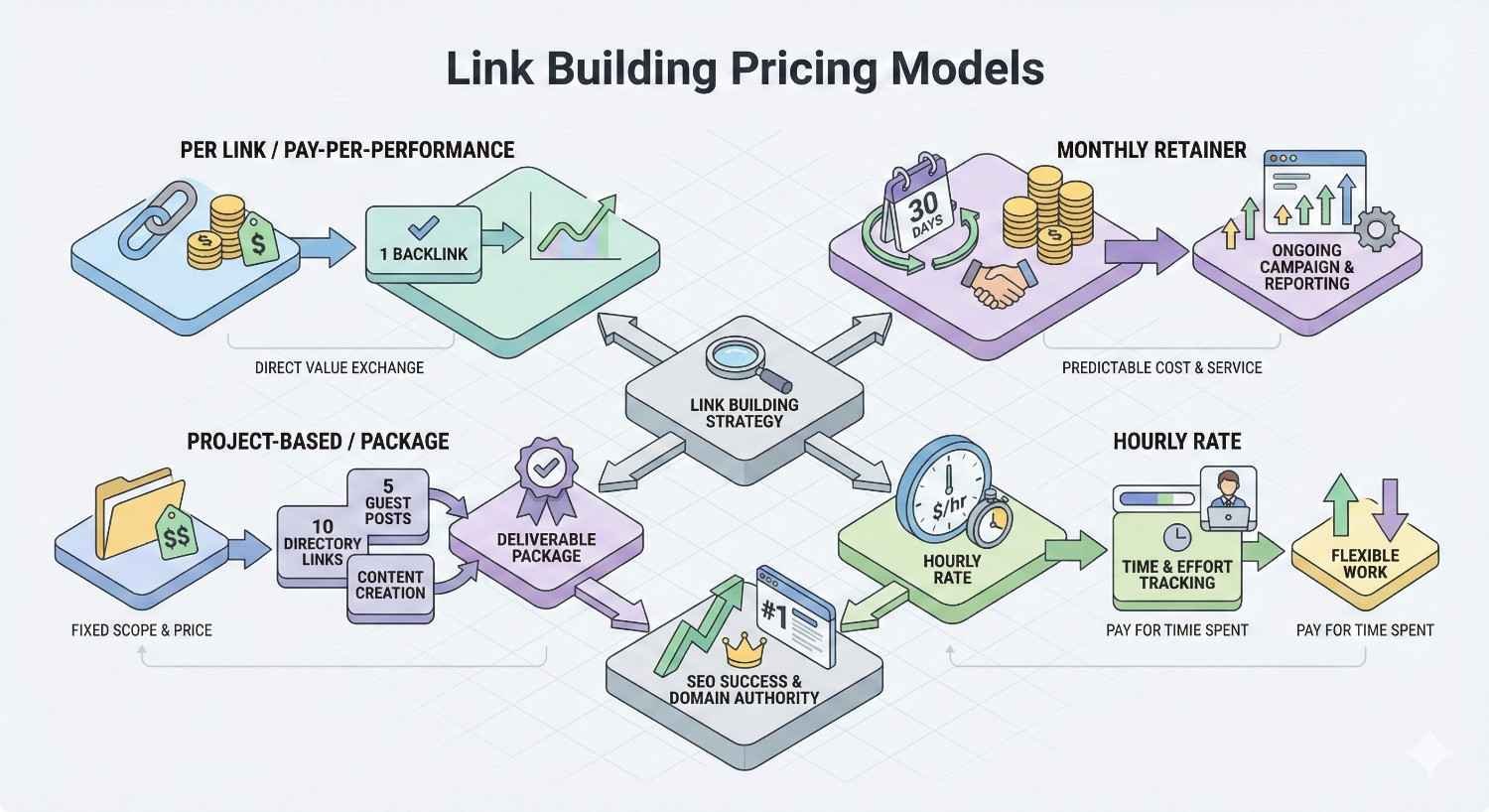
Link Building Pricing Models Explained
Pay-Per-Link Model
The pay-per-link model charges a fixed fee for each successfully placed backlink. Prices vary based on the target site’s authority, relevance, and placement type.
Advantages: Clear cost structure, pay only for delivered results, easy budget forecasting, and straightforward ROI calculation.
Disadvantages: May incentivize quantity over quality, limited strategic flexibility, and potential for providers to prioritize easy wins over valuable placements.
This model works well for businesses with specific link targets or those testing a new provider’s capabilities. Ensure contracts specify quality metrics, placement requirements, and replacement guarantees for removed links.
Monthly Retainer Model
Retainers provide ongoing link building services for a fixed monthly fee. The provider handles strategy, outreach, content creation, and reporting within the agreed scope.
Advantages: Consistent link velocity, strategic relationship development, dedicated resources, and comprehensive service integration.
Disadvantages: Higher commitment, results vary month-to-month, and potential for scope creep or underdelivery without clear KPIs.
Retainers suit businesses committed to long-term organic growth. The model allows providers to build relationships, test approaches, and optimize strategy over time rather than chasing quick wins.
Hourly Rate Model
Some consultants and freelancers charge hourly rates for link building activities. Rates typically range from $50-$200+ per hour depending on expertise and market.
Advantages: Flexibility, transparency into time allocation, and ability to scale effort up or down.
Disadvantages: Unpredictable total costs, potential inefficiency incentives, and difficulty comparing value across providers.
Hourly arrangements work best for specific projects, training, or supplementing in-house efforts. Require detailed time tracking and regular progress updates.
Performance-Based Pricing
Performance models tie payment to achieved results, whether rankings improvements, traffic gains, or link placements meeting specific criteria.
Advantages: Aligned incentives, reduced risk for clients, and providers motivated to deliver measurable outcomes.
Disadvantages: May encourage short-term tactics, difficult to attribute results solely to link building, and quality providers often avoid this model due to external ranking factors.
Approach performance-based offers cautiously. Legitimate providers understand that rankings depend on numerous factors beyond their control. Overly aggressive guarantees often signal risky tactics.
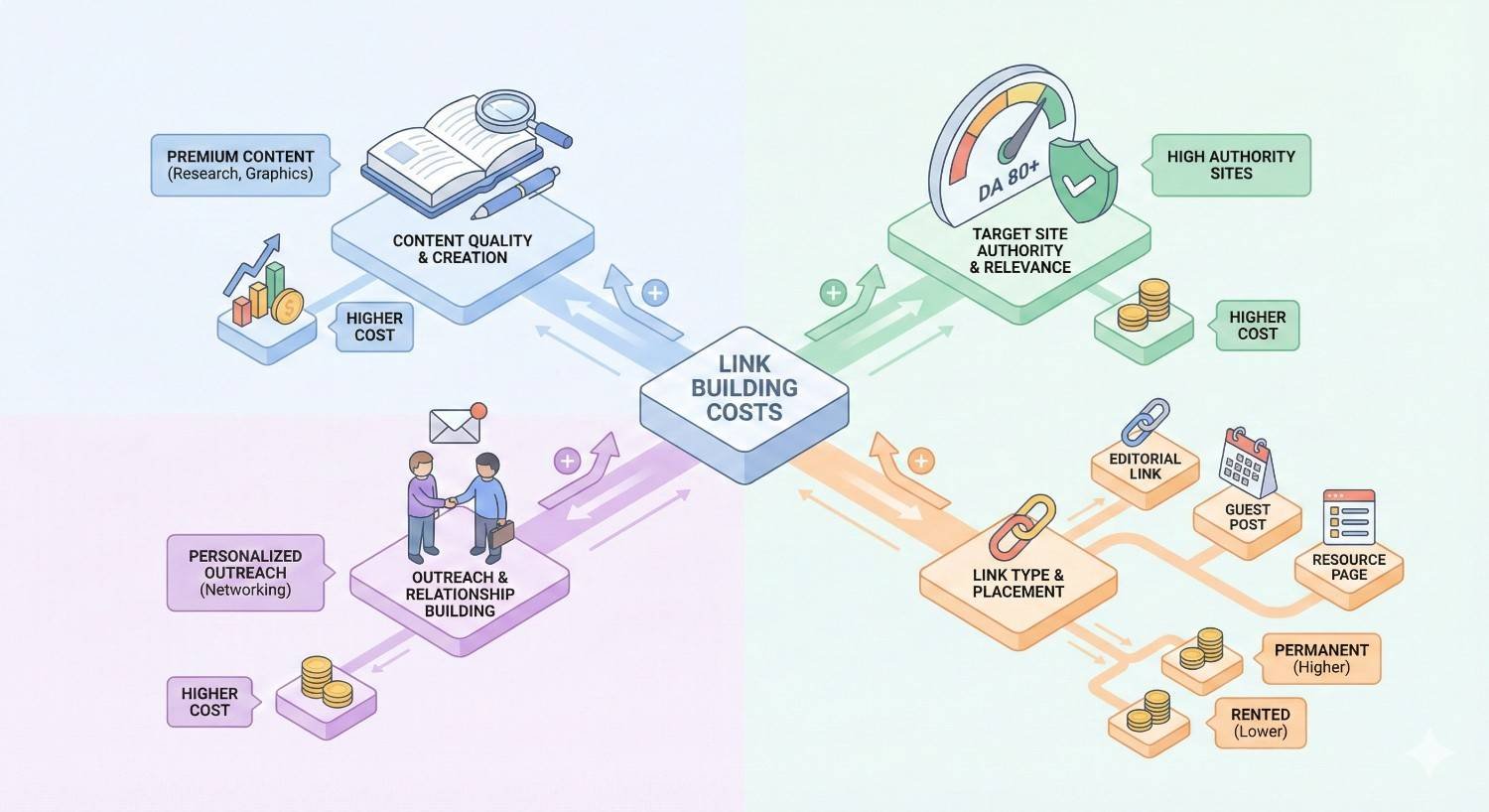
Factors That Affect Link Building Costs
Domain Authority and Quality Metrics
The target site’s authority metrics directly impact acquisition costs. Higher DA sites command premium prices because they pass more link equity and are harder to secure.
DA 20-30 sites: Relatively accessible, lower outreach effort, modest pricing.
DA 40-50 sites: Moderate difficulty, established editorial standards, mid-range pricing.
DA 60+ sites: Significant outreach effort, strict quality requirements, premium pricing.
DA 80+ sites: Major publications requiring newsworthy angles, substantial content investment, or existing relationships.
Beyond DA, consider traffic quality, topical relevance, and spam indicators. A DA 40 site with engaged, relevant traffic often outperforms a DA 60 site with questionable metrics.
Industry and Niche Competitiveness
Your industry significantly influences link building costs. Competitive sectors require more effort and higher-quality placements to move rankings.
Low competition (local services, niche B2B): Fewer quality sites exist, but lower authority thresholds suffice. Moderate pricing.
Medium competition (e-commerce, professional services): Established competitors with decent link profiles. Requires consistent investment.
High competition (finance, health, legal, SaaS): Saturated markets with well-funded competitors. Demands premium placements and substantial budgets.
YMYL niches (Your Money Your Life): Google applies heightened scrutiny. Links must come from authoritative, trustworthy sources, increasing costs significantly.
Link Type and Placement
Where and how your link appears affects both cost and value:
Contextual editorial links: Naturally placed within relevant content. Highest value, highest cost.
Guest post links: Author bio or in-content placement on external sites. Mid-range value and cost.
Resource page links: Inclusion in curated lists. Good value when relevant, moderate cost.
Directory links: Business listings and industry directories. Low value, low cost.
Sidebar/footer links: Site-wide placements. Often devalued by Google, should be avoided.
Homepage links: Prominent placement passing significant authority. Premium pricing when available.
Content Requirements
Link building often requires content creation, adding to total costs:
Basic guest posts (500-800 words): $50-$150 for writing, plus placement fees.
In-depth articles (1,500-2,500 words): $150-$500 for quality writing with research.
Data-driven content: $500-$2,000+ for original research, surveys, or analysis.
Infographics and visual assets: $300-$1,500 for design plus promotion costs.
Interactive tools and calculators: $2,000-$10,000+ for development plus ongoing maintenance.
Higher content investment typically yields better link opportunities and longer-term value as assets continue attracting links organically.
Geographic Targeting
Location-specific link building carries unique cost considerations:
Local link building: Chamber of commerce, local news, community sites. Often relationship-driven with moderate costs.
National campaigns: Broader target pool but higher competition. Standard market pricing.
International targeting: Language requirements, regional publications, and cultural considerations increase complexity and cost.
Multi-region campaigns: Require separate strategies per market, multiplying effort and investment.
Link Building Cost by Provider Type
In-House Link Building Costs
Building internal link building capacity requires significant investment:
Salary costs: Link building specialists earn $45,000-$80,000 annually depending on experience and location. Senior strategists command $80,000-$120,000+.
Tool subscriptions: Ahrefs, Semrush, Pitchbox, Hunter.io, and other essential tools run $500-$2,000+ monthly.
Training and development: Ongoing education, conferences, and skill development add $2,000-$5,000 annually.
Management overhead: Supervision, quality control, and strategic direction require senior time.
Total annual cost: A single dedicated link builder costs $70,000-$150,000+ annually when accounting for all expenses.
In-house makes sense for large organizations with substantial ongoing needs and the management capacity to maintain quality standards.
Freelancer Rates
Independent link building specialists offer flexibility without agency overhead:
Junior freelancers: $25-$50/hour or $100-$300 per link. Variable quality, requires close oversight.
Experienced specialists: $50-$100/hour or $300-$600 per link. Established processes and reliable delivery.
Expert consultants: $100-$200+/hour or $500-$1,000+ per link. Strategic guidance plus execution.
Freelancers work well for specific projects or supplementing existing efforts. Vet carefully through portfolio review, reference checks, and trial projects.
Agency Pricing
Full-service agencies provide comprehensive link building within broader SEO strategies:
Boutique agencies: $1,500-$5,000/month. Personalized service, niche expertise, smaller client loads.
Mid-size agencies: $5,000-$15,000/month. Dedicated teams, established processes, broader capabilities.
Large agencies: $15,000-$50,000+/month. Enterprise resources, multi-channel integration, premium placements.
Agency relationships offer strategic depth, accountability, and scalability. Evaluate based on case studies, client retention, and transparency in reporting.
Link Building Marketplaces
Online platforms connect buyers with link placement opportunities:
Budget marketplaces: $20-$100 per link. High risk, questionable quality, potential for PBN links.
Curated platforms: $100-$500 per link. Vetted opportunities, quality standards, but limited customization.
Premium networks: $500-$2,000+ per link. Established publications, editorial standards, transparent pricing.
Marketplaces offer convenience but require careful vetting. Many sell links from the same sites repeatedly, diminishing value and increasing footprint risk.
Cost Comparison: Quality vs. Cheap Links
What You Get at Different Price Points
Understanding value at each price tier helps set realistic expectations:
$50-$100 links typically include:
- Low DA sites (under 30)
- Thin or irrelevant content
- Limited traffic and engagement
- Potential PBN or link farm risk
- No relationship or editorial process
$200-$500 links typically include:
- Moderate DA sites (30-50)
- Relevant niche publications
- Actual editorial review
- Real traffic and readership
- Content that provides context
$500-$1,500+ links typically include:
- High DA sites (50+)
- Established publications with audiences
- Genuine editorial standards
- Significant referral traffic potential
- Brand visibility beyond SEO value
Risks of Low-Cost Link Building
Cheap links carry substantial risks that often outweigh savings:
Algorithmic penalties: Google’s Penguin algorithm targets manipulative link patterns. Recovery requires months of disavow work and reputation rebuilding.
Manual actions: Google’s webspam team issues manual penalties for egregious violations. These devastate organic visibility and require formal reconsideration requests.
Wasted budget: Links that pass no value or get removed quickly represent pure loss. The $500 saved on cheap links often costs thousands in wasted effort.
Reputation damage: Association with low-quality sites reflects poorly on your brand. Prospects researching your company may encounter these placements.
Opportunity cost: Time and budget spent on worthless links could fund legitimate strategies with lasting impact.
Signs of Overpriced Services
Not all expensive services deliver proportional value. Watch for these warning signs:
Vague deliverables: Promises of “high-quality links” without specific metrics, site examples, or placement guarantees.
Guaranteed rankings: No legitimate provider guarantees specific positions. Rankings depend on countless factors beyond link building.
Proprietary networks: Claims of exclusive access to premium sites often mask private blog networks or recycled placements.
No transparency: Unwillingness to share target sites, outreach methods, or placement examples before commitment.
Inflated metrics: Emphasis on vanity metrics like total links acquired rather than quality indicators and business impact.
Long contracts with no outs: Legitimate providers confident in their work don’t require 12-month commitments with no performance clauses.
How to Budget for Link Building
Setting Realistic Expectations
Effective budgeting starts with honest assessment of your situation:
Competitive analysis: How many quality links do top-ranking competitors have? What authority levels? This establishes your target.
Current position: Your existing domain authority and backlink profile determine how much ground you need to cover.
Timeline expectations: Link building compounds over time. Expect 6-12 months before significant ranking improvements for competitive terms.
Resource reality: Budget constraints, internal capabilities, and strategic priorities all influence appropriate investment levels.
A realistic starting point for most SMBs targeting moderately competitive keywords: $2,000-$5,000 monthly for 12+ months to build meaningful authority.
Calculating ROI on Link Building
Measuring link building ROI requires connecting activities to business outcomes:
Traffic value method: Calculate the equivalent cost of acquiring the same traffic through paid channels. If organic traffic from improved rankings would cost $10,000/month in PPC, that’s your value baseline.
Lead attribution: Track leads and conversions from organic search. Assign value based on customer lifetime value and close rates.
Ranking improvement value: Monitor keyword positions for target terms. Calculate traffic potential at each position using CTR benchmarks.
Example calculation:
- Monthly link building investment: $3,000
- Ranking improvement: Position 15 to Position 5 for target keyword
- Monthly search volume: 5,000
- CTR at Position 5: ~5% = 250 visits
- Conversion rate: 3% = 7.5 leads
- Lead value: $500 = $3,750 monthly value
- ROI: 25% monthly, compounding as authority builds
Budget Allocation by Business Size
Different business scales warrant different investment approaches:
Startups and small businesses ($1,000-$3,000/month): Focus on foundational links, local citations, and niche-relevant placements. Prioritize quality over quantity. Consider combining with content marketing for efficiency.
Growing SMBs ($3,000-$7,500/month): Consistent link velocity targeting mid-tier authority sites. Mix of guest posting, resource link building, and digital PR. Dedicated strategy and regular reporting.
Established mid-market ($7,500-$15,000/month): Aggressive campaigns targeting competitive keywords. Premium placements, original research, and multi-channel authority building. Dedicated team or agency partnership.
Enterprise ($15,000-$50,000+/month): Comprehensive programs integrating link building with broader content and PR strategies. Premium publication access, thought leadership positioning, and brand authority development.
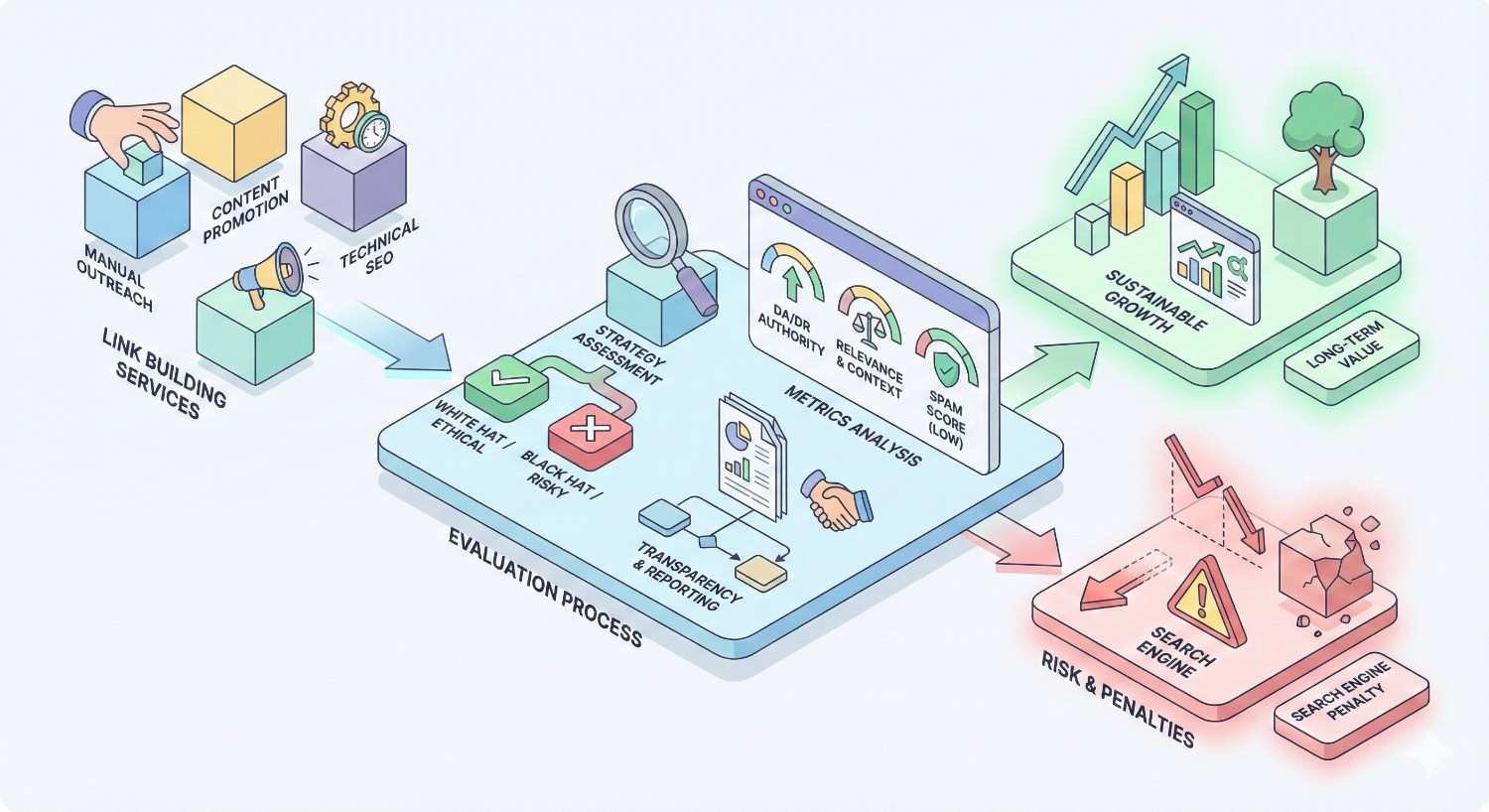
How to Evaluate Link Building Services
Questions to Ask Providers
Before committing to any link building service, get clear answers:
Strategy questions:
- How do you identify link opportunities?
- What’s your outreach process?
- How do you ensure relevance to my industry?
- What content do you create or require?
Quality questions:
- What DA/DR range do you target?
- Can you share example placements from similar clients?
- How do you vet sites for quality and safety?
- What’s your policy on link removals?
Process questions:
- What reporting will I receive?
- How often do we communicate?
- Who will manage my account?
- What’s your typical timeline for placements?
Business questions:
- What are your contract terms?
- How do you handle underperformance?
- Can you provide client references?
- What happens if links get removed?
Red Flags to Avoid
Certain signals indicate providers likely to underdeliver or cause harm:
Guaranteed rankings or specific positions: No one controls Google’s algorithm.
Unusually low prices: Quality link building requires significant effort. Prices far below market indicate shortcuts.
Unwillingness to share methods: Legitimate providers explain their approach transparently.
Emphasis on link quantity: Focus should be on quality, relevance, and strategic fit.
No examples or case studies: Established providers have demonstrable results.
Pressure tactics: Urgency, limited-time offers, and aggressive sales indicate desperation.
PBN or link network mentions: Private blog networks violate Google guidelines and carry penalty risk.
Instant results promises: Quality link building takes time. Anyone promising immediate impact is cutting corners.
Vetting Quality and Transparency
Thorough vetting protects your investment and website:
Request sample reports: Review actual deliverables from current clients (anonymized if necessary).
Check their own backlinks: Use Ahrefs or Semrush to analyze the provider’s link profile. Do they practice what they preach?
Verify case studies: Ask for references you can contact directly. Confirm results claimed in marketing materials.
Start small: Begin with a limited engagement to evaluate quality before committing to larger contracts.
Review contracts carefully: Understand deliverables, timelines, guarantees, and exit clauses before signing.
Monitor placements: Independently verify links placed. Check site quality, content relevance, and placement context.
Link Building Alternatives and Cost Comparisons
Digital PR vs. Traditional Link Building
Digital PR focuses on earning media coverage that naturally includes backlinks:
Digital PR costs: $3,000-$15,000+ per campaign. Higher upfront investment but potential for multiple high-authority links per successful placement.
Traditional link building costs: $100-$1,500 per link. More predictable per-link costs but typically lower authority ceiling.
When to choose digital PR:
- Targeting DA 70+ publications
- Building brand awareness alongside links
- Creating newsworthy content or data
- Competing in saturated markets
When to choose traditional link building:
- Consistent link velocity needs
- Niche-specific relevance priorities
- Limited content creation resources
- Predictable budget requirements
Many successful strategies combine both approaches, using digital PR for premium placements and traditional methods for consistent volume.
Content Marketing for Links
Creating linkable assets attracts backlinks organically over time:
Content investment: $500-$10,000+ per asset depending on format and depth.
Promotion costs: $1,000-$5,000 for initial outreach and amplification.
Timeline: 3-12 months to accumulate significant links organically.
Best content types for links:
- Original research and data studies
- Comprehensive guides and resources
- Free tools and calculators
- Industry surveys and reports
- Visual assets and infographics
Content marketing builds sustainable link acquisition but requires patience and ongoing investment. The assets continue attracting links long after creation, improving ROI over time.
Building Links In-House vs. Outsourcing
The build-vs-buy decision depends on your specific situation:
In-house advantages:
- Deep brand and industry knowledge
- Direct control over quality and strategy
- Long-term relationship building
- Institutional knowledge retention
In-house disadvantages:
- High fixed costs regardless of output
- Training and management overhead
- Tool and resource investments
- Scaling challenges
Outsourcing advantages:
- Variable costs aligned with needs
- Established processes and relationships
- Broader expertise and resources
- Easier scaling up or down
Outsourcing disadvantages:
- Less brand immersion
- Communication overhead
- Quality control challenges
- Dependency on external partners
Hybrid approach: Many organizations maintain strategic oversight in-house while outsourcing execution. This combines brand knowledge with operational efficiency.
Conclusion
Link building costs reflect the genuine effort required to earn quality backlinks that move rankings and drive business results. Understanding pricing models, quality indicators, and evaluation criteria empowers you to invest strategically rather than waste budget on ineffective tactics.
The right investment level depends on your competitive landscape, current authority, and growth objectives. Whether you choose in-house development, freelancer partnerships, or agency relationships, prioritize transparency, quality metrics, and measurable outcomes over promises and low prices.
At White Label SEO Service, we help businesses build sustainable organic growth through strategic link acquisition, technical optimization, and content development. Contact our team to discuss a link building approach aligned with your goals and budget.
Frequently Asked Questions About Link Building Costs
How much should I pay for a backlink?
Quality backlinks typically cost between $200-$1,500 depending on the target site’s authority, relevance, and placement type. Links under $100 often come from low-quality sources that provide minimal value or carry risk. Budget based on your competitive requirements rather than seeking the lowest price.
Why is link building so expensive?
Legitimate link building requires substantial human effort including prospect research, personalized outreach, relationship development, content creation, and quality control. Each placement involves multiple touchpoints and potential rejections. The cost reflects real labor from skilled professionals, not automated processes.
Can I do link building for free?
Yes, through methods like creating exceptional content that earns natural links, building relationships with industry peers, contributing expert commentary, and leveraging existing partnerships. However, “free” still costs time and internal resources. Most businesses find combining organic efforts with strategic investment delivers better results.
How many links do I need per month?
Link quantity requirements vary dramatically based on competition and current authority. A local service business might need 3-5 quality links monthly, while a national e-commerce site competing for valuable keywords might require 20-50+. Focus on consistent velocity with quality placements rather than arbitrary numbers.
What is a good cost per link?
A reasonable cost per link ranges from $200-$600 for mid-tier placements (DA 30-50) and $500-$1,500 for high-authority sites (DA 50+). Evaluate cost relative to the link’s potential impact rather than seeking the lowest price. One $500 link from a relevant, authoritative site outperforms ten $50 links from questionable sources.
How long does it take to see results from link building?
Most businesses see measurable ranking improvements within 3-6 months of consistent link building, with significant results typically appearing at 6-12 months. Link building compounds over time as domain authority grows. Expect gradual progress rather than immediate jumps, especially for competitive keywords.
Is link building still effective in 2024?
Yes, backlinks remain a top ranking factor according to Google and independent ranking studies. However, quality standards have increased significantly. Modern link building focuses on relevance, authority, and natural acquisition patterns rather than volume. Strategic link building integrated with quality content continues delivering strong ROI.