
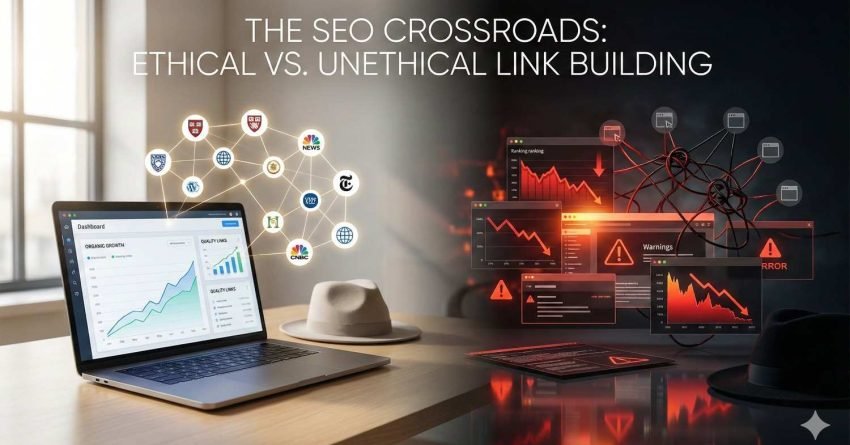
The approach you take to link building determines whether your website builds lasting authority or faces devastating Google penalties. Backlinks remain one of the top three ranking factors, but how you acquire them matters more than quantity.
This distinction between ethical and manipulative link building separates businesses that achieve sustainable organic growth from those that lose everything overnight. Your link building strategy directly impacts traffic, revenue, and brand reputation.
This guide covers white hat techniques that build real authority, black hat tactics that trigger penalties, and practical frameworks for auditing your backlink profile and developing a compliant strategy.
What Is Ethical Link Building?
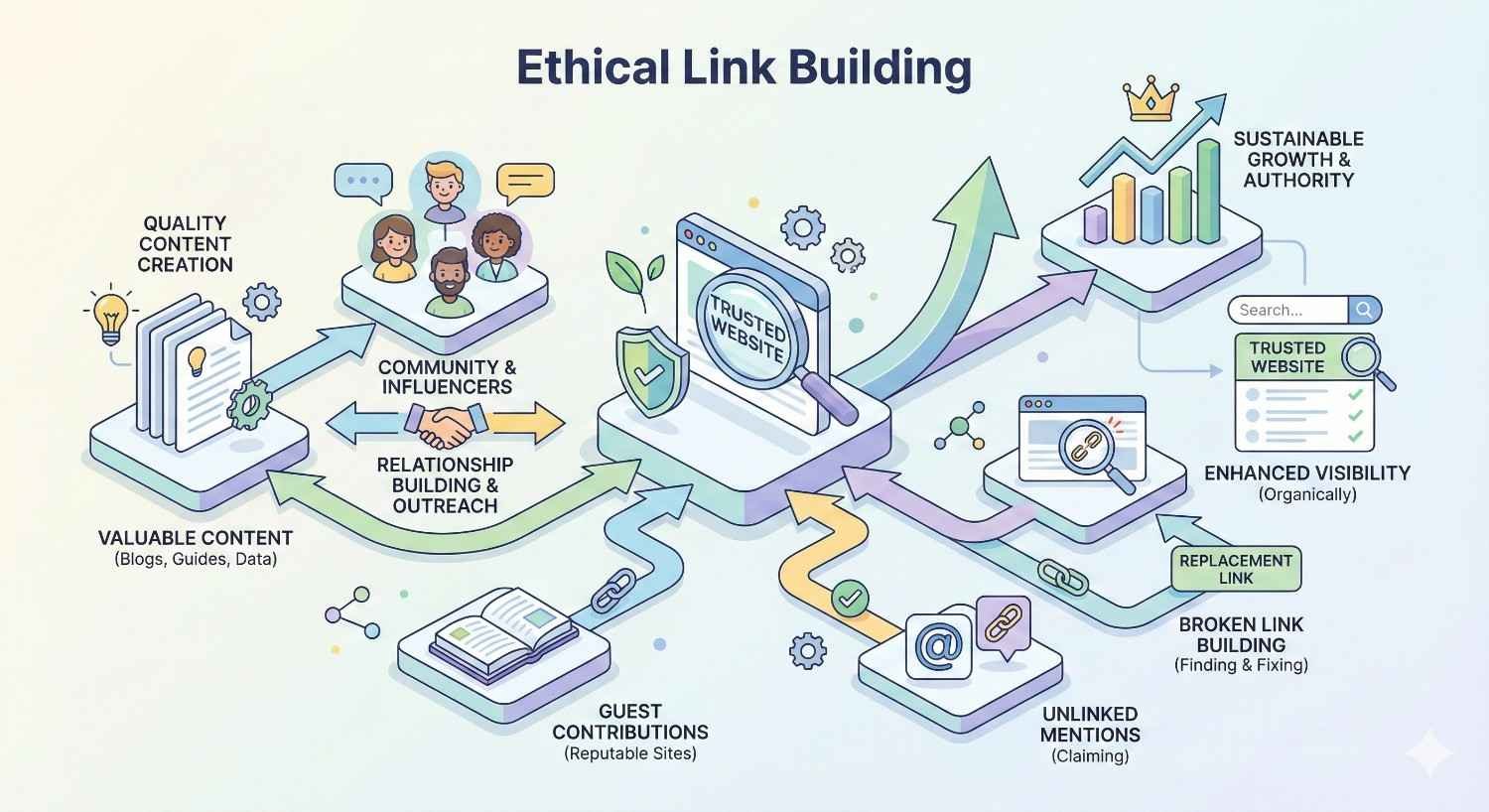
Ethical link building focuses on earning backlinks through value creation rather than manipulation. It means acquiring links that search engines view as genuine editorial endorsements of your content quality and relevance.
The core principle is simple: would you be comfortable explaining your link building methods to a Google employee? Ethical practices pass this test because they align with how search engines intend links to function as trust signals.
Google’s algorithms evaluate links based on context, relevance, and naturalness. Links earned through quality content, genuine relationships, and newsworthy information carry weight. Links obtained through schemes, purchases, or manipulation carry risk.
How Link Building Impacts Search Rankings and Authority
Backlinks function as votes of confidence from one website to another. When a reputable site links to your content, search engines interpret this as a signal that your information deserves visibility.
Google’s PageRank algorithm originally revolutionized search by treating links as citations in academic papers. The more quality citations your content receives, the more authoritative it appears. This fundamental concept still drives modern ranking algorithms.
Link authority flows through several factors:
Domain Authority of Linking Site: A link from a high-authority publication carries more weight than dozens of links from unknown blogs. Quality consistently outperforms quantity.
Relevance: Links from topically related websites signal expertise within your niche. A link from an industry publication matters more than a link from an unrelated general site.
Anchor Text: The clickable text in a hyperlink provides context about the linked page’s content. Natural anchor text variation indicates organic link acquisition.
Link Placement: Editorial links within main content carry more value than footer links, sidebar links, or comment section links.
Follow vs. Nofollow: While nofollow links don’t pass PageRank directly, they contribute to a natural link profile and can drive referral traffic.
Why Link Building Ethics Matter for Long-Term SEO Success
Short-term thinking in link building creates long-term problems. Google’s algorithms have evolved specifically to detect and penalize manipulative link practices.
The consequences extend beyond rankings. Manual actions can remove your site from search results entirely. Algorithmic penalties can suppress your visibility for months or years. Recovery requires significant time, resources, and expertise.
Beyond penalties, unethical link building damages brand reputation. When your site appears on spammy networks or gets associated with link schemes, potential customers and partners notice. Trust, once lost, proves difficult to rebuild.
Ethical link building creates compounding returns. Quality backlinks continue generating value indefinitely. They attract additional natural links as your authority grows. They drive referral traffic independent of rankings. They establish your brand as a trusted resource in your industry.
White Hat Link Building: Definition, Principles, and Best Practices
White hat link building encompasses strategies that comply with search engine guidelines while creating genuine value for users. These techniques focus on earning links through merit rather than manipulation.
The defining characteristic is sustainability. White hat methods build authority that withstands algorithm updates because they align with Google’s core mission: connecting users with the most relevant, trustworthy information.
Core Principles of White Hat Link Building
Value-First Approach: Every white hat strategy starts with creating something worth linking to. This could be exceptional content, useful tools, original research, or newsworthy information. The link becomes a natural byproduct of value creation.
Relationship Building: Genuine connections with journalists, bloggers, and industry peers lead to organic link opportunities. These relationships develop over time through consistent engagement and mutual benefit.
Transparency: White hat practitioners openly discuss their methods. There’s nothing to hide because every tactic serves users and follows guidelines.
Patience: Quality link building takes time. Rushing the process often leads to shortcuts that cross ethical lines.
Relevance Focus: Pursuing links from topically relevant sources rather than any available opportunity ensures link quality and reduces risk.
Google’s Webmaster Guidelines on Link Schemes
Google’s documentation on link schemes explicitly outlines prohibited practices. Understanding these guidelines helps distinguish white hat from black hat approaches.
Google considers the following as link scheme violations:
Buying or selling links that pass PageRank. This includes exchanging money, goods, or services for links without proper disclosure.
Excessive link exchanges or partner pages created solely for cross-linking.
Large-scale article marketing or guest posting campaigns with keyword-rich anchor text links.
Using automated programs or services to create links to your site.
Requiring a link as part of a Terms of Service, contract, or similar arrangement.
Text advertisements that pass PageRank without nofollow or sponsored attributes.
Advertorials or native advertising where payment is received for articles that include links passing PageRank.
Links with optimized anchor text in articles or press releases distributed on other sites.
Low-quality directory or bookmark site links.
Links embedded in widgets distributed across various sites.
Widely distributed links in footers or templates of various sites.
Forum comments with optimized links in the post or signature.
White Hat Link Building Techniques That Work
Effective white hat strategies require investment in content quality and relationship development. The following techniques consistently generate sustainable results.
Content Marketing and Digital PR
Creating content that naturally attracts links remains the foundation of white hat link building. This requires understanding what makes content link-worthy.
Data-Driven Content: Original statistics, surveys, and research findings give journalists and bloggers something to cite. When you’re the primary source, links follow naturally.
Comprehensive Guides: Definitive resources on specific topics become reference materials that others link to when explaining concepts to their audiences.
Visual Assets: Infographics, charts, and diagrams get embedded and linked across the web when they effectively communicate complex information.
Newsworthy Announcements: Product launches, company milestones, and industry insights can generate coverage from relevant publications.
Digital PR amplifies content reach by connecting with journalists and publications actively seeking sources. Building relationships with reporters covering your industry creates ongoing link opportunities.
Guest Posting on Relevant, Quality Sites
Guest posting remains effective when approached correctly. The key distinction is contributing genuine value to established publications rather than mass-producing low-quality content for link acquisition.
Quality Indicators for Guest Post Targets:
The site has genuine readership and engagement. Comments, social shares, and community interaction signal real audience value.
Editorial standards exist. Quality publications review submissions and maintain content standards.
The site covers topics relevant to your expertise. Topical alignment ensures link relevance.
The publication has established authority in your industry. Links from respected sources carry more weight.
Guest Posting Best Practices:
Pitch unique angles that serve the publication’s audience. Generic topics get rejected.
Write content that matches or exceeds the quality of existing articles on the site.
Include links only where they genuinely add value for readers.
Build ongoing relationships with editors rather than one-off transactions.
Disclose any commercial relationships transparently.
Resource Page Link Building
Many websites maintain resource pages listing helpful tools, guides, and references for their audiences. Getting included on relevant resource pages provides contextual, editorial links.
Finding Resource Page Opportunities:
Search operators like “keyword + resources” or “keyword + useful links” reveal potential targets.
Analyze competitor backlinks to identify resource pages linking to similar content.
Look for industry associations, educational institutions, and professional organizations maintaining resource directories.
Outreach Approach:
Identify the specific value your resource provides to the page’s audience.
Personalize outreach explaining why your content fits their existing resources.
Make it easy for webmasters to add your link by providing all necessary information.
Follow up respectfully without being pushy.
Broken Link Building
Broken link building involves finding dead links on relevant websites and suggesting your content as a replacement. This provides value to webmasters by helping them fix user experience issues.
Process:
Identify relevant websites in your niche with resource pages or content linking to external sources.
Use tools like Ahrefs, Screaming Frog, or Check My Links to find broken outbound links.
Create or identify content on your site that could replace the dead resource.
Contact the webmaster, alert them to the broken link, and suggest your content as an alternative.
Success Factors:
Your replacement content must genuinely match or exceed the quality of the original resource.
Personalized outreach explaining the specific broken link performs better than generic templates.
Providing additional value beyond just the replacement suggestion increases response rates.
Original Research and Data-Driven Content
Publishing original research creates citation opportunities that generate links naturally over time. When you’re the primary source for statistics or insights, others must link to you when referencing your findings.
Research Content Types:
Industry surveys collecting data from professionals in your field.
Analysis of proprietary data from your business operations.
Studies examining trends, behaviors, or outcomes relevant to your audience.
Benchmark reports comparing performance metrics across companies or industries.
Maximizing Research Impact:
Partner with industry associations or publications to increase credibility and distribution.
Create multiple content formats from single research projects: reports, infographics, blog posts, press releases.
Update research annually to maintain relevance and generate recurring coverage.
Promote findings to journalists covering your industry.
Strategic Partnerships and Collaborations
Business relationships naturally create link opportunities. Partnerships, sponsorships, and collaborations often include website mentions and links as part of the arrangement.
Ethical Partnership Links:
Supplier and vendor relationships where links provide genuine value to users seeking product information.
Industry association memberships with directory listings.
Event sponsorships with speaker or sponsor page links.
Co-marketing initiatives with complementary businesses.
Key Distinction:
Partnership links should serve users by providing relevant information about business relationships. Links purely for SEO purposes without user value cross into gray territory.
Timeline and Effort Required for White Hat Link Building
White hat link building requires patience. Results typically emerge over months rather than weeks.
Content Creation Phase (1-3 months): Developing link-worthy assets requires research, writing, design, and refinement. Rushing this phase compromises quality and reduces link potential.
Outreach and Relationship Building (Ongoing): Initial outreach campaigns may take 2-4 weeks to generate responses. Building journalist and blogger relationships requires consistent engagement over months.
Link Acquisition (3-6 months): Quality links accumulate gradually. Expect to see meaningful link growth after 3-6 months of consistent effort.
Ranking Impact (6-12 months): Search engines take time to discover, evaluate, and credit new links. Ranking improvements from link building typically appear 6-12 months after link acquisition.
Resource Requirements:
Content creation: Writers, designers, researchers, or agency support.
Outreach: Dedicated time for prospecting, personalization, and follow-up.
Tools: Link analysis, outreach management, and monitoring software.
Budget: Content production, tool subscriptions, and potentially agency fees.
Benefits and ROI of White Hat Link Building
White hat link building delivers compounding returns that justify the upfront investment.
Sustainable Rankings: Links earned through quality content and genuine relationships withstand algorithm updates. Google’s improvements target manipulation, not legitimate authority signals.
Referral Traffic: Quality links from relevant sites drive targeted visitors independent of search rankings. This traffic often converts at higher rates than organic search traffic.
Brand Authority: Appearing on respected publications builds credibility with potential customers. Links serve as third-party endorsements of your expertise.
Relationship Assets: Connections developed through outreach create ongoing opportunities for coverage, partnerships, and collaboration.
Penalty Protection: Compliant link profiles don’t require constant monitoring for algorithm changes or manual action risks.
Long-Term Value: Unlike paid advertising that stops when budgets end, quality backlinks continue generating value indefinitely.
Black Hat Link Building: Definition, Tactics, and Risks
Black hat link building encompasses techniques that violate search engine guidelines to manipulate rankings artificially. These methods prioritize short-term gains over sustainable growth.
The defining characteristic is deception. Black hat tactics attempt to make manipulated links appear natural to search engines. When detected, consequences range from link devaluation to complete removal from search results.
What Defines Black Hat Link Building?
Black hat link building violates Google’s guidelines through manipulation, automation, or deception. The intent is to artificially inflate link signals rather than earn them through merit.
Key Characteristics:
Manipulation: Attempting to influence rankings through artificial means rather than genuine value creation.
Scalability Through Automation: Using software or services to generate links at volumes impossible through legitimate means.
Deception: Disguising paid or manipulated links as organic editorial endorsements.
Disregard for User Value: Links exist solely for SEO purposes without providing genuine value to users.
Guideline Violations: Explicit contradiction of documented search engine policies.
Common Black Hat Link Building Tactics
Understanding black hat tactics helps identify risks in your own backlink profile and recognize problematic practices offered by vendors.
Private Blog Networks (PBNs)
Private Blog Networks consist of websites owned or controlled by a single entity, created specifically to link to target sites and manipulate rankings.
How PBNs Work:
Operators acquire expired domains with existing authority.
They populate these domains with content, often thin or AI-generated.
Links from these controlled sites point to money sites the operator wants to rank.
The network attempts to appear as independent websites to search engines.
Detection Signals:
Similar hosting, registration, or technical footprints across network sites.
Thin content with obvious link placement.
Unnatural linking patterns pointing to the same target sites.
Lack of genuine audience engagement or traffic.
Risks:
Google actively identifies and devalues PBN links. Manual actions can penalize both the network sites and target sites receiving links. Recovery requires disavowing all PBN links and demonstrating compliance.
Paid Links and Link Buying
Purchasing links that pass PageRank without proper disclosure violates Google’s guidelines. This includes direct payments, product exchanges, and services-for-links arrangements.
Common Forms:
Direct payment to website owners for dofollow links.
Sponsored posts without proper disclosure or nofollow attributes.
Link broker services connecting buyers with publishers.
Product reviews exchanged for links without disclosure.
Why It’s Problematic:
Paid links distort the organic nature of link signals. They allow sites to buy authority rather than earn it through quality content and genuine endorsements.
Proper Disclosure:
Paid links can exist ethically when properly disclosed with rel=”sponsored” or rel=”nofollow” attributes. The violation occurs when paid links attempt to pass PageRank as if they were organic endorsements.
Link Farms and Link Exchanges
Link farms are networks of sites that exist primarily to link to each other, artificially inflating link counts without providing user value.
Characteristics:
Sites with no genuine purpose beyond linking.
Reciprocal linking arrangements at scale.
Low-quality content serving only as link vehicles.
No real audience or engagement.
Link Exchange Schemes:
While occasional reciprocal links between genuinely related sites are natural, systematic link exchange programs violate guidelines. “Link to me and I’ll link to you” arrangements at scale signal manipulation.
Comment Spam and Forum Spam
Posting links in blog comments, forum signatures, and discussion threads purely for SEO purposes constitutes spam.
Characteristics:
Generic comments unrelated to the content.
Links in signatures or profiles without genuine community participation.
Automated posting across multiple sites.
Links to commercial pages from community discussions.
Impact:
Most comment and forum links carry nofollow attributes, limiting direct SEO value. However, spam patterns can still trigger penalties and damage brand reputation.
Automated Link Building Software
Software that automatically creates links across directories, article sites, social bookmarks, and web 2.0 properties violates guidelines.
How It Works:
Software creates accounts across hundreds or thousands of sites.
It automatically posts content with embedded links.
Links accumulate rapidly without human involvement.
Patterns are highly detectable by search engines.
Detection:
Automated links share obvious patterns: similar anchor text, simultaneous creation dates, identical content across sites, and links from known spam networks.
Hidden Links and Link Cloaking
Hiding links from users while making them visible to search engines constitutes deception.
Techniques:
White text on white backgrounds.
CSS positioning to move links off-screen.
Links hidden behind images or in tiny font sizes.
JavaScript that displays different content to users and crawlers.
Severity:
Hidden links represent clear intent to deceive search engines. Detection typically results in severe penalties.
Why Black Hat Link Building Works Short-Term
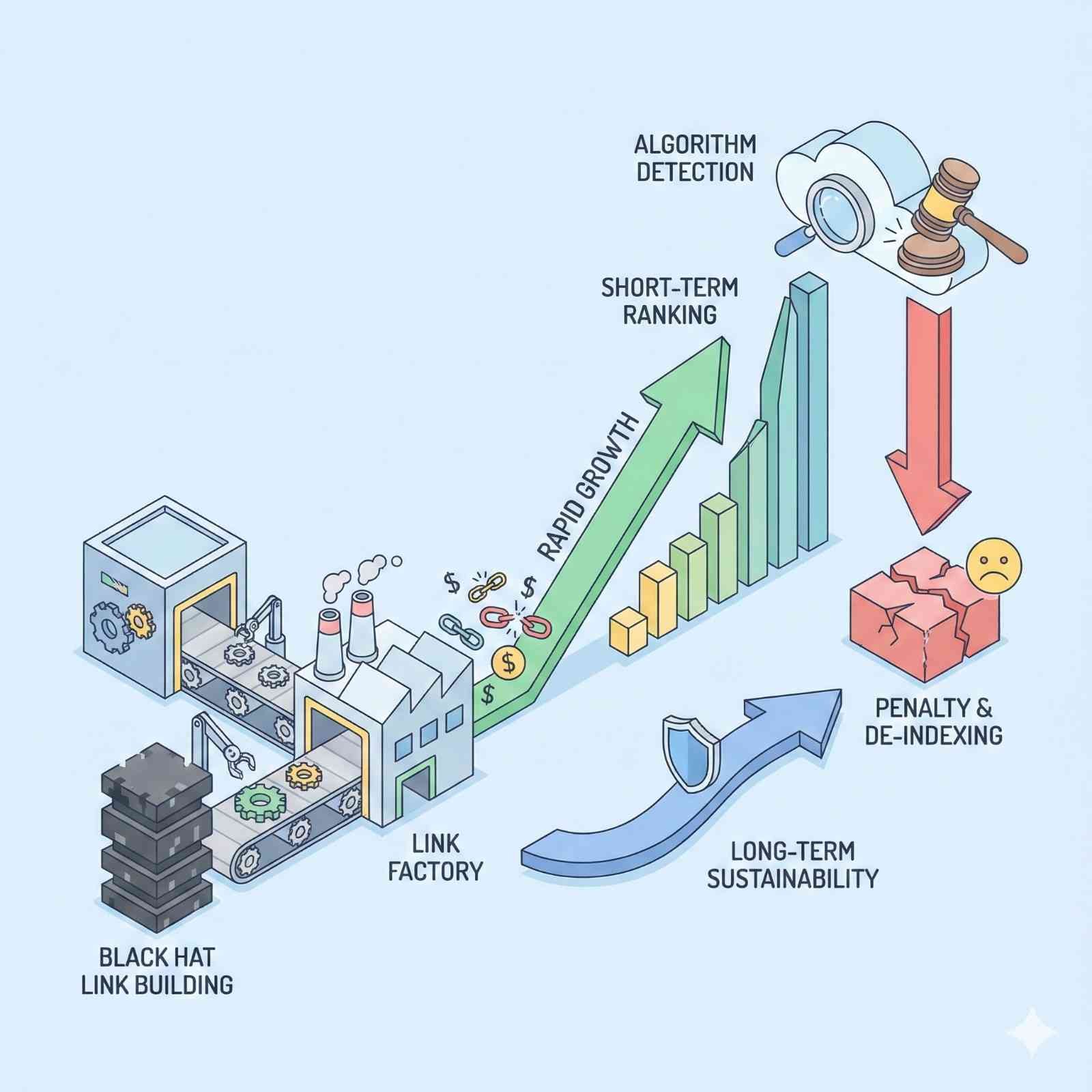
Black hat tactics can produce rapid ranking improvements, which explains their continued appeal despite risks.
Speed: Manipulated links can be acquired in days rather than months.
Scale: Automation enables link volumes impossible through legitimate means.
Cost Efficiency: Per-link costs are often lower than quality content creation and outreach.
Competitive Pressure: When competitors use black hat tactics, the temptation to match their methods increases.
Detection Lag: Search engines don’t catch every violation immediately, creating windows of benefit.
Short-Term ROI: For disposable sites or short-term campaigns, the risk-reward calculation may appear favorable.
However, these short-term benefits come with substantial long-term risks that typically outweigh any temporary gains.
Google Penalties and Algorithmic Devaluation
Google addresses link manipulation through both manual actions and algorithmic adjustments.
Manual Actions vs. Algorithmic Penalties
Manual Actions:
Human reviewers at Google identify guideline violations and apply penalties directly.
Site owners receive notifications in Google Search Console.
Penalties can affect specific pages, sections, or entire domains.
Recovery requires addressing violations and submitting reconsideration requests.
Algorithmic Penalties:
Algorithm updates automatically identify and devalue manipulative patterns.
No notification is provided to site owners.
Effects may be gradual rather than sudden.
Recovery requires removing problematic links and waiting for algorithm reassessment.
Penguin Algorithm and Link Spam Detection
Google’s Penguin algorithm, first launched in 2012 and integrated into the core algorithm in 2016, specifically targets link spam.
Penguin’s Evolution:
Initial versions penalized entire sites for link violations.
Current versions devalue specific spammy links rather than penalizing whole domains.
Real-time processing means effects appear faster than earlier versions.
The algorithm continues evolving to detect new manipulation patterns.
Detection Capabilities:
Unnatural anchor text distributions.
Links from known spam networks.
Sudden link velocity spikes.
Links from irrelevant or low-quality sources.
Patterns indicating purchased or manipulated links.
Recovery Process and Timeline
Recovering from link-related penalties requires systematic effort and patience.
Manual Action Recovery:
Audit your complete backlink profile using multiple tools.
Identify all links violating guidelines.
Attempt to remove links by contacting webmasters.
Disavow links that cannot be removed.
Document your cleanup efforts thoroughly.
Submit a reconsideration request explaining actions taken.
Wait for Google’s review, which can take weeks to months.
If rejected, address additional issues and resubmit.
Algorithmic Recovery:
Identify and remove or disavow problematic links.
Build new quality links to demonstrate compliance.
Wait for algorithm recrawling and reassessment.
Recovery timeline varies from months to over a year.
Real Business Consequences of Black Hat Link Building
Beyond search penalties, black hat link building creates tangible business damage.
Revenue Loss: Ranking drops directly impact organic traffic and conversions. Businesses dependent on search visibility can lose significant revenue overnight.
Recovery Costs: Professional penalty recovery services, content creation for new links, and internal resource allocation create substantial expenses.
Opportunity Cost: Time spent on recovery could be invested in growth initiatives.
Brand Damage: Association with spam networks and manipulative practices harms reputation with customers and partners.
Competitive Disadvantage: While recovering, competitors continue building legitimate authority.
Investor and Stakeholder Concerns: For funded companies, SEO penalties raise questions about management judgment and business sustainability.
White Hat vs Black Hat Link Building: Direct Comparison
Understanding the practical differences between approaches helps inform strategic decisions.
Cost Comparison: Upfront Investment vs. Long-Term Value
White Hat Costs:
Higher upfront investment in content creation.
Ongoing costs for outreach and relationship building.
Tool subscriptions for prospecting and monitoring.
Potentially agency fees for specialized expertise.
Black Hat Costs:
Lower per-link acquisition costs initially.
Potential penalty recovery expenses.
Lost revenue during ranking drops.
Reputation repair costs.
Ongoing risk management and monitoring.
Long-Term Economics:
White hat investments compound over time as quality links continue generating value. Black hat approaches require continuous investment to replace devalued links while carrying ongoing penalty risk.
Timeline Comparison: Quick Wins vs. Sustainable Growth
White Hat Timeline:
Content development: 1-3 months.
Initial link acquisition: 3-6 months.
Ranking improvements: 6-12 months.
Compounding returns: Ongoing.
Black Hat Timeline:
Link acquisition: Days to weeks.
Initial ranking boost: Weeks to months.
Potential penalty: Unpredictable.
Recovery period: 6-18 months.
Strategic Implications:
Businesses needing immediate results face pressure toward black hat tactics. However, the potential for penalties makes black hat approaches unsuitable for long-term brand building.
Risk Comparison: Penalty Exposure and Business Impact
White Hat Risk Profile:
Minimal penalty risk when following guidelines.
Algorithm updates typically benefit compliant sites.
Stable, predictable performance.
No sudden traffic losses from enforcement actions.
Black Hat Risk Profile:
Constant penalty exposure.
Algorithm updates frequently target manipulative patterns.
Unpredictable performance fluctuations.
Potential for catastrophic traffic loss.
Risk Tolerance Factors:
Business dependency on organic traffic.
Brand reputation sensitivity.
Recovery resource availability.
Competitive landscape and industry norms.
Scalability and Sustainability Comparison
White Hat Scalability:
Limited by content creation capacity.
Relationship building doesn’t scale linearly.
Quality constraints prevent rapid expansion.
Sustainable growth within resource constraints.
Black Hat Scalability:
Automation enables rapid scaling.
Volume limited only by budget.
Quality sacrificed for quantity.
Unsustainable due to detection and penalties.
Sustainable Growth Model:
White hat approaches build foundations for long-term authority. Black hat tactics create temporary advantages that collapse under enforcement pressure.
Quality and Authority Comparison
White Hat Link Quality:
Editorial links from relevant, authoritative sources.
Natural anchor text distribution.
Contextual placement within valuable content.
Genuine endorsements of content quality.
Black Hat Link Quality:
Links from low-quality or irrelevant sources.
Over-optimized anchor text patterns.
Placement in non-editorial contexts.
No genuine endorsement value.
Authority Building:
White hat links contribute to genuine topical authority. Black hat links may temporarily inflate metrics but don’t build real expertise signals.
Gray Hat Link Building: Where the Line Blurs
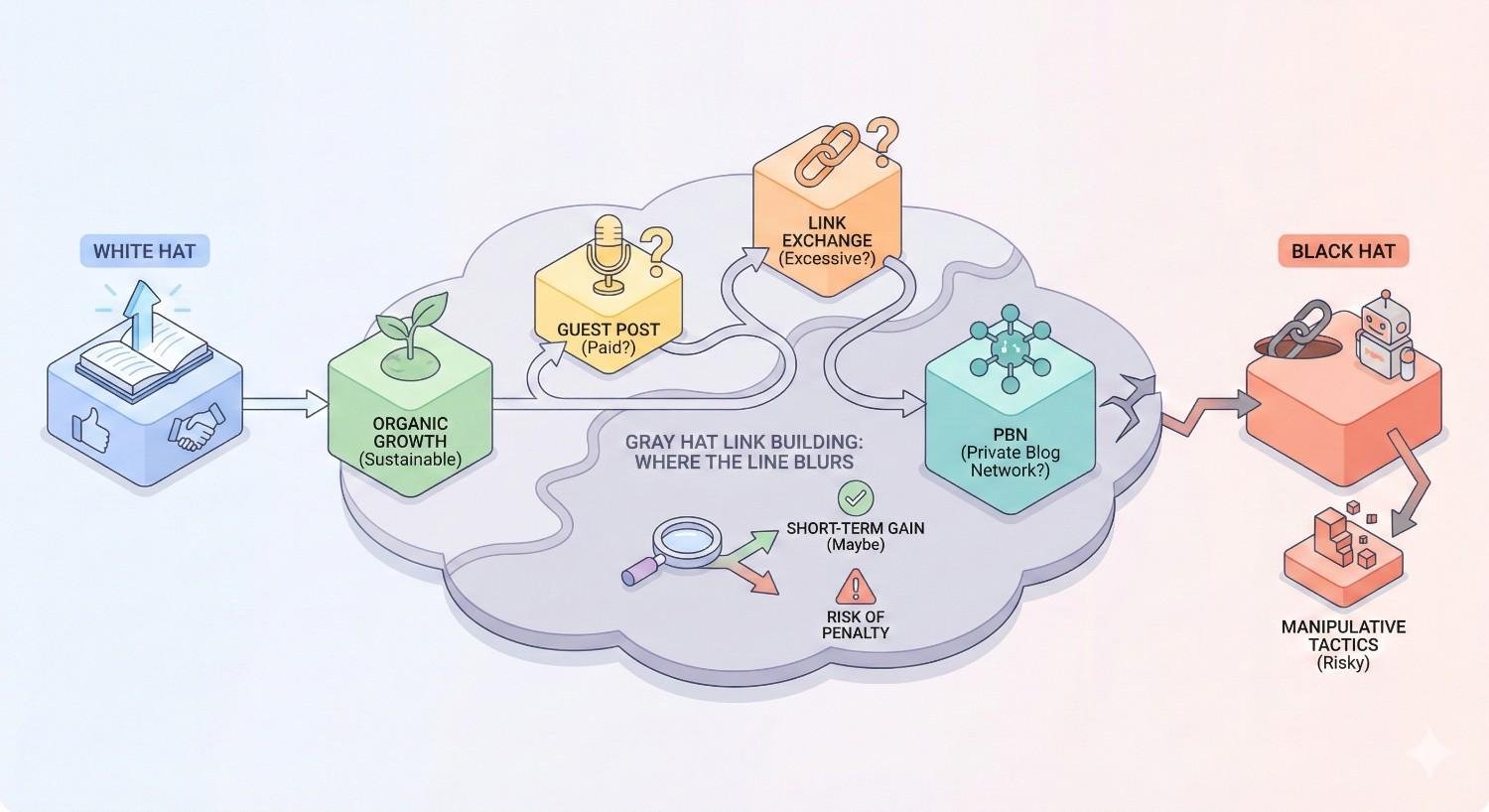
Gray hat link building occupies the space between clearly compliant and clearly violating practices. These tactics may not explicitly violate guidelines but carry elevated risk.
What Is Gray Hat Link Building?
Gray hat techniques push boundaries without clearly crossing them. They often exploit ambiguities in guidelines or use legitimate tactics in ways that approach manipulation.
Characteristics:
Not explicitly prohibited but not clearly endorsed.
Higher risk than white hat but lower than black hat.
Often involve scale or intent that transforms acceptable practices into problematic ones.
May become black hat as guidelines evolve.
Risk Assessment:
Gray hat tactics require careful evaluation of risk tolerance. What’s acceptable for a new site with little to lose may be inappropriate for an established brand.
Common Gray Hat Tactics and Their Risk Levels
Sponsored Content Without Proper Disclosure
Publishing paid content without clear disclosure or proper link attributes falls into gray territory.
The Issue:
Google requires sponsored links to use rel=”sponsored” or rel=”nofollow” attributes.
Many sponsored content arrangements include dofollow links without disclosure.
The line between editorial coverage and paid placement often blurs.
Risk Level: Moderate to High
As Google improves detection of paid content patterns, undisclosed sponsored links face increasing scrutiny.
Reciprocal Link Exchanges
Occasional reciprocal links between genuinely related sites are natural. Systematic exchanges become problematic.
Natural vs. Manipulative:
Two businesses with genuine partnerships linking to each other: Natural.
Organized programs exchanging links with dozens of unrelated sites: Manipulative.
Risk Level: Low to Moderate
Small-scale reciprocal linking rarely triggers penalties. Large-scale programs with obvious patterns face higher risk.
Scholarship Link Building
Creating scholarships to earn .edu links has become a recognized tactic with mixed reception.
The Approach:
Create a scholarship program.
Reach out to universities to list the scholarship on their financial aid pages.
Earn .edu links with high domain authority.
Gray Area:
Legitimate scholarships that genuinely help students are acceptable.
Scholarships created purely for link acquisition with minimal funding or genuine intent cross into manipulation.
Risk Level: Moderate
Google has acknowledged awareness of this tactic. Scholarships with genuine value remain acceptable; obvious link schemes face scrutiny.
Aggressive Guest Posting
Guest posting itself is legitimate. Aggressive approaches push into gray territory.
Warning Signs:
Mass outreach with templated pitches.
Accepting any site regardless of quality or relevance.
Keyword-stuffed anchor text in author bios.
Thin content created solely for link placement.
Risk Level: Moderate to High
Google specifically mentions “large-scale article marketing or guest posting campaigns with keyword-rich anchor text links” as a link scheme.
When Gray Hat Becomes Black Hat
Gray hat tactics cross into black hat territory through scale, intent, or evolution of guidelines.
Scale Transformation:
A few reciprocal links: Gray.
Hundreds of reciprocal links: Black.
Intent Indicators:
Primary purpose is user value: Acceptable.
Primary purpose is link acquisition: Problematic.
Guideline Evolution:
Tactics acceptable today may become violations tomorrow. Google continuously updates guidelines and detection capabilities.
Practical Guidance:
If you wouldn’t want to explain a tactic to a Google employee, it’s probably crossed the line. When in doubt, choose the more conservative approach.
How to Audit Your Backlink Profile for Unethical Links
Regular backlink audits identify risks before they trigger penalties. Proactive cleanup protects your site from both past mistakes and negative SEO attacks.
Tools for Backlink Analysis and Risk Assessment
Multiple tools provide backlink data, each with different strengths.
Google Search Console:
Free access to links Google has discovered.
Shows top linking sites and pages.
Limited historical data and analysis features.
Essential baseline for any audit.
Ahrefs:
Comprehensive backlink database.
Spam score and link quality metrics.
Historical data showing link acquisition patterns.
Anchor text analysis and distribution.
Semrush:
Backlink audit tool with toxicity scoring.
Integration with disavow file management.
Competitive backlink analysis.
Link building opportunity identification.
Moz:
Domain Authority and Spam Score metrics.
Link Explorer for backlink analysis.
Historical index for tracking changes.
Majestic:
Trust Flow and Citation Flow metrics.
Topical Trust Flow for relevance analysis.
Historical index extending back years.
Audit Best Practice:
Use multiple tools to ensure comprehensive coverage. Each tool crawls differently and may discover links others miss.
Identifying Toxic and Unnatural Links
Not all low-quality links require action. Focus on links that pose genuine penalty risk.
High-Risk Link Indicators:
Links from known spam networks or PBNs.
Sitewide links from irrelevant sites.
Links with exact-match anchor text at unnatural rates.
Links from sites in foreign languages unrelated to your business.
Links from adult, gambling, or pharmaceutical sites (unless relevant to your industry).
Links from hacked sites or malware-infected domains.
Links from link farms or directories with no editorial standards.
Analysis Process:
Export complete backlink data from multiple tools.
Sort by domain to identify patterns.
Flag domains with obvious spam indicators.
Review anchor text distribution for over-optimization.
Check link velocity for unnatural spikes.
Investigate suspicious patterns manually.
Context Matters:
A link from a low-quality site isn’t automatically toxic. Consider whether the link could have been placed naturally and whether it’s part of a larger problematic pattern.
Disavow Process and Best Practices
Google’s Disavow Tool allows you to tell Google to ignore specific links when assessing your site.
When to Disavow:
You’ve received a manual action for unnatural links.
You’ve identified links from a previous black hat campaign.
You’ve been targeted by negative SEO with obvious spam links.
You cannot get toxic links removed through outreach.
Disavow Best Practices:
Attempt manual removal first. Contact webmasters requesting link removal before disavowing.
Be conservative. Only disavow links that pose genuine risk. Over-disavowing can remove legitimate link value.
Disavow at domain level for obviously spammy sites. Use page-level disavows when only specific pages are problematic.
Document everything. Keep records of removal attempts and disavow decisions.
Update regularly. Add new toxic links as they’re discovered.
Disavow File Format:
Copy
# Removed links from spam campaign – [Date]
# Contacted webmaster on [Date], no response
domain:spamsite.com
# Specific page with paid link
https://example.com/paid-link-page/
Submission Process:
Access the Disavow Tool in Google Search Console.
Select your property.
Upload your disavow file.
Google processes the file during normal crawling.
Ongoing Backlink Monitoring and Maintenance
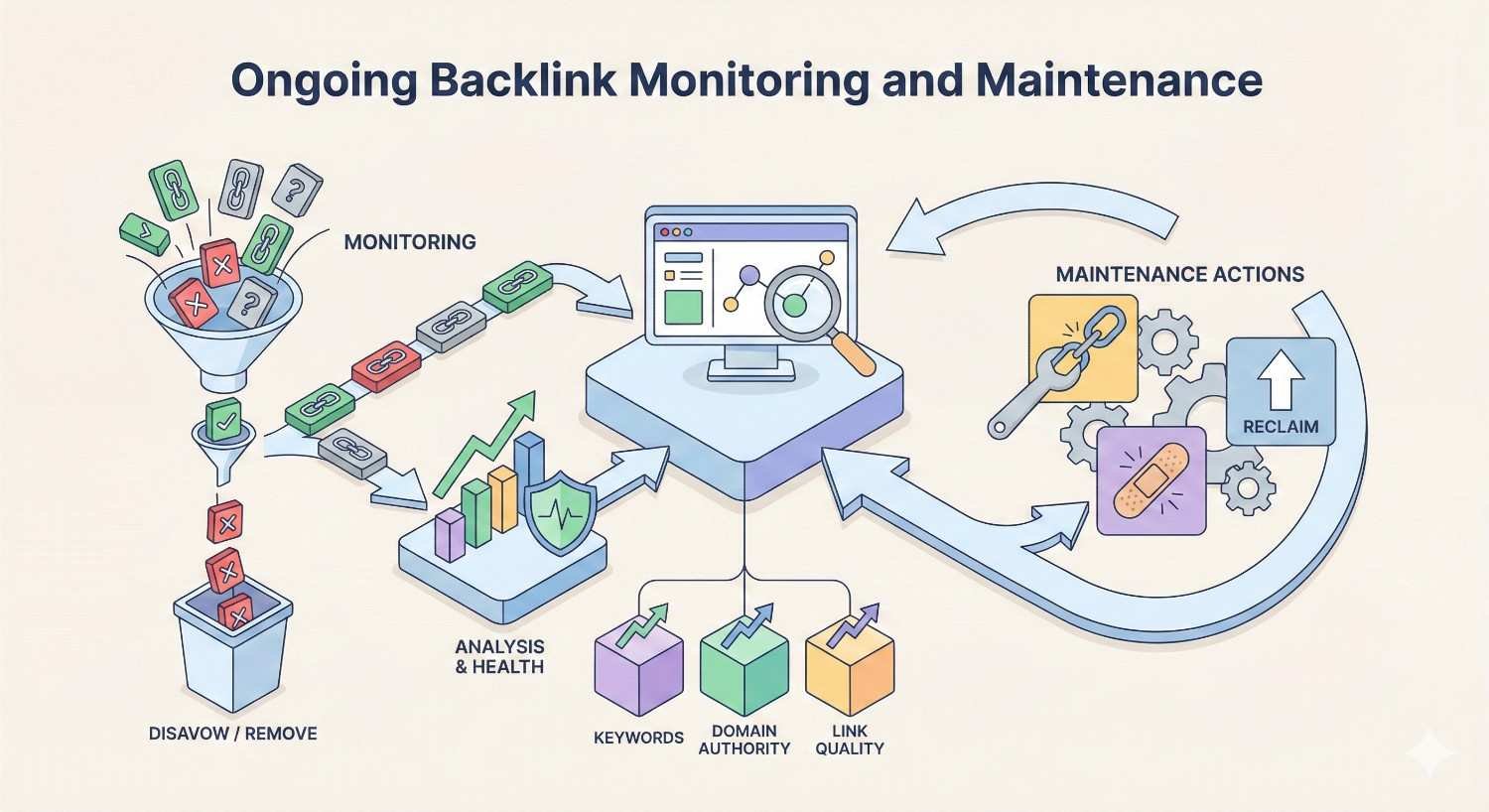
Backlink audits shouldn’t be one-time events. Continuous monitoring catches issues early.
Monitoring Frequency:
Monthly: Review new links acquired.
Quarterly: Comprehensive audit of full profile.
Immediately: After any ranking drops or manual action notifications.
Automated Alerts:
Set up alerts in backlink tools for new links from low-quality domains.
Monitor for sudden link velocity changes.
Track anchor text distribution shifts.
Negative SEO Monitoring:
Competitors may attempt to harm your rankings through spam link attacks.
Watch for sudden influxes of low-quality links.
Document patterns that suggest intentional attacks.
Disavow obvious spam promptly.
Building a White Hat Link Building Strategy for Your Business
Effective link building requires strategic planning, resource allocation, and consistent execution.
Setting Realistic Link Building Goals and KPIs
Link building goals should align with broader business objectives and realistic timelines.
Quantity Goals:
Set monthly or quarterly targets for new referring domains.
Focus on quality thresholds rather than raw numbers.
Benchmark against competitor link acquisition rates.
Quality Goals:
Define minimum domain authority or trust metrics for target sites.
Establish relevance criteria for acceptable link sources.
Set targets for links from specific publication tiers.
Outcome Goals:
Connect link building to ranking improvements for target keywords.
Track organic traffic growth attributable to authority building.
Measure referral traffic from acquired links.
Realistic Expectations:
New sites: 5-15 quality links per month with dedicated effort.
Established sites: 10-30 quality links per month with full programs.
Enterprise: 50+ quality links per month with significant resources.
Resource Allocation: Team, Budget, and Timeline
Link building requires sustained investment across multiple resource categories.
Team Requirements:
Content creators for link-worthy assets.
Outreach specialists for prospecting and relationship building.
Analysts for tracking and optimization.
Strategists for campaign planning and direction.
Budget Considerations:
Content production: $500-5,000+ per asset depending on complexity.
Tools: $200-1,000+ monthly for comprehensive toolsets.
Outreach: Time investment or agency fees.
Digital PR: $2,000-10,000+ monthly for agency support.
Timeline Planning:
Month 1-2: Strategy development and content creation.
Month 3-4: Initial outreach and relationship building.
Month 5-6: First meaningful link acquisition.
Month 7-12: Scaling successful tactics and measuring impact.
Content Assets That Attract Natural Links
Certain content types consistently earn links more effectively than others.
Original Research:
Surveys, studies, and data analysis provide citable sources.
Industry benchmarks and trend reports attract ongoing citations.
Proprietary data analysis offers unique value.
Comprehensive Guides:
Definitive resources on specific topics become reference materials.
Ultimate guides covering topics exhaustively earn educational links.
How-to content solving specific problems attracts practical links.
Tools and Calculators:
Interactive tools providing utility earn links from users sharing resources.
Calculators, generators, and analyzers create ongoing link opportunities.
Free tools in your industry niche attract relevant links.
Visual Content:
Infographics presenting data visually get embedded across sites.
Original images and diagrams earn attribution links.
Video content can generate links when offering unique value.
Newsworthy Content:
Industry commentary on current events attracts journalist attention.
Contrarian perspectives generate discussion and links.
Expert predictions and analysis earn coverage.
Outreach Strategy and Relationship Building
Effective outreach balances personalization with efficiency.
Prospecting:
Identify sites linking to competitor content.
Find journalists covering your industry.
Locate resource pages in your niche.
Build lists of relevant bloggers and publications.
Personalization:
Reference specific content on the target site.
Explain genuine relevance to their audience.
Offer clear value rather than just asking for links.
Avoid templated mass outreach.
Relationship Development:
Engage with targets on social media before pitching.
Comment thoughtfully on their content.
Share their work with your audience.
Build genuine connections over time.
Follow-Up:
Send polite follow-ups after 5-7 days.
Limit to 2-3 follow-ups maximum.
Accept non-responses gracefully.
Maintain relationships regardless of immediate link outcomes.
Measuring Link Building ROI and Performance
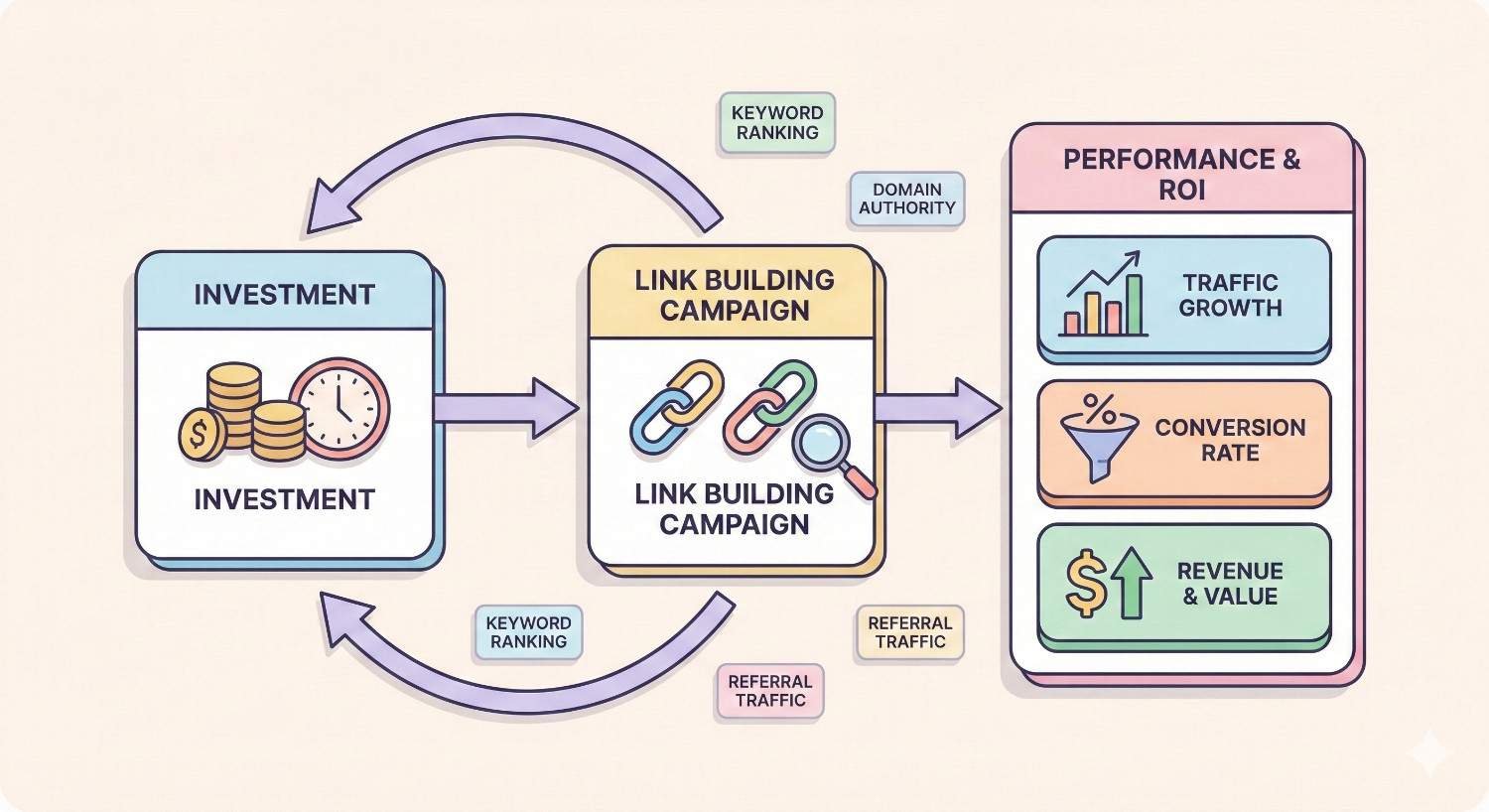
Track metrics that connect link building efforts to business outcomes.
Activity Metrics:
Outreach emails sent.
Response rates.
Links acquired.
Content pieces created.
Quality Metrics:
Average domain authority of acquired links.
Relevance scores of linking sites.
Anchor text distribution.
Link placement quality.
Outcome Metrics:
Ranking improvements for target keywords.
Organic traffic growth.
Referral traffic from links.
Conversions from link-driven traffic.
ROI Calculation:
Total link building investment (content, tools, time, agency fees).
Value of organic traffic increase (based on equivalent PPC costs).
Direct revenue from improved rankings.
Brand value from authority building.
When to Partner with an SEO Agency for Link Building
Agency partnerships make sense in specific situations.
Consider an Agency When:
Internal resources are insufficient for consistent execution.
Specialized expertise is needed for competitive industries.
Scale requirements exceed internal capacity.
Recovery from penalties requires experienced guidance.
Agency Evaluation Criteria:
Transparent methods aligned with guidelines.
Case studies demonstrating sustainable results.
Clear reporting on activities and outcomes.
No guarantees of specific link quantities or rankings.
Willingness to explain their approach in detail.
Red Flags:
Promises of guaranteed rankings or link quantities.
Unwillingness to disclose link sources.
Prices that seem too good to be true.
Focus on quantity over quality.
Lack of content strategy integration.
How Google Detects and Penalizes Unethical Link Building
Understanding detection methods helps appreciate why manipulation fails long-term.
Machine Learning and Link Pattern Recognition
Google’s algorithms use machine learning to identify manipulation patterns at scale.
Pattern Detection:
Unnatural anchor text distributions.
Link velocity anomalies.
Network patterns connecting related sites.
Content quality signals on linking pages.
User engagement metrics suggesting artificial traffic.
Continuous Learning:
Algorithms improve continuously based on new data.
Patterns that work today may be detected tomorrow.
Machine learning identifies new manipulation techniques automatically.
Scale Advantage:
Google processes billions of pages and links.
Patterns invisible at small scale become obvious at web scale.
Statistical anomalies stand out against natural baselines.
Manual Review Process and Spam Reports
Human reviewers supplement algorithmic detection.
Manual Review Triggers:
Algorithmic flags suggesting manipulation.
Competitor spam reports.
Unusual ranking movements.
Known association with spam networks.
Review Process:
Quality raters evaluate sites against published guidelines.
Reviewers assess link profiles for manipulation signals.
Manual actions are applied when violations are confirmed.
Spam Reports:
Anyone can report suspected spam through Google’s reporting tools.
Competitors frequently report each other’s violations.
Reports don’t guarantee action but contribute to detection.
Link Velocity and Anchor Text Analysis
Two signals provide strong manipulation indicators.
Link Velocity:
Natural link acquisition follows predictable patterns.
Sudden spikes suggest artificial acquisition.
Sustained unnatural velocity indicates ongoing manipulation.
New sites acquiring links faster than established competitors raise flags.
Anchor Text Analysis:
Natural anchor text is diverse and often branded or generic.
Over-optimized anchor text with exact-match keywords signals manipulation.
Anchor text distribution should match natural patterns for your industry.
Sudden shifts in anchor text patterns suggest intentional optimization.
Future of Link Building and Algorithm Evolution
Link building will continue evolving alongside search technology.
Emerging Trends:
Increased emphasis on entity relationships over raw link counts.
Better understanding of content quality and expertise signals.
Integration of user engagement data in authority assessment.
AI-generated content detection affecting link source quality.
Adaptation Requirements:
Focus on genuine authority building rather than link metrics.
Invest in brand building that generates natural mentions and links.
Create content that demonstrates genuine expertise.
Build relationships that transcend transactional link exchanges.
Long-Term Outlook:
Links will remain important but increasingly as one signal among many.
Quality and relevance will matter more than quantity.
Manipulation will become progressively harder as detection improves.
Genuine authority building will provide sustainable competitive advantage.
Case Studies: White Hat vs Black Hat Link Building Outcomes
Real-world examples illustrate the practical consequences of different approaches.
Case Study: Business Recovery After Penguin Penalty
Situation:
A mid-sized e-commerce company experienced a 70% traffic drop following a Penguin algorithm update. Previous SEO vendors had built links through PBNs and paid placements.
Discovery:
Backlink audit revealed over 2,000 links from obvious PBN sites.
Anchor text analysis showed 85% exact-match commercial keywords.
Link velocity showed unnatural spikes corresponding to vendor campaigns.
Recovery Process:
Comprehensive audit identified all problematic links.
Outreach to webmasters resulted in 15% link removals.
Disavow file submitted covering remaining toxic links.
New content strategy focused on earning legitimate links.
Timeline:
Month 1-2: Audit and cleanup.
Month 3-6: Disavow processing and new content creation.
Month 7-12: Gradual traffic recovery.
Month 13-18: Return to pre-penalty traffic levels.
Lessons:
Recovery required 18 months and significant investment.
Total cost exceeded what legitimate link building would have required initially.
Brand reputation suffered during the recovery period.
Case Study: Long-Term Growth Through Content-Driven Link Building
Situation:
A B2B software company committed to white hat link building after launching with minimal domain authority.
Strategy:
Created comprehensive industry guides addressing common customer questions.
Published original research based on anonymized customer data.
Developed free tools solving specific problems for their target audience.
Built relationships with industry journalists and bloggers.
Results Over 24 Months:
Referring domains grew from 50 to 850.
Organic traffic increased 400%.
Target keyword rankings improved from page 3+ to page 1 positions.
Referral traffic from links generated 15% of total conversions.
Key Success Factors:
Patience during the initial 6-month period with minimal visible results.
Consistent investment in content quality.
Relationship building that created ongoing opportunities.
Focus on relevance over raw link metrics.
Case Study: The True Cost of PBN Links
Situation:
A local service business purchased PBN links promising quick ranking improvements.
Initial Results:
Rankings improved within 6 weeks.
Organic traffic increased 150%.
Lead generation doubled.
Penalty Impact:
Manual action notification received after 4 months.
Rankings dropped to page 5+ for all target keywords.
Organic traffic fell 90% from peak.
Lead generation returned to pre-campaign levels.
Recovery Costs:
Professional audit and cleanup: $5,000.
Disavow file preparation and submission.
New content creation: $15,000 over 12 months.
Lost revenue during recovery: Estimated $50,000+.
Total Impact:
Initial PBN investment: $2,000.
Total cost including recovery and lost revenue: $70,000+.
Time to return to pre-penalty performance: 14 months.
Frequently Asked Questions About Link Building Ethics
Is buying links ever acceptable?
Buying links that pass PageRank without disclosure violates Google’s guidelines. However, paid placements with proper rel=”sponsored” or rel=”nofollow” attributes are acceptable. The key distinction is transparency: disclosed paid links don’t attempt to manipulate rankings.
How long does white hat link building take to show results?
White hat link building typically shows meaningful results in 6-12 months. Initial link acquisition takes 3-6 months of consistent effort. Ranking improvements from those links appear 3-6 months later as search engines discover and credit the new authority signals.
Can I recover from a Google penalty?
Yes, recovery is possible but requires systematic effort. Manual action recovery involves auditing your backlink profile, removing or disavowing problematic links, and submitting a reconsideration request. Algorithmic recovery requires similar cleanup plus patience as algorithms reassess your site. Recovery timelines range from 6-18 months.
Are all paid links considered black hat?
No. Paid links become problematic only when they attempt to pass PageRank without disclosure. Sponsored content, advertisements, and paid placements are acceptable when properly attributed with rel=”sponsored” or rel=”nofollow” attributes. The violation is deception, not payment.
What’s the difference between earned and built links?
Earned links come naturally when others discover and link to your content without outreach. Built links result from proactive efforts like outreach, guest posting, or digital PR. Both can be white hat when they provide genuine value and follow guidelines.
How many links do I need to rank?
Link quantity requirements vary dramatically by keyword competitiveness, industry, and current authority. Focus on quality over quantity. A single link from a highly authoritative, relevant source can outweigh dozens of low-quality links. Analyze competitor backlink profiles for realistic benchmarks.
What link building metrics should I track?
Track both activity and outcome metrics. Activity metrics include outreach volume, response rates, and links acquired. Quality metrics include domain authority, relevance, and anchor text distribution. Outcome metrics connect link building to rankings, traffic, and conversions.
Conclusion
Link building ethics fundamentally determine whether your SEO investment builds lasting value or creates future liabilities. White hat techniques require patience and resources but deliver sustainable authority that compounds over time. Black hat shortcuts may produce temporary gains but carry penalty risks that can devastate businesses.
The choice between approaches reflects broader business values. Companies committed to long-term brand building choose ethical methods that align with how search engines intend links to function. Those seeking quick wins often discover that shortcuts create problems far exceeding any temporary benefits.
We help businesses build sustainable organic growth through ethical link building strategies that deliver lasting results. Contact White Label SEO Service to develop a compliant link building program that builds genuine authority and protects your brand’s future.