
Link building ranking factors are the specific signals Google evaluates when deciding how much authority, relevance, and trust each backlink should transfer to a target page. Not every link counts equally, and many links count for nothing at all. Understanding how Google interprets backlinks separates campaigns that deliver compounding organic growth from campaigns that waste budget on links that never move the needle.
The stakes have never been higher. Google now processes link signals through machine-learning systems like SpamBrain, and the gap between high-impact and ignored links keeps widening every algorithm update cycle.
This guide covers authority signals, topical relevance, anchor text, link quality, placement, diversity, attributes, velocity, spam patterns, editorial trust, and the evaluation framework that ties every factor together.
What Link Building Ranking Factors Actually Are
Link building ranking factors are the measurable characteristics Google uses to score each backlink in a website’s profile. These factors determine whether a link strengthens rankings, has no effect, or actively damages search performance. According to Google’s own Search Quality documentation, links intended to manipulate rankings are classified as link spam and violate webmaster guidelines.
Modern link evaluation is multi-dimensional. A single backlink is assessed against the linking domain’s authority, the topical alignment between source and target, the anchor text used, the placement on the page, the surrounding content, and dozens of other contextual signals processed in real time.
The factors below are organized by weight and impact, beginning with the signals that carry the heaviest influence on ranking outcomes.

Link Authority and PageRank Signals
Authority remains the foundational link signal. Despite Google retiring the public PageRank toolbar in 2016, the underlying PageRank algorithm still operates inside the ranking system, distributing equity from one page to another every time a link is followed.
Authority is measured through several indicators:
- Referring domain strength — links from established, indexed, trafficked domains pass more equity than links from new or thin sites
- Page-level authority — the linking page’s own backlink profile influences how much value its outbound links can transfer
- Trust attribution — sites with strong editorial reputation pass trust as well as authority
Third-party metrics like Domain Authority (Moz), Domain Rating (Ahrefs), and Authority Score (Semrush) approximate this concept but should never be treated as Google’s actual scoring. They are useful directional benchmarks, not definitive measurements.
Domain Authority remains the most discussed metric for measuring link strength, but its calculation, limitations, and relationship to actual PageRank are widely misunderstood — our complete domain authority guide walks through every input, scoring threshold, and benchmark you need to evaluate referring domain strength accurately.
Link Relevance and Topical Alignment
Relevance has become as important as authority — and in some niches, more important. Google’s link evaluation now heavily weights whether the linking domain, the linking page, and the surrounding content match the topic of the target page.
A link from a mid-authority site within your exact niche typically outperforms a link from a higher-authority generalist publication. This shift accelerated after Google’s link spam updates throughout 2021–2024, which specifically targeted irrelevant link patterns built purely for authority transfer.
Relevance operates at three levels:
- Domain-level relevance — is the linking site broadly in your subject area
- Page-level relevance — does the specific linking page discuss your topic
- Paragraph-level relevance — does the immediate context around the link match the linked content
The strongest links satisfy all three layers simultaneously. Topical relevance has overtaken raw authority as Google’s preferred signal in many niches, which is why understanding how to build coverage depth across a subject domain matters more than chasing high-DA links — our deep dive on topical authority in SEO explains how content clusters, entity coverage, and link sources combine to signal subject mastery.
Anchor Text Composition and Distribution
Anchor text is the clickable text inside a hyperlink, and it tells Google what the destination page is about. It is one of the most powerful link signals — and one of the easiest to over-optimize into a penalty.
The 2012 Penguin algorithm specifically targeted unnatural anchor text patterns, and every subsequent link update has refined this detection. Modern link evaluation expects a healthy anchor distribution that mirrors how real people link naturally.
A natural profile typically follows ratios roughly aligned with this pattern:
- Branded anchors (company or domain name): 40–55%
- Naked URL anchors: 10–15%
- Generic anchors (click here, read more, this page): 10–15%
- Partial-match keyword anchors: 10–15%
- Exact-match keyword anchors: 1–5%
Sites that aggressively use exact-match commercial anchors trigger algorithmic suppression long before any manual review occurs. Anchor text distribution is one of the few link factors that can trigger an algorithmic penalty when handled poorly, so following a tested ratio model matters more than chasing exact-match anchors — our anchor text optimization framework breaks down healthy ratios, safe variation patterns, and Penguin recovery scenarios.
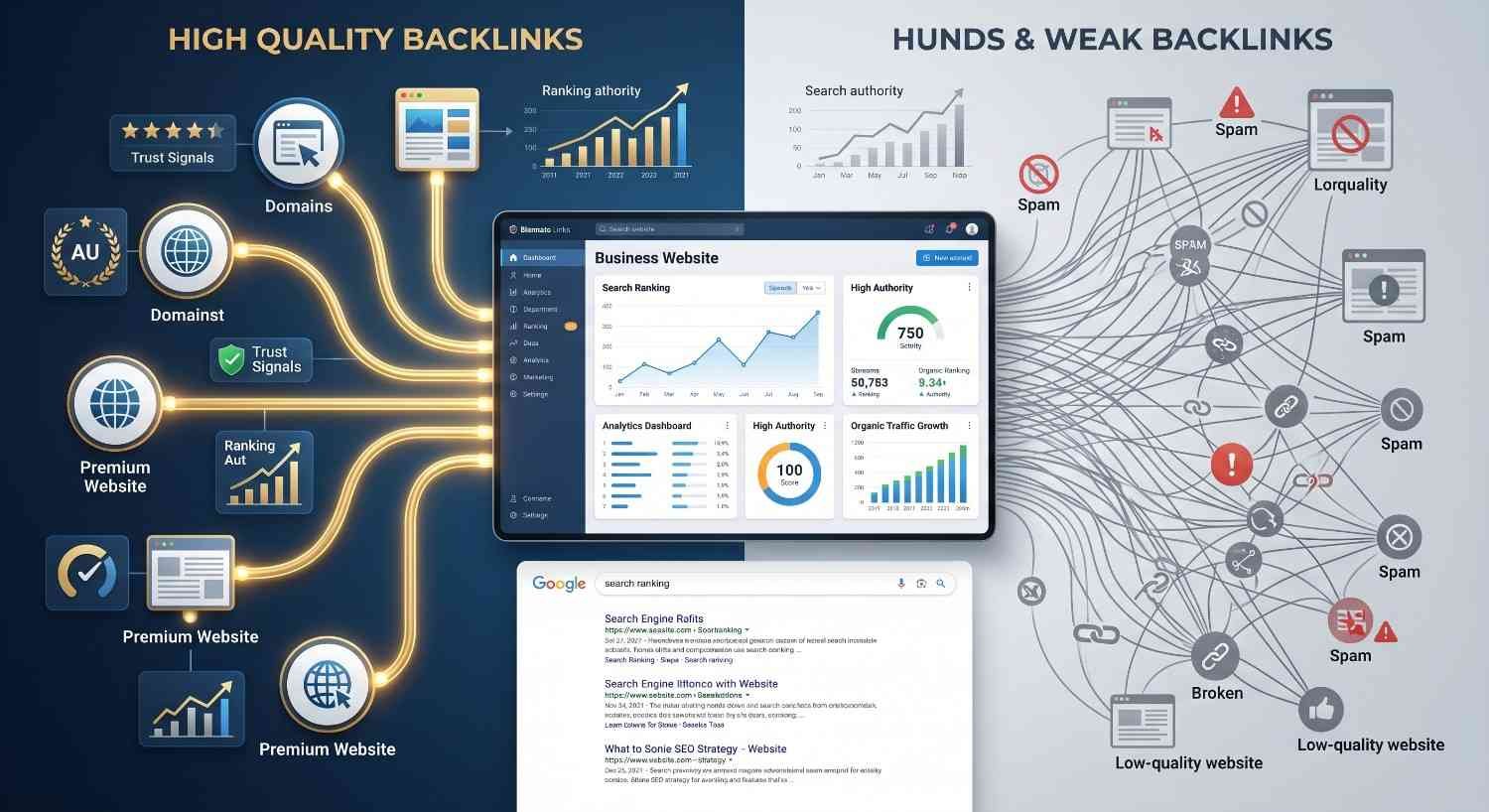
Link Quality vs. Link Quantity
The “more links equals better rankings” model died over a decade ago. Modern ranking systems exhibit clear diminishing returns on link volume and heavy weighting on link quality.
A single editorial link from a respected industry publication can outperform fifty links from low-authority directories, scraped aggregators, or comment sections. According to Ahrefs’ study of over one billion pages, the correlation between referring domain count and rankings is strong but heavily moderated by domain quality.
High-quality links share consistent traits:
- Placed editorially within relevant content
- Surrounded by topically aligned text
- From domains with real organic traffic
- Acquired without payment or reciprocity manipulation
- Stable and indexed over time
Evaluating a single link’s true value requires a repeatable scoring process rather than a gut check, especially when reviewing dozens of opportunities at once — our backlink quality checklist covers all 14 evaluation criteria, from referring domain trust to outbound link profile health.
Link Placement and Editorial Context
Where a link sits on a page directly affects how much value it transfers. This is sometimes called “Reasonable Surfer” weighting — a concept Google patented years ago that models the probability of a real user clicking each link on a page.
Placement priority generally follows this hierarchy:
- In-content body links — highest weight, especially within the first half of an article
- Author bio links — moderate weight when context is relevant
- Sidebar links — reduced weight, often site-wide and discounted
- Footer links — heavily discounted, especially when repeated across the site
- Comment section links — minimal weight, often nofollowed by default
Editorial context also matters. A link inside a sentence that genuinely discusses the destination topic transfers more meaning than the same anchor placed in unrelated content. Where a link sits on a page changes how much equity it actually passes, with in-content placements outperforming sidebar and footer links by a wide margin — our contextual link building strategy explains how to secure editorially embedded links inside relevant articles rather than peripheral page positions.
Link Diversity Factors
A natural backlink profile contains variety. Sites that accumulate links from many similar sources, with similar anchors, at similar velocity, look engineered to detection systems even when each link looks acceptable in isolation.
Diversity operates across several dimensions:
- Referring domain diversity — links from many unique domains, not just many pages on the same domain
- Source type diversity — editorial articles, news mentions, resource pages, podcasts, partnerships
- Anchor text diversity — varied phrasing rather than repeated formulas
- IP and C-Block diversity — links from servers across different networks
- Geographic diversity — relevant when targeting international or local markets
A backlink profile built from one source type or one anchor pattern looks unnatural to modern detection systems, even when each individual link is high quality — our link diversity guide breaks down how to balance referring domain types, anchor formats, and traffic sources so the profile reads as organic.
Link Attributes — Dofollow, Nofollow, Sponsored, UGC
Google now recognizes four primary link attributes, each signaling something different about the link’s nature and trust.
- Dofollow (no attribute) — the default; passes full ranking value
- rel=”nofollow” — originally created in 2005 to combat comment spam; now treated as a hint rather than a directive
- rel=”sponsored” — introduced in 2019 to mark paid or affiliate links
- rel=”ugc” — user-generated content links, such as forum or comment links
Since Google’s 2019 update, nofollow, sponsored, and UGC links may still influence rankings as soft signals — Google decides case by case whether to count them. This changed the strategic value of nofollow placements from “zero” to “meaningful but variable.”
The introduction of rel=”sponsored” and rel=”ugc” changed how Google interprets and weights different link attributes, and treating nofollow links as worthless misreads current ranking behaviour — our dofollow vs nofollow links explained breakdown clarifies what each attribute now signals and how each contributes to a healthy profile.

Link Velocity and Natural Acquisition Patterns
Link velocity refers to the rate at which a site acquires new backlinks. Google’s systems model expected velocity based on a site’s age, traffic, content output, and existing profile. Acquisition patterns that deviate sharply from these expectations trigger scrutiny.
Common velocity red flags include:
- Sudden link spikes following long inactivity
- Mass acquisition over short windows with identical anchor patterns
- Sharp velocity drops immediately after campaign budgets end
- Reciprocal acceleration with linked partners
Natural velocity isn’t slow — it’s proportional. A site launching a viral campaign, earning press coverage, or releasing a major resource can legitimately acquire hundreds of links quickly when the trigger event matches the pattern. Acquiring links too quickly — or too slowly after a campaign ends — creates pattern signals that SpamBrain can flag as manipulative, which is why pacing matters as much as link selection — our guide on link velocity in SEO explains safe acquisition curves, recovery patterns, and how to model velocity around campaign cycles.
Spam Signals and Toxic Link Patterns
Google’s SpamBrain — the AI-based spam detection system introduced in 2018 and significantly expanded in 2022 — now identifies link spam in real time and neutralizes its impact algorithmically. According to Google’s December 2022 link spam update announcement, SpamBrain detects both sites that buy and sites that exist to pass link value.
Toxic patterns Google actively identifies include:
- Private Blog Networks (PBNs) — domains repurposed to link to client sites
- Link farms — sites that exist purely to link out
- Paid link networks — undisclosed paid placement schemes
- Excessive footer or site-wide links — disproportionate to editorial value
- Comment and forum spam — automated low-value placement
- Tier-2 link manipulation — links built to existing links to boost their authority
When toxic links exceed the natural noise threshold, ranking suppression follows. The good news: most modern toxic links are simply discounted rather than penalized. Identifying which backlinks are genuinely harmful versus merely low quality requires a structured audit workflow, since over-disavowing can hurt rankings more than the toxic links themselves — our toxic backlink audit process walks through detection criteria, disavow file construction, and Google’s current treatment of disavowed links. The full timeline of every major link spam update is covered in our Google link spam updates timeline <!–NEW PAGE NEEDED–>, which traces how detection has evolved from Penguin through SpamBrain.

E-E-A-T and Editorial Trust Signals
E-E-A-T — Experience, Expertise, Authoritativeness, and Trustworthiness — describes how Google’s Quality Rater Guidelines evaluate content sources. While E-E-A-T is not a direct ranking factor itself, it shapes which sites are perceived as authoritative — and therefore which sites pass meaningful link equity.
A link from a publication with named authors, real expertise credentials, transparent editorial standards, and a strong reputation transfers significantly more trust than a link from an anonymous blog with similar third-party metrics.
Source-side trust signals Google evaluates include:
- Named, credentialed authors with topical expertise
- Citation and source standards within the linking content
- Editorial review processes
- Domain history and content consistency
- Real organic traffic and user engagement signals
The site publishing a link carries trust signals that flow through the link itself, which is why a link from a publication with strong editorial standards outperforms a link from an anonymous blog with similar metrics — our breakdown of E-E-A-T signals for SEO maps every trust factor Google evaluates at the source. The distinction between earning links from credible publishers versus paying for placement is explored further in our editorial backlinks vs paid links <!–NEW PAGE NEEDED–> comparison guide.
How to Evaluate a Backlink Opportunity
Every ranking factor above flows into a single practical question: is this specific link worth pursuing? A repeatable evaluation framework prevents both wasted effort and exposure to harmful links.
A complete evaluation reviews:
- Domain authority and organic traffic — does the site rank for real keywords and attract real visitors
- Topical relevance — does the site cover topics directly aligned with yours
- Outbound link profile — does the site link primarily to credible destinations
- Editorial standards — does it have named authors and visible quality control
- Placement quality — will your link sit in-content, surrounded by relevant text
- Anchor text flexibility — does the site allow natural, descriptive anchors
- Velocity context — does this link fit your current acquisition pattern
- Indexability — is the page indexed and crawlable
If a link fails three or more of these checks, the opportunity carries more risk than reward. Concepts like disavow workflows and removal requests become relevant only when toxic links accumulate — see our forthcoming disavow tool guide <!–NEW PAGE NEEDED–> for the complete remediation workflow.
For businesses without the time or in-house team to apply this evaluation at scale, working with a specialist team is often the faster path. For teams that need to scale link acquisition without building an in-house outreach engine, partnering with a specialist offers a faster path to measurable authority growth — our managed link building services apply this exact evaluation framework to every link we build, with reporting transparency at every stage.
Conclusion
Modern link building rewards precision, not volume. The signals Google evaluates — authority, relevance, anchor health, placement, diversity, attributes, velocity, and editorial trust — combine into a single judgment about whether each link deserves equity.
Mastering these factors transforms link building from a numbers game into a strategic discipline that compounds organic growth quarter after quarter across every ranking opportunity available.
We help businesses build authority the right way. Partner with White Label SEO Service to acquire links that move rankings, earn trust, and protect your search visibility long-term.
Frequently Asked Questions
Are backlinks still important for SEO in 2026?
Yes. Backlinks remain among Google’s top ranking signals, though their evaluation has become far more sophisticated. Quality, relevance, and editorial context now determine impact far more than raw quantity.
What makes a backlink high quality?
A high-quality backlink comes from a topically relevant, authoritative site with real traffic, sits inside editorial content, uses natural anchor text, and is acquired without manipulation. All five conditions must align.
Does Google still use PageRank?
Yes, internally. Google retired the public PageRank toolbar in 2016, but the underlying algorithm still operates inside the ranking system and continues to distribute link equity through followed links across the web.
How many backlinks do I need to rank on Google?
There is no fixed number. Ranking requirements depend on keyword competitiveness, your existing authority, and competitor profiles. Many pages rank in low-competition niches with under twenty referring domains.
Are nofollow links worth pursuing?
Yes. Since 2019, Google treats nofollow as a hint rather than a directive and may still count nofollow links as ranking signals. They also drive referral traffic, brand visibility, and natural profile diversity.
How does Google detect link spam?
Google uses SpamBrain, an AI-based detection system, to identify unnatural patterns including PBNs, paid networks, anchor manipulation, and velocity anomalies. Detected spam links are typically neutralized algorithmically rather than penalized manually.
Should I disavow low-quality backlinks?
Usually no. Google now ignores most low-quality links automatically. Disavow only when you have clear evidence of manual action risk or known paid link schemes. Over-disavowing healthy links often damages rankings.