
Every dollar you spend on link building should generate measurable returns—yet most businesses have no idea whether their backlink investments are profitable. A link building ROI calculator transforms guesswork into data-driven decisions, revealing exactly how much revenue your link acquisition efforts produce.
Understanding your link building return on investment matters more than ever as budgets tighten and stakeholders demand accountability. Without clear ROI tracking, you risk overspending on ineffective tactics or underinvesting in strategies that could accelerate growth.
This guide walks you through everything you need to calculate, track, and optimize your link building ROI—from the core formula to industry benchmarks, cost factors, and the highest-performing strategies for sustainable organic growth.
What Is Link Building ROI?
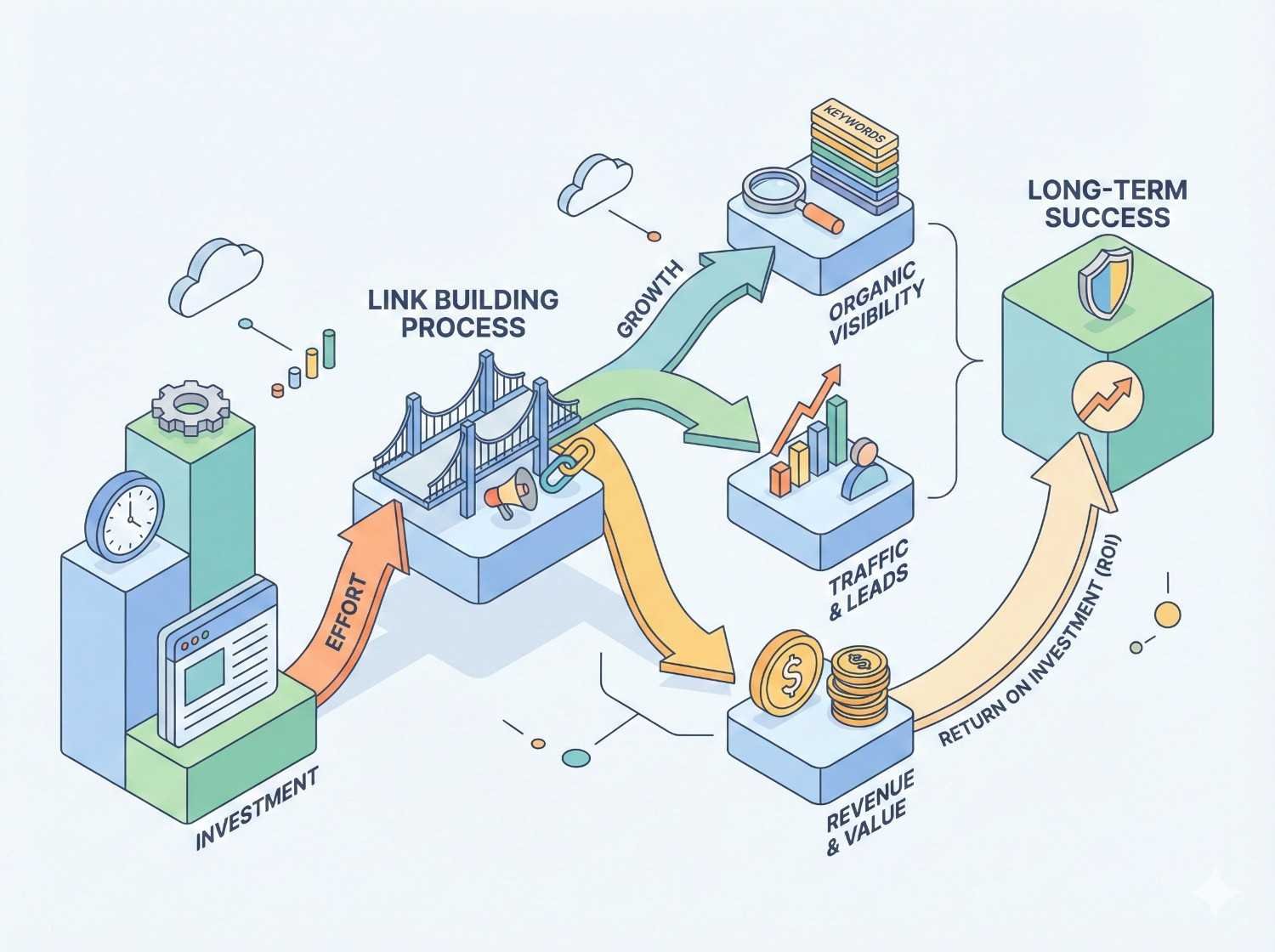
Link building ROI measures the financial return generated from your backlink acquisition investments compared to the total costs involved. It quantifies whether your link building campaigns produce positive business outcomes or drain resources without adequate returns.
This metric connects SEO activities directly to revenue, helping marketing managers and business owners justify budgets, allocate resources effectively, and identify which link building tactics deliver the strongest performance.
Understanding Return on Investment in Link Acquisition
Return on investment in link acquisition calculates the net profit generated from backlinks divided by the total investment required to obtain them. The fundamental concept mirrors standard ROI calculations but applies specifically to SEO link building activities.
Link acquisition costs include everything from content creation and outreach labor to agency fees and tool subscriptions. The returns encompass increased organic traffic value, improved rankings, referral traffic, and ultimately, revenue attributed to those backlinks.
Unlike paid advertising where results appear immediately, link building ROI unfolds over months. A single high-quality backlink can continue driving value for years, making accurate measurement both challenging and essential for long-term planning.
Why Measuring Link Building ROI Matters for Business Growth
Measuring link building ROI transforms SEO from a cost center into a documented profit driver. When you can demonstrate that every $1,000 invested in link building generates $3,000 in organic traffic value, budget conversations become significantly easier.
For startups and SMEs operating with limited resources, ROI measurement prevents wasted spending on ineffective tactics. It reveals which link building approaches deserve more investment and which should be abandoned.
ROI tracking also enables accurate forecasting. Once you understand your historical returns, you can project future growth and set realistic expectations for stakeholders. This data-driven approach builds confidence in SEO as a sustainable growth channel.
How to Calculate Link Building ROI
Calculating link building ROI requires gathering specific data points, applying a straightforward formula, and interpreting results within the context of your business model and timeline expectations.
The Link Building ROI Formula Explained
The basic link building ROI formula is:
ROI = ((Revenue from Link Building – Cost of Link Building) / Cost of Link Building) × 100
For example, if you spent $5,000 on link building over six months and generated $15,000 in attributable revenue, your calculation would be:
ROI = (($15,000 – $5,000) / $5,000) × 100 = 200% ROI
This means you earned $2 for every $1 invested. However, the challenge lies in accurately determining both the costs and the revenue attribution—which requires tracking multiple metrics over time.
Some businesses prefer calculating ROI based on organic traffic value rather than direct revenue, especially when conversion tracking is complex. In this approach, you multiply organic traffic gains by the equivalent cost-per-click value from paid search.
Key Metrics You Need to Track
Accurate ROI calculation depends on tracking four essential metrics consistently.
Cost Per Link Acquired
Calculate your average cost per link by dividing total link building expenses by the number of links obtained. This includes labor costs, content creation, outreach tools, and any placement fees. Most businesses find their cost per link ranges from $100 to $1,500 depending on quality targets and acquisition methods.
Domain Authority/Rating Improvements
Track changes in your domain authority (Moz), domain rating (Ahrefs), or authority score (Semrush) over time. While these metrics don’t directly translate to revenue, they indicate growing site authority that correlates with ranking improvements.
Organic Traffic Value
Measure the monetary value of organic traffic by multiplying monthly organic visits by the average cost-per-click you would pay for equivalent paid traffic. If you receive 10,000 organic visits monthly for keywords averaging $2.50 CPC, your monthly organic traffic value is $25,000.
Revenue Attribution
Connect organic traffic to actual conversions and revenue using Google Analytics goals, CRM data, and attribution modeling. This requires tracking which pages receive backlinks, how those pages rank, and what percentage of visitors convert.
Step-by-Step ROI Calculation Process
Follow this process to calculate your link building ROI accurately:
Step 1: Establish Your Baseline Document your current organic traffic, keyword rankings, domain authority, and monthly organic revenue before starting any link building campaign.
Step 2: Track All Costs Create a spreadsheet logging every expense: staff time (hourly rate × hours), content costs, tool subscriptions, agency fees, and any direct link placement costs.
Step 3: Monitor Link Acquisition Record each backlink obtained, including the referring domain’s authority, the target page, anchor text, and acquisition date.
Step 4: Measure Traffic and Ranking Changes After 3-6 months, compare organic traffic and rankings to your baseline. Isolate pages that received backlinks to identify direct impact.
Step 5: Calculate Revenue Impact Determine how much additional revenue came from organic traffic increases. Use conversion rates and average order values to translate traffic gains into dollars.
Step 6: Apply the Formula Subtract total costs from total revenue gains, divide by costs, and multiply by 100 for your percentage ROI.
Link Building Cost Factors
Understanding the full scope of link building costs ensures your ROI calculations reflect reality rather than incomplete data.
In-House Link Building Costs
Building links internally involves significant labor costs that many businesses underestimate. A dedicated link builder typically spends 30-40 hours per week on prospecting, outreach, content coordination, and relationship management.
Calculate in-house costs by multiplying hourly rates (including benefits and overhead) by time spent. If your link builder earns $60,000 annually with 30% overhead, their fully loaded hourly cost is approximately $39. At 160 hours monthly dedicated to link building, that’s $6,240 in labor alone.
Add content creation costs if writers produce linkable assets. A single comprehensive guide might require 20-40 hours of research and writing, plus design time for graphics and formatting.
Agency Link Building Pricing Models
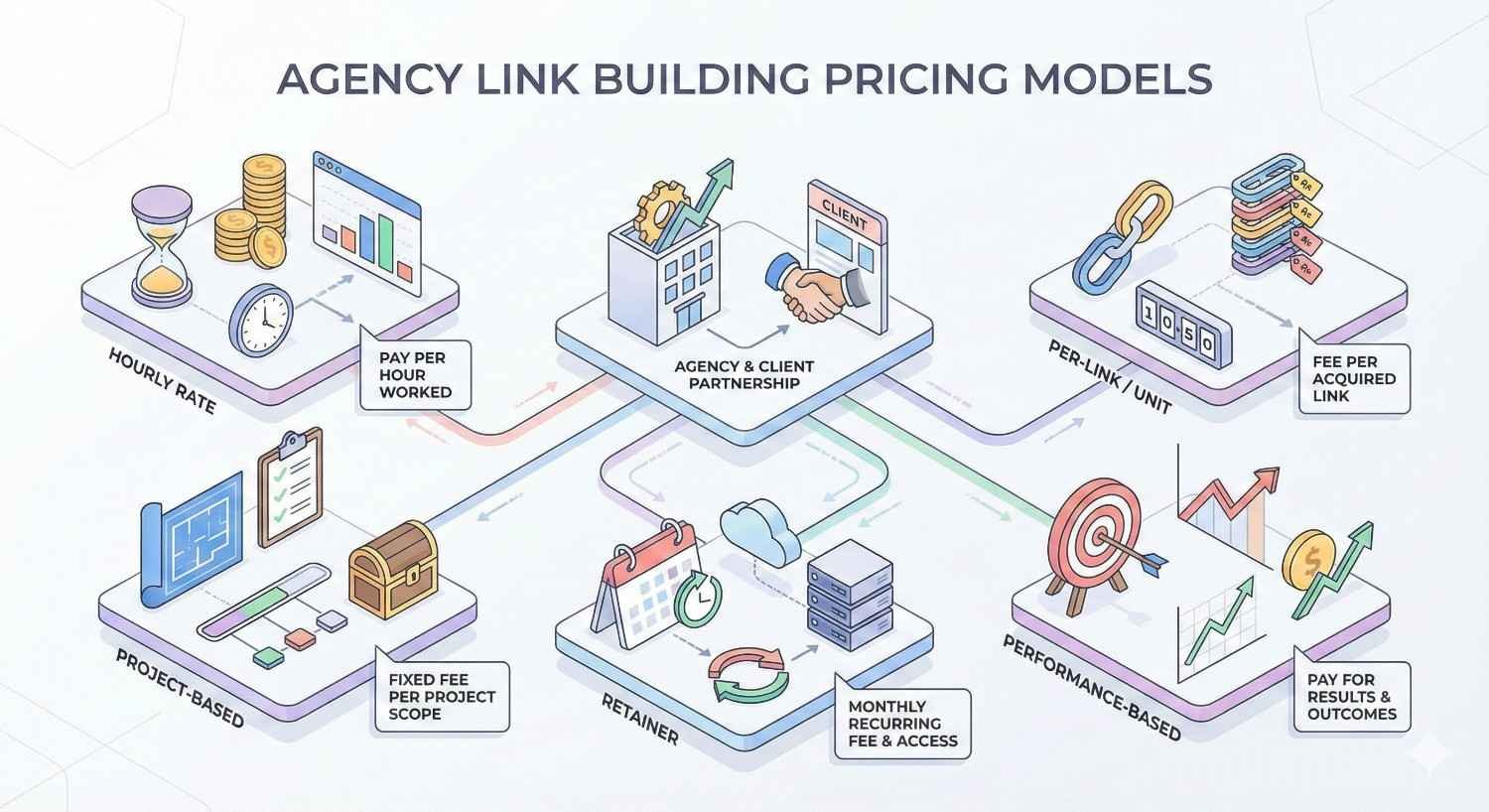
Link building agencies typically operate under three pricing structures:
Per-Link Pricing: Agencies charge $150-$1,500+ per link depending on target domain authority and niche difficulty. This model offers predictable costs but varies widely in quality.
Monthly Retainer: Retainers range from $2,000-$15,000+ monthly, covering a set number of links or hours of outreach work. This provides consistent effort but requires trust in the agency’s process.
Performance-Based: Some agencies charge based on results achieved—ranking improvements, traffic gains, or links from specific authority thresholds. This aligns incentives but can be more expensive for successful campaigns.
Tool and Software Expenses
Effective link building requires several tool categories:
SEO Platforms: Ahrefs, Semrush, or Moz subscriptions cost $99-$449+ monthly for features like backlink analysis, competitor research, and rank tracking.
Outreach Tools: Platforms like Pitchbox, BuzzStream, or Hunter.io range from $50-$500 monthly for contact finding and email management.
Content Tools: Writing assistants, grammar checkers, and design tools add $50-$200 monthly to your stack.
Budget $300-$1,000 monthly for a comprehensive tool stack supporting professional link building operations.
Hidden Costs to Include in Your Calculation
Several costs frequently escape ROI calculations:
Management Overhead: Time spent planning campaigns, reviewing reports, and coordinating teams adds up. Include manager hours in your cost calculations.
Failed Outreach: Not every campaign succeeds. Factor in the cost of outreach efforts that don’t result in links—typically 70-90% of initial contacts.
Content That Doesn’t Earn Links: Some linkable assets underperform. Spread these costs across successful campaigns for accurate per-link calculations.
Opportunity Cost: Resources dedicated to link building could be spent elsewhere. Consider what alternative investments might yield.
Measuring Link Building Value and Impact
Link building generates value through multiple channels, each requiring different measurement approaches.
Direct Traffic Value from Backlinks
Quality backlinks drive referral traffic directly from the linking site to yours. Track this in Google Analytics under Acquisition > Referrals to see which backlinks send visitors.
Calculate direct traffic value by analyzing referral visitor behavior. If backlink referrals convert at 2% with a $500 average order value, 100 referral visitors generate $1,000 in expected revenue.
High-authority sites in your niche often send the most valuable referral traffic—visitors already interested in your topic who arrive pre-qualified.
Ranking Improvements and Organic Traffic Gains
Backlinks remain one of Google’s strongest ranking signals. Quality links to specific pages typically improve those pages’ rankings within 2-6 months, driving increased organic traffic.
Measure this by tracking keyword positions for pages receiving backlinks. Compare traffic before and after link acquisition, accounting for seasonality and other variables.
The organic traffic value calculation multiplies new visitors by equivalent CPC costs. If a page gains 500 monthly visitors for keywords averaging $5 CPC, that’s $2,500 in monthly organic traffic value from improved rankings.
Lead Generation and Conversion Attribution
Connect link building to lead generation by tracking conversion paths. Use Google Analytics goals or your CRM to identify leads originating from organic search on pages that received backlinks.
Multi-touch attribution models help when customers interact with multiple channels before converting. First-touch attribution credits the initial organic visit, while linear models distribute credit across all touchpoints.
For B2B companies with longer sales cycles, track lead quality alongside quantity. Links driving high-intent traffic often produce better leads than those generating high-volume, low-quality visits.
Long-Term Compounding Value of Quality Links
Unlike paid advertising that stops working when you stop paying, quality backlinks continue generating value for years. A link from a high-authority site can drive traffic and ranking benefits for 5-10+ years.
This compounding effect means initial ROI calculations understate true returns. A link costing $500 that generates $200 annually in traffic value produces 40% annual returns—compounding over its lifetime.
Factor long-term value into strategic decisions. Investing more upfront for permanent, high-quality links often outperforms cheaper links that disappear or lose value quickly.
Link Building ROI Benchmarks by Industry
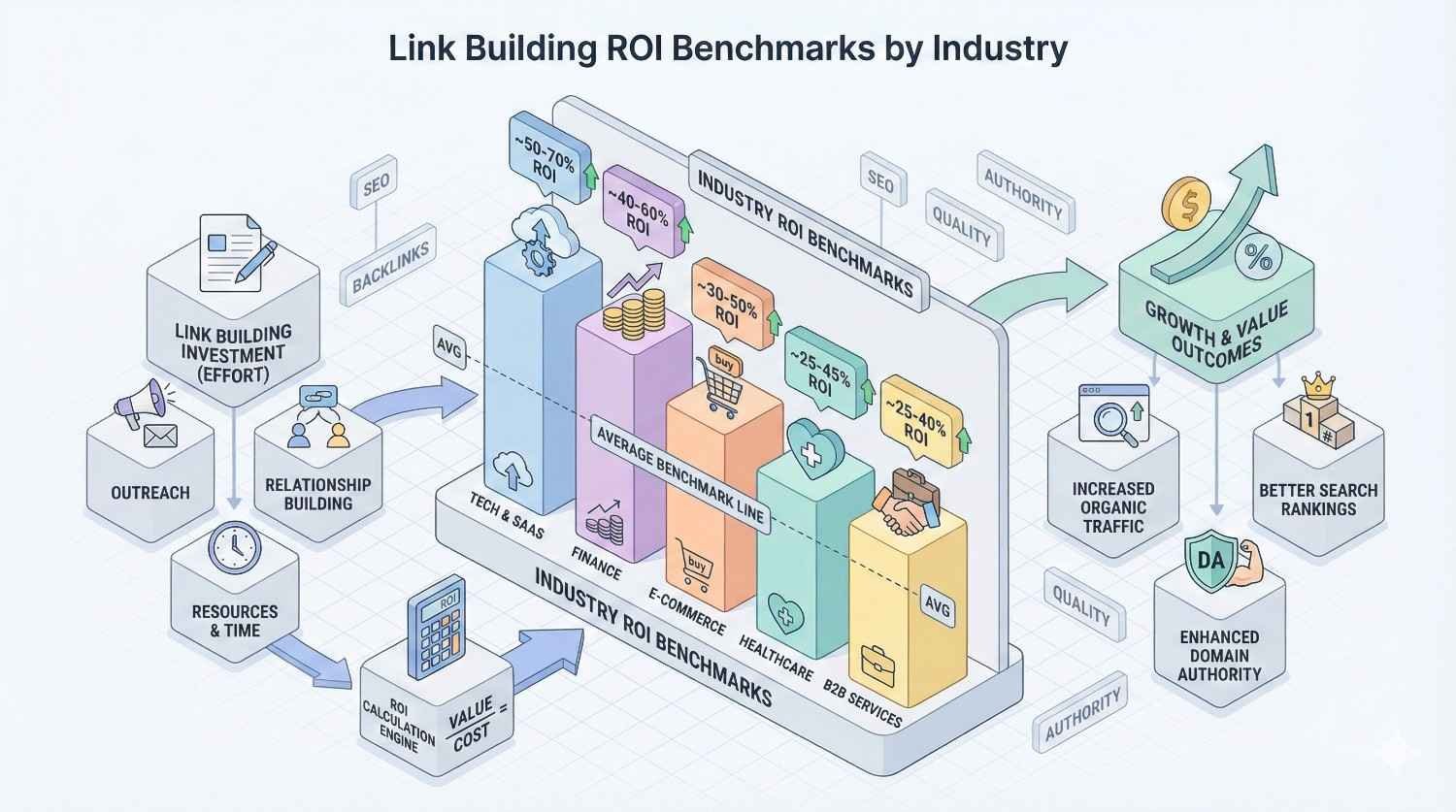
ROI expectations vary significantly across industries based on competition levels, keyword values, and conversion rates.
Average ROI Expectations by Sector
Different sectors experience different link building returns based on their organic search economics:
SaaS and Technology: High customer lifetime values and expensive keywords make link building particularly valuable. Expect 150-400% ROI over 12-18 months when targeting high-intent keywords.
E-commerce: Competitive product keywords require sustained link building. ROI typically ranges from 100-250% but depends heavily on margins and average order values.
Professional Services: Law firms, financial advisors, and consultants often see 200-500% ROI due to high client values and expensive PPC alternatives.
Local Businesses: Lower competition but also lower keyword volumes. ROI varies widely from 50-300% depending on market size and service values.
Healthcare: Strict content requirements and YMYL considerations demand higher-quality links. ROI ranges from 100-300% with longer timelines.
B2B vs B2C Link Building Returns
B2B link building typically produces higher ROI percentages but requires longer measurement windows. Enterprise sales cycles of 6-18 months mean link building value materializes slowly but substantially.
B2B advantages include higher customer lifetime values, less competition for niche keywords, and more opportunities for thought leadership content that naturally attracts links.
B2C link building often shows faster initial returns due to shorter purchase cycles. However, lower average order values and higher competition can compress ROI percentages despite strong traffic gains.
Startup vs Enterprise ROI Timelines
Startups building domain authority from scratch face longer ROI timelines—typically 9-18 months before significant returns materialize. However, the percentage gains can be dramatic as rankings improve from non-existent to competitive.
Established enterprises with existing authority see faster incremental gains. Each quality link builds on existing strength, producing measurable ranking improvements within 2-4 months.
Enterprise link building often focuses on maintaining competitive position rather than dramatic growth, which can make ROI calculations less impressive despite strategic importance.
How to Use a Link Building ROI Calculator
A link building ROI calculator simplifies complex calculations by automating the math once you input your specific data.
Input Variables Explained
Most ROI calculators require these inputs:
Total Link Building Investment: Sum of all costs including labor, tools, content, and agency fees over your measurement period.
Number of Links Acquired: Total backlinks obtained during the campaign, ideally segmented by quality tier.
Organic Traffic Increase: Additional monthly organic visitors attributed to link building efforts.
Average CPC Value: The cost you would pay for equivalent traffic through paid search.
Conversion Rate: Percentage of organic visitors who complete desired actions.
Average Conversion Value: Revenue or lead value generated per conversion.
Time Period: Months over which you’re measuring results.
Interpreting Your Results
Calculator outputs typically include:
Percentage ROI: Your return expressed as a percentage of investment. Positive percentages indicate profitable campaigns.
Cost Per Link: Average investment required for each backlink acquired.
Traffic Value Generated: Monthly organic traffic value based on CPC equivalents.
Break-Even Timeline: How long until cumulative returns exceed total investment.
Projected Annual Value: Estimated yearly returns if current performance continues.
Compare results against industry benchmarks and your own historical performance. A 150% ROI might be excellent for a competitive e-commerce niche but below expectations for a B2B SaaS company.
Adjusting Strategy Based on ROI Data
Use ROI data to optimize your link building approach:
Double Down on Winners: If certain link types or acquisition methods produce superior ROI, allocate more resources there.
Cut Underperformers: Tactics producing negative or marginal ROI should be reduced or eliminated.
Adjust Quality Targets: If high-authority links produce dramatically better ROI, shift budget toward fewer, better links rather than volume.
Refine Target Pages: Focus link building on pages with highest conversion potential rather than spreading efforts thin.
Extend Timelines: If ROI improves significantly over longer periods, adjust measurement windows and stakeholder expectations accordingly.
Common Link Building ROI Mistakes to Avoid
Several common errors lead to inaccurate ROI calculations or poor strategic decisions.
Undervaluing Long-Term Gains
Measuring ROI over 3-6 months captures only a fraction of link building value. Quality backlinks continue driving traffic and rankings for years, but short-term measurement misses this compounding benefit.
Extend your measurement window to 12-24 months for accurate ROI assessment. Use projected lifetime value calculations to justify investments that appear marginal in short-term analysis.
Consider that a link producing $100 monthly in traffic value generates $1,200 annually and potentially $6,000+ over five years—dramatically changing the ROI calculation from a $500 investment.
Ignoring Link Quality vs Quantity
Counting all links equally distorts ROI calculations. A single link from a DR 80 industry publication might drive more value than 50 links from low-authority directories.
Segment your analysis by link quality tiers. Calculate separate ROI for high-authority placements versus lower-tier links to understand where investment produces the best returns.
Quality-focused strategies often show lower link counts but superior ROI. Don’t let volume metrics obscure the value of fewer, better backlinks.
Failing to Track Attribution Properly
Without proper attribution, you cannot connect link building to revenue. Many businesses track links acquired but fail to measure downstream business impact.
Implement conversion tracking in Google Analytics. Set up goals for lead submissions, purchases, and other valuable actions. Use UTM parameters and landing page analysis to trace conversions back to organic traffic.
For complex B2B sales, integrate CRM data with analytics to track leads from first organic touch through closed deals. This reveals true revenue attribution even with long sales cycles.
Link Building Strategies with the Highest ROI
Certain link building approaches consistently outperform others in ROI analysis.
Digital PR and Earned Media
Digital PR campaigns that generate news coverage and editorial links typically produce the highest ROI. A single successful campaign can earn dozens of high-authority links simultaneously.
The key is creating genuinely newsworthy content—original research, data studies, expert commentary on trending topics, or innovative tools that journalists want to cover.
While individual campaigns require significant investment ($5,000-$50,000+), successful digital PR produces links that would cost far more through other acquisition methods.
Content-Led Link Acquisition
Creating exceptional content that naturally attracts links—linkable assets—generates sustainable ROI over time. Comprehensive guides, original research, free tools, and visual content earn links passively after initial creation.
The upfront investment is higher, but ongoing costs are minimal. A well-promoted linkable asset can continue earning links for years without additional outreach.
Focus on content gaps in your industry. What questions remain unanswered? What data doesn’t exist? Fill these gaps with authoritative content that becomes the go-to resource.
Strategic Guest Posting
Guest posting on relevant, authoritative sites delivers consistent ROI when executed strategically. Target publications your audience actually reads, not just sites that accept guest posts.
Quality guest posting requires substantial content investment—typically $500-$2,000 per placement including writing, editing, and outreach time. However, links from genuine industry publications drive both referral traffic and ranking benefits.
Avoid guest post farms and low-quality sites that accept anything. These links provide minimal value and can trigger Google penalties.
Resource Link Building
Identifying broken links, outdated resources, and link gaps on authoritative sites creates opportunities for high-ROI placements. You’re providing value to webmasters while earning links.
Resource link building requires research time but minimal content investment when you already have relevant pages. The conversion rate from outreach to placement often exceeds other methods.
Build a library of genuinely useful resources—tools, guides, templates—that webmasters want to link to. Then systematically identify sites that should be linking to these resources but aren’t.
Tools for Tracking Link Building ROI
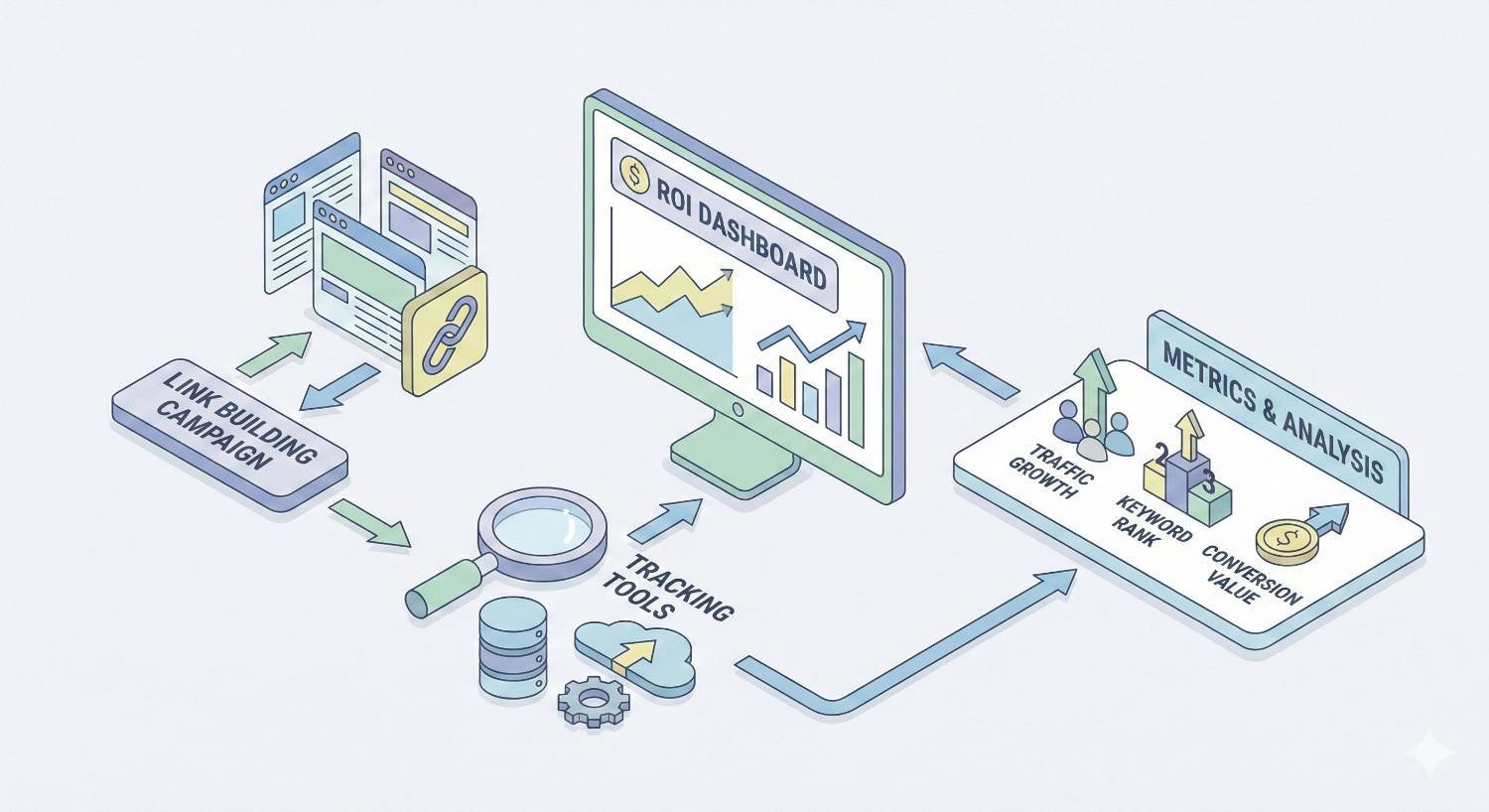
Effective ROI tracking requires combining multiple tools for complete visibility.
SEO Platforms (Ahrefs, Semrush, Moz)
Major SEO platforms provide essential data for ROI calculations:
Ahrefs excels at backlink analysis, showing new and lost links, referring domain authority, and anchor text distribution. Use it to track link acquisition and monitor competitor link building.
Semrush offers comprehensive organic traffic analytics, keyword position tracking, and traffic value estimates. Its backlink analytics complement Ahrefs with different data sources.
Moz provides domain authority metrics and link tracking with a user-friendly interface. Its Link Explorer shows link quality indicators useful for segmenting ROI analysis.
Most businesses need at least one premium SEO platform. Many use two for cross-referencing data and filling coverage gaps.
Analytics and Attribution Tools
Google Analytics 4 tracks organic traffic, user behavior, and conversions. Set up goals for all valuable actions and use the attribution reports to understand how organic search contributes to conversions.
Google Search Console provides keyword-level data showing which queries drive traffic. Monitor impressions, clicks, and average position for pages receiving backlinks.
CRM Integration connects website analytics to sales data. Platforms like HubSpot, Salesforce, or Pipedrive can track leads from first organic touch through closed revenue.
Custom ROI Tracking Spreadsheets
Build a custom spreadsheet combining data from multiple sources:
Link Tracking Tab: Log every backlink with date, referring domain, DA/DR, target page, and acquisition cost.
Cost Tracking Tab: Record all link building expenses by category and month.
Traffic Tab: Pull monthly organic traffic data from Analytics, segmented by pages receiving links.
Revenue Tab: Track conversions and revenue attributed to organic traffic.
ROI Calculation Tab: Automate formulas calculating cost per link, traffic value, and overall ROI.
Update monthly for accurate trend analysis and strategic decision-making.
Link Building ROI Calculator FAQs
What is a good ROI for link building?
A good link building ROI typically ranges from 100-300% over 12 months, meaning you earn $2-$4 for every $1 invested. However, expectations vary by industry—B2B SaaS companies often see higher percentages due to elevated customer lifetime values, while competitive e-commerce niches may produce lower but still profitable returns.
How long does it take to see link building ROI?
Most businesses see initial ranking improvements within 3-6 months of acquiring quality backlinks, with meaningful ROI materializing between 6-12 months. However, the full value of link building compounds over years as links continue driving traffic and authority benefits long after acquisition.
How do you calculate cost per link?
Calculate cost per link by dividing your total link building investment by the number of links acquired. Include all expenses: labor costs, content creation, tool subscriptions, and agency fees. For example, $10,000 in total costs producing 20 links equals a $500 cost per link.
Should I build links in-house or hire an agency?
The decision depends on your resources and expertise. In-house link building offers more control and potentially lower per-link costs but requires dedicated staff and significant time investment. Agencies provide expertise and scalability but at higher direct costs. Many businesses use a hybrid approach—handling some outreach internally while engaging agencies for specialized campaigns.
Start Calculating Your Link Building ROI
Free Link Building ROI Calculator Tool
Access our free link building ROI calculator to input your specific costs, link acquisition data, and traffic metrics. The tool automatically calculates your percentage ROI, cost per link, and projected returns based on your inputs.
Simply enter your total investment, number of links acquired, organic traffic changes, and conversion data. The calculator handles the math and provides actionable insights for optimizing your strategy.
Get a Custom Link Building ROI Analysis
For businesses wanting deeper analysis, custom ROI assessments examine your specific situation—competitive landscape, current authority, target keywords, and growth objectives—to project realistic returns from link building investment.
A personalized analysis identifies which link building strategies will produce the strongest ROI for your industry and business model, helping you allocate budget effectively.
Conclusion
Calculating link building ROI transforms SEO from an uncertain expense into a measurable growth investment. By tracking costs accurately, measuring traffic and revenue impact, and applying the ROI formula consistently, you gain clarity on which link building efforts deserve continued investment.
The key is patience combined with rigorous measurement. Link building value compounds over time, and short-term analysis often understates true returns. Use the benchmarks, formulas, and tracking methods outlined here to build a data-driven link building program.
We help businesses worldwide build sustainable organic growth through strategic link building with measurable ROI. Contact White Label SEO Service today for a custom link building ROI analysis tailored to your industry and growth objectives.
Frequently Asked Questions
How do I attribute revenue specifically to link building versus other SEO efforts?
Isolate link building impact by tracking ranking and traffic changes for specific pages that received backlinks. Compare performance before and after link acquisition, controlling for other variables like content updates or algorithm changes. Use landing page reports in Analytics to see conversions from pages where links were built.
What’s the minimum budget needed to see positive link building ROI?
Most businesses need at least $2,000-$5,000 monthly sustained over 6-12 months to generate measurable ROI. Smaller budgets can work in less competitive niches, but insufficient investment often produces too few links to move rankings meaningfully.
How do I calculate ROI when links go to informational content rather than conversion pages?
Track assisted conversions and multi-page user journeys. Informational content often introduces visitors who later convert on other pages. Use Google Analytics path analysis to see how users move from linked content to conversion pages, then attribute partial credit accordingly.
Should I include the value of brand awareness in my ROI calculations?
Brand awareness from high-visibility placements has real value but is difficult to quantify precisely. Consider tracking branded search volume increases as a proxy—if branded searches grow after major link placements, that indicates awareness value beyond direct traffic.
How often should I recalculate my link building ROI?
Review ROI metrics monthly for tactical adjustments and quarterly for strategic planning. Monthly tracking catches underperforming campaigns early, while quarterly analysis provides enough data for meaningful trend identification and budget allocation decisions.
What ROI should I expect from link building in a highly competitive industry?
Competitive industries typically produce lower percentage ROI but higher absolute returns due to expensive keyword values. Expect 75-150% ROI over 12-18 months in highly competitive spaces, with longer timelines to see initial results as you build authority against established competitors.
How do algorithm updates affect link building ROI calculations?
Major algorithm updates can temporarily distort ROI measurements by shifting rankings independent of your link building efforts. Track update dates and note any correlation with traffic changes. For accurate ROI assessment, measure performance over periods that include multiple algorithm cycles to smooth out volatility.