
Link building services remain the most effective way to build domain authority and improve search rankings in 2025. Quality backlinks from relevant, authoritative websites signal trust to Google, directly influencing where your pages appear in search results and how much organic traffic you receive.
For business owners and marketing teams investing in SEO, understanding how professional link building works separates sustainable growth from wasted budgets. The difference between a strategic link acquisition campaign and random outreach can mean months of progress or costly penalties.
This guide covers everything you need to evaluate link building services, from provider selection and pricing models to white hat strategies that build lasting authority. You’ll learn exactly what to expect, what to avoid, and how to measure real ROI from your investment.
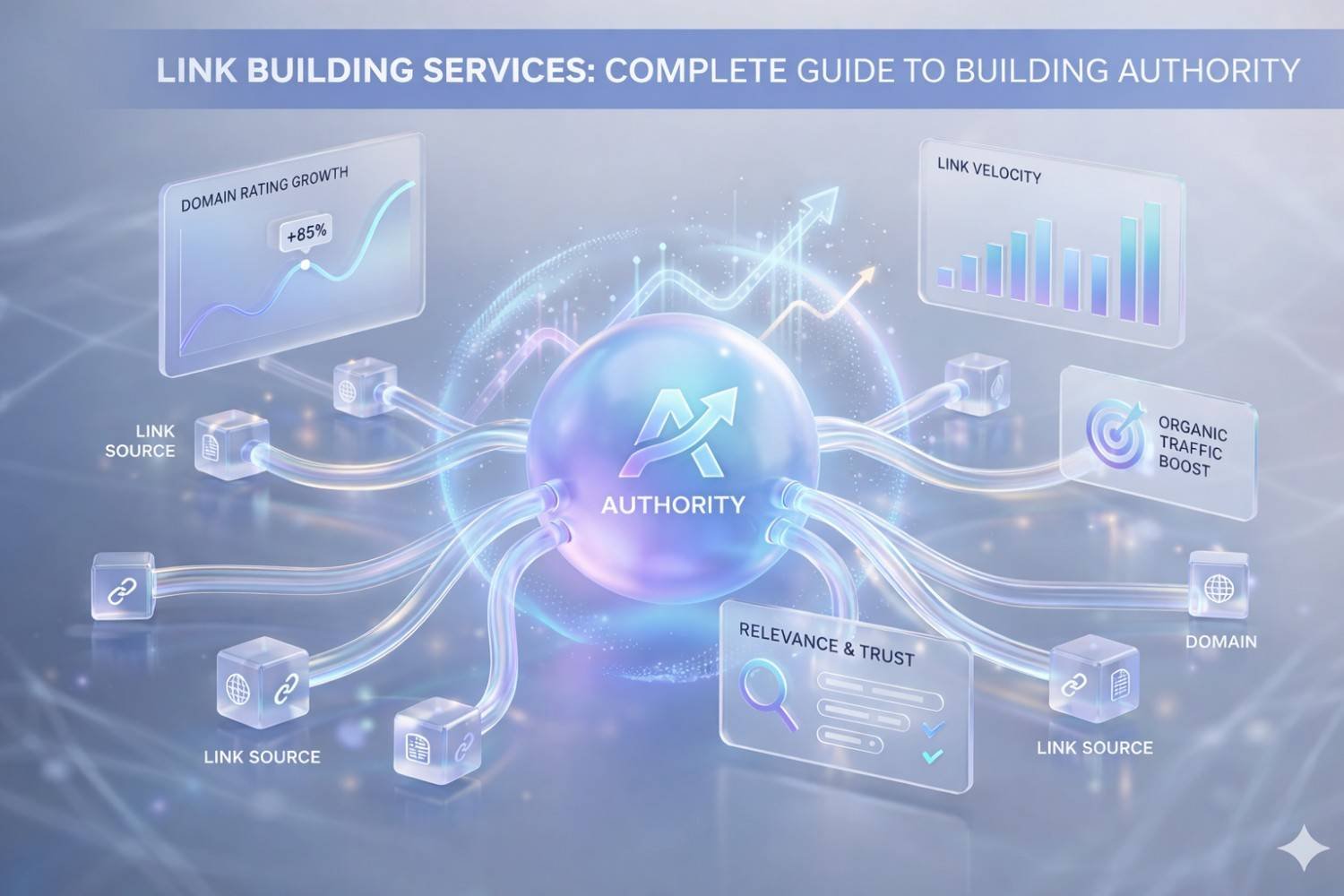
What Are Link Building Services?
Link building services are professional SEO offerings focused on acquiring backlinks from external websites to improve your site’s search engine rankings and domain authority. These services handle the research, outreach, content creation, and relationship management required to earn quality links at scale.
Definition and Core Components
Link building services encompass the strategic process of securing hyperlinks from other websites that point back to your domain. Each backlink acts as a vote of confidence, telling search engines that your content deserves attention and authority.
The core components include prospect research, where providers identify relevant websites worth pursuing. Outreach management handles communication with site owners, editors, and webmasters. Content creation produces guest posts, resources, or assets that earn placement. Finally, reporting tracks acquired links and measures impact on rankings.
Professional services differ from DIY efforts primarily in scale and expertise. Agencies maintain relationships with thousands of publishers, understand what pitches convert, and know which link opportunities actually move rankings versus those that waste resources.
How Link Building Services Work
The typical link building process follows a structured workflow. First, providers audit your current backlink profile to understand existing authority and identify gaps. They analyze competitors to find link sources you’re missing.
Next comes prospecting. Teams build lists of relevant websites based on your industry, target keywords, and quality thresholds. They evaluate each prospect for domain authority, traffic, relevance, and editorial standards.
Outreach begins with personalized pitches to site owners. This might involve proposing guest content, suggesting resource additions, or offering expert commentary. Successful outreach requires understanding what each publisher values and crafting offers that benefit both parties.
Once a site agrees to link, content creation or placement occurs. The provider either writes new content, supplies quotes for existing articles, or negotiates placement within published pages. After publication, they verify the link is live, properly attributed, and indexed.
Types of Link Building Service Providers
Full-service SEO agencies offer link building as part of comprehensive campaigns. They integrate link acquisition with technical SEO, content strategy, and ongoing optimization. This approach ensures links support broader ranking goals.
Specialized link building agencies focus exclusively on backlink acquisition. They often deliver higher volume and deeper publisher relationships but require you to handle other SEO elements separately.
Freelance link builders provide flexible, often lower-cost options for specific campaigns. Quality varies significantly, making vetting essential before engagement.
Marketplace platforms connect buyers with link opportunities directly. While convenient, these carry higher risk of low-quality or manipulative links that violate Google guidelines.

Why Link Building Matters for SEO Authority
Backlinks remain one of Google’s most important ranking factors despite algorithm evolution. Understanding why links matter helps you prioritize investment and evaluate service quality.
The Role of Backlinks in Search Rankings
Google’s original PageRank algorithm treated links as votes. More votes from important pages meant higher rankings. While the algorithm has grown vastly more sophisticated, this core principle persists.
Backlinko’s analysis of 11.8 million search results found that the number of domains linking to a page correlated with higher rankings more than any other factor studied. Pages ranking first had an average of 3.8x more backlinks than positions two through ten.
Links accomplish what on-page optimization cannot. You control your content, technical setup, and user experience. But you cannot directly control what other websites say about you. When authoritative sites link to your content, they provide third-party validation that search engines trust.
Domain Authority vs. Page Authority Explained
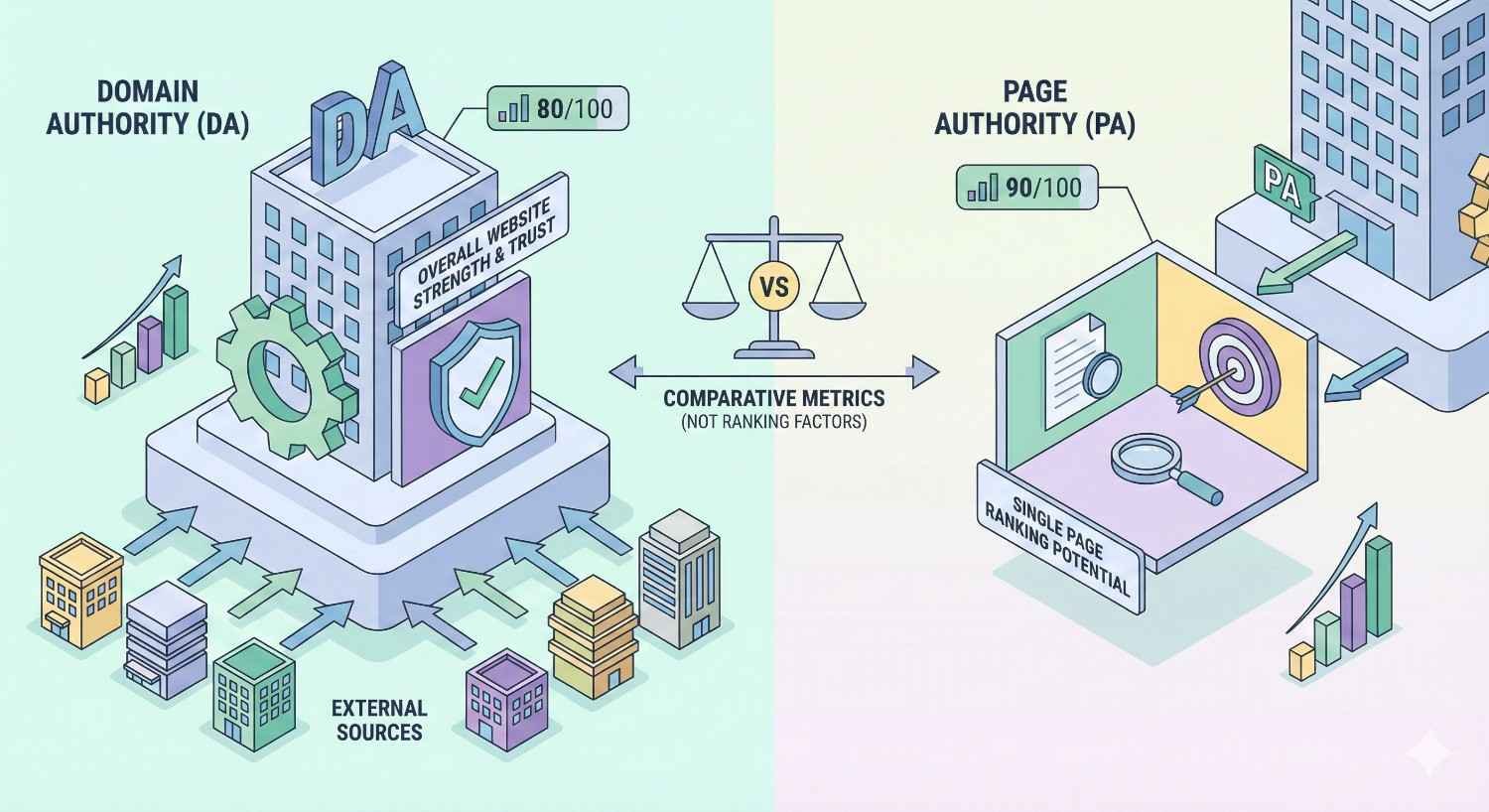
Domain Authority (DA) measures your entire website’s ranking potential based on its backlink profile. Page Authority (PA) measures individual page strength. Both metrics, developed by Moz, predict how likely a domain or page is to rank.
Domain Authority builds through links pointing anywhere on your site. A strong DA lifts all pages, making new content easier to rank. Page Authority concentrates on specific URLs, determining which pages compete for particular keywords.
Effective link building addresses both. Homepage and brand links build overall domain strength. Deep links to specific pages boost those URLs for target keywords. A balanced approach creates compound growth where domain authority supports page-level campaigns.
How Google Evaluates Link Quality
Google’s algorithms assess links across multiple dimensions. Relevance measures whether the linking site relates to your topic. A link from an industry publication carries more weight than one from an unrelated blog.
Authority considers the linking domain’s own backlink profile and trustworthiness. Links from established, well-linked sites transfer more value than those from new or poorly-linked domains.
Placement matters significantly. Editorial links within main content outperform sidebar widgets, footer links, or author bios. Context around the link influences how Google interprets its meaning and value.
Anchor text, the clickable words forming the link, signals what the target page covers. Natural anchor text varies between branded terms, naked URLs, and descriptive phrases. Over-optimized anchors with exact-match keywords trigger spam filters.
The Connection Between Links and Organic Traffic Growth
Links drive traffic through two mechanisms. Direct referral traffic comes from users clicking links on other sites. This traffic often converts well because visitors arrive with context and intent.
Indirect traffic growth comes from improved rankings. As your domain authority increases and pages climb search results, organic traffic compounds. A study by Ahrefs found that 90.63% of pages get zero organic traffic from Google, largely because they lack backlinks.
The relationship between links and traffic isn’t immediate. New links take weeks or months to influence rankings as Google recrawls and reindexes pages. But the cumulative effect of consistent link building creates sustainable traffic growth that compounds over time.
Types of Link Building Services
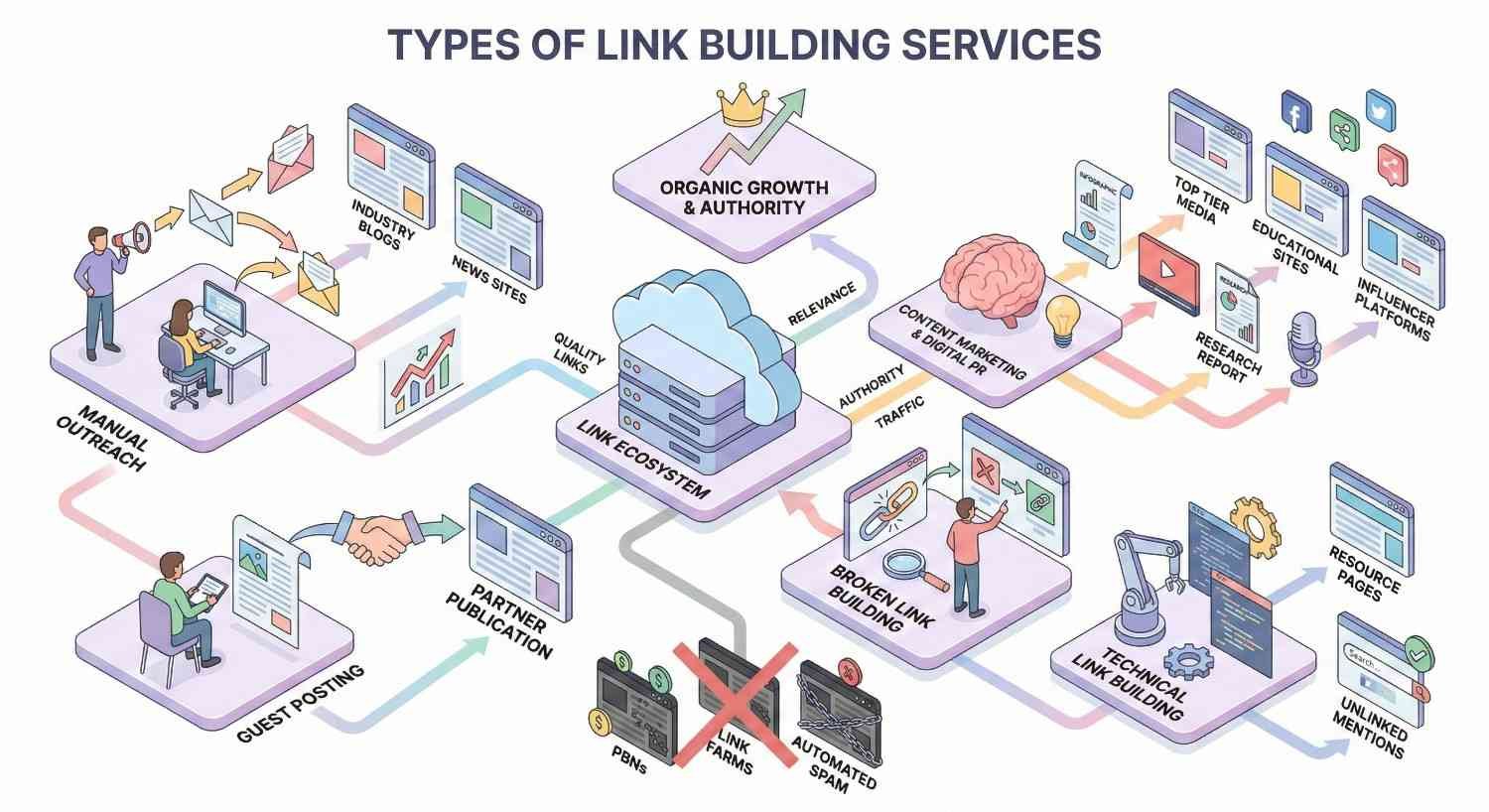
Different link building approaches suit different goals, budgets, and risk tolerances. Understanding each type helps you choose services aligned with your strategy.
Guest Posting Services
Guest posting involves writing articles for other websites in exchange for backlinks. The host site gets free content; you get exposure and a link. This remains one of the most common and effective link building methods.
Quality guest posting services identify relevant publications accepting contributions, pitch topics editors want, and produce content meeting editorial standards. They handle the entire process from prospecting through publication.
The key differentiator is publication quality. Low-end services place content on blog networks created solely for links. These provide minimal value and risk penalties. Premium services secure placements on established industry publications with real audiences and editorial oversight.
Expect to pay $150-$500+ per placement depending on the target site’s authority and traffic. Higher-authority publications command premium prices but deliver proportionally more value.
Digital PR and Media Outreach
Digital PR earns links through newsworthy content, expert commentary, and brand stories. Rather than placing content on blogs, this approach targets journalists, news sites, and major publications.
Services create press releases, develop data studies, and position executives as expert sources. When publications cover your story or quote your experts, they typically link back to your site.
Digital PR links carry exceptional authority because they come from trusted news sources. A single link from a major publication can equal dozens of guest posts in ranking impact. However, success requires genuinely newsworthy angles and professional media relationships.
This approach works best for brands with interesting stories, proprietary data, or genuine expertise to share. It’s less effective for commodity businesses without differentiation.
Broken Link Building
Broken link building finds dead links on relevant websites and offers your content as a replacement. When sites link to pages that no longer exist, webmasters appreciate being notified and often accept quality alternatives.
Services use tools to identify broken links at scale, then create or identify content on your site that serves as a suitable replacement. Outreach explains the broken link and suggests your resource as a fix.
This method works because it provides genuine value to webmasters. You’re helping them improve their site while earning a link. Response rates often exceed standard outreach because the pitch solves a real problem.
Success requires having content worth linking to. If your site lacks comprehensive resources on relevant topics, broken link building won’t work until you create linkable assets.
Resource Link Building
Resource pages compile helpful links on specific topics. Universities, libraries, government sites, and industry organizations maintain resource pages linking to valuable content in their fields.
Resource link building identifies these pages and pitches your content for inclusion. The approach works particularly well for educational content, tools, guides, and comprehensive resources.
Links from .edu and .gov domains carry significant authority due to their inherent trustworthiness. Resource link building often targets these high-value opportunities that other methods miss.
The challenge is creating content worthy of resource page inclusion. Generic blog posts won’t qualify. You need genuinely useful tools, comprehensive guides, or unique resources that serve the page’s audience.
HARO and Journalist Outreach
Help A Reporter Out (HARO) and similar platforms connect journalists with expert sources. Reporters post queries; experts respond with quotes and insights. Successful responses earn mentions and links in published articles.
Services monitor these platforms and respond on your behalf, positioning your team as industry experts. They craft responses matching journalist needs and follow up to maximize placement rates.
This approach builds authority through association with trusted publications. Links come from news sites, industry publications, and major media outlets that would otherwise be inaccessible.
Response competition is intense. Journalists receive dozens or hundreds of pitches per query. Success requires speed, relevance, and genuinely valuable insights that stand out from generic responses.
Niche Edits and Link Insertions
Niche edits place links within existing, already-indexed content rather than creating new articles. A webmaster adds your link to a relevant paragraph in a published post.
This approach offers advantages over guest posting. The content already has authority and rankings. Links appear more natural since they’re added to established articles rather than new posts created for link purposes.
Quality varies dramatically. Legitimate niche edits involve genuine editorial decisions to add valuable resources. Low-quality versions involve paying for links in irrelevant content, which violates Google guidelines.
Pricing typically ranges from $100-$400 per link depending on the host site’s metrics. Ensure providers can demonstrate editorial relationships rather than simply buying placements.
Content-Driven Link Acquisition
Content-driven link building creates exceptional resources designed to attract links naturally. This includes original research, comprehensive guides, interactive tools, and visual assets that others want to reference.
Services handle ideation, creation, and promotion of linkable assets. They identify topics with link potential, produce high-quality content, and conduct outreach to relevant sites that might link.
This approach builds sustainable link profiles because the content continues attracting links after initial promotion. A well-designed tool or definitive guide earns links for years without ongoing outreach.
The investment is higher upfront. Creating genuinely linkable content requires significant research, design, and development resources. But the long-term ROI often exceeds transactional link building.
Local Link Building Services
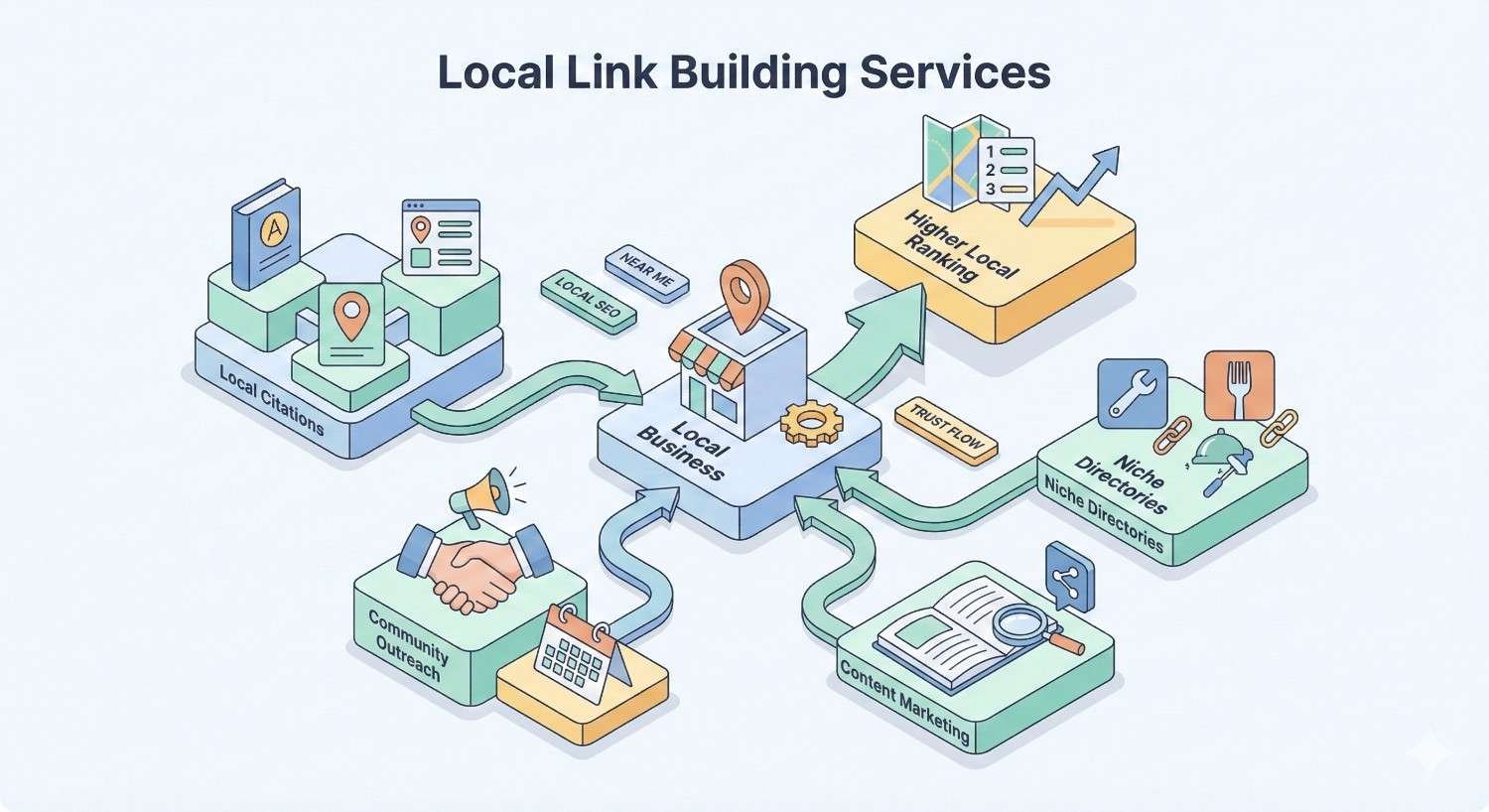
Local link building targets geographically relevant opportunities for businesses serving specific areas. This includes local directories, chamber of commerce sites, community organizations, and regional publications.
Services identify local link opportunities, manage directory submissions, and build relationships with local media and organizations. They ensure NAP (Name, Address, Phone) consistency across citations.
Local links support local pack rankings and map visibility. They also build relevance signals that help Google understand your service areas. For businesses depending on local customers, this specialized approach delivers targeted results.
How to Evaluate Link Building Service Providers
Choosing the right link building partner significantly impacts results. Poor providers waste budgets or create penalty risks. Quality providers accelerate growth sustainably.
Key Quality Indicators to Look For
Transparency tops the list. Quality providers explain their methods, show example placements, and provide detailed reporting. They don’t hide behind vague promises or proprietary secrets.
Look for realistic timelines and expectations. Anyone promising immediate results or guaranteed rankings is either inexperienced or dishonest. Legitimate link building takes months to show impact.
Examine their own website. Does it rank well? Does it have quality backlinks? Providers who can’t build authority for themselves likely can’t do it for you.
Ask about their publisher relationships. Established agencies maintain networks of sites they’ve worked with repeatedly. New providers relying entirely on cold outreach face lower success rates.
Review their content quality. Request samples of guest posts or assets they’ve created. Poor writing reflects poorly on your brand and may not earn placements on quality sites.
Red Flags and Warning Signs
Guaranteed rankings or specific link quantities signal problematic approaches. No one can guarantee Google rankings, and promising exact link numbers suggests quantity-focused tactics that sacrifice quality.
Unusually low prices indicate low-quality links. If a provider offers links at $50 each when competitors charge $300, they’re cutting corners somewhere. Those corners usually involve link farms, PBNs, or irrelevant placements.
Reluctance to share placement sites before purchase suggests they’re hiding quality issues. Legitimate providers show you where links will appear so you can evaluate relevance and authority.
No case studies or references means no proof of results. Established providers have clients willing to vouch for their work. New providers should at least show their own site’s growth.
Pressure tactics and urgency creation mirror scam patterns. Quality providers don’t need to pressure you because their results speak for themselves.
Questions to Ask Before Hiring
Start with methodology questions. How do you identify link opportunities? What’s your outreach process? How do you ensure relevance to my industry?
Ask about quality control. What metrics must a site meet before you’ll pursue it? How do you verify links remain live? What happens if a link gets removed?
Understand their content process. Who writes guest posts? What’s the revision process? Can I review content before publication?
Discuss reporting and communication. How often will I receive updates? What metrics do you track? Who’s my point of contact?
Clarify terms and guarantees. What’s your refund policy if you can’t deliver? How long is the contract? What happens if I’m unsatisfied?
Pricing Models and What to Expect
Per-link pricing charges a fixed amount for each acquired backlink. Prices range from $100-$1,500+ depending on target site authority. This model provides predictability but may incentivize quantity over quality.
Monthly retainer models charge a flat fee for ongoing link building efforts. Typical retainers range from $1,000-$10,000+ monthly depending on scope and provider reputation. This aligns incentives toward sustainable results.
Performance-based pricing ties fees to outcomes like rankings or traffic. While appealing, this model is rare because results depend on factors beyond link building alone.
Project-based pricing covers specific campaigns with defined deliverables. This works well for one-time initiatives like launching a new site or promoting a specific asset.
Case Studies and Proof of Results
Request case studies showing before-and-after metrics. Look for domain authority growth, ranking improvements, and traffic increases. Verify the timeline matches realistic expectations.
Ask for client references you can contact directly. Speaking with current or past clients reveals service quality, communication, and actual results better than polished case studies.
Check third-party reviews on platforms like Clutch, G2, or Google Business Profile. Look for patterns in feedback rather than focusing on individual reviews.
Examine their own backlink profile using tools like Ahrefs or Moz. A provider’s own link building success demonstrates their capabilities better than any sales pitch.
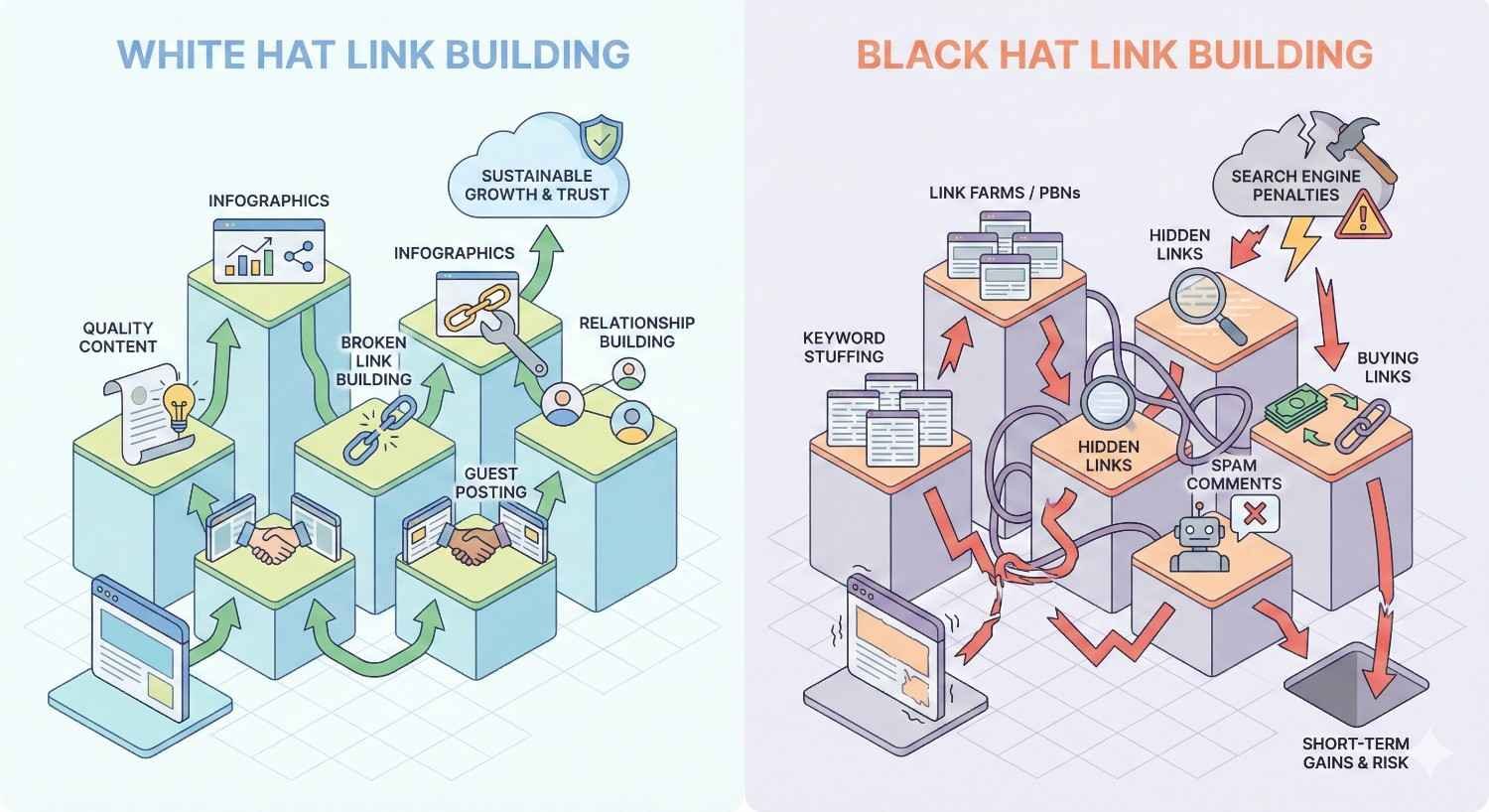
White Hat vs. Black Hat Link Building
Understanding the distinction between safe and risky link building practices protects your investment and your site’s long-term rankings.
Google’s Link Spam Guidelines
Google’s link spam policies explicitly prohibit manipulative link practices. Violations can result in manual penalties, algorithmic demotions, or complete deindexing.
Prohibited practices include buying or selling links that pass PageRank, excessive link exchanges, large-scale guest posting campaigns with keyword-rich anchors, automated link building, and requiring links as part of terms of service.
Google’s algorithms have grown increasingly sophisticated at detecting manipulation. The 2022 link spam update and subsequent refinements target previously effective gray-hat tactics.
The key principle is whether links are earned editorially. Links given because content genuinely deserves them are fine. Links acquired through payment, manipulation, or schemes violate guidelines regardless of how natural they appear.
Safe Link Building Practices
Creating genuinely valuable content that earns links naturally remains the safest approach. When your content helps people, they link to it without prompting.
Legitimate outreach that offers value to publishers stays within guidelines. Guest posting on relevant sites with editorial standards, contributing expert commentary, and suggesting your resources for appropriate contexts all qualify.
Building relationships with industry peers leads to natural link opportunities. When people know and trust you, they reference your work organically.
Digital PR that earns coverage through newsworthiness creates safe, high-authority links. Journalists link to sources they find valuable, not because they’re paid.
The common thread is providing genuine value. If you’d be comfortable explaining your link building to a Google employee, it’s probably safe.
Risky Tactics to Avoid
Private Blog Networks (PBNs) use interconnected sites controlled by the same entity to manipulate rankings. Google actively hunts and penalizes PBN links. The risk far outweighs any short-term benefit.
Link farms and low-quality directories exist solely to sell links. These sites have no real audience or editorial value. Links from them provide minimal benefit and significant risk.
Automated link building using software to create profiles, comments, or forum posts at scale triggers spam filters immediately. These links rarely help and often hurt.
Excessive reciprocal linking, where sites agree to link to each other, appears manipulative at scale. Occasional natural reciprocal links are fine, but systematic exchanges violate guidelines.
Paid links without proper disclosure violate both Google guidelines and FTC regulations. If you’re paying for placement, it must be disclosed and nofollowed.
Recovering from Link-Based Penalties
Manual penalties appear in Google Search Console with specific explanations. Recovery requires identifying and removing or disavowing problematic links, then submitting a reconsideration request.
Algorithmic impacts don’t generate notifications. If traffic drops coincide with known algorithm updates, link quality may be the cause. Recovery requires improving your overall link profile over time.
The disavow tool tells Google to ignore specific links when assessing your site. Use it for links you can’t remove that clearly violate guidelines. Don’t disavow legitimate links out of paranoia.
Recovery timelines vary from weeks for manual penalties to months for algorithmic issues. Consistent improvement in link quality eventually restores rankings, but patience is essential.
Link Building Strategies That Build Real Authority
Beyond service types, understanding strategic approaches helps you direct providers toward sustainable results.
Creating Linkable Assets
Linkable assets are content pieces designed specifically to attract backlinks. They provide unique value that others want to reference and share.
Original research and data studies earn links because they provide information unavailable elsewhere. When you publish proprietary findings, anyone discussing that topic must cite you.
Comprehensive guides that definitively cover topics become reference resources. The “ultimate guide” approach works when you genuinely create the most thorough resource available.
Free tools and calculators attract links from anyone recommending resources in your space. A useful tool earns links continuously without ongoing promotion.
Visual assets like infographics, charts, and diagrams get embedded and linked across the web. Visual content is easier to share and reference than text alone.
Building Relationships for Natural Links
Relationship-based link building focuses on connections rather than transactions. When industry peers know and respect you, links follow naturally.
Participate genuinely in industry communities. Comment thoughtfully on others’ content. Share valuable insights without expecting immediate returns. Build reputation over time.
Collaborate with complementary businesses on content, events, or resources. Joint ventures create natural linking opportunities while expanding both audiences.
Support others’ work through mentions, shares, and links. Generosity often returns multiplied. People remember and reciprocate when you’ve helped them.
Attend industry events and build in-person relationships. Digital connections strengthen when backed by real-world interactions.
Leveraging Data and Original Research
Original research creates citation-worthy content that earns links passively. When you’re the source of data, everyone discussing that data links to you.
Survey your audience or customers to generate unique insights. Even simple surveys produce data unavailable elsewhere if you ask the right questions.
Analyze publicly available data in new ways. Combining datasets, identifying trends, or providing fresh perspectives on existing information creates linkable findings.
Partner with research firms or academic institutions for credibility. Co-branded research carries more authority and reaches broader audiences.
Promote research actively to journalists and industry publications. Original data is exactly what reporters need for stories, making coverage and links more likely.
Strategic Content Partnerships
Content partnerships create mutual benefit through collaborative creation. Both parties contribute and both receive links and exposure.
Co-create content with complementary brands. Joint guides, research, or tools leverage combined expertise and audiences. Each partner links to and promotes the shared asset.
Expert roundups gather insights from multiple authorities on a topic. Contributors typically share and link to content featuring their quotes.
Podcast and webinar appearances build relationships while earning links. Show notes and event pages link to guests, creating natural backlink opportunities.
Syndication partnerships republish content across multiple platforms. While duplicate content requires careful handling, strategic syndication expands reach and link opportunities.
Competitor Backlink Analysis
Analyzing competitor backlinks reveals proven link opportunities in your space. If a site links to competitors, they might link to you too.
Use tools like Ahrefs, Moz, or Semrush to export competitor backlink profiles. Identify their highest-authority links and the content earning them.
Look for patterns in competitor link sources. Do certain publications frequently cover your industry? Are there resource pages listing competitors but not you?
Identify content gaps where competitors have linkable assets you lack. Creating better versions of successful competitor content positions you to capture their link opportunities.
Prioritize opportunities based on feasibility and value. Some competitor links come from relationships you can’t replicate. Focus on achievable opportunities with meaningful authority.
Measuring Link Building Success
Effective measurement ensures your link building investment delivers results. Track the right metrics to evaluate provider performance and campaign ROI.
Key Metrics and KPIs
Domain Authority (DA) or Domain Rating (DR) tracks overall site strength. While not Google metrics, they correlate with ranking ability and provide useful benchmarks.
Referring domains count unique websites linking to you. This matters more than total backlinks because one link from a new domain typically outweighs multiple links from existing sources.
Link quality metrics include the authority, relevance, and traffic of linking sites. Ten links from authoritative, relevant sites beat a hundred from low-quality sources.
Organic traffic growth ultimately validates link building success. More authority should translate to better rankings and more visitors over time.
Keyword rankings for target terms show direct impact. Track positions for priority keywords to see how link building affects specific ranking goals.
Tools for Tracking Backlinks
Ahrefs provides comprehensive backlink data, including new and lost links, referring domains, and anchor text distribution. Their Site Explorer tool offers detailed link profile analysis.
Moz Link Explorer tracks Domain Authority and provides link metrics. Their spam score helps identify potentially harmful links in your profile.
Semrush Backlink Analytics offers competitive analysis alongside your own link tracking. Compare your profile against competitors to identify gaps and opportunities.
Google Search Console shows links Google has discovered, though data is less comprehensive than third-party tools. It’s free and provides Google’s direct perspective on your links.
Majestic specializes in link data with unique metrics like Trust Flow and Citation Flow. Their historical data helps track link profile changes over time.
Reporting and Performance Analysis
Monthly reports should include new links acquired, their sources, and quality metrics. Transparency about what was delivered enables informed evaluation.
Track trends over time rather than fixating on individual months. Link building compounds gradually. Month-over-month comparisons matter less than quarterly or annual trajectories.
Connect link metrics to business outcomes. Correlate link acquisition with ranking changes, traffic growth, and ultimately conversions or revenue.
Benchmark against competitors to contextualize progress. Gaining ground on competitor link profiles indicates effective strategy even if absolute numbers seem modest.
Timeline Expectations for Results
New links typically take 4-8 weeks to influence rankings as Google discovers, crawls, and processes them. Expecting immediate impact sets unrealistic expectations.
Meaningful ranking improvements usually appear within 3-6 months of consistent link building. Competitive keywords may take longer; less competitive terms may move faster.
Domain authority growth happens gradually over 6-12+ months. Building genuine authority requires sustained effort, not quick fixes.
Traffic growth follows ranking improvements with some lag. As rankings improve, traffic increases. As traffic increases, additional natural links often follow, creating positive momentum.
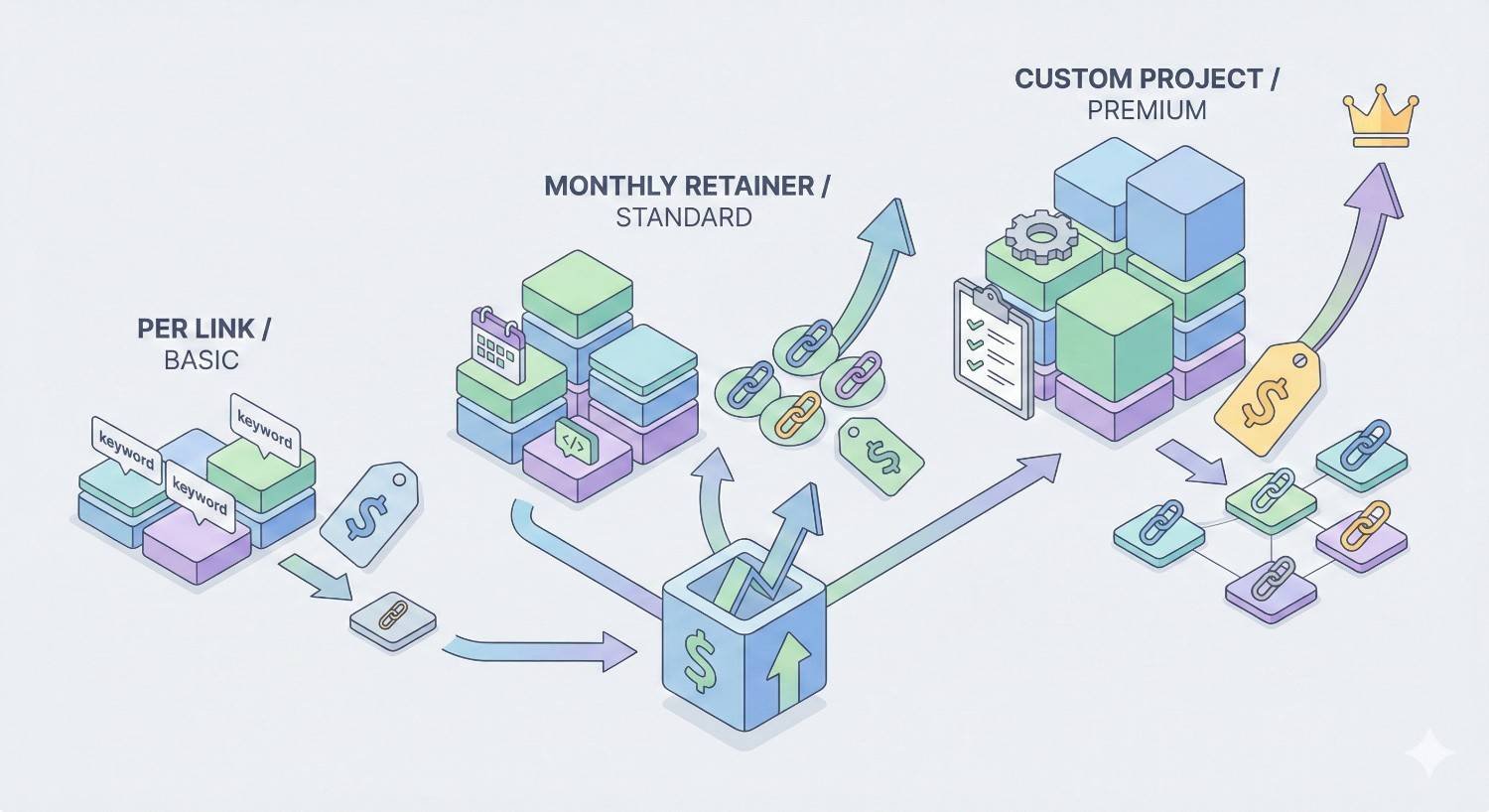
Link Building Services Pricing: What to Budget
Understanding pricing helps you budget appropriately and evaluate provider value. Costs vary significantly based on approach, quality, and provider reputation.
Average Costs by Service Type
Guest posting services range from $150-$600 per placement for mid-tier sites. High-authority publications (DA 70+) command $500-$1,500+ per link.
Digital PR campaigns typically run $3,000-$10,000+ monthly for ongoing media outreach. Individual placements in major publications can cost $1,000-$5,000 when available.
Niche edits and link insertions average $100-$400 per link depending on host site metrics. Premium placements on high-traffic sites cost more.
Monthly retainers for comprehensive link building range from $2,000-$10,000+ depending on link volume, quality targets, and provider expertise.
Content-driven campaigns requiring asset creation add $2,000-$10,000+ for research, design, and development on top of promotion costs.
Factors That Affect Pricing
Target site authority directly impacts cost. Links from DA 30 sites cost far less than DA 70+ placements. Higher authority means more value and higher prices.
Industry competitiveness affects availability and pricing. Highly competitive niches have fewer link opportunities and more demand, driving prices up.
Content requirements influence costs. If providers must create substantial content for placements, expect higher fees than simple link insertions.
Provider reputation and track record command premiums. Established agencies with proven results charge more than newer or less proven alternatives.
Geographic targeting adds complexity. International link building or location-specific campaigns require specialized expertise and publisher relationships.
ROI Calculation for Link Building Investment
Calculate potential ROI by estimating traffic value from improved rankings. If ranking first for a keyword brings 1,000 monthly visitors worth $5 each in ad value, that’s $5,000 monthly value.
Factor in conversion rates and customer lifetime value. If 2% of organic visitors convert and customers are worth $500, each 1,000 visitors generates $10,000 in customer value.
Compare investment to projected returns over time. A $3,000 monthly link building investment that generates $10,000 in monthly customer value delivers strong ROI.
Account for compounding effects. Unlike paid advertising that stops when you stop paying, link building creates lasting assets. Authority built today continues delivering value for years.
Budget Allocation Recommendations
Startups and small businesses should allocate $1,000-$3,000 monthly for meaningful link building. Lower budgets can work but limit options and slow progress.
Growing businesses targeting competitive keywords need $3,000-$7,000 monthly to build authority at pace with or faster than competitors.
Enterprise organizations in highly competitive spaces may invest $10,000-$25,000+ monthly for comprehensive link building across multiple initiatives.
Balance link building with other SEO investments. Links without quality content to support them waste potential. Ensure your site deserves the authority you’re building.
DIY Link Building vs. Hiring a Service
Deciding between in-house link building and outsourcing depends on your resources, expertise, and goals.
When to Build Links In-House
In-house link building makes sense when you have team members with outreach experience and available time. The skills required include writing, relationship building, and persistence.
Smaller link building needs may not justify agency costs. If you need a few quality links monthly, dedicated staff time might be more cost-effective than retainers.
Industries requiring deep expertise benefit from in-house approaches. Your team understands nuances that outside providers might miss, enabling more relevant outreach.
Long-term relationship building often works better internally. Ongoing partnerships with industry publications develop more naturally when managed by permanent staff.
When to Outsource Link Building
Outsource when you lack internal expertise or bandwidth. Link building requires specific skills and significant time. Without both, results suffer.
Scaling link acquisition beyond what internal resources support requires outside help. Agencies maintain larger outreach operations than most companies can justify internally.
Competitive industries demanding aggressive link building often require professional support. Keeping pace with well-funded competitors means matching their link building investment.
When speed matters, agencies deliver faster through established processes and relationships. Building internal capabilities takes months; agencies start producing immediately.
Hybrid Approaches
Many organizations combine internal and external link building. Internal teams handle relationship-based opportunities while agencies provide scale and specialized tactics.
Use agencies for specific campaigns while maintaining internal capabilities for ongoing efforts. Launch support, competitive pushes, or new market entry might warrant temporary agency engagement.
Internal teams can manage agency relationships and quality control. Having someone who understands link building ensures providers deliver value and align with your standards.
Start with agencies to learn, then build internal capabilities. Working with professionals teaches processes and tactics you can eventually bring in-house.
Resource and Time Requirements
Effective in-house link building requires 15-30+ hours weekly depending on goals. This includes prospecting, outreach, content creation, and relationship management.
Tools for link building cost $100-$500+ monthly. Ahrefs, Semrush, or similar platforms are essential for prospecting and tracking.
Training and skill development take months. Expect a learning curve before internal efforts match agency effectiveness.
Opportunity cost matters. Time spent on link building is time not spent on other marketing activities. Consider whether link building is the highest-value use of your team’s time.
Link Building for Different Business Types
Different business models require tailored link building approaches. What works for e-commerce differs from SaaS or local businesses.
Link Building for E-commerce
E-commerce link building focuses on product pages, category pages, and the overall domain. Product reviews, gift guides, and shopping roundups provide natural link opportunities.
Create linkable content beyond product pages. Buying guides, comparison tools, and educational resources attract links that benefit the entire site.
Pursue links from industry publications, lifestyle blogs, and review sites. These sources drive both authority and referral traffic from potential customers.
Leverage supplier and manufacturer relationships. Brands you carry may link to authorized retailers. Partnerships create mutual linking opportunities.
Link Building for SaaS Companies
SaaS link building emphasizes thought leadership and educational content. Industry expertise positions your brand as an authority worth referencing.
Create tools, calculators, and resources related to your product category. Free tools attract links from anyone recommending solutions in your space.
Pursue integration partner links. Companies whose products work with yours often maintain partner directories and integration pages.
Contribute to industry publications and communities. SaaS buyers research extensively; being present in their research sources builds authority and links.
Link Building for Local Businesses
Local link building targets geographically relevant opportunities. Local directories, chamber of commerce sites, and community organizations provide foundational links.
Sponsor local events, teams, or charities. Sponsorship typically includes website links from event pages and partner listings.
Pursue local media coverage. Community newspapers, local blogs, and regional publications cover local business stories and link to featured companies.
Build relationships with complementary local businesses. Cross-promotion and mutual recommendations create natural local link networks.
Link Building for Startups
Startup link building leverages newsworthiness and founder stories. Launches, funding rounds, and innovative approaches attract media coverage and links.
Pursue startup directories and investor resources. These platforms list and link to emerging companies in various industries.
Build founder personal brands. Thought leadership content, speaking engagements, and media appearances create links to both personal profiles and company sites.
Create industry-disrupting content. Startups can take positions established players avoid, attracting attention and links through bold perspectives.
Link Building for Enterprise Organizations
Enterprise link building requires coordination across departments and stakeholders. PR, marketing, and SEO teams must align on link building goals and tactics.
Leverage existing brand authority. Enterprise brands have recognition that opens doors smaller companies can’t access. Use this advantage strategically.
Create flagship research and resources. Enterprise budgets enable comprehensive studies and tools that become industry reference points.
Manage link building at scale across multiple products, regions, and initiatives. Enterprise link building often involves multiple agencies and internal teams working in coordination.
Common Link Building Mistakes to Avoid
Understanding common mistakes helps you evaluate providers and avoid costly errors in your own efforts.
Prioritizing Quantity Over Quality
Chasing link numbers rather than link quality wastes resources and risks penalties. One link from a highly relevant, authoritative site outweighs dozens from low-quality sources.
Quantity-focused providers often deliver links from irrelevant sites, link farms, or low-traffic blogs. These links provide minimal value and may trigger algorithmic filters.
Focus on links that would drive valuable referral traffic even without SEO benefit. If a link wouldn’t send relevant visitors, it probably isn’t worth pursuing.
Set quality thresholds for acceptable link sources. Minimum domain authority, traffic levels, and relevance requirements ensure consistent quality.
Ignoring Relevance and Context
Topical relevance significantly impacts link value. A link from a site in your industry carries more weight than one from an unrelated source, regardless of authority metrics.
Contextual placement matters too. Links within relevant content surrounded by related discussion transfer more value than isolated links in unrelated contexts.
Evaluate potential link sources for audience overlap. Would their readers be interested in your content? If not, the link lacks both SEO and referral value.
Avoid links that make no logical sense. If there’s no natural reason for a site to link to you, the link appears manipulative to both users and algorithms.
Over-Optimized Anchor Text
Anchor text manipulation was an early SEO tactic that now triggers penalties. Excessive exact-match keyword anchors signal manipulation to Google’s algorithms.
Natural anchor text profiles include branded terms, naked URLs, generic phrases, and varied descriptive text. Exact-match keywords should represent a small minority.
Let linking sites choose anchor text naturally when possible. Editorial decisions about how to describe your content appear more natural than prescribed anchors.
Audit your anchor text distribution regularly. If exact-match anchors exceed 5-10% of your profile, diversification is needed.
Neglecting Link Velocity
Link velocity, the rate at which you acquire new links, should appear natural. Sudden spikes followed by drops suggest manipulation.
Consistent, gradual link building appears more natural than aggressive bursts. Sustainable campaigns maintain steady acquisition over time.
Match link velocity to content publication and promotion. New content naturally attracts links; periods without new content naturally see slower acquisition.
Avoid artificial patterns. Acquiring exactly 10 links every month looks suspicious. Natural variation in timing and volume appears more organic.
Failing to Diversify Link Sources
Link profile diversity signals natural acquisition. Real websites earn links from various source types, not just one category.
Diversify across link types: editorial links, resource links, directory links, social profiles, and mentions. Over-reliance on any single type appears unnatural.
Vary linking domains rather than accumulating multiple links from the same sources. New referring domains typically provide more value than additional links from existing sources.
Balance followed and nofollowed links. Natural profiles include both. Exclusively followed links suggest manipulation.
The Future of Link Building
Link building continues evolving with search algorithms and digital marketing practices. Understanding trends helps you prepare for what’s ahead.
AI and Link Building
AI tools are transforming link building workflows. Prospecting, outreach personalization, and content creation increasingly leverage artificial intelligence.
AI-powered prospecting identifies link opportunities faster and more comprehensively than manual research. Machine learning improves targeting accuracy over time.
Automated outreach personalization scales relationship building. AI can customize pitches based on recipient characteristics while maintaining human oversight.
Content creation assistance accelerates linkable asset development. AI helps draft, research, and optimize content, though human expertise remains essential for quality.
Google’s AI also affects link evaluation. More sophisticated algorithms better identify manipulative patterns, making quality and authenticity increasingly important.
Evolving Google Algorithm Considerations
Google continues refining how it evaluates links. Recent updates target link spam more aggressively while rewarding genuine editorial links.
Entity-based understanding changes link context evaluation. Google increasingly understands what sites and content are about, making relevance assessment more sophisticated.
User signals may influence link value assessment. Links from sites users engage with positively may carry more weight than those from low-engagement sources.
The overall trend favors authentic link building. Tactics that worked years ago increasingly fail or backfire. Sustainable strategies aligned with Google’s quality guidelines become more important.
Emerging Link Building Trends
Brand building and link building increasingly converge. Strong brands naturally attract links; link building efforts increasingly focus on brand visibility.
Digital PR continues growing as a link building channel. Earned media coverage provides high-authority links while building brand awareness.
Community-driven link building through genuine participation in industry communities creates organic link opportunities. Authentic engagement replaces transactional outreach.
Content collaboration expands as brands recognize mutual benefits. Co-created content, shared research, and partnership-based link building grow more common.
How to Get Started with Link Building Services
Ready to invest in link building? Here’s how to begin effectively.
Assessing Your Current Backlink Profile
Before hiring a service, understand your starting point. Export your backlink profile using Ahrefs, Moz, or Semrush.
Evaluate current link quality. What’s your domain authority? How many referring domains do you have? What’s the quality distribution?
Identify existing problems. Do you have toxic links requiring disavowal? Are there unnatural patterns that need addressing before building new links?
Benchmark against competitors. How does your link profile compare to sites ranking for your target keywords? This reveals the gap you need to close.
Setting Goals and Expectations
Define specific, measurable link building goals. Target metrics might include domain authority increases, new referring domains, or rankings for specific keywords.
Set realistic timelines based on your starting point and competition. Significant authority building takes 6-12+ months of consistent effort.
Establish quality standards for acceptable links. Minimum authority thresholds, relevance requirements, and placement standards ensure consistent quality.
Align link building goals with broader business objectives. Links should ultimately drive traffic, leads, and revenue, not just improve vanity metrics.
Choosing the Right Service Partner
Evaluate multiple providers before committing. Request proposals, review case studies, and speak with references.
Prioritize transparency and communication. Providers who clearly explain their methods and maintain regular contact deliver better experiences.
Match provider expertise to your needs. Industry experience, geographic capabilities, and tactical specialization should align with your requirements.
Start with smaller engagements before major commitments. A trial period reveals working style and results quality before long-term contracts.
What to Expect in the First 90 Days
Month one focuses on setup and strategy. Providers audit your profile, analyze competitors, and develop targeting plans. Initial outreach begins late in the month.
Month two sees outreach scaling and first placements. Expect 3-10 links depending on your package and targeting. Quality verification and reporting establish baselines.
Month three brings momentum. Outreach processes optimize based on early results. Link acquisition accelerates. Initial ranking movements may appear for less competitive terms.
Patience remains essential. Three months provides early indicators but not definitive results. Evaluate trajectory and process quality rather than expecting transformation.
Conclusion
Link building services provide the strategic expertise and execution capacity needed to build domain authority systematically. Quality backlinks from relevant, authoritative sources remain essential for competitive search rankings and sustainable organic traffic growth.
Choosing the right link building partner requires understanding different service types, evaluating provider quality carefully, and setting realistic expectations for timelines and results. The investment pays dividends when executed properly, creating compounding authority that drives traffic for years.
We help businesses build sustainable organic growth through strategic link building, technical SEO, and comprehensive content strategies. Contact White Label SEO Service to discuss how professional link building can accelerate your authority and rankings.
Frequently Asked Questions About Link Building Services
What is the best link building service?
The best link building service depends on your specific needs, budget, and industry. Look for providers with proven results in your niche, transparent methods, and realistic expectations. Quality indicators include detailed reporting, editorial link placements, and client references you can verify.
How many backlinks do I need to rank?
There’s no universal number. Backlink requirements depend on keyword competition, your current authority, and competitor link profiles. Focus on quality over quantity. Analyze top-ranking competitors for your target keywords to estimate the authority level needed.
Are link building services worth it?
Link building services are worth it when they deliver quality links that improve rankings and traffic. Calculate ROI by comparing investment to the value of increased organic traffic. For competitive keywords, professional link building often provides the most efficient path to ranking improvement.
How do I know if a backlink is high quality?
High-quality backlinks come from relevant, authoritative sites with real traffic and editorial standards. Check the linking site’s domain authority, organic traffic, and content quality. The link should appear in contextually relevant content, not footers, sidebars, or unrelated pages.
Can link building hurt my website?
Yes, low-quality or manipulative link building can trigger Google penalties. Avoid link farms, PBNs, paid links without disclosure, and excessive exact-match anchors. Stick with providers using white hat methods and be prepared to disavow problematic links if necessary.
What is the difference between link building and link earning?
Link building involves proactive outreach to acquire links. Link earning creates content so valuable that others link to it naturally without outreach. Effective strategies combine both: create linkable assets, then promote them to accelerate natural link acquisition.
How do agencies build links?
Agencies build links through various methods including guest posting, digital PR, broken link building, resource outreach, and content partnerships. They maintain publisher relationships, employ outreach specialists, and use tools to identify opportunities at scale. Quality agencies focus on editorial placements that provide lasting value.