
Link prospecting tools transform how SEO teams identify, qualify, and pursue backlink opportunities at scale. These platforms automate the discovery of relevant websites, extract contact information, and score prospects based on authority metrics—turning weeks of manual research into hours of strategic outreach.
For businesses competing in crowded search results, quality backlinks remain a critical ranking factor. The right prospecting tool directly impacts your link acquisition velocity and overall domain authority growth.
This guide covers everything from core features and tool comparisons to advanced prospecting strategies, helping you build a systematic approach to earning high-value links.
What Are Link Prospecting Tools?
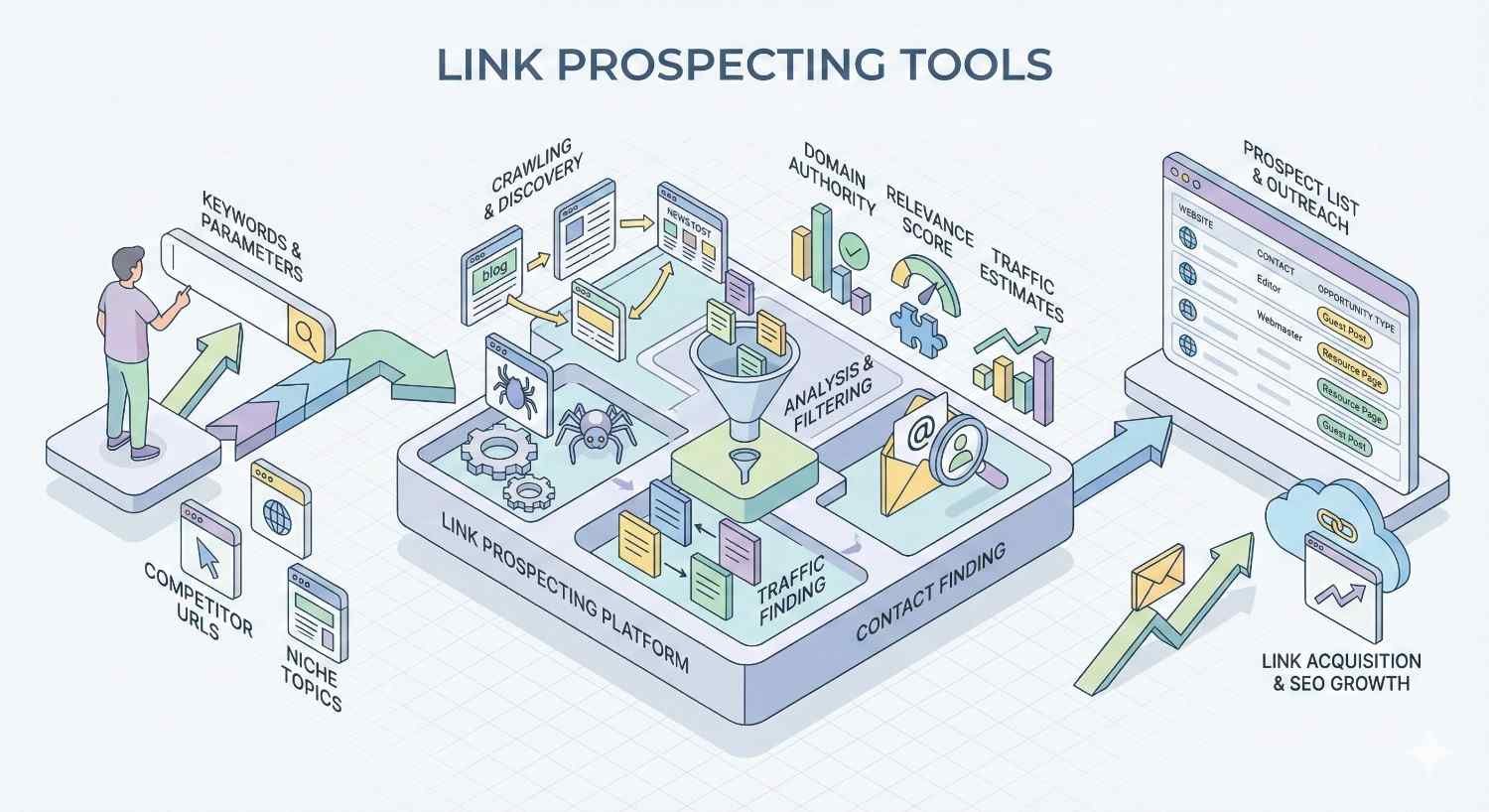
Link prospecting tools are specialized software platforms designed to identify websites that represent potential backlink opportunities for your domain. These tools crawl the web, analyze link profiles, and surface prospects based on relevance, authority, and likelihood of successful outreach.
The fundamental purpose is efficiency. Rather than manually searching Google for hours, these platforms aggregate data from billions of web pages and present filtered, actionable prospect lists. They bridge the gap between knowing you need links and finding the right sites to pursue.
Core Components of Link Prospecting Software
Modern link prospecting platforms share several foundational elements. Database infrastructure forms the backbone—tools like Ahrefs maintain indexes of over 35 trillion known links, enabling comprehensive prospect discovery.
Search and filtering engines allow users to query these databases using keywords, topics, competitor domains, or specific link types. The quality of filtering directly determines how relevant your prospect lists become.
Metrics calculation systems provide authority scores, traffic estimates, and spam indicators. These proprietary algorithms help users quickly assess whether a prospect deserves outreach effort.
Contact discovery modules extract email addresses, social profiles, and webmaster information. Some tools integrate directly with email verification services to ensure deliverability.
How Link Prospecting Tools Work
The typical workflow begins with input parameters. You might enter competitor URLs, target keywords, or specific search operators. The tool queries its database and returns matching domains.
Results undergo initial filtering based on your criteria—minimum domain authority, traffic thresholds, or topical relevance. Advanced tools apply machine learning to predict link acquisition probability.
Output formats vary from simple CSV exports to integrated CRM systems with outreach tracking. The best platforms maintain prospect status throughout the entire link building lifecycle.
Link Prospecting vs. Manual Link Research
Manual prospecting involves Google searches, spreadsheet tracking, and individual website evaluation. This approach works for small-scale campaigns but becomes unsustainable beyond a few dozen prospects monthly.
Tool-based prospecting offers several advantages. Speed increases dramatically—what takes hours manually happens in minutes. Data accuracy improves through automated metric calculation. Scalability becomes possible when pursuing hundreds of prospects simultaneously.
However, manual research still holds value for highly specialized niches or relationship-based link building where personal discovery creates better outreach angles.
Why Link Prospecting Tools Matter for SEO Growth
Backlinks remain among Google’s most influential ranking factors. Studies consistently show strong correlation between referring domain counts and organic rankings. Link prospecting tools directly enable the systematic acquisition these rankings require.
The competitive landscape has intensified. Websites ranking on page one typically have significantly more referring domains than those on page two. Without efficient prospecting, catching competitors becomes mathematically improbable.
Time Efficiency and Scalability
Consider the math. Manual prospect research averages 15-20 minutes per qualified prospect. A single link builder might identify 20-30 prospects daily through manual methods.
Link prospecting tools generate hundreds of filtered prospects in minutes. The same link builder now evaluates and prioritizes rather than searches. Output increases by multiples, not percentages.
This efficiency compounds over time. Teams using prospecting tools build larger pipelines, maintain consistent outreach volume, and ultimately acquire more links per month than manual-only competitors.
Data-Driven Link Acquisition
Prospecting tools provide metrics that inform strategic decisions. Domain authority scores help prioritize high-impact opportunities. Traffic data indicates whether a link will drive referral visitors beyond SEO value.
Historical link data reveals patterns. You can identify which types of sites link to competitors, which content formats attract links, and which outreach approaches yield responses.
This data transforms link building from guesswork into systematic execution. Decisions become defensible, results become predictable, and resources flow toward highest-probability opportunities.
Competitive Advantage in Link Building
Organizations using sophisticated prospecting tools operate at different speeds than those relying on manual methods. They identify opportunities faster, reach out sooner, and build relationships before competitors discover the same prospects.
The advantage extends beyond speed. Better data means better targeting. Better targeting means higher response rates. Higher response rates mean more links per outreach hour invested.
In competitive niches, this advantage often determines who ranks and who remains invisible.
Essential Features of Link Prospecting Tools
Not all prospecting tools offer equal capabilities. Understanding essential features helps you evaluate options and select platforms matching your specific needs.
Domain Authority and Quality Metrics
Every serious prospecting tool provides authority metrics. Moz’s Domain Authority, Ahrefs’ Domain Rating, and SEMrush’s Authority Score each use proprietary algorithms to estimate a domain’s ranking potential.
Beyond headline metrics, look for spam scores, trust indicators, and link velocity data. These secondary metrics help identify prospects that appear authoritative but carry risk.
The best tools allow custom metric thresholds. You might require DA 40+ for one campaign and DA 25+ for another. Flexible filtering prevents wasted evaluation time.
Contact Information Discovery
Finding the right contact transforms prospect lists into actionable outreach targets. Basic tools provide generic contact page links. Advanced platforms extract specific email addresses for editors, content managers, or webmasters.
Email verification integration prevents bounces that damage sender reputation. Some tools show confidence scores for discovered contacts, helping prioritize verified addresses over guesses.
Social profile discovery adds outreach channels. LinkedIn connections, Twitter handles, and other platforms enable multi-touch approaches that improve response rates.
Competitor Backlink Analysis
Understanding where competitors earn links reveals proven opportunities. If a site links to three competitors, they likely accept relevant content from your industry.
Gap analysis features identify sites linking to competitors but not to you. These represent immediate opportunities—the site already demonstrates willingness to link within your niche.
Historical data shows when competitors acquired specific links, revealing patterns in their strategy and timing you might replicate.
Niche and Industry Filtering
Relevance determines link value. A link from an unrelated site provides minimal SEO benefit and potentially raises spam flags.
Effective filtering options include topic categories, industry classifications, and content type selectors. You might filter for technology blogs, exclude news sites, and require recent publication activity.
Geographic filtering matters for local SEO campaigns. Language filtering ensures prospects can actually read your outreach and content.
Link Opportunity Scoring
Raw prospect lists require prioritization. Opportunity scoring algorithms combine multiple factors—authority, relevance, contact availability, historical link patterns—into actionable rankings.
Some tools allow custom scoring models. You might weight traffic heavily for campaigns focused on referral visitors, or prioritize authority for pure SEO plays.
Scoring reduces decision fatigue. Rather than evaluating every prospect equally, teams focus energy on highest-potential opportunities first.
Integration and Export Capabilities
Prospecting tools must connect with your broader workflow. API access enables custom integrations with internal systems. Native connections to outreach platforms like Pitchbox or BuzzStream streamline handoffs.
Export flexibility matters. CSV exports work universally. Direct CRM integration eliminates manual data entry. Webhook support enables real-time automation.
Consider reporting integrations as well. Connecting prospecting data to analytics platforms enables end-to-end link building measurement.
Types of Link Prospecting Tools
The market offers various tool categories, each serving different needs and budgets. Understanding these categories helps you identify which type fits your situation.
All-in-One SEO Platforms with Link Prospecting
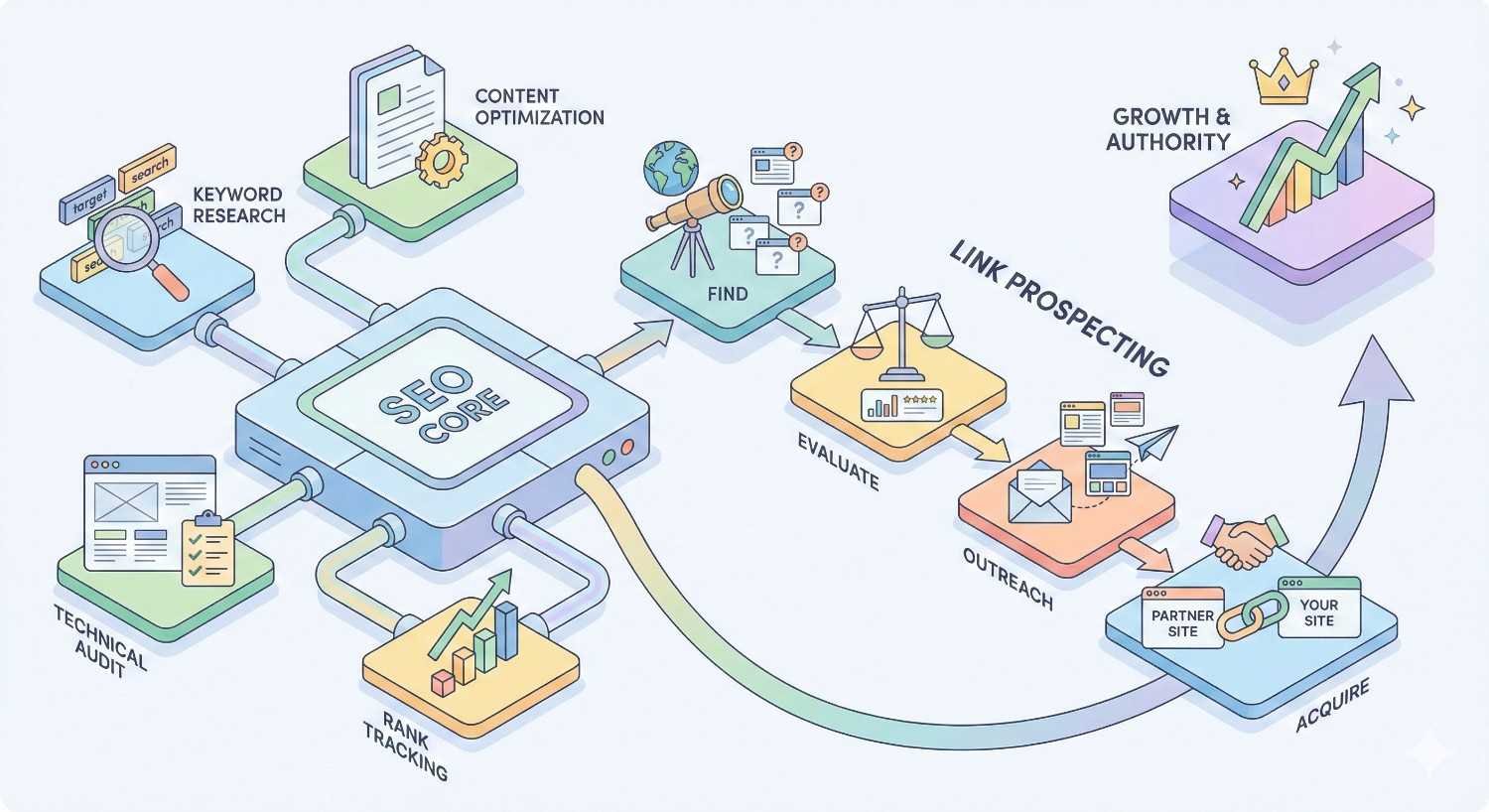
Comprehensive platforms like Ahrefs, SEMrush, and Moz combine link prospecting with keyword research, rank tracking, and site auditing. These tools suit teams wanting unified data and workflows.
Advantages include consistent metrics across functions, single subscription costs, and integrated reporting. Disadvantages include potentially less specialized prospecting features compared to dedicated tools.
For most businesses, all-in-one platforms provide sufficient prospecting capability alongside other essential SEO functions.
Dedicated Link Prospecting Software
Specialized tools like BuzzStream, Pitchbox, and Respona focus exclusively on link building workflows. They typically offer deeper prospecting features, built-in outreach, and relationship management.
These platforms excel at scale. Agencies managing multiple clients or enterprises running large campaigns benefit from specialized functionality.
The tradeoff involves additional subscription costs and potential data inconsistency when using different tools for different SEO functions.
Backlink Analysis Tools
Tools like Majestic and LinkResearchTools specialize in backlink data analysis. While not primarily prospecting tools, their databases enable competitor research and opportunity identification.
These platforms often provide unique metrics—Majestic’s Trust Flow and Citation Flow, for example—that complement data from other sources.
Backlink analysis tools work best as supplements to primary prospecting platforms rather than standalone solutions.
Content Discovery and Outreach Tools
Platforms like BuzzSumo and NinjaOutreach focus on content performance and influencer identification. They identify which content earns links and who shares it.
These tools excel at finding guest posting opportunities, identifying content gaps, and discovering influencers who might amplify your content.
Content discovery tools complement traditional prospecting by revealing why certain content attracts links, informing both prospecting and content strategy.
Chrome Extensions and Browser Tools
Extensions like Hunter.io, Check My Links, and various SEO toolbars provide prospecting functionality within your browser. They enable real-time evaluation while browsing potential prospects.
These tools work well for manual prospecting enhancement and quick checks. They lack the database scale and automation of full platforms but cost significantly less.
Browser tools suit freelancers, small teams, or anyone wanting to enhance manual prospecting without major investment.
Top Link Prospecting Tools Compared
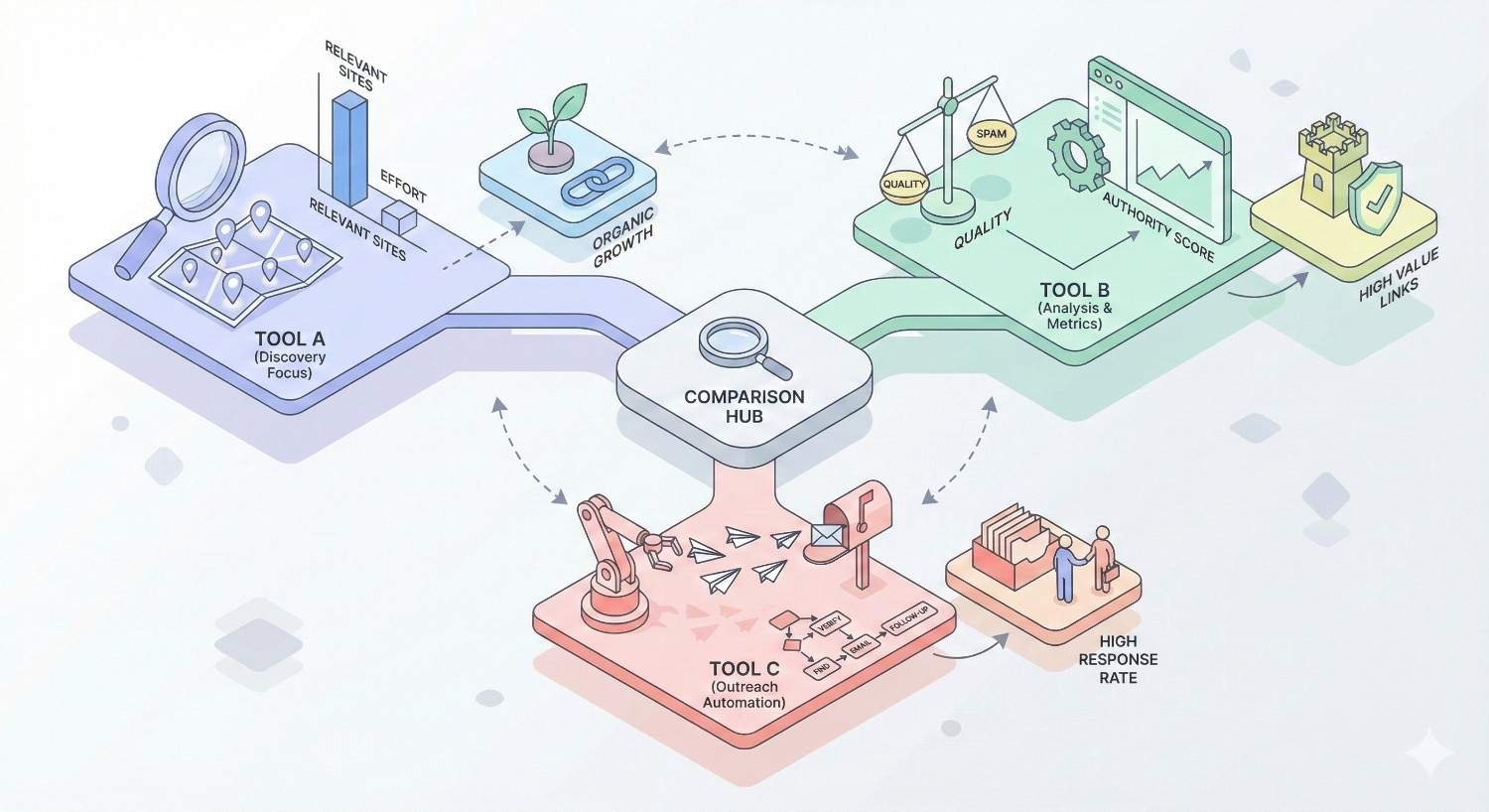
Understanding specific tool capabilities helps inform purchasing decisions. Each platform offers distinct strengths suited to different use cases.
Ahrefs Content Explorer
Ahrefs Content Explorer searches a database of billions of pages to find content matching your criteria. You can filter by domain rating, traffic, word count, publication date, and more.
Strengths include massive database coverage, accurate metrics, and tight integration with Ahrefs’ other features. The “highlight unlinked domains” feature instantly shows which results don’t already link to you.
Pricing starts at $99/month for the Lite plan, with Content Explorer access requiring Standard ($199/month) or higher tiers.
SEMrush Link Building Tool
SEMrush offers an integrated link building workflow within its broader platform. The tool suggests prospects based on your target keywords and competitor analysis.
Built-in outreach tracking and CRM functionality streamline the entire process. Integration with SEMrush’s keyword and content tools enables unified strategy execution.
Link building features require a Guru subscription ($229.95/month) or higher. The platform suits teams already using SEMrush for other SEO functions.
Moz Link Explorer
Moz Link Explorer provides backlink analysis and prospecting through its established database. The tool offers Domain Authority metrics that remain industry standards.
Link Intersect features identify sites linking to competitors but not to you. Spam Score helps filter risky prospects from your lists.
Moz Pro subscriptions start at $99/month, with full Link Explorer access at all tiers. The platform suits users who value Moz’s established metrics and educational resources.
BuzzStream
BuzzStream specializes in outreach management with strong prospecting capabilities. The platform helps discover prospects, manage relationships, and track campaign performance.
Strengths include contact discovery, email integration, and team collaboration features. The tool excels at managing large-scale outreach campaigns across multiple team members.
Pricing starts at $24/month for individuals, scaling to $999/month for large teams. BuzzStream suits agencies and enterprises prioritizing outreach workflow over raw prospecting data.
Pitchbox
Pitchbox combines prospecting with automated outreach sequences. The platform integrates with major SEO tools to import prospect data and metrics.
Personalization features enable scaled outreach that maintains individual touches. Reporting provides visibility into campaign performance and team productivity.
Pricing requires custom quotes, typically starting around $500/month. Pitchbox suits agencies and enterprises running high-volume link building operations.
Hunter.io
Hunter.io specializes in email finding and verification. While not a full prospecting platform, it solves the critical contact discovery challenge.
The tool finds email addresses associated with any domain and verifies deliverability. Chrome extension enables real-time discovery while browsing prospects.
Free tier allows 25 searches/month. Paid plans start at $49/month for 500 searches. Hunter.io complements other prospecting tools lacking strong contact discovery.
NinjaOutreach
NinjaOutreach combines influencer discovery with outreach automation. The platform maintains a database of bloggers and influencers across industries.
Built-in CRM tracks relationships and outreach history. Email templates and automation enable scaled campaigns without losing personalization.
Pricing starts at $155/month for the Flex plan. NinjaOutreach suits teams focused on influencer outreach and guest posting strategies.
Respona
Respona offers AI-assisted prospecting and outreach. The platform automates prospect discovery, contact finding, and initial outreach personalization.
Integration with Ahrefs and SEMrush imports metrics for prospect qualification. Campaign analytics track performance across all outreach efforts.
Pricing starts at $99/month for the Starter plan. Respona suits teams wanting AI assistance to scale prospecting and outreach efficiency.
How to Choose the Right Link Prospecting Tool
Selecting the right tool requires matching capabilities to your specific situation. Consider these factors before committing to any platform.
Assess Your Link Building Strategy
Your strategy determines required features. Guest posting campaigns need content discovery and editor contacts. Broken link building requires dead link identification. Resource page outreach needs specific page-type filtering.
Map your primary link building tactics to tool capabilities. Ensure any platform you consider supports your core approaches.
Consider future strategy evolution as well. A tool that fits today might limit tomorrow’s tactics if capabilities don’t expand.
Budget Considerations and ROI
Link prospecting tools range from free to thousands monthly. Evaluate cost against expected return.
Calculate your current cost per link acquired. If tools reduce that cost or increase link volume, the investment pays for itself. Most businesses find that even expensive tools deliver positive ROI through efficiency gains.
Consider total cost including training time, integration effort, and any additional tools needed to complete your workflow.
Team Size and Workflow Requirements
Solo practitioners need different tools than large agencies. Evaluate collaboration features, user seat costs, and workflow management capabilities.
Teams benefit from shared prospect databases, assignment tracking, and unified reporting. These features add cost but prevent duplicate effort and enable management oversight.
Consider how the tool fits existing workflows. Dramatic process changes increase adoption friction and reduce realized value.
Database Size and Coverage
Larger databases mean more prospects discovered. However, database size matters less than database quality and relevance to your niche.
Evaluate coverage in your specific industry. A tool with billions of pages might have limited data in specialized B2B sectors. Request trials to test actual prospect quality before committing.
Consider data freshness as well. Stale databases surface dead sites and outdated contacts, wasting outreach effort.
Learning Curve and Support
Complex tools require training investment. Evaluate documentation quality, available tutorials, and support responsiveness.
Some platforms offer onboarding assistance or dedicated account managers. This support accelerates time-to-value, especially for teams new to systematic link prospecting.
Consider your team’s technical sophistication. Advanced features provide value only if your team can actually use them effectively.
Link Prospecting Strategies Using Tools
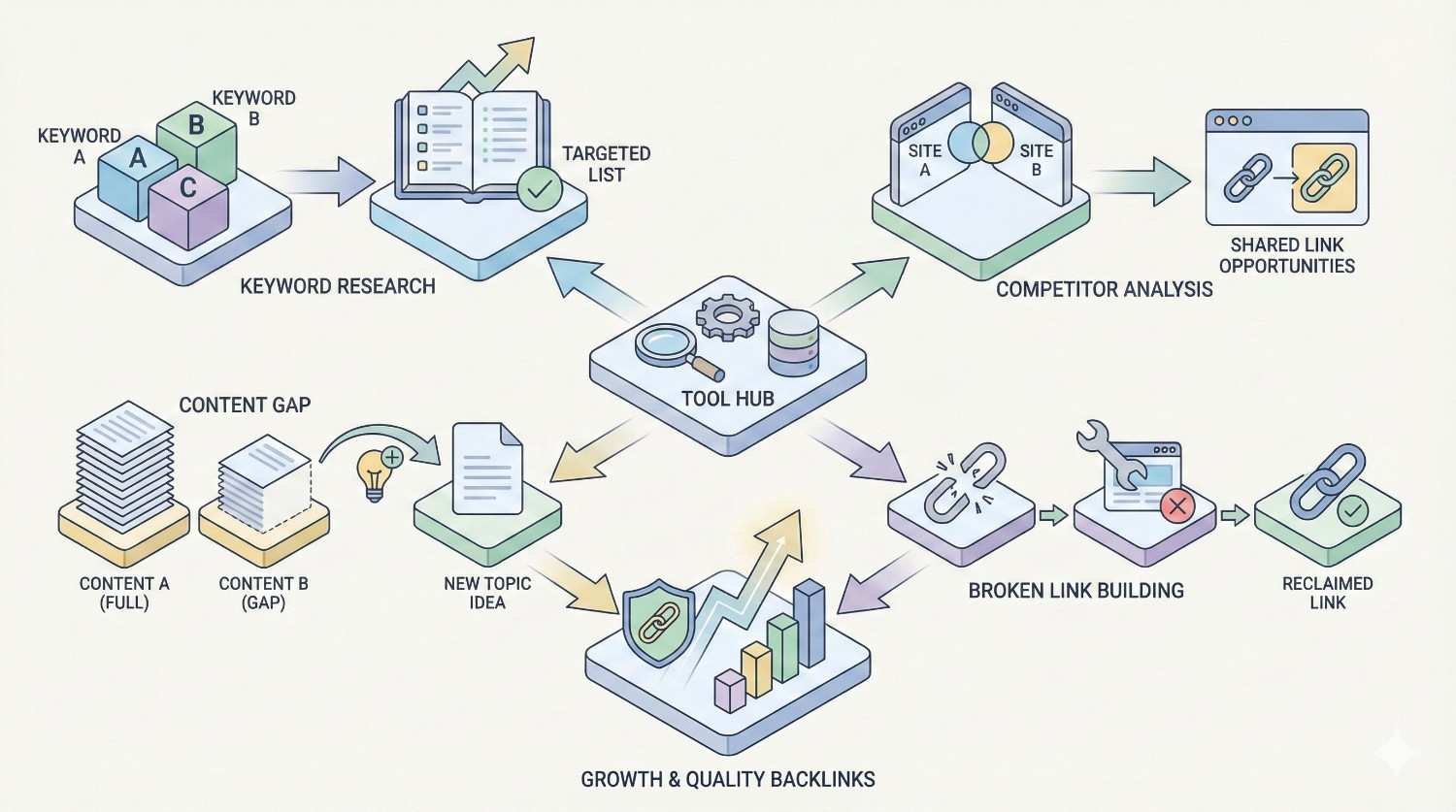
Tools enable strategies impossible through manual methods. These approaches leverage tool capabilities for maximum link building impact.
Competitor Backlink Gap Analysis
Gap analysis identifies sites linking to competitors but not to you. These prospects have demonstrated willingness to link within your niche—they simply haven’t discovered you yet.
Most major tools offer gap analysis features. Input your domain and several competitors. The tool surfaces domains linking to competitors but missing from your backlink profile.
Prioritize gaps by authority and relevance. High-authority sites linking to multiple competitors represent prime opportunities.
Broken Link Building Prospecting
Broken link building finds dead links on relevant sites and offers your content as replacements. Tools automate the discovery of broken outbound links across prospect domains.
Ahrefs’ Broken Backlinks report shows dead pages that previously earned links. You can create replacement content and reach out to sites still linking to defunct resources.
This strategy provides clear value to prospects—you’re helping them fix their site while earning a link.
Resource Page Link Opportunities
Resource pages curate links to helpful content within specific topics. These pages exist specifically to link out, making them ideal prospects.
Use search operators within prospecting tools: “keyword + resources” or “keyword + useful links.” Filter results by authority and relevance.
Resource page outreach succeeds when your content genuinely fits the page’s purpose. Evaluate each prospect’s existing links to ensure alignment.
Guest Posting Prospect Discovery
Guest posting remains effective when targeting quality publications. Tools help identify sites accepting contributions within your niche.
Search for “keyword + write for us” or “keyword + guest post guidelines.” Filter by authority thresholds to avoid low-quality sites that might harm rather than help.
Evaluate prospect content quality before pitching. Sites publishing thin or spammy content provide little value regardless of their metrics.
Unlinked Brand Mention Finding
When sites mention your brand without linking, you have a natural outreach opportunity. Tools like Ahrefs and SEMrush track brand mentions across the web.
Set up alerts for your brand name, product names, and key personnel. When mentions appear without links, reach out with a simple request to add the link.
This approach yields high conversion rates because the site already knows and references you. The ask is minimal—just adding a link to existing text.
Industry Directory and Listing Identification
Directories and listings provide foundational links for many businesses. Tools help identify relevant directories you might have missed.
Analyze competitor backlink profiles for directory links. Search for “keyword + directory” or “keyword + listings” within prospecting tools.
Prioritize directories with editorial standards over those accepting any submission. Quality directories provide value; spam directories create risk.
Step-by-Step Link Prospecting Workflow
Systematic workflows produce consistent results. Follow this process to maximize prospecting efficiency and output quality.
Step 1: Define Your Link Building Goals
Clear goals direct prospecting efforts. Determine target link quantities, quality thresholds, and timeline expectations.
Consider which metrics matter most. Pure authority building prioritizes high-DA sites. Traffic generation prioritizes sites with engaged audiences. Local SEO prioritizes geographically relevant sources.
Document goals explicitly. Vague objectives produce unfocused prospecting and wasted effort.
Step 2: Identify Target Keywords and Topics
Keywords and topics define your prospecting universe. List primary topics your content addresses and keywords you want to rank for.
Expand beyond obvious terms. Include related topics, industry terminology, and adjacent subjects where your content provides value.
These keywords become search queries within prospecting tools, determining which prospects surface in your results.
Step 3: Use Tools to Generate Prospect Lists
Execute searches across your chosen tools using defined keywords and topics. Apply initial filters for minimum authority, traffic, and relevance.
Cast a wide net initially. You’ll refine later. Capturing more prospects now prevents missing opportunities.
Export results to a central location—spreadsheet, CRM, or dedicated prospecting platform. Consolidate data from multiple tools and searches.
Step 4: Filter and Qualify Prospects
Raw prospect lists require refinement. Apply stricter criteria to identify truly viable opportunities.
Evaluate relevance manually for borderline cases. Metrics don’t capture everything—a moderately authoritative site with perfect topical alignment might outperform a high-authority site with tangential relevance.
Remove obvious poor fits: irrelevant industries, foreign languages (unless targeting), or sites with spam indicators.
Step 5: Extract Contact Information
Qualified prospects need contact details for outreach. Use contact discovery tools to find appropriate email addresses.
Prioritize specific contacts over generic addresses. Reaching the actual content decision-maker dramatically improves response rates.
Verify email addresses before outreach. Bounces damage sender reputation and waste effort.
Step 6: Organize Prospects in CRM/Spreadsheet
Organized data enables efficient outreach. Structure your prospect database with consistent fields: domain, contact, metrics, status, notes.
Tag prospects by opportunity type, priority level, or campaign. These tags enable filtered views and targeted outreach batches.
Maintain status tracking throughout the outreach lifecycle. Know which prospects received outreach, responded, or converted.
Step 7: Prioritize Outreach Sequence
Not all prospects deserve equal attention. Prioritize based on opportunity quality, timing factors, and resource availability.
High-authority, highly relevant prospects with verified contacts warrant immediate, personalized outreach. Lower-priority prospects might receive templated approaches or delayed attention.
Consider batching by opportunity type. Guest post prospects require different outreach than resource page prospects. Batching enables efficient template usage and mental context switching.
Evaluating Link Prospect Quality
Prospect quality determines link building ROI. Rigorous evaluation prevents wasted outreach effort and protects your site from harmful associations.
Domain Authority and Trust Metrics
Authority metrics provide quick quality indicators. Higher scores generally correlate with more valuable links.
However, metrics aren’t everything. A DA 30 site with perfect relevance might provide more value than a DA 60 site in an unrelated niche.
Use metrics as filters, not final decisions. They narrow your prospect pool but shouldn’t override relevance and quality assessments.
Relevance and Topical Alignment
Relevance determines whether a link makes sense contextually. Google’s algorithms increasingly evaluate link context, not just link existence.
Assess topical alignment at multiple levels: site topic, section topic, and page topic. A technology site’s marketing section linking to your marketing content makes sense. Their sports section linking to the same content does not.
Consider audience alignment as well. Links from sites your target audience reads provide referral value beyond SEO impact.
Traffic and Engagement Signals
Traffic indicates a site has actual readers. Links from high-traffic sites can drive meaningful referral visitors.
Evaluate engagement signals: comment activity, social shares, and content freshness. Active sites provide more value than abandoned domains maintaining historical authority.
Tools like Ahrefs and SEMrush estimate traffic. While imperfect, these estimates help identify sites with genuine audiences.
Link Profile Health
A prospect’s own backlink profile reveals potential risk. Sites with spammy inbound links might transfer that risk to you.
Check for unnatural link patterns: sudden spikes, irrelevant anchor text, or links from known spam networks. These signals suggest the site might face penalties that could affect your link’s value.
Healthy link profiles show gradual growth from diverse, relevant sources. These sites represent safer link opportunities.
Content Quality Assessment
Visit prospect sites and evaluate content quality directly. Well-written, original content indicates a legitimate publication.
Look for editorial standards: proper grammar, original research, expert contributors, and regular updates. These signals suggest the site maintains quality standards.
Thin content, excessive ads, or obvious content spinning indicate low-quality sites regardless of their metrics.
Red Flags to Avoid
Certain signals indicate prospects to skip entirely. Excessive outbound links suggest a link farm. Irrelevant link placements indicate paid link schemes.
Sites with no clear business model beyond selling links pose risk. Legitimate publications have audiences, products, or services beyond link sales.
Penalized sites transfer risk to linking partners. Check for sudden traffic drops or ranking losses that might indicate algorithmic penalties.
Advanced Link Prospecting Techniques
Beyond basic prospecting, advanced techniques uncover opportunities competitors miss. These approaches require more effort but yield higher-quality prospects.
Reverse Engineering Competitor Link Profiles
Detailed competitor analysis reveals their link building strategies. Identify patterns in their backlink acquisition: which types of sites, which content formats, which outreach approaches.
Look for repeatable patterns. If a competitor earned links from 20 industry podcasts, podcast outreach likely works in your niche. If they have links from specific content types, creating similar content might attract similar links.
Analyze timing patterns as well. Seasonal link acquisition might indicate event-based opportunities or content calendar alignment.
Content Gap Analysis for Link Opportunities
Content gaps represent topics competitors cover that you don’t. Filling these gaps creates linkable assets addressing proven demand.
Use tools to identify competitor content earning significant links. Analyze what makes that content link-worthy. Create superior versions addressing the same topics.
This approach combines content strategy with link prospecting. You’re not just finding prospects—you’re creating content specifically designed to attract them.
Using Boolean Search Operators
Boolean operators enable precise prospecting queries. Combine keywords with operators to surface specific opportunity types.
Examples include: “keyword” + “write for us” + -“closed” to find active guest post opportunities. Or “keyword” + “resources” + site:.edu to find educational resource pages.
Master operator syntax for your chosen tools. Each platform handles operators slightly differently. Effective operator usage dramatically improves prospect relevance.
Social Media Listening for Link Prospects
Social conversations reveal link opportunities. People sharing content, asking questions, or discussing topics represent potential prospects.
Monitor relevant hashtags, industry discussions, and competitor mentions. Engage authentically before pitching. Relationships built through social interaction convert better than cold outreach.
Tools like BuzzSumo track social sharing, identifying content that resonates and the people sharing it.
HARO and Journalist Query Monitoring
Help A Reporter Out (HARO) and similar services connect sources with journalists. Responding to relevant queries can earn high-authority media links.
Monitor queries in your expertise areas. Respond quickly with valuable, quotable insights. Successful responses result in links from major publications.
This approach requires expertise and availability. Journalists work on tight deadlines. Delayed responses rarely succeed regardless of quality.
Automated Prospect Scoring Systems
Custom scoring models prioritize prospects based on your specific criteria. Weight factors according to your strategy: authority, relevance, contact availability, historical conversion rates.
Some tools offer built-in scoring customization. Others require external calculation using exported data. Either approach beats manual prioritization at scale.
Refine scoring models based on results. Track which prospect characteristics correlate with successful link acquisition. Adjust weights accordingly.
Link Prospecting Tool Pricing and Plans
Understanding pricing structures helps budget appropriately and select tools matching your investment capacity.
Free Link Prospecting Tools and Limitations
Free options exist but carry significant limitations. Google Search with operators provides basic prospecting capability. Free tiers of paid tools offer limited functionality.
Ahrefs Webmaster Tools provides free backlink data for sites you own. Moz offers limited free searches. These tools help beginners understand capabilities before investing.
Free tools suit learning and small-scale projects. Serious link building requires paid tool investment for adequate data access and functionality.
Mid-Tier Solutions ($50-$200/month)
Mid-tier pricing covers most individual practitioners and small teams. Tools like Ahrefs Lite, SEMrush Pro, and Hunter.io paid plans fall in this range.
These tiers provide sufficient data for moderate link building campaigns. Limitations typically involve search volumes, export limits, or feature restrictions rather than complete capability gaps.
Evaluate whether limitations affect your specific use case. A tool might be perfect for your needs despite not offering every feature.
Enterprise Link Prospecting Platforms
Enterprise solutions like Pitchbox, BuzzStream Team, and custom SEMrush packages serve agencies and large organizations. Pricing typically starts at $500/month and scales with usage.
Enterprise features include unlimited users, advanced collaboration, custom integrations, and dedicated support. These capabilities matter for organizations managing multiple clients or large-scale campaigns.
Enterprise pricing often requires sales conversations. Negotiate based on your specific needs and usage patterns.
Cost vs. Value Analysis
Calculate tool ROI based on your link building economics. Determine your current cost per link acquired, including labor time.
If a $200/month tool saves 20 hours monthly at $50/hour labor cost, the tool provides $800 in value against $200 cost. Most prospecting tools deliver positive ROI through efficiency gains alone.
Consider opportunity cost as well. Time saved on prospecting enables more outreach, more content creation, or more strategic work.
Integrating Link Prospecting Tools into Your SEO Workflow
Prospecting tools provide maximum value when integrated with broader SEO operations. Seamless workflows prevent data silos and enable end-to-end measurement.
Connecting with Outreach Platforms
Prospecting and outreach represent sequential workflow stages. Integration between tools eliminates manual data transfer.
Many prospecting tools offer native outreach features. Others integrate with dedicated outreach platforms like Mailshake or Lemlist. API connections enable custom integrations.
Evaluate integration quality before committing. Poor integrations create more work than they save.
CRM and Project Management Integration
Link building involves relationship management. CRM integration tracks prospect interactions across the entire relationship lifecycle.
Project management integration enables campaign tracking, deadline management, and team coordination. Tools like Asana, Monday, or Notion can receive prospecting data through integrations or manual processes.
Consider your existing tech stack. Tools that integrate with your current systems provide faster time-to-value than those requiring new workflows.
Reporting and Performance Tracking
Measurement enables improvement. Connect prospecting data to reporting systems tracking link acquisition outcomes.
Track metrics including: prospects generated, outreach sent, responses received, links acquired, and cost per link. These metrics reveal workflow bottlenecks and optimization opportunities.
Dashboard tools like Google Data Studio or Tableau can visualize link building performance when connected to prospecting and outreach data.
Team Collaboration Features
Teams require shared access, assignment tracking, and communication tools. Evaluate collaboration features based on your team structure.
Shared prospect databases prevent duplicate outreach. Assignment features distribute work evenly. Activity logs provide management visibility.
Consider permission structures as well. Different team members might need different access levels to prospect data and outreach capabilities.
Common Link Prospecting Mistakes to Avoid
Even with powerful tools, common mistakes undermine link building success. Awareness enables prevention.
Prioritizing Quantity Over Quality
Large prospect lists feel productive but often waste resources. Hundreds of low-quality prospects yield fewer links than dozens of high-quality targets.
Focus prospecting effort on finding the best opportunities, not the most opportunities. Quality filtering should be aggressive, not permissive.
Track conversion rates by prospect quality tier. Data typically shows that high-quality prospects convert at dramatically higher rates, justifying the extra filtering effort.
Ignoring Relevance and Context
Metrics obsession leads to irrelevant prospecting. A high-authority site in an unrelated niche provides minimal value and potential risk.
Evaluate relevance at every stage. Initial filtering should include topical criteria. Manual review should assess contextual fit.
Remember that Google evaluates link context. Irrelevant links might not help rankings and could trigger algorithmic scrutiny.
Over-Reliance on Automation
Automation enables scale but can’t replace judgment. Fully automated prospecting produces lists requiring significant manual cleanup.
Use automation for data gathering and initial filtering. Apply human judgment for final qualification and prioritization.
Outreach automation carries similar risks. Personalization matters for response rates. Templates that feel automated get ignored.
Poor Prospect Organization
Disorganized prospect data creates inefficiency and errors. Duplicate outreach damages relationships. Lost contact information wastes research effort.
Establish organizational systems before scaling prospecting. Define data structures, status workflows, and maintenance procedures.
Regular database maintenance prevents decay. Remove dead prospects, update contact information, and archive completed campaigns.
Neglecting Follow-Up Systems
Initial outreach rarely succeeds. Most links come from follow-up messages to non-responders.
Build follow-up sequences into your workflow. Track which prospects received follow-ups and when. Automate follow-up timing while maintaining personalization.
Know when to stop. Excessive follow-up damages relationships and wastes time. Three to four touches typically represent the productive limit.
Manual Link Prospecting vs. Tool-Based Prospecting
Both approaches have valid applications. Understanding when each excels helps optimize your overall strategy.
When Manual Research Makes Sense
Manual prospecting suits highly specialized niches where tool databases lack coverage. It also works for relationship-based link building where personal discovery creates better outreach angles.
Small-scale campaigns might not justify tool investment. If you need 10 prospects monthly, manual research might be more cost-effective than subscription fees.
Manual research also helps you understand your niche deeply. The process of searching and evaluating builds knowledge that informs strategy.
Hybrid Approaches for Best Results
Most successful link builders combine approaches. Tools generate initial prospect lists. Manual research refines and supplements.
Use tools for scale and data. Use manual research for nuance and relationship building. The combination outperforms either approach alone.
Consider which tasks benefit most from each approach. Data gathering favors tools. Relationship assessment favors manual evaluation.
Time Investment Comparison
Manual prospecting requires approximately 15-20 minutes per qualified prospect. Tool-based prospecting reduces this to 2-5 minutes per prospect including filtering and evaluation.
At scale, this difference compounds dramatically. A team prospecting 500 targets monthly saves 100+ hours through tool usage.
Calculate your specific time savings based on prospecting volume. This calculation often justifies tool investment even at premium price points.
Link Prospecting for Different Industries
Industry context shapes prospecting strategy. What works for e-commerce differs from what works for SaaS or local businesses.
Local Business Link Prospecting
Local businesses benefit from geographically targeted prospecting. Local directories, community organizations, and regional publications provide relevant opportunities.
Tools with geographic filtering help identify local prospects. Search operators including city or region names surface location-specific opportunities.
Local link building often involves relationship building within communities. Chamber of commerce memberships, local sponsorships, and community involvement create natural link opportunities.
E-commerce Link Building Prospects
E-commerce sites benefit from product-focused prospecting. Review sites, comparison platforms, and buying guides represent prime opportunities.
Supplier and manufacturer relationships provide link opportunities. Industry publications covering your product categories offer editorial link potential.
Influencer partnerships drive both links and sales. Prospecting tools help identify relevant influencers with engaged audiences.
SaaS and B2B Link Opportunities
SaaS companies benefit from integration partnerships and industry thought leadership. Prospecting should target complementary tools, industry publications, and professional communities.
Case studies and data-driven content attract B2B links. Prospect sites that publish similar content and might reference your research.
Professional associations and industry groups provide foundational links. Membership often includes directory listings and content contribution opportunities.
Content Publishers and Media Sites
Publishers compete for links through content quality. Prospecting focuses on identifying sites that link to similar content and might reference your work.
Original research and data journalism attract links from other publishers. Prospect sites that regularly cite external sources in their coverage.
Syndication partnerships extend reach and create link opportunities. Identify publications that republish content from external contributors.
Measuring Link Prospecting Success
Measurement enables optimization. Track these metrics to understand and improve prospecting performance.
Key Metrics to Track
Essential metrics include: prospects generated, prospects qualified, outreach sent, responses received, and links acquired. These metrics reveal funnel performance at each stage.
Track metrics by source, campaign, and team member. Segmented data reveals what’s working and what isn’t.
Time-based tracking shows trends. Improving metrics indicate strategy refinement. Declining metrics signal problems requiring attention.
Prospect-to-Link Conversion Rate
Conversion rate measures prospecting quality. Higher rates indicate better prospect selection. Lower rates suggest filtering improvements needed.
Calculate conversion at multiple stages: prospect to outreach, outreach to response, response to link. Each stage reveals different optimization opportunities.
Benchmark against industry standards. Typical outreach response rates range from 5-15%. Link acquisition rates from responses vary widely based on approach and offer.
Quality Score Improvements
Track the quality of links acquired, not just quantity. Average domain authority of acquired links indicates whether prospecting targets appropriate quality levels.
Monitor relevance scores as well. Links from highly relevant sites provide more value than those from tangentially related sources.
Quality improvements often matter more than quantity increases. Ten high-quality links typically outperform fifty low-quality links.
ROI Calculation Framework
Calculate link building ROI by comparing costs to value generated. Costs include tool subscriptions, labor time, and any content creation expenses.
Value measurement is more complex. Consider ranking improvements, traffic increases, and business outcomes attributable to link building.
Even rough ROI calculations inform budget decisions. Positive ROI justifies continued or increased investment. Negative ROI signals strategy problems.
Future Trends in Link Prospecting Technology
Link prospecting tools continue evolving. Understanding emerging trends helps you prepare for future capabilities.
AI-Powered Prospect Discovery
Artificial intelligence increasingly powers prospect identification. Machine learning models predict which sites are likely to link based on historical patterns.
Natural language processing improves relevance assessment. AI can evaluate content alignment more accurately than keyword matching alone.
Expect AI features to become standard across major platforms. Early adopters gain competitive advantages through better prospect quality.
Predictive Link Opportunity Scoring
Predictive models estimate link acquisition probability for individual prospects. These scores incorporate factors beyond traditional metrics: content freshness, historical linking behavior, and outreach timing.
Predictive scoring enables smarter prioritization. Focus effort on prospects most likely to convert rather than those with highest authority.
As models improve with more data, prediction accuracy will increase. Tools with larger user bases will develop better predictive capabilities.
Automated Relationship Intelligence
Future tools will track relationship context across interactions. They’ll know when you’ve previously contacted a prospect, what content they’ve engaged with, and optimal outreach timing.
Relationship intelligence enables more personalized, better-timed outreach. It prevents embarrassing duplicate contacts and identifies warm leads.
Integration with CRM and communication tools will power these capabilities. Data from multiple sources will combine into unified relationship views.
Getting Started with Link Prospecting Tools
Ready to implement systematic link prospecting? Follow these steps to begin building your process.
Building Your First Prospect List
Start with competitor analysis. Identify three to five competitors and analyze their backlink profiles. Export sites linking to multiple competitors—these represent proven opportunities.
Supplement with keyword-based prospecting. Search for your target keywords plus opportunity indicators: “resources,” “links,” “guest post.”
Aim for 50-100 initial prospects. This volume provides enough data to refine your process without overwhelming your outreach capacity.
Setting Up Tracking and Workflows
Establish your prospect database before scaling. Define fields, statuses, and organizational structure.
Create workflow documentation. Define how prospects move from discovery through outreach to outcome. Assign responsibilities if working with a team.
Set up reporting from the start. Tracking from day one enables trend analysis and optimization as you scale.
Scaling Your Link Prospecting Efforts
Scale gradually based on outreach capacity. Generating prospects you can’t contact wastes effort. Match prospecting volume to outreach bandwidth.
Automate repetitive tasks as volume increases. Template creation, follow-up scheduling, and status updates benefit from automation.
Consider team expansion or outsourcing as volume grows. Link prospecting scales well with additional resources when processes are documented.
Conclusion
Link prospecting tools fundamentally transform backlink acquisition from manual guesswork into systematic, data-driven execution. The right platform accelerates prospect discovery, improves targeting accuracy, and enables the scale necessary for competitive link building.
Selecting appropriate tools requires matching capabilities to your strategy, budget, and team structure. Whether you choose all-in-one platforms or specialized solutions, consistent implementation of prospecting workflows drives sustainable organic growth.
We help businesses build comprehensive link building systems at White Label SEO Service. Contact our team to develop a prospecting strategy aligned with your growth objectives and competitive landscape.
Frequently Asked Questions
How much do link prospecting tools typically cost?
Link prospecting tools range from free options with limited features to enterprise platforms costing $500+ monthly. Mid-tier solutions suitable for most businesses fall between $99-$229/month. ROI typically justifies investment through time savings and improved link acquisition rates.
Can you do effective link prospecting without paid tools?
Yes, manual prospecting using Google search operators and free tool tiers works for small-scale campaigns. However, efficiency drops dramatically compared to paid tools. Manual methods suit budgets under 20 prospects monthly; larger volumes benefit significantly from tool investment.
What’s the difference between link prospecting and backlink analysis?
Link prospecting identifies new potential link opportunities you don’t currently have. Backlink analysis examines existing links pointing to your site or competitors. Many tools offer both capabilities, but they serve different strategic purposes in link building workflows.
How long does it take to see results from link prospecting efforts?
Link prospecting itself produces immediate outputs—qualified prospect lists. Converting prospects to actual links typically takes 2-8 weeks depending on outreach approach and prospect responsiveness. SEO impact from acquired links may take 2-4 months to materialize in rankings.
Which link prospecting tool is best for beginners?
Ahrefs and SEMrush offer the best combination of capability and usability for beginners. Both provide comprehensive prospecting features with extensive documentation and tutorials. Their all-in-one nature means you learn one platform for multiple SEO functions.
How do agencies use link prospecting tools differently than in-house teams?
Agencies typically require multi-client management, team collaboration features, and white-label reporting. They often choose specialized platforms like Pitchbox or BuzzStream that support these workflows. In-house teams usually prioritize integration with existing tools over agency-specific features.
What metrics matter most when evaluating link prospects?
Relevance and domain authority represent the most critical metrics. A highly relevant DA 40 site typically provides more value than an irrelevant DA 70 site. Secondary metrics include traffic estimates, spam scores, and content quality indicators that help filter the best opportunities from large prospect lists.