

Every website loses backlinks. Studies indicate that the average site loses between 5-10% of its backlink profile annually due to content changes, site migrations, and broken pages. The difference between stagnant rankings and sustained organic growth often comes down to whether you actively recover those lost links or let that hard-earned authority slip away.
Link reclamation represents one of the highest-ROI activities in SEO because you’re recovering value you’ve already earned rather than starting from scratch. For business owners and marketing teams managing limited budgets, this approach delivers measurable results faster than traditional link building campaigns.
This guide covers everything you need to implement a systematic link reclamation strategy: from identifying lost links and diagnosing causes to crafting outreach that actually gets responses and measuring your recovery success.
What Is Link Reclamation?
Definition and Core Concept
Link reclamation is the process of identifying and recovering backlinks that once pointed to your website but no longer function properly or have been removed entirely. These lost links represent authority signals that search engines previously counted toward your domain’s ranking power.
The core concept centers on restoration rather than creation. When another website linked to your content, they made an editorial decision that your page deserved a reference. That endorsement still has potential value if you can restore the connection through technical fixes or outreach.
Link reclamation encompasses several scenarios: fixing broken links caused by URL changes on your site, reaching out to webmasters who accidentally removed your links, converting unlinked brand mentions into actual hyperlinks, and implementing redirects to capture link equity from deleted pages.
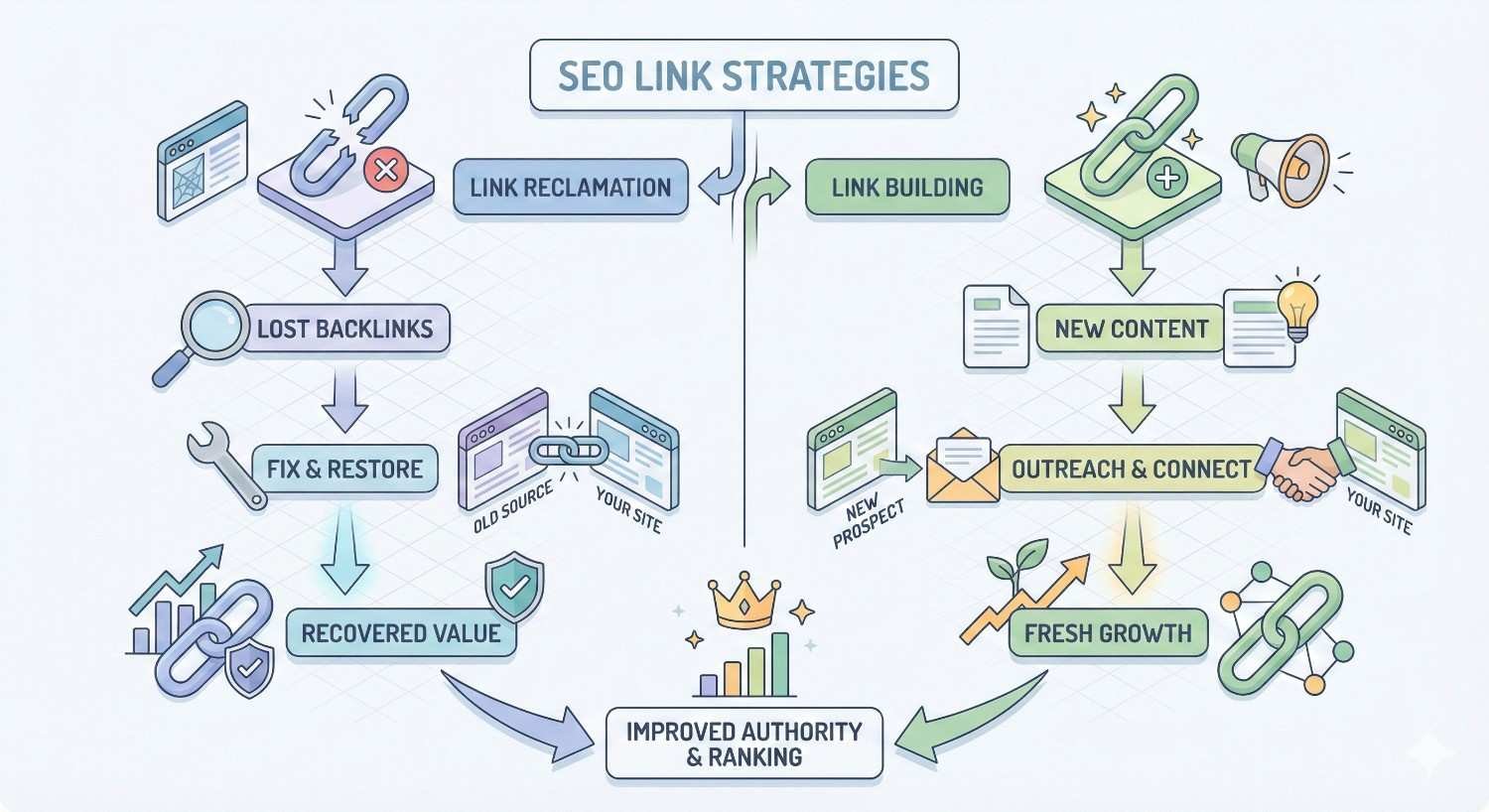
Link Reclamation vs. Link Building
Traditional link building focuses on acquiring new backlinks from websites that have never linked to you before. This requires relationship building, content creation, and significant outreach effort to convince site owners your content deserves a link.
Link reclamation works with existing relationships and prior editorial decisions. Someone already chose to link to you once, making the conversation fundamentally different. You’re asking them to restore something that existed rather than requesting a new favor.
The conversion rates reflect this distinction. Cold outreach for new links typically yields 1-5% success rates, while link reclamation outreach often achieves 10-25% recovery rates because you’re working with established context. The time investment per recovered link is substantially lower.
Both strategies belong in a comprehensive SEO program. Link building expands your authority footprint while link reclamation protects and maintains what you’ve already built.
Types of Lost Links You Can Reclaim
Broken backlinks occur when linking sites point to URLs that return 404 errors. This happens when you change URL structures, delete pages, or migrate to a new domain without proper redirects.
Removed links result from editorial decisions on linking sites. They might update content, redesign pages, or simply decide to remove external links during routine maintenance.
Unlinked brand mentions represent opportunities where websites reference your brand, products, or content without including a hyperlink. These aren’t technically “lost” links but represent unrealized link equity.
Changed links happen when a site updates a link to point somewhere else, often to a competitor or a different resource they consider more current.
Domain-level losses occur when entire linking domains expire, shut down, or undergo ownership changes that result in content removal.
Why Link Reclamation Matters for SEO
Impact on Domain Authority and Rankings
Backlinks remain one of the strongest ranking signals in search algorithms. When you lose links, you lose the authority those links passed to your domain. Cumulative losses over time can significantly impact your competitive position.
Domain Authority and similar metrics from tools like Moz, Ahrefs, and Semrush directly reflect your backlink profile strength. A steady decline in linking domains correlates with ranking drops for competitive keywords.
The impact compounds for pages that relied heavily on specific high-authority backlinks. Losing a single link from a major publication or industry resource can trigger noticeable ranking changes within weeks.
Preserving Link Equity You’ve Already Earned
Every backlink represents past investment. Whether you earned links through content marketing, PR campaigns, product launches, or organic editorial coverage, that effort has already been expended.
Link equity preservation means protecting your SEO foundation. Rather than constantly building new links just to maintain current positions, reclamation ensures your baseline authority remains stable.
This preservation mindset shifts SEO from purely offensive tactics to a balanced approach. You’re defending existing rankings while simultaneously pursuing growth through new link acquisition.
Cost-Effectiveness Compared to New Link Acquisition
New link building campaigns require substantial resources. Content creation, outreach tools, personnel time, and often direct costs for digital PR or guest posting add up quickly.
Link reclamation leverages existing assets. The content already exists. The relationship context already exists. The editorial decision to link already happened once.
When comparing cost-per-link metrics, reclamation typically delivers 3-5x better ROI than new link acquisition. For resource-constrained teams, prioritizing reclamation before aggressive link building makes strategic sense.
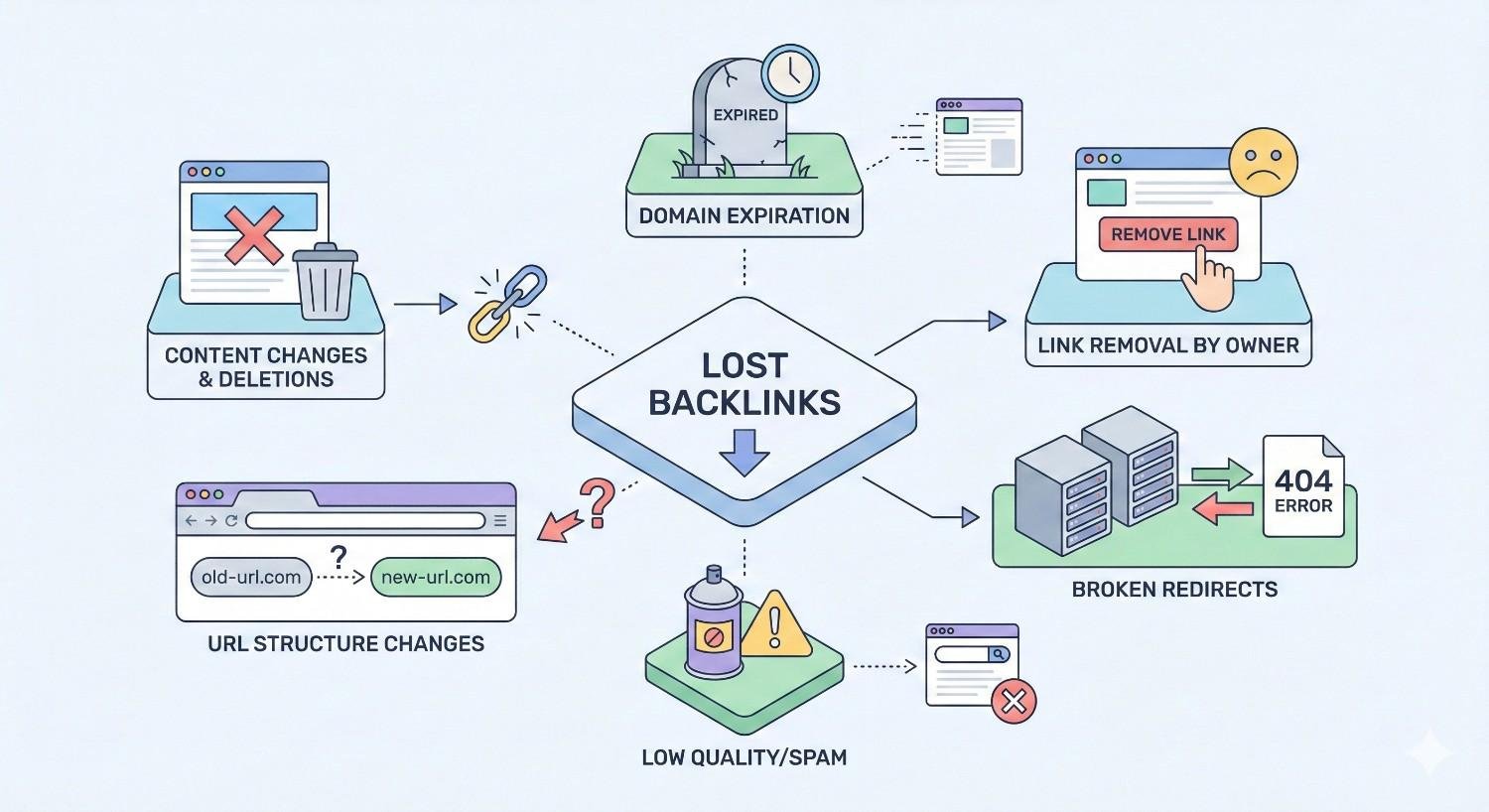
Common Causes of Lost Backlinks
Website Migrations and URL Changes
Site migrations represent the single largest source of preventable link loss. Moving to a new domain, changing CMS platforms, or restructuring URL patterns without comprehensive redirect mapping breaks existing backlinks.
Even well-planned migrations miss links. Legacy URLs that weren’t documented, dynamic parameters that weren’t accounted for, and edge cases in URL structures create gaps that linking sites fall through.
HTTPS migrations, while necessary for security, historically caused significant link loss when sites failed to redirect HTTP versions properly. Modern browsers and search engines handle this better, but legacy links may still point to non-secure versions.
Content Removal or Updates by Linking Sites
Linking websites constantly evolve their content. Resource pages get updated with fresher links. Blog posts get consolidated or removed. Editorial standards change, leading to link audits that remove older references.
Seasonal content cycles affect link stability. A holiday gift guide that linked to your product last year might feature different items this year. Industry roundups get refreshed annually with new entries.
Site redesigns on linking domains often result in collateral link loss. When webmasters rebuild navigation, update templates, or restructure content, external links sometimes disappear unintentionally.
Broken Links and 404 Errors
Internal changes to your site create broken backlinks when you don’t maintain redirect chains. Deleting old blog posts, removing discontinued products, or reorganizing site architecture without redirects leaves external links pointing nowhere.
CMS updates and plugin changes can alter URL structures unexpectedly. WordPress permalink changes, e-commerce platform migrations, and template updates sometimes modify URLs without warning.
Staging environment issues occasionally cause production URLs to break. Development work that accidentally goes live or database synchronization problems can temporarily or permanently break previously working URLs.
Domain Expiration and Site Shutdowns
Linking domains expire when owners fail to renew registration. The content disappears, taking your backlinks with it. Sometimes these domains get purchased by new owners who don’t restore the original content.
Business closures eliminate entire linking domains. Startups that shut down, publications that cease operations, and organizations that dissolve take their link equity with them permanently.
Platform shutdowns affect links from user-generated content. When social platforms, forums, or community sites close, links from those platforms vanish entirely.
Accidental Link Removal During Redesigns
Website redesigns frequently cause unintentional link loss. Developers rebuilding pages from scratch may not transfer all external links from the original content. Content migration between systems loses formatting and hyperlinks.
Template changes can strip links. Moving from one theme to another, updating widget areas, or changing sidebar content removes links that lived in those locations.
Content management handoffs create gaps. When new team members take over website maintenance, they may not understand the value of existing external links and remove them during “cleanup” efforts.
How to Find Lost and Broken Backlinks
Using Backlink Analysis Tools (Ahrefs, SEMrush, Moz)
Ahrefs provides the most comprehensive lost backlink reporting through its Site Explorer tool. The “Lost” filter in the backlinks report shows links that disappeared within your selected timeframe, including the last seen date and reason for loss.
Semrush offers backlink analytics with historical comparison features. You can track linking domain changes over time and identify when specific links dropped from your profile.
Moz Link Explorer provides lost link data alongside spam score metrics, helping you prioritize which lost links are worth pursuing based on quality indicators.
Each tool uses different crawling schedules and methodologies, so running reports across multiple platforms captures links that individual tools might miss.
Monitoring Link Loss with Alerts and Reports
Automated alerts notify you when significant link changes occur. Ahrefs and Semrush both offer email notifications for new and lost backlinks, allowing you to respond quickly before too much time passes.
Weekly or monthly backlink reports establish baseline tracking. Comparing current link counts against historical data reveals trends and identifies periods of unusual loss that warrant investigation.
Google Search Console provides referring domain data, though with less granularity than paid tools. The Links report shows top linking sites and can indicate when major referrers disappear.
Identifying Unlinked Brand Mentions
Brand mention monitoring tools find instances where websites reference your company without linking. These represent conversion opportunities rather than recovery situations, but the outreach approach is similar.
Google Alerts provides free monitoring for brand name mentions across the web. Set up alerts for your company name, product names, and key personnel to catch new mentions.
Mention and Brand24 offer more sophisticated monitoring with sentiment analysis and competitive tracking. These tools catch mentions that Google Alerts might miss.
Content analysis tools like BuzzSumo show which content mentioning your brand performs well, helping prioritize outreach to high-traffic pages.
Auditing Historical Link Data
Historical backlink data reveals patterns in link loss. Analyzing when and why links disappeared helps prevent future losses and identifies systemic issues.
Wayback Machine archives show what linking pages looked like when they contained your link. This context helps craft outreach messages and understand why links might have been removed.
Comparing backlink profiles across different time periods identifies gradual erosion versus sudden drops. Gradual loss suggests ongoing maintenance issues while sudden drops indicate specific events like migrations or algorithm updates.
Step-by-Step Link Reclamation Process
Step 1: Audit Your Backlink Profile
Export your complete backlink profile from your preferred SEO tool. Include metrics like Domain Rating, referring page URL, anchor text, and link status.
Filter for lost links within the past 6-12 months. Recent losses have higher recovery potential because the linking content likely still exists and webmasters remember the original context.
Categorize links by loss type: 404 errors on your site, removed by linking site, domain expired, or link changed. Each category requires different recovery approaches.
Document everything in a spreadsheet with columns for linking domain, original URL, current status, contact information, outreach status, and outcome.
Step 2: Prioritize Links by Value and Relevance
Not all lost links deserve equal recovery effort. Prioritize based on the linking domain’s authority, relevance to your niche, and the traffic potential of the linking page.
High-priority targets include links from domains with DR/DA 50+, industry publications, educational institutions, and government sites. These links carry significant authority and are worth substantial outreach effort.
Medium-priority links come from relevant blogs, niche directories, and business partners. These may not move rankings dramatically but contribute to a healthy, diverse backlink profile.
Low-priority links from low-authority sites, irrelevant niches, or potentially spammy sources may not warrant active recovery. Some link loss actually improves your profile quality.
Step 3: Identify the Cause of Link Loss
Understanding why a link disappeared determines your recovery approach. Check if the issue originates on your site or the linking site.
For 404 errors on your domain, verify whether the target page was intentionally removed or accidentally broken. Check your redirect mapping and server logs for clues.
For links removed by external sites, use Wayback Machine to see the original linking page. Determine if the entire page was removed, redesigned, or if just your link was deleted.
For domain-level losses, check if the domain expired, was sold, or if the site simply shut down. Expired domains sometimes return, making periodic rechecks worthwhile.
Step 4: Craft Effective Outreach Messages
Personalization dramatically improves response rates. Reference the specific page, acknowledge their content, and explain clearly why restoring the link benefits their readers.
Keep messages concise. Webmasters receive numerous emails daily. Get to the point within the first two sentences: who you are, what link was lost, and what you’re requesting.
Provide the exact URL where the link should point. Make restoration as easy as possible by including the correct anchor text and destination URL.
Offer value when possible. If you’ve updated the linked content, mention the improvements. If you can offer reciprocal promotion or other benefits, include that context.
Step 5: Implement Technical Fixes (Redirects, 404 Resolution)
For broken links caused by your URL changes, implement 301 redirects from old URLs to current equivalents. This recovers link equity without requiring external outreach.
Audit your redirect chains for efficiency. Multiple redirect hops dilute link equity. Consolidate chains to single redirects where possible.
Fix or restore accidentally deleted pages if the content still has value. Sometimes the fastest recovery path is simply putting the original content back online.
Update internal links that might be causing redirect chains. Clean internal linking improves crawl efficiency and ensures link equity flows properly.
Step 6: Track Recovery and Document Results
Log every outreach attempt with dates, contact methods, and responses. This prevents duplicate outreach and helps refine your approach over time.
Track recovery rates by link type, outreach template, and follow-up cadence. Data reveals which approaches work best for your specific situation.
Monitor ranking changes for pages that received recovered links. Correlating link recovery with ranking improvements demonstrates ROI and justifies continued investment.
Document lessons learned for future campaigns. Note which domains responded positively, which templates performed best, and which link types proved unrecoverable.
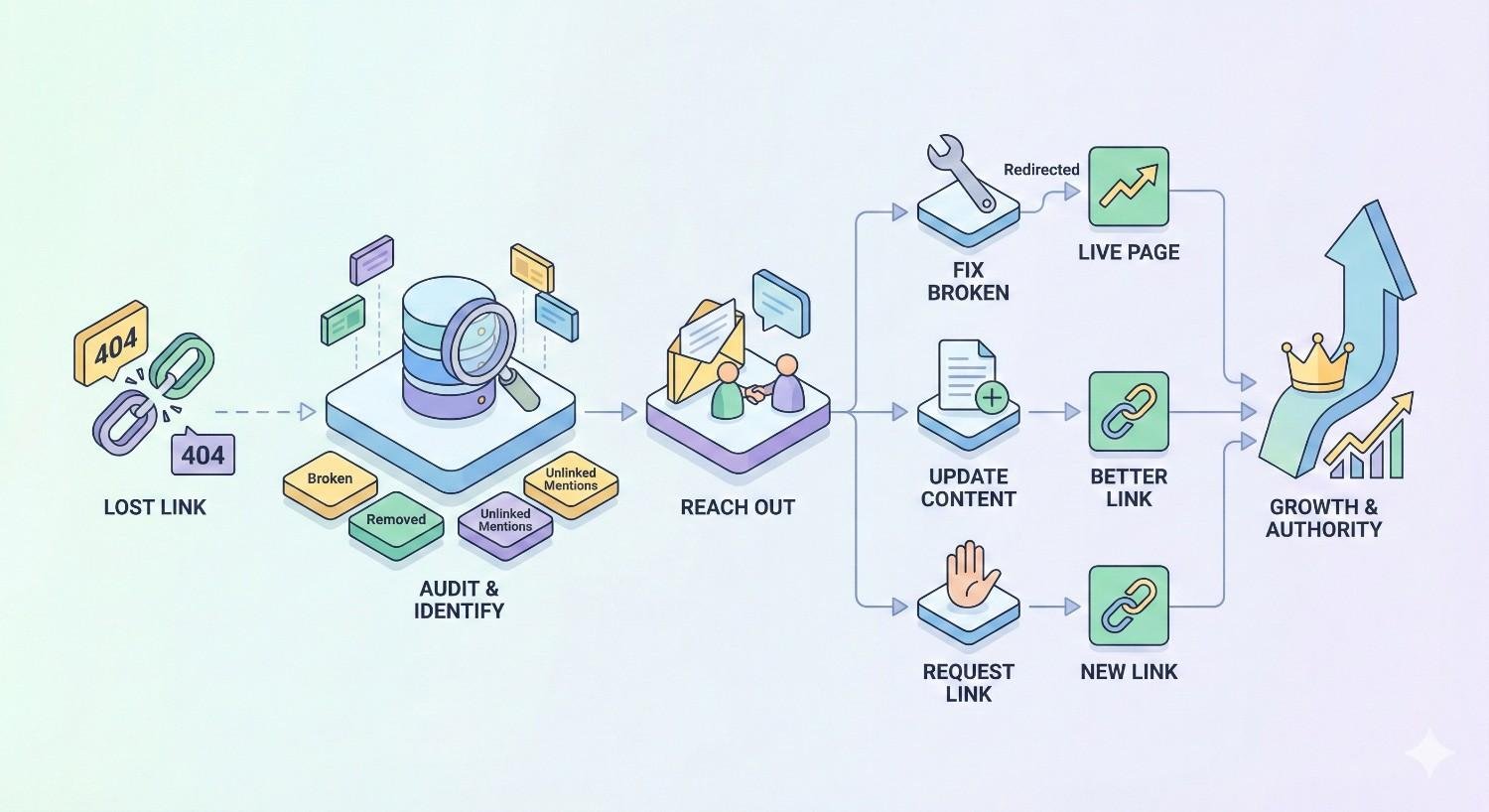
Link Reclamation Outreach Best Practices
Personalization and Relationship Building
Generic outreach fails. Webmasters recognize template emails immediately and delete them without reading. Personalization signals that you’ve actually visited their site and value the relationship.
Reference specific content on their site beyond just the linking page. Mention a recent article you found valuable or comment on their site’s focus area. This demonstrates genuine engagement.
Build relationships before you need them. Engaging with potential linking sites through social media, comments, and shares creates familiarity that improves outreach response rates.
Consider the webmaster’s perspective. They gain nothing from restoring your link unless you frame it as beneficial to their readers or site quality.
Email Templates That Get Responses
Broken Link Template:
Subject: Quick fix for [Page Title] on [Their Site]
Hi [Name],
I noticed the link to [topic] on your [page title] page is currently broken. It was pointing to our guide on [subject], which has moved to [new URL].
Would you mind updating the link? Your readers would still find it valuable since we’ve actually expanded the content with [specific improvement].
Thanks for considering, [Your name]
Removed Link Template:
Subject: Question about [Their Page Title]
Hi [Name],
I noticed our resource on [topic] was previously linked from your [page title] article but appears to have been removed during recent updates.
If it was intentional, no worries at all. But if it was accidental, here’s the current URL: [link]
Either way, thanks for the original mention.
[Your name]
Follow-Up Strategies and Timing
First follow-up should occur 5-7 days after initial outreach. Many emails get buried or forgotten rather than intentionally ignored.
Second follow-up at 14 days uses a different angle. Acknowledge your previous email and offer additional context or value.
Third and final follow-up at 21-28 days should be brief and provide an easy out. “Just checking if you saw my previous emails. If this isn’t something you can help with, no problem at all.”
Stop after three attempts. Continued outreach becomes spam and damages your reputation for future interactions.
Handling Non-Responsive Webmasters
Accept that many outreach attempts will fail. Even excellent outreach achieves 15-25% response rates at best. Non-response is the norm, not the exception.
Try alternative contact methods if email fails. LinkedIn messages, Twitter DMs, or contact forms sometimes reach people who miss emails.
For high-value links, consider phone outreach to businesses with published numbers. This approach is time-intensive but can break through when email fails.
Document non-responsive contacts for future reference. Circumstances change, and a webmaster who ignored you today might respond to a different request later.
Tools for Link Reclamation
Backlink Monitoring Tools
Ahrefs offers the most comprehensive backlink database with excellent lost link reporting. The Site Explorer tool shows exactly when links disappeared and why.
Semrush provides backlink analytics integrated with broader SEO workflows. The Backlink Audit tool specifically identifies toxic and lost links.
Moz Pro includes Link Explorer with spam score metrics that help prioritize which lost links are worth recovering based on quality signals.
Majestic offers unique metrics like Trust Flow and Citation Flow that provide additional quality assessment for prioritization decisions.
Outreach and CRM Platforms
Pitchbox automates outreach workflows with templates, follow-up sequences, and response tracking specifically designed for link building campaigns.
BuzzStream combines contact discovery with relationship management, helping teams track interactions across multiple campaigns.
Hunter.io finds email addresses associated with domains, essential for identifying the right contact when websites don’t list editorial emails publicly.
Standard CRM tools like HubSpot or Pipedrive can be adapted for link outreach with custom fields for tracking link-specific data.
Broken Link Checkers
Screaming Frog crawls your site to identify internal broken links and can check external links pointing to your domain when configured properly.
Ahrefs Site Audit identifies broken pages on your site that might be receiving external backlinks, prioritizing technical fixes.
Check My Links Chrome extension quickly validates links on any page, useful for checking linking pages during outreach research.
Dead Link Checker provides free bulk URL checking for validating lists of potentially broken backlinks.
Brand Mention Monitoring Tools
Google Alerts offers free, basic monitoring for brand mentions across Google’s index. Set up alerts for company name variations and key products.
Mention provides real-time monitoring across web, social, and news sources with sentiment analysis and competitive tracking.
Brand24 offers comprehensive mention tracking with influence scoring to prioritize outreach to high-impact mentions.
Awario includes Boolean search capabilities for precise mention monitoring and identifies unlinked mentions specifically.
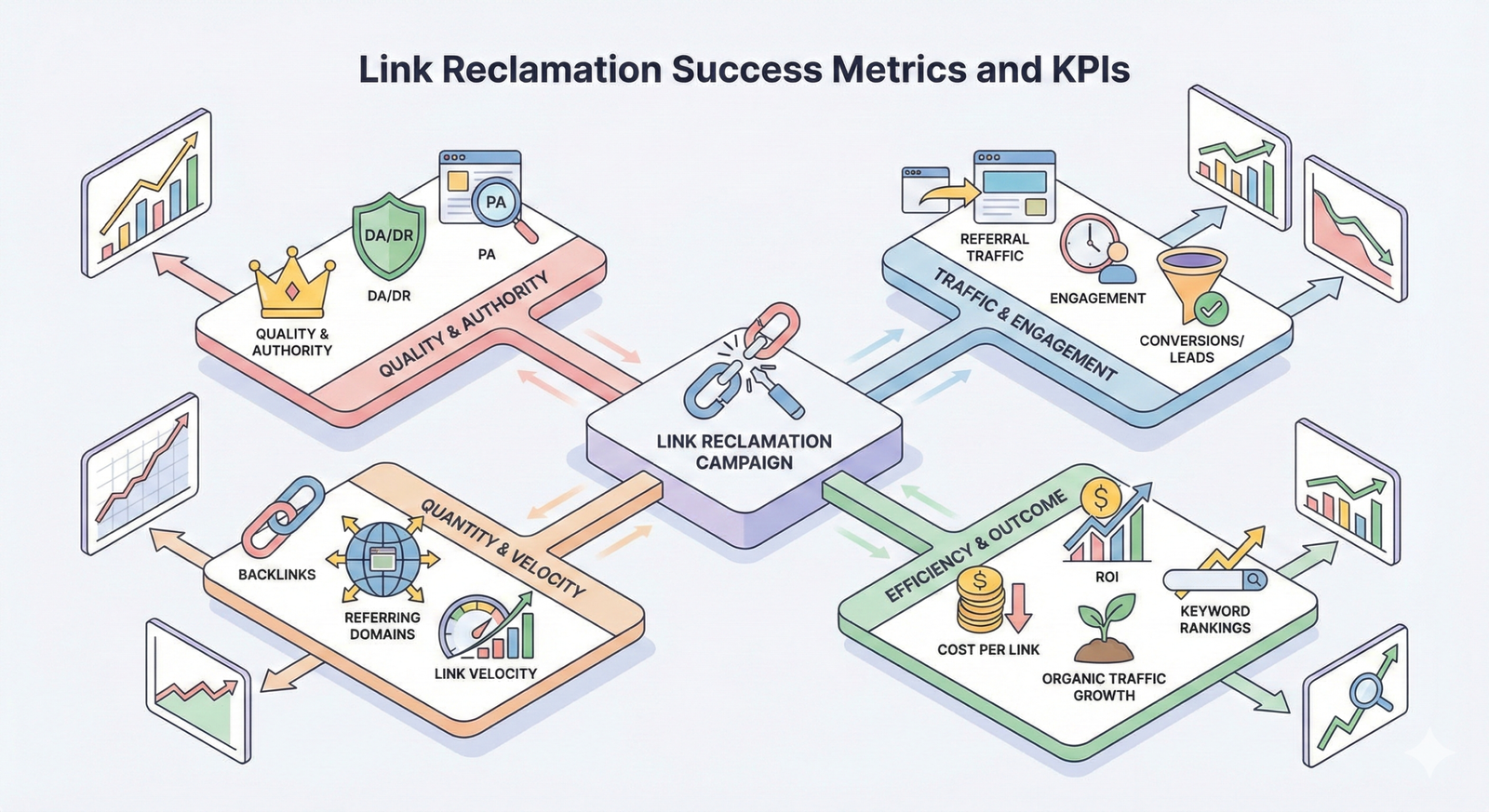
Link Reclamation Success Metrics and KPIs
Recovery Rate Benchmarks
Industry benchmarks suggest 15-25% recovery rates for well-executed link reclamation campaigns. Rates vary significantly based on link type and outreach quality.
Broken link recovery typically achieves higher rates (20-35%) because you’re helping webmasters fix a problem on their site rather than asking for a favor.
Removed link recovery rates tend to be lower (10-20%) since the removal was often intentional, even if the webmaster doesn’t remember the specific reason.
Brand mention conversion rates fall between 5-15% depending on the relationship context and value proposition offered.
Measuring Impact on Organic Traffic
Isolate traffic changes to pages that received recovered links. Compare organic sessions before and after recovery, accounting for seasonal variations and other ranking factors.
Track keyword ranking changes for target pages. Recovered links should correlate with improved positions for relevant queries within 4-8 weeks.
Monitor overall organic traffic trends alongside link recovery efforts. While individual link impacts are hard to isolate, sustained recovery efforts should contribute to positive traffic trajectories.
Tracking Domain Authority Changes
Domain Authority and Domain Rating metrics respond to backlink profile changes over time. Track these metrics monthly to observe trends.
Expect gradual improvements rather than dramatic jumps. Authority metrics aggregate many signals, so individual link recoveries produce incremental gains.
Compare your authority growth against competitors. Effective link reclamation should help you maintain or improve relative positioning even as competitors build new links.
Link Reclamation for Different Business Types
E-commerce and Retail Sites
E-commerce sites face unique challenges with product page link loss. Discontinued products, seasonal items, and inventory changes create constant URL churn that breaks existing backlinks.
Implement category-level redirects for discontinued products rather than 404 pages. This preserves link equity even when specific products are no longer available.
Product review links represent high-value recovery targets. Bloggers and publications that reviewed your products may have broken links due to URL changes or site migrations.
Seasonal content creates predictable link loss patterns. Gift guides, holiday roundups, and seasonal buying guides often remove links annually, creating recurring recovery opportunities.
SaaS and B2B Companies
SaaS companies often earn links through content marketing, making blog post and resource page links primary recovery targets.
Integration partner pages frequently link to your product. When partners update their integration directories or documentation, your links may disappear unintentionally.
Case study and testimonial links from clients represent high-authority opportunities. These links often break when client websites undergo redesigns or migrations.
Industry comparison and review sites regularly update their content. Monitor these sites for link changes and reach out promptly when your listing is affected.
Local Businesses and Service Providers
Local businesses benefit from directory and citation link reclamation. NAP (Name, Address, Phone) consistency across directories affects local SEO, and broken links compound these issues.
Local news coverage and community site links often break during site updates. These locally-relevant links carry significant weight for local search rankings.
Chamber of commerce, business association, and local organization links require periodic verification. These sites frequently redesign without maintaining external link integrity.
Sponsor and partnership links from local events, charities, and organizations represent recoverable opportunities when those organizations update their websites.
Startups and New Websites
Startups with limited backlink profiles feel individual link losses more acutely. Every link matters more when your total count is low.
Press coverage links from launch announcements and funding news often break as publications archive or reorganize content. These high-authority links deserve priority recovery efforts.
Early adopter and beta user links from blogs and forums may disappear as those platforms evolve. Document these links early and monitor them actively.
Founder personal brand links sometimes point to company pages that change. Ensure redirects capture links earned through founder visibility and thought leadership.
Common Link Reclamation Mistakes to Avoid
Ignoring Low-Authority Links
While prioritization makes sense, completely ignoring lower-authority links misses cumulative value. A diverse backlink profile includes links across the authority spectrum.
Low-authority links from relevant, legitimate sites still contribute to topical relevance signals. Niche blogs and small industry sites often provide contextually valuable links.
Recovery effort should scale with link value, not be binary. Spend less time on low-authority links, but don’t skip them entirely if recovery is straightforward.
Generic Outreach Templates
Copy-paste templates signal laziness and get ignored. Webmasters receive dozens of similar emails and recognize generic outreach immediately.
Personalization doesn’t require extensive research. Simply mentioning the specific page, acknowledging their content focus, and explaining the specific link issue demonstrates basic effort.
Test different approaches and track results. What works for one audience may fail with another. Continuous refinement improves response rates over time.
Failing to Fix Technical Issues First
Outreach for links pointing to broken pages wastes everyone’s time. Fix your 404 errors and implement redirects before asking webmasters to update their links.
Verify that recovered links will actually work. Nothing damages credibility faster than asking someone to restore a link that immediately breaks again.
Audit your site’s technical health regularly. Proactive maintenance prevents link loss and ensures recovery efforts aren’t undermined by ongoing technical problems.
Not Prioritizing High-Value Opportunities
Limited resources require strategic allocation. Spending equal effort on every lost link means high-value opportunities don’t receive adequate attention.
Create clear prioritization criteria before starting outreach. Domain authority, relevance, traffic potential, and recovery likelihood should all factor into your ranking system.
Review and adjust priorities as you gather data. Initial assumptions about which links matter most may prove incorrect as you see actual recovery results and ranking impacts.
Link Reclamation as Part of a Holistic SEO Strategy
Integrating with Technical SEO Audits
Link reclamation naturally connects with technical SEO work. Broken link identification, redirect implementation, and 404 resolution overlap significantly.
Include backlink health in regular technical audits. Checking for broken inbound links should be standard alongside internal link audits and crawl error reviews.
Coordinate migration planning with link preservation. Before any URL changes, document existing backlinks and plan redirects to maintain link equity.
Combining with Content Refresh Strategies
Content updates create natural outreach opportunities. When you improve a page that lost links, you have a compelling reason to reach out: the content is now better than when they originally linked.
Identify high-potential pages by cross-referencing lost links with content refresh candidates. Pages with significant link loss and outdated content deserve priority updates.
Use content improvements as outreach hooks. “We’ve completely updated our guide with 2024 data and new sections on [topic]” gives webmasters a reason to restore and even promote the link.
Building a Sustainable Link Maintenance System
Reactive link reclamation addresses existing losses. Proactive systems prevent losses and catch issues early when recovery is easier.
Establish monthly backlink monitoring routines. Regular checks identify losses quickly, before webmasters forget the original context.
Document your link assets comprehensively. Knowing which links you have makes identifying losses faster and ensures nothing falls through the cracks.
Create processes for common loss scenarios. Standard operating procedures for migrations, content updates, and URL changes should include link preservation steps.
Conclusion
Link reclamation delivers measurable SEO value by recovering authority you’ve already earned. The combination of higher success rates, lower costs, and faster results makes it an essential component of any comprehensive organic growth strategy.
At White Label SEO Service, we help businesses implement systematic link reclamation alongside technical SEO, content strategy, and ongoing authority building. Our data-driven approach identifies your highest-value recovery opportunities and executes outreach that actually gets results.
Ready to stop losing link equity and start recovering your SEO foundation? Contact our team to discuss how link reclamation fits into your broader organic growth strategy.
Frequently Asked Questions About Link Reclamation
How often should I audit my backlink profile?
Monthly audits catch link losses early when recovery rates are highest. Set up automated alerts for immediate notification of significant changes, then conduct deeper quarterly reviews to identify patterns and systemic issues.
Can I reclaim links from sites that no longer exist?
Links from expired or shut-down domains cannot be directly reclaimed. However, you can monitor expired domains for potential revival, and sometimes new owners restore original content. Focus recovery efforts on active sites where outreach can succeed.
What response rate should I expect from outreach?
Well-executed link reclamation outreach typically achieves 15-25% response rates, with actual recovery rates slightly lower. Broken link outreach performs better than removed link requests because you’re helping fix a problem rather than asking for a favor.
Should I use redirects or request link updates?
Use redirects for links you control through URL changes on your site. Request link updates when the linking site needs to change their href attribute. Ideally, implement redirects first as a safety net, then pursue outreach for cleaner link profiles.
How long does link reclamation take to show results?
Technical fixes like redirects can recover link equity within days of implementation. Outreach campaigns typically run 4-8 weeks to complete follow-up sequences. Ranking improvements from recovered links usually appear within 4-12 weeks depending on crawl frequency and competition.
Is link reclamation worth the effort for small businesses?
Absolutely. Small businesses often have limited backlink profiles where individual links carry more weight. The cost-effectiveness of reclamation versus new link building makes it particularly valuable for resource-constrained teams.
What is a good link reclamation success rate?
Recovery rates of 20-30% indicate effective outreach and proper prioritization. Rates below 10% suggest issues with targeting, messaging, or technical preparation. Rates above 35% are exceptional and typically involve primarily broken link recovery with strong existing relationships.