
Enterprise Magento stores face a unique SEO challenge: massive product catalogs, complex technical architectures, and multi-store configurations that standard optimization approaches simply cannot address. The difference between a well-optimized Magento enterprise site and a neglected one often translates to millions in organic revenue.
This matters because enterprise e-commerce operates at scale. A single technical SEO issue can cascade across thousands of product pages, while a strategic improvement can unlock exponential traffic growth. Your competitors are investing heavily in Magento SEO, and the gap widens daily.
This guide covers everything from technical foundations and on-page strategies to realistic timelines and partner selection. You will walk away with actionable frameworks for driving sustainable organic growth on your Magento enterprise store.

What Is Magento SEO and Why Does It Matter for Enterprise Stores?
Magento SEO encompasses the strategies, technical configurations, and content optimizations required to improve organic search visibility for stores built on the Magento (Adobe Commerce) platform. For enterprise operations, this extends far beyond basic meta tags and keyword placement into complex architectural decisions that affect crawlability, indexation, and ranking potential across thousands or millions of pages.
Enterprise stores operate in a different league. You are not optimizing a 50-page website. You are managing a dynamic ecosystem where product pages, category structures, filtered navigation, and multi-store configurations create both massive opportunity and significant risk. The scale amplifies everything: small wins compound into substantial traffic gains, while minor technical issues multiply into ranking disasters.
Understanding Magento’s Architecture and Search Visibility
Magento’s architecture presents both advantages and challenges for search visibility. The platform generates URLs dynamically, creates multiple paths to the same content, and relies heavily on JavaScript for certain functionalities. Understanding how search engines interact with this architecture is foundational to any optimization effort.
The platform uses a modular structure where products, categories, CMS pages, and attributes interconnect through database relationships. This creates flexibility for merchandising but introduces complexity for SEO. A single product might be accessible through its direct URL, multiple category paths, and search result pages simultaneously.
Magento’s default URL structure often includes unnecessary parameters and session IDs that dilute crawl budget. The platform generates layered navigation URLs that can create thousands of near-duplicate pages. Without proper configuration, Googlebot may spend its crawl budget on low-value filtered pages instead of your priority content.
The rendering process also matters. Magento 2 uses RequireJS and KnockoutJS extensively, which means some content loads via JavaScript. While Google has improved JavaScript rendering capabilities, delays in content discovery and indexation remain real concerns for enterprise catalogs.
Enterprise vs. Standard Magento SEO Requirements
Standard Magento SEO focuses on individual page optimization, basic technical hygiene, and content creation. Enterprise Magento SEO requires systematic approaches that scale across massive catalogs while maintaining consistency and preventing technical debt accumulation.
Enterprise stores typically manage 10,000+ SKUs, multiple store views, international operations, and complex category hierarchies. This scale demands automation, governance frameworks, and technical solutions that smaller stores never encounter. Manual optimization becomes impossible; you need systems that enforce SEO standards programmatically.
The stakeholder landscape differs significantly. Enterprise SEO involves development teams, merchandising departments, marketing groups, and executive leadership. Decisions require cross-functional alignment, and implementations compete with feature development for engineering resources. Your SEO strategy must account for organizational dynamics, not just technical requirements.
Budget allocation also shifts at enterprise scale. While a small store might spend a few hundred dollars monthly on SEO tools, enterprise operations require dedicated resources, specialized extensions, and often external expertise. The investment is higher, but the ROI potential scales proportionally with catalog size and traffic volume.
Technical SEO Foundations for Magento Enterprise
Technical SEO forms the infrastructure upon which all other optimization efforts depend. For enterprise Magento stores, technical foundations determine whether search engines can efficiently discover, crawl, render, and index your content. Weaknesses here undermine every other SEO investment you make.
The complexity of enterprise Magento installations means technical SEO extends beyond standard best practices. You are dealing with custom modules, third-party integrations, CDN configurations, and server architectures that introduce unique challenges. A systematic approach to technical foundations prevents issues from compounding as your catalog grows.
Site Architecture and Crawlability Optimization
Site architecture determines how search engines navigate your store and how link equity flows between pages. For enterprise catalogs, architecture decisions made early become difficult to change later. Getting this right from the start saves significant remediation costs.
Your category structure should mirror how customers think about your products while maintaining reasonable depth. Most enterprise stores perform best with three to four levels of category hierarchy. Deeper structures dilute link equity and create user experience friction. Flatter structures improve crawlability but may sacrifice organizational clarity.
Crawl budget management becomes critical at scale. Google allocates finite resources to crawling your site, and enterprise stores must ensure those resources target high-value pages. Implement crawl budget optimization by blocking low-value URLs in robots.txt, using noindex directives strategically, and ensuring your most important pages receive internal links.
Faceted navigation creates particular challenges. A category with ten filterable attributes, each with five options, theoretically generates millions of URL combinations. Without controls, search engines waste crawl budget on these permutations while your priority pages go undiscovered. Implement parameter handling through Google Search Console and use canonical tags to consolidate equity.
Internal linking architecture should prioritize your highest-value pages. Product pages with strong conversion potential, category pages targeting competitive keywords, and content hubs building topical authority all deserve prominent internal link placement. Audit your link distribution regularly to ensure equity flows where it matters most.
URL Structure and Canonical Tag Management
URL structure affects both user experience and search engine understanding. Magento’s default URL patterns often include unnecessary complexity that harms SEO performance. Enterprise stores must establish URL conventions and enforce them consistently across the catalog.
Clean URLs should be descriptive, concise, and keyword-relevant. Remove unnecessary parameters, session IDs, and tracking codes from indexed URLs. Configure Magento to generate SEO-friendly URLs by default, and establish governance processes that prevent non-compliant URLs from entering production.
Canonical tag implementation requires careful planning for enterprise catalogs. Every indexable page needs a self-referencing canonical tag. Pages accessible through multiple URL paths need canonical tags pointing to the preferred version. Filtered navigation pages typically should canonical to the parent category unless the filtered view targets distinct search intent.
Common canonical mistakes include inconsistent protocol usage (http vs. https), trailing slash variations, and parameter handling inconsistencies. Audit your canonical implementation regularly using crawling tools to identify conflicts and gaps. A single misconfigured canonical pattern can affect thousands of pages in enterprise catalogs.
Cross-domain canonicals become relevant for multi-store operations. If you operate regional stores with overlapping content, canonical tags can consolidate ranking signals to your preferred domain. However, this approach requires careful consideration of your international SEO strategy and hreflang implementation.
Page Speed and Core Web Vitals for Magento
Page speed directly impacts both rankings and conversions. Google’s Core Web Vitals measure real-user experience through Largest Contentful Paint (LCP), First Input Delay (FID), and Cumulative Layout Shift (CLS). Enterprise Magento stores often struggle with these metrics due to complex page compositions and heavy JavaScript usage.
LCP optimization for Magento typically focuses on image delivery and server response times. Implement lazy loading for below-fold images, serve appropriately sized images through responsive image techniques, and use modern formats like WebP. Server-side improvements include full-page caching, CDN implementation, and database query optimization.
FID improvements require JavaScript optimization. Magento’s default JavaScript bundles are often larger than necessary. Implement code splitting, defer non-critical scripts, and minimize main thread blocking. Consider removing or replacing heavy third-party scripts that contribute to interaction delays.
CLS problems commonly stem from images without dimensions, dynamically injected content, and web fonts causing layout shifts. Reserve space for images and ads before they load. Use font-display: swap with appropriate fallback fonts to prevent text shifting during font loading.
Enterprise stores should monitor Core Web Vitals through Google Search Console’s Core Web Vitals report and field data from Chrome User Experience Report. Lab testing with Lighthouse provides diagnostic information, but field data reflects actual user experience and influences rankings.
XML Sitemaps and Robots.txt Configuration
XML sitemaps help search engines discover your content efficiently. For enterprise catalogs, sitemap strategy requires segmentation, prioritization, and ongoing maintenance to remain effective as your catalog evolves.
Segment your sitemaps by content type: products, categories, CMS pages, and blog posts should have separate sitemap files. This segmentation improves monitoring and allows you to identify indexation issues by content type. Magento’s default sitemap generation may need customization to achieve optimal segmentation.
Sitemap size limits matter at enterprise scale. Individual sitemap files cannot exceed 50,000 URLs or 50MB uncompressed. Large catalogs require sitemap index files that reference multiple child sitemaps. Ensure your sitemap generation process handles these limits automatically.
Include only indexable, canonical URLs in your sitemaps. Filtered navigation URLs, paginated URLs beyond the first page, and URLs blocked by robots.txt should not appear in sitemaps. Misalignment between sitemaps and indexation directives creates mixed signals that confuse search engines.
Robots.txt configuration controls crawler access to your site. Block crawlers from low-value URL patterns like checkout pages, customer account areas, and internal search results. However, be cautious about blocking too aggressively. Blocking CSS and JavaScript files prevents search engines from rendering your pages correctly.
Test robots.txt changes carefully before deployment. A single syntax error can accidentally block your entire site from crawling. Use Google Search Console’s robots.txt tester to validate your configuration and identify potential issues.
Structured Data and Schema Markup Implementation
Structured data helps search engines understand your content and enables rich results in search listings. For e-commerce, Product schema, Review schema, and Organization schema provide the foundation for enhanced visibility.
Product schema should include essential properties: name, description, image, price, availability, and SKU. Include brand, GTIN, and MPN when available. Aggregate rating data from customer reviews enhances your product snippets with star ratings that improve click-through rates.
Implement BreadcrumbList schema to help search engines understand your site hierarchy and display breadcrumb trails in search results. This improves user experience by showing searchers where they will land within your site structure.
FAQ schema on relevant pages can capture additional SERP real estate through expandable question-and-answer displays. Use this strategically on category pages and content hubs where you address common customer questions.
Validate your structured data implementation using Google’s Rich Results Test and monitor for errors in Search Console’s Enhancements reports. Schema errors can prevent rich results from displaying and may indicate broader implementation issues.
Enterprise stores should implement structured data programmatically through templates rather than manual markup. This ensures consistency across your catalog and reduces maintenance burden as schema requirements evolve.
On-Page SEO Strategies for Magento Product and Category Pages
On-page optimization transforms your technical foundation into ranking potential. For enterprise Magento stores, on-page strategy must balance individual page optimization with scalable approaches that maintain quality across thousands of pages.
The challenge lies in creating unique, valuable content at scale. Product descriptions, meta data, and category content all require optimization, but manual approaches become impractical for large catalogs. Successful enterprise on-page SEO combines template-based automation with strategic manual optimization for priority pages.
Product Page Optimization Best Practices
Product pages represent your primary conversion opportunities and often target long-tail keywords with strong purchase intent. Optimization here directly impacts both organic traffic and revenue.
Unique product descriptions differentiate your pages from competitors and manufacturer content. While writing unique descriptions for every SKU may be impractical, prioritize your highest-traffic and highest-margin products. For remaining products, ensure descriptions provide genuine value rather than duplicating manufacturer specs.
Title tags should include the product name, key attributes (size, color, model), and brand when relevant. Keep titles under 60 characters to prevent truncation. Use a consistent template that places the most important information first while allowing for product-specific customization.
Image optimization extends beyond alt text. Use descriptive file names, compress images appropriately, and implement multiple product images showing different angles and use cases. Image search drives meaningful traffic for many product categories, and well-optimized images improve page performance.
Customer reviews provide unique, regularly updated content that search engines value. Implement review functionality and encourage customers to leave detailed feedback. Display reviews prominently on product pages and mark them up with Review schema for potential rich results.
Product page URL structure should be clean and descriptive. Include the product name and relevant attributes while avoiding unnecessary parameters. Consistent URL patterns across your catalog improve crawlability and user experience.
Category Page SEO and Faceted Navigation
Category pages often target higher-volume keywords than individual products and serve as entry points for users exploring your catalog. Optimizing these pages requires balancing SEO objectives with merchandising flexibility.
Category descriptions provide unique content opportunities. Write substantial introductory content that addresses user intent, includes relevant keywords naturally, and guides visitors toward appropriate products. Place this content strategically so it does not interfere with product visibility.
Faceted navigation enables users to filter products by attributes but creates SEO challenges through URL proliferation and duplicate content. Implement a clear strategy for which filter combinations should be indexable, which should use canonical tags, and which should be blocked entirely.
High-value filter combinations that target distinct search intent may deserve indexable URLs. For example, “red running shoes” might warrant its own indexable page if search volume justifies it. However, most filter combinations should consolidate to the parent category through canonical tags or remain non-indexable.
Pagination handling affects both crawlability and user experience. Implement rel=”prev” and rel=”next” for paginated series, though note that Google no longer uses these as indexing signals. Consider infinite scroll with SEO fallback or “load more” functionality that maintains crawlable pagination.
Category page internal linking should highlight featured products, bestsellers, and new arrivals. This distributes link equity to priority products while improving user navigation. Update these links regularly to reflect current merchandising priorities.
Meta Tags, Titles, and Descriptions at Scale
Meta optimization at enterprise scale requires template-based approaches that maintain quality while enabling automation. Your templates should produce unique, compelling meta content without manual intervention for every page.
Title tag templates should incorporate dynamic elements: product name, category, brand, and key attributes. Build templates that generate titles within character limits while prioritizing the most important information. Test different template structures to identify what drives the best click-through rates.
Meta descriptions should compel clicks while accurately representing page content. Include calls to action, unique value propositions, and relevant keywords. While meta descriptions do not directly influence rankings, they significantly impact click-through rates from search results.
Avoid duplicate meta content across your catalog. Even template-based approaches should produce unique combinations for each page. Audit your meta content regularly to identify duplicates and refine templates accordingly.
Priority pages warrant manual meta optimization. Your highest-traffic categories, flagship products, and strategic landing pages deserve custom-written titles and descriptions that maximize their potential. Allocate resources for ongoing optimization of these priority pages.
Internal Linking Architecture for Large Catalogs
Internal linking distributes ranking authority throughout your site and helps search engines discover content. For enterprise catalogs, internal linking strategy must be systematic and scalable.
Navigation links provide baseline internal linking but should not be your only approach. Supplement navigation with contextual links within content, related product recommendations, and cross-category connections that reflect how customers actually shop.
Related products and “customers also bought” sections create internal links while improving user experience. Ensure these recommendations are genuinely relevant rather than random. Machine learning-based recommendation engines can optimize both conversion and internal linking simultaneously.
Content-to-product linking connects your blog posts, buying guides, and educational content to relevant products. This distributes authority from content pages to commercial pages while providing user value. Implement these links contextually within content rather than as generic sidebar widgets.
Audit internal link distribution regularly. Tools like Screaming Frog can identify pages with few internal links (orphan pages) and pages receiving disproportionate link equity. Rebalance your internal linking to ensure priority pages receive appropriate attention.
Content Strategy for Magento Enterprise Stores
Content strategy extends Magento SEO beyond product and category pages into topical authority building. Enterprise stores that invest in content capture informational search traffic, build brand awareness, and create link-worthy assets that strengthen overall domain authority.
The content opportunity for e-commerce is substantial. Customers research before purchasing, seeking buying guides, comparison content, how-to information, and expert advice. Capturing this research-phase traffic positions your brand as an authority and creates remarketing opportunities.
Building Topical Authority Through Content Hubs
Content hubs organize related content around core topics, demonstrating comprehensive expertise to both users and search engines. For enterprise stores, hubs should align with product categories and customer interests.
Structure hubs with pillar pages that provide comprehensive topic overviews, supported by cluster content addressing specific subtopics. Internal linking between hub content reinforces topical relationships and distributes authority throughout the hub.
Hub topics should reflect your product expertise and customer needs. A sporting goods retailer might build hubs around specific sports, training methodologies, or equipment categories. Each hub positions the brand as an authority while creating natural connections to relevant products.
Content within hubs should vary in format and depth. Include comprehensive guides, quick-reference content, comparison articles, and multimedia content. This variety addresses different user needs and search intents while demonstrating topic breadth.
Measure hub performance through organic traffic growth, keyword rankings for hub-related terms, and engagement metrics. Successful hubs compound over time as individual pieces gain authority and reinforce each other.
Blog Integration and CMS Page Optimization
Magento’s CMS capabilities enable blog integration and informational content creation. Optimizing this content requires the same attention as product pages, with additional focus on informational search intent.
Blog content should target informational keywords that your product pages cannot effectively address. Buying guides, how-to content, industry news, and expert advice all capture search traffic while building brand authority. Ensure blog content links naturally to relevant products and categories.
CMS page optimization includes proper heading structure, internal linking, and meta optimization. Treat CMS pages as seriously as product pages in your SEO strategy. Landing pages, about pages, and policy pages all contribute to your site’s overall authority.
Content freshness matters for certain topics. Regularly update time-sensitive content like buying guides, trend articles, and seasonal content. Search engines recognize freshness signals and may favor updated content for queries where recency matters.
Implement proper URL structures for blog content that reflect your content hierarchy. Consistent patterns improve crawlability and help users understand content relationships.
User-Generated Content and Reviews for SEO
User-generated content provides unique, regularly updated material that search engines value. Reviews, Q&A sections, and community content all contribute to SEO while building trust with potential customers.
Product reviews add unique content to product pages while providing social proof. Encourage detailed reviews through follow-up emails, incentive programs, and easy submission processes. Display reviews prominently and implement Review schema for potential rich results.
Q&A functionality allows customers to ask questions that you or other customers can answer. This content often captures long-tail search queries that product descriptions miss. Monitor Q&A sections for common questions that might warrant dedicated content or product page updates.
Community content like forums or user galleries creates engagement while generating indexable content. However, community features require moderation to prevent spam and maintain quality. Only implement community features if you can commit to ongoing management.
Moderate user-generated content for quality and appropriateness. Remove spam, address inappropriate content, and respond to negative reviews professionally. Well-managed UGC builds trust; poorly managed UGC damages brand perception.
Magento SEO for Multi-Store and International Operations
Enterprise Magento installations often serve multiple regions, languages, or brands through multi-store configurations. International SEO adds complexity layers that require careful planning and ongoing management.
The opportunity is significant. International expansion multiplies your addressable market, and organic search provides cost-effective customer acquisition across regions. However, implementation mistakes can dilute your SEO efforts or create penalties for duplicate content.
Hreflang Implementation and Multi-Language SEO
Hreflang tags tell search engines which language and regional versions of pages to show different users. Correct implementation ensures French users see your French content while American users see your US content.
Implement hreflang tags for every page that has alternate language or regional versions. Tags should appear in the HTML head, HTTP headers, or XML sitemaps. Consistency across implementation methods is critical; mixing approaches can create conflicts.
Hreflang values must use correct ISO language and country codes. Common mistakes include using “en-uk” instead of “en-gb” or omitting the language code entirely. Validate your implementation using Google Search Console’s International Targeting report.
Self-referencing hreflang tags are required. Each page must include a hreflang tag pointing to itself in addition to tags pointing to alternate versions. Missing self-references can cause implementation failures.
Return links must be reciprocal. If your US page points to your UK page via hreflang, your UK page must point back to your US page. Asymmetric implementations signal errors to search engines and may be ignored.
Managing Duplicate Content Across Store Views
Multi-store configurations often create duplicate content challenges. Products available in multiple regions may have identical descriptions, and category structures may mirror each other across store views.
Hreflang implementation is your primary tool for managing cross-store duplicate content. When properly implemented, hreflang signals that pages are regional variations rather than duplicates. Search engines will show the appropriate version to each user.
Unique content for each store view strengthens your international SEO. Localized descriptions, region-specific product information, and culturally appropriate content differentiate your regional stores beyond simple translation.
Canonical tags should not point across store views unless you intentionally want to consolidate rankings to a single version. Each store view should have self-referencing canonicals with hreflang tags handling regional targeting.
Monitor indexation across store views through Google Search Console. Create separate Search Console properties for each regional domain or subdomain to track performance and identify issues specific to each market.
Regional Targeting and Geo-Specific Optimization
Beyond language, regional targeting addresses country-specific search behavior, local competition, and market-specific opportunities. Effective geo-targeting requires understanding each market’s unique characteristics.
Domain structure affects geo-targeting signals. Country-code top-level domains (ccTLDs) like .de or .co.uk provide strong geo-targeting signals but require separate domain management. Subdirectories (example.com/de/) consolidate domain authority but provide weaker geo-signals. Subdomains (de.example.com) fall between these options.
Google Search Console’s International Targeting feature allows you to specify target countries for generic TLDs. Use this feature for subdirectory or subdomain structures to strengthen geo-targeting signals.
Local link building strengthens regional authority. Acquire links from country-specific sources, local business directories, and regional publications. These links signal relevance to local search engines and users.
Content localization goes beyond translation. Address local market conditions, reference local events and trends, and use region-appropriate examples. This localization improves user engagement and signals genuine local relevance.
Common Magento SEO Challenges and How to Solve Them
Enterprise Magento stores encounter predictable SEO challenges that stem from the platform’s architecture and the complexity of large-scale operations. Understanding these challenges and their solutions prevents common pitfalls.
Proactive identification and resolution of these issues protects your organic traffic and prevents technical debt accumulation. Regular auditing and monitoring catch problems before they significantly impact performance.
Duplicate Content and Thin Page Issues
Duplicate content is perhaps the most common Magento SEO challenge. The platform’s architecture naturally creates multiple URL paths to the same content, and large catalogs often include pages with minimal unique content.
Layered navigation creates duplicate content through filter combinations. Implement canonical tags pointing filtered pages to parent categories, use parameter handling in Search Console, and consider noindex directives for low-value filter combinations.
Product URL variations occur when products are accessible through multiple category paths. Configure Magento to use canonical URLs that exclude category paths, ensuring each product has a single canonical URL regardless of how users navigate to it.
Thin content pages provide little value to users and may trigger quality algorithms. Identify pages with minimal content through crawl audits and either expand their content, consolidate them with related pages, or remove them from the index.
Pagination can create thin content issues when paginated pages contain only product listings without unique content. Ensure pagination is implemented correctly and consider whether all paginated pages need to be indexed.
JavaScript Rendering and Indexation Problems
Magento 2’s reliance on JavaScript creates potential indexation issues. While Google can render JavaScript, delays and rendering failures can prevent content from being indexed properly.
Test JavaScript rendering using Google Search Console’s URL Inspection tool. Compare the rendered HTML to your source HTML to identify content that depends on JavaScript execution. Critical content should be available in the initial HTML response.
Implement server-side rendering or dynamic rendering for critical content. This ensures search engines receive fully rendered HTML while maintaining JavaScript functionality for users. Solutions like Hyvä themes reduce JavaScript dependency significantly.
Monitor for JavaScript errors that might prevent rendering. Broken scripts, third-party failures, and resource loading issues can all prevent proper page rendering. Regular testing catches these issues before they impact indexation.
Lazy-loaded content may not be indexed if it requires user interaction to load. Ensure important content loads without user action, or implement intersection observer patterns that trigger loading as content approaches the viewport.
Extension Conflicts and SEO Plugin Selection
Magento’s extension ecosystem provides powerful functionality but introduces potential conflicts and quality concerns. SEO extensions specifically require careful evaluation and ongoing monitoring.
Evaluate extensions based on code quality, update frequency, and developer reputation. Poorly coded extensions can introduce security vulnerabilities, performance issues, and SEO problems. Check reviews, examine the developer’s track record, and test thoroughly before production deployment.
Extension conflicts occur when multiple extensions modify the same functionality. SEO extensions that modify meta tags, URL structures, or sitemap generation may conflict with each other or with core Magento functionality. Test extension combinations in staging environments before production deployment.
Keep extensions updated to receive security patches and compatibility fixes. However, test updates in staging before applying to production. Extension updates can introduce breaking changes that affect SEO functionality.
Audit extension impact on page speed. Some extensions add significant JavaScript or CSS that degrades performance. Evaluate whether extension benefits justify their performance costs and consider alternatives for heavy extensions.
Migration SEO: Preserving Rankings During Platform Updates
Platform migrations and major updates risk significant organic traffic loss if not handled carefully. Magento version upgrades, redesigns, and platform migrations all require comprehensive SEO planning.
Create complete URL inventories before migration. Map every existing URL to its post-migration equivalent. This mapping drives redirect implementation and helps identify URLs that may not have direct equivalents.
Implement 301 redirects for all changed URLs. Redirects should point to the most relevant equivalent page, not generic category pages or the homepage. Test redirect implementation thoroughly before launch.
Preserve on-page optimization through migration. Meta tags, heading structures, and content should transfer to new URLs. Create checklists to verify optimization elements survive the migration process.
Monitor performance closely after migration. Track rankings, traffic, and indexation for several months post-migration. Quick identification of issues enables rapid response before traffic loss compounds.
Plan for temporary ranking fluctuations. Even well-executed migrations typically see short-term ranking volatility as search engines process changes. Set stakeholder expectations appropriately and avoid panic-driven changes during the stabilization period.
How Long Does Magento SEO Take to Show Results?
This question reflects a fundamental concern for enterprise stakeholders investing in SEO. The honest answer involves multiple timeframes and depends on your starting position, competitive landscape, and investment level.
SEO is not a switch you flip. It is a compounding investment where early work creates foundations for later gains. Understanding realistic timelines helps set appropriate expectations and prevents premature strategy abandonment.
Measuring Magento SEO Performance and ROI
Measurement frameworks transform SEO from a cost center into a demonstrable revenue driver. Enterprise stakeholders require clear metrics that connect SEO activities to business outcomes.
Effective measurement requires proper tracking infrastructure, meaningful KPIs, and reporting frameworks that communicate value to diverse stakeholders. Investment in measurement capabilities pays dividends through better decision-making and continued organizational support.
Key Performance Indicators for Enterprise E-commerce SEO
KPIs should span leading indicators (early signals of progress) and lagging indicators (ultimate business outcomes). This combination provides both early feedback and bottom-line accountability.
Organic traffic growth measures the fundamental output of SEO efforts. Segment by landing page type (product, category, content) to understand which areas drive growth. Year-over-year comparisons account for seasonality.
Keyword rankings track visibility for target terms. Focus on rankings for high-value keywords rather than vanity metrics. Track ranking distribution (keywords in positions 1-3, 4-10, 11-20, etc.) to understand overall visibility trends.
Organic revenue directly connects SEO to business outcomes. Implement proper attribution to credit organic search appropriately. Track revenue by landing page type and category to identify highest-value SEO opportunities.
Conversion rate from organic traffic indicates traffic quality. Declining conversion rates may signal traffic growth from low-intent keywords. Segment conversion rates by landing page type for actionable insights.
Crawl metrics from Google Search Console reveal technical health. Monitor crawl requests, crawl errors, and indexation status. Sudden changes in crawl patterns often indicate technical issues requiring attention.
Analytics Setup and Tracking Configuration
Proper analytics configuration ensures accurate measurement. Enterprise Magento stores require careful setup to capture the data needed for SEO analysis.
Implement enhanced e-commerce tracking in Google Analytics 4. This provides detailed transaction data including product performance, checkout behavior, and revenue attribution. Ensure tracking fires correctly across all store views and checkout steps.
Connect Google Search Console to Google Analytics for integrated reporting. This connection enables analysis of search queries alongside on-site behavior, providing insights into which queries drive valuable traffic.
Create custom segments for organic traffic analysis. Segment by device, geography, landing page type, and user behavior to understand organic traffic composition. These segments enable deeper analysis than aggregate metrics provide.
Set up goal tracking for micro-conversions like email signups, wishlist additions, and account creations. These conversions indicate engagement even when immediate purchases do not occur.
Implement proper cross-domain tracking if your checkout process uses a different domain. Without proper configuration, checkout traffic appears as new sessions, breaking attribution and inflating traffic counts.
Reporting Frameworks for Stakeholder Communication
Different stakeholders need different information. Executives want business impact summaries. Marketing teams want channel comparisons. Technical teams want implementation details. Effective reporting addresses each audience appropriately.
Executive dashboards should focus on revenue, traffic growth, and competitive position. Use visualizations that communicate trends clearly. Include context about market conditions and competitive activity that affects results.
Marketing reports should compare organic performance to other channels. Include cost-per-acquisition comparisons that demonstrate SEO efficiency. Highlight opportunities for cross-channel optimization.
Technical reports should detail crawl health, indexation status, and Core Web Vitals performance. Include specific issues requiring development attention and prioritize by impact.
Monthly reporting cadences work well for most stakeholders. Weekly reporting may be appropriate during migrations or major initiatives. Quarterly business reviews should synthesize trends and strategic implications.
Automate reporting where possible. Tools like Google Data Studio (Looker Studio) enable automated dashboard updates that reduce manual reporting burden while ensuring stakeholders have current information.
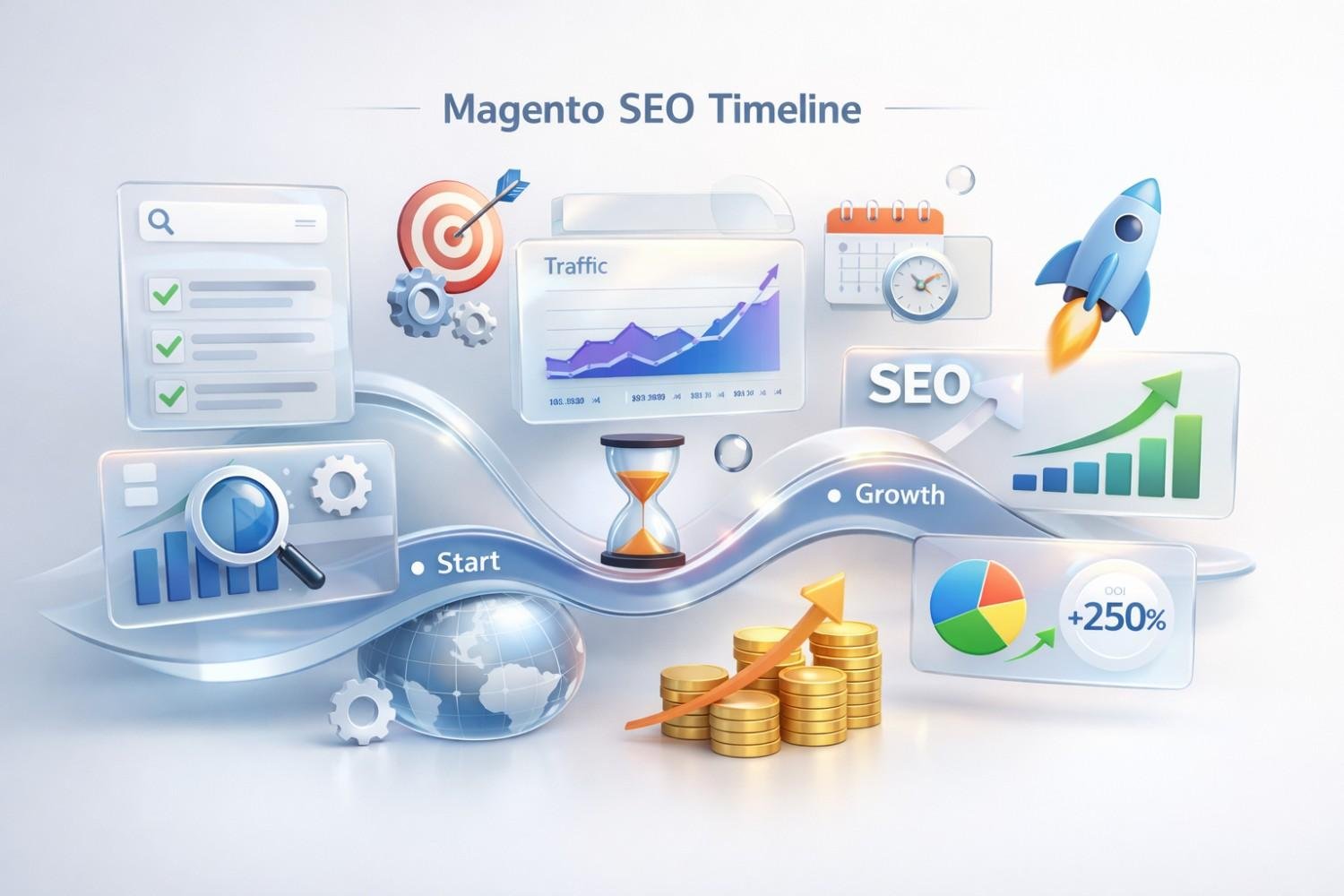
Magento SEO Timeline: What to Expect
Understanding realistic timelines prevents frustration and premature strategy changes. SEO results compound over time, and early patience enables long-term success.
These timelines assume consistent effort and reasonable investment. Reduced effort extends timelines proportionally. Competitive markets may require longer timeframes, while less competitive niches may see faster results.
Short-Term Wins (0-3 Months)
The first three months focus on technical foundations and quick wins. You are establishing infrastructure and capturing low-hanging fruit.
Technical audits identify critical issues requiring immediate attention. Fixing crawl errors, implementing redirects, and resolving indexation problems often produce quick visibility improvements. These fixes remove barriers that were actively suppressing your rankings.
On-page optimization for priority pages can show results within weeks for less competitive terms. Optimizing title tags, meta descriptions, and content for your highest-potential pages captures immediate opportunities.
Indexation improvements from sitemap optimization and crawl budget management help search engines discover your content more efficiently. You may see increased indexed pages and improved crawl statistics within this period.
Baseline establishment through proper tracking setup enables future measurement. Without accurate baselines, you cannot demonstrate progress. Invest in measurement infrastructure during this phase.
Expect modest traffic improvements during this phase, primarily from technical fixes and quick wins. Significant ranking improvements for competitive terms typically require longer timeframes.
Medium-Term Growth (3-6 Months)
Months three through six typically show accelerating results as foundational work compounds. Content investments begin maturing, and technical improvements fully propagate.
Ranking improvements for target keywords become visible. Pages optimized in earlier months gain traction as search engines recognize improvements. Monitor ranking trends rather than daily fluctuations.
Content published in earlier months begins ranking and driving traffic. Content SEO typically requires three to six months to mature. Patience during this period is essential.
Technical improvements fully propagate through search engine systems. Crawl patterns stabilize, indexation reflects your optimization efforts, and Core Web Vitals improvements appear in field data.
Traffic growth accelerates as multiple initiatives contribute simultaneously. The compounding nature of SEO becomes apparent during this phase.
Identify and double down on what is working. Analyze which content, keywords, and page types are gaining traction. Allocate resources toward proven opportunities.
Long-Term Authority Building (6-12+ Months)
Beyond six months, SEO transitions from catching up to building competitive advantage. Authority accumulation creates sustainable ranking power that competitors cannot quickly replicate.
Topical authority develops as content hubs mature and interlink. Search engines recognize your comprehensive coverage and reward it with broader visibility. Rankings improve for terms you have not explicitly targeted.
Link acquisition from content marketing efforts compounds. Quality content attracts natural links over time. These links strengthen domain authority and support rankings across your site.
Competitive positioning improves as your sustained effort outpaces competitors who lack consistency. Many competitors abandon SEO efforts before reaching this phase, creating opportunity for those who persist.
Traffic and revenue from organic search become significant business drivers. SEO transitions from experimental investment to proven channel. Organizational support for continued investment strengthens.
Continuous optimization maintains and extends gains. SEO is not a project with an end date. Ongoing effort protects existing rankings while capturing new opportunities.
Choosing the Right Magento SEO Partner
Enterprise Magento SEO often requires external expertise. The platform’s complexity and the scale of enterprise operations demand specialized knowledge that internal teams may lack. Choosing the right partner significantly impacts outcomes.
Partner selection deserves careful evaluation. The wrong partner wastes budget and time while potentially damaging your organic presence. The right partner accelerates results and transfers knowledge to your team.
In-House vs. Agency SEO for Enterprise Stores
The in-house versus agency decision depends on your organization’s capabilities, budget, and strategic priorities. Most enterprise operations benefit from hybrid approaches combining internal resources with external expertise.
In-house teams provide deep business knowledge, quick response times, and dedicated focus. However, building enterprise SEO expertise internally requires significant investment in hiring, training, and tools. In-house teams may lack exposure to diverse challenges that agencies encounter across clients.
Agency partnerships provide specialized expertise, scalable resources, and diverse experience. Agencies have seen problems you have not encountered and solutions you have not considered. However, agencies divide attention across clients and may lack deep understanding of your specific business.
Hybrid models combine internal coordination with external expertise. An internal SEO manager or team handles day-to-day optimization and stakeholder communication while agency partners provide strategic guidance, technical audits, and specialized projects.
Consider your competitive landscape. If competitors invest heavily in SEO, matching their investment may require agency support. If SEO is a secondary channel, internal management may suffice.
Evaluating Magento SEO Service Providers
Evaluation criteria should assess both general SEO competence and Magento-specific expertise. Enterprise e-commerce SEO differs significantly from small business or B2B SEO.
Request case studies specifically from Magento enterprise clients. Generic e-commerce case studies may not reflect Magento-specific challenges. Look for results with comparable catalog sizes and business models.
Assess technical depth through discovery conversations. Ask about specific Magento SEO challenges like layered navigation handling, multi-store configuration, and JavaScript rendering. Superficial answers indicate superficial expertise.
Evaluate their approach to measurement and reporting. Partners should propose specific KPIs aligned with your business objectives. Vague promises of “improved rankings” without concrete metrics suggest accountability issues.
Check references from current and former clients. Ask about communication quality, responsiveness, and actual results achieved. References reveal operational realities that sales presentations obscure.
Understand their team structure. Will senior strategists remain involved, or will your account transfer to junior staff after signing? Clarify who will do the actual work and their qualifications.
Red Flags and What to Avoid
Certain warning signs indicate partners likely to underdeliver or cause harm. Recognizing these red flags prevents costly mistakes.
Guaranteed rankings are impossible to deliver honestly. Search engines control rankings, and no legitimate provider can guarantee specific positions. Guarantees indicate either dishonesty or willingness to use risky tactics.
Vague methodologies suggest lack of genuine expertise. Legitimate SEO providers can explain their approach in detail. Reluctance to discuss methods may indicate reliance on outdated or risky tactics.
Extremely low pricing often indicates offshore outsourcing, automated tools replacing human expertise, or unsustainable business models. Quality enterprise SEO requires significant expertise and effort. Pricing dramatically below market rates should raise questions.
Ownership of assets like content, links, or technical implementations should remain with you. Partners who retain ownership create dependency and complicate transitions. Ensure contracts clearly establish your ownership of all work product.
Poor communication during sales processes predicts poor communication during engagements. If a potential partner is slow to respond, unclear in explanations, or dismissive of questions during evaluation, expect worse once they have your business.
Magento SEO Tools and Resources
Effective Magento SEO requires appropriate tools for auditing, monitoring, and optimization. The right tool stack improves efficiency and enables insights that manual analysis cannot provide.
Tool selection should balance capability with complexity. Enterprise teams need powerful tools, but overly complex solutions create adoption barriers. Choose tools your team will actually use consistently.
Essential Extensions for Magento SEO
Magento extensions extend platform capabilities for SEO. Quality extensions automate tedious tasks and enable optimizations that would otherwise require custom development.
SEO suite extensions provide comprehensive functionality including meta tag management, sitemap generation, and structured data implementation. Leading options include Amasty SEO Toolkit and Mageworx SEO Suite. Evaluate based on your specific needs and existing functionality gaps.
Rich snippets extensions simplify structured data implementation. These extensions generate Product, Review, and Organization schema without custom development. Ensure extensions produce valid markup by testing output with Google’s Rich Results Test.
Image optimization extensions automate compression, lazy loading, and WebP conversion. Given the image-heavy nature of e-commerce, these extensions significantly impact page speed with minimal ongoing effort.
URL rewrite and redirect management extensions simplify handling URL changes at scale. Native Magento redirect functionality becomes unwieldy for large redirect sets. Extensions provide better interfaces and bulk management capabilities.
Evaluate extension impact on performance before deployment. Some extensions add significant overhead that negates their benefits. Test in staging environments with performance monitoring.
Third-Party Tools for Auditing and Monitoring
External tools complement Magento extensions with capabilities the platform cannot provide natively. These tools enable competitive analysis, comprehensive auditing, and ongoing monitoring.
Crawling tools like Screaming Frog and Sitebulb audit your site from a search engine perspective. Regular crawls identify technical issues, content gaps, and optimization opportunities. Enterprise licenses enable crawling large catalogs efficiently.
Rank tracking tools monitor keyword positions over time. Platforms like Semrush, Ahrefs, and Moz provide ranking data alongside competitive intelligence. Choose tools that handle the keyword volumes enterprise stores require.
Log file analysis tools like Screaming Frog Log Analyzer reveal how search engines actually crawl your site. Log analysis identifies crawl budget waste, discovers pages search engines cannot reach, and validates robots.txt effectiveness.
Core Web Vitals monitoring through tools like SpeedCurve or Calibre tracks performance over time. These tools alert you to performance regressions before they impact rankings.
Backlink analysis tools track your link profile and identify opportunities. Ahrefs, Majestic, and Moz provide link data essential for competitive analysis and link building strategy.
Developer Resources and Documentation
Technical implementation requires developer involvement. Providing developers with appropriate resources improves implementation quality and reduces back-and-forth.
Adobe’s official documentation covers Magento SEO configuration options and best practices. While not comprehensive, official documentation provides authoritative guidance on platform-specific settings.
Google’s developer documentation explains search engine requirements and recommendations. Resources like the Search Central documentation and web.dev provide implementation guidance for technical SEO elements.
Community resources like Magento Stack Exchange and GitHub repositories offer solutions to common challenges. Developers often find answers to specific implementation questions in community discussions.
Training resources help developers understand SEO requirements. Google’s SEO fundamentals course and platform-specific training improve developer awareness of SEO implications in their work.
Create internal documentation specific to your implementation. Document your URL conventions, canonical strategies, and technical requirements. This documentation ensures consistency across development efforts.
Frequently Asked Questions About Magento SEO
Is Magento good for SEO?
Magento provides strong SEO capabilities when properly configured. The platform offers granular control over URLs, meta data, and technical elements that many platforms lack. However, Magento’s complexity means SEO success requires expertise and ongoing attention. Out-of-the-box configurations often need significant optimization.
How much does Magento SEO cost?
Enterprise Magento SEO typically requires $5,000 to $20,000+ monthly for comprehensive programs including technical optimization, content creation, and ongoing management. Costs vary based on catalog size, competitive landscape, and scope of services. One-time audits and specific projects may range from $2,500 to $15,000 depending on complexity.
Magento 2 vs. Adobe Commerce: SEO Differences
Magento 2 Open Source and Adobe Commerce (formerly Magento Commerce) share the same core SEO capabilities. Adobe Commerce adds features like content staging and B2B functionality but does not fundamentally change SEO requirements. The primary SEO differences relate to hosting, support, and available extensions rather than core platform capabilities.
Can I do Magento SEO myself?
Basic Magento SEO is achievable with dedicated learning and effort. However, enterprise-scale optimization typically requires specialized expertise that takes years to develop. Technical complexity, scale challenges, and competitive pressures make professional support valuable for most enterprise stores. Consider hybrid approaches combining internal management with external expertise.
What are the most common Magento SEO mistakes?
The most frequent mistakes include ignoring duplicate content from layered navigation, neglecting page speed optimization, using default URL structures with unnecessary parameters, failing to implement proper canonical tags, and treating SEO as a one-time project rather than ongoing program. These mistakes compound at enterprise scale.
How do I prioritize Magento SEO tasks?
Prioritize based on impact and effort. Technical issues blocking crawling or indexation deserve immediate attention. High-traffic page optimization provides quick wins. Content gaps for high-value keywords represent medium-term opportunities. Authority building through content and links supports long-term growth. Create a roadmap addressing all phases.
Does Magento version affect SEO performance?
Magento 2 offers improved performance capabilities over Magento 1, which indirectly benefits SEO through better Core Web Vitals scores. However, SEO success depends more on implementation quality than version. Well-optimized Magento 1 sites can outperform poorly optimized Magento 2 sites. If you are on Magento 1, migration planning should include SEO preservation.
Conclusion
Magento SEO for enterprise stores demands systematic approaches that address technical complexity, scale challenges, and competitive pressures simultaneously. Success requires strong technical foundations, scalable on-page optimization, strategic content development, and consistent measurement.
We understand that enterprise e-commerce teams face unique pressures. You need results that justify investment, timelines that align with business planning, and partners who understand both SEO mechanics and business realities. The frameworks in this guide provide the foundation for sustainable organic growth.
White Label SEO Service specializes in enterprise e-commerce SEO, including comprehensive Magento optimization programs. Contact us to discuss how we can help your store capture more organic traffic and revenue.