
Marketing automation SEO combines automated workflows with search optimization to scale organic visibility without proportionally scaling your team or budget. This approach transforms time-intensive SEO tasks into systematic, repeatable processes that drive consistent results.
For business owners and marketing managers juggling limited resources, automation eliminates the bottleneck between SEO strategy and execution. You gain the ability to track rankings, optimize content, and build authority at scale.
This guide covers everything from core strategies and tool selection to implementation steps and realistic timelines, giving you a complete framework to integrate automation into your SEO operations.

What Is Marketing Automation SEO?
Marketing automation SEO represents the intersection of two powerful disciplines. It applies automation technology to search engine optimization workflows, creating systems that execute SEO tasks with minimal manual intervention while maintaining quality and strategic alignment.
Defining Marketing Automation in the SEO Context
Marketing automation in SEO refers to using software, tools, and predefined workflows to handle repetitive optimization tasks. This includes everything from keyword tracking and content optimization to technical audits and reporting.
Traditional SEO requires significant manual effort. Someone needs to check rankings, analyze competitors, audit technical issues, optimize pages, and compile reports. Each task consumes hours that could go toward strategy and creative work.
Automation shifts this dynamic. Instead of manually pulling ranking data every week, automated systems deliver reports to your inbox. Rather than remembering to check for broken links, crawlers alert you when issues appear. The goal is not replacing human judgment but amplifying human capacity.
The distinction matters because automation handles execution while humans retain control over strategy, quality, and decision-making. You set the parameters. The systems execute within those boundaries.
How Marketing Automation and SEO Work Together
SEO and marketing automation create a feedback loop that accelerates results. Automation collects data faster than any human could. That data informs better decisions. Better decisions lead to improved rankings. Improved rankings generate more data to optimize further.
Consider keyword tracking. Manual tracking might cover your top 50 keywords weekly. Automated tracking monitors thousands of keywords daily across multiple search engines and locations. This granular visibility reveals opportunities and threats that manual processes miss entirely.
Content optimization follows a similar pattern. Automation tools analyze top-ranking content, identify gaps in your pages, and suggest improvements based on semantic analysis. What once required hours of manual research happens in minutes.
Technical SEO benefits dramatically from automation. Crawlers continuously monitor your site for issues like broken links, duplicate content, slow pages, and indexing problems. Instead of quarterly audits, you get real-time alerts when problems emerge.
The integration extends to link building through automated prospecting, outreach sequencing, and relationship tracking. Reporting automation consolidates data from multiple sources into unified dashboards that update automatically.
Key Components of Marketing Automation SEO
Effective marketing automation SEO includes several interconnected components working together as a system.
Data collection and monitoring forms the foundation. This includes rank tracking, traffic analytics, backlink monitoring, and technical health checks. Automated systems continuously gather this data without manual intervention.
Analysis and insights transform raw data into actionable intelligence. Automation tools identify patterns, flag anomalies, and surface opportunities that would otherwise require extensive manual analysis.
Workflow automation handles task execution. This covers content optimization suggestions, outreach sequences, report generation, and alert systems. Workflows trigger based on predefined conditions or schedules.
Integration infrastructure connects your SEO tools with other business systems. CRM integration links SEO performance to revenue. Project management integration ensures tasks flow to the right team members. Analytics integration provides unified visibility across channels.
Quality control mechanisms prevent automation from causing problems. This includes approval workflows, threshold alerts, and human checkpoints at critical decision points.
Why Marketing Automation SEO Matters for Business Growth
The business case for marketing automation SEO extends beyond efficiency gains. It fundamentally changes what’s possible for organizations with limited SEO resources while creating measurable competitive advantages.
Scaling Organic Visibility Without Scaling Resources
Most businesses face a constraint: SEO results require consistent effort, but hiring dedicated SEO staff is expensive. This creates a ceiling on organic growth potential.
Marketing automation SEO breaks through this ceiling. A small team with the right automation stack can manage SEO operations that would otherwise require significantly more headcount.
The math becomes compelling when you examine specific tasks. Manual rank tracking for 500 keywords across 10 locations requires approximately 8 hours weekly. Automated tracking requires zero ongoing hours after initial setup. That’s 400+ hours annually redirected to higher-value activities.
Content optimization shows similar leverage. Manual competitive analysis for a single piece of content takes 2 to 4 hours. Automated tools complete the same analysis in minutes, enabling optimization at scale that manual processes cannot match.
Technical SEO monitoring demonstrates perhaps the clearest efficiency gain. Comprehensive manual site audits happen quarterly at best. Automated crawlers run continuously, catching issues before they impact rankings.
The resource multiplication effect compounds over time. As your automation systems mature, they handle increasingly complex workflows while your team focuses on strategy, creative work, and relationship building that automation cannot replicate.
Connecting SEO Performance to Revenue and ROI
One of SEO’s historical challenges has been demonstrating clear ROI. Marketing automation SEO addresses this through better data integration and attribution.
Automated systems track the complete journey from keyword ranking to website visit to lead capture to closed revenue. This visibility transforms SEO from a cost center with vague metrics into a revenue driver with quantifiable returns.
CRM integration proves particularly valuable here. When your SEO tools connect with your sales system, you can trace which keywords and pages generate not just traffic but actual customers. This intelligence shapes strategy around revenue impact rather than vanity metrics.
Reporting automation makes this visibility accessible to stakeholders who need it. Instead of monthly reports compiled manually, executives receive automated dashboards showing SEO’s contribution to pipeline and revenue in real time.
The ROI calculation becomes straightforward when you can demonstrate that specific SEO investments generated specific revenue outcomes. This clarity supports continued investment and helps prioritize efforts toward highest-impact activities.
Competitive Advantages of Automated SEO Workflows
Organizations with mature automation capabilities operate at a different speed than competitors relying on manual processes.
Response time creates the first advantage. When algorithm updates occur, automated monitoring systems detect ranking changes within hours. Manual processes might not notice for days or weeks. Faster detection enables faster response.
Consistency provides the second advantage. Automated workflows execute reliably without the variability of manual processes. Reports generate on schedule. Audits run at defined intervals. Outreach sequences follow proven patterns. This consistency compounds into sustained performance.
Scale delivers the third advantage. Automated systems can monitor more keywords, analyze more competitors, audit more pages, and track more backlinks than any manual process. This comprehensive visibility reveals opportunities that competitors miss.
Data quality represents the fourth advantage. Automated collection eliminates human error in data gathering and reduces the time between data collection and analysis. Decisions based on fresher, more accurate data outperform those based on stale or error-prone information.
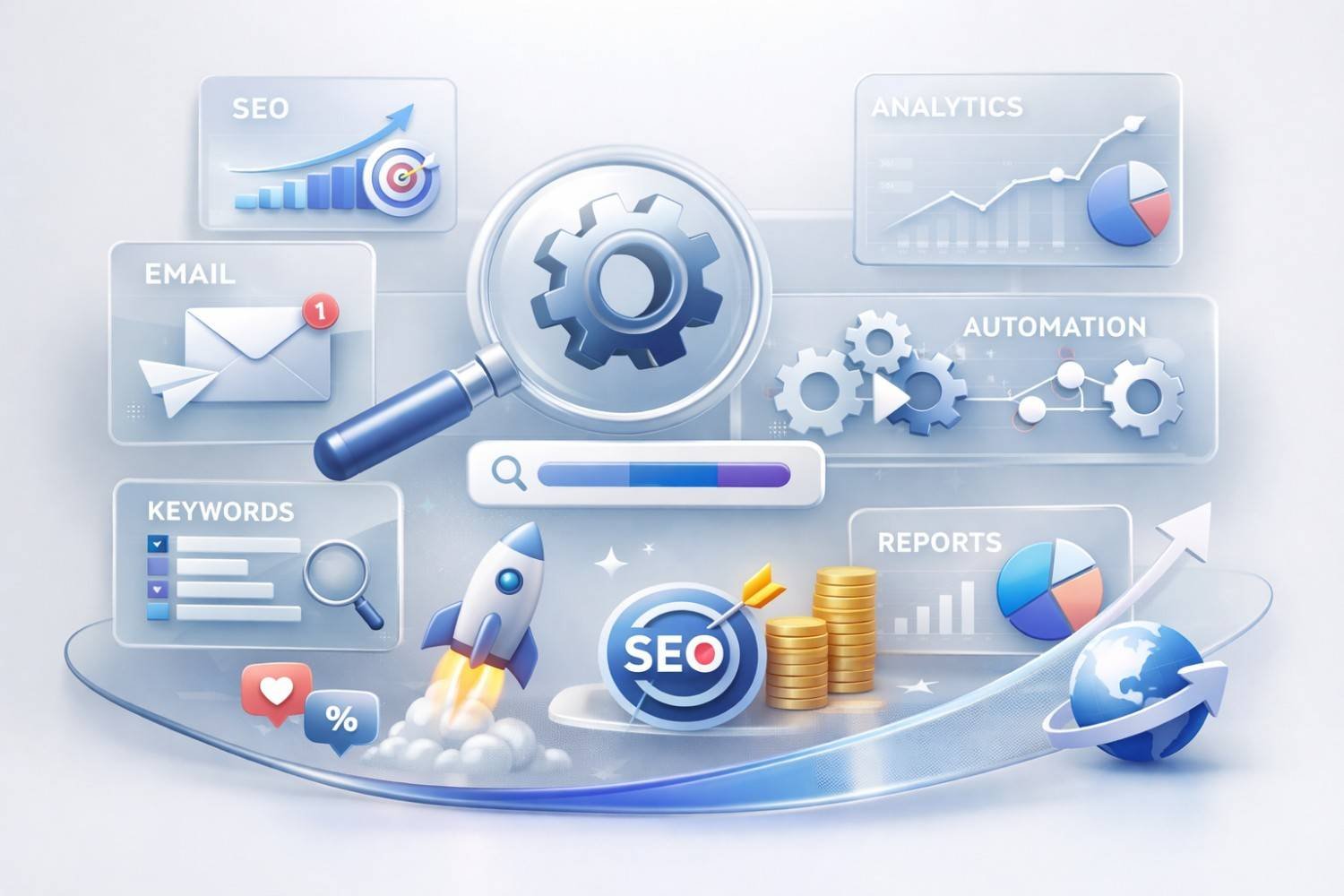
Core Marketing Automation SEO Strategies
Implementing marketing automation SEO requires understanding which strategies deliver the greatest impact. These five areas represent the highest-leverage opportunities for most organizations.
Automated Keyword Research and Tracking
Keyword automation transforms one of SEO’s most time-intensive activities into a continuous, systematic process.
Automated keyword discovery uses seed keywords to generate expanded lists of related terms, questions, and long-tail variations. Tools analyze search patterns, competitor rankings, and semantic relationships to surface opportunities you might never find manually.
Rank tracking automation monitors your positions across target keywords daily or even hourly. Advanced systems track rankings by location, device type, and search feature. Alerts notify you when significant changes occur, enabling rapid response to ranking fluctuations.
Competitor keyword monitoring reveals what terms your competitors rank for that you don’t. Automated systems continuously scan competitor visibility, flagging new ranking opportunities as they emerge.
Keyword clustering automation groups related keywords by search intent and topical relevance. This clustering informs content strategy by showing which topics to cover and how to structure content hubs.
Search volume and difficulty updates keep your keyword data current. Automated refreshes ensure you’re working with accurate metrics rather than outdated estimates.
The strategic value comes from acting on this intelligence. Automated keyword systems don’t just collect data. They surface actionable insights that guide content creation, optimization priorities, and competitive positioning.
Content Automation and Optimization Workflows
Content remains central to SEO success. Automation enhances content performance without replacing human creativity.
Content brief generation automates the research phase of content creation. Tools analyze top-ranking content for target keywords, identifying required topics, questions to answer, entities to mention, and structural patterns that correlate with rankings.
On-page optimization analysis compares your content against ranking competitors. Automated systems identify gaps in topic coverage, suggest semantic terms to include, and flag technical issues like missing meta descriptions or suboptimal heading structures.
Content performance monitoring tracks how published content performs over time. Automated alerts notify you when traffic declines, rankings drop, or engagement metrics shift. This enables proactive optimization before problems compound.
Content refresh workflows trigger when pages show signs of decay. Automated systems can identify content needing updates based on ranking changes, traffic patterns, or content age. Some tools suggest specific updates based on current SERP analysis.
Internal linking automation identifies opportunities to connect related content. Tools analyze your content inventory and suggest internal links that strengthen topical relationships and distribute page authority effectively.
The human element remains essential for content strategy, creative direction, and final quality review. Automation handles the analytical heavy lifting, freeing writers to focus on creating genuinely valuable content.
Technical SEO Automation (Crawling, Indexing, Audits)
Technical SEO involves numerous tasks that benefit enormously from automation. Manual technical audits are inherently limited by time and attention constraints.
Automated site crawling continuously monitors your website for technical issues. Crawlers check for broken links, redirect chains, duplicate content, missing tags, slow pages, and hundreds of other potential problems. Issues surface immediately rather than waiting for periodic manual audits.
Indexing monitoring tracks which pages Google has indexed and identifies indexing problems. Automated systems alert you when important pages drop from the index or when crawl errors prevent indexing.
Core Web Vitals tracking monitors page experience metrics continuously. Automation detects performance regressions before they impact rankings, enabling proactive optimization.
Schema markup validation ensures structured data remains error-free. Automated checks catch schema issues that could affect rich snippet eligibility.
Log file analysis automation processes server logs to understand how search engines crawl your site. This reveals crawl budget allocation, identifies pages receiving insufficient crawl attention, and surfaces access issues.
Staging environment testing automates pre-launch checks for new content or site changes. Automated validation catches technical issues before they reach production.
The continuous nature of automated technical monitoring represents its primary advantage over periodic manual audits. Problems get caught early when they’re easier to fix.
Link Building Automation and Outreach
Link building traditionally requires significant manual effort. Automation streamlines the process while maintaining the relationship-building that effective outreach requires.
Prospect identification automates the discovery of link opportunities. Tools analyze competitor backlink profiles, identify relevant websites in your niche, and surface potential link partners based on defined criteria.
Contact information gathering reduces the manual research required for outreach. Automated tools find email addresses, social profiles, and other contact details for prospects.
Outreach sequencing manages email campaigns at scale. Automated sequences handle initial outreach, follow-ups, and tracking while personalizing messages based on prospect data.
Response tracking monitors which outreach efforts generate replies, links, or other outcomes. This data informs optimization of outreach templates and targeting criteria.
Backlink monitoring tracks your link profile continuously. Automated alerts notify you when you gain or lose backlinks, enabling rapid response to link losses and celebration of wins.
Competitor backlink analysis reveals new links your competitors acquire. Automated monitoring surfaces link opportunities as they emerge rather than waiting for periodic manual analysis.
The relationship aspect of link building cannot be fully automated. Genuine connections require human engagement. Automation handles the operational overhead, freeing time for authentic relationship development.
Reporting and Performance Tracking Automation
Reporting often consumes disproportionate time relative to its strategic value. Automation transforms reporting from a burden into an asset.
Automated dashboard creation consolidates data from multiple sources into unified views. Instead of manually pulling data from Google Analytics, Search Console, rank trackers, and other tools, dashboards update automatically.
Scheduled report delivery ensures stakeholders receive performance updates without manual compilation. Weekly, monthly, or custom-frequency reports arrive automatically with current data.
Custom alert systems notify relevant team members when metrics cross defined thresholds. Traffic drops, ranking changes, or technical issues trigger immediate alerts rather than waiting for scheduled reports.
Goal tracking automation monitors progress toward defined objectives. Systems track whether you’re on pace to meet targets and flag when performance deviates from expectations.
Attribution reporting connects SEO activities to business outcomes. Automated systems trace the path from organic search to conversion to revenue, demonstrating SEO’s business impact.
Competitive benchmarking tracks your performance relative to competitors. Automated systems monitor competitor visibility, content output, and backlink growth, providing context for your own metrics.
Effective reporting automation requires initial setup investment but delivers ongoing time savings and improved data accessibility.
Best Marketing Automation Tools for SEO
The tool landscape for marketing automation SEO continues to evolve rapidly. Understanding the categories and leading options helps you build an effective stack.
All-in-One SEO Automation Platforms
Comprehensive platforms combine multiple automation capabilities into unified systems. These tools suit organizations wanting integrated solutions rather than assembling point solutions.
Semrush offers extensive automation across keyword research, rank tracking, site audits, content optimization, and competitive analysis. The platform’s workflow features enable custom automation sequences, and its reporting capabilities support automated delivery to stakeholders.
Ahrefs provides powerful automation for backlink analysis, keyword tracking, content exploration, and technical audits. Its alerts system notifies you of ranking changes, new backlinks, and competitor movements automatically.
Moz Pro delivers automated rank tracking, site crawling, and on-page optimization recommendations. The platform integrates keyword research with content suggestions and link opportunity identification.
SE Ranking combines rank tracking, site audits, and competitor analysis with marketing plan features that guide implementation. The platform supports white-label reporting for agencies.
Serpstat offers keyword research, rank tracking, site audits, and backlink analysis with automation features throughout. The platform’s clustering capabilities help organize keywords into content strategies.
Choosing between platforms depends on your specific needs, budget, and existing tool ecosystem. Most offer free trials that allow evaluation before commitment.
Content Marketing Automation Tools
Specialized content tools focus on automating the research, optimization, and performance tracking aspects of content SEO.
Clearscope automates content optimization through AI-powered analysis of top-ranking content. The platform generates content briefs and scores content against optimization targets.
Surfer SEO provides automated content analysis, optimization suggestions, and content planning features. Its content editor offers real-time optimization guidance during writing.
MarketMuse uses AI to automate content strategy, identifying gaps in your content coverage and prioritizing topics based on competitive opportunity.
Frase combines content research, brief generation, and optimization into automated workflows. The platform analyzes search results to inform content creation.
Copy.ai and Jasper offer AI-powered content generation that can accelerate draft creation, though human editing remains essential for quality and accuracy.
Content tools work best when integrated into broader content workflows that include human oversight for quality, accuracy, and brand voice.
Technical SEO Automation Software
Technical SEO tools automate the monitoring and analysis of website health factors that impact search performance.
Screaming Frog provides powerful site crawling with scheduling capabilities for automated audits. The tool exports data for analysis and integrates with other platforms.
Sitebulb offers automated site audits with visualization features that make technical issues easier to understand and prioritize.
DeepCrawl (Lumar) delivers enterprise-grade crawling with automation features for large websites. The platform monitors technical health continuously.
ContentKing provides real-time SEO monitoring, alerting you to changes and issues as they occur rather than waiting for scheduled crawls.
Google Search Console offers free automated monitoring of indexing, crawling, and Core Web Vitals directly from Google’s perspective.
Technical tools often work together, with different platforms providing complementary capabilities for comprehensive technical SEO automation.
Rank Tracking and Analytics Automation
Dedicated rank tracking tools offer deeper functionality than all-in-one platforms for organizations with extensive tracking needs.
AccuRanker provides fast, accurate rank tracking with automation features for reporting and alerts. The platform tracks rankings across multiple search engines and locations.
Advanced Web Ranking offers comprehensive rank tracking with white-label reporting capabilities suited for agencies managing multiple clients.
SERPWatcher from Mangools delivers rank tracking with performance metrics and automated reporting features.
Google Analytics 4 provides automated traffic analysis with custom report scheduling and alert capabilities for organic search performance.
Google Looker Studio enables automated dashboard creation pulling data from multiple sources into unified visualizations.
Rank tracking automation proves most valuable when integrated with action workflows that respond to ranking changes with optimization efforts.
CRM and SEO Integration Tools
Connecting SEO data with customer relationship management systems enables revenue attribution and sales alignment.
HubSpot offers native SEO tools alongside its CRM, enabling direct connection between organic traffic and sales outcomes.
Salesforce integrates with SEO platforms through connectors and APIs, allowing SEO data to flow into sales reporting.
Zapier automates connections between SEO tools and CRMs that lack native integrations. Custom workflows move data between systems automatically.
Supermetrics pulls data from SEO tools into reporting platforms and CRMs, enabling unified analytics across marketing channels.
Segment provides customer data infrastructure that can connect SEO touchpoints with broader customer journey data.
CRM integration transforms SEO from a traffic-focused discipline into a revenue-connected function with clear business impact visibility.
How to Implement Marketing Automation SEO
Successful implementation requires systematic planning and execution. These steps guide you from current state to mature automation operations.
Step 1: Audit Your Current SEO Workflows
Before automating, understand what you’re currently doing and how. This audit reveals automation opportunities and potential pitfalls.
Document existing processes by listing every SEO task your team performs. Include frequency, time required, tools used, and outputs produced. Be comprehensive. Tasks often hide in informal processes that aren’t officially documented.
Identify pain points by noting which tasks consume disproportionate time, produce inconsistent results, or frequently fall behind schedule. These pain points often represent prime automation candidates.
Map data flows to understand how information moves through your SEO operations. Where does data originate? Where does it go? Who uses it? Data flow mapping reveals integration requirements for automation.
Assess current tools by evaluating what you already have. Many organizations underutilize existing tool capabilities. You may have automation features available that aren’t being used.
Quantify current performance by establishing baseline metrics for efficiency and outcomes. These baselines enable measurement of automation impact after implementation.
The audit phase requires honest assessment. Automation built on poorly understood processes often automates problems rather than solving them.
Step 2: Identify Automation Opportunities
Not every SEO task should be automated. Strategic selection focuses automation where it delivers greatest value.
High-volume, repetitive tasks represent obvious automation candidates. Rank checking, report generation, and data collection fall into this category. The more frequently a task occurs, the greater the automation benefit.
Time-sensitive monitoring benefits from automation’s always-on nature. Technical issues, ranking changes, and competitor movements require rapid detection that manual processes cannot provide.
Data-intensive analysis leverages automation’s computational advantages. Keyword research, competitive analysis, and content gap identification involve processing volumes of data that exceed human capacity.
Error-prone manual processes improve through automation’s consistency. Data entry, report compilation, and multi-step workflows often introduce human errors that automation eliminates.
Tasks requiring integration between systems benefit from automated data flows. Moving information between tools manually creates delays and errors that automation resolves.
Preserve human judgment for strategic decisions, creative work, relationship building, and quality assessment. These areas require capabilities that current automation cannot replicate effectively.
Prioritize opportunities based on time savings, error reduction, and strategic impact. Start with high-impact, lower-complexity automations to build momentum.
Step 3: Select the Right Tools and Platforms
Tool selection shapes what’s possible with your automation efforts. Choose based on your specific requirements rather than feature lists.
Define requirements before evaluating tools. What specific automations do you need? What integrations are essential? What’s your budget? Clear requirements prevent feature-driven decisions that don’t serve your actual needs.
Evaluate integration capabilities carefully. Tools that don’t connect with your existing systems create data silos that limit automation potential. API availability, native integrations, and Zapier compatibility matter.
Consider scalability for future growth. Tools that work for your current scale may not handle increased volume. Understand pricing tiers and capability limits before committing.
Assess learning curves realistically. Powerful tools with steep learning curves may deliver less value than simpler tools your team will actually use. Implementation success depends on adoption.
Request demonstrations focused on your specific use cases. Generic demos showcase best-case scenarios. Ask to see how the tool handles your actual workflows.
Start with trials before annual commitments. Most platforms offer free trials or monthly plans. Test thoroughly before locking into long-term contracts.
Plan for redundancy in critical functions. Depending entirely on a single tool for essential processes creates risk. Consider backup options for mission-critical automations.
Tool selection often involves tradeoffs between capability, complexity, cost, and integration. Optimize for your specific situation rather than seeking theoretical perfection.
Step 4: Build Automated SEO Workflows
With tools selected, construct the actual automation workflows that will drive your SEO operations.
Start simple with straightforward automations before attempting complex workflows. A basic automated rank tracking report delivers value while you learn the platform. Complexity can come later.
Document workflows thoroughly as you build them. Include trigger conditions, actions performed, expected outputs, and exception handling. Documentation enables troubleshooting and knowledge transfer.
Build in checkpoints for human review at critical decision points. Fully autonomous workflows risk compounding errors. Strategic checkpoints maintain quality while preserving efficiency gains.
Test extensively before relying on automations for production work. Run parallel manual and automated processes initially to verify automated outputs match expectations.
Create feedback loops that surface automation performance. Track whether automated processes deliver expected results. Build in monitoring that catches when automations fail or produce unexpected outputs.
Iterate based on results rather than assuming initial configurations are optimal. Automation workflows improve through refinement based on actual performance data.
Train team members on new workflows thoroughly. Automation changes how people work. Ensure everyone understands new processes, their role within them, and how to handle exceptions.
Workflow construction is iterative. Expect to refine automations continuously as you learn what works in your specific context.
Step 5: Monitor, Measure, and Optimize
Automation requires ongoing attention to maintain effectiveness and capture improvement opportunities.
Track efficiency metrics comparing time spent before and after automation. Quantify hours saved to demonstrate ROI and identify areas where automation underperforms expectations.
Monitor output quality to ensure automated processes maintain standards. Automation that produces faster but lower-quality results may not deliver net benefit.
Review automation performance regularly through scheduled audits. Check that workflows still function correctly, integrations remain connected, and outputs stay accurate.
Gather user feedback from team members working with automated systems. Frontline users often identify improvement opportunities and problems that metrics miss.
Update automations as tools evolve, requirements change, and better approaches emerge. Automation built once and forgotten gradually becomes outdated and less effective.
Expand successful patterns by applying approaches that work well to additional use cases. Success in one area often indicates opportunity in related areas.
Retire underperforming automations that don’t deliver expected value. Not every automation attempt succeeds. Recognizing and eliminating failures frees resources for more productive efforts.
Continuous optimization transforms initial automation implementations into mature systems that deliver compounding value over time.
Common Implementation Mistakes to Avoid
Learning from others’ mistakes accelerates your implementation success. These pitfalls appear frequently in automation projects.
Automating before understanding current processes leads to automated chaos. Ensure you thoroughly understand what you’re automating before building workflows.
Over-automating initially creates complexity that’s difficult to manage and troubleshoot. Start simple and add complexity incrementally as you build capability.
Neglecting data quality undermines automation effectiveness. Automated processes amplify data problems. Ensure data inputs are clean and reliable before automating.
Ignoring integration requirements results in disconnected tools that don’t deliver expected value. Plan integration architecture before selecting individual tools.
Underestimating training needs leads to adoption failures. Budget time and resources for thorough team training on new automated workflows.
Failing to maintain automations causes gradual degradation. Automations require ongoing attention to remain effective as tools, requirements, and contexts evolve.
Removing human oversight entirely risks quality problems and missed opportunities. Maintain strategic human checkpoints even in highly automated workflows.
Measuring wrong metrics obscures whether automation delivers actual value. Focus on business outcomes rather than activity metrics.
Awareness of common mistakes helps you avoid them. Plan proactively to address these risks in your implementation approach.
Marketing Automation SEO Timelines and Expectations
Setting realistic expectations prevents disappointment and enables appropriate planning. Automation accelerates SEO but doesn’t eliminate the time required for search engines to recognize and reward improvements.
Realistic Timelines for Automated SEO Results
Automation impacts different aspects of SEO on different timelines. Understanding these variations helps set appropriate expectations.
Immediate benefits appear in operational efficiency. From day one, automated rank tracking, reporting, and monitoring save time compared to manual processes. These efficiency gains are measurable immediately.
Short-term improvements in technical SEO often appear within weeks. Automated detection and resolution of technical issues can produce ranking improvements as search engines recrawl and reindex affected pages.
Medium-term content gains typically emerge over 3 to 6 months. Content optimization guided by automation tools needs time for search engines to recognize improvements and adjust rankings accordingly.
Long-term authority building requires 6 to 12 months or longer. Automated link building outreach and content strategies build domain authority gradually. Search engines reward sustained effort over time.
Compounding effects accelerate results as automation matures. Initial implementations deliver modest gains. Refined systems with accumulated data and optimized workflows produce increasingly significant results.
The timeline reality is that automation makes SEO more efficient but doesn’t change how search engines evaluate and rank content. Patience remains essential even with sophisticated automation.
Short-Term vs. Long-Term ROI Expectations
ROI from marketing automation SEO manifests differently across time horizons. Planning for both ensures sustained investment and realistic expectations.
Short-term ROI comes primarily from efficiency gains. Calculate time saved through automation and value that time appropriately. If automation saves 20 hours monthly and those hours cost $50 each, that’s $1,000 monthly ROI from efficiency alone.
Medium-term ROI adds performance improvements to efficiency gains. Better keyword targeting, optimized content, and resolved technical issues produce ranking improvements that drive additional traffic and conversions.
Long-term ROI includes competitive advantages and compounding effects. Organizations with mature automation operate at different capability levels than competitors relying on manual processes. This advantage grows over time.
Investment recovery periods vary based on implementation scope and starting point. Simple automations may pay back within months. Comprehensive implementations with significant tool investments may require 12 to 18 months for full ROI realization.
Ongoing ROI continues indefinitely once automation systems mature. Unlike one-time projects, automation delivers continuous value through sustained efficiency and performance improvements.
Budget planning should account for upfront investment in tools and implementation alongside ongoing costs for maintenance and optimization. ROI calculations should include both efficiency gains and performance improvements.
Key Performance Indicators to Track
Measuring automation effectiveness requires tracking the right metrics. These KPIs provide visibility into whether your automation investments deliver expected value.
Efficiency metrics quantify operational improvements:
- Time spent on automated vs. manual tasks
- Report generation time
- Issue detection to resolution time
- Tasks completed per team member
Performance metrics track SEO outcomes:
- Organic traffic growth
- Keyword ranking improvements
- Technical health scores
- Backlink acquisition rates
Quality metrics ensure automation maintains standards:
- Error rates in automated outputs
- Manual intervention frequency
- Stakeholder satisfaction with reports
- Content optimization score improvements
Business metrics connect SEO to revenue:
- Organic traffic to lead conversion rates
- Revenue attributed to organic search
- Customer acquisition cost from SEO
- Lifetime value of SEO-acquired customers
Automation health metrics monitor system performance:
- Workflow completion rates
- Integration uptime
- Alert accuracy
- Data freshness
Track metrics consistently over time to identify trends and measure improvement. Dashboards that consolidate KPIs enable efficient monitoring without manual data gathering.
Marketing Automation SEO for Different Business Types
Automation requirements and approaches vary based on organizational context. Understanding these differences helps tailor implementation to your specific situation.
Marketing Automation SEO for Startups
Startups face unique constraints and opportunities that shape their automation approach.
Resource constraints make automation particularly valuable for startups. Small teams cannot dedicate significant time to manual SEO tasks. Automation enables SEO activity that would otherwise be impossible.
Budget limitations require careful tool selection. Free and low-cost tools can provide meaningful automation for startups. Google Search Console, Google Analytics, and free tiers of paid tools offer starting points.
Speed requirements align well with automation’s efficiency benefits. Startups need to move fast. Automation eliminates bottlenecks that slow SEO implementation.
Scaling considerations matter even early. Choose tools and approaches that can grow with your organization. Avoid building processes around tools you’ll outgrow quickly.
Focus recommendations for startups include automated rank tracking, basic technical monitoring, and content optimization guidance. These deliver high value relative to investment.
Startups should prioritize automations that free founder and early team time for activities that require human judgment and creativity.
Marketing Automation SEO for SMEs
Small and medium enterprises balance resource constraints with more established operations than startups.
Existing processes in SMEs may need documentation and optimization before automation. Automating inefficient processes amplifies inefficiency.
Team capacity in SMEs often includes dedicated marketing roles but not specialized SEO staff. Automation enables marketing generalists to execute SEO effectively.
Budget availability in SMEs supports investment in mid-tier tools. All-in-one platforms often provide good value for SMEs by consolidating multiple capabilities.
Integration needs increase as SMEs have more established systems. Ensure automation tools connect with existing CRM, analytics, and marketing platforms.
Focus recommendations for SMEs include comprehensive rank tracking, automated reporting for stakeholders, technical monitoring, and content optimization workflows.
SMEs benefit from automation that enables consistent SEO execution without requiring specialized expertise for every task.
Marketing Automation SEO for Agencies
Agencies face distinct challenges managing SEO across multiple clients with varying needs.
Scale requirements make automation essential for agency profitability. Manual processes don’t scale across dozens or hundreds of clients.
White-label capabilities matter for client-facing deliverables. Choose tools that support branded reports and dashboards.
Multi-client management requires tools designed for agency use cases. Look for features like client switching, permission management, and consolidated billing.
Standardization benefits agencies through repeatable processes. Automation enables consistent service delivery across clients regardless of which team member handles the work.
Focus recommendations for agencies include automated client reporting, rank tracking across all clients, technical monitoring with alert routing, and templated workflows for common services.
Agencies should build automation infrastructure that enables profitable service delivery at scale while maintaining quality and client satisfaction.
Marketing Automation SEO for Enterprise
Enterprise organizations have resources but face complexity challenges that automation helps address.
Scale and complexity in enterprise SEO involve thousands of pages, multiple domains, and numerous stakeholders. Automation is essential for managing this complexity.
Integration requirements are extensive in enterprise environments. SEO automation must connect with enterprise CRM, analytics, content management, and business intelligence systems.
Governance needs require approval workflows, access controls, and audit trails. Enterprise automation must support compliance and oversight requirements.
Cross-team coordination benefits from automation that routes tasks, shares data, and maintains visibility across organizational boundaries.
Focus recommendations for enterprise include enterprise-grade platforms with robust integration capabilities, custom workflow development, and comprehensive reporting that serves multiple stakeholder groups.
Enterprise automation investments are larger but deliver proportionally larger returns given the scale of operations involved.
Marketing Automation SEO vs. Manual SEO
Understanding when to automate and when to maintain manual processes ensures you apply automation appropriately.
When to Automate vs. When to Stay Manual
Not every SEO task benefits from automation. Strategic selection maximizes value while avoiding automation pitfalls.
Automate when:
- Tasks are repetitive and frequent
- Consistency matters more than creativity
- Speed of execution provides advantage
- Data volumes exceed human processing capacity
- Integration between systems adds value
- 24/7 monitoring is beneficial
Stay manual when:
- Strategic judgment is required
- Creative work is involved
- Relationship building is the goal
- Quality assessment needs human evaluation
- Context requires nuanced understanding
- One-time or rare tasks don’t justify automation investment
Gray areas exist where partial automation makes sense. Content creation benefits from automated research and optimization guidance while requiring human writing and editing. Link building uses automated prospecting while maintaining manual relationship development.
The goal is not maximum automation but optimal automation. Apply automation where it adds value and preserve human involvement where it’s essential.
Hybrid Approaches for Optimal Results
Most successful SEO operations blend automation with manual processes in hybrid approaches.
Automated research with manual strategy uses automation to gather data and surface insights while humans make strategic decisions based on that intelligence.
Automated monitoring with manual response employs automation to detect issues and opportunities while humans determine appropriate responses.
Automated outreach with manual relationship building uses automation for initial contact and follow-up sequences while humans handle relationship development when prospects engage.
Automated reporting with manual analysis generates reports automatically while humans interpret results and derive strategic implications.
Automated content optimization with manual creation provides optimization guidance through automation while humans write and refine actual content.
Hybrid approaches capture automation’s efficiency benefits while preserving human capabilities that automation cannot replicate. Design workflows that leverage both effectively.
Risk Factors and Quality Control
Automation introduces risks that require active management. Understanding and mitigating these risks protects your SEO operations.
Quality degradation can occur when automation removes human oversight from processes that benefit from it. Build quality checkpoints into automated workflows.
Over-reliance on tools creates vulnerability when tools fail, change, or become unavailable. Maintain capability to execute critical processes manually if needed.
Data accuracy issues amplify through automation. Errors in source data propagate through automated workflows. Validate data quality at input points.
Algorithm changes may invalidate automated approaches. Automation built around specific ranking factors may become counterproductive when algorithms change. Monitor for signs that automated approaches need updating.
Competitor adaptation means automation advantages diminish as competitors adopt similar approaches. Continuous improvement maintains competitive position.
Security considerations arise when automation tools have access to sensitive data and systems. Evaluate security practices of automation vendors and limit access appropriately.
Quality control requires ongoing attention. Schedule regular reviews of automated processes to ensure they continue delivering expected results without introducing problems.
Future of Marketing Automation SEO
The automation landscape continues evolving rapidly. Understanding emerging trends helps you prepare for future developments.
AI and Machine Learning in SEO Automation
Artificial intelligence is transforming what’s possible with SEO automation.
Content generation capabilities have advanced dramatically. AI tools can produce draft content, though human editing remains essential for quality, accuracy, and brand voice.
Predictive analytics use machine learning to forecast ranking changes, traffic patterns, and competitive movements. These predictions inform proactive strategy adjustments.
Natural language processing enables more sophisticated content analysis. AI tools understand semantic meaning, not just keyword presence, enabling more nuanced optimization guidance.
Pattern recognition across large datasets surfaces insights that manual analysis would miss. AI identifies correlations between site characteristics and ranking performance.
Automated testing uses AI to design and execute SEO experiments, learning from results to optimize approaches continuously.
Personalization capabilities enable dynamic content optimization based on user characteristics and behavior patterns.
AI capabilities will continue expanding. Organizations that develop AI literacy and integration capabilities will be better positioned to leverage emerging tools.
Predictive SEO and Automation Trends
Several trends are shaping the future of marketing automation SEO.
Real-time optimization is becoming more feasible as tools process data faster and algorithms update more frequently. The gap between data collection and action continues shrinking.
Voice and visual search optimization will require new automation approaches as these search modalities grow in importance.
Integration depth is increasing as tools develop more sophisticated connections with broader marketing and business systems.
Democratization of advanced capabilities makes sophisticated automation accessible to smaller organizations through improved tools and reduced costs.
Specialization is emerging as the market matures. Expect more focused tools that excel at specific automation use cases rather than trying to do everything.
Compliance automation will grow in importance as privacy regulations and search engine policies become more complex.
Staying informed about trends enables proactive adaptation rather than reactive scrambling when changes occur.
Preparing Your Strategy for Algorithm Changes
Algorithm updates can disrupt automated approaches. Preparation minimizes negative impacts.
Diversification across ranking factors reduces vulnerability to changes affecting any single factor. Don’t over-optimize for current algorithm preferences.
Quality focus provides resilience because search engines consistently reward genuinely valuable content regardless of specific algorithm mechanics.
Monitoring systems that detect ranking changes quickly enable rapid response when algorithm updates occur.
Flexible automation that can be adjusted quickly adapts better than rigid systems. Build automation with modification in mind.
Testing capabilities enable rapid experimentation when algorithm changes require strategy adjustments.
Industry awareness through following SEO news and communities provides early warning of algorithm changes and emerging best practices.
Algorithm changes are inevitable. Preparation ensures they’re manageable disruptions rather than catastrophic setbacks.
Frequently Asked Questions About Marketing Automation SEO
What is marketing automation SEO?
Marketing automation SEO combines automated software tools and workflows with search engine optimization practices. It uses technology to handle repetitive SEO tasks like rank tracking, technical audits, content optimization, and reporting. The goal is scaling SEO efforts efficiently while maintaining quality and strategic alignment.
How does marketing automation improve SEO?
Automation improves SEO by enabling consistent execution at scale, faster detection of issues and opportunities, and better data for decision-making. It frees human time from repetitive tasks, allowing focus on strategy and creative work. Automation also reduces errors inherent in manual processes and enables 24/7 monitoring that manual approaches cannot match.
What are the best tools for marketing automation SEO?
Leading tools include all-in-one platforms like Semrush, Ahrefs, and Moz Pro for comprehensive automation. Specialized tools like Screaming Frog handle technical audits, while Clearscope and Surfer SEO focus on content optimization. The best tools depend on your specific needs, budget, and existing technology stack.
How long does it take to see results from automated SEO?
Efficiency gains from automation appear immediately through time savings. Technical SEO improvements may show results within weeks. Content and authority-building results typically require 3 to 12 months, similar to manual SEO timelines. Automation accelerates execution but doesn’t change how quickly search engines recognize and reward improvements.
Is marketing automation SEO suitable for small businesses?
Yes, marketing automation SEO is particularly valuable for small businesses with limited resources. Automation enables small teams to execute SEO activities that would otherwise require dedicated staff. Free and low-cost tools provide entry points, and efficiency gains often deliver positive ROI even with modest investments.
What are the risks of automating SEO?
Risks include quality degradation without proper oversight, over-reliance on tools that may fail or change, and amplification of data errors through automated processes. Algorithm changes may invalidate automated approaches. Mitigate risks through quality checkpoints, diversified approaches, and regular review of automated processes.
Can you fully automate SEO?
No, effective SEO cannot be fully automated. Strategic decisions, creative content development, relationship building, and quality assessment require human judgment. The most effective approach combines automation for operational tasks with human involvement for strategic and creative work. Automation enhances human capability rather than replacing it.
Conclusion
Marketing automation SEO transforms how organizations approach organic search by combining systematic workflows with strategic human oversight. The efficiency gains, improved data visibility, and scaling capabilities create measurable advantages for businesses willing to invest in implementation.
Success requires thoughtful tool selection, careful workflow design, and ongoing optimization rather than set-and-forget automation. Organizations that balance automation’s operational benefits with human judgment for strategy and quality achieve the strongest results.
We help businesses implement marketing automation SEO strategies that drive sustainable organic growth. White Label SEO Service provides the technical expertise, strategic guidance, and execution support to build automation systems that deliver measurable ROI. Contact us to discuss how automation can transform your SEO operations.