
Marketing automation SEO combines automated workflows with search engine optimization to scale organic growth without proportionally increasing manual effort. This approach lets businesses systematically handle technical audits, content distribution, link building outreach, and performance tracking through software-driven processes.
The convergence matters now more than ever. Teams face mounting pressure to produce more content, monitor more metrics, and respond faster to algorithm changes. Manual SEO simply cannot keep pace with modern search demands.
This guide covers everything from core automation components and tool selection to implementation strategies, realistic timelines, and measuring ROI. You will learn exactly which tasks to automate and which require human expertise.
What Is Marketing Automation SEO?
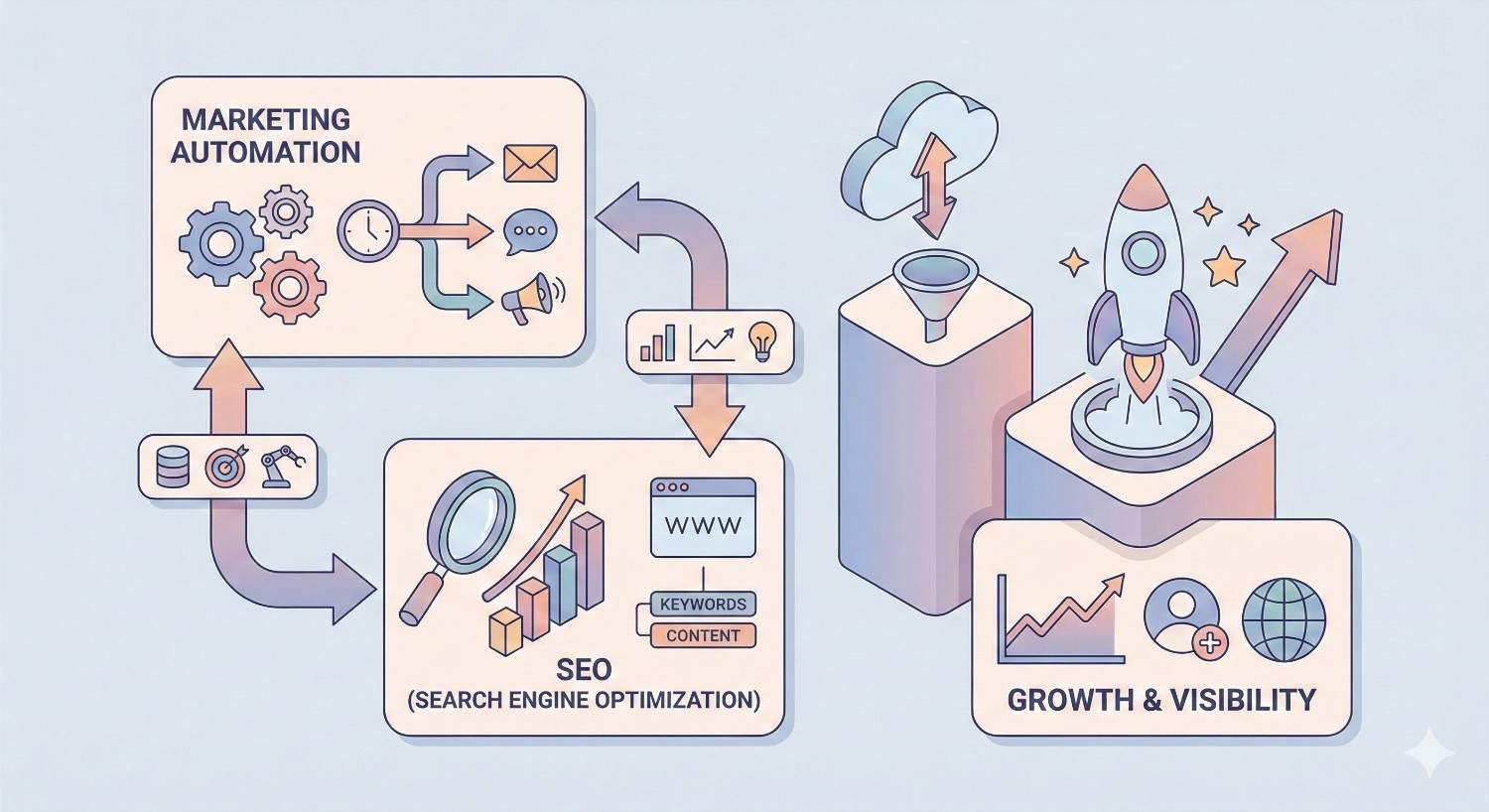
Marketing automation SEO represents the strategic integration of automated software systems with search engine optimization practices. Rather than treating automation and SEO as separate disciplines, this approach weaves them together into unified workflows that execute, monitor, and optimize organic search activities at scale.
The concept emerged from a practical reality. SEO involves hundreds of repetitive tasks. Checking rankings. Monitoring backlinks. Auditing technical issues. Distributing content. Tracking competitors. Each task consumes time. Automation reclaims that time while improving consistency and reducing human error.
Definition and Core Concepts
Marketing automation SEO is the systematic use of software tools and automated workflows to execute, monitor, and optimize search engine optimization activities. It encompasses technical SEO monitoring, content workflow automation, link building process automation, and analytics reporting.
The core concept centers on identifying repetitive, rule-based SEO tasks and delegating them to software. This frees human strategists to focus on creative work, strategic decisions, and activities requiring judgment.
Three principles define effective marketing automation SEO. First, automation handles execution while humans handle strategy. Second, automated systems must include human checkpoints for quality control. Third, automation should enhance SEO outcomes, not just reduce workload.
How Marketing Automation and SEO Work Together
Marketing automation platforms excel at triggering actions based on conditions. SEO requires consistent execution of specific tasks. The combination creates powerful synergies.
Consider content distribution. When you publish a new blog post, automation can immediately share it across social channels, notify your email list, submit it to relevant aggregators, and ping search engines. What previously required 30 minutes of manual work happens instantly.
Technical monitoring provides another example. Automated crawlers continuously scan your site for broken links, missing meta tags, slow pages, and indexing issues. When problems appear, alerts trigger immediately. You fix issues before they impact rankings rather than discovering them weeks later during manual audits.
Link building benefits from automation through prospecting and outreach sequences. Tools identify link opportunities, find contact information, send personalized outreach emails, and track responses. The human role shifts from sending emails to crafting strategy and building relationships.
Key Components of an Automated SEO Strategy
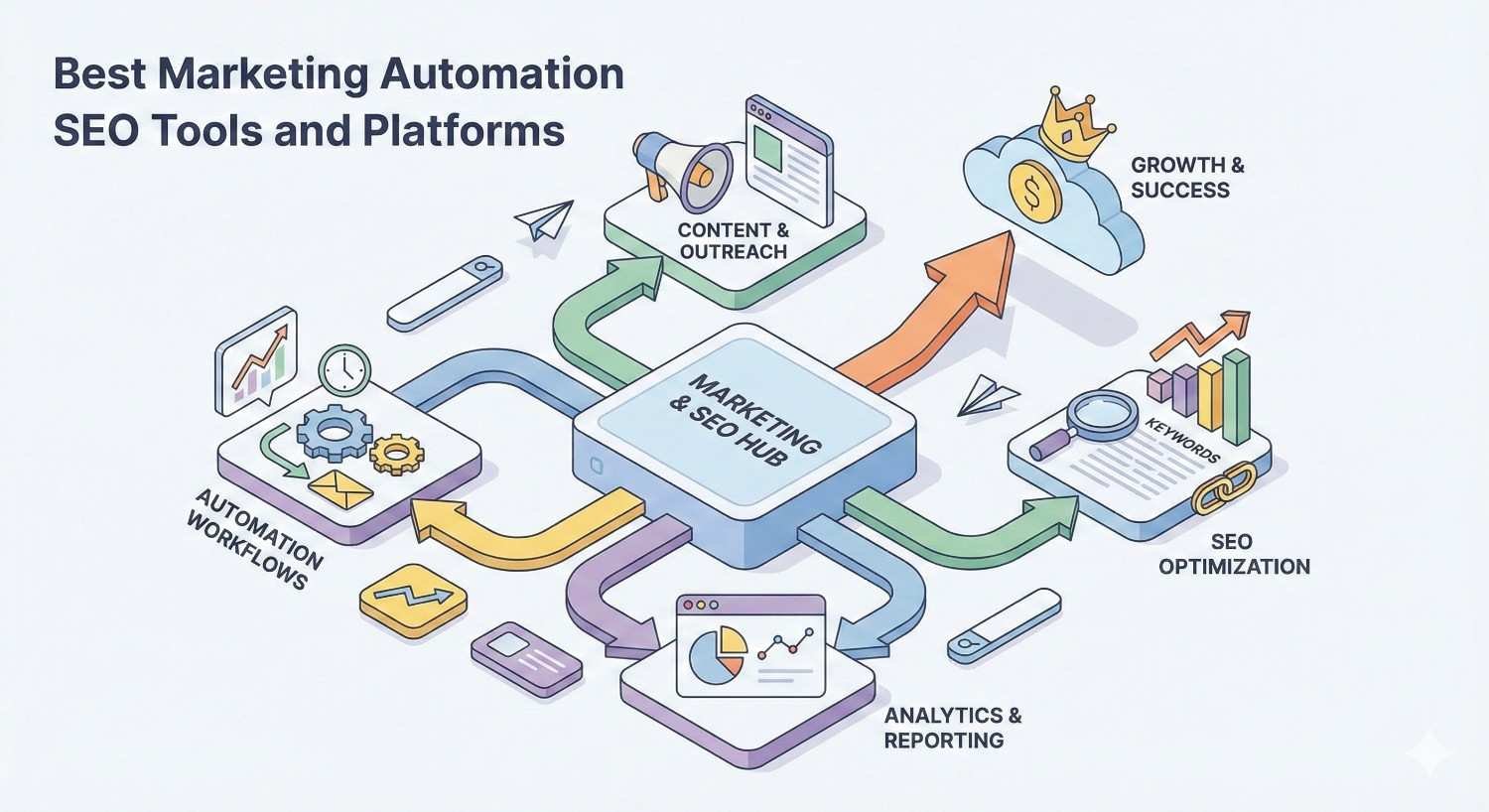
An automated SEO strategy contains four interconnected components. Technical SEO automation handles site health monitoring, crawl management, and performance tracking. Content automation manages brief generation, publishing workflows, and distribution. Link building automation covers prospecting, outreach, and backlink monitoring. Reporting automation consolidates data into actionable dashboards.
Each component requires specific tools and workflows. The components must integrate with each other. A technical issue affecting page speed should trigger content performance alerts. New content publication should initiate link building outreach. Everything connects.
Successful implementation also requires clear documentation. Automated workflows need defined triggers, actions, conditions, and human review points. Without documentation, automation becomes a black box that nobody understands or can improve.
Why Marketing Automation SEO Matters for Business Growth
Organic search remains the highest-ROI marketing channel for most businesses. But capturing that value requires consistent, comprehensive SEO execution. Marketing automation SEO makes that execution sustainable.
The business case extends beyond efficiency. Automation enables capabilities that manual processes simply cannot achieve. Real-time monitoring across thousands of keywords. Instant response to technical issues. Systematic outreach at scale. These capabilities translate directly to competitive advantage.
The ROI of Combining Automation with SEO
The ROI calculation for marketing automation SEO involves both cost reduction and revenue enhancement. On the cost side, automation reduces labor hours required for routine tasks. A single SEO specialist with proper automation can accomplish what previously required a team.
Revenue enhancement comes from improved SEO performance. Faster issue detection means less ranking volatility. Consistent content distribution increases visibility. Systematic link building accelerates authority growth. Each improvement compounds over time.
According to HubSpot’s marketing automation research, companies using marketing automation see 451% more qualified leads than those without. While this statistic covers all marketing automation, the principle applies directly to SEO. Systematic execution outperforms sporadic effort.
The payback period for marketing automation SEO investments typically ranges from three to six months. Initial tool costs and setup time represent the investment. Ongoing time savings and performance improvements represent the return.
Time and Resource Efficiency Gains
Time savings from marketing automation SEO are substantial and measurable. Manual rank tracking for 500 keywords takes hours weekly. Automated tracking takes seconds. Manual site audits require dedicated time blocks. Automated monitoring runs continuously in the background.
Consider a typical SEO workflow without automation. Check rankings manually. Export data to spreadsheets. Create reports. Send emails. Monitor backlinks. Research competitors. Each task consumes time. Multiply across clients or projects. The hours accumulate rapidly.
With automation, the same workflow transforms. Rankings update automatically. Reports generate on schedule. Alerts notify you of changes. Backlink monitoring runs continuously. Competitor tracking happens in real-time. Your role shifts from data gathering to analysis and action.
Resource efficiency extends beyond time. Automation reduces errors. Manual data entry introduces mistakes. Automated systems execute consistently. This consistency improves data quality, which improves decision-making.
Scalability Benefits for SMEs and Startups
Small and medium enterprises face a particular challenge with SEO. They need comprehensive optimization to compete but lack resources for large teams. Marketing automation SEO solves this constraint.
A startup with one marketing person can implement automated workflows that rival enterprise SEO programs. The tools are accessible. The workflows are documented. The execution is consistent. What matters is strategic thinking, not headcount.
Scalability also applies to growth. As your business expands, automated SEO workflows scale without proportional cost increases. Adding new pages to monitoring costs nothing extra. Expanding keyword tracking requires minimal additional effort. The infrastructure supports growth.
For agencies, scalability enables profitable client management. Automated workflows handle routine tasks across multiple clients. Human attention focuses on strategy and client relationships. This model supports growth without sacrificing quality.
Core Elements of Marketing Automation SEO
Effective marketing automation SEO requires systematic attention to four domains. Technical SEO automation ensures site health and crawlability. Content automation streamlines creation and distribution workflows. Link building automation scales outreach and monitoring. Reporting automation transforms data into insights.
Each domain contains specific automation opportunities. The key is identifying which tasks benefit most from automation and implementing appropriate tools and workflows.
Technical SEO Automation
Technical SEO forms the foundation of organic visibility. Without proper technical optimization, content and links cannot achieve their potential. Automation ensures technical foundations remain solid.
Technical SEO automation focuses on monitoring, alerting, and reporting. Automated systems continuously check site health, identify issues, and notify relevant team members. This proactive approach prevents problems from impacting rankings.
Automated Site Audits and Crawl Monitoring
Automated site audits run continuously or on scheduled intervals. Tools like Screaming Frog, Sitebulb, and cloud-based crawlers scan your entire site for technical issues. Broken links. Missing meta tags. Duplicate content. Redirect chains. Orphan pages.
The automation value comes from consistency and speed. Manual audits happen periodically. Automated audits happen constantly. Issues get caught immediately rather than festering for weeks.
Crawl monitoring tracks how search engines interact with your site. Tools monitor crawl frequency, crawl budget allocation, and indexing status. When crawl patterns change, alerts trigger investigation.
Setting up automated audits requires initial configuration. Define crawl frequency. Set alert thresholds. Specify which issues warrant immediate notification versus weekly reports. Once configured, the system runs independently.
Schema Markup Automation
Schema markup helps search engines understand your content. Proper implementation can earn rich snippets, knowledge panel features, and improved click-through rates. But maintaining schema across large sites is tedious.
Automation tools generate and validate schema markup at scale. For e-commerce sites, product schema updates automatically when inventory changes. For publishers, article schema applies consistently to new content. For local businesses, location schema stays synchronized with business information.
Schema validation automation catches errors before they impact search results. Automated testing tools check markup against Google’s requirements and alert you to problems.
The implementation approach depends on your CMS. WordPress sites can use plugins that automatically generate schema. Custom sites may require developer integration with schema generation APIs.
Page Speed and Core Web Vitals Monitoring
Page speed directly impacts rankings and user experience. Core Web Vitals specifically measure loading performance, interactivity, and visual stability. Monitoring these metrics requires continuous attention.
Automated monitoring tools track Core Web Vitals across your entire site. When pages fall below thresholds, alerts trigger. You can address performance issues before they accumulate ranking penalties.
Tools like Google Search Console provide Core Web Vitals data, but dedicated monitoring platforms offer more granular insights. They track performance over time, identify patterns, and correlate changes with deployments or content updates.
Setting up effective monitoring requires defining acceptable thresholds for your site. Not every page needs perfect scores. Prioritize high-traffic, high-value pages for the strictest monitoring.
Content Automation Workflows
Content drives organic traffic. But content creation involves numerous steps beyond writing. Research. Brief creation. Optimization. Publishing. Distribution. Promotion. Each step offers automation opportunities.
Content automation does not mean automated content creation. AI can assist with drafts, but human oversight remains essential for quality. Automation handles the workflow around content, not the content itself.
Content Brief Generation and Optimization
Content briefs guide writers toward SEO-optimized content. Creating comprehensive briefs manually takes significant time. Automation accelerates the process.
Brief generation tools analyze top-ranking content for target keywords. They identify common topics, questions answered, word counts, and structural patterns. This analysis informs brief creation.
Tools like Clearscope, Surfer SEO, and MarketMuse automate content optimization analysis. They score content against competitors and suggest improvements. Writers use these insights to create more comprehensive content.
The workflow integrates automation with human judgment. Tools provide data. Humans interpret data and make strategic decisions. The combination produces better briefs faster.
Automated Content Distribution
Publishing content is just the beginning. Distribution determines how many people see it. Automated distribution ensures consistent promotion across channels.
When new content publishes, automation can trigger social media posts across platforms. Email notifications can alert subscribers. Content syndication can push to relevant aggregators. RSS feeds can notify followers.
Tools like Zapier, Make, and native platform integrations enable these workflows. A single publication event triggers multiple distribution actions. No manual intervention required.
Distribution automation also includes repurposing workflows. New blog posts can automatically generate social media snippets, email newsletter content, and promotional graphics. One piece of content feeds multiple channels.
Content Performance Tracking
Understanding which content performs well guides future strategy. Manual performance tracking is tedious and often neglected. Automation ensures consistent monitoring.
Automated tracking consolidates data from multiple sources. Google Analytics provides traffic data. Search Console provides search performance data. Social platforms provide engagement data. Automation pulls everything together.
Performance dashboards update automatically. You see which content drives traffic, which earns backlinks, which generates conversions. This visibility informs content strategy decisions.
Alert systems notify you of significant changes. Traffic spikes indicate viral content worth promoting further. Traffic drops indicate problems worth investigating. Automation surfaces these signals.
Link Building Automation
Link building remains essential for SEO success. But traditional link building is labor-intensive. Finding prospects. Gathering contact information. Sending outreach. Following up. Tracking responses. Automation streamlines each step.
Important distinction: automation assists link building but cannot replace relationship building. The goal is automating administrative tasks so humans can focus on genuine connections.
Outreach Automation Tools
Outreach automation tools manage email sequences at scale. They personalize messages using merge fields, schedule sends for optimal timing, and track opens and responses.
Tools like Pitchbox, BuzzStream, and Hunter.io combine prospecting with outreach automation. They find relevant websites, extract contact information, and manage outreach campaigns.
Effective outreach automation requires careful setup. Templates must feel personal despite automation. Sequences must include appropriate follow-ups without becoming spam. Personalization must go beyond inserting names.
The human role in automated outreach focuses on strategy and relationship building. Which sites to target. What value to offer. How to build genuine connections. Automation handles the mechanics.
Backlink Monitoring and Analysis
Your backlink profile changes constantly. New links appear. Old links disappear. Competitors gain links you should pursue. Monitoring these changes manually is impractical.
Automated backlink monitoring tools track your link profile continuously. They alert you to new links worth acknowledging, lost links worth recovering, and toxic links worth disavowing.
Competitor backlink monitoring reveals link building opportunities. When competitors earn links from new sources, automation can flag those sources for your outreach. This systematic approach ensures you never miss opportunities.
Tools like Ahrefs, Moz, and Majestic provide comprehensive backlink monitoring. Setting up alerts and regular reports ensures you stay informed without manual checking.
Competitor Link Gap Automation
Link gap analysis identifies sites linking to competitors but not to you. These represent proven link opportunities. Manual analysis is time-consuming. Automation makes it practical.
Automated link gap tools continuously compare your backlink profile against competitors. They identify new gaps as competitors earn links. They prioritize opportunities based on domain authority and relevance.
The output feeds directly into outreach automation. New link opportunities automatically enter prospecting workflows. The entire process from identification to outreach can flow without manual intervention.
Regular link gap reports keep strategy current. Competitor link profiles change constantly. Automated monitoring ensures your link building targets the best current opportunities.
Reporting and Analytics Automation
Data drives SEO decisions. But gathering, organizing, and presenting data consumes enormous time. Reporting automation transforms raw data into actionable insights.
Effective reporting automation goes beyond scheduled exports. It consolidates data from multiple sources, calculates meaningful metrics, and presents information in digestible formats.
Automated Rank Tracking
Rank tracking is fundamental to SEO measurement. But tracking hundreds or thousands of keywords manually is impossible. Automation makes comprehensive tracking practical.
Rank tracking tools monitor keyword positions daily or weekly. They track desktop and mobile rankings, local and national results, featured snippets and other SERP features.
Automated alerts notify you of significant ranking changes. Drops trigger investigation. Gains confirm strategy effectiveness. The system surfaces what matters without requiring constant monitoring.
Historical tracking data reveals trends over time. Automated systems maintain this history, enabling analysis of ranking patterns, seasonality, and algorithm update impacts.
Traffic and Conversion Reporting
Traffic data from Google Analytics requires interpretation to become useful. Automated reporting transforms raw data into meaningful insights.
Scheduled reports can show organic traffic trends, landing page performance, conversion rates, and revenue attribution. These reports arrive automatically, ensuring consistent visibility into performance.
Custom segments isolate specific traffic types. Organic traffic from specific campaigns. Traffic to specific content categories. Conversions from specific keyword groups. Automation applies these segments consistently.
Integration with CRM systems enables deeper conversion tracking. Automated workflows can attribute leads and sales back to specific organic search activities, demonstrating SEO ROI.
Custom Dashboard Creation
Dashboards consolidate metrics into single views. Custom dashboards show exactly what matters for your business. Automation keeps dashboards current.
Tools like Google Data Studio, Tableau, and dedicated SEO platforms enable custom dashboard creation. Data connections pull from multiple sources automatically. Visualizations update in real-time.
Effective dashboards balance comprehensiveness with clarity. Too many metrics create confusion. Too few miss important signals. The right dashboard shows key performance indicators prominently while enabling drill-down into details.
Stakeholder-specific dashboards serve different audiences. Executive dashboards show high-level trends and ROI. Tactical dashboards show detailed metrics for optimization. Automation maintains all versions simultaneously.
Best Marketing Automation SEO Tools and Platforms
The marketing automation SEO tool landscape is extensive. Choosing the right tools requires understanding your specific needs, budget constraints, and integration requirements.
No single tool does everything well. Most effective implementations combine specialized tools for different functions. The key is selecting tools that integrate smoothly and cover your priority use cases.
All-in-One SEO Automation Platforms
All-in-one platforms attempt to cover multiple SEO functions in single interfaces. They offer convenience but may sacrifice depth in specific areas.
Semrush provides keyword research, rank tracking, site auditing, backlink analysis, and content optimization in one platform. Its automation features include scheduled reports, position tracking alerts, and site audit monitoring.
Ahrefs focuses on backlink analysis and keyword research with strong automation for rank tracking and backlink monitoring. Its site audit tool provides automated technical SEO monitoring.
Moz Pro offers keyword tracking, site crawling, and link analysis with automated reporting features. Its integration with other tools enables broader automation workflows.
SE Ranking provides comprehensive features at lower price points, making it accessible for smaller businesses. Automation includes white-label reporting and scheduled audits.
The choice between platforms depends on your priorities. Backlink-focused strategies favor Ahrefs. Content optimization focus favors Semrush. Budget constraints favor SE Ranking.
Technical SEO Automation Tools
Specialized technical SEO tools provide deeper capabilities than all-in-one platforms for specific functions.
Screaming Frog remains the standard for site crawling. Its scheduling features enable automated audits. Integration with Google Analytics and Search Console enriches crawl data.
Sitebulb offers visual site audits with automated scheduling. Its hint system prioritizes issues by impact, helping focus optimization efforts.
ContentKing provides real-time SEO monitoring. Changes to your site trigger immediate analysis and alerts. This continuous monitoring catches issues faster than scheduled crawls.
Lumar (formerly DeepCrawl) handles enterprise-scale technical SEO with advanced automation features. Its API enables custom integrations with other systems.
For most businesses, combining Screaming Frog for detailed audits with a real-time monitoring tool provides comprehensive technical SEO automation.
Content Marketing Automation Tools
Content automation tools streamline creation workflows and optimize content for search performance.
Clearscope analyzes top-ranking content and provides optimization recommendations. Its integration with Google Docs and WordPress streamlines writer workflows.
Surfer SEO offers content optimization with SERP analysis. Its content editor provides real-time optimization scoring as writers work.
MarketMuse uses AI to analyze content gaps and plan comprehensive topic coverage. Its automation features include content briefs and optimization recommendations.
Frase combines content research, brief creation, and optimization in one platform. Its AI features assist with content creation while maintaining human oversight.
Content distribution automation often uses general marketing automation tools. HubSpot, Mailchimp, and Buffer handle email and social distribution. Zapier and Make connect content management systems with distribution channels.
Link Building and Outreach Automation Tools
Link building automation tools handle prospecting, contact finding, and outreach management.
Pitchbox specializes in influencer outreach and link building. Its prospecting features find relevant opportunities. Its outreach automation manages email sequences.
BuzzStream combines relationship management with outreach automation. Its CRM-like features track interactions across campaigns.
Hunter.io finds and verifies email addresses at scale. Its integration with outreach tools enables automated contact enrichment.
Respona offers AI-assisted outreach with personalization features. Its automation handles prospecting through follow-up sequences.
HARO (Help A Reporter Out) provides journalist query alerts. While not fully automated, tools exist to filter and respond to relevant queries efficiently.
Effective link building automation combines these specialized tools. Prospecting tools feed contact data to outreach tools. Backlink monitoring tools track results.
Reporting and Analytics Automation Tools
Reporting automation consolidates data and generates insights without manual effort.
Google Data Studio (now Looker Studio) creates custom dashboards pulling from multiple data sources. Its scheduled email delivery automates report distribution.
Agency Analytics provides white-label reporting designed for agencies managing multiple clients. Automation includes scheduled reports and client dashboards.
DashThis simplifies dashboard creation with pre-built templates and automated data connections.
Supermetrics pulls data from multiple marketing platforms into spreadsheets or visualization tools. Its scheduling features automate data refreshes.
Databox offers mobile-friendly dashboards with automated alerts and goal tracking.
The choice depends on your reporting needs. Agencies benefit from white-label options. In-house teams may prefer simpler solutions. Enterprise organizations need scalable platforms.
How to Implement Marketing Automation SEO (Step-by-Step)
Implementing marketing automation SEO requires systematic planning. Rushing into tool purchases without strategy leads to wasted investment and fragmented workflows.
The implementation process follows six phases. Each phase builds on the previous. Skipping phases creates problems later.
Step 1: Audit Your Current SEO Processes
Before automating anything, document your current SEO processes. What tasks do you perform? How often? How long do they take? Who performs them?
Create a comprehensive task inventory. Include technical monitoring, content creation, link building, and reporting activities. Note time requirements and frequency for each task.
Identify pain points in current processes. Which tasks consume disproportionate time? Which tasks get neglected due to time constraints? Which tasks involve repetitive manual work?
Assess current tool usage. What tools do you already use? How well do they integrate? What gaps exist in your current stack?
This audit provides the foundation for automation planning. Without understanding current state, you cannot effectively plan future state.
Step 2: Identify Automation Opportunities
Not every SEO task should be automated. Some tasks require human judgment. Some tasks occur too infrequently to justify automation setup. Some tasks involve creative work that automation cannot replicate.
Evaluate each task from your audit against automation criteria. Is the task repetitive? Is it rule-based? Does it occur frequently? Can software execute it reliably?
Prioritize automation opportunities by impact and feasibility. High-impact, easy-to-automate tasks come first. Low-impact, difficult-to-automate tasks may not be worth pursuing.
Consider the human element. Which tasks do team members find tedious? Automating these improves job satisfaction alongside efficiency.
Create an automation roadmap. Phase implementation over time rather than attempting everything simultaneously. Start with highest-priority opportunities.
Step 3: Select the Right Tools for Your Stack
Tool selection should follow strategy, not precede it. Your automation roadmap defines requirements. Tools should meet those requirements.
Evaluate tools against specific criteria. Does the tool perform required functions? Does it integrate with existing tools? Does pricing fit your budget? Does the learning curve fit your timeline?
Consider total cost of ownership. Subscription fees are obvious costs. Training time, integration effort, and ongoing maintenance represent hidden costs.
Request trials or demos before committing. Test tools against your actual use cases. Evaluate ease of use with your actual team members.
Plan for integration from the start. Tools that do not integrate create data silos and manual workarounds. Prioritize tools with robust APIs and native integrations.
Step 4: Build Automated Workflows
With tools selected, build the actual automation workflows. Start with simple workflows before attempting complex ones.
Document each workflow thoroughly. Define triggers that initiate the workflow. Specify actions the workflow performs. Identify conditions that modify workflow behavior. Include human review points where appropriate.
Test workflows before full deployment. Run test cases through each workflow. Verify outputs match expectations. Identify edge cases that require handling.
Build in error handling. Automated workflows will encounter unexpected situations. Define how the system should respond. Include notifications for failures requiring human intervention.
Train team members on new workflows. Automation changes how people work. Ensure everyone understands new processes and their roles within them.
Step 5: Set Up Monitoring and Alerts
Automation requires oversight. Monitoring ensures automated systems function correctly. Alerts surface issues requiring attention.
Define key metrics for each automated workflow. How do you measure whether the workflow performs correctly? What thresholds indicate problems?
Configure alerts for critical issues. Technical SEO problems affecting crawlability. Significant ranking drops. Backlink profile changes. System failures.
Balance alert sensitivity. Too many alerts create noise and get ignored. Too few alerts miss important issues. Tune thresholds based on experience.
Schedule regular automation reviews. Even well-functioning automation needs periodic evaluation. Are workflows still aligned with strategy? Are there new automation opportunities?
Step 6: Measure, Optimize, and Scale
Implementation is not the end. Continuous improvement maximizes automation value.
Track automation performance metrics. Time saved. Error rates. Output quality. Compare against pre-automation baselines.
Gather feedback from team members using automated systems. What works well? What causes friction? What additional automation would help?
Optimize workflows based on performance data and feedback. Adjust triggers, actions, and conditions. Improve error handling. Enhance integrations.
Scale successful automation to new areas. Workflows proven in one context often apply elsewhere. Expand automation coverage systematically.
Stay current with tool capabilities. Automation platforms continuously add features. New capabilities may enable workflows previously impossible.
Marketing Automation SEO Strategies by Business Type
Different business types have different SEO priorities and constraints. Marketing automation SEO strategies should align with these differences.
The core principles remain consistent. Implementation details vary based on business model, resources, and objectives.
For Startups and Small Businesses
Startups and small businesses face resource constraints. Marketing automation SEO enables competitive SEO programs despite limited budgets and personnel.
Prioritize high-impact automation first. Rank tracking and technical monitoring provide immediate value with minimal setup. Content distribution automation amplifies limited content production.
Choose cost-effective tools. Many automation platforms offer startup pricing or free tiers. Open-source alternatives exist for some functions.
Focus on efficiency over comprehensiveness. You cannot automate everything immediately. Automate the tasks consuming most time first.
Leverage templates and pre-built workflows. Many tools include templates for common use cases. Adapting templates is faster than building from scratch.
Consider outsourcing specialized automation setup. Initial configuration requires expertise. Ongoing operation requires less. Investing in proper setup pays dividends.
For E-commerce Websites
E-commerce SEO involves unique challenges. Large product catalogs. Frequent inventory changes. Complex site structures. Marketing automation SEO addresses these challenges.
Automate product page optimization at scale. Schema markup automation ensures consistent product structured data. Automated audits catch duplicate content and thin pages.
Implement automated inventory-SEO synchronization. Out-of-stock products should not rank prominently. Automation can adjust page status based on inventory levels.
Monitor category and faceted navigation automatically. E-commerce sites often create crawl budget issues through faceted navigation. Automated monitoring catches problems early.
Track competitor pricing and product availability. Automated monitoring informs both SEO and business strategy.
Automate review and UGC management. User-generated content impacts SEO. Automation can moderate, respond to, and leverage reviews systematically.
For SaaS Companies
SaaS companies rely heavily on organic search for customer acquisition. Marketing automation SEO supports content-driven growth strategies.
Automate content performance tracking by funnel stage. SaaS content serves different purposes at different stages. Automation should segment and track accordingly.
Implement automated competitive monitoring. SaaS markets are competitive. Automated tracking of competitor content, rankings, and backlinks informs strategy.
Build automated workflows for product-led content. Feature updates, use cases, and integration content can follow templated workflows with automation handling distribution.
Track keyword rankings by product feature and use case. Granular tracking reveals which product aspects drive organic visibility.
Automate trial and demo attribution to organic search. Understanding which content drives conversions justifies SEO investment.
For Agencies Managing Multiple Clients
Agencies face unique automation challenges. Multiple clients mean multiple instances of similar workflows. Automation enables profitable scaling.
Implement white-label reporting automation. Client reports should generate automatically with appropriate branding. Manual report creation does not scale.
Standardize workflows across clients. Consistent processes enable automation. Client-specific customization should layer on top of standard foundations.
Automate client onboarding processes. New client setup involves predictable tasks. Automation accelerates onboarding while ensuring consistency.
Build centralized monitoring across client portfolios. Dashboards showing all client metrics enable efficient oversight. Alerts surface issues requiring attention.
Automate competitive analysis for each client. Clients expect competitive intelligence. Automation makes comprehensive monitoring practical.
For Enterprise Organizations
Enterprise SEO involves scale, complexity, and organizational challenges. Marketing automation SEO addresses these through sophisticated workflows and integrations.
Integrate SEO automation with enterprise systems. CRM, marketing automation, content management, and analytics platforms should connect. Data should flow between systems automatically.
Implement role-based automation access. Different team members need different capabilities. Automation platforms should support appropriate access controls.
Build automated governance workflows. Enterprise sites involve multiple stakeholders. Automation can enforce SEO standards through approval workflows and automated checks.
Automate cross-functional reporting. SEO impacts and is impacted by other functions. Automated reporting should serve multiple stakeholder groups.
Plan for international and multi-site automation. Enterprise organizations often operate multiple sites across regions. Automation should scale across properties.
Common Marketing Automation SEO Mistakes to Avoid
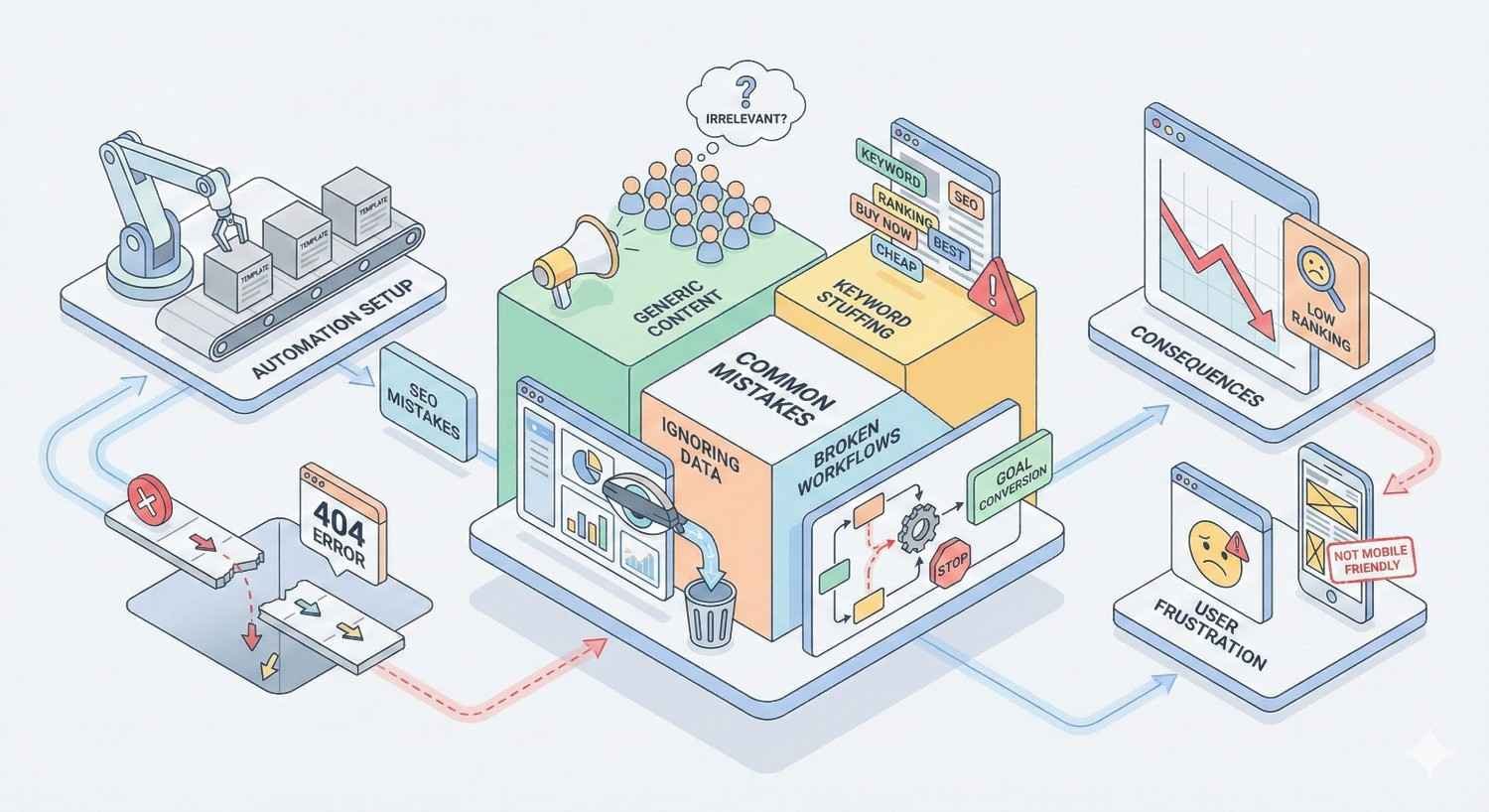
Marketing automation SEO offers significant benefits but also presents pitfalls. Understanding common mistakes helps avoid them.
Most mistakes stem from misunderstanding automation’s role. Automation executes. Humans strategize. Confusing these roles causes problems.
Over-Automating Without Human Oversight
The most common mistake is removing humans from automated processes entirely. Automation should assist humans, not replace them.
Every automated workflow needs human checkpoints. Content distribution automation should not publish without review. Outreach automation should not send without approval. Technical changes should not deploy without verification.
Automated systems make mistakes. Data sources have errors. Algorithms have edge cases. Integrations break. Human oversight catches these issues before they cause damage.
Build review points into workflows explicitly. Define who reviews what and when. Ensure reviews actually happen rather than becoming rubber stamps.
Monitor automated outputs regularly. Even well-functioning automation can drift over time. Periodic audits ensure continued quality.
Ignoring Content Quality for Quantity
Automation enables producing more content faster. This capability tempts teams to prioritize quantity over quality. The temptation should be resisted.
Search engines increasingly reward quality over quantity. Thin, low-value content harms rather than helps rankings. Automated content production without quality controls damages SEO performance.
Use automation to improve content quality, not just increase volume. Optimization tools help writers create better content. Distribution automation ensures quality content reaches audiences. Performance tracking identifies what quality looks like.
Maintain human editorial oversight. Automated brief generation assists writers but should not constrain them. Automated optimization suggestions should inform, not dictate.
Set quality standards and enforce them. Define what constitutes acceptable content. Build quality checks into workflows. Reject content that does not meet standards regardless of automation efficiency.
Neglecting Technical SEO Foundations
Automation cannot fix fundamental technical problems. Sites with poor architecture, slow hosting, or broken infrastructure will not rank well regardless of automation sophistication.
Ensure technical foundations are solid before investing heavily in automation. Site speed, mobile usability, crawlability, and indexability must work properly.
Use automation to maintain technical health, not establish it. Automated monitoring catches regressions. It does not fix underlying architectural issues.
Prioritize technical fixes over automation expansion when foundations are weak. The best content automation cannot overcome technical barriers to ranking.
Regularly audit technical foundations even with monitoring in place. Automated systems check what they are configured to check. Periodic human audits catch issues outside automated scope.
Failing to Align Automation with Business Goals
Automation should serve business objectives. Automating for automation’s sake wastes resources and may actively harm results.
Define clear objectives before implementing automation. What business outcomes should automation support? How will you measure success?
Ensure automated metrics align with business metrics. Ranking improvements matter only if they drive traffic. Traffic matters only if it drives conversions. Conversions matter only if they drive revenue.
Review automation ROI regularly. Are automated workflows delivering expected value? Should resources shift to different automation priorities?
Avoid vanity automation. Some automation looks impressive but delivers little value. Focus on automation that moves business metrics.
Marketing Automation SEO Timelines and Realistic Expectations
SEO results take time. Marketing automation SEO accelerates results but does not eliminate the fundamental timeline. Setting realistic expectations prevents disappointment and premature strategy changes.
Understanding typical timelines helps plan resource allocation and stakeholder communication.
Short-Term Wins (0-3 Months)
The first three months focus on foundation building and quick wins. Automation infrastructure gets established. Immediate opportunities get captured.
Technical SEO automation delivers fastest results. Automated audits identify issues. Fixing critical issues can improve rankings within weeks. Monitoring prevents new issues from accumulating.
Reporting automation provides immediate visibility. Dashboards consolidate data from day one. Stakeholders see progress even before rankings improve significantly.
Content distribution automation amplifies existing content immediately. Better distribution increases visibility for content already published.
Realistic expectations for this phase include infrastructure establishment, baseline measurement, and capturing low-hanging fruit. Dramatic ranking improvements are unlikely unless significant technical issues existed.
Medium-Term Growth (3-6 Months)
Months three through six show automation’s impact on ongoing operations. Workflows mature. Efficiencies compound. Results accelerate.
Content automation workflows hit stride. Brief generation, optimization, and distribution operate smoothly. Content production increases without proportional effort increase.
Link building automation generates momentum. Outreach sequences run consistently. Backlink acquisition accelerates. Domain authority grows.
Ranking improvements become visible. Consistent execution over months moves rankings. Automated monitoring tracks progress precisely.
Realistic expectations include measurable ranking improvements, traffic growth, and demonstrated time savings. ROI calculations become possible with sufficient data.
Long-Term Sustainable Results (6-12+ Months)
Beyond six months, marketing automation SEO delivers compounding returns. Authority builds. Content library expands. Competitive advantages widen.
Topical authority accumulates through consistent content production. Automated workflows ensure steady publication. Comprehensive topic coverage establishes expertise.
Backlink profiles strengthen through sustained outreach. Automated prospecting continuously identifies opportunities. Consistent outreach converts opportunities to links.
Competitive gaps widen. Competitors without automation cannot match your execution consistency. The gap compounds over time.
Realistic expectations include significant organic traffic growth, established topical authority, and clear competitive advantages. ROI should be strongly positive with proper implementation.
Measuring Marketing Automation SEO Success
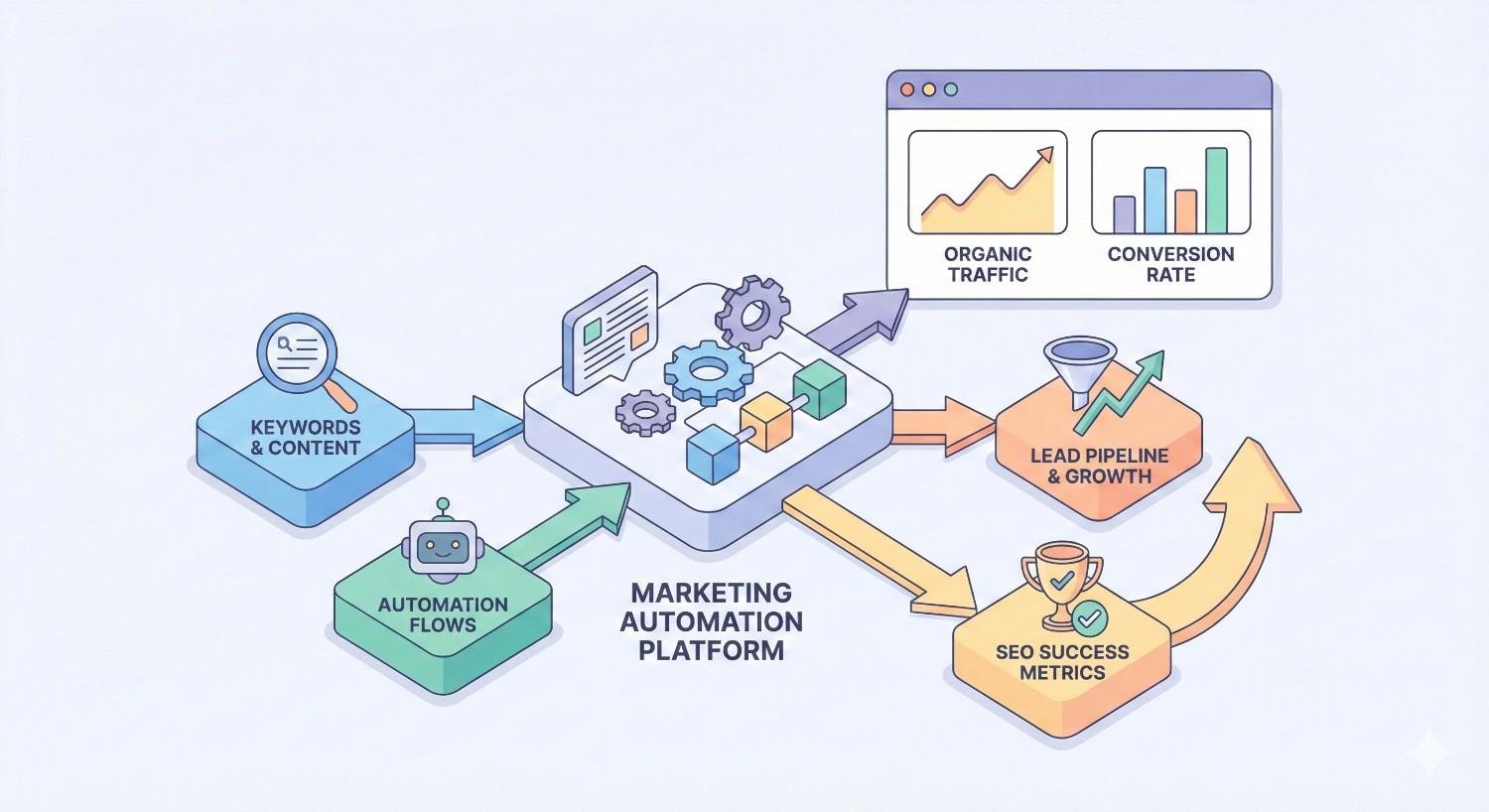
Measurement validates strategy and guides optimization. Marketing automation SEO requires specific metrics and measurement approaches.
Effective measurement connects automation activities to business outcomes. Vanity metrics without business connection provide false confidence.
Key Performance Indicators (KPIs) to Track
KPIs for marketing automation SEO span efficiency metrics and outcome metrics. Both categories matter.
Efficiency KPIs measure automation’s operational impact:
- Time saved per task category
- Tasks completed per time period
- Error rates in automated processes
- Tool utilization rates
Outcome KPIs measure SEO performance:
- Organic traffic growth
- Keyword ranking improvements
- Backlink acquisition rate
- Conversion rate from organic traffic
- Revenue attributed to organic search
Process KPIs measure workflow health:
- Content publication frequency
- Outreach response rates
- Technical issue resolution time
- Report delivery consistency
Select KPIs aligned with your specific objectives. Not every metric matters for every organization. Focus on metrics that drive decisions.
Attribution Models for Automated SEO
Attribution connects SEO activities to business outcomes. Automated systems generate data enabling sophisticated attribution.
First-touch attribution credits the first interaction. For SEO, this often means the first organic search visit. This model values top-of-funnel content.
Last-touch attribution credits the final interaction before conversion. This model may undervalue SEO if paid channels close deals.
Multi-touch attribution distributes credit across interactions. This model recognizes SEO’s role throughout the customer journey.
Data-driven attribution uses algorithms to assign credit based on actual conversion patterns. This requires sufficient data volume.
Choose attribution models appropriate for your sales cycle and data availability. Consistency matters more than perfection. Use the same model over time to track trends.
Calculating ROI from Automation Investments
ROI calculation requires quantifying both costs and returns. Marketing automation SEO involves multiple cost and return categories.
Costs include:
- Tool subscription fees
- Implementation and setup time
- Training and onboarding
- Ongoing maintenance and optimization
- Opportunity cost of resources allocated
Returns include:
- Time savings valued at labor cost
- Increased organic traffic valued at equivalent paid acquisition cost
- Conversions attributed to organic search
- Revenue from organic-attributed customers
Calculate ROI over appropriate time horizons. Short-term ROI may be negative due to setup costs. Long-term ROI should be strongly positive.
Compare ROI across different automation investments. Some workflows deliver better returns than others. Allocate resources toward highest-ROI automation.
Future of Marketing Automation SEO
Marketing automation SEO continues evolving. Understanding emerging trends helps prepare for future opportunities.
The trajectory points toward increased AI integration, predictive capabilities, and broader ecosystem connections.
AI and Machine Learning in SEO Automation
Artificial intelligence is transforming SEO automation capabilities. Machine learning enables automation previously impossible.
AI-powered content optimization goes beyond keyword matching. Natural language processing understands content meaning and suggests improvements based on semantic analysis.
Machine learning improves over time. Automated systems learn from outcomes. Recommendations become more accurate with more data.
Predictive capabilities emerge from AI analysis. Systems can forecast ranking potential, identify emerging topics, and anticipate algorithm changes.
According to Gartner’s research on AI in marketing, 80% of marketers who have invested in AI report positive ROI. SEO automation represents a prime application area.
Human oversight remains essential. AI makes mistakes. Automated systems can optimize for wrong objectives. Human judgment guides AI application.
Predictive SEO and Automated Optimization
Predictive SEO uses data analysis to anticipate future opportunities and threats. Automation enables acting on predictions at scale.
Trend prediction identifies emerging topics before competition intensifies. Automated monitoring of search patterns, social signals, and industry news surfaces opportunities early.
Ranking prediction estimates likelihood of ranking for specific keywords. This informs content prioritization and resource allocation.
Algorithm change prediction analyzes patterns to anticipate updates. While imperfect, early warning enables proactive preparation.
Automated optimization acts on predictions without manual intervention. Content adjustments, technical changes, and link building priorities shift based on predictive signals.
Integration with Broader Marketing Automation Ecosystems
SEO automation increasingly connects with broader marketing technology stacks. Integration enables more sophisticated strategies.
CRM integration connects organic search activities to customer relationships. Lead scoring can incorporate organic search behavior. Sales teams can see which content prospects consumed.
Marketing automation platform integration coordinates SEO with email, advertising, and other channels. Unified customer journeys span channels seamlessly.
Business intelligence integration brings SEO data into enterprise analytics. Executive dashboards include organic search alongside other business metrics.
The trend toward integration will accelerate. Isolated SEO tools will give way to connected ecosystems. Planning for integration now prepares for this future.
Marketing Automation SEO vs. Manual SEO: When to Use Each
Not everything should be automated. Understanding when automation helps and when human expertise is essential optimizes resource allocation.
The goal is not maximum automation but optimal automation. Some tasks benefit from automation. Others require human judgment.
Tasks Best Suited for Automation
Certain task characteristics indicate automation suitability.
Repetitive tasks that occur frequently with consistent steps are prime automation candidates. Rank tracking. Site monitoring. Report generation. Data collection.
Rule-based tasks with clear logic and predictable outcomes automate well. If-then workflows. Threshold-based alerts. Scheduled actions.
High-volume tasks that would overwhelm manual capacity benefit from automation. Monitoring thousands of keywords. Tracking hundreds of backlinks. Auditing large sites.
Time-sensitive tasks requiring immediate response automate effectively. Technical issue alerts. Ranking drop notifications. Competitor activity monitoring.
Data processing tasks involving collection, organization, and presentation automate efficiently. Dashboard updates. Report compilation. Metric calculation.
Tasks Requiring Human Expertise
Other tasks require capabilities automation cannot replicate.
Strategic decisions require human judgment. Which keywords to target. What content to create. How to position against competitors. Automation provides data. Humans decide.
Creative work requires human creativity. Writing compelling content. Crafting outreach messages. Developing brand voice. AI can assist but not replace.
Relationship building requires human connection. Building genuine partnerships. Negotiating collaborations. Establishing trust. Automation handles logistics. Humans build relationships.
Quality judgment requires human evaluation. Is this content good enough? Does this link opportunity fit our brand? Is this technical change worth the risk? Humans assess quality.
Novel situations require human adaptation. Algorithm updates. Market shifts. Competitive changes. Automation follows rules. Humans adapt to new circumstances.
Finding the Right Balance
The optimal balance depends on your specific situation. Resources, objectives, and competitive context all influence the right mix.
Start with high-impact, clearly automatable tasks. Build automation competency. Expand gradually based on results.
Maintain human involvement in strategic and creative work. Automation should free humans for higher-value activities, not eliminate human contribution.
Evaluate balance regularly. As automation capabilities improve, the optimal balance shifts. Tasks requiring human expertise today may be automatable tomorrow.
Avoid automation ideology. Neither “automate everything” nor “humans do it better” serves well. Pragmatic evaluation of each task optimizes outcomes.
How to Choose a Marketing Automation SEO Partner
Many organizations lack internal expertise to implement marketing automation SEO effectively. Partnering with specialists accelerates implementation and improves outcomes.
Choosing the right partner requires careful evaluation. The wrong partner wastes resources and may damage SEO performance.
Questions to Ask Potential Providers
Thorough evaluation requires asking the right questions.
Experience questions:
- How long have you provided marketing automation SEO services?
- What industries have you served?
- Can you share case studies with measurable results?
- What is your team’s background and expertise?
Process questions:
- How do you approach automation implementation?
- What tools do you use and why?
- How do you handle integration with existing systems?
- What does your reporting include?
Results questions:
- What results can we realistically expect?
- What timeline should we plan for?
- How do you measure and report ROI?
- What happens if results do not meet expectations?
Relationship questions:
- Who will we work with directly?
- How often will we communicate?
- How do you handle strategy changes?
- What is your approach to knowledge transfer?
Red Flags to Watch For
Certain signals indicate potential problems with providers.
Guaranteed rankings are impossible to deliver. Search engines control rankings. Providers promising specific positions are either dishonest or naive.
Black hat tactics risk penalties. Providers suggesting link schemes, content spinning, or other manipulative tactics should be avoided.
Lack of transparency about methods indicates potential problems. Reputable providers explain their approach clearly.
No case studies or references suggests limited experience or poor results. Established providers have success stories to share.
Unrealistic timelines indicate either inexperience or dishonesty. SEO takes time. Providers promising rapid results are setting false expectations.
One-size-fits-all approaches ignore your specific situation. Effective providers customize strategies to your needs.
What to Expect from a Full-Service SEO Provider
Quality providers deliver comprehensive services with clear expectations.
Strategic planning should precede tactical execution. Providers should understand your business before recommending automation approaches.
Transparent reporting should show activities and results clearly. You should understand what is being done and what outcomes result.
Regular communication should keep you informed and involved. Strategy should evolve based on results and changing circumstances.
Knowledge transfer should build your internal capabilities. Good providers make you smarter, not more dependent.
Measurable results should demonstrate value. ROI should be trackable and positive over reasonable timeframes.
Flexibility should accommodate changing needs. Business circumstances change. Providers should adapt accordingly.
Conclusion
Marketing automation SEO represents the convergence of two powerful disciplines into a unified approach for scaling organic growth. By systematically automating technical monitoring, content workflows, link building processes, and reporting, businesses can achieve SEO results previously requiring much larger teams and budgets.
The key lies in strategic implementation. Automation should handle repetitive, rule-based tasks while humans focus on strategy, creativity, and relationship building. This balance maximizes both efficiency and effectiveness, creating sustainable competitive advantages in organic search.
We at White Label SEO Service specialize in implementing marketing automation SEO strategies that drive measurable results. Contact us to discuss how automated workflows can accelerate your organic growth while freeing your team for higher-value activities.
Frequently Asked Questions About Marketing Automation SEO
What is marketing automation SEO?
Marketing automation SEO combines automated software workflows with search engine optimization practices. It uses tools to handle repetitive tasks like rank tracking, site monitoring, content distribution, and reporting while humans focus on strategy and creative work.
How much does marketing automation SEO cost?
Costs vary based on tool selection and implementation scope. Basic automation using free or low-cost tools might cost $100-500 monthly. Comprehensive enterprise implementations can exceed $5,000 monthly. Most mid-market businesses invest $500-2,000 monthly in tools plus implementation services.
Can small businesses benefit from SEO automation?
Yes, small businesses often benefit most from automation. Limited resources make efficiency critical. Automation enables small teams to execute comprehensive SEO programs that would otherwise require larger staffs. Many tools offer affordable pricing tiers for smaller organizations.
What are the best tools for marketing automation SEO?
The best tools depend on your specific needs. Semrush and Ahrefs provide comprehensive platforms. Screaming Frog handles technical audits. Clearscope and Surfer optimize content. Pitchbox manages outreach. Google Data Studio creates reports. Most implementations combine multiple specialized tools.
How long does it take to see results from automated SEO?
Initial efficiency gains appear immediately as automation reduces manual work. SEO performance improvements typically emerge over three to six months as consistent execution compounds. Significant traffic and ranking improvements usually require six to twelve months of sustained effort.
Is automated SEO safe for my website?
Properly implemented automation is completely safe. The key is maintaining human oversight and avoiding manipulative tactics. Automation should execute legitimate SEO activities more efficiently, not attempt to trick search engines. Quality providers use only white-hat approaches.
What tasks should not be automated in SEO?
Strategic decisions, creative content development, relationship building, and quality judgment should remain human responsibilities. Automation handles execution while humans handle thinking. The goal is freei