

Middle-of-funnel SaaS keywords capture prospects who already understand their problem and are actively evaluating solutions. These search terms sit between broad awareness queries and ready-to-buy transactional searches, making them critical for driving qualified leads into your sales pipeline.
For SaaS companies competing in crowded markets, MOFU keywords represent the highest-leverage SEO opportunity. They attract users with genuine purchase intent while facing less competition than bottom-funnel branded terms.
This guide covers everything from identifying MOFU keywords to building content that ranks and converts. You will learn research frameworks, content strategies, and measurement approaches that work.
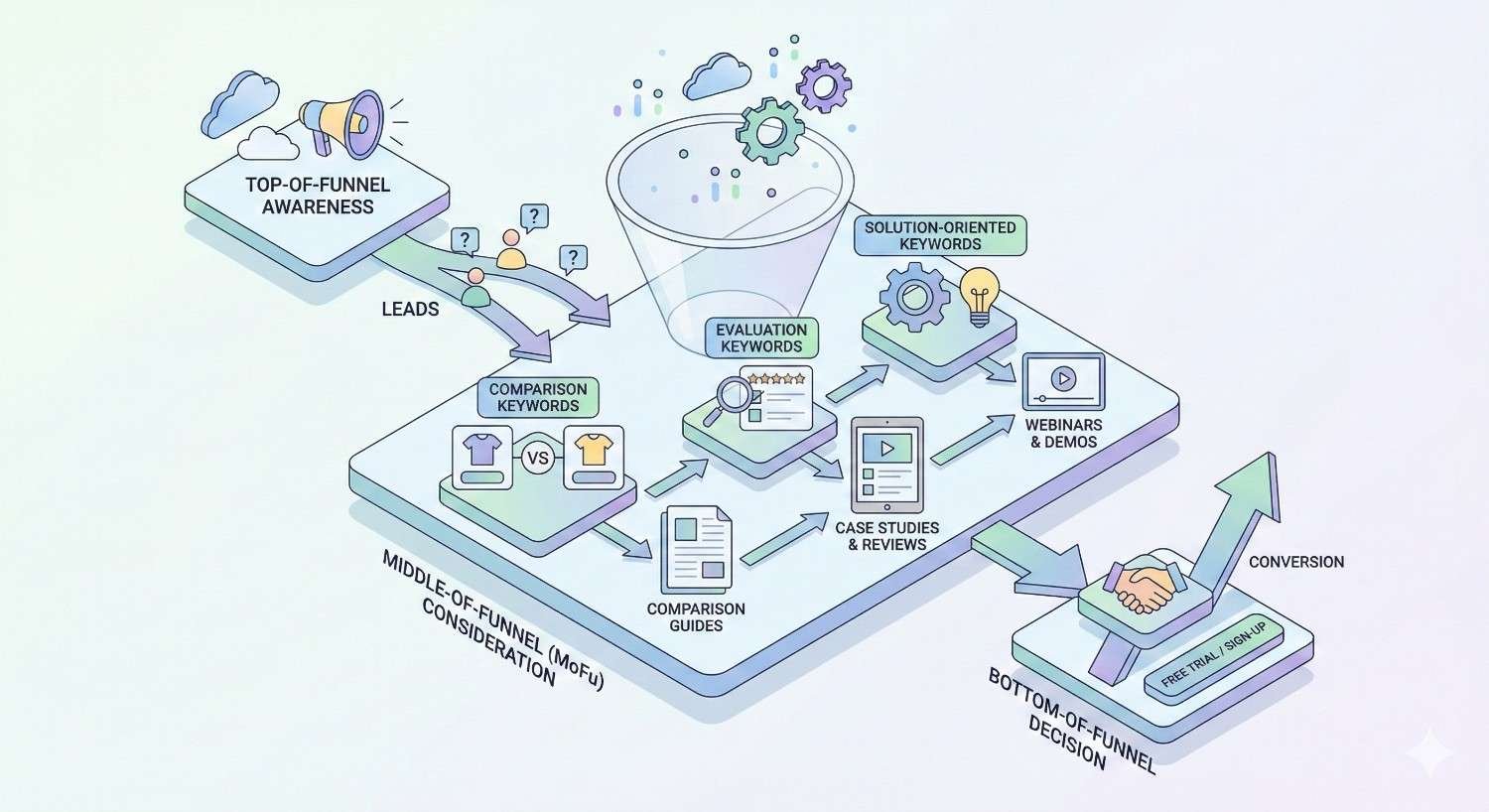
What Are Middle-of-Funnel SaaS Keywords?
Middle-of-funnel keywords bridge the gap between initial problem awareness and final purchase decisions. Understanding their characteristics helps you target the right terms and create content that matches user intent.
Definition and Core Characteristics
Middle-of-funnel SaaS keywords are search terms used by prospects who have identified a problem and are researching potential solutions. These users know they need software to solve a specific challenge but have not committed to a particular product or vendor.
MOFU keywords share several defining characteristics. They demonstrate solution awareness without brand commitment. Searchers using these terms understand categories of tools exist but are still evaluating options.
The search intent behind MOFU keywords is commercial investigation. Users want to compare, evaluate, and understand their choices before making decisions. They seek information that helps them narrow down options and build confidence in their eventual selection.
Volume and competition for MOFU terms typically fall between top-funnel informational queries and bottom-funnel branded searches. This creates opportunities for SaaS companies to capture high-intent traffic without competing directly against established market leaders on their branded terms.
How MOFU Keywords Differ from TOFU and BOFU Keywords
Top-of-funnel keywords target users in the awareness stage. These searchers are exploring problems, learning concepts, or seeking educational content. TOFU queries like “what is project management” or “how to improve team productivity” indicate early-stage research without purchase intent.
Bottom-of-funnel keywords capture users ready to buy. BOFU terms include branded searches, pricing queries, and transactional phrases. Someone searching “Asana pricing” or “buy Monday.com annual plan” has already decided on a solution and is moving toward purchase.
Middle-of-funnel keywords occupy the consideration space between these extremes. MOFU searchers have moved past general education but have not selected a specific product. Queries like “best project management software for remote teams” or “Asana vs Monday comparison” signal active evaluation.
The content requirements differ significantly across funnel stages. TOFU content educates broadly. BOFU content facilitates transactions. MOFU content must help users evaluate, compare, and build confidence in their decision-making process.
The Role of MOFU Keywords in the SaaS Buyer Journey
SaaS buyer journeys rarely follow linear paths. Prospects move between awareness, consideration, and decision stages multiple times before converting. MOFU keywords capture users during critical evaluation moments throughout this journey.
During the consideration phase, prospects actively research solutions. They read comparison articles, check reviews, explore feature lists, and assess pricing models. Each of these activities corresponds to specific MOFU keyword patterns.
MOFU content serves as a trust-building mechanism. When your content helps prospects make informed decisions, you establish credibility that carries through to the purchase stage. Even if users do not convert immediately, positive MOFU experiences create brand preference.
The SaaS buying cycle often involves multiple stakeholders. MOFU content addresses different concerns across decision-makers, influencers, and end users. A CFO might search for ROI calculators while a team lead searches for feature comparisons. Both represent MOFU opportunities.
Why Middle-of-Funnel Keywords Matter for SaaS Growth
MOFU keywords directly impact revenue metrics that matter to SaaS businesses. Understanding their strategic value helps prioritize SEO investments and align content efforts with business objectives.
Connecting Awareness to Purchase Intent
MOFU keywords create pathways from initial awareness to purchase consideration. Without middle-funnel content, prospects who discover your brand through educational content have no clear next step in their journey.
This connection works in both directions. MOFU content can introduce your brand to users who bypassed the awareness stage entirely. Someone searching “CRM alternatives to Salesforce” may never have encountered your brand through TOFU content but represents a highly qualified prospect.
The bridging function of MOFU content reduces friction in the buyer journey. Rather than expecting prospects to jump from problem awareness directly to product selection, you provide intermediate content that guides evaluation and builds confidence.
Effective MOFU strategies create multiple entry points into your funnel. Users can discover your brand through comparisons, reviews, use case guides, or feature explanations. Each entry point represents an opportunity to capture consideration-stage traffic.
Impact on Lead Quality and Sales Pipeline
MOFU traffic typically converts at higher rates than top-funnel visitors. Users searching comparison and evaluation terms have demonstrated purchase intent through their query selection. They are not casually browsing but actively researching solutions.
Lead quality from MOFU content tends to be significantly higher than TOFU sources. These prospects understand their problem, have budget awareness, and are evaluating solutions. Sales teams spend less time qualifying and educating MOFU-sourced leads.
Pipeline velocity often improves with strong MOFU content. Prospects who have consumed comparison content, reviewed feature guides, and explored pricing information arrive at sales conversations better informed. This reduces sales cycle length and improves close rates.
The qualification effect compounds over time. As your MOFU content library grows, you capture more consideration-stage traffic. This shifts your overall traffic mix toward higher-intent visitors, improving aggregate conversion metrics.
MOFU Keywords and Long-Term Organic ROI
MOFU content generates compounding returns over time. Unlike paid advertising that stops producing results when budgets end, ranking MOFU content continues attracting qualified traffic month after month.
The ROI calculation for MOFU content favors long-term investment. Initial content creation requires significant resources, but ongoing traffic acquisition costs approach zero once rankings stabilize. This creates favorable unit economics compared to paid channels.
MOFU rankings build competitive moats. Establishing authority for comparison and evaluation keywords makes it harder for competitors to capture the same traffic. Strong MOFU positions protect market share and reduce customer acquisition costs.
Content assets created for MOFU keywords often serve multiple purposes. Comparison pages inform sales conversations. Feature guides support customer success. Pricing content aids marketing campaigns. This multi-use value amplifies ROI beyond direct organic traffic.
Types of Middle-of-Funnel SaaS Keywords
MOFU keywords fall into distinct categories based on user intent and search behavior. Understanding these types helps you build comprehensive keyword strategies that capture traffic across the consideration stage.
Comparison Keywords (vs, alternatives, competitors)
Comparison keywords explicitly signal evaluation intent. Users searching these terms want to understand differences between options and make informed choices. Common patterns include “vs” comparisons, alternative searches, and competitor-focused queries.
Direct comparison queries follow predictable formats. “[Product A] vs [Product B]” searches indicate users evaluating specific options. “[Product] alternatives” queries suggest dissatisfaction with a current solution or desire to explore options beyond a known brand.
Competitor-focused keywords present strategic opportunities. Targeting “[Competitor] alternatives” or “[Competitor] vs [Your Brand]” captures users actively considering your market category. These searchers have demonstrated interest in solutions like yours.
Comparison content requires balanced, credible presentation. Users expect honest assessments that help them decide, not thinly veiled sales pitches. The most effective comparison content acknowledges competitor strengths while highlighting your differentiation.
Evaluation Keywords (reviews, pricing, features)
Evaluation keywords indicate users assessing specific aspects of potential solutions. These searches focus on gathering information needed to make confident decisions. Common patterns include reviews, pricing, and feature-focused queries.
Review searches signal trust-seeking behavior. Users want third-party validation before committing to a solution. “[Product] reviews” and “[Product] ratings” queries indicate prospects seeking social proof and real-world experiences.
Pricing keywords represent high-intent searches. Users researching pricing have moved beyond feature evaluation and are assessing budget fit. “[Product] pricing,” “[Product] cost,” and “[Category] pricing comparison” queries indicate serious purchase consideration.
Feature-focused searches help users match solutions to requirements. “[Product] features,” “[Product] integrations,” and “[Product] capabilities” queries indicate detailed evaluation. Users want to confirm a solution meets their specific needs before proceeding.
Solution-Aware Keywords (how to, best way to)
Solution-aware keywords target users who understand their problem and are researching approaches. These searches often include “how to” and “best way to” patterns combined with specific outcomes or challenges.
These keywords differ from pure TOFU educational content. Solution-aware searchers are not learning about problems but evaluating methods to solve them. “How to automate email marketing” indicates someone ready to implement, not someone learning what email marketing means.
Best-practice queries signal evaluation of approaches. “Best way to manage remote teams” or “most effective CRM implementation strategies” indicate users comparing methodologies, not just learning concepts. Content for these terms should present options and help users choose.
Solution-aware keywords often have strong commercial intent despite their informational appearance. Users searching these terms frequently convert to product trials or demos when content effectively bridges from methodology to tool recommendations.
Use Case Keywords (for teams, for startups, for enterprise)
Use case keywords target users seeking solutions for specific contexts. These searches combine product categories with audience segments, company sizes, or industry verticals. They indicate users evaluating fit for their particular situation.
Segment-focused keywords follow patterns like “[Category] for [Audience].” Examples include “project management software for agencies,” “CRM for startups,” or “accounting software for freelancers.” Users want solutions designed for their specific context.
Industry-vertical keywords target specialized needs. “HIPAA-compliant CRM” or “construction project management software” indicate users with specific requirements that generic solutions may not address. These keywords often have lower volume but higher conversion rates.
Company-size keywords help users find appropriately scaled solutions. “Enterprise marketing automation” and “small business inventory management” indicate users seeking solutions matched to their organizational complexity and budget constraints.
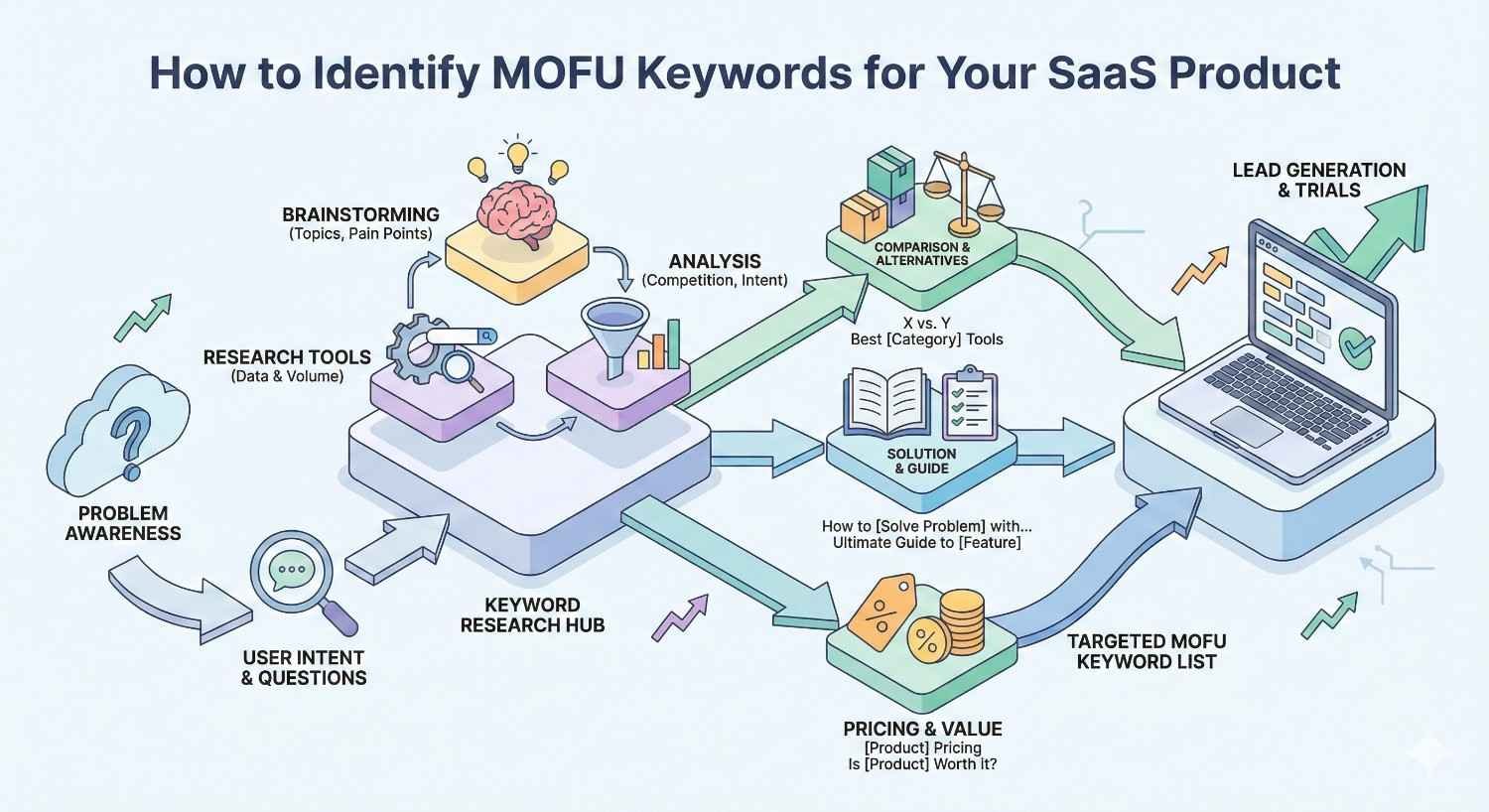
How to Identify MOFU Keywords for Your SaaS Product
Systematic keyword identification ensures you capture relevant MOFU opportunities. Multiple research approaches combined provide comprehensive coverage of your consideration-stage keyword landscape.
Analyzing Search Intent Signals
Search intent analysis distinguishes MOFU keywords from other funnel stages. Several signals indicate consideration-stage intent that should guide your keyword selection.
Query modifiers reveal intent. Words like “vs,” “alternative,” “compare,” “review,” “pricing,” and “best” typically indicate MOFU searches. These modifiers suggest users evaluating options rather than learning concepts or ready to purchase.
SERP analysis confirms intent classification. Search results for true MOFU keywords feature comparison content, review roundups, and evaluation guides. If results show primarily educational content or product pages, the keyword may belong to a different funnel stage.
User journey mapping helps identify intent. Consider what questions prospects ask during consideration. What information do they need to move from awareness to decision? Keywords that answer these questions likely represent MOFU opportunities.
Commercial investigation intent differs from transactional intent. MOFU searchers want information to support decisions, not immediate purchase pathways. Content should educate and build confidence rather than push for immediate conversion.
Keyword Research Tools and Techniques
Multiple tools and techniques support MOFU keyword discovery. Combining approaches ensures comprehensive coverage of your opportunity landscape.
Traditional keyword research platforms provide volume and competition data. Tools like Ahrefs, Semrush, and Moz help identify MOFU keyword opportunities and assess their potential value. Filter for commercial investigation intent to focus on consideration-stage terms.
Seed keyword expansion reveals MOFU variations. Start with core product categories and expand using modifier patterns. Add “vs,” “alternatives,” “reviews,” “pricing,” “features,” and “for [segment]” to category terms to generate MOFU keyword lists.
Question-based research uncovers evaluation queries. Tools that surface questions people ask about your category reveal MOFU opportunities. “Which [category] is best for [use case]” and “how does [product] compare to [competitor]” patterns indicate consideration-stage searches.
Search suggest and related searches provide additional ideas. Google’s autocomplete and “People also ask” features reveal actual user queries. These suggestions often include MOFU patterns that formal keyword tools miss.
Mining Competitor Content for MOFU Opportunities
Competitor analysis reveals proven MOFU keyword opportunities. Understanding what consideration-stage content competitors rank for helps identify gaps and priorities for your own strategy.
Content gap analysis compares your rankings to competitors. Identify MOFU keywords where competitors rank but you do not. These gaps represent opportunities to capture traffic currently going to competing solutions.
Top-performing competitor content reveals successful approaches. Analyze which MOFU pages drive the most traffic for competitors. Understanding their content strategies helps you create superior alternatives.
Competitor comparison pages present direct opportunities. If competitors have created “[Your Brand] vs [Competitor]” content, you should control that narrative with your own comparison page. Letting competitors define the comparison disadvantages your positioning.
Backlink analysis reveals MOFU content that earns links. Comparison and evaluation content that attracts backlinks indicates topics with strong interest. These keywords often represent high-value MOFU opportunities worth prioritizing.
Using Customer Questions to Discover MOFU Terms
Customer interactions reveal authentic MOFU language and concerns. Mining these sources uncovers keywords that formal research tools may miss.
Sales conversation analysis surfaces evaluation questions. What do prospects ask during demos and sales calls? These questions often translate directly into MOFU keyword opportunities. “How does your pricing compare to [competitor]” becomes a targetable search term.
Support ticket analysis reveals post-purchase evaluation. Questions from new customers about features, integrations, and use cases indicate topics prospects researched before buying. Creating content for these topics captures future MOFU traffic.
Review mining uncovers evaluation criteria. What aspects do customers mention in reviews? The factors people discuss when evaluating your product indicate what MOFU searchers want to know. Create content addressing these evaluation criteria.
Community and forum research reveals organic discussions. How do people in your market talk about evaluating solutions? Reddit threads, industry forums, and social media discussions surface authentic MOFU language and concerns.
MOFU Keyword Research Framework for SaaS
A structured framework ensures systematic MOFU keyword identification. Following these steps builds comprehensive keyword strategies aligned with business objectives.
Step 1: Map Your Buyer Journey Stages
Journey mapping creates the foundation for MOFU keyword research. Understanding how prospects move from awareness to purchase reveals where MOFU content should intervene.
Document the stages prospects pass through. What triggers initial awareness? What information do they seek during evaluation? What factors influence final decisions? Each stage corresponds to different keyword opportunities.
Identify decision criteria at each stage. What must prospects understand or believe to move forward? MOFU keywords should address the specific information needs that enable progression from consideration to decision.
Map content types to journey stages. Educational content serves awareness. Comparison and evaluation content serves consideration. Product and pricing content serves decision. This mapping guides keyword categorization and content planning.
Consider multiple buyer personas. Different stakeholders have different journey patterns. A technical evaluator searches different MOFU terms than an executive decision-maker. Map journeys for each key persona to ensure comprehensive keyword coverage.
Step 2: Identify Problem-Solution Gaps
Gap analysis reveals MOFU opportunities where prospects need information you are not currently providing. These gaps represent high-priority keyword targets.
Audit existing content against journey stages. Where do you have strong coverage? Where are prospects left without guidance? Gaps in consideration-stage content indicate MOFU keyword opportunities.
Analyze competitor coverage for gaps. What MOFU topics do competitors address that you do not? These gaps may be costing you traffic and leads. Prioritize closing gaps where competitors have established positions.
Survey prospects and customers about information needs. What did they wish they had known during evaluation? What questions went unanswered? Direct feedback reveals gaps that research tools cannot identify.
Review search console data for gap signals. Are you getting impressions for MOFU queries without corresponding content? These queries indicate demand for consideration-stage content you have not yet created.
Step 3: Build Keyword Clusters by Intent
Keyword clustering organizes MOFU opportunities into actionable groups. Clusters enable efficient content creation and comprehensive topic coverage.
Group keywords by intent pattern. Comparison keywords form one cluster. Evaluation keywords form another. Use case keywords form a third. This organization guides content strategy and prevents redundant efforts.
Create sub-clusters within major categories. Within comparison keywords, group by competitor pairs. Within use case keywords, group by segment or industry. Sub-clustering enables targeted content creation.
Map clusters to content types. Comparison clusters map to versus pages. Evaluation clusters map to review and feature content. Use case clusters map to segment-specific guides. This mapping connects keywords to content execution.
Identify cluster relationships. How do different MOFU clusters connect? Users searching comparisons may also search reviews. Understanding relationships enables internal linking strategies that guide users through evaluation.
Step 4: Prioritize by Volume, Difficulty, and Business Value
Prioritization ensures you target the highest-impact MOFU keywords first. Balancing multiple factors creates effective prioritization frameworks.
Volume indicates traffic potential. Higher-volume keywords offer more traffic opportunity but often face more competition. Consider volume in context of your domain authority and competitive position.
Difficulty assesses ranking feasibility. Keyword difficulty scores estimate how hard ranking will be. Prioritize keywords where difficulty aligns with your site’s authority. Targeting keywords beyond your current capability wastes resources.
Business value reflects conversion potential. Not all MOFU traffic converts equally. Keywords indicating strong purchase intent or alignment with your ideal customer profile deserve higher priority regardless of volume.
Create scoring models combining factors. Weight volume, difficulty, and business value based on your priorities. Score keywords systematically to create ranked priority lists. This removes subjectivity from prioritization decisions.
Content Types That Rank for MOFU SaaS Keywords
Different MOFU keywords require different content approaches. Understanding which content types rank for specific keyword patterns guides effective content creation.
Comparison Pages and Versus Content
Comparison pages rank for direct versus queries and alternative searches. These pages directly address the evaluation needs of prospects comparing specific options.
Effective comparison content presents balanced assessments. Users expect honest evaluation, not marketing spin. Acknowledge competitor strengths while clearly articulating your differentiation. Credibility requires fairness.
Structure comparisons for scannability. Users want quick answers to specific questions. Use comparison tables, feature matrices, and clear section headings. Enable users to find the specific comparisons they need.
Include clear recommendations. After presenting comparisons, help users decide. Indicate which solution fits which use cases. Users appreciate guidance, not just information dumps.
Update comparison content regularly. Product features and pricing change. Outdated comparisons damage credibility and rankings. Establish review cadences to keep comparison content accurate.
Product Alternative Roundups
Alternative roundups rank for “[Product] alternatives” and “best [category]” queries. These pages present multiple options for users exploring beyond a specific known solution.
Roundup content should provide genuine value. Include sufficient detail about each alternative to help users evaluate. Superficial lists that lack depth fail to satisfy user intent and struggle to rank.
Position your product appropriately within roundups. If you are creating a “[Competitor] alternatives” roundup, include your product but present it fairly alongside other options. Overly promotional roundups lose credibility.
Organize alternatives by use case or user type. Different alternatives suit different needs. Helping users identify which alternative fits their situation increases content value and conversion potential.
Include comparison criteria and methodology. Explain how you evaluated alternatives. Transparency about your assessment approach builds trust and differentiates your content from superficial listicles.
Feature Deep-Dives and Use Case Guides
Feature and use case content ranks for evaluation keywords and segment-specific searches. This content helps users assess whether solutions meet their specific requirements.
Feature deep-dives should go beyond feature lists. Explain how features work, why they matter, and how users benefit. Connect features to outcomes users care about. Depth differentiates from shallow competitor content.
Use case guides address specific applications. How does your product solve particular problems for particular users? Detailed use case content helps prospects envision implementation and builds confidence in fit.
Include practical examples and demonstrations. Screenshots, walkthroughs, and real-world examples make abstract features concrete. Users evaluating solutions want to see how things actually work.
Address limitations honestly. No product does everything perfectly. Acknowledging limitations builds credibility and helps users make informed decisions. Prospects appreciate transparency over sales spin.
Pricing and ROI Calculators
Pricing content ranks for high-intent cost and value queries. Users searching pricing information have moved deep into consideration and need budget-related information.
Transparent pricing content builds trust. If your pricing is public, present it clearly with context about what each tier includes. If pricing requires consultation, explain why and what factors influence cost.
ROI calculators help users justify purchases. Interactive tools that estimate value based on user inputs address a critical evaluation need. Calculators also generate leads by capturing user information.
Comparison pricing content addresses competitive evaluation. How does your pricing compare to alternatives? Users want to understand relative value, not just absolute cost. Address competitive pricing transparently.
Include total cost of ownership considerations. Implementation, training, and ongoing costs matter beyond subscription prices. Comprehensive cost content helps users budget accurately and reduces post-purchase surprises.
Case Studies and Social Proof Content
Case studies rank for trust-seeking queries and industry-specific searches. This content provides the social proof prospects need to build confidence in their evaluation.
Effective case studies tell complete stories. Present the customer’s challenge, the solution implemented, and the results achieved. Narrative structure engages readers and makes outcomes memorable.
Include specific metrics and outcomes. Vague claims about “improved efficiency” lack impact. Concrete numbers like “reduced processing time by 40%” or “increased conversion by 25%” provide credible evidence.
Feature customers similar to target prospects. Case studies resonate most when readers see themselves in the featured customer. Segment case studies by industry, company size, or use case to maximize relevance.
Make case studies discoverable. Optimize case studies for relevant MOFU keywords. A case study about a healthcare customer should target healthcare-specific evaluation queries. Strategic optimization extends case study value beyond direct sharing.
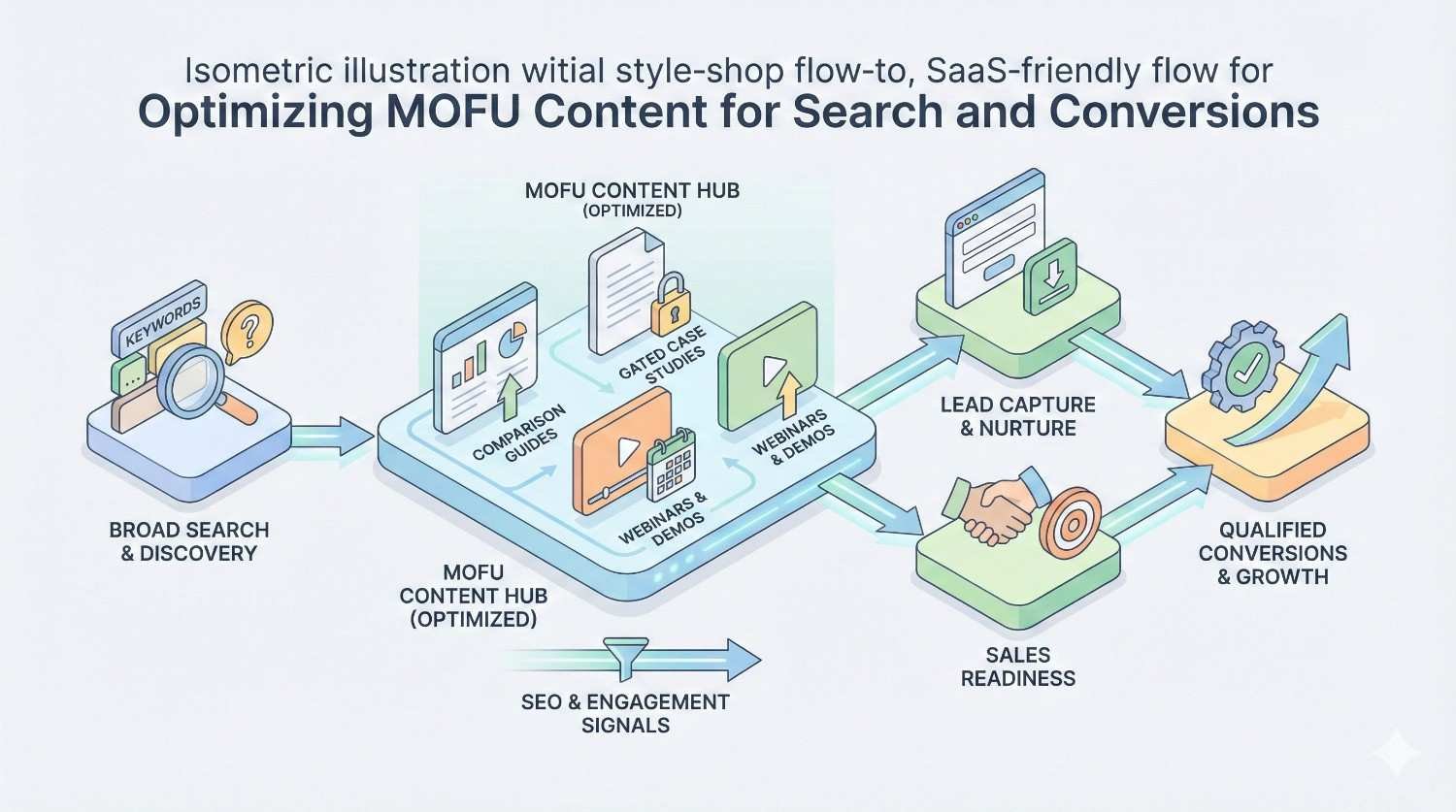
Optimizing MOFU Content for Search and Conversions
MOFU content must perform for both search engines and human readers. Optimization strategies should address ranking factors while maximizing conversion potential.
On-Page SEO Best Practices for MOFU Pages
On-page optimization ensures search engines understand and rank your MOFU content appropriately. Standard best practices apply with consideration-stage-specific adjustments.
Title tags should include primary MOFU keywords. Comparison pages need “[Product A] vs [Product B]” in titles. Alternative pages need “[Product] Alternatives” phrasing. Clear keyword inclusion signals relevance.
Meta descriptions should address evaluation intent. Highlight what users will learn and why your comparison or evaluation is valuable. Include calls to action appropriate for consideration-stage users.
Header structure should organize evaluation content logically. Use H2s for major comparison categories or evaluation criteria. Use H3s for specific features or products within categories. Clear structure aids both users and search engines.
Content depth should exceed competitors. Thin MOFU content struggles to rank against comprehensive alternatives. Ensure your comparison and evaluation content provides more value than competing pages.
Structuring Content for Featured Snippets
Featured snippets capture significant MOFU search traffic. Structuring content for snippet eligibility increases visibility and click-through rates.
Comparison tables earn table snippets. Structure product comparisons as clear tables with consistent columns. Tables that directly answer comparison queries frequently earn featured snippet positions.
Definition paragraphs earn paragraph snippets. Include clear, concise definitions of key terms near the top of content. Direct answers to “what is” questions within MOFU content can capture snippet positions.
Numbered lists earn list snippets. When presenting steps, criteria, or ranked options, use numbered list formatting. Lists that answer “how to” or “best” queries frequently earn featured positions.
Question-and-answer formatting supports snippet eligibility. Include common evaluation questions as subheadings with direct answers immediately following. This format aligns with how snippets are extracted.
Internal Linking Strategies for Funnel Progression
Internal linking guides users through evaluation and toward conversion. Strategic linking from MOFU content supports both SEO and user journey objectives.
Link MOFU content to related MOFU pages. Comparison pages should link to relevant feature guides. Alternative roundups should link to individual product comparisons. This creates evaluation pathways users can follow.
Link MOFU content to BOFU conversion pages. After helping users evaluate, guide them toward next steps. Link to pricing pages, demo requests, or trial signups. Make progression easy for users ready to advance.
Link from TOFU content to MOFU content. Educational content should guide readers toward evaluation content. Users who finish learning about problems should find easy paths to solution evaluation.
Use descriptive anchor text for internal links. Anchor text should indicate what users will find. “Compare features” and “see pricing details” provide clearer guidance than generic “learn more” links.
CTA Placement and Lead Capture Optimization
MOFU content should capture leads and drive conversions without disrupting the evaluation experience. Strategic CTA placement balances conversion goals with user needs.
Match CTAs to evaluation stage. Users reading comparisons may not be ready for demos. Offer content downloads, email subscriptions, or tool trials as intermediate conversion options. Meet users where they are.
Place CTAs at natural decision points. After presenting comparison conclusions or evaluation summaries, users are primed for next steps. Position CTAs where users naturally consider what to do with the information provided.
Test CTA variations for MOFU content. Different offers resonate with different evaluation stages. A/B test demo requests versus trial signups versus content downloads to identify what converts best for specific MOFU pages.
Avoid aggressive interruption. Pop-ups and intrusive CTAs that interrupt evaluation damage user experience. MOFU users need to complete their research. Let them finish before pushing conversion actions.
Common Mistakes When Targeting MOFU SaaS Keywords
Avoiding common mistakes improves MOFU content performance. Understanding these pitfalls helps you create more effective consideration-stage content.
Ignoring Search Intent Nuances
Intent misalignment causes MOFU content to fail. Creating content that does not match what users actually want results in poor rankings and high bounce rates.
Comparison queries require comparison content. Users searching “[Product A] vs [Product B]” want direct comparison, not general information about either product. Content that fails to compare directly misses intent.
Alternative queries require multiple options. Users searching “[Product] alternatives” want to see several options, not a single product pitch. Content that only promotes your solution fails to satisfy the query.
Evaluation queries require evaluation criteria. Users searching “best [category] for [use case]” want assessment frameworks and recommendations. Content that lists products without evaluation provides insufficient value.
Validate intent through SERP analysis. Before creating MOFU content, review what currently ranks. The ranking content reveals what search engines understand users to want. Align your content with demonstrated intent.
Over-Optimizing for Volume Over Quality
Chasing high-volume keywords without considering quality leads to wasted effort. Volume alone does not indicate MOFU keyword value.
High-volume keywords often have misaligned intent. Broad category terms may have high search volume but attract users at various funnel stages. Targeting these keywords with MOFU content may miss the mark.
Lower-volume MOFU keywords often convert better. Specific comparison and evaluation queries may have modest volume but attract highly qualified prospects. These keywords deserve priority despite lower traffic potential.
Quality content for the right keywords outperforms thin content for popular keywords. A comprehensive comparison page for a 500-search-volume keyword may generate more leads than a superficial page targeting a 5,000-search-volume term.
Balance volume with intent alignment and conversion potential. The best MOFU keywords combine reasonable volume with clear consideration-stage intent and strong business relevance.
Failing to Differentiate from Competitors
Generic MOFU content struggles to rank and convert. When your comparison or evaluation content looks like everyone else’s, you provide no reason for users or search engines to prefer it.
Add unique perspectives and insights. What do you know about your market that competitors do not share? Original analysis, proprietary data, or expert perspectives differentiate your content.
Include original research or testing. First-hand product testing, user surveys, or performance benchmarks create unique value. Content based on original research earns links and rankings that aggregated information cannot.
Present information in superior formats. Better organization, clearer visuals, or more useful interactive elements can differentiate even when covering similar topics. Execution quality matters.
Take clear positions. Generic content that refuses to recommend or conclude provides less value than content that helps users decide. Confident recommendations based on clear criteria differentiate your content.
Neglecting Content Updates and Freshness
Outdated MOFU content damages credibility and rankings. Products change, pricing updates, and features evolve. Stale content provides inaccurate information.
Establish update schedules for MOFU content. Comparison pages need regular review as products change. Pricing content needs updates when competitors adjust pricing. Build maintenance into your content operations.
Monitor for accuracy triggers. Product launches, pricing changes, and feature updates should trigger content reviews. Set alerts for competitor announcements that might affect your MOFU content accuracy.
Display update dates prominently. Users evaluating solutions want current information. Showing when content was last updated builds trust and signals freshness to search engines.
Refresh content proactively. Do not wait for rankings to drop before updating. Regular refreshes maintain positions and ensure users always find accurate information.
Measuring MOFU Keyword Performance
Measurement validates MOFU strategy effectiveness and guides optimization. Tracking the right metrics ensures you understand how MOFU content contributes to business objectives.
Key Metrics: Rankings, Traffic, and Engagement
Foundational metrics indicate MOFU content visibility and initial performance. These metrics provide early signals about content effectiveness.
Keyword rankings show search visibility. Track positions for target MOFU keywords over time. Improving rankings indicate content and optimization effectiveness. Declining rankings signal need for updates or competitive response.
Organic traffic measures audience reach. Monitor traffic to MOFU pages from organic search. Traffic growth validates keyword targeting and content quality. Traffic declines warrant investigation.
Engagement metrics indicate content quality. Time on page, scroll depth, and bounce rate reveal whether content satisfies user needs. Strong engagement suggests content matches intent. Poor engagement indicates misalignment or quality issues.
Click-through rate from search results measures title and description effectiveness. Low CTR despite good rankings suggests meta content needs improvement. High CTR indicates compelling search presence.
Tracking Lead Generation and Pipeline Contribution
Business metrics connect MOFU content to revenue outcomes. These metrics demonstrate the actual value MOFU content creates.
Lead generation from MOFU pages measures conversion effectiveness. Track form submissions, demo requests, and trial signups originating from MOFU content. Lead volume indicates content’s contribution to pipeline.
Lead quality from MOFU sources matters more than quantity. Track how MOFU-sourced leads progress through sales stages. Higher conversion rates and faster progression indicate quality traffic.
Pipeline contribution quantifies revenue impact. Attribute pipeline value to MOFU content touchpoints. Understanding revenue contribution justifies continued MOFU investment and guides resource allocation.
Compare MOFU metrics to other channels. How does MOFU content performance compare to paid advertising, social media, or other organic content? Relative performance guides channel investment decisions.
Attribution Models for MOFU Content
Attribution connects MOFU touchpoints to conversions. Understanding how MOFU content contributes to customer journeys enables accurate performance assessment.
First-touch attribution credits the initial touchpoint. If MOFU content introduces prospects to your brand, first-touch attribution captures this value. This model may undervalue MOFU content that assists rather than initiates journeys.
Last-touch attribution credits the final touchpoint before conversion. MOFU content rarely receives last-touch credit since users typically visit product or pricing pages before converting. This model undervalues MOFU contribution.
Multi-touch attribution distributes credit across touchpoints. Linear, time-decay, or position-based models recognize MOFU content’s role in assisted conversions. Multi-touch approaches provide more accurate MOFU valuation.
Choose attribution models that reflect your buyer journey. If MOFU content typically assists rather than initiates or closes, ensure your attribution model recognizes assisted conversion value.
Reporting Frameworks for Stakeholders
Effective reporting communicates MOFU value to stakeholders. Different audiences need different information presented in accessible formats.
Executive reporting should focus on business outcomes. Pipeline contribution, lead quality, and ROI metrics matter most to leadership. Connect MOFU performance to revenue and growth objectives.
Marketing team reporting should include tactical metrics. Rankings, traffic, engagement, and conversion rates help teams optimize performance. Detailed metrics enable informed optimization decisions.
Create dashboards for ongoing visibility. Automated reporting ensures stakeholders have current information without manual report generation. Dashboards enable self-service access to MOFU performance data.
Contextualize metrics with benchmarks and trends. Raw numbers lack meaning without context. Compare current performance to historical trends, goals, and industry benchmarks to make metrics meaningful.
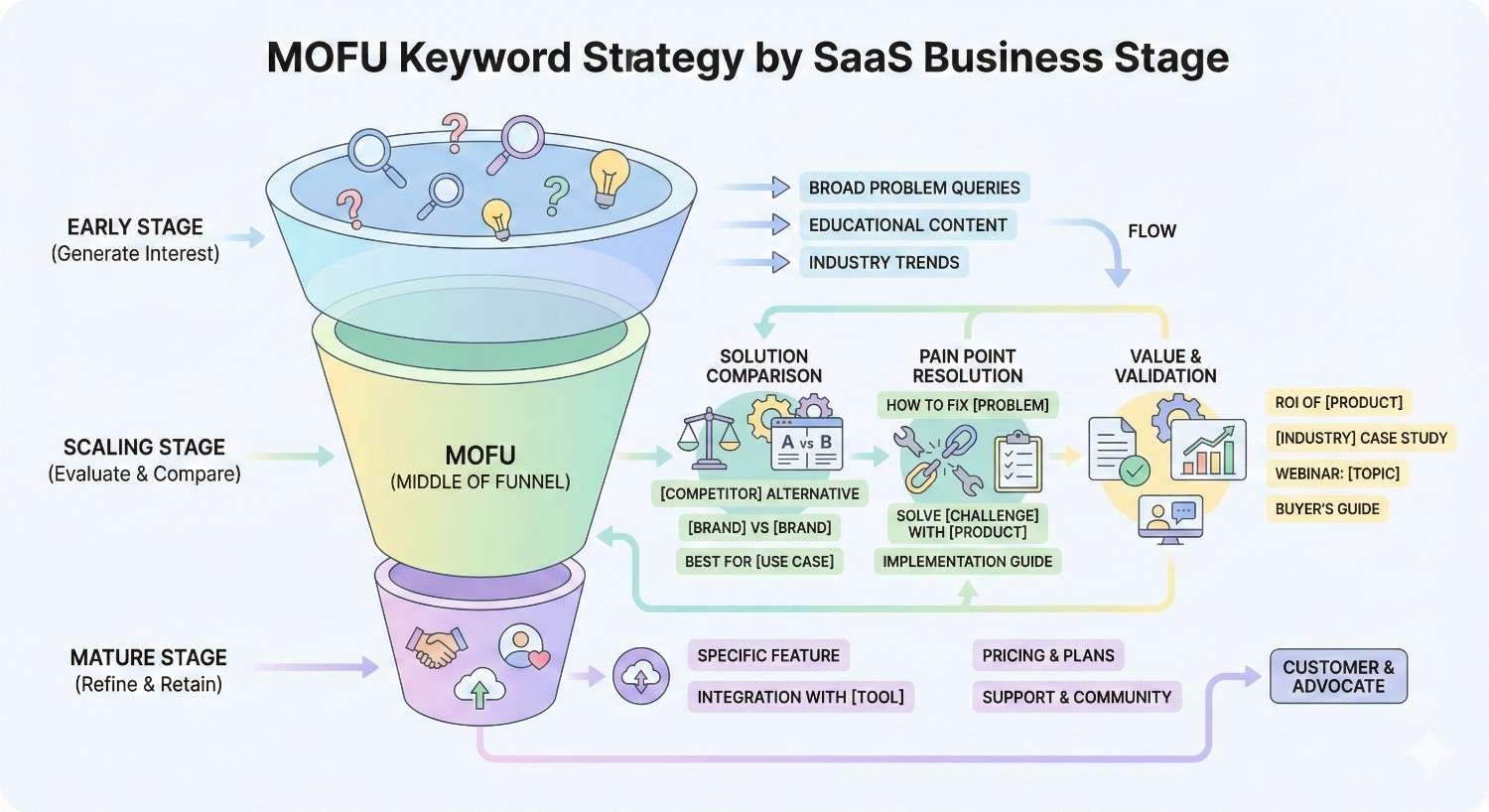
MOFU Keyword Strategy by SaaS Business Stage
MOFU strategies should align with company maturity and resources. Different business stages require different approaches to consideration-stage content.
Early-Stage Startups: Building Foundation
Early-stage companies need efficient MOFU strategies that maximize impact with limited resources. Focus and prioritization matter more than comprehensive coverage.
Target lower-competition MOFU keywords first. Early-stage sites lack authority to rank for competitive terms. Identify MOFU keywords where you can realistically compete and build from there.
Focus on differentiation-focused content. Comparison content that highlights your unique value proposition serves both SEO and positioning objectives. Create content that establishes your market position while capturing search traffic.
Prioritize keywords aligned with ideal customer profiles. Limited resources require focus. Target MOFU keywords that attract your best-fit prospects rather than pursuing broad traffic.
Build foundational content before expanding. Create core comparison and evaluation content for your primary market before expanding to adjacent segments. Depth in your core market matters more than breadth across markets.
Growth-Stage SaaS: Scaling MOFU Content
Growth-stage companies can invest more aggressively in MOFU content. Scaling strategies should maintain quality while expanding coverage.
Expand keyword coverage systematically. Build out comparison content for additional competitors. Create evaluation content for more features and use cases. Develop segment-specific content for additional verticals.
Invest in content quality and differentiation. As competition increases, content quality becomes more important. Original research, expert perspectives, and superior execution differentiate growth-stage content.
Build content operations for sustainable production. Scaling requires systems. Establish workflows, templates, and processes that enable consistent MOFU content production without sacrificing quality.
Integrate MOFU content with broader marketing. Connect MOFU content to demand generation campaigns, sales enablement, and customer marketing. Maximize value by using MOFU content across multiple functions.
Enterprise SaaS: Advanced Segmentation
Enterprise companies can pursue sophisticated MOFU strategies. Advanced segmentation and personalization enable precise targeting of consideration-stage prospects.
Create segment-specific MOFU content. Enterprise markets often include distinct segments with different evaluation criteria. Develop tailored comparison and evaluation content for each key segment.
Pursue international MOFU opportunities. Enterprise companies can invest in localized MOFU content for international markets. Translated and culturally adapted content captures global consideration-stage traffic.
Integrate MOFU content with account-based marketing. For enterprise sales, MOFU content can support ABM campaigns targeting specific accounts. Create content addressing the specific evaluation needs of target accounts.
Leverage customer data for MOFU optimization. Enterprise companies have rich customer data. Use insights about successful customers to refine MOFU keyword targeting and content development.
Tools for MOFU SaaS Keyword Research and Tracking
The right tools enable effective MOFU keyword research and performance monitoring. Building an appropriate tool stack supports strategy execution.
Keyword Research Platforms
Keyword research platforms provide the data foundation for MOFU strategy. These tools help identify opportunities and assess keyword potential.
Ahrefs offers comprehensive keyword data and competitive analysis. Keyword Explorer provides volume, difficulty, and SERP analysis. Content Gap identifies MOFU keywords competitors rank for that you do not.
Semrush provides keyword research and position tracking. Keyword Magic Tool generates MOFU keyword ideas. Position Tracking monitors rankings for target terms over time.
Moz offers keyword research with unique metrics. Keyword Explorer provides priority scores combining volume, difficulty, and opportunity. SERP Analysis reveals what content types rank for target keywords.
Google Keyword Planner provides search volume data directly from Google. While designed for advertising, the volume data supports organic keyword research. Free access makes it accessible for all budget levels.
Competitive Intelligence Tools
Competitive intelligence tools reveal competitor MOFU strategies. Understanding what competitors do informs your own approach.
Ahrefs Site Explorer analyzes competitor organic performance. See which MOFU keywords competitors rank for and which pages drive their traffic. Identify opportunities to create superior alternatives.
Semrush Competitive Research provides detailed competitor analysis. Traffic Analytics estimates competitor traffic. Organic Research reveals their keyword rankings and top pages.
SpyFu focuses specifically on competitive intelligence. See competitor keyword history and identify terms they have targeted successfully. Historical data reveals long-term competitive patterns.
SimilarWeb provides traffic and engagement estimates. Understand competitor traffic sources and audience behavior. Benchmark your performance against competitive alternatives.
Content Optimization Software
Content optimization tools help create MOFU content that ranks. These platforms guide content development based on competitive analysis.
Clearscope analyzes top-ranking content to guide optimization. Content reports identify terms and topics to include. Real-time scoring helps writers create comprehensive content.
Surfer SEO provides content optimization recommendations. Content Editor suggests structure, length, and terms based on SERP analysis. Audit features identify optimization opportunities for existing content.
MarketMuse uses AI to analyze content comprehensiveness. Content briefs guide creation of topically complete content. Inventory analysis identifies gaps in existing content coverage.
Frase combines research and optimization features. Content briefs aggregate information from top-ranking pages. Optimization tools guide content improvement based on competitive analysis.
Analytics and Reporting Dashboards
Analytics tools measure MOFU content performance. Dashboards provide visibility into how content contributes to business objectives.
Google Analytics tracks traffic and engagement. Monitor organic traffic to MOFU pages. Analyze user behavior and conversion paths. Free access makes it essential for all organizations.
Google Search Console provides search performance data. See which queries drive impressions and clicks. Monitor ranking positions and identify optimization opportunities.
Databox creates custom dashboards combining multiple data sources. Build MOFU-specific dashboards showing rankings, traffic, and conversions. Automated reporting saves time and ensures consistent visibility.
Looker Studio enables custom reporting from Google data. Create detailed reports combining Search Console and Analytics data. Free access to Google’s visualization platform.
Building a Sustainable MOFU Keyword Strategy
Sustainable MOFU strategies require ongoing commitment and integration with broader marketing efforts. Building for long-term success ensures continued returns on MOFU investment.
Creating a MOFU Content Calendar
Content calendars ensure consistent MOFU content production. Planning prevents gaps and enables strategic sequencing of content development.
Map content to keyword priorities. Your prioritized keyword list should drive calendar planning. Schedule content creation for highest-priority MOFU keywords first.
Balance new content with updates. Calendars should include both new content creation and updates to existing MOFU pages. Maintenance is as important as expansion.
Align with product and marketing calendars. Coordinate MOFU content with product launches, campaigns, and seasonal patterns. Strategic timing maximizes content impact.
Build flexibility for reactive content. Leave calendar capacity for responding to competitor moves, market changes, or emerging opportunities. Rigid calendars miss timely opportunities.
Integrating MOFU with Full-Funnel SEO
MOFU content works best as part of comprehensive funnel coverage. Integration with TOFU and BOFU content creates complete user journeys.
Connect TOFU content to MOFU content. Educational content should guide readers toward evaluation content. Internal linking creates pathways from awareness to consideration.
Connect MOFU content to BOFU content. Evaluation content should guide readers toward conversion content. Users who complete evaluation should find easy paths to purchase.
Balance investment across funnel stages. Over-investing in any single stage creates gaps. Assess coverage at each stage and allocate resources to address weaknesses.
Measure full-funnel performance. Track how users move through funnel stages. Understand which TOFU content feeds MOFU pages and which MOFU content drives BOFU conversions.
When to Partner with an SEO Agency
Agency partnerships can accelerate MOFU strategy execution. Understanding when external support makes sense helps optimize resource allocation.
Consider agencies when internal capacity is limited. If your team cannot produce sufficient MOFU content, agencies provide additional capacity. External resources enable faster coverage expansion.
Consider agencies for specialized expertise. MOFU content requires understanding of both SEO and your market. Agencies with relevant experience bring expertise that may exceed internal capabilities.
Consider agencies for competitive situations. If competitors are aggressively building MOFU content, you may need to accelerate your own efforts. Agencies enable faster response to competitive pressure.
Evaluate agency fit carefully. Not all agencies understand SaaS or MOFU strategies. Seek partners with demonstrated experience in your market and content type.
Conclusion
Middle-of-funnel SaaS keywords represent the highest-leverage organic opportunity for most software companies. These consideration-stage terms capture prospects actively evaluating solutions, delivering traffic that converts at rates far exceeding top-funnel awareness content.
Building effective MOFU strategies requires systematic keyword research, content types matched to user intent, and ongoing optimization based on performance data. The frameworks and approaches outlined here provide the foundation for capturing consideration-stage traffic that drives qualified leads and pipeline growth.
We help SaaS companies build sustainable MOFU keyword strategies that deliver long-term organic ROI. White Label SEO Service provides the research, content development, and optimization expertise needed to dominate your consideration-stage keyword landscape. Contact us to discuss how we can accelerate your MOFU content strategy.
Frequently Asked Questions
How long does it take to rank for MOFU keywords?
MOFU keyword ranking timelines typically range from three to six months for moderately competitive terms. Factors including domain authority, content quality, and competition level influence specific timelines. Lower-competition MOFU keywords may rank faster while highly competitive comparison terms require longer investment.
What metrics should I track for MOFU content?
Track rankings, organic traffic, and engagement metrics as leading indicators. Measure lead generation, lead quality, and pipeline contribution as business outcome metrics. Attribution modeling helps connect MOFU touchpoints to conversions that may occur through other pages.
How do I balance MOFU with TOFU and BOFU content?
Allocate content resources based on funnel gaps and business priorities. Most SaaS companies underinvest in MOFU content relative to its conversion potential. Assess current coverage at each stage and prioritize filling gaps that limit user journey progression.
What makes MOFU content different from product pages?
MOFU content helps users evaluate and compare options while product pages present your specific solution. MOFU content should provide balanced information that builds trust through fairness. Product pages can be more promotional since users have already selected your solution for deeper consideration.
How often should I update MOFU content?
Review MOFU content quarterly at minimum, with immediate updates when products, pricing, or features change significantly. Comparison and pricing content requires more frequent updates than feature guides or use case content. Display update dates to signal freshness to users and search engines.
Can I rank for competitor brand keywords?
Yes, competitor brand keywords represent legitimate MOFU opportunities. “[Competitor] alternatives” and “[Competitor] vs [Your Brand]” queries indicate users evaluating your market category. Create balanced, valuable content rather than purely promotional pages to rank and convert effectively.
Should I include my product in alternative roundups I create?
Include your product when genuinely relevant, but present it fairly alongside alternatives. Overly promotional roundups lose credibility and fail to satisfy user intent. Position your product honestly, acknowledging where alternatives may be stronger for certain use cases.