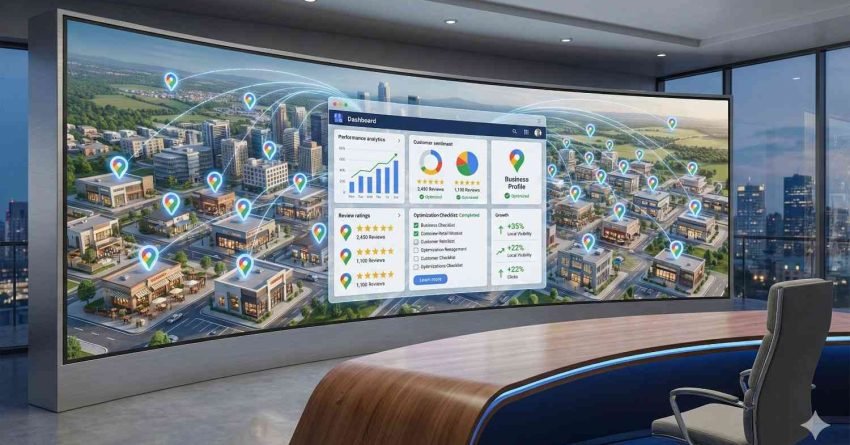
Managing Google Business Profiles across multiple locations demands more than copy-paste tactics—it requires systematic processes that maintain brand consistency while optimizing each location for its unique local market. Businesses with 10, 50, or 500+ locations face compounding challenges: inconsistent NAP data, duplicate listings, unmanaged reviews, and missed ranking opportunities that directly impact foot traffic and revenue.
This guide breaks down the strategic framework for scalable multi-location GMB management. You’ll learn verification workflows, content optimization systems, review management protocols, and performance tracking methods that transform scattered local presence into coordinated visibility across every market you serve.

What Is Multiple Location GMB Management?
Multiple location GMB management refers to the coordinated administration of Google Business Profiles across two or more physical business locations. This encompasses everything from initial profile creation and verification to ongoing optimization, review management, and performance analysis at scale.
Unlike single-location management, multi-location strategies must balance brand-wide consistency with location-specific relevance. A restaurant chain needs identical branding across 200 profiles while ensuring each location displays accurate hours, local photos, and market-specific offers. This dual requirement creates operational complexity that grows exponentially with each new location.
The core components include centralized profile ownership, standardized optimization protocols, location-specific content strategies, unified review response systems, and aggregated performance reporting. Each element requires dedicated processes that prevent the inconsistencies and oversights that plague businesses attempting to manage multiple profiles manually.
Google treats each Business Profile as a distinct local entity competing in its specific geographic market. This means optimization strategies must account for local competition, regional search behavior, and market-specific ranking factors while maintaining the operational efficiency necessary for scalable management.
Why Multi-Location GMB Strategy Matters for Business Growth
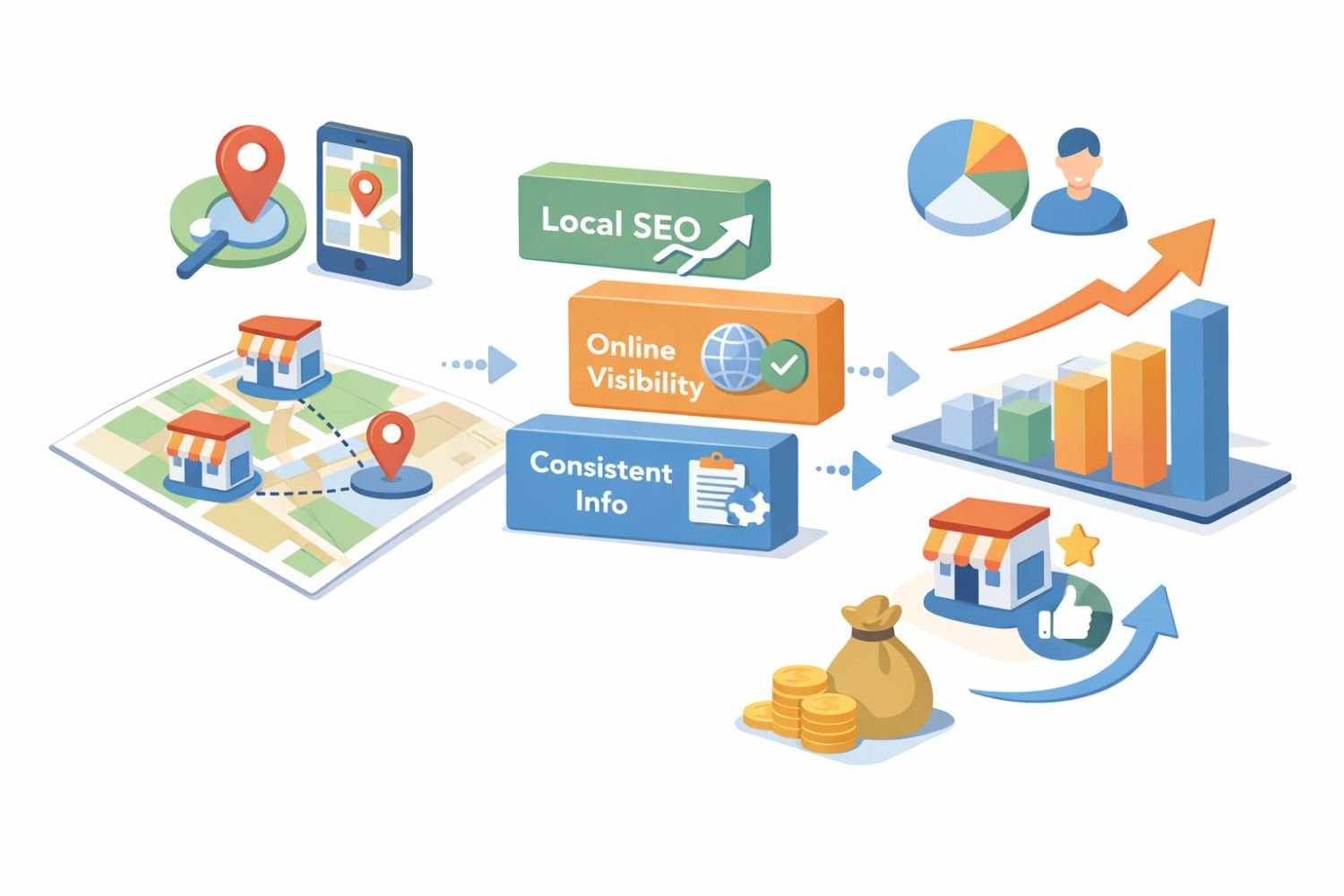
Local search drives measurable business outcomes. According to Google’s consumer insights, 76% of people who search for something nearby visit a business within 24 hours, and 28% of those searches result in a purchase. For multi-location businesses, this translates to significant revenue potential—or significant losses when profiles underperform.
Each unoptimized location represents a leak in your local visibility funnel. Incomplete profiles, incorrect hours, missing categories, and unresponded reviews compound across locations, creating systematic underperformance that competitors exploit. A business with 50 locations and 20% profile optimization gaps effectively operates with 10 invisible storefronts.
The competitive dynamics intensify in multi-location scenarios. National brands compete against local specialists in each market. Regional chains face different competitive landscapes across territories. Franchise networks contend with inconsistent franchisee engagement. Without coordinated management, these challenges fragment attention and dilute results.
Centralized multi-location management creates operational leverage. Standardized processes reduce per-location management time. Aggregated data reveals system-wide patterns and opportunities. Coordinated campaigns amplify impact across markets. This efficiency advantage compounds as location counts increase, making professional management increasingly valuable at scale.
Setting Up Your Multi-Location GMB Infrastructure
Establishing Centralized Account Architecture
Proper account structure prevents the access issues, duplicate profiles, and management fragmentation that plague growing businesses. The foundation starts with a single organizational Google account that owns all location profiles, separate from individual employee accounts that may leave the company.
Create a dedicated business email (e.g., gmb@yourbusiness.com) as the primary owner for all locations. This account should use two-factor authentication and have recovery options that don’t depend on any single employee. Document access credentials in a secure password manager accessible to authorized team members.
For businesses with complex organizational structures, Google’s Agency Dashboard or location groups provide hierarchical management capabilities. These tools allow you to organize locations by region, brand, or management responsibility while maintaining centralized oversight and reporting.
Establish clear permission levels before adding team members. Primary owners should be limited to senior leadership or agency partners. Managers can edit profile information but cannot transfer ownership. Communications managers can respond to reviews and messages without accessing sensitive settings. This tiered approach protects against both intentional misuse and accidental changes.
Bulk Verification Strategies
Verification represents the first major operational hurdle for multi-location businesses. Google offers several verification pathways depending on your business type and location count.
Standard verification (postcard, phone, email) works for small location counts but becomes impractical beyond 10-15 locations. Each verification requires individual attention and typically takes 5-14 days per location.
Bulk verification becomes available for businesses with 10+ locations sharing the same brand. This process requires submitting a spreadsheet with all location details and typically involves a single verification call or video verification for the entire batch. Processing time ranges from 1-4 weeks depending on complexity.
Chain verification applies to businesses with 10+ locations that Google already recognizes as a chain. This streamlined process often requires minimal additional verification for new locations once the chain relationship is established.
Video verification has become increasingly common, requiring a live video call where you demonstrate physical presence at the business location. For multi-location businesses, this may require coordinating with on-site staff at each location.
Document your verification status for each location in a centralized tracking system. Include verification date, method used, and any issues encountered. This documentation proves invaluable when troubleshooting suspended profiles or adding new locations.
Optimizing Profiles Across All Locations
Standardizing Core Business Information
NAP consistency (Name, Address, Phone) forms the foundation of local SEO credibility. Inconsistencies confuse both users and search algorithms, diluting ranking signals and creating trust issues. Establish exact formatting standards and enforce them across all profiles and external citations.
Business name should match your legal business name exactly as it appears on signage and official documents. Avoid keyword stuffing (e.g., “Joe’s Pizza – Best Pizza in Chicago”) which violates Google’s guidelines and risks suspension. If locations have distinct names (common in franchise models), document the approved name for each.
Address formatting requires standardization decisions: “Street” vs “St.”, “Suite” vs “Ste.”, apartment/unit notation. Choose one format and apply it universally. Include suite numbers and building identifiers that help customers find you, but avoid P.O. boxes for service-area businesses.
Phone numbers should use local numbers for each location rather than a central call center when possible. Local numbers strengthen geographic relevance signals and improve user experience. If using tracking numbers, ensure they’re properly configured to avoid NAP inconsistencies across the web.
Business hours require location-specific accuracy and timely updates for holidays, seasonal changes, and special events. Incorrect hours generate negative reviews and erode trust. Implement a calendar system that prompts hour updates before holidays and seasonal transitions.
Category Selection Strategy
Primary and secondary category selection directly impacts which searches trigger your profile. Google offers approximately 4,000 categories, and strategic selection determines your competitive positioning in each local market.
Primary category should represent your core business function—the main reason customers visit. This category carries the most ranking weight and should align with your highest-value search terms. For multi-location businesses with consistent offerings, primary categories typically remain uniform across locations.
Secondary categories (up to 9 additional) expand your visibility for related searches. A hardware store might add “Paint Store,” “Key Duplication Service,” and “Tool Rental Service” to capture adjacent search intent. Analyze which secondary categories competitors use and identify gaps you can fill.
Location-specific category variations may apply when locations offer different services. A fitness chain where some locations have pools would add “Swimming Pool” only to relevant profiles. Document these variations in your location database to ensure accuracy during audits.
Review category selections quarterly. Google adds new categories regularly, and emerging categories may better represent your offerings. Competitor analysis may reveal category opportunities you’ve overlooked.
Crafting Location-Specific Descriptions
Business descriptions provide 750 characters to communicate your value proposition and incorporate relevant keywords. While brand messaging should remain consistent, location-specific elements improve local relevance and user engagement.
Opening statement should immediately communicate what you do and who you serve. Lead with your primary service or product category, not your company history. “Full-service auto repair for domestic and import vehicles” outperforms “Founded in 1985, we’ve been serving…”
Location-specific elements to incorporate:
- Neighborhood or district names
- Nearby landmarks or cross-streets
- Local service area boundaries
- Community involvement or local partnerships
- Location-specific offerings or specialties
Keyword integration should feel natural, not forced. Include your primary category, key services, and location identifiers without repetitive stuffing. Google’s algorithms detect and may penalize obvious manipulation.
Call-to-action in the final sentence encourages engagement: “Visit our [neighborhood] location for a free consultation” or “Call today to schedule your appointment.”
Create a description template with standardized brand messaging and designated fields for location-specific customization. This ensures consistency while allowing necessary localization.
Managing Reviews at Scale
Building Systematic Review Generation
Reviews influence both rankings and conversion rates. BrightLocal’s 2024 consumer survey found that 98% of consumers read online reviews for local businesses, and businesses with higher ratings consistently outperform competitors in click-through rates.
Post-transaction review requests generate the highest response rates. Timing matters—request reviews within 24-48 hours of service completion when the experience remains fresh. Automated email or SMS sequences triggered by POS transactions or service completion create consistent generation without manual effort.
Direct review links simplify the process for customers. Google provides a shareable review link for each profile. Shorten these links for easier sharing and track click-through rates to measure request effectiveness.
In-location prompts capture reviews from customers who might not respond to digital requests. Table tents, receipt messages, and staff verbal requests all contribute to review volume. Train staff on appropriate, non-pressuring request language.
Review velocity matters for rankings. A steady stream of reviews signals ongoing business activity and customer engagement. Aim for consistent monthly review acquisition rather than sporadic bursts followed by dry spells.
Track review generation metrics by location to identify underperformers. Locations with low review velocity may need additional staff training, different request timing, or alternative generation methods.
Responding to Reviews Efficiently
Review responses demonstrate engagement and influence potential customers reading existing reviews. For multi-location businesses, response consistency and timeliness require systematic processes.
Response time targets should be established and monitored. Aim to respond to all reviews within 24-48 hours. Negative reviews warrant faster response—ideally within hours—to demonstrate attentiveness and potentially mitigate damage.
Response templates accelerate workflow while maintaining quality. Create templates for common scenarios:
- Positive reviews (general satisfaction)
- Positive reviews (specific service mentions)
- Neutral reviews
- Negative reviews (service issues)
- Negative reviews (product issues)
- Negative reviews (staff-related)
- Fake or spam reviews
Personalization requirements prevent responses from feeling robotic. Templates should include fields for customer name, specific details mentioned in their review, and location-specific elements. “Thank you for visiting our [location] store” feels more genuine than generic corporate responses.
Escalation protocols define when reviews require management attention. Establish criteria for escalation: reviews mentioning legal issues, health/safety concerns, specific employee names, or threats. Document the escalation path and response authority levels.
Negative review resolution should move conversations offline when possible. Provide direct contact information for a manager who can address concerns personally. Public back-and-forth arguments damage perception regardless of who’s “right.”
Local Content Strategy for Multiple Locations
Creating Location-Specific Google Posts
Google Posts provide a content channel directly within your Business Profile. Posts appear in search results and Maps, offering promotional real estate that many competitors underutilize.
Post types to leverage:
- Updates: General announcements, news, tips
- Events: Time-bound happenings with dates
- Offers: Promotions with optional coupon codes
- Products: Featured inventory highlights
Posting frequency recommendations vary, but consistency matters more than volume. Aim for 1-2 posts per week per location. Posts expire after 7 days (except events, which expire after the event date), so regular posting maintains visibility.
Location-specific content opportunities:
- Local events your business participates in
- Community sponsorships or partnerships
- Location-specific promotions
- Staff spotlights for individual locations
- Local customer success stories
- Neighborhood-relevant tips or information
Scalable content creation requires balancing efficiency with localization. Create brand-wide post templates that locations can customize with local details. A retail chain might create a “Weekend Sale” template that each location populates with their specific offers and hours.
Performance tracking through Google Business Profile Insights reveals which post types and topics generate engagement. Analyze patterns across locations to identify winning content approaches worth replicating.
Photo and Visual Content Management
Visual content significantly impacts profile engagement and click-through rates. Google reports that businesses with photos receive 42% more requests for directions and 35% more website clicks than those without.
Required photo categories:
- Cover photo: Primary brand image (recommended 1080×608 pixels)
- Logo: Square format for consistent brand recognition
- Exterior photos: Storefront, signage, parking
- Interior photos: Customer areas, ambiance, layout
- Product photos: Key offerings, menu items, inventory
- Team photos: Staff, customer interactions
Photo quality standards should be documented and enforced:
- Minimum resolution requirements
- Lighting and composition guidelines
- Brand consistency elements (colors, styling)
- Prohibited content (competitor products, inappropriate imagery)
User-generated photos appear on profiles and require monitoring. While you can’t remove customer photos directly, you can flag inappropriate images for Google review. Encourage customers to share quality photos through review requests and social media engagement.
Photo refresh cadence keeps profiles current. Seasonal updates, new product additions, and renovation documentation all warrant photo updates. Establish quarterly photo audits to identify stale or outdated imagery.
Performance Tracking and Reporting
Key Metrics for Multi-Location Analysis
Google Business Profile Insights provides performance data that reveals optimization opportunities and validates strategy effectiveness. For multi-location businesses, aggregated analysis identifies patterns invisible at the individual location level.
Discovery metrics show how customers find your profiles:
- Direct searches: Customers searching your business name
- Discovery searches: Customers searching categories or products you offer
- Branded searches: Searches including your brand name with other terms
High discovery search percentages indicate strong local SEO performance. Locations with low discovery rates may need category optimization, description improvements, or review generation focus.
Engagement metrics measure customer actions:
- Website clicks: Traffic driven to your site
- Direction requests: Navigation intent signals
- Phone calls: Direct contact attempts
- Message conversations: Chat engagement
Compare engagement rates across locations to identify high and low performers. Investigate what top-performing locations do differently—their practices may be replicable across the network.
Photo and post metrics reveal content effectiveness:
- Photo views compared to competitors
- Post views and engagement
- Content type performance patterns
Building Multi-Location Dashboards
Aggregated reporting transforms location-level data into strategic insights. Manual data compilation becomes impractical beyond a handful of locations, making automated reporting essential.
Data aggregation approaches:
- Google Business Profile API: Direct data access for custom reporting
- Third-party platforms: Tools like BrightLocal, Moz Local, or Yext aggregate multi-location data
- Manual export compilation: Feasible for smaller location counts
Dashboard components for multi-location management:
- Location-by-location performance comparison
- Trend analysis over time
- Geographic performance patterns
- Category and attribute coverage audits
- Review sentiment analysis
- Competitive benchmarking where available
Reporting cadence recommendations:
- Weekly: Review response compliance, urgent issues
- Monthly: Performance trends, optimization opportunities
- Quarterly: Strategic analysis, competitive positioning, goal progress
Actionable insights should drive reporting, not just data presentation. Each report should identify specific optimization actions, responsible parties, and expected impact. Data without action recommendations becomes noise.
Common Multi-Location GMB Challenges and Solutions
Handling Duplicate Listings
Duplicate profiles fragment your visibility and confuse customers. They commonly arise from previous owners, employee-created profiles, automated Google generation, or acquisition of businesses with existing profiles.
Duplicate identification requires systematic searching:
- Search your business name + city for each location
- Search address variations
- Search phone number variations
- Check Google Maps directly for unmarked duplicates
Resolution process:
- Claim the duplicate if unverified
- Mark as duplicate through Google Business Profile
- Request merger with your verified listing
- If merger fails, request removal through Google support
Prevention measures:
- Maintain comprehensive location documentation
- Monitor for new listings monthly
- Establish clear processes for new location setup
- Train field staff on duplicate reporting
Managing Suspended Profiles
Suspensions disrupt local visibility and require prompt attention. Common suspension triggers include guideline violations, suspicious activity patterns, or verification issues.
Soft suspensions disable the profile but allow editing. These typically result from guideline violations like keyword-stuffed names or ineligible business types.
Hard suspensions remove the profile entirely and require reinstatement requests. These often stem from suspected fraud, multiple guideline violations, or verification failures.
Reinstatement process:
- Identify the likely suspension cause
- Correct any guideline violations
- Submit reinstatement request through Google Business Profile
- Provide requested documentation (business license, utility bills, etc.)
- Follow up if no response within 3-5 business days
Prevention strategies:
- Regular guideline compliance audits
- Avoid bulk changes that trigger suspicious activity flags
- Maintain consistent, accurate information
- Document verification for all locations
Coordinating Franchise and Multi-Brand Portfolios
Franchise networks and multi-brand portfolios add complexity layers requiring additional governance structures.
Franchise considerations:
- Centralized vs. franchisee-managed profiles
- Brand compliance enforcement mechanisms
- Performance accountability across independent operators
- Technology and process standardization
Multi-brand management:
- Separate organizational structures per brand
- Cross-brand performance benchmarking
- Shared resource efficiency opportunities
- Brand-specific optimization strategies
Governance documentation should address:
- Profile ownership and access policies
- Optimization standards and requirements
- Review response guidelines and approval workflows
- Performance expectations and accountability measures
- Violation consequences and remediation processes
Scaling Your Multi-Location GMB Operations
Technology Stack for Efficient Management
Manual management becomes unsustainable as location counts grow. Technology investments create the leverage necessary for efficient scaling.
Essential tool categories:
- Profile management platforms: Centralized editing, bulk updates, approval workflows
- Review management software: Aggregated monitoring, response templates, sentiment analysis
- Listing accuracy tools: Citation monitoring, NAP consistency checking
- Reporting and analytics: Automated data aggregation, custom dashboards
- Content management: Post scheduling, asset libraries, approval workflows
Build vs. buy considerations:
- Location count and growth trajectory
- Internal technical capabilities
- Budget constraints
- Integration requirements with existing systems
- Customization needs
Implementation priorities for growing businesses:
- Centralized profile access and management
- Review monitoring and response workflow
- Performance reporting automation
- Content scheduling and distribution
- Advanced analytics and competitive intelligence
Team Structure and Responsibilities
Effective multi-location management requires clear role definition and accountability structures.
Core responsibilities to assign:
- Profile optimization and maintenance
- Review monitoring and response
- Content creation and posting
- Performance analysis and reporting
- Issue escalation and resolution
- New location onboarding
- Compliance auditing
Team structure models:
- Centralized: Corporate team manages all locations
- Distributed: Regional or location managers handle their areas
- Hybrid: Corporate sets standards, local teams execute
Training requirements:
- Google Business Profile platform proficiency
- Brand guidelines and voice standards
- Review response protocols
- Escalation procedures
- Tool-specific training
Performance accountability:
- Define KPIs for each role
- Establish regular review cadences
- Create feedback loops for continuous improvement
- Recognize and replicate top performer practices
Conclusion
Multiple location GMB management transforms from overwhelming complexity to competitive advantage when approached systematically. The businesses that win local search across their markets build infrastructure, establish processes, and maintain consistency that competitors managing profiles ad-hoc simply cannot match.
Your multi-location presence represents significant untapped potential. Each optimized profile, responded review, and strategic post compounds across your network, creating visibility advantages that translate directly to foot traffic, phone calls, and revenue. The frameworks outlined here provide the roadmap—execution determines results.
White Label SEO Service specializes in scalable local SEO solutions for multi-location businesses. Our team manages GMB portfolios ranging from 10 to 1,000+ locations, delivering the systematic optimization, review management, and performance tracking that drives measurable local visibility growth. Contact us to discuss how we can transform your multi-location presence into a coordinated competitive advantage.
Frequently Asked Questions
How many Google Business Profiles can one account manage?
A single Google account can manage unlimited Business Profiles, though Google recommends using location groups or the Agency Dashboard for portfolios exceeding 100 locations. There’s no hard limit, but organizational structure becomes critical for efficient management at scale.
What is the fastest way to verify multiple business locations?
Bulk verification through Google’s official process is fastest for 10+ locations. Submit a spreadsheet with all location details, and Google typically verifies the entire batch within 1-4 weeks after a single verification call or video session, compared to weeks of individual postcard verifications.
Should each location have unique content or can we use the same descriptions?
Each location should have unique descriptions incorporating location-specific elements like neighborhood names, nearby landmarks, and local service details. While brand messaging remains consistent, localized content improves relevance signals and user experience for each market.
How often should we post Google Posts for each location?
Aim for 1-2 posts per week per location to maintain consistent visibility. Posts expire after 7 days, so regular posting ensures your profile always displays fresh content. Quality and relevance matter more than volume—avoid posting just to meet frequency targets.
What causes Google Business Profile suspensions for multi-location businesses?
Common triggers include keyword-stuffed business names, address inconsistencies, bulk changes that appear suspicious, unverifiable business information, and guideline violations across multiple profiles. Systematic compliance auditing prevents most suspension scenarios.
How do we handle negative reviews across multiple locations?
Implement standardized response templates with personalization requirements, establish response time targets (ideally under 24 hours for negative reviews), and create escalation protocols for serious issues. Move resolution conversations offline by providing direct manager contact information.
Can we use the same phone number for multiple locations?
Each location should have a unique local phone number when possible. Shared numbers weaken geographic relevance signals and create poor user experiences. If using tracking numbers, ensure they’re properly configured to maintain NAP consistency across citations.
How do we measure ROI from multi-location GMB management?
Track direction requests, phone calls, website clicks, and message conversations through Google Business Profile Insights. Correlate these engagement metrics with actual store visits, calls received, and conversions. Compare performance trends before and after optimization initiatives.
What’s the best way to manage GMB for franchise locations?
Establish clear governance documentation covering profile ownership, optimization standards, review response guidelines, and performance accountability. Decide between centralized corporate management or franchisee-managed profiles with corporate oversight based on your network’s capabilities and compliance requirements.
How frequently should we audit our multi-location GMB profiles?
Conduct comprehensive audits quarterly, covering NAP accuracy, category optimization, photo freshness, and description relevance. Implement monthly monitoring for review response compliance, duplicate listings, and performance anomalies. Weekly checks should catch urgent issues like incorrect hours or suspended profiles.