
NAP consistency directly impacts your local search rankings and customer trust. When your business Name, Address, and Phone number match exactly across Google Business Profile, directories, and your website, search engines reward you with better visibility. Even minor discrepancies—like “Street” versus “St.”—can dilute your local SEO authority and confuse potential customers trying to reach you.
Local search algorithms use NAP data as a core ranking signal. Inconsistent citations create uncertainty about your business legitimacy, pushing you down in map pack results where competitors with clean data appear instead.
This guide explains what NAP consistency means, why it matters for organic growth, how to audit your current citations, and the exact steps to fix and maintain accurate business information across the web.
What NAP Consistency Means in Local SEO
NAP stands for Name, Address, and Phone number—the three critical data points that identify your business location online. Consistency means these details appear identically across every platform where your business is listed: your website, Google Business Profile, Bing Places, Yelp, industry directories, social media profiles, and citation sources.
Search engines crawl these platforms to verify business information. When they find matching NAP data across multiple trusted sources, they gain confidence in your business legitimacy and location accuracy. This verification process directly influences local pack rankings, organic visibility, and map search results.
Exact matching matters more than you think. BrightLocal’s 2024 Local Search Ranking Factors study found that citation signals account for approximately 7% of local pack ranking factors. While this percentage seems modest, it represents the difference between appearing in the top three map results versus being buried on page two.
Inconsistencies create what SEO professionals call “citation conflicts.” When Google finds your business listed as “ABC Marketing Inc.” on your website but “ABC Marketing” on Yelp and “A.B.C. Marketing Incorporated” elsewhere, it cannot confidently determine which version is correct. This ambiguity weakens your local search authority.
The impact extends beyond rankings. Customers searching for your business encounter conflicting information, leading to failed contact attempts, lost foot traffic, and damaged trust. A customer who calls a disconnected number found on an outdated directory listing will likely choose a competitor instead.
Core Components of NAP Data
Your business name should match your legal entity name or the name customers recognize. Avoid adding keywords, taglines, or service descriptions. If your legal name is “Smith Plumbing LLC,” use that exact format everywhere—not “Smith Plumbing – Emergency Services” or “Smith Plumbing Company.”
Address formatting requires precision. Use the same abbreviations, suite numbers, and spacing across all listings. “123 Main Street, Suite 4B” differs from “123 Main St Ste 4B” in search engine eyes. Choose one format and replicate it exactly.
Phone numbers need consistent formatting too. Decide whether you’ll use (555) 123-4567, 555-123-4567, or +1-555-123-4567, then apply that format universally. Moz’s Local Search Ranking Factors survey indicates that phone number consistency correlates with higher local visibility, particularly for mobile searches where click-to-call functionality matters most.
Service area businesses face additional complexity. If you operate from a home office but serve a wider region, your NAP strategy must balance privacy with accuracy. Google Business Profile allows service area designation without displaying your home address publicly, but your NAP must still remain consistent across citations that do show your address.
Multi-location businesses need location-specific NAP data for each physical address. Each location requires its own Google Business Profile, unique phone number when possible, and separate citation profiles. Sharing phone numbers across locations dilutes individual location authority and confuses local search algorithms.
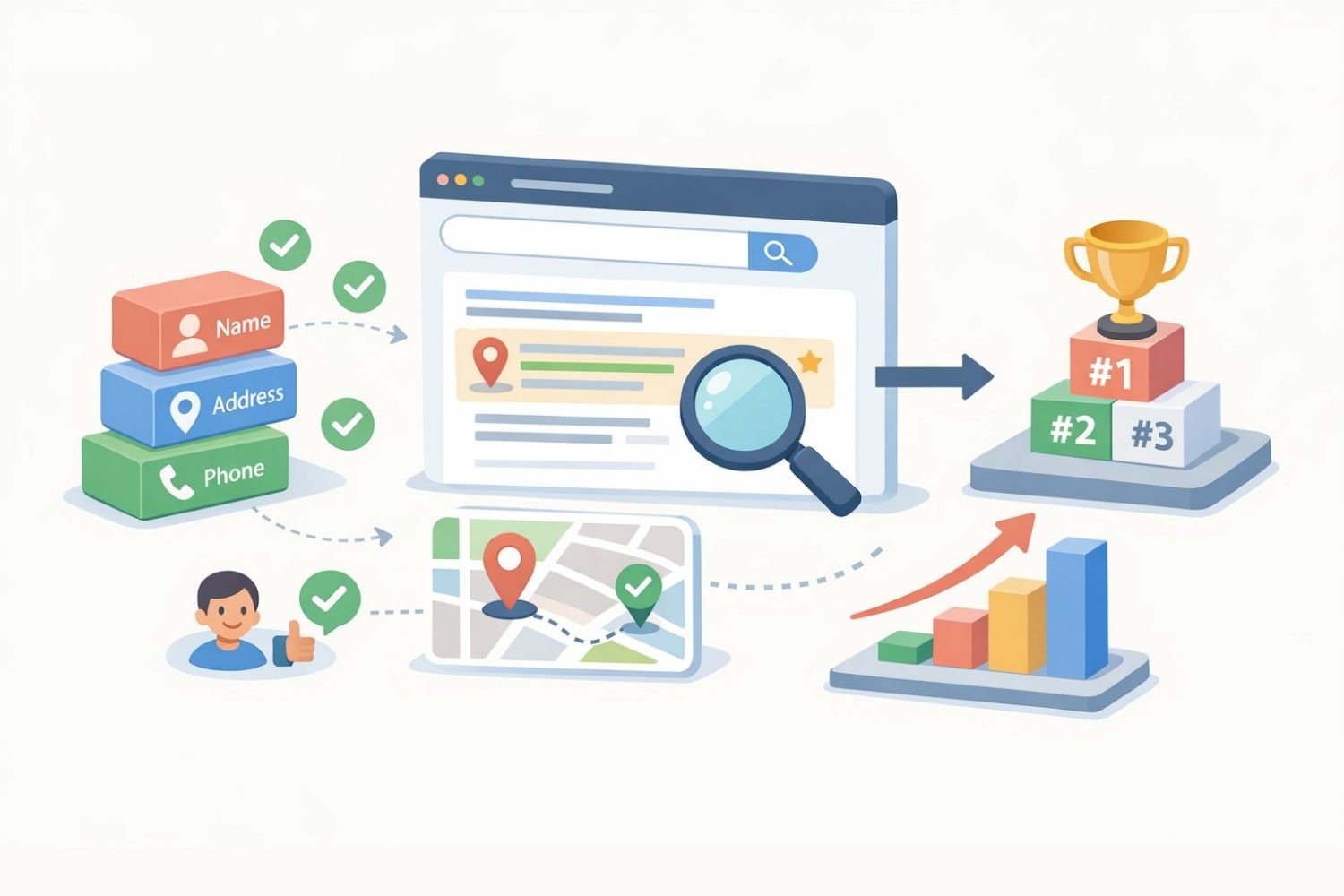
Why NAP Consistency Impacts Rankings
Search engines use NAP data as a trust signal. When they crawl the web and find your business information repeated accurately across authoritative directories, they interpret this pattern as validation. Multiple independent sources confirming the same details suggest your business is legitimate, established, and worthy of ranking.
Inconsistent NAP data triggers algorithmic skepticism. If Google encounters five different phone numbers associated with your business name, it cannot determine which is current. Rather than risk showing users incorrect information, the algorithm may suppress your visibility entirely or favor competitors with cleaner data.
The local pack—those top three map results appearing for location-based searches—relies heavily on citation consistency. Google’s local search algorithm evaluates relevance, distance, and prominence. Prominence incorporates citation quality and consistency as key factors determining which businesses appear in this coveted position.
Citation conflicts also waste your link equity. When your business information appears on 50 directories but uses 10 different formatting variations, search engines struggle to consolidate these signals into a unified authority score. Clean, consistent NAP data allows all citations to reinforce a single, strong local search presence.
Customer behavior metrics suffer from inconsistencies too. When users click your listing but find a disconnected phone number or wrong address, they bounce back to search results immediately. High bounce rates signal poor user experience, prompting search engines to demote your rankings in favor of businesses that provide accurate information.
Common NAP Inconsistency Problems
Business name variations create the most frequent issues. Companies often list themselves differently across platforms: using “Inc.” on some, “LLC” on others, omitting legal designations entirely elsewhere, or adding descriptive keywords. Each variation fragments your citation authority.
Address abbreviations cause silent ranking damage. Your website might show “123 North Main Street, Building C, Floor 2” while directories display “123 N Main St Bldg C Fl 2.” These represent the same location, but search algorithms see different strings of text. The inconsistency weakens your local search signals.
Phone number changes during business growth often leave outdated numbers scattered across old citations. You update your website and Google Business Profile but forget about the 40 directory listings created years ago. Customers calling those old numbers encounter disconnected lines or wrong businesses, destroying trust and conversion opportunities.
Tracking numbers complicate NAP consistency. Many businesses use unique phone numbers for different marketing channels to measure campaign performance. While valuable for attribution, using different numbers across citations confuses search engines about your actual business phone number. Search Engine Journal’s local SEO research recommends using your primary business number for all citations, implementing tracking at the website level instead.
Mergers, acquisitions, and rebrands create citation chaos. Your business might operate under a new name, but hundreds of old citations still reference the previous entity. Search engines see two separate businesses rather than recognizing the transition, splitting your authority between old and new identities.
How to Audit Your Current NAP Consistency
Start with a comprehensive citation inventory. Search Google for your business name in quotes, combined with your city name. Review the first 10 pages of results, documenting every directory, review site, and platform where your business appears. Create a spreadsheet tracking the platform name, URL, and exact NAP data shown.
Use specialized citation tracking tools for efficiency. Moz Local, BrightLocal, and Whitespark scan hundreds of directories automatically, identifying where your business is listed and flagging inconsistencies. These tools save dozens of hours compared to manual searching.
Check your Google Business Profile first. This listing serves as your NAP source of truth. Whatever format you use here should replicate across all other platforms. Verify your business name, address, phone number, website URL, and business hours are current and accurate.
Search for variations of your business name. Try searches with and without legal designations, with common misspellings, and with old business names if you’ve rebranded. Each variation might reveal citation profiles you’ve forgotten about or never knew existed.
Review major data aggregators next. Platforms like Data Axle, Neustar Localeze, Foursquare, and Factual supply business information to hundreds of smaller directories. Errors at the aggregator level cascade across the entire citation ecosystem. Correcting data at the source fixes multiple downstream listings simultaneously.
Step-by-Step NAP Correction Process
Establish your official NAP format before making any changes. Document the exact formatting you’ll use for business name, address, and phone number. This becomes your consistency standard. Share it with your team to ensure everyone references the same format when creating new listings or updating existing ones.
Prioritize high-authority platforms first. Update your Google Business Profile, Bing Places, Apple Maps, and Yelp before addressing smaller directories. These platforms carry the most ranking weight and receive the most user traffic. Correcting them delivers immediate SEO and customer experience benefits.
For platforms where you control the listing, log in and update the information directly. Most directories allow business owners to claim and edit their profiles. Make changes carefully, ensuring you match your official NAP format exactly. Save changes and verify they display correctly on the public-facing listing.
Submit correction requests for listings you don’t control. Some directories pull data from aggregators or third-party sources. These platforms typically offer a “suggest an edit” or “report incorrect information” option. Submit your correction with supporting documentation like a utility bill or business license showing your official address.
Delete duplicate listings aggressively. Multiple profiles for the same business location confuse search engines and split your review equity. Most platforms allow you to report duplicates for removal. Provide evidence that both listings represent the same business, such as matching phone numbers or addresses.
Managing NAP Across Multiple Locations
Each physical location needs its own distinct NAP profile. Create separate Google Business Profiles for every address where customers can visit you. Use location-specific phone numbers when possible—this helps search engines understand you operate multiple distinct locations rather than one business with inconsistent data.
Implement a location naming convention for clarity. If you operate “Smith Plumbing” in three cities, list each as “Smith Plumbing – Austin,” “Smith Plumbing – Dallas,” and “Smith Plumbing – Houston.” This naming structure helps customers identify the nearest location while maintaining brand consistency.
Centralize NAP management through a spreadsheet or location management platform. Document the official NAP data for each location in a master reference file. When team members need to create citations or update listings, they reference this single source of truth rather than guessing at formatting.
Tools like SOCi, Yext, and Rio SEO specialize in multi-location citation management. These platforms push accurate NAP data to hundreds of directories simultaneously, monitor for inconsistencies, and alert you when incorrect information appears. For businesses with 10+ locations, these tools become essential for maintaining consistency at scale.
Franchise businesses face unique challenges. Individual franchisees might create their own citations without following brand guidelines, introducing inconsistencies across the franchise network. Establish clear NAP formatting standards in your franchise operations manual and provide franchisees with pre-approved citation profiles they can claim rather than creating new ones.
NAP Consistency for Service Area Businesses
Service area businesses without physical storefronts can still leverage local SEO through proper NAP management. Google Business Profile allows you to hide your street address while still appearing in local search results for your service area. Your NAP must remain consistent across citations, but you control which platforms display your full address publicly.
Use a real, verifiable address for your NAP. Google requires a physical location where they can send a verification postcard. PO boxes don’t qualify. If you operate from home, use your home address for verification and citation purposes, then hide it from public display in your Google Business Profile settings.
Define your service area clearly in your Google Business Profile. Specify the cities, ZIP codes, or radius you serve. This helps Google show your business to searchers in those areas even though you don’t have a storefront there. Your NAP consistency still matters—search engines verify your business legitimacy through citation matching before showing you in service area results.
Consider using a virtual office or coworking space address if you need a professional business address for citations. Ensure you have legitimate access to this location and can receive mail there. Google’s guidelines prohibit using addresses where you don’t have regular, in-person access to customers or staff.
Service area businesses should focus citation efforts on industry-specific directories rather than general local directories. A plumber benefits more from citations on HomeAdvisor, Angi, and Porch than on general directories. These niche platforms carry more relevance for your target searches and provide qualified lead opportunities.
Monitoring and Maintaining NAP Accuracy
Set up automated monitoring to catch new inconsistencies quickly. Citation tracking tools can alert you when your business information changes on major platforms or when new listings appear. Early detection prevents small errors from spreading across the citation ecosystem.
Schedule quarterly NAP audits. Even with monitoring tools, manual reviews catch issues automated systems miss. Search for your business name every three months, checking the first 10 pages of Google results for new citations or changed information. Document any discrepancies and correct them immediately.
Train your team on NAP consistency importance. Receptionists updating the website, marketing staff creating social media profiles, and sales teams registering on industry platforms all touch your NAP data. Everyone needs to reference your official NAP format document before entering business information anywhere online.
Monitor review sites particularly closely. Customers often submit business listings to review platforms, sometimes with incorrect information. Claim these profiles quickly and correct any NAP errors before they influence your rankings or mislead potential customers.
Track your local search performance metrics to measure NAP consistency impact. Monitor your Google Business Profile insights for changes in search impressions, map views, and direction requests. Google Search Console shows which local search queries drive traffic to your website. Improvements in these metrics after NAP cleanup validate your efforts.
NAP Consistency and Schema Markup
Implement LocalBusiness schema markup on your website to reinforce your NAP data. This structured data format tells search engines exactly where to find your business name, address, and phone number on your site. It eliminates ambiguity and strengthens the connection between your website and your citation profiles.
Your schema markup must match your citation NAP exactly. If your Google Business Profile lists “123 Main Street” but your schema shows “123 Main St,” you’ve created another inconsistency. Use the same formatting across schema, citations, and visual display on your website.
Include all relevant LocalBusiness schema properties: name, address, telephone, url, priceRange, openingHours, and geo coordinates. The more complete your schema markup, the more information search engines can verify against your citation profiles. This comprehensive data strengthens your local search authority.
Multi-location businesses should implement schema markup on individual location pages. Each page needs its own LocalBusiness schema with that location’s specific NAP data. Don’t use organization-level schema with multiple locations in a single markup—this confuses search engines about which location serves which area.
Test your schema implementation using Google’s Rich Results Test. This tool validates your markup syntax and shows how Google interprets your structured data. Fix any errors or warnings before publishing. Proper schema implementation helps your business appear in rich results and knowledge panels.
The Connection Between NAP and Online Reviews
Review platforms require accurate NAP data to function effectively. When customers search for your business to leave a review, they need to find the correct profile. Inconsistent NAP data creates multiple profiles on the same platform, splitting your reviews across several listings and diluting your overall rating.
Consolidated reviews boost local rankings significantly. BrightLocal’s Consumer Review Survey found that 87% of consumers read online reviews for local businesses in 2024. Search engines factor review quantity, quality, and recency into local pack rankings. Scattered reviews across duplicate profiles prevent you from building the review velocity that drives visibility.
Claim and verify your profiles on major review platforms using your consistent NAP data. This ownership prevents customers from creating duplicate listings with incorrect information. Most platforms prioritize verified business profiles in search results, making it easier for customers to find the right place to leave feedback.
Respond to reviews using your official business name and contact information. This reinforces your NAP consistency and provides additional citation signals. When you respond professionally to reviews, you’re creating more instances of your business name appearing alongside your location and contact details.
Encourage customers to review you on platforms where you’ve already established strong citation profiles. Rather than spreading reviews across dozens of sites, concentrate them on Google, Yelp, Facebook, and 2-3 industry-specific platforms. This focused approach builds authority on the platforms that matter most for your local search visibility.
NAP Consistency for Businesses That Move or Rebrand
Business relocations require careful NAP transition management. Update your Google Business Profile immediately with your new address. Google allows you to change your address without losing your review history or ranking authority, but delays in updating can cause temporary visibility drops.
Maintain your old address in citations for 30-60 days after moving. This grace period allows search engines to recognize the transition rather than interpreting it as a new business. After this period, systematically update all citations to your new address. Document which platforms you’ve updated to track progress.
For rebrands, decide whether to maintain your old business name in citations temporarily or switch immediately. If your rebrand includes a new legal entity, you’ll need to create new citation profiles under the new name. If you’re keeping the same legal entity with a new DBA, you can update existing citations to the new name.
Submit a business name change in Google Business Profile through the info editing section. Google reviews name changes to prevent spam, so provide supporting documentation like updated business licenses or articles of incorporation. This verification process can take several days.
Create 301 redirects from your old website URLs to new ones if your rebrand includes a domain change. This preserves your SEO equity and helps search engines understand the connection between your old and new online presence. Update your NAP data on your new website before launching it publicly.
Tools and Resources for NAP Management
Citation management platforms automate much of the NAP consistency work. Moz Local distributes your business information to major data aggregators and monitors for inconsistencies. Yext offers real-time updates across its publisher network, ensuring changes you make appear everywhere simultaneously.
Free tools provide value for small businesses with limited budgets. Whitespark’s Local Citation Finder identifies where your competitors have citations, revealing opportunities for your business. BrightLocal’s Citation Tracker offers a free trial for auditing your current citation profile.
Google Business Profile remains your most important free tool. Keep this profile updated, complete, and accurate. Respond to reviews, post updates, and add photos regularly. Your Google Business Profile serves as the foundation for all other local SEO efforts.
Spreadsheet templates help organize manual NAP management. Create columns for platform name, URL, current NAP data, status (correct/needs update), and date last checked. This simple system works well for businesses with fewer than 50 citations to manage.
Data aggregator submission services like Data Axle Reference Solutions and Neustar Localeze allow you to submit your NAP data directly to the sources that feed hundreds of smaller directories. One submission can correct dozens of downstream citations automatically.
Measuring NAP Consistency Impact on Performance
Track your local pack rankings before and after NAP cleanup. Use tools like Local Falcon or BrightLocal’s Local Rank Tracker to monitor your position in map results for target keywords. Most businesses see ranking improvements within 4-8 weeks of correcting major NAP inconsistencies.
Monitor Google Business Profile insights for engagement changes. Track metrics like search impressions (how often your profile appears), map views (how often users view your location), and direction requests (how often users get directions to your business). Increases in these metrics indicate improved local visibility from better NAP consistency.
Measure website traffic from local search queries in Google Search Console. Filter your performance report by queries containing your city name or “near me” terms. Growth in impressions and clicks for these queries suggests your local SEO improvements are working.
Track phone call volume and source. Many businesses see increased call volume after fixing NAP inconsistencies because customers can actually reach them. Use call tracking numbers on your website while maintaining your primary business number in citations to measure this impact without creating new inconsistencies.
Review your citation score in tools like Moz Local or BrightLocal. These platforms assign a consistency score based on how many citations they find and how accurately they match your official NAP data. A score above 80% indicates strong citation health, while scores below 60% suggest significant inconsistency problems.
Conclusion
NAP consistency forms the foundation of effective local SEO strategy. When your business name, address, and phone number match exactly across your website, Google Business Profile, and directory citations, search engines reward you with better local pack rankings and increased visibility. The effort required to audit, correct, and maintain consistent NAP data directly translates into more customers finding your business when they search for your services.
Citation inconsistencies create algorithmic confusion and customer frustration. Every mismatched address or disconnected phone number weakens your local search authority and sends potential customers to competitors with cleaner data. Regular monitoring and systematic correction prevent these problems from undermining your organic growth.
Local search visibility drives real business results—more calls, more foot traffic, more revenue. White Label SEO Service helps businesses build and maintain the citation consistency that powers sustainable local search performance. Our technical SEO expertise and systematic approach to NAP management ensure your business information strengthens rather than sabotages your rankings. Let’s audit your current citation profile and create a plan for dominating your local search market.
Frequently Asked Questions
What exactly counts as a NAP inconsistency?
Any variation in how your business name, address, or phone number appears across different platforms creates an inconsistency. This includes different abbreviations, spacing, punctuation, or formatting—even if the information points to the same location.
How long does it take to fix NAP inconsistencies?
Updating platforms you control takes hours to days. Corrections on third-party directories can take 2-8 weeks as they verify changes. Full citation ecosystem cleanup typically requires 2-3 months for complete propagation across all platforms.
Can I use different phone numbers for tracking purposes?
Using different numbers across citations confuses search engines about your actual business phone. Use your primary number for all citations and implement website-level call tracking instead to measure campaign performance without creating NAP inconsistencies.
Do I need citations on every directory?
Focus on high-authority general directories (Google, Bing, Apple Maps, Yelp) and industry-specific platforms relevant to your business. Quality matters more than quantity—50 accurate citations on relevant platforms outperform 200 scattered across irrelevant sites.
What happens if I move my business location?
Update your Google Business Profile immediately with your new address. Maintain your old address in citations for 30-60 days to help search engines recognize the transition, then systematically update all citations to your new location.
Should service area businesses hide their address?
Google Business Profile allows service area businesses to hide their street address while still appearing in local results. You still need a real, verifiable address for citations and verification, but you control public visibility.
How do I handle NAP for multiple business locations?
Create separate Google Business Profiles for each location with unique NAP data. Use location-specific phone numbers when possible and implement a naming convention like “Business Name – City” to differentiate locations clearly.
Can NAP inconsistencies hurt my rankings?
Yes. Inconsistent citations weaken your local search authority, create algorithmic confusion about your business legitimacy, and can suppress your visibility in local pack results where competitors with cleaner data appear instead.
What’s the difference between citations and backlinks?
Citations are mentions of your NAP data on other websites, with or without a link to your site. Backlinks are hyperlinks pointing to your website. Both matter for SEO, but citations specifically impact local search rankings through NAP consistency signals.
How often should I audit my NAP consistency?
Conduct comprehensive NAP audits quarterly to catch new inconsistencies early. Set up automated monitoring through citation management tools to alert you when changes occur on major platforms between manual audits.