
On-page SEO is the practice of optimizing individual web pages so search engines and users understand exactly what each page is about, who it serves, and why it deserves to rank. It controls roughly half of every ranking decision Google makes, which is why a structured checklist matters more than scattered tactics for any business serious about organic growth.
Ignoring on-page work in 2026 means losing visibility to competitors who treat optimization as a discipline, not a one-time task. Search behavior, AI overviews, and ranking signals have all evolved together.
This guide covers all fifty checkpoints across URLs, titles, meta descriptions, headers, content quality, keywords, images, internal links, schema, and Core Web Vitals — a complete on-page system.
What Is On-Page SEO and Why It Still Matters in 2026
On-page SEO refers to every optimization performed directly on a webpage to improve its search visibility, including HTML elements, content quality, internal links, and user experience signals. Unlike off-page SEO, which deals with backlinks and external authority, on-page work is entirely under your control. That makes it the highest-leverage starting point for any SEO program.
The factors that matter have shifted significantly over the past three years. Google’s helpful content system, AI-generated SERP features, and the rollout of new Core Web Vitals metrics have all reshaped how on-page signals are weighted. Pages that win in 2026 demonstrate clear topical relevance, satisfy specific search intent, load fast on mobile, and surface structured data search engines can parse confidently.
On-page SEO sits inside the broader discipline of search optimization, which combines technical infrastructure, content quality, and authority signals — our guide to foundational SEO principles breaks down every layer of how search engines crawl, index, and rank pages so you understand where on-page work fits in the bigger picture.

URL Structure & Permalink Optimization (Points 1–5)
URLs are the first signal search engines and users see, and clean structure influences both crawl behavior and click-through rates. Poorly structured URLs create indexing confusion and erode trust before a user ever reaches your content.
Point 1 — Use short, descriptive URLs. Keep slugs under 60 characters and front-load the target keyword. Strip filler words like “the,” “and,” and “of” wherever possible.
Point 2 — Use hyphens, not underscores. Hyphens separate words for search engines; underscores merge them into a single token Google cannot parse correctly.
Point 3 — Match the URL to the page’s primary topic. The slug should mirror the H1’s core concept, not the full title. Avoid date stamps, category folders, or session IDs unless absolutely necessary.
Point 4 — Avoid dynamic parameters where possible. Static URLs (/blue-running-shoes/) outrank dynamic ones (/?id=4592&cat=37) because they signal stable, indexable content.
Point 5 — Implement HTTPS site-wide. SSL has been a confirmed ranking factor since 2014, and mixed-content warnings now actively suppress click-throughs.
Clean, descriptive URLs influence both crawl efficiency and click-through behavior, but the rules shift between content types and CMS platforms — our complete guide to SEO-friendly URL structures walks through canonical patterns, parameter handling, and migration safety for every common scenario.
Title Tag Optimization (Points 6–10)
Title tags remain among the strongest individual on-page ranking signals and the single biggest CTR lever on the SERP. A well-written title can lift organic clicks by 20–30% without changing rankings at all.
Point 6 — Keep titles between 50–60 characters. Anything longer truncates on desktop SERPs. Google may rewrite overly long titles, stripping your strategic phrasing.
Point 7 — Place the primary keyword near the start. Front-loading keywords improves both relevance signals and human scannability.
Point 8 — Include a unique value proposition or modifier. Words like “complete,” “2026,” “checklist,” “guide,” and “examples” lift CTR measurably across most niches.
Point 9 — Avoid title duplication across pages. Every URL needs a unique title tag — duplicates trigger Google’s deduplication and suppress weaker variants.
Point 10 — Match title intent to the SERP. If the top ten results are listicles, a definition-style title will underperform regardless of authority.
Title tags remain one of the strongest ranking signals Google still respects in 2026, and the difference between a generic title and an optimized one often shows up as double-digit CTR gains — our dedicated guide to title tag optimization tactics covers character limits, modifier strategy, and rewrite frameworks proven across thousands of pages.
Meta Description Optimization (Points 11–15)
Meta descriptions do not directly influence rankings, but they control the click decision every searcher makes when scanning the SERP. A strong description can outperform a higher-ranked competitor on raw clicks alone.
Point 11 — Stay within 150–160 characters. Anything beyond truncates with an ellipsis on most SERP layouts, cutting off your CTA mid-sentence.
Point 12 — Include the primary keyword once, naturally. Google bolds matching query terms in the description, which visually lifts engagement.
Point 13 — Lead with the user benefit, not the feature. Describe what the reader will gain, learn, or solve — not what the page contains structurally.
Point 14 — End with a soft call to action. Phrases like “learn how,” “see the data,” or “get the framework” prompt clicks without sounding spammy.
Point 15 — Write a unique description for every page. Auto-generated or duplicated descriptions waste your highest-value SERP real estate.
Meta descriptions do not directly influence rankings, but they shape the click decision every searcher makes on the SERP — our complete breakdown of writing meta descriptions that earn clicks covers length optimization, intent matching, and emotional triggers that lift organic CTR.

Header Tag Hierarchy and Content Structure (Points 16–20)
Header tags create the structural skeleton search engines use to understand your content’s organization. Proper hierarchy supports featured snippets, AI overview citations, and user scannability simultaneously.
Point 16 — Use exactly one H1 per page. The H1 must match the page’s primary topic and should closely mirror the title tag without being identical.
Point 17 — Structure H2s as logical content chapters. Each H2 should cover one major subtopic and contain the section’s primary keyword variant.
Point 18 — Nest H3s under H2s when adding sub-points. Skipping heading levels (H2 directly to H4) breaks the semantic hierarchy crawlers rely on.
Point 19 — Include question-based headings where relevant. Headings phrased as questions (“How does X work?”) frequently win PAA features and voice search results.
Point 20 — Keep heading text under 70 characters. Long headings dilute keyword focus and break visual scannability on mobile.
Proper header hierarchy gives search engines a structural map of your content while making it scannable for human readers — our deep-dive on structuring heading tags for SEO explains every H1 through H6 best practice, including how heading depth supports featured snippets and AI search results.
Content Quality & Semantic Optimization (Points 21–25)
Content quality is the single largest on-page ranking factor in 2026, weighted more heavily after each Google helpful content update. Search engines now evaluate semantic depth, topical completeness, and author expertise alongside basic keyword relevance.
Point 21 — Cover topics comprehensively, not superficially. Pages that fully answer a query rank better than thin pages with the right keywords. Target topical depth over word count.
Point 22 — Use semantic and related entity terms. Pages that mention all the entities a topic naturally requires demonstrate topical authority. A page about “Core Web Vitals” should reference LCP, INP, CLS, field data, lab data, and PageSpeed Insights without forcing them in.
Point 23 — Match content depth to search intent. Informational queries demand comprehensive answers; transactional queries demand fast, direct ones. Mismatched depth tanks engagement signals.
Point 24 — Demonstrate E-E-A-T signals. Cite credible sources, attribute authors, include first-hand experience where relevant, and link to authoritative external research. Google’s quality raters explicitly evaluate these signals.
Point 25 — Update content regularly. Pages with stale data or outdated examples lose freshness signals and ranking position over time. Quarterly audits with refresh-or-prune decisions are the industry standard.
High-quality, semantically rich content remains the single biggest lever in on-page SEO, but producing it consistently at scale requires a documented process most in-house teams cannot maintain — our strategic content marketing services handle topic mapping, briefs, writing, and optimization end-to-end.
Keyword Placement & Search Intent Alignment (Points 26–30)
Keyword placement only delivers rankings when it sits on top of correct intent matching and competitive viability. The placement rules are simple; the strategy underneath them is where most SEO programs fail.
Point 26 — Place the primary keyword in the first 100 words. Early placement reinforces topical relevance for crawlers and confirms the page matches the searcher’s query immediately.
Point 27 — Use natural keyword variations throughout. Synonyms, plurals, and related phrasings signal natural language and prevent keyword stuffing penalties.
Point 28 — Optimize for the dominant SERP intent type. Review the top ten results before writing. If they are all listicles, write a listicle; if they are all comparison pages, build a comparison page.
Point 29 — Target one primary keyword per page. Spreading focus across multiple primary keywords splits ranking equity and confuses search engines about the page’s purpose.
Point 30 — Include long-tail variations in subheadings and body copy. Long-tail terms drive most organic traffic and convert significantly better than head terms.
Keyword placement only works when the keywords themselves are chosen correctly, mapped to intent, and prioritized against competition — our complete keyword research framework walks through every method, tool, and prioritization step needed to build a keyword strategy from scratch.

Image Optimization for Search and Speed (Points 31–35)
Image optimization influences page speed, accessibility, and image-pack visibility simultaneously. Most sites lose significant performance budget to unoptimized media before any other technical issue.
Point 31 — Compress every image before upload. Use WebP or AVIF formats where browser support allows. Aim for under 100KB for hero images and under 50KB for inline images.
Point 32 — Write descriptive, keyword-aware alt text. Alt text serves accessibility first and SEO second. Describe what the image actually shows, including the primary keyword only when contextually accurate.
Point 33 — Use descriptive file names. Replace generic names like IMG_4592.jpg with descriptive slugs like on-page-seo-checklist-diagram.jpg.
Point 34 — Implement lazy loading below the fold. Defer non-critical images using native loading=”lazy” to prioritize initial render speed.
Point 35 — Set explicit width and height attributes. Defined dimensions prevent layout shift, directly improving your CLS Core Web Vital score.
Image optimization affects page speed, accessibility, and image-pack visibility simultaneously, and the technical specifics shift by format and use case — our complete guide to image SEO best practices covers compression, lazy loading, alt text writing, and structured image data.
Internal Linking and Anchor Text Strategy (Points 36–40)
Internal links distribute PageRank across your site, signal topical relationships, and guide users through logical content journeys. A strong internal linking system can outperform external link building in ROI for most mid-size sites.
Point 36 — Link to relevant pages within the first 100 words of body content. Early contextual links carry stronger signals than links buried in footers or sidebars.
Point 37 — Use descriptive, varied anchor text. Match anchor text to the destination page’s topic. Avoid generic phrases like “click here” or “read more.”
Point 38 — Build hub-and-spoke topical clusters. Pillar pages link down to cluster spokes; cluster spokes link back up to the pillar. This two-way structure builds topical authority.
Point 39 — Audit for orphan pages quarterly. Any indexed page with zero internal links pointing to it is invisible to PageRank flow and likely underranking.
Point 40 — Limit internal links per page to a sensible ceiling. Too many links dilute the equity each one passes. Aim for natural placement based on relevance, not link quotas.
Internal links distribute PageRank, build topical authority clusters, and guide users through logical content journeys — our complete strategic internal linking framework covers hub-and-spoke architecture, anchor text systems, and orphan page audits in full detail.
Schema Markup & Structured Data (Points 41–45)
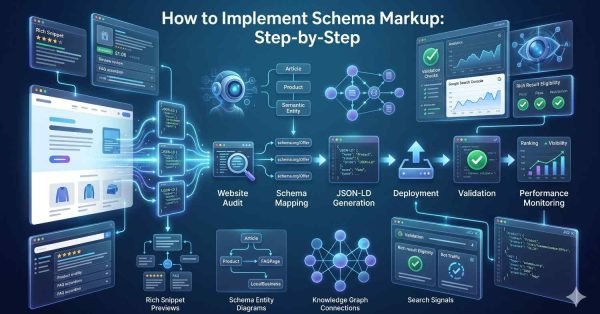
Schema markup gives search engines machine-readable context for your content, unlocking rich results, knowledge panel features, and AI overview citations. Sites that implement schema correctly gain visibility advantages competitors cannot replicate without it.
Point 41 — Implement Article schema on every blog post. Include headline, author, datePublished, and dateModified fields at minimum.
Point 42 — Add FAQ schema where natural Q&A exists. Pages with valid FAQ schema frequently win expanded SERP real estate, lifting click-through rates substantially.
Point 43 — Use Product schema for ecommerce pages. Required fields include price, availability, and aggregateRating. Missing fields disqualify the page from rich results.
Point 44 — Add Breadcrumb schema on multi-level sites. Breadcrumbs improve both UX and the visual presentation of your URL in the SERP.
Point 45 — Validate every schema deployment. Use Google’s Rich Results Test and Schema.org validator before pushing live. Invalid schema is worse than no schema.
Structured data helps search engines parse your content into rich results, knowledge panels, and AI overviews — our complete guide to implementing schema markup correctly walks through every common schema type, JSON-LD syntax, and validation workflow.
Page Experience, Core Web Vitals & Mobile (Points 46–50)
Page experience signals are how Google measures whether real users actually have a good experience on your site. They function as both ranking factors and conversion drivers, making them the highest-ROI technical investments in on-page SEO.
Point 46 — Optimize Largest Contentful Paint (LCP) under 2.5 seconds. LCP measures when the main content becomes visible. Compress hero images, defer unused JavaScript, and use a fast CDN to hit this threshold.
Point 47 — Keep Interaction to Next Paint (INP) under 200 milliseconds. INP replaced FID in 2024 and measures responsiveness to every user input. Heavy JavaScript execution is the primary culprit.
Point 48 — Hold Cumulative Layout Shift (CLS) below 0.1. Set explicit dimensions for images, ads, and embeds to prevent layout jumps as the page loads.
Point 49 — Pass Google’s mobile-friendly test. Use a responsive design, readable font sizes, and tap targets at least 48 pixels apart. Mobile-first indexing has been universal since 2023.
Point 50 — Ensure HTTPS, no intrusive interstitials, and safe browsing status. These three baseline signals are minimum requirements for page experience scoring, and failing any one suppresses rankings site-wide.
Core Web Vitals measure how real users experience your page through speed, interactivity, and visual stability metrics that directly influence rankings — our complete guide to improving Core Web Vitals covers LCP, INP, and CLS diagnosis with technical fixes for every major issue.

How to Prioritize the 50-Point Checklist for Maximum Impact
Implementing fifty optimization points across a live website requires sequencing, not simultaneous execution. Trying to fix everything at once usually breaks something and reveals nothing.
Start with the highest-traffic, highest-revenue pages. Audit those pages against all fifty points, log every gap, and prioritize fixes by ranking impact and implementation effort. Title tags, meta descriptions, and content quality typically deliver the fastest visible wins. Core Web Vitals fixes take longer to compound but produce the most durable long-term lift.
Next, batch fixes by category rather than by page. Updating all title tags in one sprint is dramatically faster than rotating between title tags, schema, and image compression page by page. Build templates and patterns first; apply them across the site second.
Track ranking, CTR, and conversion changes weekly during major rollouts. Some changes will lift performance immediately; others will take 4–8 weeks to compound in the rankings. Patience matters more than perfectionism.
Implementing all fifty checkpoints across a large site requires coordinated technical, content, and analytics work most teams cannot resource internally — our full-service SEO execution handles audit, prioritization, and rollout against measurable ranking and revenue targets.
Common On-Page SEO Mistakes That Kill Rankings
Even sophisticated SEO programs repeat the same mistakes. Recognizing the patterns protects you from quiet ranking losses that take months to diagnose.
The most common errors include keyword cannibalization (two pages targeting the same query), thin content masquerading as comprehensive (long but shallow), missing or duplicate meta descriptions (defaulting to auto-generated text), broken internal links that erode crawl efficiency, and schema markup deployed without validation.
Most on-page mistakes hide in patterns invisible at the page level but obvious at the site level, which is why a structured diagnostic matters — our comprehensive SEO audit surfaces every on-page, technical, and content issue holding your rankings back.
The remaining quiet killers are mobile usability failures masked by acceptable desktop performance, alt text written for keyword stuffing rather than accessibility, and over-optimization of internal anchor text that triggers algorithmic skepticism. Each issue alone rarely tanks rankings; in combination, they compound into measurable visibility loss.
Conclusion
This fifty-point on-page SEO checklist covers every page-level optimization that influences how search engines understand, rank, and surface your content in 2026.
Each section connects to deeper cluster resources that go further into the specific tactics, formulas, and frameworks behind every checkpoint covered here.
We help businesses turn checklists like this into measurable ranking gains — partner with White Label SEO Service to execute every point against real revenue outcomes.
Frequently Asked Questions
What is on-page SEO and how is it different from off-page SEO?
On-page SEO covers every optimization made directly on your website, including content, HTML elements, and structure. Off-page SEO focuses on external signals like backlinks and brand mentions.
How long does it take for on-page SEO changes to impact rankings?
Most on-page changes show ranking movement within 4–8 weeks after Google recrawls and reindexes the page. Title tag and content updates often move faster than technical changes.
Which on-page SEO factors matter most in 2026?
Content quality, search intent alignment, title tags, and Core Web Vitals carry the heaviest weight. Schema markup and internal linking have grown significantly in importance with AI-driven SERPs.
Can I do on-page SEO myself or do I need an agency?
Small sites with 10–50 pages can handle on-page SEO in-house with training. Sites with hundreds or thousands of pages typically need agency support to maintain quality and speed.
How often should I update on-page SEO on existing pages?
Audit top-performing pages quarterly and lower-performing pages every six months. Refresh dates, statistics, examples, and broken links systematically rather than reactively.
Does on-page SEO still matter with AI search and Google’s AI overviews?
Yes — AI overviews pull from pages that demonstrate strong on-page signals, structured data, and topical authority. On-page optimization is more important for AI visibility, not less.
What is the single most important on-page SEO factor?
Content quality that fully satisfies search intent is the single biggest factor. No technical optimization can compensate for content that fails to answer the user’s actual question.