
Outreach email templates are pre-written frameworks that help you connect with prospects, secure backlinks, land guest posts, and close deals faster. The right template can mean the difference between a 2% response rate and a 25% response rate.
Whether you’re building links for SEO, pitching journalists, or reaching out to potential partners, having proven templates saves hours of writing time while dramatically improving results. Most businesses struggle with outreach because they start from scratch every time.
This guide delivers ready-to-use templates for every outreach scenario, plus the strategy behind what makes them work. You’ll find copy-paste examples, subject line formulas, follow-up sequences, and performance benchmarks to measure success.
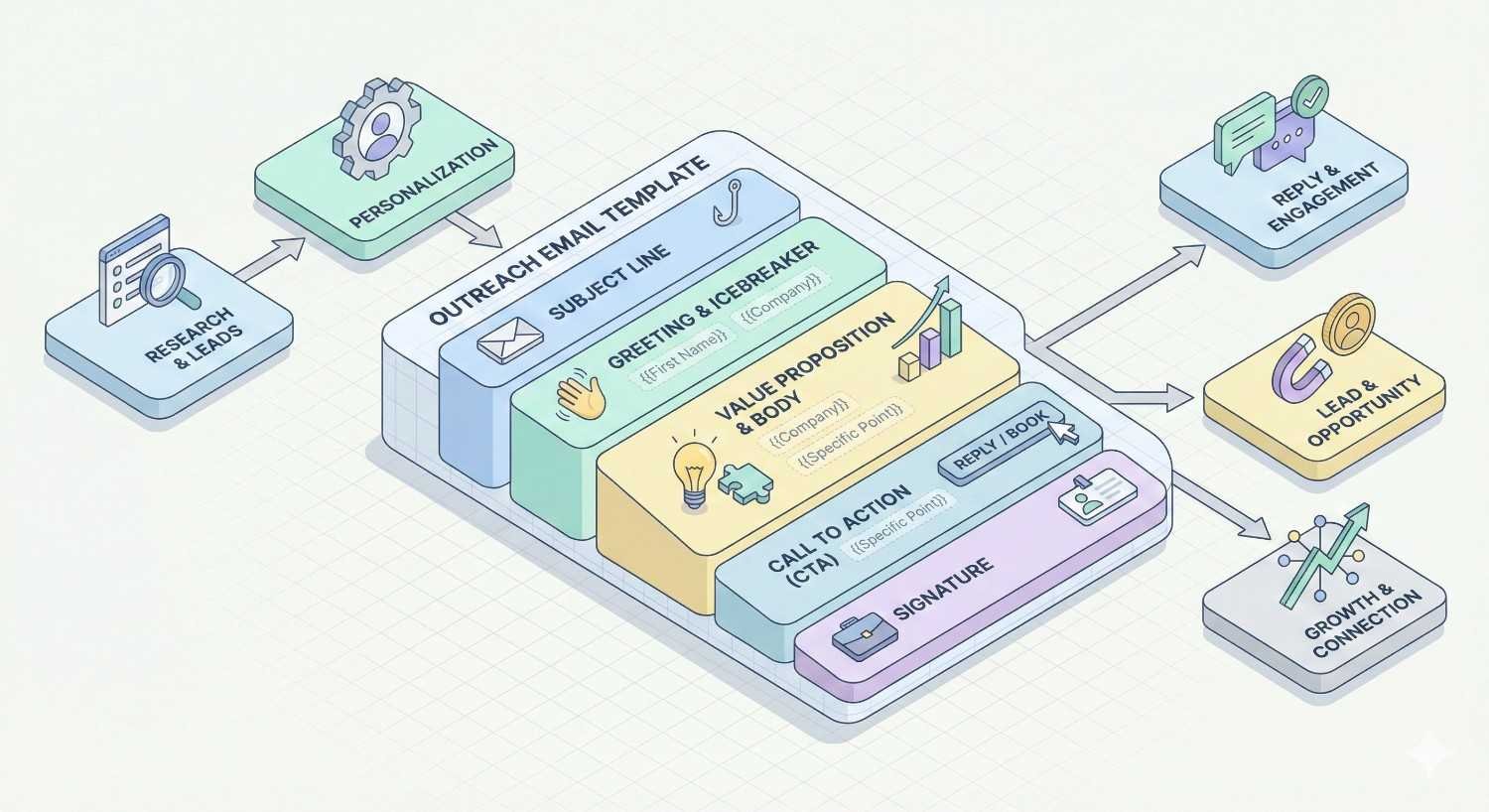
What Are Outreach Email Templates?
Definition and Purpose
Outreach email templates are structured email frameworks designed to initiate contact with specific recipients for business purposes. They provide a proven starting point that you customize for each prospect.
Templates serve three core functions. First, they establish a repeatable process that maintains quality across hundreds of emails. Second, they encode best practices learned from thousands of sends. Third, they reduce the cognitive load of writing each email from scratch.
A good template is not a rigid script. It’s a flexible framework with placeholders for personalization, a clear value proposition, and a specific call-to-action. The structure stays consistent while the details change for each recipient.
Think of templates as your outreach playbook. Sales teams use them. Link builders use them. PR professionals use them. Anyone who sends cold emails at scale needs them.
Why Outreach Emails Matter for Business Growth
Outreach emails drive measurable business outcomes across multiple channels. For SEO, they’re the primary mechanism for acquiring backlinks that improve search rankings. For sales, they open conversations with prospects who’ve never heard of you. For PR, they get your story in front of journalists and influencers.
The math is straightforward. If you send 100 outreach emails with a 5% response rate, you get 5 conversations. Improve your templates to achieve a 15% response rate, and you triple your opportunities without sending more emails.
Link building outreach directly impacts organic traffic. Each quality backlink you acquire strengthens your domain authority and helps pages rank higher. Guest post outreach expands your audience reach. Influencer outreach builds brand awareness. Sales outreach fills your pipeline.
Businesses that systematize outreach consistently outperform those that don’t. Templates make that systematization possible.
Types of Outreach Email Templates
Link Building Outreach Templates
Link building templates focus on acquiring backlinks from relevant websites. These emails must demonstrate clear value to the recipient since you’re asking them to edit their content or add a link.
The most effective link building templates include broken link outreach, resource page outreach, skyscraper outreach, and unlinked brand mention outreach. Each targets a different opportunity type.
Broken link templates alert webmasters to dead links on their site while offering your content as a replacement. Resource page templates pitch your content for inclusion on curated lists. Skyscraper templates promote content that improves upon something they’ve already linked to. Unlinked mention templates request links from sites that mention your brand without linking.
Success rates vary by template type. Broken link outreach typically converts at 5-10% because you’re solving a problem. Generic link requests convert below 1%.
Guest Post Outreach Templates
Guest post templates pitch article ideas to blogs and publications in your industry. The goal is securing a byline that includes a link back to your site.
Effective guest post outreach demonstrates familiarity with the target publication. You need to reference specific articles they’ve published, propose topics that fit their editorial calendar, and explain why you’re qualified to write about the subject.
These templates require more customization than link building emails. Editors receive dozens of pitches daily. Generic “I’d love to write for your blog” messages get deleted immediately.
The best guest post templates lead with a specific headline, include 2-3 bullet points outlining the article, and mention relevant credentials or previous publications.
PR and Media Outreach Templates
PR templates pitch stories, expert commentary, and press releases to journalists and media outlets. They follow different conventions than other outreach types.
Journalists want news. They want data. They want expert sources for stories they’re already working on. Your template must deliver one of these things quickly.
Press release pitches summarize the news in the subject line and first sentence. Expert commentary templates offer your spokesperson as a source for trending topics. Data-driven pitches lead with surprising statistics from original research.
Timing matters more for PR outreach than other types. Journalists work on deadlines. Your pitch needs to arrive when they’re actively seeking sources.
Influencer Outreach Templates
Influencer templates initiate partnerships with content creators who have engaged audiences. These relationships can drive brand awareness, product sales, and content creation.
Influencer outreach requires understanding the creator’s content style, audience demographics, and typical partnership structures. Templates should acknowledge their work specifically and propose collaborations that benefit both parties.
Product seeding templates offer free products in exchange for honest reviews. Sponsored content templates propose paid partnerships with clear deliverables. Affiliate templates offer commission-based arrangements.
The key differentiator is authenticity. Influencers receive constant pitches. Templates that feel genuine and demonstrate real familiarity with their content perform significantly better.
Sales and Cold Outreach Templates
Sales templates initiate conversations with potential customers who haven’t expressed interest in your product or service. They’re the foundation of outbound sales strategies.
Cold email templates must capture attention immediately. Recipients don’t know you. They didn’t ask to hear from you. You have seconds to demonstrate relevance.
Effective sales templates focus on the prospect’s problems, not your product features. They reference specific triggers like recent funding, job changes, or company news. They propose clear next steps.
The best sales templates are short. Under 100 words typically outperforms longer messages. Every sentence must earn its place.
Partnership and Collaboration Templates
Partnership templates propose mutually beneficial business relationships. These might include co-marketing arrangements, integration partnerships, affiliate relationships, or joint ventures.
These emails require demonstrating clear value for both parties. You need to explain what you bring to the table and what you’re asking for in return.
Partnership outreach typically targets decision-makers. Templates should be professional, specific about the proposed arrangement, and include relevant credentials or case studies.
Success often requires multiple touchpoints. Initial templates should focus on starting a conversation rather than closing a deal.
Blogger Outreach Templates
Blogger outreach templates target independent content creators for link building, product reviews, or content collaborations. They overlap with influencer outreach but typically involve smaller creators.
Bloggers often have more flexibility than journalists or large publications. They can add links to existing content, write sponsored posts, or participate in roundups.
Templates should acknowledge the blogger’s specific content and propose arrangements that respect their time and audience. Many bloggers receive compensation for their work, so templates should address this expectation.
Personalization is critical. Bloggers can spot mass emails immediately. Templates that reference specific posts or demonstrate genuine readership convert significantly better.
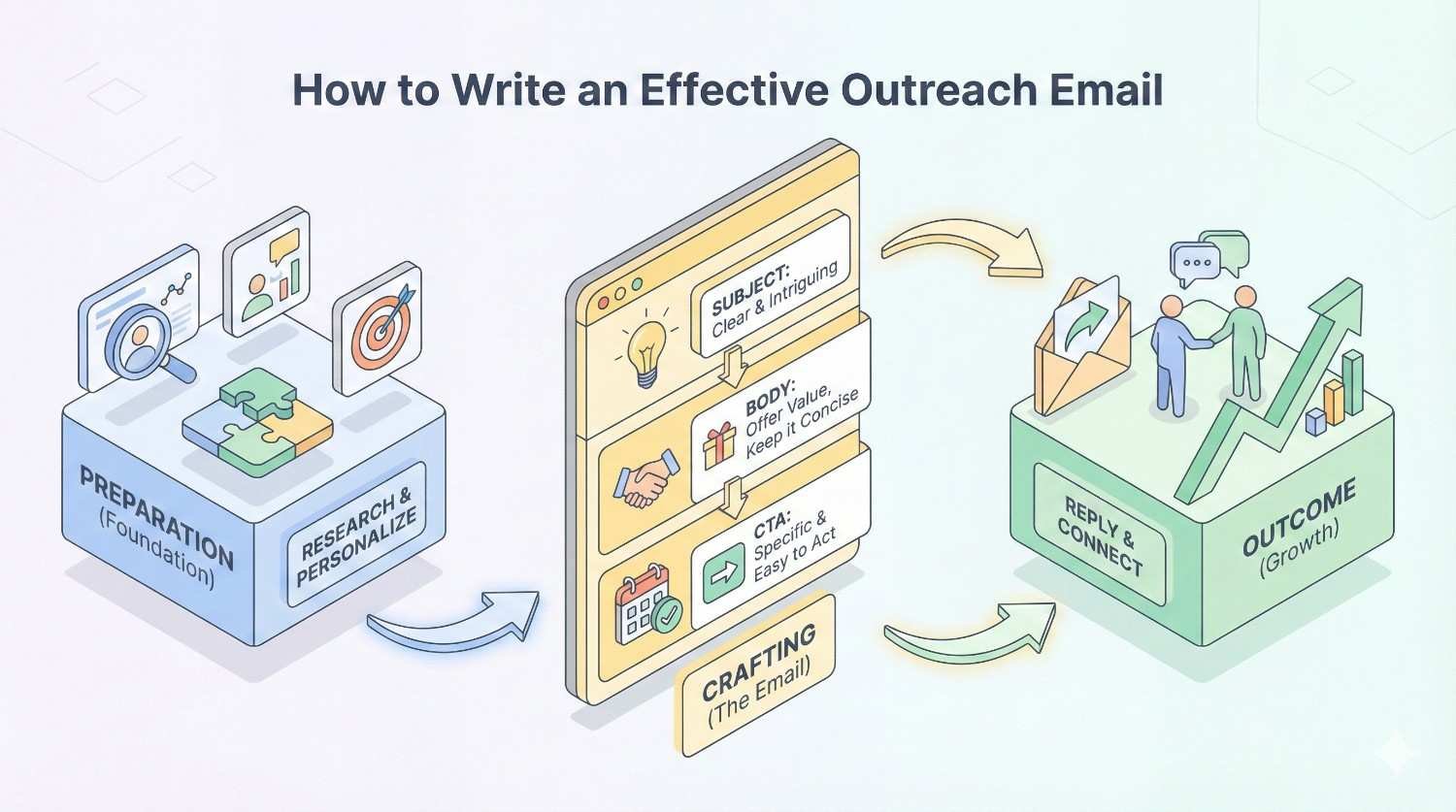
How to Write an Effective Outreach Email
Crafting a Compelling Subject Line
Your subject line determines whether your email gets opened. Everything else is irrelevant if the recipient never reads past the inbox.
Effective subject lines are specific, relevant, and create curiosity without being clickbait. They should indicate what the email is about while giving a reason to open.
Personalization in subject lines increases open rates. Including the recipient’s name, company name, or a reference to their content signals that this isn’t a mass email.
Keep subject lines under 50 characters for mobile optimization. Front-load the most important words since many email clients truncate longer subjects.
Avoid spam triggers. Words like “free,” excessive punctuation, and all caps can send your email to spam folders before anyone sees it.
Writing a Personalized Opening
The first sentence must demonstrate that you’ve done your research. Generic openings like “I came across your website” signal a mass email and get deleted.
Reference something specific. Mention a recent article they published. Comment on a podcast appearance. Note a company announcement. Anything that proves you know who you’re emailing.
Keep the personalization genuine. Forced compliments feel manipulative. A simple acknowledgment of their work is more effective than excessive flattery.
The opening should transition naturally into your pitch. Don’t spend three paragraphs on pleasantries before getting to the point.
Communicating Value Clearly
Every outreach email must answer one question: what’s in it for the recipient? If you can’t articulate clear value, your email will fail.
For link building, the value might be fixing a broken link, adding a useful resource for their readers, or getting early access to original research. For sales, it’s solving a problem they have. For partnerships, it’s mutual benefit.
State the value proposition early. Don’t bury it in the third paragraph. Recipients skim emails. Put the most important information where they’ll see it.
Be specific about the value. “This could help your readers” is weak. “This guide covers three strategies your article on X doesn’t mention” is stronger.
Creating a Strong Call-to-Action
Every outreach email needs a clear, single call-to-action. Tell the recipient exactly what you want them to do next.
Weak CTAs ask for too much. “Let me know if you’d like to discuss a partnership, review our product, or share our content” gives too many options. Strong CTAs are specific: “Would you be open to a 15-minute call next week?”
Make the CTA easy to complete. Asking someone to read a 5,000-word guide before responding creates friction. Asking if they’re interested in learning more is simpler.
Frame CTAs as questions when possible. Questions invite responses. Statements don’t.
Optimizing Email Length and Format
Shorter emails typically outperform longer ones. Aim for 50-125 words for cold outreach. Every word must earn its place.
Use short paragraphs. One to three sentences maximum. Large blocks of text don’t get read on mobile devices.
White space improves readability. Break up your email visually so recipients can scan it quickly.
Avoid attachments in initial outreach. They trigger spam filters and create friction. Link to resources instead.
Use a professional signature with your name, title, company, and one contact method. Don’t include inspirational quotes, multiple phone numbers, or social media icons.
Best Outreach Email Templates by Use Case
Link Building Email Templates
Broken Link Building Template
Subject: Quick fix for [Page Name]
Hi [Name],
I was reading your article on [Topic] and noticed the link to [Anchor Text] in the [Section] is broken.
I recently published a comprehensive guide on [Related Topic] that could work as a replacement: [URL]
Either way, wanted to give you a heads up about the dead link.
Best, [Your Name]
This template works because you’re solving a problem. The webmaster has a broken link hurting their user experience. You’re offering a solution.
Resource Page Outreach Template
Subject: Resource for your [Topic] page
Hi [Name],
I found your [Topic] resource page while researching [Subject]. Great collection of links.
I recently published [Content Title], which covers [Specific Angle]. It might be a good fit for your readers.
Here’s the link if you’d like to check it out: [URL]
Thanks for curating such a helpful resource.
[Your Name]
Resource page outreach targets curated lists of links. Your content must genuinely fit the page’s theme and quality standards.
Skyscraper Technique Template
Subject: Updated resource on [Topic]
Hi [Name],
I noticed you linked to [Competitor’s Article] in your post about [Topic].
I just published an updated version that includes [Specific Improvements]:
- [Improvement 1]
- [Improvement 2]
- [Improvement 3]
Here’s the link: [URL]
Might be worth updating your article with the newer resource.
Best, [Your Name]
The skyscraper technique requires content that’s demonstrably better than what they currently link to. Be specific about your improvements.
Unlinked Brand Mention Template
Subject: Thanks for mentioning [Brand]
Hi [Name],
Thanks for mentioning [Brand] in your article about [Topic]. We appreciate the coverage.
I noticed the mention doesn’t include a link. Would you mind adding one so readers can find us easily?
Here’s our homepage: [URL]
Thanks again for the mention.
[Your Name]
Unlinked mention outreach has high conversion rates because the recipient has already endorsed your brand. You’re just asking for a small addition.
Guest Posting Email Templates
Initial Pitch Template
Subject: Guest post idea: [Specific Headline]
Hi [Name],
I’ve been reading [Publication] for a while. Your recent piece on [Topic] was particularly useful.
I’d like to pitch a guest post: “[Specific Headline]”
The article would cover:
- [Point 1]
- [Point 2]
- [Point 3]
I’ve previously written for [Publication 1] and [Publication 2] on similar topics.
Would this be a good fit for your editorial calendar?
[Your Name]
Lead with a specific headline, not a vague topic. Editors want to see that you’ve thought through the article.
Follow-Up Template
Subject: Re: Guest post idea: [Specific Headline]
Hi [Name],
Following up on my guest post pitch from last week. I know you’re busy, so I wanted to check if this topic might work for [Publication].
Happy to adjust the angle or propose alternatives if this one doesn’t fit.
[Your Name]
Follow-ups should be brief and add minimal new information. You’re simply reminding them of your original pitch.
Influencer Collaboration Templates
Product Review Request Template
Subject: [Product] for your [Content Type]
Hi [Name],
I’ve been following your [Platform] content for a while. Your [Specific Content Piece] was really helpful.
I’m reaching out from [Brand]. We make [Product Description], and I think it could be relevant for your audience.
Would you be interested in trying [Product] for a potential review? No obligations. If you like it, great. If not, no hard feelings.
Let me know if you’d like me to send one over.
[Your Name]
Product seeding works best when you’ve genuinely engaged with the creator’s content and your product fits their niche.
Sponsored Content Template
Subject: Paid collaboration with [Brand]
Hi [Name],
I’m [Your Name] from [Brand]. We’re looking to partner with creators in the [Niche] space for sponsored content.
Your [Specific Content] caught our attention. Your style aligns well with our brand.
We’re thinking a [Content Type] featuring [Product/Service]. Budget is [Range] depending on deliverables.
Would you be open to discussing a collaboration?
[Your Name]
Be upfront about paid partnerships. Include budget ranges to filter for creators within your price point.
PR and Journalist Outreach Templates
Press Release Pitch Template
Subject: [News Hook]: [Company] [Action]
Hi [Name],
[Company] just [News Event]. This is relevant for your coverage of [Beat] because [Reason].
Key details:
- [Fact 1]
- [Fact 2]
- [Fact 3]
I can provide [Additional Resources: quotes, data, images] if you’re interested in covering this.
[Your Name] [Contact Info]
Journalists want news. Lead with the news hook, not background about your company.
Expert Commentary Template
Subject: Expert source for [Trending Topic]
Hi [Name],
I saw you’re covering [Trending Topic]. [Expert Name], [Title] at [Company], is available for expert commentary.
[Expert Name] has [Relevant Credentials] and can speak to [Specific Angles].
Available for phone, email, or video interviews this week.
Let me know if you’d like to connect.
[Your Name]
Expert commentary pitches work best when tied to topics the journalist is actively covering. Monitor their recent articles.
Sales Prospecting Templates
Cold Email Introduction Template
Subject: [Specific Trigger] at [Company]
Hi [Name],
Noticed [Company] recently [Trigger Event]. Companies in that situation often struggle with [Problem].
We help [Target Audience] solve [Problem] by [Solution]. [Brief Proof Point].
Worth a quick conversation?
[Your Name]
Cold emails must be relevant. Reference a specific trigger that makes your outreach timely.
Value Proposition Template
Subject: [Specific Result] for [Company]
Hi [Name],
[Similar Company] was dealing with [Problem]. We helped them achieve [Specific Result] in [Timeframe].
Given [Company]’s focus on [Priority], I thought this might be relevant.
Would you be open to seeing how we did it?
[Your Name]
Lead with results, not features. Specific numbers and timeframes are more compelling than vague claims.
Outreach Email Subject Lines That Get Opened
Subject Line Formulas That Work
Certain subject line structures consistently outperform others. These formulas provide starting points you can customize.
The Specific Reference: “[Their Article Title] + quick question” This works because it proves you’ve engaged with their content. It’s clearly not a mass email.
The Mutual Connection: “Referred by [Name]” Referrals dramatically increase open rates. If you have a mutual connection, lead with it.
The Value Lead: “[Specific Benefit] for [Their Company]” Leading with value captures attention. Be specific about what you’re offering.
The Curiosity Gap: “Quick idea about [Topic]” Curiosity drives opens. Don’t reveal everything in the subject line.
The Direct Ask: “Guest post for [Publication]” Sometimes direct is best. Editors know exactly what you want.
Subject Line Examples by Industry
SaaS/Technology:
- “Integration idea for [Product]”
- “[Competitor] users are switching. Here’s why.”
- “Quick question about your [Feature] roadmap”
E-commerce:
- “Partnership opportunity for [Season]”
- “Your [Product Category] feature on [Publication]”
- “[Influencer Name] mentioned your brand”
Professional Services:
- “Referral from [Mutual Connection]”
- “[Specific Result] for [Industry] clients”
- “Quick question about [Their Recent Project]”
Agencies:
- “Collaboration on [Client Type] projects”
- “[Their Case Study] + follow-up question”
- “White label opportunity”
A/B Testing Your Subject Lines
Testing subject lines improves performance over time. Send variations to small segments before rolling out to your full list.
Test one variable at a time. If you change both the format and the personalization, you won’t know which change affected results.
Sample sizes matter. You need at least 100 sends per variation to get statistically meaningful results. Smaller samples produce unreliable data.
Track open rates by subject line in your outreach tool. Most platforms provide this data automatically.
Common variables to test include personalization (name vs. company vs. none), length (short vs. medium), format (question vs. statement), and specificity (vague vs. detailed).
Outreach Email Follow-Up Strategies
When to Send Follow-Up Emails
Most responses come from follow-ups, not initial emails. Giving up after one send leaves significant results on the table.
Wait 3-5 business days before your first follow-up. This gives recipients time to see and consider your initial email without feeling pressured.
Send follow-ups on different days and times than your original email. If someone missed your Tuesday morning email, they might catch a Thursday afternoon follow-up.
Stop following up if you receive a clear “no” or if the recipient asks you to stop. Continuing after rejection damages your reputation and sender score.
Follow-Up Email Templates
Follow-Up #1 (3-5 days after initial email):
Subject: Re: [Original Subject]
Hi [Name],
Wanted to bump this to the top of your inbox. I know you’re busy.
[One-sentence reminder of your ask]
Worth discussing?
[Your Name]
Follow-Up #2 (5-7 days after Follow-Up #1):
Subject: Re: [Original Subject]
Hi [Name],
Following up one more time on [Topic].
[Add new information or different angle]
If this isn’t relevant, no worries. Just let me know and I’ll stop reaching out.
[Your Name]
Follow-Up #3 (7-10 days after Follow-Up #2):
Subject: Should I close your file?
Hi [Name],
I haven’t heard back, so I’m assuming the timing isn’t right.
I’ll close out your file for now. Feel free to reach out if things change.
[Your Name]
The “closing the file” email often generates responses from people who intended to reply but forgot.
How Many Follow-Ups to Send
Three to four follow-ups is the standard for most outreach types. More than that risks annoying recipients and damaging your sender reputation.
The exception is high-value prospects. For enterprise sales or major partnership opportunities, longer sequences may be appropriate.
Space follow-ups further apart as the sequence progresses. First follow-up at 3-5 days, second at 5-7 days, third at 7-10 days.
Each follow-up should add something new. Repeating the same message multiple times is ineffective. Add new information, try a different angle, or acknowledge that you’re following up.
Common Outreach Email Mistakes to Avoid
Generic and Impersonal Messages
Mass emails that could be sent to anyone get deleted immediately. Recipients can spot templates that haven’t been customized.
The fix is genuine personalization. Reference specific content they’ve created. Mention something unique about their company. Show that you’ve done research.
Personalization doesn’t mean adding their name to a mail merge field. It means demonstrating that you understand who they are and why you’re reaching out to them specifically.
If you can’t find something specific to reference, you probably shouldn’t be emailing that person. Better targeting beats better templates.
Weak or Missing Value Propositions
Many outreach emails focus entirely on what the sender wants without explaining what the recipient gets. This approach fails.
Every email must answer “what’s in it for me?” from the recipient’s perspective. If you’re asking for a link, explain why adding it benefits their readers. If you’re pitching a partnership, clarify the mutual value.
Vague value propositions don’t work. “This could be valuable for your audience” is weak. “This guide answers the three questions your readers ask most in the comments” is specific.
If you can’t articulate clear value, reconsider whether you should send the email at all.
Poor Subject Lines
Subject lines that are too long, too vague, or too salesy kill open rates before your message has a chance.
Avoid spam trigger words. “Free,” “limited time,” “act now,” and similar phrases can send your email to spam folders.
Don’t use all caps or excessive punctuation. “AMAZING OPPORTUNITY!!!” looks like spam.
Keep subject lines under 50 characters. Many email clients truncate longer subjects, especially on mobile.
Test different approaches. What works for one audience may not work for another.
Sending Without Research
Emailing the wrong person, pitching irrelevant topics, or demonstrating ignorance about the recipient’s work wastes everyone’s time.
Research before you send. Read their recent content. Understand their role. Know what topics they cover.
Verify email addresses before sending. Bounced emails hurt your sender reputation and waste your time.
Check that your pitch is relevant. Don’t pitch a guest post about marketing to a publication that only covers technology. Don’t pitch a product to someone who’s already reviewed a competitor.
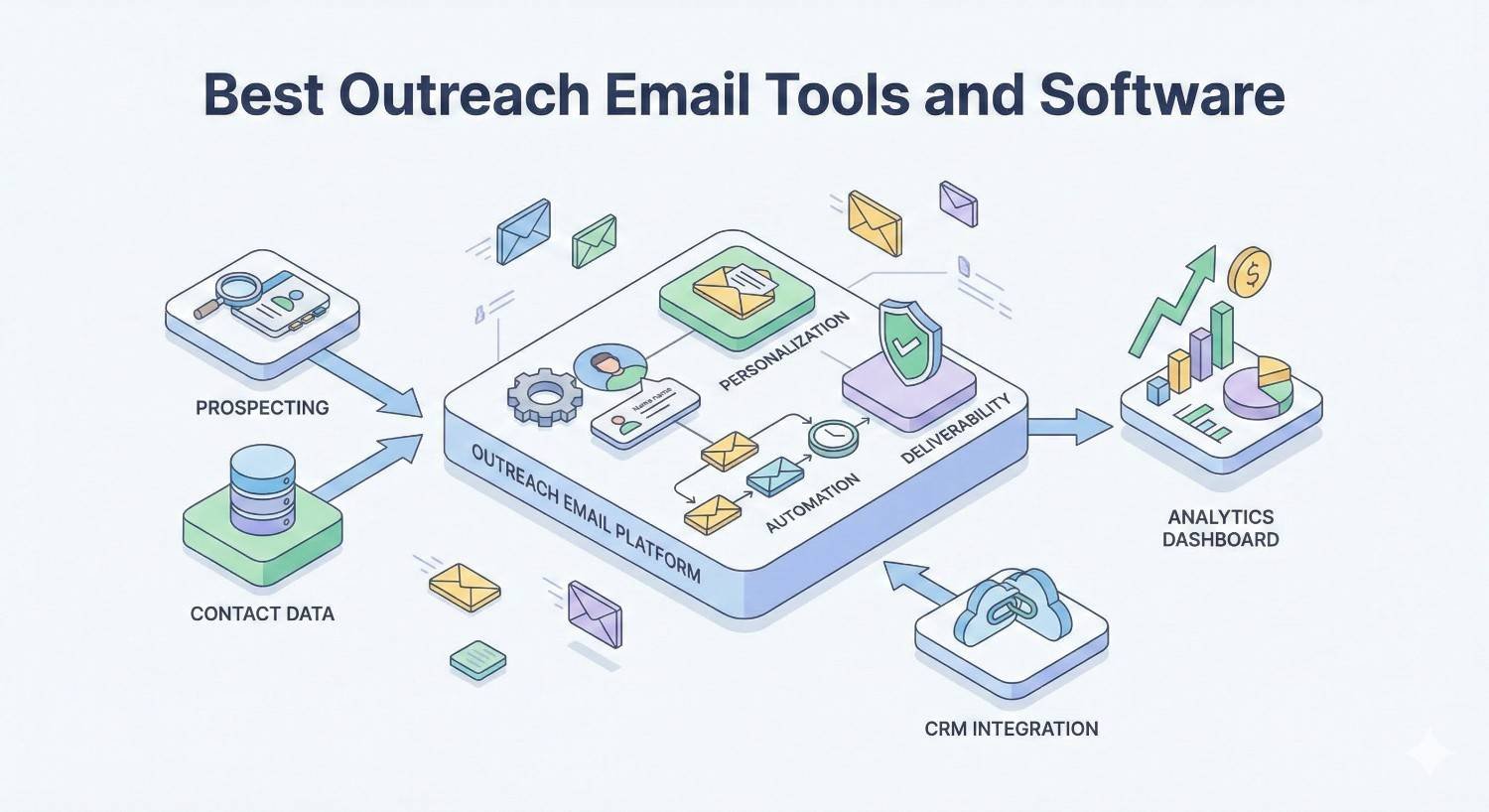
Best Outreach Email Tools and Software
Email Finding Tools
Finding accurate email addresses is the foundation of outreach. Several tools specialize in this function.
Hunter.io searches for email addresses associated with specific domains. It also verifies addresses to reduce bounce rates.
Apollo.io combines email finding with a database of company and contact information. It’s particularly useful for sales outreach.
Snov.io offers email finding, verification, and basic outreach automation in one platform.
RocketReach provides email and phone data for professionals across industries.
Clearbit connects to your CRM and enriches contact records with email addresses and company data.
The key metric for email finding tools is accuracy. Inaccurate emails lead to bounces, which damage your sender reputation.
Outreach Automation Platforms
Automation platforms send personalized emails at scale while tracking opens, clicks, and responses.
Mailshake provides email sequences, A/B testing, and integration with popular CRMs. It’s designed specifically for cold outreach.
Lemlist offers advanced personalization features including custom images and videos in emails.
Woodpecker focuses on deliverability with features like email warm-up and sending limits.
Pitchbox is built specifically for link building and PR outreach with features for finding prospects and managing campaigns.
BuzzStream combines prospecting, outreach, and relationship management for content marketing teams.
Choose a platform based on your primary use case. Sales-focused tools differ from link building tools in their feature sets.
CRM Integration Options
Connecting outreach tools to your CRM creates a unified view of prospect interactions.
Most outreach platforms integrate with Salesforce, HubSpot, and Pipedrive. Check compatibility before committing to a tool.
Integration allows you to track outreach alongside other touchpoints. You can see if a prospect opened your email before they booked a demo.
Two-way sync keeps data consistent. When you update a contact in your CRM, the change reflects in your outreach tool.
Automation triggers can start outreach sequences based on CRM events. A new lead entering a specific stage could automatically receive an email sequence.
Measuring Outreach Email Performance
Key Metrics to Track
Open Rates
Open rate measures the percentage of recipients who opened your email. It indicates subject line effectiveness and sender reputation.
Calculate open rate by dividing opens by delivered emails, then multiplying by 100. If 50 people opened out of 200 delivered, your open rate is 25%.
Open rates vary by outreach type. Cold sales emails typically see 15-25% open rates. Warm outreach to existing contacts can exceed 50%.
Low open rates suggest problems with subject lines, sender reputation, or targeting. If people aren’t opening, nothing else matters.
Note that open tracking isn’t perfectly accurate. Some email clients block tracking pixels, and Apple’s Mail Privacy Protection can inflate open rates.
Response Rates
Response rate measures the percentage of recipients who replied to your email. It’s the most important metric for outreach success.
Calculate response rate by dividing replies by delivered emails. Include both positive and negative responses in the count.
Response rates vary significantly by outreach type and quality. Link building outreach might see 5-15% response rates. Highly personalized sales outreach can exceed 20%.
Low response rates with decent open rates indicate problems with your email body, value proposition, or call-to-action.
Track positive response rates separately. A 10% response rate means little if 8% are rejections.
Conversion Rates
Conversion rate measures the percentage of outreach that achieves your goal. For link building, it’s links acquired. For sales, it’s meetings booked or deals closed.
Calculate conversion rate by dividing successful outcomes by total emails sent. If you sent 500 emails and acquired 25 links, your conversion rate is 5%.
Conversion rates are the ultimate measure of outreach effectiveness. High open and response rates mean nothing if they don’t lead to results.
Track conversion rates by template, by target type, and by team member. This data reveals what’s working and what needs improvement.
Benchmarks and Industry Standards
Benchmarks provide context for your performance. They help you understand whether your results are good, average, or need improvement.
Link Building Outreach:
- Open rates: 30-50%
- Response rates: 5-15%
- Link acquisition rates: 2-10%
Guest Post Outreach:
- Open rates: 25-40%
- Response rates: 5-20%
- Acceptance rates: 2-10%
Sales Cold Email:
- Open rates: 15-25%
- Response rates: 1-5%
- Meeting booking rates: 0.5-2%
Influencer Outreach:
- Open rates: 20-35%
- Response rates: 5-15%
- Partnership rates: 2-8%
These benchmarks represent averages. Top performers significantly exceed these numbers through better targeting, personalization, and value propositions.
Your own historical data is more valuable than industry benchmarks. Track your performance over time and aim for continuous improvement.
Outreach Email Templates for Different Industries
SaaS and Technology
SaaS outreach often targets technical audiences who value specificity and data. Templates should demonstrate understanding of their tech stack and challenges.
Link Building for SaaS: Focus on technical content, comparison guides, and integration documentation. Target developer blogs, tech publications, and industry resource pages.
Sales Outreach for SaaS: Reference specific tools in their stack, recent funding, or hiring patterns. Lead with how you solve problems they’re likely facing at their growth stage.
Partnership Outreach for SaaS: Propose integrations, co-marketing opportunities, or affiliate arrangements. Be specific about technical requirements and mutual benefits.
E-commerce and Retail
E-commerce outreach often involves product-focused pitches to bloggers, influencers, and media outlets.
Influencer Outreach for E-commerce: Lead with product fit for their audience. Offer samples, affiliate commissions, or sponsored content budgets.
PR Outreach for E-commerce: Pitch seasonal angles, trend stories, and gift guides. Timing matters. Reach out to holiday gift guide editors in September, not December.
Link Building for E-commerce: Target resource pages, buying guides, and comparison articles. Offer exclusive data or expert commentary to earn editorial links.
Professional Services
Professional services outreach emphasizes expertise, credentials, and results. Trust signals matter more than in other industries.
Sales Outreach for Professional Services: Reference specific challenges in their industry. Include case studies with measurable results. Offer value upfront through insights or assessments.
PR Outreach for Professional Services: Position principals as expert sources for industry trends. Offer commentary on news events. Pitch thought leadership content.
Partnership Outreach for Professional Services: Propose referral arrangements, co-branded content, or complementary service bundles.
Agencies and Consultants
Agency outreach often targets potential clients, partners, or white-label relationships.
Client Acquisition Outreach: Lead with results for similar clients. Be specific about your process and deliverables. Offer audits or assessments as conversation starters.
Partnership Outreach: Propose white-label arrangements, referral partnerships, or subcontracting relationships. Be clear about capacity and capabilities.
Link Building for Agencies: Target industry publications, marketing blogs, and business media. Offer original research, case studies, or expert commentary.
How to Scale Your Outreach Campaigns
Building Prospect Lists
Quality prospect lists are the foundation of scalable outreach. Poor lists waste time and damage sender reputation.
Start with clear criteria. Define your ideal prospect by industry, company size, role, and other relevant factors. Vague criteria produce vague lists.
Use multiple data sources. Combine LinkedIn Sales Navigator, industry databases, and manual research. No single source captures everyone.
Verify email addresses before adding to your list. Invalid emails cause bounces that hurt deliverability.
Segment lists by outreach type, priority, and personalization requirements. Not every prospect needs the same level of customization.
Update lists regularly. People change jobs. Companies pivot. Outdated data wastes effort.
Personalization at Scale
Personalization improves response rates but takes time. Scaling requires systems that maintain quality while increasing volume.
Create personalization tiers. High-value prospects get deep research and custom emails. Lower-priority prospects get template-based personalization with merge fields.
Build personalization into your prospecting process. When you add someone to your list, capture the personalization details you’ll need later.
Use tools that support dynamic content. Many outreach platforms allow conditional content blocks based on prospect attributes.
Develop templates for common scenarios. If you frequently reach out to marketing directors at SaaS companies, create a template optimized for that segment.
Set realistic volume expectations. Highly personalized outreach might max out at 20-30 emails per day. Template-based outreach can scale to hundreds.
Managing Outreach Workflows
Workflows keep campaigns organized and ensure consistent follow-up. Without systems, prospects fall through cracks.
Define your outreach stages. Typical stages include prospecting, initial outreach, follow-up sequence, response handling, and outcome tracking.
Use your outreach platform’s workflow features. Most tools support automated sequences, task reminders, and status tracking.
Establish response handling protocols. Who responds to positive replies? How quickly? What’s the handoff process to sales or partnerships?
Track time spent on each stage. This data reveals bottlenecks and optimization opportunities.
Review and optimize workflows regularly. What worked six months ago may not work today.
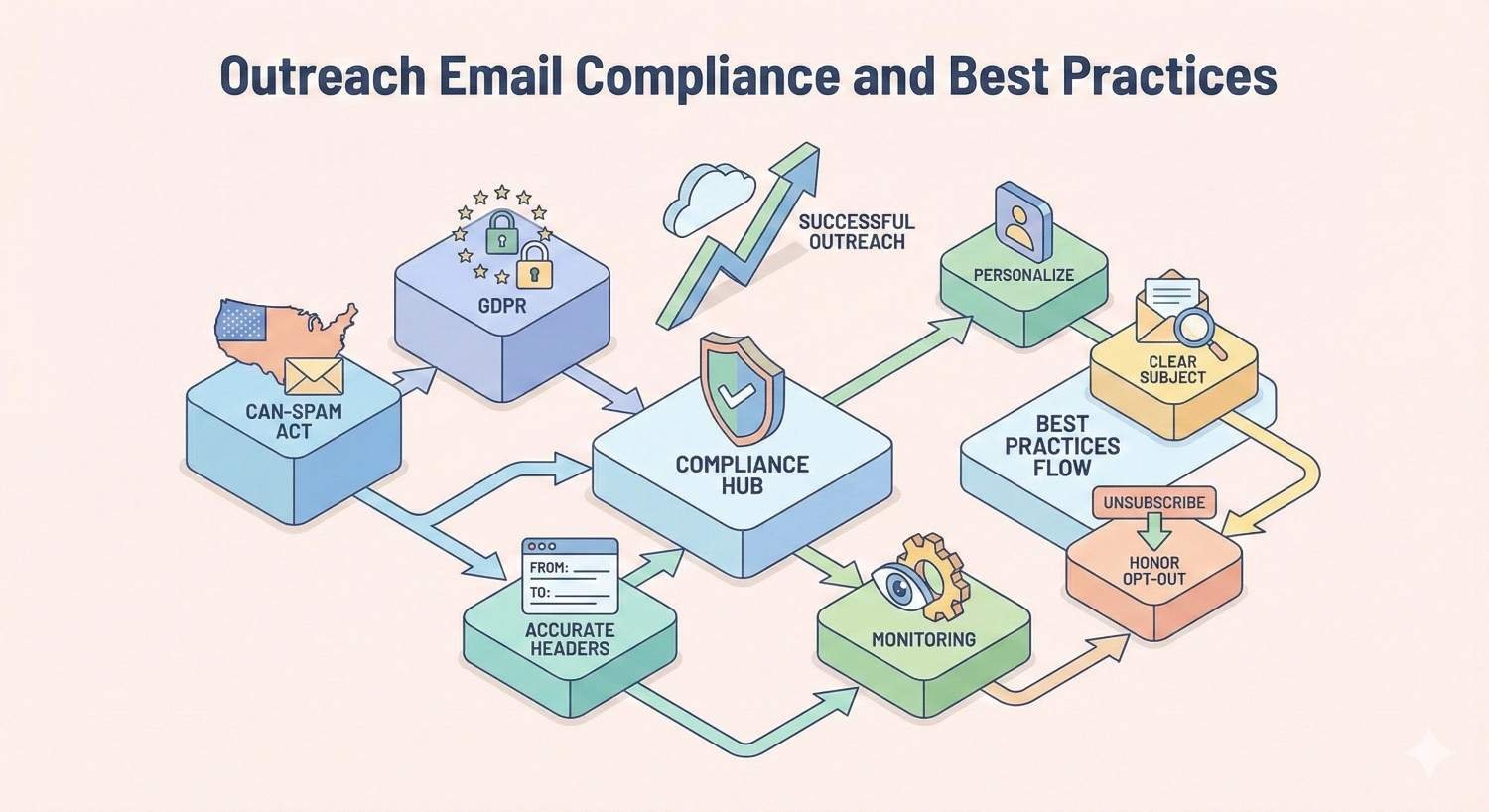
Outreach Email Compliance and Best Practices
CAN-SPAM and GDPR Considerations
Email regulations vary by jurisdiction. Non-compliance can result in significant fines and damage to your sender reputation.
CAN-SPAM (United States):
- Don’t use deceptive subject lines
- Include your physical address
- Provide a clear opt-out mechanism
- Honor opt-out requests within 10 business days
- Identify the message as an advertisement if applicable
GDPR (European Union):
- Have a lawful basis for processing (legitimate interest for B2B outreach)
- Be transparent about data usage
- Honor data subject requests
- Maintain records of processing activities
CASL (Canada):
- Requires express or implied consent for commercial emails
- Stricter than CAN-SPAM
- Significant penalties for violations
Consult legal counsel for specific compliance questions. Regulations change, and penalties can be substantial.
Email Deliverability Tips
Deliverability determines whether your emails reach inboxes or spam folders. Poor deliverability undermines all other outreach efforts.
Warm up new email accounts gradually. Start with 10-20 emails per day and increase slowly over 2-4 weeks.
Maintain list hygiene. Remove bounced addresses immediately. Regularly clean inactive contacts.
Authenticate your domain. Set up SPF, DKIM, and DMARC records. These protocols verify that emails actually come from your domain.
Monitor your sender reputation. Tools like Google Postmaster Tools and Sender Score provide visibility into how email providers view your domain.
Avoid spam trigger words and formatting. Excessive links, images, and promotional language can trigger spam filters.
Keep bounce rates below 2%. Higher rates signal list quality problems and damage reputation.
Building Sender Reputation
Sender reputation is a score that email providers assign to your domain and IP address. It determines inbox placement.
Reputation builds over time through consistent, legitimate sending behavior. There are no shortcuts.
Send emails that recipients want. High engagement (opens, replies, forwards) improves reputation. Low engagement (ignores, spam reports) damages it.
Start with your warmest contacts when building reputation. Emails to people who know you generate better engagement signals.
Don’t buy email lists. Purchased lists contain invalid addresses and uninterested recipients. They destroy reputation quickly.
Use dedicated sending domains for outreach. This protects your main domain’s reputation if outreach campaigns underperform.
Monitor feedback loops. Major email providers offer programs that notify you when recipients mark your emails as spam.
Conclusion
Outreach email templates transform scattered efforts into systematic campaigns that deliver measurable results. The templates, strategies, and frameworks in this guide provide everything you need to launch effective outreach for link building, guest posting, PR, influencer partnerships, and sales prospecting.
Success comes from combining proven templates with genuine personalization, consistent follow-up, and continuous optimization based on performance data. Start with the templates that match your immediate goals, track your results, and refine your approach over time.
At White Label SEO Service, we help businesses build sustainable organic growth through strategic outreach, quality link acquisition, and comprehensive SEO programs. Contact us to discuss how professional outreach can accelerate your search visibility and drive long-term results.
Frequently Asked Questions About Outreach Emails
What is the best time to send outreach emails?
Tuesday through Thursday between 9-11 AM in the recipient’s time zone typically generates the highest open rates. Avoid Mondays when inboxes are full and Fridays when people are wrapping up for the weekend.
How long should an outreach email be?
Keep cold outreach emails between 50-125 words. Shorter emails get read completely and make your ask clear. Every sentence should serve a purpose.
What response rate should I expect?
Response rates vary by outreach type. Cold sales emails typically see 1-5% response rates. Link building outreach ranges from 5-15%. Highly personalized outreach to warm contacts can exceed 20%.
How do I find email addresses for outreach?
Use email finding tools like Hunter.io, Apollo.io, or Snov.io to locate professional email addresses. Verify addresses before sending to reduce bounce rates and protect your sender reputation.
Should I use images or attachments in outreach emails?
Avoid images and attachments in initial outreach. They trigger spam filters and increase load times. Use plain text emails with minimal formatting for best deliverability.
How do I improve my outreach response rates?
Focus on three areas: better targeting to reach relevant prospects, stronger personalization that demonstrates research, and clearer value propositions that answer “what’s in it for them.”
What should I do if someone doesn’t respond?
Send 2-3 follow-up emails spaced 3-7 days apart. Each follow-up should add new information or try a different angle. Stop if you receive a clear rejection or no response after the sequence.