
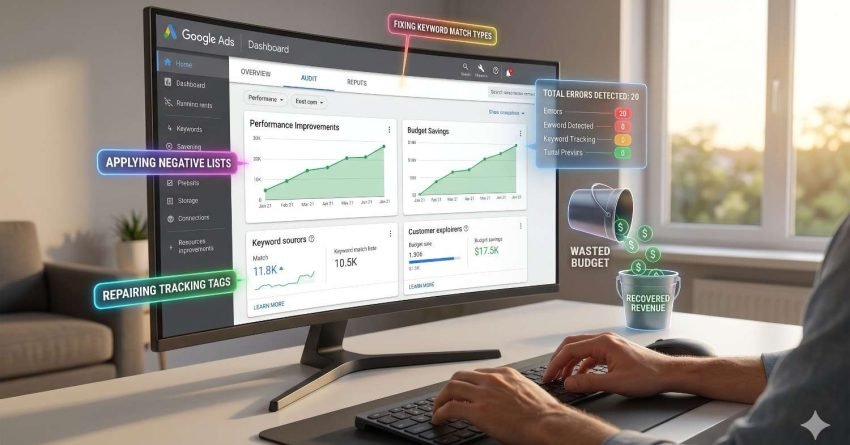
Most PPC accounts waste 20–30% of spend on avoidable errors — from poor keyword targeting and missing negative lists to broken tracking and weak landing pages. Fixing them rarely requires more budget. It requires sharper structure, smarter measurement, and disciplined optimization.
Paid search rewards precision. Every wasted impression, mistargeted click, and untracked conversion compounds into lost revenue and inflated cost per acquisition.
This guide walks through the 20 most common PPC mistakes, why each one hurts performance, and exactly how to fix them fast.
Why PPC Campaigns Fail Before They Start
Most PPC failures trace back to setup, not strategy. Accounts go live without negative keyword lists, conversion tracking, or proper campaign segmentation, and then advertisers blame the platform when results disappoint. The truth is simpler: poor foundations produce poor data, and poor data produces poor decisions.
Knowing which mistakes to avoid is the fastest path to profitability. The 20 errors below appear in nearly every underperforming account we audit, regardless of industry or budget size.

Keyword & Targeting Mistakes
Keyword strategy determines who sees your ads and what they cost. Get this layer wrong and every downstream metric suffers.
1. Ignoring Negative Keywords
Without negative keywords, your ads appear for irrelevant queries that drain budget without generating qualified clicks. A plumbing company bidding on “plumber” will pay for searches like “plumber salary” or “plumber jokes” unless those terms are explicitly excluded. Build a negative keyword list from day one and update it weekly.
2. Using the Wrong Keyword Match Types
Broad match casts too wide a net. Exact match alone limits reach. Most accounts perform best with a layered structure of phrase and exact match keywords supported by tightly managed broad match modifiers paired with smart bidding.
3. Targeting Overly Broad Keywords
Single-word keywords like “shoes” or “insurance” attract massive volume but minimal intent. Long-tail keywords convert at higher rates because they reflect specific buying decisions. Prioritize commercial intent over search volume.
4. Skipping Competitor Keyword Research
If you do not know which keywords drive your competitors’ paid traffic, you are bidding blind. Tools like SEMrush, Ahrefs, and SpyFu reveal competitor ad copy, landing pages, and keyword overlap, helping you find gaps and avoid expensive head-to-head auctions.
5. Forgetting Search Intent Alignment
A keyword that ranks well for SEO does not always convert for PPC. Informational queries belong in content marketing. Paid search budgets should focus on transactional and commercial-investigation keywords where conversion intent is highest. Strong PPC keyword strategy starts with the same fundamentals as organic search — our keyword research guide breaks down how to map intent, group themes, and prioritize commercial terms.

Campaign Structure & Settings Mistakes
Account architecture controls how budget flows and how easily you can optimize. Structural mistakes are expensive because they hide problems inside aggregated data.
6. Lumping Everything Into One Campaign
One campaign with mixed keywords, locations, and audiences creates a reporting nightmare. You cannot allocate budget by performance because all signals blur together. Separate campaigns by product line, geography, match type, and funnel stage.
7. Ignoring Geo-Targeting Settings
Default location settings often target “people in or interested in” your chosen region, which expands reach far beyond your actual service area. Switch to “presence” targeting whenever local intent matters, and exclude regions you do not serve. Campaign structure only pays off if measurement is airtight, and our conversion tracking setup walks through the exact events, goals, and attribution windows that separate guesswork from real ROI.
8. Skipping Ad Scheduling
Running ads 24/7 wastes spend during hours when your audience is asleep or disengaged. Review conversion data by hour and day, then use ad scheduling to concentrate budget when prospects are most likely to convert.
9. Choosing the Wrong Bidding Strategy
Maximize Clicks burns budget on volume. Target CPA only works once you have stable conversion data. New accounts should start with manual CPC or Maximize Conversions, then graduate to smart bidding once enough conversion signals exist for the algorithm to learn from.
10. Misallocating Daily Budgets
A campaign starved of budget never collects enough data to optimize. A bloated campaign on weak keywords overspends before bringing in returns. Match daily budget to expected conversion volume and CPA, not to vanity reach.
Ad Copy & Creative Mistakes
Even perfect targeting fails if the ad itself does not earn the click. Creative mistakes inflate cost per click and erode Quality Score.
11. Writing Weak or Generic Ad Copy
Headlines like “Best Service in Town” do not convince anyone. Strong ad copy includes specific value propositions, numbers, and a clear call to action. Mirror the language searchers use and address the exact problem they are trying to solve.
12. Not Using Ad Extensions
Sitelinks, callouts, structured snippets, call extensions, and lead form extensions expand your ad real estate and boost click-through rates. Skipping them hands competitors free visibility above and below your ad.
13. Failing to A/B Test Creatives
Running one version of an ad indefinitely is leaving performance on the table. Test two to four headlines and descriptions per ad group, retire underperformers, and rotate fresh variations every 30 to 60 days.
Landing Page & Conversion Mistakes
Paid clicks are only valuable when the landing experience converts. This is where the largest budget leaks usually hide.
14. Sending Traffic to the Homepage
The homepage is built for general visitors, not paid searchers with specific intent. Send each ad group to a dedicated landing page with message match, focused content, and a single primary conversion action.
15. Ignoring Mobile Experience
Over half of paid search traffic is mobile. Slow load times, awkward forms, and tiny click targets destroy mobile conversion rates. Test every landing page on a real mobile device before launch.
16. Forgetting Conversion Tracking
Without proper tracking, you cannot tell which keywords, ads, or audiences drive revenue. Set up conversion actions for every meaningful event including form submissions, phone calls, purchases, and qualified lead actions. The traffic you pay for is only as valuable as the page it lands on, which is why our landing page optimization resource details message match, load speed, and form friction fixes.

Optimization & Measurement Mistakes
The accounts that win compound small gains week after week. The accounts that lose treat PPC as a launch-and-leave channel.
17. Ignoring Quality Score Signals
Quality Score directly influences cost per click and ad position. Low scores usually point to weak keyword-to-ad relevance, poor landing page experience, or low expected CTR. Treat Quality Score as a diagnostic, not a vanity metric.
18. Treating PPC as Set-and-Forget
Auctions, competitors, and consumer behavior change constantly. Without weekly reviews of search terms, bids, budgets, and creatives, performance drifts. The best accounts get 30 to 60 minutes of focused attention several times per week.
19. Skipping the Search Terms Report
The search terms report shows the actual queries triggering your ads. It is the single richest source of negative keyword discoveries, new keyword opportunities, and intent mismatches. Review it every week without exception. PPC reporting becomes far sharper when paired with deeper site analytics, and our Google Analytics guide explains how to track user behavior beyond the click.
20. Underusing Remarketing Audiences
Most visitors do not convert on the first click. Remarketing audiences let you re-engage warm prospects with tailored messaging, often at a fraction of cold acquisition cost. Build audience lists for site visitors, cart abandoners, and existing customers, then layer them into search and display campaigns.

How to Build a Mistake-Proof PPC Process
Avoiding mistakes is not about memorizing a checklist. It is about building a repeatable process. Start every campaign with documented keyword research, granular campaign structure, complete conversion tracking, and a dedicated landing page. Review performance weekly, optimize creative monthly, and audit account structure quarterly.
Paid search rewards consistency. Long-term performance compounds when paid and organic work together, and our SEO and PPC integration breakdown shows how shared keyword data, audience signals, and landing pages amplify both channels.
Conclusion
Avoiding these 20 PPC mistakes transforms paid search from a budget drain into a predictable growth channel built on accurate data, tight targeting, and disciplined optimization.
Sustainable performance comes from the same fundamentals that drive organic growth: clear strategy, measurable execution, and continuous refinement across every campaign touchpoint.
At White Label SEO Service, we help businesses align paid and organic search into a single growth engine that delivers compounding traffic, leads, and long-term ROI.
Frequently Asked Questions
What is the most common PPC mistake?
The most common PPC mistake is launching campaigns without negative keywords or conversion tracking. This wastes budget on irrelevant clicks and leaves advertisers unable to measure what actually drives revenue.
How much PPC budget is typically wasted?
Industry audits consistently show 20–30% of PPC budgets are wasted on irrelevant queries, low-intent keywords, and untracked conversions. Tighter targeting and proper measurement usually recover that spend within 30–60 days.
How often should I optimize my PPC campaigns?
Optimize PPC campaigns weekly at minimum. Review search terms, adjust bids, refresh creative, and update negative keywords. Major structural audits should happen quarterly to prevent drift and keep account architecture efficient.
Why is my PPC Quality Score low?
Low Quality Score usually signals weak keyword-to-ad relevance, poor landing page experience, or low expected click-through rate. Tighten ad group themes, match ad copy to keywords, and improve landing page speed and message match.
Should I use broad match or exact match keywords?
Use a layered match type strategy. Exact and phrase match deliver predictable intent and control, while broad match paired with smart bidding can expand reach once you have reliable conversion data and strong negative keyword lists.