
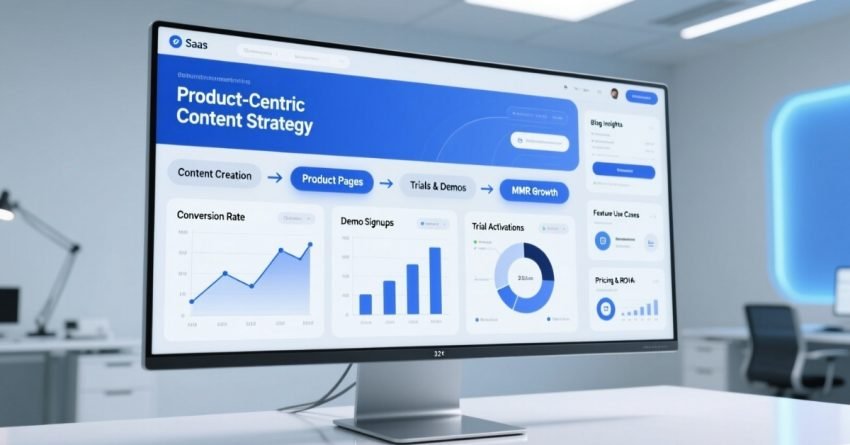
If you’re running a SaaS company (or you’re a marketing agency working with one), you’ve likely seen this: you publish blog posts, you do SEO, you get traffic but the users, trials, demos or sign-ups just don’t show up the way you hoped.
Lots of content → low conversion.
Lots of visitors → few demos.
The missing piece? Content that’s genuinely product-centric. Not just generic guides or lofty brand posts but content that talks about your product in real-world ways: pricing, use cases, integrations, demos, trials, ROI, and comparisons with alternatives. This kind of content bridges the gap between “people found us” and “people used us.”
For SaaS companies especially, you’ll need content that works with your product-led growth model or your B2B pipeline. A product-led SaaS SEO agency knows how to build that content mix. And if you partner with an agency like the one at White Label SEO Service you can offload the heavy work so you can stay focused on product and customers.
Let’s dig into why product-centric content matters, what it looks like, and how to build it the right way.
Why Product-Centric Content Matters
Think of your product landing page. It probably mentions features, pricing, maybe a demo button. Now imagine you found that same page via organic search not from a brand ad and the visitor already has the product in mind. All the content around them should help move them closer to a demo, trial, sign-up, or upgrade.
Here’s what product-centric content helps you do:
- Showcase your {brand} pricing and {brand} enterprise pricing: Instead of hiding pricing deep within a site, tell people what the cost actually is and what features they’ll get at each level.
- Encourage {brand} demo or {brand} free trial: When you talk about real customers, real use cases and real results, you make the demo/trial feel like the next obvious step.
- Highlight {brand} product tour, {brand} features and {brand} use cases: Instead of just “our software does X,” you show “here’s how Company A uses it to solve Y.”
- Display {brand} case studies and {brand} ROI calculator or {brand} TCO (total cost of ownership) calculator: This helps early-buyers see the value in clear terms.
- Talk about {brand} implementation services, {brand} onboarding time, {brand} security SOC 2 and {brand} GDPR compliance, {brand} SLA uptime: These are questions enterprise buyers ask and they search for answers.
- Cover {brand} API documentation, {brand} integrations, {brand} Salesforce integration: Product-centric content shows how your tool fits into their stack.
- Compare {brand} vs {competitor}, show {brand} alternatives: Because many buyers arrive with comparison intent. Help them see why your product is the right choice.
In short, this is content built to convert not just to rank. It’s perfect for companies with freemium models, trial flows, or complex B2B setups aimed at pipeline growth.
The Role of a SaaS SEO Agency in Product-Centric Content
If you’re a product-led SaaS company (PLG), or a B2B SaaS company focused on MRR, you need a content strategy aligned with your product, pricing, growth and revenue goals. That’s where a SaaS SEO agency for PLG companies or B2B SaaS SEO agency for pipeline growth steps in.
Here’s what they bring to the table:
- A clear roadmap that ties organic search to demos and trials (“SaaS SEO to increase demos and trials”).
- Keyword research oriented around activation, onboarding, product adoption (“SaaS SEO for product adoption”, “SEO for SaaS onboarding and activation”).
- Bottom-funnel content support (“bottom-of-funnel SaaS SEO agency”) and blog/educational content for earlier stages.
- Technical + content SEO that supports SaaS revenue growth (“technical + content SEO for SaaS revenue”).
- Link building and domain authority work that supports traction (“link building for SaaS revenue growth”).
- A partner that understands freemium sign-ups, MRR metrics, CAC reduction (“SEO services for freemium SaaS signups”, “SEO to reduce CAC for SaaS”).
When you work with a specialized agency, you get content that is not just written but designed to funnel users toward your product.
How to Build Product-Centric Content (Step-by-Step)
Here’s a simple process you can use (or hand off) to create content that truly centers your product.
1. Identify Key Product Themes
Start with your product and your customer problems. Ask:
- What are the main use cases for {brand}?
- Who uses it and why?
- What objections do people have? (e.g., pricing, integrations, onboarding)
- What comparisons do they make? (i.e., {brand} vs {competitor})
Make a list: features, pricing tiers, integrations, compliance and security, onboarding, case studies, ROI metrics.
2. Map Content Types to Buyer Intent
You’ll want a mix of content that addresses different stages:
- Awareness: “How to solve X problem with Y tool.”
- Consideration: “{brand} features compared with {brand} alternatives and {brand} vs {competitor}.”
- Decision: “{brand} pricing (or enterprise pricing), implementation services, onboarding time, trial vs paid.”
- Retention/Adoption: “Waiting for demo? Here’s how to use {brand} integrations, API documentation, Salesforce integration, etc.”
3. Create Product-Specific Blog Posts or Pages
Using the themes you’ve identified, build content that is product-centric:
- A blog post like: “What you should know about {brand} pricing for startups and enterprise.”
- A guide: “The complete {brand} product tour: features, use cases and integrations.”
- A comparison piece: “How {brand} vs {competitor} measure up choose the right tool.”
- A deep dive: “How Company X used {brand} for onboarding reduction and ROI in 90 days.”
- A resources page: “{brand} API documentation, integrations & Salesforce integration explained.”
4. Align On-Page SEO Elements
Make sure your content includes the phrases people are actually searching for: “{brand} pricing”, “{brand} demo”, “{brand} free trial”, “{brand} vs {competitor}”, “{brand} alternatives”, etc. These are high-intent keywords since they indicate the searcher is considering your product.
5. Build Supporting Assets & Backlinks
Product-centric content also needs authoritative signals:
- Use case studies and ROI calculators to drive credibility.
- Secure links from niche industry publications, blogs, partner sites.
- Create “feature pages” for integrations (“{brand} Salesforce integration”) to attract search volume.
- Work with a link building for SaaS revenue growth approach not just random guest posts.
6. Measure Product-Driven Outcomes
Don’t just measure traffic. Measure:
- Free trial sign-ups from blog pages
- Demo requests coming via content
- Activation rates from product-centric flows
- MRR uplifts or pipeline growth tied to content
This is the difference between generic content and content that directly supports your product and revenue.
Common Mistakes to Avoid
When agencies or SaaS companies approach content, here’s what often goes wrong:
- Too much general content: A blog full of “Top 10 digital marketing tips” won’t convert for your SaaS unless you tie it back to your product.
- Ignoring product intent: If you write only about features but never about “pricing”, “demo”, “use case”, you miss the final step.
- Poor integration with product journey: Your content must link clearly to trials, demos, onboarding pages. If you talk about features but don’t provide a clear next step, you lose conversions.
- Weak backlinks for product pages: Product-specific pages often lack the links that generic blog posts get. You may rank, but without authority you won’t dominate.
- No adoption/retention content: For SaaS, content isn’t done when someone signs up. You need content for onboarding, activation, integrations, power-users.
Why Agencies Need to Offer Product-Centric Content as a Service
If you’re a marketing agency working with SaaS clients, this is a huge opportunity:
- Many SaaS companies already do generic content but struggle with product-centric content.
- By offering “content + SEO for SaaS revenue” you move beyond content for ranking and into content that drives MRR, pipeline, demos.
- You can partner or white-label with agencies that specialize in SaaS SEO, helping you fulfill the harder technical and product-specific SEO needs.
- This is especially powerful if your client is a PLG tool, freemium SaaS, or enterprise SaaS product your content strategy must be tighter.
When you deliver product-centric content, you become the marketing partner who understands their product, not just their blog.
How WhiteLabelSEOService.com Can Help
If you’re reading this and thinking “This is great but my team is stretched or we don’t have the internal expertise to build product-centric content at scale,” then partnering with a specialized SaaS SEO provider makes sense.
Here’s how a provider like WhiteLabelSEOService.com supports you:
- They act as a SaaS SEO agency for PLG companies, helping you map product-specific content to growth stages.
- They build the research, strategy and execution for revenue-focused SaaS SEO services, including product crashes, demos, trials and adoption.
- They handle the technical + content SEO for SaaS revenue, so you don’t just publish content you publish content that converts.
- They support link building for SaaS revenue growth, ensuring your product and feature pages attract authority links, not just generic blog links.
- They help reduce churn by creating content for onboarding and activation so your users don’t just sign up, they keep using.
When you outsource this work, you get the benefit of deep SaaS SEO expertise while retaining your brand and client relationship.
Final Thoughts: Make Your Product the Star of Your Content
At the end of the day: your SaaS product is your differentiator. Your content should showcase that product its features, its use cases, its value.
Content that mentions {brand} pricing, {brand} demo, {brand} free trial, {brand} product tour, {brand} features, {brand} use cases, {brand} case studies it all signals to searchers: this isn’t a generic blog, this is your tool. People who search for “{brand} vs {competitor}” are closer to buying. They’re looking for answers.
Your job is to meet them there with content that addresses their intent and moves them smoothly into your product experience.
If you do that, you’ll see:
- More demos and trials
- Lower cost per acquisition (CAC)
- Higher conversion rates
- Faster product adoption
- Stronger SEO ROI
💥 Ready to make your SaaS product the hero of your content?
If you’re tired of producing blog posts that rank but don’t convert, it’s time to shift your focus toward product-centric content that drives demos and MRR.
At White Label SEO Service, we specialize in:
✅ Intent-driven SEO for SaaS that focuses on demos, trials and pipeline.
✅ Product-led growth content and SEO for freemium or enterprise SaaS.
✅ Link building and authority-building designed for SaaS revenue growth.
Let’s transform your content from “nice to read” into “hard to ignore”.
👉 Schedule your free SaaS content-SEO strategy call and let us help you convert traffic into users, and users into loyal customers.