
Well-crafted product descriptions can increase conversion rates by 30% or more, transforming browsers into buyers. This guide delivers everything you need to write descriptions that sell products and rank in search engines.
Whether you manage ten products or ten thousand, the principles remain the same. You need descriptions that speak to your ideal customer, differentiate your offerings, and satisfy search engine requirements simultaneously.
This comprehensive resource covers definition and purpose, key elements, step-by-step writing processes, formats and templates, SEO best practices, industry examples, common mistakes, tools, scaling strategies, and performance measurement.
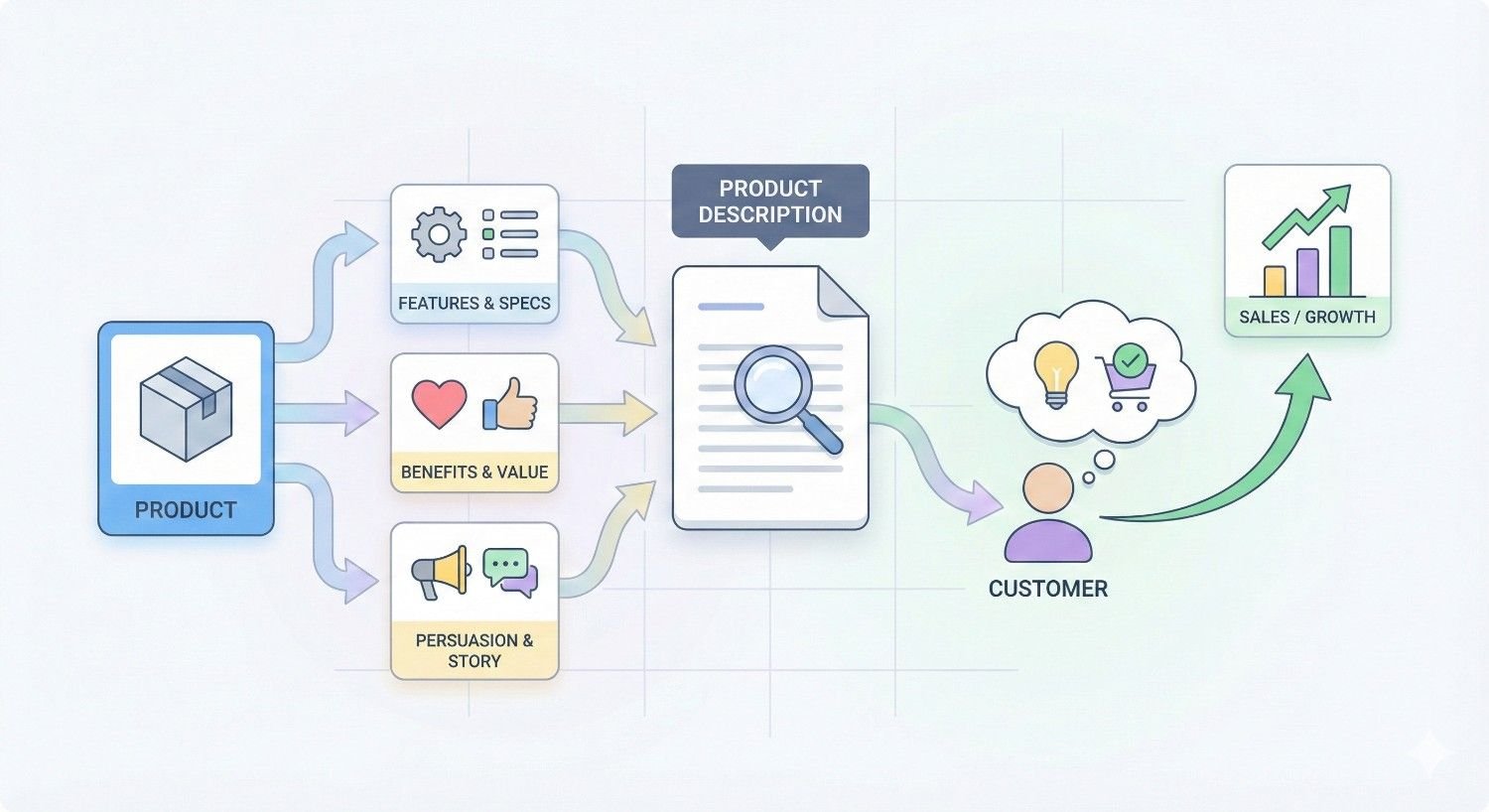
What Is a Product Description?
Product descriptions serve as your silent salespeople, working around the clock to convert visitors into customers. Understanding their fundamental nature helps you craft copy that performs.
Definition and Purpose
A product description is written content that explains what a product is, what it does, and why someone should buy it. It appears on product pages, category listings, marketplaces, and marketing materials.
The primary purpose extends beyond simple explanation. Effective descriptions answer customer questions before they arise, overcome objections, and create emotional connections with potential buyers. They bridge the gap between physical retail experiences and digital shopping.
Product descriptions must accomplish multiple objectives simultaneously. They inform, persuade, differentiate, and optimize for search visibility. Each word carries weight in this limited real estate.
Why Product Descriptions Matter for Sales and SEO
Product descriptions directly impact your bottom line. Unique, compelling copy reduces bounce rates, increases time on page, and drives purchase decisions. Generic or missing descriptions leave money on the table.
From an SEO perspective, product descriptions provide critical indexable content. Search engines need text to understand what you sell and match your pages to relevant queries. Without unique descriptions, your products compete poorly in organic search results.
The dual benefit creates compounding returns. Better descriptions attract more organic traffic through improved rankings. That traffic converts at higher rates because the copy resonates with buyer intent. Revenue grows from both increased visitors and improved conversion rates.
Key Elements of an Effective Product Description
Strong product descriptions share common characteristics regardless of industry or product type. Mastering these elements creates a foundation for consistent performance.
Compelling Headlines and Product Titles
Your product title is the first thing shoppers see. It must communicate what the product is while incorporating relevant search terms naturally.
Effective titles balance clarity with keyword optimization. Include the brand name, product type, key differentiator, and critical specifications when space allows. Avoid keyword stuffing that makes titles unreadable.
Consider how titles appear across different contexts. They show in search results, category pages, shopping feeds, and social shares. Each character counts toward making a strong first impression.
Features vs. Benefits (How to Balance Both)
Features describe what a product has or does. Benefits explain why those features matter to the customer. The most persuasive descriptions connect both seamlessly.
Lead with benefits when possible. Customers care about outcomes more than specifications. A laptop battery lasting 12 hours means freedom to work anywhere without hunting for outlets.
Include features for customers who need technical validation. Some buyers research extensively before purchasing. Provide the specifications they need to confirm your product meets their requirements.
Sensory and Emotional Language
Online shoppers cannot touch, smell, or try your products. Descriptive language bridges this sensory gap and creates vivid mental images.
Use specific adjectives that evoke physical sensations. Instead of “soft fabric,” try “buttery-soft cotton that feels like a gentle embrace.” Paint pictures with words that help customers imagine ownership.
Emotional triggers drive purchasing decisions. Connect your product to feelings customers want to experience. Security, confidence, joy, relief, excitement—identify the emotional payoff and weave it throughout your copy.
Technical Specifications and Details
Certain products require detailed specifications. Electronics, industrial equipment, apparel, and consumables all have technical aspects customers need to evaluate.
Present specifications in scannable formats. Tables, bullet points, and clearly labeled sections help customers find specific information quickly. Dense paragraphs of technical data frustrate rather than inform.
Accuracy matters enormously. Incorrect specifications lead to returns, negative reviews, and damaged trust. Verify all technical details before publishing and update them when products change.
Clear Calls-to-Action
Every product description should guide customers toward the next step. Whether adding to cart, requesting a quote, or learning more, make the desired action obvious.
Use action-oriented language that creates urgency without manipulation. “Add to Cart,” “Get Yours Today,” or “Start Your Free Trial” clearly communicate what happens next.
Position calls-to-action strategically. Place them after compelling benefit statements when purchase motivation peaks. Repeat them for longer descriptions so customers never have to scroll to take action.
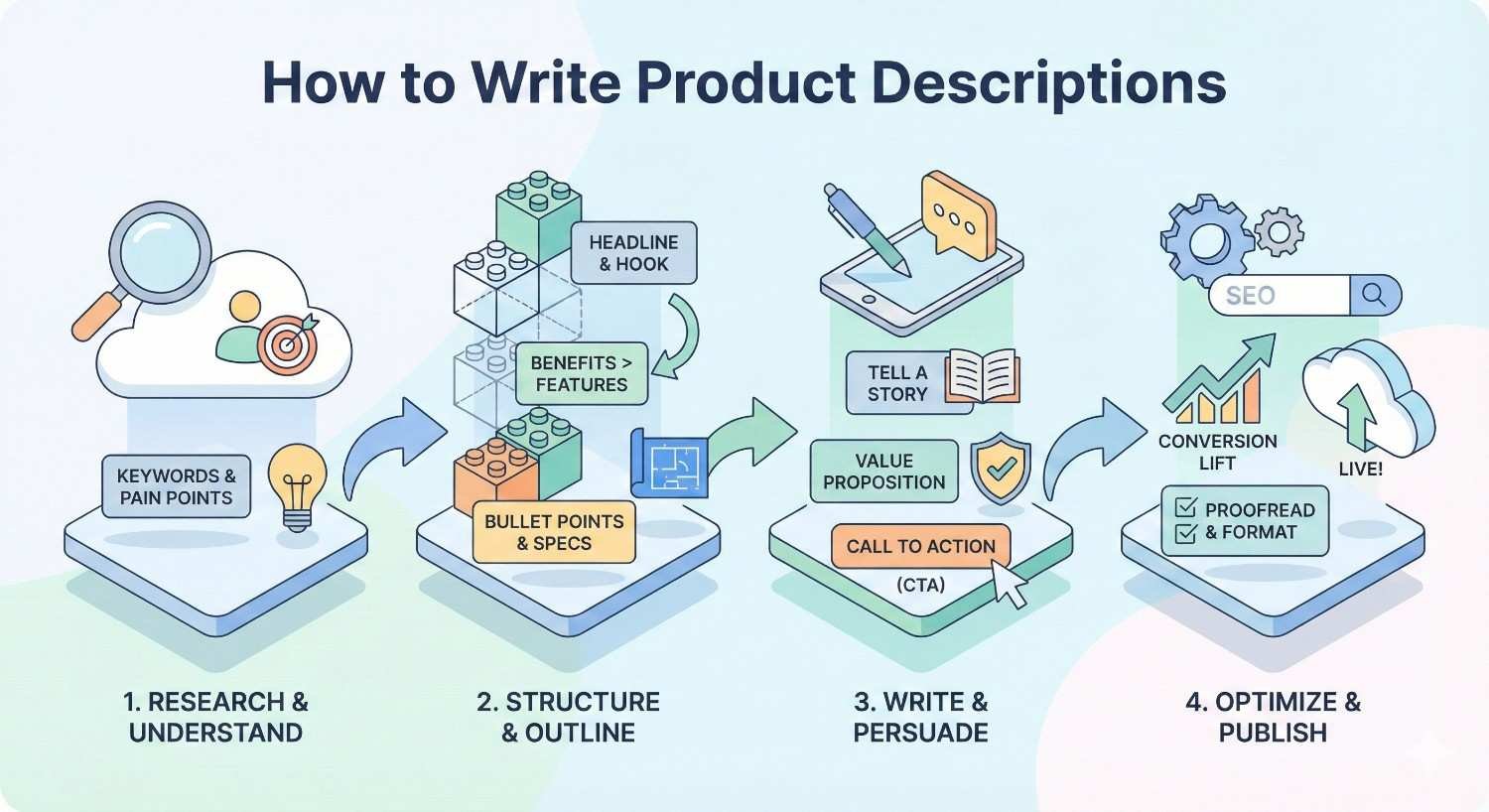
How to Write Product Descriptions Step-by-Step
A systematic approach produces consistent results across your entire catalog. Follow these steps to create descriptions that convert.
Step 1 – Know Your Target Customer
Effective descriptions speak directly to specific people. Generic copy that tries to appeal to everyone resonates with no one.
Create detailed buyer personas for your products. Understand their demographics, pain points, aspirations, and purchasing triggers. Know what language they use and what objections they raise.
Research where your customers spend time online. Read reviews of competing products. Monitor social media conversations. Join relevant communities. This intelligence informs every word you write.
Step 2 – Research Competitor Descriptions
Analyze how competitors describe similar products. Identify what works, what falls flat, and where opportunities exist to differentiate.
Look beyond direct competitors. Study brands known for exceptional copywriting in any industry. Borrow techniques and adapt them to your products and audience.
Note common patterns in your category. Some industries expect certain information presented in specific ways. Meeting these expectations while adding unique value creates competitive advantage.
Step 3 – Identify Unique Selling Points (USPs)
Every product needs clear differentiation. Why should customers choose your offering over alternatives? Answer this question explicitly.
List everything that makes your product special. Superior materials, innovative features, better warranty, ethical sourcing, local manufacturing—capture every potential differentiator.
Prioritize USPs based on customer value. Some differentiators matter more than others to your target audience. Lead with the most compelling points and support with secondary benefits.
Step 4 – Write the First Draft
Start writing without self-editing. Get ideas on the page before refining them. Perfectionism during drafting slows production and stifles creativity.
Open with your strongest benefit or most compelling hook. Capture attention immediately because many readers never scroll past the first paragraph.
Write more than you need initially. Cutting excess content during editing is easier than expanding thin copy. Give yourself material to work with.
Step 5 – Optimize for SEO
Integrate target keywords naturally throughout your description. Include primary keywords in the first 100 words, headings, and naturally within body copy.
Use semantic variations and related terms. Search engines understand context and synonyms. “Running shoes,” “athletic footwear,” and “jogging sneakers” all reinforce topical relevance.
Optimize supporting elements. Write unique meta descriptions, add alt text to images, and structure content for featured snippet opportunities.
Step 6 – Edit, Test, and Refine
Review your draft with fresh eyes. Check for clarity, flow, grammar, and persuasive impact. Read aloud to catch awkward phrasing.
Test different versions when possible. A/B testing headlines, benefit statements, and calls-to-action reveals what resonates with your specific audience.
Treat descriptions as living documents. Update them based on performance data, customer feedback, and product changes. Continuous improvement compounds over time.
Product Description Formats and Templates
Different products and platforms call for different formats. Match your approach to context and customer expectations.
Short-Form Descriptions (Under 100 Words)
Brief descriptions work for simple products, category pages, and platforms with character limits. Every word must earn its place.
Focus on the single most compelling benefit. Support it with one or two key features. Include a clear call-to-action.
Short-form requires ruthless editing. Cut adjectives that don’t add meaning. Eliminate redundancy. Compress ideas without losing clarity.
Long-Form Descriptions (300+ Words)
Complex products, high-consideration purchases, and SEO-focused pages benefit from extended descriptions. More content means more opportunities to persuade and rank.
Structure long-form content with clear sections. Use subheadings to organize information and improve scannability. Break up text with visual elements.
Maintain engagement throughout longer copy. Vary sentence length and structure. Include specific examples and proof points. Build toward a compelling conclusion.
Bullet Point Format
Bullets excel at presenting multiple features or benefits quickly. Scannable format matches how most people read online.
Start each bullet with the benefit or action. Front-load the most important information. Keep bullets parallel in structure.
Limit bullets to digestible quantities. Five to seven points work well for most products. Too many bullets overwhelm rather than inform.
Storytelling Format
Narrative descriptions create emotional connections and memorable impressions. They work particularly well for lifestyle products and brand-driven purchases.
Tell stories about product creation, customer transformations, or usage scenarios. Make the customer the hero who achieves something through your product.
Balance story with substance. Entertaining copy that lacks practical information frustrates buyers seeking details. Weave facts into narrative naturally.
Hybrid Format (Bullets + Paragraphs)
Combining formats serves different reader types simultaneously. Some customers want quick facts while others prefer detailed explanations.
Open with a compelling paragraph that hooks readers and establishes value. Follow with bullet points highlighting key features and benefits. Close with additional context or story elements.
This format performs well for SEO because it provides substantial content while remaining user-friendly. Search engines and humans both appreciate the structure.
SEO Best Practices for Product Descriptions
Optimizing product descriptions for search engines expands your organic reach and reduces customer acquisition costs.
Keyword Research and Placement
Identify keywords customers use when searching for your products. Tools like Google Keyword Planner, Ahrefs, and Semrush reveal search volume and competition levels.
Target a mix of head terms and long-tail keywords. Broad terms drive volume while specific phrases capture high-intent traffic. “Running shoes” versus “women’s trail running shoes for wide feet” serve different purposes.
Place keywords strategically without forcing them. Include primary keywords in titles, first paragraphs, and subheadings. Distribute secondary keywords throughout body content naturally.
Writing Unique Descriptions (Avoiding Duplicate Content)
Duplicate content hurts search rankings and wastes crawl budget. Never copy manufacturer descriptions used by countless other retailers.
Write original descriptions for every product. Yes, this requires significant effort for large catalogs. The SEO and conversion benefits justify the investment.
When products share characteristics, create templates with customizable sections. Maintain unique elements while systematizing common information.
Optimizing Meta Titles and Meta Descriptions
Meta titles appear in search results and browser tabs. Keep them under 60 characters, include primary keywords, and make them compelling enough to click.
Meta descriptions provide search result previews. Write 150-160 characters that summarize value and include a call-to-action. While not a direct ranking factor, good meta descriptions improve click-through rates.
Avoid duplicate meta content across products. Each page needs unique metadata that accurately represents its specific content.
Structured Data and Schema Markup
Schema markup helps search engines understand your product information. Implement Product schema to enable rich results with prices, availability, and reviews.
Include all relevant schema properties. Name, description, price, availability, brand, SKU, and aggregate ratings all enhance how your products appear in search results.
Test implementation using Google’s Rich Results Test. Errors in structured data prevent rich results from displaying. Regular validation catches issues before they impact visibility.
Internal Linking Strategies
Link product descriptions to related products, category pages, and informational content. Internal links distribute page authority and help customers discover relevant items.
Use descriptive anchor text that indicates link destinations. “View our complete running shoe collection” tells users and search engines what to expect.
Create logical link structures that reflect product relationships. Cross-sell complementary items. Link to size guides, care instructions, and buying guides where relevant.
Product Description Examples by Industry
Different industries have distinct conventions and customer expectations. Study these examples to understand effective approaches for various contexts.
E-commerce and Retail Examples
Retail descriptions balance persuasion with practical information. Customers need enough detail to purchase confidently without overwhelming complexity.
Effective retail copy leads with lifestyle benefits. How does this product improve the customer’s life? What problem does it solve? What aspiration does it fulfill?
Include practical details like dimensions, materials, care instructions, and compatibility. Anticipate questions customers ask before purchasing and answer them proactively.
SaaS and Technology Examples
Technology products require clear explanation of capabilities and benefits. Avoid jargon that confuses non-technical buyers while providing depth for informed evaluators.
Focus on outcomes rather than features. Customers care about saving time, reducing errors, or growing revenue more than specific technical implementations.
Address integration, security, and support concerns directly. Technology buyers evaluate risk alongside functionality. Reduce perceived risk through transparent information.
Fashion and Apparel Examples
Fashion descriptions create desire through sensory language and lifestyle positioning. Help customers imagine wearing the item and receiving compliments.
Include essential fit information. Size charts, model measurements, and fit descriptions reduce returns and increase purchase confidence.
Describe materials and construction quality. Fabric composition, stitching details, and care requirements matter to fashion-conscious buyers.
Food and Beverage Examples
Food descriptions engage taste, smell, and texture senses through vivid language. Make readers hungry or thirsty through words alone.
Include sourcing and ingredient information. Health-conscious consumers scrutinize what they eat. Transparency builds trust and justifies premium pricing.
Suggest serving occasions and pairings. Help customers envision enjoying your product in specific contexts that resonate with their lifestyle.
B2B Product Examples
B2B descriptions emphasize ROI, efficiency, and reliability. Business buyers justify purchases through measurable outcomes.
Address multiple stakeholders. Technical evaluators, financial decision-makers, and end users all influence B2B purchases. Provide information relevant to each perspective.
Include specifications, certifications, and compliance information. B2B buyers often have specific requirements that products must meet.
Common Product Description Mistakes to Avoid
Learning from common errors accelerates improvement. Avoid these pitfalls that undermine description effectiveness.
Using Manufacturer Descriptions
Copying manufacturer-provided descriptions creates duplicate content across every retailer selling that product. Search engines have no reason to rank your version over competitors.
Manufacturer copy often lacks persuasive elements. It describes products technically without connecting to customer benefits or creating emotional resonance.
Invest in original descriptions that reflect your brand voice and target audience. This differentiation improves both SEO performance and conversion rates.
Focusing Only on Features
Feature-heavy descriptions assume customers understand why specifications matter. Most don’t. They need explicit benefit connections.
Transform every feature into a customer benefit. “10-hour battery life” becomes “Work all day without searching for outlets.” Make the value obvious.
Balance features and benefits based on your audience. Technical buyers may want specification-forward content, but always include benefit context.
Keyword Stuffing
Cramming keywords into descriptions damages readability and triggers search engine penalties. Unnatural repetition signals manipulation rather than quality.
Write for humans first. If a sentence sounds awkward when read aloud, revise it. Natural language that happens to include keywords outperforms forced optimization.
Use semantic variations instead of exact-match repetition. Search engines understand synonyms and related terms. Variety improves both user experience and topical relevance.
Ignoring Mobile Readability
Most e-commerce traffic comes from mobile devices. Descriptions must display well on small screens with limited attention spans.
Use short paragraphs and ample white space. Dense text blocks that work on desktop become impenetrable walls on mobile.
Front-load critical information. Mobile users scroll less than desktop users. Put your most compelling content where they’ll actually see it.
Neglecting to Update Descriptions
Outdated descriptions containing incorrect information damage trust and increase returns. Products evolve, and descriptions must keep pace.
Establish review schedules for product content. Quarterly audits catch outdated information before it causes problems.
Update descriptions based on customer feedback and questions. If customers repeatedly ask about something not covered, add that information.
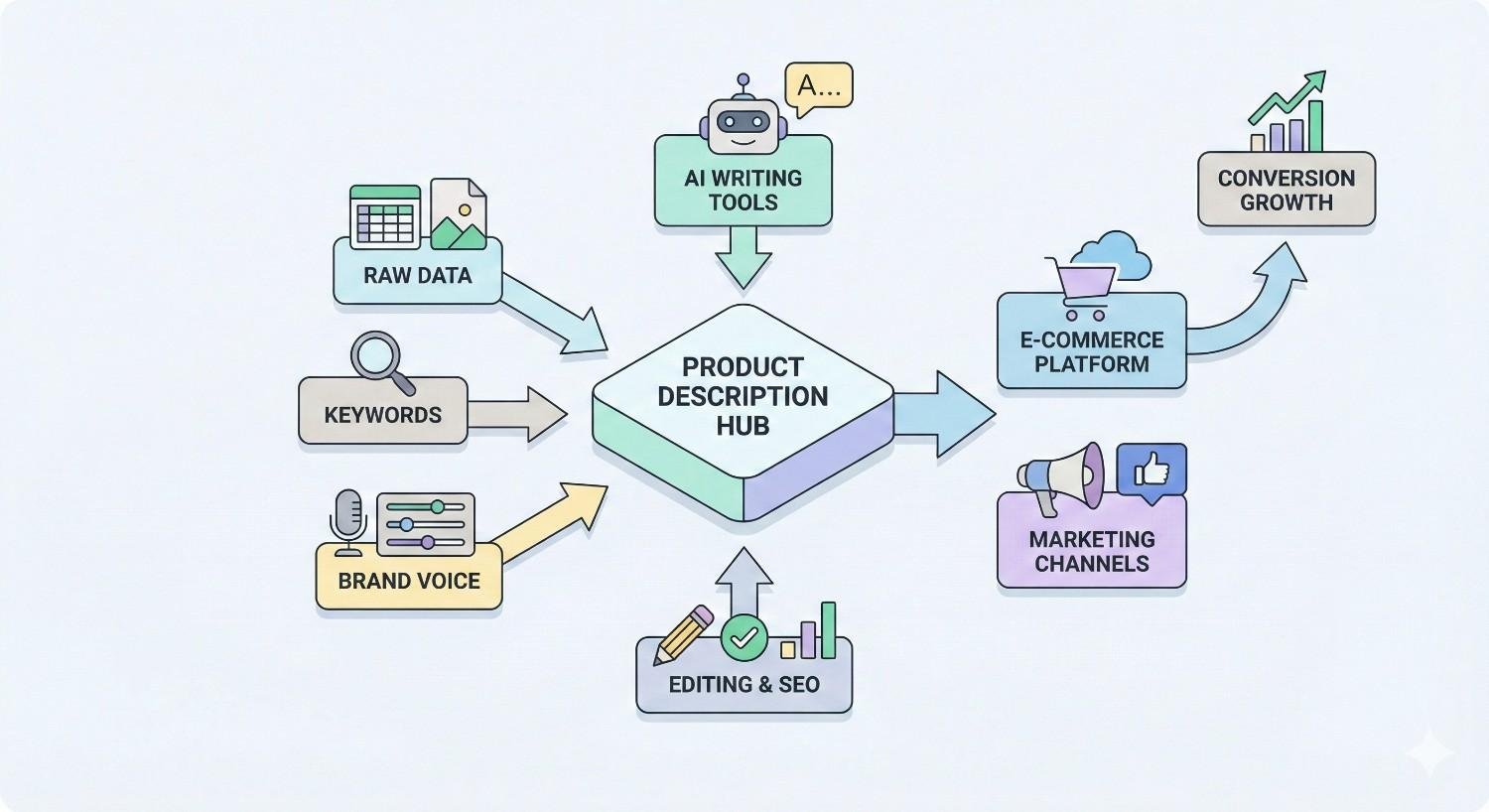
Tools and Resources for Writing Product Descriptions
The right tools increase efficiency and quality. Build a toolkit that supports your description writing workflow.
AI Writing Assistants and Copywriting Tools
AI tools like ChatGPT, Jasper, and Copy.ai accelerate first draft creation. They generate starting points that human writers refine and improve.
Use AI for ideation and variation generation. Create multiple headline options or benefit statements quickly, then select and polish the best.
Never publish AI output without human review. AI-generated content requires editing for accuracy, brand voice, and persuasive impact.
SEO and Keyword Research Tools
Keyword research tools inform optimization strategy. Google Keyword Planner provides search volume data. Ahrefs and Semrush offer competitive analysis and keyword suggestions.
Use these tools to identify target keywords before writing. Understanding search demand shapes content strategy and prioritization.
Monitor rankings after publishing. Track which descriptions perform well and analyze what makes them successful.
Readability and Grammar Checkers
Tools like Grammarly and Hemingway Editor catch errors and improve clarity. They identify passive voice, complex sentences, and grammatical mistakes.
Run every description through readability analysis. Aim for reading levels appropriate to your audience. Most consumer content should target 8th-grade reading level or below.
Don’t rely solely on automated tools. They miss context-dependent issues and sometimes suggest incorrect changes. Human judgment remains essential.
Product Description Templates and Swipe Files
Templates accelerate writing by providing proven structures. Create templates for different product categories and description formats.
Build swipe files of excellent descriptions from any industry. Study what makes them effective and adapt techniques to your products.
Share templates across your team to ensure consistency. Documented frameworks help multiple writers produce cohesive content.
How to Scale Product Description Writing
Large catalogs require systematic approaches to maintain quality while increasing output. Scale intelligently without sacrificing effectiveness.
Creating Style Guides and Brand Voice Documents
Document your brand voice, tone, and writing standards. Clear guidelines enable multiple writers to produce consistent content.
Include specific examples of preferred and avoided language. Show rather than just tell. Concrete examples clarify abstract guidelines.
Update style guides as your brand evolves. Living documents that reflect current standards serve teams better than outdated references.
Building Description Templates by Product Category
Create category-specific templates that capture required information and proven structures. Templates reduce decision fatigue and ensure completeness.
Include prompts for category-relevant details. Apparel templates prompt for fit and materials. Electronics templates prompt for specifications and compatibility.
Balance structure with flexibility. Templates should guide without constraining creativity or forcing awkward content.
Outsourcing vs. In-House Writing
Both approaches have merits depending on your situation. In-house writers understand your brand deeply but have limited capacity. Outsourced writers scale quickly but require more oversight.
Hybrid models often work best. Keep strategic content in-house while outsourcing volume production. Maintain quality through clear briefs and review processes.
Evaluate writers based on results, not just output. Descriptions that convert justify higher investment than cheap content that underperforms.
Using AI for Bulk Product Descriptions
AI tools enable rapid generation of description drafts at scale. Feed product data and receive initial content for human refinement.
Establish quality control processes for AI-assisted content. Every piece needs human review for accuracy, brand alignment, and persuasive effectiveness.
Use AI to augment human writers, not replace them. The combination of AI efficiency and human judgment produces better results than either alone.
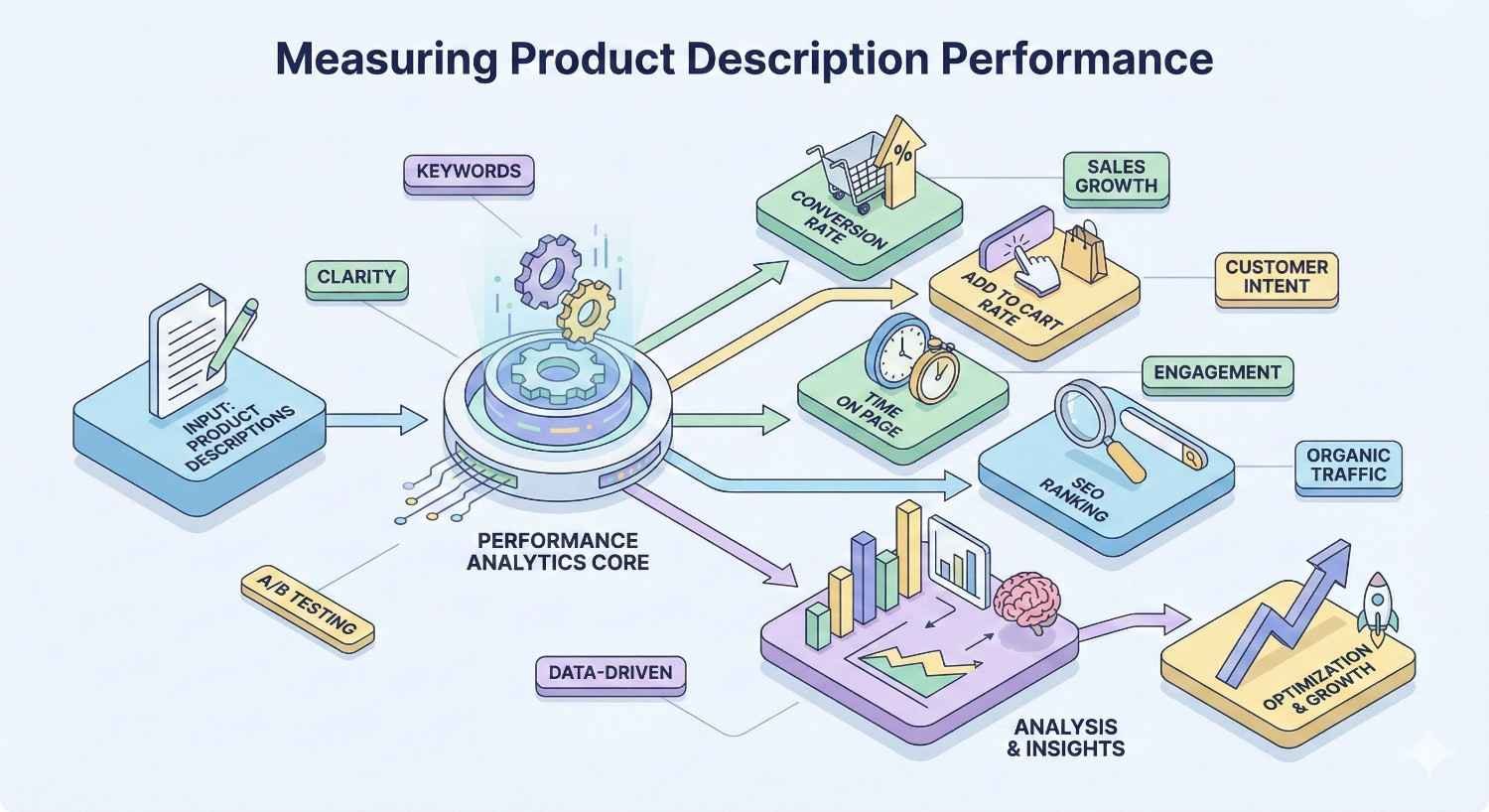
Measuring Product Description Performance
Data-driven optimization improves results over time. Track the right metrics and act on insights.
Key Metrics to Track (Conversion Rate, Bounce Rate, Time on Page)
Conversion rate measures how effectively descriptions drive purchases. Track this metric at the product level to identify high and low performers.
Bounce rate indicates whether descriptions meet visitor expectations. High bounce rates suggest misalignment between search intent and page content.
Time on page reveals engagement levels. Longer times generally indicate compelling content, though context matters. Quick purchases aren’t necessarily bad.
A/B Testing Product Descriptions
Test different description versions to identify what resonates with your audience. Change one element at a time to isolate impact.
Test headlines, benefit statements, formats, and calls-to-action. Small changes sometimes produce significant conversion improvements.
Run tests long enough to achieve statistical significance. Premature conclusions based on insufficient data lead to incorrect optimizations.
Iterating Based on Customer Feedback
Customer questions reveal description gaps. If support repeatedly answers the same questions, add that information to descriptions.
Reviews highlight what customers value and what disappoints them. Use this feedback to emphasize strengths and address concerns proactively.
Return reasons identify description failures. Products returned because they didn’t match expectations indicate description accuracy problems.
Conclusion
Product descriptions represent one of the highest-leverage opportunities in e-commerce and digital marketing. Well-crafted copy improves search rankings, increases conversion rates, and builds brand perception simultaneously.
The principles in this guide apply whether you’re writing your first description or optimizing thousands. Know your customer, differentiate your products, balance features with benefits, and optimize for both humans and search engines.
At White Label SEO Service, we help businesses create product descriptions that rank and convert. Our team combines copywriting expertise with SEO strategy to deliver content that drives measurable results. Contact us to discuss how we can support your product content needs.
Frequently Asked Questions
How long should a product description be?
Optimal length depends on product complexity and purchase consideration level. Simple, low-cost items need 50-100 words. Complex or expensive products benefit from 300+ words that address all buyer questions and objections.
Can I use the same description on multiple platforms?
Using identical descriptions across platforms creates duplicate content issues that can harm SEO. Write unique versions for your website, Amazon, and other marketplaces. Adapt core messaging while maintaining distinct content for each channel.
How often should I update product descriptions?
Review descriptions quarterly at minimum. Update immediately when products change, customer feedback reveals gaps, or performance data indicates problems. Seasonal products may need more frequent refreshes.
Do product descriptions really affect SEO?
Absolutely. Unique, keyword-optimized descriptions help search engines understand and rank your products. Sites with original descriptions consistently outperform those using manufacturer copy or thin content.
Should I include pricing in product descriptions?
Generally, keep pricing separate from description copy since prices change frequently. However, mentioning value propositions like “premium quality at an accessible price point” can be effective without stating specific numbers.
What’s the biggest mistake in product description writing?
Copying manufacturer descriptions is the most damaging mistake. It creates duplicate content that hurts SEO while failing to differentiate your brand or connect with your specific audience.
How do I write descriptions for products I haven’t used?
Research extensively through customer reviews, competitor analysis, and manufacturer materials. Interview people who have used the product. Focus on documented benefits and verified specifications rather than making claims you cannot support.