
Professional SEO services deliver measurable organic growth through technical optimization, content strategy, and authority building, with most businesses seeing significant results within 6 to 12 months of consistent implementation. Understanding what these services include, how much they cost, and what separates legitimate providers from scams is essential for any business investing in search visibility.
This guide breaks down every component of professional SEO in 2026, from technical foundations and pricing models to provider selection and ROI measurement. Whether you’re a startup exploring SEO for the first time or an established company evaluating your current strategy, you’ll find actionable frameworks to make informed decisions.
What Are Professional SEO Services?
Definition and Core Concepts
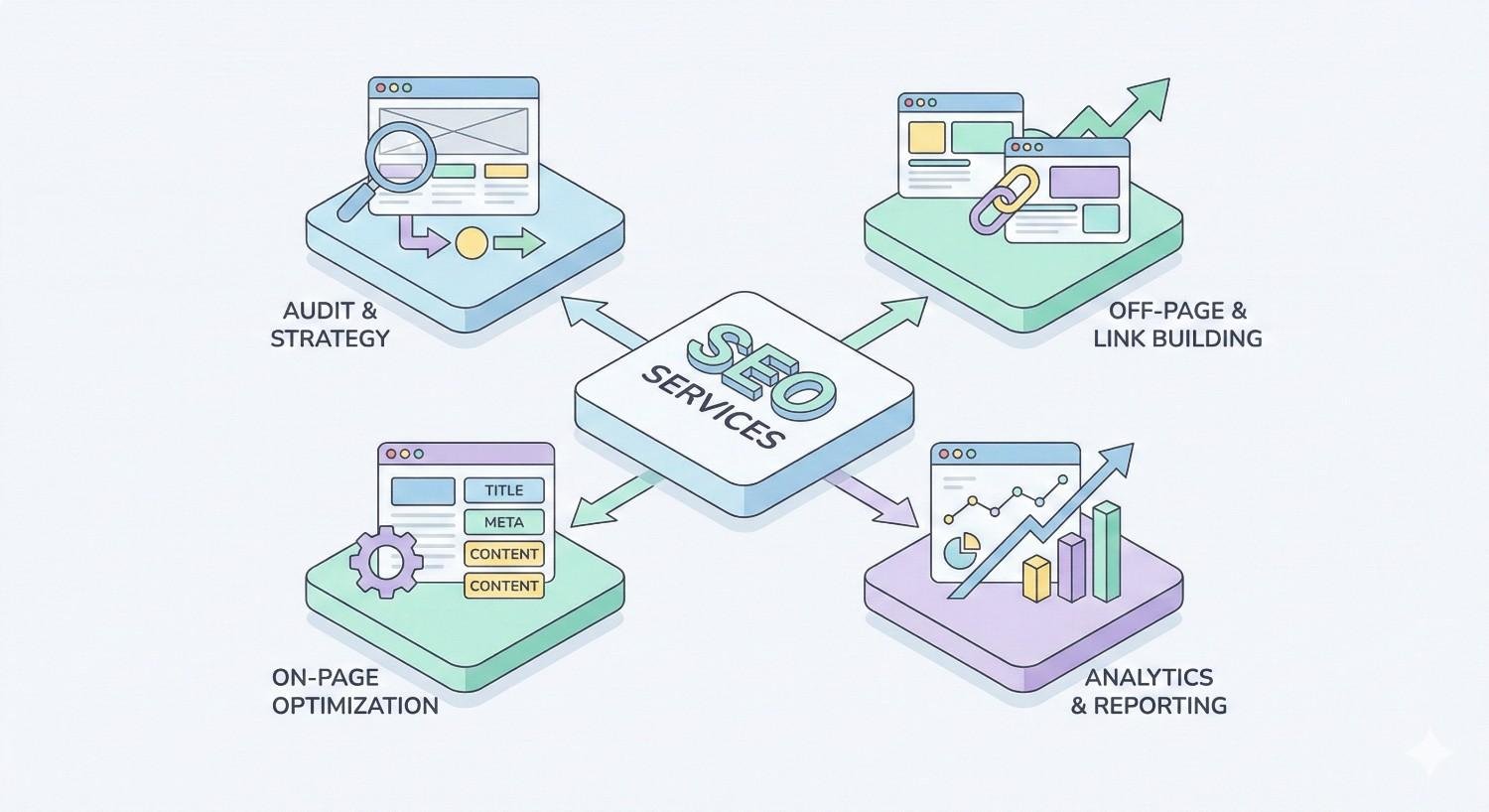
Professional SEO services encompass the strategic activities that improve a website’s visibility in organic search results. These services combine technical website optimization, content development, and off-site authority building to help businesses rank higher for relevant search queries.
At its core, SEO is about aligning your website with how search engines evaluate and rank content. Google’s algorithm considers hundreds of ranking factors, from page load speed and mobile usability to content relevance and backlink quality. Professional SEO providers systematically address these factors to improve your competitive position.
The fundamental components include technical SEO, which ensures search engines can crawl and index your site effectively. On-page SEO optimizes individual pages for target keywords and user experience. Off-page SEO builds external signals like backlinks and brand mentions that demonstrate authority. Content marketing creates valuable resources that attract both users and links.
How SEO Services Have Evolved (2020–2026)
The SEO landscape has transformed dramatically since 2020. What once focused primarily on keyword density and link quantity now demands sophisticated strategies addressing user intent, content quality, and technical performance.
Google’s introduction of Core Web Vitals in 2021 made page experience a direct ranking factor. Websites now compete on loading speed, visual stability, and interactivity metrics that directly impact user satisfaction. This shift forced SEO providers to develop deeper technical capabilities.
The rise of AI-generated content created new challenges and opportunities. Google’s helpful content updates penalized low-quality, mass-produced content while rewarding genuinely useful resources. Professional SEO services adapted by emphasizing E-E-A-T signals, demonstrating experience, expertise, authoritativeness, and trustworthiness through content quality and author credentials.
Search behavior itself evolved significantly. Voice search, visual search, and zero-click results changed how users interact with search engines. Modern SEO strategies must optimize for featured snippets, knowledge panels, and AI-generated overviews that answer queries directly on the results page.
Why Businesses Need SEO in 2026
Organic search remains the dominant source of website traffic for most industries. BrightEdge research indicates that organic search drives over 53% of all trackable website traffic, making it the largest digital channel for most businesses.
The economics of SEO become increasingly compelling over time. Unlike paid advertising, where traffic stops when spending stops, SEO investments compound. Content and authority built today continue generating traffic for years, reducing customer acquisition costs as your organic presence strengthens.
Competition for organic visibility intensifies annually. Businesses that delay SEO investment find themselves competing against established competitors with years of accumulated authority. Starting now, even with modest budgets, positions your business to capture market share as your domain authority grows.
The integration of AI into search results makes professional optimization more important, not less. Google’s AI Overviews and similar features pull information from authoritative sources. Websites optimized for these systems gain visibility in new formats that less sophisticated competitors cannot access.

The Complete Breakdown of SEO Service Components
Technical SEO Services
Technical SEO creates the foundation that enables all other optimization efforts. Without proper technical implementation, even excellent content struggles to rank because search engines cannot effectively crawl, index, or evaluate your pages.
Core Web Vitals Optimization
Core Web Vitals measure real-world user experience through three specific metrics. Largest Contentful Paint (LCP) tracks loading performance, measuring how quickly the main content becomes visible. First Input Delay (FID) and its successor Interaction to Next Paint (INP) measure interactivity, tracking how quickly pages respond to user actions. Cumulative Layout Shift (CLS) measures visual stability, penalizing pages where elements move unexpectedly during loading.
Professional SEO services optimize these metrics through image compression, code minification, server response improvements, and layout stabilization techniques. Achieving “good” scores across all three metrics provides a ranking advantage and improves conversion rates through better user experience.
Mobile-First Indexing
Google now uses the mobile version of websites as the primary basis for indexing and ranking. This means your mobile site experience directly determines your search visibility, regardless of how well your desktop version performs.
Mobile optimization extends beyond responsive design. Professional services evaluate tap target sizing, font readability, content parity between mobile and desktop versions, and mobile-specific performance issues. Sites that provide degraded mobile experiences face ranking penalties even for desktop searches.

Site Architecture & Crawlability
How your website is structured determines how effectively search engines discover and understand your content. Logical URL hierarchies, internal linking patterns, and XML sitemaps guide crawlers through your site efficiently.
Professional technical SEO includes crawl budget optimization for larger sites, ensuring search engines prioritize your most important pages. This involves identifying and fixing crawl traps, managing pagination, handling duplicate content, and implementing proper canonical tags.
Schema Markup Implementation
Structured data helps search engines understand the context and relationships within your content. Schema markup enables rich results like review stars, FAQ dropdowns, product information, and event details that increase click-through rates from search results.
Implementation requires identifying appropriate schema types for your content, correctly formatting the markup, and validating implementation through Google’s testing tools. Professional services maintain schema as your content evolves and new markup types become available.
On-Page SEO Services
On-page optimization ensures individual pages effectively target relevant keywords while providing excellent user experiences. This component directly influences how search engines evaluate your content’s relevance and quality.
Content Optimization
Content optimization aligns existing pages with search intent and ranking factors. This includes optimizing title tags, meta descriptions, header structures, and body content for target keywords while maintaining natural readability.
Professional optimization goes beyond keyword placement. It evaluates content comprehensiveness, ensuring pages thoroughly address user questions. It identifies content gaps where competitors provide information you don’t. It improves content structure for both users and search engines through strategic formatting.
Keyword Strategy
Effective keyword strategy identifies the search terms that drive qualified traffic to your business. This involves analyzing search volume, competition levels, and commercial intent to prioritize opportunities with the best ROI potential.
Modern keyword research considers semantic relationships and topic clusters rather than isolated keywords. Professional services map keyword opportunities to your content architecture, identifying which pages should target which terms and where new content is needed.
Internal Linking
Internal links distribute authority throughout your website and help search engines understand content relationships. Strategic internal linking improves crawlability, establishes topical relevance, and guides users to related content.
Professional internal linking audits identify orphaned pages lacking internal links, over-optimized anchor text patterns, and opportunities to strengthen important pages through additional internal references. This often-overlooked element significantly impacts how search engines evaluate your site structure.
User Experience Signals
Search engines increasingly evaluate user behavior signals when ranking content. Metrics like time on page, bounce rate, and pages per session indicate whether your content satisfies user intent.
Optimization for user experience includes improving content readability, adding visual elements that increase engagement, structuring content for easy scanning, and ensuring pages load quickly. These improvements benefit both rankings and conversion rates.
Off-Page SEO Services
Off-page SEO builds external signals that demonstrate your website’s authority and trustworthiness. These factors often determine competitive rankings when on-page optimization is similar across competitors.
Link Building Strategies
Backlinks from authoritative websites remain among the strongest ranking factors. Quality link building focuses on earning links from relevant, trustworthy sources rather than accumulating large quantities of low-quality links.
Professional link building strategies include digital PR, guest posting on industry publications, resource link building, broken link reclamation, and relationship-based outreach. The emphasis is on links that drive referral traffic and demonstrate genuine editorial endorsement.
Digital PR
Digital PR combines traditional public relations with SEO objectives. Creating newsworthy content, data studies, and expert commentary generates media coverage that includes valuable backlinks from high-authority news sites.
This approach produces links that manual outreach cannot achieve. Major publications rarely respond to link requests but regularly link to genuinely newsworthy content. Professional services develop PR-worthy assets and manage media relationships to maximize coverage.
Brand Mention Optimization
Unlinked brand mentions represent untapped link opportunities. When websites mention your brand without linking, professional services identify these mentions and conduct outreach to convert them into backlinks.
Beyond link acquisition, brand mention monitoring tracks your online reputation and identifies partnership opportunities. Understanding where and how your brand appears online informs broader marketing strategy.
Content Marketing Services
Content marketing creates the assets that attract organic traffic and earn backlinks. Without consistent content development, SEO strategies eventually plateau as competitors publish more comprehensive resources.
Content Strategy Development
Content strategy aligns content creation with business objectives and keyword opportunities. This involves identifying content gaps, prioritizing topics by potential impact, and planning content calendars that systematically build topical authority.
Professional content strategy considers the full customer journey, creating content for awareness, consideration, and decision stages. It maps content to keyword clusters, ensuring comprehensive coverage of topics important to your audience.
Content Creation & Optimization
Content creation produces the articles, guides, tools, and resources that rank for target keywords. Quality content requires subject matter expertise, thorough research, and optimization for both users and search engines.
Professional content services include writer management, editorial oversight, fact-checking, and SEO optimization. The goal is content that genuinely serves user needs while incorporating technical elements that improve ranking potential.
Content Distribution
Creating excellent content is insufficient without distribution strategies that generate initial visibility and links. Content distribution includes social promotion, email marketing, influencer outreach, and syndication to relevant platforms.
Effective distribution amplifies content reach, generating the engagement signals and backlinks that improve organic rankings. Professional services develop distribution playbooks tailored to your audience and content types.
Local SEO Services
Local SEO optimizes your presence for location-based searches. For businesses serving specific geographic areas, local optimization often delivers the highest ROI by connecting you with nearby customers actively seeking your services.
Google Business Profile Optimization
Your Google Business Profile directly influences local pack rankings and provides information to potential customers. Optimization includes accurate business information, strategic category selection, compelling descriptions, and regular posting.
Professional local SEO maintains profile completeness, responds to questions, and optimizes for local keywords. Profile performance tracking identifies opportunities to improve visibility in local search results.
Local Citation Building
Citations are mentions of your business name, address, and phone number across online directories. Consistent citations across authoritative directories strengthen local ranking signals.
Professional citation building identifies relevant directories for your industry, ensures NAP consistency across all listings, and monitors for inaccurate citations that could harm rankings. This foundational work supports all other local SEO efforts.
Review Management
Reviews influence both local rankings and customer decisions. Professional review management includes strategies for generating positive reviews, responding appropriately to all feedback, and monitoring review platforms for reputation issues.
Effective review management increases review volume and average ratings while demonstrating customer service quality to potential customers researching your business.
Types of Professional SEO Services
Full-Service SEO Agencies
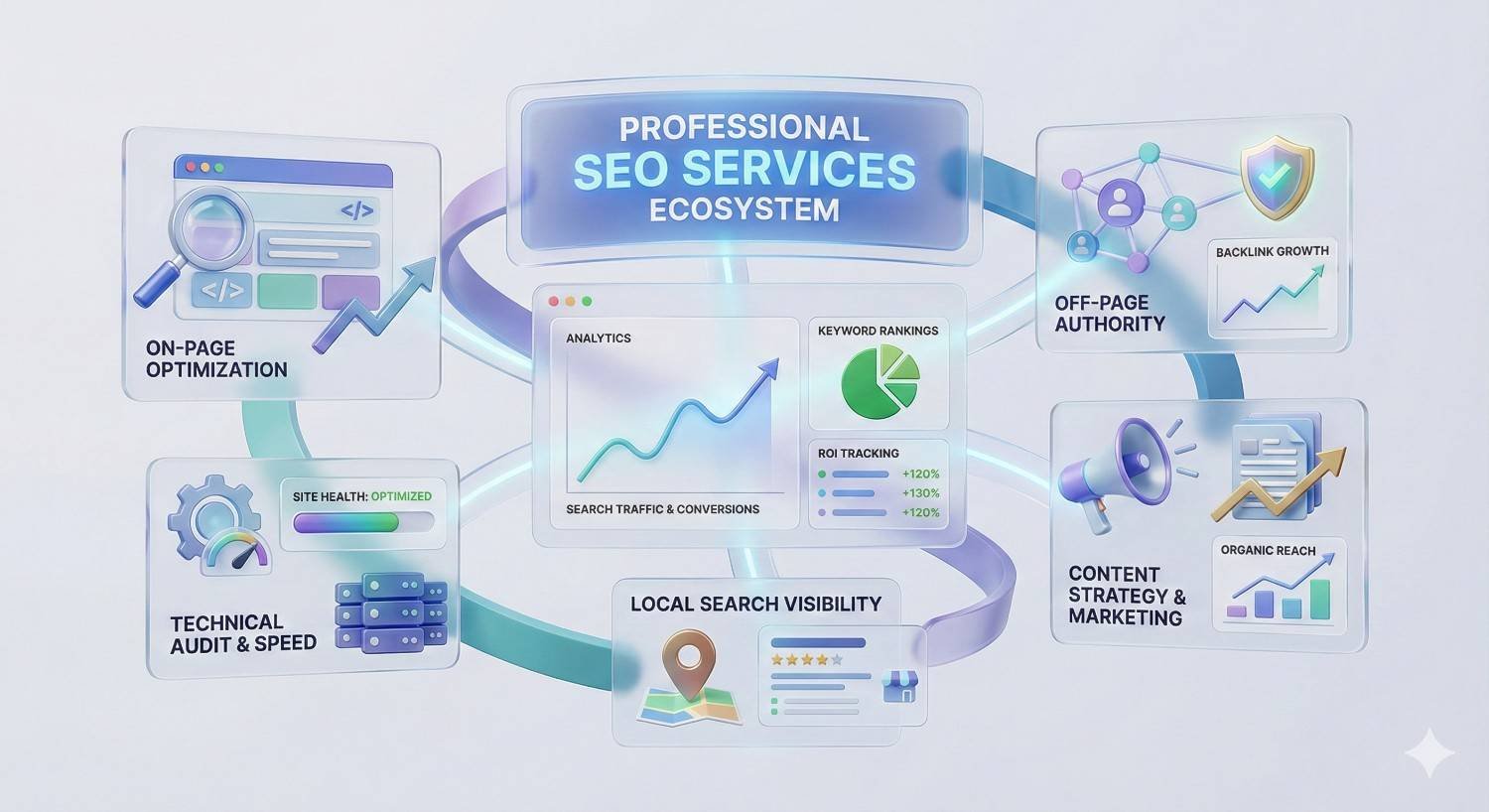
Full-service agencies provide comprehensive SEO management, handling all components from technical optimization to content creation and link building. These agencies typically employ specialists across different SEO disciplines, offering integrated strategies.
This model suits businesses wanting to outsource SEO entirely without managing multiple vendors. Full-service agencies coordinate all activities, provide unified reporting, and take responsibility for overall results. The trade-off is typically higher costs and less specialized expertise in any single area.
Specialized SEO Consultants
Specialized consultants focus on specific SEO components like technical audits, link building, or content strategy. These experts offer deep knowledge in their specialty areas, often exceeding what generalist agencies provide.
Businesses with internal marketing teams often engage specialists to fill specific capability gaps. A company might hire a technical SEO consultant for an audit while handling content internally. This approach requires more coordination but can deliver superior results in priority areas.
Enterprise SEO Solutions
Enterprise SEO addresses the unique challenges of large websites with thousands or millions of pages. These solutions emphasize automation, scalability, and integration with enterprise technology stacks.
Enterprise providers offer specialized tools for managing SEO at scale, including automated auditing, change monitoring, and cross-team workflow management. They understand the organizational complexities of implementing SEO recommendations across large companies with multiple stakeholders.
E-commerce SEO Services
E-commerce SEO specializes in optimizing online stores with product catalogs, category structures, and transactional intent keywords. These services address unique challenges like product page optimization, faceted navigation, and seasonal inventory changes.
E-commerce specialists understand platform-specific considerations for Shopify, WooCommerce, Magento, and other systems. They optimize for product-focused search features like Google Shopping and address technical issues common to e-commerce sites.
Local SEO Services
Local SEO services focus exclusively on improving visibility for location-based searches. These specialists understand local ranking factors, Google Business Profile optimization, and multi-location management.
Businesses serving specific geographic areas often achieve better results with local specialists than generalist agencies. Local SEO requires different strategies than national campaigns, and specialists stay current with local algorithm updates and best practices.
International SEO Services
International SEO optimizes websites targeting multiple countries or languages. This specialty addresses hreflang implementation, country-specific domain strategies, and localization beyond simple translation.
International SEO requires understanding how search engines handle multilingual content and how user behavior varies across markets. Specialists help businesses expand globally without creating technical issues that harm performance in any market.

2026 SEO Trends Shaping Professional Services
AI-Powered SEO Strategies
Artificial intelligence transforms both how search engines work and how SEO professionals optimize for them. Google’s AI systems better understand content quality, user intent, and semantic relationships than previous algorithms.
Professional SEO services now use AI tools for content optimization, competitive analysis, and pattern recognition across large datasets. However, the most effective strategies combine AI capabilities with human expertise, using technology to scale analysis while applying strategic judgment to recommendations.
AI content generation requires careful management. Search engines can identify and devalue low-quality AI content, but thoughtfully edited AI-assisted content can improve production efficiency. Professional services develop workflows that leverage AI benefits while maintaining quality standards.
Voice Search Optimization
Voice search continues growing as smart speakers and voice assistants become ubiquitous. Voice queries differ from typed searches, typically using conversational language and question formats.
Optimizing for voice search involves targeting featured snippets, which voice assistants often read as answers. Content structured around natural questions with concise, direct answers performs well for voice queries. Professional services identify voice search opportunities within your keyword strategy.

Visual Search & Image SEO
Visual search allows users to search using images rather than text. Google Lens and similar tools identify products, landmarks, and information from photos, creating new optimization opportunities.
Image SEO includes proper file naming, alt text optimization, and structured data for images. E-commerce businesses particularly benefit from visual search optimization, as users can photograph products to find purchasing options. Professional services ensure images are optimized for both traditional and visual search.
E-E-A-T and Authority Building
Experience, Expertise, Authoritativeness, and Trustworthiness increasingly determine rankings, especially for topics affecting health, finances, or safety. Google’s quality rater guidelines emphasize these factors, and algorithm updates reward sites demonstrating genuine expertise.
Professional SEO services build E-E-A-T through author credentials, expert contributions, authoritative citations, and transparent business information. This involves both on-page signals and off-page reputation building through media coverage and industry recognition.
Zero-Click Search Optimization
Zero-click searches, where users find answers directly on the results page without clicking through to websites, now represent a significant portion of all searches. Featured snippets, knowledge panels, and AI overviews provide information without requiring site visits.
Rather than viewing zero-click results as threats, professional services optimize for these features to maximize brand visibility. Appearing in featured snippets builds authority even when users don’t click, and some featured snippet appearances do drive significant traffic.
Benefits of Hiring Professional SEO Services
Expertise and Industry Knowledge
SEO complexity exceeds what most businesses can effectively manage internally. Algorithm updates, technical requirements, and competitive dynamics require specialized knowledge that takes years to develop.
Professional providers bring experience across multiple clients and industries, recognizing patterns and opportunities that internal teams might miss. They stay current with industry changes through continuous education, testing, and professional networks.
Access to Premium Tools and Technology
Enterprise SEO tools cost thousands of dollars monthly, making them impractical for individual businesses. Professional services spread these costs across clients, providing access to capabilities otherwise unavailable.
Tools like Ahrefs, Semrush, Screaming Frog, and specialized technical auditing platforms enable analysis impossible with free alternatives. Professional providers also develop proprietary processes and templates that improve efficiency and consistency.
Time and Resource Savings
Effective SEO requires consistent effort across multiple disciplines. Most businesses lack the bandwidth to maintain SEO activities while managing core operations.
Outsourcing SEO frees internal resources for activities where your team adds unique value. Rather than developing SEO expertise internally, you leverage specialists while focusing on product development, customer service, and other priorities.
Scalable, Sustainable Results
Professional SEO builds assets that appreciate over time. Content, backlinks, and technical improvements continue generating value long after initial investment. This contrasts with advertising, where results stop immediately when spending stops.
Sustainable SEO strategies avoid shortcuts that risk penalties. Professional providers understand the difference between effective tactics and risky manipulation, protecting your long-term organic visibility.
Staying Ahead of Algorithm Updates
Google updates its algorithm thousands of times annually, with major updates potentially reshuffling rankings significantly. Businesses managing SEO internally often react to updates after rankings drop.
Professional services monitor algorithm changes proactively, adjusting strategies before updates impact performance. Their experience across multiple clients provides early warning of ranking shifts and faster identification of effective responses.
SEO Services Pricing Guide for 2026
Common Pricing Models Explained
Monthly Retainers
Monthly retainers provide ongoing SEO services for a fixed monthly fee. This model suits businesses wanting consistent optimization without managing project-by-project engagements.
Retainer arrangements typically include a defined scope of services, regular reporting, and strategic guidance. Pricing varies based on scope, with basic packages starting around $500 monthly and comprehensive enterprise retainers exceeding $25,000 monthly.
Project-Based Pricing
Project-based pricing applies to defined deliverables like technical audits, content strategies, or site migrations. You pay a fixed price for specific outcomes rather than ongoing services.
This model works well for businesses with internal SEO capabilities needing specialized expertise for specific initiatives. Project costs vary widely based on scope, from $1,000 for basic audits to $50,000+ for complex migrations.
Hourly Consulting Rates
Hourly consulting provides flexible access to SEO expertise without ongoing commitments. Consultants typically charge between $100 and $500 hourly depending on experience and specialization.
This model suits businesses needing occasional guidance rather than full-service management. It’s also common for training engagements where consultants educate internal teams.
Performance-Based Pricing
Performance-based models tie compensation to results, typically rankings or traffic improvements. While appealing in theory, these arrangements often create misaligned incentives.
Providers may focus on easily achievable metrics rather than business impact, or use risky tactics to hit targets quickly. Most reputable agencies avoid pure performance-based pricing, though some incorporate performance bonuses within retainer structures.
Average Costs by Business Size
Small Business SEO ($500–$2,000/month)
Small business SEO packages focus on foundational optimization and local visibility. At this investment level, expect basic technical fixes, Google Business Profile optimization, limited content creation, and local citation building.
These packages suit businesses with modest competition and local focus. National competition or complex technical requirements typically exceed what’s achievable at this price point.
Mid-Market SEO ($2,000–$10,000/month)
Mid-market SEO provides comprehensive optimization for growing businesses. This investment level supports ongoing content creation, active link building, technical optimization, and strategic guidance.
Businesses at this level can compete for moderately competitive keywords and build meaningful organic traffic. The specific scope varies by provider, but expect dedicated account management and regular strategic reviews.
Enterprise SEO ($10,000+/month)
Enterprise SEO addresses complex requirements of large organizations. These engagements include dedicated teams, custom tool development, cross-departmental coordination, and sophisticated reporting.
Enterprise pricing reflects the scale and complexity involved. Large e-commerce sites, multi-location businesses, and companies in highly competitive industries typically require enterprise-level investment.
Factors That Influence SEO Pricing
Several factors affect SEO pricing beyond business size. Competition intensity significantly impacts required investment, as highly competitive industries demand more aggressive strategies.
Current website condition matters considerably. Sites with significant technical debt or penalty history require more remediation work before growth-focused activities begin. Geographic scope affects pricing, with national campaigns requiring more resources than local optimization.
Industry specialization can increase costs when providers need specific expertise. Healthcare, legal, and financial services SEO requires understanding compliance requirements and E-E-A-T considerations unique to these sectors.
How to Choose the Right SEO Service Provider
Define Your SEO Goals First
Before evaluating providers, clarify what success looks like for your business. Are you prioritizing traffic growth, lead generation, e-commerce revenue, or brand visibility? Different goals require different strategies and provider capabilities.
Establish baseline metrics and realistic targets. Understanding your current organic performance helps evaluate provider proposals and set appropriate expectations. Vague goals like “improve SEO” make it impossible to assess provider fit or measure success.
Evaluate Experience and Track Record
Provider experience should align with your specific needs. Ask about experience in your industry, with businesses your size, and with your specific challenges. A provider excellent for local service businesses may lack enterprise e-commerce expertise.
Look for longevity and stability. SEO requires long-term commitment, and providers who’ve operated successfully for years demonstrate sustainable business practices. Ask about team tenure and how they handle staff transitions.
Review Case Studies and Results
Request case studies demonstrating results for similar businesses. Effective case studies include specific metrics, timeframes, and context about the competitive environment.
Be skeptical of case studies showing only rankings without business impact. Rankings for irrelevant keywords don’t generate value. Look for evidence of traffic growth, lead generation, or revenue impact from SEO efforts.
Assess Their SEO Process and Methodology
Understanding how providers work reveals their sophistication and fit with your organization. Ask about their audit process, strategy development approach, and implementation methodology.
Quality providers explain their process clearly without revealing proprietary details. They should articulate how they prioritize activities, handle technical issues, and adapt strategies based on results. Vague answers suggest underdeveloped processes.
Check Communication and Reporting Practices
SEO success requires ongoing communication between provider and client. Understand reporting frequency, formats, and what metrics they track. Ask about account management structure and who your primary contact will be.
Request sample reports to evaluate clarity and relevance. Reports should connect activities to results and provide actionable insights, not just data dumps. Regular strategic discussions should supplement automated reporting.
Understand Contract Terms and Deliverables
Review contracts carefully before signing. Understand minimum commitment periods, cancellation terms, and what happens to work product if you end the relationship.
Ensure deliverables are clearly defined. Vague promises like “ongoing optimization” create disputes later. Specific deliverables like “4 blog posts monthly” or “technical audit within 30 days” establish clear expectations.
Red Flags and SEO Scams to Avoid
Guaranteed #1 Rankings
No legitimate provider guarantees specific rankings. Google’s algorithm considers hundreds of factors, many outside any provider’s control. Competitors’ actions, algorithm updates, and search behavior changes all affect rankings unpredictably.
Providers offering ranking guarantees either don’t understand SEO or are willing to deceive you. Either disqualifies them from consideration. Reputable providers discuss realistic expectations and focus on metrics they can influence.
Secret or Proprietary Techniques
SEO best practices are well-documented and widely understood. Providers claiming secret techniques that competitors don’t know are either exaggerating or using risky tactics they don’t want to disclose.
Legitimate providers explain their methodology transparently. They may have proprietary tools or efficient processes, but the underlying strategies should align with industry best practices. Secrecy often hides black-hat tactics that risk penalties.
Extremely Low Pricing
SEO requires significant expertise and ongoing effort. Providers offering comprehensive services at prices far below market rates cannot deliver quality work profitably.
Low-cost providers typically cut corners through automated link schemes, spun content, or minimal actual work. These shortcuts may produce short-term results but risk long-term penalties. Quality SEO requires investment commensurate with the value it delivers.
Lack of Transparency
Reputable providers share what they’re doing and why. They provide access to analytics, explain their activities, and welcome questions about their approach.
Providers who won’t explain their tactics, share reporting access, or answer detailed questions may be hiding problematic practices. Transparency builds trust and enables collaboration that improves results.
Black-Hat SEO Practices
Black-hat SEO uses tactics that violate search engine guidelines to manipulate rankings. These include link schemes, cloaking, keyword stuffing, and private blog networks.
While black-hat tactics sometimes produce short-term gains, they risk severe penalties including complete removal from search results. Recovery from penalties takes months or years and may never fully restore previous performance. No legitimate business objective justifies this risk.
The Professional SEO Process: What to Expect
Phase 1: Discovery and SEO Audit
Professional engagements begin with comprehensive discovery. Providers analyze your current organic performance, technical infrastructure, content assets, and competitive landscape.
Technical audits identify issues preventing optimal crawling and indexing. Content audits evaluate existing assets and identify gaps. Competitive analysis reveals opportunities and benchmarks for success. This phase typically takes two to four weeks depending on site complexity.
Phase 2: Strategy Development
Audit findings inform strategy development. Providers prioritize opportunities based on potential impact and required resources, creating roadmaps that sequence activities logically.
Strategy documents should include specific recommendations, timelines, and success metrics. You should understand what will be done, when, and how success will be measured. This phase involves collaboration to align SEO strategy with business objectives.
Phase 3: Implementation
Implementation executes the strategy through technical fixes, content creation, and link building activities. The pace depends on your approval processes, development resources, and provider capacity.
Effective implementation requires coordination between provider and client. Technical changes may need developer involvement. Content may require subject matter expert input. Clear communication and defined responsibilities keep implementation on track.
Phase 4: Monitoring and Optimization
SEO requires ongoing monitoring and adjustment. Providers track rankings, traffic, and conversions, identifying what’s working and what needs refinement.
Regular optimization responds to performance data and competitive changes. Content may need updating as search intent evolves. Technical issues may emerge as your site changes. Continuous improvement distinguishes professional SEO from one-time projects.
Phase 5: Reporting and Refinement
Regular reporting communicates progress and informs strategic decisions. Reports should connect activities to outcomes, showing how SEO efforts impact business metrics.
Reporting cadence varies by engagement, but monthly reports are standard. Quarterly strategic reviews assess overall direction and adjust priorities based on results and changing business needs.
SEO Results Timeline: Setting Realistic Expectations
Months 1–3: Foundation Building
Early months focus on technical fixes, strategy development, and initial content creation. Visible ranking improvements are unlikely during this phase, though you may see increased crawling activity and indexing improvements.
This foundation-building phase is essential but often frustrating for businesses expecting immediate results. Trust the process while monitoring leading indicators like indexed pages and crawl statistics.
Months 4–6: Early Momentum
Initial ranking improvements typically appear during months four through six. Long-tail keywords and less competitive terms show movement first, followed gradually by more competitive targets.
Traffic increases may be modest initially but demonstrate that strategies are working. This phase validates the approach and builds confidence for continued investment.
Months 6–12: Significant Growth
Months six through twelve typically produce meaningful traffic growth. Accumulated content, backlinks, and technical improvements compound to drive substantial ranking improvements.
This phase often delivers the ROI that justifies SEO investment. Businesses see measurable increases in organic traffic, leads, and revenue attributable to SEO efforts.
Year 2+: Compounding Returns
SEO benefits compound over time. Content continues ranking and generating traffic. Domain authority grows, making new content easier to rank. Competitive advantages widen as you build assets competitors must match.
Long-term SEO investment produces increasingly efficient returns. Customer acquisition costs decrease as organic traffic grows relative to investment. This compounding effect makes SEO one of the highest-ROI marketing channels over time.
Measuring SEO Service Success and ROI
Key Performance Indicators (KPIs)
Effective SEO measurement tracks multiple KPIs across different categories. Visibility metrics include rankings, impressions, and share of voice. Traffic metrics include organic sessions, new users, and pages per session. Conversion metrics include leads, sales, and revenue from organic traffic.
Select KPIs aligned with your business objectives. E-commerce businesses prioritize revenue and transactions. Lead generation businesses focus on form submissions and qualified leads. Brand awareness campaigns emphasize impressions and visibility.
SEO Reporting Best Practices
Quality reports connect activities to outcomes. They should show what was done, what changed, and what it means for your business. Avoid reports that simply dump data without interpretation.
Reports should include trend analysis showing progress over time, not just current snapshots. Competitive context helps interpret whether results are strong relative to market conditions. Actionable recommendations should accompany performance data.
Calculating SEO ROI
SEO ROI calculation requires attributing value to organic traffic. For e-commerce, this means tracking revenue from organic sessions. For lead generation, assign values to leads based on conversion rates and customer lifetime value.
Compare attributed value to SEO investment over appropriate timeframes. SEO ROI typically improves over time as initial investments continue generating returns. Calculate both monthly ROI and cumulative ROI to understand full value.
When to Adjust Your Strategy
Performance data should inform strategic adjustments. If certain content types outperform others, shift resources accordingly. If technical issues persist despite fixes, investigate root causes.
However, avoid overreacting to short-term fluctuations. Rankings vary naturally, and algorithm updates cause temporary volatility. Evaluate trends over quarters rather than weeks before making major strategic changes.
DIY SEO vs. Professional SEO Services
When DIY SEO Makes Sense
DIY SEO can work for businesses with limited budgets, low competition, and willingness to invest time learning. Local businesses in non-competitive markets may achieve adequate results through basic optimization and Google Business Profile management.
DIY also suits businesses with technical team members who can implement recommendations. If you have developers comfortable with technical SEO and marketers capable of content creation, you may only need strategic guidance rather than full-service management.
When to Hire Professionals
Professional services become necessary when competition intensifies, technical complexity increases, or internal resources are insufficient. Businesses competing for valuable keywords against established competitors rarely succeed with DIY approaches.
Consider professionals when SEO becomes a significant growth lever. If organic traffic could meaningfully impact revenue, the investment in professional services typically delivers positive ROI. The opportunity cost of suboptimal SEO often exceeds service costs.
Hybrid Approaches
Many businesses combine internal capabilities with external expertise. You might handle content creation internally while outsourcing technical SEO and link building. Or engage consultants for strategy while implementing recommendations with internal resources.
Hybrid approaches require clear role definition and coordination. Establish who owns which activities and how handoffs work. Regular communication prevents gaps and duplication.
Industry-Specific SEO Services
E-commerce SEO
E-commerce SEO optimizes product and category pages for transactional searches. Key considerations include product schema markup, faceted navigation management, and seasonal inventory optimization.
E-commerce sites face unique technical challenges from large product catalogs, dynamic content, and complex site architectures. Specialists understand platform-specific issues and optimization opportunities for Shopify, Magento, WooCommerce, and other systems.
SaaS and B2B SEO
SaaS and B2B SEO targets longer sales cycles with multiple decision-makers. Content strategies address different buyer personas and journey stages, from awareness through evaluation to purchase.
These businesses often compete for informational keywords that build authority and capture prospects early in their research. Integration with marketing automation and lead scoring systems connects SEO to revenue attribution.
Healthcare and Medical SEO
Healthcare SEO operates under strict E-E-A-T requirements. Google’s quality guidelines specifically address health content, requiring demonstrated medical expertise and accurate information.
Healthcare SEO specialists understand HIPAA considerations, medical content requirements, and reputation management for healthcare providers. They navigate the balance between optimization and compliance.
Legal SEO
Legal SEO combines local optimization for practice areas with content strategies addressing legal questions. Competition is intense in most legal markets, requiring sophisticated strategies.
Legal SEO specialists understand bar association advertising rules and ethical considerations. They develop content strategies that demonstrate expertise while complying with professional responsibility requirements.
Real Estate SEO
Real estate SEO targets location-specific searches with high commercial intent. Optimization includes property listings, neighborhood content, and agent profiles.
Real estate sites often integrate with MLS systems, creating technical considerations around duplicate content and dynamic listings. Specialists understand these platform integrations and optimize accordingly.
Local Service Business SEO
Local service businesses like plumbers, electricians, and contractors depend heavily on local search visibility. Google Business Profile optimization, review management, and local content drive results.
These businesses often compete in the local pack, where different ranking factors apply than organic results. Local SEO specialists understand these distinctions and optimize for both local pack and organic visibility.
Integrating SEO with Your Marketing Strategy
SEO and Content Marketing
SEO and content marketing are deeply interconnected. SEO identifies what content to create through keyword research. Content marketing produces the assets that rank and attract links.
Integrated strategies align content calendars with keyword opportunities. Content serves both SEO objectives and broader marketing goals like thought leadership and lead nurturing. This alignment maximizes return on content investment.
SEO and Paid Advertising
SEO and paid search complement each other when coordinated. Paid campaigns provide immediate visibility while SEO builds long-term organic presence. Data from paid campaigns informs SEO keyword targeting.
Coordinated strategies avoid cannibalization where paid and organic compete for the same clicks. They identify opportunities where one channel can compensate for the other’s weaknesses.
SEO and Social Media
Social media doesn’t directly impact rankings, but it amplifies content reach and generates engagement signals. Social sharing exposes content to potential linkers and builds brand awareness that influences search behavior.
Integrated strategies use social channels to distribute SEO content, building initial visibility that supports organic ranking. Social listening also identifies content opportunities and audience interests.
SEO and Email Marketing
Email marketing distributes content to engaged audiences, generating traffic and engagement that support SEO objectives. Email subscribers often share content and link from their own sites.
SEO-driven content provides valuable material for email campaigns. The combination builds audience relationships while supporting organic visibility goals.
The Future of Professional SEO Services (2026 and Beyond)
AI and Automation in SEO
AI increasingly automates routine SEO tasks like technical auditing, content optimization suggestions, and reporting. This automation improves efficiency but doesn’t replace strategic thinking.
Professional services will increasingly differentiate through strategic expertise rather than execution capacity. AI handles data processing and pattern recognition while humans provide judgment, creativity, and business context.
Evolving Search Behaviors
Search behavior continues evolving as new interfaces emerge. Voice search, visual search, and conversational AI change how users find information. SEO strategies must adapt to these new interaction patterns.
The fundamental principle remains constant: understand what users want and provide it effectively. The specific tactics evolve, but user-focused optimization continues driving results.
New Search Platforms and Channels
Search extends beyond Google to include Amazon, YouTube, TikTok, and AI assistants. Comprehensive visibility strategies address multiple platforms where your audience searches.
Professional services increasingly offer multi-platform optimization, recognizing that organic visibility spans many channels. Platform-specific expertise becomes more valuable as search fragments across services.
Preparing for Algorithm Changes
Algorithm changes are inevitable and unpredictable. The best preparation is building genuinely valuable content and avoiding manipulative tactics that risk penalties.
Professional services monitor algorithm developments and adjust strategies proactively. They build resilient SEO foundations that withstand updates rather than chasing short-term ranking tactics.
Frequently Asked Questions About SEO Services
How long does SEO take to work?
Most businesses see initial ranking improvements within three to six months, with significant traffic growth occurring between six and twelve months. Results depend on competition, current site condition, and investment level. SEO is a long-term strategy that compounds over time rather than producing immediate results.
How much should I budget for SEO?
Small businesses typically invest $500 to $2,000 monthly, mid-market companies $2,000 to $10,000 monthly, and enterprises $10,000+ monthly. Appropriate budget depends on competition, goals, and current organic performance. Underinvesting relative to competition limits results.
Can I do SEO myself?
Basic SEO is learnable, and businesses with limited competition can achieve results through DIY efforts. However, competitive markets and complex technical requirements typically exceed DIY capabilities. Most businesses benefit from at least strategic guidance from professionals.
What’s the difference between SEO and SEM?
SEO optimizes for organic search results, which are free but require time to achieve. SEM (Search Engine Marketing) typically refers to paid search advertising, which provides immediate visibility but requires ongoing spending. Most businesses benefit from both channels working together.
How do I know if my SEO is working?
Track organic traffic in Google Analytics, monitor rankings for target keywords, and measure conversions from organic visitors. Effective SEO produces increasing organic traffic and conversions over time. If metrics aren’t improving after six months of professional work, evaluate whether strategy adjustments are needed.
SEO Service Provider Evaluation Checklist
Questions to Ask Potential Providers
Ask providers about their experience with businesses like yours, their process for developing strategies, and how they measure success. Request case studies with specific metrics and client references you can contact.
Inquire about team structure and who will work on your account. Understand their communication practices and reporting frequency. Ask how they stay current with algorithm changes and industry developments.
Evaluation Scorecard Template
Rate potential providers across key criteria: relevant experience, process clarity, communication quality, pricing transparency, and cultural fit. Weight criteria based on your priorities and compare providers systematically.
Document your evaluation process to support decision-making and provide reference if you need to revisit provider selection later.
Contract Review Checklist
Review contracts for minimum commitment periods, cancellation terms, and ownership of work product. Ensure deliverables are specifically defined with timelines. Understand what happens to content, reports, and access if you end the relationship.
Clarify payment terms, including any setup fees, and what triggers price increases. Ensure contracts include confidentiality provisions protecting your business information.
Getting Started with Professional SEO Services
Next Steps for Your Business
Begin by assessing your current organic performance using Google Search Console and Analytics. Identify your primary business objectives and how organic traffic could support them. Research potential providers and request proposals from three to five candidates.
Evaluate proposals against your goals and budget. Check references and review case studies carefully. Select a provider whose approach aligns with your needs and whose communication style fits your organization.
How to Prepare for an SEO Partnership
Gather access credentials for analytics, search console, and your website CMS. Document your business objectives, target audience, and competitive landscape. Identify internal stakeholders who will participate in the engagement.
Prepare to invest time in the partnership. Effective SEO requires client collaboration for content input, approval processes, and strategic alignment. Budget internal resources alongside external investment.
Your SEO Success Roadmap
Successful SEO follows a predictable path: audit and strategy development in months one and two, implementation beginning in month three, initial results appearing in months four through six, and significant growth in months six through twelve.
Maintain realistic expectations and consistent investment through the early months when results are limited. Trust the process while monitoring leading indicators. Celebrate early wins while maintaining focus on long-term objectives.
Conclusion
Professional SEO services combine technical optimization, content strategy, and authority building to drive sustainable organic growth. Understanding the components, pricing models, and realistic timelines empowers you to make informed investment decisions and select providers aligned with your goals.
The SEO landscape continues evolving with AI integration, new search platforms, and changing user behaviors. Partnering with experienced professionals ensures your strategy adapts to these changes while building lasting competitive advantages through accumulated content and authority.
We help businesses build sustainable organic growth through comprehensive SEO services at White Label SEO Service. Contact us to discuss how professional SEO can drive traffic, leads, and revenue for your business.
Frequently Asked Questions
What should I expect from a professional SEO audit?
A comprehensive SEO audit examines technical infrastructure, content quality, backlink profile, and competitive positioning. Expect detailed findings with prioritized recommendations and estimated impact for each fix. Quality audits take two to four weeks and provide actionable roadmaps for improvement.
How do professional SEO services differ from automated SEO tools?
Professional services provide strategic judgment, creative problem-solving, and customized approaches that automated tools cannot replicate. Tools assist with data collection and analysis, but professionals interpret findings, prioritize opportunities, and develop strategies aligned with your specific business context.
What questions should I ask during an SEO provider consultation?
Ask about their experience with similar businesses, their process for developing strategies, and how they measure success. Request specific case studies with metrics and timelines. Inquire about team structure, communication practices, and how they handle algorithm updates.
How can I tell if an SEO provider is using ethical practices?
Ethical providers explain their tactics transparently and align with Google’s webmaster guidelines. They focus on content quality and legitimate link building rather than manipulation. Ask directly about their link building methods and content creation processes.
What’s included in typical monthly SEO retainer services?
Monthly retainers typically include ongoing technical monitoring, content creation or optimization, link building activities, and regular reporting. Specific deliverables vary by provider and price point. Ensure contracts clearly define what’s included and expected output volumes.
How do I measure the business impact of SEO investment?
Track organic traffic growth, conversions from organic visitors, and revenue attributed to organic channels. Calculate customer acquisition cost from organic compared to other channels. Evaluate both direct conversions and assisted conversions where organic touchpoints contributed to eventual sales.
When should I consider switching SEO providers?
Consider switching if results consistently underperform expectations after adequate time, communication breaks down, or strategic recommendations don’t align with your business direction. However, avoid switching prematurely before strategies have time to produce results, typically at least six to twelve months.