
Project management software companies that invest in SEO consistently outperform competitors relying solely on paid acquisition, with organic search delivering the lowest customer acquisition costs in the SaaS industry. The difference between ranking on page one and page three can mean millions in lost revenue annually.
This matters because your potential customers actively search for solutions like yours every day. Without strategic SEO, you’re invisible to buyers ready to convert.
This guide covers everything from keyword strategy and technical foundations to realistic timelines and measurement frameworks for sustainable organic growth.

What Is Project Management Software SEO?
Project management software SEO encompasses the specialized strategies and tactics used to improve organic search visibility for SaaS platforms in the project management space. It combines technical optimization, content strategy, and authority building tailored specifically to how buyers research and evaluate these tools.
Unlike generic SEO approaches, project management software SEO accounts for the unique buyer journey, competitive landscape, and content requirements of the SaaS industry. Success requires understanding both search engine mechanics and how decision-makers evaluate software purchases.
Definition and Core Concepts
Project management software SEO is the practice of optimizing websites, content, and technical infrastructure to rank higher in search results for queries related to project management tools, features, and solutions. The core concepts include keyword targeting across the buyer journey, technical site health, content depth, and domain authority.
The foundation rests on three pillars. First, technical SEO ensures search engines can crawl, index, and understand your site. Second, content SEO creates valuable resources that match user intent. Third, off-page SEO builds authority through backlinks and brand mentions.
These elements work together to signal relevance and trustworthiness to search algorithms. Neglecting any pillar limits overall performance regardless of strength in other areas.
Why SEO Matters for Project Management Software Companies
Organic search drives sustainable, compounding growth that paid channels cannot replicate. While paid ads stop generating traffic the moment you stop spending, SEO investments continue delivering returns for years.
The project management software market is intensely competitive. Established players like Asana, Monday.com, and ClickUp dominate paid advertising, making cost-per-click prohibitively expensive for smaller competitors. SEO provides an alternative path to visibility that rewards quality over budget size.
Buyers researching project management solutions conduct extensive online research before contacting sales. Gartner research indicates B2B buyers spend only 17% of their purchase journey meeting with potential suppliers. The rest happens through independent research where organic search plays a dominant role.
How Search Engines Evaluate Project Management Software Websites
Search engines use hundreds of ranking factors to determine which pages deserve top positions. For project management software sites, certain signals carry more weight due to the nature of the industry and user expectations.
Understanding these evaluation criteria helps prioritize optimization efforts. Focus resources on factors that move the needle rather than chasing every possible improvement.
Technical SEO Foundations
Technical SEO forms the infrastructure that enables all other optimization efforts. Without solid technical foundations, even excellent content struggles to rank.
Core technical requirements include fast page load speeds, mobile responsiveness, secure HTTPS connections, and clean site architecture. Search engines must be able to crawl and index your pages efficiently. Broken links, redirect chains, and duplicate content create obstacles that dilute ranking potential.
For SaaS platforms specifically, JavaScript rendering presents unique challenges. Many project management tools use heavy JavaScript frameworks that can prevent search engines from seeing content. Server-side rendering or dynamic rendering solutions address this issue.
XML sitemaps, robots.txt configuration, and canonical tags guide search engines through your site structure. These elements tell crawlers which pages matter most and how content relates to each other.
Content Quality Signals
Search engines evaluate content quality through multiple lenses. Relevance to the search query comes first. Does the page actually address what the user searched for?
Comprehensiveness matters significantly for informational queries. Pages that thoroughly cover a topic outperform thin content that only scratches the surface. For project management software, this means detailed feature explanations, use case documentation, and educational resources.
Freshness signals indicate whether content remains current and accurate. Regularly updated pages demonstrate ongoing maintenance and relevance. Outdated information about features or pricing damages both rankings and user trust.
User engagement metrics provide indirect quality signals. Pages where visitors quickly return to search results suggest poor content-query match. Pages that satisfy user intent and keep visitors engaged signal quality to algorithms.
Authority and Trust Factors
Domain authority reflects the overall trustworthiness and credibility of your website. Search engines measure this primarily through backlink profiles. Links from reputable, relevant websites pass authority to your domain.
For project management software companies, authority signals include links from technology publications, business media, industry analysts, and integration partners. The quality of linking domains matters far more than quantity.
Brand signals also contribute to authority assessment. Search volume for your brand name, mentions across the web, and social media presence all factor into how search engines perceive your credibility.
E-E-A-T principles (Experience, Expertise, Authoritativeness, Trustworthiness) guide content evaluation. Demonstrating real experience with project management, showcasing team expertise, and building industry authority all strengthen trust signals.
Keyword Strategy for Project Management Software
Effective keyword strategy maps search terms to buyer journey stages and business objectives. Not all keywords deserve equal attention. Strategic prioritization focuses resources on terms that drive qualified traffic and conversions.
The project management software space contains thousands of potential keywords. Success requires identifying which terms align with your positioning, competitive advantages, and target customer profiles.
High-Intent Commercial Keywords
Commercial keywords indicate active purchase consideration. These terms drive the most valuable traffic because searchers are evaluating solutions and ready to buy.
Examples include “project management software,” “best project management tools,” “project management software for teams,” and “enterprise project management platform.” These keywords face intense competition but deliver high conversion rates when you rank.
Branded comparison terms like “Asana vs Monday” or “ClickUp alternatives” capture users actively comparing options. Creating comparison content positions your solution in these conversations even when you’re not the primary search target.
Pricing-related keywords such as “project management software pricing” or “free project management tools” attract budget-conscious buyers. These terms often convert well because searchers have moved past feature evaluation to cost consideration.
Informational and Problem-Aware Keywords
Informational keywords target users earlier in their journey. These searchers recognize problems but haven’t yet identified project management software as the solution.
Problem-aware terms include “how to manage remote teams,” “improve team collaboration,” “track project deadlines,” and “reduce project delays.” Content targeting these keywords educates potential customers while introducing your solution as the answer.
Educational content builds brand awareness and captures email subscribers for nurturing. While these keywords don’t convert immediately, they fill the top of your funnel with qualified prospects.
The volume of informational searches far exceeds commercial queries. Capturing this traffic establishes topical authority and creates multiple touchpoints throughout the buyer journey.
Competitor and Comparison Keywords
Competitor keywords represent users researching specific alternatives. These searchers know what project management software is and are evaluating options.
Target terms like “[Competitor] alternatives,” “[Competitor] vs [Competitor],” and “[Competitor] reviews.” Creating honest, valuable comparison content captures traffic from users considering competitors.
This strategy works particularly well for challengers competing against established players. Users searching for alternatives are often dissatisfied with current solutions or seeking specific features the market leader lacks.
Comparison content must provide genuine value rather than simply promoting your product. Balanced assessments that acknowledge competitor strengths while highlighting your advantages build trust and credibility.
Long-Tail and Feature-Specific Keywords
Long-tail keywords contain three or more words and target specific use cases or features. These terms have lower search volume but higher conversion rates and less competition.
Feature-specific examples include “project management software with Gantt charts,” “Kanban board project management,” “project management with time tracking,” and “agile project management tools for software teams.”
Industry-specific long-tail terms narrow targeting further. “Project management software for construction,” “marketing project management tools,” and “project management for creative agencies” attract highly qualified traffic.
Long-tail keywords often represent users with clear requirements. They’ve moved past general research and know exactly what features they need. Content matching these specific needs converts at significantly higher rates.
On-Page SEO for Project Management Software Websites
On-page optimization ensures individual pages communicate relevance and value to both search engines and users. Every page on your site should target specific keywords and serve clear purposes within your overall strategy.
Effective on-page SEO balances technical optimization with user experience. Over-optimization that prioritizes search engines over visitors backfires through poor engagement metrics.
Homepage and Product Page Optimization
Your homepage carries the most authority and should target your primary commercial keywords. For most project management software companies, this means “project management software” or your specific positioning term.
The homepage title tag should include your primary keyword and brand name. Meta descriptions should compel clicks while accurately representing page content. Header tags (H1, H2, H3) should create logical content hierarchy incorporating target keywords naturally.
Product pages require detailed feature descriptions, benefit-focused copy, and clear calls to action. Each major feature deserves dedicated content explaining what it does, why it matters, and how it works.
Social proof elements like customer logos, testimonials, and case study snippets strengthen both conversion rates and trust signals. Include these elements prominently while ensuring they don’t slow page load times.
Feature Pages and Use Case Pages
Dedicated feature pages target specific capability-related keywords. Create individual pages for Gantt charts, Kanban boards, time tracking, resource management, reporting, and other core features.
Each feature page should explain the capability in depth, demonstrate how it works, and connect to relevant use cases. Include screenshots, videos, or interactive demos where possible.
Use case pages target industry or role-specific keywords. “Project management for marketing teams,” “construction project management,” and “project management for remote teams” each deserve dedicated pages.
Use case content should address industry-specific challenges, showcase relevant features, and include testimonials or case studies from similar customers. This specificity improves both rankings and conversion rates.
Pricing Page SEO Considerations
Pricing pages attract high-intent traffic from users ready to evaluate costs. Optimize these pages for terms like “[your brand] pricing,” “project management software pricing,” and “project management software cost.”
Transparent pricing information satisfies user intent and builds trust. If you don’t display prices publicly, explain your pricing model and provide clear paths to get quotes.
Include comparison tables showing plan differences, feature availability by tier, and value propositions for each option. This content helps users self-select appropriate plans while providing keyword-rich text for search engines.
FAQ sections on pricing pages address common questions about billing, upgrades, discounts, and enterprise options. These sections capture long-tail queries and improve page comprehensiveness.
Internal Linking Architecture
Internal links distribute authority throughout your site and help search engines understand content relationships. Strategic internal linking improves rankings for target pages while enhancing user navigation.
Create hub-and-spoke structures where pillar content links to related subtopic pages and vice versa. Your main “project management software” page should link to feature pages, use case pages, and relevant blog content.
Use descriptive anchor text that includes target keywords for linked pages. Avoid generic phrases like “click here” or “learn more.” Instead, use “explore our Gantt chart features” or “see project management for marketing teams.”
Audit internal links regularly to ensure important pages receive adequate link equity. New content should be integrated into existing link structures rather than orphaned without connections.
Content Strategy for Project Management Software SEO
Content strategy determines what you create, why you create it, and how it supports business objectives. For project management software companies, content must serve multiple purposes across the buyer journey.
Effective content strategy balances search optimization with genuine value creation. Content that ranks but doesn’t help users ultimately fails. Content that helps users but doesn’t rank limits reach.
Blog Content and Thought Leadership
Blog content targets informational keywords and establishes thought leadership. Topics should address challenges your target customers face, industry trends, and best practices for project management.
Educational content like “how to create a project timeline” or “project management methodologies explained” attracts early-stage researchers. This content builds brand awareness and captures email subscribers.
Thought leadership content positions your team as industry experts. Original research, trend analysis, and opinion pieces on industry developments differentiate your brand from competitors publishing generic content.
Maintain consistent publishing schedules to signal freshness and build audience expectations. Quality matters more than quantity, but regular publication demonstrates ongoing investment in content.
Comparison and Alternative Pages
Comparison content captures users evaluating options. Create pages comparing your solution to major competitors and pages listing alternatives to competitors.
Effective comparison content provides balanced, honest assessments. Acknowledge competitor strengths while highlighting areas where your solution excels. Biased content that unfairly criticizes competitors damages credibility.
Structure comparison pages with clear criteria, feature-by-feature breakdowns, and recommendations for different use cases. Some users may be better served by competitors, and acknowledging this builds trust.
Alternative pages target users searching for options beyond a specific competitor. “[Competitor] alternatives” pages should list multiple options including your solution, providing genuine value rather than just self-promotion.
Integration and Template Pages
Integration pages target users searching for connections between tools. “Project management software with Slack integration” or “Jira integration project management” capture users with specific tech stack requirements.
Create dedicated pages for each major integration explaining capabilities, setup processes, and use cases. These pages attract qualified traffic from users whose requirements align with your integration ecosystem.
Template pages provide immediate value while showcasing your platform’s capabilities. Project templates, workflow templates, and industry-specific templates attract users searching for ready-made solutions.
Template content should be genuinely useful, not just promotional. Provide downloadable resources or interactive templates that users can apply immediately, with clear paths to try your full platform.
Resource Hubs and Pillar Content
Resource hubs organize related content around central themes. A “project management guide” hub might link to articles on methodologies, tools, best practices, and industry applications.
Pillar content provides comprehensive coverage of broad topics. These long-form pieces (3,000+ words) establish topical authority and serve as link targets for both internal and external linking.
Structure pillar content with clear navigation, table of contents, and logical section organization. Users should be able to find specific information quickly while having access to comprehensive coverage.
Update pillar content regularly to maintain accuracy and freshness. These pages represent significant investments and should be treated as living documents rather than one-time publications.
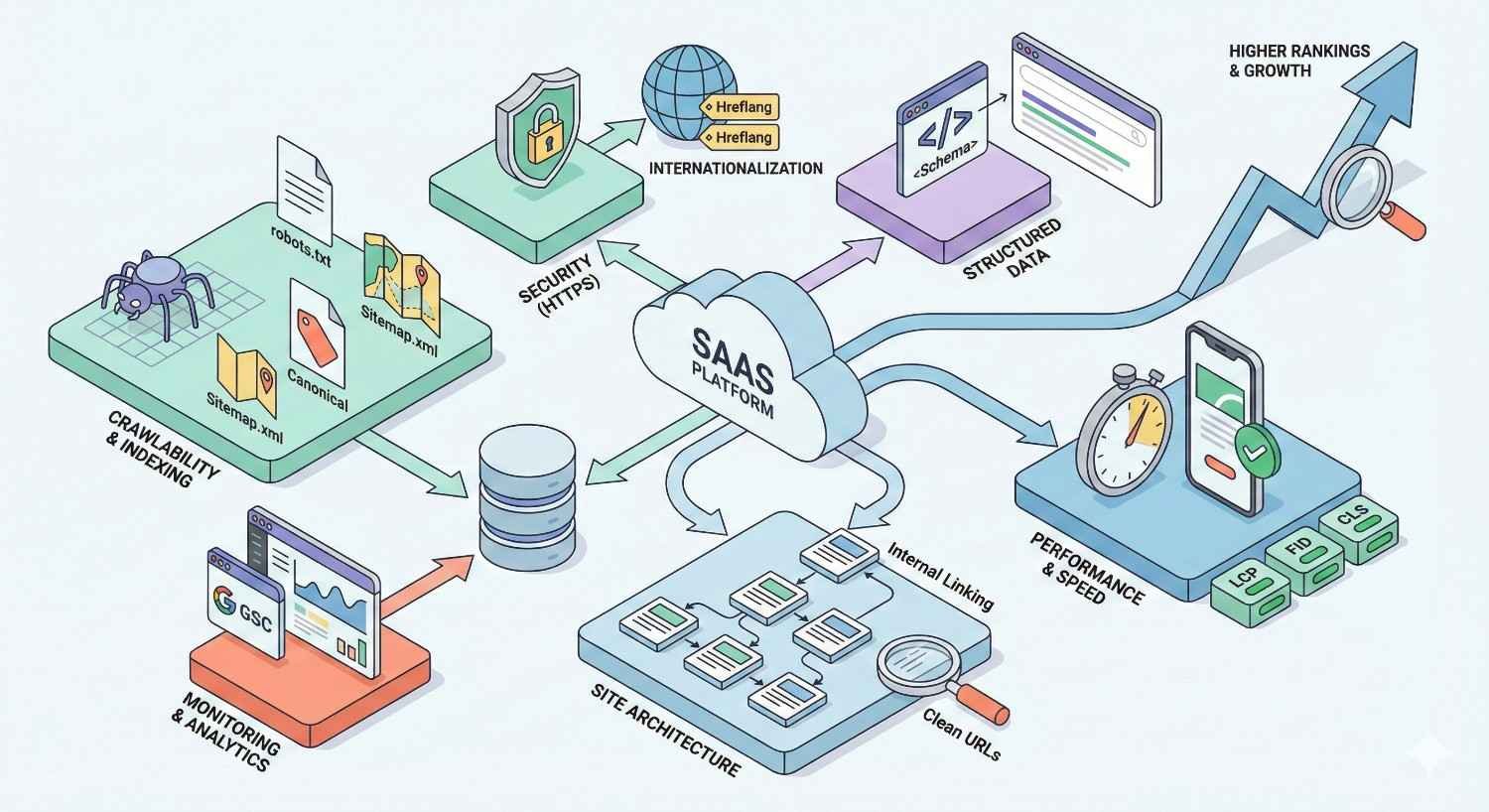
Technical SEO Requirements for SaaS Platforms
Technical SEO for SaaS platforms presents unique challenges beyond standard website optimization. Application architecture, user authentication, and dynamic content all require specialized approaches.
Addressing technical requirements early prevents problems that become increasingly difficult to fix as sites grow. Technical debt accumulates quickly and can undermine content and link building investments.
Site Speed and Core Web Vitals
Page speed directly impacts both rankings and user experience. Google’s Core Web Vitals measure loading performance, interactivity, and visual stability.
Largest Contentful Paint (LCP) should occur within 2.5 seconds. First Input Delay (FID) should be under 100 milliseconds. Cumulative Layout Shift (CLS) should remain below 0.1.
Common speed issues for SaaS sites include unoptimized images, excessive JavaScript, render-blocking resources, and slow server response times. Address these through image compression, code splitting, lazy loading, and CDN implementation.
Monitor Core Web Vitals through Google Search Console and address issues promptly. Performance degradation often happens gradually as new features and content accumulate.
Mobile Optimization
Mobile-first indexing means Google primarily uses mobile versions of pages for ranking and indexing. Mobile optimization is no longer optional for any website.
Responsive design ensures pages adapt to different screen sizes without separate mobile URLs. Test all pages on multiple devices and screen sizes to identify layout issues.
Mobile usability extends beyond responsive design. Touch targets must be appropriately sized, text must be readable without zooming, and navigation must work smoothly on touchscreens.
For project management software, consider how your marketing site performs on mobile even if your application is primarily desktop-focused. Buyers research on mobile devices even when they’ll use desktop applications.
Crawlability and Indexation
Search engines must be able to discover and index your pages for them to rank. Crawlability issues prevent content from entering search results regardless of quality.
Submit XML sitemaps through Google Search Console and Bing Webmaster Tools. Sitemaps should include all important pages and exclude pages you don’t want indexed (login pages, user dashboards, etc.).
Robots.txt files control crawler access to different site sections. Ensure important pages aren’t accidentally blocked while preventing crawlers from wasting resources on unimportant pages.
Monitor index coverage reports in Search Console to identify pages with indexing issues. Address errors and warnings promptly to maintain healthy indexation.
Schema Markup for Software Products
Schema markup helps search engines understand page content and can enable rich results in search listings. Software-specific schema types communicate product information clearly.
SoftwareApplication schema describes your product including name, operating system, category, and offers. This markup can generate rich snippets showing ratings, pricing, and other details.
FAQ schema marks up question-and-answer content for potential inclusion in search results. Implement this on FAQ pages and sections to increase SERP visibility.
Organization schema establishes your company identity and can influence knowledge panel information. Include logo, social profiles, and contact information in organization markup.
Link Building Strategies for Project Management Software
Link building remains essential for ranking in competitive markets. Project management software keywords require significant domain authority to rank, making strategic link acquisition critical.
Quality matters far more than quantity. A single link from a respected technology publication provides more value than dozens of links from low-quality directories.
Digital PR and Industry Publications
Digital PR generates links through newsworthy content and media relationships. Original research, industry surveys, and data-driven content attract coverage from technology and business publications.
Identify journalists and publications covering project management, productivity, and SaaS topics. Build relationships before pitching by engaging with their content and providing value.
Newsjacking involves connecting your expertise to trending topics. When project management or remote work trends emerge, position your team as expert sources for journalist queries.
Press releases for genuine news (funding rounds, major partnerships, significant product launches) can generate coverage and links. Avoid press releases for minor updates that don’t warrant media attention.
Integration Partner Link Opportunities
Integration partnerships create natural link building opportunities. Partners typically maintain integration directories and documentation that link to connected tools.
Pursue integrations with popular tools in your target customers’ tech stacks. Each integration creates opportunities for links from partner websites, app marketplaces, and integration directories.
Co-marketing with integration partners extends link opportunities further. Joint webinars, case studies, and content collaborations generate links from partner promotion.
Maintain integration documentation on your site that partners can link to. Make it easy for partners to reference your integration by providing clear, helpful documentation.
Resource Link Building
Resource link building targets pages that curate tools, guides, and references for specific topics. Many websites maintain resource pages listing project management tools or productivity software.
Identify resource pages through searches like “project management tools list,” “productivity software resources,” and “best project management guides.” Reach out to page owners suggesting your content or tool for inclusion.
Create linkable assets that resource pages want to include. Comprehensive guides, free tools, templates, and original research attract links naturally and provide value for outreach.
Educational institutions, industry associations, and professional organizations often maintain resource pages. These high-authority domains provide particularly valuable links.
Guest Posting and Thought Leadership
Guest posting places your content and links on external websites. Target publications your audience reads rather than sites that exist primarily for link building.
Pitch unique, valuable content ideas rather than generic topics. Publications receive countless pitches and only accept content that serves their audience.
Thought leadership extends beyond traditional guest posts. Podcast appearances, webinar presentations, and conference speaking all generate links and brand exposure.
Build genuine relationships with publication editors and content managers. Long-term relationships yield ongoing opportunities rather than one-time placements.
Realistic SEO Timelines for Project Management Software
SEO requires patience and sustained investment. Understanding realistic timelines helps set appropriate expectations and maintain commitment through early phases when results are limited.
Timelines vary based on starting position, competition, and resource investment. New domains face longer timelines than established sites with existing authority.
Months 1-3: Foundation Phase
The foundation phase focuses on technical optimization, keyword research, and content planning. Visible ranking improvements are unlikely during this period.
Technical audits identify and prioritize issues requiring attention. Address critical problems first while documenting lower-priority improvements for later phases.
Keyword research maps the competitive landscape and identifies target terms. Prioritize keywords based on business value, competition, and current positioning.
Content planning creates editorial calendars and production workflows. Begin creating foundational content while establishing processes for ongoing production.
Months 4-6: Growth Phase
The growth phase sees initial ranking improvements for lower-competition keywords. Long-tail terms and branded queries typically show movement first.
Content production accelerates with established workflows. Publish consistently while maintaining quality standards. Quantity without quality wastes resources.
Link building efforts begin generating results. Early links from partnerships, guest posts, and digital PR start building domain authority.
Monitor rankings and traffic for signs of progress. Adjust strategy based on what’s working and what’s not. Flexibility matters more than rigid adherence to initial plans.
Months 7-12: Scale Phase
The scale phase brings meaningful traffic growth and ranking improvements for competitive terms. Compound effects from earlier investments become visible.
Content libraries reach critical mass, establishing topical authority. Internal linking structures mature, distributing authority effectively across the site.
Link building momentum builds as earlier efforts generate ongoing results. Linkable assets attract natural links while outreach continues generating placements.
Conversion optimization becomes increasingly important as traffic grows. Ensure landing pages convert visitors effectively to maximize ROI from organic traffic.
Long-Term Expectations and ROI
SEO ROI typically exceeds other channels over multi-year timeframes. Initial investments take time to generate returns, but those returns compound over time.
Expect 12-18 months before SEO becomes a significant traffic driver for competitive keywords. Patience during this period separates successful programs from abandoned efforts.
Long-term organic traffic costs decrease as content and authority accumulate. Unlike paid channels where costs remain constant, SEO investments continue delivering returns without proportional ongoing spend.
Measure ROI through customer acquisition cost comparisons, lifetime value of organic customers, and revenue attribution. Organic customers often have higher lifetime values than paid acquisition customers.
How to Measure SEO Success for Project Management Software
Measurement frameworks connect SEO activities to business outcomes. Without proper measurement, it’s impossible to evaluate performance or justify continued investment.
Effective measurement combines leading indicators (rankings, traffic) with lagging indicators (conversions, revenue). Both matter for understanding performance and predicting future results.
Key Performance Indicators (KPIs)
Primary KPIs should align with business objectives. For most project management software companies, these include organic traffic, trial signups, demo requests, and revenue from organic sources.
Secondary KPIs track progress toward primary goals. Keyword rankings, domain authority, indexed pages, and backlink growth indicate whether activities will eventually drive primary metrics.
Set specific, measurable targets for each KPI. “Increase organic traffic” is too vague. “Increase organic traffic by 50% within 12 months” provides clear success criteria.
Review KPIs regularly but avoid overreacting to short-term fluctuations. SEO metrics naturally vary week to week. Focus on trends over months rather than daily changes.
Traffic and Ranking Metrics
Organic traffic from Google Search Console provides the most accurate traffic data. Google Analytics organic traffic can be affected by attribution issues and sampling.
Track rankings for target keywords using dedicated rank tracking tools. Monitor both average position and SERP features (featured snippets, People Also Ask) for complete visibility.
Segment traffic by page type, keyword category, and user intent. Understanding which content drives traffic helps prioritize future investments.
Compare traffic trends to algorithm updates and competitive changes. External factors significantly impact organic performance and must be considered when evaluating results.
Conversion and Revenue Attribution
Connect organic traffic to conversions through proper tracking setup. Ensure Google Analytics goals or events capture trial signups, demo requests, and other conversion actions.
Attribution modeling determines how organic search receives credit for conversions. First-touch attribution credits the initial traffic source. Last-touch credits the final source before conversion. Multi-touch models distribute credit across the journey.
For SaaS with longer sales cycles, organic search often plays an early-journey role that last-touch attribution undervalues. Consider multi-touch or position-based attribution for more accurate measurement.
Revenue attribution connects conversions to actual revenue. Track which organic visitors become paying customers and their lifetime value to calculate true SEO ROI.
Reporting Frameworks and Tools
Google Search Console provides essential data on search performance, indexing, and technical issues. This free tool should be the foundation of any SEO measurement stack.
Google Analytics tracks user behavior after visitors arrive on your site. Connect Search Console data to Analytics for complete visibility from search to conversion.
Dedicated SEO tools like Ahrefs, Semrush, or Moz provide competitive analysis, rank tracking, and backlink monitoring. These tools supplement Google’s data with additional insights.
Create regular reporting cadences with stakeholders. Monthly reports for tactical teams, quarterly reports for leadership. Tailor detail level to audience needs.
Common SEO Mistakes Project Management Software Companies Make
Learning from common mistakes helps avoid costly errors. Many project management software companies make similar missteps that delay or prevent SEO success.
Recognizing these patterns early allows course correction before significant resources are wasted. Prevention costs far less than remediation.
Ignoring Technical Debt
Technical debt accumulates as sites grow and evolve. Ignored technical issues compound over time, eventually creating significant ranking obstacles.
Common technical debt includes slow page speeds, mobile usability issues, crawl errors, and duplicate content. These problems often develop gradually and go unnoticed until they cause visible ranking drops.
Regular technical audits identify issues before they become critical. Schedule quarterly audits at minimum, with continuous monitoring for critical metrics.
Prioritize technical fixes based on impact and effort. Some issues require immediate attention while others can wait for convenient implementation windows.
Targeting Wrong Keywords
Keyword targeting mistakes waste content resources on terms that won’t drive business results. Common errors include targeting keywords that are too competitive, too broad, or misaligned with buyer intent.
New or smaller companies often target head terms dominated by established competitors. “Project management software” may be the obvious target, but ranking for it requires significant authority that takes years to build.
Misaligned intent targeting creates content that ranks but doesn’t convert. Informational content targeting commercial keywords or commercial content targeting informational queries both underperform.
Validate keyword targets through competitive analysis and intent assessment. Ensure you can realistically rank and that ranking will drive meaningful business outcomes.
Neglecting Content Quality
Thin, low-quality content fails to rank and damages overall site quality signals. Publishing content just to have content wastes resources and can hurt performance.
Quality issues include shallow coverage, outdated information, poor writing, and lack of unique value. Content that doesn’t provide something better than existing results won’t rank.
Audit existing content regularly for quality issues. Update, consolidate, or remove underperforming content rather than letting it drag down site quality.
Invest in content quality over quantity. One comprehensive, well-researched piece outperforms ten shallow articles targeting similar keywords.
Expecting Immediate Results
Unrealistic timeline expectations lead to premature strategy abandonment. SEO requires sustained investment over months and years, not weeks.
Stakeholders unfamiliar with SEO often expect results comparable to paid advertising timelines. Education about realistic expectations prevents disappointment and maintains support.
Early-phase metrics focus on activity and leading indicators rather than traffic and conversions. Track content published, technical issues resolved, and links acquired during foundation phases.
Maintain commitment through early phases when results are limited. The compound nature of SEO means early investments generate returns long after initial publication.
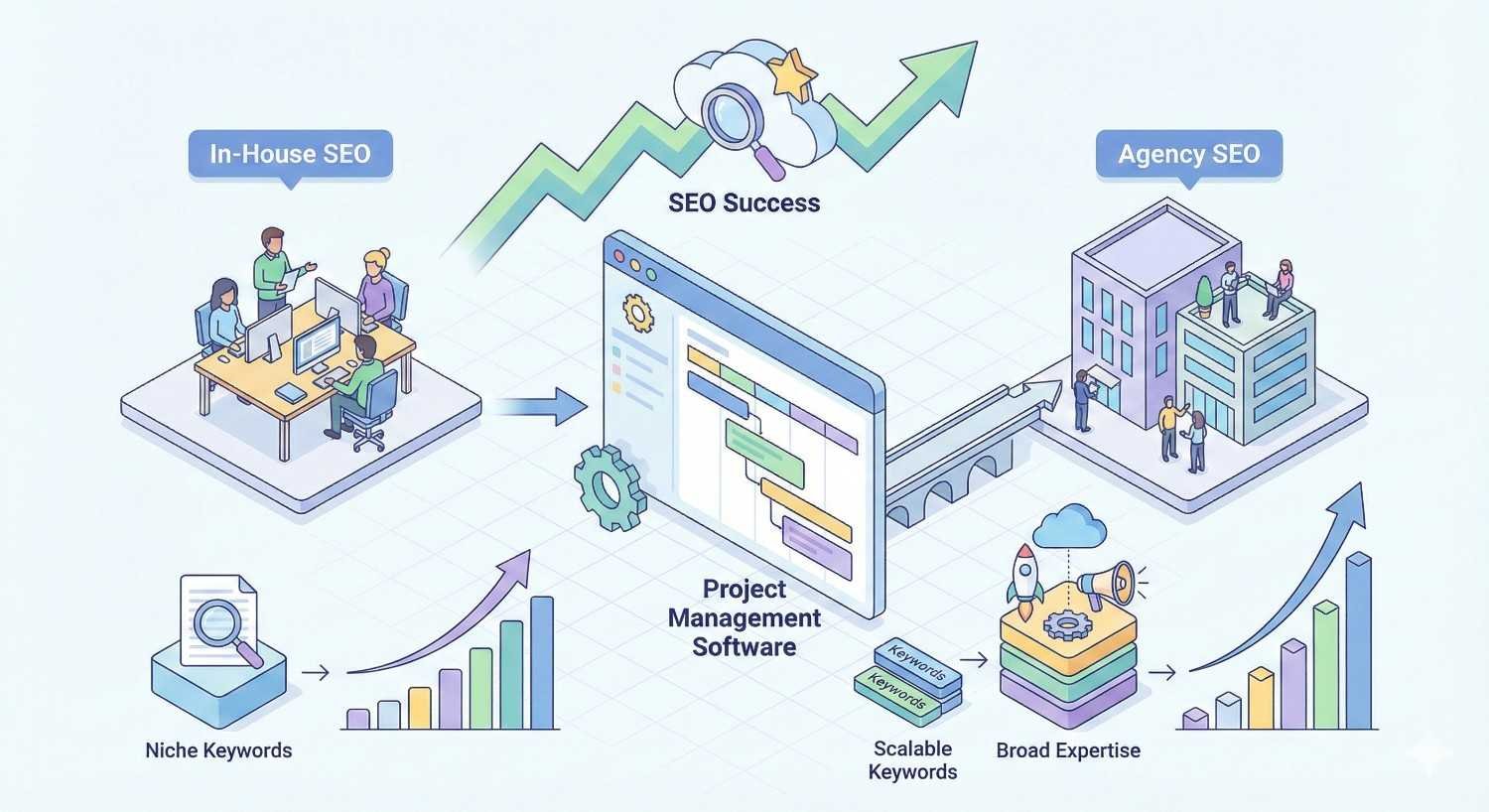
In-House vs. Agency SEO for Project Management Software
Choosing between in-house teams and agency partnerships depends on resources, expertise, and strategic priorities. Both approaches can succeed with proper execution.
Many companies use hybrid approaches combining internal resources with external expertise. The right structure depends on your specific situation and goals.
When to Build an In-House Team
In-house teams make sense when SEO is a core strategic priority and you have resources for competitive compensation. Internal teams develop deep product and market knowledge that agencies struggle to match.
Building in-house requires hiring experienced practitioners, not just assigning SEO to existing marketing staff. Effective SEO requires specialized skills that take years to develop.
In-house teams work best when you can attract and retain talent. SEO professionals have many employment options, and competitive compensation is essential.
Consider in-house when you need tight integration with product, engineering, and content teams. Internal teams navigate organizational dynamics more easily than external partners.
When to Partner with an SEO Agency
Agencies provide immediate access to experienced practitioners without hiring delays. For companies needing to move quickly, agencies offer faster time to execution.
Agency partnerships make sense when SEO isn’t a core competency you want to build internally. Outsourcing allows focus on product development and other priorities.
Agencies bring diverse experience across multiple clients and industries. This breadth provides perspective and best practices that single-company teams may lack.
Consider agencies when you need specialized expertise for specific initiatives. Technical audits, link building campaigns, and content strategy development often benefit from specialized agency capabilities.
Hybrid Approaches
Hybrid models combine internal ownership with external execution support. An internal SEO manager might oversee strategy while agencies handle content production or link building.
This approach provides strategic control while accessing specialized capabilities. Internal leaders ensure alignment with business objectives while agencies provide execution capacity.
Hybrid models require clear role definition and communication processes. Ambiguity about responsibilities creates gaps and conflicts that undermine performance.
Start with clear documentation of who owns what decisions and deliverables. Regular communication cadences keep internal and external teams aligned.

Project Management Software SEO Case Studies
Real-world examples illustrate how SEO strategies translate to business results. These case studies demonstrate patterns that apply across different company stages and situations.
While specific tactics vary, underlying principles remain consistent. Focus on the strategic patterns rather than copying exact approaches.
Startup Growth Example
A project management startup entered a market dominated by established players with limited budget and no existing domain authority. Traditional competitive approaches would have failed against well-funded competitors.
The startup focused on long-tail keywords and underserved niches. Rather than targeting “project management software,” they targeted “project management for freelancers” and “simple project management for small teams.”
Content strategy emphasized depth over breadth. Instead of publishing frequently on many topics, they created comprehensive guides that became definitive resources for their target niches.
Within 18 months, organic traffic grew from near zero to over 50,000 monthly visitors. More importantly, this traffic converted at higher rates than paid channels because it attracted highly qualified prospects.
Enterprise Repositioning Example
An established enterprise project management platform had significant domain authority but declining organic traffic. Years of neglected SEO had allowed competitors to capture market share.
Technical audit revealed significant issues including slow page speeds, mobile usability problems, and thousands of pages with thin content. Addressing technical debt became the first priority.
Content consolidation reduced page count by 40% while improving quality of remaining pages. Outdated blog posts were updated, merged, or removed based on performance and relevance.
Refreshed content strategy targeted commercial keywords the brand had authority to rank for but had neglected. Within 12 months, organic traffic increased 85% with corresponding improvements in lead generation.
Key Takeaways and Patterns
Successful SEO programs share common patterns regardless of company size or market position. Understanding these patterns helps apply lessons to your situation.
Technical foundations must be solid before content and link building investments pay off. Addressing technical issues first prevents wasted effort on content that can’t rank.
Keyword strategy should match competitive reality. Targeting keywords you can’t realistically rank for wastes resources. Start with achievable targets and expand as authority grows.
Consistency matters more than intensity. Sustained effort over years outperforms short bursts of activity. SEO rewards patience and persistence.
Conclusion
Project management software SEO requires strategic patience, technical excellence, and content that genuinely serves your target audience. The companies that commit to this long-term approach build sustainable competitive advantages that paid channels cannot replicate.
Success comes from understanding how search engines evaluate software websites, targeting keywords aligned with buyer intent, and building authority through quality content and legitimate link acquisition. Every element works together to create compound growth over time.
We help project management software companies build organic growth engines that deliver qualified leads for years. Contact White Label SEO Service to discuss how we can accelerate your SEO results.
Frequently Asked Questions
How long does SEO take for project management software?
Expect 6-12 months before seeing significant organic traffic growth for competitive keywords. Foundation work in months 1-3 rarely produces visible results. Long-tail keywords may show movement in months 4-6, with competitive terms following in months 7-12.
What budget is needed for project management software SEO?
Effective SEO programs typically require $5,000-$15,000 monthly for mid-market companies, including content production, technical optimization, and link building. Enterprise programs may require $20,000+ monthly. Smaller budgets can work but extend timelines significantly.
Can project management software rank against established competitors?
Yes, but strategy must account for competitive reality. New entrants succeed by targeting long-tail keywords, underserved niches, and building authority gradually. Direct competition for head terms against Asana or Monday.com requires years of sustained investment.
What is the ROI of SEO for SaaS companies?
SEO typically delivers the lowest customer acquisition cost among digital channels for SaaS companies over multi-year timeframes. While initial ROI is negative during foundation phases, mature programs often achieve 3-5x ROI compared to paid acquisition costs.
How often should project management software companies publish content?
Quality matters more than frequency. Publishing 2-4 high-quality pieces monthly typically outperforms daily publication of thin content. Consistency matters more than volume. Establish sustainable cadences rather than unsustainable bursts.
What technical SEO issues most commonly affect SaaS websites?
JavaScript rendering problems, slow page speeds, mobile usability issues, and crawlability obstacles are most common. SaaS platforms often use heavy JavaScript frameworks that prevent search engines from seeing content without proper rendering solutions.
Should project management software companies hire in-house SEO or use agencies?
The answer depends on resources, strategic priority, and timeline. Agencies provide faster access to expertise while in-house teams develop deeper product knowledge. Many successful companies use hybrid approaches combining internal strategy ownership with agency execution support.