
Resource page link building remains one of the most reliable methods for earning editorial backlinks that actually move rankings. Unlike paid placements or manipulative tactics, these links come from curated pages where webmasters actively want to share valuable resources with their audience.
The strategy works because it aligns perfectly with how search engines evaluate link quality. You’re not asking for favors; you’re offering genuine value to pages designed specifically to help visitors find useful content.
This guide covers everything from finding high-quality resource pages to crafting outreach emails that get responses, plus templates, tools, and realistic benchmarks for measuring success.
What Is Resource Page Link Building
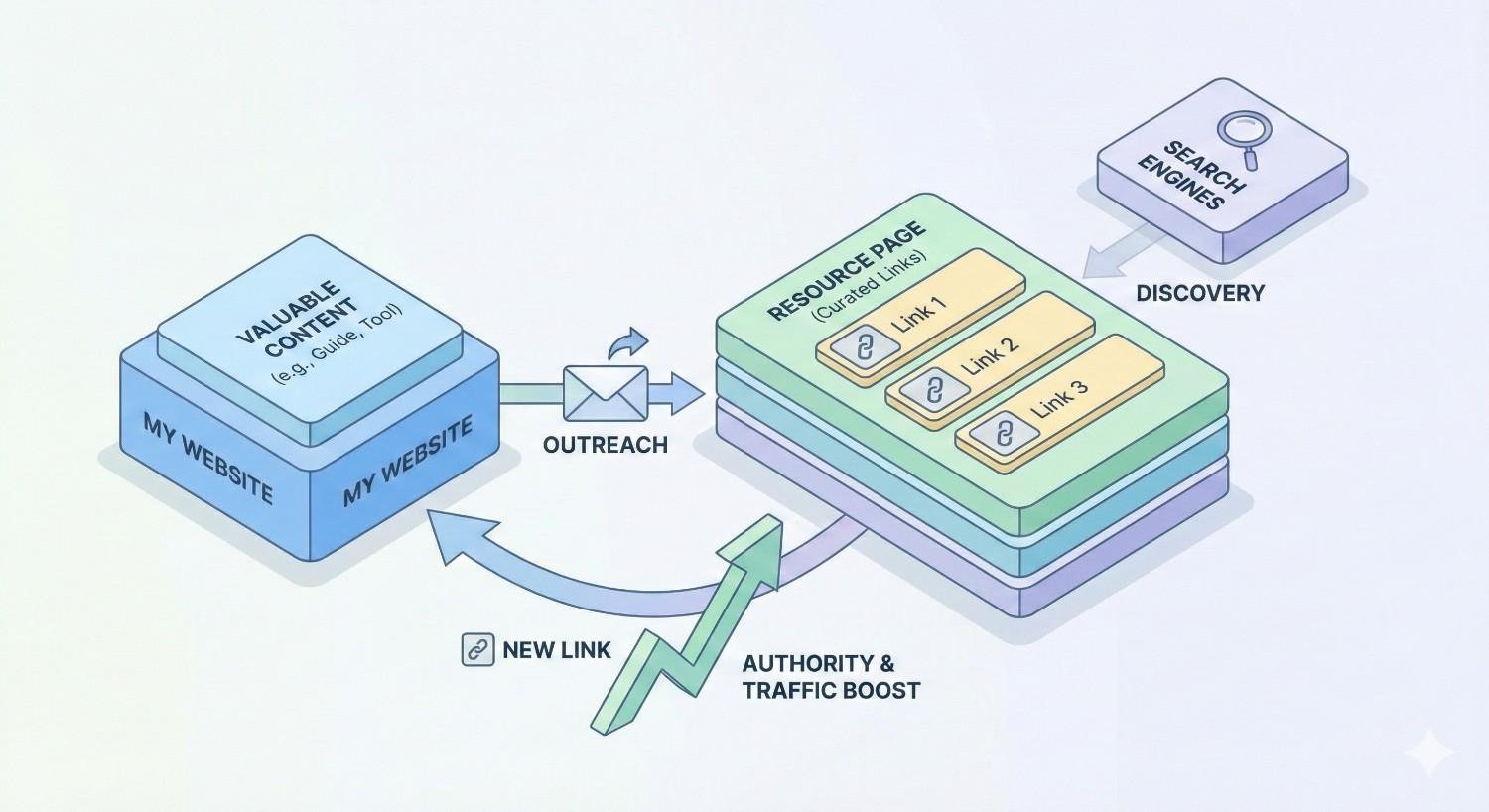
Resource page link building is a white-hat SEO strategy focused on earning backlinks from curated pages that compile helpful links for a specific audience. These pages exist across virtually every industry, from university research guides to industry association directories.
Definition and Core Concept
A resource page is any webpage created specifically to list and link to valuable external content on a particular topic. Think of them as curated bibliographies or recommended reading lists maintained by organizations, educational institutions, bloggers, or businesses.
The link building process involves identifying relevant resource pages, creating content worthy of inclusion, and reaching out to page owners with a compelling case for adding your link. Success depends on offering genuine value rather than simply requesting placement.
This approach differs fundamentally from transactional link schemes. Resource page curators add links because they believe the content helps their audience, not because they received payment or reciprocal benefits.
How Resource Pages Differ from Other Link Sources
Resource pages occupy a unique position in the link building landscape. Unlike guest posts where you create content for another site, resource page links point to assets you already own and control.
Blog comment links and forum signatures typically carry minimal SEO value and often appear spammy. Resource page links, by contrast, sit within curated editorial content where every link represents a deliberate recommendation.
Directory submissions often land on low-quality pages with hundreds of outbound links. Quality resource pages maintain selective standards, limiting links to genuinely useful resources. This selectivity signals higher trust to search engines.
Social media links provide referral traffic but pass no direct ranking value. Resource page backlinks transfer authority and relevance signals that directly influence search positions.
Why Search Engines Value Resource Page Links
Google’s ranking algorithms prioritize links that represent genuine editorial endorsements. Resource page links check every box for what constitutes a high-quality backlink.
First, they’re contextually relevant. A marketing resource page linking to your SEO guide creates a topically coherent connection that search engines recognize and reward.
Second, they’re editorially placed. Someone reviewed your content and decided it deserved inclusion alongside other trusted resources. This human curation signals quality far more effectively than automated or paid placements.
Third, resource pages typically maintain strong trust metrics themselves. Educational institutions, government agencies, and established industry organizations frequently maintain resource pages, passing significant authority through their outbound links.
The placement context matters too. Links appearing within curated lists of recommended resources carry different weight than links buried in footers or sidebars.
How Resource Page Link Building Works
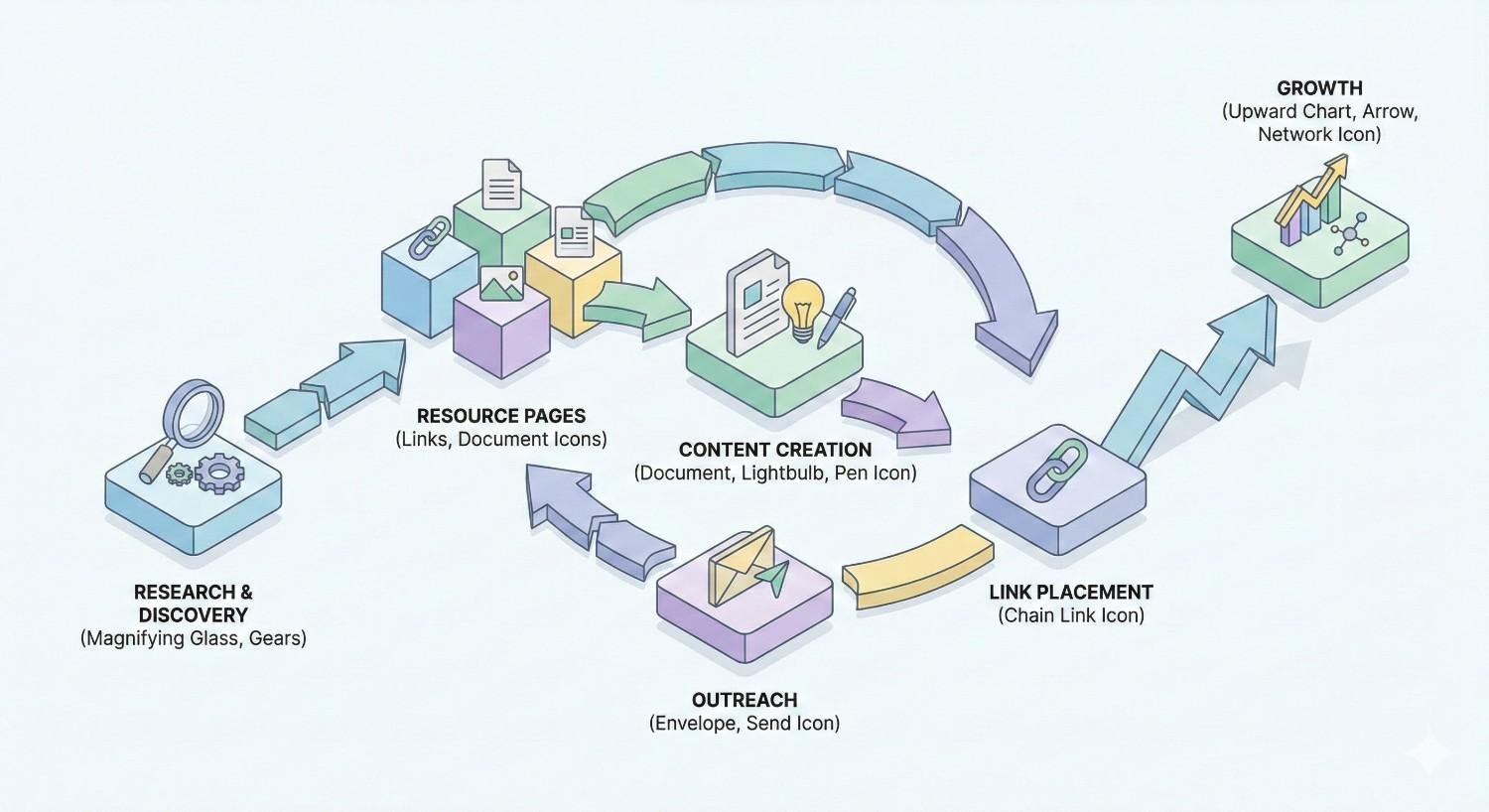
Successful resource page campaigns follow a systematic process: discover relevant pages, evaluate their quality, create link-worthy content, and execute targeted outreach. Each phase requires specific skills and tools.
The Resource Page Link Building Process Overview
The workflow begins with prospecting. You’ll use search operators, competitor analysis, and industry research to build a list of potential resource pages in your niche.
Next comes qualification. Not every resource page deserves your attention. You’ll evaluate domain authority, topical relevance, page quality, and link placement potential before adding prospects to your outreach list.
Content creation often runs parallel to prospecting. You need assets worth linking to before approaching resource page owners. This might mean improving existing content or developing new resources specifically designed for link acquisition.
Outreach execution involves finding contact information, crafting personalized emails, and managing follow-up sequences. Response rates typically range from 5% to 15% for well-executed campaigns.
Finally, tracking and optimization help you refine your approach over time. Monitor which resource pages link back, measure the SEO impact, and adjust your strategy based on results.
Finding Resource Pages in Your Niche
Discovery is the foundation of any resource page campaign. Multiple methods exist, and combining them yields the most comprehensive prospect lists.
Google Search Operators for Resource Page Discovery
Search operators help you find resource pages that standard queries miss. Start with these proven combinations:
Basic resource page queries:
- “keyword” + “resources”
- “keyword” + “useful links”
- “keyword” + “recommended sites”
- “keyword” + “helpful resources”
Educational and institutional pages:
- site:.edu “keyword” + “resources”
- site:.gov “keyword” + “links”
- site:.org “keyword” + “recommended”
Specific page types:
- intitle:resources “keyword”
- inurl:resources “keyword”
- inurl:links “keyword”
Combine operators for precision. The query site:.edu intitle:resources “content marketing” surfaces educational resource pages specifically about content marketing.
Document your search queries and results systematically. A spreadsheet tracking which operators produced which prospects helps you refine future campaigns.
Competitor Backlink Analysis Method
Your competitors have already done prospecting work for you. Analyzing their backlink profiles reveals resource pages that link to similar content.
Export competitor backlinks using tools like Ahrefs, Moz, or Semrush. Filter for pages containing terms like “resources,” “links,” or “recommended” in the URL or title.
Look for patterns across multiple competitors. Resource pages linking to two or three competitors in your space represent high-probability targets for your outreach.
Pay attention to the specific content competitors used to earn these links. Understanding what resource page curators found valuable helps you position your own assets effectively.
Industry Directory and Curated List Mining
Industry associations, professional organizations, and niche communities often maintain resource directories that accept submissions or link requests.
Search for your industry plus terms like “association,” “organization,” “community,” or “network.” Many of these entities maintain member resources or recommended vendor lists.
Trade publications frequently compile annual resource guides or tool roundups. These represent excellent link opportunities, especially when timed around their editorial calendars.
Niche blogs often maintain resource pages for their audiences. A personal finance blogger might curate a list of budgeting tools; a marketing blog might list recommended SEO resources.
Evaluating Resource Page Quality and Relevance
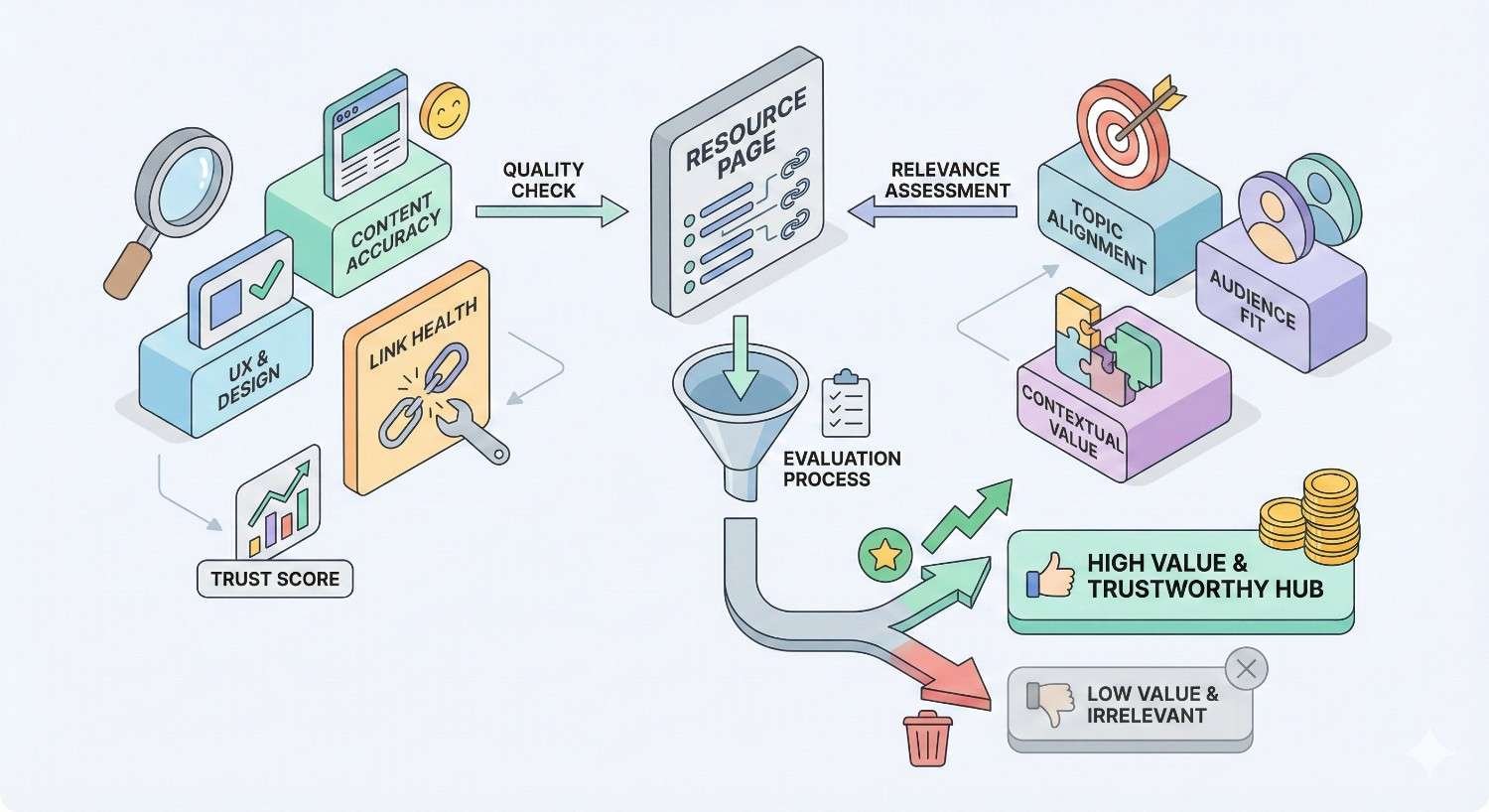
Not all resource pages deliver equal value. Rigorous qualification prevents wasted outreach effort and ensures you pursue links that actually impact rankings.
Domain Authority and Trust Metrics
Domain authority provides a useful starting point for evaluation. Pages on domains with DA 40+ typically pass meaningful link equity, though lower-authority sites can still provide value if highly relevant.
Check the domain’s backlink profile for spam signals. A resource page on a domain with thousands of low-quality inbound links may not help your SEO despite appearing legitimate.
Trust flow and citation flow metrics from Majestic offer additional perspective. High trust flow relative to citation flow suggests a cleaner, more authoritative link profile.
Verify the domain hasn’t been penalized. Manual actions or significant traffic drops visible in historical data indicate potential problems.
Topical Relevance Assessment
Relevance often matters more than raw authority. A link from a moderately authoritative page in your exact niche typically outperforms a link from a high-authority page in an unrelated field.
Evaluate the resource page’s topic focus. Does it cover subjects directly related to your content? Would your target audience naturally visit this page?
Check other links on the page. If the resource page links to your direct competitors or complementary services, your content likely fits the curator’s criteria.
Consider the linking domain’s overall topical focus. A marketing agency’s resource page carries more relevance for marketing content than a general business directory.
Link Placement and Page Structure Analysis
Where your link appears on the page affects its value. Links within the main content area typically carry more weight than sidebar or footer placements.
Examine the page’s link density. Resource pages with hundreds of outbound links dilute the value passed to each destination. Pages with 20-50 curated links often represent the sweet spot.
Check whether existing links are dofollow or nofollow. While nofollow links still provide referral traffic and brand exposure, dofollow links deliver direct SEO benefit.
Assess the page’s indexation status. A resource page that isn’t indexed by Google can’t pass link equity regardless of its other qualities.
Creating Link-Worthy Assets for Resource Pages
Resource page curators link to content that genuinely helps their audience. Creating assets specifically designed for link acquisition dramatically improves outreach success rates.
Ultimate Guides and Comprehensive Resources
Comprehensive guides that thoroughly cover a topic represent the most common link-worthy asset type. These work because resource page curators want to point their audience toward definitive information sources.
Effective guides share common characteristics: they’re longer and more detailed than competing content, they’re well-organized with clear navigation, and they’re regularly updated to maintain accuracy.
Structure matters as much as length. Use clear headings, include a table of contents, and break complex topics into digestible sections. Curators evaluate whether content will actually help their audience, not just whether it exists.
Include original insights or perspectives that differentiate your guide from others. Aggregating existing information provides some value, but unique analysis or proprietary data makes your content truly link-worthy.
Tools, Calculators, and Interactive Content
Interactive tools earn links at higher rates than static content because they provide ongoing utility. A mortgage calculator, ROI estimator, or industry benchmark tool gives resource page visitors a reason to click through.
Tools don’t require massive development budgets. Simple calculators built with spreadsheet embeds or basic JavaScript can attract significant links if they solve real problems.
Consider what calculations or assessments your target audience performs regularly. Building a tool that automates tedious manual processes creates genuine value worth linking to.
Free tools also generate organic links beyond resource pages. Users share helpful tools with colleagues, mention them in blog posts, and reference them in social discussions.
Original Research and Data Studies
Original research represents perhaps the highest-value link asset type. Data that doesn’t exist elsewhere becomes a required citation for anyone writing about your topic.
Survey your customers or industry peers to generate proprietary statistics. Even small sample sizes can produce linkable insights if the questions address genuine knowledge gaps.
Analyze publicly available data in new ways. Government databases, academic repositories, and industry reports contain raw material for original analysis that others will cite.
Present research findings in multiple formats: a detailed methodology section for credibility, key statistics highlighted for easy citation, and visual charts for social sharing.
Resource Page Outreach Strategy
Finding great resource pages means nothing without effective outreach. The difference between 5% and 15% response rates often comes down to email quality and follow-up discipline.
Building a Qualified Prospect List
Start with quantity, then ruthlessly qualify. Initial prospecting might generate hundreds of potential resource pages; careful evaluation narrows this to dozens worth pursuing.
Create a spreadsheet tracking key qualification criteria: domain authority, topical relevance, contact information availability, and any notes about the page or curator.
Prioritize prospects based on potential value and likelihood of success. High-authority, highly-relevant pages with clear contact information deserve immediate attention.
Segment your list by outreach approach. Educational institutions may require different messaging than industry blogs or corporate resource pages.
Finding the Right Contact Person
Generic contact forms and info@ email addresses produce lower response rates than direct outreach to the right person. Invest time in finding specific contacts.
Check the resource page itself for author attribution. Many curators include their name, which you can then research to find direct contact information.
LinkedIn proves invaluable for identifying content managers, webmasters, or marketing team members responsible for website updates. A brief profile review often reveals email patterns or direct contact options.
For larger organizations, look for content team members, digital marketing managers, or web administrators. These roles typically control resource page updates.
Hunter.io, Voila Norbert, and similar tools help verify email addresses once you’ve identified the right contact. Sending to invalid addresses wastes effort and can harm sender reputation.
Crafting Effective Outreach Emails
Your email competes with dozens of others in the recipient’s inbox. Standing out requires genuine personalization, clear value proposition, and professional presentation.
Subject Line Best Practices
Subject lines determine whether your email gets opened. Keep them short, specific, and curiosity-inducing without appearing spammy.
Effective patterns include:
- Reference to their specific resource page: “Quick suggestion for your [topic] resources page”
- Value-focused: “Resource that might help your [audience]”
- Direct and professional: “Link suggestion for [page name]”
Avoid subject lines that trigger spam filters or appear mass-produced. Generic phrases like “link request” or “partnership opportunity” often get ignored or filtered.
Test different subject line approaches across your campaign. Track open rates to identify what resonates with your specific audience.
Email Body Structure and Value Proposition
Open with something specific about their resource page that proves you actually visited it. Generic compliments signal mass outreach and reduce response likelihood.
Quickly introduce your resource and explain why it fits their page. Focus on how your content helps their audience rather than how the link helps you.
Keep emails concise. Three to four short paragraphs typically suffice. Busy webmasters won’t read lengthy pitches.
Include a clear, low-friction call to action. “Would you consider adding it to your resources?” works better than vague requests for “collaboration.”
Personalization Techniques That Work
Surface-level personalization (using their name, mentioning their site) represents the minimum standard. Deeper personalization dramatically improves results.
Reference specific resources already on their page. Noting that you found their link to [specific resource] helpful demonstrates genuine engagement.
Connect your content to gaps in their current resource list. If their page covers topics A, B, and D, position your content as the missing C.
Mention any genuine connection: you’ve shared their content before, you’re in the same industry community, or you’ve referenced their work in your own content.
Follow-Up Sequences and Timing
Most successful link placements require follow-up. Initial emails often get lost in busy inboxes; polite persistence pays off.
Wait 5-7 days before sending your first follow-up. This gives recipients time to review your initial email without feeling pressured.
Keep follow-ups brief and add new value if possible. Reference your original email, perhaps mention a recent update to your resource, and reiterate the value proposition.
Two to three follow-ups typically maximize response rates without crossing into annoyance. After three unanswered emails, move the prospect to a “revisit later” list.
Track all outreach activity meticulously. Knowing exactly when you contacted each prospect and what you said prevents embarrassing duplicate outreach.
Common Outreach Mistakes to Avoid
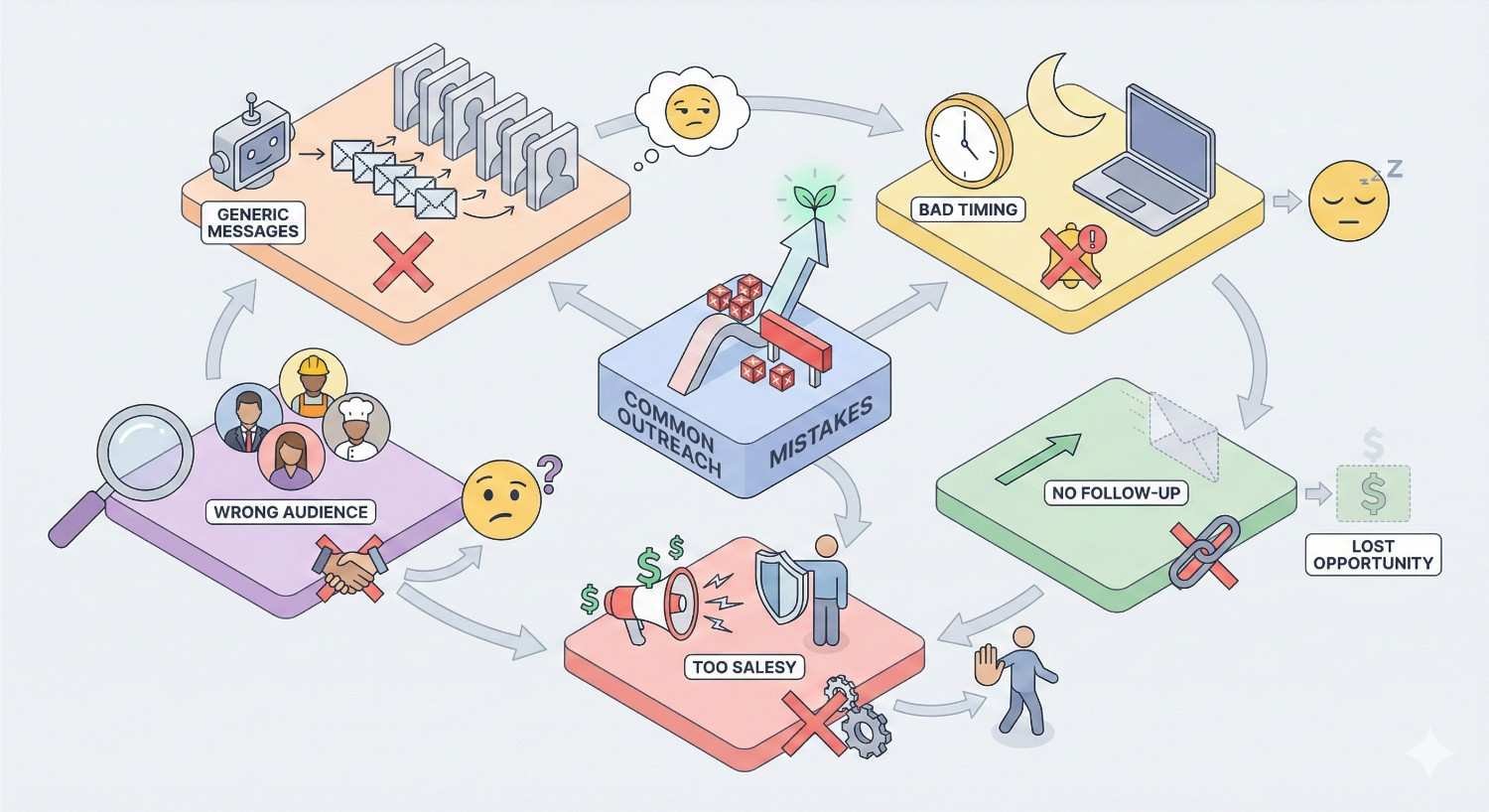
Mass-produced templates with obvious mail merge fields signal lazy outreach. Recipients recognize and ignore these immediately.
Focusing on your needs rather than their audience’s needs positions you as a taker rather than a giver. Frame everything around the value you provide.
Sending to wrong or outdated contacts wastes effort and can damage your sender reputation. Verify contact information before sending.
Following up too aggressively or too frequently annoys recipients and can get your domain flagged as spam. Respect reasonable boundaries.
Failing to track outreach leads to duplicate emails, missed follow-ups, and inability to learn from results. Use a CRM or spreadsheet system consistently.
Resource Page Link Building Templates and Examples
Templates provide starting points, not final products. Customize every email based on the specific recipient and resource page.
Outreach Email Templates
These templates demonstrate effective structure and tone. Adapt them significantly for each outreach target.
Initial Contact Template
Subject: Resource suggestion for your [topic] page
Hi [Name],
I was researching [topic] resources and found your page at [URL]. Really helpful collection, especially the link to [specific resource they included].
I recently published [brief description of your content] that covers [specific angle or value]. Given your page focuses on helping [their audience] with [topic], I thought it might be a useful addition.
Here’s the link if you’d like to take a look: [URL]
Either way, thanks for maintaining such a helpful resource page.
[Your name]
Follow-Up Email Template
Subject: Re: Resource suggestion for your [topic] page
Hi [Name],
Just following up on my email from last week about your [topic] resources page.
I understand you’re busy, so I’ll keep this brief. The resource I mentioned covers [key value point], which I noticed isn’t currently represented on your page.
Happy to answer any questions if you’d like more information.
[Your name]
Broken Link Replacement Template
Subject: Broken link on your [topic] resources page
Hi [Name],
I was going through your [topic] resources page and noticed that the link to [broken resource name] appears to be broken (returns a 404).
I have a similar resource that covers [topic]: [your URL]. It might work as a replacement if you’re looking to update the page.
Either way, wanted to give you a heads up about the broken link.
[Your name]
Real-World Campaign Examples
A B2B software company targeting marketing resource pages achieved 12% response rate by focusing exclusively on pages that already linked to competitor tools. Their outreach emphasized specific feature comparisons that differentiated their product.
An educational content publisher earned 47 resource page links over three months by creating a comprehensive industry glossary. The asset’s reference utility made it an easy addition for curators building beginner-friendly resource collections.
A local service business secured links from 8 regional resource pages by targeting chamber of commerce sites, local business directories, and community organization pages. Geographic relevance compensated for lower domain authority.
Success Metrics and Benchmarks
Response rates between 8% and 15% indicate healthy campaign performance. Rates below 5% suggest targeting or messaging problems requiring adjustment.
Conversion from response to link placement typically ranges from 30% to 50%. Some responses will be rejections or requests for changes you can’t accommodate.
Overall, expect 3% to 8% of qualified prospects to result in placed links. A campaign targeting 100 resource pages might yield 3-8 new backlinks.
Time from initial outreach to link placement averages 2-6 weeks. Some curators respond and add links within days; others take months to update their pages.
Tools for Resource Page Link Building
The right tools dramatically improve efficiency across prospecting, outreach, and tracking. Most successful campaigns combine multiple tools for different workflow stages.
Prospecting and Discovery Tools
Ahrefs Content Explorer surfaces pages containing specific keywords, filterable by domain rating, traffic, and other metrics. Use it to find resource pages at scale.
Semrush offers similar functionality through its backlink analytics and content research tools. The platform excels at competitor backlink analysis.
Google Search Console reveals which sites already link to you, potentially identifying resource pages you didn’t know about that might link to additional content.
Screaming Frog helps analyze resource pages at scale, checking for broken links, page structure, and other quality indicators.
Email Outreach and CRM Tools
Hunter.io finds and verifies email addresses associated with specific domains. Essential for identifying correct contacts.
Pitchbox provides end-to-end outreach management including prospecting, email sequencing, and response tracking. Popular among agencies running large campaigns.
BuzzStream offers similar outreach CRM functionality with strong relationship tracking features.
Mailshake and Lemlist handle email sequencing and personalization for smaller-scale campaigns at lower price points.
Backlink Analysis Tools
Ahrefs remains the industry standard for backlink analysis, offering the largest link index and most detailed metrics.
Moz Link Explorer provides domain authority scores and spam metrics useful for qualifying prospects.
Majestic offers unique trust flow and citation flow metrics that complement other tools’ data.
Google Search Console shows which backlinks Google has actually discovered and indexed, providing ground truth for your link profile.
Tracking and Reporting Tools
Google Sheets or Airtable work well for tracking outreach activity, prospect status, and campaign results.
Google Analytics reveals referral traffic from newly acquired resource page links, helping measure non-SEO value.
Rank tracking tools like Ahrefs, Semrush, or dedicated platforms show ranking improvements correlated with link acquisition.
Custom dashboards in Google Data Studio or similar tools can combine data sources for comprehensive campaign reporting.
Resource Page Link Building vs Other Link Building Tactics
Understanding how resource page link building compares to alternatives helps you allocate effort effectively across your overall link acquisition strategy.
Resource Pages vs Guest Posting
Guest posting requires creating new content for each link opportunity. Resource page link building leverages existing assets, making it more scalable once you have link-worthy content.
Guest posts typically provide more control over anchor text and link placement. Resource page links depend on curator decisions about how to present your link.
Guest posting builds relationships with publishers who may offer ongoing opportunities. Resource page outreach often results in one-time transactions.
Both tactics produce editorial links that search engines value. Guest posting may offer additional brand exposure through the published content itself.
Resource Pages vs Broken Link Building
Broken link building specifically targets dead links on resource pages, offering replacement content. It’s essentially a subset of resource page link building with a specific angle.
The broken link approach provides a stronger value proposition: you’re helping fix a problem rather than just suggesting an addition. This can improve response rates.
However, broken link opportunities are more limited. Not every resource page has broken links, and not every broken link matches content you can replace.
Combining both approaches maximizes resource page opportunities. Pitch your content as a new addition while also noting any broken links you discover.
Resource Pages vs Digital PR
Digital PR focuses on earning links through newsworthy content, journalist relationships, and media coverage. It typically produces links from news sites and major publications.
Resource page links come from curated pages rather than news coverage. The links tend to be more stable, as resource pages update less frequently than news sites.
Digital PR can generate many links from a single successful campaign. Resource page building produces links more gradually through sustained outreach.
Digital PR requires genuinely newsworthy angles or data. Resource page building works with evergreen educational content that doesn’t need news hooks.
When to Use Each Strategy
Resource page link building works best when you have comprehensive, evergreen content assets and want steady, sustainable link acquisition.
Guest posting suits situations where you want to build ongoing publisher relationships and can commit to regular content creation.
Broken link building makes sense as a supplementary tactic when you discover relevant broken link opportunities during resource page prospecting.
Digital PR fits campaigns with genuinely newsworthy data, product launches, or industry insights that merit media coverage.
Most successful link building programs combine multiple tactics based on available resources, content assets, and competitive requirements.
How Long Does Resource Page Link Building Take
Setting realistic timeline expectations prevents frustration and helps you plan resource allocation appropriately.
Realistic Timeline Expectations
Initial prospecting and list building typically requires 1-2 weeks for a focused campaign targeting 50-100 qualified prospects.
Content creation or improvement, if needed, adds 2-4 weeks depending on asset complexity and existing content quality.
Outreach execution and follow-up sequences span 4-8 weeks from first email to final follow-up for each prospect batch.
Link placement after positive response takes 1-4 weeks as curators find time to update their pages.
End-to-end, expect 2-4 months from campaign initiation to meaningful link acquisition results. SEO impact from those links may take additional months to materialize in rankings.
Factors That Affect Campaign Duration
Content readiness significantly impacts timeline. Campaigns with existing link-worthy assets launch faster than those requiring new content development.
Prospect list quality affects outreach efficiency. Well-qualified lists with verified contacts produce faster results than broad, unverified prospect pools.
Outreach volume and team capacity determine how quickly you can work through your prospect list. Larger teams or agency support accelerate execution.
Niche competitiveness influences response rates. Oversaturated niches where curators receive many requests may require more touches to earn responses.
Seasonality matters for some industries. Resource pages at educational institutions may update primarily during academic calendar transitions.
Scaling Resource Page Outreach
Scaling requires systematizing each workflow component: prospecting, qualification, content creation, outreach, and tracking.
Templates and processes enable team members to execute consistently without senior oversight on every decision.
Tool investments pay off at scale. Manual prospecting and outreach become unsustainable beyond a few dozen monthly targets.
Quality control becomes critical as volume increases. Rushed outreach with poor personalization damages response rates and sender reputation.
Consider agency partnerships for significant scale. Experienced link building agencies have established processes, tools, and sometimes existing relationships that accelerate results.
Resource Page Link Building Costs and ROI
Understanding cost structures helps you budget appropriately and evaluate whether results justify investment.
In-House vs Agency vs Freelancer Costs
In-house execution requires staff time for prospecting, outreach, and content creation. Fully-loaded costs often reach $200-500 per acquired link when accounting for all labor.
Freelancers typically charge $100-300 per link for resource page placements, though quality varies significantly. Vet freelancers carefully and start with small test projects.
Agencies charge $300-1,000+ per link depending on target quality, niche difficulty, and service level. Premium agencies focusing on high-authority placements command higher rates.
Tool subscriptions add $200-500 monthly for comprehensive prospecting and outreach capabilities. These costs apply regardless of execution model.
Measuring Link Building ROI
Direct ROI measurement remains challenging because links contribute to rankings alongside many other factors. However, several approaches provide useful signals.
Track ranking improvements for pages receiving new backlinks. Correlation doesn’t prove causation, but consistent patterns suggest link impact.
Monitor organic traffic growth to linked pages. Increased visibility from better rankings should produce measurable traffic gains.
Calculate customer acquisition cost improvements. If organic traffic converts to customers, link building investment can be measured against customer value.
Compare link building costs to equivalent paid traffic costs. What would you pay in ads to generate the same traffic that organic rankings produce?
Budget Allocation Recommendations
New campaigns should allocate 60-70% of budget to content creation and improvement. Link-worthy assets are prerequisites for successful outreach.
Outreach execution typically requires 20-30% of budget, covering tools, labor, and any outsourced support.
Reserve 10-15% for testing and optimization. Initial campaigns rarely achieve optimal performance; budget for iteration.
For ongoing programs, shift allocation toward outreach as content assets mature. Established content libraries require less creation investment.
Common Resource Page Link Building Challenges
Anticipating common obstacles helps you prepare solutions before they derail your campaign.
Low Response Rates and How to Improve Them
Response rates below 5% indicate fundamental problems requiring diagnosis. Check email deliverability first; technical issues may prevent messages from reaching inboxes.
Review targeting criteria. Outreach to irrelevant or low-quality resource pages wastes effort and produces poor results regardless of email quality.
Audit email content for personalization depth. Generic templates perform poorly; invest more time in customization.
Test different value propositions. If your current angle isn’t resonating, try emphasizing different benefits or content aspects.
Consider timing factors. Outreach during major holidays or industry events may receive less attention.
Finding Enough Quality Resource Pages
Niche markets may have limited resource page inventory. Expand your definition of relevant topics to find adjacent opportunities.
Look beyond obvious keyword searches. Industry associations, educational programs, and professional communities often maintain resource pages that standard queries miss.
Create resource pages yourself, then reach out to similar pages for reciprocal awareness. This builds relationships that may yield link opportunities.
Consider international resource pages if your content applies globally. Non-English resource pages in your industry represent untapped opportunities.
Creating Content Worth Linking To
Audit existing content honestly. Would you link to it if you curated a resource page? If not, improvement is necessary before outreach.
Study content that resource pages in your niche already link to. Identify patterns in format, depth, and presentation that curators value.
Invest in differentiation. Content that merely matches competitors won’t earn links; you need clear superiority in some dimension.
Consider format diversity. If your niche has many text guides, a video resource or interactive tool may stand out.
Maintaining Link Velocity Without Penalties
Natural link profiles grow gradually with occasional spikes around content launches or viral moments. Sudden, sustained link acquisition looks artificial.
Vary your link sources. Resource page links should complement other link types including editorial mentions, guest posts, and organic citations.
Monitor anchor text distribution. Over-optimized anchor text patterns can trigger algorithmic penalties regardless of link source quality.
Focus on relevance over volume. Ten highly relevant resource page links typically outperform fifty marginally relevant placements.
Document your link building activities. If questions arise, you want clear records showing legitimate outreach rather than manipulative schemes.
Resource Page Link Building Best Practices
Following established best practices maximizes results while minimizing risk.
Quality Over Quantity Approach
Prioritize high-authority, highly-relevant resource pages over volume. One link from a DA 60 educational resource page often outweighs ten links from DA 20 blogs.
Invest more time in fewer, better outreach emails rather than blasting templates to large lists. Personalization quality directly correlates with response rates.
Create fewer, better content assets rather than many mediocre pieces. One comprehensive guide earns more links than five thin articles.
Measure success by link quality metrics, not just quantity. Track domain authority, relevance scores, and traffic impact alongside raw link counts.
Building Relationships, Not Just Links
View each outreach interaction as relationship initiation, not transaction completion. Curators who link once may link again to future content.
Provide value beyond your link request. Share their resource page on social media, mention it in your own content, or offer other genuine support.
Follow up after link placement with thanks and continued engagement. Maintaining relationships creates ongoing opportunities.
Join communities where resource page curators participate. Industry forums, social media groups, and professional associations provide relationship-building contexts.
Diversifying Your Link Profile
Resource page links should complement other link types, not replace them entirely. Healthy link profiles include editorial mentions, guest posts, citations, and organic links.
Vary the types of resource pages you target. Mix educational, commercial, organizational, and blog-based resource pages.
Pursue links to multiple pages on your site, not just your homepage or one key asset. Distributed link equity benefits overall domain authority.
Balance followed and nofollowed links. While followed links pass more direct SEO value, a natural profile includes both types.
Staying Compliant with Google Guidelines
Never pay for resource page placements. Purchased links violate Google’s guidelines regardless of how natural they appear.
Avoid excessive link exchanges. Reciprocal linking arrangements can appear manipulative at scale.
Don’t use automated outreach tools that send identical messages to hundreds of targets. This behavior patterns trigger spam filters and damage sender reputation.
Disclose any material relationships. If you have business connections to resource page curators, transparency protects both parties.
Focus on earning links through genuine value rather than manipulation. Sustainable SEO success comes from practices that would survive public scrutiny.
Frequently Asked Questions About Resource Page Link Building
Is Resource Page Link Building Still Effective?
Yes, resource page link building remains effective when executed properly. The tactic works because it produces genuine editorial links from relevant, authoritative sources. Search engines continue valuing these signals. However, success requires quality content and personalized outreach rather than mass template approaches.
How Many Links Can You Get from Resource Pages?
Typical campaigns yield 3-8 links per 100 qualified prospects contacted. Results vary significantly based on content quality, niche competitiveness, and outreach execution. Some niches have abundant resource page opportunities; others have limited inventory requiring creative prospecting approaches.
Are Resource Page Links Nofollow or Dofollow?
Most resource page links are dofollow, passing direct SEO value. However, some curators use nofollow attributes, particularly on commercial resource listings. Check target pages before outreach to understand their linking practices. Nofollow links still provide referral traffic and brand exposure value.
What Makes a Good Resource Page Target?
Quality targets combine strong domain authority (DA 30+), topical relevance to your content, reasonable link density (under 100 outbound links), and active maintenance. Pages on educational, governmental, or established industry domains typically offer highest value. Verify pages are indexed and recently updated.
Can Resource Page Link Building Hurt Your SEO?
Resource page link building poses minimal risk when executed ethically. Avoid paid placements, excessive reciprocal arrangements, or targeting spammy resource pages. Focus on earning links through genuine value. The tactic aligns with Google’s guidelines for natural link acquisition through quality content.
Getting Started with Resource Page Link Building
Moving from understanding to execution requires clear action steps and organized processes.
Step-by-Step Action Plan
Week 1-2: Foundation Audit existing content for link-worthiness. Identify your strongest assets or plan new content development. Set up tracking spreadsheets and tool accounts.
Week 3-4: Prospecting Execute search operator queries across your target topics. Analyze competitor backlinks for resource page opportunities. Build initial prospect list of 50-100 targets.
Week 5-6: Qualification Evaluate each prospect for domain authority, relevance, and contact availability. Prioritize list by potential value. Research and verify contact information.
Week 7-10: Outreach Send initial outreach emails to prioritized prospects. Track responses and manage follow-up sequences. Document results and refine messaging based on feedback.
Week 11-12: Optimization Analyze campaign performance against benchmarks. Identify successful patterns to replicate. Plan next campaign phase based on learnings.
Resource Page Link Building Checklist
Pre-Campaign:
- Link-worthy content asset identified or created
- Prospecting tools and accounts configured
- Tracking spreadsheet or CRM prepared
- Email templates drafted and personalized
Prospecting Phase:
- Search operator queries executed
- Competitor backlinks analyzed
- Industry directories reviewed
- Initial prospect list compiled
Qualification Phase:
- Domain authority checked for all prospects
- Topical relevance verified
- Page quality and link density assessed
- Contact information researched and verified
Outreach Phase:
- Personalized emails sent to qualified prospects
- Follow-up sequences scheduled
- Responses tracked and managed
- Results documented
Post-Campaign:
- Link placements verified
- Performance metrics calculated
- Learnings documented
- Next campaign planned
When to Consider Professional Link Building Services
Consider agency support when internal bandwidth limits campaign scale. Link building requires consistent effort; sporadic execution produces poor results.
Agencies make sense when you lack specialized expertise. Experienced teams have refined processes, established tools, and sometimes existing relationships that accelerate results.
Evaluate agency partnerships when cost-per-link calculations favor outsourcing. If internal fully-loaded costs exceed agency rates for comparable quality, outsourcing improves ROI.
Professional services help when you need predictable, reportable results. Agencies provide structured reporting and accountability that internal ad-hoc efforts may lack.
Conclusion
Resource page link building delivers sustainable SEO results through genuine editorial endorsements from curated, authoritative sources. The strategy requires quality content, systematic prospecting, and personalized outreach, but rewards that investment with links that search engines trust and value.
Success depends on approaching resource page curators as partners rather than targets. When you offer genuine value to their audience, link placement becomes a natural outcome rather than a difficult ask.
We help businesses build comprehensive link acquisition programs that include resource page outreach alongside other proven tactics. Contact White Label SEO Service to discuss how professional link building support can accelerate your organic growth and deliver measurable ranking improvements.
Frequently Asked Questions
What is the best way to find resource pages in my industry?
Combine Google search operators with competitor backlink analysis for comprehensive discovery. Use queries like “your keyword” + “resources” and site:.edu “your topic” to surface curated pages. Then analyze where competitors have earned resource page links using tools like Ahrefs or Semrush.
How long should I wait before following up on outreach emails?
Wait 5-7 business days before sending your first follow-up. This gives recipients adequate time to review your initial message without feeling pressured. Send a maximum of two to three follow-ups spaced one week apart before moving prospects to a revisit-later list.
What response rate should I expect from resource page outreach?
Well-executed campaigns typically achieve 8-15% response rates. Rates below 5% indicate problems with targeting, messaging, or email deliverability requiring diagnosis. Of those who respond, expect 30-50% to result in actual link placements.
Do I need to create new content for resource page link building?
Not necessarily. Audit existing content first for link-worthy assets. Comprehensive guides, useful tools, and original research often already exist on your site. However, if current content doesn’t meet resource page curator standards, investment in new or improved assets becomes necessary.
How do I know if a resource page is worth targeting?
Evaluate domain authority (DA 30+ preferred), topical relevance to your content, page link density (under 100 outbound links), and recent update activity. Verify the page is indexed by Google and check whether existing links are dofollow. High-quality targets combine strong metrics with clear audience alignment.
Can I do resource page link building myself or should I hire help?
Both approaches work depending on your resources. In-house execution requires 10-20 hours weekly for meaningful results. If you lack bandwidth or expertise, freelancers and agencies offer scalable alternatives. Start with a small test campaign to evaluate whether internal execution is sustainable.
What makes outreach emails more likely to get responses?
Deep personalization drives response rates. Reference specific content on their resource page, explain precisely why your content fits their audience, and keep messages concise. Avoid generic templates, focus on value to their readers rather than benefits to you, and use clear subject lines that indicate your purpose.