
SaaS comparison pages convert at 2-3x the rate of standard blog content because they capture buyers actively evaluating solutions. These pages target high-intent keywords like “[Product A] vs [Product B]” and “[Competitor] alternatives,” positioning your brand directly in front of decision-ready prospects.
This guide covers everything you need to build a scalable comparison page program. You’ll learn research methods, page structure, SEO optimization, and measurement frameworks that drive real pipeline growth.
What Are SaaS Comparison Pages?
Definition and Core Purpose
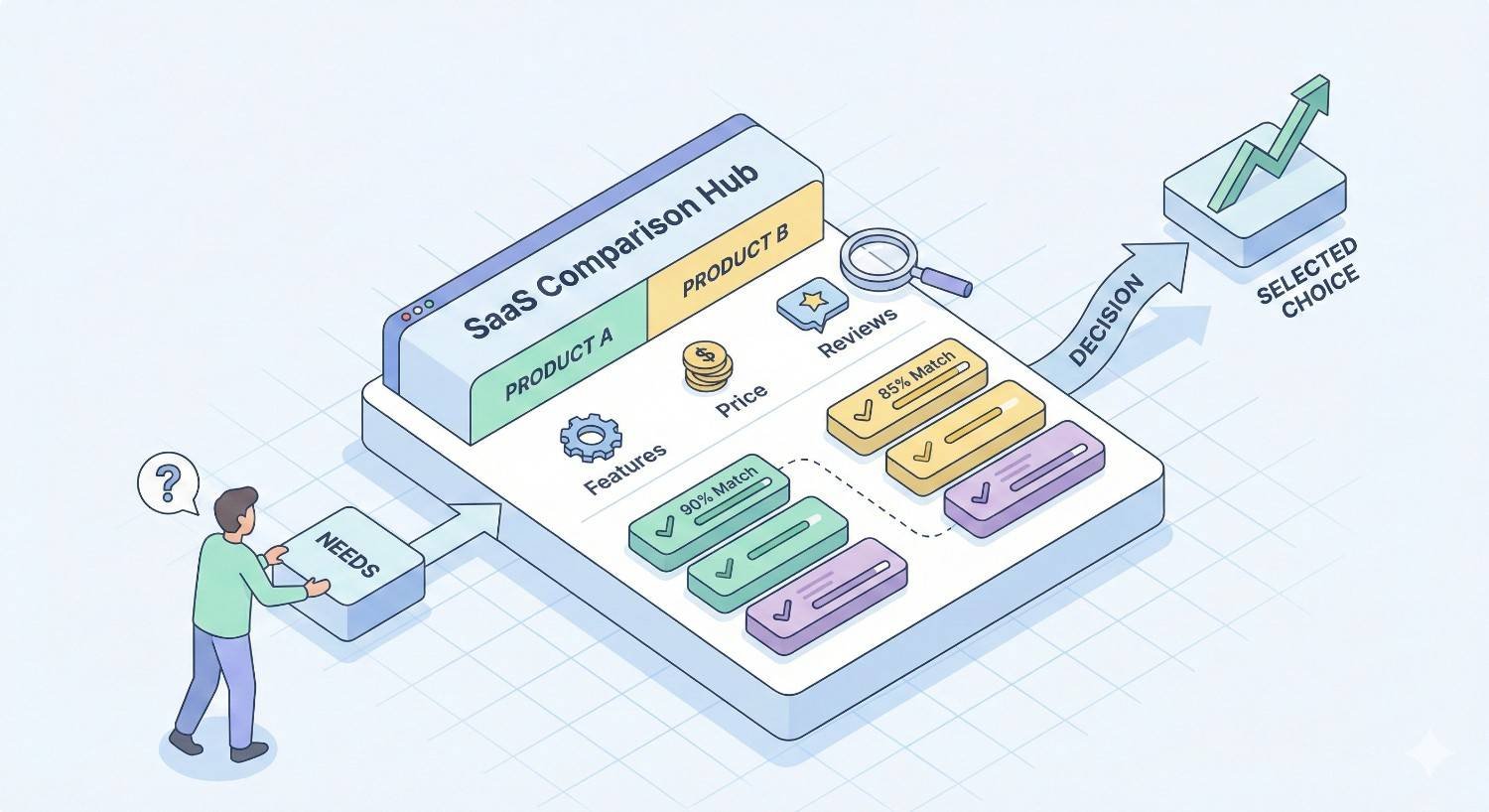
SaaS comparison pages are dedicated landing pages that evaluate your product against competitors or present alternatives to well-known solutions. Their core purpose is capturing commercial search traffic from buyers in the consideration and decision stages.
These pages serve a dual function. They satisfy user intent by providing objective product evaluations while strategically positioning your solution as the superior choice. The best comparison pages accomplish both without feeling promotional.
Unlike feature pages or product documentation, comparison content directly addresses the competitive questions prospects ask before purchasing. This makes them essential assets for any SaaS company competing in a crowded market.
Types of SaaS Comparison Content
One-to-One Competitor Comparisons
These pages directly compare your product against a single competitor. They target searches like “HubSpot vs Salesforce” or “Slack vs Microsoft Teams.” One-to-one comparisons work best when targeting a competitor with significant brand recognition and search volume.
The format typically includes feature-by-feature breakdowns, pricing comparisons, use case recommendations, and a clear verdict. Successful pages acknowledge competitor strengths while highlighting areas where your product excels.
Alternative Pages
Alternative pages target searches like “[Competitor] alternatives” or “best [Competitor] alternatives.” These capture users actively looking to switch from a specific product, often due to pricing, feature gaps, or poor experiences.
Alternative pages typically list multiple options, including your product, which builds credibility through apparent objectivity. Your product should appear prominently but not exclusively, as searchers expect genuine alternatives.
Multi-Product Roundups
Roundup pages compare multiple products in a category, targeting searches like “best project management software” or “top CRM tools for startups.” These pages cast a wider net, capturing users earlier in their research process.
While roundups require more research and maintenance, they establish topical authority and can rank for high-volume category keywords. They also create natural internal linking opportunities to your one-to-one comparison pages.
Feature Comparison Tables
Feature comparison tables provide scannable, side-by-side evaluations of specific capabilities. They work as standalone pages or embedded elements within broader comparison content.
Tables excel at communicating complex information quickly. They’re particularly effective for technical buyers who want to verify specific functionality before scheduling demos.
Where Comparison Pages Fit in the Buyer Journey
Comparison pages target the consideration and decision stages of the buyer journey. At this point, prospects have identified their problem, researched potential solutions, and narrowed their options to a shortlist.
These buyers aren’t looking for educational content. They want specific information to make a final decision: pricing details, feature differences, integration capabilities, and real user experiences.
This positioning makes comparison pages some of the highest-converting content in your SEO portfolio. According to Gartner research, B2B buyers spend 27% of their purchase journey researching independently online. Comparison pages capture this research activity and direct it toward your solution.
Why SaaS Comparison Pages Drive High-Intent Organic Traffic
Search Intent Alignment and Commercial Value
Comparison keywords signal clear commercial intent. Someone searching “Asana vs Monday” isn’t casually browsing. They’re actively evaluating tools and likely have budget allocated for a purchase.
This intent alignment creates exceptional traffic quality. While informational keywords might generate higher volume, comparison keywords deliver visitors ready to convert. A single comparison page visitor often equals dozens of top-funnel blog readers in terms of pipeline value.
Search engines recognize this intent pattern. Google’s algorithms increasingly prioritize content that matches user intent precisely. Comparison pages that deliver comprehensive, balanced evaluations earn strong rankings because they satisfy exactly what searchers need.
Conversion Rate Advantages Over Informational Content
Comparison pages consistently outperform informational content in conversion metrics. HubSpot’s marketing benchmarks show that bottom-funnel content converts at 2-5x higher rates than awareness-stage content.
This performance gap exists because comparison visitors arrive with purchase intent already established. They don’t need convincing that they have a problem or that software can solve it. They need help choosing between specific options.
The conversion advantage compounds over time. As comparison pages accumulate rankings and traffic, they become reliable pipeline generators that require minimal ongoing investment compared to paid acquisition channels.
Competitive Positioning and Brand Visibility
Comparison pages put your brand in direct conversation with market leaders. Even if you’re a smaller player, ranking for “[Big Competitor] vs [Your Product]” positions you as a legitimate alternative in buyers’ minds.
This visibility extends beyond direct traffic. Comparison rankings signal market relevance to analysts, investors, and potential partners. They demonstrate that your product competes at the level of established players.
Strategic comparison content also shapes competitive narratives. By controlling the comparison conversation, you determine which features get highlighted and how differences get framed. This proactive positioning beats letting competitors or third-party review sites define your market position.
How to Research and Select Comparison Page Targets
Identifying Competitor Keywords and Search Demand
Start by listing every competitor your sales team encounters during deals. Include direct competitors, adjacent solutions, and legacy tools your product replaces. This list forms your initial keyword universe.
Use keyword research tools like Ahrefs, Semrush, or Moz to analyze search volume for comparison queries. Focus on patterns like:
- [Competitor] vs [Your Product]
- [Competitor A] vs [Competitor B]
- [Competitor] alternatives
- [Competitor] competitors
- Best [Competitor] alternative
Prioritize competitors with meaningful search volume. A comparison page targeting a competitor nobody searches for won’t generate traffic regardless of how well it ranks.
Also examine your own brand’s comparison queries. If people search “[Your Product] vs [Competitor],” you need to own that conversation rather than ceding it to third-party sites or the competitor themselves.
Analyzing SERP Landscape and Ranking Difficulty
Before committing to a comparison target, analyze who currently ranks for that query. Search the exact keyword and evaluate the top ten results.
Look for these ranking signals:
- Domain authority of ranking sites
- Content depth and quality of existing pages
- Page type (vendor comparison vs third-party review)
- SERP features present (featured snippets, People Also Ask)
- Content freshness and update frequency
Vendor-created comparison pages can absolutely rank, even against third-party review sites. Google increasingly shows diverse result types, including vendor perspectives, when they provide genuine value.
Assess difficulty realistically. If the top results come from high-authority review sites with comprehensive content, you’ll need exceptional content and strong domain authority to compete. Start with lower-difficulty comparisons to build momentum.
Prioritizing Comparisons by Traffic Potential and Business Impact
Not all comparison opportunities deserve equal investment. Create a prioritization matrix weighing:
Traffic potential: Monthly search volume for the comparison query and related variations.
Conversion likelihood: How often do deals involve this competitor? Higher competitive overlap suggests higher conversion potential.
Strategic importance: Does winning this comparison support broader market positioning goals?
Ranking feasibility: Can you realistically rank within 6-12 months given current domain authority and competitive landscape?
Content investment: How much research and production effort does this comparison require?
Score each potential comparison across these dimensions. Focus initial efforts on high-impact, achievable targets before tackling more competitive comparisons.
Mapping Comparison Opportunities to Product Strengths
The best comparison pages highlight genuine product advantages. Before writing, map each competitor’s weaknesses against your strengths.
Identify specific areas where your product demonstrably outperforms:
- Feature capabilities
- Pricing and value
- Ease of use
- Integration ecosystem
- Customer support
- Implementation speed
- Scalability
Build comparison narratives around these genuine differentiators. Forced or exaggerated claims damage credibility and conversion rates. Authentic advantages, clearly communicated, drive results.
Also acknowledge areas where competitors excel. This honesty builds trust and helps readers self-select. A prospect who needs a feature you lack shouldn’t convert anyway. Transparent comparisons attract better-fit customers.
Structuring SaaS Comparison Pages for SEO and Conversions
Optimal Page Layout and Information Hierarchy
Effective comparison pages follow a predictable structure that serves both SEO and user experience goals. The layout should answer questions in the order users ask them.
Above the fold: Clear headline identifying the comparison, brief summary of key differences, and a comparison table or visual overview. Visitors should immediately understand what they’ll learn.
Quick verdict section: Many visitors want the bottom line first. Provide a summary recommendation early, then support it with detailed analysis below.
Detailed comparison sections: Break down differences by category (features, pricing, integrations, support). Use consistent formatting across all comparison pages for brand coherence.
Social proof: Customer testimonials, case studies, or review aggregations that validate your positioning.
Clear CTAs: Multiple conversion opportunities throughout the page, not just at the end.
This structure serves both scanners who want quick answers and researchers who need comprehensive detail.
Comparison Table Best Practices
Comparison tables are the most-viewed element on comparison pages. They need to communicate differences clearly and honestly.
Design principles:
- Use checkmarks and X marks sparingly. They oversimplify nuanced differences.
- Include specific details rather than just yes/no indicators.
- Highlight your advantages without hiding competitor strengths.
- Make tables mobile-responsive. Many comparison searches happen on phones.
- Keep tables scannable. Limit to 10-15 rows maximum.
Content principles:
- Compare features that matter to buyers, not just features where you win.
- Use neutral language in row labels.
- Include pricing information when possible.
- Update tables regularly as products evolve.
Tables should feel like objective resources, not marketing collateral. Readers recognize bias instantly, and it undermines the entire page’s credibility.
Writing Balanced, Credible Comparison Copy
The most effective comparison copy acknowledges that different products suit different needs. This balanced approach actually improves conversions by building trust.
Credibility techniques:
- Acknowledge competitor strengths explicitly.
- Explain who should choose the competitor instead of you.
- Use specific examples rather than vague claims.
- Cite third-party sources for claims about competitors.
- Avoid superlatives and marketing language.
Persuasion techniques:
- Lead with your strongest differentiators.
- Use customer quotes that address competitive concerns.
- Provide concrete evidence for capability claims.
- Address common objections proactively.
The goal is helping readers make the right decision, even if that decision isn’t your product. This approach builds long-term brand trust and attracts better-fit customers who convert and retain.
Integrating Social Proof and Trust Signals
Social proof transforms comparison pages from marketing claims into validated recommendations. Strategic placement of proof elements increases conversion rates significantly.
Effective social proof types:
- Customer testimonials addressing competitive switching
- Case studies from customers who evaluated competitors
- Third-party review scores and badges
- Customer logos, especially recognizable brands
- Specific metrics and outcomes from real customers
Placement strategy:
- Include proof near major claims about your product.
- Feature switching testimonials prominently.
- Use review aggregation widgets from G2, Capterra, or TrustRadius.
- Highlight industry-specific proof for relevant audiences.
Proof should feel integrated, not bolted on. Each testimonial or case study should support specific comparison points rather than generic product praise.
Call-to-Action Placement and Conversion Optimization
Comparison pages need multiple conversion opportunities because visitors arrive at different decision stages. Some want to try immediately. Others need more information first.
Primary CTA options:
- Free trial signup
- Demo request
- Pricing page link
- Contact sales
Secondary CTA options:
- Product tour or video
- Feature deep-dive pages
- Customer case studies
- Comparison PDF download
Placement strategy:
- Include a CTA above the fold.
- Add CTAs after major comparison sections.
- Use sticky CTAs on longer pages.
- End with a strong closing CTA.
Test different CTA combinations to optimize conversion rates. The right mix depends on your sales model, product complexity, and typical buyer journey.
On-Page SEO for SaaS Comparison Pages
Title Tags and Meta Descriptions for Comparison Queries
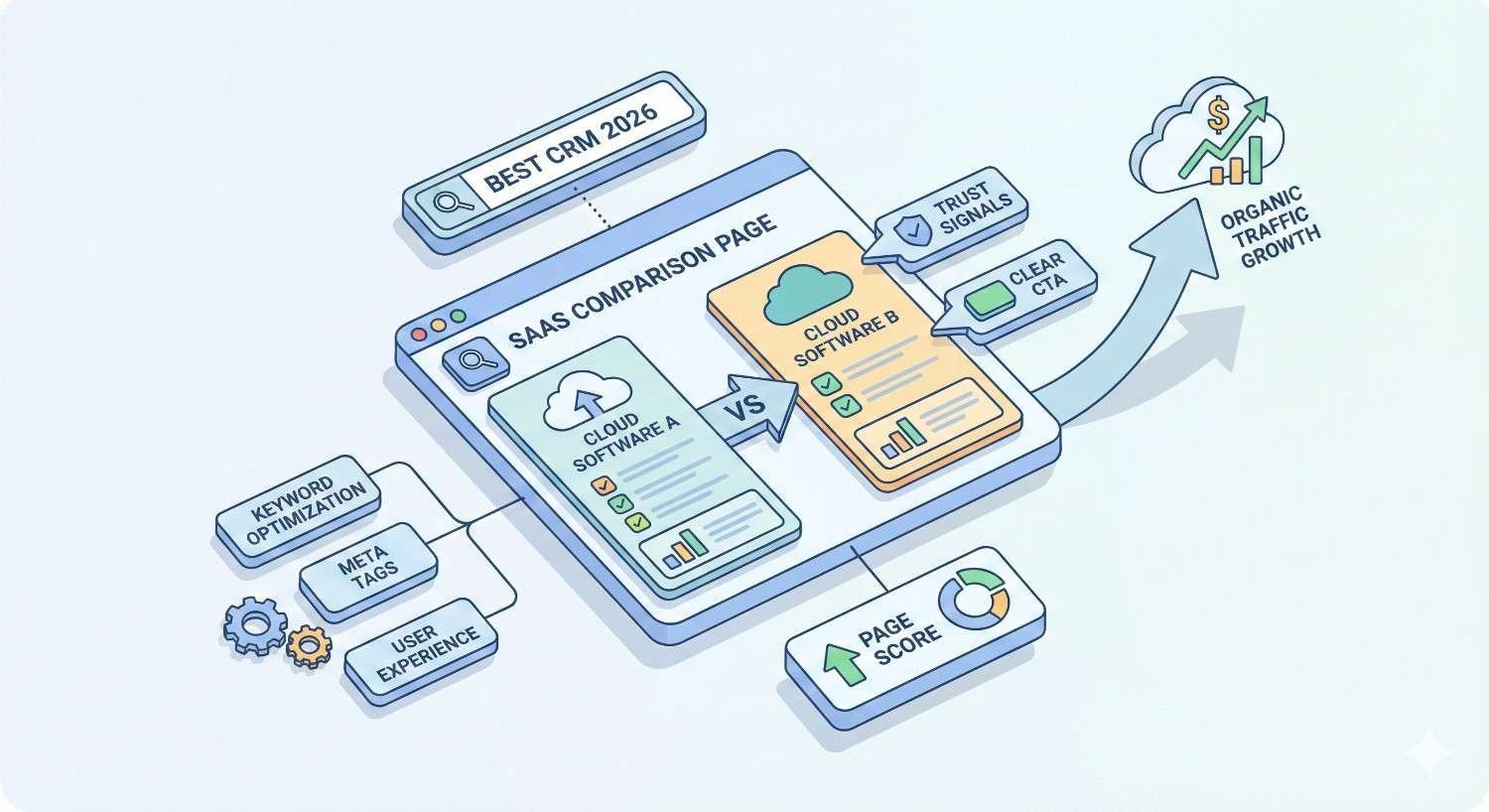
Title tags for comparison pages should clearly communicate the comparison being made while encouraging clicks.
Title tag formula:
[Product A] vs [Product B]: [Key Differentiator or Year]
Examples:
- “HubSpot vs Salesforce: Which CRM Fits Your Business (2025)”
- “Slack vs Microsoft Teams: Features, Pricing & Verdict”
- “10 Best Asana Alternatives for Project Management”
Keep titles under 60 characters to avoid truncation. Front-load the comparison keywords since they’re the primary search target.
Meta description strategy:
Meta descriptions should expand on the title’s promise and include a clear value proposition. Mention specific comparison elements like pricing, features, or use cases.
Example:
“Compare HubSpot and Salesforce across features, pricing, integrations, and ease of use. See which CRM fits your team size and sales process.”
Include a soft CTA when space allows: “Find your perfect fit” or “See the full breakdown.”
Header Structure and Semantic Markup
Proper header hierarchy helps search engines understand your content structure and improves accessibility.
H1: Use once, matching or closely reflecting the title tag. Include the primary comparison keyword.
H2s: Major comparison sections (Features, Pricing, Integrations, Verdict).
H3s: Subsections within each H2 (specific feature categories, pricing tiers).
H4s: Granular details when needed, but avoid over-nesting.
Maintain logical hierarchy. Every H3 should fall under a relevant H2. Skipping levels (H2 directly to H4) confuses both users and search engines.
Use semantic HTML elements beyond headers. Comparison tables should use proper <table> markup. Lists should use <ul> or <ol> elements. This semantic structure helps search engines parse and feature your content.
Internal Linking Strategy for Comparison Content
Comparison pages should connect to your broader content ecosystem through strategic internal linking.
Link to comparison pages from:
- Product pages (competitor comparison section)
- Pricing pages (value comparison context)
- Blog posts mentioning competitors
- Feature pages (competitive differentiation)
- Homepage (if comparisons are a key conversion path)
Link from comparison pages to:
- Detailed feature pages for claims made
- Pricing page for current information
- Case studies mentioned as proof
- Related comparison pages (create comparison hubs)
- Demo or trial signup pages
Use descriptive anchor text that includes relevant keywords. “See our full feature comparison” beats “click here” for both users and search engines.
Schema Markup for Comparison and Review Content
Structured data helps search engines understand your comparison content and can enable rich results in SERPs.
Relevant schema types:
- Product schema: For your product and competitors mentioned
- Review schema: If including ratings or review aggregations
- FAQ schema: For frequently asked questions sections
- Article schema: For the overall page content
- Table schema: For comparison tables
Implement schema using JSON-LD format in your page’s head section. Test implementation using Google’s Rich Results Test tool.
Note that Google’s guidelines prohibit self-serving review markup. Don’t use review schema to rate your own product favorably. Use it for legitimate third-party review aggregations only.
Content Quality and E-E-A-T Considerations
Demonstrating First-Hand Experience and Expertise
Google’s E-E-A-T guidelines emphasize first-hand experience as a quality signal. Comparison pages should demonstrate genuine product knowledge.
Experience signals:
- Screenshots from actual product usage
- Specific workflow descriptions
- Detailed feature explanations beyond marketing copy
- Mention of testing methodology
- Author credentials and product expertise
Expertise signals:
- Technical accuracy in feature descriptions
- Industry-specific context and use cases
- Nuanced recommendations based on buyer segments
- Acknowledgment of product limitations
If your team hasn’t used competitor products directly, consider purchasing trials for research purposes. First-hand experience produces more accurate, credible comparisons than relying on marketing materials alone.
Maintaining Objectivity and Transparency
Readers expect vendor comparison pages to favor the vendor’s product. Exceeding this expectation through genuine objectivity builds trust and improves conversions.
Objectivity practices:
- Clearly identify yourself as the vendor upfront
- Acknowledge competitor advantages honestly
- Recommend competitors for specific use cases when appropriate
- Avoid misleading feature comparisons
- Use neutral language in descriptions
Transparency practices:
- Disclose your relationship to the products compared
- Date your content and note when last updated
- Cite sources for competitor information
- Explain your comparison methodology
This transparency doesn’t weaken your competitive position. It strengthens it by establishing your brand as trustworthy and customer-focused.
Updating Comparison Pages for Accuracy
SaaS products evolve constantly. Comparison pages require regular updates to maintain accuracy and rankings.
Update triggers:
- Competitor pricing changes
- New feature releases (yours or competitors)
- Significant UI/UX changes
- Market positioning shifts
- New competitors entering the space
Update frequency:
Audit comparison pages quarterly at minimum. High-traffic pages warrant monthly reviews. Set calendar reminders and assign ownership to ensure updates happen.
Update signals:
- Add “Last updated” dates to pages
- Note significant changes in update logs
- Refresh screenshots and examples
- Update any time-sensitive claims
Search engines favor fresh, accurate content. Regular updates also give you opportunities to improve rankings through content enhancements.
Building Authority and Links for Comparison Pages
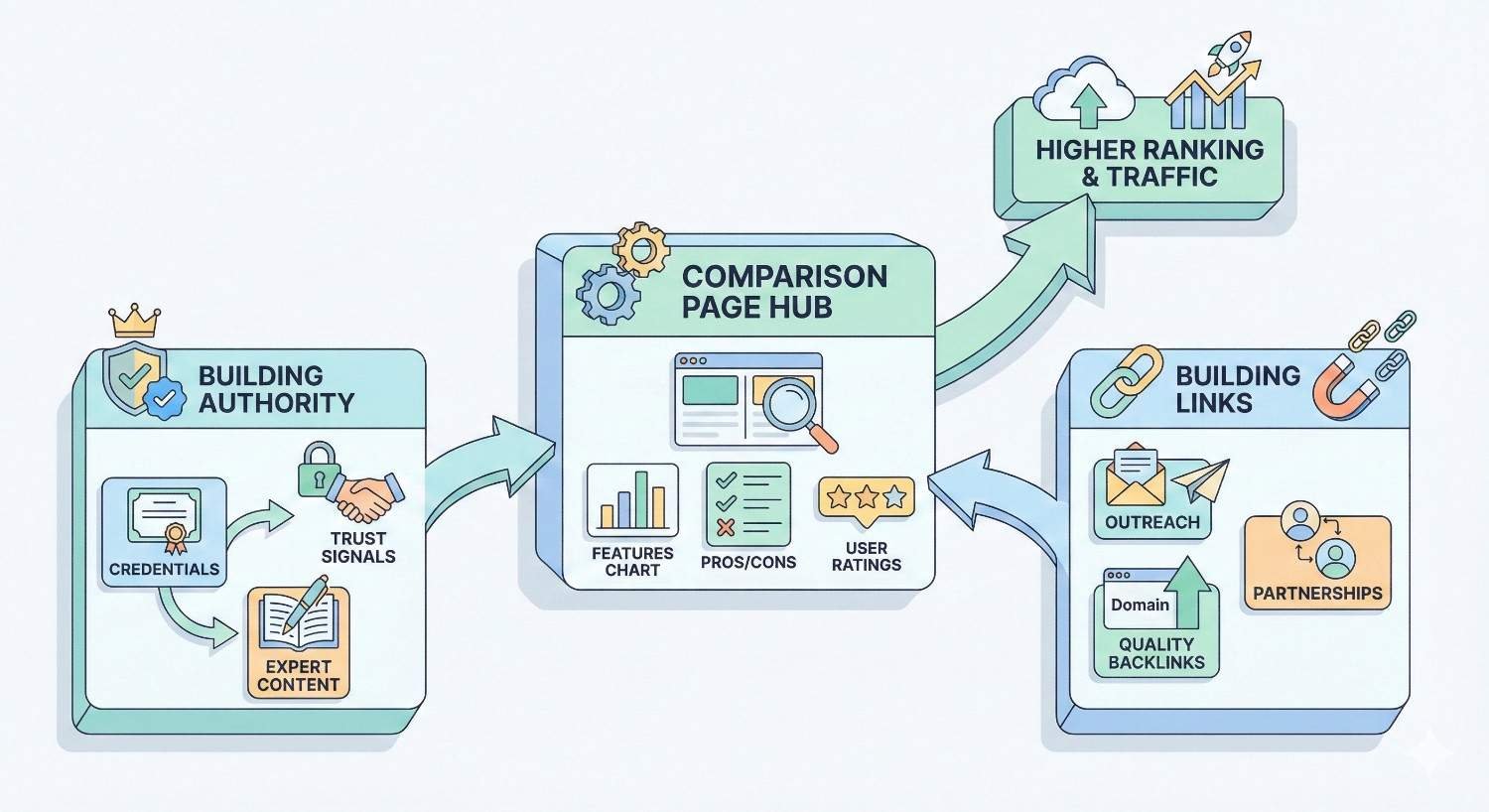
Link Acquisition Strategies for Comparison Content
Comparison pages can earn links through several strategies, though they require different approaches than informational content.
Resource page outreach:
Many industry resource pages link to comparison content. Identify relevant resource pages and pitch your comparison as a valuable addition for their audience.
Broken link building:
Find broken links to outdated comparison content and offer your updated page as a replacement. Tools like Ahrefs can identify broken link opportunities at scale.
Original research:
Add unique data to comparison pages, such as performance benchmarks, survey results, or pricing analysis. Original research earns links from journalists and bloggers covering your industry.
Guest posting:
Write guest posts for industry publications that naturally reference your comparison content. Focus on topics where comparison data adds value to the discussion.
Leveraging Comparison Pages for Digital PR
Comparison content can generate media coverage when positioned correctly.
PR angles:
- Industry pricing trends based on your comparison research
- Feature evolution analysis across competitors
- Market consolidation or fragmentation insights
- Buyer behavior data from your comparison page analytics
Outreach targets:
- Industry trade publications
- Business and technology journalists
- Podcast hosts covering your market
- Newsletter writers in your space
Frame pitches around insights and trends rather than your product specifically. Journalists want stories, not product promotions.
Competitor Mention Outreach Tactics
When you publish comparison content, notify relevant parties who might share or link to it.
Outreach targets:
- Bloggers who’ve written about the competitors you compare
- Review sites covering your product category
- Consultants who advise on tool selection
- Community managers in relevant forums or groups
Outreach approach:
Position your comparison as a resource for their audience rather than a promotional piece. Emphasize the balanced, comprehensive nature of your analysis.
Avoid contacting competitors directly about comparison content. This rarely produces positive outcomes and can create unnecessary friction.
Measuring SaaS Comparison Page Performance
Key Metrics and KPIs to Track
Comparison page success requires tracking both traffic and conversion metrics.
Traffic metrics:
- Organic sessions and users
- Keyword rankings for target comparisons
- Click-through rate from SERPs
- Bounce rate and time on page
- Pages per session from comparison entry
Conversion metrics:
- Trial signups attributed to comparison pages
- Demo requests from comparison traffic
- Conversion rate by comparison page
- Pipeline generated from comparison visitors
- Revenue attributed to comparison content
Engagement metrics:
- Scroll depth
- CTA click rates
- Table interaction (if trackable)
- Video plays (if embedded)
Set up dashboards tracking these metrics weekly. Monthly reviews should analyze trends and identify optimization opportunities.
Attribution and Conversion Tracking Setup
Accurate attribution requires proper tracking infrastructure.
Technical setup:
- UTM parameters for internal links to comparison pages
- Goal tracking in Google Analytics for key conversions
- Event tracking for CTA clicks and engagement
- CRM integration for pipeline attribution
Attribution models:
Comparison pages often appear mid-funnel, making attribution complex. Consider:
- First-touch attribution (did comparison page start the journey?)
- Last-touch attribution (did comparison page close the deal?)
- Multi-touch attribution (what role did comparison play?)
Most SaaS companies benefit from multi-touch models that credit comparison pages appropriately without over or undervaluing their contribution.
Iterating Based on Performance Data
Use performance data to continuously improve comparison pages.
Optimization opportunities:
- Low CTR: Test new title tags and meta descriptions
- High bounce rate: Improve above-fold content and page speed
- Low conversion rate: Test CTA placement, copy, and offers
- Declining rankings: Update content and build additional links
A/B testing priorities:
- CTA button copy and design
- Comparison table format and content
- Social proof placement and type
- Page layout and information hierarchy
Document changes and results to build institutional knowledge about what works for your audience.
Common Mistakes in SaaS Comparison Page Strategy
Overly Biased or Salesy Content
The most common comparison page mistake is obvious bias that undermines credibility.
Signs of problematic bias:
- Competitor weaknesses exaggerated or fabricated
- Your product’s limitations never mentioned
- Comparison criteria cherry-picked to favor your product
- Marketing language instead of factual descriptions
- No acknowledgment of legitimate competitor strengths
Consequences:
Biased content converts poorly because readers recognize manipulation. It also risks negative brand perception and potential legal issues if claims are demonstrably false.
Solution:
Write comparisons you’d be comfortable showing to the competitor’s team. If any claim would embarrass you in that context, revise it.
Ignoring Search Intent Variations
Different comparison queries signal different intents. Treating all comparison searches identically misses conversion opportunities.
Intent variations:
- “[A] vs [B]”: Direct comparison, decision-stage
- “[A] alternatives”: Switching intent, possibly negative experience with A
- “Best [category] software”: Earlier research stage, broader consideration
- “[A] vs [B] pricing”: Specific concern, possibly budget-constrained
Solution:
Create different content types for different intents. A “[Competitor] alternatives” page should differ significantly from a direct “[You] vs [Competitor]” comparison.
Neglecting Mobile and Page Experience
Many comparison searches happen on mobile devices, yet comparison pages often perform poorly on small screens.
Common mobile issues:
- Tables that require horizontal scrolling
- CTAs too small to tap easily
- Slow load times from unoptimized images
- Text too small to read comfortably
Solution:
Design mobile-first. Test comparison pages on actual devices, not just browser emulators. Prioritize Core Web Vitals scores, as page experience affects both rankings and conversions.
Failing to Update Outdated Information
Stale comparison content damages credibility and rankings.
Outdated content risks:
- Incorrect pricing frustrates and misleads visitors
- Missing features make your comparison incomplete
- Old screenshots look unprofessional
- Competitors may have addressed previous weaknesses
Solution:
Implement a systematic update process. Assign ownership, set review schedules, and track competitor changes proactively.
SaaS Comparison Page Examples and Case Studies
High-Performing Comparison Page Breakdowns
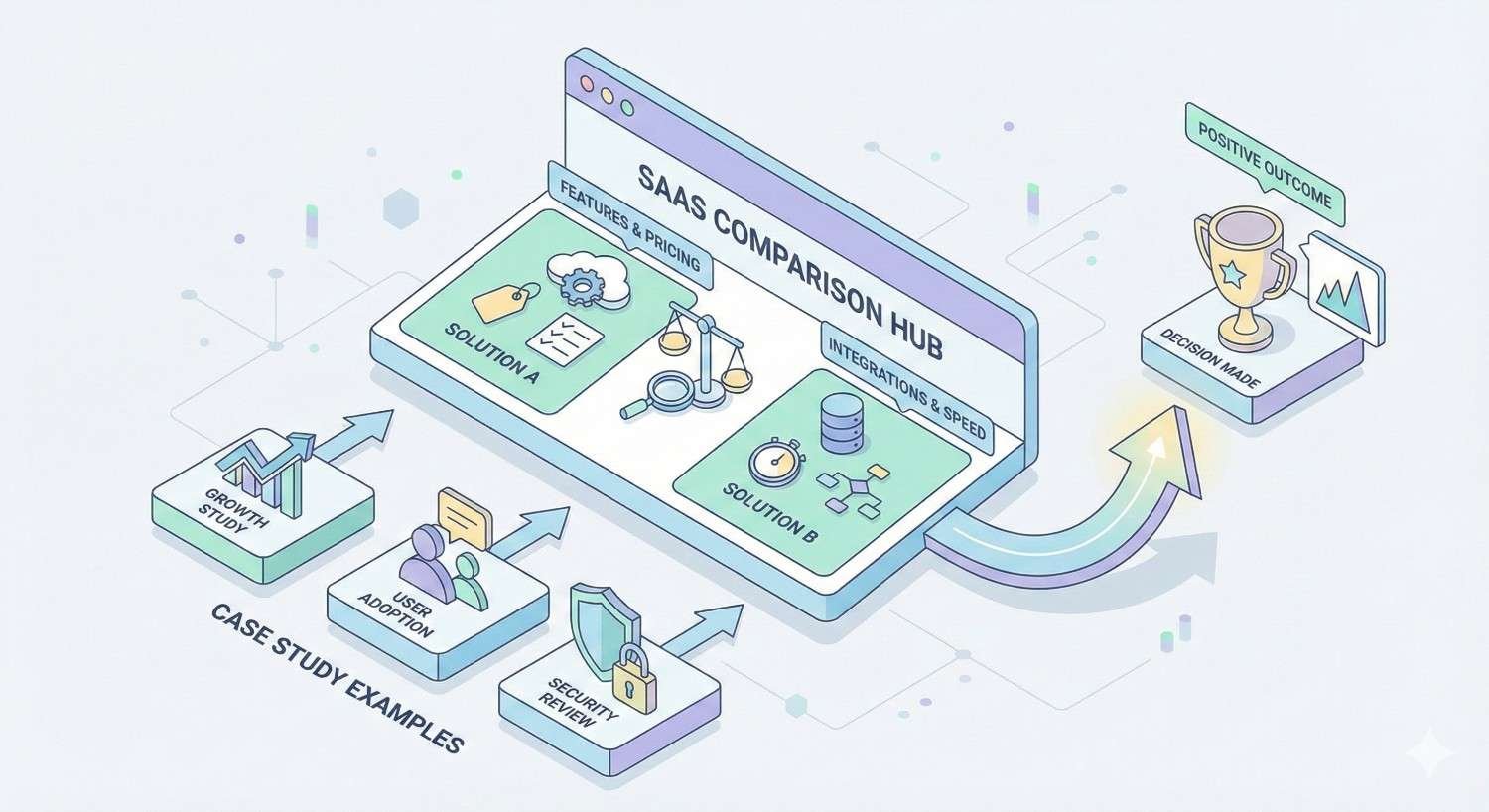
Successful comparison pages share common characteristics worth emulating.
Effective elements observed in top performers:
- Clear, scannable comparison tables above the fold
- Balanced tone acknowledging competitor strengths
- Specific use case recommendations
- Strong social proof from customers who switched
- Multiple CTA types for different buyer stages
- Regular content updates with visible timestamps
Structure patterns:
Most high-performing pages follow a similar flow: quick verdict, detailed comparison by category, social proof, and strong closing CTA. This structure serves both quick scanners and thorough researchers.
Lessons from Successful SaaS Comparison Strategies
Companies with mature comparison programs share strategic approaches.
Portfolio approach:
Successful programs don’t rely on single comparison pages. They build comprehensive comparison content covering all significant competitors and alternative queries.
Integration with sales:
Top performers align comparison content with sales team needs. Sales reps use comparison pages in deals, and their feedback improves content quality.
Continuous optimization:
Leading programs treat comparison pages as living assets. They test, update, and improve continuously rather than publishing and forgetting.
Cross-functional ownership:
Effective comparison programs involve product marketing, SEO, content, and sales teams. This collaboration ensures accuracy, optimization, and practical utility.
Scaling Your SaaS Comparison Content Program
Building a Comparison Page Content Calendar
Systematic content planning prevents gaps and ensures consistent output.
Calendar components:
- New comparison page production schedule
- Update cycles for existing pages
- Competitor monitoring triggers
- Seasonal or event-based updates
Prioritization framework:
Sequence new comparisons by traffic potential and strategic importance. Don’t try to cover every competitor simultaneously. Build momentum with achievable targets first.
Resource allocation:
Estimate production time realistically. Quality comparison pages require research, writing, design, and review. Rushing production compromises quality and results.
Template and Workflow Standardization
Templates accelerate production while maintaining quality consistency.
Template elements:
- Standard page structure and sections
- Comparison table format
- CTA placement guidelines
- Social proof integration points
- SEO checklist items
Workflow stages:
- Research and competitor analysis
- Outline and positioning development
- Content drafting
- Design and visual elements
- SEO optimization
- Review and approval
- Publication and promotion
- Performance monitoring
Document workflows clearly so team members can execute consistently. Templates should guide without constraining creativity for unique comparison angles.
Integrating Comparison Pages into Broader SEO Strategy
Comparison pages work best as part of comprehensive SEO programs.
Content ecosystem integration:
- Link comparison pages from relevant blog content
- Create category hub pages connecting related comparisons
- Build supporting content that strengthens comparison page authority
- Develop bottom-funnel content clusters around comparison themes
Technical SEO alignment:
- Ensure comparison pages meet Core Web Vitals standards
- Implement proper internal linking architecture
- Optimize for featured snippets and SERP features
- Monitor and address crawling or indexing issues
Authority building:
Comparison page rankings improve as overall domain authority grows. Invest in link building and content marketing that benefits your entire site, not just comparison pages specifically.
Conclusion
SaaS comparison pages represent one of the highest-ROI content investments available to software companies. They capture bottom-funnel traffic, convert at exceptional rates, and position your brand directly against competitors in buyers’ minds.
Success requires balancing SEO optimization with genuine user value. The best comparison pages rank well because they deserve to, providing comprehensive, balanced, and regularly updated information that helps buyers make confident decisions.
At White Label SEO Service, we help SaaS companies build comparison page programs that drive sustainable organic growth. From keyword research and content strategy to technical optimization and performance tracking, our team delivers the expertise needed to compete and win in search.
Frequently Asked Questions About SaaS Comparison Pages
Are comparison pages ethical if you’re the vendor?
Yes, vendor-created comparison pages are ethical when they’re transparent and accurate. Disclose your relationship to the products, present information honestly, and acknowledge competitor strengths. Readers expect some bias from vendors but appreciate genuine helpfulness over manipulation.
How do comparison pages impact brand perception?
Well-executed comparison pages strengthen brand perception by demonstrating confidence and transparency. Poor comparisons that feel manipulative damage trust. The key is providing genuine value to readers, even when that means acknowledging your product isn’t right for everyone.
What’s the ideal word count for comparison pages?
Most successful comparison pages range from 1,500 to 3,000 words. Length should match the complexity of the comparison and user needs. Comprehensive comparisons of enterprise products warrant more depth than simple tool comparisons. Prioritize completeness over arbitrary word counts.
Should you include pricing on comparison pages?
Include pricing when possible, as it’s one of the most-searched comparison elements. If competitor pricing isn’t publicly available, note that clearly. Update pricing information regularly since outdated prices frustrate users and damage credibility.
How long does it take for comparison pages to rank?
New comparison pages typically take 3-6 months to reach stable rankings, depending on domain authority and competition. Lower-competition comparisons may rank faster. High-competition queries against established review sites may take longer or require additional authority building.
How often should SaaS comparison pages be updated?
Review comparison pages quarterly at minimum. Update immediately when competitors change pricing, release major features, or rebrand. High-traffic pages warrant monthly reviews. Add visible “last updated” dates to signal freshness to both users and search engines.
Can small SaaS companies rank comparison pages against larger competitors?
Yes, smaller companies can rank comparison pages against larger competitors. Focus on long-tail comparison queries, provide exceptional content depth, and build authority systematically. Your direct product knowledge often enables more detailed, accurate comparisons than third-party review sites can produce.