
SaaS SEO agency retainers typically range from $3,000 to $25,000+ monthly, while building an in-house team costs $240,000 to $400,000+ annually when you factor in salaries, benefits, tools, and overhead. The right choice depends on your growth stage, budget flexibility, and how quickly you need results.
This decision shapes your organic growth trajectory for years. Get it wrong, and you burn budget without building sustainable search visibility. Get it right, and SEO becomes your most cost-effective customer acquisition channel.
This guide breaks down real costs, hidden expenses, ROI timelines, and decision frameworks so you can make an informed investment choice for your SaaS business.
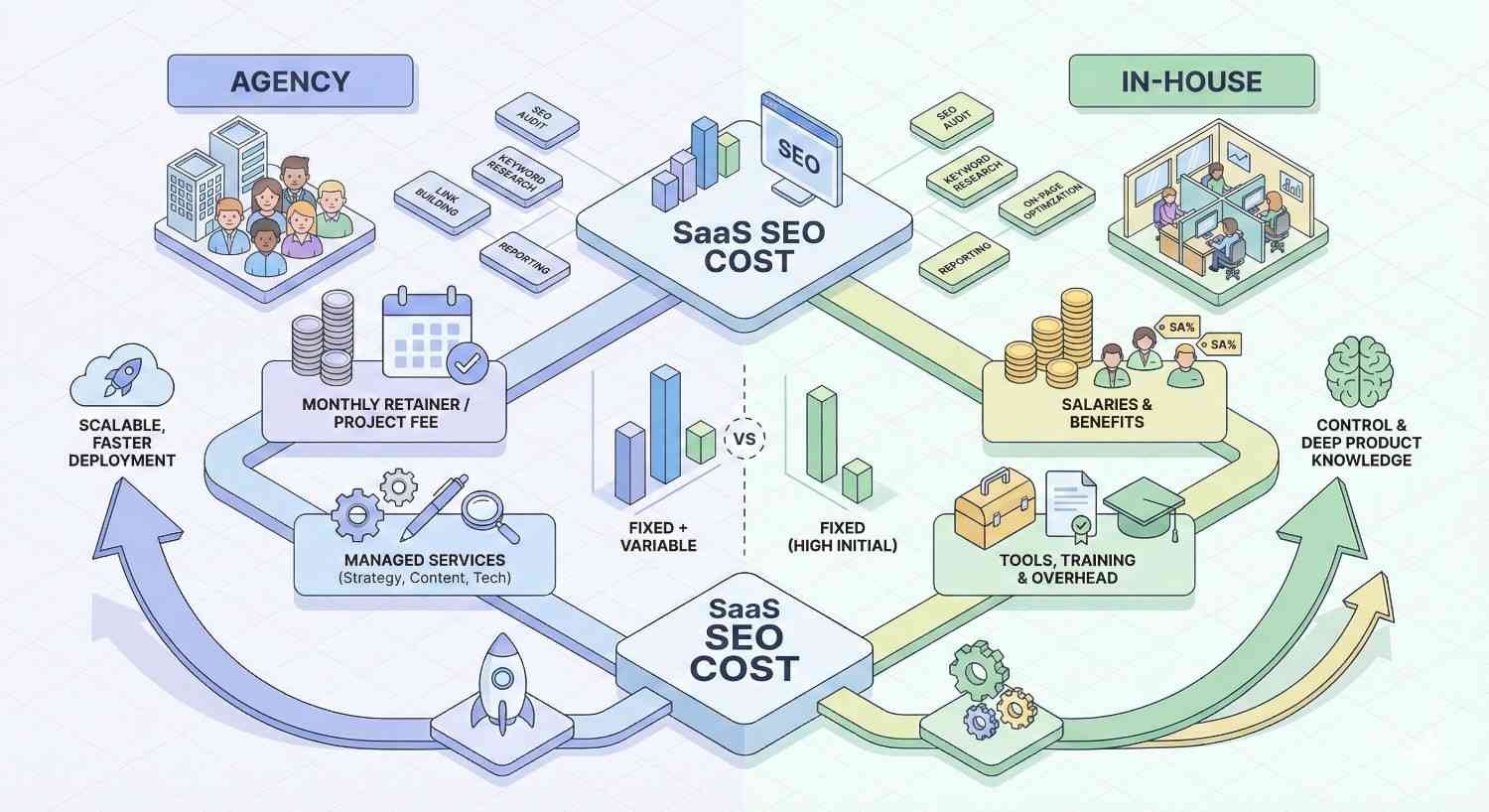
What Does SaaS SEO Cost? Agency vs In-House Overview
Defining SaaS SEO Requirements
SaaS SEO differs fundamentally from traditional SEO. You’re optimizing for complex buyer journeys, technical product documentation, feature comparison pages, integration content, and bottom-of-funnel conversion pages simultaneously.
A typical SaaS SEO program requires technical SEO expertise to handle JavaScript rendering, site architecture for multiple product lines, and Core Web Vitals optimization. Content needs span educational blog posts, product-led content, comparison pages, and documentation that ranks.
Link building for SaaS demands relationships with industry publications, technology reviewers, and integration partners. You need expertise across multiple disciplines working in coordination.
Most SaaS companies need coverage across four core areas: technical SEO foundations, content strategy and production, authority building through links and digital PR, and performance tracking with attribution modeling. Whether you hire an agency or build in-house, these requirements don’t change. Only the delivery method and cost structure differ.
Why This Comparison Matters for Growing Businesses
The agency vs in-house decision impacts more than your marketing budget. It affects how quickly you can execute, how deeply SEO integrates with product development, and whether you build lasting internal capabilities.
Early-stage SaaS companies often default to agencies because hiring feels risky. Established companies sometimes build in-house teams without calculating true costs. Both approaches work. Neither is universally better.
Your specific situation determines the right answer. Revenue predictability, growth targets, existing marketing infrastructure, and competitive landscape all factor into this decision. A Series A startup with 18 months of runway faces different constraints than a profitable SaaS with $10M ARR.
SaaS SEO Agency Costs Breakdown
Monthly Retainer Pricing Models ($3,000–$25,000+)
Agency retainers vary dramatically based on scope, expertise level, and market positioning. Understanding these tiers helps you evaluate proposals accurately.
Entry-level agencies ($3,000–$5,000/month) typically provide basic technical audits, limited content production, and templated reporting. You might get 4-8 blog posts monthly, quarterly technical reviews, and standard link building outreach. These agencies often work with junior staff and use standardized processes across all clients.
Mid-market agencies ($5,000–$12,000/month) offer more customization. Expect dedicated account management, 8-15 content pieces monthly, ongoing technical optimization, and strategic link building campaigns. These agencies usually have SaaS experience and can handle product-led content strategies.
Premium SaaS-focused agencies ($12,000–$25,000+/month) provide senior strategists, custom content frameworks, enterprise-level technical SEO, and sophisticated link building through digital PR and thought leadership. They typically work with fewer clients and offer deeper integration with your marketing team.
The price difference reflects expertise depth, execution capacity, and strategic sophistication. A $5,000 retainer buys different outcomes than a $20,000 retainer.
Project-Based SEO Pricing
Some agencies offer project-based pricing for specific deliverables. This model works well for defined scopes with clear endpoints.
Technical SEO audits typically range from $2,500 to $15,000 depending on site complexity. A 50-page SaaS site costs less to audit than a 5,000-page platform with multiple subdomains and JavaScript rendering challenges.
Content strategy development runs $5,000 to $20,000 for comprehensive keyword research, content gap analysis, and editorial calendar creation. This deliverable provides the roadmap for ongoing content production.
Site migrations and redesigns command $10,000 to $50,000+ depending on complexity. These projects require intensive technical work over compressed timelines with significant risk if executed poorly.
Link building campaigns as standalone projects typically cost $3,000 to $10,000 monthly for defined periods. Agencies may offer 3-month or 6-month campaign packages focused on specific authority-building goals.
Performance-Based Pricing Structures
Performance-based models tie agency compensation to results. These arrangements sound attractive but require careful evaluation.
Ranking-based models pay agencies when target keywords reach specific positions. The risk: agencies may target easier keywords that drive rankings but not revenue. Ensure contracts specify keywords aligned with business outcomes.
Traffic-based models compensate based on organic traffic growth. This aligns incentives better but doesn’t account for traffic quality. A 50% traffic increase means nothing if visitors don’t convert.
Lead-based models pay per marketing qualified lead from organic search. This creates strong alignment but requires sophisticated attribution and clear lead definitions. Expect higher per-lead costs to compensate for agency risk.
Most reputable agencies avoid pure performance models because SEO results depend on factors outside their control. Algorithm updates, competitor actions, and client-side implementation delays all affect outcomes. Hybrid models combining base retainers with performance bonuses often work better.
What’s Typically Included in Agency Packages
Understanding standard inclusions helps you compare proposals accurately and identify gaps.
Technical SEO Audits & Implementation
Comprehensive technical audits cover crawlability, indexation, site architecture, page speed, mobile usability, structured data, and Core Web Vitals. Quality agencies provide prioritized recommendations with implementation guidance.
Implementation support varies. Some agencies handle technical changes directly. Others provide specifications for your development team. Clarify this before signing. Development bottlenecks kill SEO momentum.
Ongoing technical monitoring catches issues before they impact rankings. Expect regular crawl analysis, index coverage monitoring, and Core Web Vitals tracking as part of retained engagements.
Content Strategy & Production
Content services typically include keyword research, topic clustering, content briefs, writing, editing, and optimization. Production volume depends on retainer level.
Quality varies significantly. Some agencies use in-house writers with SaaS expertise. Others outsource to content mills. Ask about writer backgrounds and request samples. SaaS content requires understanding complex products and technical concepts.
Content strategy should connect to your product positioning and buyer journey. Generic blog posts don’t move pipeline. Effective SaaS content addresses specific pain points and positions your product as the solution.
Link Building & Authority Development
Link building approaches range from basic outreach to sophisticated digital PR campaigns. Methods include guest posting, resource link building, broken link building, HARO responses, and original research promotion.
Quality agencies focus on relevant, authoritative links rather than volume. Ten links from respected SaaS publications outperform 100 links from random blogs. Ask about link quality standards and typical referring domain profiles.
Digital PR campaigns create linkable assets and pitch them to journalists and industry publications. This approach builds brand awareness alongside link equity but requires larger budgets and longer timelines.
Reporting & Performance Tracking
Standard reporting includes ranking tracking, traffic analysis, and conversion monitoring. Quality agencies connect SEO metrics to business outcomes like leads, trials, and revenue.
Reporting frequency varies from weekly dashboards to monthly comprehensive reviews. Ensure reports include actionable insights, not just data dumps. Good agencies explain what happened, why it matters, and what they’re doing about it.
Attribution modeling for SaaS requires understanding multi-touch buyer journeys. Organic search often assists conversions attributed to other channels. Sophisticated agencies help you understand true SEO impact beyond last-click attribution.
Hidden Costs & Additional Fees to Consider
Agency contracts often exclude costs that add up quickly.
Content production overages occur when you need more content than your retainer includes. Agencies typically charge $300-$800 per additional blog post, more for technical or long-form content.
Development implementation costs fall outside most agency scopes. Technical recommendations require developer time. Budget 10-20 hours monthly for SEO-related development work.
Tool access fees sometimes get passed through. Some agencies include enterprise tools in their retainer. Others charge separately for access to rank tracking, technical audit platforms, or content optimization tools.
Rush fees apply when you need faster turnaround. Expect 25-50% premiums for expedited work.
Strategy pivots may incur additional charges. If you launch a new product line or enter new markets, agencies may need to scope additional work beyond your original agreement.
In-House SaaS SEO Team Costs Breakdown
Salary Ranges by Role
Building an effective in-house team requires multiple specialized roles. Salary ranges reflect 2024 market rates for experienced professionals in major markets.
SEO Manager ($70,000–$120,000)
The SEO Manager owns strategy, coordinates execution, and reports on performance. This role requires 5+ years of SEO experience, preferably with SaaS or B2B technology companies.
Strong candidates understand technical SEO, content strategy, and link building at a strategic level. They can manage agencies, contractors, or junior team members while maintaining hands-on involvement in critical initiatives.
At the lower end, you’ll find candidates with solid execution skills but limited strategic experience. Higher salaries attract professionals who’ve built SEO programs at successful SaaS companies and can replicate that success.
Content Strategist ($55,000–$90,000)
Content Strategists translate keyword research into editorial calendars and content briefs. They understand buyer journeys, search intent, and how to create content that ranks and converts.
This role bridges SEO and content marketing. Strong candidates have both SEO knowledge and editorial skills. They can manage writers, maintain brand voice, and optimize content for search without sacrificing readability.
Junior Content Strategists handle execution with guidance. Senior professionals develop comprehensive content frameworks and mentor other team members.
Technical SEO Specialist ($65,000–$110,000)
Technical SEO Specialists handle site architecture, crawlability, page speed, structured data, and Core Web Vitals. They work closely with development teams to implement optimizations.
This role requires understanding of HTML, CSS, JavaScript, and how search engines crawl and render pages. Experience with enterprise CMS platforms, headless architectures, or JavaScript frameworks commands premium salaries.
Technical SEO specialists are harder to find than generalists. Strong candidates often come from development backgrounds with SEO training or vice versa.
Link Building Specialist ($50,000–$80,000)
Link Building Specialists execute outreach campaigns, manage relationships with publishers, and secure quality backlinks. This role requires persistence, communication skills, and creativity.
Effective link builders understand what makes content linkable and can pitch stories to journalists and bloggers. They track outreach metrics, maintain prospect databases, and continuously refine their approach.
This role has high turnover due to the repetitive nature of outreach work. Budget for ongoing recruitment or consider outsourcing link building to specialized agencies.
Full Employment Costs Beyond Salary
Salaries represent only 60-70% of true employment costs. Factor in these additional expenses.
Benefits & Insurance (20–30% overhead)
Health insurance, dental, vision, and life insurance add significant costs. For a $100,000 salary, expect $15,000-$25,000 in benefits costs annually.
Retirement contributions, whether 401(k) matching or other plans, add another 3-6% of salary. Paid time off, while not a direct cost, reduces productive hours by 10-15%.
Payroll taxes including Social Security, Medicare, and unemployment insurance add approximately 7.65% to salary costs.
Training & Professional Development
SEO changes constantly. Budget $2,000-$5,000 per employee annually for conferences, courses, certifications, and learning resources.
New hires require onboarding time from existing team members. Expect 40-80 hours of manager time to onboard each new SEO team member effectively.
Management & Supervision Time
Someone must manage your SEO team. If that’s you or another executive, factor in the opportunity cost of that time. If you hire a dedicated manager, add their salary to total costs.
Weekly one-on-ones, performance reviews, career development conversations, and team coordination consume 5-10 hours weekly for a manager overseeing 3-4 SEO professionals.
SEO Tools & Software Stack Costs
Professional SEO requires enterprise-grade tools. Budget $2,000-$5,000 monthly for a comprehensive stack.
Enterprise SEO Platforms ($500–$2,000+/month)
Platforms like Semrush, Ahrefs, or Moz Pro provide keyword research, rank tracking, backlink analysis, and competitive intelligence. Enterprise tiers with higher limits and additional features cost more.
Semrush’s enterprise plans start around $450/month and scale based on users and data limits. Ahrefs offers similar pricing structures. Most SaaS companies need mid-tier or enterprise plans to handle their data needs.
Content & Keyword Research Tools
Beyond core SEO platforms, you may need specialized content tools. Clearscope, Surfer SEO, or MarketMuse help optimize content for search intent. These tools run $200-$500 monthly.
Additional keyword research tools like Keywords Everywhere, AnswerThePublic, or AlsoAsked add $50-$200 monthly for premium features.
Technical Audit & Monitoring Tools
Screaming Frog ($259/year), Sitebulb ($35-$100/month), or DeepCrawl ($100-$500/month) handle technical audits and monitoring. Google Search Console is free but limited for enterprise needs.
Page speed monitoring through tools like SpeedCurve or Calibre adds $50-$200 monthly. Uptime monitoring and log file analysis tools add additional costs.
Infrastructure & Operational Costs
Beyond salaries and tools, in-house teams require infrastructure support.
Office space and equipment for each employee costs $5,000-$15,000 annually depending on your location and setup. Remote teams reduce this but don’t eliminate it entirely.
HR and administrative overhead for recruiting, payroll processing, and employee management adds 5-10% to total team costs.
Contractor and freelancer costs fill gaps when your team lacks specific skills. Budget $5,000-$20,000 annually for specialized projects or overflow work.
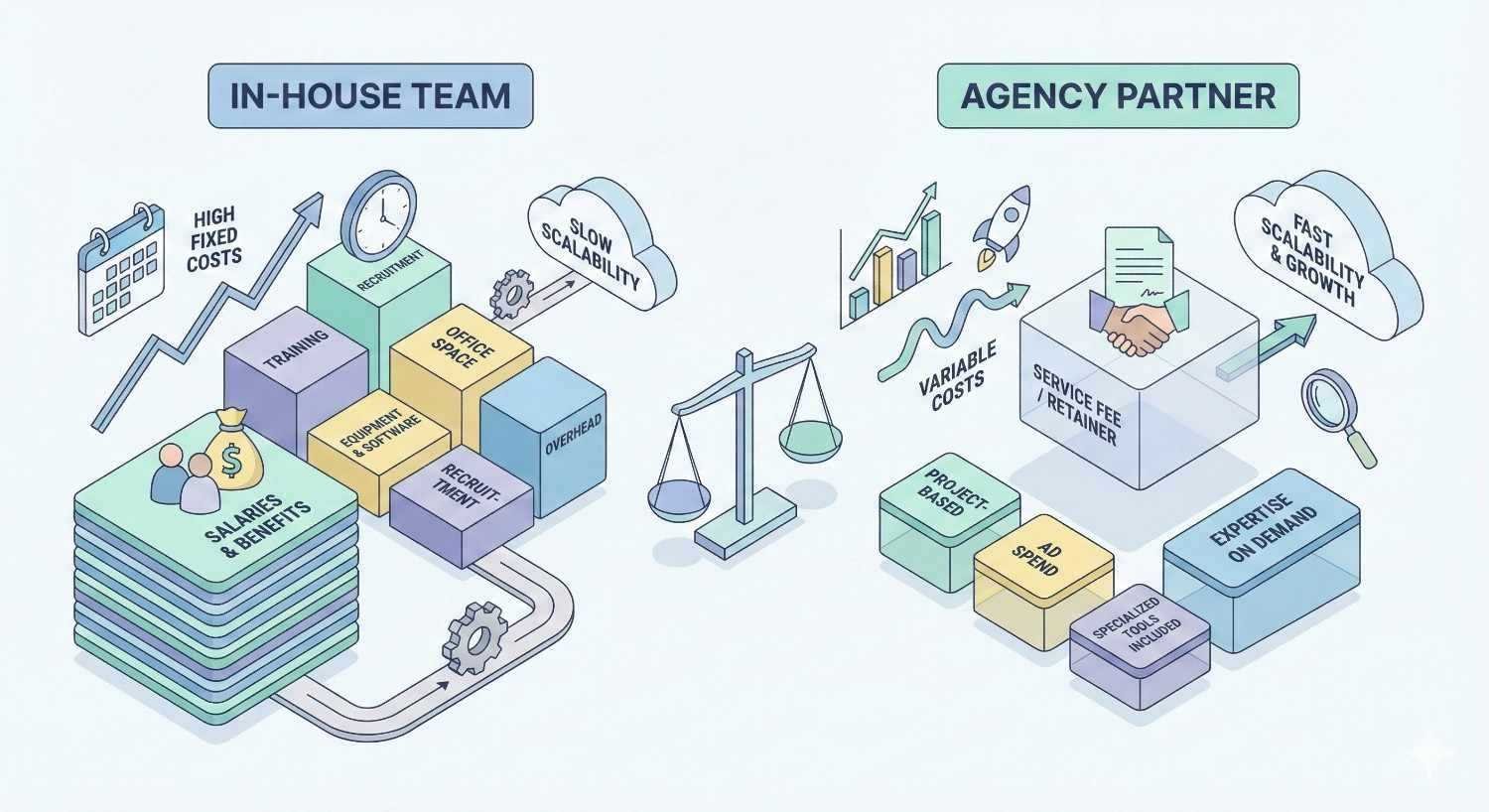
Direct Cost Comparison: Agency vs In-House
Year 1 Total Investment Analysis
Let’s compare realistic Year 1 costs for both approaches.
Agency Model (Mid-Market)
- Monthly retainer: $8,000 × 12 = $96,000
- Content overages: $12,000
- Development support: $15,000
- Tool access (if not included): $6,000
- Total Year 1: $129,000
In-House Model (Minimum Viable Team)
- SEO Manager: $95,000 salary + $28,500 overhead = $123,500
- Tools and software: $36,000
- Training and development: $4,000
- Recruiting costs: $15,000
- Total Year 1: $178,500
The agency model costs approximately 28% less in Year 1 while providing immediate expertise access. However, this comparison assumes a single in-house hire. Most effective SEO programs require 2-4 team members.
In-House Model (Full Team)
- SEO Manager: $123,500 (fully loaded)
- Content Strategist: $97,500 (fully loaded)
- Technical SEO Specialist: $110,500 (fully loaded)
- Tools and software: $48,000
- Training: $12,000
- Recruiting: $35,000
- Total Year 1: $426,500
A full in-house team costs 3.3x more than a mid-market agency in Year 1.
Year 2–3 Scaling Costs
Cost dynamics shift over time as you scale.
Agency Model Years 2-3
Agency costs typically increase 10-20% annually as you expand scope. A $96,000 Year 1 retainer might grow to $115,000 in Year 2 and $135,000 in Year 3 as you add content volume, new markets, or additional products.
Total 3-year agency investment: approximately $400,000-$450,000.
In-House Model Years 2-3
In-house costs stabilize after Year 1 recruiting expenses. Salary increases of 3-5% annually and tool cost inflation of 10% are typical.
However, you’ve built internal capabilities. Your team understands your product deeply, can respond faster to opportunities, and creates institutional knowledge that compounds over time.
Total 3-year in-house investment (full team): approximately $1,100,000-$1,200,000.
Cost-Per-Outcome Comparison
Raw costs don’t tell the full story. What matters is cost per meaningful outcome.
Cost per ranking improvement varies dramatically based on keyword difficulty and competition. Agencies with proven SaaS experience often achieve rankings faster due to established processes and cross-client learnings.
Cost per lead depends on content quality, technical execution, and link building effectiveness. Neither model inherently produces better leads. Execution quality matters more than delivery model.
Cost per organic revenue dollar is the ultimate metric. Track this over 18-24 months to understand true ROI from either approach.
Break-Even Analysis by Company Size
Company size and growth stage affect the break-even calculation.
Under $2M ARR: Agency model almost always wins. You can’t justify full-time SEO salaries, and you need results faster than you can hire and ramp a team.
$2M-$10M ARR: Hybrid models become attractive. Consider an agency for execution with a single in-house hire for strategy and coordination.
$10M-$25M ARR: In-house teams become cost-competitive if you have predictable growth and can retain talent. The break-even point typically occurs around 18-24 months.
$25M+ ARR: In-house teams often make sense for core SEO functions, with agencies handling specialized projects or overflow work.
Beyond Costs: Strategic Value Comparison
Time to Results & Ramp-Up Period
Agency: Immediate Expertise Access
Agencies start executing from day one. They bring established processes, trained teams, and cross-client experience. A quality agency can complete technical audits within 2-4 weeks and begin content production immediately.
The learning curve focuses on understanding your specific product and market, not building SEO fundamentals. Expect 30-60 days before an agency operates at full effectiveness.
In-House: 3–6 Month Hiring & Onboarding
Hiring takes 2-4 months for each role. Finding qualified SaaS SEO professionals requires extensive sourcing, interviewing, and negotiation. Top candidates have multiple offers.
Onboarding adds another 1-2 months before new hires contribute meaningfully. They need to understand your product, market, competitors, and existing marketing infrastructure.
Total time from decision to full productivity: 4-6 months minimum for a single hire, 6-12 months for a complete team.
Expertise Depth & Breadth
Agency: Cross-Industry Experience
Agencies work across multiple SaaS clients simultaneously. They see what works across different markets, product types, and competitive landscapes. This breadth accelerates learning and helps avoid common mistakes.
However, agencies divide attention across clients. Your account might get 20-40 hours of senior strategist time monthly. Junior team members handle most execution.
In-House: Deep Product Knowledge
In-house teams develop intimate product understanding that agencies rarely match. They attend product meetings, understand roadmaps, and can create content that reflects genuine expertise.
This depth enables product-led SEO strategies that tie organic search directly to product capabilities. In-house teams can respond faster to product launches and feature updates.
Scalability & Flexibility
Agencies scale up or down based on your needs. Increasing budget adds capacity. Decreasing budget reduces scope. This flexibility helps during uncertain growth periods or seasonal fluctuations.
In-house teams are less flexible. Hiring takes months. Layoffs damage morale and culture. You’re committed to salary costs regardless of business conditions.
However, in-house teams scale expertise more efficiently. Once you have strong SEO leadership, adding junior team members costs less than equivalent agency capacity increases.
Control & Communication
In-house teams offer direct control over priorities, processes, and daily activities. Communication happens in real-time through Slack, meetings, and informal conversations.
Agencies require more structured communication. Weekly calls, project management tools, and formal reporting create overhead. Urgent requests may take 24-48 hours to address.
Some founders prefer agency relationships because they’re easier to manage. Others want the control that comes with direct employees. Neither preference is wrong.
Risk Factors & Mitigation
Agency Risks:
- Account manager turnover disrupts continuity
- Agency may take on competing clients
- Quality may decline as agency scales
- Institutional knowledge stays with agency
Mitigation: Choose agencies with strong retention, clear conflict policies, and documented processes. Maintain internal documentation of strategies and learnings.
In-House Risks:
- Key employee departure devastates program
- Hiring mistakes are expensive to fix
- Skills may become outdated without external exposure
- Echo chamber thinking limits innovation
Mitigation: Cross-train team members, document processes, budget for ongoing education, and maintain agency relationships for outside perspective.
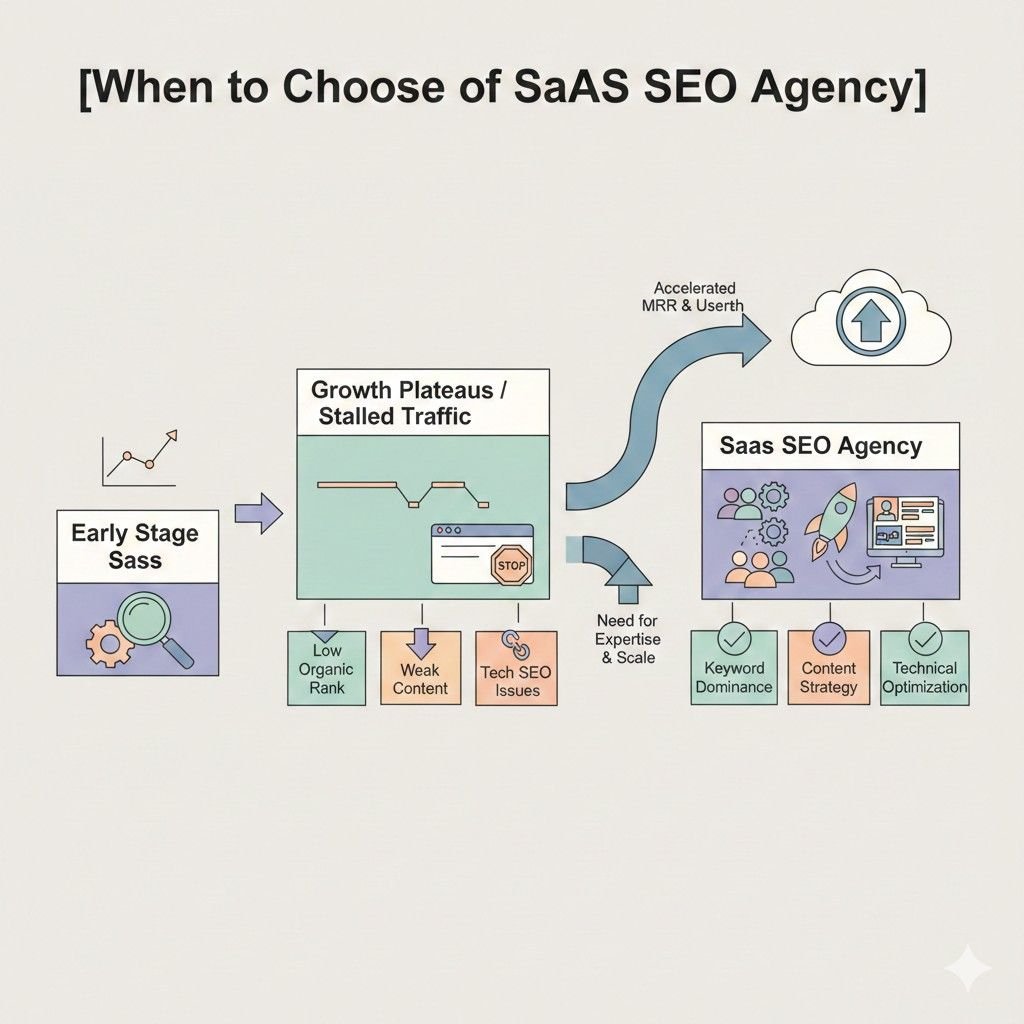
When to Choose a SaaS SEO Agency
Early-Stage Startups & Limited Budgets
Startups with less than $2M ARR typically can’t justify full-time SEO salaries. A $5,000-$10,000 monthly agency retainer provides professional SEO execution at a fraction of in-house costs.
Agencies also reduce risk during uncertain growth phases. If funding doesn’t materialize or pivot becomes necessary, you can adjust agency scope without layoff complications.
Early-stage companies need results quickly to prove channel viability. Agencies deliver faster time-to-value than building internal teams.
Companies Needing Rapid Results
If you’re entering a new market, launching a major product, or facing competitive pressure, agencies provide immediate capacity. You can’t wait 6 months to hire and onboard a team.
Agencies with SaaS experience have playbooks for common scenarios. They’ve helped other companies through similar situations and can apply those learnings immediately.
Businesses Without SEO Leadership
If no one internally understands SEO strategy, hiring junior SEO staff creates problems. Without experienced leadership, junior hires lack direction and make avoidable mistakes.
Agencies provide strategic leadership as part of their service. They can guide your SEO program while you develop internal capabilities or decide whether to hire dedicated leadership.
Organizations Requiring Specialized Expertise
Some SEO challenges require specialized skills your team may never need full-time. International SEO, technical migrations, or enterprise-scale link building might justify agency partnerships even if you have strong in-house capabilities.
Agencies concentrate specialized expertise across multiple clients. They can afford to employ experts in narrow disciplines that wouldn’t justify full-time roles at individual companies.
When to Build an In-House SEO Team
Established SaaS with Predictable Revenue
Companies with $10M+ ARR and predictable growth can justify in-house investment. You have budget stability to commit to salaries and time horizon to realize returns on hiring investments.
Predictable revenue also enables long-term SEO strategies. You can invest in content and links that take 12-18 months to generate returns, knowing you’ll be around to capture that value.
Complex Products Requiring Deep Integration
If your product requires extensive technical understanding to market effectively, in-house teams have advantages. They can attend product meetings, access internal documentation, and develop genuine expertise.
Developer tools, technical platforms, and complex B2B products often benefit from in-house SEO teams who truly understand what they’re marketing.
Companies with Long-Term Organic Growth Goals
If organic search is a primary growth channel for the next 3-5 years, building internal capabilities makes strategic sense. You’re investing in an asset that compounds over time.
In-house teams build institutional knowledge, develop proprietary processes, and create competitive advantages that agencies can’t replicate.
Organizations with Existing Marketing Infrastructure
Companies with established content teams, development resources, and marketing operations can integrate SEO more easily. You’re adding SEO expertise to existing infrastructure rather than building from scratch.
If you already have writers, designers, and developers, an SEO strategist can leverage those resources effectively. The marginal cost of adding SEO is lower than building everything simultaneously.
The Hybrid Model: Combining Agency & In-House
How the Hybrid Approach Works
Hybrid models combine in-house strategy and coordination with agency execution. A typical structure includes:
- In-house: SEO Manager or Director who owns strategy, manages agency relationships, and coordinates with internal teams
- Agency: Handles content production, link building, and technical implementation under in-house direction
This model provides strategic control while accessing agency execution capacity. The in-house leader ensures agency work aligns with business objectives and product positioning.
Cost Structure of Hybrid Models
Hybrid models typically cost more than pure agency approaches but less than full in-house teams.
Example Hybrid Budget:
- In-house SEO Manager: $123,500 (fully loaded)
- Agency retainer: $72,000 ($6,000/month)
- Tools: $24,000
- Total: $219,500
This investment provides strategic leadership plus execution capacity, costing 50% less than a full in-house team while maintaining more control than pure agency relationships.
Best Practices for Agency-Team Collaboration
Successful hybrid models require clear role definition and communication protocols.
Define ownership clearly. Specify who makes strategic decisions, who approves content, and who handles technical implementation. Ambiguity creates friction and delays.
Establish communication rhythms. Weekly syncs between in-house leadership and agency account managers keep projects aligned. Monthly strategic reviews assess progress and adjust priorities.
Share context generously. Give agencies access to product roadmaps, competitive intelligence, and customer insights. Better context produces better work.
Maintain documentation. Record strategies, processes, and learnings in shared systems. This protects against turnover on either side.
When Hybrid Makes the Most Sense
Hybrid models work best for companies in transition. You might be:
- Growing from agency-only toward eventual in-house team
- Scaling beyond what a single in-house hire can manage
- Needing specialized expertise alongside core in-house capabilities
- Testing SEO investment before committing to full in-house build
The hybrid approach provides flexibility to adjust as your needs evolve.
How to Calculate SEO ROI for SaaS Companies
Key Metrics for Measuring SEO Success
Organic Traffic Growth
Track organic sessions monthly, segmented by landing page type. Blog traffic, product page traffic, and documentation traffic have different values.
Year-over-year comparisons account for seasonality. Month-over-month shows momentum. Both matter for understanding program health.
Keyword Rankings & Visibility
Track rankings for target keywords across difficulty tiers. High-volume head terms indicate authority growth. Long-tail rankings show content depth.
Share of voice metrics compare your visibility against competitors. Increasing share of voice correlates with market share gains over time.
Lead Generation & MQLs
Organic search should generate marketing qualified leads. Track form submissions, demo requests, and trial signups attributed to organic traffic.
Segment by content type to understand what drives conversions. Bottom-funnel comparison pages typically convert better than top-funnel educational content.
Customer Acquisition Cost (CAC) Impact
Calculate organic CAC by dividing SEO investment by customers acquired through organic search. Compare against paid channels to understand relative efficiency.
Mature SEO programs often achieve CAC 50-80% lower than paid acquisition. This efficiency compounds as organic traffic grows without proportional cost increases.
Attribution Models for SaaS SEO
SaaS buyer journeys involve multiple touchpoints. Last-click attribution undervalues SEO’s contribution.
First-touch attribution credits SEO for introducing prospects who later convert through other channels. This model often shows SEO’s true top-of-funnel impact.
Linear attribution distributes credit equally across all touchpoints. This provides balanced perspective but may undervalue high-impact interactions.
Position-based attribution weights first and last touches more heavily. This model recognizes both discovery and conversion contributions.
Most SaaS companies benefit from analyzing multiple attribution models to understand SEO’s full impact across the buyer journey.
Realistic ROI Timelines (6–18 Months)
SEO generates returns on extended timelines. Set expectations accordingly.
Months 1-3: Foundation building. Technical fixes, content strategy development, initial content production. Minimal ranking or traffic impact.
Months 4-6: Early signals. New content begins ranking for long-tail terms. Technical improvements show in crawl metrics. Traffic growth starts.
Months 7-12: Acceleration phase. Content library builds authority. Link building compounds. Significant traffic and lead growth becomes visible.
Months 13-18: Maturity. Head terms begin ranking. Organic becomes meaningful revenue contributor. ROI calculations become favorable.
Most SaaS companies see positive ROI between months 12-18. Patience and consistent investment are required.
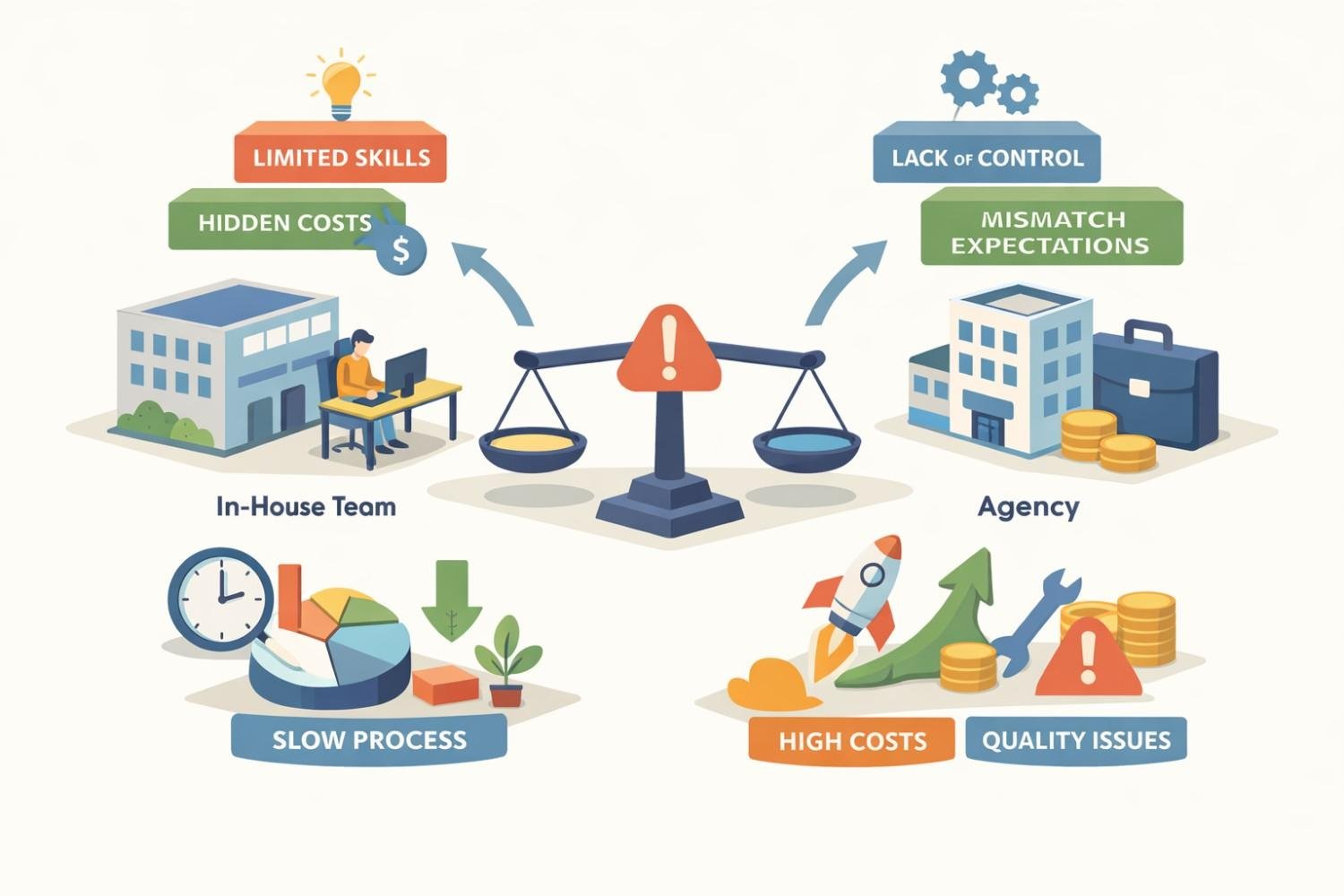
Common Mistakes When Choosing Between Agency & In-House
Underestimating True In-House Costs
Many companies compare agency retainers against salaries alone. This dramatically underestimates in-house costs.
A $90,000 salary becomes $120,000+ with benefits, taxes, and overhead. Add tools, training, management time, and recruiting costs. The true cost often exceeds initial estimates by 40-60%.
Build comprehensive cost models before deciding. Include every expense category outlined earlier in this guide.
Choosing Agencies Based on Price Alone
The cheapest agency rarely delivers the best results. Low-cost agencies typically employ junior staff, use templated approaches, and lack SaaS-specific expertise.
A $3,000/month agency that produces mediocre results costs more than a $10,000/month agency that drives meaningful growth. Evaluate agencies on capabilities, experience, and track record, not just price.
Expecting Immediate Results
SEO takes time regardless of delivery model. Agencies don’t have magic shortcuts. In-house teams can’t accelerate algorithm timelines.
Companies that expect quick wins often abandon SEO before it generates returns. Commit to 12-18 month timelines before evaluating success.
Neglecting the Transition Period
Switching from agency to in-house (or vice versa) creates transition risk. Knowledge transfer takes time. Momentum can stall during handoffs.
Plan transitions carefully. Overlap agency and in-house resources during handoff periods. Document everything before making changes.
How to Evaluate a SaaS SEO Agency
Questions to Ask Before Signing
Experience questions:
- How many SaaS clients do you currently serve?
- Can you share case studies from similar companies?
- What’s your team’s background in B2B technology marketing?
Process questions:
- How do you develop content strategy for new clients?
- What’s your approach to technical SEO for JavaScript-heavy sites?
- How do you build links for SaaS companies specifically?
Communication questions:
- Who will be my primary contact?
- How often will we meet?
- What’s your response time for urgent requests?
Results questions:
- What results should I expect in 6, 12, and 18 months?
- How do you measure and report success?
- What happens if we don’t see expected results?
Red Flags to Watch For
Guaranteed rankings are impossible to promise. Agencies claiming guaranteed positions either lie or target worthless keywords.
Vague deliverables indicate unclear value. Contracts should specify exactly what you receive monthly.
No SaaS experience means learning on your dime. SaaS SEO has unique requirements that generalist agencies may not understand.
High account manager turnover disrupts continuity. Ask about retention rates and team stability.
Reluctance to share references suggests unhappy clients. Quality agencies readily connect prospects with current customers.
Case Studies & Proof of Results
Request case studies from companies similar to yours. Look for:
- Specific metrics (traffic growth percentages, ranking improvements, lead increases)
- Realistic timelines (results achieved over 12-18 months, not 3 months)
- Challenges overcome (how they handled obstacles)
- Client testimonials (ideally with contact information for verification)
Be skeptical of case studies showing only vanity metrics. Traffic growth without conversion impact doesn’t demonstrate business value.
Contract Terms & Exit Clauses
Contract length: 6-12 month minimums are standard. Avoid multi-year commitments until you’ve validated the relationship.
Termination clauses: Understand notice requirements and any early termination fees. 30-60 day notice periods are reasonable.
Ownership of work: Ensure you own all content, strategies, and deliverables created during the engagement.
Non-compete clauses: Some agencies restrict working with competitors. Understand these limitations before signing.
Building Your In-House SEO Team: A Hiring Framework
Essential Roles & Hiring Sequence
Build your team in phases based on immediate needs and budget.
Phase 1: SEO Manager/Lead Start with an experienced generalist who can handle strategy and execution across all SEO disciplines. This person sets direction and can manage agencies or contractors for specialized work.
Phase 2: Content Strategist Add content expertise once you have strategic direction. This role accelerates content production and improves quality.
Phase 3: Technical SEO Specialist Bring technical expertise in-house when your site complexity justifies it. Until then, the SEO Manager can handle technical basics with agency support for complex projects.
Phase 4: Link Building Specialist Add dedicated link building capacity last. This role is most easily outsourced, so in-house hiring makes sense only at scale.
Skills & Experience to Prioritize
For SEO Managers:
- 5+ years SEO experience with demonstrable results
- SaaS or B2B technology background strongly preferred
- Experience managing teams or agencies
- Strong analytical and communication skills
- Understanding of content marketing and product positioning
For Content Strategists:
- 3+ years content marketing experience
- SEO knowledge (keyword research, search intent, optimization)
- Editorial skills and attention to quality
- Ability to translate technical concepts for various audiences
- Experience with content management systems and workflows
For Technical SEO Specialists:
- Deep understanding of how search engines crawl and render pages
- Experience with JavaScript SEO and modern web frameworks
- Familiarity with enterprise CMS platforms
- Ability to communicate technical concepts to non-technical stakeholders
- Problem-solving orientation and attention to detail
Onboarding & Performance Benchmarks
30-day milestones:
- Complete product and market orientation
- Audit current SEO program and identify quick wins
- Establish baseline metrics and tracking
- Develop initial 90-day action plan
90-day milestones:
- Execute quick wins and show early results
- Develop comprehensive SEO strategy
- Establish processes and workflows
- Build relationships with cross-functional teams
6-month milestones:
- Demonstrate measurable traffic or ranking improvements
- Launch major content initiatives
- Complete significant technical optimizations
- Prove ability to work independently
Making the Right Decision for Your SaaS Business
Decision Framework by Growth Stage
Pre-seed to Seed ($0-$1M ARR): Recommendation: Agency or fractional SEO consultant. You need results without full-time commitment. Budget $3,000-$5,000 monthly.
Series A ($1M-$5M ARR): Recommendation: Agency with potential hybrid transition. As you approach $3M ARR, consider adding in-house SEO leadership. Budget $5,000-$10,000 monthly for agency, or $150,000-$200,000 annually for hybrid model.
Series B ($5M-$15M ARR): Recommendation: Hybrid model or full in-house team. You have budget stability and growth trajectory to justify investment. Budget $200,000-$350,000 annually.
Series C+ ($15M+ ARR): Recommendation: In-house team with specialized agency support. Build core capabilities internally, use agencies for specific projects or overflow. Budget $350,000-$500,000+ annually.
Budget Allocation Guidelines
Allocate SEO budget across three categories:
Strategy and management (20-30%): Leadership, planning, and coordination costs. This includes in-house salaries or agency strategy fees.
Content production (40-50%): Writing, editing, design, and optimization. Content is the primary output of most SEO programs.
Link building and promotion (20-30%): Outreach, digital PR, and authority building. This category often gets underfunded but drives ranking improvements.
Tools and infrastructure (5-10%): Software, platforms, and technical resources. Necessary but shouldn’t dominate budget.
Creating Your SEO Investment Roadmap
Build a 12-month roadmap that accounts for your specific situation.
Months 1-3: Foundation
- Conduct comprehensive audit (agency or consultant)
- Fix critical technical issues
- Develop content strategy and editorial calendar
- Establish tracking and reporting
Months 4-6: Execution
- Begin consistent content production
- Launch link building campaigns
- Implement ongoing technical optimizations
- Evaluate agency performance or begin hiring process
Months 7-9: Optimization
- Analyze early results and adjust strategy
- Scale successful content types
- Expand keyword targeting
- Consider team structure changes based on results
Months 10-12: Scaling
- Increase investment in working channels
- Add team capacity (agency scope or in-house hires)
- Develop advanced strategies (international, enterprise features)
- Plan Year 2 based on proven ROI
Conclusion
The agency vs in-house decision ultimately depends on your growth stage, budget constraints, and strategic priorities. Agencies offer faster time-to-value and lower initial investment, while in-house teams provide deeper integration and long-term capability building.
Most successful SaaS companies evolve their approach over time. They start with agencies, transition to hybrid models as they scale, and eventually build robust in-house teams supported by specialized agency partnerships.
We help SaaS companies navigate this decision and execute effective SEO programs regardless of delivery model. Whether you need full-service SEO support or strategic guidance for your in-house team, White Label SEO Service provides the expertise to drive sustainable organic growth.
Frequently Asked Questions
How much should a SaaS company spend on SEO?
Most SaaS companies invest 5-15% of their marketing budget in SEO. For early-stage companies, this typically means $3,000-$10,000 monthly. Established companies with $10M+ ARR often invest $15,000-$50,000 monthly across agency fees and in-house team costs.
Is it cheaper to hire an SEO agency or build in-house?
Agencies cost less in Year 1, typically 30-50% less than equivalent in-house capabilities. However, in-house teams become cost-competitive by Year 2-3 for companies with $10M+ ARR. The break-even point depends on team size, salary levels, and agency pricing.
How long before SEO generates ROI for SaaS?
Most SaaS companies see positive ROI between months 12-18 of consistent SEO investment. Early traffic and ranking improvements appear by months 4-6, but meaningful lead generation and revenue impact typically require 12+ months of compounding effort.
Can I start with an agency and transition to in-house?
Yes, this is a common and effective approach. Start with an agency to build momentum and prove channel viability. Hire in-house leadership around months 12-18, then gradually transition execution while maintaining agency relationships for specialized work.
What size team do I need for in-house SaaS SEO?
Minimum viable in-house SEO requires one experienced generalist who can handle strategy and coordinate execution. Full in-house capabilities typically require 3-4 specialists covering strategy, content, technical SEO, and link building. Team size scales with company revenue and organic growth ambitions.
How do I know if my SEO investment is working?
Track organic traffic growth, keyword ranking improvements, and leads attributed to organic search. Compare organic customer acquisition cost against paid channels. Healthy SEO programs show consistent month-over-month traffic growth and improving CAC efficiency over 12-18 month periods.
What’s the biggest mistake companies make when choosing between agency and in-house?
Underestimating true in-house costs is the most common mistake. Companies compare agency retainers against salaries alone, ignoring benefits, tools, training, management overhead, and recruiting costs. A comprehensive cost analysis often reveals in-house teams cost 40-60% more than initial salary estimates suggest.