
SaaS companies face a unique SEO challenge: ranking for high-intent keywords in competitive markets where product differentiation happens at the feature level. Understanding which ranking factors matter most for software businesses directly impacts your ability to capture qualified traffic and convert it into trial signups or demo requests.
The difference between page one and page two visibility can mean millions in lost recurring revenue. SaaS SEO requires balancing technical excellence, product-led content, and authority signals that search engines use to evaluate software websites differently than traditional businesses.
This guide breaks down every ranking factor that influences SaaS search visibility. You will learn how to prioritize technical foundations, create content that ranks, build authority, and measure progress with realistic timelines.
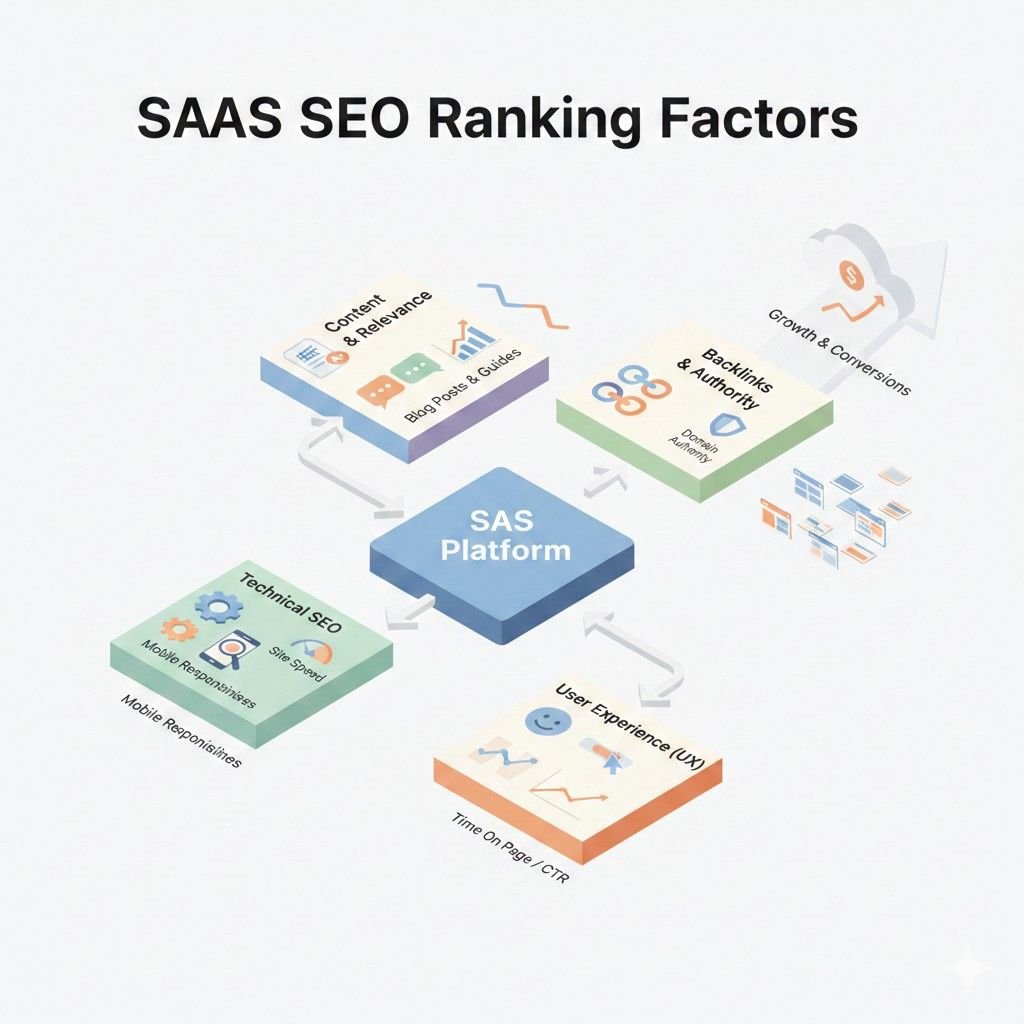
What Are SaaS SEO Ranking Factors?
SaaS SEO ranking factors are the specific signals search engines use to determine where software company websites appear in search results. These factors span technical infrastructure, content quality, user experience, and external authority indicators that collectively influence organic visibility.
For SaaS businesses, ranking factors carry additional weight because the buyer journey involves extensive research. Prospects compare features, read reviews, evaluate pricing, and seek educational content before committing to a subscription. Each touchpoint represents a ranking opportunity.
How Search Engines Evaluate SaaS Websites
Search engines assess SaaS websites through multiple evaluation layers. Crawlers first examine technical accessibility, checking whether pages load quickly, render properly on mobile devices, and follow structured markup conventions that help algorithms understand content relationships.
Content evaluation follows technical assessment. Algorithms analyze whether pages satisfy search intent, demonstrate topical expertise, and provide comprehensive answers to user queries. For SaaS sites, this means evaluating product pages, feature documentation, comparison content, and educational resources as interconnected topic clusters.
Authority signals complete the evaluation picture. Search engines measure backlink profiles, brand mentions, review signals, and engagement patterns to determine whether a SaaS company has earned trust within its industry. Newer sites face a credibility gap that requires strategic link acquisition and brand building to overcome.
Why SaaS SEO Differs From Traditional SEO
SaaS SEO operates under distinct conditions that traditional businesses rarely encounter. The subscription model creates lifetime value calculations that justify higher customer acquisition costs through organic channels. A single ranking improvement for a high-intent keyword can generate compounding revenue over years of customer retention.
Product complexity introduces content requirements that simpler businesses avoid. SaaS companies must explain features, document use cases, address integration questions, and educate prospects on implementation. This content depth creates both challenges and opportunities for topical authority building.
Competition intensity in SaaS verticals often exceeds traditional industries. Well-funded competitors invest heavily in content marketing, link building, and technical optimization. Winning rankings requires sustained effort across multiple fronts rather than quick tactical wins.
The buyer journey length also distinguishes SaaS SEO. Enterprise software purchases involve multiple stakeholders, extended evaluation periods, and comparison shopping. Content must address awareness, consideration, and decision stages with appropriate depth at each phase.
Technical SEO Ranking Factors for SaaS
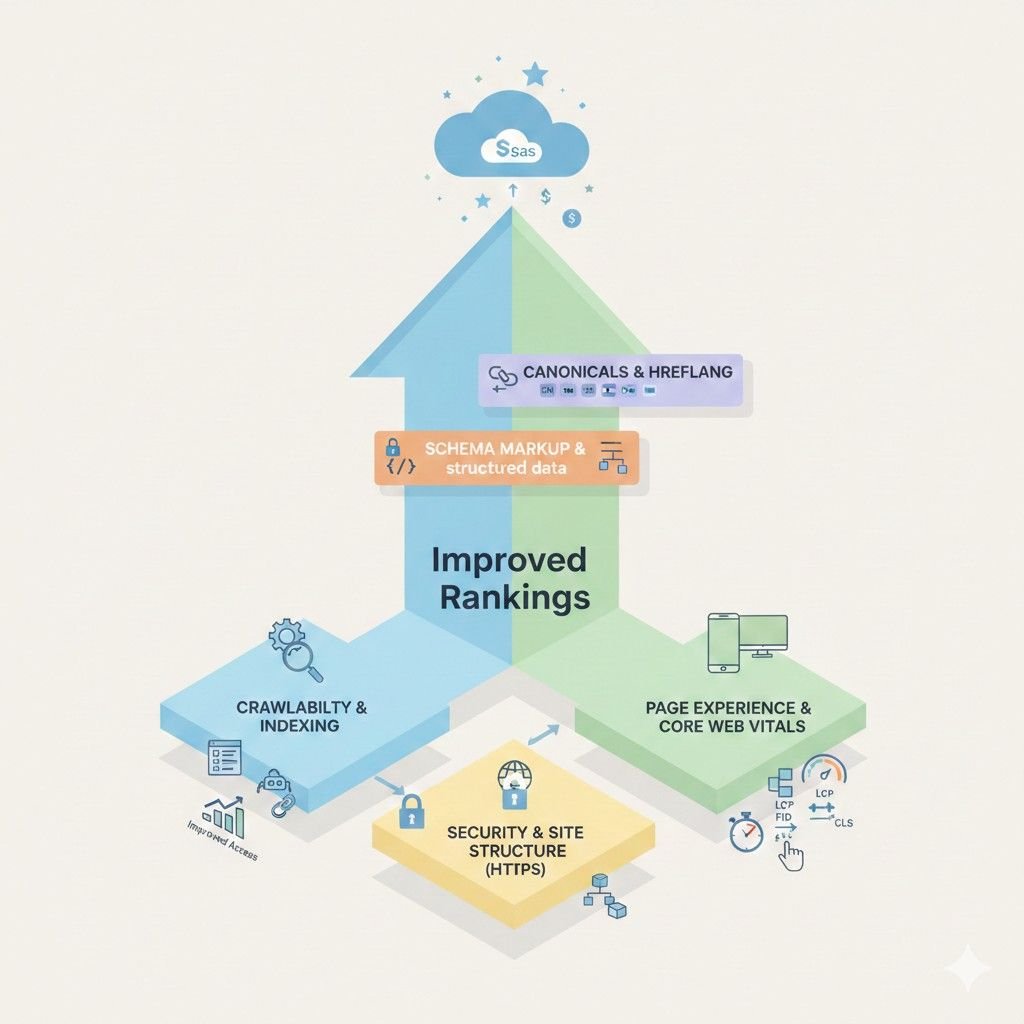
Technical SEO forms the foundation that enables all other ranking factors to function effectively. Without proper technical infrastructure, even exceptional content struggles to achieve visibility. SaaS websites face particular technical challenges due to application complexity, dynamic content, and frequent deployment cycles.
Site Architecture and Crawlability
Site architecture determines how efficiently search engines discover and index your pages. A logical hierarchy helps crawlers understand content relationships while distributing link equity throughout your site. Poor architecture creates orphan pages, crawl budget waste, and indexation gaps.
Effective SaaS site architecture typically follows a hub-and-spoke model. Core product pages serve as hubs, with feature pages, use case content, and supporting documentation linking back to central conversion points. This structure signals topical relevance while guiding users toward desired actions.
Crawlability issues frequently plague SaaS sites. JavaScript-heavy applications may render content that crawlers cannot access. Faceted navigation on pricing or feature comparison pages can create duplicate content problems. Login walls blocking valuable content prevent indexation entirely.
XML sitemaps require careful maintenance for SaaS sites with dynamic content. Product updates, new feature pages, and blog content should appear in sitemaps promptly. Removing deprecated pages prevents crawl budget waste on outdated content.
Internal linking deserves particular attention. Every important page should receive links from related content, navigation elements, or contextual mentions. Orphan pages with no internal links rarely achieve meaningful rankings regardless of content quality.
Core Web Vitals and Page Speed
Core Web Vitals measure user experience through three specific metrics: Largest Contentful Paint (LCP), First Input Delay (FID), and Cumulative Layout Shift (CLS). Google uses these metrics as ranking signals, making performance optimization essential for competitive SaaS markets.
LCP measures loading performance. Pages should render their largest content element within 2.5 seconds to meet Google’s threshold. SaaS sites often struggle with LCP due to heavy JavaScript bundles, unoptimized images, and slow server response times.
FID measures interactivity responsiveness. Users expect pages to respond to clicks and inputs within 100 milliseconds. Complex SaaS interfaces with extensive JavaScript can delay interactivity, frustrating users and harming rankings.
CLS measures visual stability. Pages should maintain a CLS score below 0.1 to avoid layout shifts that disrupt user experience. Dynamic content loading, late-loading advertisements, and improperly sized images commonly cause CLS problems.
Performance optimization strategies for SaaS sites include implementing lazy loading for below-fold content, compressing images appropriately, minimizing JavaScript execution time, and leveraging content delivery networks for global audience reach.
Mobile-First Indexing Requirements
Google predominantly uses mobile versions of websites for indexing and ranking. SaaS companies must ensure mobile experiences match or exceed desktop functionality. Mobile-first indexing failures can devastate rankings regardless of desktop optimization quality.
Responsive design represents the minimum requirement. Pages must adapt layouts, navigation, and content presentation for smaller screens without sacrificing information completeness. Mobile users should access the same content as desktop visitors.
Touch-friendly interfaces matter for engagement signals. Buttons, links, and interactive elements need adequate spacing and sizing for finger navigation. Frustrating mobile experiences increase bounce rates and reduce time on site.
Mobile page speed often differs significantly from desktop performance. Slower mobile connections and less powerful processors require additional optimization attention. Testing mobile performance separately from desktop reveals issues that aggregate metrics obscure.
Content parity between mobile and desktop versions prevents indexation problems. Hidden content, collapsed sections, or mobile-specific content restrictions can harm rankings when Google indexes the mobile version as the primary representation.
HTTPS and Security Signals
HTTPS encryption serves as a confirmed ranking signal. SaaS websites handling sensitive customer data face additional scrutiny regarding security implementation. Proper HTTPS configuration demonstrates trustworthiness to both users and search engines.
SSL certificate installation represents the baseline requirement. Certificates must cover all subdomains, including staging environments, documentation sites, and application interfaces. Mixed content warnings from insecure resources undermine HTTPS benefits.
Security headers provide additional protection signals. Implementing Content Security Policy, X-Frame-Options, and other security headers demonstrates technical competence while protecting users from common attack vectors.
Regular security audits identify vulnerabilities before they impact rankings or user trust. SaaS companies should monitor for certificate expiration, configuration drift, and emerging security requirements that affect search visibility.
Structured Data and Schema Markup
Structured data helps search engines understand content context and relationships. Proper schema markup can generate rich results that increase click-through rates and visibility in search results. SaaS websites benefit from multiple schema types.
Organization schema establishes brand identity and connects your company to knowledge graph entities. Including logo, social profiles, and contact information helps search engines display accurate brand information.
Product schema applies to SaaS offerings, enabling rich results with pricing, ratings, and availability information. Software application schema provides additional specificity for software products, including operating system requirements and feature descriptions.
FAQ schema transforms frequently asked questions into expandable results that dominate additional SERP real estate. How-to schema applies to tutorial and documentation content, potentially generating step-by-step rich results.
Article schema benefits blog content, enabling publication dates, author information, and featured images in search results. Review schema aggregates customer testimonials into star ratings that build trust before clicks occur.
On-Page SEO Ranking Factors for SaaS
On-page optimization transforms technical foundations into ranking performance. These factors directly influence how search engines interpret page relevance, quality, and authority. SaaS websites must balance keyword optimization with user experience and conversion goals.
Keyword Optimization and Search Intent Alignment
Keyword optimization extends beyond simple placement to encompass semantic relevance and intent satisfaction. Search engines evaluate whether content comprehensively addresses the underlying need behind a query, not merely whether it contains specific terms.
Primary keyword placement remains important in strategic locations. Title tags, H1 headings, first paragraphs, and URL slugs should include target keywords naturally. Forced or awkward keyword insertion harms readability and signals manipulation.
Semantic keyword variations strengthen topical relevance. Using synonyms, related terms, and natural language variations demonstrates comprehensive topic coverage. Content that only repeats exact-match keywords appears thin compared to semantically rich alternatives.
Search intent alignment determines ranking potential more than keyword density. Informational queries require educational content. Commercial investigation queries need comparison and evaluation content. Transactional queries demand clear conversion paths. Misaligned content rarely ranks regardless of optimization.
Long-tail keyword coverage captures specific queries with lower competition. SaaS companies benefit from targeting feature-specific, use-case-specific, and integration-specific queries that larger competitors may overlook.
Content Quality and E-E-A-T Signals
Content quality encompasses accuracy, depth, originality, and usefulness. Search engines increasingly evaluate whether content demonstrates genuine expertise rather than surface-level aggregation. SaaS content must reflect actual product knowledge and industry understanding.
Experience signals demonstrate first-hand knowledge. Content that references actual product usage, customer interactions, or implementation scenarios carries more weight than theoretical discussions. Including specific examples, screenshots, and practical guidance signals authentic experience.
Expertise appears through technical accuracy, appropriate terminology, and comprehensive coverage. SaaS content should demonstrate understanding of industry challenges, competitive landscape, and practical solutions. Superficial content fails expertise evaluation.
Authoritativeness develops through consistent quality, external recognition, and topical focus. Building authority requires sustained content investment, earning backlinks from respected sources, and establishing thought leadership within your niche.
Trustworthiness manifests through transparency, accuracy, and user-focused content. Clearly identifying authors, maintaining factual accuracy, providing sources for claims, and prioritizing user benefit over manipulation builds trust signals.
Title Tags, Meta Descriptions, and Header Structure
Title tags directly influence rankings and click-through rates. Effective titles include primary keywords near the beginning, communicate clear value, and differentiate from competitors. Character limits around 50-60 characters prevent truncation in search results.
Meta descriptions do not directly affect rankings but significantly impact click-through rates. Compelling descriptions summarize page value, include relevant keywords naturally, and end with implicit or explicit calls to action. Staying within 150-160 characters ensures complete display.
Header structure organizes content for both users and search engines. H1 tags should appear once per page, containing the primary topic. H2 tags divide major sections. H3 tags break down subsections. Logical hierarchy helps algorithms understand content relationships.
Header optimization includes keywords where natural but prioritizes clarity and user experience. Keyword-stuffed headers harm readability and signal manipulation. Descriptive headers that accurately preview section content perform better long-term.
Internal Linking Architecture
Internal links distribute authority throughout your site while helping search engines discover and understand content relationships. Strategic internal linking strengthens important pages and establishes topical clusters that demonstrate comprehensive coverage.
Contextual links within body content carry more weight than navigation or footer links. Linking to related content using descriptive anchor text helps both users and search engines understand destination page topics.
Hub pages should receive links from all related content. Product pages, pillar content, and key conversion pages benefit from extensive internal linking that signals their importance within your site hierarchy.
Link equity distribution requires attention to page depth. Important pages should sit within three clicks of the homepage. Deep pages with minimal internal links struggle to accumulate authority regardless of content quality.
Anchor text diversity prevents over-optimization penalties. Using varied but relevant anchor text appears more natural than repeatedly linking with exact-match keywords. Descriptive phrases that accurately describe linked content perform best.
URL Structure and Optimization
URL structure affects both user experience and search engine interpretation. Clean, descriptive URLs communicate page topics before users click while providing keyword signals to search algorithms.
Effective URLs include relevant keywords, use hyphens between words, and avoid unnecessary parameters or session IDs. Shorter URLs generally perform better than lengthy strings with multiple subdirectories.
Consistent URL patterns help users understand site structure. Establishing conventions for blog posts, product pages, and documentation creates predictable navigation that benefits both users and crawlers.
URL changes require careful redirect implementation. Changing established URLs without proper 301 redirects loses accumulated authority and creates broken link problems. Avoid URL modifications unless absolutely necessary.
Content-Based Ranking Factors for SaaS
Content strategy determines long-term ranking success for SaaS companies. The right content mix attracts qualified traffic at every buyer journey stage while building topical authority that strengthens overall domain performance.
Product-Led Content Strategy
Product-led content integrates your software naturally into valuable educational material. Rather than creating separate marketing content and product documentation, product-led approaches demonstrate value through practical application.
Feature-focused content shows how specific capabilities solve real problems. Instead of listing features, effective content demonstrates workflows, outcomes, and use cases that resonate with target audiences.
Template and resource content provides immediate value while showcasing product capabilities. Offering downloadable templates, calculators, or tools that complement your software attracts links and establishes expertise.
Tutorial content addresses implementation questions while reducing support burden. Comprehensive how-to guides rank for long-tail queries while helping existing customers succeed with your product.
Feature Pages and Use Case Content
Feature pages target specific capability searches that indicate high purchase intent. Each significant feature deserves dedicated content explaining benefits, applications, and differentiation from alternatives.
Effective feature pages balance technical detail with business value. Technical audiences need specifications and integration information. Business audiences need outcome-focused messaging and ROI justification.
Use case content addresses specific applications of your software. Industry-specific, role-specific, and workflow-specific use cases capture targeted traffic while demonstrating versatility and relevance.
Use case pages should include concrete examples, customer stories when available, and clear paths to trial or demo. Abstract use case descriptions fail to convert compared to specific, relatable scenarios.
Comparison and Alternative Pages
Comparison content captures commercial investigation traffic from prospects evaluating options. Creating honest, comprehensive comparisons positions your brand as a trusted resource while influencing purchase decisions.
Direct competitor comparisons require careful balance. Accurate representation of competitor capabilities builds credibility. Unfair criticism damages trust. Highlighting genuine differentiators without disparagement performs best.
Alternative pages target searches for competitor alternatives. Users searching for alternatives have identified problems with current solutions, creating opportunities to address specific pain points your product solves.
Category comparison pages evaluate multiple options within your space. Comprehensive guides comparing several solutions, including your own, attract links and establish authority as an objective resource.
Educational Content and Thought Leadership
Educational content builds awareness-stage traffic that feeds your conversion funnel. Blog posts, guides, and resources addressing industry challenges attract prospects before they begin active product searches.
Thought leadership content establishes expertise and differentiates from competitors producing commodity content. Original research, unique perspectives, and forward-looking analysis attract attention and links.
Beginner-focused content captures audiences early in their learning journey. Glossary pages, introductory guides, and foundational explanations rank for informational queries while building brand familiarity.
Advanced content serves experienced practitioners seeking deeper knowledge. Technical deep-dives, advanced strategies, and expert-level content attracts qualified audiences and earns respect within professional communities.
Content Freshness and Update Frequency
Content freshness signals relevance for topics where information changes. Search engines evaluate publication dates, update frequency, and content currency when ranking time-sensitive queries.
Regular content updates maintain ranking performance for established pages. Refreshing statistics, adding new sections, and improving existing content signals ongoing relevance and investment.
Publication frequency affects crawl patterns and indexation speed. Sites that consistently publish quality content receive more frequent crawls, enabling faster indexation of new pages.
Historical optimization improves existing content performance. Auditing older content for accuracy, completeness, and optimization opportunities often yields faster results than creating new content from scratch.
Off-Page SEO Ranking Factors for SaaS
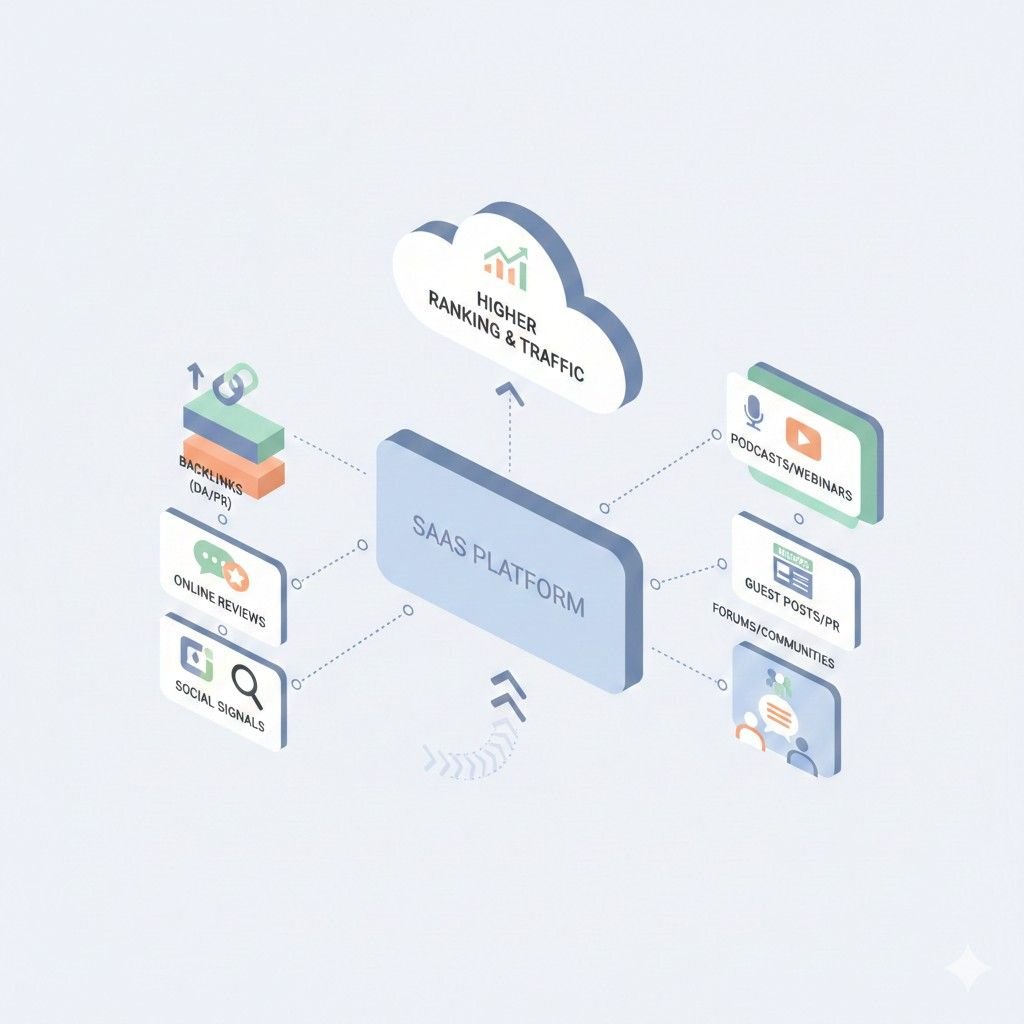
Off-page factors measure external validation of your website’s authority and trustworthiness. While you cannot directly control these signals, strategic efforts influence how others perceive and reference your brand.
Backlink Quality and Authority Signals
Backlinks remain among the strongest ranking signals. Links from authoritative, relevant websites pass trust and authority to your pages. Quality dramatically outweighs quantity in modern link evaluation.
Domain authority of linking sites influences link value. Links from established, trusted websites carry more weight than links from new or low-quality sources. A single link from a respected industry publication often outperforms dozens of low-quality links.
Relevance between linking and linked content matters increasingly. Links from topically related websites signal genuine endorsement. Random links from unrelated sites provide less ranking benefit and may trigger scrutiny.
Anchor text distribution affects how search engines interpret linked pages. Natural link profiles include branded anchors, naked URLs, generic phrases, and some keyword-rich anchors. Over-optimized anchor text profiles appear manipulative.
Link velocity patterns influence how algorithms interpret link acquisition. Sudden spikes in backlinks may trigger manual review. Steady, organic link growth appears more natural and sustainable.
Brand Mentions and Unlinked Citations
Brand mentions without links still provide value. Search engines can identify brand references and use them as trust signals even without hyperlinks. Building brand awareness creates mention opportunities.
Unlinked citations represent link building opportunities. Monitoring brand mentions and requesting link additions converts existing references into active backlinks. Tools like Google Alerts help identify mention opportunities.
Co-citation patterns associate your brand with related entities. Appearing alongside respected brands in industry discussions builds associative authority. Thought leadership and industry participation create co-citation opportunities.
Digital PR and Link Acquisition Strategies
Digital PR generates high-quality backlinks through newsworthy content and media relationships. Creating linkable assets, conducting original research, and building journalist relationships produces authoritative links.
Data-driven content attracts links naturally. Original research, surveys, and industry analysis provide unique value that journalists and bloggers reference. Investment in research content often yields sustained link acquisition.
Expert commentary positions company leaders as industry authorities. Responding to journalist queries, contributing guest perspectives, and participating in industry discussions builds relationships that generate links.
Content partnerships with complementary brands create mutual link opportunities. Co-created content, joint research, and collaborative resources benefit both parties while expanding audience reach.
Review Signals and Third-Party Validation
Review signals influence both rankings and conversion rates. Positive reviews on third-party platforms build trust while generating referral traffic and potential backlinks.
Software review platforms like G2, Capterra, and TrustRadius carry significant weight for SaaS companies. Active profiles with substantial review volumes signal market validation and customer satisfaction.
Industry awards and recognition provide authority signals. Pursuing relevant awards, certifications, and industry acknowledgments builds credibility that influences both rankings and conversions.
Customer testimonials and case studies demonstrate real-world success. Publishing detailed customer stories with measurable outcomes attracts links while providing social proof for prospects.
User Experience Ranking Factors
User experience signals help search engines evaluate whether content satisfies user needs. While direct measurement remains debated, behavioral patterns clearly influence ranking performance through various mechanisms.
Engagement Metrics and Behavioral Signals
Engagement metrics indicate content quality and relevance. Pages that hold attention, encourage exploration, and satisfy user intent send positive signals that reinforce ranking performance.
Click-through rate from search results influences rankings through feedback loops. Higher CTR indicates relevant, compelling results. Lower CTR suggests misalignment between search intent and page content.
Pages per session and session duration indicate content value. Users who explore multiple pages and spend significant time demonstrate satisfaction. Single-page sessions with quick exits suggest unmet expectations.
Return visits signal content value worth revisiting. Building resources that users bookmark and return to creates sustained engagement patterns that benefit long-term rankings.
Bounce Rate and Dwell Time Considerations
Bounce rate measures single-page sessions without further interaction. High bounce rates may indicate content problems, but context matters significantly. Some queries are satisfied with single-page visits.
Dwell time measures duration between search click and return to results. Longer dwell times suggest content satisfaction. Quick returns to search results indicate unmet needs that prompt continued searching.
Pogo-sticking describes rapid clicking through multiple search results. When users quickly abandon your page for competitor results, it signals relevance or quality problems that harm rankings.
Reducing bounce rates requires matching content to search intent, providing clear navigation to related content, and ensuring pages load quickly enough to retain impatient visitors.
Conversion Path Optimization
Conversion optimization affects SEO through engagement signals and business outcomes. Pages that convert visitors into leads or customers demonstrate value that justifies continued ranking investment.
Clear calls to action guide users toward desired outcomes. Every page should include logical next steps, whether signing up for trials, requesting demos, or exploring related content.
Friction reduction improves conversion rates and engagement metrics. Simplifying forms, reducing required fields, and streamlining processes keeps users engaged rather than abandoning frustrating experiences.
Trust signals throughout conversion paths maintain confidence. Security badges, testimonials, and clear privacy policies reduce abandonment while building the trust that supports both conversions and rankings.
How to Prioritize SaaS SEO Ranking Factors
Resource constraints require strategic prioritization. Not all ranking factors deserve equal attention. Understanding relative impact and effort requirements enables efficient allocation of SEO investment.
Ranking Factor Impact Assessment
Impact assessment evaluates potential ranking improvement from addressing specific factors. Technical foundations typically offer highest impact for sites with significant issues. Content improvements benefit sites with solid technical bases.
Competitive analysis reveals which factors differentiate top performers. Examining ranking competitors identifies gaps and opportunities. Matching or exceeding competitor performance on key factors enables ranking improvement.
Current performance baselines identify priority areas. Sites with poor Core Web Vitals should prioritize performance. Sites with thin content need content investment. Sites lacking backlinks require authority building.
Resource Allocation Framework
Resource allocation balances impact potential against effort requirements. Quick wins with high impact deserve immediate attention. High-effort improvements require longer-term planning and sustained investment.
Technical SEO often requires developer resources that compete with product development. Prioritizing technical fixes that block other improvements maximizes efficiency. Fixing crawlability issues before investing in content prevents wasted effort.
Content investment scales with team capacity. Starting with high-intent, lower-competition keywords builds momentum. Expanding to competitive terms as authority grows improves success rates.
Link building requires sustained effort over extended periods. Allocating consistent resources to outreach, content promotion, and relationship building produces compounding results.
Quick Wins vs. Long-Term Investments
Quick wins deliver measurable improvement within weeks. Title tag optimization, meta description improvements, and internal linking adjustments often produce rapid results with minimal effort.
Technical fixes frequently qualify as quick wins. Resolving crawl errors, implementing redirects, and fixing broken links remove obstacles to ranking improvement. These fixes enable other optimizations to succeed.
Long-term investments build sustainable competitive advantages. Comprehensive content programs, authority building, and topical coverage require months of consistent effort before producing significant results.
Balancing quick wins with long-term investments maintains momentum while building toward larger goals. Early wins demonstrate progress and justify continued investment in longer-term initiatives.
SaaS SEO Timeline and Realistic Expectations
SEO timelines vary significantly based on competition, starting position, and investment level. Setting realistic expectations prevents premature strategy abandonment while enabling appropriate progress measurement.
Typical Ranking Timelines by Competition Level
Low-competition keywords may show ranking improvement within 1-3 months. Long-tail queries with limited competition respond relatively quickly to optimization efforts. These keywords often represent early wins for new SEO programs.
Moderate-competition keywords typically require 3-6 months of sustained effort. Building sufficient content depth, earning relevant backlinks, and establishing topical authority takes time. Patience and consistency produce results.
High-competition keywords may require 6-12 months or longer for meaningful ranking improvement. Competitive SaaS markets feature well-funded competitors with established authority. Overtaking entrenched competitors requires exceptional content and sustained link building.
New domains face additional timeline challenges. Domain age and authority accumulation require time regardless of optimization quality. New sites should expect longer timelines than established domains pursuing similar keywords.
Factors That Accelerate or Delay Results
Existing domain authority accelerates results. Sites with established backlink profiles and ranking history see faster improvement from optimization efforts. Authority provides a foundation that amplifies other investments.
Technical debt delays results. Sites with significant technical problems must resolve foundational issues before content and link building produce expected returns. Technical audits should precede major content investments.
Content quality dramatically affects timelines. Exceptional content that genuinely serves user needs attracts links and engagement naturally. Mediocre content requires more promotional effort and produces slower results.
Competitive response affects timelines. Competitors may increase their own SEO investment in response to your gains. Sustained improvement requires ongoing effort, not one-time optimization.
Setting KPIs and Measuring Progress
Keyword rankings provide directional indicators but fluctuate frequently. Tracking ranking trends over months reveals meaningful patterns. Daily or weekly fluctuations rarely indicate strategic success or failure.
Organic traffic growth measures real business impact. Increasing qualified traffic from search engines demonstrates SEO effectiveness regardless of specific keyword positions. Traffic quality matters as much as quantity.
Conversion metrics connect SEO to business outcomes. Tracking leads, trials, and revenue from organic traffic justifies continued investment. SEO that generates traffic without conversions requires strategy adjustment.
Engagement metrics indicate content quality. Improving time on site, pages per session, and bounce rates suggests content resonates with audiences. Declining engagement despite traffic growth signals content problems.
Common SaaS SEO Mistakes That Hurt Rankings
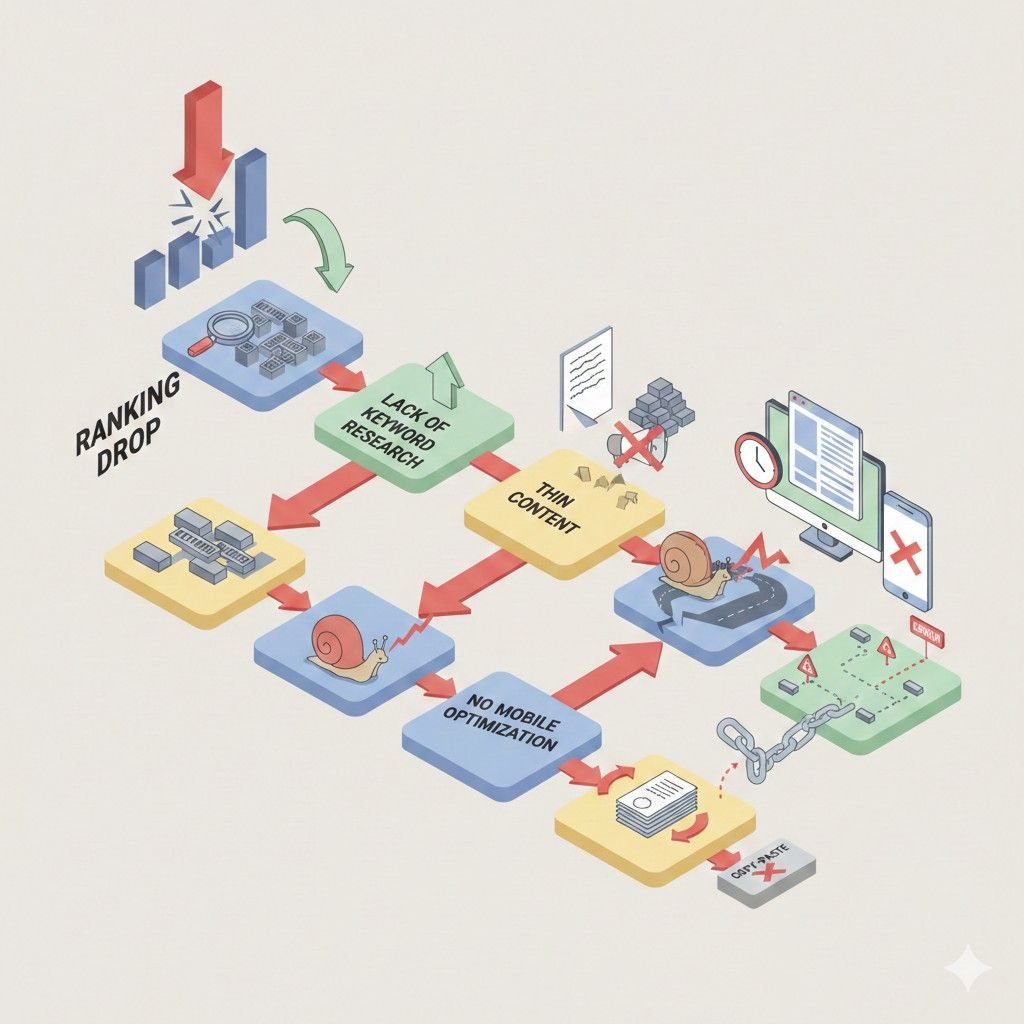
Avoiding common mistakes prevents wasted effort and ranking setbacks. Learning from others’ errors accelerates progress while protecting existing rankings from preventable damage.
Technical Debt and Neglected Foundations
Technical debt accumulates when development priorities override SEO requirements. JavaScript rendering issues, slow page speeds, and crawlability problems compound over time. Addressing technical debt before it becomes critical prevents ranking emergencies.
Neglected technical foundations undermine content investments. Publishing excellent content on technically broken sites wastes resources. Technical audits should precede major content initiatives.
Migration mistakes cause dramatic ranking losses. Site redesigns, platform changes, and URL restructuring require careful SEO planning. Rushed migrations without proper redirect implementation devastate organic traffic.
Thin Content and Keyword Cannibalization
Thin content fails to satisfy user intent comprehensively. Pages with minimal depth, limited information, or obvious padding struggle to rank against comprehensive alternatives. Quality consistently outperforms quantity.
Keyword cannibalization occurs when multiple pages target identical queries. Search engines struggle to determine which page deserves ranking, often resulting in neither page performing well. Content audits identify cannibalization problems.
Resolving cannibalization requires consolidation or differentiation. Merging similar pages into comprehensive resources or clearly differentiating target intent prevents internal competition.
Duplicate content across product variations, location pages, or syndicated content creates similar problems. Canonical tags, unique content development, and strategic consolidation address duplication issues.
Short-Term Tactics vs. Sustainable Growth
Short-term tactics may produce temporary gains but risk penalties and ranking losses. Link schemes, keyword stuffing, and manipulative practices violate search engine guidelines. Recovery from penalties requires significant time and effort.
Sustainable growth builds lasting competitive advantages. Investing in genuine expertise, quality content, and earned authority produces compounding returns. Short-term thinking sacrifices long-term potential.
Algorithm updates frequently target manipulative tactics. Sites relying on shortcuts face periodic ranking losses as search engines improve detection. Sustainable practices provide stability through algorithm changes.
How to Build a SaaS SEO Strategy Around Ranking Factors
Strategic planning transforms ranking factor knowledge into actionable programs. Systematic approaches ensure comprehensive coverage while maintaining focus on highest-impact opportunities.
Audit and Baseline Assessment
Technical audits identify infrastructure problems requiring attention. Crawl analysis, performance testing, and indexation review reveal issues blocking ranking improvement. Prioritize fixes based on severity and impact.
Content audits evaluate existing assets. Identifying high-performing content, underperforming pages, and content gaps guides strategy development. Understanding current strengths and weaknesses enables targeted improvement.
Competitive analysis benchmarks your position. Examining competitor content depth, backlink profiles, and technical implementation reveals gaps and opportunities. Matching competitor strengths while exploiting weaknesses guides prioritization.
Baseline metrics establish starting points for progress measurement. Documenting current rankings, traffic, and conversions enables meaningful comparison over time. Without baselines, improvement measurement becomes impossible.
Prioritization and Roadmap Development
Prioritization frameworks balance impact against effort. Plotting potential improvements on impact/effort matrices identifies quick wins and strategic investments. Limited resources require ruthless prioritization.
Roadmap development sequences activities logically. Technical foundations precede content investment. Content development precedes aggressive link building. Logical sequencing maximizes efficiency and results.
Resource planning ensures execution capability. Identifying required skills, tools, and budget enables realistic planning. Ambitious roadmaps without adequate resources produce frustration rather than results.
Milestone definition creates accountability checkpoints. Breaking annual goals into quarterly objectives and monthly targets maintains momentum while enabling course correction.
Ongoing Optimization and Performance Tracking
Continuous optimization maintains and improves rankings over time. Search algorithms evolve, competitors adjust strategies, and user expectations change. Static approaches lose ground to dynamic competitors.
Performance tracking identifies what works and what requires adjustment. Regular reporting on key metrics reveals trends, highlights successes, and surfaces problems requiring attention.
Testing and iteration improve results over time. A/B testing titles, experimenting with content formats, and trying new link building approaches discovers improvements that compound over time.
Competitive monitoring tracks market changes. Watching competitor activities, new market entrants, and industry trends enables proactive strategy adjustment rather than reactive scrambling.
Conclusion
SaaS SEO ranking factors span technical foundations, content quality, user experience, and external authority signals. Success requires addressing all categories systematically rather than focusing narrowly on individual factors. The companies that build comprehensive SEO programs across these dimensions achieve sustainable organic growth that compounds over time.
Understanding ranking factors provides the knowledge foundation, but execution determines results. Prioritizing high-impact improvements, maintaining consistent effort, and measuring progress against realistic timelines transforms knowledge into traffic, leads, and revenue growth.
At White Label SEO Service, we help SaaS companies build and execute comprehensive SEO strategies that address every ranking factor systematically. Contact us to discuss how we can accelerate your organic growth through technical optimization, content development, and authority building tailored to your competitive landscape.
Frequently Asked Questions About SaaS SEO Ranking Factors
What is the most important SEO ranking factor for SaaS?
Content quality and relevance represent the most important ranking factors for SaaS companies. Search engines prioritize content that comprehensively satisfies user intent with accurate, expert information. Technical foundations enable content to rank, but exceptional content drives sustainable competitive advantage.
How many ranking factors does Google use?
Google uses hundreds of ranking signals in its algorithms, though the company does not publish a definitive list. Major confirmed factors include content quality, backlinks, page experience, and mobile-friendliness. The relative weight of factors varies by query type and competitive context.
Do SaaS companies need different SEO than other businesses?
SaaS companies face unique SEO requirements due to complex products, lengthy buyer journeys, and competitive markets. Product-led content, feature documentation, comparison pages, and technical content needs distinguish SaaS SEO from simpler business models. The subscription revenue model also justifies higher customer acquisition investment.
How do I know if my SaaS SEO is working?
Effective SaaS SEO produces measurable improvements in organic traffic, keyword rankings, and conversion metrics over time. Track month-over-month traffic growth, ranking improvements for target keywords, and leads or trials attributed to organic search. Expect gradual improvement over 3-6 months rather than immediate results.
How long does it take to see SEO results for SaaS?
SaaS SEO typically produces noticeable results within 3-6 months for moderate-competition keywords. Highly competitive terms may require 6-12 months or longer. New domains face extended timelines due to authority building requirements. Consistent effort over extended periods produces the best outcomes.
What technical SEO factors matter most for SaaS websites?
Core Web Vitals, mobile-friendliness, crawlability, and site architecture represent the most critical technical factors for SaaS websites. JavaScript rendering issues particularly affect SaaS sites with complex applications. Addressing technical foundations before investing heavily in content maximizes overall SEO effectiveness.
How do backlinks affect SaaS SEO rankings?
Backlinks from authoritative, relevant websites significantly influence SaaS rankings by passing trust and authority signals. Quality matters more than quantity. Links from respected industry publications, software review sites, and complementary businesses carry substantial weight. Building a natural backlink profile requires sustained content marketing and relationship development.