
Scaling link building outreach means building a repeatable system that acquires quality backlinks consistently without sacrificing personalization or deliverability. Most SEO teams hit a ceiling at 20-30 links per month because their process relies on manual effort that cannot grow.
This matters because backlinks remain one of Google’s strongest ranking signals. Without a scalable acquisition engine, your competitors will outpace your domain authority growth and capture the organic traffic you need.
This guide covers the complete framework for scaling outreach, from infrastructure setup and prospect research to templates, tools, and measurement systems that connect link acquisition directly to ranking improvements.
What Is Link Building Outreach at Scale?
Link building outreach at scale is the systematic process of acquiring backlinks through email campaigns that can grow from dozens to hundreds or thousands of prospects monthly while maintaining quality and conversion rates. It transforms link acquisition from a sporadic activity into a predictable growth channel.
The core difference between scaled outreach and traditional methods lies in infrastructure, not just volume. Scaled systems use dedicated email domains, automated sequences, CRM tracking, and templated personalization that allow teams to multiply output without proportionally increasing labor costs.
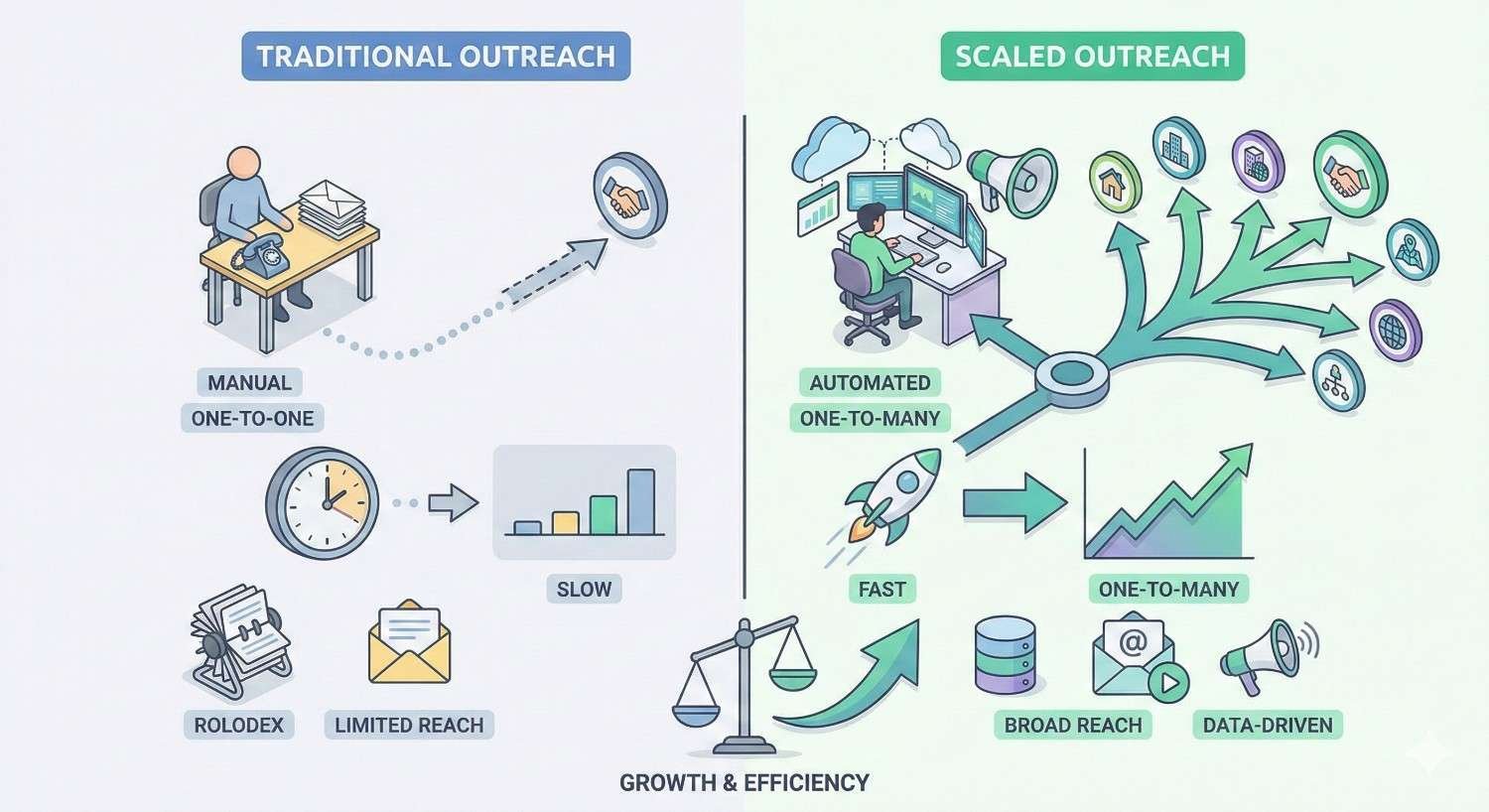
Traditional Outreach vs. Scaled Outreach
Traditional outreach typically involves one person manually finding prospects, writing individual emails, and tracking responses in a spreadsheet. This approach works for acquiring 5-15 links monthly but creates a hard ceiling on growth.
Scaled outreach separates each function into specialized workflows. Prospect research becomes a dedicated process with defined criteria and quality checks. Email sending uses multiple domains and warming protocols. Personalization follows frameworks that balance efficiency with relevance. Response management uses CRM systems that track every touchpoint.
The practical difference shows in output capacity. A traditional approach might yield 10 links from 200 emails monthly. A scaled system can send 2,000+ emails monthly while maintaining similar or better conversion rates through better targeting and deliverability.
Why Scaling Matters for Organic Growth
Domain authority growth requires consistent link velocity over time. Ahrefs research shows that pages ranking in the top 10 positions have significantly more referring domains than lower-ranking pages. Sporadic link building creates inconsistent authority signals that slow ranking progress.
Competitive niches demand higher link velocity. If your competitors acquire 30 quality links monthly and you acquire 10, the authority gap widens every month. Scaling outreach closes this gap and creates sustainable competitive advantage.
The economics also favor scale. Fixed costs like tools, training, and process development spread across more links acquired. A team spending $5,000 monthly on outreach that acquires 50 links has a $100 cost per link. The same investment in a scaled system acquiring 100 links drops to $50 per link.
Core Components of a Scalable Link Building System
Building a scalable link building system requires four interconnected components working together. Weakness in any single area creates bottlenecks that limit overall capacity and conversion rates.
Prospect Research and List Building
Prospect research determines campaign success more than any other factor. Poor targeting wastes email capacity on sites that will never link, while precise targeting maximizes conversion rates and link quality.
Scalable prospect research uses defined criteria applied consistently. Domain authority thresholds, traffic minimums, content relevance scores, and spam indicators create filters that qualify prospects before they enter outreach sequences.
List building at scale requires systematic processes. Competitor backlink analysis identifies sites already linking to similar content. Resource page discovery finds curated lists in your niche. Guest post opportunity databases provide pre-qualified targets. Each source feeds into a central prospect database with standardized fields.
Quality control prevents list degradation. Regular audits remove dead domains, sites that stopped publishing, and prospects who previously declined. Deduplication across campaigns prevents sending multiple pitches to the same contact.
Email Infrastructure and Deliverability
Email deliverability determines whether your messages reach inboxes or spam folders. At scale, deliverability becomes the primary constraint on campaign performance.
Domain infrastructure requires multiple sending domains to distribute volume and protect your primary domain reputation. Each outreach domain needs proper SPF, DKIM, and DMARC authentication. New domains require 2-4 weeks of warming before full-volume sending.
Sending patterns affect deliverability significantly. Gradual volume increases, randomized sending times, and natural reply patterns signal legitimate communication to email providers. Sudden volume spikes or robotic timing patterns trigger spam filters.
Inbox placement monitoring tracks deliverability across email providers. Tools like GlockApps or Mail-Tester identify deliverability issues before they impact campaign performance. Regular seed list testing catches problems early.
Personalization Frameworks
Personalization at scale requires frameworks that balance relevance with efficiency. Fully manual personalization limits volume. Fully automated personalization destroys conversion rates.
Effective frameworks use tiered personalization based on prospect value. High-value targets receive deep personalization with specific content references and custom value propositions. Mid-tier prospects receive templated personalization with dynamic fields. Lower-tier prospects receive lighter personalization focused on relevance signals.
Personalization tokens automate variable insertion. First name, company name, recent article titles, and specific page references can populate automatically from prospect data. The key is collecting this data during research rather than at sending time.
Template libraries provide starting points for different outreach types. Guest post pitches, resource page requests, broken link notifications, and skyscraper outreach each require different structures and value propositions.
Response Management and Follow-Up Sequences
Response management becomes complex at scale. Hundreds of active conversations require systematic tracking to prevent dropped opportunities and ensure timely follow-up.
CRM integration centralizes all prospect communication. Every email sent, response received, and action taken logs automatically. Pipeline stages track prospects from initial contact through link placement and verification.
Follow-up sequences increase response rates significantly. Backlinko research found that sending multiple follow-ups can increase response rates substantially. Automated sequences send follow-ups at optimal intervals while pausing when prospects respond.
Response categorization enables efficient handling. Positive responses route to negotiation workflows. Questions route to FAQ templates. Rejections update prospect status and trigger removal from active sequences.
How to Build a Link Building Outreach Process That Scales
Building a scalable outreach process requires systematic development across seven steps. Each step creates infrastructure that supports increased volume without proportional effort increases.
Step 1: Define Link Acquisition Goals and KPIs
Clear goals prevent wasted effort and enable meaningful measurement. Vague objectives like “get more links” provide no guidance for prioritization or resource allocation.
Effective link building goals specify quantity, quality, and timeline. Example: “Acquire 40 links monthly from DR 40+ sites in the marketing technology niche within 6 months.” This goal provides clear targets for prospect research, outreach volume, and conversion rate requirements.
KPIs should track both activity and outcomes. Activity metrics include emails sent, response rates, and follow-up completion. Outcome metrics include links acquired, average domain authority, and cost per link. Leading indicators like response rates predict future link acquisition before links actually place.
Baseline measurement establishes starting points. Document current link velocity, average link quality, and cost per acquisition before implementing changes. This enables accurate measurement of improvement.
Step 2: Create Linkable Assets Worth Pitching
Outreach campaigns fail when they pitch content that provides no value to the linking site. Linkable assets give prospects genuine reasons to add your link.
Original research generates the highest link conversion rates. Surveys, data studies, and industry benchmarks provide unique value that cannot be found elsewhere. Sites link to original research because it strengthens their own content.
Comprehensive guides that exceed existing resources attract links through superior utility. The skyscraper technique identifies popular content and creates substantially better versions. These assets succeed when they genuinely provide more value than alternatives.
Tools and calculators earn links through ongoing utility. Interactive resources that solve specific problems attract links from sites recommending solutions to their audiences.
Visual assets including infographics, charts, and diagrams earn links when they communicate complex information effectively. Sites embed visual assets and link to sources.
Step 3: Build Targeted Prospect Lists
Prospect list quality determines campaign success. Time invested in building precise lists returns through higher conversion rates and better link quality.
Competitor backlink analysis identifies proven link opportunities. Sites linking to competitors have demonstrated willingness to link to similar content. Tools like Ahrefs, Moz, or Semrush export competitor backlink profiles for analysis.
Filtering criteria qualify prospects before outreach. Minimum domain authority thresholds ensure link value. Traffic requirements indicate active sites. Content relevance scores confirm topical alignment. Spam indicators identify sites to avoid.
Contact discovery adds the human element. Finding the right person to contact increases response rates significantly. Editor names, content manager emails, and author contact information improve targeting over generic contact forms.
List segmentation enables personalized campaigns. Grouping prospects by site type, content focus, or relationship potential allows tailored messaging that resonates with each segment.
Step 4: Set Up Outreach Tools and Automation
Tool selection impacts both capability and cost. The right stack balances functionality with complexity and budget constraints.
Email sending platforms handle volume, sequencing, and tracking. Options range from simple tools like Mailshake or Lemlist to enterprise platforms like Outreach or Salesloft. Key features include sequence automation, A/B testing, and deliverability monitoring.
Prospecting tools accelerate list building. Hunter.io finds email addresses. Ahrefs and Semrush analyze backlink profiles. Screaming Frog audits prospect sites. Integration between tools reduces manual data transfer.
CRM systems track relationships across campaigns. HubSpot, Pipedrive, or dedicated link building CRMs like Pitchbox centralize prospect data and communication history.
Automation should enhance, not replace, human judgment. Automate repetitive tasks like follow-up scheduling and data entry. Keep strategic decisions like prospect qualification and response handling under human control.
Step 5: Develop Email Templates and Personalization Tokens
Templates provide consistent starting points while personalization tokens add relevance at scale. The combination enables volume without sacrificing conversion rates.
Template structure follows proven patterns. Subject lines that create curiosity or indicate value. Opening lines that establish relevance to the recipient. Value propositions that explain benefits clearly. Calls to action that specify next steps.
Personalization tokens insert variable data automatically. Common tokens include first name, company name, recent article title, specific page URL, and custom compliments. Token data must be collected during prospect research.
A/B testing identifies winning variations. Test subject lines, opening approaches, value propositions, and CTAs systematically. Statistical significance requires sufficient volume before declaring winners.
Template libraries organize variations by outreach type, prospect segment, and campaign goal. Easy access to proven templates accelerates campaign launches.
Step 6: Launch, Track, and Iterate Campaigns
Campaign launch requires careful sequencing to protect deliverability and enable learning. Rushing volume before validating approach wastes resources and damages sender reputation.
Soft launches test campaigns with small prospect batches. Send to 50-100 prospects initially and monitor deliverability, open rates, and response rates. Identify problems before scaling volume.
Gradual scaling increases volume as metrics validate approach. Double volume weekly while maintaining performance metrics. Sudden volume spikes trigger spam filters and reduce deliverability.
Real-time monitoring catches issues early. Daily checks on bounce rates, spam complaints, and response patterns identify problems before they compound. Quick adjustments prevent campaign failure.
Iteration improves performance continuously. Weekly analysis identifies underperforming segments, templates, or prospect sources. Systematic testing of alternatives drives ongoing improvement.
Step 7: Measure Results and Optimize Conversion Rates
Measurement connects activity to outcomes and identifies optimization opportunities. Without clear measurement, teams cannot distinguish effective tactics from wasted effort.
Funnel metrics track conversion at each stage. Emails sent to opens, opens to responses, responses to agreements, agreements to live links. Bottlenecks appear where conversion drops significantly.
Link quality metrics ensure volume does not sacrifice value. Average domain authority, traffic to linking pages, and relevance scores indicate whether acquired links will impact rankings.
Cost metrics enable ROI calculation. Total campaign costs divided by links acquired yields cost per link. Comparing cost per link to link value determines campaign profitability.
Optimization focuses on highest-impact bottlenecks. If open rates are low, test subject lines. If response rates are low, test value propositions. If agreement rates are low, test negotiation approaches.
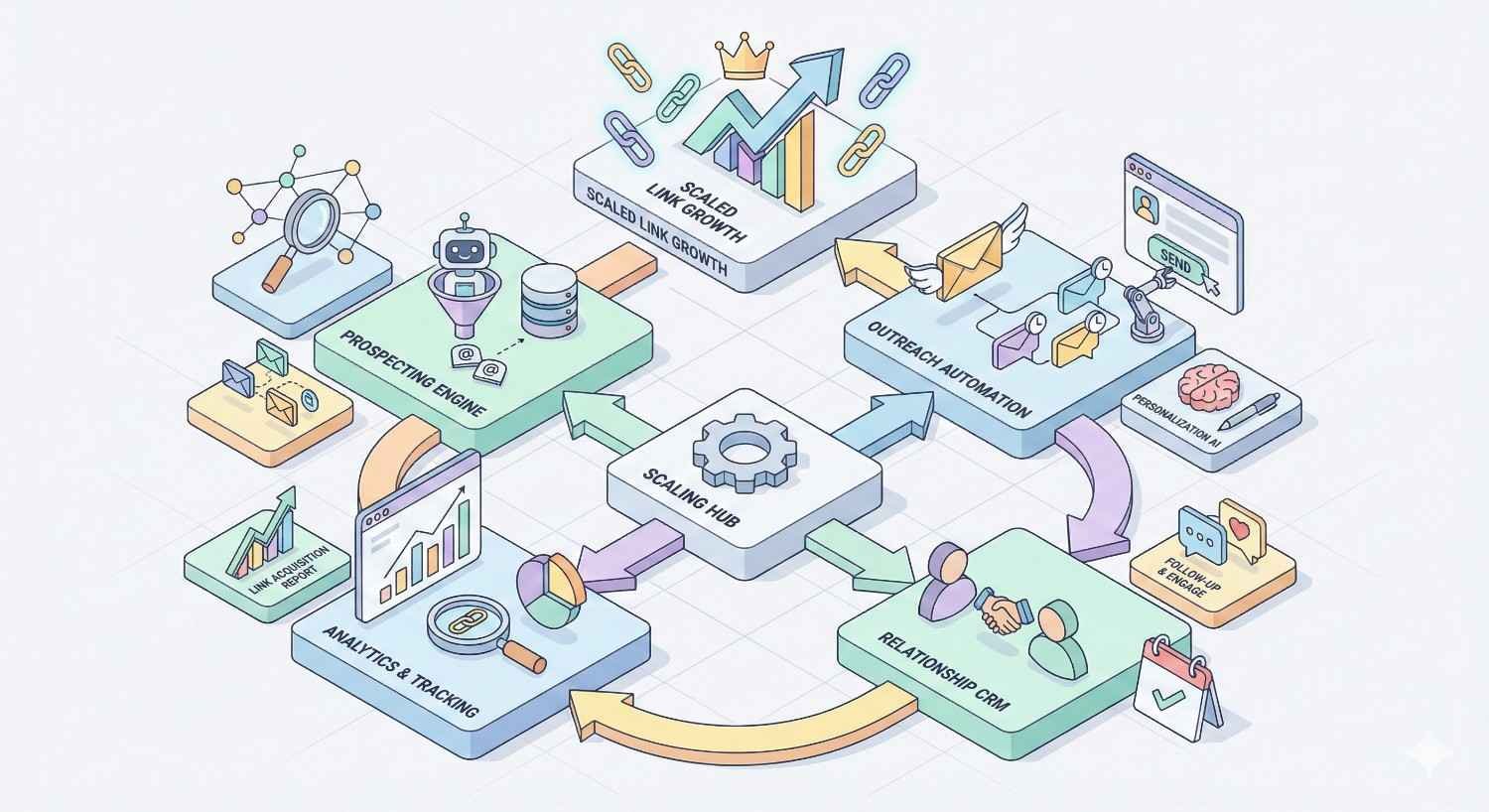
Best Tools for Scaling Link Building Outreach
Tool selection significantly impacts outreach capacity and efficiency. The right combination automates repetitive tasks while providing data for strategic decisions.
Prospecting and Research Tools
Ahrefs provides comprehensive backlink analysis for competitor research and prospect qualification. The Content Explorer feature identifies linkable content opportunities. Site Explorer analyzes prospect domain metrics.
Semrush offers similar backlink analysis with additional features for content gap analysis and keyword research integration. The Link Building Tool provides workflow management for prospect tracking.
Hunter.io finds and verifies email addresses at scale. The domain search feature identifies all known emails for a company. Email verification reduces bounce rates.
Screaming Frog audits prospect websites for broken links, content quality, and technical issues. Broken link discovery enables broken link building campaigns.
Email Outreach Platforms
Pitchbox combines prospecting, outreach, and CRM in a dedicated link building platform. Built-in prospecting integrations and link building-specific workflows streamline the entire process.
Mailshake provides straightforward email sequencing with good deliverability features. The simpler interface suits teams new to scaled outreach.
Lemlist offers advanced personalization including dynamic images and video. Higher personalization capabilities suit high-value prospect campaigns.
Respona combines AI-assisted prospecting with outreach automation. The platform identifies opportunities and suggests personalization automatically.
CRM and Pipeline Management
HubSpot provides free CRM functionality with email integration and pipeline tracking. The marketing hub adds automation capabilities for larger operations.
Pipedrive offers sales-focused pipeline management that adapts well to link building workflows. Visual pipeline views show campaign progress clearly.
BuzzStream provides link building-specific CRM with relationship tracking and outreach history. The platform maintains context across multiple campaigns to the same prospects.
Link Monitoring and Reporting Tools
Ahrefs Alerts notifies when new backlinks appear or existing links disappear. Monitoring ensures link placements remain live.
Linkody tracks backlink status and provides automated monitoring reports. The tool identifies lost links quickly for recovery outreach.
Google Search Console shows which links Google has discovered and indexed. Comparing acquired links to indexed links identifies indexing issues.
Agency Analytics or Databox create client-facing reports that connect link acquisition to ranking and traffic improvements.
Link Building Outreach Templates That Convert
Effective templates balance proven structure with customization opportunities. These frameworks provide starting points that teams can adapt to their specific assets and audiences.
Guest Post Outreach Templates
Guest post outreach succeeds when it demonstrates value to the target site’s audience. The pitch must show understanding of their content and readers.
Template Framework:
Subject: Guest post idea for [Site Name]: [Specific Topic]
Hi [First Name],
I’ve been reading [Site Name] for a while, particularly enjoyed your recent piece on [Recent Article Topic]. The section about [Specific Detail] was especially useful.
I’d love to contribute a guest post on [Proposed Topic]. Based on your existing content, I think your readers would find value in [Specific Angle].
Here’s a quick outline:
- [Point 1]
- [Point 2]
- [Point 3]
I’ve previously written for [Relevant Publication] on similar topics. Happy to share samples if helpful.
Would this be a good fit for [Site Name]?
[Name]
The template works because it demonstrates familiarity with the site, proposes specific value, and provides easy next steps.
Resource Page Link Request Templates
Resource page outreach targets curated lists where your content genuinely belongs. Success requires identifying pages where your resource adds value to their collection.
Template Framework:
Subject: Resource suggestion for your [Topic] page
Hi [First Name],
I found your [Resource Page Title] while researching [Topic]. Great collection, especially the section on [Specific Category].
I recently published [Your Resource Title] that covers [Brief Description]. It includes [Unique Value Point] that I didn’t see in your current list.
Here’s the link: [URL]
If you think it would be helpful for your readers, I’d be grateful for the addition. Either way, thanks for maintaining such a useful resource.
[Name]
This template succeeds by acknowledging their existing work, explaining specific value addition, and making the request easy to fulfill.
Broken Link Building Templates
Broken link outreach provides immediate value by identifying problems on the prospect’s site. The approach positions your link as a solution rather than a request.
Template Framework:
Subject: Broken link on your [Page Title]
Hi [First Name],
I was reading your article on [Topic] and noticed the link to [Broken Link Anchor Text] in the [Section] appears to be broken.
I actually have a similar resource that covers [Topic]: [Your URL]
It includes [Brief Value Description] that might work as a replacement.
Either way, wanted to give you a heads up about the broken link.
[Name]
The template works because it leads with value (identifying the problem) before making any request. The replacement suggestion feels helpful rather than promotional.
Skyscraper Technique Outreach Templates
Skyscraper outreach targets sites already linking to inferior content. The pitch must clearly communicate why your resource is substantially better.
Template Framework:
Subject: Better resource for your [Topic] article
Hi [First Name],
I noticed you linked to [Competitor Resource] in your article about [Topic]. Great piece overall.
I recently published an updated guide on the same subject that goes significantly deeper: [Your URL]
Compared to the resource you currently link to, mine includes:
- [Improvement 1]
- [Improvement 2]
- [Improvement 3]
Might be worth a look if you’re updating that article. Happy to answer any questions about the content.
[Name]
This template succeeds by being specific about improvements rather than making vague claims of superiority.
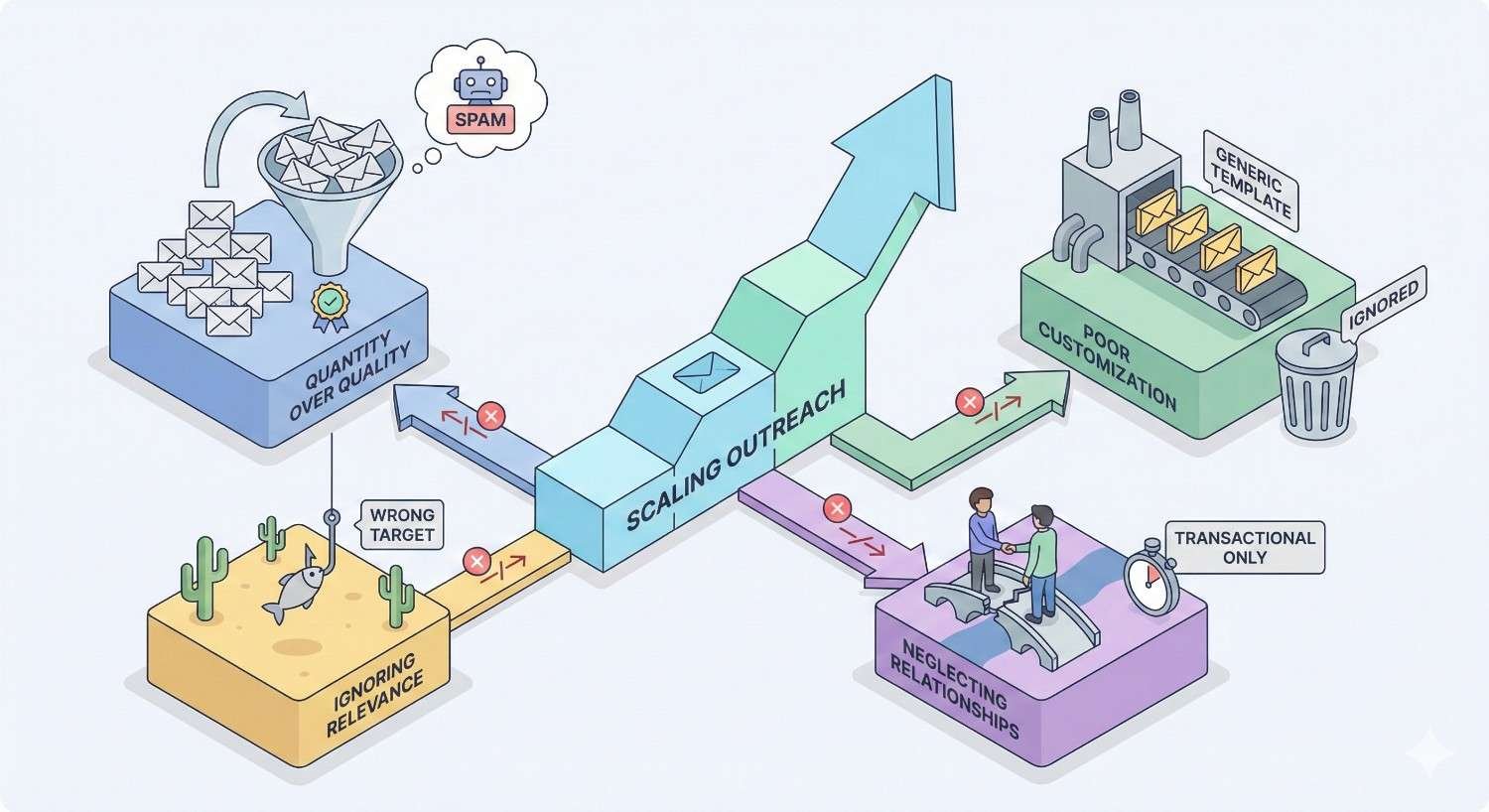
Common Mistakes When Scaling Link Building Outreach
Scaling introduces failure modes that do not exist at lower volumes. Recognizing these patterns prevents costly mistakes that damage campaigns and sender reputation.
Over-Automation and Generic Messaging
Automation enables scale but destroys conversion when applied without judgment. Prospects recognize mass emails instantly and delete them without reading.
The symptoms appear in response rates. Campaigns with heavy automation typically see response rates below 2%. Well-personalized campaigns at scale maintain 5-10% response rates.
The solution balances automation with personalization. Automate sending, sequencing, and tracking. Keep personalization elements that require human judgment. Test personalization levels to find the minimum effective dose.
Generic messaging fails because it provides no reason for the specific recipient to respond. “I found your site and thought you might be interested” applies to everyone and therefore resonates with no one.
Poor List Quality and Targeting
List quality problems compound at scale. Sending to 100 poor prospects wastes limited effort. Sending to 2,000 poor prospects wastes significant resources and damages sender reputation.
Common quality issues include outdated contact information, irrelevant sites, low-authority domains, and spam sites. Each bad prospect consumes email capacity that could reach qualified targets.
Quality control requires systematic processes. Define qualification criteria before building lists. Verify data accuracy before importing to outreach tools. Audit lists regularly to remove degraded prospects.
Targeting precision matters more than list size. A list of 500 highly relevant prospects outperforms a list of 5,000 loosely related sites. Conversion rates on precise lists can be 5-10x higher than broad lists.
Ignoring Email Deliverability
Deliverability problems are invisible until they become severe. Emails landing in spam folders generate no bounces or complaints, just silence.
Warning signs include declining open rates, increasing bounce rates, and responses mentioning spam folder retrieval. By the time these appear, damage has accumulated.
Prevention requires proactive monitoring. Regular seed list testing checks inbox placement across email providers. Domain reputation monitoring identifies problems early. Sending pattern analysis ensures natural behavior.
Recovery from deliverability damage takes weeks or months. Warming new domains, cleaning lists, and rebuilding reputation requires patience. Prevention costs far less than recovery.
Failing to Track and Attribute Results
Without tracking, teams cannot identify what works or justify continued investment. Link building becomes a cost center rather than a measurable growth channel.
Common tracking failures include not connecting links to specific campaigns, not measuring link quality alongside quantity, and not tracking costs accurately.
Proper attribution requires end-to-end tracking. Every link acquired should trace back to the campaign, template, and prospect source that generated it. This data enables optimization and ROI calculation.
Connecting links to rankings requires patience and methodology. Links take weeks to months to impact rankings. Tracking link acquisition alongside ranking changes over time reveals correlation patterns.
How to Measure Link Building Outreach Success
Measurement transforms link building from an art into a science. Clear metrics enable optimization, justify investment, and connect activity to business outcomes.
Key Metrics and KPIs
Activity metrics track effort and efficiency. Emails sent measures volume. Open rates indicate subject line effectiveness and deliverability. Response rates measure message resonance. Follow-up completion rates show process discipline.
Conversion metrics track progress through the funnel. Response to agreement rate measures pitch effectiveness. Agreement to live link rate measures follow-through. Overall conversion rate (emails to links) provides the summary metric.
Quality metrics ensure volume does not sacrifice value. Average domain authority of acquired links indicates link strength. Relevance scores measure topical alignment. Traffic to linking pages suggests real audience exposure.
Velocity metrics track progress over time. Links acquired per month shows growth rate. Link velocity trend indicates whether the program is accelerating or stalling.
Calculating Cost Per Link Acquired
Cost per link enables ROI calculation and budget optimization. The metric requires accurate cost tracking across all inputs.
Direct costs include tool subscriptions, contractor payments, and content creation expenses. Indirect costs include team time valued at loaded labor rates.
The calculation divides total costs by links acquired. A program spending $8,000 monthly (including labor) that acquires 80 links has a $100 cost per link.
Benchmarking cost per link against link value determines profitability. If links from DR 50+ sites typically cost $200-500 when purchased, acquiring them for $100 through outreach represents significant value creation.
Cost optimization focuses on the largest cost components. If labor represents 70% of costs, improving efficiency has more impact than reducing tool costs.
Connecting Link Acquisition to Ranking Improvements
The ultimate measure of link building success is ranking improvement and resulting traffic growth. Connecting links to rankings requires careful methodology.
Correlation analysis tracks link acquisition alongside ranking changes for target keywords. Increased link velocity should precede ranking improvements by 4-12 weeks typically.
Controlled comparison examines pages with different link building investment. Pages receiving focused link building should show stronger ranking improvement than pages without.
Traffic attribution connects ranking improvements to organic traffic growth. Google Search Console shows impressions and clicks by query, enabling connection from links to rankings to traffic.
Revenue attribution extends the chain to business outcomes. Traffic from improved rankings generates leads or sales that can be valued and compared to link building investment.
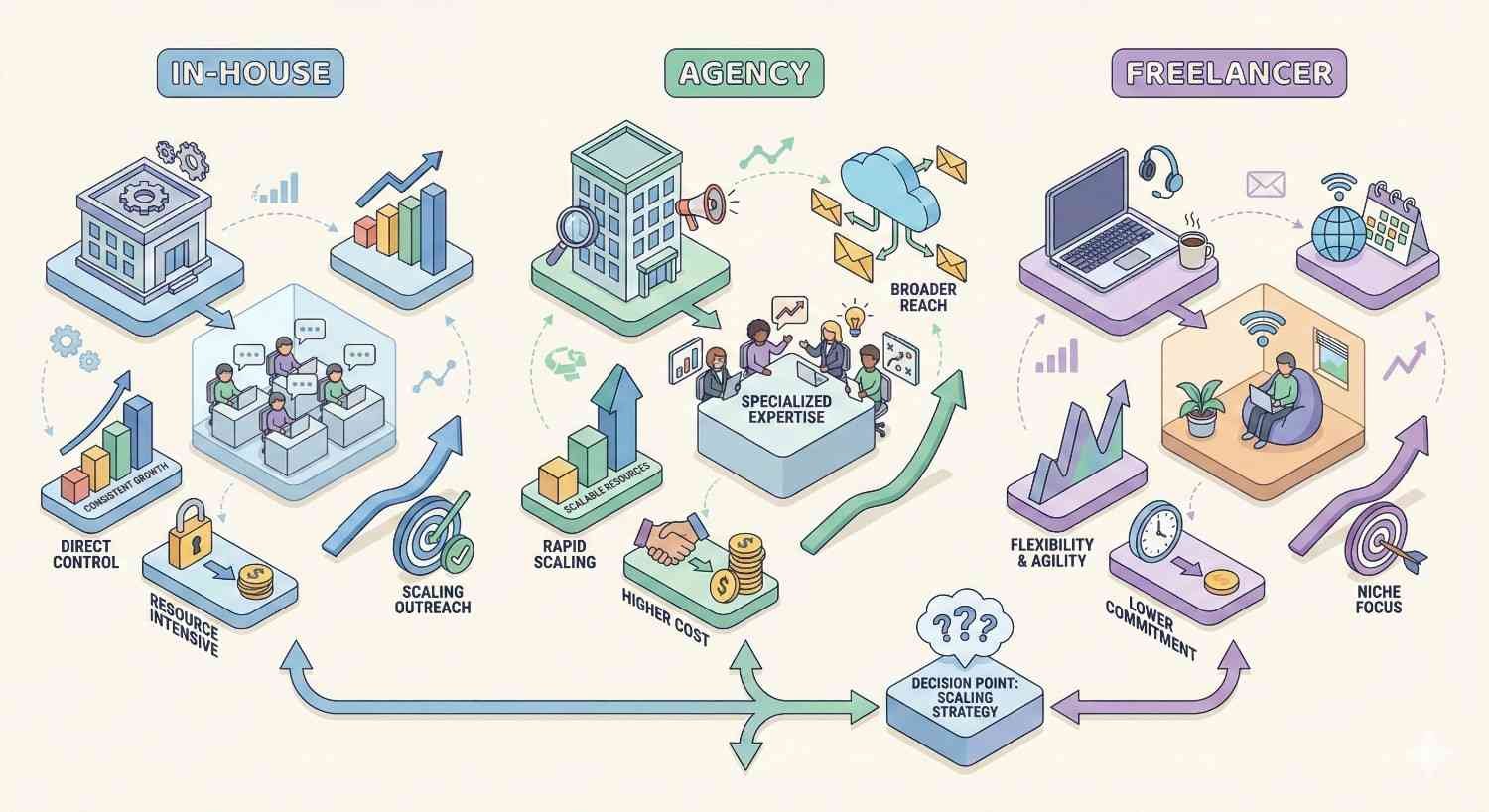
In-House vs. Agency vs. Freelancer: Who Should Scale Your Outreach?
Execution model selection impacts cost, quality, and scalability. Each approach offers distinct advantages and limitations.
Building an In-House Link Building Team
In-house teams provide maximum control and institutional knowledge accumulation. Team members understand your brand, content, and goals deeply.
The investment required is substantial. Hiring, training, and managing link building specialists requires management attention. Tool costs, salaries, and overhead add up quickly.
Typical team structure includes a link building manager overseeing specialists in prospecting, outreach, and relationship management. Minimum viable team size is usually 2-3 people for meaningful scale.
In-house makes sense when link building is a core competitive advantage, when volume requirements justify dedicated staff, and when institutional knowledge accumulation provides long-term value.
Working with a Link Building Agency
Agencies provide immediate scale and expertise without hiring complexity. Established agencies have refined processes, trained teams, and tool infrastructure already in place.
Cost structures vary widely. Some agencies charge per link with prices ranging from $100-1,000+ depending on quality requirements. Others charge monthly retainers for agreed link volumes.
Quality control requires clear agreements and monitoring. Define link quality requirements explicitly. Request transparency on methods and prospect sources. Monitor acquired links for relevance and authority.
Agency partnerships work well when you need scale quickly, when link building is not a core competency you want to develop, or when variable costs are preferable to fixed team costs.
Hiring Freelancers and Virtual Assistants
Freelancers and VAs provide flexible capacity at lower cost than agencies or full-time hires. The approach suits specific tasks or supplementary capacity.
Task allocation should match skill levels. VAs handle data entry, list building, and basic research effectively. Skilled freelancers manage outreach campaigns, write templates, and handle negotiations.
Management overhead increases with freelancer count. Each freelancer requires onboarding, quality monitoring, and communication. The management burden can exceed time savings if not structured well.
Hybrid models combine approaches effectively. In-house strategy and quality control with freelancer execution for volume tasks. Agency partnerships for specialized campaigns with freelancer support for ongoing maintenance.
How Link Building Outreach Fits Into a Complete SEO Strategy
Link building does not exist in isolation. Maximum impact requires integration with content strategy, technical SEO, and overall organic growth planning.
Aligning Outreach with Content Strategy
Content strategy should inform link building priorities. Creating linkable assets that also target valuable keywords multiplies the return on content investment.
Content gaps identified through keyword research become link building opportunities. Creating the best resource on an underserved topic attracts both organic traffic and natural links.
Editorial calendars should coordinate content creation with outreach campaigns. Publishing linkable assets with immediate outreach campaigns maximizes initial link velocity and ranking potential.
Existing content audits identify link building opportunities. High-performing content that lacks backlinks represents quick wins. Underperforming content with link potential may need updates before outreach.
Integrating Technical SEO and Site Authority
Technical SEO ensures acquired links transfer maximum value. Crawlability issues, indexing problems, or internal linking weaknesses reduce link impact.
Site architecture should support link equity flow. Links to deep pages need internal linking paths to distribute authority. Orphaned pages cannot benefit from site-wide authority gains.
Page speed and user experience affect how links impact rankings. Google considers page quality alongside link signals. Poor user experience can limit ranking gains from link acquisition.
HTTPS, mobile optimization, and Core Web Vitals provide the technical foundation for link building success. Addressing technical issues before scaling link building prevents wasted effort.
Long-Term Link Velocity and Sustainable Growth
Sustainable link building maintains consistent velocity over time rather than sporadic bursts. Search engines recognize natural link patterns and may discount unnatural spikes.
Link velocity targets should align with competitive requirements and resource capacity. Analyze competitor link acquisition rates to set appropriate targets.
Diversification across link types, sources, and anchor text creates natural link profiles. Over-reliance on single tactics or sources creates vulnerability.
Relationship building creates compounding returns. Sites that link once are more likely to link again. Building genuine relationships with editors and content managers creates ongoing opportunities.
Frequently Asked Questions About Scaling Link Building Outreach
How many outreach emails should I send per day?
Start with 50-100 emails daily per sending domain and increase gradually based on deliverability metrics. New domains should begin with 20-30 daily and warm up over 2-4 weeks. Monitor bounce rates and spam complaints closely. If deliverability degrades, reduce volume immediately.
What is a realistic link conversion rate?
Well-targeted campaigns typically convert 1-5% of emails sent into acquired links. Response rates of 5-15% are achievable with good personalization. Conversion from response to link placement ranges from 20-50% depending on asset quality and negotiation skill.
How do I avoid spam filters when scaling outreach?
Use authenticated sending domains with proper SPF, DKIM, and DMARC records. Warm new domains gradually before full-volume sending. Avoid spam trigger words and excessive links in emails. Maintain natural sending patterns with randomized timing. Monitor deliverability actively and adjust quickly when issues appear.
Is link building outreach still effective in 2024?
Yes, link building outreach remains effective when executed properly. Backlinks continue to be a significant ranking factor. The key is quality over quantity, genuine value propositions, and professional execution. Spammy mass outreach fails, but strategic relationship-based outreach succeeds.
How long does it take to see results from link building?
Individual links typically take 4-12 weeks to impact rankings after Google discovers and processes them. Meaningful ranking improvements from sustained link building usually appear within 3-6 months. Competitive keywords may require 6-12 months of consistent link acquisition.
What is a good response rate for outreach campaigns?
Response rates of 5-15% indicate effective targeting and messaging. Rates below 3% suggest problems with list quality, deliverability, or message relevance. Rates above 15% are achievable with highly targeted campaigns and strong personalization.
Should you outsource link building outreach?
Outsourcing makes sense when you need scale quickly, lack in-house expertise, or prefer variable costs. Keep strategy and quality control in-house while outsourcing execution. Vet partners carefully and monitor results closely. Hybrid models combining in-house oversight with outsourced execution often work best.
Next Steps: Building Your Scalable Link Acquisition Engine
Audit Your Current Outreach Process
Document your existing link building activities, tools, and results. Identify bottlenecks limiting scale. Measure current cost per link and conversion rates. This baseline enables meaningful improvement measurement.
Assess infrastructure readiness. Do you have dedicated sending domains? CRM tracking? Defined processes? Gaps in infrastructure must be addressed before scaling volume.
Prioritize Quick Wins and High-Impact Tactics
Start with highest-ROI opportunities. Competitor backlink analysis often reveals easy wins from sites already linking to similar content. Broken link building provides immediate value that increases conversion rates.
Build systems incrementally. Perfect one component before adding complexity. A simple process executed consistently outperforms a complex process executed poorly.
Partner with Experts for Accelerated Results
Scaling link building outreach requires expertise across prospecting, deliverability, copywriting, and relationship management. Building all capabilities in-house takes time most teams do not have.
We help businesses build sustainable organic growth through strategic link acquisition integrated with technical SEO and content strategy. Our team has scaled outreach programs from startup to enterprise level.
White Label SEO Service provides the infrastructure, expertise, and execution capacity to accelerate your link building results. Contact us to discuss how we can help you build a scalable link acquisition engine that drives measurable ranking improvements and organic traffic growth.
Frequently Asked Questions
What is the difference between link building and link building outreach?
Link building encompasses all methods of acquiring backlinks, including content marketing, digital PR, and passive link attraction. Link building outreach specifically refers to proactively contacting website owners to request links. Outreach is one tactic within the broader link building strategy.
How much does it cost to scale link building outreach?
Costs vary significantly based on approach and quality targets. In-house teams typically cost $5,000-15,000 monthly including salaries and tools. Agency partnerships range from $2,000-20,000 monthly depending on volume and quality requirements. Cost per link typically ranges from $50-500 for quality placements.
What makes a good link building prospect?
Good prospects have relevant content, sufficient domain authority (typically DR 30+), active publishing schedules, and real traffic. They should accept guest contributions or maintain resource pages. Avoid sites with spam indicators, excessive outbound links, or no editorial standards.
How do I personalize outreach emails at scale?
Use tiered personalization frameworks. High-value prospects receive custom research and specific content references. Mid-tier prospects receive templated personalization with dynamic fields for name, site, and recent content. Collect personalization data during prospect research rather than at sending time.
What tools do I need to scale link building outreach?
Essential tools include a prospecting platform (Ahrefs or Semrush), email finder (Hunter.io), outreach platform (Pitchbox, Mailshake, or Lemlist), and CRM for relationship tracking. Additional tools for deliverability monitoring and link tracking add value as you scale.
How do I measure link building ROI?
Calculate cost per link by dividing total program costs by links acquired. Compare to the value of equivalent links if purchased. Track ranking improvements for pages receiving links. Connect ranking gains to traffic increases and ultimately to leads or revenue generated from that traffic.
When should I hire a link building agency versus building in-house?
Hire an agency when you need scale quickly, lack internal expertise, or prefer variable costs. Build in-house when link building is a core competitive advantage, when you have management capacity, and when long-term institutional knowledge accumulation justifies the investment. Many companies use hybrid approaches.