
Introduction: Understanding the Local-to-National SEO Transition
Scaling from local to national SEO requires a fundamental shift in strategy, moving from geographic-specific optimization to building broad topical authority across your entire industry. This transition typically takes 12-24 months and demands significant investment in content, link building, and technical infrastructure.
The opportunity is substantial. Businesses that successfully make this transition unlock exponentially larger addressable markets while maintaining their established local presence.
This guide covers the complete framework: auditing your foundation, developing national keyword strategies, scaling content production, building domain authority, and measuring performance across regions.

What Does Scaling from Local to National SEO Actually Mean?
Scaling local SEO to national involves transitioning your optimization focus from ranking in specific geographic areas to competing for industry-wide search terms without location modifiers. This shift changes everything from keyword targeting to content strategy to link building priorities.
Local SEO centers on Google Business Profile optimization, local citations, and geographic keywords. National SEO requires comprehensive topical coverage, high-authority backlinks from industry publications, and content that serves users regardless of location.
Defining Local vs. National Search Intent
Local search intent includes explicit geographic signals. Users searching “plumber near me” or “best dentist in Chicago” want location-specific results. Google’s algorithm prioritizes proximity, relevance, and prominence within that geographic context.
National search intent lacks geographic modifiers. Searches like “how to fix a leaky faucet” or “best teeth whitening methods” indicate users want information regardless of location. These queries trigger organic results based on topical authority and content quality rather than physical proximity.
Understanding this distinction shapes your entire strategy. Local intent requires Google Business Profile optimization and local citations. National intent demands comprehensive content that establishes your brand as an industry authority.
Geographic Targeting vs. Topical Authority
Geographic targeting focuses your SEO efforts on specific service areas. You optimize for city names, neighborhoods, and regional terms. Your content addresses local concerns, references local landmarks, and builds citations on local directories.
Topical authority means becoming the definitive resource on subjects within your industry. Instead of ranking for “personal injury lawyer Dallas,” you aim to rank for “how to file a personal injury claim” or “car accident settlement calculator.”
The transition requires building content depth across your entire topic space. You need pillar pages covering broad subjects, supporting content addressing specific questions, and internal linking that demonstrates comprehensive expertise.
When Your Business Is Ready to Scale Beyond Local
Several indicators suggest readiness for national expansion. Strong local rankings across multiple geographic areas demonstrate your SEO fundamentals work. Consistent lead flow from organic search shows your content converts. Operational capacity to serve customers beyond your immediate area confirms you can fulfill increased demand.
Revenue stability matters. National SEO requires sustained investment over 12-24 months before generating significant returns. Businesses need financial runway to support this timeline without expecting immediate results.
Market opportunity validation is essential. Research whether national search volume exists for your services. Some businesses are inherently local. Others have massive national demand waiting to be captured.
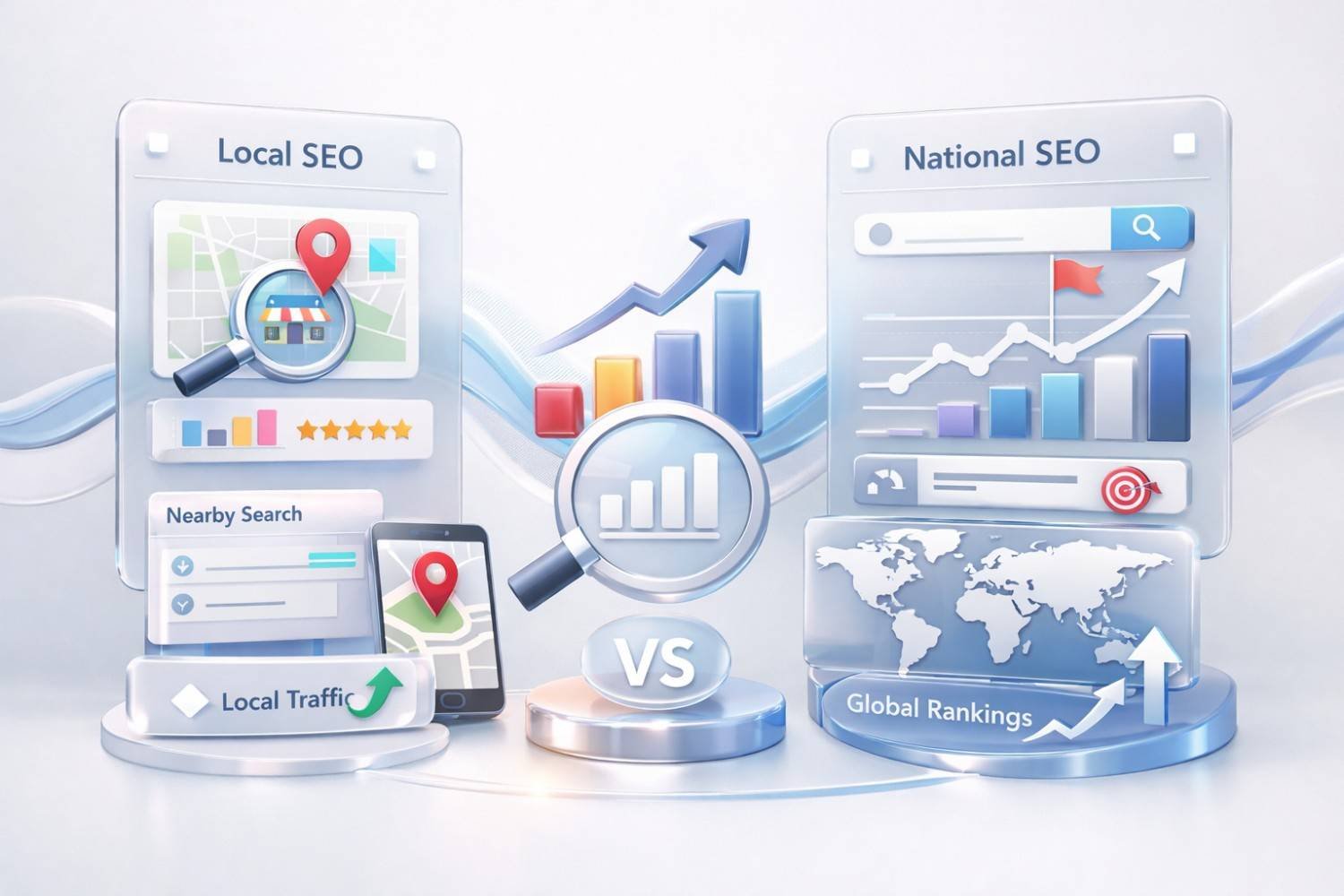
Core Differences Between Local and National SEO Strategy
The strategic differences between local and national SEO extend across every optimization discipline. Understanding these distinctions prevents wasted resources and misaligned expectations.
Keyword Strategy: From “Near Me” to Industry-Wide Terms
Local keyword strategy targets geographic modifiers. You optimize for “[service] + [city],” “[service] near me,” and “[service] in [neighborhood].” Competition exists primarily among local businesses within your service area.
National keyword strategy targets industry-wide terms without geographic qualifiers. These keywords typically have higher search volume but dramatically increased competition. You compete against established national brands, major publications, and aggregator sites.
The keyword research process changes fundamentally. Local research focuses on identifying all geographic variations of your core services. National research requires mapping your entire topic space, identifying content gaps, and prioritizing terms based on business impact and competitive difficulty.
Content Volume and Topical Coverage Requirements
Local SEO can succeed with relatively limited content. A well-optimized homepage, service pages for each offering, and location pages for service areas often suffice. Quality matters more than quantity at the local level.
National SEO demands substantial content volume. Establishing topical authority requires comprehensive coverage of your subject matter. This means dozens or hundreds of pages addressing every aspect of your industry, from beginner guides to advanced technical content.
Content clusters become essential. Each major topic needs a pillar page providing comprehensive coverage, supported by multiple related articles addressing specific subtopics and questions. Internal linking connects these pieces into coherent topic architectures.
Link Building: Local Citations vs. National Authority
Local link building emphasizes citations and local relevance. Directory listings on Yelp, Yellow Pages, and industry-specific local directories build local authority. Links from local news sites, chambers of commerce, and community organizations strengthen geographic relevance.
National link building requires high-authority backlinks from industry publications, major news outlets, and respected websites in your space. These links signal to Google that your site deserves to rank for competitive national terms.
The difficulty level increases substantially. Local citations are largely self-service. National backlinks require digital PR, relationship building, and creating content worthy of links from authoritative sources.
Technical Infrastructure for Multi-Location or National Reach
Local technical SEO focuses on Google Business Profile optimization, local schema markup, and NAP consistency across citations. Site architecture is relatively simple, with location pages serving different service areas.
National technical SEO requires robust site architecture supporting hundreds or thousands of pages. You need efficient crawling and indexing, proper internal linking at scale, and technical performance that handles increased traffic.
Multi-location businesses face additional complexity. Managing duplicate content across location pages, implementing proper schema for multiple locations, and maintaining site speed as page count grows all require careful planning.
Step 1: Audit Your Current Local SEO Foundation
Before scaling nationally, assess your existing local SEO performance. Weaknesses in your foundation will amplify as you expand. Strengths provide leverage for national growth.
Evaluating Your Google Business Profile Performance
Review your Google Business Profile metrics in detail. Examine search queries driving impressions and clicks. Identify which services and keywords generate the most visibility. Note seasonal patterns and trending directions.
Analyze your review profile. Review quantity, quality, and recency all impact local rankings. Businesses with strong review profiles have demonstrated ability to generate social proof, which transfers to national credibility.
Check your GBP category selections and attributes. Ensure you’re maximizing visibility for all relevant service categories. Incomplete profiles leave ranking potential untapped.
Assessing Local Citation Consistency and Quality
Audit your citation profile using tools like BrightLocal or Whitespark. Identify inconsistencies in name, address, and phone number across directories. Inconsistent NAP data confuses search engines and undermines local authority.
Evaluate citation quality beyond just quantity. Citations on relevant industry directories carry more weight than generic listings. Identify gaps in industry-specific directories you should be listed on.
Document your current citation baseline. This inventory helps you understand what local authority you’ve built and what transfers to national efforts versus what becomes less relevant.
Analyzing Current Keyword Rankings and Geographic Reach
Pull comprehensive ranking data for your target keywords across different geographic locations. Tools like Semrush, Ahrefs, or BrightLocal allow location-specific rank tracking.
Map your current geographic footprint. Identify where you rank well, where you’re visible but not dominant, and where you have no presence. This reveals both your strengths and expansion opportunities.
Analyze which content types and page formats perform best. Understanding what works locally informs your national content strategy. Patterns in successful local content often translate to national opportunities.
Identifying Technical SEO Gaps Before Scaling
Run a comprehensive technical audit using Screaming Frog, Sitebulb, or similar tools. Identify crawl errors, broken links, duplicate content, and indexing issues. These problems multiply as your site grows.
Evaluate site speed and Core Web Vitals. Check performance on both desktop and mobile. Slow sites struggle to rank nationally against optimized competitors. Address performance issues before scaling content production.
Review your site architecture and internal linking. Assess whether your current structure can accommodate significant content expansion. Identify whether you need architectural changes before adding hundreds of new pages.
Step 2: Develop a National Keyword and Content Strategy
National keyword strategy requires systematic research, careful prioritization, and content planning that builds topical authority over time.
Expanding Keyword Research Beyond Geographic Modifiers
Start by removing geographic modifiers from your existing keyword targets. “Personal injury lawyer Chicago” becomes “personal injury lawyer” and “how to hire a personal injury lawyer.” This reveals your core topic space.
Use keyword research tools to expand from these seed terms. Ahrefs, Semrush, and Moz all provide related keyword suggestions, questions, and topic ideas. Build comprehensive keyword lists covering your entire subject matter.
Analyze search intent for each keyword cluster. Informational queries require educational content. Commercial investigation queries need comparison content. Transactional queries demand conversion-focused pages. Map content types to intent categories.
Building Topical Authority Through Content Clusters
Organize your keywords into topic clusters. Each cluster centers on a pillar topic with supporting subtopics branching from it. This structure signals comprehensive expertise to search engines.
Create pillar pages that comprehensively cover broad topics. These pages should be your most thorough, authoritative content on major subjects. They serve as hubs linking to more specific supporting content.
Develop supporting content addressing specific questions and subtopics within each cluster. Each supporting piece links back to its pillar page and to related supporting content. This internal linking structure reinforces topical relationships.
Mapping User Intent Across the National Customer Journey
National audiences enter your funnel at different stages. Some seek basic information. Others compare solutions. Some are ready to purchase. Your content strategy must serve all stages.
Create awareness-stage content answering fundamental questions about your industry. These pieces attract top-of-funnel traffic and introduce your brand to potential customers early in their journey.
Develop consideration-stage content helping users evaluate options. Comparison guides, feature breakdowns, and detailed explanations help prospects understand their choices. This content captures users actively researching solutions.
Build decision-stage content facilitating conversions. Case studies, testimonials, pricing information, and clear calls-to-action help ready-to-buy visitors take action.
Prioritizing Keywords by Business Impact and Competition
Not all keywords deserve equal investment. Prioritize based on business value, search volume, and competitive difficulty. High-volume keywords with impossible competition waste resources. Low-volume keywords with high conversion potential may deserve priority.
Assess competitive difficulty realistically. Analyze the domain authority, content quality, and backlink profiles of current ranking pages. Identify keywords where you can realistically compete within your timeline and budget.
Create a phased keyword roadmap. Start with lower-competition terms where you can win relatively quickly. Build authority and momentum before attacking highly competitive head terms.
Step 3: Scale Your Content Production and Distribution
Scaling content production requires systems, processes, and strategic decisions about resource allocation. Random content creation wastes resources. Systematic production builds compounding authority.
Creating Scalable Content Systems and Workflows
Document your content production process. Define steps from keyword selection through publication and promotion. Identify bottlenecks and inefficiencies. Standardize what can be standardized while maintaining quality.
Build content templates for recurring content types. Templates ensure consistency, reduce production time, and maintain quality standards across multiple writers or team members.
Implement editorial calendars and project management systems. Tools like Asana, Monday, or Notion help coordinate content production at scale. Clear workflows prevent content from stalling in review or falling through cracks.
Balancing Location-Specific and National Content
Maintain your local content while building national presence. Local pages continue serving geographic searches. National content expands your reach. Both contribute to overall domain authority.
Avoid cannibalizing your own content. Local and national pages targeting similar topics need clear differentiation. Local pages should include geographic specificity. National pages should provide comprehensive, location-agnostic information.
Consider how local and national content can support each other. National pillar pages can link to location-specific examples. Local pages can reference national resources for deeper information.
Leveraging Programmatic SEO for Multi-Location Businesses
Programmatic SEO creates pages at scale using templates and data. For multi-location businesses, this enables efficient creation of location pages, service-area pages, and location-specific landing pages.
Build robust templates that create unique, valuable pages. Thin programmatic content that merely swaps city names provides little value and risks penalties. Templates should incorporate unique local data, testimonials, and information.
Implement proper technical controls for programmatic content. Use canonical tags appropriately. Ensure pages are crawlable and indexable. Monitor for duplicate content issues as page counts grow.
Content Quality vs. Quantity: Finding the Right Balance
Quality always trumps quantity, but national SEO requires substantial content volume. The solution is maintaining quality standards while increasing production capacity.
Define minimum quality standards for all content. Every piece should provide genuine value, answer user questions thoroughly, and demonstrate expertise. Content that doesn’t meet standards shouldn’t publish.
Invest in quality at the pillar level. Your most important pages deserve the most investment. Supporting content can be somewhat lighter while still meeting quality thresholds.
Step 4: Build National-Level Domain Authority
Domain authority determines your ability to rank for competitive national keywords. Building authority requires strategic link acquisition from high-quality sources.
Transitioning from Local Citations to Industry Backlinks
Local citations build local authority but contribute minimally to national rankings. National SEO requires backlinks from authoritative industry sources, major publications, and respected websites.
Identify target link sources in your industry. Industry publications, trade associations, educational institutions, and major news outlets all provide valuable backlinks. Create a target list of sites you want links from.
Develop linkable assets that attract natural links. Original research, comprehensive guides, useful tools, and unique data all attract links. Invest in creating content worthy of links from authoritative sources.
Digital PR and Link Acquisition Strategies at Scale
Digital PR generates backlinks through media coverage. Develop newsworthy angles, original research, and expert commentary that journalists want to cover.
Build relationships with journalists covering your industry. Respond to HARO queries, pitch story ideas, and offer expert commentary on trending topics. Consistent relationship building generates ongoing link opportunities.
Create data-driven content that earns media coverage. Original surveys, industry reports, and data analysis provide journalists with unique information worth covering and linking to.
Building Relationships with National Publications and Platforms
Identify publications your target audience reads. Industry trade publications, major business media, and vertical-specific sites all represent link opportunities.
Develop guest posting relationships with relevant publications. Contribute valuable content that serves their audience while building your authority and earning backlinks.
Participate in industry events, podcasts, and webinars. These appearances often generate backlinks from event pages, show notes, and related coverage.
Leveraging Brand Mentions and Unlinked Citations
Monitor brand mentions across the web using tools like Google Alerts, Mention, or Ahrefs. Identify mentions of your brand that don’t include links.
Reach out to sites mentioning your brand without linking. A polite request often converts unlinked mentions into backlinks. This low-effort tactic captures link value you’ve already earned.
Track competitor mentions for link opportunities. Sites linking to competitors may be willing to link to you as well, especially if you offer superior content or resources.
Step 5: Optimize Technical SEO for National Scale
Technical SEO becomes increasingly critical as your site grows. Issues that were minor at small scale become major problems with hundreds or thousands of pages.
Site Architecture for Multi-Location or National Businesses
Design site architecture that scales efficiently. Flat architectures with logical categorization help search engines understand your content organization. Deep nesting creates crawling inefficiencies.
Implement clear URL structures that communicate content hierarchy. Users and search engines should understand page relationships from URLs alone. Consistent naming conventions prevent confusion.
Plan for growth. Architecture decisions made now affect your ability to scale later. Build structures that accommodate your content roadmap without requiring major restructuring.
Managing Duplicate Content Across Locations
Multi-location businesses face inherent duplicate content challenges. Service descriptions, company information, and process explanations naturally repeat across location pages.
Differentiate location pages with unique local content. Local testimonials, location-specific images, team member information, and local service details create unique value on each page.
Use canonical tags appropriately when some duplication is unavoidable. Point duplicate or near-duplicate pages to preferred versions. This consolidates ranking signals and prevents dilution.
Schema Markup Strategy for Local and National Presence
Implement LocalBusiness schema on location pages. Include accurate NAP information, service areas, hours, and other relevant local details. This supports local pack visibility.
Add Organization schema at the site level for national presence. This helps search engines understand your brand entity and its relationships to locations.
Use appropriate schema for content types. FAQ schema on question-focused content, HowTo schema on instructional content, and Article schema on blog posts all enhance search visibility.
Page Speed and Core Web Vitals at Scale
Monitor Core Web Vitals across your entire site, not just key pages. Tools like Google Search Console and PageSpeed Insights reveal site-wide performance patterns.
Optimize images site-wide. Implement lazy loading, proper sizing, and modern formats like WebP. Image optimization often provides the largest performance gains.
Evaluate hosting and CDN needs as traffic grows. Sites serving national audiences need infrastructure that performs well across geographic regions. Consider CDN implementation for static assets.
Step 6: Track, Measure, and Refine Your National SEO Performance
Measurement becomes more complex at national scale. You need systems that track performance across regions, content types, and competitive positions.
Setting Up Analytics for Multi-Geographic Tracking
Configure Google Analytics to segment traffic by geography. Create views or reports showing performance by state, region, or metro area. This reveals geographic patterns in your national performance.
Set up location-specific conversion tracking. Understand not just where traffic comes from but where conversions originate. Some regions may drive traffic without converting, indicating content or targeting issues.
Implement proper attribution modeling. National customer journeys often involve multiple touchpoints across different content types. Attribution helps you understand which content contributes to conversions.
KPIs That Matter When Scaling to National
Track organic traffic growth overall and by content cluster. Cluster-level tracking reveals which topic areas are gaining traction and which need additional investment.
Monitor keyword ranking distribution. Track not just individual rankings but the overall distribution of rankings across your target keywords. Movement from page two to page one matters more than position changes within page one.
Measure share of voice against national competitors. Tools like Semrush and Ahrefs calculate visibility scores that show your competitive position in the overall search landscape.
Identifying and Addressing Performance Gaps by Region
Analyze performance variations across geographic regions. Some regions may significantly underperform others, indicating opportunities for targeted improvement.
Investigate underperforming regions. Check for technical issues, content gaps, or competitive factors specific to those areas. Regional competitors may dominate certain markets.
Develop region-specific strategies where warranted. Some markets may require additional local content, targeted link building, or adjusted messaging to improve performance.
Continuous Optimization and Competitive Monitoring
Implement ongoing content optimization processes. Regularly update existing content with new information, improved formatting, and enhanced depth. Content freshness signals matter for competitive rankings.
Monitor competitor movements. Track when competitors publish new content, earn significant links, or make strategic changes. Competitive intelligence informs your own strategy adjustments.
Conduct quarterly strategy reviews. Assess progress against goals, identify what’s working and what isn’t, and adjust resource allocation accordingly. National SEO requires ongoing strategic refinement.
How Long Does It Take to Scale from Local to National SEO?
Timeline expectations vary significantly based on industry, competition, and resource investment. Setting realistic expectations prevents premature strategy abandonment.
Realistic Timeline Expectations by Industry
Low-competition industries may see meaningful national traction within 6-12 months. Niche B2B services, specialized professional services, and emerging categories often have less established competition.
Moderate-competition industries typically require 12-18 months for significant national visibility. Most service businesses, regional retailers expanding nationally, and mid-market B2B companies fall into this category.
High-competition industries demand 18-24 months or longer. Legal services, healthcare, financial services, and consumer categories with established national players require sustained investment over extended periods.
Factors That Accelerate or Slow National Expansion
Existing domain authority accelerates expansion. Sites with established authority from local success have a foundation to build upon. Starting from zero authority extends timelines significantly.
Content production capacity impacts speed. Businesses able to publish high-quality content consistently build topical authority faster than those publishing sporadically.
Link acquisition capability matters enormously. Sites that can earn authoritative backlinks through PR, relationships, or linkable assets progress faster than those struggling to build links.
Budget and resource allocation directly correlate with timeline. Underinvesting extends timelines. Appropriate investment enables faster progress.
Milestone Benchmarks to Track Progress
Month 3-6: Initial content foundation established. Core pillar pages published. First supporting content live. Technical foundation optimized.
Month 6-12: Content clusters developing. Initial rankings for lower-competition terms. Link building generating results. Traffic growth beginning.
Month 12-18: Topical authority establishing. Rankings improving for moderate-competition terms. Organic traffic contributing meaningfully to business results.
Month 18-24: National visibility achieved. Competitive rankings for target keywords. Organic channel driving significant revenue. Sustainable growth trajectory established.
Budget and Resource Planning for National SEO Expansion
National SEO requires significant investment across multiple disciplines. Understanding cost structures helps you plan appropriately and set realistic expectations.
Cost Breakdown: Content, Links, and Technical Investment
Content production typically represents 40-50% of national SEO budgets. This includes strategy, writing, editing, design, and publication. Quality content at scale requires substantial investment.
Link building and digital PR consume 30-40% of budgets. Outreach, relationship building, content promotion, and PR activities all require dedicated resources.
Technical SEO and tools account for 10-20% of budgets. Platform costs, technical optimization, and ongoing maintenance require consistent investment.
In-House vs. Agency vs. Hybrid SEO Teams
In-house teams provide control and institutional knowledge but require significant hiring investment. Building a complete SEO team means hiring strategists, content creators, link builders, and technical specialists.
Agencies provide immediate capability and scalability but require finding the right partner. Agency relationships work best with clear communication, defined expectations, and strategic alignment.
Hybrid models combine in-house strategy and oversight with agency execution. This approach provides control while accessing specialized capabilities and scalable resources.
ROI Expectations and Revenue Modeling
Model expected returns based on realistic traffic and conversion projections. Use current conversion rates and customer values to estimate revenue potential from increased organic traffic.
Account for timeline in ROI calculations. Investment occurs upfront while returns build over time. Calculate payback periods and long-term value rather than expecting immediate returns.
Compare SEO ROI to other channels. Organic traffic typically provides superior long-term economics compared to paid channels, but requires patience and sustained investment.
Common Mistakes When Scaling Local SEO to National
Avoiding common pitfalls accelerates your national expansion and prevents wasted resources. Learn from others’ mistakes rather than repeating them.
Neglecting Local SEO While Pursuing National Rankings
Local SEO continues generating leads while you build national presence. Abandoning local optimization sacrifices current revenue for uncertain future gains.
Maintain Google Business Profile optimization, review generation, and local citation management. These activities require relatively modest ongoing investment while protecting established revenue streams.
Balance resource allocation between local maintenance and national growth. Local SEO shouldn’t consume resources needed for national expansion, but shouldn’t be abandoned either.
Spreading Resources Too Thin Across Too Many Keywords
Attempting to rank for everything simultaneously dilutes your efforts. Focused investment in priority keywords generates results faster than scattered efforts across hundreds of terms.
Prioritize ruthlessly. Identify the keywords with the best combination of business value, search volume, and achievable competition. Concentrate resources on winning these terms before expanding targets.
Build depth before breadth. Establishing authority in one topic cluster before moving to the next creates compounding advantages. Shallow coverage across many topics builds authority nowhere.
Ignoring Regional Search Behavior Differences
Search behavior varies by region. Terminology, preferences, and priorities differ across geographic markets. National content that ignores these variations underperforms.
Research regional keyword variations. The same service may be searched using different terms in different regions. Capture these variations in your keyword strategy.
Consider regional content where appropriate. Some topics warrant region-specific treatment. Identifying these opportunities improves relevance for regional audiences.
Underestimating the Competitive Landscape
National competition is dramatically more intense than local competition. Established national brands have years of authority building, content development, and link acquisition.
Conduct thorough competitive analysis before committing resources. Understand what you’re competing against. Identify realistic opportunities versus aspirational targets.
Develop competitive advantages. Unique expertise, proprietary data, superior content quality, or specialized focus can differentiate you from established competitors.
Industry-Specific Considerations for Scaling SEO
Different industries face unique challenges and opportunities when scaling from local to national. Understanding your industry’s specific dynamics improves strategy effectiveness.
E-commerce: Local Stores to National Online Presence
E-commerce businesses transitioning from local retail to national online presence face inventory, fulfillment, and competitive challenges alongside SEO considerations.
Product page optimization becomes critical. Category pages, product descriptions, and technical product SEO require attention at scale. Structured data for products enhances search visibility.
Content marketing differentiates e-commerce sites. Buying guides, comparison content, and educational resources build authority beyond transactional product pages.
Service Businesses: Franchises and Multi-Location Operations
Franchise and multi-location service businesses must balance brand consistency with local relevance. Corporate content supports national visibility while location content serves local searches.
Develop scalable content frameworks. Templates and guidelines help locations create consistent, quality content while incorporating local differentiation.
Manage review strategies across locations. Aggregate review profiles impact brand perception while individual location reviews affect local rankings.
SaaS and Digital Products: Geographic-Agnostic Scaling
SaaS and digital product companies face inherently national or global markets. Geographic considerations matter less than topical authority and competitive positioning.
Focus on product-led content. Feature explanations, use case content, and comparison pages serve users evaluating solutions. Integration content captures searches for complementary tools.
Build thought leadership content. Industry insights, trend analysis, and expert perspectives establish authority beyond product-focused content.
Healthcare, Legal, and Regulated Industries
Regulated industries face additional constraints on content and marketing. YMYL (Your Money or Your Life) content receives heightened scrutiny from search algorithms.
Emphasize E-E-A-T signals heavily. Author credentials, expert review, citations to authoritative sources, and demonstrated expertise matter more in regulated industries.
Navigate compliance requirements carefully. Content must satisfy both SEO objectives and regulatory constraints. Legal and compliance review should be integrated into content workflows.
Tools and Technology Stack for National SEO Management
Effective national SEO requires appropriate tools for research, tracking, and optimization. The right technology stack improves efficiency and insight.
Enterprise SEO Platforms and Rank Tracking
Enterprise platforms like Semrush, Ahrefs, or Moz provide comprehensive SEO capabilities. These tools support keyword research, rank tracking, competitive analysis, and site auditing at scale.
Implement rank tracking across your full keyword portfolio. Track rankings by keyword, content cluster, and geographic region. Historical data reveals trends and measures progress.
Use competitive tracking features to monitor competitor movements. Understanding when competitors gain or lose visibility informs your strategic responses.
Content Management and Workflow Tools
Content management systems must support SEO requirements. WordPress, Webflow, and similar platforms offer SEO-friendly architecture with appropriate plugins and configurations.
Workflow tools coordinate content production at scale. Asana, Monday, Notion, or similar platforms help manage editorial calendars, assignments, and review processes.
Content optimization tools like Clearscope, Surfer, or MarketMuse help ensure content comprehensiveness and competitive positioning.
Link Analysis and Competitive Intelligence Software
Link analysis tools reveal your backlink profile and competitors’ link strategies. Ahrefs, Majestic, and Moz provide detailed link data for strategic planning.
Monitor new and lost links to your site. Link velocity and quality trends indicate whether your link building efforts are working.
Analyze competitor link profiles to identify opportunities. Sites linking to competitors may be willing to link to you with appropriate outreach.
Working with an SEO Partner to Scale Nationally
Many businesses benefit from partnering with SEO agencies or consultants for national expansion. The right partner accelerates progress and provides specialized expertise.
What to Look for in a National SEO Agency
Seek agencies with demonstrated national SEO experience. Case studies showing successful local-to-national transitions indicate relevant capability.
Evaluate their approach to content and link building. These disciplines drive national SEO success. Agencies should have clear, sustainable strategies for both.
Assess communication and reporting practices. Regular updates, clear metrics, and strategic transparency indicate professional partnership approaches.
How Full-Service SEO Supports Sustainable Growth
Full-service SEO partners provide integrated strategy across technical, content, and authority building disciplines. This integration ensures all elements work together effectively.
Scalable resources adapt to your needs. Agencies can increase or decrease effort as your strategy evolves, providing flexibility that in-house teams cannot match.
Specialized expertise across disciplines improves results. Dedicated specialists in technical SEO, content strategy, and link building bring depth that generalists cannot provide.
Questions to Ask Before Hiring an SEO Partner
Ask about their experience with businesses similar to yours. Industry experience and business model familiarity improve strategy relevance.
Request detailed explanations of their methodology. Vague answers or reluctance to explain approaches indicate potential concerns.
Understand their reporting and communication practices. Clear expectations about updates, metrics, and strategic discussions prevent relationship friction.
Discuss timeline expectations and milestone definitions. Aligned expectations about progress and results prevent disappointment and premature strategy changes.
Conclusion
Scaling local SEO to national requires systematic strategy across keyword research, content production, link building, and technical optimization. Success demands sustained investment over 12-24 months with realistic expectations about timeline and competitive challenges.
The transition fundamentally changes your SEO approach from geographic targeting to topical authority building. Understanding these differences and executing accordingly separates successful national expansions from failed attempts.
We help businesses navigate this transition through comprehensive SEO services covering every aspect of national expansion. Contact White Label SEO Service to discuss your national growth strategy and build sustainable organic visibility.
Frequently Asked Questions
What is the difference between local SEO and national SEO?
Local SEO focuses on ranking in specific geographic areas using location-based keywords, Google Business Profile optimization, and local citations. National SEO targets industry-wide keywords without geographic modifiers, requiring comprehensive content, high-authority backlinks, and topical authority building.
How much does it cost to scale from local to national SEO?
National SEO typically requires monthly investments of $5,000-$25,000 or more depending on industry competition and growth goals. This covers content production, link building, technical optimization, and tools. Total investment over an 18-24 month timeline often ranges from $100,000-$500,000.
Can I do national SEO while maintaining my local rankings?
Yes, local and national SEO can work together. Maintain your Google Business Profile optimization and local content while building national topical authority. The domain authority gained from national efforts often strengthens local rankings as well.
What are the most important ranking factors for national SEO?
Content comprehensiveness, backlink quality and quantity, and topical authority are the primary national ranking factors. Technical SEO provides the foundation, but content and links drive competitive national rankings.
Should I hire an agency or build an in-house team for national SEO?
The choice depends on your resources, timeline, and expertise. Agencies provide immediate capability and specialized expertise. In-house teams offer control and institutional knowledge. Many businesses use hybrid approaches combining internal strategy with agency execution.
How do I know if my business is ready to scale nationally?
Readiness indicators include strong local rankings, consistent lead flow from organic search, operational capacity to serve national customers, and financial runway to support 18-24 months of investment before significant returns.
What is the biggest mistake businesses make when scaling to national SEO?
Underestimating competition and spreading resources too thin are the most common mistakes. National keywords face dramatically more competition than local terms. Focused investment in priority keywords generates results faster than scattered efforts across too many targets.