
The choice between hiring SEO services or handling SEO yourself comes down to three factors: your available time, technical expertise, and growth timeline. Professional SEO services deliver faster, more consistent results but require budget investment. DIY SEO costs less upfront but demands significant time and a steep learning curve.
This decision impacts your organic visibility for years. Choosing wrong means either wasted budget on services you could handle internally or months of stagnant rankings while competitors pull ahead.
This guide breaks down both approaches with real costs, time requirements, and expected outcomes so you can make the right call for your business situation.
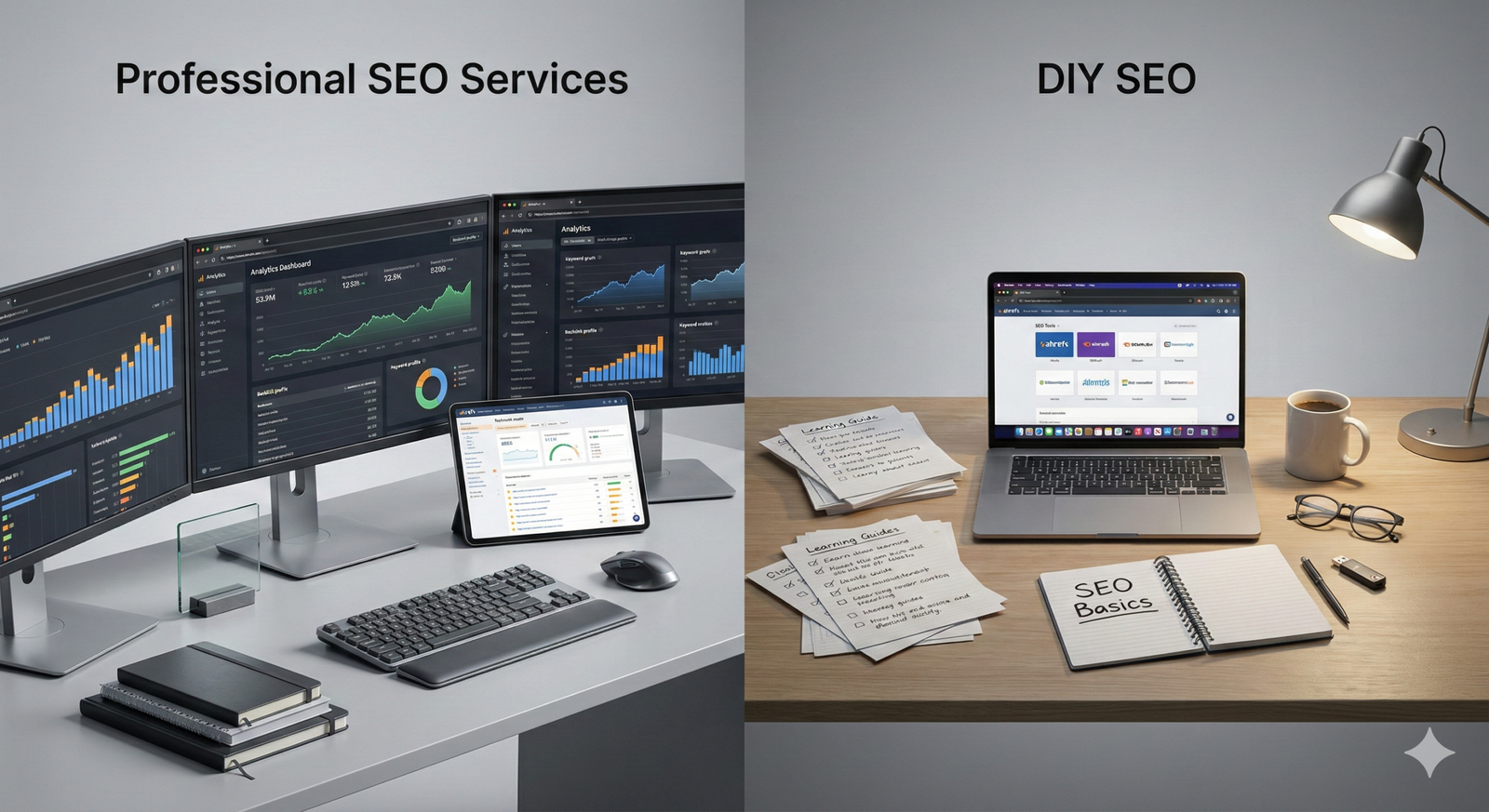
What Are SEO Services?
SEO services encompass professional optimization work performed by agencies, consultants, or specialized firms to improve your website’s search engine rankings. These services cover the full spectrum of search optimization, from technical audits and content strategy to link building and performance tracking.
Professional SEO providers bring dedicated teams with specialized skills across different optimization disciplines. A typical agency employs technical SEO specialists, content strategists, link builders, and analytics experts working together on your account.
What Professional SEO Agencies Deliver
Full-service SEO agencies provide comprehensive optimization packages that address every ranking factor. Their deliverables typically include technical site audits identifying crawlability issues, indexation problems, and Core Web Vitals improvements.
Content services range from keyword research and content gap analysis to full article production optimized for search intent. According to Ahrefs’ 2024 content study, pages targeting specific search intent rank 68% higher than generic content.
Link building remains a core agency offering. Professional outreach teams secure backlinks from relevant, authoritative domains through relationship-based strategies that would take in-house teams years to develop.
Monthly reporting packages track keyword movements, traffic changes, and conversion improvements. Quality agencies provide actionable insights, not just data dumps.
Types of SEO Service Providers
The SEO service market includes several provider categories, each suited to different business needs.
Full-service agencies handle every aspect of SEO under one roof. They work best for businesses wanting comprehensive management without coordinating multiple vendors. Retainers typically range from $3,000 to $15,000 monthly depending on scope and competition level.
Specialized consultants focus on specific SEO disciplines like technical optimization or link acquisition. They charge $150 to $500 hourly and work best when you need targeted expertise rather than full management.
Freelance SEO professionals offer budget-friendly options for smaller projects. Quality varies significantly, so vetting becomes critical. Rates range from $50 to $200 hourly based on experience and specialization.
White label SEO providers serve agencies needing fulfillment partners. They deliver work under your brand, allowing you to offer SEO services without building internal teams.
What Is DIY SEO?
DIY SEO means handling search engine optimization internally using your own team, tools, and resources. This approach puts you in direct control of strategy, execution, and timeline without external dependencies.
The DIY path requires learning SEO fundamentals, investing in optimization tools, and dedicating consistent time to implementation. Success depends on your ability to stay current with algorithm changes and industry best practices.
Core Components of DIY SEO
Effective DIY SEO requires mastery across several interconnected disciplines.
Technical SEO forms your foundation. This includes ensuring proper site architecture, fixing crawl errors in Google Search Console, optimizing page speed, implementing structured data, and maintaining mobile usability. Technical issues block ranking potential regardless of content quality.
On-page optimization covers keyword targeting, title tags, meta descriptions, header structure, and internal linking. Each page needs strategic optimization aligned with specific search queries your audience uses.
Content creation demands understanding search intent and producing comprehensive resources that satisfy user needs better than competing pages. HubSpot’s 2024 marketing report found that businesses publishing 16+ blog posts monthly generate 3.5x more traffic than those publishing four or fewer.
Link building remains the most challenging DIY component. Earning quality backlinks requires outreach skills, relationship building, and content worth linking to. Most DIY practitioners struggle here.
Analytics and iteration close the loop. Tracking performance in Google Analytics and Search Console reveals what works, enabling continuous improvement.
Tools Required for DIY SEO
DIY SEO requires investment in professional tools to compete effectively.
Keyword research platforms like Semrush, Ahrefs, or Moz provide search volume data, keyword difficulty scores, and competitor analysis. Annual subscriptions run $1,200 to $2,400 for professional-tier access.
Technical audit tools identify site issues automatically. Screaming Frog, Sitebulb, and built-in features within major SEO platforms handle crawling and error detection.
Rank tracking software monitors keyword positions over time. Accurate tracking requires daily updates across multiple search locations.
Content optimization tools like Clearscope, Surfer SEO, or MarketMuse analyze top-ranking content and provide optimization recommendations. These add $100 to $500 monthly to your tool stack.
Google’s free tools remain essential regardless of paid subscriptions. Search Console, Analytics, PageSpeed Insights, and the Mobile-Friendly Test provide data directly from Google.
SEO Services vs DIY SEO: Key Differences
Understanding the fundamental differences between these approaches helps clarify which fits your situation.
Cost Comparison
SEO services require predictable monthly investment. Quality agencies charge $2,500 to $10,000 monthly for small to mid-sized businesses. Enterprise-level campaigns run $15,000 to $50,000+ monthly. These costs include strategy, execution, tools, and reporting.
DIY SEO shifts costs from services to tools and time. Tool subscriptions total $3,000 to $6,000 annually for a competitive stack. However, the real cost is labor. If your time is worth $100 hourly and SEO requires 20 hours weekly, that represents $8,000 monthly in opportunity cost.
The cost calculation changes based on your existing team. If you have marketing staff with available bandwidth, DIY becomes more economical. If SEO would pull you from revenue-generating activities, services often deliver better ROI.
Time Investment
Professional SEO services minimize your time involvement. Expect 2-4 hours monthly for strategy calls, content approvals, and performance reviews. Agencies handle execution independently.
DIY SEO demands substantial ongoing commitment. Effective optimization requires 15-25 hours weekly for research, content creation, technical fixes, link building, and analysis. This time investment continues indefinitely since SEO is never “done.”
According to BrightEdge research, organic search drives 53% of all website traffic. Underinvesting in either approach means leaving significant traffic potential unrealized.
Expertise and Learning Curve
SEO agencies bring immediate expertise. Their teams have handled hundreds of campaigns across industries, learning what works through direct experience. They stay current with algorithm updates, attend industry conferences, and test new strategies continuously.
DIY SEO requires building expertise from scratch. The learning curve spans 6-12 months before reaching competency. Algorithm updates, technical complexities, and evolving best practices demand ongoing education. What worked last year may hurt rankings today.
The expertise gap shows most clearly in technical SEO and link building. These disciplines require specialized knowledge that takes years to develop fully.
Results Timeline
Professional services typically show measurable improvements within 3-6 months. Agencies know which levers to pull first for fastest impact. Their experience helps avoid common mistakes that delay results.
DIY SEO often takes 6-12 months to show significant movement. Learning while implementing slows progress. Mistakes require identification and correction, adding time to the timeline.
Both approaches require patience. SEO is inherently a long-term strategy. Anyone promising immediate results is either misleading you or using tactics that risk penalties.
When to Choose Professional SEO Services
Certain business situations clearly favor hiring professional help.
You Need Faster Results
Competitive markets demand speed. If competitors already dominate search results, catching up requires aggressive, expert-level optimization. Agencies compress timelines by deploying proven strategies immediately rather than learning through trial and error.
Businesses launching new products, entering new markets, or recovering from traffic drops benefit from professional urgency. The cost of delayed rankings often exceeds service fees.
Your Team Lacks SEO Expertise
SEO requires specialized knowledge that general marketers rarely possess. Technical optimization, link building strategy, and algorithm interpretation demand dedicated study and experience.
Hiring an agency provides instant access to specialists across every SEO discipline. You gain a full team’s expertise without recruiting, training, or managing individual hires.
You Have Budget but Limited Time
Business owners and marketing leaders often have budget flexibility but severe time constraints. Every hour spent learning SEO is an hour not spent on core business activities.
Services make sense when your hourly value exceeds what you’d pay for equivalent professional work. A founder billing $300 hourly shouldn’t spend time on tasks an agency handles for $150 hourly equivalent.
You Operate in a Competitive Industry
Highly competitive verticals like finance, legal, healthcare, and SaaS require sophisticated SEO strategies. Competitors invest heavily in optimization, raising the bar for everyone.
Agencies serving competitive industries understand the specific tactics required. They know which link sources matter, what content depth ranks, and how to differentiate in crowded markets.
You Need Accountability and Reporting
Professional services include structured reporting and accountability. Monthly reviews track progress against goals, identify issues early, and adjust strategies based on data.
This accountability structure helps businesses stay focused on SEO outcomes rather than getting lost in tactical details. Clear metrics show whether investment generates returns.
When to Choose DIY SEO
DIY SEO makes sense under specific circumstances where internal execution provides advantages.
You Have Limited Budget
Early-stage businesses and bootstrapped startups often lack budget for professional services. DIY SEO allows progress despite financial constraints.
The key is realistic expectations. Limited budget means slower progress and more personal time investment. But some SEO progress beats no SEO progress.
Tool costs remain necessary even for DIY. Budget $200-500 monthly minimum for essential subscriptions. Free tools alone won’t provide competitive intelligence needed for effective optimization.
You Have Marketing Team Capacity
Companies with existing marketing teams can distribute SEO responsibilities across staff. Content writers handle optimization, developers address technical issues, and marketing managers oversee strategy.
This approach works when team members have bandwidth and interest in learning SEO. Forcing SEO onto overloaded staff produces poor results.
Training investment pays dividends over time. Team members who develop SEO skills add permanent value to your organization.
You Want Full Control Over Strategy
Some businesses prefer direct control over every marketing decision. DIY SEO provides complete visibility into tactics, priorities, and execution.
This control matters most for brands with strict guidelines, sensitive industries, or unique positioning requirements. You never worry about an agency misrepresenting your brand or using questionable tactics.
Your Industry Has Low Competition
Local businesses, niche markets, and emerging industries often face minimal SEO competition. Basic optimization can achieve strong rankings without sophisticated strategies.
In low-competition environments, DIY SEO delivers excellent ROI. Simple technical fixes, local optimization, and consistent content creation may be all you need.
Research your specific keywords before assuming low competition. Some seemingly niche terms have surprisingly competitive landscapes.
You’re Building Long-Term Internal Capability
Companies planning to scale marketing teams benefit from building SEO expertise internally. Starting with DIY creates foundational knowledge that informs future hiring and agency management.
Even businesses that eventually hire agencies benefit from internal SEO understanding. You’ll evaluate proposals more effectively, ask better questions, and hold providers accountable.
How to Evaluate Your SEO Needs
Making the right choice requires honest assessment of your specific situation.
Assess Your Current Resources
Time availability: Calculate realistic hours your team can dedicate to SEO weekly. Include research, content creation, technical work, and link building. If the total falls below 15 hours weekly, DIY will produce minimal results.
Existing expertise: Rate your team’s current SEO knowledge honestly. Can they conduct technical audits? Do they understand search intent? Have they built links successfully before? Gaps in any area slow progress significantly.
Tool access: Inventory your current marketing tools. Do you have keyword research capabilities? Rank tracking? Technical crawling? Missing tools require budget allocation.
Define Your Goals and Timeline
Traffic targets: Quantify the organic traffic increase you need. Doubling traffic requires different effort than 20% improvement.
Timeline expectations: When do you need results? Aggressive timelines favor professional services. Patient growth allows DIY development.
Revenue connection: Calculate how organic traffic converts to revenue. This determines appropriate investment levels for either approach.
Analyze Your Competitive Landscape
Competitor investment: Research what competitors spend on SEO. Check their content volume, backlink profiles, and technical sophistication. Matching or exceeding their investment is necessary to compete.
Keyword difficulty: Analyze difficulty scores for your target keywords. High-difficulty terms require more resources regardless of approach.
Market dynamics: Consider whether your market is growing, stable, or contracting. Growing markets offer more opportunity for new entrants.
Consider Hybrid Approaches
Many businesses find success combining professional services with internal efforts.
Agency strategy plus internal execution: Hire consultants for strategy development while your team handles implementation. This provides expert direction at lower cost than full-service management.
Specialized outsourcing: Keep content and technical SEO internal while outsourcing link building. Link acquisition is often the hardest component to execute effectively in-house.
Phased transition: Start with agency services to build momentum, then gradually bring capabilities internal as your team develops expertise.
Making Your Final Decision
The right choice depends on weighing multiple factors against your specific situation.
Decision Framework
Choose SEO services if:
- You need results within 6 months
- Your team lacks SEO expertise
- You operate in a competitive industry
- Your time is worth more than service costs
- You want accountability and structured reporting
Choose DIY SEO if:
- Budget constraints prevent service investment
- You have team capacity and interest
- Your industry has low competition
- You want complete strategic control
- You’re building long-term internal capability
Questions to Ask Potential Providers
If leaning toward services, vet agencies thoroughly:
- What specific results have you achieved for similar businesses?
- How do you approach link building?
- What does your reporting include?
- Who will work on my account directly?
- How do you stay current with algorithm changes?
- What happens if results don’t meet projections?
Red Flags to Avoid
Watch for warning signs in either approach:
Agency red flags: Guaranteed rankings, unusually low prices, vague strategies, no case studies, reluctance to explain tactics.
DIY red flags: Underestimating time requirements, skipping technical foundations, focusing only on content, ignoring link building, expecting immediate results.
Conclusion
Choosing between SEO services and DIY SEO requires balancing your budget, time availability, expertise level, and growth timeline. Neither approach is universally superior. The right choice aligns with your specific resources and goals.
Professional services accelerate results and provide expertise but require ongoing investment. DIY SEO preserves budget and builds internal capability but demands significant time and accepts slower progress. Many successful businesses combine both approaches strategically.
White Label SEO Service helps businesses navigate this decision and implement the right strategy for sustainable organic growth. Contact our team to discuss which approach fits your situation and how we can support your search visibility goals.
Frequently Asked Questions
How much do professional SEO services typically cost?
Professional SEO services range from $2,500 to $10,000 monthly for small to mid-sized businesses. Enterprise campaigns run $15,000 to $50,000+ monthly. Costs vary based on competition level, scope of work, and agency expertise.
How long does it take to see results from SEO?
Professional services typically show measurable improvements within 3-6 months. DIY SEO often takes 6-12 months due to the learning curve. Both approaches require patience since SEO is inherently a long-term strategy.
Can I start with DIY SEO and switch to services later?
Yes, many businesses start with DIY to learn fundamentals, then hire agencies when budget allows or growth demands acceleration. Internal SEO knowledge actually helps you evaluate and manage agencies more effectively.
What tools do I need for DIY SEO?
Essential tools include keyword research platforms like Semrush or Ahrefs, Google Search Console, Google Analytics, and technical crawling software. Budget $3,000 to $6,000 annually for a competitive tool stack.
Is DIY SEO effective for local businesses?
DIY SEO works particularly well for local businesses facing limited competition. Basic technical optimization, Google Business Profile management, and consistent local content often achieve strong results without professional help.
How do I know if an SEO agency is legitimate?
Legitimate agencies provide case studies with verifiable results, explain their strategies clearly, avoid ranking guarantees, and offer transparent reporting. Ask for references and check reviews before committing.
Should I hire an agency or a freelance SEO consultant?
Agencies provide comprehensive teams covering all SEO disciplines. Freelancers offer specialized expertise at lower cost but limited scope. Choose agencies for full management and freelancers for specific projects or consulting.